

- Market Size (2026)
- USD 62 Mn
- Forecast (2036)
- USD 162.3 Mn
- CAGR (2026 to 2036)
- 10.1%
Single-Use Bioreactor Bag Integrity and Leak Test Equipment Market Size, Market Forecast and Outlook by FMI
The single-use bioreactor bag integrity and leak test equipment market is projected to grow from USD 62 million in 2026 to USD 162.3 million by 2036 at a 10.1% CAGR. The market stood at USD 56.3 million in 2025, and the forecast implies an incremental opportunity of USD 100.3 million over the assessment period. Demand is growing as larger disposable bag formats become more common in biologics production, pushing suppliers and manufacturers towards repeatable leak-testing methods that support stronger release records and reduce uncertainty before use.
Summary of Single-Use Bioreactor Bag Integrity and Leak Test Equipment Market
- The market is forecast to reach USD 162.3 million by 2036.
- The market is expected to expand at a 10.1% CAGR from 2026 to 2036.
- Market value is estimated at USD 62 million in 2026, up from USD 56.3 million in 2025.
- The forecast period represents an incremental opportunity of USD 100.3 million.
- Pressure decay testing is expected to account for 36% share in 2026 as users prefer practical, repeatable daily testing.
- Supplier QA is projected to hold 34% share in 2026 because defect screening begins before shipment.
- Bag makers are forecast to account for 37% share in 2026 as release responsibility remains concentrated upstream.
- 3D bags hold 41.0% of the bag format segment in 2026, reflecting greater leak-testing need in larger and more complex bag assemblies.
- 201-1000 L accounts for 33.0% of the capacity range segment, supported by its commercial relevance across many biologics operations.
- Semi-automatic systems represent 38.0% of the automation segment, balancing repeatability, record quality, and manageable equipment complexity.
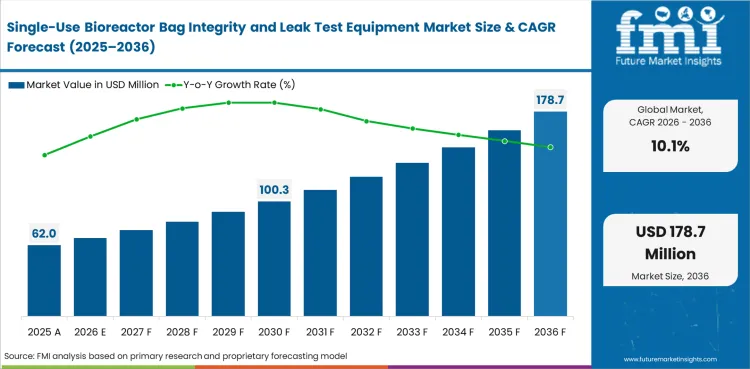
Key Takeaways, Market Size, and Forecast
- Single-Use Bioreactor Bag Integrity and Leak Test Equipment Market is projected to climb from USD 62 million in 2026 to USD 162.3 million by 2036, reflecting a CAGR of 10.1%.
- The single-use bioreactor bag integrity and leak test equipment market was valued at USD 56.3 million in 2025.
- By 2036, the Single-Use Bioreactor Bag Integrity and Leak Test Equipment Market is expected to be worth USD 162.3 million.
- From 2026 through 2036, the market is forecast to expand at a CAGR of 10.1%.
- The market is projected to create an incremental opportunity of USD 100.3 million over the forecast horizon.
- In 2026, Pressure decay testing is expected to account for 36.0% of the test method segment.
- India (11.6%) and China (10.8%) are two of the fastest growing markets.
Single-Use Bioreactor Bag Integrity and Leak Test Equipment Market Key Takeaways
| Parameter | Details |
|---|---|
| Market value (2026) | USD 62 million |
| Forecast value (2036) | USD 162.3 million |
| CAGR (2026 to 2036) | 10.1% |
| Estimated market value (2025) | USD 56.3 million |
| Incremental opportunity | USD 100.3 million |
| Leading technology | Pressure decay testing (36% of technology segment) |
| Leading application | Supplier QA (34% of application segment) |
| Leading end use | Bag makers (37% of end-user segment) |
| Key players | Sartorius AG, ZELTWANGER Leaktesting & Automation GmbH, Cincinnati Test Systems, Pfeiffer Vacuum+Fab Solutions, Bonfiglioli Engineering |
Source: Future Market Insights, 2026.
Visual inspection is becoming less dependable in this market. Larger flexible bags, higher batch value, and tighter quality review are increasing demand for test systems that deliver stable readings and usable records. Adoption improves when bag suppliers and biologics manufacturers define clear leakage limits by bag type, because testing fits more naturally into release, incoming inspection, and validation workflows.
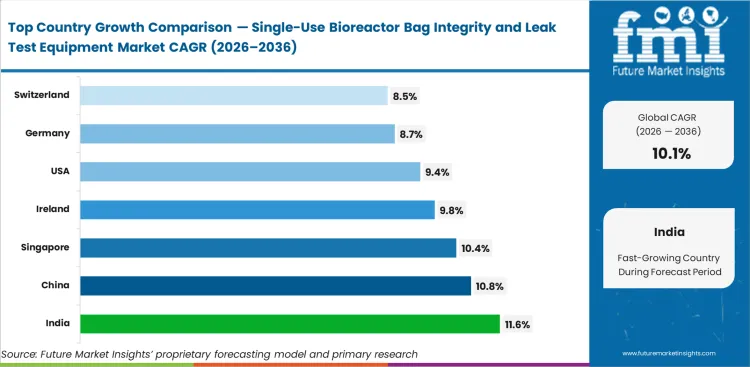
Across tracked countries, India is expected to grow at 11.6% CAGR through 2036, followed by China at 10.8%, Singapore at 10.4%, Ireland at 9.8%, United States at 9.4%, Germany at 8.7%, and Switzerland at 8.5%. Faster growth in India and China reflects new biologics capacity and rising single-use installation activity, while Singapore and Ireland remain strong because dense biomanufacturing clusters place greater operational value on bag reliability and documented integrity checks.
Single-Use Bioreactor Bag Integrity and Leak Test Equipment Market Definition
The single-use bioreactor bag integrity and leak test equipment market includes systems that detect leaks, verify seal quality, and confirm whether disposable bioreactor bags are suitable for sterile bioprocess use. Scope is restricted to test equipment, related fixtures, software, and associated testing functions rather than the bag assemblies themselves. This keeps the category separate from the broader single-use bioreactors market.
Single-Use Bioreactor Bag Integrity and Leak Test Equipment Market Inclusions
Scope includes pressure decay, helium-based, vacuum decay, tracer gas, force decay, and related integrity test systems used for single-use bioreactor bags, mixing bags, liners, and other flexible assemblies in upstream sterile processing. Bench units, semi-automatic stations, automated cells, fixtures, software, and validation-related accessories are included when they serve this application. Coverage also extends to equipment used for supplier release, incoming inspection, point-of-use verification, and related checks linked to bioprocess containers and fluid transfer solutions.
Single-Use Bioreactor Bag Integrity and Leak Test Equipment Market Exclusions
Revenue from single-use bags, single-use bioreactors, fluid-path consumables, and general sterile-transfer assemblies is excluded unless it is tied directly to test hardware sales. Generic package inspection systems for vials, syringes, blister packs, and broad pharma CCIT platforms are excluded when they are not designed for flexible bioprocess bags.
Single-Use Bioreactor Bag Integrity and Leak Test Equipment Market Research Methodology
- Primary Research: Interviews were conducted with single-use bag manufacturing heads, biologics plant quality managers, validation leads, and CDMO operations heads.
- Desk Research: Review covered public company filings, official guidance on sterile package integrity, association material on single-use assurance, technical papers on leak-test methods, and product literature for flexible-bag testing.
- Market Sizing and Forecasting: Baseline estimates were built from installed single-use bag use in biologics processing, testing needs across supplier and end-user workflows, and equipment use across bag manufacturing and site assurance activity.
- Data Validation and Update Cycle: Forecasts were cross-checked against public revenue exposure in bioprocess hardware, single-use system adoption patterns, and current guidance influencing leak-test method selection.
Why is the Single-Use Bioreactor Bag Integrity and Leak Test Equipment Market Growing?
- Pressure decay testing accounts for 36% of test method demand in 2026, as users need simple, repeatable leak checks for daily release work.
- Supplier QA holds 34% of deployment demand, because defect screening starts before shipment and helps reduce disputes at customer sites.
- Asia Pacific expansion is changing market demand, with India and China adding biologics capacity and increasing the need for bag integrity testing equipment.
Demand is rising because disposable process assemblies are becoming more important in upstream biologics manufacturing, especially in mixing, holding, and reactor-linked applications. As larger 3D bags move deeper into commercial workflows, a leak creates more than a minor quality issue. It can interrupt batch preparation, delay line clearance, create deviation work, and complicate release review. This increases the value of equipment that deliver repeatable results under routine operating conditions, particularly in facilities expanding their use of upstream bioprocessing equipment.
Supplier-side testing is adding further support to market growth. Bag manufacturers need dependable defect screening before assemblies reach customer facilities, since weak release controls can create post-shipment disputes and increase incoming inspection burden. This is increasing adoption of pressure decay and other methods that fit practical release work without excessive setup difficulty. Many facilities are also moving from manual routines toward semi-automatic systems because they improve workflow control, reduce operator dependence, and generate records that are easier to review within broader bioprocess validation frameworks.
Segmental Analysis
- Pressure decay testing holds 36% of the test method segment in 2026, while Supplier QA captures 34% of deployment demand, as suppliers need repeatable leak checks before shipment.
- 3D bags account for 41% of the bag format segment in 2026, while 201-1000 L holds 33% of capacity range demand, reflecting strong use in core biologics operations.
- Semi-automatic systems represent 38% of the automation segment in 2026, while Bag makers lead end-user demand at 37%, as release responsibility remains concentrated upstream.
The single-use bioreactor bag integrity and leak test equipment market is segmented by Test Method, Deployment, Bag Format, Capacity Range, Automation, End User, and Region. By Test Method, the market is divided into Pressure Decay, Helium Vacuum, Vacuum Decay, Tracer Gas, and Force Decay. In terms of Deployment, the market is classified into Supplier QA, Point-of-Use, At-Line, In-Line, and Lab Testing. Based on Bag Format, the market is segmented into 3D Bags, 2D Bags, Bioreactor Liners, Mixing Bags, and Storage Bags. By Capacity Range, the market is divided into Up to 50 L, 51-200 L, 201-1000 L, 1001-2000 L, and Above 2000 L. In terms of Automation, the market is classified into Manual, Semi-Automatic, Automatic, and Robotic systems. Based on End User, the market is segmented into Bag Makers, Biopharma, CDMOs, and QC Labs.
Insights into the Pressure Decay Test Method Segment
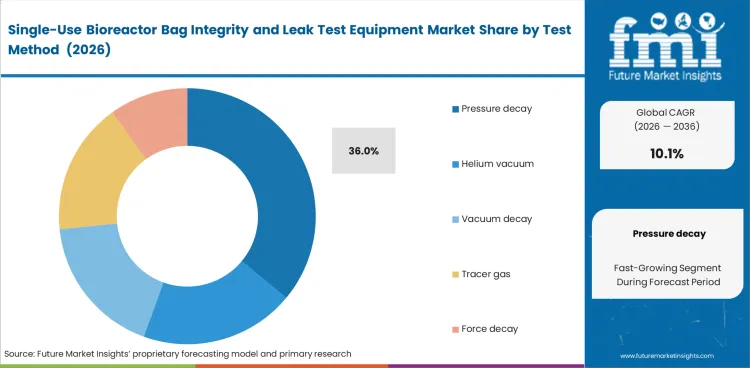
Pressure decay leads this segment because it offers a practical balance between repeatability, cycle time, and setup burden. In 2026, this segment is projected to account for 36% share. Helium-based and vacuum-based methods remain relevant in more demanding applications, though many bag manufacturers and biologics facilities prefer methods that integrate more easily into routine testing. In flexible films, stable and reviewable output often matters more than technical claims that are harder to apply consistently in day-to-day release work.
Insights into the Supplier QA Deployment Segment
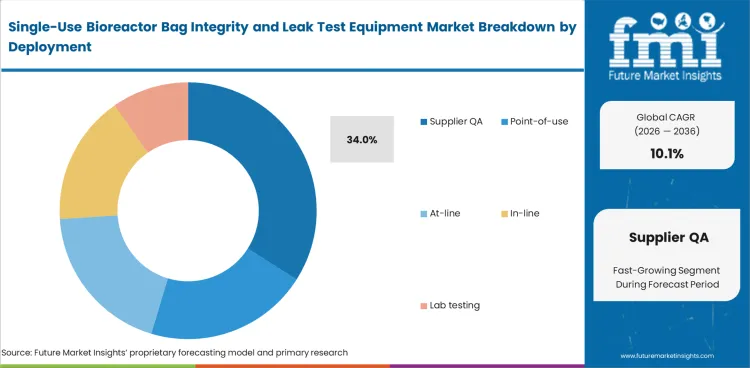
Supplier QA remains the leading deployment segment because defect checks begin before a bag is sterilized, packed, and shipped to the biologics site. The segment is expected to account for 34% share in 2026. Bag manufacturers rely on dedicated testing stations to identify manufacturing defects early, reduce downstream disputes, and support stronger release documentation. Point-of-use testing remains relevant in higher-risk workflows, but strong supplier-side assurance reduces the need for repeat checks later in the chain.
Insights into the 3D Bags Format Segment
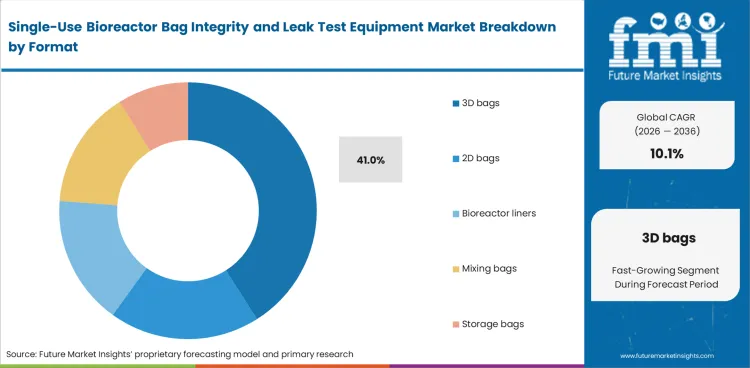
Bag geometry affects equipment performance directly, which keeps format as a central selection factor in this market. Larger flexible assemblies do not behave like flat pouches, and 3D bags create added testing difficulty because chamber fit, trapped volume, film movement, and handling variation can all influence the reading. 3D bags are projected to account for 41% share in 2026. Their wide use in mixing, holding, and reactor-linked applications keeps testing demand concentrated around this format.
Insights into the 201-1000 L Capacity Range Segment
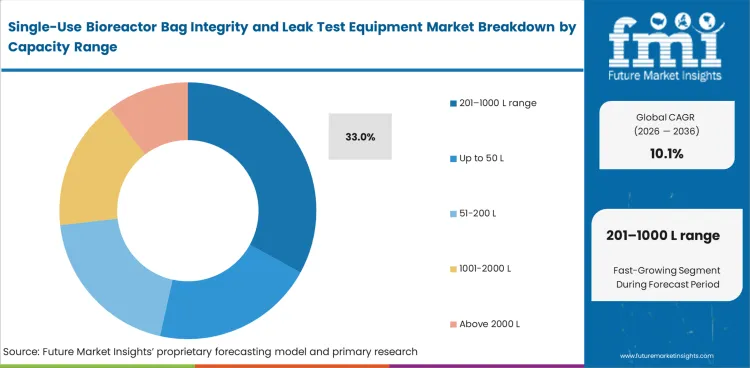
The 201-1000 L range sits near the center of many biologics operations, which keeps it important in this market. Users in this range balance higher bag value with manageable throughput and fixture complexity, which supports a projected 33% share in 2026. Smaller formats are easier to handle, though they do not always justify the same level of dedicated testing. Very large systems often require more specialized fixtures and method adjustments. This operating balance is similar to adoption patterns seen in portable bioprocessing bioreactors, where flexibility and practical scale fit remain important.
Insights into the Semi-Automatic Systems Segment
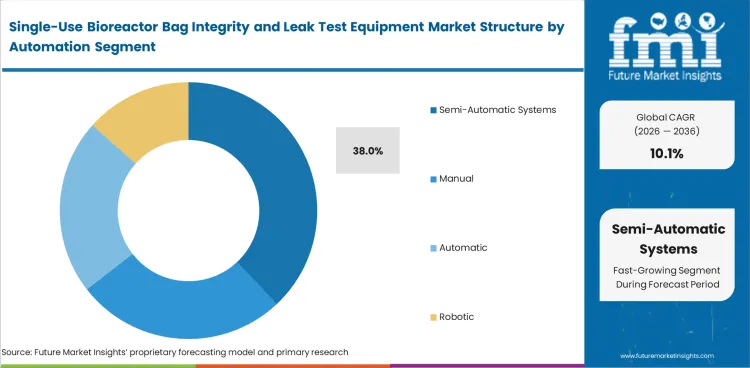
Semi-automatic systems are expected to account for 38% share in 2026 because they offer a practical middle ground between manual testing and full automation. Manual routines are still used, but repeatability, data quality, and operator dependence become harder to control as bag volumes rise. Semi-automatic platforms improve workflow discipline and electronic record capture without adding the higher cost, engineering support, and changeover burden often associated with fully automated systems. This preference is becoming more visible in facilities investing in adjacent quality tools, including single-use bioprocess sensor calibration and validation test systems.
Insights into the Bag Makers End-User Segment
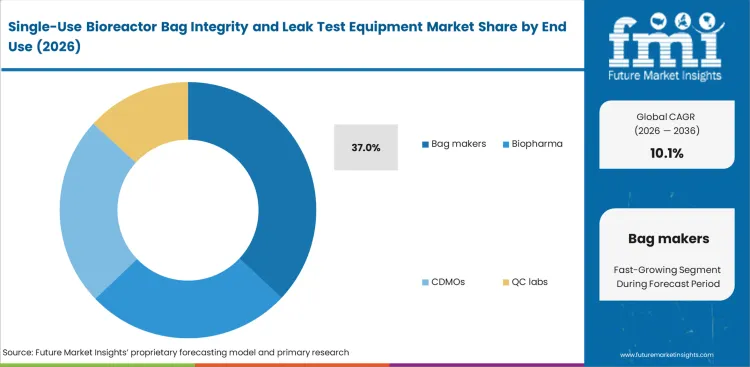
Bag makers remain the largest end-user group because defect screening begins before assemblies move into customer operations. The segment is projected to hold 37% share in 2026. Weak release testing at the supplier level can lead to shipment disputes, added incoming checks, and more review work once bags enter biologics sites. Biopharma companies and CDMOs represent notable demand as well, especially where internal quality rules require incoming verification. But supplier-side testing remains dominant because it addresses uncertainty earlier and with greater efficiency.
What are the Drivers, Restraints, and Key Trends of the Single-Use Bioreactor Bag Integrity and Leak Test Equipment Market?
- Wider use of single-use bioreactor bags in biologics manufacturing is increasing the need for reliable integrity checks before bags enter production.
- Larger bag sizes, higher batch value, and tighter quality review are making visual inspection less dependable on its own.
- Supplier QA teams and biopharma facilities are moving toward repeatable test methods that create cleaner records and reduce defect-related review burden.
The single-use bioreactor bag integrity and leak test equipment market is expanding steadily with wider use of disposable process assemblies, growing dependence on larger 3D bag formats, and stronger demand for repeatable leak testing across supplier release and biologics site workflows. Equipment selection is moving beyond defect detection toward systems that support cleaner records, easier validation, and more dependable release decisions. Method transfer across bag families and setup variability in flexible assemblies still create challenges, though growth opportunities remain strong as suppliers and end users formalize bag assurance beyond visual checks.
Larger Bag Sizes and Higher Batch Value Are Raising Testing Needs
Demand is supported by broader use of single-use bags across mixing, holding, and reactor-linked biologics operations, where a leak can disrupt preparation work, delay release, and trigger added review. The commercial effect becomes more serious as bag size increases because defect-related replacement, investigation, and handling carry greater process consequences. This increases the value of equipment that can deliver repeatable readings under daily operating conditions rather than only under controlled technical demonstrations.
Method Transfer Across Flexible Bag Families Remains a Practical Restraint
Market growth remains constrained because flexible bag systems do not behave uniformly during testing. Chamber fit, trapped volume, film movement, connector placement, and handling setup can all influence result stability, which makes it harder to apply one method consistently across different bag formats. This increases validation effort and slows broader standardization, especially for users trying to scale test routines across multiple assemblies without adding review complexity.
Analysis of Single-Use Bioreactor Bag Integrity and Leak Test Equipment Market By Key Countries
- Asia Pacific is moving faster than other regions as new biologics capacity adds more single-use installations and tighter bag-assurance needs.
- India leads tracked countries at 11.6% CAGR, supported by new biomanufacturing setups and wider single-use adoption.
- China follows at 10.8% CAGR, backed by broader biologics investment and stronger local manufacturing depth.
- The United States at 9.4% and Germany at 8.7% benefit from established biologics operations and steady upgrade-led demand.
.webp "Top Country Growth Comparison Single Use Bioreactor Bag Integrity And Leak Test Equipment Market Cagr (2026 2036)")
| Country | CAGR (2026 to 2036) |
|---|---|
| India | 11.6% |
| China | 10.8% |
| Singapore | 10.4% |
| Ireland | 9.8% |
| United States | 9.4% |
| Germany | 8.7% |
| Switzerland | 8.5% |
Source: Future Market Insights, 2026.
Demand Outlook for Single-Use Bioreactor Bag Integrity and Leak Test Equipment Market in the United States
The United States is anticipated to grow at a CAGR of 9.4% through 2036, supported by a broad installed base of disposable process systems, strong commercial biologics production, and rising need for repeatable bag-release and incoming-check routines. Manufacturers in the country place greater value on equipment that can produce stable output and review-ready records without disrupting existing site procedures.
- Broad single-use adoption keeps bag-release and incoming-check routines commercially important across biologics manufacturing sites.
- Commercial biologics activity supports steady demand for repeatable testing that reduces review uncertainty.
- Manufacturers prefer systems that fit existing quality workflows without adding unnecessary handling complexity.
Future Outlook for Single-Use Bioreactor Bag Integrity and Leak Test Equipment Market in Ireland
Ireland is expected to rise at a CAGR of 9.8% from 2026 to 2036, with demand supported by concentrated biologics activity, export-oriented sterile processing, and stronger operational focus on bag reliability. Compact and well-documented testing systems are gaining interest because they fit busy production environments where dependable release work carries direct commercial importance.
- Concentrated biologics activity keeps bag assurance important in day-to-day plant operations and release work.
- Sterile export operations support demand for dependable integrity checks before bags move into use.
- Compact systems with strong documentation fit better in busy, validation-conscious production environments.
Opportunity Analysis of Single-Use Bioreactor Bag Integrity and Leak Test Equipment Market in Germany
Germany is projected to grow at a CAGR of 8.7% by 2036 as disciplined biologics production, structured quality practices, and careful upgrade cycles sustain demand for integrity testing systems. Equipment decisions in the country are usually linked to method fit, software quality, and manageable validation effort rather than first-time adoption. This favors suppliers that support stable performance under existing site controls.
- Upgrade cycles shape much of demand as sites refine existing integrity-check routines rather than add first-time systems.
- Method stability remains a core buying filter because validation effort is closely reviewed before adoption.
- Software quality and service support influence supplier selection where dependable performance matters most.
In-depth Analysis of Single-Use Bioreactor Bag Integrity and Leak Test Equipment Market in Switzerland
Switzerland is expected to grow at a CAGR of 8.5% through 2036, reflecting the country has high-value biopharma base and a disciplined quality environment. Adoption stays measured because many facilities operate under careful capital review. Integrity testing remains important where specialized assemblies and dependable output take priority over broader-volume release capacity.
- High-value biopharma operations keep bag integrity testing relevant across specialized and quality-sensitive workflows.
- Careful capital review slows broader expansion, even when assurance needs remain well established.
- Dependable output matters more where specialized assemblies require stable and review-ready test performance.
Sales Analysis of Single-Use Bioreactor Bag Integrity and Leak Test Equipment Market in China
China is projected to expand at a CAGR of 10.8% through 2036. Broader biologics investment, stronger local manufacturing depth, and wider use of single-use hardware across production sites support this growth. Plants are moving toward more formal integrity assurance routines as higher bag volumes make manual-only checks less reliable in daily operations.
- Biologics investment is expanding disposable system use and raising the need for formal testing routines.
- Local manufacturing depth supports wider adoption of equipment suited to routine flexible-bag assurance.
- Formal integrity programs are replacing manual-only checks as bag volumes rise across production sites.
In-depth Analysis of Single-Use Bioreactor Bag Integrity and Leak Test Equipment Market in India
India is likely to record a CAGR of 11.6% by 2036, supported by new biomanufacturing setups, wider single-use adoption, and stronger quality-system buildout across expanding facilities. Manufacturers prefers equipment that is easier to validate, works across multiple bag types, and fits semi-automatic workflows without adding excessive cost or review burden.
- New facilities are lifting testing demand as single-use systems become more common in biologics operations.
- Multi-bag usability improves equipment appeal where sites are scaling quickly across different workflows.
- Semi-automatic systems fit expansion-stage needs by improving control without adding heavy automation cost.
Sales Analysis of Single-Use Bioreactor Bag Integrity and Leak Test Equipment Market in Singapore
Singapore is set to witness at a CAGR of 10.4% through 2036, supported by dense high-value biomanufacturing activity and strong site discipline. Manufacturers prefer repeatable systems with efficient record handling because space, speed, and review efficiency carry more importance in compact facilities that run high-value production with limited tolerance for process disruption.
- Dense biomanufacturing activity supports strong per-site demand for dependable and repeatable bag testing.
- Record handling matters more in compact facilities where speed and review efficiency shape daily operations.
- Repeatable systems help reduce review delay in high-output environments with limited space for disruption.
Competitive Landscape of Single-Use Bioreactor Bag Integrity and Leak Test Equipment Market
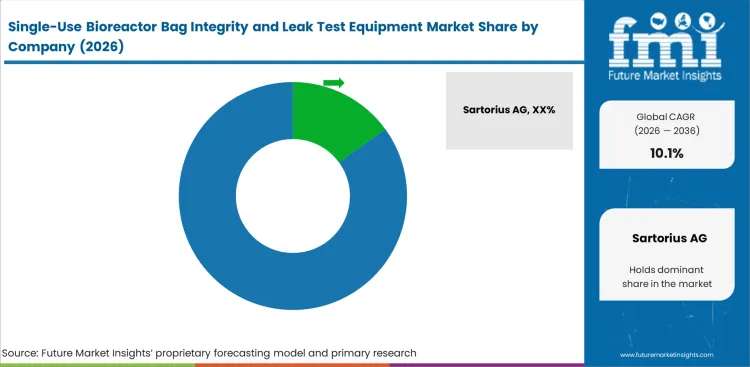
- Sartorius AG and ZELTWANGER Leaktesting & Automation compete through stronger application fit, repeatable output, and better alignment with flexible bioprocess bag testing needs.
- The competitive landscape is moderately specialized, with suppliers differentiated less by general leak-test capability and more by fixture control, software traceability, and validation support for flexible bag assemblies.
- Cleanroom compatibility, chamber design, and service support represent important competitive differentiators for vendors serving bag makers, biopharma sites, and CDMOs with formal bag-assurance workflows.
The single-use bioreactor bag integrity and leak test equipment market includes suppliers that combine leak-testing expertise with a practical understanding of flexible bioprocess bag behavior. Sartorius AG remains well positioned because of its close connection to single-use process environments, while ZELTWANGER Leaktesting & Automation, Cincinnati Test Systems, and Pfeiffer Vacuum+Fab Solutions compete through chamber design, controlled leak-detection capability, and support for repeatable test performance.
Bonfiglioli Engineering maintains relevance through its experience in inspection and validation-oriented testing environments. LACO Technologies and InterTech Development Company continue to serve specialized requirements where manufacturers need narrower bag-format support, targeted service, or simpler software handling. Manufacturers in this market place more weight on stable output during real bag handling, practical fixture adaptability, and review-ready records than on generic inspection claims.
Barriers to entry are moderate at the hardware level, though they rise when suppliers must prove method stability across multiple bag families, support validation-heavy workflows, and provide record traceability that fits formal release and incoming inspection routines. Vendors that reduce uncertainty during supplier QA and point-of-use assurance are better placed to strengthen their competitive position.
Major Industry Players
Key global companies leading the single-use bioreactor bag integrity and leak test equipment market include:
- Sartorius AG (Germany), ZELTWANGER Leaktesting & Automation GmbH (Germany), Cincinnati Test Systems (USA), and Pfeiffer Vacuum+Fab Solutions were identified as some of the leading participants in the single-use bioreactor bag integrity and leak test equipment market, given their stronger leak-testing capability, broader application relevance, and better fit with repeatable bag-assurance workflows.
- Bonfiglioli Engineering (Italy), LACO Technologies (USA), and InterTech Development Company (USA) have established competitive relevance by serving controlled leak-testing requirements where chamber design, software handling, and support for specialized flexible assemblies influence supplier selection.
- Smaller and specialized participants continue to find space in this market where niche bag geometries, lighter validation requirements, or more targeted service needs create openings beyond the larger, better-established leak-testing platforms.
Competitive Benchmarking: Single-Use Bioreactor Bag Integrity and Leak Test Equipment Market
| Company | Bioprocess Bag Fit | Validation Support | Software / Traceability | Flexible-Bag Test Capability |
|---|---|---|---|---|
| Sartorius AG | High | High | Strong | High |
| ZELTWANGER Leaktesting & Automation GmbH | Medium | Medium | Strong | High |
| Cincinnati Test Systems | Medium | Medium | Moderate | High |
| Pfeiffer Vacuum+Fab Solutions | Medium | Medium | Moderate | High |
| Bonfiglioli Engineering | Medium | High | Moderate | Medium |
| LACO Technologies | Medium | Medium | Moderate | Medium |
| InterTech Development Company | Medium | Medium | Moderate | Medium |
Source: Future Market Insights competitive analysis, 2026.
Key Developments in Single-Use Bioreactor Bag Integrity and Leak Test Equipment Market
- In June 2025, Sartorius completed its Aubagne capacity expansion, adding 9,000 m² of clean rooms to support demand for single-use solutions, which strengthens the broader bag supply base tied to integrity-assurance workflows.
- In April 2025, Cincinnati Test Systems introduced the Sentinel IX5, a fifth-generation leak test platform supporting multiple methods including pressure, flow, and vacuum leak testing, improving flexibility for users seeking more precise and efficient validation-oriented leak testing.
Key Players in the Single-Use Bioreactor Bag Integrity and Leak Test Equipment Market
Major Global Players
- Sartorius AG
- ZELTWANGER Leaktesting & Automation GmbH
- Cincinnati Test Systems
- Pfeiffer Vacuum+Fab Solutions
- Bonfiglioli Engineering
Emerging Players / Specialized Challengers
- LACO Technologies
- InterTech Development Company
Scope of the Report
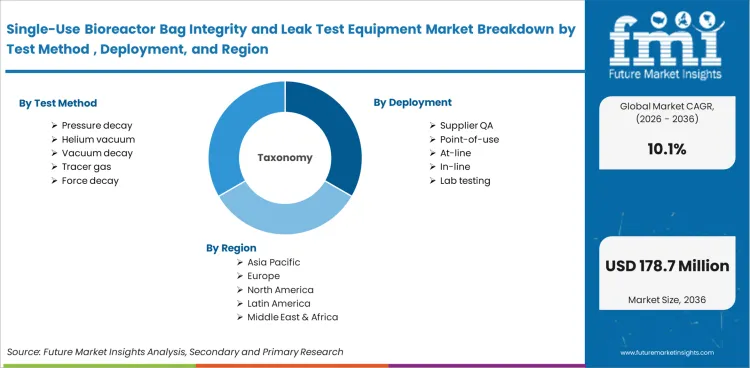
| Metric | Value |
|---|---|
| Quantitative Units | USD 56.3 million (2025) / USD 62.0 million (2026) to USD 162.3 million (2036), at a CAGR of 10.1% |
| Market Definition | The single-use bioreactor bag integrity and leak test equipment market includes systems that detect leaks, verify seal quality, and confirm whether disposable bioreactor bags are suitable for sterile bioprocess use. Scope is restricted to test equipment, related fixtures, software, and associated testing functions rather than the bag assemblies themselves. |
| Segmentation |
|
| Regions Covered | North America, Europe, Asia Pacific |
| Countries Covered | United States, Germany, Ireland, Switzerland, China, India, Singapore, and 40 plus countries |
| Key Companies Profiled | Sartorius AG, ZELTWANGER Leaktesting & Automation GmbH, Cincinnati Test Systems, Pfeiffer Vacuum+Fab Solutions, Bonfiglioli Engineering, LACO Technologies, InterTech Development Company |
| Forecast Period | 2026 to 2036 |
| Approach | FMI combined primary interviews with bag makers, validation leads, and biologics site quality teams with desk review of public filings, guidance, association material, and method papers |
Source: Future Market Insights, 2026.
Single-Use Bioreactor Bag Integrity and Leak Test Equipment Market Segments Analysis
Test Method
- Pressure decay
- Helium vacuum
- Vacuum decay
- Tracer gas
- Force decay
Deployment
- Supplier QA
- Point-of-use
- At-line
- In-line
- Lab testing
Bag Format
- 3D bags
- 2D bags
- Bioreactor liners
- Mixing bags
- Storage bags
Capacity Range
- Up to 50 L
- 51-200 L
- 201-1000 L
- 1001-2000 L
- Above 2000 L
Automation
- Manual
- Semi-automatic
- Automatic
- Robotic
End User
- Bag makers
- Biopharma
- CDMOs
- QC labs
Region
- North America
- United States
- Europe
- Germany
- Ireland
- Switzerland
- Asia Pacific
- China
- India
- Singapore
Bibliography
- Sartorius AG. (2025, June 17). Sartorius expands manufacturing and R&D capacities for innovative bioprocess solutions in France.
- Cincinnati Test Systems. (2025, April 22). Sentinel IX5 Q&A: Your common questions answered.
- USA Food and Drug Administration. (2024, July 24). Container Closure System and Component Changes: Glass Vials and Stoppers.
- Bio-Process Systems Alliance. (2024, October 23). BPSA Releases Frequently Asked Questions about Single-Use Systems (SUS) for Integrity Assurance.
- BioPhorum. (2024, October 30). Pre-use post sterilization integrity testing (PUPSIT) practice, a post Annex 1 implementation survey of industry practice.
This bibliography is provided for reader reference. The full FMI report contains the complete reference list with primary source documentation.
This Report Addresses
- Market sizing and forecast for bioreactor bag integrity test equipment.
- Segment analysis across methods, deployment, formats, automation, and end users.
- Country outlook across key biomanufacturing countries and major regional clusters.
- Competitive review covering leading equipment suppliers and their market position.
- Use-case analysis for supplier release and point-of-use bag verification workflows.
- Assessment of 3D bags and mid-volume systems in biologics processing operations.
- Quality, validation, and data-record needs shaping equipment selection across sites.
- Scope, exclusions, methodology, and forecast logic used in the assessment.
Frequently Asked Questions
How large is the single-use bioreactor bag integrity and leak test equipment market in 2026?
The market is projected to be anticipated at USD 62 million in 2026.
What will the market be worth by 2036?
FMI estimates the market will reach USD 162.3 million by 2036.
What CAGR is expected between 2026 and 2036?
The market is forecast to expand at a 10.1% CAGR during the period.
Which test method leads the market?
Pressure decay leads because it offers repeatable results and fits routine release workflows.
Which deployment setting remains dominant?
Supplier QA remains dominant because defect screening begins before shipment.
Which bag format leads adoption?
3D bags lead because larger flexible assemblies need more dependable integrity checks.
Preview the report firsthand - request a free sample
Get SampleGet the brochure for pricing and purchase details.
Get PDFTable of Content
- Executive Summary
- Global Market Outlook
- Demand-side Trends
- Supply-side Trends
- Technology Roadmap Analysis
- Analysis and Recommendations
- Market Overview
- Market Coverage / Taxonomy
- Market Definition / Scope / Limitations
- Research Methodology
- Chapter Orientation
- Analytical Lens and Working Hypotheses
- Market Structure, Signals, and Trend Drivers
- Benchmarking and Cross-market Comparability
- Market Sizing, Forecasting, and Opportunity Mapping
- Research Design and Evidence Framework
- Desk Research Programme (Secondary Evidence)
- Company Annual and Sustainability Reports
- Peer-reviewed Journals and Academic Literature
- Corporate Websites, Product Literature, and Technical Notes
- Earnings Decks and Investor Briefings
- Statutory Filings and Regulatory Disclosures
- Technical White Papers and Standards Notes
- Trade Journals, Industry Magazines, and Analyst Briefs
- Conference Proceedings, Webinars, and Seminar Materials
- Government Statistics Portals and Public Data Releases
- Press Releases and Reputable Media Coverage
- Specialist Newsletters and Curated Briefings
- Sector Databases and Reference Repositories
- FMI Internal Proprietary Databases and Historical Market Datasets
- Subscription Datasets and Paid Sources
- Social Channels, Communities, and Digital Listening Inputs
- Additional Desk Sources
- Expert Input and Fieldwork (Primary Evidence)
- Primary Modes
- Qualitative Interviews and Expert Elicitation
- Quantitative Surveys and Structured Data Capture
- Blended Approach
- Why Primary Evidence is Used
- Field Techniques
- Interviews
- Surveys
- Focus Groups
- Observational and In-context Research
- Social and Community Interactions
- Stakeholder Universe Engaged
- C-suite Leaders
- Board Members
- Presidents and Vice Presidents
- R&D and Innovation Heads
- Technical Specialists
- Domain Subject-matter Experts
- Scientists
- Physicians and Other Healthcare Professionals
- Governance, Ethics, and Data Stewardship
- Research Ethics
- Data Integrity and Handling
- Primary Modes
- Tooling, Models, and Reference Databases
- Desk Research Programme (Secondary Evidence)
- Data Engineering and Model Build
- Data Acquisition and Ingestion
- Cleaning, Normalisation, and Verification
- Synthesis, Triangulation, and Analysis
- Quality Assurance and Audit Trail
- Market Background
- Market Dynamics
- Drivers
- Restraints
- Opportunity
- Trends
- Scenario Forecast
- Demand in Optimistic Scenario
- Demand in Likely Scenario
- Demand in Conservative Scenario
- Opportunity Map Analysis
- Product Life Cycle Analysis
- Supply Chain Analysis
- Investment Feasibility Matrix
- Value Chain Analysis
- PESTLE and Porter’s Analysis
- Regulatory Landscape
- Regional Parent Market Outlook
- Production and Consumption Statistics
- Import and Export Statistics
- Market Dynamics
- Global Market Analysis 2021 to 2025 and Forecast, 2026 to 2036
- Historical Market Size Value (USD Million) Analysis, 2021 to 2025
- Current and Future Market Size Value (USD Million) Projections, 2026 to 2036
- Y-o-Y Growth Trend Analysis
- Absolute $ Opportunity Analysis
- Global Market Pricing Analysis 2021 to 2025 and Forecast 2026 to 2036
- Global Market Analysis 2021 to 2025 and Forecast 2026 to 2036, By Test Method
- Introduction / Key Findings
- Historical Market Size Value (USD Million) Analysis By Test Method , 2021 to 2025
- Current and Future Market Size Value (USD Million) Analysis and Forecast By Test Method , 2026 to 2036
- Pressure decay
- Helium vacuum
- Vacuum decay
- Tracer gas
- Force decay
- Pressure decay
- Y-o-Y Growth Trend Analysis By Test Method , 2021 to 2025
- Absolute $ Opportunity Analysis By Test Method , 2026 to 2036
- Global Market Analysis 2021 to 2025 and Forecast 2026 to 2036, By Deployment
- Introduction / Key Findings
- Historical Market Size Value (USD Million) Analysis By Deployment, 2021 to 2025
- Current and Future Market Size Value (USD Million) Analysis and Forecast By Deployment, 2026 to 2036
- Supplier QA
- Point-of-use
- At-line
- In-line
- Lab testing
- Supplier QA
- Y-o-Y Growth Trend Analysis By Deployment, 2021 to 2025
- Absolute $ Opportunity Analysis By Deployment, 2026 to 2036
- Global Market Analysis 2021 to 2025 and Forecast 2026 to 2036, By Format
- Introduction / Key Findings
- Historical Market Size Value (USD Million) Analysis By Format, 2021 to 2025
- Current and Future Market Size Value (USD Million) Analysis and Forecast By Format, 2026 to 2036
- 3D bags
- 2D bags
- Bioreactor liners
- Mixing bags
- Storage bags
- 3D bags
- Y-o-Y Growth Trend Analysis By Format, 2021 to 2025
- Absolute $ Opportunity Analysis By Format, 2026 to 2036
- Global Market Analysis 2021 to 2025 and Forecast 2026 to 2036, By Capacity Range
- Introduction / Key Findings
- Historical Market Size Value (USD Million) Analysis By Capacity Range, 2021 to 2025
- Current and Future Market Size Value (USD Million) Analysis and Forecast By Capacity Range, 2026 to 2036
- 201–1000 L range
- Up to 50 L
- 51-200 L
- 1001-2000 L
- Above 2000 L
- 201–1000 L range
- Y-o-Y Growth Trend Analysis By Capacity Range, 2021 to 2025
- Absolute $ Opportunity Analysis By Capacity Range, 2026 to 2036
- Global Market Analysis 2021 to 2025 and Forecast 2026 to 2036, By Automation
- Introduction / Key Findings
- Historical Market Size Value (USD Million) Analysis By Automation, 2021 to 2025
- Current and Future Market Size Value (USD Million) Analysis and Forecast By Automation, 2026 to 2036
- Semi-Automatic Systems
- Manual
- Automatic
- Robotic
- Semi-Automatic Systems
- Y-o-Y Growth Trend Analysis By Automation, 2021 to 2025
- Absolute $ Opportunity Analysis By Automation, 2026 to 2036
- Global Market Analysis 2021 to 2025 and Forecast 2026 to 2036, By End Use
- Introduction / Key Findings
- Historical Market Size Value (USD Million) Analysis By End Use, 2021 to 2025
- Current and Future Market Size Value (USD Million) Analysis and Forecast By End Use, 2026 to 2036
- Bag makers
- Biopharma
- CDMOs
- QC labs
- Bag makers
- Y-o-Y Growth Trend Analysis By End Use, 2021 to 2025
- Absolute $ Opportunity Analysis By End Use, 2026 to 2036
- Global Market Analysis 2021 to 2025 and Forecast 2026 to 2036, By Region
- Introduction
- Historical Market Size Value (USD Million) Analysis By Region, 2021 to 2025
- Current Market Size Value (USD Million) Analysis and Forecast By Region, 2026 to 2036
- North America
- Latin America
- Western Europe
- Eastern Europe
- East Asia
- South Asia and Pacific
- Middle East & Africa
- Market Attractiveness Analysis By Region
- North America Market Analysis 2021 to 2025 and Forecast 2026 to 2036, By Country
- Historical Market Size Value (USD Million) Trend Analysis By Market Taxonomy, 2021 to 2025
- Market Size Value (USD Million) Forecast By Market Taxonomy, 2026 to 2036
- By Country
- USA
- Canada
- Mexico
- By Test Method
- By Deployment
- By Format
- By Capacity Range
- By Automation
- By End Use
- By Country
- Market Attractiveness Analysis
- By Country
- By Test Method
- By Deployment
- By Format
- By Capacity Range
- By Automation
- By End Use
- Key Takeaways
- Latin America Market Analysis 2021 to 2025 and Forecast 2026 to 2036, By Country
- Historical Market Size Value (USD Million) Trend Analysis By Market Taxonomy, 2021 to 2025
- Market Size Value (USD Million) Forecast By Market Taxonomy, 2026 to 2036
- By Country
- Brazil
- Chile
- Rest of Latin America
- By Test Method
- By Deployment
- By Format
- By Capacity Range
- By Automation
- By End Use
- By Country
- Market Attractiveness Analysis
- By Country
- By Test Method
- By Deployment
- By Format
- By Capacity Range
- By Automation
- By End Use
- Key Takeaways
- Western Europe Market Analysis 2021 to 2025 and Forecast 2026 to 2036, By Country
- Historical Market Size Value (USD Million) Trend Analysis By Market Taxonomy, 2021 to 2025
- Market Size Value (USD Million) Forecast By Market Taxonomy, 2026 to 2036
- By Country
- Germany
- UK
- Italy
- Spain
- France
- Nordic
- BENELUX
- Rest of Western Europe
- By Test Method
- By Deployment
- By Format
- By Capacity Range
- By Automation
- By End Use
- By Country
- Market Attractiveness Analysis
- By Country
- By Test Method
- By Deployment
- By Format
- By Capacity Range
- By Automation
- By End Use
- Key Takeaways
- Eastern Europe Market Analysis 2021 to 2025 and Forecast 2026 to 2036, By Country
- Historical Market Size Value (USD Million) Trend Analysis By Market Taxonomy, 2021 to 2025
- Market Size Value (USD Million) Forecast By Market Taxonomy, 2026 to 2036
- By Country
- Russia
- Poland
- Hungary
- Balkan & Baltic
- Rest of Eastern Europe
- By Test Method
- By Deployment
- By Format
- By Capacity Range
- By Automation
- By End Use
- By Country
- Market Attractiveness Analysis
- By Country
- By Test Method
- By Deployment
- By Format
- By Capacity Range
- By Automation
- By End Use
- Key Takeaways
- East Asia Market Analysis 2021 to 2025 and Forecast 2026 to 2036, By Country
- Historical Market Size Value (USD Million) Trend Analysis By Market Taxonomy, 2021 to 2025
- Market Size Value (USD Million) Forecast By Market Taxonomy, 2026 to 2036
- By Country
- China
- Japan
- South Korea
- By Test Method
- By Deployment
- By Format
- By Capacity Range
- By Automation
- By End Use
- By Country
- Market Attractiveness Analysis
- By Country
- By Test Method
- By Deployment
- By Format
- By Capacity Range
- By Automation
- By End Use
- Key Takeaways
- South Asia and Pacific Market Analysis 2021 to 2025 and Forecast 2026 to 2036, By Country
- Historical Market Size Value (USD Million) Trend Analysis By Market Taxonomy, 2021 to 2025
- Market Size Value (USD Million) Forecast By Market Taxonomy, 2026 to 2036
- By Country
- India
- ASEAN
- Australia & New Zealand
- Rest of South Asia and Pacific
- By Test Method
- By Deployment
- By Format
- By Capacity Range
- By Automation
- By End Use
- By Country
- Market Attractiveness Analysis
- By Country
- By Test Method
- By Deployment
- By Format
- By Capacity Range
- By Automation
- By End Use
- Key Takeaways
- Middle East & Africa Market Analysis 2021 to 2025 and Forecast 2026 to 2036, By Country
- Historical Market Size Value (USD Million) Trend Analysis By Market Taxonomy, 2021 to 2025
- Market Size Value (USD Million) Forecast By Market Taxonomy, 2026 to 2036
- By Country
- Kingdom of Saudi Arabia
- Other GCC Countries
- Turkiye
- South Africa
- Other African Union
- Rest of Middle East & Africa
- By Test Method
- By Deployment
- By Format
- By Capacity Range
- By Automation
- By End Use
- By Country
- Market Attractiveness Analysis
- By Country
- By Test Method
- By Deployment
- By Format
- By Capacity Range
- By Automation
- By End Use
- Key Takeaways
- Key Countries Market Analysis
- USA
- Pricing Analysis
- Market Share Analysis, 2025
- By Test Method
- By Deployment
- By Format
- By Capacity Range
- By Automation
- By End Use
- Canada
- Pricing Analysis
- Market Share Analysis, 2025
- By Test Method
- By Deployment
- By Format
- By Capacity Range
- By Automation
- By End Use
- Mexico
- Pricing Analysis
- Market Share Analysis, 2025
- By Test Method
- By Deployment
- By Format
- By Capacity Range
- By Automation
- By End Use
- Brazil
- Pricing Analysis
- Market Share Analysis, 2025
- By Test Method
- By Deployment
- By Format
- By Capacity Range
- By Automation
- By End Use
- Chile
- Pricing Analysis
- Market Share Analysis, 2025
- By Test Method
- By Deployment
- By Format
- By Capacity Range
- By Automation
- By End Use
- Germany
- Pricing Analysis
- Market Share Analysis, 2025
- By Test Method
- By Deployment
- By Format
- By Capacity Range
- By Automation
- By End Use
- UK
- Pricing Analysis
- Market Share Analysis, 2025
- By Test Method
- By Deployment
- By Format
- By Capacity Range
- By Automation
- By End Use
- Italy
- Pricing Analysis
- Market Share Analysis, 2025
- By Test Method
- By Deployment
- By Format
- By Capacity Range
- By Automation
- By End Use
- Spain
- Pricing Analysis
- Market Share Analysis, 2025
- By Test Method
- By Deployment
- By Format
- By Capacity Range
- By Automation
- By End Use
- France
- Pricing Analysis
- Market Share Analysis, 2025
- By Test Method
- By Deployment
- By Format
- By Capacity Range
- By Automation
- By End Use
- India
- Pricing Analysis
- Market Share Analysis, 2025
- By Test Method
- By Deployment
- By Format
- By Capacity Range
- By Automation
- By End Use
- ASEAN
- Pricing Analysis
- Market Share Analysis, 2025
- By Test Method
- By Deployment
- By Format
- By Capacity Range
- By Automation
- By End Use
- Australia & New Zealand
- Pricing Analysis
- Market Share Analysis, 2025
- By Test Method
- By Deployment
- By Format
- By Capacity Range
- By Automation
- By End Use
- China
- Pricing Analysis
- Market Share Analysis, 2025
- By Test Method
- By Deployment
- By Format
- By Capacity Range
- By Automation
- By End Use
- Japan
- Pricing Analysis
- Market Share Analysis, 2025
- By Test Method
- By Deployment
- By Format
- By Capacity Range
- By Automation
- By End Use
- South Korea
- Pricing Analysis
- Market Share Analysis, 2025
- By Test Method
- By Deployment
- By Format
- By Capacity Range
- By Automation
- By End Use
- Russia
- Pricing Analysis
- Market Share Analysis, 2025
- By Test Method
- By Deployment
- By Format
- By Capacity Range
- By Automation
- By End Use
- Poland
- Pricing Analysis
- Market Share Analysis, 2025
- By Test Method
- By Deployment
- By Format
- By Capacity Range
- By Automation
- By End Use
- Hungary
- Pricing Analysis
- Market Share Analysis, 2025
- By Test Method
- By Deployment
- By Format
- By Capacity Range
- By Automation
- By End Use
- Kingdom of Saudi Arabia
- Pricing Analysis
- Market Share Analysis, 2025
- By Test Method
- By Deployment
- By Format
- By Capacity Range
- By Automation
- By End Use
- Turkiye
- Pricing Analysis
- Market Share Analysis, 2025
- By Test Method
- By Deployment
- By Format
- By Capacity Range
- By Automation
- By End Use
- South Africa
- Pricing Analysis
- Market Share Analysis, 2025
- By Test Method
- By Deployment
- By Format
- By Capacity Range
- By Automation
- By End Use
- USA
- Market Structure Analysis
- Competition Dashboard
- Competition Benchmarking
- Market Share Analysis of Top Players
- By Regional
- By Test Method
- By Deployment
- By Format
- By Capacity Range
- By Automation
- By End Use
- Competition Analysis
- Competition Deep Dive
- Sartorius AG
- Overview
- Product Portfolio
- Profitability by Market Segments (Product/Age /Sales Channel/Region)
- Sales Footprint
- Strategy Overview
- Marketing Strategy
- Product Strategy
- Channel Strategy
- ZELTWANGER Leaktesting & Automation GmbH
- Cincinnati Test Systems
- Pfeiffer Vacuum+Fab Solutions
- Bonfiglioli Engineering
- Sartorius AG
- Competition Deep Dive
- Assumptions & Acronyms Used


