

- Industry Size (2026)
- USD 290.0 Mn
- Forecast (2036)
- USD 850.0 Mn
- CAGR (2026 to 2036)
- 11.40%
Continuous Methane Monitoring and Leak Detection Test Equipment Market Size, Market Forecast and Outlook By FMI
The continuous methane monitoring and leak detection test equipment market crossed a valuation of USD 260.0 million in 2025 and is projected to reach USD 290.0 million in 2026. FMI estimates the market will expand at a CAGR of 11.40% from 2026 to 2036, taking total revenue to USD 850.0 million by the end of the forecast period. Growth is being shaped less by discretionary monitoring budgets and more by regulatory enforcement that is pushing operators toward permanent measurement infrastructure. As environmental agencies move beyond periodic inspection models, continuous methane monitoring equipment is becoming part of the compliance base rather than an optional field upgrade.
Operators are facing stronger pressure to move away from voluntary sampling programs and adopt continuous systems built around validated methane quantification equipment. Periodic field checks no longer capture the timing, recurrence, or commercial impact of intermittent release events, particularly across large and widely distributed assets. Acquisition teams evaluating gas sensors are giving more weight to measurement reliability, calibration stability, and data defensibility because quarterly manual surveys leave gaps that can develop into unresolved compliance risk. FMI analysts also note that early users of methane super-emitter detection equipment are using verified low-emission performance to improve their commercial standing with European natural gas buyers, who are applying closer scrutiny to upstream emissions intensity.
Report Summary of Continuous Methane Monitoring and Leak Detection Test Equipment Market
- Market Snapshot
- Continuous methane monitoring and leak detection test equipment market is estimated at USD 290.0 million in 2026 and is projected to reach USD 850.0 million by 2036.
- Sales are anticipated to rise at a 11.40% CAGR during 2026 to 2036.
- Market valuation stood at USD 260.0 million in 2025, showing the early commercial base ahead of the forecast period.
- Demand is being shaped by the move from periodic leak inspection toward permanent methane measurement infrastructure.
- Demand and Growth Drivers
- Regulatory enforcement is pushing operators to install continuous systems instead of relying on voluntary sampling programs.
- Periodic field checks do not capture intermittent release events across large and distributed assets.
- Procurement teams are giving stronger weight to measurement reliability, calibration stability, and data defensibility.
- Approved alternative test method pathways are reducing compliance uncertainty and supporting capital approval for automated systems.
- Spending is moving away from repeated manual inspection activity toward hardware, analytics, and continuous reporting infrastructure.
- Product and Segment View
- Point sensors are expected to lead the technology segment with 41.0% share in 2026.
- Fixed networks are projected to lead deployment with 48.0% share in 2026 as operators reduce monitoring gaps between inspections.
- Production pads are anticipated to account for 37.0% share in 2026 due to high asset density and persistent leak exposure.
- Upstream is likely to hold 52.0% share in 2026, reflecting the strongest scrutiny on fugitive methane releases.
- Hardware is estimated to capture 56.0% share in 2026 because continuous coverage requires a large installed base of sensors and related field components.
- Market scope covers automated networks and associated analytics that continuously detect, locate, and quantify methane emissions across oil and gas facilities.
- Geography and Competitive Outlook
- The United States is projected to record the fastest growth at 13.2% CAGR through 2036.
- Canada is expected to expand at 12.6%, while Germany and the Netherlands are likely to post 11.8% and 11.5%, respectively.
- China, the United Arab Emirates, and Saudi Arabia are anticipated to register CAGRs of 10.9%, 10.7%, and 10.3%, respectively.
- Key market participants include Teledyne FLIR, SLB, Qube Technologies, Project Canary, LongPath Technologies, and Sensirion Connected Solutions.
- Competitive positioning is being shaped by regulatory approvals, analytics capability, and continuous quantification performance.
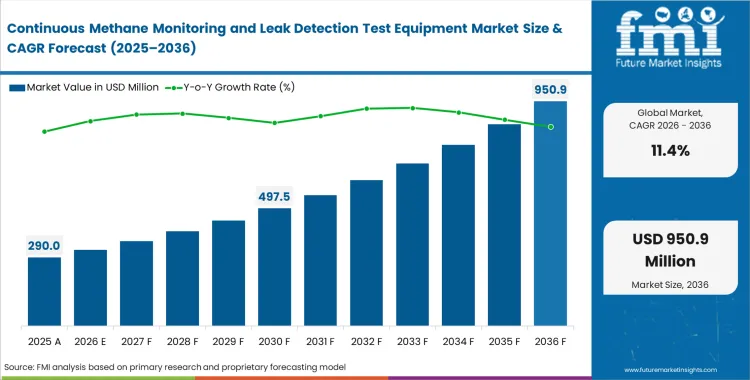
Recognition of alternative test method pathways is also changing the pace at which automated systems move from pilot projects into routine field use. Once regulators accept an approved monitoring pathway, buyers face less uncertainty around compliance treatment and audit readiness, making capital approval easier to justify. Certified algorithmic global gas leak detectors and other automated detection platforms are reducing dependence on labor-intensive inspection cycles, while permanent fixed methane monitoring systems are pushing site operations toward condition-based maintenance and faster response. Spending priorities are shifting accordingly, with less budget going to repeated manual inspection activity and more directed toward durable hardware, analytics, and continuous reporting infrastructure.
The United States is projected to expand at a CAGR of 13.2% through 2036 as federal waste-prevention rules push operators to install continuous monitoring hardware across production sites. Canada is expected to grow at 12.6%, supported by provincial requirements for verifiable baseline measurement and stronger methane accountability. Germany and the Netherlands are likely to record CAGRs of 11.8% and 11.5%, respectively, as EU methane rules tighten site-level detection and reconciliation standards. China is anticipated to advance at 10.9%, reflecting broader monitoring adoption across large energy assets, while the United Arab Emirates and Saudi Arabia are set to post 10.7% and 10.3%, supported by infrastructure upgrades led by national oil companies.
Segmental Analysis
Continuous Methane Monitoring and Leak Detection Test Equipment Market Analysis by Technology
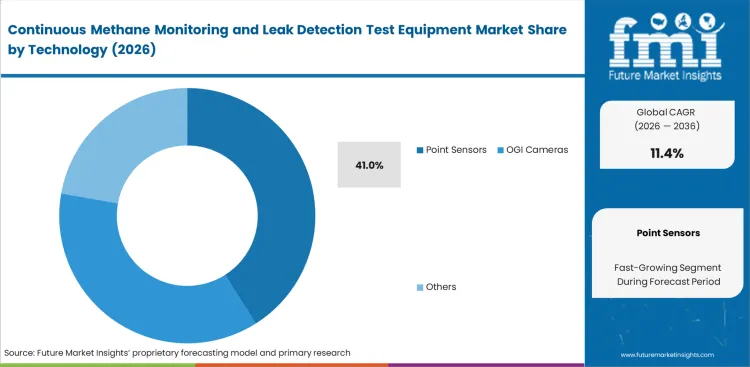
Quarterly manual camera inspections leave long gaps during which intermittent equipment faults can go unnoticed. Facilities managers increasingly use automated continuous emission monitoring systems to cover dense tank batteries where open-path lasers struggle with line-of-sight barriers. Point sensors are expected to account for 41.0% share in 2026 because they provide continuous concentration tracking directly at likely emission points. Engineering teams comparing point sensors with methane lidar often find that overlapping sensor grids offset individual drift over longer deployment periods. FMI’s analysis indicates that operators favor point sensor arrays because modular layouts can be expanded step by step as site footprints change. Many compliance teams also rely on these systems alongside an advanced methane leak localization system to identify the exact release point and accelerate repair dispatch. Sites without dedicated maintenance support often run into operational strain when large sensor networks must be kept within tight regulatory accuracy limits.
- Drift degradation: Chemical sensing elements gradually lose calibration accuracy after prolonged exposure to volatile organic compounds. Maintenance teams must perform recurring bump tests to confirm sensor integrity, which adds labor pressure at remote production locations and weakens part of the automation benefit.
- Interference vulnerability: Localized sensors can generate false alarms when non-methane hydrocarbons pass across the sensing element during routine operations. Control room staff then must check operating logs manually to confirm whether a real leak exists, increasing the risk of alert fatigue where filtering algorithms are weak.
- Deployment optimization: Continuous protection depends on careful placement based on site wind behavior and equipment density. Engineering teams typically run detailed CFD assessments before installation so critical leak pathways intersect the sensor grid with acceptable consistency.
Continuous Methane Monitoring and Leak Detection Test Equipment Market Analysis by Deployment
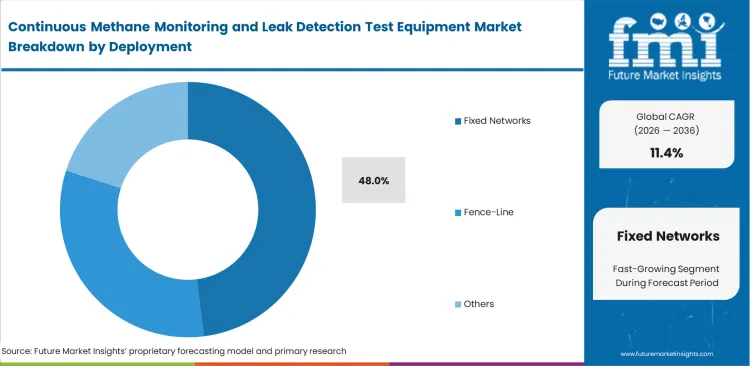
Upstream environmental teams are weighing the higher capital commitment of permanent systems against the recurring field labor tied to mobile survey programs. Asset managers reviewing fixed monitoring against periodic LDAR increasingly want pipeline monitoring systems in place so compliance moves from periodic checking to continuous oversight. Fixed networks are forecast to command 48.0% share in 2026 as tighter super-emitter rules reduce tolerance for measurement gaps between inspections. FMI estimates that permanent installations reshape day-to-day coordination between field staff and compliance teams because reporting flows become automated rather than manually assembled. Safety personnel also depend on fixed pipeline integrity nodes for immediate alerts during major equipment failures. Fixed networks are often misunderstood as tools mainly for locating large leaks, while their broader value lies in measuring routine venting accurately enough to establish site-level emissions baselines that regulators will accept. Operators trying to rely on mobile units instead of fixed coverage often struggle to meet the stricter standards attached to continuous monitoring frameworks.
- Capital allocation: Permanent installations require heavy upfront spending on hardware, mounting systems, and hazardous-area infrastructure. Finance teams justify that cost by comparing it with the long-term removal of contracted manual survey work over the expected operating life of the equipment.
- Maintenance overhead: Fixed sensors running continuously in harsh field conditions require structured preventive maintenance. Operating costs often rise faster than expected because power systems, solar components, and supporting electronics can fail well before the methane sensing element itself needs replacement.
- Lifecycle valuation: Continuous monitoring can produce savings that periodic surveys fail to reveal. A single super-emitter event identified weeks earlier than a manual inspection cycle can be enough to offset much of the network installation cost.
Continuous Methane Monitoring and Leak Detection Test Equipment Market Analysis by Site Type
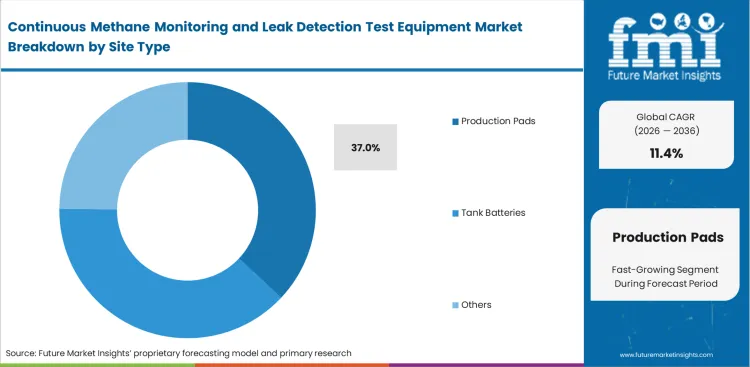
Installing automated detection hardware changes how operators prioritize field maintenance and dispatch repair crews. Production pads remain a major focus because they combine high asset counts with persistent leak exposure across dispersed operations. In 2026, production pads are expected to contribute 37.0% of total market share. Field teams emphasize tank battery methane monitoring across these pipeline safety assets because unmonitored storage and handling points can create a large cumulative liability under newer emissions fee structures. FMI observes that self-contained environmental monitoring units at remote pads shift maintenance behavior away from fixed inspection rounds and toward intervention based on actual leak severity. Localized alerts also help technicians arrive with the right seals and parts instead of spending time on exploration visual checks. One practical consequence is that more sensitive continuous systems often reveal weaknesses in older pneumatic controllers, forcing operators into separate upgrade spending that was not part of the original monitoring budget. Companies that fail to build reliable pad-level quantification remain exposed to regulatory emissions estimates that can overstate their actual tax burden.
- Initial trigger: Approaching compliance deadlines push operators to establish field baselines across distributed assets before regulators impose default emission assumptions. Pilot programs usually begin on high-producing pads where teams can compare sensor performance under actual wind and weather conditions.
- Validation criteria: Engineering teams judge competing systems largely by whether they can transmit dependable concentration data through satellite or cellular links. Equipment that requires frequent site visits for calibration often gets rejected, even when detection sensitivity is marginally better.
- Expansion catalyst: Expansion usually follows once emissions data is integrated successfully into existing supervisory control systems. Standardized monitoring architecture then becomes easier to justify across nearby assets because reporting, maintenance, and audit preparation all become more consistent.
Continuous Methane Monitoring and Leak Detection Test Equipment Market Analysis by End Use
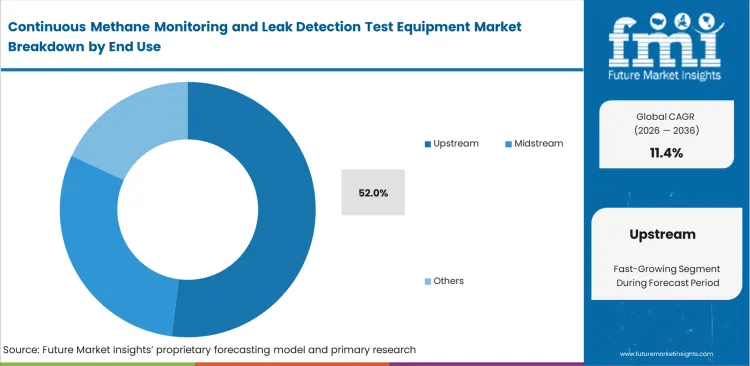
Producers are under increasing pressure to sustain output and demonstrate lower emissions performance to both regulators and gas buyers. Environmental teams are expanding air quality monitoring system deployments to support certification of gas volumes sold into markets where emissions credentials are being examined more closely. Wide geographic spread across upstream assets is also lifting demand for air quality monitoring equipment that can operate reliably in remote locations and harsh field conditions. Upstream applications are expected to account for 52.0% market share in 2026, reflecting the heavier scrutiny this part of the value chain faces on fugitive methane releases. FMI’s assessment indicates that field engineers are increasingly linking continuous monitoring data with operating dashboards so process deviations can be detected before they escalate into larger safety or compliance issues. One commercial constraint receives less attention during procurement: many operators do not own the emissions algorithms used to interpret these readings and instead rely on recurring software subscriptions that deepen vendor dependence over time. Companies that delay continuous upstream deployment risk weaker market access as buyers place greater preference on certified low-methane gas supply.
- Production constraints: Manufacturers face difficulty securing optical components, precision lasers, and other critical inputs at the pace needed for large upstream rollout plans. Installation schedules are often staggered because sensor availability remains tighter than operator demand.
- Calibration bottlenecks: Factory calibration capacity places a real limit on how quickly units can be shipped. Each sensor requires controlled gas-exposure testing and certification time, which slows output even when order books are strong.
- Market consolidation: Larger energy technology groups are acquiring specialist sensor companies to assemble broader emissions-management offerings. Vendor choice is likely to narrow over time, pushing buyers toward bundled service relationships rather than one-time equipment purchases.
Continuous Methane Monitoring and Leak Detection Test Equipment Market Analysis by Offering
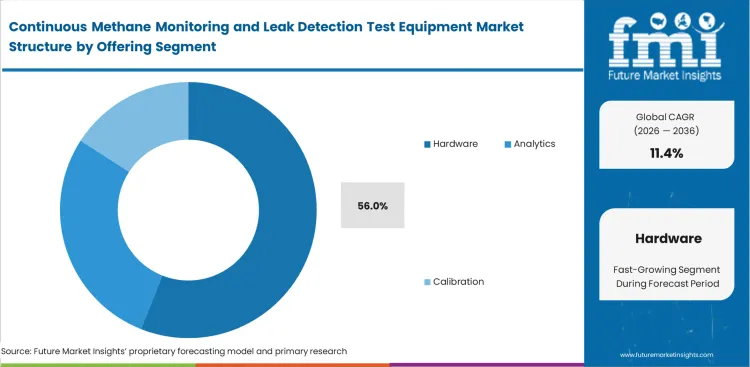
Deployment across thousands of active sites keeps procurement centered on physical detection infrastructure. Operations teams continue to favor rugged pollution monitoring equipment that can meet methane detection thresholds in remote settings without relying on grid power or complex communications architecture. Hardware is estimated to account for 56.0% of market share in 2026, reflecting the large installed base of sensors, power units, enclosures, and peripheral field components needed for continuous coverage. Procurement decisions rarely stop at sensor sensitivity alone. The choice between infrared point sensors, laser arrays, and non-dispersive infrared (NDIR) configurations often determines which analytics stack and subscription structure the site must adopt over time. Instrument engineers spend significant time testing enclosure durability, battery life, and long-term survivability under field conditions because those factors directly affect replacement cycles and maintenance cost. Margin on the hardware itself often remains limited, while suppliers recover profitability through analytics and reporting layers added later in the contract lifecycle. Buyers that approach continuous monitoring as a one-time hardware purchase frequently miss the software cost required to turn raw readings into auditable emissions records. That miscalculation continues to be a common source of budget overruns across this market.
- Early integration: Large energy operators tend to move first with bulk hardware orders to secure supply and improve pricing leverage. Initial deployments usually begin at major processing assets where infrastructure is already in place and emission reductions are easier to demonstrate.
- Secondary rollout: Mid-sized operators often follow once first-wave projects that prove technically and regulatorily workable. Standardized packages then gain traction at remote sites because they reduce design complexity and shorten implementation time.
- Laggard conversion: Smaller operators usually postpone hardware spending until enforcement pressure becomes immediate. Those buyers then prefer pre-configured systems that can be deployed quickly, even if the network design is less tailored to site conditions.
Continuous Methane Monitoring and Leak Detection Test Equipment Market Drivers, Restraints, and Opportunities
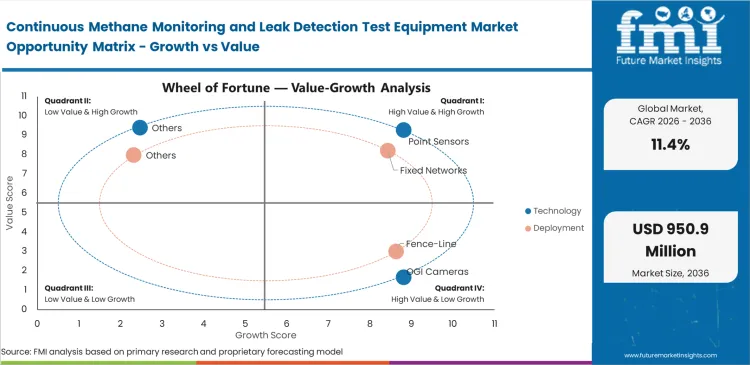
Regulatory frameworks have completely abandoned tolerance for calculated engineering estimates, requiring actual empirical measurement to verify facility output. Facility managers acting decisively to deploy continuous automated monitoring entirely avoid the punitive tax structures levied on unverified production assets. Postponing this hardware integration leaves operators exposed to massive financial liabilities initiated by momentary equipment failures that periodic manual surveys miss entirely. The speed at which regulatory agencies implement alternative test method standards dictates the urgency, compressing typical multi-year purchasing cycles into immediate mandated deployments across the methane monitoring systems market.
Strict methane monitoring calibration requirements and software algorithmic maturity limit the practical scalability of these continuous networks across complex processing environments. Raw hardware sensitivity easily detects methane presence, but translating concentration spikes into accurate mass emission rates requires computational processing and site-specific wind modeling. Instrument engineers constantly battle false positive alarms generated by routine pneumatic actuation, a data overload problem that erodes control room confidence in the automated system. Manufacturers are developing advanced machine learning filters to suppress non-critical alerts, but proving this algorithmic reliability to skeptical regulators extends implementation timelines significantly.
Opportunities in the Continuous Methane Monitoring and Leak Detection Test Equipment Market
- Certified low-emission gas pricing: Environmental directors establish premium-tier natural gas contracts by verifying absolute emission thresholds through auditable continuous sensor data.
- Algorithmic data licensing: Technology vendors monetize their accumulated baseline venting data by training highly specialized sensor platforms designed for predictive maintenance.
- Turnkey compliance-as-a-service: Service providers assume complete liability for network uptime, calibration, and regulatory reporting, allowing producers to outsource their entire emission oversight operation.
Regional Analysis
Based on regional analysis, continuous methane monitoring and leak detection test equipment market is segmented into North America, Europe, Asia Pacific, and Middle East & Africa across 40 plus countries.
.webp "Top Country Growth Comparison Continuous Methane Monitoring And Leak Detection Test Equipment Market Cagr (2026 2036)")
| Country | CAGR (2026 to 2036) |
|---|---|
| United States | 13.2% |
| Canada | 12.6% |
| Germany | 11.8% |
| Netherlands | 11.5% |
| China | 10.9% |
| United Arab Emirates | 10.7% |
| Saudi Arabia | 10.3% |
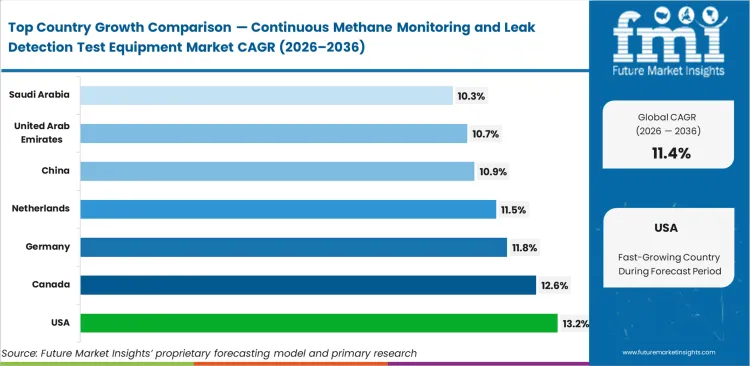
Source: Future Market Insights (FMI) analysis, based on proprietary forecasting model and primary research
North America Continuous Methane Monitoring and Leak Detection Test Equipment Market Analysis
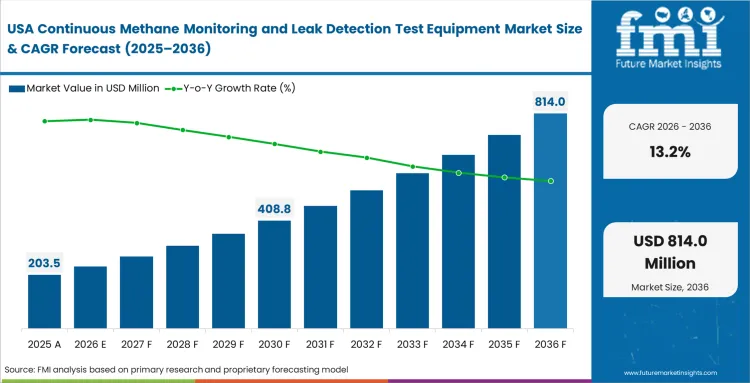
Policy mandates in North America have moved aggressively from voluntary incentive structures to punitive regulatory requirements. Federal and provincial environmental agencies now force operators to abandon predictive emission factors in favor of empirical site-level quantification. FMI analysts note that this transition compels upstream producers to deploy vast networks of autonomous nodes across widely dispersed extraction basins. Operations managers navigate complex alternative test method approval pathways to certify their continuous systems against stringent federal specifications. The underlying pressure stems from impending super-emitter response programs that levy massive fines on unmitigated release events, fundamentally changing the risk profile of unmonitored wellheads.
- United States: Strict federal waste prevention rules force immediate hardware deployment on production pads to establish empirical emission baselines. Compliance directors face pressure to select continuous networks that meet specific Environmental Protection Agency alternative test method criteria. The United States methane monitoring industry is projected to expand at a 13.2% CAGR as operators replace outdated optical imaging protocols with permanent autonomous monitoring arrays. Buyers acting decisively to implement approved networks eliminate the recurring operational expenses associated with mandated quarterly manual camera surveys.
- Canada: Provincial upstream targets require verifiable baseline measurements, pushing operators to adopt ruggedized cold-weather sensing technology. Field engineers prioritize systems capable of surviving extreme temperature fluctuations while maintaining precise calibration stability. Demand for Canada methane leak detection equipment is anticipated to rise at a 12.6% CAGR as producers integrate continuous methane data directly into their emissions reporting frameworks. Canadian extraction firms utilizing continuous quantification directly position themselves as preferred suppliers for environmentally scrutinized global liquefied natural gas markets.
FMI's report includes detailed analysis of Mexico and remaining North American territories. Regional expansion relies heavily on cross-border standardization of alternative test method protocols and advanced infrared sensors.
Europe Continuous Methane Monitoring and Leak Detection Test Equipment Market Analysis
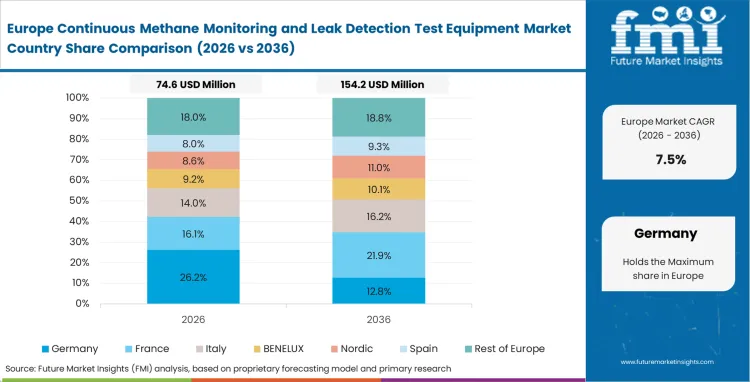
Rigid measurement, reporting, and verification directives define the adoption curve across European energy infrastructure. Continental regulators mandate strict source-level reconciliation, forcing natural gas importers and distributors to deploy highly accurate detection networks at critical transfer nodes. FMI observes that midstream operators face scrutiny regarding pipeline integrity and compressor station fugitive emissions. Facility managers prioritize localized point sensors and laser open-path systems that integrate directly with existing industrial control networks. The true operational constraint involves translating raw continuous concentration data into the highly specific regulatory reporting formats demanded by the European Union methane framework.
- Germany: Implementation of comprehensive continental reporting mandates forces infrastructure operators to prioritize high-fidelity leak detection networks. Environmental officers require interconnected sensor arrays capable of attributing specific emission rates to distinct pieces of compression equipment. Demand for methane leak detection equipment in Germany is set to record a CAGR of 11.8% during the assessment period as utility providers modernize their environmental oversight capabilities. Operators achieving precise source-level quantification insulate their operations from impending import penalties targeting unverified natural gas supply chains.
- Netherlands: Dense infrastructure and proximity to residential zones compel operators to install hyper-sensitive continuous monitoring perimeters. Facility engineers integrate advanced algorithmic filtering to prevent harmless operational venting from activating widespread public alarms. The Netherlands sector is expected to register a CAGR of 11.5% through 2036 driven by uncompromising localized environmental oversight. By demonstrating absolute real-time control over fugitive emissions, Dutch terminal operators actively protect their social license to operate within highly populated industrial corridors.
FMI's report includes analysis of the United Kingdom, Norway, and Italy. Adoption across these secondary markets tracks closely with the rollout of integrated continental emission trading schemes demanding precise environmental test equipment.
Asia Pacific & Middle East Continuous Methane Monitoring and Leak Detection Test Equipment Market Analysis
National energy conglomerates run the trajectory across these advancing markets by integrating comprehensive continuous monitoring into broader operational modernization programs. Corporate strategists deploy advanced localized networks to future-proof massive extraction assets against anticipated international carbon taxation. Based on FMI's analysis, purchase directors execute massive volume contracts, favoring established global vendors capable of providing turnkey hardware and analytics packages. The primary adoption friction involves maintaining sensitive optical equipment in extreme environments and managing the complex logistics of remote site calibration across vast infrastructure footprints.
- China: Expanding measurement frameworks prioritize broad presence detection over immediate punitive enforcement. Central planners direct state-owned enterprises to baseline processing facilities using standardized continuous hardware. Methane leak detection equipment segment in China is likely to post a CAGR of 10.9% by 2036 as domestic manufacturing scales to meet internal deployment mandates. Chinese operators actively build massive proprietary data lakes to train highly specific predictive maintenance algorithms.
- United Arab Emirates: National energy producers upgrade their emissions management infrastructure to support aggressive corporate net-zero targets. Facility managers deploy high-end open-path laser arrays to blanket massive export terminals with continuous coverage. The UAE is projected to witness 10.7% CAGR through 2036 as sovereign wealth initiatives fund state-of-the-art environmental oversight capabilities. Operators deploying these advanced networks secure their competitive positioning as preferred low-carbon energy suppliers to European markets.
- Saudi Arabia: Massive scale production demands highly autonomous monitoring solutions that require minimal human intervention. Instrumentation engineers specify ruggedized sensors capable of surviving extreme ambient temperatures and sandstorms. Demand in Saudi Arabia is anticipated to rise at a 10.3% CAGR as national directives force the integration of real-time methane tracking into centralized operational control centers. Successfully automating leak detection across vast desert infrastructure alters how national oil companies execute preventative maintenance logistics.
FMI's report includes analysis of India, Australia, and emerging African extraction markets. Expansion heavily depends on technology transfer agreements linked to foreign direct investment in smart sensor and basic emissions management infrastructure.
Competitive Aligners for Market Players
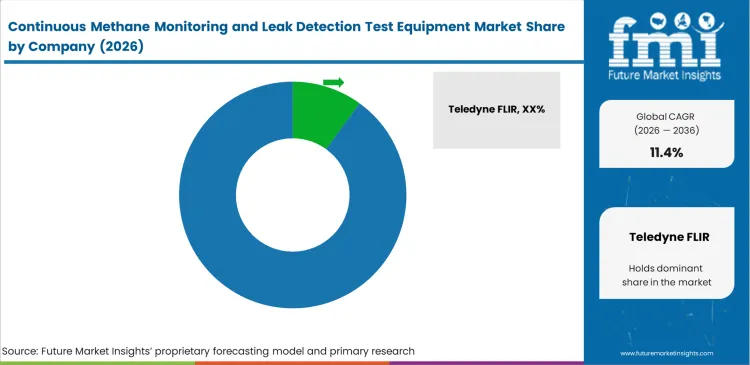
The competitive structure of continuous methane monitoring centers on the race to secure regulatory algorithmic approvals rather than pure hardware specifications. Teledyne FLIR and SLB dominate sourcing evaluations not solely based on sensor sensitivity, but because their proprietary analytics engines hold critical Environmental Protection Agency alternative test method certifications. Operations directors prioritize EPA approved methane monitoring systems specifically to shield themselves from impending super-emitter regulatory audits. Companies like Qube Technologies and Project Canary structure their market approach around software-as-a-service models, treating the physical detection nodes as loss leaders to secure highly profitable, multi-year data management contracts.
Leading methane leak detection equipment manufacturers possess massive, accumulated datasets of real-world operational venting patterns that challengers cannot rapidly replicate. LongPath Technologies and Sensirion Connected Solutions utilize this proprietary baseline data to refine their machine learning models, drastically reducing false positive alarm rates prompted by non-methane hydrocarbons. This algorithmic maturity constitutes a massive barrier to entry; new methane monitoring equipment suppliers discover that highly sensitive sensors are useless if they cannot accurately differentiate between a harmless pneumatic actuation and a critical seal failure. Vendors providing integrated catalysts insights alongside leak detection establish deeper operational entrenchment.
Large extraction conglomerates resist vendor lock-in by demanding open application programming interfaces that funnel raw concentration data into their own centralized supervisory control systems. Acquisition teams asking which companies sell continuous methane monitoring systems flatly reject closed proprietary dashboards, insisting on hardware interoperability to ensure they can swap out degraded field nodes without abandoning their existing analytical software infrastructure. Approaching 2036, hardware commoditization will force pure sensor manufacturers to merge with advanced analytics firms, as buyers explicitly refuse to purchase physical detection equipment decoupled from regulatory-certified quantification reporting algorithms.
Key Players in Continuous Methane Monitoring and Leak Detection Test Equipment Market
- Teledyne FLIR
- SLB
- Qube Technologies
- Project Canary
- LongPath Technologies
- Sensirion Connected Solutions
Scope of the Report
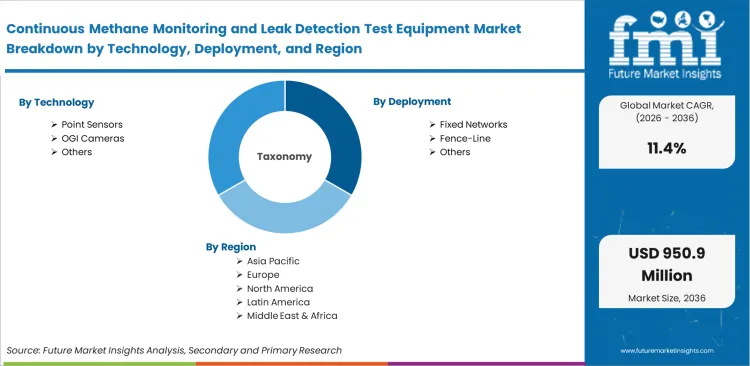
| Metric | Value |
|---|---|
| Quantitative Units | USD 290.0 million to USD 850.0 million, at a CAGR of 11.40% |
| Market Definition | Automated networks and associated analytics that continuously detect, locate, and quantify methane emissions across oil and gas facilities. These systems replace periodic manual inspections with permanent oversight designed for strict regulatory compliance. |
| Segmentation | Technology, Deployment, Site type, End use, Offering, and Region |
| Regions Covered | North America, Latin America, Europe, Asia Pacific, Middle East and Africa |
| Countries Covered | United States, Canada, Germany, Netherlands, China, United Arab Emirates, Saudi Arabia |
| Key Companies Profiled | Teledyne FLIR, SLB, Qube Technologies, Project Canary, LongPath Technologies, Sensirion Connected Solutions |
| Forecast Period | 2026 to 2036 |
| Approach | Baseline established via public upstream production pad counts multiplied by expected multi-sensor network deployment densities. |
Source: Future Market Insights (FMI) analysis, based on proprietary forecasting model and primary research
Continuous Methane Monitoring and Leak Detection Test Equipment Market Analysis by Segments
Technology
- Point sensors
- OGI cameras
- Laser systems
- Open-path systems
- Hybrid systems
Deployment
- Fixed networks
- Fence-line
- Tower units
- Mobile units
- Portable units
Site type
- Production pads
- Tank batteries
- Compressor stations
- Processing plants
- LNG sites
End use
- Upstream
- Midstream
- LNG terminals
- Utilities
- Landfills
Offering
- Hardware
- Analytics
- Calibration
- Services
- Software
Region:
- North America
- United States
- Canada
- Europe
- Germany
- United Kingdom
- France
- Italy
- Spain
- Asia Pacific
- China
- Japan
- South Korea
- Taiwan
- Singapore
- Latin America
- Brazil
- Mexico
- Argentina
- Middle East & Africa
- GCC Countries
- South Africa
Bibliography
- U.S. Department of Energy, National Energy Technology Laboratory. (2024). Methane measurement guidelines for marginal conventional wells.
- National Institute of Standards and Technology. (2025). Common practices for quantifying methane emissions from plumes detected by remote sensing (NIST IR 8575).
- Zimmerle, D., Levin, E., Emerson, E., Juery, C., Marcarian, X., & Blandin, V. (2025). Controlled test protocol: Emission detection and quantification protocol (Version 1.2). Colorado State University, Methane Emissions Technology Evaluation Center.
- Chen, Q., Kimura, Y., & Allen, D. T. (2024). Defining detection limits for continuous monitoring systems for methane emissions at oil and gas facilities. Atmosphere, 15(3), 383.
- Yang, S. L., & Ravikumar, A. P. (2025). Assessing the performance of point sensor continuous monitoring systems at midstream natural gas compressor stations. ACS ES&T Air, 2(4), 466–475.
This bibliography is provided for reader reference. The full FMI report contains the complete reference list with primary source documentation.
This Report Addresses
- Sourcing directors navigating exact alternative test method compliance protocols.
- Site managers replacing manual optical imaging with localized point sensor arrays.
- Compliance officers validating upstream production pad continuous network designs.
- Field engineers struggling with false-positive alarm rates from non-methane hydrocarbons.
- Sustainability executives securing premium LNG contracts via verified emission tracking.
- Instrumentation managers transitioning from hardware purchasing to software subscriptions.
- Pipeline safety directors utilizing fixed monitoring nodes for instantaneous leak alerting.
- Chief technology officers standardizing measurement platforms across disparate extraction basins.
Frequently Asked Questions
What is continuous methane monitoring equipment?
It refers to automated networks and associated analytics that constantly detect, locate, and quantify methane emissions across industrial sites. These systems replace periodic manual inspections with unblinking oversight designed for strict environmental compliance.
How large is the continuous methane monitoring equipment market?
The market is projected to reach USD 290.0 million in 2026. This figure reflects the immediate capital expenditure surge as upstream operators scramble to baseline their large, distributed networks before new super-emitter penalties take effect.
What is driving demand for methane leak detection equipment?
Impending super-emitter financial penalties force operations directors to establish irrefutable site-level emission baselines immediately. Regulatory frameworks now require actual empirical measurement to verify facility output instead of relying on calculated engineering estimates.
Which technologies dominate methane monitoring systems?
Point sensors are estimated to lead the technology segment with a 41.0% share because their inherent modularity allows facility managers to construct dense, overlapping coverage grids that track emissions across complex processing facilities.
How do point sensors compare with OGI cameras and lidar systems?
Point sensors provide continuous, localized detection that captures intermittent leaks missed by periodic OGI camera surveys. Lidar and open-path systems offer broad perimeter security but frequently struggle with physical line-of-sight obstructions in dense facility layouts.
Which countries are adopting methane monitoring equipment fastest?
The United States accelerates at 13.2% driven by punitive super-emitter fees that force immediate high-fidelity quantification. Canada follows at 12.6% propelled by provincial upstream targets requiring verifiable baseline measurements.
Which companies sell EPA-approved methane monitoring systems?
Companies like Teledyne FLIR, SLB, Qube Technologies, Project Canary, and LongPath Technologies currently hold critical Environmental Protection Agency alternative test method certifications, allowing their proprietary analytics engines to substitute for manual imaging surveys.
How is the EU methane regulation affecting equipment demand?
Continental regulators mandate strict source-level reconciliation, forcing natural gas importers to deploy highly accurate detection networks. This uncompromising environmental oversight insulates European utility providers from impending import penalties targeting unverified natural gas supply chains.
What is the difference between periodic LDAR and continuous monitoring?
Periodic Leak Detection and Repair relies on manual inspection crews visiting a site quarterly, leaving massive temporal gaps where leaks accumulate. Continuous monitoring utilizes fixed, automated hardware to provide real-time, uninterrupted emission rate data directly to control rooms.
Can continuous methane monitoring systems quantify leaks accurately?
Yes, but translating raw concentration spikes into accurate mass emission rates requires computational processing and site-specific wind modeling. Operators rely on advanced machine learning algorithms integrated with OGMP 2.0 continuous monitoring guidelines to filter false positives and certify quantification data.
Preview the report firsthand - request a free sample
Get SampleGet the brochure for pricing and purchase details.
Get PDFTable of Content
- Executive Summary
- Global Market Outlook
- Demand-side Trends
- Supply-side Trends
- Technology Roadmap Analysis
- Analysis and Recommendations
- Market Overview
- Market Coverage / Taxonomy
- Market Definition / Scope / Limitations
- Research Methodology
- Chapter Orientation
- Analytical Lens and Working Hypotheses
- Market Structure, Signals, and Trend Drivers
- Benchmarking and Cross-market Comparability
- Market Sizing, Forecasting, and Opportunity Mapping
- Research Design and Evidence Framework
- Desk Research Programme (Secondary Evidence)
- Company Annual and Sustainability Reports
- Peer-reviewed Journals and Academic Literature
- Corporate Websites, Product Literature, and Technical Notes
- Earnings Decks and Investor Briefings
- Statutory Filings and Regulatory Disclosures
- Technical White Papers and Standards Notes
- Trade Journals, Industry Magazines, and Analyst Briefs
- Conference Proceedings, Webinars, and Seminar Materials
- Government Statistics Portals and Public Data Releases
- Press Releases and Reputable Media Coverage
- Specialist Newsletters and Curated Briefings
- Sector Databases and Reference Repositories
- FMI Internal Proprietary Databases and Historical Market Datasets
- Subscription Datasets and Paid Sources
- Social Channels, Communities, and Digital Listening Inputs
- Additional Desk Sources
- Expert Input and Fieldwork (Primary Evidence)
- Primary Modes
- Qualitative Interviews and Expert Elicitation
- Quantitative Surveys and Structured Data Capture
- Blended Approach
- Why Primary Evidence is Used
- Field Techniques
- Interviews
- Surveys
- Focus Groups
- Observational and In-context Research
- Social and Community Interactions
- Stakeholder Universe Engaged
- C-suite Leaders
- Board Members
- Presidents and Vice Presidents
- R&D and Innovation Heads
- Technical Specialists
- Domain Subject-matter Experts
- Scientists
- Physicians and Other Healthcare Professionals
- Governance, Ethics, and Data Stewardship
- Research Ethics
- Data Integrity and Handling
- Primary Modes
- Tooling, Models, and Reference Databases
- Desk Research Programme (Secondary Evidence)
- Data Engineering and Model Build
- Data Acquisition and Ingestion
- Cleaning, Normalisation, and Verification
- Synthesis, Triangulation, and Analysis
- Quality Assurance and Audit Trail
- Market Background
- Market Dynamics
- Drivers
- Restraints
- Opportunity
- Trends
- Scenario Forecast
- Demand in Optimistic Scenario
- Demand in Likely Scenario
- Demand in Conservative Scenario
- Opportunity Map Analysis
- Product Life Cycle Analysis
- Supply Chain Analysis
- Investment Feasibility Matrix
- Value Chain Analysis
- PESTLE and Porter’s Analysis
- Regulatory Landscape
- Regional Parent Market Outlook
- Production and Consumption Statistics
- Import and Export Statistics
- Market Dynamics
- Global Market Analysis 2021 to 2025 and Forecast, 2026 to 2036
- Historical Market Size Value (USD Million) Analysis, 2021 to 2025
- Current and Future Market Size Value (USD Million) Projections, 2026 to 2036
- Y-o-Y Growth Trend Analysis
- Absolute $ Opportunity Analysis
- Global Market Pricing Analysis 2021 to 2025 and Forecast 2026 to 2036
- Global Market Analysis 2021 to 2025 and Forecast 2026 to 2036, By Technology
- Introduction / Key Findings
- Historical Market Size Value (USD Million) Analysis By Technology , 2021 to 2025
- Current and Future Market Size Value (USD Million) Analysis and Forecast By Technology , 2026 to 2036
- Point Sensors
- OGI Cameras
- Others
- Point Sensors
- Y-o-Y Growth Trend Analysis By Technology , 2021 to 2025
- Absolute $ Opportunity Analysis By Technology , 2026 to 2036
- Global Market Analysis 2021 to 2025 and Forecast 2026 to 2036, By Deployment
- Introduction / Key Findings
- Historical Market Size Value (USD Million) Analysis By Deployment, 2021 to 2025
- Current and Future Market Size Value (USD Million) Analysis and Forecast By Deployment, 2026 to 2036
- Fixed Networks
- Fence-Line
- Others
- Fixed Networks
- Y-o-Y Growth Trend Analysis By Deployment, 2021 to 2025
- Absolute $ Opportunity Analysis By Deployment, 2026 to 2036
- Global Market Analysis 2021 to 2025 and Forecast 2026 to 2036, By Site Type
- Introduction / Key Findings
- Historical Market Size Value (USD Million) Analysis By Site Type, 2021 to 2025
- Current and Future Market Size Value (USD Million) Analysis and Forecast By Site Type, 2026 to 2036
- Production Pads
- Tank Batteries
- Others
- Production Pads
- Y-o-Y Growth Trend Analysis By Site Type, 2021 to 2025
- Absolute $ Opportunity Analysis By Site Type, 2026 to 2036
- Global Market Analysis 2021 to 2025 and Forecast 2026 to 2036, By End Use
- Introduction / Key Findings
- Historical Market Size Value (USD Million) Analysis By End Use, 2021 to 2025
- Current and Future Market Size Value (USD Million) Analysis and Forecast By End Use, 2026 to 2036
- Upstream
- Midstream
- Others
- Upstream
- Y-o-Y Growth Trend Analysis By End Use, 2021 to 2025
- Absolute $ Opportunity Analysis By End Use, 2026 to 2036
- Global Market Analysis 2021 to 2025 and Forecast 2026 to 2036, By Offering
- Introduction / Key Findings
- Historical Market Size Value (USD Million) Analysis By Offering, 2021 to 2025
- Current and Future Market Size Value (USD Million) Analysis and Forecast By Offering, 2026 to 2036
- Hardware
- Analytics
- Calibration
- Hardware
- Y-o-Y Growth Trend Analysis By Offering, 2021 to 2025
- Absolute $ Opportunity Analysis By Offering, 2026 to 2036
- Global Market Analysis 2021 to 2025 and Forecast 2026 to 2036, By Region
- Introduction
- Historical Market Size Value (USD Million) Analysis By Region, 2021 to 2025
- Current Market Size Value (USD Million) Analysis and Forecast By Region, 2026 to 2036
- North America
- Latin America
- Western Europe
- Eastern Europe
- East Asia
- South Asia and Pacific
- Middle East & Africa
- Market Attractiveness Analysis By Region
- North America Market Analysis 2021 to 2025 and Forecast 2026 to 2036, By Country
- Historical Market Size Value (USD Million) Trend Analysis By Market Taxonomy, 2021 to 2025
- Market Size Value (USD Million) Forecast By Market Taxonomy, 2026 to 2036
- By Country
- USA
- Canada
- Mexico
- By Technology
- By Deployment
- By Site Type
- By End Use
- By Offering
- By Country
- Market Attractiveness Analysis
- By Country
- By Technology
- By Deployment
- By Site Type
- By End Use
- By Offering
- Key Takeaways
- Latin America Market Analysis 2021 to 2025 and Forecast 2026 to 2036, By Country
- Historical Market Size Value (USD Million) Trend Analysis By Market Taxonomy, 2021 to 2025
- Market Size Value (USD Million) Forecast By Market Taxonomy, 2026 to 2036
- By Country
- Brazil
- Chile
- Rest of Latin America
- By Technology
- By Deployment
- By Site Type
- By End Use
- By Offering
- By Country
- Market Attractiveness Analysis
- By Country
- By Technology
- By Deployment
- By Site Type
- By End Use
- By Offering
- Key Takeaways
- Western Europe Market Analysis 2021 to 2025 and Forecast 2026 to 2036, By Country
- Historical Market Size Value (USD Million) Trend Analysis By Market Taxonomy, 2021 to 2025
- Market Size Value (USD Million) Forecast By Market Taxonomy, 2026 to 2036
- By Country
- Germany
- UK
- Italy
- Spain
- France
- Nordic
- BENELUX
- Rest of Western Europe
- By Technology
- By Deployment
- By Site Type
- By End Use
- By Offering
- By Country
- Market Attractiveness Analysis
- By Country
- By Technology
- By Deployment
- By Site Type
- By End Use
- By Offering
- Key Takeaways
- Eastern Europe Market Analysis 2021 to 2025 and Forecast 2026 to 2036, By Country
- Historical Market Size Value (USD Million) Trend Analysis By Market Taxonomy, 2021 to 2025
- Market Size Value (USD Million) Forecast By Market Taxonomy, 2026 to 2036
- By Country
- Russia
- Poland
- Hungary
- Balkan & Baltic
- Rest of Eastern Europe
- By Technology
- By Deployment
- By Site Type
- By End Use
- By Offering
- By Country
- Market Attractiveness Analysis
- By Country
- By Technology
- By Deployment
- By Site Type
- By End Use
- By Offering
- Key Takeaways
- East Asia Market Analysis 2021 to 2025 and Forecast 2026 to 2036, By Country
- Historical Market Size Value (USD Million) Trend Analysis By Market Taxonomy, 2021 to 2025
- Market Size Value (USD Million) Forecast By Market Taxonomy, 2026 to 2036
- By Country
- China
- Japan
- South Korea
- By Technology
- By Deployment
- By Site Type
- By End Use
- By Offering
- By Country
- Market Attractiveness Analysis
- By Country
- By Technology
- By Deployment
- By Site Type
- By End Use
- By Offering
- Key Takeaways
- South Asia and Pacific Market Analysis 2021 to 2025 and Forecast 2026 to 2036, By Country
- Historical Market Size Value (USD Million) Trend Analysis By Market Taxonomy, 2021 to 2025
- Market Size Value (USD Million) Forecast By Market Taxonomy, 2026 to 2036
- By Country
- India
- ASEAN
- Australia & New Zealand
- Rest of South Asia and Pacific
- By Technology
- By Deployment
- By Site Type
- By End Use
- By Offering
- By Country
- Market Attractiveness Analysis
- By Country
- By Technology
- By Deployment
- By Site Type
- By End Use
- By Offering
- Key Takeaways
- Middle East & Africa Market Analysis 2021 to 2025 and Forecast 2026 to 2036, By Country
- Historical Market Size Value (USD Million) Trend Analysis By Market Taxonomy, 2021 to 2025
- Market Size Value (USD Million) Forecast By Market Taxonomy, 2026 to 2036
- By Country
- Kingdom of Saudi Arabia
- Other GCC Countries
- Turkiye
- South Africa
- Other African Union
- Rest of Middle East & Africa
- By Technology
- By Deployment
- By Site Type
- By End Use
- By Offering
- By Country
- Market Attractiveness Analysis
- By Country
- By Technology
- By Deployment
- By Site Type
- By End Use
- By Offering
- Key Takeaways
- Key Countries Market Analysis
- USA
- Pricing Analysis
- Market Share Analysis, 2025
- By Technology
- By Deployment
- By Site Type
- By End Use
- By Offering
- Canada
- Pricing Analysis
- Market Share Analysis, 2025
- By Technology
- By Deployment
- By Site Type
- By End Use
- By Offering
- Mexico
- Pricing Analysis
- Market Share Analysis, 2025
- By Technology
- By Deployment
- By Site Type
- By End Use
- By Offering
- Brazil
- Pricing Analysis
- Market Share Analysis, 2025
- By Technology
- By Deployment
- By Site Type
- By End Use
- By Offering
- Chile
- Pricing Analysis
- Market Share Analysis, 2025
- By Technology
- By Deployment
- By Site Type
- By End Use
- By Offering
- Germany
- Pricing Analysis
- Market Share Analysis, 2025
- By Technology
- By Deployment
- By Site Type
- By End Use
- By Offering
- UK
- Pricing Analysis
- Market Share Analysis, 2025
- By Technology
- By Deployment
- By Site Type
- By End Use
- By Offering
- Italy
- Pricing Analysis
- Market Share Analysis, 2025
- By Technology
- By Deployment
- By Site Type
- By End Use
- By Offering
- Spain
- Pricing Analysis
- Market Share Analysis, 2025
- By Technology
- By Deployment
- By Site Type
- By End Use
- By Offering
- France
- Pricing Analysis
- Market Share Analysis, 2025
- By Technology
- By Deployment
- By Site Type
- By End Use
- By Offering
- India
- Pricing Analysis
- Market Share Analysis, 2025
- By Technology
- By Deployment
- By Site Type
- By End Use
- By Offering
- ASEAN
- Pricing Analysis
- Market Share Analysis, 2025
- By Technology
- By Deployment
- By Site Type
- By End Use
- By Offering
- Australia & New Zealand
- Pricing Analysis
- Market Share Analysis, 2025
- By Technology
- By Deployment
- By Site Type
- By End Use
- By Offering
- China
- Pricing Analysis
- Market Share Analysis, 2025
- By Technology
- By Deployment
- By Site Type
- By End Use
- By Offering
- Japan
- Pricing Analysis
- Market Share Analysis, 2025
- By Technology
- By Deployment
- By Site Type
- By End Use
- By Offering
- South Korea
- Pricing Analysis
- Market Share Analysis, 2025
- By Technology
- By Deployment
- By Site Type
- By End Use
- By Offering
- Russia
- Pricing Analysis
- Market Share Analysis, 2025
- By Technology
- By Deployment
- By Site Type
- By End Use
- By Offering
- Poland
- Pricing Analysis
- Market Share Analysis, 2025
- By Technology
- By Deployment
- By Site Type
- By End Use
- By Offering
- Hungary
- Pricing Analysis
- Market Share Analysis, 2025
- By Technology
- By Deployment
- By Site Type
- By End Use
- By Offering
- Kingdom of Saudi Arabia
- Pricing Analysis
- Market Share Analysis, 2025
- By Technology
- By Deployment
- By Site Type
- By End Use
- By Offering
- Turkiye
- Pricing Analysis
- Market Share Analysis, 2025
- By Technology
- By Deployment
- By Site Type
- By End Use
- By Offering
- South Africa
- Pricing Analysis
- Market Share Analysis, 2025
- By Technology
- By Deployment
- By Site Type
- By End Use
- By Offering
- USA
- Market Structure Analysis
- Competition Dashboard
- Competition Benchmarking
- Market Share Analysis of Top Players
- By Regional
- By Technology
- By Deployment
- By Site Type
- By End Use
- By Offering
- Competition Analysis
- Competition Deep Dive
- Teledyne FLIR
- Overview
- Product Portfolio
- Profitability by Market Segments (Product/Age /Sales Channel/Region)
- Sales Footprint
- Strategy Overview
- Marketing Strategy
- Product Strategy
- Channel Strategy
- SLB
- Qube Technologies
- Project Canary
- LongPath Technologies
- Sensirion Connected Solutions
- Teledyne FLIR
- Competition Deep Dive
- Assumptions & Acronyms Used


