

- Industry Size (2026)
- USD 240 Mn
- Forecast (2036)
- USD 790 Mn
- CAGR (2026 to 2036)
- 12.6%
In-Situ Layer-by-Layer AM Defect Monitoring Test Equipment Market Size, Market Forecast and Outlook By FMI
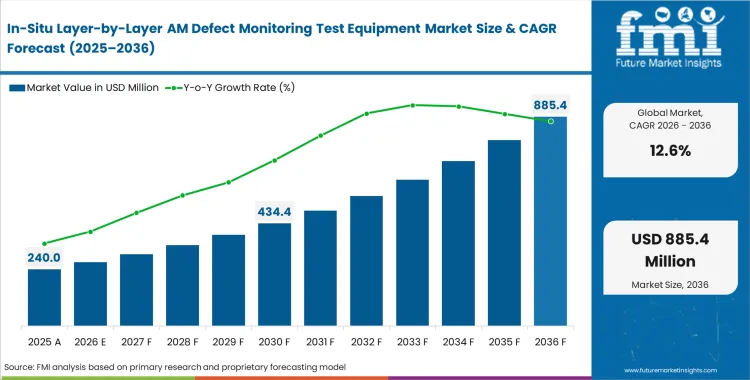
The global in-situ layer-by-layer AM defect monitoring test equipment market is entering a rapid expansion phase. Valued at USD 210 million in 2025, the market is projected to reach USD 240 million in 2026, reflecting a 12.6% CAGR. Over the longer term, the change in aerospace qualification, from post-build inspection to real‑time layer certification, is expected to accelerate adoption, driving the market to nearly USD 790 million by 2036.
Summary of In-Situ Layer-by-Layer AM Defect Monitoring Test Equipment Market
- Market Snapshot
- The in‑situ, layer‑by‑layer AM defect‑monitoring equipment market is valued at USD 210 million in 2025 and is expected to increase to USD 240 million in 2026.
- The market is projected to grow at a 12.6% CAGR from 2026 to 2036, creating approximately USD 790 million in incremental opportunity over the period.
- This segment represents a specification‑driven AM quality domain focused on layer‑wise defect detection, process traceability, and qualification support, distinct from general-purpose AM hardware.
- NIST highlights in‑process monitoring and in‑process NDE as critical enablers for reducing qualification time and cost in metal AM, while noting that technology maturity and standardization remain limited for safety‑critical applications.
- Demand and Growth Drivers
- Demand is strengthening as manufacturers seek earlier defect detection in metal AM workflows, where variability, qualification expense, and scrap risk remain barriers to scaling serial production.
- Adoption of optical and layer‑wise monitoring solutions is accelerating as vendors shift from passive data capture to real‑time corrective control and closed‑loop thermal stabilization.
- Growth is also propelled by industrialization efforts across aerospace, defense, medical, and energy sectors, where traceability and repeatability increasingly outweigh prototype cycle time.
- Across key growth markets, India leads with 14.8% CAGR, followed by China (14.3%), Germany (12.1%), the United States (11.4%), South Korea (11.2%), Japan (10.6%), and the United Kingdom (9.9%).
- Expansion continues to be moderated by the lower technology readiness of in‑process monitoring compared with post‑process NDE for critical qualification pathways, slowing adoption in the most regulated programs.
- Product and Segment View
- The market spans optical, thermal, acoustic, electromagnetic, and multisensor monitoring technologies, delivered as integrated hardware, analytics software, and validation‑support systems for layer‑wise AM quality assurance.
- These solutions are deployed across powder bed fusion, directed energy deposition, binder jetting, and select high‑value layer‑wise production cells where real‑time defect detection is mandatory.
- Optical monitoring leads the monitoring‑mode segment with 41.0% share, driven by the commercialization of camera‑based and tomography systems in metal AM.
- OEM‑integrated monitoring accounts for 58.0% share, reflecting customer preference for machine‑linked solutions over stand‑alone retrofits.
- Powder bed fusion dominates the AM‑process segment with 63.0% share, aligned with the concentration of commercial offerings and qualification activity on L‑PBF platforms.
- Aerospace is estimated to hold 32.0% share of end‑use demand, supported by stringent requirements for documentation, defect control, and qualification economics.
- Hardware accounts for 54.0% share of component demand, as sensing, imaging, and machine‑integration modules continue to represent the primary deployment expense.
- The scope includes in‑situ sensing, layer‑wise inspection, melt‑pool and powder‑bed monitoring, embedded or retrofit QA modules, analytics, and qualification‑support software. It excludes AM printer sales, CT‑only post‑process inspection, and general-purpose machine‑vision solutions unrelated to AM.
- Geography and Competitive Outlook
- India, China, and Germany represent the fastest‑growing markets, while the United States remains a mature, high‑value installed‑base market with strong qualification‑driven demand.
- Competitive differentiation is increasingly shaped by OEM integration depth, retrofit flexibility, closed‑loop control capability, and qualification‑focused analytics rather than low‑cost sensing hardware.
- Key market participants include EOS, Renishaw, TRUMPF, Nikon SLM Solutions, Additive Assurance, Phase3D, and Additive Industries.
- The competitive landscape remains moderately concentrated, with the leading player holding significant share, reflecting OEM control over system‑level integration and the growing influence of specialist monitoring firms in retrofit and analytics layers.
| Metric | Unit |
|---|---|
| Industry Size (2026) | USD 240 million |
| Industry Value (2036) | USD 790 million |
| CAGR (2026 to 2036) | 12.60% |
Source: Future Market Insights (FMI) analysis, based on proprietary forecasting model and primary research
Aerospace OEMs face a throughput constraint: post-build computed tomography cannot scale at the speed required for higher‑volume AM adoption. As production ramps, qualification bottlenecks increasingly hinge on the ability to validate internal geometries during the build. In-situ monitoring effectively converts metal AM from a prototyping expense into a certifiable production pathway by enabling defect detection while parts remain on the build plate.
Regulatory acceptance of real‑time thermal melt pool signatures as a substitute for post-build ultrasound will represent a major inflection point. Once tier‑1 suppliers incorporate these capabilities into supplier quality manuals, in‑situ monitoring becomes not optional but foundational, rendering many legacy post-build inspection steps redundant.
Growth trajectories vary significantly across regions. India is expected to lead with 14.8% CAGR, supported by rapid expansion in industrial metal powder capacity. China follows at 14.3% CAGR, driven by accelerated aerospace qualification programs. Germany (12.1% CAGR) benefits from strong participation in standards bodies and equipment replacement cycles. The United States (11.4% CAGR) sees steady demand from medical device producers. South Korea (11.2% CAGR) and Japan (10.6% CAGR) expand through targeted high‑spec manufacturing and tooling applications, respectively. The United Kingdom (9.9% CAGR) grows as defense production transitions to serialized AM components. This distribution reflects a divergence between regions building foundational AM capacity and those optimizing established high‑value platforms.
Segmental Analysis
In-Situ Layer-by-Layer AM Defect Monitoring Test Equipment Market Analysis by Monitoring Mode
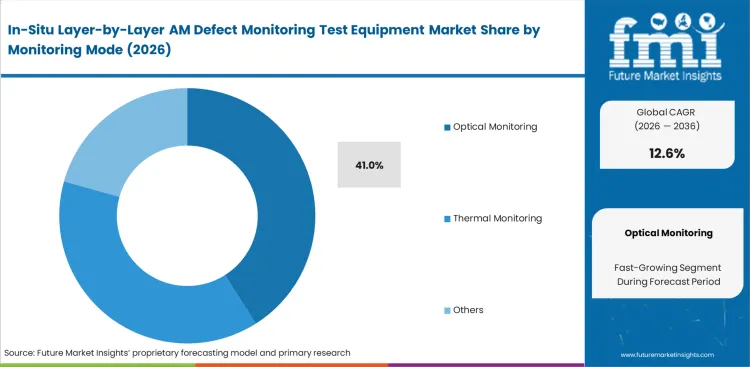
High-resolution visual correlation with known defect typologies supports optical dominance. Optical monitoring commands 41.0% share in 2026 as production engineers demand immediate photographic evidence of powder bed anomalies. FMI's analysis indicates machine vision algorithms mapping physical recoater streaks deliver faster initial qualification than complex thermal models. Correlating dark pixels directly to lack-of-fusion voids allows operators to establish baseline control limits rapidly. Acoustic systems require vast datasets to distinguish normal cooling stress from actual cracking. Optical tomography for additive manufacturing captures geometry rather than physics, making output intuitively readable for conventional inspectors. Facilities delaying optical integration face unsustainable scrap rates during complex titanium builds.
- Initial detection: High-speed cameras capture recoater streaks instantly. Production engineers halt builds before subsequent layers lock in fatal geometry flaws.
- Algorithmic correlation: Edge computing matches dark pixel clusters to known void signatures. Quality managers build localized defect libraries without extensive destructive testing.
- Scaling expansion: Multisensor fusion overlays optical data with thermal logs. QA directors validate complex internal structures previously impossible to certify.
In-Situ Layer-by-Layer AM Defect Monitoring Test Equipment Market Analysis by Deployment
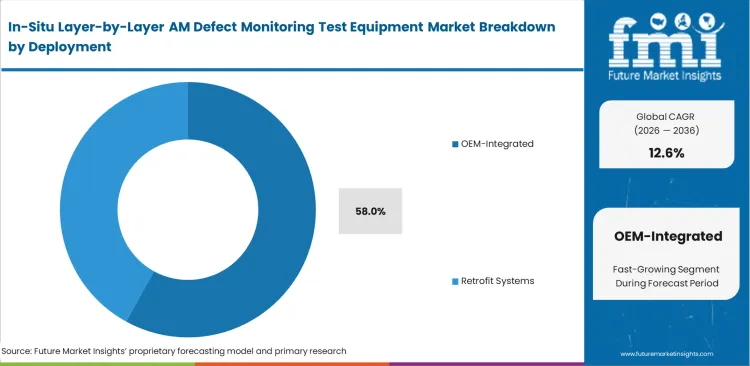
Proprietary machine controller architectures lock out aftermarket hardware. Procurement directors evaluating OEM integrated vs retrofit AM monitoring specify factory-integrated machine vision systems to maintain baseline machine warranties. Retrofitting third-party sensors voids service level agreements on million-dollar production assets. OEM-integrated deployment is anticipated to hold 58.0% share in 2026 because primary manufacturers strictly guard internal laser synchronization protocols. According to FMI's estimates, microsecond adjustments to laser power cannot function over external APIs. Independent analytics firms must partner directly with printer manufacturers or remain relegated to passive observation. Third-party vendors failing to secure OEM interface agreements face complete exclusion from serialized production environments.
- Warranty enforcement: Primary manufacturers void service agreements upon unauthorized sensor installation. Procurement directors reject retrofits to protect capital investments.
- Hidden latency: External USB connections introduce millisecond delays. System integrators discover passive monitoring cannot initiate emergency laser shutoffs in real time.
- Integration dominance: Factory-installed arrays synchronize perfectly with galvanometer movements. Facility managers achieve closed-loop melt pool control impossible with bolt-on solutions.
In-Situ Layer-by-Layer AM Defect Monitoring Test Equipment Market Analysis by AM Process
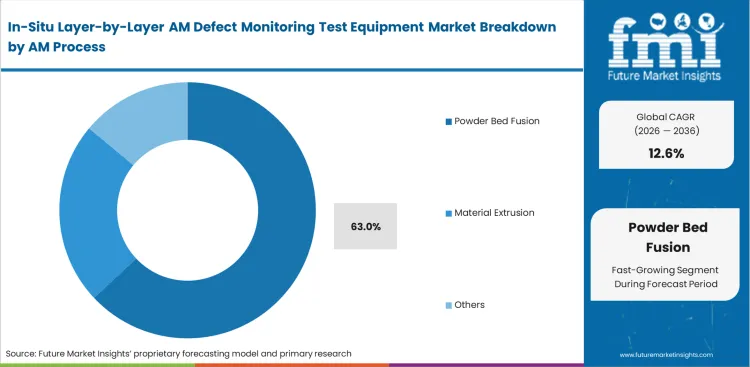
Deep standardization within aerospace metal qualification continues to shape adoption patterns. Metallurgical engineers rely on industrial machine vision to validate melting dynamics across large titanium arrays. Evaluating directed energy deposition monitoring systems requires different focal lengths and tracking speeds due to moving print heads. As a result, powder bed fusion is anticipated to capture 63.0% share in 2026, reflecting the stringent aviation requirements that demand comprehensive quality control. As per FMI's projection, powder bed fusion monitoring hardware presents a static, predictable focal plane ideal for fixed overhead camera positioning. This geometric consistency accelerates algorithm training significantly compared to free-space deposition methods. Facilities relying on unmonitored powder bed systems cannot compete for prime defense contracts.
- Spatter mapping: Overhead cameras track ejecta trajectories during laser firing. Metallurgical engineers identify specific build regions compromised by localized power spikes.
- Residual risk: Complex overhangs block line-of-sight for fixed pyrometers. Quality teams must still deploy secondary ultrasound for heavily supported geometries.
- Full qualification: Statistical process control models absorb thousands of consecutive layer images. Aerospace suppliers finally achieve part-to-part consistency matching traditional forgings.
In-Situ Layer-by-Layer AM Defect Monitoring Test Equipment Market Analysis by End Use
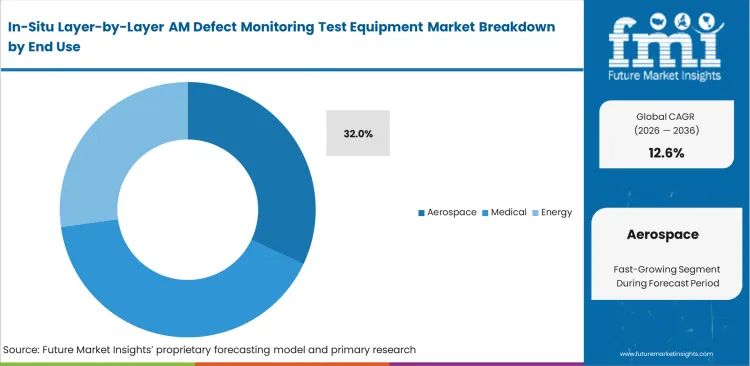
Critical failure consequences dictate investment timelines. Aerospace is projected to lead with 32.0% share in 2026 because post-build defect discovery destroys complex components, costing thousands in raw 3d printing metal alone. Flight qualification officers require unbroken traceability chains from powder lot to final geometry. Medical implant manufacturers follow closely, needing metal 3D printing quality assurance to prove proper porous structure formation. Based on FMI's assessment, automotive applications prioritize speed over comprehensive layer logging, capping their near-term spend. Aerospace applications face weight-reduction imperatives that push designs to extreme limits requiring perfect execution. Contract manufacturers lacking certified aerospace monitoring hardware compete solely on low-margin industrial prototyping.
- Tier-1 suppliers: Aviation contractors face massive backlogs. Procurement officers install monitoring suites to slash scrap rates on critical engine components.
- Specialized facilities: Medical device fabricators must document specific porosity levels. Quality teams utilize thermal logs to prove bone-ingrowth surfaces formed correctly.
- Mass producers: Automotive lines reach volume thresholds requiring automated QA. Plant managers finally integrate monitoring when manual inspection bottlenecks stall assembly lines.
In-Situ Layer-by-Layer AM Defect Monitoring Test Equipment Market Analysis by Component Type
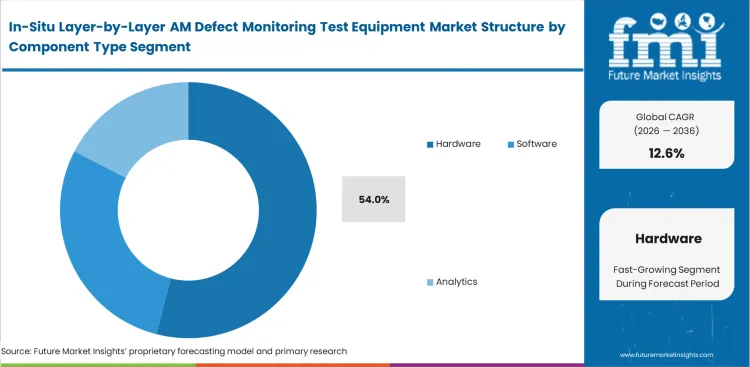
Physical sensor arrays represent an immediate capital expenditure for facilities adopting in‑situ monitoring systems. Organizations prioritize high‑resolution machine vision camera installations across existing machine fleets, while IT directors allocate budgets toward edge computing nodes capable of processing terabytes of image data per build. Although software margins remain higher, the emphasis on physical integration continues to elevate upfront revenue contributions, resulting in hardware accounting for 54.0% of the market share in 2026. FMI analysts note that software licensing models struggle until hardware penetration reaches critical mass. Analytics packages currently serve as bundled incentives to enhance sensor sales rather than standalone products. Suppliers focusing purely on cloud algorithms without securing edge hardware partnerships face severe data acquisition bottlenecks.
- Cost realization: Edge computing units require massive processing power. IT directors realize basic commercial servers cannot handle terabyte-scale localized image streaming.
- Data storage: Cloud uploads become financially unviable for raw high-speed video. Network architects discover local processing is mandatory before pushing summaries to external servers.
- Lifecycle tracking: Total cost of ownership changes from upfront sensor purchase to ongoing algorithmic updates. Procurement managers rewrite contracts emphasizing long-term software support over hardware specs.
In-Situ Layer-by-Layer AM Defect Monitoring Test Equipment Market Drivers, Restraints, and Opportunities
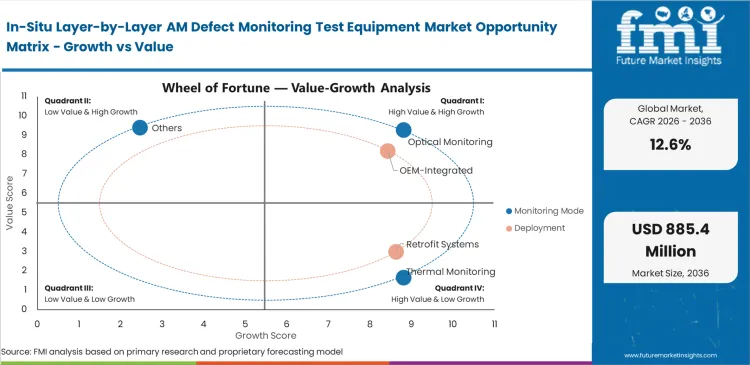
Production bottlenecks force aerospace quality managers to replace days-long computed tomography scanning queues with immediate build-plate validation. Scaling industrial output requires validating internal geometries while parts remain active inside chambers. Delaying this transition restricts output volume strictly to what legacy non destructive testing equipment can process manually. Discovering a fatal void after completing a four-day titanium print destroys material value and cripples delivery schedules. Immediate detection utilizing in-situ NDE for additive manufacturing allows operators to halt doomed builds instantly, recovering vital machine capacity for profitable work.
Data standardization friction severely delays integration across mixed-brand printer fleets. IT directors encounter isolated proprietary formats lacking uniform export protocols. Establishing baseline testing inspection and certification procedures becomes mathematically impossible when three different machine brands output three distinct log formats. Open-source initiatives attempt bridging these silos, yet primary manufacturers actively restrict API access to protect lucrative service contracts. Complete cross-platform analytics remains blocked until regulatory bodies mandate unified data export standards.
Opportunities in the In-Situ Layer-by-Layer AM Defect Monitoring Test Equipment Market
- Algorithm training libraries: Aggregating defect signatures across thousands of builds. Machine learning engineers build predictive models that identify failing additive manufacturing with metal powders prints before visible geometry changes occur.
- Closed-loop power adjustment: Translating thermal data into microsecond laser interventions. Control systems engineers automatically heal minor porosity issues without halting active production runs.
- Digital passport generation: Compiling layer images into immutable certification logs. Quality assurance directors supply complete evidence alongside physical parts to aviation authorities.
Regional Analysis
Based on regional analysis, In-Situ Layer-by-Layer AM Defect Monitoring Test Equipment Market is segmented into China, India, Germany, United States, Japan, South Korea, and United Kingdom across 40 plus countries.
.webp "Top Country Growth Comparison In Situ Layer By Layer Am Defect Monitoring Test Equipment Market Cagr (2026 2036)")
| Country | CAGR (2026 to 2036) |
|---|---|
| India | 14.8% |
| China | 14.3% |
| Germany | 12.1% |
| United States | 11.4% |
| South Korea | 11.2% |
| Japan | 10.6% |
| United Kingdom | 9.9% |
Source: Future Market Insights (FMI) analysis, based on proprietary forecasting model and primary research
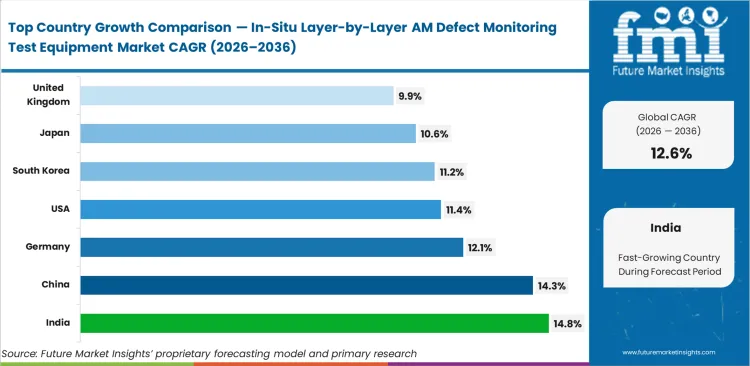
Asia Pacific In-Situ Layer-by-Layer AM Defect Monitoring Test Equipment Market Analysis
Massive expansion of industrial metal powder capacity defines adoption across Asia Pacific. Contract manufacturers install hundreds of multi-laser systems to serve global supply chains. FMI observes that facilities leapfrog legacy post-build inspection entirely, specifying real-time monitoring on all new equipment orders. Domestic aviation programs demand stringent qualification data, forcing rapid deployment of edge analytics hardware. High throughput requirements make manual scanning mathematically unviable. Integrating layer-wise validation transforms prototyping job shops into certified mass production centers.
- India: To successfully manage massive parallel builds across dozens of machines simultaneously, production engineers in India require immediate defect flagging. This operational urgency explains why the country's layer-by-layer AM defect monitoring segment is projected to expand at a 14.8% CAGR between 2026 and 2036. By supplying comprehensive digital quality passports alongside finished components, domestic contract manufacturers rapidly secure lucrative international export agreements.
- China: Aggressive catch-up cycles in aerospace qualification strictly dictate equipment specifications across Chinese production facilities. Quality directors actively utilize additive binder jets coupled with advanced optical arrays to bypass traditional forging constraints. This rapid domestic fleet buildout alters global component pricing structures, driving China's in-situ AM defect monitoring test equipment industry to a 14.3% CAGR over the 2026 to 2036 forecast period. This momentum underscores China’s emergence as a dominant competitor in the global in‑situ AM monitoring landscape.
- South Korea: South Korea's AM quality assurance equipment segment relies on targeted high-spec adoption within specialized manufacturing zones and is estimated to progress at 11.2% CAGR from 2026 to 2036. Electronics manufacturers deploy acoustic sensors to closely monitor delicate heat exchanger fabrications during active printing. Operators achieve the strict part-to-part consistency required for critical semiconductor equipment components without interrupting active deposition cycles.
- Japan: Specialized tooling applications strongly contribute to surgical equipment upgrades within Japanese facilities, where metallurgical teams require absolute thermal control during complex die casting mold production. Driven by these exact tolerances, Japanese demand for AM defect detection systems is poised to track at a 10.6% CAGR through 2036. Buyers maintain a distinct quality premium over regional mass producers by preventing microscopic stress fractures.
FMI's report includes additional countries not in bullets. Taiwan's contract manufacturers integrate monitoring strictly to satisfy Western automotive supply chain mandates.
Europe In-Situ Layer-by-Layer AM Defect Monitoring Test Equipment Market Analysis
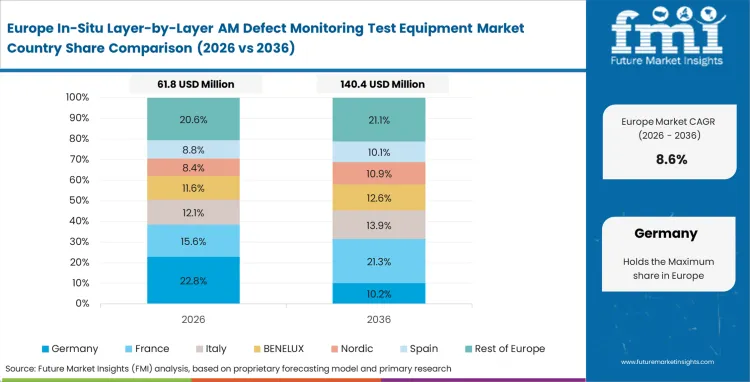
Deep standards participation and replacement economics support European momentum. Incumbent industrial hubs possess vast installed bases of early-generation machines requiring urgent retrofits. FMI's analysis indicates regulatory bodies actively draft binding certification frameworks demanding layer-by-layer traceability. Heavy industrial conglomerates refuse to scale production without statistical process control equivalent to traditional machining. Integrating multisensor fusion arrays satisfies stringent continental safety directives. Transitioning from reactive to proactive monitoring unlocks localized defense supply chain contracts.
- Germany: Poised to grow at a 12.1% CAGR for in-situ monitoring test equipment sales between 2026 and 2036, Germany relies heavily on replacement economics. Plant managers actively strip outdated 3d printing in aerospace setups to install closed-loop validation sensors across massive legacy installed bases. Upgrading these aging hardware systems allows facilities to achieve total integration with digital twin models spanning entire factory floors.
- United Kingdom: Production across the United Kingdom is shifting heavily toward serialized defense components that require absolute geometric certainty. The UK metal AM process monitoring equipment demand is set to grow at a 9.9% CAGR through the next decade. Procurement officers mandate continuous thermal monitoring on all classified naval propulsion parts, ensuring authorized suppliers embed these digital signatures deeply into critical national infrastructure programs.
FMI's report includes additional countries not in bullets. France leverages dense aerospace clusters to test experimental edge computing architectures.
North America In-Situ Layer-by-Layer AM Defect Monitoring Test Equipment Market Analysis
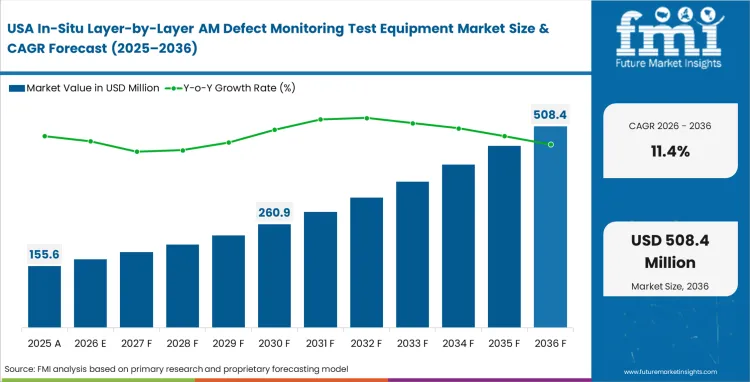
Core medical and defense demand strictly dictates hardware specifications. Federal contractors cannot process sensitive geometries without demonstrating closed-loop thermal control. According to FMI's estimates, primary aviation OEMs enforce supplier mandates requiring physical proof of melt pool stability. Private spaceflight ventures utilize acoustic emission sensors to certify massive combustion chambers impossible to scan via X-ray. Meeting these extreme operating thresholds separates qualified Tier-1 partners from commodity printers. Adopting proactive monitoring remains the sole pathway into classified procurement programs.
- United States: Core regional demand reflects stringent federal defense mandates enforced across the United States, where quality assurance directors install fully integrated hybrid additive manufacturing machines specifically to certify rocket engine components. Domestic contractors rely on this capability to reshore critical 3d printed aerospace fasteners production, propelling the United States AM defect monitoring equipment industry to an anticipated 11.4% CAGR over the 2026 to 2036 period.
FMI's report includes additional countries not in bullets. Canada aligns aerospace validation standards tightly with cross-border supply chain requirements.
Competitive Aligners for Market Players
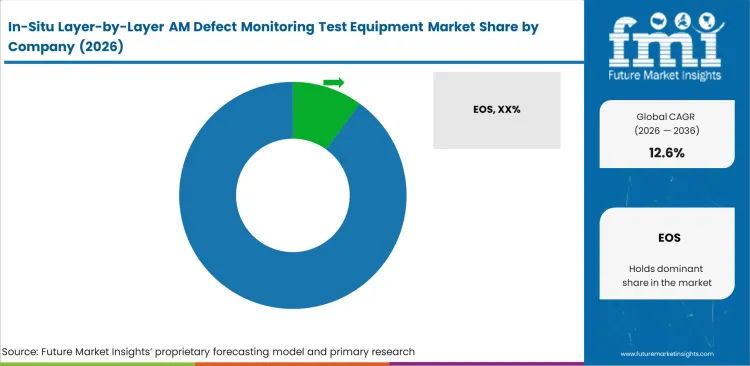
Integration lock-in shapes primary competitive behavior. Companies like EOS and TRUMPF strictly control laser synchronization interfaces, preventing independent software vendors from accessing real-time melt pool data. FMI notes that machine builders utilize proprietary hardware architecture to capture aftermarket software licensing revenue. Third-party AM monitoring equipment suppliers such as Additive Assurance and Phase3D must negotiate complex interface agreements to deploy their 3d scanning edge analytics hardware. This closed ecosystem forces buyers to accept factory-bundled sensor packages or risk voiding massive capital equipment warranties.
Algorithms require vast training datasets to identify microscopic defects accurately. Nikon SLM Solutions leverages massive global machine networks to feed proprietary neural models, identifying lack-of-fusion signatures across thousands of distinct titanium builds. Startups lack this raw operational volume, limiting their acoustic or thermal models to narrow material subsets. FMI's assessment indicates edge computing capability dictates deployment success because transmitting high-speed 3d printing in automotive camera data to cloud servers introduces fatal latency. Securing local processing dominance outweighs pure algorithmic sophistication.
Major aerospace contractors exert massive leverage over reporting formats. Large buyers demand unified digital passports combining Renishaw optical logs with Additive Industries thermal histories into single standardized files. FMI analysts observe that OEMs resisting open data export face exclusion from prime defense contracts. Procurement directors actively penalize closed ecosystems by diverting volume toward suppliers offering transparent 3d scanner API access. Standardizing cross-platform validation protocols destroys proprietary software monopolies while rapidly accelerating fleet-wide industrial qualification.
Key Players in In-Situ Layer-by-Layer AM Defect Monitoring Test Equipment Market
- EOS
- Renishaw
- TRUMPF
- Nikon SLM Solutions
- Additive Assurance
- Phase3D
- Additive Industries
Scope of the Report
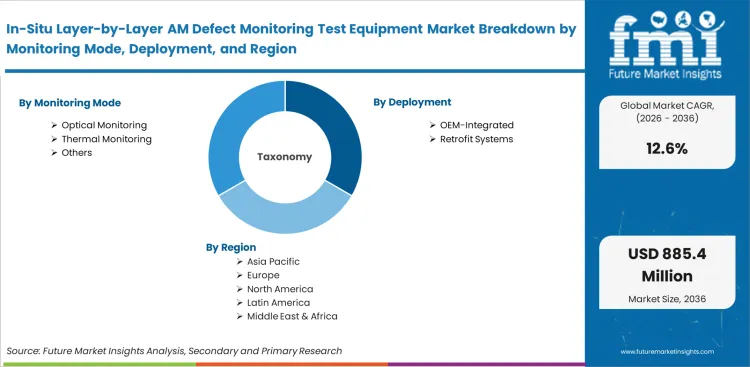
| Metric | Value |
|---|---|
| Quantitative Units | USD 240 million to USD 790 million, at a CAGR of 12.60% |
| Market Definition | AM quality assurance equipment market technologies capture physical parameters of melt pools during printing cycles. Hardware maps porosity and geometric deviations before subsequent powder layers obscure flaws, replacing reactive evaluation with proactive intervention. |
| Segmentation | Monitoring mode, Deployment, AM process, End use, Component type |
| Regions Covered | North America, Latin America, Europe, Asia Pacific, Middle East and Africa |
| Countries Covered | China, India, Germany, United States, Japan, South Korea, United Kingdom |
| Key Companies Profiled | EOS, Renishaw, TRUMPF, Nikon SLM Solutions, Additive Assurance, Phase3D, Additive Industries |
| Forecast Period | 2026 to 2036 |
| Approach | Annual machine shipments configured with closed-loop optical and thermal sensing packages |
Source: Future Market Insights (FMI) analysis, based on proprietary forecasting model and primary research
In-Situ Layer-by-Layer AM Defect Monitoring Test Equipment Market Analysis by Segments
Monitoring mode:
- Optical monitoring
- Thermal monitoring
- Acoustic monitoring
- Electromagnetic monitoring
- Multisensor fusion
Deployment:
- OEM integrated
- Retrofit systems
- Edge analytics
- Cloud analytics
- Validation services
AM process:
- Powder bed fusion
- Directed energy deposition
- Binder jetting
- Material extrusion
End use:
- Aerospace
- Medical
- Energy
- Automotive
- Defense
- Research labs
Component type:
- Hardware
- Software
- Analytics
- Services
Region:
- North America
- United States
- Canada
- Europe
- Germany
- United Kingdom
- France
- Italy
- Spain
- Asia Pacific
- China
- Japan
- South Korea
- Taiwan
- Singapore
- Latin America
- Brazil
- Mexico
- Argentina
- Middle East & Africa
- GCC Countries
- South Africa
Bibliography
- Additive Assurance. (2026). AMiRIS®: Best in class quality assurance for L-PBF.
- America Makes. (2024, November 19). Phase3D's Fringe Inspection technology eliminates guesswork in powder-based AM builds.
- ASTM International. (2025, February). Standardization impact report: Advanced manufacturing.
- EOS GmbH. (2026). EOS Smart Monitoring - In-Situ AM process monitoring & quality assurance.
- Gunasegaram, D. R., Barnard, A. S., Matthews, M. J., Jared, B. H., Andreaco, A. M., Bartsch, K., & Murphy, A. B. (2024, February). Machine learning-assisted in-situ adaptive strategies for the control of defects and anomalies in metal additive manufacturing. Additive Manufacturing, 85, 104013.
- Nikon SLM Solutions AG. (2025, November 11). Nikon SLM Solutions and Additive Assurance partner to integrate AMiRIS Inside for enhanced in-process quality assurance.
- NIST. (2024, September). In-process monitoring and non-destructive evaluation for metal additive manufacturing processes (NIST IR 8538).
- Phase3D. (2026). Fringe Inspection.
- Renishaw plc. (2024). Annual Report 2024.
This bibliography is provided for reader's reference and is not exhaustive. The full report contains the complete reference list and detailed citations.
This Report Addresses
- Immediate capital expenditure constraints limiting hardware integration across legacy powder bed monitoring equipment platforms.
- Strict warranty enforcement policies restricting aftermarket edge analytics deployment on primary machine networks.
- Geometric consistency requirements pushing aerospace manufacturers toward closed-loop thermal tracking systems.
- Rapid industrialized metal powder capacity expansion forcing Indian contract manufacturers to adopt automated optical inspection.
- Massive data storage bottlenecks preventing cloud uploads of high-speed video sensor streams.
- Independent software vendors struggling to secure raw application programming interface access from primary equipment builders.
- Federal defense mandates dictating exact physical proof requirements for classified naval propulsion components.
- High-resolution visual correlation displacing complex acoustic modeling due to faster algorithmic qualification timelines.
Frequently Asked Questions
What is in-situ monitoring in additive manufacturing?
It involves utilizing real-time sensor arrays inside build chambers to capture physical parameters of melt pools during printing cycles. Hardware maps porosity and geometric deviations before subsequent powder layers obscure flaws, replacing reactive evaluation with proactive intervention.
How does layer-by-layer defect monitoring work in AM?
Equipment captures continuous sensor data including high-speed optical tracking, thermal imaging, and acoustic emissions. Edge computing modules correlate these signals instantly against known defect typologies, alerting operators to delamination or lack-of-fusion events as they occur.
Why is melt pool monitoring important in metal 3D printing?
Evaluating melt pool thermal signatures confirms metallurgical bonding occurs exactly as engineered. Flight qualification officers require unbroken thermal histories to certify internal titanium geometries that remain inaccessible to post-build inspection methodologies.
Can in-situ AM monitoring replace CT scanning?
Yes, validating internal geometries while parts remain on build plates renders post-build scanning largely redundant for internal defect mapping. Scaling production requires abandoning days-long CT scanning queues in favor of immediate build-plate validation.
Which AM processes use in-situ defect monitoring?
Powder bed fusion represents primary adoption because static focal planes allow consistent overhead camera positioning. Binder jetting layer inspection and directed energy deposition also utilize monitoring, though moving print heads complicate algorithmic correlation.
What industries use AM defect monitoring equipment?
Aerospace leads adoption to satisfy strict flight qualification mandates. Medical device fabricators utilize thermal tracking to prove bone-ingrowth surfaces formed correctly, while defense contractors require geometric certainty for serialized naval and propulsion components.
Who are the top companies in layer-by-layer AM monitoring equipment?
Major participants include EOS, Renishaw, TRUMPF, Nikon SLM Solutions, Additive Assurance, Phase3D, and Additive Industries. Primary machine builders currently dominate by controlling proprietary laser synchronization interfaces.
What is the forecast for additive manufacturing in-situ monitoring equipment?
Hardware and analytics expenditures expand at 12.60% CAGR, pushing overall value to USD 790 million by 2036. Scaling production past prototyping limits forces global QA departments to invest heavily in additive manufacturing in-situ monitoring market infrastructure.
What is the difference between OEM integrated and retrofit AM monitoring?
OEM systems arrive factory-installed and communicate directly with proprietary laser controls without latency. Retrofit solutions involve aftermarket sensors that often require complex third-party API agreements and risk voiding capital equipment warranties.
Why does aerospace spend more on AM qualification monitoring?
Aviation contractors face massive production backlogs and severe failure consequences. Installing advanced monitoring suites slashes scrap rates on critical engine components costing thousands in raw titanium or Inconel alone.
What forces medical device fabricators to invest in thermal tracking?
Documenting specific porosity levels proves bone-ingrowth surfaces formed correctly. Regulatory bodies demand localized temperature logs confirming proper metallurgical bonding across complex lattice structures.
How does closed-loop control differ from passive observation?
Passive systems simply flag doomed builds for manual abort. Closed-loop networks translate thermal spikes into microsecond laser power adjustments, healing minor porosity issues without halting active production runs.
Why do automotive lines delay comprehensive layer logging?
Automotive applications prioritize pure deposition speed over extreme geometric certainty. Plant managers cap near-term sensor spend until manual inspection bottlenecks critically stall assembly line output.
What limitation affects directed energy deposition monitoring?
Moving print heads require dynamic focal lengths and tracking speeds. Geometric inconsistency drastically complicates algorithmic defect correlation compared to static powder bed planes.
How do unified digital passports disrupt proprietary software models?
Defense contractors demand standard export files combining multiple machine brands. OEMs resisting open data protocols face total exclusion from prime procurement networks prioritizing cross-platform visibility.
What role do standard algorithms play in adoption scaling?
Aggregating defect signatures across global networks builds predictive models. Startups lacking massive operational volume struggle to train neural networks accurately on rare lack-of-fusion anomalies.
Why do contract manufacturers accept hardware integration lock-in?
Protecting service level agreements outweighs software flexibility. Facility managers prioritize guaranteed laser synchronization from primary builders over theoretical capabilities promised by aftermarket retrofits.
How does thermal history mapping reduce raw material waste?
Operators halt failing builds immediately upon detecting localized delamination. Recovering machine capacity early prevents wasting thousands of dollars completing compromised titanium or Inconel components.
What constraint limits cloud-based analytics deployment?
Raw optical arrays generate gigabytes of data per vertical inch. Network architects find uploading uncompressed layer video financially and physically unviable across standard industrial connections.
Why do Japanese facilities maintain distinct procurement profiles?
Targeted tooling applications enhance specific surgical and mold equipment upgrades. Metallurgical teams require absolute thermal control rather than pure throughput scaling demanded by mass contract manufacturers.
How does post-build computed tomography increase monitoring hardware sales?
CT scanning creates massive physical bottlenecks. Quality directors install in-situ arrays specifically to slash scanning queues and shift validation processes directly onto active build plates.
What defines transition from prototyping to serialized production?
Replacing destructive batch testing with statistical process control via thermal signatures. Facilities achieving part-to-part consistency unlock lucrative aviation supply chain contracts previously restricted to forged components.
Preview the report firsthand - request a free sample
Get SampleGet the brochure for pricing and purchase details.
Get PDFTable of Content
- Executive Summary
- Global Market Outlook
- Demand-side Trends
- Supply-side Trends
- Technology Roadmap Analysis
- Analysis and Recommendations
- Market Overview
- Market Coverage / Taxonomy
- Market Definition / Scope / Limitations
- Research Methodology
- Chapter Orientation
- Analytical Lens and Working Hypotheses
- Market Structure, Signals, and Trend Drivers
- Benchmarking and Cross-market Comparability
- Market Sizing, Forecasting, and Opportunity Mapping
- Research Design and Evidence Framework
- Desk Research Programme (Secondary Evidence)
- Company Annual and Sustainability Reports
- Peer-reviewed Journals and Academic Literature
- Corporate Websites, Product Literature, and Technical Notes
- Earnings Decks and Investor Briefings
- Statutory Filings and Regulatory Disclosures
- Technical White Papers and Standards Notes
- Trade Journals, Industry Magazines, and Analyst Briefs
- Conference Proceedings, Webinars, and Seminar Materials
- Government Statistics Portals and Public Data Releases
- Press Releases and Reputable Media Coverage
- Specialist Newsletters and Curated Briefings
- Sector Databases and Reference Repositories
- FMI Internal Proprietary Databases and Historical Market Datasets
- Subscription Datasets and Paid Sources
- Social Channels, Communities, and Digital Listening Inputs
- Additional Desk Sources
- Expert Input and Fieldwork (Primary Evidence)
- Primary Modes
- Qualitative Interviews and Expert Elicitation
- Quantitative Surveys and Structured Data Capture
- Blended Approach
- Why Primary Evidence is Used
- Field Techniques
- Interviews
- Surveys
- Focus Groups
- Observational and In-context Research
- Social and Community Interactions
- Stakeholder Universe Engaged
- C-suite Leaders
- Board Members
- Presidents and Vice Presidents
- R&D and Innovation Heads
- Technical Specialists
- Domain Subject-matter Experts
- Scientists
- Physicians and Other Healthcare Professionals
- Governance, Ethics, and Data Stewardship
- Research Ethics
- Data Integrity and Handling
- Primary Modes
- Tooling, Models, and Reference Databases
- Desk Research Programme (Secondary Evidence)
- Data Engineering and Model Build
- Data Acquisition and Ingestion
- Cleaning, Normalisation, and Verification
- Synthesis, Triangulation, and Analysis
- Quality Assurance and Audit Trail
- Market Background
- Market Dynamics
- Drivers
- Restraints
- Opportunity
- Trends
- Scenario Forecast
- Demand in Optimistic Scenario
- Demand in Likely Scenario
- Demand in Conservative Scenario
- Opportunity Map Analysis
- Product Life Cycle Analysis
- Supply Chain Analysis
- Investment Feasibility Matrix
- Value Chain Analysis
- PESTLE and Porter’s Analysis
- Regulatory Landscape
- Regional Parent Market Outlook
- Production and Consumption Statistics
- Import and Export Statistics
- Market Dynamics
- Global Market Analysis 2021 to 2025 and Forecast, 2026 to 2036
- Historical Market Size Value (USD Million) Analysis, 2021 to 2025
- Current and Future Market Size Value (USD Million) Projections, 2026 to 2036
- Y-o-Y Growth Trend Analysis
- Absolute $ Opportunity Analysis
- Global Market Pricing Analysis 2021 to 2025 and Forecast 2026 to 2036
- Global Market Analysis 2021 to 2025 and Forecast 2026 to 2036, By Monitoring Mode
- Introduction / Key Findings
- Historical Market Size Value (USD Million) Analysis By Monitoring Mode , 2021 to 2025
- Current and Future Market Size Value (USD Million) Analysis and Forecast By Monitoring Mode , 2026 to 2036
- Optical Monitoring
- Thermal Monitoring
- Others
- Optical Monitoring
- Y-o-Y Growth Trend Analysis By Monitoring Mode , 2021 to 2025
- Absolute $ Opportunity Analysis By Monitoring Mode , 2026 to 2036
- Global Market Analysis 2021 to 2025 and Forecast 2026 to 2036, By Deployment
- Introduction / Key Findings
- Historical Market Size Value (USD Million) Analysis By Deployment, 2021 to 2025
- Current and Future Market Size Value (USD Million) Analysis and Forecast By Deployment, 2026 to 2036
- OEM-Integrated
- Retrofit Systems
- OEM-Integrated
- Y-o-Y Growth Trend Analysis By Deployment, 2021 to 2025
- Absolute $ Opportunity Analysis By Deployment, 2026 to 2036
- Global Market Analysis 2021 to 2025 and Forecast 2026 to 2036, By AM Process
- Introduction / Key Findings
- Historical Market Size Value (USD Million) Analysis By AM Process, 2021 to 2025
- Current and Future Market Size Value (USD Million) Analysis and Forecast By AM Process, 2026 to 2036
- Powder Bed Fusion
- Material Extrusion
- Others
- Powder Bed Fusion
- Y-o-Y Growth Trend Analysis By AM Process, 2021 to 2025
- Absolute $ Opportunity Analysis By AM Process, 2026 to 2036
- Global Market Analysis 2021 to 2025 and Forecast 2026 to 2036, By End Use
- Introduction / Key Findings
- Historical Market Size Value (USD Million) Analysis By End Use, 2021 to 2025
- Current and Future Market Size Value (USD Million) Analysis and Forecast By End Use, 2026 to 2036
- Aerospace
- Medical
- Energy
- Aerospace
- Y-o-Y Growth Trend Analysis By End Use, 2021 to 2025
- Absolute $ Opportunity Analysis By End Use, 2026 to 2036
- Global Market Analysis 2021 to 2025 and Forecast 2026 to 2036, By Component Type
- Introduction / Key Findings
- Historical Market Size Value (USD Million) Analysis By Component Type, 2021 to 2025
- Current and Future Market Size Value (USD Million) Analysis and Forecast By Component Type, 2026 to 2036
- Hardware
- Software
- Analytics
- Hardware
- Y-o-Y Growth Trend Analysis By Component Type, 2021 to 2025
- Absolute $ Opportunity Analysis By Component Type, 2026 to 2036
- Global Market Analysis 2021 to 2025 and Forecast 2026 to 2036, By Region
- Introduction
- Historical Market Size Value (USD Million) Analysis By Region, 2021 to 2025
- Current Market Size Value (USD Million) Analysis and Forecast By Region, 2026 to 2036
- North America
- Latin America
- Western Europe
- Eastern Europe
- East Asia
- South Asia and Pacific
- Middle East & Africa
- Market Attractiveness Analysis By Region
- North America Market Analysis 2021 to 2025 and Forecast 2026 to 2036, By Country
- Historical Market Size Value (USD Million) Trend Analysis By Market Taxonomy, 2021 to 2025
- Market Size Value (USD Million) Forecast By Market Taxonomy, 2026 to 2036
- By Country
- USA
- Canada
- Mexico
- By Monitoring Mode
- By Deployment
- By AM Process
- By End Use
- By Component Type
- By Country
- Market Attractiveness Analysis
- By Country
- By Monitoring Mode
- By Deployment
- By AM Process
- By End Use
- By Component Type
- Key Takeaways
- Latin America Market Analysis 2021 to 2025 and Forecast 2026 to 2036, By Country
- Historical Market Size Value (USD Million) Trend Analysis By Market Taxonomy, 2021 to 2025
- Market Size Value (USD Million) Forecast By Market Taxonomy, 2026 to 2036
- By Country
- Brazil
- Chile
- Rest of Latin America
- By Monitoring Mode
- By Deployment
- By AM Process
- By End Use
- By Component Type
- By Country
- Market Attractiveness Analysis
- By Country
- By Monitoring Mode
- By Deployment
- By AM Process
- By End Use
- By Component Type
- Key Takeaways
- Western Europe Market Analysis 2021 to 2025 and Forecast 2026 to 2036, By Country
- Historical Market Size Value (USD Million) Trend Analysis By Market Taxonomy, 2021 to 2025
- Market Size Value (USD Million) Forecast By Market Taxonomy, 2026 to 2036
- By Country
- Germany
- UK
- Italy
- Spain
- France
- Nordic
- BENELUX
- Rest of Western Europe
- By Monitoring Mode
- By Deployment
- By AM Process
- By End Use
- By Component Type
- By Country
- Market Attractiveness Analysis
- By Country
- By Monitoring Mode
- By Deployment
- By AM Process
- By End Use
- By Component Type
- Key Takeaways
- Eastern Europe Market Analysis 2021 to 2025 and Forecast 2026 to 2036, By Country
- Historical Market Size Value (USD Million) Trend Analysis By Market Taxonomy, 2021 to 2025
- Market Size Value (USD Million) Forecast By Market Taxonomy, 2026 to 2036
- By Country
- Russia
- Poland
- Hungary
- Balkan & Baltic
- Rest of Eastern Europe
- By Monitoring Mode
- By Deployment
- By AM Process
- By End Use
- By Component Type
- By Country
- Market Attractiveness Analysis
- By Country
- By Monitoring Mode
- By Deployment
- By AM Process
- By End Use
- By Component Type
- Key Takeaways
- East Asia Market Analysis 2021 to 2025 and Forecast 2026 to 2036, By Country
- Historical Market Size Value (USD Million) Trend Analysis By Market Taxonomy, 2021 to 2025
- Market Size Value (USD Million) Forecast By Market Taxonomy, 2026 to 2036
- By Country
- China
- Japan
- South Korea
- By Monitoring Mode
- By Deployment
- By AM Process
- By End Use
- By Component Type
- By Country
- Market Attractiveness Analysis
- By Country
- By Monitoring Mode
- By Deployment
- By AM Process
- By End Use
- By Component Type
- Key Takeaways
- South Asia and Pacific Market Analysis 2021 to 2025 and Forecast 2026 to 2036, By Country
- Historical Market Size Value (USD Million) Trend Analysis By Market Taxonomy, 2021 to 2025
- Market Size Value (USD Million) Forecast By Market Taxonomy, 2026 to 2036
- By Country
- India
- ASEAN
- Australia & New Zealand
- Rest of South Asia and Pacific
- By Monitoring Mode
- By Deployment
- By AM Process
- By End Use
- By Component Type
- By Country
- Market Attractiveness Analysis
- By Country
- By Monitoring Mode
- By Deployment
- By AM Process
- By End Use
- By Component Type
- Key Takeaways
- Middle East & Africa Market Analysis 2021 to 2025 and Forecast 2026 to 2036, By Country
- Historical Market Size Value (USD Million) Trend Analysis By Market Taxonomy, 2021 to 2025
- Market Size Value (USD Million) Forecast By Market Taxonomy, 2026 to 2036
- By Country
- Kingdom of Saudi Arabia
- Other GCC Countries
- Turkiye
- South Africa
- Other African Union
- Rest of Middle East & Africa
- By Monitoring Mode
- By Deployment
- By AM Process
- By End Use
- By Component Type
- By Country
- Market Attractiveness Analysis
- By Country
- By Monitoring Mode
- By Deployment
- By AM Process
- By End Use
- By Component Type
- Key Takeaways
- Key Countries Market Analysis
- USA
- Pricing Analysis
- Market Share Analysis, 2025
- By Monitoring Mode
- By Deployment
- By AM Process
- By End Use
- By Component Type
- Canada
- Pricing Analysis
- Market Share Analysis, 2025
- By Monitoring Mode
- By Deployment
- By AM Process
- By End Use
- By Component Type
- Mexico
- Pricing Analysis
- Market Share Analysis, 2025
- By Monitoring Mode
- By Deployment
- By AM Process
- By End Use
- By Component Type
- Brazil
- Pricing Analysis
- Market Share Analysis, 2025
- By Monitoring Mode
- By Deployment
- By AM Process
- By End Use
- By Component Type
- Chile
- Pricing Analysis
- Market Share Analysis, 2025
- By Monitoring Mode
- By Deployment
- By AM Process
- By End Use
- By Component Type
- Germany
- Pricing Analysis
- Market Share Analysis, 2025
- By Monitoring Mode
- By Deployment
- By AM Process
- By End Use
- By Component Type
- UK
- Pricing Analysis
- Market Share Analysis, 2025
- By Monitoring Mode
- By Deployment
- By AM Process
- By End Use
- By Component Type
- Italy
- Pricing Analysis
- Market Share Analysis, 2025
- By Monitoring Mode
- By Deployment
- By AM Process
- By End Use
- By Component Type
- Spain
- Pricing Analysis
- Market Share Analysis, 2025
- By Monitoring Mode
- By Deployment
- By AM Process
- By End Use
- By Component Type
- France
- Pricing Analysis
- Market Share Analysis, 2025
- By Monitoring Mode
- By Deployment
- By AM Process
- By End Use
- By Component Type
- India
- Pricing Analysis
- Market Share Analysis, 2025
- By Monitoring Mode
- By Deployment
- By AM Process
- By End Use
- By Component Type
- ASEAN
- Pricing Analysis
- Market Share Analysis, 2025
- By Monitoring Mode
- By Deployment
- By AM Process
- By End Use
- By Component Type
- Australia & New Zealand
- Pricing Analysis
- Market Share Analysis, 2025
- By Monitoring Mode
- By Deployment
- By AM Process
- By End Use
- By Component Type
- China
- Pricing Analysis
- Market Share Analysis, 2025
- By Monitoring Mode
- By Deployment
- By AM Process
- By End Use
- By Component Type
- Japan
- Pricing Analysis
- Market Share Analysis, 2025
- By Monitoring Mode
- By Deployment
- By AM Process
- By End Use
- By Component Type
- South Korea
- Pricing Analysis
- Market Share Analysis, 2025
- By Monitoring Mode
- By Deployment
- By AM Process
- By End Use
- By Component Type
- Russia
- Pricing Analysis
- Market Share Analysis, 2025
- By Monitoring Mode
- By Deployment
- By AM Process
- By End Use
- By Component Type
- Poland
- Pricing Analysis
- Market Share Analysis, 2025
- By Monitoring Mode
- By Deployment
- By AM Process
- By End Use
- By Component Type
- Hungary
- Pricing Analysis
- Market Share Analysis, 2025
- By Monitoring Mode
- By Deployment
- By AM Process
- By End Use
- By Component Type
- Kingdom of Saudi Arabia
- Pricing Analysis
- Market Share Analysis, 2025
- By Monitoring Mode
- By Deployment
- By AM Process
- By End Use
- By Component Type
- Turkiye
- Pricing Analysis
- Market Share Analysis, 2025
- By Monitoring Mode
- By Deployment
- By AM Process
- By End Use
- By Component Type
- South Africa
- Pricing Analysis
- Market Share Analysis, 2025
- By Monitoring Mode
- By Deployment
- By AM Process
- By End Use
- By Component Type
- USA
- Market Structure Analysis
- Competition Dashboard
- Competition Benchmarking
- Market Share Analysis of Top Players
- By Regional
- By Monitoring Mode
- By Deployment
- By AM Process
- By End Use
- By Component Type
- Competition Analysis
- Competition Deep Dive
- EOS
- Overview
- Product Portfolio
- Profitability by Market Segments (Product/Age /Sales Channel/Region)
- Sales Footprint
- Strategy Overview
- Marketing Strategy
- Product Strategy
- Channel Strategy
- Renishaw
- TRUMPF
- Nikon SLM Solutions
- Additive Assurance
- Phase3D
- Additive Industries
- EOS
- Competition Deep Dive
- Assumptions & Acronyms Used


