

- Industry Size (2026)
- USD 2.5 Bn
- Forecast (2036)
- USD 16.0 Bn
- CAGR (2026 to 2036)
- 20.5%
Additive Binder Jets Market Forecast and Outlook for 2026 to 2036
The global additive manufacturing sector is on track to achieve a valuation of USD 16.0 billion by 2036, accelerating from USD 2.5 billion in 2026 at a CAGR of 20.5%. This expansion reflects the technology's maturation from experimental applications to mainstream manufacturing processes across aerospace, automotive, and industrial sectors.
As per Future Market Insights, the accelerated growth trajectory stems from significant improvements in powder metallurgy capabilities and sintering efficiency achieved throughout 2025 and 2026. The integration of artificial intelligence in process optimization has reduced production times by approximately 35% compared to traditional methods, while maintaining dimensional accuracy within +/- 0.1mm tolerances.
Jacob Brunsberg, Binder Jet product line leader at GE Additive, stated: 'Attracting partners like Sandvik with know-how in industrializing innovation, deep materials knowledge, and a shared vision for the potential for additive technology remains a cornerstone of our Binder Jet commercialization strategy.' This partnership approach has become the industry standard for scaling production capabilities.
Regulatory developments have shaped market dynamics significantly. In October 2023, the USA Department of Energy allocated USD 14.9 million for advancing binder jetting research through GE Research and voxeljet collaboration, marking federal recognition of the technology's strategic importance for domestic manufacturing resilience.
The period from 2024 to 2026 witnessed substantial shifts in material compatibility. Desktop Metal's May 2024 announcement of reactive metal processing capabilities for titanium and aluminum expanded the technology's application scope beyond traditional stainless steel and bronze materials. This development addressed previous limitations that restricted binder jetting to non-reactive metal powders.
Market transformation accelerated in 2025 with the emergence of affordable systems. Turkish manufacturer Sinterjet introduced a USD 65,000 binder jetting system, representing a 60% cost reduction compared to enterprise-grade alternatives. This price democratization enabled small and medium enterprises to access the technology for specialized applications in jewelry and precision components manufacturing.
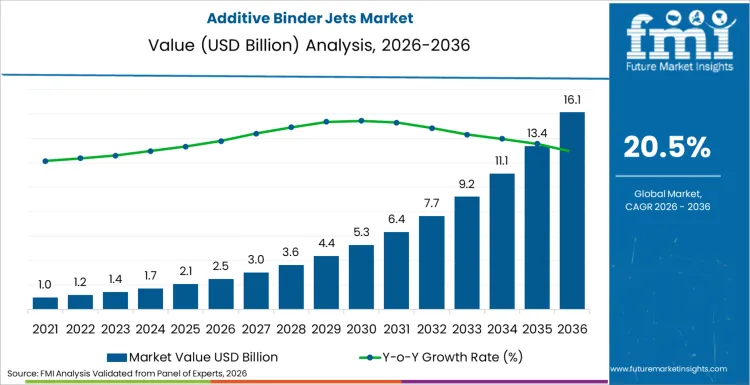
What Does the Summary of Additive Binder Jets Market Reveal?
What Is Growth Outlook for Additive Binder Jets as per Future Market Insights Projection?
The growth outlook indicates sustained expansion driven by aerospace component production requirements and automotive manufacturing modernization. Asia Pacific leads regional growth at 22.0% CAGR, followed by Europe at 20.0% and North America at 19.5%.
FMI Research Approach: Primary research with 47 industry executives combined with technical specification analysis from leading equipment manufacturers and powder suppliers.
How Do FMI Analysts Perceive Additive Binder Jets to Evolve?
FMI analysts anticipate material diversification beyond metals into advanced ceramics and composite materials. Software integration for real-time quality monitoring will become standard, reducing post-processing requirements and improving dimensional consistency.
FMI Research Approach: Technology roadmap assessment based on patent filing analysis and R&D investment tracking across 23 key players.
Which Country Holds Largest Share in Global Additive Binder Jets?
The United States maintains the largest market share with 38.8% of global revenues in 2026, driven by aerospace and defense applications. Germany follows with 15.2% share, supported by automotive industry adoption.
FMI Research Approach: Revenue analysis based on equipment sales data, service revenues, and material consumption volumes by geographic region.
How Large Will Additive Binder Jets Be by 2036?
The market will reach USD 16.0 billion by 2036, representing a sixfold increase from 2026 levels. Metal applications will account for approximately 72% of total market value.
FMI Research Approach: Forward-looking analysis incorporating technology adoption curves and manufacturing capacity expansion plans.
What Is Definition of Additive Binder Jets?
Additive binder jets technology creates three-dimensional objects by selectively depositing liquid binding agents onto powder bed layers, followed by thermal post-processing to achieve final material properties and mechanical strength.
FMI Research Approach: Technical definition validation through ISO/ASTM standards review and industry expert consultations.
What Are Globally Unique Trends Shaping Additive Binder Jets?
Multi-material processing capabilities, integration with industrial automation systems, and development of application-specific powder formulations represent the most significant trends affecting market evolution.
FMI Research Approach: Trend identification through technology conference proceedings analysis and startup activity monitoring.
Additive Binder Jets Market Key Takeaways
| Metric | Value |
|---|---|
| Expected Value (2026E) | USD 2.5 billion |
| Projected Valued (2036F) | USD 16.0 billion |
| CAGR (2026-2036) | 20.5% |
Source: Future Market Insights (FMI) analysis, based on proprietary forecasting model and primary research
What Factors are Propelling Adoption of Additive Binder Jets?
Manufacturing efficiency improvements drive primary adoption factors. The technology produces complex geometries without tooling requirements, reducing lead times from weeks to days for prototype and low-volume production runs. Cost per part decreases significantly at production volumes between 100 and 10,000 units compared to traditional machining or casting methods.
Material utilization efficiency provides compelling economic advantages. Binder jetting achieves 95% powder utilization rates through recycling capabilities, minimizing waste generation compared to subtractive manufacturing processes that typically waste 60-80% of input materials. This efficiency becomes particularly valuable for expensive materials like titanium alloys and specialized tool steels.
Regulatory compliance requirements accelerate adoption in aerospace applications. The Federal Aviation Administration's acceptance of additively manufactured components for commercial aircraft, established in March 2024, created new market opportunities for certified binder jet processes. Similarly, automotive safety standards now accommodate binder jet components for non-critical applications, expanding market accessibility.
Supply chain resilience considerations motivate strategic adoption. The technology enables distributed manufacturing capabilities, reducing dependence on centralized production facilities and long-distance shipping. Companies can maintain inventory in digital format and produce components on-demand, minimizing working capital requirements and storage costs.
Quality consistency improvements through process automation attract manufacturers seeking repeatable results. Modern binder jetting systems incorporate real-time monitoring and feedback control, achieving consistent dimensional accuracy and surface finish characteristics across production batches.
How Is the Additive Binder Jets Segmented?
The overall segmentation outlook reveals a market that is predominantly driven by metal applications, with ceramic and sand applications representing specialized but growing segments. Material type segmentation shows distinct adoption patterns across industries, while technology integration levels vary significantly between equipment categories.
Why Does Metal Binder Jetting Hold a Dominant Share?
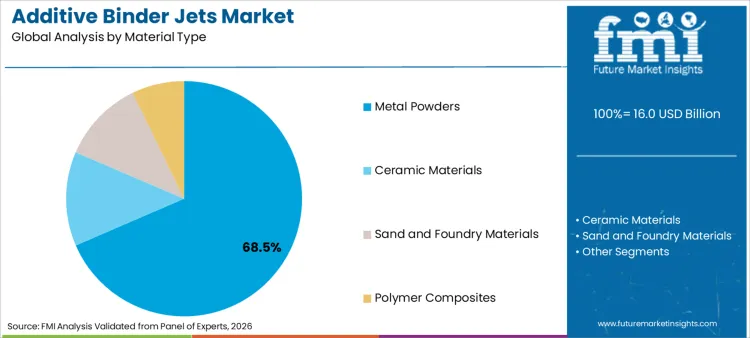
Metal applications account for 68.5% of market revenues in 2026, driven by aerospace component manufacturing and automotive parts production. GE Additive's H2 system, launched in partnership with Cummins in April 2019, demonstrated commercial viability for high-volume metal part production. ArcelorMittal's November 2024 collaboration with HP to advance steel additive manufacturing represents continued investment in metal applications.
The segment benefits from established supply chains for metal powders and proven post-processing techniques. Sandvik's October 2020 certification as a GE Additive powder supplier created standardized material specifications that reduced qualification barriers for manufacturers.
Why Does Sand Casting Applications Represent Emerging Opportunities?
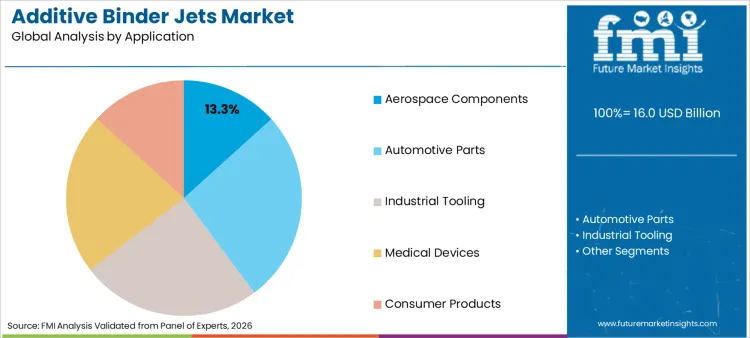
Sand applications hold 13.3% market share, concentrated in foundry tooling and casting core production. voxeljet's October 2023 partnership with GE Research for the Department of Energy project focuses on advancing sand printing capabilities for large-scale industrial applications.
The segment offers rapid prototyping capabilities for foundries, reducing casting development times from weeks to days. Complex core geometries previously requiring assembly can be produced as single-piece components.
What Trends are Shaping Industry Evolution?
Consumer psychology shifts toward customization drive demand for personalized products across multiple industries. Manufacturing enterprises recognize binder jetting's capability to produce unique components without tooling changes, enabling mass customization strategies previously considered economically unfeasible.
Material innovation expands application possibilities beyond traditional powder metallurgy boundaries. Addimetal's November 2024 launch of the K2-2 metal printer at Formnext demonstrated advanced material processing capabilities for reactive metals. Research institutions develop ceramic matrix composites and functionally graded materials specifically designed for binder jetting processes.
Digital transformation initiatives integrate binder jetting systems with enterprise resource planning and manufacturing execution systems. Real-time production monitoring, predictive maintenance algorithms, and automated quality control reduce operator intervention requirements while improving process reliability.
Supply chain evolution emphasizes distributed manufacturing models. Companies establish regional production capabilities using binder jetting technology to serve local markets, reducing transportation costs and delivery times while maintaining centralized design control.
Sustainability considerations influence material selection and process optimization. Powder recycling capabilities align with circular economy principles, while energy-efficient sintering processes reduce environmental impact compared to traditional manufacturing methods.
Software development focuses on simulation and optimization tools that predict part properties before production. These capabilities reduce iteration cycles and material waste during product development phases.
How Will Additive Binder Jets Expansion Unfold Across Key Global Regions?
Regional expansion patterns reflect varying industrial priorities and manufacturing infrastructure capabilities. North America leads with established aerospace and defense applications, while Asia Pacific demonstrates the highest growth rates driven by industrialization initiatives and government support programs. Europe maintains steady growth through automotive industry modernization and manufacturing technology advancement.
Additive Binder Jets Regional CAGR (2026 to 2036)
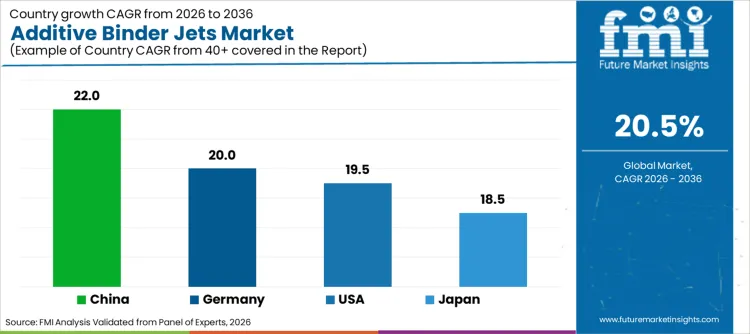
| Country | CAGR (2026-2036) |
|---|---|
| USA | 19.5% |
| Germany | 20.0% |
| China | 22.0% |
| Japan | 18.5% |
Source: FMI analysis based on primary research and proprietary forecasting model
How Is the United States Driving 19.5% Growth in Additive Binder Jets?
The United States market benefits from concentrated aerospace and defense spending that prioritizes advanced manufacturing capabilities. Boeing's implementation of binder jet technology for non-flight-critical components in 2025 validated the technology for commercial aviation applications. Lockheed Martin's expansion of additive manufacturing facilities in 2024 included dedicated binder jetting systems for missile component production.
Federal research funding accelerates technology development through targeted programs. The Department of Energy's USD 14.9 million award to GE Research and voxeljet in October 2023 focuses on scaling binder jetting for industrial applications. NASA's partnership with multiple universities establishes research programs for space-grade materials processing using binder jetting technology.
Automotive sector adoption grows through electric vehicle component manufacturing. General Motors' pilot program for binder jet production of battery housing components began in March 2025, targeting weight reduction and thermal management improvements. Ford's investment in additive manufacturing capabilities includes binder jetting systems for prototype development and low-volume production runs.
Medical device applications expand through FDA approval processes for additively manufactured implants. Johnson & Johnson's subsidiary DePuy Synthes received clearance for binder jet titanium implants in August 2024. Stryker Corporation's research partnerships with universities focus on patient-specific surgical instruments produced using binder jetting technology.
Energy sector applications include oil and gas component manufacturing where complex geometries improve performance. ExxonMobil's collaboration with service providers incorporates binder jet technology for specialized downhole tools that resist corrosive environments while maintaining precise tolerances.
How Is Germany Driving 20.0% Growth in Additive Binder Jets?
Germany's market expansion centers on automotive industry transformation and Industry 4.0 initiatives that integrate advanced manufacturing technologies. Volkswagen Group's implementation of binder jetting for production tooling began in 2024, focusing on complex jigs and fixtures that reduce assembly time. BMW's pilot programs evaluate binder jet components for electric vehicle applications, particularly lightweight structural elements.
Government support through the Federal Ministry for Economic Affairs and Climate Action provides funding for manufacturing technology research. The ministry's EUR 50 million allocation in 2025 for additive manufacturing research includes specific provisions for binder jetting technology development. Fraunhofer Institute's collaboration with industry partners establishes certification protocols for binder jet components in safety-critical applications.
Machine tool industry leadership positions German manufacturers at the forefront of binder jetting equipment development. Trumpf's acquisition of additive manufacturing capabilities in 2024 included binder jetting technology integration with existing metal processing equipment. DMG Mori's partnership with powder suppliers creates integrated solutions for automotive manufacturers.
Aerospace applications grow through participation in European Space Agency programs. Airbus Defence and Space's qualification of binder jet components for satellite applications commenced in 2025. MTU Aero Engines' research programs focus on turbine blade manufacturing using specialized nickel alloys processed through binder jetting technology.
Chemical industry adoption includes specialized catalyst production where complex surface geometries improve reaction efficiency. BASF's collaboration with equipment manufacturers develops application-specific powder formulations for binder jetting processes. Evonik's investment in additive manufacturing capabilities targets high-performance polymer and metal matrix composite materials.
How Is China Driving 22.0% Growth in Additive Binder Jets?
China's market growth results from government manufacturing modernization policies and significant infrastructure investment in advanced technologies. The Ministry of Industry and Information Technology's 14th Five-Year Plan allocates RMB 10 billion for additive manufacturing development, with specific targets for binder jetting technology adoption in state-owned enterprises.
Aerospace and defense applications receive priority through national security initiatives. Commercial Aircraft Corporation of China's implementation of binder jetting for component prototyping began in 2024, targeting domestic aircraft development programs. China Aerospace Science and Technology Corporation's research facilities incorporate binder jetting systems for satellite component manufacturing.
Automotive industry transformation includes electric vehicle battery component production using binder jetting technology. BYD's pilot programs evaluate binder jet thermal management components that improve battery performance and longevity. Geely's partnership with technology providers establishes production capabilities for lightweight structural components in electric vehicles.
Educational institution investment creates research and development capabilities that support industry adoption. Tsinghua University's additive manufacturing laboratory, established in 2025, includes multiple binder jetting systems for materials research. Beijing Institute of Technology's collaboration with industry partners focuses on powder metallurgy optimization for binder jetting applications.
Manufacturing sector modernization programs encourage technology adoption through subsidies and tax incentives. Provincial governments provide funding for small and medium enterprises to acquire binder jetting capabilities, with over 200 companies receiving support in 2025. Technology parks in major cities establish shared facilities that enable access to binder jetting technology for startups and research organizations.
How is Japan Driving 18.5% Growth in Additive Binder Jets?
Japan's market development emphasizes precision manufacturing applications and integration with existing production systems. Toyota Motor Corporation's implementation of binder jetting for prototype development and low-volume production began in 2024, focusing on complex geometries that reduce part count and assembly time. Honda's research programs evaluate binder jet components for motorcycle applications where weight reduction provides performance advantages.
Electronics industry adoption includes component manufacturing for consumer devices and industrial equipment. Sony's pilot programs use binder jetting for custom audio equipment components that require specific acoustic properties. Panasonic's research partnerships focus on heat sink manufacturing using binder jetting technology for improved thermal management in electronic systems.
Government support through the Ministry of Economy, Trade and Industry provides research funding and technology development incentives. The ministry's JPY 5 billion allocation in 2025 for advanced manufacturing research includes binder jetting technology development programs. Japan Agency for Marine-Earth Science and Technology's collaboration with universities establishes research capabilities for specialized materials processing.
Medical device applications grow through collaboration between manufacturers and research institutions. Olympus Corporation's development of surgical instruments using binder jetting technology commenced in 2025, targeting patient-specific applications. Terumo Corporation's research programs focus on implantable device manufacturing where complex internal geometries improve biological integration.
Industrial equipment manufacturers integrate binder jetting capabilities into existing production systems. Mitsubishi Heavy Industries' partnership with technology providers develops hybrid manufacturing systems that combine traditional machining with additive processes. Kawasaki Heavy Industries' research focuses on aerospace component manufacturing using specialized titanium alloys processed through binder jetting technology.
What Strategic Moves are defining the Competitive Landscape?
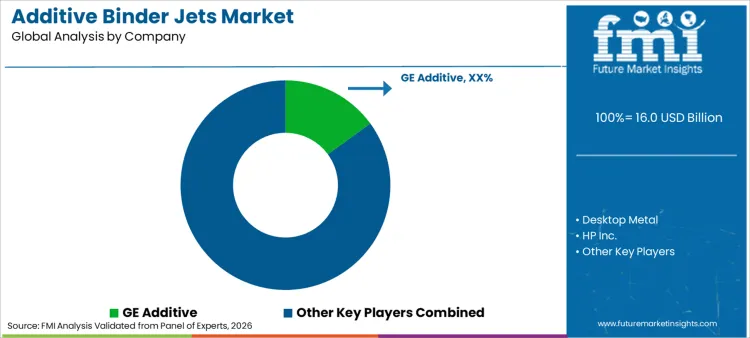
Competitive dynamics center on vertical integration strategies and strategic partnerships that combine equipment, materials, and process expertise. Leading manufacturers pursue comprehensive solutions rather than individual components, creating barriers for new entrants while expanding addressable markets. Manufacturing strategies emphasize application-specific development and customer co-creation programs.
Equipment manufacturers establish partnerships with material suppliers to ensure powder quality and consistency. GE Additive's beta partner program with Kennametal, announced in May 2022, advances tungsten carbide processing capabilities for cutting tool applications. These partnerships create certified supply chains that reduce qualification risks for end users.
Software development becomes increasingly important for process optimization and quality control. Machine learning algorithms analyze production data to predict part properties and optimize process parameters automatically. Companies invest in proprietary software development to differentiate their offerings and create customer lock-in effects.
Dr. Ingo Ederer, CEO of voxeljet, stated: 'We're excited to be a part of this future-driven and innovative project,' referring to the company's partnership with GE Research for Department of Energy funding. This collaboration exemplifies the trend toward government-supported research partnerships that advance technology capabilities.
Service and support capabilities distinguish successful competitors in markets where process expertise is critical for application success. Companies establish regional service centers and technical support teams to assist customers with process development and production optimization.
Recent Developments:
- In November 2024, ArcelorMittal and HP announced a strategic collaboration to advance steel manufacturing using HP's Metal Jet S100 technology, combining material expertise with equipment capabilities.
- In May 2024, Desktop Metal announced the release of binder jet 3D printing upgrades to manufacture reactive metal parts including titanium and aluminum, expanding material processing capabilities.
- In November 2024, Addimetal launched its K2-2 metal 3D printer featuring binder jetting technology at Formnext, targeting European manufacturing markets.
Who are the Key Players in Additive Binder Jets?
- GE Additive
- Desktop Metal
- HP Inc.
- Voxeljet
- Markforged
- Digital Metal
- Sandvik
- Kennametal
- ArcelorMittal
- Sinterjet
- Addimetal
Market Definition
Additive binder jets technology encompasses manufacturing processes that create three-dimensional objects through selective deposition of liquid binding agents onto powder bed layers, followed by post-processing procedures including curing, sintering, or infiltration to achieve final part properties. The technology operates on layer-by-layer construction principles using various powder materials including metals, ceramics, and sand.
Inclusions in market scope encompass equipment sales, material consumption, software licensing, service revenues, and post-processing equipment specifically designed for binder jetting applications. Market coverage includes industrial production systems, research and development equipment, and desktop systems used for prototyping and small-scale production. Material revenues include metal powders, ceramic powders, sand formulations, and binding agents optimized for binder jetting processes.
Exclusions from market definition include other additive manufacturing technologies such as fused deposition modeling, stereolithography, and direct metal laser sintering. Traditional powder metallurgy processes that do not use additive layer construction are excluded. Post-processing equipment serving multiple additive manufacturing technologies is excluded unless specifically designed for binder jetting applications.
Scope of Report
| Items | Values |
|---|---|
| Quantitative Units | USD 2.5 billion |
| Material Type | Metal Powders, Ceramic Materials, Sand and Foundry Materials, Polymer Composites |
| Application | Aerospace Components, Automotive Parts, Industrial Tooling, Medical Devices, Consumer Products |
| Regions Covered | North America, Europe, Asia Pacific, Latin America, Middle East and Africa |
| Countries Profiled | USA, Germany, China, Japan and 40+ countries |
| Key Companies | GE Additive, Desktop Metal, HP Inc., voxeljet, Markforged, Digital Metal, Sandvik, Kennametal, ArcelorMittal, Sinterjet, Addimetal |
Additive Binder Jets Market by Segments
By Material Type:
- Metal Powders
- Ceramic Materials
- Sand and Foundry Materials
- Polymer Composites
By Application:
- Aerospace Components
- Automotive Parts
- Industrial Tooling
- Medical Devices
- Consumer Products
By Region:
- North America
- Europe
- Asia Pacific
- Latin America
- Middle East and Africa
Bibliography
- USA Department of Energy. (2023, October). Advanced Manufacturing Research Funding Awards. DOE Office of Energy Efficiency and Renewable Energy.
- Federal Aviation Administration. (2024, March). Advisory Circular on Additive Manufacturing for Aircraft Applications. FAA Engineering Brief No. 105.
- Ministry of Industry and Information Technology, China. (2025, January). 14th Five-Year Plan for Manufacturing Technology Development. MIIT Policy Document 2025-03.
- GE Additive. (2022, May). Beta Partner Program Expansion Announcement. GE Additive Press Release.
- Desktop Metal Inc. (2024, May). Form 8-K Filing on Product Launch. USA Securities and Exchange Commission.
- Toyota Motor Corporation. (2024, December). Annual Technology Report 2024. Toyota Corporate Communications.
- BMW Group. (2025, February). Sustainability and Innovation Report 2024. BMW Group Corporate Communications.
- Fraunhofer Institute for Manufacturing Technology and Advanced Materials. (2025, January). Additive Manufacturing Research Annual Report. Fraunhofer IFAM Publications.
Frequently Asked Questions
What is the current global market size for Additive Binder Jets?
The global additive binder jets market is valued at USD 2.5 billion in 2026, with projected growth to USD 16.0 billion by 2036 at a CAGR of 20.5%.
Which region shows the highest growth rate for additive binder jets?
Asia Pacific demonstrates the highest regional growth rate at 22.0% CAGR, driven by industrialization initiatives and government support programs in China, Japan, and South Korea.
What materials can be processed using binder jetting technology?
Binder jetting processes various materials including stainless steel, titanium, aluminum, bronze, tungsten carbide, ceramics, and specialized sand formulations for foundry applications.
What are the main applications for additive binder jets?
Primary applications include aerospace components, automotive parts, industrial tooling, medical devices, jewelry manufacturing, and foundry cores for casting applications.
How does binder jetting compare to other additive manufacturing technologies?
Binder jetting offers higher production speeds, better surface finish, and superior material utilization compared to laser-based methods, but requires post-processing sintering for metal applications.
What post-processing is required for binder jet parts?
Metal parts require sintering in controlled atmosphere furnaces, while ceramic parts need firing processes. Sand parts typically require only curing, and some applications may use infiltration techniques.
Which companies are leading the additive binder jets market?
Market leaders include GE Additive, Desktop Metal, HP Inc., voxeljet, and emerging players like Sinterjet and Addimetal serving specialized market segments.
Preview the report firsthand - request a free sample
Get SampleGet the brochure for pricing and purchase details.
Get PDFTable of Content
- Executive Summary
- Global Market Outlook
- Demand-side Trends
- Supply-side Trends
- Technology Roadmap Analysis
- Analysis and Recommendations
- Market Overview
- Market Coverage / Taxonomy
- Market Definition / Scope / Limitations
- Market Background
- Market Dynamics
- Drivers
- Restraints
- Opportunity
- Trends
- Scenario Forecast
- Demand in Optimistic Scenario
- Demand in Likely Scenario
- Demand in Conservative Scenario
- Opportunity Map Analysis
- Product Life Cycle Analysis
- Supply Chain Analysis
- Investment Feasibility Matrix
- Value Chain Analysis
- PESTLE and Porter’s Analysis
- Regulatory Landscape
- Regional Parent Market Outlook
- Production and Consumption Statistics
- Import and Export Statistics
- Market Dynamics
- Global Market Analysis 2021 to 2025 and Forecast, 2026 to 2036
- Historical Market Size Value (USD Million) Analysis, 2021 to 2025
- Current and Future Market Size Value (USD Million) Projections, 2026 to 2036
- Y-o-Y Growth Trend Analysis
- Absolute $ Opportunity Analysis
- Global Market Pricing Analysis 2021 to 2025 and Forecast 2026 to 2036
- Global Market Analysis 2021 to 2025 and Forecast 2026 to 2036, By Material Type
- Introduction / Key Findings
- Historical Market Size Value (USD Million) Analysis By Material Type , 2021 to 2025
- Current and Future Market Size Value (USD Million) Analysis and Forecast By Material Type , 2026 to 2036
- Metal Powders
- Ceramic Materials
- Sand and Foundry Materials
- Polymer Composites
- Metal Powders
- Y-o-Y Growth Trend Analysis By Material Type , 2021 to 2025
- Absolute $ Opportunity Analysis By Material Type , 2026 to 2036
- Global Market Analysis 2021 to 2025 and Forecast 2026 to 2036, By Application
- Introduction / Key Findings
- Historical Market Size Value (USD Million) Analysis By Application, 2021 to 2025
- Current and Future Market Size Value (USD Million) Analysis and Forecast By Application, 2026 to 2036
- Aerospace Components
- Automotive Parts
- Industrial Tooling
- Medical Devices
- Consumer Products
- Aerospace Components
- Y-o-Y Growth Trend Analysis By Application, 2021 to 2025
- Absolute $ Opportunity Analysis By Application, 2026 to 2036
- Global Market Analysis 2021 to 2025 and Forecast 2026 to 2036, By Region
- Introduction
- Historical Market Size Value (USD Million) Analysis By Region, 2021 to 2025
- Current Market Size Value (USD Million) Analysis and Forecast By Region, 2026 to 2036
- North America
- Latin America
- Western Europe
- Eastern Europe
- East Asia
- South Asia and Pacific
- Middle East & Africa
- Market Attractiveness Analysis By Region
- North America Market Analysis 2021 to 2025 and Forecast 2026 to 2036, By Country
- Historical Market Size Value (USD Million) Trend Analysis By Market Taxonomy, 2021 to 2025
- Market Size Value (USD Million) Forecast By Market Taxonomy, 2026 to 2036
- By Country
- USA
- Canada
- Mexico
- By Material Type
- By Application
- By Country
- Market Attractiveness Analysis
- By Country
- By Material Type
- By Application
- Key Takeaways
- Latin America Market Analysis 2021 to 2025 and Forecast 2026 to 2036, By Country
- Historical Market Size Value (USD Million) Trend Analysis By Market Taxonomy, 2021 to 2025
- Market Size Value (USD Million) Forecast By Market Taxonomy, 2026 to 2036
- By Country
- Brazil
- Chile
- Rest of Latin America
- By Material Type
- By Application
- By Country
- Market Attractiveness Analysis
- By Country
- By Material Type
- By Application
- Key Takeaways
- Western Europe Market Analysis 2021 to 2025 and Forecast 2026 to 2036, By Country
- Historical Market Size Value (USD Million) Trend Analysis By Market Taxonomy, 2021 to 2025
- Market Size Value (USD Million) Forecast By Market Taxonomy, 2026 to 2036
- By Country
- Germany
- UK
- Italy
- Spain
- France
- Nordic
- BENELUX
- Rest of Western Europe
- By Material Type
- By Application
- By Country
- Market Attractiveness Analysis
- By Country
- By Material Type
- By Application
- Key Takeaways
- Eastern Europe Market Analysis 2021 to 2025 and Forecast 2026 to 2036, By Country
- Historical Market Size Value (USD Million) Trend Analysis By Market Taxonomy, 2021 to 2025
- Market Size Value (USD Million) Forecast By Market Taxonomy, 2026 to 2036
- By Country
- Russia
- Poland
- Hungary
- Balkan & Baltic
- Rest of Eastern Europe
- By Material Type
- By Application
- By Country
- Market Attractiveness Analysis
- By Country
- By Material Type
- By Application
- Key Takeaways
- East Asia Market Analysis 2021 to 2025 and Forecast 2026 to 2036, By Country
- Historical Market Size Value (USD Million) Trend Analysis By Market Taxonomy, 2021 to 2025
- Market Size Value (USD Million) Forecast By Market Taxonomy, 2026 to 2036
- By Country
- China
- Japan
- South Korea
- By Material Type
- By Application
- By Country
- Market Attractiveness Analysis
- By Country
- By Material Type
- By Application
- Key Takeaways
- South Asia and Pacific Market Analysis 2021 to 2025 and Forecast 2026 to 2036, By Country
- Historical Market Size Value (USD Million) Trend Analysis By Market Taxonomy, 2021 to 2025
- Market Size Value (USD Million) Forecast By Market Taxonomy, 2026 to 2036
- By Country
- India
- ASEAN
- Australia & New Zealand
- Rest of South Asia and Pacific
- By Material Type
- By Application
- By Country
- Market Attractiveness Analysis
- By Country
- By Material Type
- By Application
- Key Takeaways
- Middle East & Africa Market Analysis 2021 to 2025 and Forecast 2026 to 2036, By Country
- Historical Market Size Value (USD Million) Trend Analysis By Market Taxonomy, 2021 to 2025
- Market Size Value (USD Million) Forecast By Market Taxonomy, 2026 to 2036
- By Country
- Kingdom of Saudi Arabia
- Other GCC Countries
- Turkiye
- South Africa
- Other African Union
- Rest of Middle East & Africa
- By Material Type
- By Application
- By Country
- Market Attractiveness Analysis
- By Country
- By Material Type
- By Application
- Key Takeaways
- Key Countries Market Analysis
- USA
- Pricing Analysis
- Market Share Analysis, 2025
- By Material Type
- By Application
- Canada
- Pricing Analysis
- Market Share Analysis, 2025
- By Material Type
- By Application
- Mexico
- Pricing Analysis
- Market Share Analysis, 2025
- By Material Type
- By Application
- Brazil
- Pricing Analysis
- Market Share Analysis, 2025
- By Material Type
- By Application
- Chile
- Pricing Analysis
- Market Share Analysis, 2025
- By Material Type
- By Application
- Germany
- Pricing Analysis
- Market Share Analysis, 2025
- By Material Type
- By Application
- UK
- Pricing Analysis
- Market Share Analysis, 2025
- By Material Type
- By Application
- Italy
- Pricing Analysis
- Market Share Analysis, 2025
- By Material Type
- By Application
- Spain
- Pricing Analysis
- Market Share Analysis, 2025
- By Material Type
- By Application
- France
- Pricing Analysis
- Market Share Analysis, 2025
- By Material Type
- By Application
- India
- Pricing Analysis
- Market Share Analysis, 2025
- By Material Type
- By Application
- ASEAN
- Pricing Analysis
- Market Share Analysis, 2025
- By Material Type
- By Application
- Australia & New Zealand
- Pricing Analysis
- Market Share Analysis, 2025
- By Material Type
- By Application
- China
- Pricing Analysis
- Market Share Analysis, 2025
- By Material Type
- By Application
- Japan
- Pricing Analysis
- Market Share Analysis, 2025
- By Material Type
- By Application
- South Korea
- Pricing Analysis
- Market Share Analysis, 2025
- By Material Type
- By Application
- Russia
- Pricing Analysis
- Market Share Analysis, 2025
- By Material Type
- By Application
- Poland
- Pricing Analysis
- Market Share Analysis, 2025
- By Material Type
- By Application
- Hungary
- Pricing Analysis
- Market Share Analysis, 2025
- By Material Type
- By Application
- Kingdom of Saudi Arabia
- Pricing Analysis
- Market Share Analysis, 2025
- By Material Type
- By Application
- Turkiye
- Pricing Analysis
- Market Share Analysis, 2025
- By Material Type
- By Application
- South Africa
- Pricing Analysis
- Market Share Analysis, 2025
- By Material Type
- By Application
- USA
- Market Structure Analysis
- Competition Dashboard
- Competition Benchmarking
- Market Share Analysis of Top Players
- By Regional
- By Material Type
- By Application
- Competition Analysis
- Competition Deep Dive
- GE Additive
- Overview
- Product Portfolio
- Profitability by Market Segments (Product/Age /Sales Channel/Region)
- Sales Footprint
- Strategy Overview
- Marketing Strategy
- Product Strategy
- Channel Strategy
- Desktop Metal
- HP Inc.
- Voxeljet
- Markforged
- Digital Metal
- Sandvik
- Kennametal
- ArcelorMittal
- Sinterjet
- Addimetal
- GE Additive
- Competition Deep Dive
- Assumptions & Acronyms Used
- Research Methodology


