

- Industry Size (2026)
- USD 95.7 Mn
- Forecast (2036)
- USD 206.6 Mn
- CAGR (2026 to 2036)
- 8.0%
Additively Manufactured Lattice Structure Mechanical Test Systems Market Size, Market Forecast and Outlook By FMI
The additively manufactured lattice structure mechanical test systems market was valued at USD 88.6 million in 2025. Revenue is expected to reach USD 95.7 million in 2026 and exceed USD 206.6 million by 2036 at an 8.0% CAGR during the forecast period. Steady capital deployment is expected to take the market to USD 206.6 million by 2036, as structural engineering teams adopt high-frequency optical tracking within mechanical testing equipment to detect lattice instability before visible deformation appears.
Aerospace validation teams are working with printed cellular geometries that fail in ways conventional tester frames were never designed to capture. Standard mechanical testing equipment records bulk displacement effectively, yet lattice structures often begin to fail through internal buckling well before any external distortion can be seen. That leaves procurement teams exposed when they rely on older systems for qualification work, especially where subtle failure onset determines whether a design moves forward or returns for rework. Regulators are placing greater weight on evidence that finite-element models match physical behavior under cyclic loading. Medical implant producers that delay equipment upgrades are left with slower validation cycles and heavier dependence on manual inspection. FMI notes that this gap is pushing capital spending toward systems that combine high-resolution load cells with synchronized digital image correlation.
Summary of Additively Manufactured Lattice Structure Mechanical Test Systems Market
- Market Snapshot
- The market for additively manufactured lattice structure mechanical test systems stands at USD 88.6 million in 2025 and is projected to reach USD 206.6 million by 2036, supported by an 8.0% CAGR from 2026 to 2036 as lattice components move deeper into regulated and fatigue‑sensitive programs.
- Buyers continue to prioritize compression accuracy, repeatability, software traceability, and AM‑specific fixture design, as these requirements shape qualification outcomes more directly than a lower upfront machine price.
- Demand aligns closely with ISO/ASTM qualification stages, particularly when lattice structures transition from early design exploration toward validated structural or biomedical applications that demand controlled mechanical verification.
- Demand and Growth Drivers
- Demand is rising as lattice components enter medical, aerospace, and industrial qualification cycles where consistent compression, tensile, and fatigue testing becomes essential for certification.
- Metal lattice testing continues to gain traction because LPBF and similar metal AM routes require closer validation of orientation effects, porosity distribution, and post‑processing variability.
- National laboratories and universities contribute to steady expansion through ongoing work in lattice optimization and metrology, which broadens the installed base of mechanical testing platforms.
- India is anticipated to see demand grow at a 10.8% CAGR, followed by China at 10.1% and South Korea at 8.7%. Germany is estimated at 8.0%, the United States at 7.6%, the United Kingdom at 7.1%, and Japan at 6.9% as each market deepens its research and qualification activity.
- Procurement cycles often extend because many users require custom fixtures, AM‑specific sample preparation, and multi‑mode validation protocols, even after budget approval and technical justification.
- Product and Segment View
- The market includes compression systems, tensile systems, fatigue rigs, hybrid frames, and supporting software used to assess metallic, polymeric, ceramic, and composite lattice structures in research labs, aerospace qualification, medical‑implant testing, and AM process development.
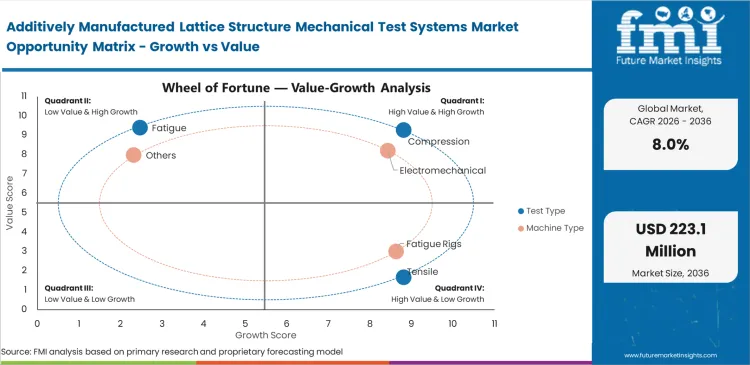
- Compression testing remains the starting point for most lattice evaluations due to its role in benchmarking stiffness and collapse behavior. The compression segment is expected to account for 41% share in 2026, reflecting its position in early screening workflows. Many labs rely on this mode to establish baseline performance.
- Electromechanical systems continue to serve as the primary choice for quasi‑static compression and tensile tests in research and pre‑qualification stages. The electromechanical category is anticipated to hold 46% share in 2026, supported by stable control capabilities and straightforward integration.
- Metal lattice programs show deeper testing intensity across LPBF titanium, stainless steel, and aluminum, encouraging greater investment in advanced mechanical validation. The metal lattice category is forecast to represent 49% market share in 2026, driven by broader adoption of metal AM across regulated sectors. One additional sentence ensures smooth closure.
- Research institutes remain the leading end‑user group because universities and national labs conduct early experimentation on lattice topologies and mechanical characterization methods. The research‑institute segment is poised to garner 34% share in 2026 as institutions expand their AM testing capabilities.
- Load ranges up to 100 kN align with most lattice coupon tests and lightweighting applications. The up‑to‑100‑kN segment is expected to secure 44% share in 2026, supported by the load requirements of biomedical and structural lightweight geometries. This load band continues to dominate initial qualification work.
- The scope includes standalone test frames, fatigue systems, grips, fixtures, chambers, and software aligned with AM lattice characterization, while excluding hardness testers, metrology‑only platforms, and full AM production lines.
- Geography and Competitive Outlook
- India is poised to record a 10.8% CAGR through 2036 for AM lattice testing systems as aerospace suppliers, research centers, and medical‑device developers increase qualification work. Rising institutional investment strengthens this trajectory.
- China is expected to witness demand for lattice testing systems rise at a 10.1% CAGR during the assessment period, supported by rapid growth in metal AM adoption across aerospace, tooling, and university networks. Expanding LPBF capacity continues to elevate testing requirements.
- South Korea is set to post a 8.7% CAGR through 2036 as government‑supported AM programs and lightweighting initiatives raise the need for controlled mechanical validation. Testing infrastructure continues to mature steadily.
- Germany is projected to register a 8.0% CAGR by 2036 in line with expanding lattice qualification within automotive and engineering firms. Strong institutional capability keeps Germany an active testing market.
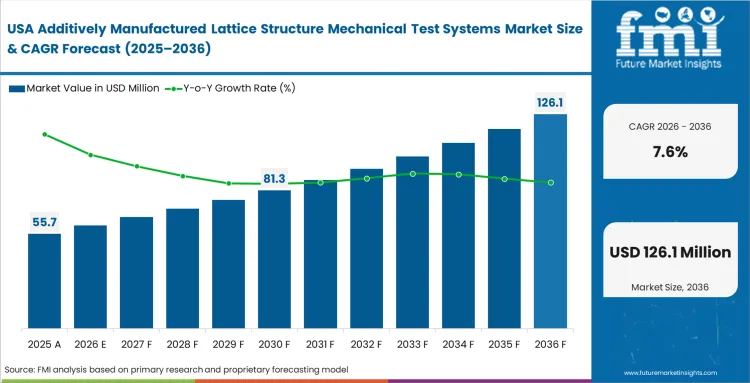
- The United States market is anticipated to see steady expansion at a 7.6% CAGR, underpinned by an extensive installed base of testing systems and long‑established research activity. Universities and aerospace suppliers sustain consistent demand.
- The United Kingdom is expected to post 7.1% CAGR during the forecast period, while Japan is likely to record 6.9% CAGR through 2036, each supported by active research ecosystems and regulated industrial programs. Both markets maintain predictable upgrade patterns.
- Competition is shaped by application‑specific selling, software integration, and fixture customization rather than volume‑driven machine supply. ZwickRoell, Instron, Shimadzu, MTS Systems, and ADMET remain central participants, with Tinius Olsen and Hegewald & Peschke adding broader capabilities across materials‑testing portfolios. The market stays expertise‑driven because vendors specialize in different parts of the lattice‑testing workflow.
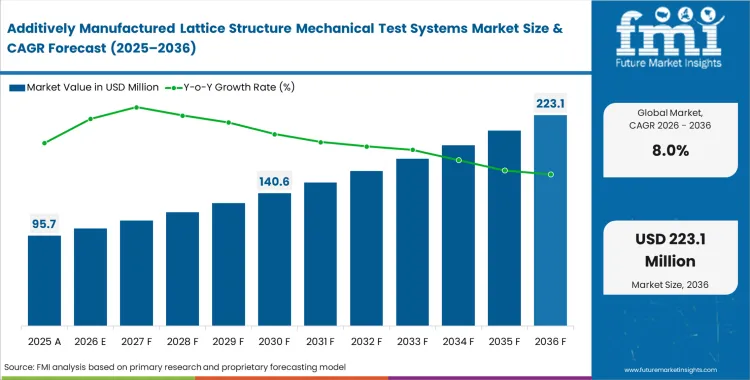
Certification requirements in aviation are likely to shape the next round of equipment purchases once empirical fatigue thresholds for internal lattice nodes become a formal part of qualification. Conventional validation methods do not measure porosity variation or density gradients with the precision these structures demand. Laboratory managers need equipment that can map stress behavior across variable-density parts in far greater detail if they are to keep pace with compliance requirements and broader adoption of lattice-based designs.
Domestic qualification infrastructure is expanding quickly in India, and demand for these systems is forecast to rise at a CAGR of 10.8% through 2036. China follows closely at 10.1%, supported by continued aerospace prototyping activity and wider use of printed structural components in development programs. South Korea is set to record 8.7% CAGR over the same period as automotive lightweighting programs create more demand for accurate lattice validation. Germany benefits from a strong precision-engineering base using advanced ISO ASTM 52927 protocols, which keeps the market on track for 8.0% CAGR by 2036. In the United States, sales are expected to increase at a CAGR of 7.6% as buyers build on a mature installed base and replace older systems with higher-resolution platforms. The United Kingdom is projected to grow at 7.1%, while Japan is likely to post 6.9% CAGR as replacement demand centers on high-temperature mechanical testing equipment.
Segmental Analysis
Additively Manufactured Lattice Structure Mechanical Test Systems Market Analysis by Test Type
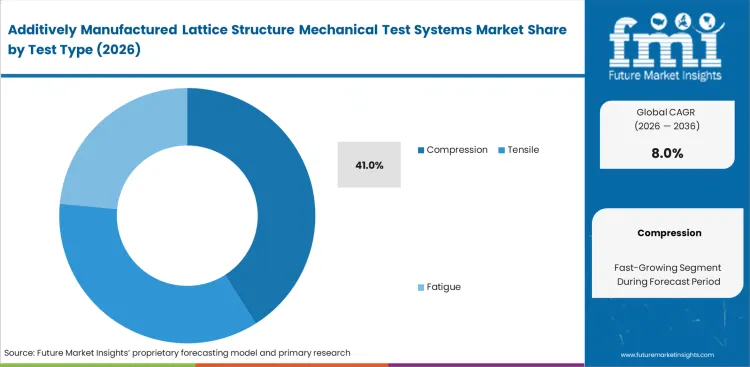
Standard crush-resistance evaluations in energy-absorbing applications define this segment. Compression rigs are estimated to account for 41.0% share in 2026. FMI’s assessment indicates packaging engineers favor lattice compression testing systems because cellular topologies are primarily designed to absorb impact energy through controlled deformation. Evaluating energy dissipation requires precise crosshead displacement tracking during bulk compression. Most tensile testing machine setups struggle with porous grips. Bulk material testing protocols often miss how edge-effect crushing at platen interfaces can invalidate core lattice data. Specialized fixtures for 3D printed lattice compression tests help reduce this boundary failure. Testing managers who ignore platen interaction effects often generate artificial failure data that cannot support regulatory approval.
- Platen interaction: Bare metal plates crush surface nodes prematurely. Laboratory directors need compliant intermediate layers to distribute loads more evenly. Incorrect interface materials can lead to rejected validation reports.
- Deformation mapping: Internal struts collapse in sequence. Quality assurance heads integrate optical tracking to capture this non-linear progression. Systems without digital image correlation miss critical internal failure mechanisms.
- Energy quantification: Software calculates the area under stress-strain curves. Materials scientists use these values to assess precise dissipation performance in crash structures. Weak software integration leaves designers guessing actual impact behavior.
Additively Manufactured Lattice Structure Mechanical Test Systems Market Analysis by Machine Type
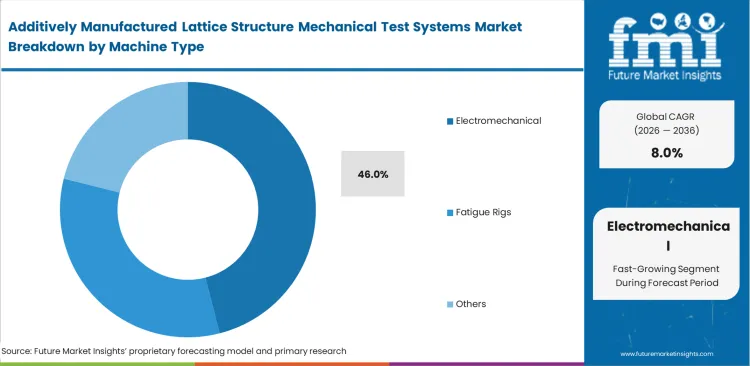
Precise crosshead control during low-force testing continues to support the use of electromechanical platforms in lattice applications, particularly where thin-walled metals and polymers are tested. Ball-screw mechanisms provide stable, low-noise displacement rates that suit progressive strut-collapse tracking, while servo-hydraulic systems can introduce signal noise that obscures subtle failure events. FMI’s view is that laboratories focused on high-resolution lattice behavior increasingly treat electromechanical systems as core testing assets rather than optional upgrades. The electromechanical category is projected to secure 46.0% share in 2026, reflecting this preference for cleaner signal capture and stronger programmability. Total ownership costs remain above those of basic hydraulic rigs because precision drivetrains require tighter calibration control, yet facilities reduce hydraulic fluid handling and lower contamination risk in clean testing environments. Medical and implant-focused laboratories operating legacy hydraulic systems continue to face recurring maintenance burdens and greater exposure during compliance audits.
- Resolution sensitivity: Standard load cells miss micro-fractures. Test engineers install low-capacity sensors to track individual strut snapping. Over-specifying load capacity obliterates critical low-force data.
- Maintenance overhead: Screw mechanisms require pristine environments. Facilities managers face high calibration costs for precision drivetrains. Neglected maintenance causes crosshead stutter and invalidates delicate tests.
- Cleanroom compatibility: Medical evaluations prohibit hydraulic fluid. Quality directors specify enclosed electromechanical frames for implant validation. Contamination events from legacy systems halt entire production lines.
Additively Manufactured Lattice Structure Mechanical Test Systems Market Analysis by Material Focus
Metal lattices are anticipated to hold 49.0% share in 2026. Metallurgists need rigorous data on titanium and aluminum cellular structures exposed to extreme cyclical stresses using an ISO ASTM 52909 orientation testing machine. Equipment must handle high fracture toughness without damaging sensitive extensometers. FMI observes that specialized biomaterial tester rigs adapted for metals often lack the stiffness required for titanium lattices. What generalist engineers misunderstand is that brittle failures in printed metals release sudden energy bursts capable of shattering optical tracking lenses mounted too closely. Testing directors must invest in protective shielding that complicates optical calibration. Organizations ignoring high-energy fracture risks experience severe equipment damage during routine evaluations.
- High-energy fracture: Titanium struts snap violently. Laboratory managers install polycarbonate shielding to protect digital correlation cameras. Unprotected lenses suffer damage during routine tension tests.
- Grip slippage: Hard printed metals destroy standard jaw faces. Procurement teams must source specialized diamond-coated grips for secure clamping. Standard grips slip and ruin expensive printed samples.
- Temperature control: Aerospace parts operate hot. Test engineers integrate induction heating coils to evaluate high-temperature fatigue. Room-temperature tests provide zero value for turbine component qualification.
Additively Manufactured Lattice Structure Mechanical Test Systems Market Analysis by End User
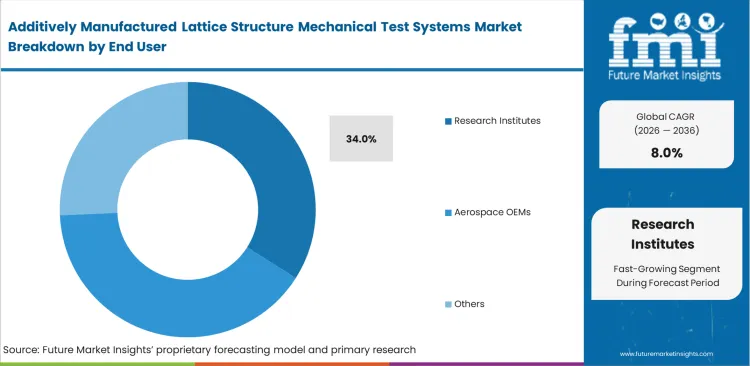
Baseline material characterization and early‑stage concept validation are concentrated in academic and public‑research environments. Research institutes are poised to garner 34.0% share in 2026, as principal investigators run exploratory programs on novel lattice designs before industry partners formalize them into commercial specifications. These laboratories need broad flexibility to test diverse polymers, metals, and ceramics on the same frame, while many commercial aerospace testers are optimized for narrower material envelopes. Rigs in academic settings are frequently modified with open‑source controllers and custom instrumentation, which improves experimental freedom but complicates traceability. OEMs that adopt academic results without re‑validation on certified commercial additive manufacturing coupon testing systems encounter gaps when moving into formal qualification. FMI’s view is that research‑institute infrastructure functions best as a discovery and pre‑screening environment, with clear handover protocols into regulated industrial lines.
- Versatility requirement: Academic projects span multiple materials. Principal investigators demand modular grips and interchangeable load cells. Rigid industrial machines limit experimental scope and frustrate researchers.
- Open-source integration: Researchers modify standard protocols. Laboratory heads connect custom sensor arrays via open APIs. Closed-system architectures prevent advanced experimental data capture.
- Data portability: Commercial partners demand standardized reports. Quality directors struggle to convert academic output into certified compliance documents. Poorly formatted data delays technology transfer to commercial lines.
Additively Manufactured Lattice Structure Mechanical Test Systems Market Analysis by Load Range
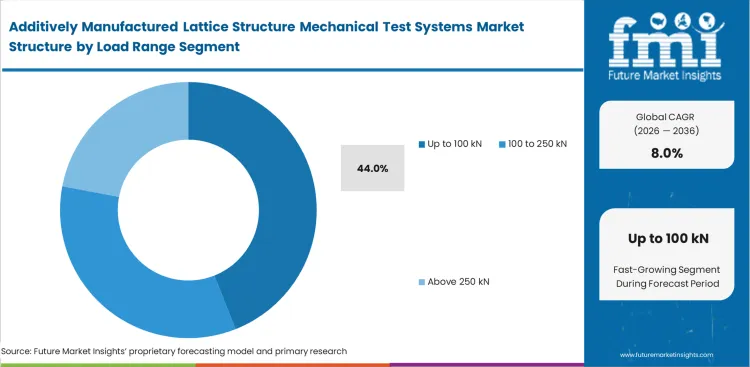
Systems up to 100 kN are expected to represent 44.0% share in 2026. Biomechanical engineers testing orthopedic implants operate well within this range using a dedicated load frame for lattice coupons. The focus shifts from raw power to extreme sensitivity and control resolution. Specialized construction material testing equipment built for concrete provides far too much capacity and zero necessary precision. What procurement departments misunderstand is that a 250 kN frame is not "better" just because it has higher capacity; large frames introduce mechanical inertia that obscures the micro-fracture signatures of 50 kN lattice tests. Facilities buying oversized machines to future-proof their labs actively degrade their current testing accuracy.
- Inertial masking: Heavy crossheads dampen high-frequency signals. Test engineers struggle to detect single-strut failures on oversized frames. Rightsizing equipment ensures clean data resolution.
- Sensor matching: Low-force events require matched cells. Laboratory directors must swap massive sensors for delicate 10 kN units during micro-lattice work. Using 100 kN sensors for 5 kN tests produces unacceptable noise.
- Footprint efficiency: Medical labs possess limited space. Facilities managers prefer compact 50 kN benchtop units for routine quality checks. Massive floor-standing frames waste valuable cleanroom real estate.
Additively Manufactured Lattice Structure Mechanical Test Systems Market Drivers, Restraints, and Opportunities
Regulatory review in medical implants leaves little room for assumption when porous osseointegrative structures are involved. Conventional solid titanium implants benefit from decades of fatigue evidence, while printed lattices enter evaluation with a far thinner validation base. Clearance depends on proving how these porous geometries perform under long-duration cyclic loading that reflects years of walking stress. That burden falls on physical testing because irregular lattice architectures still exceed the reliability of simulation alone. Biomechanical teams can model part of the behavior, yet software does not capture every failure path inside complex cellular networks. Manufacturers that delay investment in dedicated fatigue testing and measurement systems slow their own path to approval, and that delay directly affects the launch of higher-margin implant programs.
Testing capacity is further constrained by the way these samples must be prepared before a single load cycle begins. Porous structures cannot be gripped like conventional metal coupons because standard jaws crush the ends and distort the test. Laboratories often resort to custom potting methods or print solid interface sections simply to hold the specimen securely. Days can be lost in preparation, even when the actual tension or fatigue test takes far less time. Aerospace metallurgy teams encounter the same issue, with engineers spending substantial time embedding lattice ends in epoxy before they can generate usable data. Throughput will remain limited until equipment suppliers offer clamping systems built for variable-density lattice structures rather than relying on adaptations of hardware designed for solid materials.
Opportunities in the Additively Manufactured Lattice Structure Mechanical Test Systems Market
- In-situ optical integration: Quality assurance directors need native digital image correlation software built directly into frame controllers rather than relying on clumsy third-party camera systems.
- Automated potting stations: Manufacturing engineers require standardized sample preparation tools that quickly cast epoxy gripping ends onto porous test blocks without manual alignment.
- Multi-axial rigs: Aerospace structural designers seek machines capable of applying simultaneous torsion and compression to validate complex turbine geometries under realistic flight conditions.
Regional Analysis
Based on regional analysis, Additively Manufactured Lattice Structure Mechanical Test Systems Market is segmented into North America, Europe, Asia Pacific, and other regions across 40 plus countries.
.webp "Top Country Growth Comparison Additively Manufactured Lattice Structure Mechanical Test Systems Market Cagr (2026 2036)")
| Country | CAGR (2026 to 2036) |
|---|---|
| India | 10.8% |
| China | 10.1% |
| South Korea | 8.7% |
| Germany | 8.0% |
| United States | 7.6% |
| United Kingdom | 7.1% |
| Japan | 6.9% |
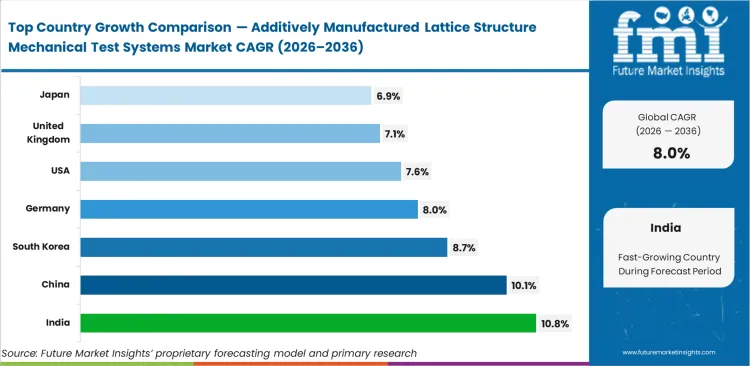
Source: Future Market Insights (FMI) analysis, based on proprietary forecasting model and primary research
Asia Pacific Additively Manufactured Lattice Structure Mechanical Test Systems Market Analysis
Domestic qualification infrastructure scaling drives regional momentum across Asian markets. Governments heavily subsidize advanced manufacturing hubs to reduce reliance on Western testing protocols. FMI's analysis indicates local service bureaus face pressure to validate indigenous printer outputs against international aerospace standards. This requires immediate procurement of sophisticated dynamic frames capable of handling complex geometries. Buyers prioritize cost-effective but highly sensitive rigs over massive high-capacity industrial machines. The region displays a stark split between academic installations focusing on basic characterization and commercial aerospace suppliers demanding rigorous fatigue documentation.
- India: Expanding domestic defense manufacturing forces testing laboratories in the India additive manufacturing test systems industry to rapidly scale their structural validation capabilities. Laboratory heads at regional defense research institutes urgently procure specialized electromechanical fatigue setups to validate lightweight drone and missile components featuring printed cellular cores. Without these dedicated test frames, local defense contractors cannot certify novel generative designs for flight. Adoption of these lattice mechanical test systems across India is anticipated to advance at a CAGR of 10.8% by 2036. Procurement directors face a narrow window to establish this internal testing capacity before international prime contractors lock in their regional supply chains. Service bureaus upgrading to advanced optical tracking and multi-axial compression immediately secure lucrative Tier-1 aerospace validation contracts that were previously outsourced to European facilities.
- China: The market for additively manufactured lattice structure mechanical test systems in China is poised to expand at a CAGR of 10.1% through 2036. Massive state-funded aerospace prototyping investments dictate procurement cycles across the China AM lattice testing segment. Structural engineers at state-owned aviation enterprises require large volumes of empirical failure data to train indigenous generative design algorithms and reduce reliance on imported simulation software. This data-hungry environment requires fully automated, multi-station test frames capable of running thousands of lattice coupons continuously. Quality assurance directors often struggle with the practical execution of these high-volume test programs. Integrating locally sourced 3d metrology scanning hardware with imported European test frame controllers creates severe software compatibility bottlenecks that frequently delay the release of critical turbine qualification data.
- South Korea: Automotive lightweighting programs are forcing vehicle manufacturers in South Korea to reassess how they validate additively manufactured structures. Engineering teams are testing printed energy-absorbing bumper designs that behave very differently from conventional stamped components, and that shift exposes the limits of standard crash validation infrastructure. Traditional uniaxial frames do not reproduce the combined compression and shear loads these lattice structures face during impact, which is why R&D teams are moving toward custom multi-axial compression setups. Demand for AM testing equipment in South Korea is forecast to rise at a CAGR of 8.7% from 2026 to 2036. As these systems enter automotive development labs, validation moves earlier into the design cycle and reduces dependence on repeated physical prototype rounds. Teams that build reliable crash-correlation models around these test platforms can shorten development timelines for next-generation EV structures and make design decisions with greater confidence.
- Japan: Demand for specialized lattice testing equipment across Japan is anticipated to rise at a CAGR of 6.9% through 2036. Extreme high-temperature propulsion applications define the procurement strategy for the Japan AM mechanical testing systems sector. Metallurgists at major turbine manufacturers actively replace legacy hydraulic bulk material frames with highly precise electromechanical drives specifically suited for delicate aerospace lattices operating in extreme thermal environments. Testing these superalloy cellular structures at room temperature provides zero actionable data for flight qualification. Procurement teams focus exclusively on sensor precision and thermal chamber integration rather than raw load capacity. Facilities investing in these advanced environmental test rigs position themselves as the sole qualified suppliers for next-generation hydrogen turbine components, effectively locking out regional competitors who rely on standard ambient-temperature validation.
FMI's report includes detailed analysis of emerging manufacturing hubs across Southeast Asia. Local governments actively fund university laboratories to establish baseline testing standards for regional industries.
Europe Additively Manufactured Lattice Structure Mechanical Test Systems Market Analysis
Dense precision-engineering ecosystems define the European testing environment. Automotive and aerospace sectors operate with deeply integrated supply chains requiring unified validation standards. FMI observes that certification bodies dictate extremely rigid protocols for physical testing, driving demand for highly calibrated, fully automated rigs. Laboratories cannot rely on theoretical simulations; they must produce physical proof of fatigue limits. Buyers favor established European equipment manufacturers due to localized support and guaranteed calibration services. The emphasis rests entirely on traceability and strict compliance with evolving ISO/ASTM additive manufacturing mandates.
- Germany: Complex industrial qualification programs force continuous equipment modernization across the Germany lattice testing equipment market. Quality assurance directors at elite automotive OEMs and medical device firms deploy fully integrated dynamic frames to physically test porous cooling structures and orthopedic implants. These organizations cannot risk deploying unvalidated cellular designs into high-liability environments without exhaustive empirical data. The German market for these specialized test systems is expected to grow at a CAGR of 8.0% during the study period. Procurement decisions depend heavily on how seamlessly testing hardware connects with existing digital engineering platforms. Tight synchronization between advanced metrology software and electromechanical test controllers establishes a highly automated validation loop, pushing the national testing infrastructure toward fully autonomous quality assurance workflows by the end of the decade.
- United Kingdom: Sales of lattice mechanical testing systems in the United Kingdom are poised to increase at a CAGR of 7.1% during the assessment period. Specialized aviation and defense testing protocols heavily influence capital expenditure within the United Kingdom. Aerospace engineers require advanced environmental chambers mounted directly onto precision test frames to accurately simulate high-altitude flight conditions on titanium and superalloy lattices. Standard ambient testing facilities cannot secure contracts for next-generation defense projects involving these complex geometries. Testing laboratories must adapt their equipment to meet these extreme environmental testing criteria or risk obsolescence. Facilities that successfully integrate extreme temperature and multi-axial capabilities immediately unlock exclusive defense qualification contracts, capturing high-margin testing revenue that standard commercial laboratories cannot access.
FMI's report includes analysis of aerospace research clusters in France and automotive testing centers in Italy. These specialized hubs drive demand for custom-engineered multi-axial testing solutions.
North America Additively Manufactured Lattice Structure Mechanical Test Systems Market Analysis
Mature installed bases force buyers to focus on specific technological upgrades rather than basic capacity expansion. Aerospace and medical device sectors drive the most stringent requirements. Based on FMI's assessment, laboratory managers prioritize software integration and advanced optical tracking over basic mechanical frame performance. Existing high-capacity machines receive retrofits with sophisticated low-force load cells to handle delicate additive manufacturing and material lattices. The regulatory environment demands absolute data integrity, pushing procurement toward closed-loop systems that automatically sync physical failure events with digital design models.
- United States: Medical device laboratories in the United States already operate advanced testing infrastructure, yet qualifying AM lattice implants demands a different level of capability. Orthopedic manufacturers are using high-frequency fatigue rigs to evaluate porous spinal implants whose osseointegrative designs cannot be validated with the same assumptions applied to solid devices. FDA reviewers treat these printed geometries as a separate qualification challenge and do not accept historical fatigue evidence from conventional implants as a substitute for direct testing. The United States AM lattice qualification systems market is expected to grow at a CAGR of 7.6% from 2026 to 2036. Many procurement teams still misjudge how much this regulatory shift changes equipment requirements inside the lab. Optical strain mapping is moving from an R&D add-on to a core validation requirement because FDA documentation standards increasingly depend on synchronized digital measurement and traceable deformation data. Facilities built around legacy systems often find that those platforms cannot support video correlation workflows, leaving replacement or major upgrades as the only practical path.
FMI's report includes analysis of Canadian aerospace testing centers. These facilities increasingly adopt hybrid testing methodologies combining physical loads with advanced computed tomography scanning.
Competitive Aligners for Market Players
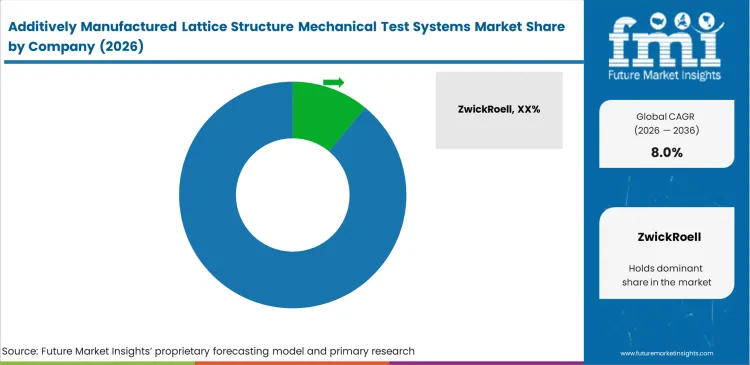
Specialized software integration defines competitive separation far more than mechanical frame strength when buyers evaluate the best testing machine for additively manufactured lattice structures. ZwickRoell and Instron dominate high-end medical implant qualification because their software architectures seamlessly handle non-linear deformation data generated by 3d printing topologies. Buyers evaluate vendors not on load capacity, but on how easily the equipment links physical failure events back to original finite-element simulations. Regional challengers struggle to replicate this deep software ecosystem, forcing them to compete purely on mechanical frame pricing in academic markets.
Incumbents hold massive advantages in environmental chamber integration and specialized gripping solutions. Shimadzu and MTS Systems possess extensive libraries of custom grips designed specifically to hold delicate porous 3d printing materials without crushing boundary nodes. Challengers must engineer these interfaces from scratch for every new client. Establishing a reliable optical tracking sync that works flawlessly inside a heated environmental chamber requires years of proprietary engineering that new entrants cannot bypass simply by purchasing off-the-shelf cameras.
Large aerospace buyers actively resist total vendor lock-in by standardizing their data output formats across multiple equipment brands. Procurement directors at Tier-1 suppliers force test equipment manufacturers to open their APIs before they finalize budgets or request quote AM lattice testing machine packages, allowing custom additive manufacturing with metal powders analytical tools to process raw load data. Equipment vendors who maintain strictly closed software ecosystems risk alienating their largest industrial clients, eventually ceding ground to agile competitors willing to provide raw, unencrypted sensor access.
Key Players in Additively Manufactured Lattice Structure Mechanical Test Systems Market
- ZwickRoell
- Instron
- Shimadzu
- MTS Systems
- ADMET
- Tinius Olsen
- Hegewald & Peschke
Scope of the Report
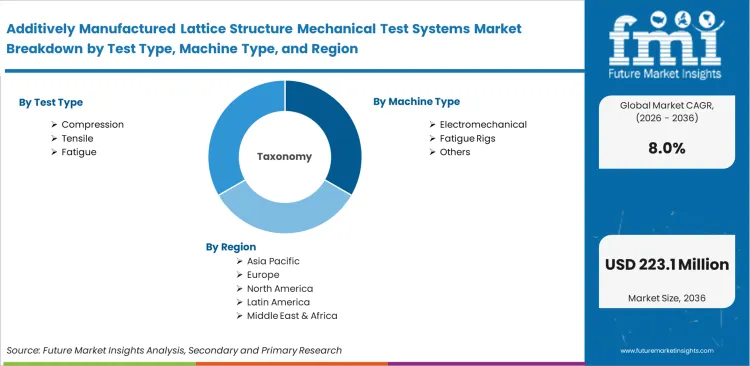
| Metric | Value |
|---|---|
| Quantitative Units | USD 95.7 million to USD 206.6 million, at a CAGR of 8.00% |
| Market Definition | Equipment applies physical loads to additively manufactured cellular topologies to validate structural integrity. Specialized grips prevent local crushing while high-resolution sensors capture internal strut buckling. |
| Segmentation | By Test type, By Machine type, By Material focus, By End user, By Load range, and Region |
| Regions Covered | North America, Latin America, Europe, East Asia, South Asia & Pacific, Middle East & Africa |
| Countries Covered | India, China, South Korea, Germany, United States, United Kingdom, Japan |
| Key Companies Profiled | ZwickRoell, Instron, Shimadzu, MTS Systems, ADMET, Tinius Olsen, Hegewald & Peschke |
| Forecast Period | 2026 to 2036 |
| Approach | Annual capital expenditure on specialized testing frames by major service bureaus and Tier-1 aerospace suppliers. |
Source: Future Market Insights (FMI) analysis, based on proprietary forecasting model and primary research
Additively Manufactured Lattice Structure Mechanical Test Systems Market Analysis by Segments
Test type
- Compression
- Tensile
- Fatigue
- Flexural
- Multi-axial
Machine type
- Electromechanical
- Servo-hydraulic
- Fatigue rigs
- Hybrid rigs
Material focus
- Metal lattices
- Polymer lattices
- Ceramic lattices
- Composite lattices
End user
- Research institutes
- Aerospace OEMs
- Medical device firms
- AM OEMs
- Service bureaus
Load range
- Up to 100 kN
- 100 to 250 kN
- Above 250 kN
Region:
- North America
- United States
- Canada
- Europe
- Germany
- United Kingdom
- France
- Italy
- Spain
- Asia Pacific
- China
- Japan
- South Korea
- Taiwan
- Singapore
- Latin America
- Brazil
- Mexico
- Argentina
- Middle East & Africa
- GCC Countries
- South Africa
Bibliography
- Donmez, A., Fox, J., Kim, F., Lane, B., Praniewicz, M., Tondare, V., Weaver, J., & Witherell, P. (2024). In-process monitoring and non-destructive evaluation for metal additive manufacturing processes (NIST IR 8538). National Institute of Standards and Technology.
- International Organization for Standardization, & ASTM International. (2024). ISO/ASTM 52909:2024 Additive manufacturing of metals-Finished part properties-Orientation and location dependence of mechanical properties for metal parts. International Organization for Standardization.
- Ráž, K., Chval, Z., & Pereira, M. (2024). Lattice structures-Mechanical description with respect to additive manufacturing. Materials, 17(21), 5298.
- Pir, İ., Şahin, S. A., Tufekci, M., & Tüfekci, E. (2024). Evaluation of mechanical properties of additively manufactured beams with lattice structures. In Proceedings of ASME Turbo Expo 2024 (Vol. 10A, Article V10AT23A003). American Society of Mechanical Engineers.
- Peto, M. P. M., García-Ávila, J. G., Rodriguez, C. A., Siller, H. R., da Silva, J. V. L., & Ramírez-Cedillo, E. R. (2024). Review on structural optimization techniques for additively manufactured implantable medical devices. Frontiers in Mechanical Engineering, 10, 1353108.
This bibliography is provided for reader reference. The full FMI report contains the complete reference list with primary source documentation.
This Report Addresses
- Identifies specific optical tracking requirements for validating micro-strut failures in complex aerospace structures.
- Explains platen interaction challenges when compressing energy-absorbing porous topographies.
- Analyzes gripping constraints during high-force tensile tests on titanium aerospace 3d printing materials.
- Maps capacity requirements against delicate low-force data resolution needs for medical implants.
- Details maintenance burdens associated with deploying electromechanical frames in cleanroom environments.
- Highlights regional divergences between basic academic characterization and rigorous commercial fatigue qualification.
- Evaluates proprietary software advantages in syncing finite-element simulations with physical fracture events.
- Quantifies equipment capital expenditure timelines driven by strict aviation certification mandates.
Frequently Asked Questions
What is the market size of additively manufactured lattice structure mechanical test systems?
The market was valued at USD 88.6 million in 2025 and is expected to cross USD 206.6 million by 2036. This 8.00% CAGR reflects the urgent need for structural engineers to capture internal strut buckling using high-frequency optical tracking before macroscopic failure occurs.
What standards apply to testing 3D printed lattice parts?
ISO/ASTM 52927 and ISO/ASTM 52909 dictate rigorous physical validation requirements. These frameworks force manufacturers to move beyond theoretical finite-element simulations and produce empirical data proving how variable-density cellular structures behave under cyclical stress and varying load orientations.
Explain the additively manufactured lattice structure mechanical test systems market?
This sector provides specialized load frames, optical tracking hardware, and software capable of validating the structural integrity of 3D printed cellular topologies. Traditional bulk material testers crush delicate lattices at the grip points, necessitating these purpose-built systems for aerospace and medical qualification.
What is compare compression, tensile, and fatigue systems for AM lattice testing?
Compression rigs measure energy absorption in crash structures. Tensile setups evaluate ultimate tensile strength but require specialized diamond-coated grips to prevent boundary crushing. Fatigue systems apply cyclical loads over millions of cycles to validate the long-term durability of orthopedic implants and aerospace turbine components.
Which companies sell machines for testing 3D printed lattice structures?
ZwickRoell, Instron, Shimadzu, MTS Systems, ADMET, Tinius Olsen, and Hegewald & Peschke lead the market. These vendors provide integrated solutions combining precision mechanical frames with synchronized digital image correlation software to map non-linear deformation paths.
How do ISO ASTM standards affect AM lattice testing equipment demand?
Strict regulatory mandates transform advanced optical strain mapping from an optional research tool into a production requirement. Facilities must upgrade legacy hydraulic frames to precise electromechanical systems to comply with new ISO/ASTM documentation rules regarding micro-fracture traceability.
Give me a vendor shortlist for AM lattice testing systems?
For high-end medical and aerospace qualification requiring deep software integration, ZwickRoell, Instron, and MTS Systems are primary targets. For academic research institutes needing versatile, open-source compatible frames, ADMET and Tinius Olsen offer highly adaptable architectures.
What specific capability separates leading test equipment vendors?
Native integration of digital image correlation software directly into the frame controller allows leaders to map internal non-linear deformation paths. Competitors relying on clumsy third-party camera setups fail to sync physical and optical data seamlessly.
How does South Korea differ from the United Kingdom?
South Korean buyers prioritize multi-axial compression setups for automotive lightweighting initiatives, whereas British facilities demand specialized environmental chambers to simulate extreme flight conditions for 3d printing in aerospace and defense components.
Why do procurement departments over-specify load capacity?
Generalist managers assume massive 250 kN frames provide future-proof utility. This misunderstands lattice physics; heavy crosshead inertia dampens high-frequency signals, obscuring the delicate micro-fracture signatures critical to 3d printed medical implants evaluation.
What changes when testing high-energy titanium lattices?
Brittle struts snap violently, releasing energy bursts capable of shattering optical tracking lenses. Laboratories must install specialized polycarbonate shielding that complicates visual calibration but prevents damage during routine 3d printed medical devices tension tests.
What changes when testing high-energy titanium lattices?
Brittle struts snap violently, releasing energy bursts capable of shattering optical tracking lenses. Laboratories must install specialized polycarbonate shielding that complicates visual calibration but prevents damage during routine 3d printed medical devices tension tests.
Preview the report firsthand - request a free sample
Get SampleGet the brochure for pricing and purchase details.
Get PDFTable of Content
- Executive Summary
- Global Market Outlook
- Demand-side Trends
- Supply-side Trends
- Technology Roadmap Analysis
- Analysis and Recommendations
- Market Overview
- Market Coverage / Taxonomy
- Market Definition / Scope / Limitations
- Research Methodology
- Chapter Orientation
- Analytical Lens and Working Hypotheses
- Market Structure, Signals, and Trend Drivers
- Benchmarking and Cross-market Comparability
- Market Sizing, Forecasting, and Opportunity Mapping
- Research Design and Evidence Framework
- Desk Research Programme (Secondary Evidence)
- Company Annual and Sustainability Reports
- Peer-reviewed Journals and Academic Literature
- Corporate Websites, Product Literature, and Technical Notes
- Earnings Decks and Investor Briefings
- Statutory Filings and Regulatory Disclosures
- Technical White Papers and Standards Notes
- Trade Journals, Industry Magazines, and Analyst Briefs
- Conference Proceedings, Webinars, and Seminar Materials
- Government Statistics Portals and Public Data Releases
- Press Releases and Reputable Media Coverage
- Specialist Newsletters and Curated Briefings
- Sector Databases and Reference Repositories
- FMI Internal Proprietary Databases and Historical Market Datasets
- Subscription Datasets and Paid Sources
- Social Channels, Communities, and Digital Listening Inputs
- Additional Desk Sources
- Expert Input and Fieldwork (Primary Evidence)
- Primary Modes
- Qualitative Interviews and Expert Elicitation
- Quantitative Surveys and Structured Data Capture
- Blended Approach
- Why Primary Evidence is Used
- Field Techniques
- Interviews
- Surveys
- Focus Groups
- Observational and In-context Research
- Social and Community Interactions
- Stakeholder Universe Engaged
- C-suite Leaders
- Board Members
- Presidents and Vice Presidents
- R&D and Innovation Heads
- Technical Specialists
- Domain Subject-matter Experts
- Scientists
- Physicians and Other Healthcare Professionals
- Governance, Ethics, and Data Stewardship
- Research Ethics
- Data Integrity and Handling
- Primary Modes
- Tooling, Models, and Reference Databases
- Desk Research Programme (Secondary Evidence)
- Data Engineering and Model Build
- Data Acquisition and Ingestion
- Cleaning, Normalisation, and Verification
- Synthesis, Triangulation, and Analysis
- Quality Assurance and Audit Trail
- Market Background
- Market Dynamics
- Drivers
- Restraints
- Opportunity
- Trends
- Scenario Forecast
- Demand in Optimistic Scenario
- Demand in Likely Scenario
- Demand in Conservative Scenario
- Opportunity Map Analysis
- Product Life Cycle Analysis
- Supply Chain Analysis
- Investment Feasibility Matrix
- Value Chain Analysis
- PESTLE and Porter’s Analysis
- Regulatory Landscape
- Regional Parent Market Outlook
- Production and Consumption Statistics
- Import and Export Statistics
- Market Dynamics
- Global Market Analysis 2021 to 2025 and Forecast, 2026 to 2036
- Historical Market Size Value (USD Million) Analysis, 2021 to 2025
- Current and Future Market Size Value (USD Million) Projections, 2026 to 2036
- Y-o-Y Growth Trend Analysis
- Absolute $ Opportunity Analysis
- Global Market Pricing Analysis 2021 to 2025 and Forecast 2026 to 2036
- Global Market Analysis 2021 to 2025 and Forecast 2026 to 2036, By Test Type
- Introduction / Key Findings
- Historical Market Size Value (USD Million) Analysis By Test Type , 2021 to 2025
- Current and Future Market Size Value (USD Million) Analysis and Forecast By Test Type , 2026 to 2036
- Compression
- Tensile
- Fatigue
- Compression
- Y-o-Y Growth Trend Analysis By Test Type , 2021 to 2025
- Absolute $ Opportunity Analysis By Test Type , 2026 to 2036
- Global Market Analysis 2021 to 2025 and Forecast 2026 to 2036, By Machine Type
- Introduction / Key Findings
- Historical Market Size Value (USD Million) Analysis By Machine Type, 2021 to 2025
- Current and Future Market Size Value (USD Million) Analysis and Forecast By Machine Type, 2026 to 2036
- Electromechanical
- Fatigue Rigs
- Others
- Electromechanical
- Y-o-Y Growth Trend Analysis By Machine Type, 2021 to 2025
- Absolute $ Opportunity Analysis By Machine Type, 2026 to 2036
- Global Market Analysis 2021 to 2025 and Forecast 2026 to 2036, By Material Focus
- Introduction / Key Findings
- Historical Market Size Value (USD Million) Analysis By Material Focus, 2021 to 2025
- Current and Future Market Size Value (USD Million) Analysis and Forecast By Material Focus, 2026 to 2036
- Metal Lattices
- Polymer Lattices
- Others
- Metal Lattices
- Y-o-Y Growth Trend Analysis By Material Focus, 2021 to 2025
- Absolute $ Opportunity Analysis By Material Focus, 2026 to 2036
- Global Market Analysis 2021 to 2025 and Forecast 2026 to 2036, By End User
- Introduction / Key Findings
- Historical Market Size Value (USD Million) Analysis By End User, 2021 to 2025
- Current and Future Market Size Value (USD Million) Analysis and Forecast By End User, 2026 to 2036
- Research Institutes
- Aerospace OEMs
- Others
- Research Institutes
- Y-o-Y Growth Trend Analysis By End User, 2021 to 2025
- Absolute $ Opportunity Analysis By End User, 2026 to 2036
- Global Market Analysis 2021 to 2025 and Forecast 2026 to 2036, By Load Range
- Introduction / Key Findings
- Historical Market Size Value (USD Million) Analysis By Load Range, 2021 to 2025
- Current and Future Market Size Value (USD Million) Analysis and Forecast By Load Range, 2026 to 2036
- Up to 100 kN
- 100 to 250 kN
- Above 250 kN
- Up to 100 kN
- Y-o-Y Growth Trend Analysis By Load Range, 2021 to 2025
- Absolute $ Opportunity Analysis By Load Range, 2026 to 2036
- Global Market Analysis 2021 to 2025 and Forecast 2026 to 2036, By Region
- Introduction
- Historical Market Size Value (USD Million) Analysis By Region, 2021 to 2025
- Current Market Size Value (USD Million) Analysis and Forecast By Region, 2026 to 2036
- North America
- Latin America
- Western Europe
- Eastern Europe
- East Asia
- South Asia and Pacific
- Middle East & Africa
- Market Attractiveness Analysis By Region
- North America Market Analysis 2021 to 2025 and Forecast 2026 to 2036, By Country
- Historical Market Size Value (USD Million) Trend Analysis By Market Taxonomy, 2021 to 2025
- Market Size Value (USD Million) Forecast By Market Taxonomy, 2026 to 2036
- By Country
- USA
- Canada
- Mexico
- By Test Type
- By Machine Type
- By Material Focus
- By End User
- By Load Range
- By Country
- Market Attractiveness Analysis
- By Country
- By Test Type
- By Machine Type
- By Material Focus
- By End User
- By Load Range
- Key Takeaways
- Latin America Market Analysis 2021 to 2025 and Forecast 2026 to 2036, By Country
- Historical Market Size Value (USD Million) Trend Analysis By Market Taxonomy, 2021 to 2025
- Market Size Value (USD Million) Forecast By Market Taxonomy, 2026 to 2036
- By Country
- Brazil
- Chile
- Rest of Latin America
- By Test Type
- By Machine Type
- By Material Focus
- By End User
- By Load Range
- By Country
- Market Attractiveness Analysis
- By Country
- By Test Type
- By Machine Type
- By Material Focus
- By End User
- By Load Range
- Key Takeaways
- Western Europe Market Analysis 2021 to 2025 and Forecast 2026 to 2036, By Country
- Historical Market Size Value (USD Million) Trend Analysis By Market Taxonomy, 2021 to 2025
- Market Size Value (USD Million) Forecast By Market Taxonomy, 2026 to 2036
- By Country
- Germany
- UK
- Italy
- Spain
- France
- Nordic
- BENELUX
- Rest of Western Europe
- By Test Type
- By Machine Type
- By Material Focus
- By End User
- By Load Range
- By Country
- Market Attractiveness Analysis
- By Country
- By Test Type
- By Machine Type
- By Material Focus
- By End User
- By Load Range
- Key Takeaways
- Eastern Europe Market Analysis 2021 to 2025 and Forecast 2026 to 2036, By Country
- Historical Market Size Value (USD Million) Trend Analysis By Market Taxonomy, 2021 to 2025
- Market Size Value (USD Million) Forecast By Market Taxonomy, 2026 to 2036
- By Country
- Russia
- Poland
- Hungary
- Balkan & Baltic
- Rest of Eastern Europe
- By Test Type
- By Machine Type
- By Material Focus
- By End User
- By Load Range
- By Country
- Market Attractiveness Analysis
- By Country
- By Test Type
- By Machine Type
- By Material Focus
- By End User
- By Load Range
- Key Takeaways
- East Asia Market Analysis 2021 to 2025 and Forecast 2026 to 2036, By Country
- Historical Market Size Value (USD Million) Trend Analysis By Market Taxonomy, 2021 to 2025
- Market Size Value (USD Million) Forecast By Market Taxonomy, 2026 to 2036
- By Country
- China
- Japan
- South Korea
- By Test Type
- By Machine Type
- By Material Focus
- By End User
- By Load Range
- By Country
- Market Attractiveness Analysis
- By Country
- By Test Type
- By Machine Type
- By Material Focus
- By End User
- By Load Range
- Key Takeaways
- South Asia and Pacific Market Analysis 2021 to 2025 and Forecast 2026 to 2036, By Country
- Historical Market Size Value (USD Million) Trend Analysis By Market Taxonomy, 2021 to 2025
- Market Size Value (USD Million) Forecast By Market Taxonomy, 2026 to 2036
- By Country
- India
- ASEAN
- Australia & New Zealand
- Rest of South Asia and Pacific
- By Test Type
- By Machine Type
- By Material Focus
- By End User
- By Load Range
- By Country
- Market Attractiveness Analysis
- By Country
- By Test Type
- By Machine Type
- By Material Focus
- By End User
- By Load Range
- Key Takeaways
- Middle East & Africa Market Analysis 2021 to 2025 and Forecast 2026 to 2036, By Country
- Historical Market Size Value (USD Million) Trend Analysis By Market Taxonomy, 2021 to 2025
- Market Size Value (USD Million) Forecast By Market Taxonomy, 2026 to 2036
- By Country
- Kingdom of Saudi Arabia
- Other GCC Countries
- Turkiye
- South Africa
- Other African Union
- Rest of Middle East & Africa
- By Test Type
- By Machine Type
- By Material Focus
- By End User
- By Load Range
- By Country
- Market Attractiveness Analysis
- By Country
- By Test Type
- By Machine Type
- By Material Focus
- By End User
- By Load Range
- Key Takeaways
- Key Countries Market Analysis
- USA
- Pricing Analysis
- Market Share Analysis, 2025
- By Test Type
- By Machine Type
- By Material Focus
- By End User
- By Load Range
- Canada
- Pricing Analysis
- Market Share Analysis, 2025
- By Test Type
- By Machine Type
- By Material Focus
- By End User
- By Load Range
- Mexico
- Pricing Analysis
- Market Share Analysis, 2025
- By Test Type
- By Machine Type
- By Material Focus
- By End User
- By Load Range
- Brazil
- Pricing Analysis
- Market Share Analysis, 2025
- By Test Type
- By Machine Type
- By Material Focus
- By End User
- By Load Range
- Chile
- Pricing Analysis
- Market Share Analysis, 2025
- By Test Type
- By Machine Type
- By Material Focus
- By End User
- By Load Range
- Germany
- Pricing Analysis
- Market Share Analysis, 2025
- By Test Type
- By Machine Type
- By Material Focus
- By End User
- By Load Range
- UK
- Pricing Analysis
- Market Share Analysis, 2025
- By Test Type
- By Machine Type
- By Material Focus
- By End User
- By Load Range
- Italy
- Pricing Analysis
- Market Share Analysis, 2025
- By Test Type
- By Machine Type
- By Material Focus
- By End User
- By Load Range
- Spain
- Pricing Analysis
- Market Share Analysis, 2025
- By Test Type
- By Machine Type
- By Material Focus
- By End User
- By Load Range
- France
- Pricing Analysis
- Market Share Analysis, 2025
- By Test Type
- By Machine Type
- By Material Focus
- By End User
- By Load Range
- India
- Pricing Analysis
- Market Share Analysis, 2025
- By Test Type
- By Machine Type
- By Material Focus
- By End User
- By Load Range
- ASEAN
- Pricing Analysis
- Market Share Analysis, 2025
- By Test Type
- By Machine Type
- By Material Focus
- By End User
- By Load Range
- Australia & New Zealand
- Pricing Analysis
- Market Share Analysis, 2025
- By Test Type
- By Machine Type
- By Material Focus
- By End User
- By Load Range
- China
- Pricing Analysis
- Market Share Analysis, 2025
- By Test Type
- By Machine Type
- By Material Focus
- By End User
- By Load Range
- Japan
- Pricing Analysis
- Market Share Analysis, 2025
- By Test Type
- By Machine Type
- By Material Focus
- By End User
- By Load Range
- South Korea
- Pricing Analysis
- Market Share Analysis, 2025
- By Test Type
- By Machine Type
- By Material Focus
- By End User
- By Load Range
- Russia
- Pricing Analysis
- Market Share Analysis, 2025
- By Test Type
- By Machine Type
- By Material Focus
- By End User
- By Load Range
- Poland
- Pricing Analysis
- Market Share Analysis, 2025
- By Test Type
- By Machine Type
- By Material Focus
- By End User
- By Load Range
- Hungary
- Pricing Analysis
- Market Share Analysis, 2025
- By Test Type
- By Machine Type
- By Material Focus
- By End User
- By Load Range
- Kingdom of Saudi Arabia
- Pricing Analysis
- Market Share Analysis, 2025
- By Test Type
- By Machine Type
- By Material Focus
- By End User
- By Load Range
- Turkiye
- Pricing Analysis
- Market Share Analysis, 2025
- By Test Type
- By Machine Type
- By Material Focus
- By End User
- By Load Range
- South Africa
- Pricing Analysis
- Market Share Analysis, 2025
- By Test Type
- By Machine Type
- By Material Focus
- By End User
- By Load Range
- USA
- Market Structure Analysis
- Competition Dashboard
- Competition Benchmarking
- Market Share Analysis of Top Players
- By Regional
- By Test Type
- By Machine Type
- By Material Focus
- By End User
- By Load Range
- Competition Analysis
- Competition Deep Dive
- ZwickRoell
- Overview
- Product Portfolio
- Profitability by Market Segments (Product/Age /Sales Channel/Region)
- Sales Footprint
- Strategy Overview
- Marketing Strategy
- Product Strategy
- Channel Strategy
- Instron
- Shimadzu
- MTS Systems
- ADMET
- ZwickRoell
- Competition Deep Dive
- Assumptions & Acronyms Used


