

- Industry Size (2026)
- USD 756.2 Mn
- Forecast (2036)
- USD 2186.1 Mn
- CAGR (2026 to 2036)
- 11.2%
Urban Air Mobility Flight Test Systems Market Forecast and Outlook 2026-2036
Demand for urban air mobility flight test systems is valued at USD 756.2 million in 2026 and is projected to reach USD 2,186.1 million by 2036, expanding at a CAGR of 11.2%. Demand growth is supported by rapid development of eVTOL platforms, certification-driven flight testing, and increased validation needs for autonomous and electric propulsion architectures.
Data acquisition and recording systems represent the leading instrumentation type in global demand due to requirement for high-fidelity flight data capture, real-time performance monitoring, and post-flight analytics across propulsion, avionics, and flight control subsystems. Integration of synchronized sensors and telemetry supports compliance with evolving airworthiness and safety standards.
China, Brazil, South Korea, USA, and Germany emerge as fastest-growing countries, driven by regulatory sandbox programs, public-private test corridors, and sustained investment in advanced air mobility ecosystems. Curtiss-Wright, Safran Data Systems, Collins Aerospace, Honeywell, L3Harris, ACRA Control, Spirent Communications, dSPACE, NI (Emerson Test & Measurement), and Garmin maintain strong positions through certified flight test instrumentation, simulation-linked test platforms, and established aerospace validation expertise.
Quick Stats for Urban Air Mobility Flight Test Systems Market
- Urban Air Mobility Flight Test Systems Market Value (2026): USD 756.2 million
- Urban Air Mobility Flight Test Systems Market Forecast Value (2036): USD 2,186.1 million
- Urban Air Mobility Flight Test Systems Market Forecast CAGR (2026 to 2036): 11.2%
- Leading Instrumentation Type in Global Demand: Data Acquisition & Recording Systems
- Fastest-Growing Countries: China, Brazil, South Korea, USA, Germany
- Top Players in Global Demand: Curtiss-Wright, Safran Data Systems, Collins Aerospace, Honeywell, L3Harris, ACRA Control, Spirent Communications, dSPACE, NI (Emerson Test & Measurement), Garmin
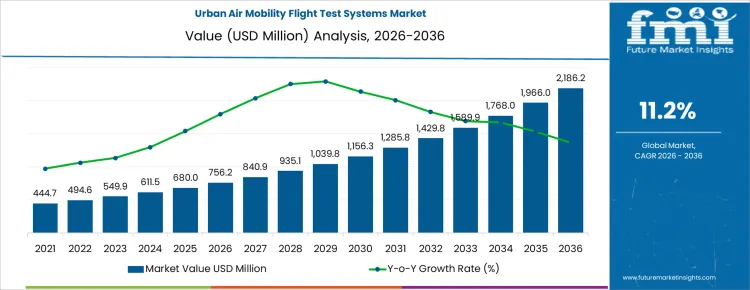
Urban Air Mobility Flight Test Systems Market Key Takeaways
| Metric | Value |
|---|---|
| Market Value (2026) | USD 756.2 million |
| Market Forecast Value (2036) | USD 2,186.1 million |
| Forecast CAGR (2026-2036) | 11.2% |
Why is the Demand for Urban Air Mobility Flight Test Systems Market Growing Globally?
Demand for urban air mobility flight test systems is growing globally due to intensifying development of electric vertical takeoff and landing aircraft, air taxis, and advanced rotorcraft platforms. Manufacturers and research organizations require sophisticated test rigs and instrumentation to validate flight dynamics, propulsion integration, control systems, and safety protocols under varied urban operational scenarios. Expansion of concept demonstrators and certification programs across multiple regions increases flight test activity, which strengthens procurement of ground support systems, telemetry, and sensor suites. Regulatory authorities globally are defining frameworks for airspace integration, noise standards, and collision avoidance performance, which drives structured testing prior to commercial deployment.
Urban air mobility developers invest in simulation environments and flight test instrumentation to reduce risk, quantify performance margins, and support iterative design improvements. Growth in smart city initiatives fuels interest from municipal stakeholders seeking to evaluate infrastructure readiness and vertiport compatibility. Academic and industry partnerships expand research on traffic management, autonomy, and human factors, increasing usage of test platforms that support integrated system evaluation. Test equipment suppliers develop modular solutions that adapt to diverse aircraft configurations and international certification criteria. Secondary demand stems from pilot training and operational readiness programs aligned with impending service introduction.
How Are the Segments Classified in the Urban Air Mobility Flight Test Systems Market?
Demand for urban air mobility flight test systems globally is shaped by certification readiness, flight safety validation, and rapid prototyping of electric aircraft platforms. Stakeholders evaluate instrumentation accuracy, real-time data integrity, system redundancy, and compatibility with emerging airworthiness frameworks. Adoption patterns reflect intensive test activity across passenger-focused eVTOL programs, cargo platforms, and hybrid-electric aircraft supporting controlled flight envelope expansion.
Which Instrumentation Type Holds the Largest Share of Global Demand?

Data acquisition and recording systems hold 34.0%, representing the largest instrumentation share globally. These systems capture high-frequency flight parameters, structural loads, propulsion behavior, and environmental conditions during test flights. Reliable data logging supports post-flight analysis, fault investigation, and certification documentation. Flight control HIL systems hold 24.0%, enabling validation of control laws and software-hardware interaction. Telemetry and communications account for 22.0%, supporting real-time monitoring and safety oversight. Tracking and range systems hold 20.0%, enabling precise position and trajectory measurement. Instrumentation distribution reflects priority for comprehensive data capture during early flight testing.
Key Points
- Data acquisition leads due to certification and analysis requirements.
- HIL systems support flight control validation.
- Telemetry and tracking ensure real-time safety oversight.
Which Aircraft Type Drives the Highest Demand for Flight Test Systems?
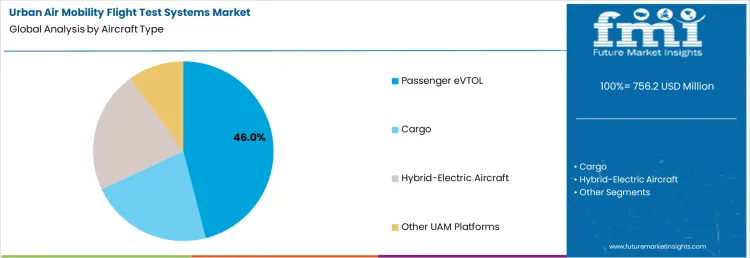
Passenger eVTOL aircraft hold 46.0%, driving the highest global demand. These platforms require extensive testing to validate safety, redundancy, and passenger operations under regulatory scrutiny. Cargo aircraft hold 22.0%, supporting logistics-focused use cases with lower certification complexity. Hybrid-electric aircraft also account for 22.0%, requiring validation of combined propulsion architectures. Other UAM platforms hold 10.0%, covering experimental and niche designs. Aircraft-type distribution reflects dominance of passenger-focused development programs within urban air mobility initiatives.
Key Points
- Passenger eVTOLs dominate due to certification intensity.
- Cargo platforms support logistics-focused validation.
- Hybrid-electric aircraft require propulsion integration testing.
Which End-User Group Represents the Largest Share of Global Demand?
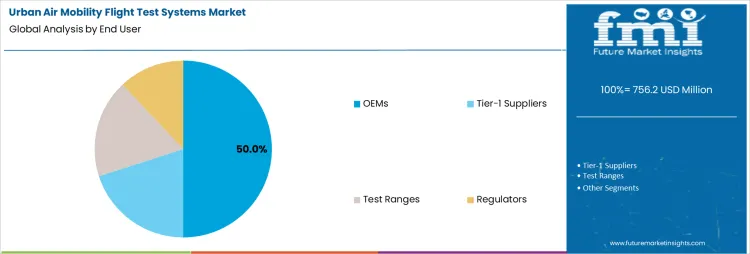
OEMs hold 50.0%, representing the largest end-user share globally. OEMs conduct in-house and contracted flight testing to support design validation, certification readiness, and production planning. Tier-1 suppliers hold 20.0%, validating subsystem performance and integration compatibility. Test ranges account for 18.0%, providing controlled airspace and instrumentation infrastructure. Regulators hold 12.0%, supporting oversight, benchmarking, and standards development. End-user distribution reflects concentration of testing responsibility within aircraft developers.
Key Points
- OEMs lead due to direct responsibility for certification.
- Tier-1 suppliers validate subsystem performance.
- Test ranges and regulators support oversight and standards.
What are the Key Dynamics in the Urban Air Mobility Flight Test Systems Market?
Global demand rises as aerospace manufacturers, government agencies, and research institutions develop and certify urban air mobility (UAM) and eVTOL aircraft requiring rigorous flight test validation. Flight test systems support performance evaluation, control law verification, safety assessment, and airspace integration testing under varied urban environments. Adoption aligns with expanding UAM demonstrator programs, regulatory frameworks, and collaboration between industry and civil aviation authorities worldwide. Usage spans performance measurement instrumentation, telemetry suites, and integrated ground test infrastructure to ensure reliable and safe operation.
How do UAM development programs and regulatory frameworks shape global demand?
Urban air mobility concepts involve novel aircraft configurations, distributed propulsion, and electric propulsion systems requiring comprehensive flight test data. Developers use flight test systems to validate stability, control responsiveness, energy management, and transition between hover and cruise modes. Regulatory bodies in North America, Europe, and Asia-Pacific increasingly publish guidance for type certification pathways, influencing test planning and acceptance criteria. Integration with air traffic management pilots and vertiport operations prompts use of scenarios reflecting real-world mission profiles. Test systems that capture high-fidelity kinematics, environmental sensing, and pilot interaction data support safety evidence packages required for incremental approvals. Collaborative research consortia and industry alliances further standardize test methodologies, enhancing comparability across programs.
How do infrastructure costs, technical complexity, and interoperability requirements influence market growth?
Flight test systems involve significant investment in instrumentation, data telemetry, and ground support infrastructure to handle multi-sensor integration and real-time analysis. Airspace availability and urban flight corridors influence test scheduling, requiring coordination with civil aviation authorities and community engagement. Integration of onboard test instrumentation with external tracking arrays and airspace management systems increases complexity. Emerging digital twin and simulation tools complement physical testing, but require calibration to live data streams. Interoperability between test assets and certification documentation systems adds engineering workload. Global proliferation of UAM standards and test guidelines will influence adoption, while cost, skilled workforce availability, and cross-border data sharing agreements shape long-term scalability of flight test systems worldwide.
How Is Demand for Urban Air Mobility Flight Test Systems Evolving?
Demand for urban air mobility flight test systems is increasing globally due to rapid eVTOL development, certification requirements, and integration of advanced avionics. China leads with a 13.0% CAGR, supported by state-backed UAM programs and large-scale prototype testing. Brazil follows at 12.5%, driven by emerging aerospace innovation hubs and experimental flight activity. South Korea records an 11.1% CAGR, shaped by smart city mobility initiatives and defense-linked aviation research. USA posts 11.0%, reflecting private sector eVTOL development and FAA-driven certification testing. Germany records 10.7%, supported by aerospace engineering expertise and structured validation frameworks. Growth reflects rising flight testing intensity, safety validation needs, and regulatory alignment worldwide.
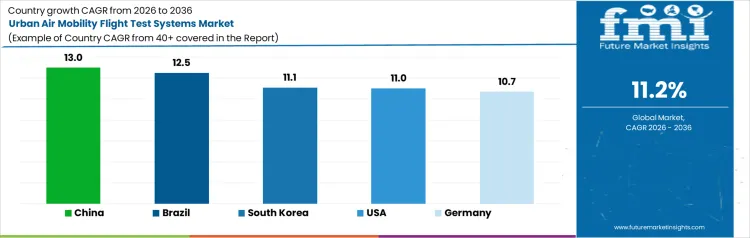
| Country | CAGR (%) |
|---|---|
| China | 13.0 |
| Brazil | 12.5 |
| South Korea | 11.1 |
| USA | 11.0 |
| Germany | 10.7 |
What factors are accelerating adoption of UAM flight test systems in China?
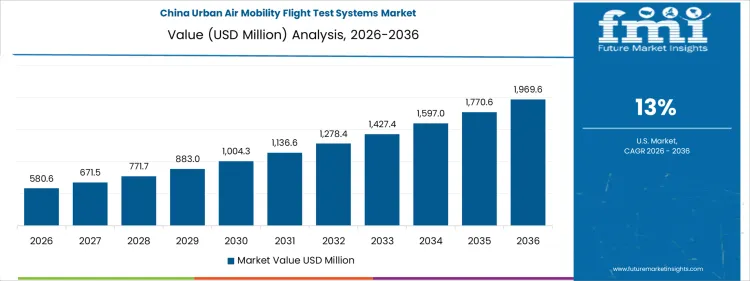
China drives demand through aggressive development of eVTOL platforms, government-supported test corridors, and integrated aerospace manufacturing. Country’s CAGR of 13.0% reflects extensive use of flight test instrumentation, telemetry systems, and real-time data acquisition platforms. Developers conduct repeated envelope expansion, autonomy validation, and propulsion performance testing. State-backed programs accelerate prototype iteration and parallel testing campaigns. Test systems emphasize scalability, redundancy, and integration with digital flight control models. Academic and industrial collaboration supports high test frequency. Growth remains volume-driven and policy-aligned, supported by coordinated national efforts to commercialize urban air mobility platforms.
- Government-backed eVTOL development programs
- High-frequency prototype flight testing
- Integrated telemetry and data acquisition systems
- Parallel testing and rapid iteration capability
Why is Brazil emerging as a fast-growing UAM flight test system market?
Brazil demand is shaped by aerospace innovation programs, experimental aviation culture, and expanding urban mobility research. Country’s CAGR of 12.5% reflects increasing deployment of modular flight test systems for prototype eVTOL aircraft. Test activities focus on flight stability, noise measurement, and propulsion validation. Shared test facilities optimize cost and enable access for startups and research institutions. Collaboration with international partners supports adoption of global testing standards. Demand favors flexible and reconfigurable systems suited for diverse aircraft designs. Growth remains research-led and capability-focused, aligned with gradual progression toward certified urban air mobility operations.
- Experimental and research-driven flight testing
- Shared and cost-efficient test facilities
- Focus on stability, noise, and propulsion metrics
- Modular and reconfigurable test systems
How do smart city initiatives influence UAM test system demand in South Korea?
South Korea demand reflects integration of urban air mobility into smart city planning and advanced transportation research. Country’s CAGR of 11.1% is supported by structured flight testing for autonomy, navigation, and communication systems. Test programs emphasize safety validation within controlled urban environments. Government-backed initiatives promote standardized testing protocols and data integrity. Flight test systems prioritize precision tracking, latency control, and cybersecurity. Demand growth remains technology-driven, aligned with national mobility strategies and emphasis on safe integration of UAM platforms into urban airspace.
- Smart city and UAM integration initiatives
- Emphasis on autonomous flight validation
- Standardized and secure test protocols
- High-precision tracking and telemetry systems
What market dynamics sustain steady UAM flight test system growth in the USA?
USA demand is driven by private eVTOL developers, venture-backed startups, and structured certification pathways. Country’s CAGR of 11.0% reflects extensive flight testing required for FAA compliance, safety demonstration, and performance validation. Developers invest in comprehensive test systems covering propulsion, flight control, and redundancy verification. Test campaigns involve incremental envelope expansion and data-driven certification support. Demand favors high-fidelity instrumentation and analytics platforms. Growth remains commercialization-led, aligned with competitive timelines and regulatory requirements governing urban air mobility deployment.
- FAA-driven certification flight testing
- Private sector eVTOL development activity
- High-fidelity instrumentation and analytics
- Data-driven safety validation processes
How is Germany positioning itself within the global UAM flight test ecosystem?
Germany demand reflects strong aerospace engineering capability, structured certification culture, and industrial research collaboration. Country’s CAGR of 10.7% is supported by adoption of flight test systems for hybrid and electric vertical lift aircraft. Test programs emphasize reliability, redundancy assessment, and system integration validation. Research institutions and manufacturers share test infrastructure to optimize utilization. Compliance with European aviation safety standards shapes test system requirements. Growth remains engineering-led and regulation-aligned, supporting Germany’s role in advancing certified urban air mobility platforms.
- Aerospace engineering and system integration focus
- Shared research and industrial test infrastructure
- Emphasis on reliability and redundancy validation
- Alignment with European aviation safety standards
What is the competitive landscape of demand for urban air mobility flight test systems globally?
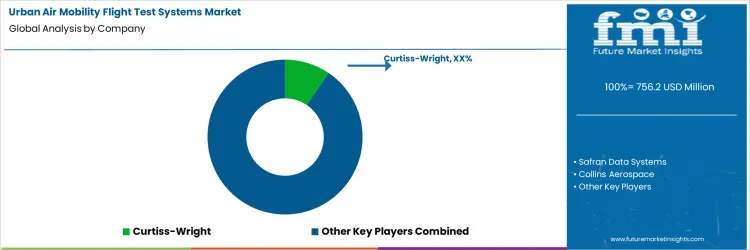
Demand for urban air mobility flight test systems is driven by development of eVTOL aircraft, autonomous flight control architectures, and certification-oriented testing programs. Testing environments require integrated avionics validation, flight control law verification, navigation integrity assessment, and data acquisition across prototype and pre-certification phases. Buyers prioritize real-time data accuracy, redundancy management, deterministic latency, and compliance with evolving civil aviation certification frameworks. Procurement teams assess system interoperability, scalability from ground testing to flight testing, and capability to support hybrid-electric propulsion architectures. Reliability during iterative flight campaigns and availability of aerospace-grade support services influence supplier selection. Trend in the global market reflects convergence of avionics, simulation, and telemetry systems to accelerate certification readiness.
Curtiss-Wright maintains strong positioning through ruggedized flight test instrumentation and data acquisition systems used across aerospace programs. Safran Data Systems supplies telemetry, onboard recording, and tracking solutions supporting real-time flight test monitoring. Collins Aerospace and Honeywell contribute integrated avionics, flight controls, and test support systems aligned with certification pathways. L3Harris supports flight test operations with telemetry, avionics integration, and secure data handling capabilities. ACRA Control provides flight test engineering services and instrumentation tailored to experimental and certification campaigns. Spirent Communications supports navigation and GNSS simulation for flight performance and resilience testing. dSPACE and NI, operating under Emerson Test and Measurement, deliver HIL platforms supporting control system validation prior to flight. Garmin contributes avionics and integrated flight decks adapted for emerging air mobility platforms. Competitive differentiation depends on certification alignment, data integrity, system integration depth, and support for autonomous flight testing.
Key Players in the Urban Air Mobility Flight Test Systems Market
- Curtiss-Wright
- Safran Data Systems
- Collins Aerospace
- Honeywell
- L3Harris
- ACRA Control
- Spirent Communications
- dSPACE
- NI (Emerson Test & Measurement)
- Garmin
Scope of the Report
| Items | Values |
|---|---|
| Quantitative Units | USD million |
| Instrumentation Type | Data Acquisition & Recording Systems; Telemetry & Communications Systems; Flight Control Hardware-in-the-Loop (HIL); Tracking & Range Systems |
| Aircraft Type | Passenger eVTOL Aircraft; Cargo eVTOL Platforms; Hybrid-Electric Aircraft; Other Urban Air Mobility Platforms |
| End User | OEMs; Tier-1 Suppliers; Certified Test Ranges; Aviation Regulators |
| Test Phase | Prototype Flight Testing; Certification & Compliance Testing; Production Validation; In-Service Monitoring |
| Regions Covered | Asia Pacific; Europe; North America; Latin America; Middle East & Africa |
| Countries Covered | USA; China; Germany; Brazil; UK; Japan; South Korea; and 40+ countries |
| Key Companies Profiled | Curtiss-Wright; Safran Data Systems; Collins Aerospace; Honeywell; L3Harris; ACRA Control; Spirent Communications; dSPACE; NI (Emerson Test & Measurement); Garmin |
| Additional Attributes | Market growth is driven by eVTOL certification programs, regulator-led flight safety validation, and rapid prototype iteration. Systems emphasize real-time telemetry, flight control verification, redundancy testing, and scalable data analytics to support certification, fleet entry, and operational monitoring. |
Urban Air Mobility Flight Test Systems Market by Segment
Instrumentation Type:
- Data Acquisition & Recording
- Telemetry & Communications
- Flight Control HIL
- Tracking & Range Systems
Aircraft Type:
- Passenger eVTOL
- Cargo
- Hybrid-Electric Aircraft
- Other UAM Platforms
End User:
- OEMs
- Tier-1 Suppliers
- Test Ranges
- Regulators
Test Phase:
- Prototype
- Certification Testing
- Production
- In-Service Monitoring
Region:
- Asia Pacific
- China
- Japan
- South Korea
- India
- Australia & New Zealand
- ASEAN
- Rest of Asia Pacific
- Europe
- Germany
- United Kingdom
- France
- Italy
- Spain
- Nordic
- BENELUX
- Rest of Europe
- North America
- United States
- Canada
- Mexico
- Latin America
- Brazil
- Chile
- Rest of Latin America
- Middle East & Africa
- Kingdom of Saudi Arabia
- Other GCC Countries
- Turkey
- South Africa
- Other African Union
- Rest of Middle East & Africa
Frequently Asked Questions
How big is the urban air mobility flight test systems market in 2026?
The global urban air mobility flight test systems market is estimated to be valued at USD 756.2 million in 2026.
What will be the size of urban air mobility flight test systems market in 2036?
The market size for the urban air mobility flight test systems market is projected to reach USD 2,186.2 million by 2036.
How much will be the urban air mobility flight test systems market growth between 2026 and 2036?
The urban air mobility flight test systems market is expected to grow at a 11.2% CAGR between 2026 and 2036.
What are the key product types in the urban air mobility flight test systems market?
The key product types in urban air mobility flight test systems market are data acquisition & recording, telemetry & communications, flight control hil and tracking & range systems.
Which aircraft type segment to contribute significant share in the urban air mobility flight test systems market in 2026?
In terms of aircraft type, passenger evtol segment to command 46.0% share in the urban air mobility flight test systems market in 2026.
Preview the report firsthand - request a free sample
Get SampleGet the brochure for pricing and purchase details.
Get PDFTable of Content
- Executive Summary
- Global Market Outlook
- Demand-side Trends
- Supply-side Trends
- Technology Roadmap Analysis
- Analysis and Recommendations
- Market Overview
- Market Coverage / Taxonomy
- Market Definition / Scope / Limitations
- Market Background
- Market Dynamics
- Drivers
- Restraints
- Opportunity
- Trends
- Scenario Forecast
- Demand in Optimistic Scenario
- Demand in Likely Scenario
- Demand in Conservative Scenario
- Opportunity Map Analysis
- Product Life Cycle Analysis
- Supply Chain Analysis
- Investment Feasibility Matrix
- Value Chain Analysis
- PESTLE and Porter’s Analysis
- Regulatory Landscape
- Regional Parent Market Outlook
- Production and Consumption Statistics
- Import and Export Statistics
- Market Dynamics
- Global Market Analysis 2021 to 2025 and Forecast, 2026 to 2036
- Historical Market Size Value (USD Million) Analysis, 2021 to 2025
- Current and Future Market Size Value (USD Million) Projections, 2026 to 2036
- Y-o-Y Growth Trend Analysis
- Absolute $ Opportunity Analysis
- Global Market Pricing Analysis 2021 to 2025 and Forecast 2026 to 2036
- Global Market Analysis 2021 to 2025 and Forecast 2026 to 2036, By Instrumentation Type
- Introduction / Key Findings
- Historical Market Size Value (USD Million) Analysis By Instrumentation Type , 2021 to 2025
- Current and Future Market Size Value (USD Million) Analysis and Forecast By Instrumentation Type , 2026 to 2036
- Data Acquisition & Recording
- Telemetry & Communications
- Flight Control HIL
- Tracking & Range Systems
- Y-o-Y Growth Trend Analysis By Instrumentation Type , 2021 to 2025
- Absolute $ Opportunity Analysis By Instrumentation Type , 2026 to 2036
- Global Market Analysis 2021 to 2025 and Forecast 2026 to 2036, By Aircraft Type
- Introduction / Key Findings
- Historical Market Size Value (USD Million) Analysis By Aircraft Type, 2021 to 2025
- Current and Future Market Size Value (USD Million) Analysis and Forecast By Aircraft Type, 2026 to 2036
- Passenger eVTOL
- Cargo
- Hybrid-Electric Aircraft
- Other UAM Platforms
- Y-o-Y Growth Trend Analysis By Aircraft Type, 2021 to 2025
- Absolute $ Opportunity Analysis By Aircraft Type, 2026 to 2036
- Global Market Analysis 2021 to 2025 and Forecast 2026 to 2036, By End User
- Introduction / Key Findings
- Historical Market Size Value (USD Million) Analysis By End User, 2021 to 2025
- Current and Future Market Size Value (USD Million) Analysis and Forecast By End User, 2026 to 2036
- OEMs
- Tier-1 Suppliers
- Test Ranges
- Regulators
- Y-o-Y Growth Trend Analysis By End User, 2021 to 2025
- Absolute $ Opportunity Analysis By End User, 2026 to 2036
- Global Market Analysis 2021 to 2025 and Forecast 2026 to 2036, By Test Phase
- Introduction / Key Findings
- Historical Market Size Value (USD Million) Analysis By Test Phase, 2021 to 2025
- Current and Future Market Size Value (USD Million) Analysis and Forecast By Test Phase, 2026 to 2036
- Prototype
- Certification Testing
- Production
- In-Service Monitoring
- Y-o-Y Growth Trend Analysis By Test Phase, 2021 to 2025
- Absolute $ Opportunity Analysis By Test Phase, 2026 to 2036
- Global Market Analysis 2021 to 2025 and Forecast 2026 to 2036, By Region
- Introduction
- Historical Market Size Value (USD Million) Analysis By Region, 2021 to 2025
- Current Market Size Value (USD Million) Analysis and Forecast By Region, 2026 to 2036
- North America
- Latin America
- Western Europe
- Eastern Europe
- East Asia
- South Asia and Pacific
- Middle East & Africa
- Market Attractiveness Analysis By Region
- North America Market Analysis 2021 to 2025 and Forecast 2026 to 2036, By Country
- Historical Market Size Value (USD Million) Trend Analysis By Market Taxonomy, 2021 to 2025
- Market Size Value (USD Million) Forecast By Market Taxonomy, 2026 to 2036
- By Country
- USA
- Canada
- Mexico
- By Instrumentation Type
- By Aircraft Type
- By End User
- By Test Phase
- By Country
- Market Attractiveness Analysis
- By Country
- By Instrumentation Type
- By Aircraft Type
- By End User
- By Test Phase
- Key Takeaways
- Latin America Market Analysis 2021 to 2025 and Forecast 2026 to 2036, By Country
- Historical Market Size Value (USD Million) Trend Analysis By Market Taxonomy, 2021 to 2025
- Market Size Value (USD Million) Forecast By Market Taxonomy, 2026 to 2036
- By Country
- Brazil
- Chile
- Rest of Latin America
- By Instrumentation Type
- By Aircraft Type
- By End User
- By Test Phase
- By Country
- Market Attractiveness Analysis
- By Country
- By Instrumentation Type
- By Aircraft Type
- By End User
- By Test Phase
- Key Takeaways
- Western Europe Market Analysis 2021 to 2025 and Forecast 2026 to 2036, By Country
- Historical Market Size Value (USD Million) Trend Analysis By Market Taxonomy, 2021 to 2025
- Market Size Value (USD Million) Forecast By Market Taxonomy, 2026 to 2036
- By Country
- Germany
- UK
- Italy
- Spain
- France
- Nordic
- BENELUX
- Rest of Western Europe
- By Instrumentation Type
- By Aircraft Type
- By End User
- By Test Phase
- By Country
- Market Attractiveness Analysis
- By Country
- By Instrumentation Type
- By Aircraft Type
- By End User
- By Test Phase
- Key Takeaways
- Eastern Europe Market Analysis 2021 to 2025 and Forecast 2026 to 2036, By Country
- Historical Market Size Value (USD Million) Trend Analysis By Market Taxonomy, 2021 to 2025
- Market Size Value (USD Million) Forecast By Market Taxonomy, 2026 to 2036
- By Country
- Russia
- Poland
- Hungary
- Balkan & Baltic
- Rest of Eastern Europe
- By Instrumentation Type
- By Aircraft Type
- By End User
- By Test Phase
- By Country
- Market Attractiveness Analysis
- By Country
- By Instrumentation Type
- By Aircraft Type
- By End User
- By Test Phase
- Key Takeaways
- East Asia Market Analysis 2021 to 2025 and Forecast 2026 to 2036, By Country
- Historical Market Size Value (USD Million) Trend Analysis By Market Taxonomy, 2021 to 2025
- Market Size Value (USD Million) Forecast By Market Taxonomy, 2026 to 2036
- By Country
- China
- Japan
- South Korea
- By Instrumentation Type
- By Aircraft Type
- By End User
- By Test Phase
- By Country
- Market Attractiveness Analysis
- By Country
- By Instrumentation Type
- By Aircraft Type
- By End User
- By Test Phase
- Key Takeaways
- South Asia and Pacific Market Analysis 2021 to 2025 and Forecast 2026 to 2036, By Country
- Historical Market Size Value (USD Million) Trend Analysis By Market Taxonomy, 2021 to 2025
- Market Size Value (USD Million) Forecast By Market Taxonomy, 2026 to 2036
- By Country
- India
- ASEAN
- Australia & New Zealand
- Rest of South Asia and Pacific
- By Instrumentation Type
- By Aircraft Type
- By End User
- By Test Phase
- By Country
- Market Attractiveness Analysis
- By Country
- By Instrumentation Type
- By Aircraft Type
- By End User
- By Test Phase
- Key Takeaways
- Middle East & Africa Market Analysis 2021 to 2025 and Forecast 2026 to 2036, By Country
- Historical Market Size Value (USD Million) Trend Analysis By Market Taxonomy, 2021 to 2025
- Market Size Value (USD Million) Forecast By Market Taxonomy, 2026 to 2036
- By Country
- Kingdom of Saudi Arabia
- Other GCC Countries
- Turkiye
- South Africa
- Other African Union
- Rest of Middle East & Africa
- By Instrumentation Type
- By Aircraft Type
- By End User
- By Test Phase
- By Country
- Market Attractiveness Analysis
- By Country
- By Instrumentation Type
- By Aircraft Type
- By End User
- By Test Phase
- Key Takeaways
- Key Countries Market Analysis
- USA
- Pricing Analysis
- Market Share Analysis, 2025
- By Instrumentation Type
- By Aircraft Type
- By End User
- By Test Phase
- Canada
- Pricing Analysis
- Market Share Analysis, 2025
- By Instrumentation Type
- By Aircraft Type
- By End User
- By Test Phase
- Mexico
- Pricing Analysis
- Market Share Analysis, 2025
- By Instrumentation Type
- By Aircraft Type
- By End User
- By Test Phase
- Brazil
- Pricing Analysis
- Market Share Analysis, 2025
- By Instrumentation Type
- By Aircraft Type
- By End User
- By Test Phase
- Chile
- Pricing Analysis
- Market Share Analysis, 2025
- By Instrumentation Type
- By Aircraft Type
- By End User
- By Test Phase
- Germany
- Pricing Analysis
- Market Share Analysis, 2025
- By Instrumentation Type
- By Aircraft Type
- By End User
- By Test Phase
- UK
- Pricing Analysis
- Market Share Analysis, 2025
- By Instrumentation Type
- By Aircraft Type
- By End User
- By Test Phase
- Italy
- Pricing Analysis
- Market Share Analysis, 2025
- By Instrumentation Type
- By Aircraft Type
- By End User
- By Test Phase
- Spain
- Pricing Analysis
- Market Share Analysis, 2025
- By Instrumentation Type
- By Aircraft Type
- By End User
- By Test Phase
- France
- Pricing Analysis
- Market Share Analysis, 2025
- By Instrumentation Type
- By Aircraft Type
- By End User
- By Test Phase
- India
- Pricing Analysis
- Market Share Analysis, 2025
- By Instrumentation Type
- By Aircraft Type
- By End User
- By Test Phase
- ASEAN
- Pricing Analysis
- Market Share Analysis, 2025
- By Instrumentation Type
- By Aircraft Type
- By End User
- By Test Phase
- Australia & New Zealand
- Pricing Analysis
- Market Share Analysis, 2025
- By Instrumentation Type
- By Aircraft Type
- By End User
- By Test Phase
- China
- Pricing Analysis
- Market Share Analysis, 2025
- By Instrumentation Type
- By Aircraft Type
- By End User
- By Test Phase
- Japan
- Pricing Analysis
- Market Share Analysis, 2025
- By Instrumentation Type
- By Aircraft Type
- By End User
- By Test Phase
- South Korea
- Pricing Analysis
- Market Share Analysis, 2025
- By Instrumentation Type
- By Aircraft Type
- By End User
- By Test Phase
- Russia
- Pricing Analysis
- Market Share Analysis, 2025
- By Instrumentation Type
- By Aircraft Type
- By End User
- By Test Phase
- Poland
- Pricing Analysis
- Market Share Analysis, 2025
- By Instrumentation Type
- By Aircraft Type
- By End User
- By Test Phase
- Hungary
- Pricing Analysis
- Market Share Analysis, 2025
- By Instrumentation Type
- By Aircraft Type
- By End User
- By Test Phase
- Kingdom of Saudi Arabia
- Pricing Analysis
- Market Share Analysis, 2025
- By Instrumentation Type
- By Aircraft Type
- By End User
- By Test Phase
- Turkiye
- Pricing Analysis
- Market Share Analysis, 2025
- By Instrumentation Type
- By Aircraft Type
- By End User
- By Test Phase
- South Africa
- Pricing Analysis
- Market Share Analysis, 2025
- By Instrumentation Type
- By Aircraft Type
- By End User
- By Test Phase
- USA
- Market Structure Analysis
- Competition Dashboard
- Competition Benchmarking
- Market Share Analysis of Top Players
- By Regional
- By Instrumentation Type
- By Aircraft Type
- By End User
- By Test Phase
- Competition Analysis
- Competition Deep Dive
- Curtiss-Wright
- Overview
- Product Portfolio
- Profitability by Market Segments (Product/Age /Sales Channel/Region)
- Sales Footprint
- Strategy Overview
- Marketing Strategy
- Product Strategy
- Channel Strategy
- Safran Data Systems
- Collins Aerospace
- Honeywell
- L3Harris
- ACRA Control
- Spirent Communications
- dSPACE
- NI (Emerson Test & Measurement)
- Garmin
- Curtiss-Wright
- Competition Deep Dive
- Assumptions & Acronyms Used
- Research Methodology


