

- Industry Size (2026)
- USD 671.1 Mn
- Forecast (2036)
- USD 338.0 Mn
- CAGR (2026 to 2036)
- 7.1%
Aircraft SATCOM Radome Systems Market Size, Market Forecast and Outlook By FMI
The aircraft SATCOM radome systems market’s baseline revenue reached USD 315.6 million in 2025. Forward estimates indicate the market value to cross USD 338.0 million in 2026, tracking a CAGR of 7.1% during the forecast period. This momentum expands the industry growth to USD 671.1 million through 2036 as fleet operators transition from legacy L-band structures to structurally reinforced, multi-orbit hardware capable of handling high-throughput satellite constellations.
The fundamental transformation defining this market's size revolves around decoupling the internal RF payload from the external protective shell. Procurement directors at major airlines no longer evaluate these enclosures as passive aerodynamic blisters. Instead, they must determine whether their current aviation satcom radome market strategies can accommodate entirely new, unreleased antenna form factors without triggering repeated certification downtime.
Summary of Aircraft SATCOM Radome Systems Market
- Aircraft SATCOM Radome Systems Market Definition
- This market provides the structurally certified, RF-transparent enclosures necessary to protect airborne satellite communication arrays. It bridges the gap between aerospace material science and advanced telecommunications, ensuring aircraft can maintain broadband connectivity without compromising aerodynamic efficiency.
- Demand Drivers in the Market
- Passenger demand for uninterrupted high-bandwidth streaming forces commercial airline fleet directors to upgrade legacy narrow-band communication structures.
- Multi-orbit constellation deployments compel avionics integrators to qualify new radome profiles capable of supporting specialized electronic steerable arrays.
- Military command requirements for secure beyond-line-of-sight data links obligate defense procurement officers to retrofit existing ISR platforms with low-profile enclosures.
- Key Segments Analyzed in the FMI Report
- Commercial Aircraft: 46.0% share in 2026, driven by the sheer volume of global passenger fleets undergoing mandatory in-flight connectivity upgrades.
- Ku-Band: 37.0% share in 2026, supported by its established position in legacy satellite networks and broad geographic coverage.
- Retrofit: 61.0% share in 2026, reflecting the massive existing installed base of aircraft requiring modernization before their natural retirement cycles.
- ARINC 791 Standard Radome: 42.0% share in 2026, favored for its proven certification history and broad compatibility with traditional gimballed antennas.
- Passenger IFC: 49.0% share in 2026, representing the largest commercial incentive for airlines to invest in physical airframe modifications.
- India: 9.0% CAGR, reflecting rapid low-cost carrier expansion and recent regulatory approvals for airspace connectivity.
- Analyst Opinion at FMI
- Nikhil Kaitwade, Principal Analyst, Automotive, at FMI, opines, "Standard metrics assume that new aircraft deliveries dictate radome market growth. However, the structural clock runs differently because flat-panel arrays render existing enclosures obsolete long before their physical expiration date. Airlines are ripping out perfectly viable ten-year-old composite structures simply because their thermal and aerodynamic profiles cannot support the next generation of electronically steered antennas."
- Strategic Implications / Executive Takeaways
- STC certification managers must prioritize pre-approved adapter configurations to minimize grounding time during complex retrofit operations.
- Aerospace composite manufacturers should invest in specialized RF-transparent materials to prevent signal degradation as fleets migrate to higher-frequency Ka-band networks.
- Airline fleet planners face structural constraints regarding aerodynamic drag penalties that require careful evaluation of low-profile radome alternatives before fleet-wide rollouts.
- Methodology
- Primary Research: Direct consultation with aviation connectivity integrators and structural composite engineers.
- Desk Research: Analysis of aviation regulatory databases and approved supplemental type certificates.
- Market-Sizing and Forecasting: Baseline established via commercial aircraft retrofit backlogs and OEM line-fit projections.
- Data Validation and Update Cycle: Independent verification through component supplier financial reporting and satellite network installation data.
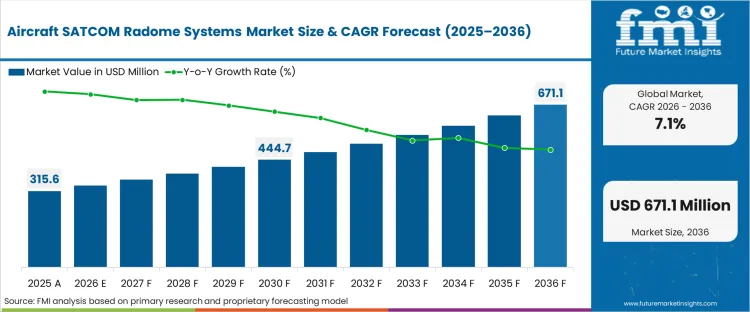
Fleet managers who delay this architectural shift face an immediate competitive disadvantage in passenger experience metrics and forfeit the flexibility to seamlessly switch satellite network providers. The standardizing influence of ARINC 792 specifications acts as a key inflection point, creating a highly predictable aircraft satcom radome systems market forecast. FMI analysis further indicates that the operational fuel penalty generated by poorly integrated domes often exceeds the initial hardware expense, accelerating demand for highly optimized aerospace radome configurations.
Before growth becomes self-reinforcing, one specific condition must be met, the decoupling of the physical enclosure from the internal connectivity hardware via universal adapter plates. Airframe integrators who achieve this structural separation unlock a scalable pathway for airline connectivity radome systems, enabling rapid hardware upgrades without re-certifying the exterior aerodynamic profile. Once this gate is passed, airlines can modernize their in flight internet arrays swiftly, fundamentally shifting the installation economics from custom engineering to standardized deployment.
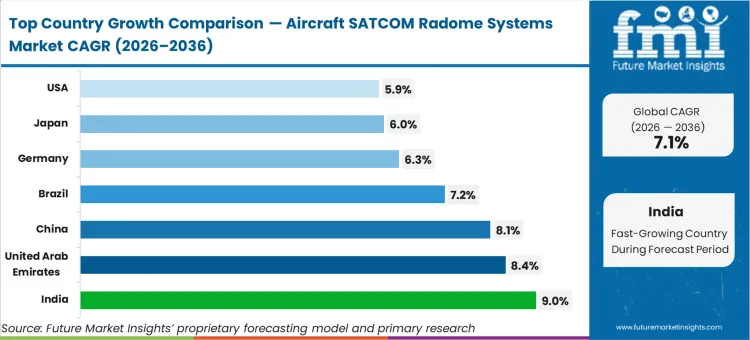
India tracks at a 9.0% CAGR, reflecting its rapid adoption of passenger connectivity radome systems across newly delivered airframes. The United Arab Emirates expands at 8.4%, closely followed by China at 8.1%, as both regions standardize widebody fleets for optimal RF transmission. Brazil is estimated to record a 7.2% expansion rate, while Germany is poised to advance at 6.3% under strict EASA compliance frameworks. Japan registers a 6.0% compound growth rate, and the United States tracks a steady 5.9% baseline as it manages complex retrofits. This geographic divergence reveals a clear split between nations undertaking initial wide-scale fleet activations and mature airspace networks optimizing legacy installations.
Aircraft SATCOM Radome Systems Market Definition
The aircraft SATCOM radome systems market encompasses the engineering, production, and certification of specialized RF-transparent enclosures designed to protect aviation satellite communication antennas. These structures are defined by their dual mandate to maintain strict aerodynamic profiles while enabling multi-frequency signal transmission across various orbital altitudes without inducing severe attenuation or structural fatigue under high-velocity conditions.
Aircraft SATCOM Radome Systems Market Inclusions
This sector includes the manufacturing of composite radome shells, integrated adapter plates, skirt fairings, and thermal management subsystems necessary for rooftop or belly installations. Components tested for specific radome bird-strike compliance, specialized hydrophobic coatings for signal preservation, and mounting hardware explicitly designed for line-fit or retrofit SATCOM architectures fall firmly within this scope.
Aircraft SATCOM Radome Systems Market Exclusions
The market explicitly excludes the internal satellite communication antennas, phased array panels, and modems housed within the radome structure. It also excludes standard weather radar enclosures located in the aircraft nose. These exclusions exist because weather radar domes lack the broadband RF transmissibility requirements of SATCOM systems, and the communication antennas themselves represent a distinct procurement category driven by network service providers rather than aero-structural integrators.
Aircraft SATCOM Radome Systems Market Research Methodology
- Primary Research: FMI conducted targeted interviews with airline fleet directors, aerospace composite structural engineers, and STC certification managers responsible for avionics integration.
- Desk Research: Analysts aggregated data from aviation authority type-certificate registries, commercial airframe delivery schedules, and regulatory documentation regarding composite material flight safety standards.
- Market-Sizing and Forecasting: The baseline valuation anchors directly to annual commercial and defense aircraft retrofit schedules combined with projected line-fit SATCOM adoption rates from major OEMs.
- Data Validation and Update Cycle: Forecasts were triangulated against reported component delivery volumes from tier-one aerospace structural suppliers and cross-verified with satellite network operator installation targets.
Segmental Analysis
Aircraft SATCOM Radome Systems Market Analysis by Platform
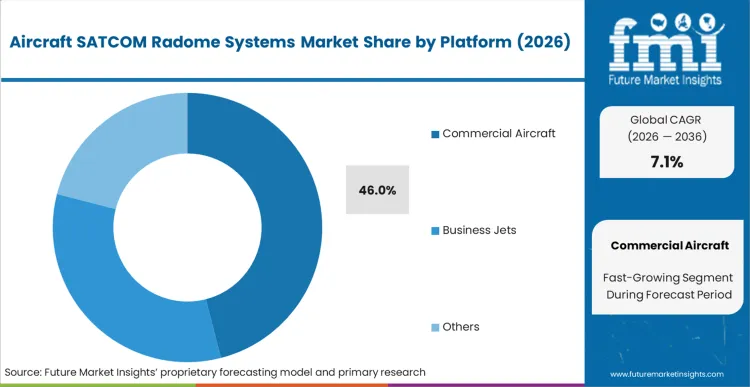
Fleet directors evaluating connectivity upgrades face an immediate decision regarding the physical footprint and thermal management of their rooftop hardware. As airlines compete heavily on cabin digital experience, the installation of broadband gateways becomes a baseline operational necessity. As per FMI's projection, the transition toward flat panel antenna configurations heavily dictates this platform's structural needs, pushing carriers away from traditional blister domes. The commercial aviation satcom radome market holds 46.0% share in 2026 because it represents the largest concentration of revenue-generating assets that absolutely require modernization to maintain brand loyalty. Aircraft operators who fail to integrate optimized enclosures face compounding fuel burn penalties that rapidly erode long-haul route profitability.
- Initial Purchase Trigger: The demand for continuous passenger streaming forces commercial carriers to initiate structural qualification programs for wide-scale hardware integration.
- Qualification Validation: Airlines evaluate composite enclosures based on demonstrated aerodynamic drag reduction and verified bird-strike survivability during the STC approval process.
- Renewal Driver: Fleet harmonization mandates require carriers to duplicate successful radome configurations across their entire operational inventory to simplify heavy maintenance.
Aircraft SATCOM Radome Systems Market Analysis by Frequency Band
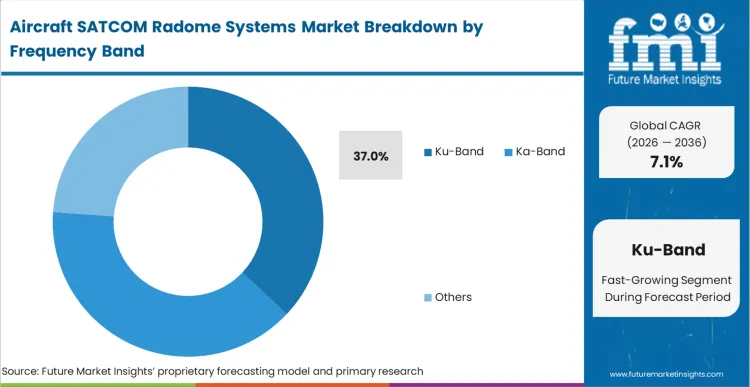
Operators clinging to outdated narrow-band structures forfeit the ability to process the massive data volumes required for modern flight operations. Legacy L-band architectures fail to deliver the bandwidth density required for modern passenger streaming, forcing a structural migration toward higher-frequency solutions. When evaluating the Ku band vs Ka band aircraft radome demand, Ku-band installations secure 37.0% share in 2026 because they currently offer the most extensive global satellite network redundancy. Radome composites designed for these frequencies must balance precise thickness tolerances with extreme structural rigidity. In FMI's view, the ongoing deployment of satellite phased array networks pushes composite manufacturers to refine their resin matrices to ensure RF transparency across broader operating spectrums.
- Performance Baseline: Ku-band radomes establish the minimum acceptable RF transmissibility baseline for modern broadband connectivity, satisfying immediate operational data requirements.
- Edge Limitations: Signal degradation becomes measurable during extreme weather events if the external hydrophobic coatings degrade prematurely under high-altitude UV exposure.
- Acceptability Standard: Aviation regulatory bodies dictate the exact composite layup specifications required to maintain structural integrity while passing these specific, high-frequency wavelengths.
Aircraft SATCOM Radome Systems Market Analysis by Installation Type
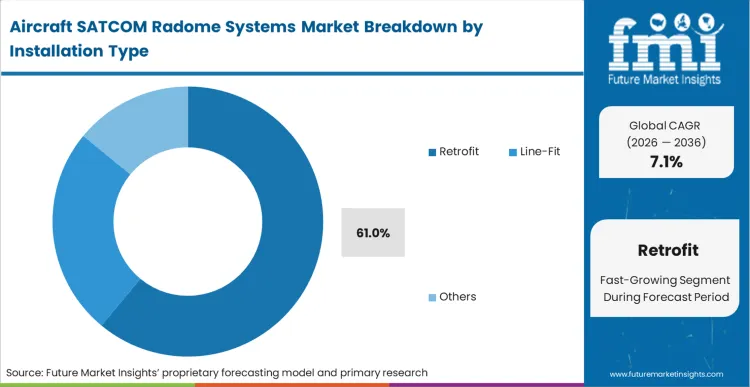
Based on FMI's assessment, the reliance on pre-certified airborne radar and SATCOM installation kits drastically reduces the capital risk associated with these heavy maintenance events. Maintenance facilities attempting custom integration without established STC documentation face indeterminate grounding periods and severe cost overruns. The massive financial penalty associated with grounding a revenue-generating airframe highlights the severe commercial reality of structural modifications. The retrofit satcom radome demand as a result captures 61.0% share in 2026 simply because the active global fleet dwarfs annual new aircraft deliveries. Modifying an active airframe requires complex adapter plates and meticulously documented engineering orders to ensure the new enclosure does not compromise the fuselage pressure vessel.
- Primary Cost Origin: The main financial burden resides in the engineering hours required to validate the structural integrity of the fuselage modification rather than the composite shell itself.
- Hidden Operational Costs: Unexpected corrosion or structural fatigue discovered beneath legacy antennas during the teardown phase often drastically inflates the initial retrofit budget.
- Lifecycle Comparison: Standardized retrofit kits demonstrate a lower total cost of ownership by drastically reducing aircraft-on-ground time compared to custom engineering solutions.
Aircraft SATCOM Radome Systems Market Analysis by Radome Profile / Standard
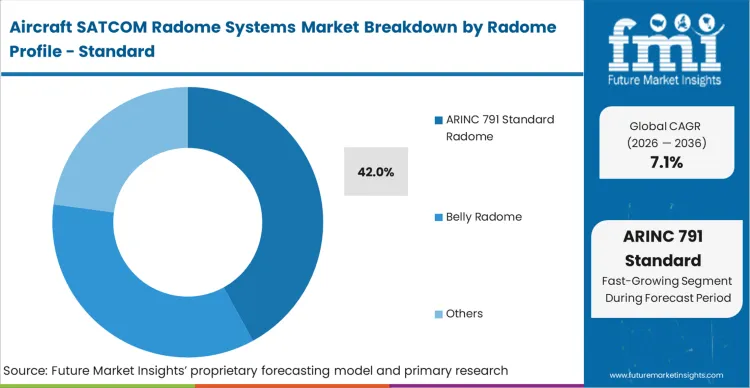
The structural reason the ARINC 791 standard dominates this segment comes down to a single operational reality: airlines cannot afford custom engineering for every antenna vendor they test. When comparing ARINC 791 vs ARINC 792 radome configurations, the 791 profile holds 42.0% share in 2026 because it provides a universally recognized mechanical and electrical footprint, allowing carriers to standardize their rooftop mounts regardless of the internal hardware supplier. According to FMI's estimates, while Aviation 5G initiatives push for a low profile aircraft satcom radome (ARINC 792), the immense installed base of 791-certified platforms ensures its continued relevance through the decade. Operators experimenting with non-standard profiles face severe vendor lock-in, as switching networks later requires entirely new structural modifications.
- Early Adopters: Tier-one international carriers adopted this standard rapidly to de-risk their initial broadband investments and maintain flexibility in satellite provider selection.
- Subsequent Followers: Regional airlines follow this standard because the engineering costs have already been amortized by the wider industry, making adoption financially viable.
- Final Converters: Freight operators migrate to this standard last, transitioning only when their legacy narrow-band communication hardware becomes entirely unsupported by network providers.
Aircraft SATCOM Radome Systems Market Analysis by Application
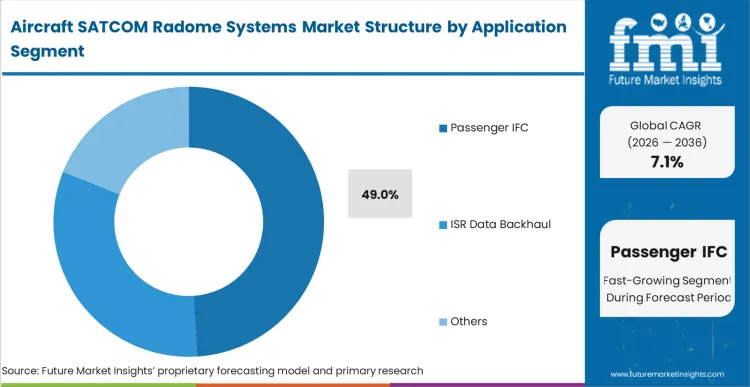
The structural tension between delivering high-capacity Wi-Fi and maintaining optimal aircraft aerodynamics defines the engineering boundary of this sector. Demand for passenger connectivity radome systems drives 49.0% of the market in 2026, serving as the primary commercial engine for radome modernization. Airlines view this application as a critical ancillary revenue stream and a core component of brand loyalty, justifying the significant capital expenditure required for structural modifications. FMI analysts opine that effective airline technology integration relies entirely on radomes capable of managing the intense thermal loads generated by modern IFC arrays operating at high altitudes. Enclosures that fail to provide adequate thermal dissipation cause internal antenna throttling, leading to network dropouts and immediate passenger dissatisfaction.
- Primary Failure Prevention: Advanced composite radomes prevent catastrophic structural failure from high-velocity bird strikes while protecting sensitive RF electronics from extreme altitude moisture.
- Residual Risk: Micro-cracking in the outer protective coatings remains a constant threat, requiring periodic visual inspection and sealant application during standard maintenance checks.
- Operational Mitigation: Ground crews must strictly adhere to specialized cleaning protocols to prevent chemical degradation of the RF-transparent surfaces, ensuring maximum signal preservation.
Aircraft SATCOM Radome Systems Market Drivers, Restraints, And Opportunities
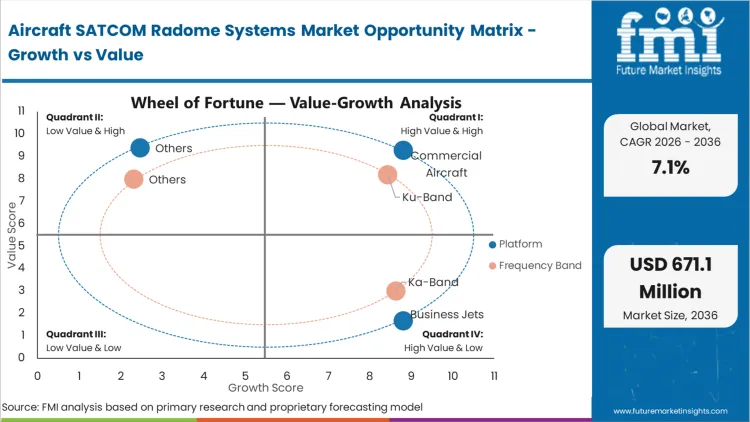
The necessity to integrate high-throughput multi-orbit constellations compels commercial airline fleet directors to initiate comprehensive radome replacement programs. Legacy enclosures designed for low-bandwidth L-band systems physically block the frequencies required for modern Ku/Ka-band operations, making structural upgrades mandatory rather than optional. Fleet operators face a direct commercial penalty: operating without modern broadband severely damages passenger retention and restricts the flight deck from accessing real-time weather and avionics data. This pressure forces airlines to prioritize aircraft radome drag reduction for satcom, securing certified composite enclosures that balance RF transparency with stringent aerodynamic tolerances to protect route profitability.
The certification delta acts as the primary structural friction slowing broader market adoption. Upgrading an aircraft radome fundamentally alters its aerodynamic profile and structural loading, a reality that heavily impacts any aircraft satcom radome STC provider. This requires exhaustive Supplemental Type Certificate processes that can ground revenue-generating assets for months. This friction is not a temporary supply chain issue but a permanent regulatory reality rooted in flight safety protocols. While pre-certified adapter plates partially mitigate this delay for common airframes, complex or older fuselage types still face immense engineering barriers, effectively gating the speed at which aerospace avionics upgrades can be deployed across mixed fleets.
Opportunities in the Aircraft SATCOM Radome Systems Market
- Thermal Management Integration: Electronically steered antennas generate significant heat within enclosed spaces. Aerospace component manufacturers capture this segment by engineering radomes with active or passive cooling channels built directly into the composite structure.
- Conformal Array Housings: The drive for absolute aerodynamic efficiency pushes the industry toward zero-drag solutions. Engineering firms that develop conformal aircraft fairings capable of housing flat-panel arrays capture premium military and business jet contracts.
- Multi-Band Material Science: Constellations operating across different orbital planes require radomes transparent to multiple frequencies simultaneously. Material scientists develop proprietary resin matrices to solve this complex RF challenge for tier-one satellite operators.
Regional Analysis
Based on the regional analysis, the market is segmented into North America, Latin America, Western Europe, Eastern Europe, East Asia, South Asia & Pacific, and Middle East & Africa across 40 plus countries with its regional trajectory revealing a stark contrast between emerging aviation hubs prioritizing aggressive fleet expansion and mature airspace domains focusing on sophisticated retrofits. Global demand is dictated by distinct regional regulatory frameworks, airspace modernization directives, and the unique operational requirements of domestic carriers.
.webp "Top Country Growth Comparison Aircraft Satcom Radome Systems Market Cagr (2026 2036)")
| Country | CAGR (2026 to 2036) |
|---|---|
| India | 9.0% |
| United Arab Emirates | 8.4% |
| China | 8.1% |
| Brazil | 7.2% |
| Germany | 6.3% |
| Japan | 6.0% |
| United States | 5.9% |
Source: Future Market Insights (FMI) analysis, based on proprietary forecasting model and primary research
Asia Pacific Aircraft SATCOM Radome Systems Market Analysis
Operators in this geography are fundamentally outfitting relatively young airframes with broadband capabilities for the first time, rather than swapping out aging hardware. Evaluating the aircraft satcom radome market in Asia Pacific reveals an adoption curve heavily dictated by the rollback of connectivity restrictions and the explosive growth of low-cost carrier fleets. Because airlines increasingly treat aviation IOT as a baseline requirement for real-time asset tracking, FMI estimates there is massive regional urgency for line-fit radomes and fast-turnaround retrofit kits. The certification demands as a result are forcing maintenance and overhaul centers to rapidly expand their composite structural operations to absorb the sheer volume of new aircraft entering service.
- India: Previously untapped commercial opportunity is unlocking across India's domestic airspace following recent regulatory shifts that finally permit in-flight connectivity. Expanding at a 9.0% CAGR, the sector is dominated by low-cost carriers demanding immediate SATCOM integration. Operations directors eyeing the aircraft satcom radome market in India are racing to qualify new composite structures to monetize these passenger services on highly competitive routes. Airlines that quickly secure STC approvals tailored to their specific fleets are successfully capturing a distinct first-mover advantage in cabin experience.
- China: With an anticipated CAGR of 8.1%, China's trajectory is defined by massive state-aligned carriers executing sweeping fleet homogenization mandates. Procurement officers are compelled to standardize SATCOM hardware across hundreds of identical airframes, a strategy that radically drives down the per-unit engineering costs associated with radome certification. The domestic aerospace supply chain, as a result, is actively substituting imported composite structures with locally manufactured alternatives. This standardization ultimately streamlines heavy maintenance checks, delivering a highly efficient operational outcome for the country's sprawling domestic networks.
- Japan: Navigating the stringent structural modification regulations of Japanese airspace requires procurement managers to rely strictly on globally validated ARINC 791 profiles rather than testing experimental aerodynamic architectures. Domestic aviation authorities mandate exhaustive local validation for any composite enclosure before authorizing installation. Japan is expected to see its sector grow at a CAGR of 6.0%, as a result of the maintenance facilities that successfully establish these pre-approved regulatory frameworks secure lucrative leading long-term fleet modernization contracts with premium regional carriers.
FMI's report includes market analysis for South Korea and Australia within this region. The overarching regional dynamic points toward a heavy reliance on proven STC packages to bypass complex domestic engineering hurdles, enabling rapid deployment across aggressively expanding fleets.
Middle East Aircraft SATCOM Radome Systems Market Analysis
Fleet directors across this specific geography operate under zero-tolerance mandates for network dropouts, fundamentally shaping how regional buyers approach airspace modernization. The dense concentration of premium airlines here creates a highly specialized environment demanding enclosures that deliver flawless RF transparency alongside premium aerodynamic efficiency. FMI analysts opine that the rapid integration of the aircraft interface device standard is further accelerating regional requirements for structures capable of housing complex, software-defined arrays. Ensuring continuous, multi-orbit connectivity remains the highest priority for carriers seeking to dominate global long-haul transit.
- United Arab Emirates: Forecast to register a CAGR of 8.4%, the UAE market is driven by intense competition among premium Gulf carriers attempting to guarantee ultra-high-speed, uninterrupted passenger streaming. Radome enclosures optimized for seamless Ka-band performance are an absolute operational necessity to meet these zero-tolerance connectivity mandates. This relentless pursuit of technological superiority creates a severe competitive positioning gap against global rivals. By deploying low-profile, multi-orbit capable hardware years ahead of competitors, regional operators solidify their dominance in the premium transit sector.
Looking beyond the UAE, surrounding Gulf nations mirror this aggressive technological adoption pattern. The regional strategy remains hyper-focused on utilizing premium, high-frequency enclosures to maintain the superior cabin connectivity standards expected by long-haul transit passengers.
Europe Aircraft SATCOM Radome Systems Market Analysis
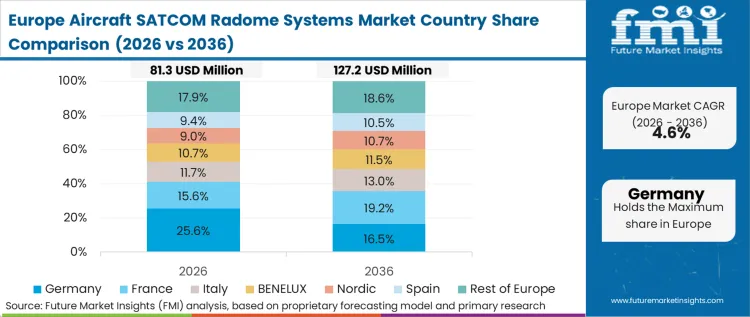
Procurement behavior across the European continent is heavily shaped by strict policy directives focused on secure broadband integration and rigorous airspace safety protocols. Avionics integrators must navigate highly fragmented national airspaces, requiring multi-orbit capabilities that do not compromise strict regulatory standards. The certification environment actively forces engineering teams to prioritize bird-strike resilience and proven structural integrity over aggressive aerodynamic experimentation. The adoption of advanced connectivity hardware, as a result, is highly methodical and deeply tethered to EASA compliance frameworks.
- Germany: Avionics integrators in Germany are forced to prioritize demonstrable bird-strike resilience and structural integrity above raw aerodynamic optimization due to the country's uncompromising EASA-aligned certification environment. Over the forecast period, the sector in Germany is set for a CAGR of 6.3%. Engineering managers must flawlessly document every adapter plate modification and composite layup, as minor manufacturing deviations trigger immediate regulatory rejection. This creates a harsh practitioner reality where securing compliance demands far more resources than the physical installation itself, leading to extended project timelines.
FMI's report includes market analysis for the United Kingdom, France, and Italy. Across these major European hubs, operators show a distinct preference for leveraging STC packages already validated by major aviation authorities, actively avoiding the severe financial risks of funding independent structural engineering programs from the ground up.
North America and Latin America Aircraft SATCOM Radome Systems Market Analysis
Capital availability certainly enables major carriers in this hemisphere to execute fleet-wide modernization programs, but procurement is strictly gated by proven returns on investment, either through ancillary passenger revenue or definitive operational fuel savings. The massive installed base of mature business and commercial fleets drives a highly economics-led approach to radome selection. Operators scrutinize hardware upgrades entirely through the lens of total lifecycle drag penalties and aircraft-on-ground time. The regional engineering focus is further continually diversified by the demand to integrate advanced UAV satellite communication capabilities into specialized defense and ISR platforms.
- Brazil: Maintenance directors managing Brazil's geographically dispersed aviation networks must prioritize composite enclosures that resist the heavy precipitation and severe UV degradation native to equatorial routes. Operating across these environmental extremes requires highly durable, weather-resilient radomes that prevent signal degradation without demanding frequent depot-level recoating. Demand in Brazil is estimated to expand at a CAGR of 7.2%, propelled by achieving standardized radome deployment leading the regional operators to drastically simplify spares inventory and streamline heavy maintenance across diverse bases.
- United States: Planners managing the densest commercial flight schedules globally must carefully sequence heavy maintenance events to transition fleets from early-generation Ku-band blisters to modern flat-panel enclosures without disrupting operations. Expanding at a 5.9% CAGR, the United States sector operates under the severe constraint of deeply entrenched legacy systems that require complex structural teardowns. Successfully executing this modernization allows carriers to achieve a critical operational outcome. By finally retiring these aerodynamically inefficient legacy structures, domestic airlines capture immediate and highly measurable reductions in fleet-wide fuel consumption.
FMI's report includes market analysis for Mexico and Canada. The overarching dynamic throughout North America and Latin America reinforces a highly pragmatic procurement strategy, where operators strictly balance the upfront capital expenditure of complex STC modifications against the long-term economic benefits of drag reduction and enhanced network access.
Competitive Aligners for Market Players
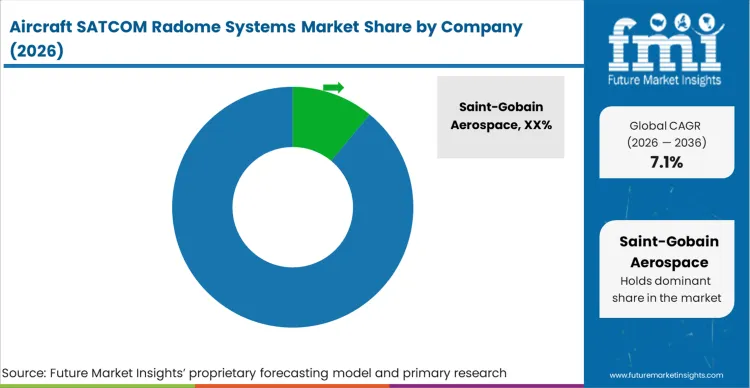
Qualification in this sector operates strictly on an exclusionary basis, where the possession of specific Supplemental Type Certificates acts as the ultimate gatekeeper for airline procurement. Airlines do not run sourcing events to discover untested aerodynamic concepts; they evaluate vendors almost exclusively on whether they already hold the exact regulatory paperwork required for a specific airframe. Heavyweights like Saint-Gobain Aerospace and Astronics Corporation command this arena because their vast, historical libraries of pre-approved EASA and FAA certifications act as an impenetrable moat against challengers. When a fleet director evaluates a radome package, the core deciding metric is not the raw unit cost of the composite shell, but the operational certainty that the hardware will not ground a revenue-generating aircraft in a prolonged regulatory audit.
The technological fortress protecting established tier-one suppliers relies heavily on proprietary material science, specifically the guarded resin matrices and hydrophobic coatings required to manage multi-orbit frequencies. Players such as Honeywell Aerospace and ThinKom Solutions hold a decisive engineering edge because their RF-transparent materials and advanced conformal designs are already validated to pass Ku and Ka-band signals without severe attenuation. For an emerging manufacturer to disrupt this balance, they cannot simply undercut on price; they must fund aerospace-grade autoclave production capable of near-zero-defect yields. The specialized hardware supplied by firms like HEICO Electronic Technologies (Sensor Systems) further demonstrates how intricately these enclosures must be built to manage the intense thermal loads generated by modern electronically steered arrays, effectively turning the radome from a passive weather shield into an active thermal management component.
Large commercial operators actively resist this intense vendor lock-in by weaponizing universal mounting architectures like ARINC 791 and 792 against proprietary hardware ecosystems. This creates a persistent commercial friction between airlines demanding interchangeable components and manufacturers incentivized to sell tightly integrated packages. As the development difficulty of shielding multi-orbit networks escalates, specialized aerospace integration firms like MAG Aerospace and interconnectivity experts like Amphenol CIT are increasingly critical in solving the most intricate, high-stakes defense and VVIP broadband requirements. Through 2036, the sheer technical burden of fabricating these multi-band, low-profile composite assemblies will push the industry into further consolidation, compelling smaller fabrication shops to either be absorbed by these tier-one integrators or abandon the aviation connectivity sector altogether.
Key Players in Aircraft SATCOM Radome Systems Market
- Saint-Gobain Aerospace
- Astronics Corporation
- HEICO Electronic Technologies (Sensor Systems)
- MAG Aerospace
- Amphenol CIT
- Honeywell Aerospace
- ThinKom Solutions
Scope of the Report
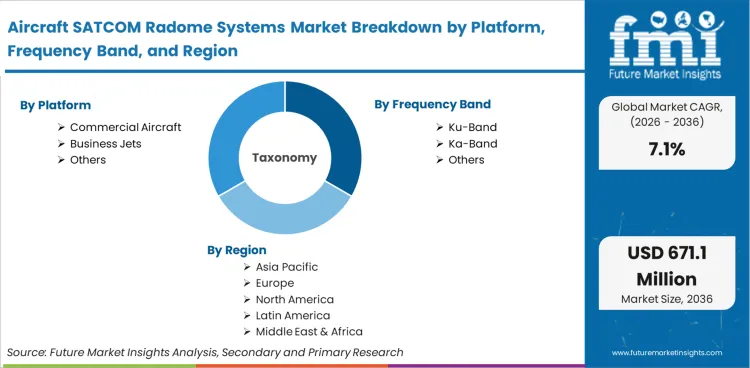
| Metric | Value |
|---|---|
| Quantitative Units | USD 338.0 million to USD 671.1 million, at a CAGR of 7.1% |
| Market Definition | The market covers the engineering and production of structurally certified, RF-transparent enclosures that protect airborne satellite communication arrays. It focuses on composite structures designed to minimize aerodynamic drag while facilitating multi-orbit, high-frequency connectivity. |
| Platform Segmentation | Commercial aircraft, Business jets, Military aircraft, Special mission / ISR aircraft, Regional turboprops |
| Frequency band Segmentation | Ku-band, Ka-band, Multi-band Ku/Ka, L-band / narrowband, X-band / defense-focused |
| Installation type Segmentation | Retrofit, Line-fit, Quick-change / mission-kit installations, STC-based aftermarket upgrades |
| Radome profile / standard Segmentation | ARINC 791 standard radome, ARINC 792 low-profile radome, Custom/conformal radome, Belly radome, Tail-mounted fairing/radome assemblies |
| Application Segmentation | Passenger IFC, Cockpit / operational connectivity, Government BLOS communications, ISR data backhaul, VVIP / head-of-state broadband |
| Regions Covered | North America, Latin America, Western Europe, Eastern Europe, East Asia, South Asia & Pacific, Middle East & Africa |
| Countries Covered | United States, China, India, United Arab Emirates, Germany, Japan, Brazil, and 40 plus countries |
| Key Companies Profiled | Saint-Gobain Aerospace, Astronics Corporation, HEICO Electronic Technologies (Sensor Systems), MAG Aerospace, Amphenol CIT, Honeywell Aerospace, ThinKom Solutions |
| Forecast Period | 2026 to 2036 |
| Approach | FMI analysts interviewed fleet directors and aerospace composite engineers to establish structural adoption realities. Baseline figures were anchored to commercial retrofit backlogs and OEM line-fit projections across global fleets. Forecasts were cross-validated using component supplier reporting and satellite network installation targets. |
Source: Future Market Insights (FMI) analysis, based on proprietary forecasting model and primary research
Segments
Platform:
- Commercial aircraft
- Business jets
- Military aircraft
- Special mission / ISR aircraft
- Regional turboprops
Frequency band:
- Ku-band
- Ka-band
- Multi-band Ku/Ka
- L-band / narrowband
- X-band / defense-focused
Installation type:
- Retrofit
- Line-fit
- Quick-change / mission-kit installations
- STC-based aftermarket upgrades
Radome profile / standard:
- ARINC 791 standard radome
- ARINC 792 low-profile radome
- Custom/conformal radome
- Belly radome
- Tail-mounted fairing/radome assemblies
Application:
- Passenger IFC
- Cockpit / operational connectivity
- Government BLOS communications
- ISR data backhaul
- VVIP / head-of-state broadband
Region:
- North America
- United States
- Canada
- Europe
- Germany
- United Kingdom
- France
- Italy
- Spain
- Asia Pacific
- China
- Japan
- South Korea
- Taiwan
- Singapore
- Latin America
- Brazil
- Mexico
- Argentina
- Middle East & Africa
- GCC Countries
- South Africa
- Israel
Bibliography
- European Union Agency for the Space Programme. (2025, January). GNSS and Secure SATCOM User Technology Report. EUSPA.
- Federal Aviation Administration. (2025). DRS-SA04204NY - Dynamic Regulatory System. USA Department of Transportation.
- Gogo Inc. (2026). 10-K. USA Securities and Exchange Commission.
- HEICO Corp. (2024). Annual Report on Form 10-K for fiscal year ended October 31, 2024. 20241031.htm
- Intelsat. (2025, April). Intelsat installs multi-orbit system on 130 aircraft, nearing 1000 orders. Intelsat.
- Viasat, Inc. (2025). Annual Report. Viasat Investor Relations.
This bibliography is provided for reader reference. The full FMI report contains the complete reference list with primary source documentation.
This Report Addresses
- Market intelligence to support strategic decision making across aerospace radome enclosures, composite thermal management, and RF-transparent adapter plates
- Market size estimation and 10-year revenue forecasts from 2026 to 2036, supported by structural STC certification tracking and global fleet retrofit backlogs
- Growth opportunity mapping across line-fit installations and multi-band frequency hardware with emphasis on the decoupling of radome shells from antenna hardware via ARINC 792 standards
- Segment and regional revenue forecasts covering commercial passenger IFC applications across stringent regulatory environments like EASA and the FAA
- Competition strategy assessment including STC portfolio advantages, proprietary composite resin formulations, and autoclave manufacturing capacities
- Capability development tracking including ARINC 791 and 792 standardization, low-profile phased array integration, and multi-orbit thermal management frameworks
- Market access analysis covering aerospace composite flight safety approvals, bird-strike testing parameters, and domestic airspace connectivity regulations
- Market report delivery in PDF, Excel, PPT, and interactive dashboard formats for executive strategy, airline fleet connectivity planning, and operational benchmarking use
Frequently Asked Questions
How large is the aircraft SATCOM radome systems market in 2025?
The valuation sits at USD 315.6 million in 2025, reflecting the heavy capital airlines are currently committing to upgrade physical rooftop structures for modern broadband before older systems become obsolete.
What is the aircraft satcom radome systems forecast through 2036?
The market is projected to reach USD 671.1 million by 2036 as the industry shifts toward multi-orbit, high-throughput satellite constellations that mandate entirely new composite enclosures.
What is the aircraft satcom radome systems CAGR?
A 7.1% CAGR is projected from 2026 to 2036, aligning precisely with the pace at which fleet operators can cycle aircraft through heavy maintenance checks to execute complex structural modifications.
Which platforms generate the most demand for SATCOM radomes?
The commercial aviation satcom radome market holds a dominant 46.0% share in 2026 because passenger expectations for high-speed Wi-Fi force major airlines to execute fleet-wide upgrades.
Which frequency band leads the market?
Ku-band installations represent 37.0% of the segment in 2026 because legacy satellite network architecture heavily favors this spectrum globally, compelling manufacturers to optimize composite layups accordingly.
Why does retrofit account for most aircraft SATCOM radome revenue?
Retrofit satcom radome demand captures 61.0% share in 2026 because the massive installed base of active aircraft requires immediate modernization via standardized installation kits to remain competitive.
What drives demand for satcom radomes on aircraft?
The commercial imperative to integrate multi-orbit flat-panel arrays directly drives demand, forcing airlines to swap out legacy domes for high-frequency enclosures to unlock modern data speeds.
What role do STCs play in SATCOM radome installation economics?
Because custom engineering can ground assets for months, securing an aircraft satcom radome STC provider dictates installation economics by allowing airlines to use pre-certified adapter packages.
Which regions are growing fastest for aircraft satcom radomes?
India expands at a 9.0% CAGR, outpacing the United Arab Emirates at 8.4%, due to its rapid integration of connectivity into a booming low-cost carrier market following recent regulatory approvals.
What is an aircraft SATCOM radome system?
It is a highly engineered, RF-transparent composite shell that protects delicate communication antennas while minimizing aerodynamic drag and resisting bird-strikes.
What is the difference between ARINC 791 and ARINC 792 radomes?
When evaluating ARINC 791 vs ARINC 792 radome standards, 791 accommodates bulky mechanical antennas with a universal footprint, whereas 792 establishes an ultra-low-profile mounting standard for modern electronically steered arrays.
Who are the top companies in aircraft satcom radome systems?
Saint-Gobain Aerospace, Astronics Corporation, and HEICO Electronic Technologies lead the sector due to their massive libraries of approved STCs and aerospace-grade autoclave manufacturing capabilities.
How do electronically steered antennas affect radome demand?
Integrating electronically steered antennas forces fleet operators to completely replace their legacy composite enclosures with specialized, flat-panel housings that offer entirely different thermal management and structural profiles.
Do flat panel antennas still need radomes on aircraft?
Yes, flat panel antennas still require highly specialized conformal fairings to protect the delicate electronic arrays from high-altitude moisture, UV radiation, and catastrophic bird-strikes.
Why are retrofit radomes important in aviation connectivity?
Retrofits are the only mechanism by which an airline can modernize older airframes to support modern broadband speeds, preventing passengers from being cut off from high-throughput networks.
Which aircraft use ARINC 791 radomes?
The ARINC 791 standard is primarily utilized by widebody and large narrowbody commercial airframes operating on long-haul transoceanic routes to standardize rooftop mounts.
How does a low profile aircraft satcom radome compare to standard versions?
While standard radomes accommodate bulky antennas but generate significant aerodynamic drag, low-profile versions drastically reduce this fuel-penalizing drag but require advanced thermal management for densely packed electronic arrays.
What is the state of the business aviation satcom radome market?
This market operates under extreme pressure to deliver zero-drag, conformal solutions that do not compromise the sleek aesthetics or speed of premium jets during VVIP broadband applications.
How does the military BLOS aircraft radome systems segment function?
Military platforms prioritize absolute signal security and low radar cross-sections over commercial bandwidth, compelling defense integrators to procure highly specialized X-band transparent radomes.
Where can an airline find an aircraft satcom radome installation partner?
Airlines secure installation partnerships through major MRO facilities that possess specialized composite structural capabilities to execute complex airframe modifications during mandatory heavy maintenance checks.
Preview the report firsthand - request a free sample
Get SampleGet the brochure for pricing and purchase details.
Get PDFTable of Content
- Executive Summary
- Global Market Outlook
- Demand-side Trends
- Supply-side Trends
- Technology Roadmap Analysis
- Analysis and Recommendations
- Market Overview
- Market Coverage / Taxonomy
- Market Definition / Scope / Limitations
- Research Methodology
- Chapter Orientation
- Analytical Lens and Working Hypotheses
- Market Structure, Signals, and Trend Drivers
- Benchmarking and Cross-market Comparability
- Market Sizing, Forecasting, and Opportunity Mapping
- Research Design and Evidence Framework
- Desk Research Programme (Secondary Evidence)
- Company Annual and Sustainability Reports
- Peer-reviewed Journals and Academic Literature
- Corporate Websites, Product Literature, and Technical Notes
- Earnings Decks and Investor Briefings
- Statutory Filings and Regulatory Disclosures
- Technical White Papers and Standards Notes
- Trade Journals, Industry Magazines, and Analyst Briefs
- Conference Proceedings, Webinars, and Seminar Materials
- Government Statistics Portals and Public Data Releases
- Press Releases and Reputable Media Coverage
- Specialist Newsletters and Curated Briefings
- Sector Databases and Reference Repositories
- FMI Internal Proprietary Databases and Historical Market Datasets
- Subscription Datasets and Paid Sources
- Social Channels, Communities, and Digital Listening Inputs
- Additional Desk Sources
- Expert Input and Fieldwork (Primary Evidence)
- Primary Modes
- Qualitative Interviews and Expert Elicitation
- Quantitative Surveys and Structured Data Capture
- Blended Approach
- Why Primary Evidence is Used
- Field Techniques
- Interviews
- Surveys
- Focus Groups
- Observational and In-context Research
- Social and Community Interactions
- Stakeholder Universe Engaged
- C-suite Leaders
- Board Members
- Presidents and Vice Presidents
- R&D and Innovation Heads
- Technical Specialists
- Domain Subject-matter Experts
- Scientists
- Physicians and Other Healthcare Professionals
- Governance, Ethics, and Data Stewardship
- Research Ethics
- Data Integrity and Handling
- Primary Modes
- Tooling, Models, and Reference Databases
- Desk Research Programme (Secondary Evidence)
- Data Engineering and Model Build
- Data Acquisition and Ingestion
- Cleaning, Normalisation, and Verification
- Synthesis, Triangulation, and Analysis
- Quality Assurance and Audit Trail
- Market Background
- Market Dynamics
- Drivers
- Restraints
- Opportunity
- Trends
- Scenario Forecast
- Demand in Optimistic Scenario
- Demand in Likely Scenario
- Demand in Conservative Scenario
- Opportunity Map Analysis
- Product Life Cycle Analysis
- Supply Chain Analysis
- Investment Feasibility Matrix
- Value Chain Analysis
- PESTLE and Porter’s Analysis
- Regulatory Landscape
- Regional Parent Market Outlook
- Production and Consumption Statistics
- Import and Export Statistics
- Market Dynamics
- Global Market Analysis 2021 to 2025 and Forecast, 2026 to 2036
- Historical Market Size Value (USD Million) Analysis, 2021 to 2025
- Current and Future Market Size Value (USD Million) Projections, 2026 to 2036
- Y-o-Y Growth Trend Analysis
- Absolute $ Opportunity Analysis
- Global Market Pricing Analysis 2021 to 2025 and Forecast 2026 to 2036
- Global Market Analysis 2021 to 2025 and Forecast 2026 to 2036, By Platform
- Introduction / Key Findings
- Historical Market Size Value (USD Million) Analysis By Platform , 2021 to 2025
- Current and Future Market Size Value (USD Million) Analysis and Forecast By Platform , 2026 to 2036
- Commercial Aircraft
- Business Jets
- Others
- Commercial Aircraft
- Y-o-Y Growth Trend Analysis By Platform , 2021 to 2025
- Absolute $ Opportunity Analysis By Platform , 2026 to 2036
- Global Market Analysis 2021 to 2025 and Forecast 2026 to 2036, By Frequency Band
- Introduction / Key Findings
- Historical Market Size Value (USD Million) Analysis By Frequency Band, 2021 to 2025
- Current and Future Market Size Value (USD Million) Analysis and Forecast By Frequency Band, 2026 to 2036
- Ku-Band
- Ka-Band
- Others
- Ku-Band
- Y-o-Y Growth Trend Analysis By Frequency Band, 2021 to 2025
- Absolute $ Opportunity Analysis By Frequency Band, 2026 to 2036
- Global Market Analysis 2021 to 2025 and Forecast 2026 to 2036, By Installation Type
- Introduction / Key Findings
- Historical Market Size Value (USD Million) Analysis By Installation Type, 2021 to 2025
- Current and Future Market Size Value (USD Million) Analysis and Forecast By Installation Type, 2026 to 2036
- Retrofit
- Line-Fit
- Others
- Retrofit
- Y-o-Y Growth Trend Analysis By Installation Type, 2021 to 2025
- Absolute $ Opportunity Analysis By Installation Type, 2026 to 2036
- Global Market Analysis 2021 to 2025 and Forecast 2026 to 2036, By Radome Profile / Standard
- Introduction / Key Findings
- Historical Market Size Value (USD Million) Analysis By Radome Profile / Standard, 2021 to 2025
- Current and Future Market Size Value (USD Million) Analysis and Forecast By Radome Profile / Standard, 2026 to 2036
- ARINC 791 Standard Radome
- Belly Radome
- Others
- ARINC 791 Standard Radome
- Y-o-Y Growth Trend Analysis By Radome Profile / Standard, 2021 to 2025
- Absolute $ Opportunity Analysis By Radome Profile / Standard, 2026 to 2036
- Global Market Analysis 2021 to 2025 and Forecast 2026 to 2036, By Application
- Introduction / Key Findings
- Historical Market Size Value (USD Million) Analysis By Application, 2021 to 2025
- Current and Future Market Size Value (USD Million) Analysis and Forecast By Application, 2026 to 2036
- Passenger IFC
- ISR Data Backhaul
- Others
- Passenger IFC
- Y-o-Y Growth Trend Analysis By Application, 2021 to 2025
- Absolute $ Opportunity Analysis By Application, 2026 to 2036
- Global Market Analysis 2021 to 2025 and Forecast 2026 to 2036, By Region
- Introduction
- Historical Market Size Value (USD Million) Analysis By Region, 2021 to 2025
- Current Market Size Value (USD Million) Analysis and Forecast By Region, 2026 to 2036
- North America
- Latin America
- Western Europe
- Eastern Europe
- East Asia
- South Asia and Pacific
- Middle East & Africa
- Market Attractiveness Analysis By Region
- North America Market Analysis 2021 to 2025 and Forecast 2026 to 2036, By Country
- Historical Market Size Value (USD Million) Trend Analysis By Market Taxonomy, 2021 to 2025
- Market Size Value (USD Million) Forecast By Market Taxonomy, 2026 to 2036
- By Country
- USA
- Canada
- Mexico
- By Platform
- By Frequency Band
- By Installation Type
- By Radome Profile / Standard
- By Application
- By Country
- Market Attractiveness Analysis
- By Country
- By Platform
- By Frequency Band
- By Installation Type
- By Radome Profile / Standard
- By Application
- Key Takeaways
- Latin America Market Analysis 2021 to 2025 and Forecast 2026 to 2036, By Country
- Historical Market Size Value (USD Million) Trend Analysis By Market Taxonomy, 2021 to 2025
- Market Size Value (USD Million) Forecast By Market Taxonomy, 2026 to 2036
- By Country
- Brazil
- Chile
- Rest of Latin America
- By Platform
- By Frequency Band
- By Installation Type
- By Radome Profile / Standard
- By Application
- By Country
- Market Attractiveness Analysis
- By Country
- By Platform
- By Frequency Band
- By Installation Type
- By Radome Profile / Standard
- By Application
- Key Takeaways
- Western Europe Market Analysis 2021 to 2025 and Forecast 2026 to 2036, By Country
- Historical Market Size Value (USD Million) Trend Analysis By Market Taxonomy, 2021 to 2025
- Market Size Value (USD Million) Forecast By Market Taxonomy, 2026 to 2036
- By Country
- Germany
- UK
- Italy
- Spain
- France
- Nordic
- BENELUX
- Rest of Western Europe
- By Platform
- By Frequency Band
- By Installation Type
- By Radome Profile / Standard
- By Application
- By Country
- Market Attractiveness Analysis
- By Country
- By Platform
- By Frequency Band
- By Installation Type
- By Radome Profile / Standard
- By Application
- Key Takeaways
- Eastern Europe Market Analysis 2021 to 2025 and Forecast 2026 to 2036, By Country
- Historical Market Size Value (USD Million) Trend Analysis By Market Taxonomy, 2021 to 2025
- Market Size Value (USD Million) Forecast By Market Taxonomy, 2026 to 2036
- By Country
- Russia
- Poland
- Hungary
- Balkan & Baltic
- Rest of Eastern Europe
- By Platform
- By Frequency Band
- By Installation Type
- By Radome Profile / Standard
- By Application
- By Country
- Market Attractiveness Analysis
- By Country
- By Platform
- By Frequency Band
- By Installation Type
- By Radome Profile / Standard
- By Application
- Key Takeaways
- East Asia Market Analysis 2021 to 2025 and Forecast 2026 to 2036, By Country
- Historical Market Size Value (USD Million) Trend Analysis By Market Taxonomy, 2021 to 2025
- Market Size Value (USD Million) Forecast By Market Taxonomy, 2026 to 2036
- By Country
- China
- Japan
- South Korea
- By Platform
- By Frequency Band
- By Installation Type
- By Radome Profile / Standard
- By Application
- By Country
- Market Attractiveness Analysis
- By Country
- By Platform
- By Frequency Band
- By Installation Type
- By Radome Profile / Standard
- By Application
- Key Takeaways
- South Asia and Pacific Market Analysis 2021 to 2025 and Forecast 2026 to 2036, By Country
- Historical Market Size Value (USD Million) Trend Analysis By Market Taxonomy, 2021 to 2025
- Market Size Value (USD Million) Forecast By Market Taxonomy, 2026 to 2036
- By Country
- India
- ASEAN
- Australia & New Zealand
- Rest of South Asia and Pacific
- By Platform
- By Frequency Band
- By Installation Type
- By Radome Profile / Standard
- By Application
- By Country
- Market Attractiveness Analysis
- By Country
- By Platform
- By Frequency Band
- By Installation Type
- By Radome Profile / Standard
- By Application
- Key Takeaways
- Middle East & Africa Market Analysis 2021 to 2025 and Forecast 2026 to 2036, By Country
- Historical Market Size Value (USD Million) Trend Analysis By Market Taxonomy, 2021 to 2025
- Market Size Value (USD Million) Forecast By Market Taxonomy, 2026 to 2036
- By Country
- Kingdom of Saudi Arabia
- Other GCC Countries
- Turkiye
- South Africa
- Other African Union
- Rest of Middle East & Africa
- By Platform
- By Frequency Band
- By Installation Type
- By Radome Profile / Standard
- By Application
- By Country
- Market Attractiveness Analysis
- By Country
- By Platform
- By Frequency Band
- By Installation Type
- By Radome Profile / Standard
- By Application
- Key Takeaways
- Key Countries Market Analysis
- USA
- Pricing Analysis
- Market Share Analysis, 2025
- By Platform
- By Frequency Band
- By Installation Type
- By Radome Profile / Standard
- By Application
- Canada
- Pricing Analysis
- Market Share Analysis, 2025
- By Platform
- By Frequency Band
- By Installation Type
- By Radome Profile / Standard
- By Application
- Mexico
- Pricing Analysis
- Market Share Analysis, 2025
- By Platform
- By Frequency Band
- By Installation Type
- By Radome Profile / Standard
- By Application
- Brazil
- Pricing Analysis
- Market Share Analysis, 2025
- By Platform
- By Frequency Band
- By Installation Type
- By Radome Profile / Standard
- By Application
- Chile
- Pricing Analysis
- Market Share Analysis, 2025
- By Platform
- By Frequency Band
- By Installation Type
- By Radome Profile / Standard
- By Application
- Germany
- Pricing Analysis
- Market Share Analysis, 2025
- By Platform
- By Frequency Band
- By Installation Type
- By Radome Profile / Standard
- By Application
- UK
- Pricing Analysis
- Market Share Analysis, 2025
- By Platform
- By Frequency Band
- By Installation Type
- By Radome Profile / Standard
- By Application
- Italy
- Pricing Analysis
- Market Share Analysis, 2025
- By Platform
- By Frequency Band
- By Installation Type
- By Radome Profile / Standard
- By Application
- Spain
- Pricing Analysis
- Market Share Analysis, 2025
- By Platform
- By Frequency Band
- By Installation Type
- By Radome Profile / Standard
- By Application
- France
- Pricing Analysis
- Market Share Analysis, 2025
- By Platform
- By Frequency Band
- By Installation Type
- By Radome Profile / Standard
- By Application
- India
- Pricing Analysis
- Market Share Analysis, 2025
- By Platform
- By Frequency Band
- By Installation Type
- By Radome Profile / Standard
- By Application
- ASEAN
- Pricing Analysis
- Market Share Analysis, 2025
- By Platform
- By Frequency Band
- By Installation Type
- By Radome Profile / Standard
- By Application
- Australia & New Zealand
- Pricing Analysis
- Market Share Analysis, 2025
- By Platform
- By Frequency Band
- By Installation Type
- By Radome Profile / Standard
- By Application
- China
- Pricing Analysis
- Market Share Analysis, 2025
- By Platform
- By Frequency Band
- By Installation Type
- By Radome Profile / Standard
- By Application
- Japan
- Pricing Analysis
- Market Share Analysis, 2025
- By Platform
- By Frequency Band
- By Installation Type
- By Radome Profile / Standard
- By Application
- South Korea
- Pricing Analysis
- Market Share Analysis, 2025
- By Platform
- By Frequency Band
- By Installation Type
- By Radome Profile / Standard
- By Application
- Russia
- Pricing Analysis
- Market Share Analysis, 2025
- By Platform
- By Frequency Band
- By Installation Type
- By Radome Profile / Standard
- By Application
- Poland
- Pricing Analysis
- Market Share Analysis, 2025
- By Platform
- By Frequency Band
- By Installation Type
- By Radome Profile / Standard
- By Application
- Hungary
- Pricing Analysis
- Market Share Analysis, 2025
- By Platform
- By Frequency Band
- By Installation Type
- By Radome Profile / Standard
- By Application
- Kingdom of Saudi Arabia
- Pricing Analysis
- Market Share Analysis, 2025
- By Platform
- By Frequency Band
- By Installation Type
- By Radome Profile / Standard
- By Application
- Turkiye
- Pricing Analysis
- Market Share Analysis, 2025
- By Platform
- By Frequency Band
- By Installation Type
- By Radome Profile / Standard
- By Application
- South Africa
- Pricing Analysis
- Market Share Analysis, 2025
- By Platform
- By Frequency Band
- By Installation Type
- By Radome Profile / Standard
- By Application
- USA
- Market Structure Analysis
- Competition Dashboard
- Competition Benchmarking
- Market Share Analysis of Top Players
- By Regional
- By Platform
- By Frequency Band
- By Installation Type
- By Radome Profile / Standard
- By Application
- Competition Analysis
- Competition Deep Dive
- Saint-Gobain Aerospace
- Overview
- Product Portfolio
- Profitability by Market Segments (Product/Age /Sales Channel/Region)
- Sales Footprint
- Strategy Overview
- Marketing Strategy
- Product Strategy
- Channel Strategy
- Astronics Corporation
- HEICO Electronic Technologies (Sensor Systems)
- MAG Aerospace
- Amphenol CIT
- Honeywell Aerospace
- Saint-Gobain Aerospace
- Competition Deep Dive
- Assumptions & Acronyms Used


