

- Industry Size (2026)
- USD 1.3 Bn
- Forecast (2036)
- USD 2.1 Bn
- CAGR (2026 to 2036)
- 5.6%
Flush-Mounted Aircraft Cabin Door Systems Market Size, Market Forecast and Outlook By FMI
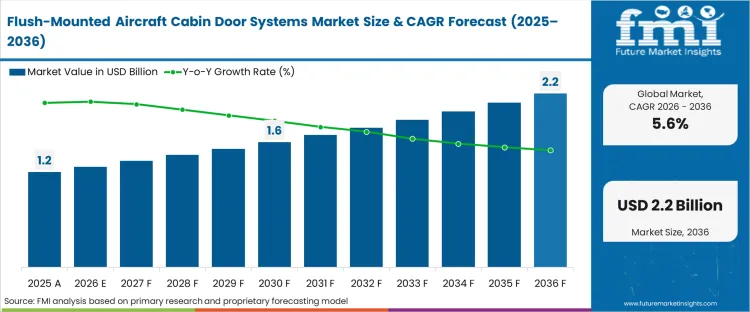
The Flush-Mounted Aircraft Cabin Door Systems Market was assessed to be at USD 1.2 billion in 2025 with the industry all set to cross USD 1.3 billion in 2026 at a CAGR of 5.6% during the forecast period. This steady scale-up carries the valuation to USD 2.1 billion through 2036 as the relentless retirement of legacy single-aisle fleets forces procurement directors to specify hardware capable of absorbing higher-frequency pressurization cycles without maintenance delays. To protect tight turnaround schedules, this structural shift directly drives demand for flush-mounted aircraft doors engineered for peak dispatch reliability within the broader commercial aircraft cabin doors market.
Airlines and leasing companies are shifting their procurement strategy from reactive component replacement to predictive overhaul frameworks. This transformation requires airframers to elevate door assemblies from passive structural barriers into integrated kinematic systems that report their own wear profiles. Delaying this transition exposes fleet operators to unexpected dispatch interruptions, directly impacting turnaround metrics and profitability. Procurement teams are consequently prioritizing intelligent aircraft doors that communicate seamlessly with the broader global aircraft cabin interior management network.
The structural gate that accelerates the aircraft cabin door market size is the standardization of electrically monitored smart-latch systems on next-generation narrowbody production lines. Once major suppliers successfully scale these sensor-embedded architectures to match record-breaking monthly delivery targets, the economic penalty of operating analog aircraft cabin interior closures becomes unsustainable for low-cost carriers. This shift transitions predictive capability from a premium widebody feature to a baseline necessity across all commercial fleets.
Summary of Flush-Mounted Aircraft Cabin Door Systems Market
- Flush-Mounted Aircraft Cabin Door Systems Market Definition
- This market tracks the highly engineered, flush-fitting pressure barriers that secure the fuselage exterior. It is functionally bounded by the rigorous safety certification standards required for components that must independently sustain cabin pressure while remaining instantly operable for emergency evacuation.
- Demand Drivers in the Market
- Stringent dispatch reliability targets force airline operations managers to specify aircraft door latching systems with integrated health-monitoring sensors.
- Record narrowbody production backlogs compel major aerostructures suppliers to heavily automate manufacturing processes for aircraft door actuation systems.
- Enhanced evacuation certification mandates push airframers to integrate lighter, power-assisted deployment mechanisms and highly reliable aviation safety door compliance systems.
- Key Segments Analyzed in the FMI Report
- Passenger Entry Doors: Passenger entry doors are expected to hold 41.0% share in 2026, driven by their critical dual-role function as both high-cycle boarding access points and primary evacuation routes.
- Single-Aisle Aircraft: Single-aisle aircraft is poised to account for 58.0% share in 2026, as high-frequency flight schedules place the maximum cyclic stress on these specific airframes.
- Plug-Type Mechanically Latched, Power-Assisted Systems: This architecture is set to garner 46.0% share, reflecting its established reliability profile and proven compliance with long-standing safety regulations.
- Aluminum / Aluminum-Lithium Structures: Securing 52.0% share, metallic structures remain dominant due to their understood fatigue characteristics and vast global MRO repair infrastructure.
- OEM Line-Fit: Leading with 55.0% share, this segment is anchored directly to the massive multi-year delivery backlogs of the primary commercial aerospace manufacturers.
- India: Expanding at 7.2% CAGR, reflecting unprecedented domestic carrier fleet expansion and localized assembly investments.
- Analyst Opinion at FMI
- Nikhil Kaitwade, Principal Analyst, Process Automation, at FMI, opines, "The generalist assumption evaluates door systems purely through the lens of weight reduction and composite adoption. However, the true competitive battleground lies in kinematic sensing. Weight reduction, while it remains a factor, kinematic sensing now dictates the competitive landscape. Airframers prioritize the procurement of intelligent nodes capable of preventing multi-million-dollar dispatch delays by flagging a misaligned strike-plate early, moving their procurement focus entirely past basic pressure plugs."
- Strategic Implications / Executive Takeaways
- Aerostructures manufacturers must secure long-term raw material supply agreements for specialized alloys to protect against production bottlenecks.
- Airline fleet procurement teams should mandate predictive maintenance capabilities in all new airframe delivery contracts to lower lifecycle costs.
- MRO service providers face immediate pressure to upgrade tooling and technician training to handle composite-hybrid door repairs.
- Methodology
- Primary Research: Strategic interviews with supply chain heads and fleet engineering directors.
- Desk Research: Aggregation of OEM production data and aviation regulatory frameworks.
- Market-Sizing and Forecasting: Baseline driven by commercial aircraft production rates.
- Data Validation and Update Cycle: Triangulation against aerospace supplier revenue reports.
India tracks to advance at a CAGR of 7.2%, followed closely by China at 6.8% and Singapore at 6.1%. North American and European hubs show mature expansion, with Canada recording 5.9%, France registering 5.5%, Germany growing at 5.2%, and the United States expanding at 4.7%. This divergence reflects the sheer volume of narrowbody orders originating from the Asia-Pacific basin, demanding localized MRO ecosystems and immediate line-fit supply chain shifts to support high-density commercial aviation door systems.
Flush-Mounted Aircraft Cabin Door Systems Market Definition
The market encompasses the engineered pressure-vessel closures that seal the passenger cabin environment from external atmospheric conditions during flight. It specifically isolates the kinematic hardware, structural panels, and latching mechanisms that align perfectly flush with the fuselage exterior to eliminate aerodynamic drag, distinguishing these critical components from internal partitions or non-pressurized access panels.
Flush-Mounted Aircraft Cabin Door Systems Market Inclusions
This market includes all primary passenger entry doors, galley service doors, and overwing emergency exits designed for flush exterior alignment. It covers the structural composite or metallic shells alongside internal hinge and articulation mechanisms. The market also includes power-assist deployment systems, pressure-sealing interfaces, and the integrated sensory hardware required for modern aircraft cabin interiors.
Flush-Mounted Aircraft Cabin Door Systems Market Exclusions
The market explicitly excludes cockpit security doors, internal lavatory closures, and cargo hold access panels. Cargo doors are excluded because they operate under fundamentally different actuation kinematics, load-bearing requirements, and safety certification pathways than passenger-rated pressure barriers, requiring entirely separate manufacturing and qualification streams.
Flush-Mounted Aircraft Cabin Door Systems Market Research Methodology
- Primary Research: Sourcing directors at major airframers, VP-level engineering heads at Tier-1 aerostructures suppliers, and chief maintenance officers at commercial airlines.
- Desk Research: Aviation safety authority (FAA/EASA) airworthiness directives, aerospace materials certification registries, and primary manufacturer delivery schedules.
- Market-Sizing and Forecasting: The baseline anchors to verifiable annual commercial aircraft delivery projections multiplied by average door configurations per airframe variant.
- Data Validation and Update Cycle: Forecasts cross-validated against supplier backlog disclosures and commercial fleet retirement rates to map precise replacement cycles.
Segmental Analysis
Flush-Mounted Aircraft Cabin Door Systems Market Analysis by Door Type
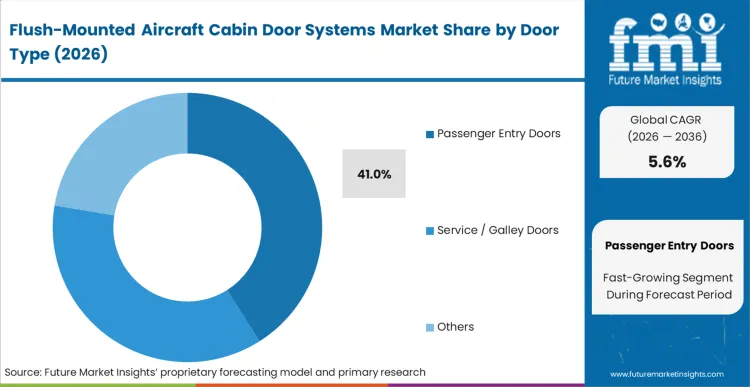
Passenger entry doors capture their commanding 41.0% share because they serve as the singular bottleneck for both routine revenue operations and emergency survival. Based on FMI's assessment, airframers cannot compromise on the cyclic durability of these primary interfaces without immediately degrading airline turnaround times, driving intense focus on both the aircraft entry door systems market and the aircraft emergency exit door systems market. The integration of advanced aircraft evacuation mechanisms into these specific passenger aircraft door systems further elevates their unit value compared to standard aircraft service door systems. A failure to optimize entry door kinematics directly punishes low-cost carriers with delayed boarding procedures and cascading schedule disruptions. Advancements in integrated aircraft interior lighting surrounding these frames also add to their complexity and cost.
- Boarding Efficiency: High-cycle kinematic designs ensure smooth operation under rapid turnaround pressures. Low-cost carriers capture immediate ROI through reduced ground time.
- Evacuation Integration: Seamlessly housing power-assist deployment hardware guarantees compliance with stringent egress timing mandates. Safety certifiers validate airframe viability based on this metric.
- Aesthetic Transition: Flush alignment eliminates aerodynamic drag while maintaining clean exterior lines. Fleet operators achieve fractional fuel savings over the component's lifespan.
Flush-Mounted Aircraft Cabin Door Systems Market Analysis by Aircraft Type
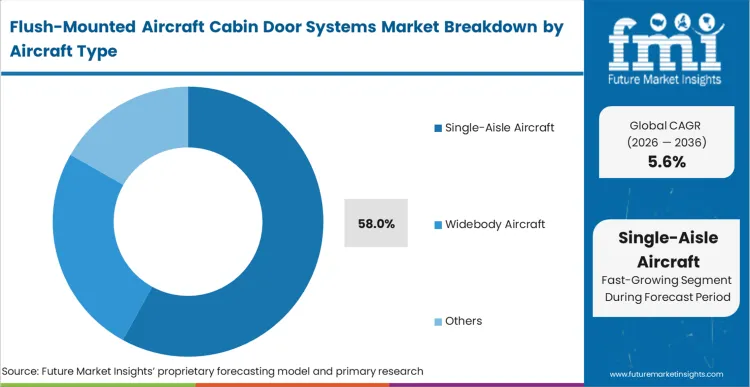
Suppliers failing to secure narrowbody line-fit contracts effectively lock themselves out of the industry's primary revenue engine. The structural reason single-aisle aircraft dominate with a 58.0% share lies in the operational model of the airlines purchasing them: maximum daily sectors requiring constant cabin pressurization and depressurization. As per FMI's projection, this punishing cyclic environment forces early adoption of highly durable door hardware that widebody platforms operating fewer long-haul sectors can defer. The sheer volume of narrowbody backlogs means that any improvement in aircraft door systems for narrowbody jets instantly scales across thousands of units. While widebodies prioritize integration with heavy aircraft galley systems and premium aircraft seating, narrowbodies demand pure, unyielding cyclic reliability.
- Cyclic Endurance: Narrowbody platforms undergo extreme pressurization cycles daily. MRO providers base overhaul schedules precisely on these cycle counts.
- Volume Scaling: Unprecedented airframe backlogs drive manufacturing economies of scale. Major suppliers prioritize narrowbody tooling to meet delivery mandates.
- Turnaround Velocity: Rapid actuation mechanisms support aggressive low-cost carrier scheduling. Fleet managers penalize platforms that delay boarding operations.
Flush-Mounted Aircraft Cabin Door Systems Market Analysis by System Architecture
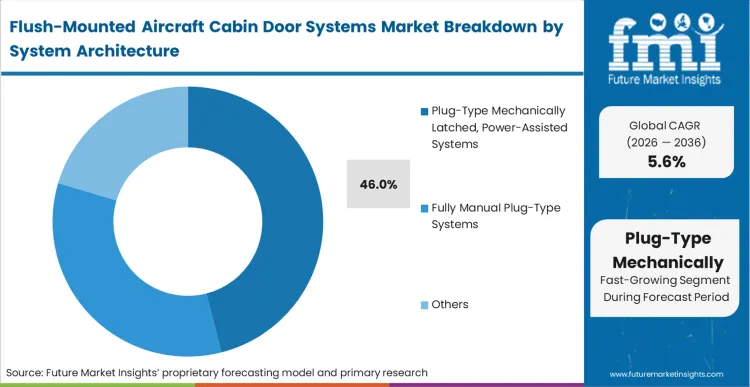
FMI analysts opine that because a plug door physically cannot open while the cabin is pressurized, it eliminates a massive category of in-flight risk, making these plug-type aircraft cabin doors the default baseline for certification. The addition of power-assist ensures flight attendants can rapidly deploy the slide in emergencies, a critical factor for overwing exit door systems aircraft and main doors alike. As the industry moves toward highly integrated structural shells and aircraft fairings, this architecture remains standard because deviating from it requires an astronomically expensive recertification process. Replacing these systems with fully automated variants requires overcoming severe regulatory skepticism regarding digital fail-states, pushing buyers to stick with known mechanical baselines integrated with aircraft cabin environment sensor overlays. Plug-type mechanically latched, power-assisted systems secure 46.0% share by offering the exact balance of fail-safe physics and operational ease that safety regulators demand.
- Fail-Safe Physics: The wedge-shape design uses cabin pressure to physically seal the barrier. Regulators mandate this inherent safety feature for primary exits.
- Deployment Assistance: Pneumatic or spring-loaded aids ensure rapid emergency operation. Flight crews rely on this capability to meet evacuation timing standards.
- Maintenance Familiarity: Decades of operational history mean every global repair station understands the mechanism. Airlines avoid exotic architectures that strand aircraft in remote locations.
Flush-Mounted Aircraft Cabin Door Systems Market Analysis by Material
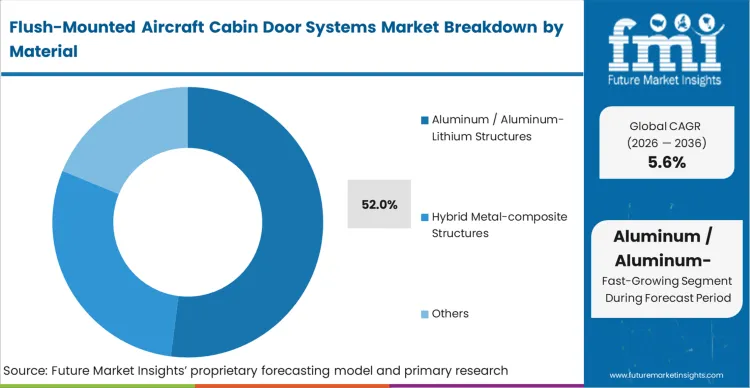
Airlines operating high-density routes prefer metallic doors because minor damage can be evaluated and patched quickly using standard visual inspections and traditional reusable aircraft cabin panel fasteners. According to FMI's estimates, when engineers compare composite and aluminum aircraft cabin doors, they recognize that while composites offer undeniable weight advantages, a ramp rash incident involving composite aircraft cabin doors often grounds an aircraft until specialized non-destructive testing can verify structural integrity. Aluminum and aluminum-lithium structures maintain a 52.0% share simply because the global MRO infrastructure knows exactly how to inspect, measure, and repair metallic fatigue. The integration of complex aircraft interface device technology is also well-mapped within metallic frames. Fleet operators who prematurely force all-composite doors onto harsh regional routes routinely suffer extended dispatch delays when ground support equipment inevitably strikes the fuselage.
- Fatigue Predictability: Metallic alloys have decades of proven cyclic degradation data. Engineering teams confidently schedule deep maintenance without guesswork.
- Repair Velocity: Standard sheet metal techniques can address minor ramp damage swiftly. Airlines avoid the costly groundings associated with composite delamination testing.
- Supply Chain Maturity: Global raw material availability prevents production bottlenecks. Airframers maintain delivery schedules without waiting on specialized autoclave capacity.
Flush-Mounted Aircraft Cabin Door Systems Market Analysis by End Use
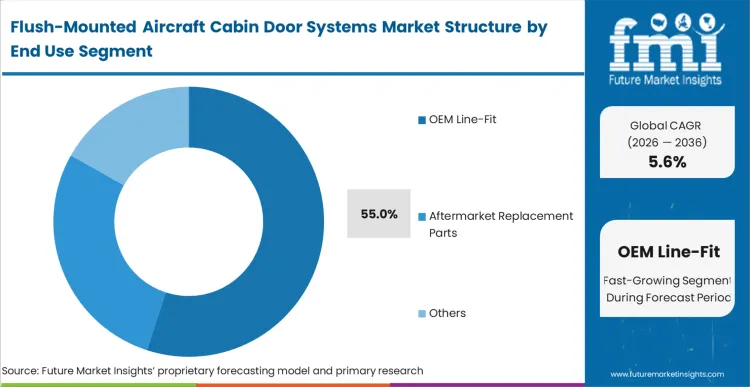
OEM line-fit dominates with a 55.0% share because cabin doors are fundamental airframe structures installed long before the interior is outfitted. In FMI's view, a door is not an accessory; it is a critical load-bearing segment of the fuselage, making its original installation the single largest value capture point for aircraft door system suppliers for OEM linefit. Aftermarket replacements are exceedingly rare and generally only occur following severe ground accidents. While operators regularly overhaul interiors with new quick release aircraft interior fasteners and aircraft curtains, doors remain with the airframe for decades. This reality means aircraft cabin door retrofit suppliers compete in a highly specialized, smaller aircraft cabin door retrofit market. When airlines issue a request for quote for aircraft cabin door assemblies, they typically focus their procurement on modifications and upgrades to existing frames.
- Structural Integration: Doors are fitted during primary fuselage assembly. Manufacturers secure revenue at the absolute start of the aircraft's life.
- Certification Lock-In: The original door design is permanently linked to the aircraft's type certificate. Competitors cannot easily substitute aftermarket alternatives without massive regulatory burden.
- Lifespan Matching: These components are designed to outlast the economic life of the airframe itself. Operators rarely budget for full door replacements during standard heavy checks.
Flush-Mounted Aircraft Cabin Door Systems Market Drivers, Restraints, and Opportunities
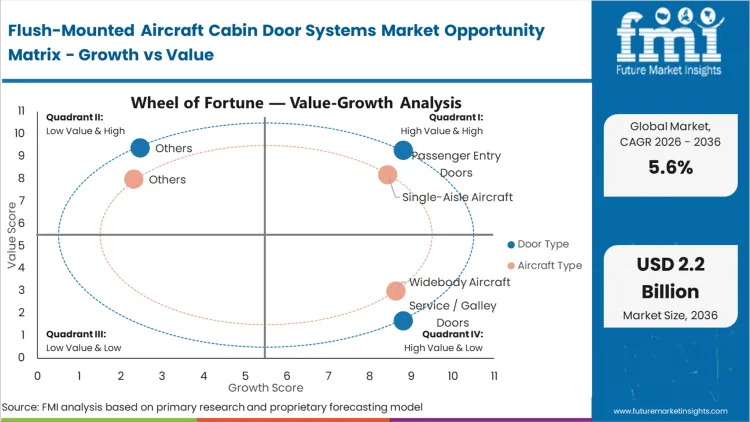
For commercial fleets, profitability hinges entirely on maximizing daily flight sectors. This brutal utilization math leaves procurement teams with zero tolerance for hardware that slows down ground operations. If a maintenance crew has to pause a tight turnaround to manually troubleshoot aircraft door seals and locking mechanisms, a low-cost carrier’s entire daily schedule begins to fracture. To survive this operational tempo, airframers are actively stripping out legacy analog closures and substituting them with intelligent, sensor-driven kinematics capable of tracking their own strike-plate degradation. Carriers that neglect to spec these self-diagnosing systems at the initial point of sale are effectively baking future dispatch delays and margin collapse directly into their aging fleets.
On the supply side, the ultimate choke point is the grueling certification gauntlet triggered by even the smallest design modification. A cabin door functions as both a primary pressure vessel and the ultimate fail-safe for emergency egress, extending its engineering requirements far beyond those of a simple physical barrier. Swapping out a minor alloy or altering a hinge as a result requires an exhausting regulatory validation process to guarantee equivalent safety. This extreme friction suffocates rapid prototyping and traps suppliers inside decades-long product cycles. Digital twinning and stress simulation software can only take engineering teams so far that in the end, aviation authorities still demand literal, full-scale destruction and physical evacuation trials before they will sign off on airworthiness.
Opportunities in the Flush-Mounted Aircraft Cabin Door Systems Market
- Predictive Maintenance Integration: The shift toward data-driven airline operations creates demand for kinematic sensors. Suppliers who embed these sensors capture lucrative long-term data monitoring contracts.
- Aluminum-Lithium Alloys: The need for weight reduction without sacrificing metallic repairability drives material innovation. Machining firms that master these advanced alloys secure preferred positions on next-generation narrowbody programs.
- Automated Manufacturing: Unprecedented OEM production rate hikes necessitate robotic assembly. Suppliers investing in automated fastening and aircraft soft goods isolation capture scale advantages that manual aircraft textile and metal shops cannot match.
Regional Analysis
.webp "Top Country Growth Comparison Flush Mounted Aircraft Cabin Door Systems Market Cagr (2026 2036)")
Global adoption trajectories for flush-mounted door systems vary distinctly by territory. Aggressive narrowbody fleet expansion shapes the Asian landscape, while precision engineering optimization drives the European sector and relentless MRO cyclic demands define North America. Based on the regional analysis, the flush-mounted aircraft cabin door systems market is segmented into North America, Europe, Asia Pacific, and other regions across 40 plus countries.
| Country | CAGR (2026 to 2036) |
|---|---|
| India | 7.2% |
| China | 6.8% |
| Singapore | 6.1% |
| Canada | 5.9% |
| France | 5.5% |
| Germany | 5.2% |
| United States | 4.7% |
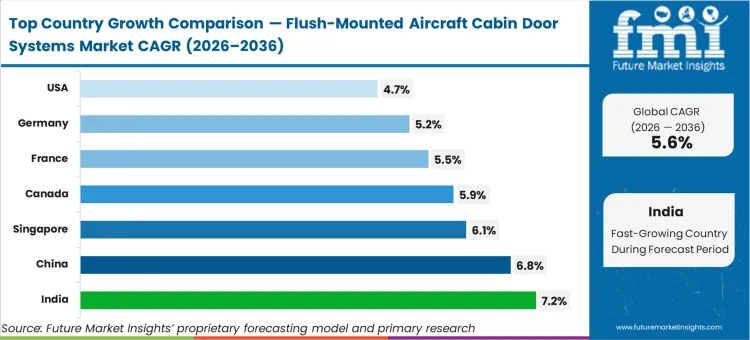
Source: Future Market Insights (FMI) analysis, based on proprietary forecasting model and primary research
Asia Pacific Flush-Mounted Aircraft Cabin Door Systems Market Analysis
As regional airlines execute historic, multi-hundred aircraft orders, airframers are heavily incentivized to build localized final assembly lines and MRO hubs to mitigate logistical friction. According to FMI, this massive infrastructure shift forces major door suppliers to transition structural assembly packages away from legacy Western facilities directly into expanding Asian aerospace corridors, firmly moving the global supply chain's center of gravity.
- India: Expanding at a rapid CAGR of 7.2%, India aircraft cabin door manufacturing is accelerating as domestic aerostructures firms rapidly scale up to meet strict line-fit requirements. Global airframers are compelled by aggressive localized offset mandates to source these critical structures directly from within the country to satisfy massive airline orders. Early access to the world’s most intense commercial aviation boom is effectively secured by those companies that successfully establish certified manufacturing footprints on the ground.
- China: Dual demand streams are emerging as indigenous commercial aircraft programs scale up right alongside the established Western final assembly lines operating locally. Supported by a projected CAGR of 6.8%, China’s market state-backed suppliers are swiftly absorbing advanced composite manufacturing techniques to fulfill these orders. The resulting robust ecosystem is sharply diminishing the nation's historical reliance on imported aerostructures.
- Singapore: Heavy maintenance providers located here demand a continuous influx of advanced diagnostic tooling and specialized replacement hardware to service widebody fleets. Because of its strategic geographic positioning, Singapore functions as the preeminent widebody maintenance hub for the entire Asia Pacific basin. Driving a 6.1% CAGR for aircraft cabin door MRO services by operating a certified aircraft door repair station in this zone, MROs ensure regional fleet expansions are sustained without routing jets back to Europe.
FMI’s analysis additionally covers emerging Southeast Asian maintenance corridors operating just outside these primary hubs. As these developing markets invest heavily in localized structural repair capabilities, they open fresh avenues for established component suppliers aiming to capture spillover line-maintenance demand from major regional carriers.
Europe Flush-Mounted Aircraft Cabin Door Systems Market Analysis
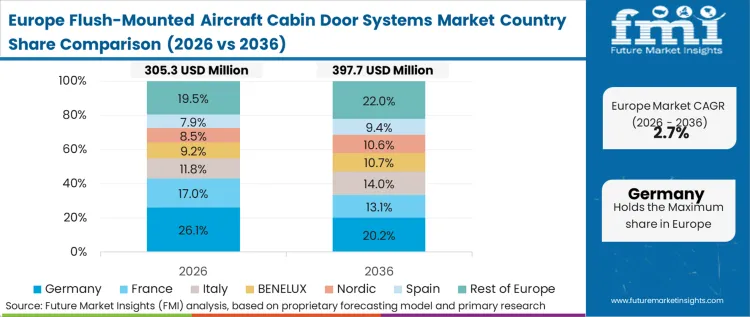
The European landscape is fundamentally dictated by engineering optimization and the deeply entrenched supply networks of apex commercial airframers, prioritizing precision over volume expansion. FMI analysts observe that local manufacturers are aggressively pushing the limits of smart-latch integration and automated composite manufacturing to drive down unit costs through robotics. By doing so, they strive to meet strict sustainability targets while defending their global market share from rising Asian competitors, an effort firmly anchored by regional aircraft seals engineering expertise.
- France: Set to advance at a CAGR of 5.5% over the forecast period, the French sector relies heavily on synchronized, just-in-time delivery schedules driven by its close physical proximity to OEMs. High-volume, direct demand for completed door modules is dictated by the absolute concentration of primary airframe final assembly lines within the country. Bidders attempting to secure next-generation platform contracts from outside this immediate geographic radius face immense logistical penalties.
- Germany: Leading the transition away from purely mechanical latches, German engineering firms are architecting the next generation of digitally monitored smart systems. FMI estimates the German market will expand at a 5.2% CAGR, fueled by the country's deep, specialized expertise in electromechanical actuation and precision kinematics. By dominating these complex architectures, European firms successfully retain control over the highest-margin, intellectual property-dense components.
FMI's intelligence further evaluates secondary Eastern European production zones that reliably feed into these primary Western hubs. Functioning as vital cost-reduction centers, these supplementary markets supply essential raw materials and sub-assemblies to the dominant aerostructures integrators currently managing massive, multi-year order backlogs.
North America Flush-Mounted Aircraft Cabin Door Systems Market Analysis
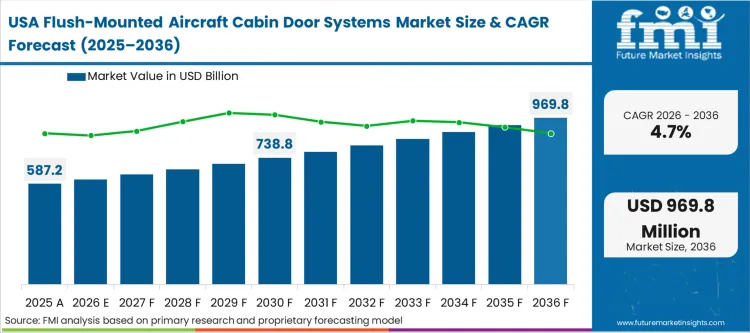
Because airlines operate on razor-thin turnaround margins, any component failure that interrupts the complex choreography of domestic scheduling is severely punished in this region. According to FMI's estimates, procurement strategies are heavily dictated by both stringent safety oversight and the extreme cyclic endurance required to maintain high-frequency hub-and-spoke networks. The immediate availability of replacement parts, as a result, fundamentally shapes the North American landscape's operational realities.
- Canada: Specialized composite engineering capabilities uniquely combined with robust regional aircraft manufacturing are the primary drivers of the Canadian landscape. By focusing intensely on optimizing door structures for smaller airframes subjected to extreme cyclic commuter loads, local suppliers successfully avoid direct competition with mega-manufacturers targeting large widebodies. Canadian industry to demonstrate a solid 5.9% CAGR, is allowed by this hyper-specialized structural approach.
- United States: Rigorous compliance with evolving FAA directives regarding structural inspections is non-negotiable given the sheer scale of legacy fleet operations demanding continuous MRO support. The United States landscape, poised to achieve a CAGR of 4.7%, requires absolute reliability to safeguard highly optimized domestic routing grids. Competitors equipped with superior domestic support networks consistently win major fleet renewal contracts over airframers that cannot guarantee immediate, localized spares availability.
FMI's report includes secondary European and Latin American aviation hubs. These tertiary markets rely entirely on imported MRO expertise, creating lucrative out-station support contracts for global aircraft refurbishing providers operating within the broader aircraft retrofit market who can deploy rapid-response structural repair teams.
Competitive Aligners for Market Players
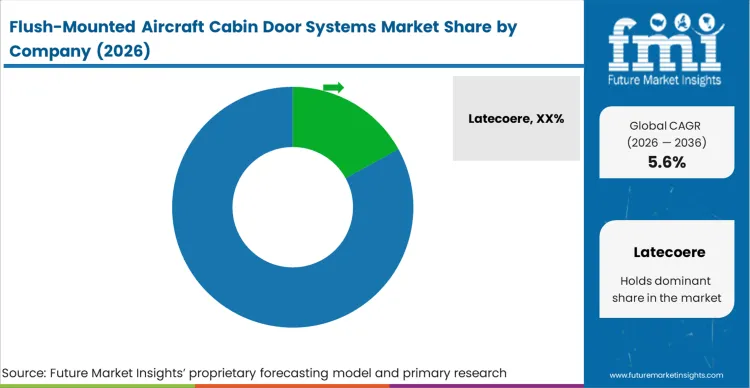
Navigating a punishing, multi-year certification gauntlet is the defining barrier to entry in the manufacturing of primary flush-mounted pressure vessels, a reality that immediately weeds out undercapitalized aerospace suppliers. When procurement teams ask who are the top suppliers in aircraft cabin door systems, airframers dictate vendor selection based on a single, uncompromising metric: the demonstrated capacity to execute massive, flawless production runs without triggering a single airworthiness directive. This rigid stance concentrates immense power among apex aircraft door manufacturers like Latecoere, Airbus Atlantic, and Airbus Aerostructures, who possess the vast, certified factory footprints required to deliver thousands of defect-free kinematic assemblies annually. For procurement directors evaluating the best aircraft cabin door suppliers, a vendor's historical safety record, mastery of aviation safety door compliance systems, and sheer financial stamina heavily outweigh any theoretical design innovation pitched by smaller challengers.
Holding a profound structural advantage, incumbents within the commercial aircraft cabin doors market anchor their dominance on vast archives of proprietary cyclic fatigue data gathered over decades of active fleet operations. Powerhouses such as Safran Cabin, Collins Aerospace, and GKN Aerospace actively leverage these deep operational records to pre-validate their kinematic architectures and aircraft door actuation systems, drastically compressing the regulatory risk associated with new platform integration. This structural reality heavily protects established aircraft door system suppliers for OEM linefit, ensuring that once they secure an initial contract, they effectively capture the exclusive revenue stream for the entire thirty-year operational lifespan of that specific airframe.
Even with such heavy supplier concentration in the aircraft door systems market, primary airframers consistently push back against total supply chain lock-in by executing strategic dual-sourcing agreements whenever production volumes permit. This dynamic creates a perpetual structural tension between an OEM's demand for pricing leverage and a supplier's absolute need for guaranteed manufacturing volumes to amortize their intensive tooling costs. As production rates surge through 2036, agility and localized manufacturing will increasingly define competitive survival, empowering firms like Dynamatic Technologies that can rapidly scale regional operations to absorb overflow from strained Western facilities. Ultimately, this pressure will force a broader industry realignment within the aircraft cabin door systems market, compelling apex airframers to either pull highly complex, sensor-integrated door production back in-house or permanently elevate agile regional manufacturers into the global Tier-1 hierarchy.
Key Players in Flush-Mounted Aircraft Cabin Door Systems Market
- Latecoere
- Airbus Atlantic
- Collins Aerospace
- Safran Cabin
- Dynamatic Technologies
- Airbus Aerostructures
- GKN Aerospace
Scope of the Report
| Metric | Value |
|---|---|
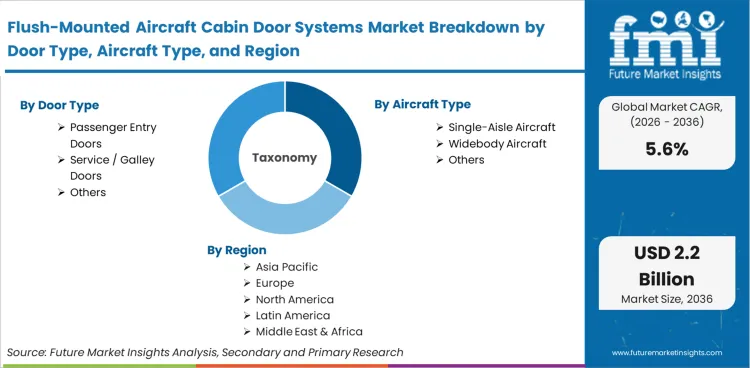
| Quantitative Units | USD 1.3 billion to USD 2.1 billion, at a CAGR of 5.6% |
| Market Definition | This market encompasses the engineered pressure-vessel closures that seal the passenger cabin. It isolates the kinematic hardware and structures that align flush with the fuselage to eliminate drag, functioning as critical safety boundaries. |
| Door Type Segmentation | Passenger entry doors, Service / galley doors, Overwing emergency exit doors, Cabin-adjacent security / transition doors |
| Aircraft Type Segmentation | Single-aisle aircraft, Widebody aircraft, Regional aircraft, Business / VIP aircraft |
| System Architecture Segmentation | Plug-type mechanically latched, power-assisted systems, Fully manual plug-type systems, Electrically monitored smart-latch systems, Hydraulic / electromechanical actuation packages |
| Material Segmentation | Aluminum / aluminum-lithium structures, Hybrid metal-composite structures, CFRP / thermoplastic composite doors, Titanium-intensive hardware modules |
| Regions Covered | North America, Europe, Asia Pacific |
| Countries Covered | India, China, Singapore, Canada, France, Germany, United States, and 40 plus countries |
| Key Companies Profiled | Latecoere, Airbus Atlantic, Collins Aerospace, Safran Cabin, Dynamatic Technologies, Airbus Aerostructures, GKN Aerospace |
| Forecast Period | 2026 to 2036 |
| Approach | Primary interviews targeted engineering VPs and supply chain directors at major aerostructures firms. The baseline anchored to verifiable annual commercial aircraft delivery schedules. Forecasts were cross-validated using major aerospace supplier financial disclosures and long-term fleet retirement modeling. |
Source: Future Market Insights (FMI) analysis, based on proprietary forecasting model and primary research
Segments:
Door Type:
- Passenger entry doors
- Service / galley doors
- Overwing emergency exit doors
- Cabin-adjacent security / transition doors
Aircraft Type:
- Single-aisle aircraft
- Widebody aircraft
- Regional aircraft
- Business / VIP aircraft
System Architecture:
- Plug-type mechanically latched, power-assisted systems
- Fully manual plug-type systems
- Electrically monitored smart-latch systems
- Hydraulic / electromechanical actuation packages
Material:
- Aluminum / aluminum-lithium structures
- Hybrid metal-composite structures
- CFRP / thermoplastic composite doors
- Titanium-intensive hardware modules
End Use:
- OEM line-fit
- Aftermarket replacement parts
- Retrofit / upgrade kits
- MRO service bundles
Region:
- North America
- United States
- Canada
- Europe
- Germany
- United Kingdom
- France
- Italy
- Spain
- Asia Pacific
- China
- Japan
- South Korea
- Taiwan
- Singapore
- Latin America
- Brazil
- Mexico
- Argentina
- Middle East & Africa
- GCC Countries
- South Africa
- Israel
Bibliography
- Federal Aviation Administration. (2024, January). FAA Statement on Recommending Visual Inspections of Boeing 737-900ER Mid-Exit Door Plugs. Federal Aviation Administration.
- European Union Aviation Safety Agency. (2025, June). Installed Physical Secondary Barrier. EASA Product Certification.
- Latecoere. (2025, March). Latecoere Reports FY 2024 Results. Latecoere Investors.
- ACI World & International Civil Aviation Organization. (2025, January). Joint ACI World-ICAO Passenger Traffic Report, Trends and Outlook. ACI Aviation Data.
- Cui, Z. (2024, August). Research on the Design of Aviation and Aerospace Hatch Doors from the Perspective of Reliability and Safety. Aerospace.
- RTX. (2024, January). RTX 2024 Annual Report. RTX Investors.
- Dynamatic Technologies Limited. (2026, January). Dynamatic technologies sets new benchmark for ‘make in india’: Delivers complete set of airbus A220 doors in record time. Dynamatic News.
This bibliography is provided for reader reference. The full FMI report contains the complete reference list with primary source documentation.
This Report Addresses
- Market intelligence to support strategic decision making across plug-type mechanically latched systems and smart-latch architectures
- Market size estimation and 10-year revenue forecasts from 2026 to 2036, supported by commercial aircraft production rate aggregation
- Growth opportunity mapping across aircraft type dimensions with emphasis on the standardization of electrically monitored sensors on narrowbody lines
- Segment and regional revenue forecasts covering aluminum-lithium structures across stringent EASA and FAA regulatory environments
- Competition strategy assessment including automated manufacturing scale and proprietary cyclic fatigue data advantages
- Capability development tracking including kinematic sensors, power-assist deployment mechanisms, and predictive maintenance frameworks
- Market access analysis covering aviation safety authority airworthiness directives and strict OEM line-fit qualification standards
- Market report delivery includes standard digital document and spreadsheet formats, providing interactive dashboards tailored for executive strategy, fleet procurement planning, and operational benchmarking.
Frequently Asked Questions
How large is the flush-mounted aircraft cabin door systems market in 2026?
The flush-mounted aircraft cabin door systems market is valued at USD 1.3 billion in 2026, reflecting the massive capital deployed by airframers to clear narrowbody delivery backlogs.
What will it be valued at by 2036?
The sector will reach USD 2.1 billion by 2036, signaling a permanent industry shift toward procuring intelligent, sensor-laden cabin closures.
What is the forecast CAGR for aircraft cabin door systems?
A CAGR of 5.6% is expected over the forecast period, mirroring long-term aircraft production schedules that shield the market from short-term macroeconomic volatility.
Which Door Type segment leads?
Passenger entry doors lead the market because they act as the absolute operational bottleneck for airlines, directly impacting daily flight sector profitability and boarding velocity.
Which Aircraft Type segment leads?
Single-aisle aircraft dominate this dimension as the grueling high-frequency schedules of modern low-cost carriers subject these airframes to maximum pressurization cycles.
Which System Architecture segment leads?
Plug-type aircraft cabin doors with power-assist secure the top position because aviation regulators mandate their fail-safe physics as the non-negotiable baseline for emergency egress certification.
What is driving growth in aircraft cabin door retrofits?
Growth is driven by airlines forcing airframers to integrate predictive maintenance capabilities into aging door assemblies to prevent unexpected dispatch delays.
What is the primary restraint?
The exhaustive regulatory certification process restrains rapid innovation, as substituting even a minor material in these primary pressure vessels requires physical destruction testing.
Which country grows fastest?
India expands at the fastest rate of 7.2%, driven by aggressive mandates for India aircraft cabin door manufacturing localization to support record-breaking aircraft orders.
How do FAA and EASA directives shape this market?
Safety authorities enforce an immovable regulatory stance on evacuation timing standards, forcing manufacturers to continuously optimize aviation safety door compliance systems.
How is smart-latch sensing altering procurement?
Procurement teams are now specifying data-generating aircraft door latching systems that feed directly into airline health-monitoring networks for predictive maintenance.
Who are the top suppliers in aircraft cabin door systems?
The top aircraft door manufacturers like Latecoere and Airbus Atlantic dominate because they possess decades of proprietary cyclic fatigue data and massive, certified factory footprints.
Why do aluminum structures maintain market dominance?
Airlines prefer metallic alloys because standard repair stations worldwide know exactly how to patch them after ramp damage without the complex testing required for composite doors.
How does OEM line-fit dictate aftermarket dynamics?
Because a door remains with the airframe for decades, securing the initial aircraft door system suppliers for OEM linefit contract is the primary way to capture long-term revenue.
What advantage do French suppliers hold in Europe?
French Tier-1 firms operate in physical proximity to major final assembly lines, enabling highly synchronized, just-in-time delivery that competitors cannot logistically match.
How do plug-type aircraft cabin doors work?
They utilize a wedge-shaped architecture where the cabin's internal pressurization physically seals the barrier tightly against the airframe, ensuring the door cannot be opened mid-flight.
Why are business jet doors technically distinct?
While sharing basic physics, business jet doors prioritize acoustic isolation and seamless aesthetic transitions over the extreme high-cycle durability required by commercial airliners.
How do operators handle composite door damage?
Operators must deploy specialized ultrasonic or thermographic testing to detect hidden delamination, which makes high-density airlines hesitant to transition away from metallic frames.
What defines the boundary between inclusions and exclusions?
The market explicitly isolates pressure-bearing, externally flush closures, excluding internal lavatory or cockpit doors that lack aerodynamic and atmospheric load requirements.
How does automated manufacturing impact unit costs?
Robotic assembly allows major suppliers to handle complex alloys with perfect repeatability, reducing scrap rates and shielding them from the intense pricing pressure exerted by apex airframers.
Preview the report firsthand - request a free sample
Get SampleGet the brochure for pricing and purchase details.
Get PDFTable of Content
- Executive Summary
- Global Market Outlook
- Demand-side Trends
- Supply-side Trends
- Technology Roadmap Analysis
- Analysis and Recommendations
- Market Overview
- Market Coverage / Taxonomy
- Market Definition / Scope / Limitations
- Research Methodology
- Chapter Orientation
- Analytical Lens and Working Hypotheses
- Market Structure, Signals, and Trend Drivers
- Benchmarking and Cross-market Comparability
- Market Sizing, Forecasting, and Opportunity Mapping
- Research Design and Evidence Framework
- Desk Research Programme (Secondary Evidence)
- Company Annual and Sustainability Reports
- Peer-reviewed Journals and Academic Literature
- Corporate Websites, Product Literature, and Technical Notes
- Earnings Decks and Investor Briefings
- Statutory Filings and Regulatory Disclosures
- Technical White Papers and Standards Notes
- Trade Journals, Industry Magazines, and Analyst Briefs
- Conference Proceedings, Webinars, and Seminar Materials
- Government Statistics Portals and Public Data Releases
- Press Releases and Reputable Media Coverage
- Specialist Newsletters and Curated Briefings
- Sector Databases and Reference Repositories
- FMI Internal Proprietary Databases and Historical Market Datasets
- Subscription Datasets and Paid Sources
- Social Channels, Communities, and Digital Listening Inputs
- Additional Desk Sources
- Expert Input and Fieldwork (Primary Evidence)
- Primary Modes
- Qualitative Interviews and Expert Elicitation
- Quantitative Surveys and Structured Data Capture
- Blended Approach
- Why Primary Evidence is Used
- Field Techniques
- Interviews
- Surveys
- Focus Groups
- Observational and In-context Research
- Social and Community Interactions
- Stakeholder Universe Engaged
- C-suite Leaders
- Board Members
- Presidents and Vice Presidents
- R&D and Innovation Heads
- Technical Specialists
- Domain Subject-matter Experts
- Scientists
- Physicians and Other Healthcare Professionals
- Governance, Ethics, and Data Stewardship
- Research Ethics
- Data Integrity and Handling
- Primary Modes
- Tooling, Models, and Reference Databases
- Desk Research Programme (Secondary Evidence)
- Data Engineering and Model Build
- Data Acquisition and Ingestion
- Cleaning, Normalisation, and Verification
- Synthesis, Triangulation, and Analysis
- Quality Assurance and Audit Trail
- Market Background
- Market Dynamics
- Drivers
- Restraints
- Opportunity
- Trends
- Scenario Forecast
- Demand in Optimistic Scenario
- Demand in Likely Scenario
- Demand in Conservative Scenario
- Opportunity Map Analysis
- Product Life Cycle Analysis
- Supply Chain Analysis
- Investment Feasibility Matrix
- Value Chain Analysis
- PESTLE and Porter’s Analysis
- Regulatory Landscape
- Regional Parent Market Outlook
- Production and Consumption Statistics
- Import and Export Statistics
- Market Dynamics
- Global Market Analysis 2021 to 2025 and Forecast, 2026 to 2036
- Historical Market Size Value (USD Million) Analysis, 2021 to 2025
- Current and Future Market Size Value (USD Million) Projections, 2026 to 2036
- Y-o-Y Growth Trend Analysis
- Absolute $ Opportunity Analysis
- Global Market Pricing Analysis 2021 to 2025 and Forecast 2026 to 2036
- Global Market Analysis 2021 to 2025 and Forecast 2026 to 2036, By Door Type
- Introduction / Key Findings
- Historical Market Size Value (USD Million) Analysis By Door Type , 2021 to 2025
- Current and Future Market Size Value (USD Million) Analysis and Forecast By Door Type , 2026 to 2036
- Passenger Entry Doors
- Service / Galley Doors
- Others
- Passenger Entry Doors
- Y-o-Y Growth Trend Analysis By Door Type , 2021 to 2025
- Absolute $ Opportunity Analysis By Door Type , 2026 to 2036
- Global Market Analysis 2021 to 2025 and Forecast 2026 to 2036, By Aircraft Type
- Introduction / Key Findings
- Historical Market Size Value (USD Million) Analysis By Aircraft Type, 2021 to 2025
- Current and Future Market Size Value (USD Million) Analysis and Forecast By Aircraft Type, 2026 to 2036
- Single-Aisle Aircraft
- Widebody Aircraft
- Others
- Single-Aisle Aircraft
- Y-o-Y Growth Trend Analysis By Aircraft Type, 2021 to 2025
- Absolute $ Opportunity Analysis By Aircraft Type, 2026 to 2036
- Global Market Analysis 2021 to 2025 and Forecast 2026 to 2036, By System Architecture
- Introduction / Key Findings
- Historical Market Size Value (USD Million) Analysis By System Architecture, 2021 to 2025
- Current and Future Market Size Value (USD Million) Analysis and Forecast By System Architecture, 2026 to 2036
- Plug-Type Mechanically Latched, Power-Assisted Systems
- Fully Manual Plug-Type Systems
- Others
- Plug-Type Mechanically Latched, Power-Assisted Systems
- Y-o-Y Growth Trend Analysis By System Architecture, 2021 to 2025
- Absolute $ Opportunity Analysis By System Architecture, 2026 to 2036
- Global Market Analysis 2021 to 2025 and Forecast 2026 to 2036, By Material
- Introduction / Key Findings
- Historical Market Size Value (USD Million) Analysis By Material, 2021 to 2025
- Current and Future Market Size Value (USD Million) Analysis and Forecast By Material, 2026 to 2036
- Aluminum / Aluminum-Lithium Structures
- Hybrid Metal-composite Structures
- Others
- Aluminum / Aluminum-Lithium Structures
- Y-o-Y Growth Trend Analysis By Material, 2021 to 2025
- Absolute $ Opportunity Analysis By Material, 2026 to 2036
- Global Market Analysis 2021 to 2025 and Forecast 2026 to 2036, By End Use
- Introduction / Key Findings
- Historical Market Size Value (USD Million) Analysis By End Use, 2021 to 2025
- Current and Future Market Size Value (USD Million) Analysis and Forecast By End Use, 2026 to 2036
- OEM Line-Fit
- Aftermarket Replacement Parts
- Others
- OEM Line-Fit
- Y-o-Y Growth Trend Analysis By End Use, 2021 to 2025
- Absolute $ Opportunity Analysis By End Use, 2026 to 2036
- Global Market Analysis 2021 to 2025 and Forecast 2026 to 2036, By Region
- Introduction
- Historical Market Size Value (USD Million) Analysis By Region, 2021 to 2025
- Current Market Size Value (USD Million) Analysis and Forecast By Region, 2026 to 2036
- North America
- Latin America
- Western Europe
- Eastern Europe
- East Asia
- South Asia and Pacific
- Middle East & Africa
- Market Attractiveness Analysis By Region
- North America Market Analysis 2021 to 2025 and Forecast 2026 to 2036, By Country
- Historical Market Size Value (USD Million) Trend Analysis By Market Taxonomy, 2021 to 2025
- Market Size Value (USD Million) Forecast By Market Taxonomy, 2026 to 2036
- By Country
- USA
- Canada
- Mexico
- By Door Type
- By Aircraft Type
- By System Architecture
- By Material
- By End Use
- By Country
- Market Attractiveness Analysis
- By Country
- By Door Type
- By Aircraft Type
- By System Architecture
- By Material
- By End Use
- Key Takeaways
- Latin America Market Analysis 2021 to 2025 and Forecast 2026 to 2036, By Country
- Historical Market Size Value (USD Million) Trend Analysis By Market Taxonomy, 2021 to 2025
- Market Size Value (USD Million) Forecast By Market Taxonomy, 2026 to 2036
- By Country
- Brazil
- Chile
- Rest of Latin America
- By Door Type
- By Aircraft Type
- By System Architecture
- By Material
- By End Use
- By Country
- Market Attractiveness Analysis
- By Country
- By Door Type
- By Aircraft Type
- By System Architecture
- By Material
- By End Use
- Key Takeaways
- Western Europe Market Analysis 2021 to 2025 and Forecast 2026 to 2036, By Country
- Historical Market Size Value (USD Million) Trend Analysis By Market Taxonomy, 2021 to 2025
- Market Size Value (USD Million) Forecast By Market Taxonomy, 2026 to 2036
- By Country
- Germany
- UK
- Italy
- Spain
- France
- Nordic
- BENELUX
- Rest of Western Europe
- By Door Type
- By Aircraft Type
- By System Architecture
- By Material
- By End Use
- By Country
- Market Attractiveness Analysis
- By Country
- By Door Type
- By Aircraft Type
- By System Architecture
- By Material
- By End Use
- Key Takeaways
- Eastern Europe Market Analysis 2021 to 2025 and Forecast 2026 to 2036, By Country
- Historical Market Size Value (USD Million) Trend Analysis By Market Taxonomy, 2021 to 2025
- Market Size Value (USD Million) Forecast By Market Taxonomy, 2026 to 2036
- By Country
- Russia
- Poland
- Hungary
- Balkan & Baltic
- Rest of Eastern Europe
- By Door Type
- By Aircraft Type
- By System Architecture
- By Material
- By End Use
- By Country
- Market Attractiveness Analysis
- By Country
- By Door Type
- By Aircraft Type
- By System Architecture
- By Material
- By End Use
- Key Takeaways
- East Asia Market Analysis 2021 to 2025 and Forecast 2026 to 2036, By Country
- Historical Market Size Value (USD Million) Trend Analysis By Market Taxonomy, 2021 to 2025
- Market Size Value (USD Million) Forecast By Market Taxonomy, 2026 to 2036
- By Country
- China
- Japan
- South Korea
- By Door Type
- By Aircraft Type
- By System Architecture
- By Material
- By End Use
- By Country
- Market Attractiveness Analysis
- By Country
- By Door Type
- By Aircraft Type
- By System Architecture
- By Material
- By End Use
- Key Takeaways
- South Asia and Pacific Market Analysis 2021 to 2025 and Forecast 2026 to 2036, By Country
- Historical Market Size Value (USD Million) Trend Analysis By Market Taxonomy, 2021 to 2025
- Market Size Value (USD Million) Forecast By Market Taxonomy, 2026 to 2036
- By Country
- India
- ASEAN
- Australia & New Zealand
- Rest of South Asia and Pacific
- By Door Type
- By Aircraft Type
- By System Architecture
- By Material
- By End Use
- By Country
- Market Attractiveness Analysis
- By Country
- By Door Type
- By Aircraft Type
- By System Architecture
- By Material
- By End Use
- Key Takeaways
- Middle East & Africa Market Analysis 2021 to 2025 and Forecast 2026 to 2036, By Country
- Historical Market Size Value (USD Million) Trend Analysis By Market Taxonomy, 2021 to 2025
- Market Size Value (USD Million) Forecast By Market Taxonomy, 2026 to 2036
- By Country
- Kingdom of Saudi Arabia
- Other GCC Countries
- Turkiye
- South Africa
- Other African Union
- Rest of Middle East & Africa
- By Door Type
- By Aircraft Type
- By System Architecture
- By Material
- By End Use
- By Country
- Market Attractiveness Analysis
- By Country
- By Door Type
- By Aircraft Type
- By System Architecture
- By Material
- By End Use
- Key Takeaways
- Key Countries Market Analysis
- USA
- Pricing Analysis
- Market Share Analysis, 2025
- By Door Type
- By Aircraft Type
- By System Architecture
- By Material
- By End Use
- Canada
- Pricing Analysis
- Market Share Analysis, 2025
- By Door Type
- By Aircraft Type
- By System Architecture
- By Material
- By End Use
- Mexico
- Pricing Analysis
- Market Share Analysis, 2025
- By Door Type
- By Aircraft Type
- By System Architecture
- By Material
- By End Use
- Brazil
- Pricing Analysis
- Market Share Analysis, 2025
- By Door Type
- By Aircraft Type
- By System Architecture
- By Material
- By End Use
- Chile
- Pricing Analysis
- Market Share Analysis, 2025
- By Door Type
- By Aircraft Type
- By System Architecture
- By Material
- By End Use
- Germany
- Pricing Analysis
- Market Share Analysis, 2025
- By Door Type
- By Aircraft Type
- By System Architecture
- By Material
- By End Use
- UK
- Pricing Analysis
- Market Share Analysis, 2025
- By Door Type
- By Aircraft Type
- By System Architecture
- By Material
- By End Use
- Italy
- Pricing Analysis
- Market Share Analysis, 2025
- By Door Type
- By Aircraft Type
- By System Architecture
- By Material
- By End Use
- Spain
- Pricing Analysis
- Market Share Analysis, 2025
- By Door Type
- By Aircraft Type
- By System Architecture
- By Material
- By End Use
- France
- Pricing Analysis
- Market Share Analysis, 2025
- By Door Type
- By Aircraft Type
- By System Architecture
- By Material
- By End Use
- India
- Pricing Analysis
- Market Share Analysis, 2025
- By Door Type
- By Aircraft Type
- By System Architecture
- By Material
- By End Use
- ASEAN
- Pricing Analysis
- Market Share Analysis, 2025
- By Door Type
- By Aircraft Type
- By System Architecture
- By Material
- By End Use
- Australia & New Zealand
- Pricing Analysis
- Market Share Analysis, 2025
- By Door Type
- By Aircraft Type
- By System Architecture
- By Material
- By End Use
- China
- Pricing Analysis
- Market Share Analysis, 2025
- By Door Type
- By Aircraft Type
- By System Architecture
- By Material
- By End Use
- Japan
- Pricing Analysis
- Market Share Analysis, 2025
- By Door Type
- By Aircraft Type
- By System Architecture
- By Material
- By End Use
- South Korea
- Pricing Analysis
- Market Share Analysis, 2025
- By Door Type
- By Aircraft Type
- By System Architecture
- By Material
- By End Use
- Russia
- Pricing Analysis
- Market Share Analysis, 2025
- By Door Type
- By Aircraft Type
- By System Architecture
- By Material
- By End Use
- Poland
- Pricing Analysis
- Market Share Analysis, 2025
- By Door Type
- By Aircraft Type
- By System Architecture
- By Material
- By End Use
- Hungary
- Pricing Analysis
- Market Share Analysis, 2025
- By Door Type
- By Aircraft Type
- By System Architecture
- By Material
- By End Use
- Kingdom of Saudi Arabia
- Pricing Analysis
- Market Share Analysis, 2025
- By Door Type
- By Aircraft Type
- By System Architecture
- By Material
- By End Use
- Turkiye
- Pricing Analysis
- Market Share Analysis, 2025
- By Door Type
- By Aircraft Type
- By System Architecture
- By Material
- By End Use
- South Africa
- Pricing Analysis
- Market Share Analysis, 2025
- By Door Type
- By Aircraft Type
- By System Architecture
- By Material
- By End Use
- USA
- Market Structure Analysis
- Competition Dashboard
- Competition Benchmarking
- Market Share Analysis of Top Players
- By Regional
- By Door Type
- By Aircraft Type
- By System Architecture
- By Material
- By End Use
- Competition Analysis
- Competition Deep Dive
- Latecoere
- Overview
- Product Portfolio
- Profitability by Market Segments (Product/Age /Sales Channel/Region)
- Sales Footprint
- Strategy Overview
- Marketing Strategy
- Product Strategy
- Channel Strategy
- Airbus Atlantic
- Collins Aerospace
- Safran Cabin
- Dynamatic Technologies
- Airbus Aerostructures
- Latecoere
- Competition Deep Dive
- Assumptions & Acronyms Used


