

- Industry Size (2026)
- USD 242.0 Mn
- Forecast (2036)
- USD 417.3 Mn
- CAGR (2026 to 2036)
- 5.6%
Aircraft Passenger Door And Hatch Seal Systems Market Size, Market Forecast and Outlook By FMI
The aircraft passenger door and hatch seal systems market surpassed a valuation of USD 229.2 million in 2025, following this baseline, the industry is positioned to hit USD 242.0 million in 2026 and advance at a CAGR of 5.6% throughout the forecast period. This momentum propels the market growth to USD 417.3 million by 2036, as the structural realities of mandatory maintenance cycles and strict flight-hour limits compel operators to prioritize seal integrity against the backdrop of accelerating fleet utilization.
Airline procurement directors and maintenance heads are being forced to transition from evaluating piece-part component costs to calculating total lifecycle replacement intervals. The financial penalty of unscheduled maintenance, driven by pressure-leak indicators during flight operations, drastically outweighs the initial acquisition savings of utilizing non-optimized aircraft seals across a fleet. Operators that delay qualifying advanced elastomeric formulations forfeit the opportunity to align door maintenance with less frequent D-check schedules, effectively grounding aircraft unnecessarily while trying to manage passenger aircraft door seal replacement demand.
Summary of Aircraft Passenger Door And Hatch Seal Systems Market
- Aircraft Passenger Door And Hatch Seal Systems Market Definition:
- The commercial aircraft door seal market consists of specialized elastomeric profiles that secure fuselage access points against pressure loss, aerodynamic friction, and environmental extremes. Its boundary is defined by the rigorous flame, smoke, and toxicity (FST) standards required for pressurized cabin envelopes.
- Demand Drivers in the Market:
- Rigid airworthiness directives regarding cabin pressurization limits compel MRO facility managers to execute scheduled replacements regardless of visual wear.
- The acceleration of narrowbody fleet utilization pushes airline technical directors to specify high-friction-resistant elastomers that withstand higher daily operational cycles.
- Operator focus on cabin acoustics obligates interior completion centers to deploy acoustic-dampening hybrid profiles to minimize wind noise during high-speed cruise phases.
- Key Segments Analyzed in the FMI Report:
- Static Compression Perimeter Seals: 46.0% in 2026, as they represent the baseline structural requirement for plug-type cabin doors, minimizing mechanical complexity while ensuring pressure retention.
- Silicone Elastomers: Garner 34.0% share in 2026, driven by their unmatched thermal stability across the extreme temperature gradients experienced between ground operation and high-altitude cruise.
- Single-Aisle Passenger Aircraft: Account for 58.0% share in 2026, due to the sheer volume of global deliveries and their higher frequency of daily flight cycles accelerating mechanical wear.
- Aftermarket/MRO: 64.0% share in 2026, reflecting the continuous replacement cycles mandated throughout a commercial airframe's thirty-year operational lifespan.
- Main Passenger/Crew Entry Doors: 41.0% share in 2026, as these entryways endure the highest frequency of physical operation and ground support equipment interaction.
- India: 7.1% of CAGR, stemming from its massive backlog of narrowbody deliveries and the simultaneous scaling of localized C-check and D-check maintenance capabilities.
- Analyst Opinion at FMI:
- Nikhil Kaitwade, Principal Analyst, Automotive and Aerospace, at FMI, opines, "There is a widely held belief across procurement desks that standardizing elastomeric profiles across mixed fleets reduces inventory overhead. In reality, operators attempting this discover that minute dimensional variances in airframe aging cause universal profiles to leak under high-altitude torsional stress. A successful seal strategy depends more on the specific compression set resistance of the door's cycle-history than on the initial unit cost."
- Strategic Implications / Executive Takeaways:
- Component formulators must align product development with emerging sustainable aviation frameworks to secure supplier status on next-generation airframe programs.
- MRO facility directors should prioritize sourcing agreements with manufacturers capable of delivering customized commercial aircraft MRO seal kits to minimize aircraft-on-ground (AOG) delays.
- Airframe OEMs face pressure-retention challenges that require tighter collaboration with polymer chemists to mitigate acoustic issues on larger composite fuselage structures.
- Methodology:
- Primary Research: MRO facility managers, aerospace polymer chemists, and airline technical directors.
- Desk Research: Service bulletins, aviation safety agency directives, and material data sheets.
- Market-Sizing and Forecasting: Anchored to active global fleet sizes, forecasted aircraft deliveries, and documented component replacement intervals.
- Data Validation and Update Cycle: Cross-validated against commercial aerospace supply chain indices and independent MRO expansion reports.
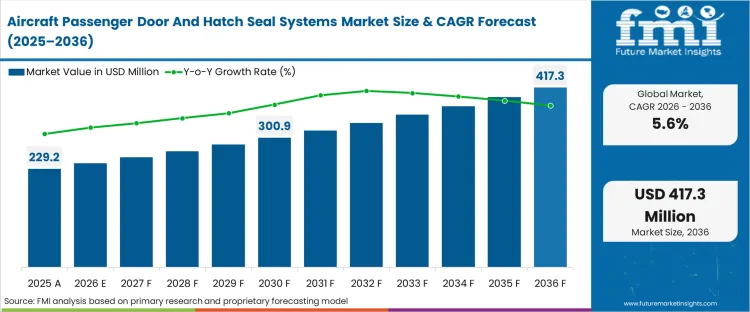
Before growth in high-performance materials becomes self-reinforcing within the broader commercial aircraft sealing systems ecosystem, the industry must cross a specific predictive maintenance threshold. Once digital wear-tracking algorithms can accurately forecast elastomeric degradation before cabin pressure sensors trigger alerts, airlines will shift entirely from reactive replacements to scheduled line-maintenance interventions. The resulting ecosystem will allow carriers to drastically reduce dedicated safety stock inventories at secondary hub locations.
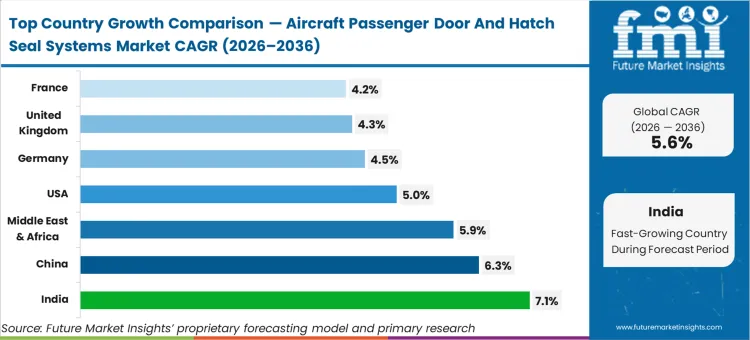
Geographically, India is expected to advance at a CAGR of 7.1% through the assessment period. China follows closely, projected to track a CAGR of 6.3%. The Middle East & Africa region is estimated to post a CAGR of 5.9%, while the United States is likely to record a growth rate of 5.0%. Germany is set to expand at 4.5%, the United Kingdom is anticipated to garner a 4.3% CAGR, and France is forecast to grow at 4.2%. This broad divergence reflects the pace at which distinct aviation networks are scaling their localized heavy maintenance infrastructure against the backdrop of massive new single-aisle aircraft delivery backlogs.
Aircraft Passenger Door And Hatch Seal Systems Market Definition
These systems are functionally engineered barriers made of elastomers and composites. They protect the perimeters of access points, including primary, emergency, and service doors, on both commercial and business aircraft. These commercial aviation door perimeter seals serve the critical function of maintaining cabin pressurization at altitude, preventing aerodynamic noise intrusion, and ensuring flame, smoke, and toxicity compliance under extreme thermal cycling.
Aircraft Passenger Door And Hatch Seal Systems Market Inclusions
This sector tracks the consumption of static, inflatable, and hybrid seals manufactured specifically for aviation door and hatch applications. It incorporates perimeter gaskets for main entryways, overwing exit hatch seals, and specialized barriers for cargo and galley doors. The scope extends to both OEM line-fit installations and aftermarket replacements procured during scheduled heavy maintenance checks alongside broader aircraft cabin interiors refurbishment programs.
Aircraft Passenger Door And Hatch Seal Systems Market Exclusions
The analysis explicitly excludes standard weather stripping utilized in ground support equipment and basic aircraft access panel and hatch seals that do not require cabin pressurization certification. Components used in hydraulic actuators, engine nacelles, and landing gear assemblies are omitted because their material formulations, qualification pathways, and primary failure modes differ completely from the pressure-retention requirements of fuselage access points.
Aircraft Passenger Door And Hatch Seal Systems Market Research Methodology
- Primary Research: Chief Engineers of Airframe Structures, Directors of Airline Technical Procurement, and MRO Base Maintenance Managers were interviewed to validate replacement intervals and evaluate typical aircraft door seal RFQ processes.
- Desk Research: Mandatory airworthiness directives, service bulletin archives, and OEM component maintenance manuals (CMM) were aggregated to establish baseline replacement frequencies.
- Market-Sizing and Forecasting: The baseline anchors to annual flight-cycle accumulation metrics and the existing backlog of commercial aircraft deliveries, filtered by door configuration density per airframe type.
- Data Validation and Update Cycle: Forecasts were triangulated against global aviation passenger traffic recovery models and independently published fleet retirement schedules.
Segmental Analysis
Aircraft Passenger Door And Hatch Seal Systems Market Analysis by Seal Configuration
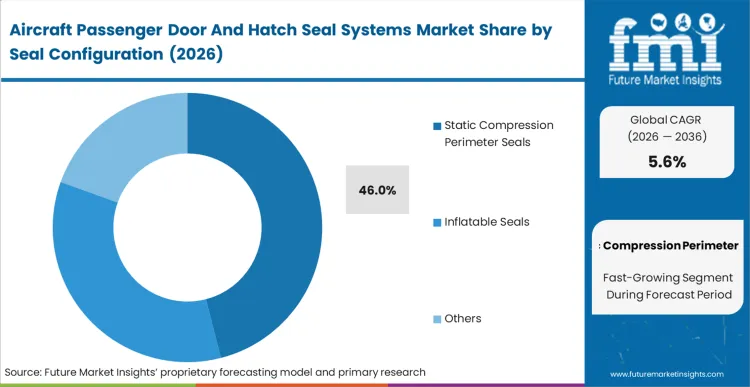
Previous pneumatic variations failed to deliver the required reliability for high-cycle narrowbody operations, pushing operators back toward the inherent mechanical simplicity of static configurations when comparing low friction door seals vs compression seals aircraft. Static compression perimeter seals hold 46.0% share as they eliminate the risk of inflation system failure while naturally leveraging the aircraft's internal cabin pressure to seat the door tighter against the fuselage frame. Procurement directors evaluating aerospace adhesives and sealants prioritize these architectures because they dramatically reduce the man-hours required for line-maintenance inspections. As per FMI's assessment, airlines that standardize on these profiles benefit from a predictable degradation curve that allows for perfectly timed C-check replacements. Operators that continue deploying highly complex active-inflation assemblies, frequently analyzing how do inflatable aircraft door seals compare with static seals, face spiraling maintenance costs and increased risk of dispatch delays due to minor pneumatic faults.
- Triggering Metric: Mechanical simplicity initiates the purchase decision, as it directly correlates with reduced aircraft downtime during line maintenance. Maintenance planners capture immediate labor savings by eliminating pneumatic system checks from turnaround procedures.
- Validation Standard: Extensive pressure-decay testing over 10,000 simulated flight cycles proves the structural integrity of the seal during the qualification phase. Component engineering teams use this data to justify the transition from legacy designs.
- Expansion Catalyst: Demonstrated resistance to compression set after long-term operational deployment drives fleet-wide retrofits. Airline technical directors mandate fabric reinforced aircraft door seals across all new deliveries to unify maintenance protocols against mechanical shear.
Aircraft Passenger Door And Hatch Seal Systems Market Analysis by Material
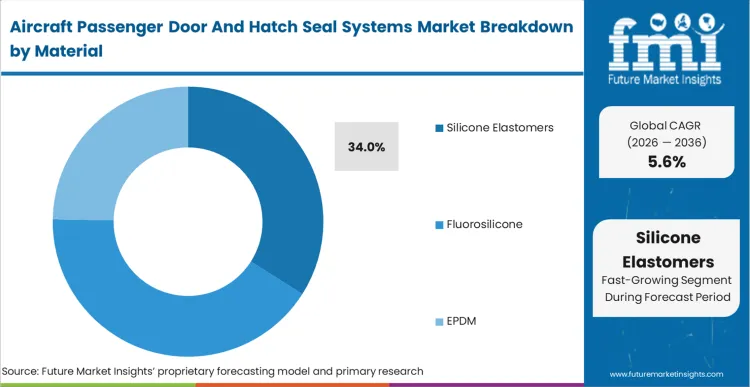
Material scientists developing modern aerospace sealants focus on blending fluorinated compounds to address this exact weakness, leading to intense silicone vs fluorosilicone aircraft seals evaluations. According to FMI's estimates, the operational trade-off is widely accepted because the primary function of a passenger door is environmental isolation, not fluid resistance. Airframe manufacturers who attempt to substitute lower-cost EPDM compounds on primary access points rapidly encounter premature embrittlement, leading to inflight acoustic complaints and costly unscheduled seal replacements. Silicone elastomers dominate 34.0% of the market because they are the only compounds capable of surviving the extreme thermal shock between tarmac heat and cruise-altitude freezing. This material dominance is dictated by the thermal extremes of commercial aviation, forcing engineers assessing what materials are used in aircraft hatch seals to specify silicones despite their vulnerability to certain aviation fluids.
- Thermal Embrittlement: Exposure to deep-freeze conditions at cruise altitude causes inferior polymers to harden and lose their sealing memory. Flight crews operating aircraft with compromised materials report unacceptable cabin noise and localized drafts.
- Skydrol Degradation: Accidental exposure to aggressive aviation hydraulic fluids strips the structural integrity from standard silicones, leaving a gummy residue. Maintenance technicians must implement strict chemical isolation protocols during nearby servicing to prevent catastrophic seal failure.
- FST Non-Compliance: The use of legacy rubber compounds risks toxic outgassing during cabin fire events, violating strict airworthiness mandates. Engineering divisions must meticulously trace material pedigree for aerospace elastomer seals for cabin doors to ensure full compliance with aviation safety authority standards.
Aircraft Passenger Door And Hatch Seal Systems Market Analysis by Aircraft Platform
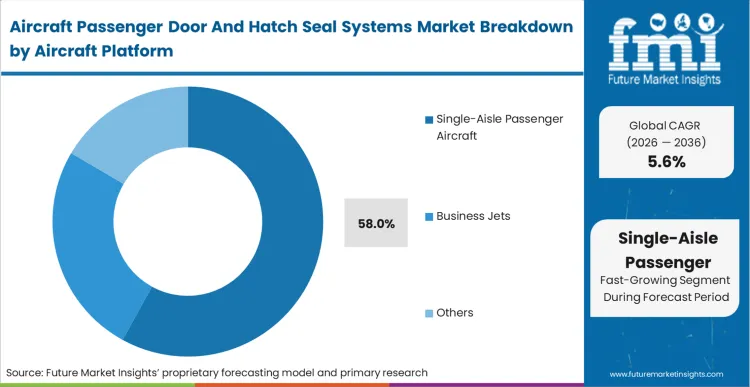
The integration of durable profiles across the global aircraft cabin interior footprint is critical for maintaining dispatch reliability. Airlines failing to adapt their narrowbody sealing strategies to high-cycle realities face cascading operational disruptions as pressure-related faults ground aircraft during peak scheduling windows. The structural tension between the massive volume of narrowbody operations and the complex engineering requirements of widebody fuselages defines the procurement landscape across the passenger aviation door systems market. Daily flight schedules for narrowbody aircraft, often reaching six cycles, push single-aisle platforms to a leading 58.0% market share as components wear down faster. Based on FMI's assessment, fleet managers operating these short-haul networks face intense pressure to minimize turnaround times, placing a premium on resilient materials that tolerate aggressive handling by ground service personnel.
- Procurement Baseline: The sheer volume of narrowbody deliveries establishes the economies of scale that drive baseline material pricing for the entire industry. Airline sourcing teams leverage these volumes to negotiate favorable long-term agreements for their entire fleet.
- Hidden Operational Penalty: Unscheduled replacement of a main entry seal due to ground-handler damage introduces immediate AOG costs that dwarf the component's acquisition price. Hub managers must balance the speed of passenger boarding against the risk of physical component strikes.
- Lifecycle Equilibrium: Tracking the total cost of ownership reveals that premium, friction-resistant profiles on short-haul aircraft yield a positive return on investment within eighteen months. Financial controllers increasingly approve higher initial expenditures to capture these downstream maintenance savings.
Aircraft Passenger Door And Hatch Seal Systems Market Analysis by End Use
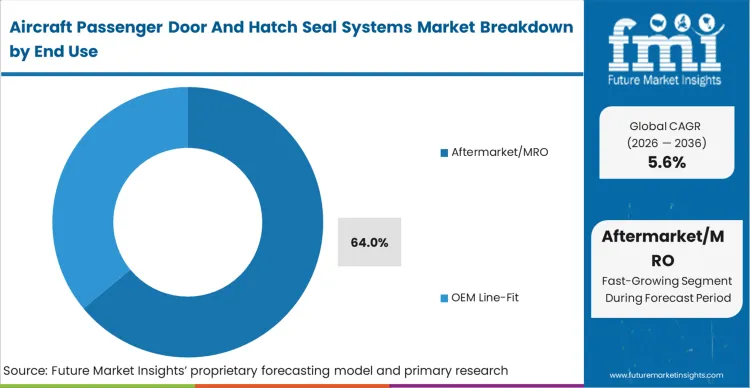
Maintenance facility directors are currently forced to decide whether to continue sourcing OEM-certified replacement kits or to qualify specialized third-party parts manufacturer approval (PMA) alternatives when evaluating OEM vs aftermarket aircraft door seal demand. The aftermarket / MRO segment claims 64.0% share as the installed base of tens of thousands of aging commercial aircraft requires multiple seal replacements over their operational lifespans. FMI analysts opine that the structural advantage of the aftermarket lies in the rigid, calendar-driven nature of aviation maintenance, which guarantees demand irrespective of new aircraft delivery delays. To support commercial aircraft cabin interior refits, MRO centers are consolidating their supply chains to ensure immediate part availability for airline MRO door seal replacement. Procurement officers who fail to secure robust channels within the aircraft seal systems aftermarket risk missing tight D-check turnaround windows, incurring severe financial penalties from their airline customers.
- Initial Operator Adoption: Legacy carriers transitioning older airframes into secondary service phases drive the baseline demand for aftermarket components. Technical directors authorize PMA alternatives to control escalating maintenance expenditures on mature platforms.
- Secondary Market Shift: Independent MRO providers adopt specialized installation tooling to expedite the curing process of hybrid bonded seals, changing the workflow dynamics on the hangar floor. Technicians drastically reduce the aircraft downtime required for a full door refurbishment.
- Late-Stage Conversion: Even highly conservative tier-one airlines eventually convert to high-performance aftermarket profiles when OEM supply chains falter during production ramps. Sourcing executives leverage these supply gaps to permanently qualify alternative vendors within their strict procurement frameworks.
Aircraft Passenger Door And Hatch Seal Systems Market Analysis by Door/Hatch Type
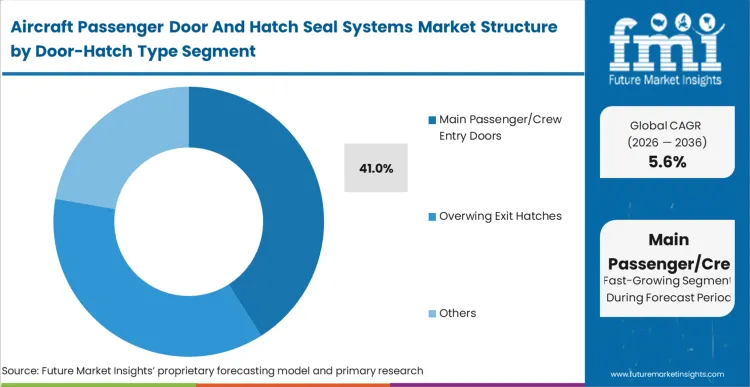
Operators that specify standard homogeneous rubber profiles for these high-traffic entryways routinely experience premature seal degradation, leading to unacceptable cabin noise levels and eventual pressurization warnings that force mid-flight diversions. The operational reality of aircraft main entry door seals experiencing constant physical friction from jet bridges, catering trucks, and boarding passengers dictates their 41.0% dominant share. Unlike static aircraft fairings or emergency exit door seals aircraft that remain sealed for years, these primary access points suffer extreme mechanical shear forces daily. In FMI's view, the consequence of this wear pattern is that engineers must design primary door seals with highly specialized low-friction fabric reinforcements to prevent tearing during operation.
- Baseline Retention: Standard static compression limits establish the minimum threshold for maintaining safe cabin altitudes during normal operations. Flight operations managers rely on this baseline performance to ensure passenger comfort and regulatory compliance on every flight.
- High-Shear Vulnerability: Frequent operation against misaligned fuselage frames accelerates wear on the outer elastomeric skin of aircraft service door seals, exposing the inner core to environmental degradation. Maintenance crews must diligently monitor these friction points to prevent sudden pressure leaks.
- Qualification Mandate: Upgrading to advanced fabric-reinforced profiles for aircraft baggage hatch seals requires passing rigorous continuous-cycle testing overseen by aviation authorities. Engineering teams must document every phase of this performance gradient to secure operational approval for the new assemblies.
Aircraft Passenger Door And Hatch Seal Systems Market Drivers, Restraints, and Opportunities
Airline technical directors must follow airworthiness directives on cabin pressure, which forces them to audit and replace seals regularly. This compliance pressure forces maintenance organizations to embed component replacement directly into their heavy check schedules, eliminating discretionary deferrals. Operators that fail to maintain these documented replacement intervals risk immediate grounding by aviation safety regulators, effectively suspending their ability to generate revenue from those specific airframes.
The single biggest buyer friction in this landscape is the agonizingly slow qualification cycle required to approve new polymer formulations for flight operations. Safety regulators require rigorous testing for pressure decay and flammability. These certifications, alongside smoke and toxicity standards, create a significant barrier for new market entrants. While third-party PMA developers are attempting to streamline approvals for certified aerospace door gasket systems, their efforts remain bottlenecked by the sheer volume of engineering data required to prove absolute equivalence to legacy designs.
Opportunities in the Aircraft Passenger Door And Hatch Seal Systems Market
- Acoustic Dampening Integration: The push for quieter passenger cabins creates a demand for hybrid profiles that actively absorb aerodynamic frequencies. Interior completion centers capture premium margins by offering these specialized aerostructure integrations to business jet operators evaluating aircraft galley door seals.
- Predictive Degradation Tracking: The shift toward digital aircraft monitoring enables the development of smart seals embedded with conductive wear sensors. Airline technical divisions deploy these systems to transition from reactive AOG events to perfectly scheduled maintenance interventions.
- Sustainable Formulation Pathways: Increasing environmental scrutiny compels the industry to explore bio-based elastomers and non-toxic curing agents. Formulators who successfully qualify these sustainable alternatives secure long-term contracts with environmentally focused European airframe manufacturers.
Regional Analysis
The regional landscape of the aircraft door seal systems market reveals distinct adoption trajectories shaped by local regulatory environments, climatic extremes, and established MRO infrastructures. Across over 40 countries, localized aviation demands dictate exactly which regions will grow fastest for aircraft door seal systems as operators transition toward predictive maintenance and high-performance elastomeric profiles.
.webp "Top Country Growth Comparison Aircraft Passenger Door And Hatch Seal Systems Market Cagr (2026 2036)")
| Country | CAGR (2026 to 2036) |
|---|---|
| India | 7.1% |
| China | 6.3% |
| Middle East & Africa | 5.9% |
| United States | 5.0% |
| Germany | 4.5% |
| United Kingdom | 4.3% |
| France | 4.2% |
Source: Future Market Insights (FMI) analysis, based on proprietary forecasting model and primary research
Asia Pacific Aircraft Passenger Door And Hatch Seal Systems Market Analysis
Instead of relying on imported, pre-assembled seal kits, prominent airlines throughout the Asia Pacific corridor are channeling heavy investments into domestic polymer engineering capabilities. This pivot is largely driven by a regulatory push to internalize aviation supply chains, which in turn compels international material formulators to forge local joint ventures to meet national sourcing quotas. By marrying regional seal production with domestic aircraft hydraulic system overhauls, these localized supply networks drastically cut down heavy maintenance turnaround times, enabling fast-growing regional fleets to sustain highly demanding flight schedules.
- India: A robust 7.1% CAGR being registered through the assessment period, the aircraft door seal market in India is rapidly scaling its localized C-check and D-check infrastructure. This physical expansion is an absolute necessity to manage an unprecedented backlog of narrowbody aircraft deliveries entering the country. The MRO facility directors, as a result, are racing to ink regional supply pacts to ensure their expanding hangars have immediate access to critical replacement parts, instantly rewarding vendors that establish local kitting operations with preferred-supplier status.
- China: To navigate complex joint-venture requirements, procurement leaders shaping the aircraft door seal market in China are working closely with state-backed aerospace conglomerates that enforce strict localization mandates. These mandates effectively obligate Western component manufacturers to transfer advanced polymer technologies to domestic partners if they wish to supply certified replacement parts, assessing the forecast period, China's landscape is expected to expand at a CAGR of 6.3% which in the end results with streamlining domestic heavy maintenance workflows.
As per FMI’s projection, the Asia Pacific dynamic is defined by an aggressive localization of the MRO supply chain, transforming the region from a net importer of maintenance components into a self-sustaining hub for specialized polymer engineering.
Middle East & Africa Aircraft Passenger Door And Hatch Seal Systems Market Analysis
Unforgiving physical environments, specifically abrasive particulate matter and extreme tarmac heat, create a completely unique material degradation curve for operators in this territory. When an airframe violently shifts from a 50°C runway environment to the deep freeze of cruising altitude, standard elastomers become embrittled much faster than original manufacturer projections account for. This intense thermal shock forces regional fleet directors to abandon baseline replacement intervals in favor of mandating highly customized, temperature-resistant silicones across their widebody networks. Fusing these resilient profiles into broader global air transport MRO schedules is essential to head off cascading dispatch delays triggered by unexpected cabin pressure faults.
- Middle East & Africa: The relentless threat of abrasive sand ingestion and severe thermal cycling means widebody fleet managers cannot rely on standard perimeter seals, thereby escalating Middle East aircraft door seal demand. To combat this, technical directors are actively over-specifying their material requirements, heavily favoring fluorosilicone blends that vastly outperform baseline OEM parts in resisting environmental degradation. The Middle East & Africa landscape advances at a projected CAGR of 5.9%, is witnessing a rapid, environment-driven transition that pushes the adoption of high-performance materials well ahead of any global regulatory mandates.
Per FMI’s assessments, the Middle East and Africa sector acts as an extreme-stress testing ground, where environmental hostility accelerates the procurement of premium elastomeric technologies far faster than standard compliance schedules would dictate.
North America Aircraft Passenger Door And Hatch Seal Systems Market Analysis
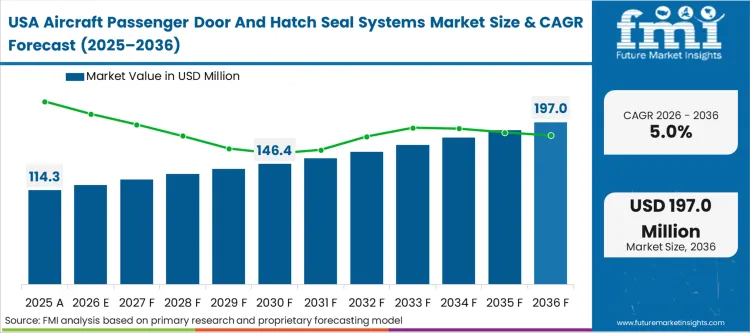
Across North American aviation hubs, capital availability and strict cost structures heavily influence material adoption, with airlines prioritizing total cost of ownership over initial acquisition prices. Fleet operators meticulously calculate the exact labor expenses tied to line-maintenance interventions, actively hunting for engineered profiles that maximize time on-wing. This economics-first mentality directly fuels the integration of fabric-reinforced barriers and advanced aerospace coatings that are engineered specifically to reduce mechanical friction during high-frequency door operations.
- United States: Boasting a highly mature and massive legacy domestic fleet, the United States is poised to achieve a CAGR of 5.0% over the coming decade. To keep maintenance costs from spiraling, aircraft door seal suppliers in the United States heavily leverage the third-party Parts Manufacturer Approval (PMA) ecosystem, aggressively qualifying alternative elastomeric profiles. This deliberate strategy fractures the traditional pricing power held by original equipment manufacturers and arms domestic operators with a robust aftermarket supply chain capable of weathering global production disruptions.
FMI analyses, the North American trajectory illustrates how operators of massive legacy fleets systematically utilize independent aftermarket approvals to break OEM pricing control, establishing a procurement environment defined strictly by lifecycle economics rather than original equipment loyalty.
Europe Aircraft Passenger Door And Hatch Seal Systems Market Analysis
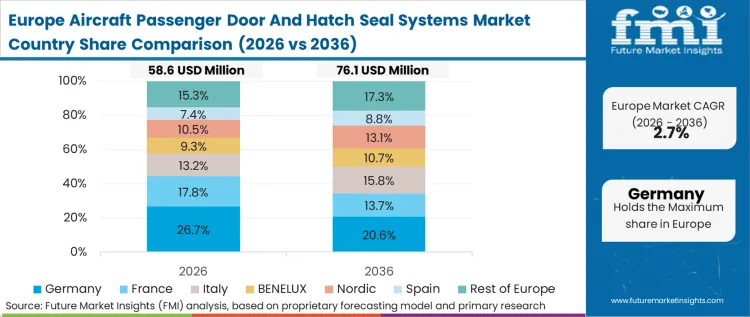
European fleet operators share a similar focus on calculating the total lifecycle economics of maintenance interventions, seeking engineered profiles that extend operational lifespans despite higher upfront costs across the Europe aircraft hatch seal systems market. However, Europe's market dynamics are uniquely characterized by a dense concentration of specialized material science research facilities and highly stringent regulatory frameworks. This highly technical environment actively drives the rapid adoption of advanced aerospace coatings and highly engineered fabric-reinforced structures to ensure absolute compliance and optimal performance.
- Germany: German engineers are currently at the forefront of evaluating sustainable polymer matrices and bio based aircraft coatings for integration into next-generation seal architectures. This highly structured aviation engineering sector places a massive premium on long-term material research, which in turn directly shapes how global flame, smoke, and toxicity (FST) standards are drafted, driving Germany aircraft seal systems demand. As a result, the German market growth is anticipated to record a 4.5% CAGR, with the regulatory compliance landscape observed today acting as a reliable predictor for tomorrow's global operational standards.
- United Kingdom: The UK aerospace door seal market benefits heavily from its dense concentration of specialized aerospace material science facilities, which dramatically speeds up the creation of advanced hybrid retaining structures propelling the advancing at a 4.3% of CAGR value through the forecast period. By utilizing local expertise in aircraft contaminant resistant coatings, component developers here are successfully designing seals that repel hydraulic fluids, resolving a pervasive maintenance challenge. Suppliers who firmly embed themselves within this localized R&D ecosystem consistently secure early access to proprietary formulations, allowing them to command premium contract pricing.
- France: Sourcing directors managing major French assembly lines demand total integration, requiring vendors to deliver seals as complete, ready-to-install assemblies outfitted with advanced fireproof aerospace fastener coatings. Because France serves as a primary assembly hub for leading commercial airframes, its domestic procurement requirements instantly ripple across the global supply chain. With an estimated CAGR of 4.2%, France's market sector rewards suppliers who master this complex sub-assembly delivery model, as it drastically cuts down the final door installation time on the hangar floor.
FMI's report includes extensive coverage of secondary European and North American aviation markets. The consistent theme across these mature infrastructure networks is a universal shift away from reactive maintenance toward predictive replacement models, utilizing advanced Aero engine coatings and related aerospace technologies to track component lifecycles digitally.
Competitive Aligners for Market Players
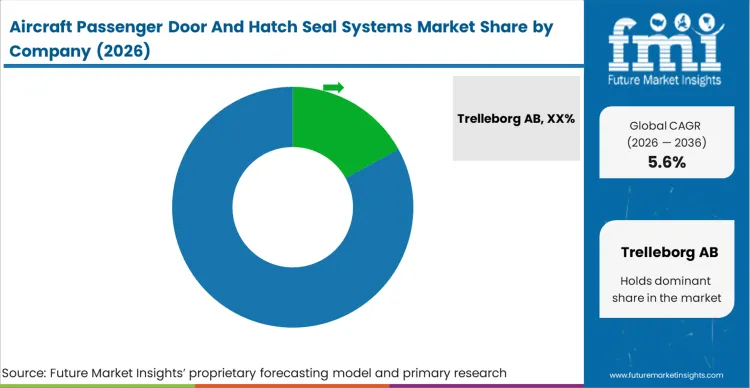
The formidable concentration within this landscape stems directly from the extreme capital thresholds required to qualify aviation-grade elastomers, leaving procurement directors constantly evaluating the best aircraft door seal suppliers. Industry heavyweights like Trelleborg AB, Hutchinson SA, and Parker-Hannifin Corporation maintain an ironclad grip because they have spent decades amassing the exhaustive material property databases demanded by aviation safety authorities. For these top aircraft door seal manufacturers, vendor selection rarely comes down to product geometry; the ultimate dividing line between qualified and unqualified aircraft passenger door seal suppliers is the ability to instantly generate certified flame, smoke, and toxicity test documentation for every batch of polymer cured.
Elite manufacturers sustain their operational advantage by embedding themselves into an airframe OEM's digital design environments years before a new aircraft type ever receives certification. Players such as Freudenberg Sealing Technologies and Eaton Corporation plc effectively guarantee long-term aftermarket revenue as aerospace door seal OEM suppliers by engineering proprietary retaining architectures that make third-party substitution mechanically and mathematically prohibitive. Any challenger attempting to replicate this footprint faces a grueling aircraft refurbishing qualification gauntlet, requiring millions in upfront capital and years of relentless burn-chamber testing before a single alternative component for certified aerospace door gasket systems is permitted to fly.
To break this cycle of vendor lock-in, massive global airlines are aggressively financing the development of Parts Manufacturer Approval (PMA) alternatives through independent engineering networks. Agile polymer specialists like Precision Polymer Engineering Ltd., acting as a dedicated aircraft seal retrofit supplier, and focused aftermarket providers such as Brown Aircraft Supply Co., operating as an aerospace door seal distributor, are capitalizing on this pushback by delivering certified replacements that bypass original equipment channels entirely. The fundamental tension between airline procurement teams demanding generic interoperability and legacy vendors fortifying proprietary retaining systems will dictate the competitive trajectory through 2036, polarizing the landscape between massive line-fit OEMs and highly specialized heavy maintenance disruptors during major commercial aircraft MRO cycles.
Key Players in Aircraft Passenger Door And Hatch Seal Systems Market
- Trelleborg AB
- Hutchinson SA
- Parker-Hannifin Corporation
- Freudenberg Sealing Technologies
- Eaton Corporation plc
- Brown Aircraft Supply Co.
- Precision Polymer Engineering Ltd.
Scope of the Report
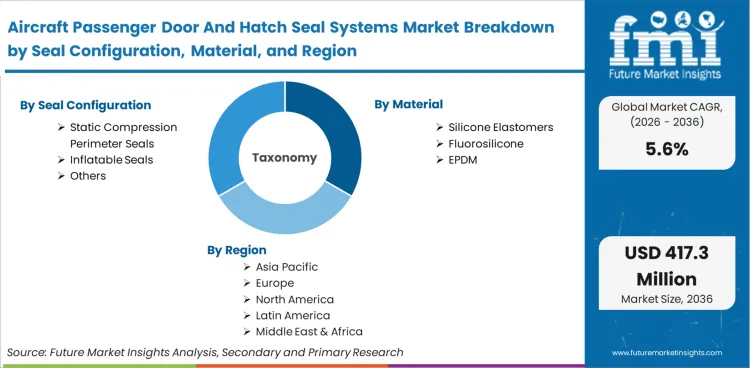
| Metric | Value |
|---|---|
| Quantitative Units | USD 242.0 million to USD 417.3 millionh at a CAGR of 5.6% |
| Market Definition | The market encompasses the highly engineered elastomeric and composite barriers installed around the perimeter of primary, emergency, and service access points on commercial and business airframes. It covers components designed specifically to maintain cabin pressurization, prevent aerodynamic noise, and ensure flame/smoke compliance. |
| Seal Configuration Segmentation | Static compression perimeter seals, Inflatable seals, Fabric-reinforced low-friction door seals, Hybrid retainer-bonded seal assemblies |
| Material Segmentation | Silicone elastomers, Fluorosilicone, EPDM, FKM / fluoroelastomer, PTFE / thermoplastic composites |
| Aircraft Platform Segmentation | Single-aisle passenger aircraft, Widebody passenger aircraft, Regional jets / turboprops, Business jets |
| End Use Segmentation | Aftermarket / MRO, OEM line-fit |
| Regions Covered | Asia Pacific, Middle East & Africa, North America, Europe |
| Countries Covered | India, China, Middle East & Africa, United States, Germany, United Kingdom, France, and 40 plus countries |
| Key Companies Profiled | Trelleborg AB, Hutchinson SA, Parker-Hannifin Corporation, Freudenberg Sealing Technologies, Eaton Corporation plc, Brown Aircraft Supply Co., Precision Polymer Engineering Ltd. |
| Forecast Period | 2026 to 2036 |
| Approach | Primary interviews were conducted with airline technical directors and MRO facility managers. The baseline data anchors to active global fleet sizes and forecasted aircraft deliveries. Forecasts were cross-validated using commercial aviation traffic recovery models and component replacement interval documentation. |
Source: Future Market Insights (FMI) analysis, based on proprietary forecasting model and primary research
Segments
Seal Configuration:
- Static compression perimeter seals
- Inflatable seals
- Fabric-reinforced low-friction door seals
- Hybrid retainer-bonded seal assemblies
Material:
- Silicone elastomers
- Fluorosilicone
- EPDM
- FKM / fluoroelastomer
- PTFE / thermoplastic composites
Aircraft Platform:
- Single-aisle passenger aircraft
- Widebody passenger aircraft
- Regional jets / turboprops
- Business jets
End Use:
- Aftermarket / MRO
- OEM line-fit
Door / Hatch Type:
- Main passenger / crew entry doors
- Overwing exit hatches
- Service / galley doors
- Baggage / service compartment hatches
Region:
- North America
- United States
- Canada
- Europe
- Germany
- United Kingdom
- France
- Italy
- Spain
- Asia Pacific
- China
- Japan
- South Korea
- Taiwan
- Singapore
- Latin America
- Brazil
- Mexico
- Argentina
- Middle East & Africa
- GCC Countries
- South Africa
- Israel
Bibliography
- International Air Transport Association. (2025). Reviving the commercial aircraft supply chain.
- European Union Aviation Safety Agency. (2025, September). EASA AD No.: 2025-0192 Airworthiness Directive: ATA 52 – Doors – Passenger / Crew Door Girt Bar Fitting Assemblies – Inspection.
- EUROCONTROL. (2025, February). EUROCONTROL seven-year forecast 2025-2031 (Spring 2025).
- Civil Aviation Authority. (2024). CAP3146 Annual Safety Review 2024.
- Directorate General of Civil Aviation. (2025, April). Airworthiness procedures manual.
- Transportation Safety Board of Canada. (2025, March). Air transportation safety investigation A25O0021 preliminary report.
- International Civil Aviation Organization. (2025). Realizing aviation's sustainable future.
This bibliography is provided for reader reference. The full FMI report contains the complete reference list with primary source documentation.
This Report Addresses
- Market intelligence to support strategic decision making across elastomeric profiles and specialized fabric-reinforced aviation components within the aerospace door seals market.
- Market size estimation and 10-year revenue forecasts from 2026 to 2036, supported by documented component replacement interval data.
- Growth opportunity mapping across Seal Configuration and Material categories with emphasis on the transition to predictive digital degradation tracking for the aircraft hatch gasket market forecast.
- Segment and regional revenue forecasts covering single-aisle aircraft requirements across strict Middle Eastern thermal environments and European safety frameworks.
- Competition strategy assessment including proprietary retaining architectures and the expansion of third-party PMA component networks.
- Qualification development tracking including advanced flame, smoke, and toxicity compliance protocols utilized by global aviation safety bodies.
- Market access analysis covering extreme thermal cycling requirements and specific airframe OEM documentation mandates.
- Market report delivery in PDF, Excel, PPT, and interactive dashboard formats for executive strategy, airline technical procurement planning, and operational benchmarking use across the aerospace industry analysis.
Frequently Asked Questions
How big is the aircraft passenger door and hatch seal systems market?
The market is valued at USD 242.0 million in 2026, establishing the baseline financial commitment global airlines must allocate purely to maintain the pressurized envelopes of their active fleets.Replacement intervals are not discretionary but are strictly governed by OEM Component Maintenance Manuals (CMM), typically aligning with heavy C-check or D-check schedules depending on the specific airframe's daily utilization rate.
What will it be valued at by 2036?
It is projected to reach USD 417.3 million by 2036, signaling the accumulating financial burden of continuous replacement cycles tied to an expanding global commercial aircraft installed base.
What is the CAGR of aircraft door seal systems?
A CAGR of 5.6% is expected during the forecast period, anchored heavily to rigid, calendar-driven heavy maintenance schedules rather than macroscopic economic or passenger-demand fluctuations.
Which Seal Configuration segment leads?
Static compression perimeter seals hold 46.0% share because their mechanical simplicity drastically reduces the labor-hours required for line-maintenance pressure testing compared to active inflation systems.
Which Material segment leads?
Silicone elastomers capture 34.0% share because no other cost-effective polymer can repeatedly endure the aggressive thermal shock of transitioning between tarmac heat and high-altitude deep freeze without fracturing.
Which Aircraft Platform segment leads?
Single-aisle passenger aircraft account for 58.0% of the market because narrowbody jets accumulate daily flight cycles significantly faster than widebody aircraft, forcing operators to execute seal replacements at highly accelerated intervals due to sheer mechanical friction.
What drives demand for aircraft passenger door seal systems?
Growth is driven by strict airworthiness directives that obligate airlines to remove and replace these elastomers during D-checks without discretionary deferrals, guaranteeing perpetual aftermarket demand.
What is the primary restraint?
The primary restraint is the agonizingly slow qualification cycle required to certify new polymer blends, as formulators must generate years of exhaustive pressure-decay and flammability test data for safety regulators.
Which regions will grow fastest for aircraft door seal systems?
India advances at 7.1%, significantly outpacing the US rate of 5.0%, as India must rapidly scale localized heavy MRO hangar capacity to service a massive influx of new narrowbody deliveries while the US merely maintains a mature infrastructure base.
Why are aircraft door seals replaced so often?
Because the constant physical friction of daily operations degrades the elastomeric memory, operators are forced to execute premature replacements tied to hard flight-hour limits to ensure the cabin retains safe pressurization.
Is the market mainly OEM or aftermarket?
The aftermarket/MRO segment claims 64.0% of the total valuation because a commercial airframe flies for up to 30 years and will cycle through multiple sets of perimeter seals long after leaving the OEM assembly line.
How large is the replacement market for aircraft door seals?
Replacement demand dictates the majority of vendor revenue, as tens of thousands of active commercial aircraft require mandatory seal swaps during scheduled D-check intervals, buffering suppliers from new-aircraft delivery delays.
Are aircraft door seals safety critical?
Yes, they are fundamental to flight safety, as an inflight seal failure leads to rapid cabin depressurization, emergency descents, and severe regulatory audits from aviation authorities.
Who are the top aircraft door seal companies?
The supplier landscape is highly concentrated, with Trelleborg AB, Hutchinson SA, and Parker-Hannifin Corporation leading the sector due to their massive, pre-certified material property databases.
Which companies make aircraft passenger door seals?
Alongside the tier-one leaders, companies like Freudenberg Sealing Technologies, Eaton Corporation plc, Brown Aircraft Supply Co., and Precision Polymer Engineering Ltd. manufacture critical elastomeric profiles for both line-fit and aftermarket operations.
How do inflatable aircraft door seals compare with static seals?
While inflatable seals rely on mechanically complex active pneumatic pressure to close structural gaps, static seals leverage the aircraft's natural cabin pressure to tighten the barrier, reducing maintenance inspection times and eliminating pneumatic failure risks.
What materials are used in aircraft hatch seals?
Engineers primarily rely on silicone elastomers, fluorosilicone, EPDM, FKM, and PTFE composites, choosing formulations by balancing thermal stability requirements against potential exposure to harsh aviation hydraulic fluids.
Which material is best for aircraft door seals?
While silicone dominates due to thermal resilience, fluorosilicone is often considered superior for environments where the seal might be exposed to Skydrol or other aggressive hydraulic fluids that would destroy standard rubber.
What are the key trends in aerospace door sealing?
The industry is pivoting toward smart seals embedded with conductive wear sensors, allowing technical divisions to transition from reactive replacements to perfectly scheduled, predictive maintenance interventions.
How often are aircraft hatch seals replaced?
Replacement intervals are not discretionary but are strictly governed by OEM Component Maintenance Manuals (CMM), typically aligning with heavy C-check or D-check schedules depending on the specific airframe's daily utilization rate.
What is the impact of localized MRO expansion in China?
State-backed mandates requiring Chinese airlines to utilize domestic heavy maintenance facilities force Western polymer suppliers to execute complex joint ventures, permanently altering supply chain logistics for replacement door seals in the Asia Pacific region.
Preview the report firsthand - request a free sample
Get SampleGet the brochure for pricing and purchase details.
Get PDFTable of Content
- Executive Summary
- Global Market Outlook
- Demand-side Trends
- Supply-side Trends
- Technology Roadmap Analysis
- Analysis and Recommendations
- Market Overview
- Market Coverage / Taxonomy
- Market Definition / Scope / Limitations
- Research Methodology
- Chapter Orientation
- Analytical Lens and Working Hypotheses
- Market Structure, Signals, and Trend Drivers
- Benchmarking and Cross-market Comparability
- Market Sizing, Forecasting, and Opportunity Mapping
- Research Design and Evidence Framework
- Desk Research Programme (Secondary Evidence)
- Company Annual and Sustainability Reports
- Peer-reviewed Journals and Academic Literature
- Corporate Websites, Product Literature, and Technical Notes
- Earnings Decks and Investor Briefings
- Statutory Filings and Regulatory Disclosures
- Technical White Papers and Standards Notes
- Trade Journals, Industry Magazines, and Analyst Briefs
- Conference Proceedings, Webinars, and Seminar Materials
- Government Statistics Portals and Public Data Releases
- Press Releases and Reputable Media Coverage
- Specialist Newsletters and Curated Briefings
- Sector Databases and Reference Repositories
- FMI Internal Proprietary Databases and Historical Market Datasets
- Subscription Datasets and Paid Sources
- Social Channels, Communities, and Digital Listening Inputs
- Additional Desk Sources
- Expert Input and Fieldwork (Primary Evidence)
- Primary Modes
- Qualitative Interviews and Expert Elicitation
- Quantitative Surveys and Structured Data Capture
- Blended Approach
- Why Primary Evidence is Used
- Field Techniques
- Interviews
- Surveys
- Focus Groups
- Observational and In-context Research
- Social and Community Interactions
- Stakeholder Universe Engaged
- C-suite Leaders
- Board Members
- Presidents and Vice Presidents
- R&D and Innovation Heads
- Technical Specialists
- Domain Subject-matter Experts
- Scientists
- Physicians and Other Healthcare Professionals
- Governance, Ethics, and Data Stewardship
- Research Ethics
- Data Integrity and Handling
- Primary Modes
- Tooling, Models, and Reference Databases
- Desk Research Programme (Secondary Evidence)
- Data Engineering and Model Build
- Data Acquisition and Ingestion
- Cleaning, Normalisation, and Verification
- Synthesis, Triangulation, and Analysis
- Quality Assurance and Audit Trail
- Market Background
- Market Dynamics
- Drivers
- Restraints
- Opportunity
- Trends
- Scenario Forecast
- Demand in Optimistic Scenario
- Demand in Likely Scenario
- Demand in Conservative Scenario
- Opportunity Map Analysis
- Product Life Cycle Analysis
- Supply Chain Analysis
- Investment Feasibility Matrix
- Value Chain Analysis
- PESTLE and Porter’s Analysis
- Regulatory Landscape
- Regional Parent Market Outlook
- Production and Consumption Statistics
- Import and Export Statistics
- Market Dynamics
- Global Market Analysis 2021 to 2025 and Forecast, 2026 to 2036
- Historical Market Size Value (USD Million) Analysis, 2021 to 2025
- Current and Future Market Size Value (USD Million) Projections, 2026 to 2036
- Y-o-Y Growth Trend Analysis
- Absolute $ Opportunity Analysis
- Global Market Pricing Analysis 2021 to 2025 and Forecast 2026 to 2036
- Global Market Analysis 2021 to 2025 and Forecast 2026 to 2036, By Seal Configuration
- Introduction / Key Findings
- Historical Market Size Value (USD Million) Analysis By Seal Configuration , 2021 to 2025
- Current and Future Market Size Value (USD Million) Analysis and Forecast By Seal Configuration , 2026 to 2036
- Static Compression Perimeter Seals
- Inflatable Seals
- Others
- Static Compression Perimeter Seals
- Y-o-Y Growth Trend Analysis By Seal Configuration , 2021 to 2025
- Absolute $ Opportunity Analysis By Seal Configuration , 2026 to 2036
- Global Market Analysis 2021 to 2025 and Forecast 2026 to 2036, By Material
- Introduction / Key Findings
- Historical Market Size Value (USD Million) Analysis By Material, 2021 to 2025
- Current and Future Market Size Value (USD Million) Analysis and Forecast By Material, 2026 to 2036
- Silicone Elastomers
- Fluorosilicone
- EPDM
- Silicone Elastomers
- Y-o-Y Growth Trend Analysis By Material, 2021 to 2025
- Absolute $ Opportunity Analysis By Material, 2026 to 2036
- Global Market Analysis 2021 to 2025 and Forecast 2026 to 2036, By Aircraft Platform
- Introduction / Key Findings
- Historical Market Size Value (USD Million) Analysis By Aircraft Platform, 2021 to 2025
- Current and Future Market Size Value (USD Million) Analysis and Forecast By Aircraft Platform, 2026 to 2036
- Single-Aisle Passenger Aircraft
- Business Jets
- Others
- Single-Aisle Passenger Aircraft
- Y-o-Y Growth Trend Analysis By Aircraft Platform, 2021 to 2025
- Absolute $ Opportunity Analysis By Aircraft Platform, 2026 to 2036
- Global Market Analysis 2021 to 2025 and Forecast 2026 to 2036, By End Use
- Introduction / Key Findings
- Historical Market Size Value (USD Million) Analysis By End Use, 2021 to 2025
- Current and Future Market Size Value (USD Million) Analysis and Forecast By End Use, 2026 to 2036
- Aftermarket/MRO
- OEM Line-Fit
- Aftermarket/MRO
- Y-o-Y Growth Trend Analysis By End Use, 2021 to 2025
- Absolute $ Opportunity Analysis By End Use, 2026 to 2036
- Global Market Analysis 2021 to 2025 and Forecast 2026 to 2036, By Door-Hatch Type
- Introduction / Key Findings
- Historical Market Size Value (USD Million) Analysis By Door-Hatch Type, 2021 to 2025
- Current and Future Market Size Value (USD Million) Analysis and Forecast By Door-Hatch Type, 2026 to 2036
- Main Passenger/Crew Entry Doors
- Overwing Exit Hatches
- Others
- Main Passenger/Crew Entry Doors
- Y-o-Y Growth Trend Analysis By Door-Hatch Type, 2021 to 2025
- Absolute $ Opportunity Analysis By Door-Hatch Type, 2026 to 2036
- Global Market Analysis 2021 to 2025 and Forecast 2026 to 2036, By Region
- Introduction
- Historical Market Size Value (USD Million) Analysis By Region, 2021 to 2025
- Current Market Size Value (USD Million) Analysis and Forecast By Region, 2026 to 2036
- North America
- Latin America
- Western Europe
- Eastern Europe
- East Asia
- South Asia and Pacific
- Middle East & Africa
- Market Attractiveness Analysis By Region
- North America Market Analysis 2021 to 2025 and Forecast 2026 to 2036, By Country
- Historical Market Size Value (USD Million) Trend Analysis By Market Taxonomy, 2021 to 2025
- Market Size Value (USD Million) Forecast By Market Taxonomy, 2026 to 2036
- By Country
- USA
- Canada
- Mexico
- By Seal Configuration
- By Material
- By Aircraft Platform
- By End Use
- By Door-Hatch Type
- By Country
- Market Attractiveness Analysis
- By Country
- By Seal Configuration
- By Material
- By Aircraft Platform
- By End Use
- By Door-Hatch Type
- Key Takeaways
- Latin America Market Analysis 2021 to 2025 and Forecast 2026 to 2036, By Country
- Historical Market Size Value (USD Million) Trend Analysis By Market Taxonomy, 2021 to 2025
- Market Size Value (USD Million) Forecast By Market Taxonomy, 2026 to 2036
- By Country
- Brazil
- Chile
- Rest of Latin America
- By Seal Configuration
- By Material
- By Aircraft Platform
- By End Use
- By Door-Hatch Type
- By Country
- Market Attractiveness Analysis
- By Country
- By Seal Configuration
- By Material
- By Aircraft Platform
- By End Use
- By Door-Hatch Type
- Key Takeaways
- Western Europe Market Analysis 2021 to 2025 and Forecast 2026 to 2036, By Country
- Historical Market Size Value (USD Million) Trend Analysis By Market Taxonomy, 2021 to 2025
- Market Size Value (USD Million) Forecast By Market Taxonomy, 2026 to 2036
- By Country
- Germany
- UK
- Italy
- Spain
- France
- Nordic
- BENELUX
- Rest of Western Europe
- By Seal Configuration
- By Material
- By Aircraft Platform
- By End Use
- By Door-Hatch Type
- By Country
- Market Attractiveness Analysis
- By Country
- By Seal Configuration
- By Material
- By Aircraft Platform
- By End Use
- By Door-Hatch Type
- Key Takeaways
- Eastern Europe Market Analysis 2021 to 2025 and Forecast 2026 to 2036, By Country
- Historical Market Size Value (USD Million) Trend Analysis By Market Taxonomy, 2021 to 2025
- Market Size Value (USD Million) Forecast By Market Taxonomy, 2026 to 2036
- By Country
- Russia
- Poland
- Hungary
- Balkan & Baltic
- Rest of Eastern Europe
- By Seal Configuration
- By Material
- By Aircraft Platform
- By End Use
- By Door-Hatch Type
- By Country
- Market Attractiveness Analysis
- By Country
- By Seal Configuration
- By Material
- By Aircraft Platform
- By End Use
- By Door-Hatch Type
- Key Takeaways
- East Asia Market Analysis 2021 to 2025 and Forecast 2026 to 2036, By Country
- Historical Market Size Value (USD Million) Trend Analysis By Market Taxonomy, 2021 to 2025
- Market Size Value (USD Million) Forecast By Market Taxonomy, 2026 to 2036
- By Country
- China
- Japan
- South Korea
- By Seal Configuration
- By Material
- By Aircraft Platform
- By End Use
- By Door-Hatch Type
- By Country
- Market Attractiveness Analysis
- By Country
- By Seal Configuration
- By Material
- By Aircraft Platform
- By End Use
- By Door-Hatch Type
- Key Takeaways
- South Asia and Pacific Market Analysis 2021 to 2025 and Forecast 2026 to 2036, By Country
- Historical Market Size Value (USD Million) Trend Analysis By Market Taxonomy, 2021 to 2025
- Market Size Value (USD Million) Forecast By Market Taxonomy, 2026 to 2036
- By Country
- India
- ASEAN
- Australia & New Zealand
- Rest of South Asia and Pacific
- By Seal Configuration
- By Material
- By Aircraft Platform
- By End Use
- By Door-Hatch Type
- By Country
- Market Attractiveness Analysis
- By Country
- By Seal Configuration
- By Material
- By Aircraft Platform
- By End Use
- By Door-Hatch Type
- Key Takeaways
- Middle East & Africa Market Analysis 2021 to 2025 and Forecast 2026 to 2036, By Country
- Historical Market Size Value (USD Million) Trend Analysis By Market Taxonomy, 2021 to 2025
- Market Size Value (USD Million) Forecast By Market Taxonomy, 2026 to 2036
- By Country
- Kingdom of Saudi Arabia
- Other GCC Countries
- Turkiye
- South Africa
- Other African Union
- Rest of Middle East & Africa
- By Seal Configuration
- By Material
- By Aircraft Platform
- By End Use
- By Door-Hatch Type
- By Country
- Market Attractiveness Analysis
- By Country
- By Seal Configuration
- By Material
- By Aircraft Platform
- By End Use
- By Door-Hatch Type
- Key Takeaways
- Key Countries Market Analysis
- USA
- Pricing Analysis
- Market Share Analysis, 2025
- By Seal Configuration
- By Material
- By Aircraft Platform
- By End Use
- By Door-Hatch Type
- Canada
- Pricing Analysis
- Market Share Analysis, 2025
- By Seal Configuration
- By Material
- By Aircraft Platform
- By End Use
- By Door-Hatch Type
- Mexico
- Pricing Analysis
- Market Share Analysis, 2025
- By Seal Configuration
- By Material
- By Aircraft Platform
- By End Use
- By Door-Hatch Type
- Brazil
- Pricing Analysis
- Market Share Analysis, 2025
- By Seal Configuration
- By Material
- By Aircraft Platform
- By End Use
- By Door-Hatch Type
- Chile
- Pricing Analysis
- Market Share Analysis, 2025
- By Seal Configuration
- By Material
- By Aircraft Platform
- By End Use
- By Door-Hatch Type
- Germany
- Pricing Analysis
- Market Share Analysis, 2025
- By Seal Configuration
- By Material
- By Aircraft Platform
- By End Use
- By Door-Hatch Type
- UK
- Pricing Analysis
- Market Share Analysis, 2025
- By Seal Configuration
- By Material
- By Aircraft Platform
- By End Use
- By Door-Hatch Type
- Italy
- Pricing Analysis
- Market Share Analysis, 2025
- By Seal Configuration
- By Material
- By Aircraft Platform
- By End Use
- By Door-Hatch Type
- Spain
- Pricing Analysis
- Market Share Analysis, 2025
- By Seal Configuration
- By Material
- By Aircraft Platform
- By End Use
- By Door-Hatch Type
- France
- Pricing Analysis
- Market Share Analysis, 2025
- By Seal Configuration
- By Material
- By Aircraft Platform
- By End Use
- By Door-Hatch Type
- India
- Pricing Analysis
- Market Share Analysis, 2025
- By Seal Configuration
- By Material
- By Aircraft Platform
- By End Use
- By Door-Hatch Type
- ASEAN
- Pricing Analysis
- Market Share Analysis, 2025
- By Seal Configuration
- By Material
- By Aircraft Platform
- By End Use
- By Door-Hatch Type
- Australia & New Zealand
- Pricing Analysis
- Market Share Analysis, 2025
- By Seal Configuration
- By Material
- By Aircraft Platform
- By End Use
- By Door-Hatch Type
- China
- Pricing Analysis
- Market Share Analysis, 2025
- By Seal Configuration
- By Material
- By Aircraft Platform
- By End Use
- By Door-Hatch Type
- Japan
- Pricing Analysis
- Market Share Analysis, 2025
- By Seal Configuration
- By Material
- By Aircraft Platform
- By End Use
- By Door-Hatch Type
- South Korea
- Pricing Analysis
- Market Share Analysis, 2025
- By Seal Configuration
- By Material
- By Aircraft Platform
- By End Use
- By Door-Hatch Type
- Russia
- Pricing Analysis
- Market Share Analysis, 2025
- By Seal Configuration
- By Material
- By Aircraft Platform
- By End Use
- By Door-Hatch Type
- Poland
- Pricing Analysis
- Market Share Analysis, 2025
- By Seal Configuration
- By Material
- By Aircraft Platform
- By End Use
- By Door-Hatch Type
- Hungary
- Pricing Analysis
- Market Share Analysis, 2025
- By Seal Configuration
- By Material
- By Aircraft Platform
- By End Use
- By Door-Hatch Type
- Kingdom of Saudi Arabia
- Pricing Analysis
- Market Share Analysis, 2025
- By Seal Configuration
- By Material
- By Aircraft Platform
- By End Use
- By Door-Hatch Type
- Turkiye
- Pricing Analysis
- Market Share Analysis, 2025
- By Seal Configuration
- By Material
- By Aircraft Platform
- By End Use
- By Door-Hatch Type
- South Africa
- Pricing Analysis
- Market Share Analysis, 2025
- By Seal Configuration
- By Material
- By Aircraft Platform
- By End Use
- By Door-Hatch Type
- USA
- Market Structure Analysis
- Competition Dashboard
- Competition Benchmarking
- Market Share Analysis of Top Players
- By Regional
- By Seal Configuration
- By Material
- By Aircraft Platform
- By End Use
- By Door-Hatch Type
- Competition Analysis
- Competition Deep Dive
- Trelleborg AB
- Overview
- Product Portfolio
- Profitability by Market Segments (Product/Age /Sales Channel/Region)
- Sales Footprint
- Strategy Overview
- Marketing Strategy
- Product Strategy
- Channel Strategy
- Hutchinson SA
- Parker-Hannifin Corporation
- Freudenberg Sealing Technologies
- Eaton Corporation plc
- Brown Aircraft Supply Co.
- Trelleborg AB
- Competition Deep Dive
- Assumptions & Acronyms Used


