

- Industry Size (2026)
- USD 1.0 Bn
- Forecast (2036)
- USD 1.4 Bn
- CAGR (2026 to 2036)
- 3.5%
Door Hinge and Door Latch Fasteners Market Forecast and Outlook 2026 to 2036
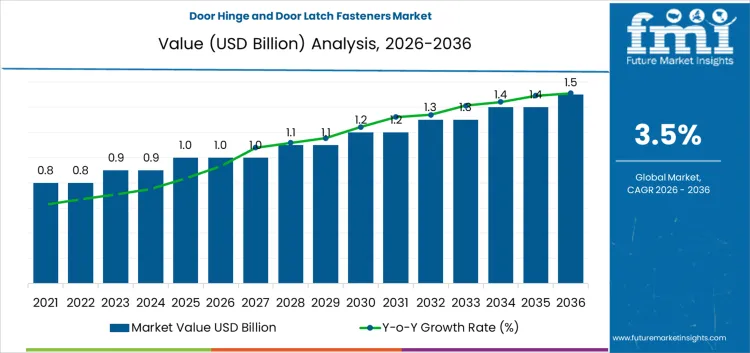
The door hinge and door latch fasteners market is valued at USD 1.0 billion in 2026 and is projected to reach USD 1.4 billion by 2036, reflecting a CAGR of 3.5%. Market performance is influenced by the critical safety and operational requirements of door assemblies, requiring fasteners that maintain alignment and withstand repeated mechanical stress. Production is concentrated among suppliers capable of meeting OEM standards for strength, corrosion resistance, and dimensional accuracy. Regional adoption varies according to vehicle production volumes, body styles, and regulatory compliance. Smaller suppliers face limitations in obtaining certification and scaling production for high-volume programs.
Profit capture is concentrated among companies that integrate validated material performance, assembly line compatibility, and technical guidance into their offerings. Leading manufacturers secure strategic advantage through long-term OEM partnerships, standardized quality assurance, and multi-platform design compatibility. Financial outcomes are determined by fastening reliability, compliance adherence, and system integration support rather than production quantity. Operators lacking certification and robust quality control encounter restricted participation despite available manufacturing capacity.
Quick Stats of the Door Hinge and Door Latch Fasteners Market
- Door Hinge and Door Latch Fasteners Market Value (2026): USD 1.0 billion
- Door Hinge and Door Latch Fasteners Forecast Value (2036): USD 1.4 billion
- Door Hinge and Door Latch Fasteners Forecast CAGR 2026 to 2036: 3.5%
- Leading Fastener Type in Door Hinge and Door Latch Fasteners Market: High-strength bolts (44 % share)
- Leading Door System in Door Hinge and Door Latch Fasteners Market: Conventional hinged doors (62 % share)
- Key Growth Regions in Door Hinge and Door Latch Fasteners Market: India, China, South Korea, USA, Japan
- Top Players in Door Hinge and Door Latch Fasteners Market: KAMAX, LISI Automotive, Bulten, Stanley Engineered Fastening, Meidoh, Böllhoff, Nedschroef, Fontana Gruppo, Würth Automotive, SFS Group
Door Hinge and Door Latch Fasteners Market Key Takeaways
| Metric | Value |
|---|---|
| Market Value (2026) | USD 1.0 billion |
| Forecast Value (2036) | USD 1.4 billion |
| Forecast CAGR 2026 to 2036 | 3.50% |
How Innovative Fasteners Are Strengthening Vehicle Door Hinge and Latch Systems
Door hinge and door latch fasteners are increasingly used to ensure secure attachment, smooth operation, and occupant safety in automotive doors. Historically, standard bolts and rivets provided basic fastening but often lacked vibration resistance and long-term durability, leading to wear, misalignment, or rattling. Modern fasteners use high-strength alloys, precision threading, and corrosion-resistant coatings to withstand dynamic loads, repeated opening cycles, and environmental exposure. Automotive OEMs, body suppliers, and aftermarket providers prioritize reliability, safety compliance, and compatibility with modular door assemblies. Early adoption focused on premium and high-volume passenger cars, while current demand spans SUVs, trucks, and electric vehicles, driven by stricter crashworthiness standards, lightweight designs, and user experience expectations. Material toughness, fatigue resistance, and dimensional accuracy influence supplier selection.
Increasing regulatory safety requirements, vehicle electrification, and consumer expectations for smooth door operation are shaping market growth. Compared with conventional hardware, modern door hinge and latch fasteners emphasize long-term durability, precise alignment, and resistance to environmental stress. Cost structures depend on material quality, manufacturing precision, and surface treatment, concentrating margins among suppliers capable of delivering certified, high-performance components. Vehicle manufacturers adopt these fasteners to ensure door structural integrity, maintain occupant safety, and enhance user experience. By 2036, advanced door hinge and latch fasteners are expected to become standard across passenger, commercial, and electric vehicles, supporting safety, reliability, and assembly efficiency in automotive door systems.
How Are Fastener Types Influencing Door Hinge and Latch Performance Across Vehicle Systems?
The demand for door hinge and door latch fasteners is segmented by fastener type and door system. Fastener types include high-strength bolts, shoulder bolts or pins, rivets, and other specialized components. Door systems include conventional hinged doors, power sliding doors, frameless doors, and rear hatch modules. Adoption is influenced by torque retention, vibration resistance, and structural durability. Uptake is driven by assembly efficiency, crash safety compliance, and maintenance ease. Fastener type and door system selection depend on load-bearing needs, operational cycles, and environmental exposure, ensuring reliable, durable, and safe door operation across passenger, commercial, and premium vehicles.
Why Are High-Strength Bolts Leading the Fastener Type Segment in Door Hinge and Latch Applications?
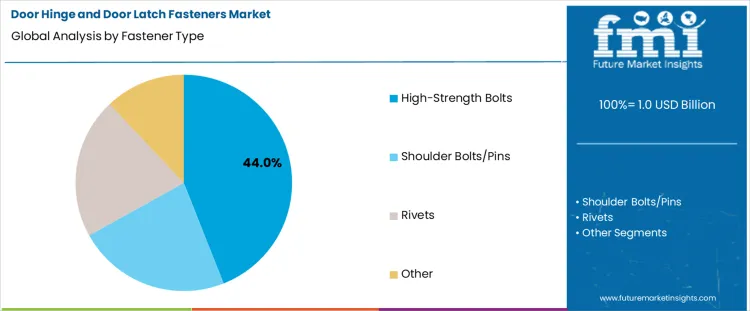
High-strength bolts account for approximately 44% of fastener type demand, making them the leading category. These bolts are designed to secure door hinges and latch mechanisms under repeated use and dynamic loads, maintaining alignment and operational reliability. Adoption is driven by the need for crash safety compliance and durability across varying vehicle classes. Operational procedures include torque verification, thread inspection, and assembly checks to ensure secure mounting. High-strength bolts accommodate conventional hinged doors and heavy-duty power sliding doors, providing consistent load distribution, preventing deformation, and ensuring long-term hinge and latch performance.
Operational factors further reinforce adoption. Bolts must resist loosening under vibration, temperature changes, and repeated door cycles. High-strength bolts lead because they deliver predictable performance, ease of assembly, and integration with multiple door designs. They maintain door alignment, prevent rattling, and support safety-critical applications. Their use enhances durability, reduces maintenance requirements, and ensures occupant protection while maintaining operational consistency across passenger and commercial vehicles.
Why Are Conventional Hinged Doors Representing the Largest Door System Segment in Fastener Demand?
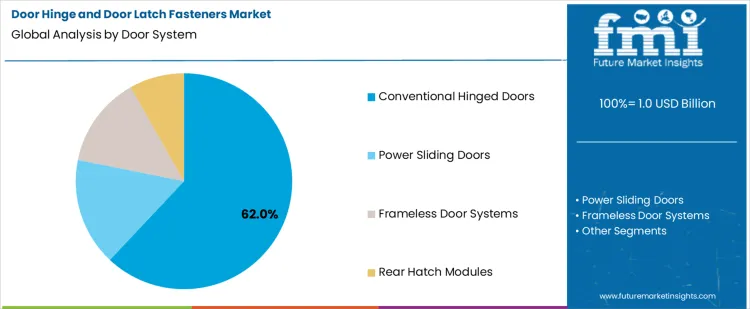
Conventional hinged doors account for approximately 62% of total door system demand, making them the largest segment. Adoption is driven by the continued prevalence of traditional door designs in passenger and commercial vehicles. Fasteners for these doors must maintain precise hinge alignment, secure latch operation, and structural integrity during repeated use and crash events. Operational procedures include accurate bolt torque application, hinge alignment verification, and regular inspection for fatigue or loosening. Conventional doors benefit from standardized fastener designs that allow scalable assembly and reliable long-term performance.
Functional and operational factors further reinforce adoption. Fasteners must withstand environmental exposure, repeated opening cycles, and dynamic forces during vehicle operation. Conventional hinged doors lead because they provide predictable, durable performance, ease of assembly, and compliance with safety regulations. Their use ensures smooth door operation, occupant protection, and reduced service requirements, supporting both high-volume production and long-term vehicle reliability.
How Are Fasteners Securing Vehicle Doors for Safety and Longevity?
Door hinge and latch fasteners are increasingly adopted to maintain precise door alignment, smooth operation, and crashworthiness in passenger vehicles, commercial trucks, and SUVs. Adoption is strongest in regions with high automotive production, diverse vehicle designs, and stringent safety testing requirements. Fasteners are selected for tensile strength, wear resistance, and durability under repeated opening and closing cycles. Growth is driven by the need to ensure occupant protection, minimize rattling, and maintain long-term door functionality. Investment focuses on material toughness, precision manufacturing, and corrosion resistance. OEMs prioritize fasteners that support secure hinge and latch assembly while accommodating design variations.
Why Are Vehicle Design Variability and Load Dynamics Driving Demand?
Demand is influenced by differences in door weight, hinge design, and latch mechanisms across vehicle models. Manufacturers adopt fasteners capable of withstanding torsion, vibration, and environmental exposure without loosening or deforming. Components offering consistent torque retention, high fatigue resistance, and reliable alignment gain preference. Adoption is concentrated in regions with diverse automotive platforms and strict crash and operational standards. Operational reliability, occupant safety, and long-term performance drive procurement rather than cost. Suppliers providing validated, durable fasteners gain a competitive edge among OEMs and door system integrators.
What Factors Restrict Broader Deployment of Door Hinge and Latch Fasteners?
High mechanical stress, environmental exposure, and variability in door design restrict adoption. Fastener performance can be affected by temperature fluctuations, repeated mechanical cycles, and corrosion from moisture or road chemicals. Integration with electronic latch controls and adjustable hinges adds engineering complexity. Smaller manufacturers or regions with limited assembly precision adopt solutions more slowly. These factors concentrate early deployment among premium and mass-market OEMs with advanced door systems and high-quality standards.
How Are Material Engineering and Load Adaptation Shaping Market Trends?
Fasteners are designed for high fatigue resistance, dimensional precision, and corrosion protection while supporting multi-door vehicle architectures. Collaboration between fastener suppliers, hinge and latch designers, and OEM engineers ensures load distribution, long-term reliability, and alignment stability. Pilot testing evaluates torque retention, mechanical endurance, and environmental resilience before large-scale deployment. Quality monitoring, standardized manufacturing, and material validation maintain consistent performance. Focus is on structural integrity, operational reliability, and long-term durability rather than cost or volume. These approaches enable broader adoption of door hinge and door latch fasteners across automotive assembly and safety-critical applications.
What is the Demand for Door Hinge and Door Latch Fasteners by Country?
| Country | CAGR (%) |
|---|---|
| China | 4.6% |
| India | 4.9% |
| USA | 3.2% |
| South Korea | 3.9% |
| Japan | 2.5% |
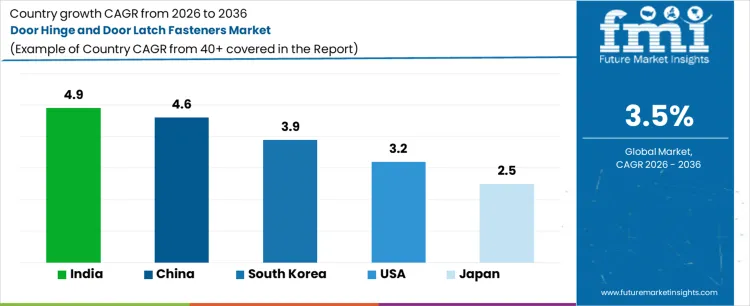
Demand for door hinge and door latch fasteners is rising as automotive manufacturers focus on vehicle safety, durability, and assembly efficiency. India leads with a 4.9% CAGR, driven by growing vehicle production, modernization of car designs, and adoption of high-strength fasteners. China follows at 4.6%, supported by large-scale automotive manufacturing and standardized fastener integration in door assemblies. South Korea grows at 3.9%, shaped by domestic vehicle production and regulatory compliance. The USA records 3.2% growth, reflecting replacement demand and integration in new vehicle models. Japan shows 2.5% CAGR, influenced by mature automotive markets and moderate expansion in door hinge and latch fastener adoption.
How is China experiencing growth in the door hinge and door latch fasteners market?
China is experiencing growth at a CAGR of 4.6%, supported by adoption of door hinge and door latch fasteners market solutions to improve vehicle door assembly, operational reliability, and structural durability. Manufacturers and suppliers are producing fasteners optimized for load-bearing performance, corrosion resistance, and compatibility with door systems. Demand is concentrated in automotive production hubs, assembly plants, and component manufacturing facilities. Investments focus on material quality, production consistency, and compliance with automotive safety standards rather than large-scale deployment. Growth reflects rising vehicle production, industrial adoption of high-quality fasteners, and increasing focus on door assembly reliability.
- Automotive door assembly drives adoption.
- Fasteners optimize load-bearing performance and corrosion resistance.
- Production hubs and assembly plants concentrate demand.
- Material quality and safety compliance guide investment.
How is India witnessing growth in the door hinge and door latch fasteners market?
India is witnessing growth at a CAGR of 4.9%, fueled by adoption of door hinge and door latch fasteners market solutions to enhance vehicle door durability, structural integrity, and assembly efficiency. Manufacturers and suppliers are deploying fasteners optimized for corrosion resistance, load capacity, and integration with door hinge and latch systems. Demand is concentrated in automotive manufacturing hubs, assembly centers, and component production facilities. Investments prioritize material performance, production quality, and adherence to automotive safety standards rather than fleet-scale deployment. Growth reflects increasing automotive production, industrial adoption of reliable fasteners, and focus on operational safety.
- Door durability drives adoption.
- Fasteners provide corrosion resistance and load capacity.
- Manufacturing hubs and assembly centers concentrate demand.
- Material performance and safety compliance guide investment.
How is the United States experiencing growth in the door hinge and door latch fasteners market?
United States is experiencing growth at a CAGR of 3.2%, supported by adoption of door hinge and door latch fasteners market solutions to improve vehicle door assembly, operational reliability, and structural safety. Manufacturers and suppliers are producing fasteners optimized for load-bearing performance, corrosion resistance, and compatibility with automotive door systems. Demand is concentrated in assembly plants, component manufacturing hubs, and vehicle production facilities. Investments focus on material durability, production quality, and compliance with automotive safety standards rather than large-scale deployment. Growth reflects moderate automotive production, industrial adoption of high-quality fasteners, and attention to door assembly reliability.
- Door assembly drives adoption.
- Fasteners ensure load-bearing performance and corrosion resistance.
- Assembly plants and manufacturing hubs concentrate demand.
- Material durability and quality compliance guide investment.
How is South Korea witnessing growth in the door hinge and door latch fasteners market?
South Korea is witnessing growth at a CAGR of 3.9%, fueled by adoption of door hinge and door latch fasteners market solutions to enhance vehicle door durability, structural integrity, and assembly reliability. Manufacturers and suppliers are deploying fasteners optimized for corrosion resistance, load-bearing capacity, and compatibility with door systems. Demand is concentrated in automotive manufacturing hubs, assembly plants, and component production centers. Investments prioritize material quality, operational reliability, and adherence to safety standards rather than large-scale deployment. Growth reflects industrial adoption of reliable fasteners, moderate automotive production, and focus on precise door assembly.
- Door durability drives adoption.
- Fasteners optimize corrosion resistance and load-bearing capacity.
- Automotive hubs and assembly plants concentrate demand.
- Material quality and operational reliability guide investment.
How is Japan experiencing growth in the door hinge and door latch fasteners market?
Japan is experiencing growth at a CAGR of 2.5%, supported by adoption of door hinge and door latch fasteners market solutions to improve vehicle door assembly, structural durability, and operational reliability. Manufacturers and suppliers are producing fasteners optimized for load capacity, corrosion resistance, and integration with door hinge and latch systems. Demand is concentrated in automotive assembly plants, component hubs, and production facilities. Investments focus on material performance, production consistency, and adherence to automotive safety standards rather than large-scale deployment. Growth reflects moderate vehicle production, industrial adoption of high-quality fasteners, and emphasis on door assembly reliability.
- Door assembly drives adoption.
- Fasteners ensure load capacity and corrosion resistance.
- Assembly plants and component hubs concentrate demand.
- Material performance and safety compliance guide investment.
Who Competes in the Door Hinge and Door Latch Fasteners Market and What Defines Their Capabilities?
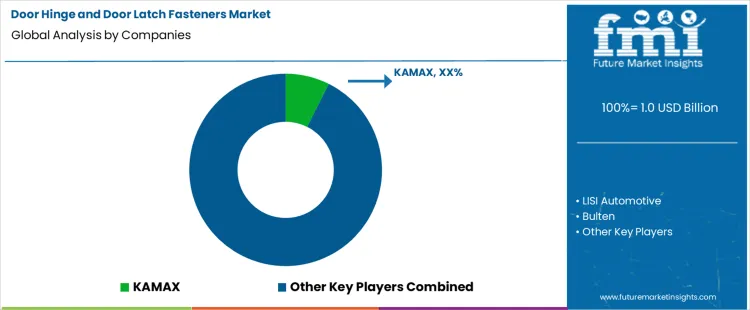
Competition in the door hinge and door latch fasteners market is defined by tensile strength, fatigue resistance, and compliance with automotive safety standards. KAMAX supplies high-strength fasteners engineered for secure door hinge and latch assembly, ensuring long-term durability under repeated operational loads. LISI Automotive develops precision fasteners optimized for fatigue resistance and consistent torque in safety-critical door mechanisms. Bulten provides engineered fasteners for lightweight door structures while maintaining mechanical integrity. Stanley Engineered Fastening delivers components designed for vibration resistance and secure assembly in automotive doors. Meidoh supplies corrosion-resistant fasteners suitable for door latches and hinges.
Böllhoff provides fasteners with coatings for durability and torque consistency. Nedschroef develops high-strength fasteners compatible with various door designs and assembly lines. Fontana Gruppo supplies precision components for door hinges and latches emphasizing dimensional stability. Würth Automotive delivers fasteners engineered for reliability and high-load applications. SFS Group provides modular solutions compatible with different hinge and latch systems. Other regional and specialty suppliers produce fasteners for lightweight, hybrid, and high-volume vehicle platforms. Competitive differentiation arises from material performance, fatigue resistance, corrosion protection, dimensional precision, and compliance with automotive safety regulations.
Key Players in the Door Hinge and Door Latch Fasteners Market
- KAMAX
- LISI Automotive
- Bulten
- Stanley Engineered Fastening
- Meidoh
- Böllhoff
- Nedschroef
- Fontana Gruppo
- Würth Automotive
- SFS Group
Scope of the Report
| Items | Values |
|---|---|
| Quantitative Units (2026) | USD billion |
| Fastener Type | High-Strength Bolts, Shoulder Bolts/Pins, Rivets, Other |
| Door System | Conventional Hinged Doors, Power Sliding Doors, Frameless Door Systems, Rear Hatch Modules |
| Material and Coating | Zinc-Nickel Coated, Geomet Coated, Phosphate and Oiled, Stainless Steel |
| Sales Channel | OEM/Tier 1 Supply, Aftermarket, Service Replacements, Other |
| Region | Asia Pacific, Europe, North America, Latin America, Middle East & Africa |
| Key Countries Covered | China, India, USA, South Korea, Japan |
| Key Companies Profiled | KAMAX, LISI Automotive, Bulten, Stanley Engineered Fastening, Meidoh, Böllhoff, Nedschroef, Fontana Gruppo, Würth Automotive, SFS Group |
| Additional Attributes | Dollar sales by fastener type, door system, material, and sales channel; regional CAGR, volume and value growth projections; adoption across passenger cars, SUVs, and commercial vehicles; focus on crashworthiness, torque retention, and vibration resistance; margins concentrated among suppliers delivering certified, high-performance fasteners; competitive advantage from OEM partnerships, assembly line integration, and validated durability in door systems. |
Door Hinge and Door Latch Fasteners Market Segmentation
By Fastener Type:
- High-Strength Bolts
- Shoulder Bolts/Pins
- Rivets
- Other
By Door System:
- Conventional Hinged Doors
- Power Sliding Doors
- Frameless Door Systems
- Rear Hatch Modules
By Material and Coating:
- Zinc-Nickel Coated
- Geomet Coated
- Phosphate and Oiled
- Stainless Steel
By Sales Channel:
- OEM/Tier 1 Supply
- Aftermarket
- Service Replacements
- Other
By Region:
- Asia Pacific
- China
- Japan
- South Korea
- India
- Australia & New Zealand
- ASEAN
- Rest of Asia Pacific
- Europe
- Germany
- United Kingdom
- France
- Italy
- Spain
- Nordic
- BENELUX
- Rest of Europe
- North America
- United States
- Canada
- Mexico
- Latin America
- Brazil
- Chile
- Rest of Latin America
- Middle East & Africa
- Kingdom of Saudi Arabia
- Other GCC Countries
- Turkey
- South Africa
- Other African Union
- Rest of Middle East & Africa
Bibliography
- National Highway Traffic Safety Administration (NHTSA). (2024). Federal Motor Vehicle Safety Standards (FMVSS) No. 214 - Side impact protection.
- European Commission - Joint Research Centre (JRC). (2024). Vehicle passive safety and crashworthiness regulatory science.
- United Nations Economic Commission for Europe (UNECE). (2024). UN Regulation No. 11 - Door latches and door retention components.
- International Organization for Standardization (ISO). (2024). ISO 898-1 - Mechanical properties of fasteners made of carbon steel and alloy steel.
Frequently Asked Questions
How big is the door hinge and door latch fasteners market in 2026?
The global door hinge and door latch fasteners market is estimated to be valued at USD 1.0 billion in 2026.
What will be the size of door hinge and door latch fasteners market in 2036?
The market size for the door hinge and door latch fasteners market is projected to reach USD 1.4 billion by 2036.
How much will be the door hinge and door latch fasteners market growth between 2026 and 2036?
The door hinge and door latch fasteners market is expected to grow at a 3.5% CAGR between 2026 and 2036.
What are the key product types in the door hinge and door latch fasteners market?
The key product types in door hinge and door latch fasteners market are high-strength bolts, shoulder bolts/pins, rivets and other.
Which door system segment to contribute significant share in the door hinge and door latch fasteners market in 2026?
In terms of door system, conventional hinged doors segment to command 62.0% share in the door hinge and door latch fasteners market in 2026.
Preview the report firsthand - request a free sample
Get SampleGet the brochure for pricing and purchase details.
Get PDFTable of Content
- Executive Summary
- Global Market Outlook
- Demand-side Trends
- Supply-side Trends
- Technology Roadmap Analysis
- Analysis and Recommendations
- Market Overview
- Market Coverage / Taxonomy
- Market Definition / Scope / Limitations
- Market Background
- Market Dynamics
- Drivers
- Restraints
- Opportunity
- Trends
- Scenario Forecast
- Demand in Optimistic Scenario
- Demand in Likely Scenario
- Demand in Conservative Scenario
- Opportunity Map Analysis
- Product Life Cycle Analysis
- Supply Chain Analysis
- Investment Feasibility Matrix
- Value Chain Analysis
- PESTLE and Porter’s Analysis
- Regulatory Landscape
- Regional Parent Market Outlook
- Production and Consumption Statistics
- Import and Export Statistics
- Market Dynamics
- Global Market Analysis 2021 to 2025 and Forecast, 2026 to 2036
- Historical Market Size Value (USD Million) Analysis, 2021 to 2025
- Current and Future Market Size Value (USD Million) Projections, 2026 to 2036
- Y-o-Y Growth Trend Analysis
- Absolute $ Opportunity Analysis
- Global Market Pricing Analysis 2021 to 2025 and Forecast 2026 to 2036
- Global Market Analysis 2021 to 2025 and Forecast 2026 to 2036, By Fastener Type
- Introduction / Key Findings
- Historical Market Size Value (USD Million) Analysis By Fastener Type , 2021 to 2025
- Current and Future Market Size Value (USD Million) Analysis and Forecast By Fastener Type , 2026 to 2036
- High-Strength Bolts
- Shoulder Bolts/Pins
- Rivets
- Other
- High-Strength Bolts
- Y-o-Y Growth Trend Analysis By Fastener Type , 2021 to 2025
- Absolute $ Opportunity Analysis By Fastener Type , 2026 to 2036
- Global Market Analysis 2021 to 2025 and Forecast 2026 to 2036, By Door System
- Introduction / Key Findings
- Historical Market Size Value (USD Million) Analysis By Door System, 2021 to 2025
- Current and Future Market Size Value (USD Million) Analysis and Forecast By Door System, 2026 to 2036
- Conventional Hinged Doors
- Power Sliding Doors
- Frameless Door Systems
- Rear Hatch Modules
- Conventional Hinged Doors
- Y-o-Y Growth Trend Analysis By Door System, 2021 to 2025
- Absolute $ Opportunity Analysis By Door System, 2026 to 2036
- Global Market Analysis 2021 to 2025 and Forecast 2026 to 2036, By Material and Coating
- Introduction / Key Findings
- Historical Market Size Value (USD Million) Analysis By Material and Coating, 2021 to 2025
- Current and Future Market Size Value (USD Million) Analysis and Forecast By Material and Coating, 2026 to 2036
- Zinc-Nickel Coated
- Geomet Coated
- Phosphate and Oiled
- Stainless Steel
- Zinc-Nickel Coated
- Y-o-Y Growth Trend Analysis By Material and Coating, 2021 to 2025
- Absolute $ Opportunity Analysis By Material and Coating, 2026 to 2036
- Global Market Analysis 2021 to 2025 and Forecast 2026 to 2036, By Sales Channel
- Introduction / Key Findings
- Historical Market Size Value (USD Million) Analysis By Sales Channel, 2021 to 2025
- Current and Future Market Size Value (USD Million) Analysis and Forecast By Sales Channel, 2026 to 2036
- OEM/Tier 1 Supply
- Aftermarket
- Service Replacements
- Other
- OEM/Tier 1 Supply
- Y-o-Y Growth Trend Analysis By Sales Channel, 2021 to 2025
- Absolute $ Opportunity Analysis By Sales Channel, 2026 to 2036
- Global Market Analysis 2021 to 2025 and Forecast 2026 to 2036, By Region
- Introduction
- Historical Market Size Value (USD Million) Analysis By Region, 2021 to 2025
- Current Market Size Value (USD Million) Analysis and Forecast By Region, 2026 to 2036
- North America
- Latin America
- Western Europe
- Eastern Europe
- East Asia
- South Asia and Pacific
- Middle East & Africa
- Market Attractiveness Analysis By Region
- North America Market Analysis 2021 to 2025 and Forecast 2026 to 2036, By Country
- Historical Market Size Value (USD Million) Trend Analysis By Market Taxonomy, 2021 to 2025
- Market Size Value (USD Million) Forecast By Market Taxonomy, 2026 to 2036
- By Country
- USA
- Canada
- Mexico
- By Fastener Type
- By Door System
- By Material and Coating
- By Sales Channel
- By Country
- Market Attractiveness Analysis
- By Country
- By Fastener Type
- By Door System
- By Material and Coating
- By Sales Channel
- Key Takeaways
- Latin America Market Analysis 2021 to 2025 and Forecast 2026 to 2036, By Country
- Historical Market Size Value (USD Million) Trend Analysis By Market Taxonomy, 2021 to 2025
- Market Size Value (USD Million) Forecast By Market Taxonomy, 2026 to 2036
- By Country
- Brazil
- Chile
- Rest of Latin America
- By Fastener Type
- By Door System
- By Material and Coating
- By Sales Channel
- By Country
- Market Attractiveness Analysis
- By Country
- By Fastener Type
- By Door System
- By Material and Coating
- By Sales Channel
- Key Takeaways
- Western Europe Market Analysis 2021 to 2025 and Forecast 2026 to 2036, By Country
- Historical Market Size Value (USD Million) Trend Analysis By Market Taxonomy, 2021 to 2025
- Market Size Value (USD Million) Forecast By Market Taxonomy, 2026 to 2036
- By Country
- Germany
- UK
- Italy
- Spain
- France
- Nordic
- BENELUX
- Rest of Western Europe
- By Fastener Type
- By Door System
- By Material and Coating
- By Sales Channel
- By Country
- Market Attractiveness Analysis
- By Country
- By Fastener Type
- By Door System
- By Material and Coating
- By Sales Channel
- Key Takeaways
- Eastern Europe Market Analysis 2021 to 2025 and Forecast 2026 to 2036, By Country
- Historical Market Size Value (USD Million) Trend Analysis By Market Taxonomy, 2021 to 2025
- Market Size Value (USD Million) Forecast By Market Taxonomy, 2026 to 2036
- By Country
- Russia
- Poland
- Hungary
- Balkan & Baltic
- Rest of Eastern Europe
- By Fastener Type
- By Door System
- By Material and Coating
- By Sales Channel
- By Country
- Market Attractiveness Analysis
- By Country
- By Fastener Type
- By Door System
- By Material and Coating
- By Sales Channel
- Key Takeaways
- East Asia Market Analysis 2021 to 2025 and Forecast 2026 to 2036, By Country
- Historical Market Size Value (USD Million) Trend Analysis By Market Taxonomy, 2021 to 2025
- Market Size Value (USD Million) Forecast By Market Taxonomy, 2026 to 2036
- By Country
- China
- Japan
- South Korea
- By Fastener Type
- By Door System
- By Material and Coating
- By Sales Channel
- By Country
- Market Attractiveness Analysis
- By Country
- By Fastener Type
- By Door System
- By Material and Coating
- By Sales Channel
- Key Takeaways
- South Asia and Pacific Market Analysis 2021 to 2025 and Forecast 2026 to 2036, By Country
- Historical Market Size Value (USD Million) Trend Analysis By Market Taxonomy, 2021 to 2025
- Market Size Value (USD Million) Forecast By Market Taxonomy, 2026 to 2036
- By Country
- India
- ASEAN
- Australia & New Zealand
- Rest of South Asia and Pacific
- By Fastener Type
- By Door System
- By Material and Coating
- By Sales Channel
- By Country
- Market Attractiveness Analysis
- By Country
- By Fastener Type
- By Door System
- By Material and Coating
- By Sales Channel
- Key Takeaways
- Middle East & Africa Market Analysis 2021 to 2025 and Forecast 2026 to 2036, By Country
- Historical Market Size Value (USD Million) Trend Analysis By Market Taxonomy, 2021 to 2025
- Market Size Value (USD Million) Forecast By Market Taxonomy, 2026 to 2036
- By Country
- Kingdom of Saudi Arabia
- Other GCC Countries
- Turkiye
- South Africa
- Other African Union
- Rest of Middle East & Africa
- By Fastener Type
- By Door System
- By Material and Coating
- By Sales Channel
- By Country
- Market Attractiveness Analysis
- By Country
- By Fastener Type
- By Door System
- By Material and Coating
- By Sales Channel
- Key Takeaways
- Key Countries Market Analysis
- USA
- Pricing Analysis
- Market Share Analysis, 2025
- By Fastener Type
- By Door System
- By Material and Coating
- By Sales Channel
- Canada
- Pricing Analysis
- Market Share Analysis, 2025
- By Fastener Type
- By Door System
- By Material and Coating
- By Sales Channel
- Mexico
- Pricing Analysis
- Market Share Analysis, 2025
- By Fastener Type
- By Door System
- By Material and Coating
- By Sales Channel
- Brazil
- Pricing Analysis
- Market Share Analysis, 2025
- By Fastener Type
- By Door System
- By Material and Coating
- By Sales Channel
- Chile
- Pricing Analysis
- Market Share Analysis, 2025
- By Fastener Type
- By Door System
- By Material and Coating
- By Sales Channel
- Germany
- Pricing Analysis
- Market Share Analysis, 2025
- By Fastener Type
- By Door System
- By Material and Coating
- By Sales Channel
- UK
- Pricing Analysis
- Market Share Analysis, 2025
- By Fastener Type
- By Door System
- By Material and Coating
- By Sales Channel
- Italy
- Pricing Analysis
- Market Share Analysis, 2025
- By Fastener Type
- By Door System
- By Material and Coating
- By Sales Channel
- Spain
- Pricing Analysis
- Market Share Analysis, 2025
- By Fastener Type
- By Door System
- By Material and Coating
- By Sales Channel
- France
- Pricing Analysis
- Market Share Analysis, 2025
- By Fastener Type
- By Door System
- By Material and Coating
- By Sales Channel
- India
- Pricing Analysis
- Market Share Analysis, 2025
- By Fastener Type
- By Door System
- By Material and Coating
- By Sales Channel
- ASEAN
- Pricing Analysis
- Market Share Analysis, 2025
- By Fastener Type
- By Door System
- By Material and Coating
- By Sales Channel
- Australia & New Zealand
- Pricing Analysis
- Market Share Analysis, 2025
- By Fastener Type
- By Door System
- By Material and Coating
- By Sales Channel
- China
- Pricing Analysis
- Market Share Analysis, 2025
- By Fastener Type
- By Door System
- By Material and Coating
- By Sales Channel
- Japan
- Pricing Analysis
- Market Share Analysis, 2025
- By Fastener Type
- By Door System
- By Material and Coating
- By Sales Channel
- South Korea
- Pricing Analysis
- Market Share Analysis, 2025
- By Fastener Type
- By Door System
- By Material and Coating
- By Sales Channel
- Russia
- Pricing Analysis
- Market Share Analysis, 2025
- By Fastener Type
- By Door System
- By Material and Coating
- By Sales Channel
- Poland
- Pricing Analysis
- Market Share Analysis, 2025
- By Fastener Type
- By Door System
- By Material and Coating
- By Sales Channel
- Hungary
- Pricing Analysis
- Market Share Analysis, 2025
- By Fastener Type
- By Door System
- By Material and Coating
- By Sales Channel
- Kingdom of Saudi Arabia
- Pricing Analysis
- Market Share Analysis, 2025
- By Fastener Type
- By Door System
- By Material and Coating
- By Sales Channel
- Turkiye
- Pricing Analysis
- Market Share Analysis, 2025
- By Fastener Type
- By Door System
- By Material and Coating
- By Sales Channel
- South Africa
- Pricing Analysis
- Market Share Analysis, 2025
- By Fastener Type
- By Door System
- By Material and Coating
- By Sales Channel
- USA
- Market Structure Analysis
- Competition Dashboard
- Competition Benchmarking
- Market Share Analysis of Top Players
- By Regional
- By Fastener Type
- By Door System
- By Material and Coating
- By Sales Channel
- Competition Analysis
- Competition Deep Dive
- KAMAX
- Overview
- Product Portfolio
- Profitability by Market Segments (Product/Age /Sales Channel/Region)
- Sales Footprint
- Strategy Overview
- Marketing Strategy
- Product Strategy
- Channel Strategy
- LISI Automotive
- Bulten
- Stanley Engineered Fastening
- Meidoh
- Böllhoff
- Nedschroef
- Fontana Gruppo
- Würth Automotive
- SFS Group
- KAMAX
- Competition Deep Dive
- Assumptions & Acronyms Used
- Research Methodology


