

- Industry Size (2026)
- USD 506.00 Mn
- Forecast (2036)
- USD 986.10 Mn
- CAGR (2026 to 2036)
- 6.9%
Lightweight High-Strength Passenger Window Systems for Next-Gen Aircraft Market Size, Market Forecast and Outlook By FMI
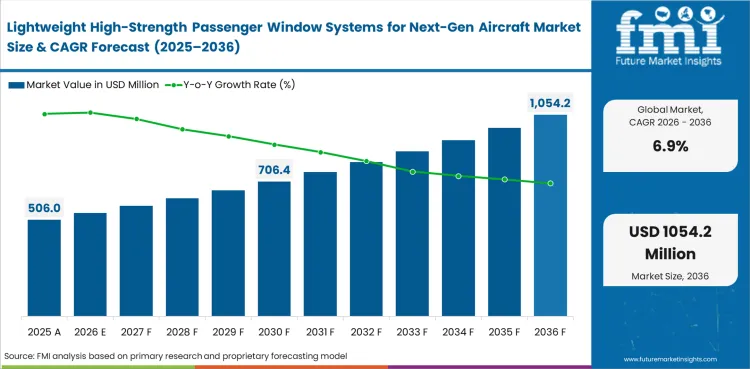
The lightweight high-strength passenger window systems market was valued at USD 473.40 million in 2025. The market is set to reach USD 506.00 million by 2026 and is estimated to grow at a rate of 6.9% between 2026 to 2036 to reach USD 986.10 million by 2036. Standard windows is likely to dominate the Window Format segment with 54.0%, while narrowbody is expected to lead the aircraft type with 46.0%.
Summary of the Lightweight High-Strength Passenger Window Systems
- Demand and Growth Drivers
- Demand is expected to rise because aircraft builders still value lighter repeat-use parts across every cabin section.
- Smart shading systems are gaining attention where airlines want a better cabin feel with fewer moving parts.
- Adoption is slower where certification time and higher unit cost make upgrades harder to justify.
- Product and Segment View
- Stretched acrylic is a leading material because it gives a good balance of low weight, clarity, and known performance.
- Narrowbody aircraft lead because production volumes are higher than other passenger aircraft classes.
- Demand for premium glazing and adaptive shading are growing, though standard windows hold most installed positions.
- Geography and Competitive Outlook
- China and India are likely to record faster growth because fleet expansion is stronger.
- France and Germany benefit from Airbus-linked production and supplier depth.
- Competition favors companies that can combine window engineering, certification support, and repair capability.
- Analyst Opinion
- Nikhil Kaitwade Principal Consultant at FMI says, “The stronger route to scale comes from line-fit cabin window programs where suppliers can cut weight without making integration harder for OEMs.”
Key Takeaways, Market Size, and Forecast
- The lightweight high-strength passenger window systems market was valued at USD 473.4 million in 2025.
- By 2036, the lightweight high-strength passenger window systems market is expected to be worth USD 986.1 million.
- From 2026 to 2036, the market is projected to expand at a CAGR of 6.9%.
- The market is projected to create an incremental opportunity of USD 480.1 million between 2026 and 2036.
- In 2026, standard windows are expected to account for 54.0% of the window format segment.
- China at 8.4% and India at 8.1% are among the fastest growing markets.
- Commercial value comes from lighter cabin windows that reduce weight, hold up well in service, and support better passenger comfort.
Lightweight High-Strength Passenger Window Systems Market Value Analysis
- This market is part of the broader aircraft windows and windshields market, but this segment focuses on passenger cabin windows instead of cockpit glazing.
- Growth is supported by higher aircraft output, cabin upgrades, and stronger interest in passenger-facing comfort features.
- The market is benefiting from the wider move toward aerospace lightweight materials, especially in parts used many times across one aircraft.
- Demand is higher in line-fit programs than in replacement business because cabin windows do not change often once aircraft are in service.
Lightweight High-Strength Passenger Window Systems Market Definition
The market includes passenger cabin window assemblies designed for next-generation aircraft using materials and system designs that improve strength-to-weight ratio, optical clarity, and cabin comfort. It also includes standard passenger windows, premium window formats, and window systems with integrated shading or dimming capability.
Lightweight High-Strength Passenger Window Systems Market Inclusions
Market scope includes commercially supplied passenger cabin window systems categorized by aircraft type, material, window format, shading technology, sales channel, and region. The scope includes line-fit and replacement window assemblies, cabin-side transparencies, coatings, and light-control systems supplied for next-generation passenger aircraft between 2026 and 2036.
Lightweight High-Strength Passenger Window Systems Market Exclusions
The scope does not include cockpit windshields, military canopies, radomes, or generic architectural smart-glass products. It also excludes raw glazing materials sold without aircraft-qualified window integration.
Lightweight High-Strength Passenger Window Systems Market Research Methodology
- Primary Research: FMI analysts interacted with aircraft interiors specialists, transparency manufacturers, aerospace materials stakeholders, and aftermarket support providers.
- Desk Research: Analysis combined aircraft delivery data, airline traffic outlook, certification references, company disclosures, and technical material information.
- Market sizing and forecasting: Forecasting used a bottom-up model built from aircraft deliveries, blended window-set pricing, and replacement demand.
- Data validation: Estimates were checked against parent market benchmarks, company positioning, fleet growth trends, and long-range passenger aircraft demand indicators.
Why is the Lightweight High-Strength Passenger Window Systems Market Growing?
- Aircraft makers want lighter cabin parts that can reduce weight without weakening durability.
- Airlines and OEMs are giving more attention to better light control and lower cabin heat load.
- China and India are supporting growth because fleet expansion is stronger than in mature markets.
Passenger window systems matter because they are installed many times across each aircraft. Even a small reduction in weight per unit becomes more useful when multiplied across a full cabin layout. This market is closely related with the aircraft cabin interior market.
Cabin windows are becoming part of the passenger experience. Better glare control, solar management, and improved cabin appearance are increasing interest in electrochromic glass and electrochromic glass and devices, especially in premium cabins.
The major challenge for suppliers is qualification and replacement economics. These factors keep companies focused on proven designs and suppliers with strong support capability. This is one reason adoption of the product is slower than commercial aircraft cabin interior market upgrades.
Market Segmentation Analysis
- Narrowbody aircraft account for the largest share at 46.0% market share because production volume is higher than widebody and business-jet output.
- Stretched acrylic leads the material segment at 39.0% market share due to lower weight and established use in aircraft transparencies.
- OEM line-fit leads the sales segment because window systems gain stronger value when integrated during aircraft production.
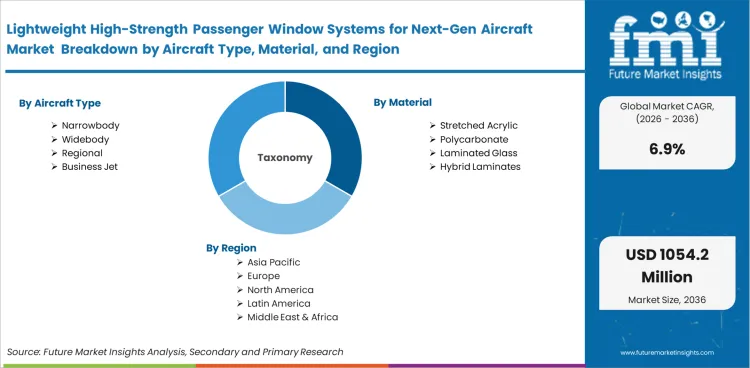
The market for lightweight high-strength passenger window systems for next-gen aircraft is divided into groups based on aircraft type, material, window format, shading technology, sales channel, and region. There are narrowbody, widebody, regional, and business jet aircraft types. By material, the market includes stretched acrylic, polycarbonate, laminated glass, and hybrid laminates. By window format, it covers standard windows, panoramic windows, exit windows, and premium windows. Based on shading technology, the market includes mechanical shades, electrochromic, SPD glazing, and dual-mode systems. By sales channel, it is segmented into OEM line-fit, retrofit, and MRO replacement.
Insights into the Narrowbody Aircraft Segment
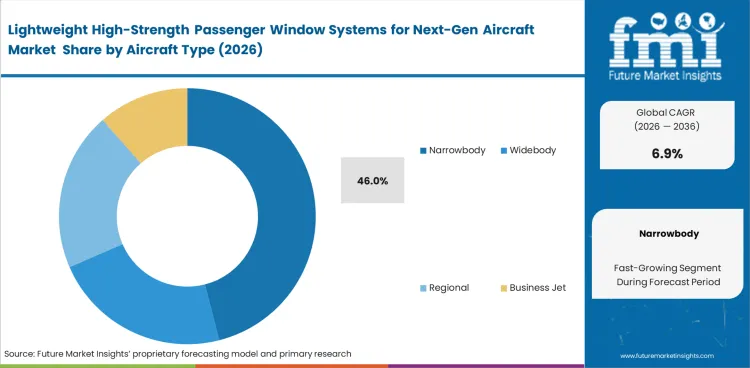
- In 2026, narrowbody aircraft are expected to account for 46.0% of the market. Higher production rates keep window-set demand broad in this segment.
- Widebody and business-jet programs are estimated to account for larger market shares per shipset, though narrowbody demand is higher because more aircraft are delivered.
Insights into the Stretched Acrylic Segment
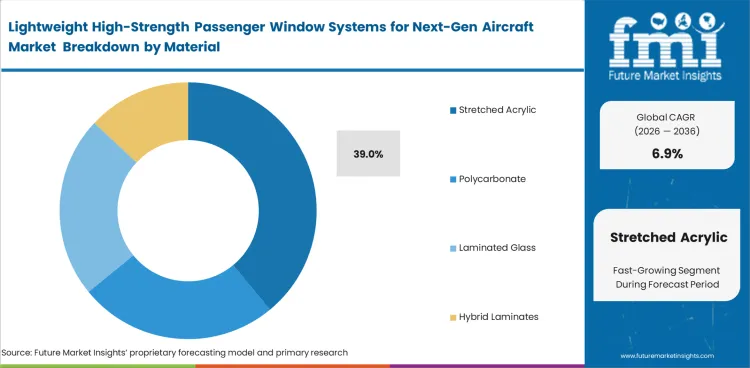
- In 2026, stretched acrylic is expected to account for 39.0% of the material segment. The segment leads because it combines lower weight, good clarity, and known qualification history.
- Polycarbonate and hybrid laminates are gaining interest in selected programs. Broader use is limited by cost and validation time. Material suppliers watch advances in lightweight polymers market development and advanced glass market trends.
Insights into the Standard Windows Segment
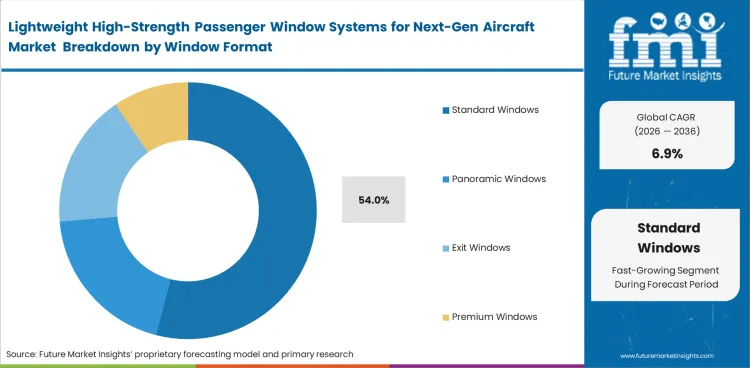
- In 2026, standard windows are expected to account for 54.0% of the window format segment. They hold the default fit across most passenger aircraft.
- Panoramic and premium windows improve cabin appeal. Larger formats raise sealing, design, and service considerations. Related niches such as the eVTOL panoramic window and skylight systems market are growing from a different design starting point.
Insights into the OEM Line-fit Segment
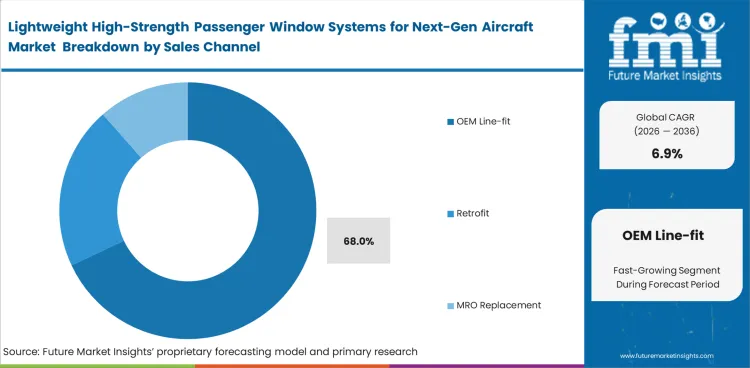
- In 2026, OEM line-fit is expected to account for 68.0% of the sales channel segment. The segment leads because system approval is stronger when the window is qualified during aircraft build.
- Retrofit and MRO replacement still matter where airlines, aircraft operators, and maintenance companies want new shading systems or replacement of worn cabin windows. Companies in this channel often compare product durability and certification fit across related aerospace industry analysis and advanced composites market.
Lightweight High-Strength Passenger Window Systems Market Drivers, Restraints, and Opportunities
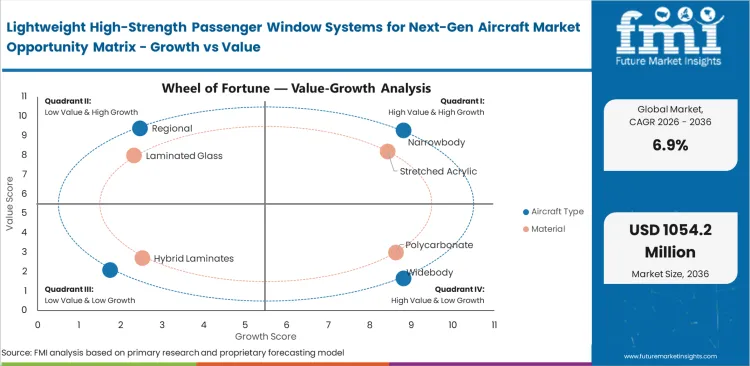
- Fleet expansion and next-generation aircraft production are supporting new line-fit demand.
- Adoption is limited by certification work, long replacement cycles, and higher cost for advanced window systems.
- Opportunity remains stronger in programs that value cabin comfort, premium design, and lower maintenance burden.
The market is moving forward because lighter cabin components still hold value in aircraft programs. The category does not expand evenly, though, because suppliers must balance weight reduction with durability, service life, and approval discipline.
Smart Shading and Cabin Comfort Upgrades
The category is shifting from simple transparency performance toward improved cabin experience. Suppliers are gaining more attention where adaptive light-control systems can reduce glare and improve passenger comfort without depending on traditional shades. That design path overlaps with innovation themes seen in the electrochromic and liquid crystal polymer market and even selected concepts from the aircraft interior lighting market.
Certification Is Moving from Material Claims to Installed-System Proof
For the lightweight high-strength passenger window systems for next-gen aircraft market, regulatory compliance is centered less on headline material performance and more on whether the full installed window system can clear transport-category airworthiness evidence under real operating loads. Under 14 CFR § 25.775, window designs in pressurized aircraft must account for continuous and cyclic pressurization, temperature differentials, and single-failure conditions; the FAA requires the panels to withstand maximum cabin-pressure differential loads combined with critical aerodynamic and temperature effects after any single failure. EASA’s CS-25 mirrors that logic and explicitly ties compliance to test-and-analysis methods for pressurized-cabin windows. [1]
Premium Cabin Design and Larger Window Adoption
Larger and better-controlled window openings are becoming part of cabin design strategy in selected aircraft programs. The same design direction is visible in adjacent cabin systems such as the aircraft exterior lighting market and aircraft LED market, where passenger-facing design value is becoming easier to justify.
Analysis of Lightweight High-Strength Passenger Window Systems Market By Key Countries
.webp "Top Country Growth Comparison Lightweight High Strength Passenger Window Systems For Next Gen Aircraft Market Cagr (2026 2036)")
| Country | CAGR |
|---|---|
| China | 8.4% |
| India | 8.1% |
| France | 7.5% |
| Germany | 7.2% |
| United States | 6.8% |
| United Kingdom | 6.5% |
Source: FMI analysis based on primary research and proprietary forecasting model
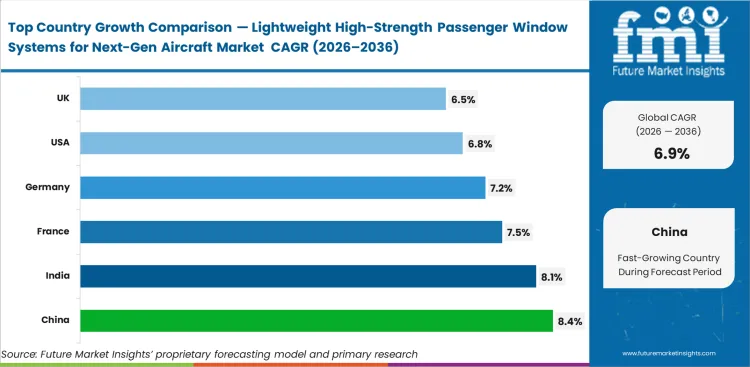
Lightweight High-Strength Passenger Window Systems Market Cagr Analysis By Country
- China registers fastest growth at 8.4% CAGR because fleet intake and passenger demand remain strong.
- India is estimated to record 8.1% CAGR due to fast airline growth and narrowbody expansion.
- France at 7.5% CAGR and Germany at 7.2% CAGR stay above the global rate because of Airbus-linked production and supplier capability.
- The United States grows at 6.8% CAGR as a large installed base supports replacement and premium retrofit demand.
- The United Kingdom at 6.5% remains steady due to aerospace engineering depth and supply-chain participation.
The global market is expected to grow at a CAGR of 6.9% from 2026 to 2036, with faster growth in Asia and more stable demand in mature aerospace markets.
Demand Outlook for Lightweight High-Strength Passenger Window Systems in the United States
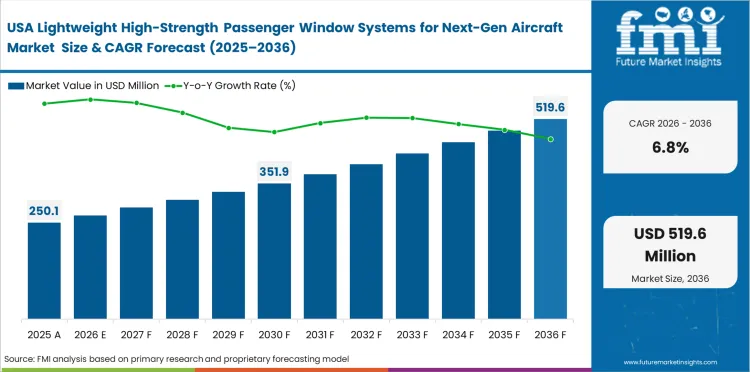
The United States is an important market because it combines a large fleet, premium business aviation activity, and strong aftermarket support. Sales of lightweight high-strength passenger window systems in the United States are expected to rise at a CAGR of 6.8% through 2036, driven by fleet replacement and premium retrofit demand. Suppliers with repair capability and certification support hold stronger value in this market.
- Mature fleet base supports replacement demand.
- Premium cabin upgrades improve retrofit value.
- Aftermarket depth helps supplier preference.
Future Outlook for Lightweight High-Strength Passenger Window Systems in China
China is a strong market because airline growth and aircraft intake are high. Demand in China is expected to rise at a CAGR of 8.4% through 2036, supported by fleet expansion and passenger traffic growth. The market is more relevant for suppliers that can align with long-term OEM and maintenance relationships.
- Large aircraft demand base supports shipset volume.
- Faster passenger growth lifts cabin-system intake.
- Local support capability can improve supplier access.
Opportunity Analysis of Lightweight High-Strength Passenger Window Systems in India
India shows strong growth potential because the market is expanding from a smaller installed base with fast airline growth. Demand in India is expected to rise at a CAGR of 8.1% through 2036, owing to narrowbody fleet additions and rising air travel demand. The market holds stronger value for suppliers that can support cost-sensitive expansion without lowering quality standards.
- Narrowbody growth raises window-set demand.
- Airline expansion supports future OEM intake.
- Cost discipline matters in supplier selection.
In-depth Analysis of Lightweight High-Strength Passenger Window Systems in France
France is an important market because Airbus-led production gives the country direct relevance in civil aircraft supply chains. Demand in France is expected to rise at a CAGR of 7.5% through 2036, driven by OEM production exposure and engineering depth. Business value is higher where suppliers can fit line-fit programs and long qualification cycles.
- Airbus linkage supports OEM-side demand.
- Engineering depth helps qualification work.
- Line-fit capability improves supplier position.
Sales Analysis of Lightweight High-Strength Passenger Window Systems in Germany
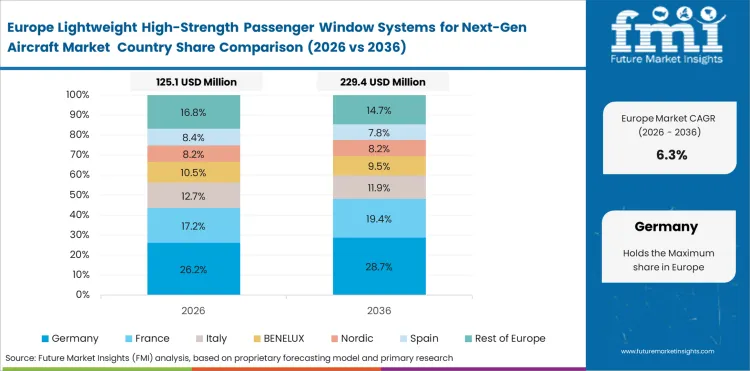
Germany is an important market due to aerospace materials expertise, engineering capability, and participation in European aircraft manufacturing programs. Demand in Germany is expected to rise at a CAGR of 7.2% through 2036, driven by supplier integration and advanced manufacturing strength. The market is more favorable for companies that can combine durability, coating performance, and reliable delivery.
- Manufacturing strength supports supply depth.
- Advanced materials capability aids innovation.
- Delivery reliability remains a buying factor.
Future Outlook for Lightweight High-Strength Passenger Window Systems in the United Kingdom
The United Kingdom holds importance because it combines aerospace design capability with specialist transparency and systems engineering. Demand in the United Kingdom is expected to rise at a CAGR of 6.5% through 2036, supported by engineering strength and supply-chain participation. Supplier advantage depends on technology depth rather than domestic fleet size alone.
- Engineering capability supports specialist supply.
- Program participation lifts export-linked demand.
- Technology depth matters more than scale.
Competitive Landscape and Strategic Positioning
- PPG, GKN Aerospace, and NORDAM remain central because they combine transparency capability with OEM and aftermarket access.
- Gentex and Gauzy are strengthening relevance where dimmable and passenger-comfort-focused systems gain traction.
- Entry barriers remain high because certification, repair support, coating know-how, and program approvals take time to build.
The leading company cluster is split between established transparency suppliers and smart-window specialists. The first group wins through qualification depth, production reliability, and service coverage. The second group matters more where smart glazing and adaptive passenger-comfort systems shape cabin design priorities.
Buyer screening remains conservative. Airlines and OEMs can test new technologies, but supplier approval depends on durability, fail-safe behavior, and maintainability. This caution is also visible in material-heavy aerospace categories such as the aerospace 3D printing materials market and in long-life engineered inputs like the aerospace forging materials market.
Key Companies in the Lightweight High-Strength Passenger Window Systems Market
Key global companies leading the lightweight high-strength passenger window systems market include:
- PPG Industries, GKN Aerospace, and NORDAM, which combine broad transparency manufacturing capability with OEM and aftermarket support across civil aircraft programs.
- Gentex and Gauzy, which are more visible in dimmable and adaptive passenger window systems where light control and cabin comfort carry added value.
- Lee Aerospace and Saint-Gobain Sully, which remain relevant in specialty transparencies, replacement windows, glazing technology, and aircraft-grade materials.
Competitive Benchmarking: Lightweight High-Strength Passenger Window Systems
| Company | Window Technology | Certification Depth | Aftermarket Support | Geographic Footprint |
|---|---|---|---|---|
| PPG Industries | High | High | Strong | Global |
| GKN Aerospace | High | High | Strong | Global |
| NORDAM | High | High | Strong | North America, Global |
| Gentex | High | Medium | Moderate | North America, Europe |
| Gauzy | High | Medium | Moderate | Europe, North America, Global |
| Lee Aerospace | Medium | High | Strong | North America |
| Saint-Gobain Sully | Medium | Medium | Moderate | Europe |
Source: Future Market Insights competitive analysis, 2026. Ratings reflect relative positioning based on window technology, certification depth, and aftermarket support.
Key Developments in Lightweight High-Strength Passenger Window Systems
- April 2025: Gentex showcased SSL-enhanced electronically dimmable windows at AIX 2025, adding switchable scattering layer technology to improve passenger privacy and reduce reflected light.
- April 2025: Air France selected Gauzy’s technology for its new 5-window La Première first-class suites on Boeing 777 models, expanding Gauzy’s role in airline shading and lighting.
Key Players in the Lightweight High-Strength Passenger Window Systems:
Major Global Players:
- PPG Industries
- GKN Aerospace
- NORDAM
- Gentex
- Gauzy
Emerging Players/Startups
- Lee Aerospace
- Saint-Gobain Sully
Report Scope and Coverage
| Parameter | Details |
|---|---|
| Quantitative Units | USD 506.00 million to USD 986.10 million, at a CAGR of 6.9% |
| Market Definition | Passenger cabin window systems designed for next-generation aircraft with emphasis on lower weight, higher strength, durability, optical performance, and cabin comfort |
| Regions Covered | North America, Latin America, Europe, East Asia, South Asia and Pacific, Middle East and Africa |
| Countries Covered | United States, China, India, France, Germany, United Kingdom, and additional markets across 30+ countries |
| Key Companies Profiled | PPG Industries, GKN Aerospace, NORDAM, Gentex, Gauzy, Lee Aerospace, Saint-Gobain Sully |
| Forecast Period | 2026 to 2036 |
| Approach | Hybrid bottom-up and top-down methodology using aircraft delivery data, system-level pricing logic, fleet growth indicators, and supplier benchmarking |
Lightweight High-Strength Passenger Window Systems Market by Segments
Lightweight High-Strength Passenger Window Systems Market Segmented by Aircraft Type:
- Narrowbody
- Widebody
- Regional
- Business Jet
Lightweight High-Strength Passenger Window Systems Market Segmented by Material:
- Stretched Acrylic
- Polycarbonate
- Laminated Glass
- Hybrid Laminates
Lightweight High-Strength Passenger Window Systems Market Segmented by Window Format:
- Standard Windows
- Panoramic Windows
- Exit Windows
- Premium Windows
Lightweight High-Strength Passenger Window Systems Market Segmented by Shading Technology:
- Mechanical Shades
- Electrochromic
- SPD Glazing
- Dual-mode
Lightweight High-Strength Passenger Window Systems Market Segmented by Sales Channel:
- OEM Line-fit
- Retrofit
- MRO Replacement
Lightweight High-Strength Passenger Window Systems Market by Region:
- North America
- Latin America
- Europe
- East Asia
- South Asia and Pacific
- Middle East and Africa
Research Sources and Bibliography
- Gentex Corporation. (2025, April 8). Gentex showcases SSL-enhanced electronically dimmable windows at AIX 2025.
- Gauzy Ltd. (2025, April 22). Gauzy is proud to announce Air France selection of Gauzy’s technology for its new 5-window La Première first-class suites on Boeing 777 models. GlobeNewswire.
- Federal Register, National Archives and Records Administration; Office of the Federal Register. [2026, April]. eCFR :: 14 CFR 25.775 - Windshields and windows. (FAR 25.775)
- Federal Aviation Administration. (2025, July). How Does the FAA Certify Aircraft?
- European Union Aviation Safety Agency. (2024, March). 2024-0075 : Doors - Passenger Jettisonable Window Mechanism - Replacement.
- International Air Transport Association. (2025, December). Global Outlook for Air Transport in 2026 - December 2025.
- Zhuofei Jia, Yiming Sui, Long Qian, Xi Ren, Yunxiang Zhao, Rui Yao, Lumeng Wang, Dongliang Chao, and Cheng Yang. (2024, July). Electrochromic windows with fast response and wide dynamic range for visible-light modulation without traditional electrodes.
This Report Answers
- What is the current and future size of the lightweight high-strength passenger window systems market?
- How fast is the market expected to grow between 2026 and 2036?
- Which aircraft type is expected to account for the highest demand by 2026?
- Which material segment is likely to lead the market by 2026?
- Why do standard windows continue to dominate overall installations?
- How are smart shading and dimmable systems changing product demand?
- Why are China and India expected to grow faster than mature Western markets?
- What limits wider use of premium panoramic and adaptive window systems?
- Which companies are best positioned across OEM line-fit and aftermarket support?
- How does certification depth affect supplier preference in this market?
- Why does narrowbody volume matter more than premium per-aircraft value?
- Where does the strongest opportunity sit between line-fit and replacement demand?
Frequently Asked Questions
What is the global market demand for lightweight high-strength passenger window systems in 2026?
In 2026, the global market for lightweight high-strength passenger window systems is expected to be worth USD 506.00 million.
How big will the market for lightweight high-strength passenger window systems be in 2036?
By 2036, the market is expected to be worth USD 986.10 million.
How much will demand grow between 2026 and 2036?
Demand is expected to grow at a CAGR of 6.9% during the forecast period.
Which aircraft type leads the market by 2026?
Narrowbody aircraft lead because production volume remains higher and window-set demand scales with delivery rates.
Which material segment is likely to lead by 2026?
Stretched acrylic is expected to lead due to weight advantage, optical clarity, and known qualification history.
Why do standard windows still dominate this market?
They fit current fuselage architecture, cost expectations, and maintenance practices better than larger premium formats.
Why are adaptive and dimmable windows gaining attention?
They improve glare control, solar management, and passenger comfort in cabins where premium experience matters.
What is the main barrier to wider adoption?
The main barrier is certification and lifecycle economics, not lack of technical interest.
Which countries are expected to grow the fastest?
China and India are expected to post the fastest growth because of stronger fleet expansion and passenger-demand trends.
What makes a supplier competitive in this market?
Suppliers are stronger when they combine lightweight design, transparency know-how, certification support, and aftermarket service reach.
Preview the report firsthand - request a free sample
Get SampleGet the brochure for pricing and purchase details.
Get PDFTable of Content
- Executive Summary
- Global Market Outlook
- Technology Roadmap Analysis
- Analysis and Recommendations
- Market Overview
- Market Coverage / Taxonomy
- Market Definition / Scope / Limitations
- Research Methodology
- Chapter Orientation
- Analytical Lens and Working Hypotheses
- Market Structure, Signals, and Trend Drivers
- Benchmarking and Cross-market Comparability
- Market Sizing, Forecasting, and Opportunity Mapping
- Company Annual and Sustainability Reports
- Peer-reviewed Journals and Academic Literature
- Corporate Websites, Product Literature, and Technical Notes
- Earnings Decks and Investor Briefings
- Statutory Filings and Regulatory Disclosures
- Technical White Papers and Standards Notes
- Trade Journals, Industry Magazines, and Analyst Briefs
- Conference Proceedings, Webinars, and Seminar Materials
- Government Statistics Portals and Public Data Releases
- Press Releases and Reputable Media Coverage
- Specialist Newsletters and Curated Briefings
- Sector Databases and Reference Repositories
- FMI Internal Proprietary Databases and Historical Market Datasets
- Subscription Datasets and Paid Sources
- Social Channels, Communities, and Digital Listening Inputs
- Additional Desk Sources
- Expert Input and Fieldwork (Primary Evidence)
- Primary Modes
- Qualitative Interviews and Expert Elicitation
- Field Techniques
- Interviews
- Surveys
- Focus Groups
- Observational and In-context Research
- Social and Community Interactions
- Stakeholder Universe Engaged
- C-suite Leaders
- Board Members
- Presidents and Vice Presidents
- R&D and Innovation Heads
- Technical Specialists
- Domain Subject-matter Experts
- Scientists
- Physicians and Other Healthcare Professionals
- Governance, Ethics, and Data Stewardship
- Research Ethics
- Data Integrity and Handling
- Tooling, Models, and Reference Databases
- Primary Modes
- Data Engineering and Model Build
- Data Acquisition and Ingestion
- Cleaning, Normalisation, and Verification
- Synthesis, Triangulation, and Analysis
- Quality Assurance and Audit Trail
- Market Background
- Market Dynamics
- Drivers
- Restraints
- Opportunity
- Trends
- Scenario Forecast
- Demand in Optimistic Scenario
- Demand in Likely Scenario
- Demand in Conservative Scenario
- Opportunity Map Analysis
- Product Life Cycle Analysis
- Supply Chain Analysis
- Investment Feasibility Matrix
- Value Chain Analysis
- PESTLE and Porter’s Analysis
- Regulatory Landscape
- Regional Parent Market Outlook
- Production and Consumption Statistics
- Import and Export Statistics
- Market Dynamics
- Global Market Analysis 2021 to 2025 and Forecast, 2026 to 2036
- Historical Market Size Value (USD Million) Analysis, 2021 to 2025
- Current and Future Market Size Value (USD Million) Projections, 2026 to 2036
- Y-o-Y Growth Trend Analysis
- Absolute $ Opportunity Analysis
- Global Market Pricing Analysis 2021 to 2025 and Forecast 2026 to 2036
- Global Market Analysis 2021 to 2025 and Forecast 2026 to 2036, By Aircraft Type
- Introduction / Key Findings
- Historical Market Size Value (USD Million) Analysis By Aircraft Type , 2021 to 2025
- Current and Future Market Size Value (USD Million) Analysis and Forecast By Aircraft Type , 2026 to 2036
- Narrowbody
- Widebody
- Regional
- Business Jet
- Narrowbody
- Y-o-Y Growth Trend Analysis By Aircraft Type , 2021 to 2025
- Absolute $ Opportunity Analysis By Aircraft Type , 2026 to 2036
- Global Market Analysis 2021 to 2025 and Forecast 2026 to 2036, By Material
- Introduction / Key Findings
- Historical Market Size Value (USD Million) Analysis By Material, 2021 to 2025
- Current and Future Market Size Value (USD Million) Analysis and Forecast By Material, 2026 to 2036
- Stretched Acrylic
- Polycarbonate
- Laminated Glass
- Hybrid Laminates
- Stretched Acrylic
- Y-o-Y Growth Trend Analysis By Material, 2021 to 2025
- Absolute $ Opportunity Analysis By Material, 2026 to 2036
- Global Market Analysis 2021 to 2025 and Forecast 2026 to 2036, By Window Format
- Introduction / Key Findings
- Historical Market Size Value (USD Million) Analysis By Window Format, 2021 to 2025
- Current and Future Market Size Value (USD Million) Analysis and Forecast By Window Format, 2026 to 2036
- Standard Windows
- Panoramic Windows
- Exit Windows
- Premium Windows
- Standard Windows
- Y-o-Y Growth Trend Analysis By Window Format, 2021 to 2025
- Absolute $ Opportunity Analysis By Window Format, 2026 to 2036
- Global Market Analysis 2021 to 2025 and Forecast 2026 to 2036, By Sales Channel
- Introduction / Key Findings
- Historical Market Size Value (USD Million) Analysis By Sales Channel, 2021 to 2025
- Current and Future Market Size Value (USD Million) Analysis and Forecast By Sales Channel, 2026 to 2036
- OEM Line-fit
- Retrofit
- MRO Replacement
- OEM Line-fit
- Y-o-Y Growth Trend Analysis By Sales Channel, 2021 to 2025
- Absolute $ Opportunity Analysis By Sales Channel, 2026 to 2036
- Global Market Analysis 2021 to 2025 and Forecast 2026 to 2036, By Region
- Introduction
- Historical Market Size Value (USD Million) Analysis By Region, 2021 to 2025
- Current Market Size Value (USD Million) Analysis and Forecast By Region, 2026 to 2036
- North America
- Latin America
- Western Europe
- Eastern Europe
- East Asia
- South Asia and Pacific
- Middle East & Africa
- Market Attractiveness Analysis By Region
- North America Market Analysis 2021 to 2025 and Forecast 2026 to 2036, By Country
- Historical Market Size Value (USD Million) Trend Analysis By Market Taxonomy, 2021 to 2025
- Market Size Value (USD Million) Forecast By Market Taxonomy, 2026 to 2036
- By Country
- USA
- Canada
- Mexico
- By Aircraft Type
- By Material
- By Window Format
- By Sales Channel
- By Country
- Market Attractiveness Analysis
- By Country
- By Aircraft Type
- By Material
- By Window Format
- By Sales Channel
- Key Takeaways
- Latin America Market Analysis 2021 to 2025 and Forecast 2026 to 2036, By Country
- Historical Market Size Value (USD Million) Trend Analysis By Market Taxonomy, 2021 to 2025
- Market Size Value (USD Million) Forecast By Market Taxonomy, 2026 to 2036
- By Country
- Brazil
- Chile
- Rest of Latin America
- By Aircraft Type
- By Material
- By Window Format
- By Sales Channel
- By Country
- Market Attractiveness Analysis
- By Country
- By Aircraft Type
- By Material
- By Window Format
- By Sales Channel
- Key Takeaways
- Western Europe Market Analysis 2021 to 2025 and Forecast 2026 to 2036, By Country
- Historical Market Size Value (USD Million) Trend Analysis By Market Taxonomy, 2021 to 2025
- Market Size Value (USD Million) Forecast By Market Taxonomy, 2026 to 2036
- By Country
- Germany
- UK
- Italy
- Spain
- France
- Nordic
- BENELUX
- Rest of Western Europe
- By Aircraft Type
- By Material
- By Window Format
- By Sales Channel
- By Country
- Market Attractiveness Analysis
- By Country
- By Aircraft Type
- By Material
- By Window Format
- By Sales Channel
- Key Takeaways
- Eastern Europe Market Analysis 2021 to 2025 and Forecast 2026 to 2036, By Country
- Historical Market Size Value (USD Million) Trend Analysis By Market Taxonomy, 2021 to 2025
- Market Size Value (USD Million) Forecast By Market Taxonomy, 2026 to 2036
- By Country
- Russia
- Poland
- Hungary
- Balkan & Baltic
- Rest of Eastern Europe
- By Aircraft Type
- By Material
- By Window Format
- By Sales Channel
- By Country
- Market Attractiveness Analysis
- By Country
- By Aircraft Type
- By Material
- By Window Format
- By Sales Channel
- Key Takeaways
- East Asia Market Analysis 2021 to 2025 and Forecast 2026 to 2036, By Country
- Historical Market Size Value (USD Million) Trend Analysis By Market Taxonomy, 2021 to 2025
- Market Size Value (USD Million) Forecast By Market Taxonomy, 2026 to 2036
- By Country
- China
- Japan
- South Korea
- By Aircraft Type
- By Material
- By Window Format
- By Sales Channel
- By Country
- Market Attractiveness Analysis
- By Country
- By Aircraft Type
- By Material
- By Window Format
- By Sales Channel
- Key Takeaways
- South Asia and Pacific Market Analysis 2021 to 2025 and Forecast 2026 to 2036, By Country
- Historical Market Size Value (USD Million) Trend Analysis By Market Taxonomy, 2021 to 2025
- Market Size Value (USD Million) Forecast By Market Taxonomy, 2026 to 2036
- By Country
- India
- ASEAN
- Australia & New Zealand
- Rest of South Asia and Pacific
- By Aircraft Type
- By Material
- By Window Format
- By Sales Channel
- By Country
- Market Attractiveness Analysis
- By Country
- By Aircraft Type
- By Material
- By Window Format
- By Sales Channel
- Key Takeaways
- Middle East & Africa Market Analysis 2021 to 2025 and Forecast 2026 to 2036, By Country
- Historical Market Size Value (USD Million) Trend Analysis By Market Taxonomy, 2021 to 2025
- Market Size Value (USD Million) Forecast By Market Taxonomy, 2026 to 2036
- By Country
- Kingdom of Saudi Arabia
- Other GCC Countries
- Turkiye
- South Africa
- Other African Union
- Rest of Middle East & Africa
- By Aircraft Type
- By Material
- By Window Format
- By Sales Channel
- By Country
- Market Attractiveness Analysis
- By Country
- By Aircraft Type
- By Material
- By Window Format
- By Sales Channel
- Key Takeaways
- Key Countries Market Analysis
- USA
- Pricing Analysis
- Market Share Analysis, 2025
- By Aircraft Type
- By Material
- By Window Format
- By Sales Channel
- Canada
- Pricing Analysis
- Market Share Analysis, 2025
- By Aircraft Type
- By Material
- By Window Format
- By Sales Channel
- Mexico
- Pricing Analysis
- Market Share Analysis, 2025
- By Aircraft Type
- By Material
- By Window Format
- By Sales Channel
- Brazil
- Pricing Analysis
- Market Share Analysis, 2025
- By Aircraft Type
- By Material
- By Window Format
- By Sales Channel
- Chile
- Pricing Analysis
- Market Share Analysis, 2025
- By Aircraft Type
- By Material
- By Window Format
- By Sales Channel
- Germany
- Pricing Analysis
- Market Share Analysis, 2025
- By Aircraft Type
- By Material
- By Window Format
- By Sales Channel
- UK
- Pricing Analysis
- Market Share Analysis, 2025
- By Aircraft Type
- By Material
- By Window Format
- By Sales Channel
- Italy
- Pricing Analysis
- Market Share Analysis, 2025
- By Aircraft Type
- By Material
- By Window Format
- By Sales Channel
- Spain
- Pricing Analysis
- Market Share Analysis, 2025
- By Aircraft Type
- By Material
- By Window Format
- By Sales Channel
- France
- Pricing Analysis
- Market Share Analysis, 2025
- By Aircraft Type
- By Material
- By Window Format
- By Sales Channel
- India
- Pricing Analysis
- Market Share Analysis, 2025
- By Aircraft Type
- By Material
- By Window Format
- By Sales Channel
- ASEAN
- Pricing Analysis
- Market Share Analysis, 2025
- By Aircraft Type
- By Material
- By Window Format
- By Sales Channel
- Australia & New Zealand
- Pricing Analysis
- Market Share Analysis, 2025
- By Aircraft Type
- By Material
- By Window Format
- By Sales Channel
- China
- Pricing Analysis
- Market Share Analysis, 2025
- By Aircraft Type
- By Material
- By Window Format
- By Sales Channel
- Japan
- Pricing Analysis
- Market Share Analysis, 2025
- By Aircraft Type
- By Material
- By Window Format
- By Sales Channel
- South Korea
- Pricing Analysis
- Market Share Analysis, 2025
- By Aircraft Type
- By Material
- By Window Format
- By Sales Channel
- Russia
- Pricing Analysis
- Market Share Analysis, 2025
- By Aircraft Type
- By Material
- By Window Format
- By Sales Channel
- Poland
- Pricing Analysis
- Market Share Analysis, 2025
- By Aircraft Type
- By Material
- By Window Format
- By Sales Channel
- Hungary
- Pricing Analysis
- Market Share Analysis, 2025
- By Aircraft Type
- By Material
- By Window Format
- By Sales Channel
- Kingdom of Saudi Arabia
- Pricing Analysis
- Market Share Analysis, 2025
- By Aircraft Type
- By Material
- By Window Format
- By Sales Channel
- Turkiye
- Pricing Analysis
- Market Share Analysis, 2025
- By Aircraft Type
- By Material
- By Window Format
- By Sales Channel
- South Africa
- Pricing Analysis
- Market Share Analysis, 2025
- By Aircraft Type
- By Material
- By Window Format
- By Sales Channel
- USA
- Market Structure Analysis
- Competition Dashboard
- Competition Benchmarking
- Market Share Analysis of Top Players
- By Regional
- By Aircraft Type
- By Material
- By Window Format
- By Sales Channel
- Competition Analysis
- Competition Deep Dive
- Competition Deep Dive
- Assumptions & Acronyms Used


