

- Industry Size (2026)
- USD 366.3 Mn
- Forecast (2036)
- USD 579.3 Mn
- CAGR (2026 to 2036)
- 4.70%
Aircraft Surface Temperature Monitoring Systems Market Size, Market Forecast and Outlook By FMI
The aircraft surface temperature monitoring systems market was valued at USD 349.9 million in 2025. The industry is poised to reach USD 366.3 million in 2026 at a CAGR of 4.70% during the forecast period. Revenue expansion propels the total opportunity to USD 579.3 million through 2036 as aging fleets and extreme flight envelopes require precise thermal monitoring to prevent catastrophic material failure, shifting maintenance from scheduled intervals to condition-based sensing.
Fleet operators are moving away from simple limit-switching towards predictive thermal profiling, where the rate of temperature change is monitored to identify mechanical friction or insulation degradation before a failure threshold is hit. This shift forces procurement teams to decide between maintaining legacy analog thermostats or investing in digital-bus compatible components. Delaying this transition results in higher fuel burn and unscheduled groundings, as modern aircraft sensors provide the granular data necessary for the sophisticated health management systems found in next-generation airframes. A non-obvious hurdle remains the signal shielding in high-EMI environments like engine nacelles, where the physical casing of the sensor often impacts response time more than the internal sensing element itself.
Summary of Aircraft Surface Temperature Monitoring Systems Market
- Aircraft Surface Temperature Monitoring Systems Market Definition:
- The market defines the critical safety infrastructure used to track thermal changes on aircraft skins and internal high-heat components. These systems are bound by the requirement for high-accuracy telemetry in extreme vibration and pressure environments, separating them from standard industrial sensing.
- Demand Drivers in the Market
- The shift toward predictive maintenance compels fleet maintenance directors to replace binary thermal switches with high-resolution digital sensors.
- Stringent de-icing and anti-icing protocols drive procurement heads to integrate more sophisticated wing-surface monitoring to optimize heater-mat cycles.
- The expansion of the UAV and eVTOL sector obligates drone manufacturers to implement lightweight thermal sensing for battery and motor housing protection.
- Key Segments Analyzed in the FMI Report
- Commercial Aircraft: Commercial Aircraft is anticipated to hold a 38.0% share in 2026, as high-utilization flight cycles generate the most thermal stress on engines and brakes.
- Thermostat: Thermostat is expected to grab a 41.0% share in 2026, primarily due to their established reliability in fail-safe limit-switching applications across legacy fleets.
- Engine: Engine is projected to account for a 46.0% share in 2026, driven by the critical need for continuous thermal monitoring in combustion and exhaust sections.
- India: 6.9% compound growth, supported by the massive commercial fleet expansion and the establishment of local MRO hubs prioritizing modern sensing.
- Analyst Opinion at FMI
- Nikhil Kaitwade, Principal Analyst, Process Automation, at FMI, opines, "The industry focuses heavily on sensor precision, but the real practitioner paradox lies in the mounting hardware and signal isolation. I have observed that while a sensor might have laboratory-accuracy, the thermal lag introduced by its protective housing or the EMI noise in a nacelle can render that precision useless. The winners in this market will not be those with the most sensitive elements, but those who solve the integration of the sensor into the aircraft's skin without compromising structural health or signal integrity."
- Strategic Implications / Executive Takeaways
- Avionics directors must prioritize sensors compatible with digital data buses to ensure long-term integration with advanced health management systems.
- MRO providers should invest in specialized testing equipment for RTDs to capture the growing aftermarket demand as fleets move away from thermostats.
- OEMs face a structural constraint in qualification timelines that requires them to engage in early-stage co-development with sensor vendors for next-generation airframes.
- Methodology:
- The methodology utilizes a bottom-up approach to track the sensor density across various aircraft types, ensuring that the market size reflects actual component counts rather than broad industry spend. This allows for precise forecasting of the transition from legacy analog switches to modern digital RTDs.
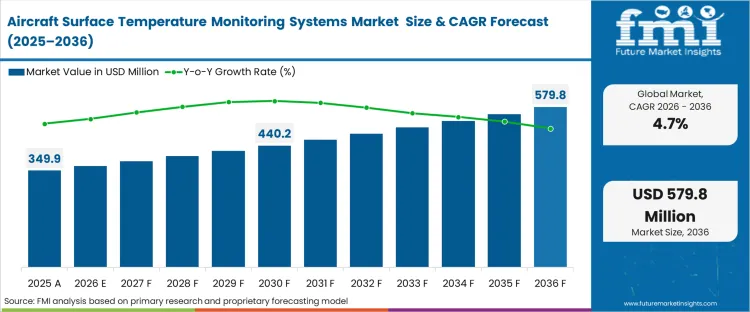
Aircraft Surface Temperature Monitoring Systems Market Key Takeaways
| Metric | Details |
|---|---|
| Industry Size (2026) | USD 366.3 million |
| Industry Value (2036) | USD 579.3 million |
| CAGR (2026-2036) | 4.70% |
Source: Future Market Insights (FMI) analysis, based on proprietary forecasting model and primary research
The structural gate for accelerated growth is the full-scale integration of digital avionic backbones across regional and general aviation platforms. Once these aircraft move from analog signal processing to digital data buses, high-resolution sensing becomes significantly easier to deploy without complex rewiring. Avionics integrators trigger this shift by standardizing sensor interfaces, allowing the next unit of thermal monitoring to be added with minimal qualification latency compared to legacy hardware.
India is expected to advance at a CAGR of 6.9%, followed by China at 6.7% and Japan at 5.8%. The United Kingdom is anticipated to record a growth rate of 5.5%, while Germany is projected to post 5.4%. In North America, the United States and Canada are predicted to expand at 5.2% and 4.9% respectively. This structural divergence is driven by the concentration of MRO hub development in emerging economies vs. the replacement cycles of established Western defense and commercial fleets.
Aircraft Surface Temperature Monitoring Systems Market Definition
The aircraft surface temperature monitoring systems market encompasses the specialized hardware and software used to measure thermal signatures on external and internal aircraft surfaces. These systems are functionally distinct from ambient air measurement as they provide direct contact or non-contact thermal data from high-stress components. This distinction is critical for maintaining structural integrity and preventing ice formation on wings or overheating in engine nacelles during flight.
Aircraft Surface Temperature Monitoring Systems Market Inclusions
This market includes the procurement of thermostats, resistive temperature detectors (RTDs), and thermocouples specifically designed for aerospace environments. It covers components utilized in thermal management for engines, landing gear assemblies, and flight control surfaces. Both original equipment manufacturer (OE) installations and aftermarket replacements for commercial, military, and unmanned aerial vehicles are within the analytical scope.
Aircraft Surface Temperature Monitoring Systems Market Exclusions
The scope excludes general industrial temperature sensors not certified for aerospace use and ambient cabin thermostats used purely for passenger comfort without safety-critical functions. It also excludes software-only thermal simulation tools and ground-based thermal imaging equipment used for pre-flight inspections that are not integrated into the aircraft's onboard avionics. These exclusions ensure the analysis remains focused on flight-certified hardware and its immediate telemetry interfaces.
Aircraft Surface Temperature Monitoring Systems Market Research Methodology
- Primary Research: FMI conducted interviews with Avionics Systems Engineers, Aerospace Procurement Directors, and MRO Maintenance Supervisors to validate sensor replacement cycles.
- Desk Research: Analysis involved reviewing FAA/EASA certification registries, aerospace component procurement archives, and technical specifications from leading tier-1 avionic suppliers.
- Market-Sizing and Forecasting: The baseline anchors to the global aircraft delivery and retirement data, using the average sensor density per airframe type as the foundation.
- Data Validation and Update Cycle: Forecasts were cross-validated using independent fleet utilization data and component-level demand signals from major aftermarket distributors.
Segmental Analysis
Aircraft Surface Temperature Monitoring Systems Market Analysis by Aircraft Type
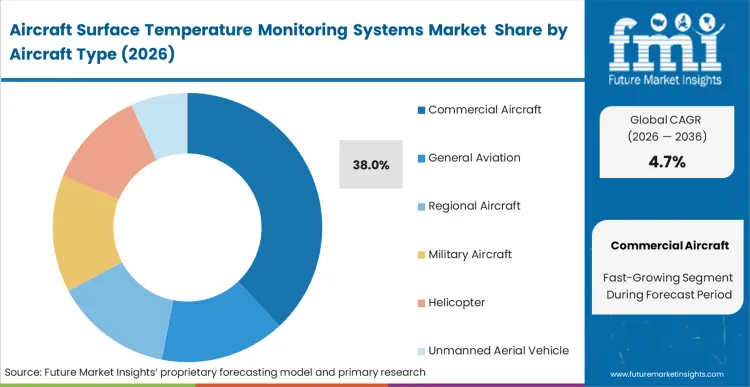
Fleet modernization efforts highlight the failure of legacy airframes to support the high-frequency data sampling required for modern analytics, driving a displacement of traditional sensing setups. Commercial aircraft operators are the primary movers in this space, as high utilization rates make the cost of unscheduled maintenance far more punitive than the upfront cost of advanced aircraft interface device and sensor upgrades. According to FMI's estimates, the commercial segment leads with a 38.0% share because the operational efficiency of large-scale passenger fleets depends on minimizing the "cool down" periods for brakes and engines. This requirement forces maintenance crews to rely on real-time surface data rather than estimated cooling tables.
- Strategic Sourcing: Fleet expansion plans trigger the initial purchase decision for integrated thermal suites that reduce the need for manual inspections. Maintenance directors validate these choices during the first heavy-check cycle where sensor reliability directly impacts turnaround time.
- Digital Expansion: Performance data captured during initial flight testing makes the buyer renew or expand their sensor contracts to include additional monitoring points. This ensures the entire airframe is covered by a unified thermal telemetry network.
- Contract Renewal: Procurement cycles for military and commercial fleets are increasingly tied to the ability of the sensor vendor to provide long-term software support for digital signal processing.
Aircraft Surface Temperature Monitoring Systems Market Analysis by Sensor Type
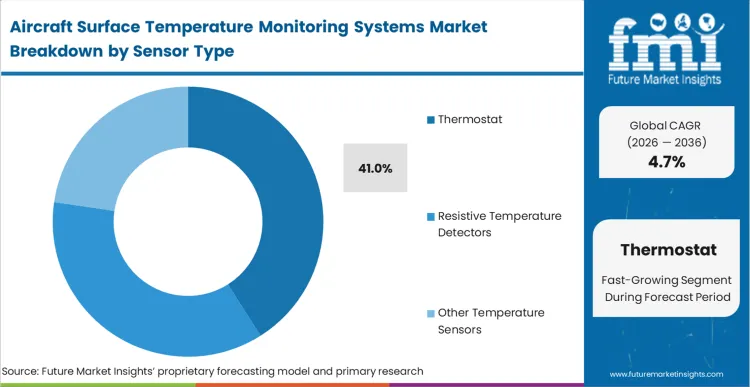
The reason thermostats hold a dominant 41.0% share comes down to the structural reliability of binary switching in safety-critical fail-safes where power-loss scenarios are possible. While RTDs offer higher resolution, the legacy logic of aircraft design prioritizes a sensor that can operate independently of the central processor for overheat alerts. In FMI's view, this share is not merely a reflection of legacy hardware but of a cost-efficient approach to non-critical monitoring points where high-resolution data adds little operational value. However, the shift toward RTD temperature sensors is accelerating in engine nacelles where precise fuel-air mixture calculations depend on millisecond-level thermal feedback.
- Integration Economics: Cost savings originate in the procurement cycle when manufacturers opt for standardized thermostat housings that fit multiple airframe locations. This reduces the inventory overhead for both OEMs and aftermarket providers.
- Operating Overhead: Hidden costs emerge in the operational phase when low-precision thermostats lead to conservative "no-go" decisions that could have been avoided with RTD resolution. The lifecycle comparison increasingly favors RTDs for high-utilization engines.
- Lifecycle Valuation: The total cost of ownership over ten years reveals that high-resolution sensors pay for themselves by enabling longer component lives through more precise thermal management.
Aircraft Surface Temperature Monitoring Systems Market Analysis by Application Type
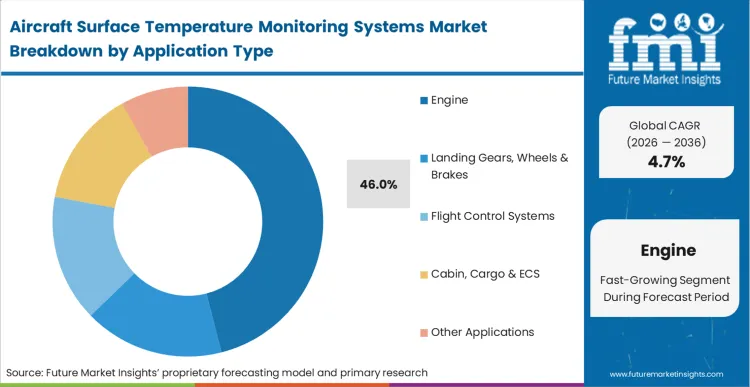
The decision to focus investment on engine monitoring reflects the extreme thermal gradients that these components must withstand, where a five-degree deviation can signal an impending bearing failure. Engineers face a choice between mounting sensors in the direct gas path or on the external surface of the nacelle, a decision that dictates the required sensor durability and signal processing logic. FMI analysts opine that the engine application's 46.0% share is reinforced by the movement toward "more electric" engines, which require additional monitoring of integrated electronics and cooling systems. As airframes become more integrated, the aerospace avionics must handle thousands of thermal data points simultaneously.
- Thermal Runaway: High-resolution sensing prevents catastrophic engine failure by detecting localized hotspots before they propagate through the casing. Engine manufacturers must implement these systems to meet modern safety certification standards.
- Signal Degradation: Residual risk remains even with advanced sensors due to the potential for wire-harness degradation in high-vibration engine environments. Buyers must use reinforced cabling to capture the full benefit of high-accuracy sensors.
- Operational Recovery: Maintenance crews must follow specific calibration protocols to ensure that surface sensors accurately reflect internal core temperatures under varying atmospheric conditions.
Aircraft Surface Temperature Monitoring Systems Market Analysis by End-User Type
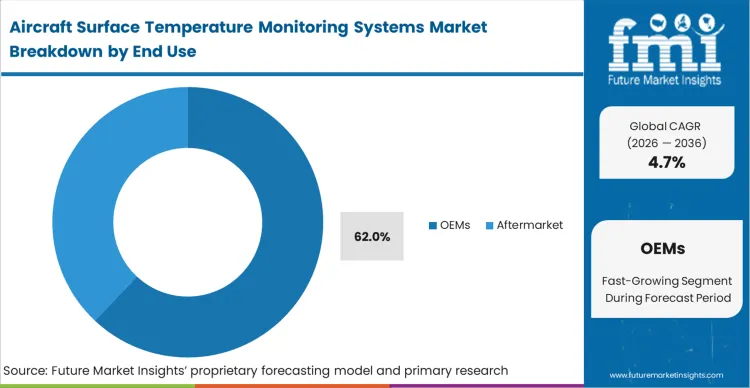
The structural tension between OE and Aftermarket segments is defined by the certification lag that protects original equipment manufacturers from rapid commoditization. OEMs hold 62.0% of the market because the qualification of a new sensor for an existing airframe is often more expensive than the sensor itself, keeping the OE specification locked for years. According to FMI's projections, the aftermarket is gradually gaining ground as flight data monitoring systems are retrofitted into older aircraft to extend their operational life. This dynamic forces aftermarket vendors to build complex cross-reference databases to ensure their components meet the original type-certificate requirements.
- Tier-1 Stability: Established aerospace suppliers produce the majority of OE sensors because they can sustain the high R&D costs and multi-year payment cycles of major airframers. This creates a high barrier for new entrants.
- Procurement Bottlenecks: Supply constraints often appear in the aftermarket when specialized materials like platinum for RTD elements experience price volatility. Buyers must plan around these cycles to maintain fleet readiness.
- Strategic Supply: The supply landscape heading toward 2036 will see more vertically integrated suppliers who control both the sensor element and the data-bus interface.
Aircraft Surface Temperature Monitoring Systems Market Drivers, Restraints, and Opportunities
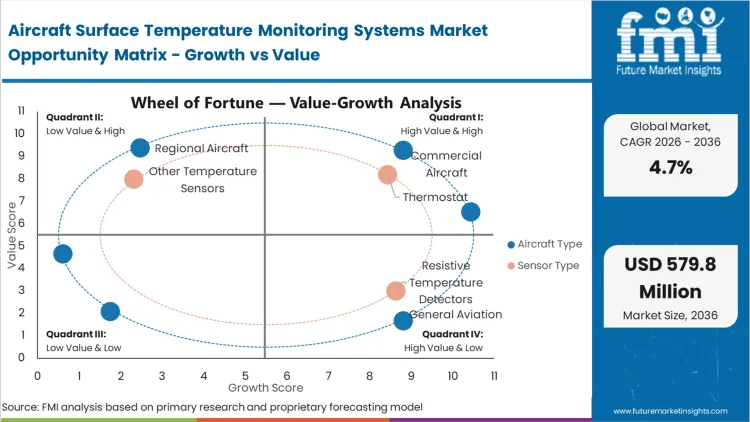
The primary structural forcing condition is the transition to condition-based maintenance, where procurement directors at major airlines are moving away from replacing parts based on flight hours and toward replacement based on actual wear data. This shift requires a massive increase in surface temperature monitoring points to accurately model the thermal fatigue of composite and alloy components. Forcing the adoption of structural health monitoring, this trend ensures that the commercial stakes of acting are tied directly to reducing the USD 1,000-per-minute cost of unscheduled groundings.
The structural buyer friction remains the massive certification latency for new sensor architectures, where the 2-5 year approval window by global aviation authorities prevents the rapid deployment of innovative thin-film sensors. This friction is structural because the safety-critical nature of aerospace hardware demands rigorous testing that cannot be bypassed even for simple thermal components. While manufacturers are developing "pre-qualified" sensor platforms, the limitation remains the integration with legacy avionic systems that were not designed for high-bandwidth thermal telemetry.
Opportunities in the Aircraft Surface Temperature Monitoring Systems Market
- Conformal Sensing: The integration of sensors directly into composite skins allows airframers to monitor structural integrity without aerodynamic penalties. Defense contractors are the primary buyers capturing this opportunity to improve stealth and speed profiles.
- UAV Thermal Management: Rapidly expanding drone fleets require lightweight, low-power thermal sensors for battery protection during long-range missions. Emerging electric aircraft onboard sensors providers are positioning themselves to capture this high-volume segment.
- Hydrogen Propulsion Monitoring: The move toward cryogenic fuel storage creates a structural need for extreme-cold sensing that legacy aerospace sensors cannot fulfill. Specialized cryogenic sensor vendors can win early contracts as hydrogen prototypes move to flight testing.
Regional Analysis
Based on the regional analysis, the Aircraft Surface Temperature Monitoring Systems market is segmented into North America, Europe, Asia-Pacific, and the Rest of the World across 40 plus countries.
.webp "Top Country Growth Comparison Aircraft Surface Temperature Monitoring Systems Market Cagr (2026 2036)")
| Country | CAGR (2026 to 2036) |
|---|---|
| India | 6.9% |
| China | 6.7% |
| Japan | 5.8% |
| United Kingdom | 5.5% |
| Germany | 5.4% |
| United States | 5.2% |
| Canada | 4.9% |
Source: Future Market Insights (FMI) analysis, based on proprietary forecasting model and primary research
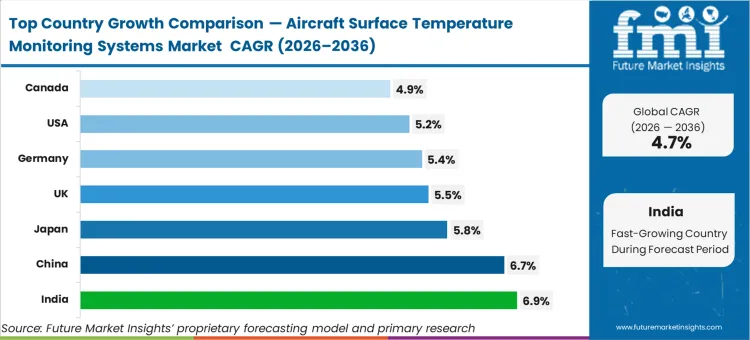
Asia-Pacific Aircraft Surface Temperature Monitoring Systems Market Analysis
Asia-Pacific adoption is driven by the rapid decentralization of the global aerospace supply chain, as manufacturing hubs in the region shift from assembly to high-value component production. According to FMI's assessment, the economics-led growth in this region is anchored by the aggressive expansion of low-cost carriers who prioritize hardware that minimizes operational downtime. This regional dynamic is fundamentally different from Western markets because it is building from a "greenfield" MRO infrastructure that is not beholden to legacy analog maintenance tools.
- India: India's massive commercial fleet expansion creates a direct commercial opportunity for sensor vendors who can establish local calibration and repair centers. The market is advancing at a CAGR of 6.9% as airlines like Air India and Indigo require localized support for their record-breaking aircraft orders.
- China: The growth of the domestic C919 airframe program positions Chinese buyers to move from importing sensors to localizing the entire sensors market ecosystem. China follows with a 6.7% growth rate as the state-backed aerospace industry prioritizes self-sufficiency in flight-critical electronics.
- Japan: Japanese aerospace firms are integrating high-precision RTDs into their composite wing production for global OEMs, achieving a structural outcome where thermal data is used to validate the curing process of the airframe itself. The market registers a CAGR of 5.8%.
Europe Aircraft Surface Temperature Monitoring Systems Market Analysis
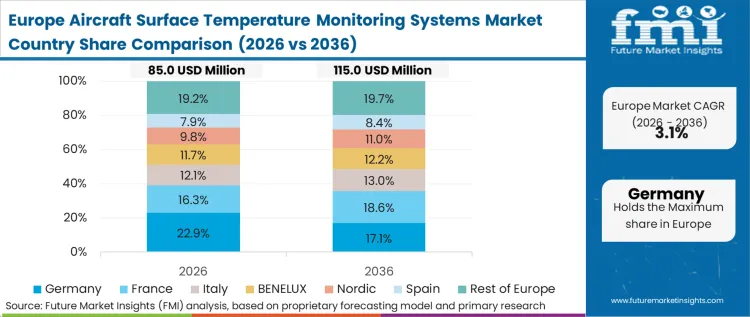
European market dynamics are dictated by policy-led initiatives focused on the "Clean Sky" program, where reducing fuel burn through optimized engine performance is the primary structural driver. FMI analysts opine that European buyers are more likely to invest in expensive high-resolution sensors if they can prove a reduction in carbon emissions through better thermal management. This environment favors vendors who can integrate their hardware with advanced aviation test equipment and environmental monitoring suites.
- United Kingdom: The UK's focus on next-generation engine architecture, such as the UltraFan, establishes a structural trajectory where sensors must withstand higher temperatures and more extreme pressures than ever before. Demand in the UK is set for a CAGR of 5.5%.
- Germany: German aerospace procurement follows a practitioner reality where the strict adherence to DIN and ISO standards for sensor housings often overrides the search for the lowest unit cost. The German sector is poised for 5.4% growth as it maintains its role as the primary MRO hub for Europe's aging wide-body fleets.
North America Aircraft Surface Temperature Monitoring Systems Market Analysis
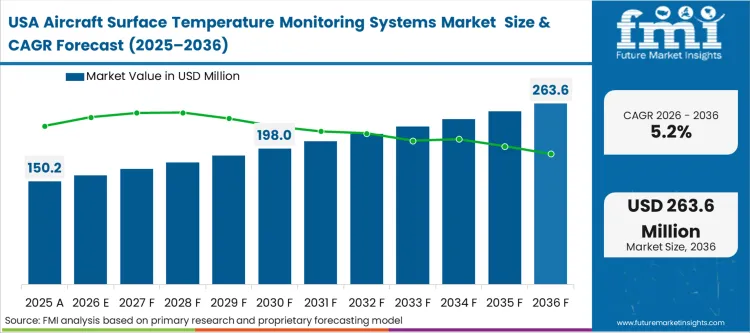
In North America, the market is infrastructure-led, characterized by a massive installed base of military and general aviation aircraft that require systematic sensor retrofits to remain compliant with updated flight safety regulations. FMI's projections suggest that the United States remains the primary hub for sensor innovation, particularly in the development of thermocouple temperature sensors for hypersonic and space-launch applications.
- United States: The USA defense sector is absorbing the bulk of innovation in high-speed thermal monitoring, creating a commercial opportunity for vendors who can navigate the complex ITAR and MIL-SPEC qualification landscape. The USA market registers a CAGR of 5.2%.
- Canada: Canadian aerospace firms are specializing in cold-weather anti-icing systems, creating a structural trajectory where the market grows at 4.9% based on the need for extreme-environment certification.
FMI's report includes additional coverage across 40 plus countries, including Brazil, France, and Singapore. These markets follow a structural pattern where the concentration of regional aircraft traffic drives a steady demand for landing gear and brake thermal sensors, reflecting a localized need for high-frequency cycle monitoring.
Competitive Aligners for Market Players
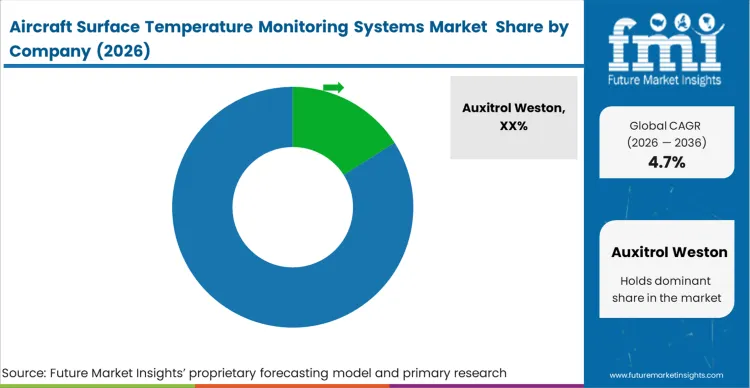
The competitive structure of this market is highly concentrated, with the top players like Auxitrol Weston and Honeywell controlling significant portions of the OE specification. This concentration is driven by the structural requirement for multi-decade reliability data; a sensor vendor cannot simply offer a cheaper product, they must prove that their hardware will not fail over 50,000 flight hours. Buyers use "flight history" as the primary variable to distinguish qualified from unqualified vendors, creating a high barrier for new entrants who lack a legacy on major airframes.
Incumbents like Collins Aerospace and Parker Meggitt possess a structural advantage in their deep integration with the primary avionics manufacturers. They do not just sell a sensor; they sell the signal processing algorithms and the hardened connectors that ensure the telemetry reaches the cockpit without interference. To replicate this, a challenger must build a category of capability in high-EMI signal isolation and vibration-dampening mounting, which often requires years of co-development with airframe engineers. According to FMI, thermal management technologies are becoming the primary battlefield for competitive differentiation.
Large buyers, such as Boeing and Airbus, resist vendor lock-in by maintaining "dual-source" specifications for high-volume sensors, but the cost of qualifying a second source often limits this to the highest-volume components. There is a structural tension between the buyer's preference for standardized, interchangeable sensors and the dominant vendor's incentive to create proprietary interfaces that lock in aftermarket revenue. Through 2036, the market will likely become more concentrated as the complexity of digital sensor integration favors vendors who can offer a full thermal management suite rather than individual components.
Key Players in Aircraft Surface Temperature Monitoring Systems Market
- Auxitrol Weston
- Honeywell International Inc.
- TE Connectivity Ltd.
- RTX Corporation (Collins Aerospace)
- AMETEK, Inc.
- Parker Hannifin Corporation (Parker Meggitt)
- Sensata Technologies, Inc.
Scope of the Report
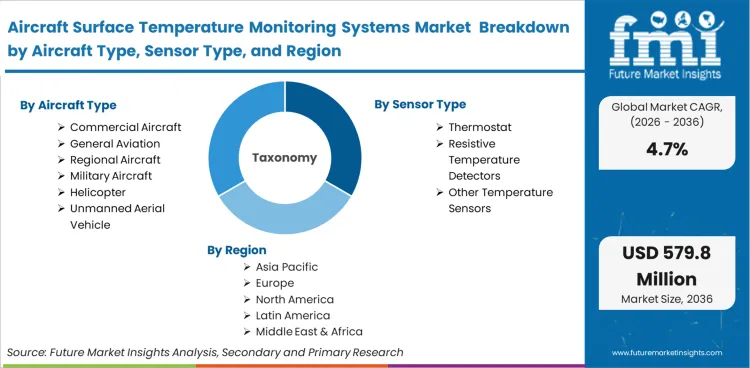
| Metric | Value |
|---|---|
| Quantitative Units | USD 366.3 million to USD 579.3 million, at a CAGR of 4.70% |
| Market Definition | The market covers flight-certified systems and sensors used for measuring surface temperatures on engines, wings, and landing gear to ensure safety and efficiency. |
| Aircraft Type Segmentation | Commercial Aircraft, General Aviation, Regional Aircraft, Military Aircraft, Helicopter, Unmanned Aerial Vehicle |
| Sensor Type Segmentation | Thermostat, Resistive Temperature Detectors, Other Temperature Sensors |
| Application Type Segmentation | Engine, Landing Gears, Wheels & Brakes, Flight Control Systems, Cabin, Cargo & ECS |
| End-User Type Segmentation | OE, Aftermarket |
| Regions Covered | North America, Europe, Asia-Pacific, Rest of the World |
| Countries Covered | India, China, Japan, United Kingdom, Germany, United States, Canada, and 40 plus countries |
| Key Companies Profiled | Auxitrol Weston, Honeywell, TE Connectivity, Collins Aerospace, AMETEK, Parker Meggitt, Sensata |
| Forecast Period | 2026 to 2036 |
| Approach | FMI used a component-density model to estimate the total sensor count per aircraft type, validated by primary interviews with aerospace systems engineers and procurement data. |
Source: Future Market Insights (FMI) analysis, based on proprietary forecasting model and primary research
Aircraft Surface Temperature Monitoring Systems Market Analysis by Segments
Aircraft Type:
- Commercial Aircraft
- General Aviation
- Regional Aircraft
- Military Aircraft
- Helicopter
- Unmanned Aerial Vehicle
Sensor Type:
- Thermostat
- Resistive Temperature Detectors
- Other Temperature Sensors
Application Type:
- Engine
- Landing Gears, Wheels & Brakes
- Flight Control Systems
- Cabin, Cargo & ECS
- Other Applications
End-User Type:
- OE
- Aftermarket
Region:
- North America
- United States
- Canada
- Europe
- United Kingdom
- Germany
- Asia-Pacific
- India
- China
- Japan
- Rest of the World
Bibliography
- Farina, D. (2024, April). Environmental Chamber Characterization of an Ice Detection Sensor Based on Graphene. Micromachines.
- Maio, L. (2026, January). A review of ice detection technologies. Journal of Electrostatics.
- Renno, N. O. (2026, February). A new type of aircraft icing detection system. Scientific Reports.
- Ramirez Zeigler, H. (2025, June). Calibration of Ice Detection and Liquid Water Content Sensor for Unmanned Aircraft Systems in Low Altitude Environments. AIAA AVIATION Forum.
- Yan, Y. (2025, July). Visual Detection on Aircraft Wing Icing Process Using a Lightweight Deep Learning Framework under Natural Lighting Conditions. Aerospace.
This bibliography is provided for reader reference. The full FMI report contains the complete reference list with primary source documentation.
Frequently Asked Questions
How large is the Aircraft Surface Temperature Monitoring Systems Market in 2026?
The industry is projected to reach USD 579.3 million by 2036. This growth reflects the cumulative buildup of digital-ready airframes and the mandatory replacement of legacy analog systems.
What CAGR is projected for the market?
The market is valued at USD 366.3 million in 2026. This figure signals a steady recovery in aircraft delivery rates and an increasing sensor count per airframe as safety protocols expand.
What will it be valued at by 2036?
A CAGR of 4.70% is expected during the forecast period. This rate is constrained by the multi-year qualification cycles for new hardware but supported by the shift to predictive maintenance.
Which Aircraft Type segment leads the market?
Commercial Aircraft leads with a 38.0% share. This leadership is driven by high-utilization flight cycles that necessitate the most frequent and precise thermal monitoring for engines and brakes.
Which Sensor Type segment leads the market?
Thermostats lead with 41.0% share. They remain the primary choice for fail-safe limit-switching because they can operate independently of central power or processing in emergency scenarios.
Which Application Type segment leads the market?
The Engine application leads with 46.0% share. This is because engine thermal management is critical for both safety and fuel efficiency, requiring the highest density of sensing points.
What drives the rapid growth in thermal sensing?
The transition to predictive maintenance forces operators to move from binary switches to high-resolution sensors. This allows for the modeling of component wear based on thermal stress rather than just flight hours.
What is the primary restraint on market expansion?
The structural gate of certification latency slows the adoption of new sensor technologies. The 2-5 year approval process ensures that even superior technologies take years to reach the cockpit.
Which country grows the fastest in this market?
India is the fastest-growing market at a 6.9% CAGR. Compared to the United States (5.2%), India's growth is driven by massive greenfield fleet expansion and new local MRO infrastructure.
How does digital backbone integration impact sensor choice?
Once an aircraft moves to a digital avionic bus, it favors RTDs over thermostats because high-resolution data can be shared across multiple flight systems without additional wiring.
What is the significance of "conformal sensing" in this market?
Conformal sensors are integrated into the composite skin of the aircraft, allowing for monitoring without the aerodynamic drag or weight penalties of traditional bolt-on sensor housings.
Why is the Engine application share so much higher than others?
Engine components operate at the edge of material thermal limits, making constant monitoring essential to prevent catastrophic bearing or blade failures that occur in seconds.
How do MRO providers influence the aftermarket for sensors?
MROs are increasingly acting as advisors to airlines, recommending sensor upgrades during heavy checks to reduce future unscheduled maintenance events.
What role does EMI shielding play in sensor accuracy?
In high-EMI environments like engines, the shielding determines the real-world accuracy of the sensor. Without it, the data is often too noisy for use in predictive analytics.
Is the market for UAV thermal sensors significantly different?
Yes, UAV sensors prioritize weight and power consumption over absolute longevity, creating a high-volume but lower-margin segment compared to commercial aviation.
How do certification standards like AS9100 affect market entry?
These standards create a high barrier to entry by requiring vendors to maintain rigorous quality and traceability data that many industrial sensor firms cannot match.
What is the impact of hydrogen propulsion on thermal monitoring?
Hydrogen fuel requires cryogenic temperature monitoring, which is a structural shift away from the high-heat sensing that has dominated the aerospace market for decades.
How does the aftermarket differ between military and commercial users?
Military users prioritize sensor ruggedness and stealth-skin integration, while commercial users focus on reliability and the cost-per-flight-hour of the hardware.
What is the "practitioner paradox" in thermal sensing?
The paradox is that a highly accurate sensor element can be rendered useless by a mounting bracket that introduces thermal lag or vibration noise into the telemetry.
Will the market see consolidation among tier-1 suppliers?
Consolidation is likely because the cost of maintaining the software and certification for modern digital sensors favors large, vertically integrated avionics firms.
What is the structural difference between North American and Asian markets?
North America is driven by retrofitting a massive legacy fleet, while Asia-Pacific is driven by the delivery of new aircraft with pre-installed modern sensing suites.
How does FMI validate the sensor density figures in the report?
FMI uses a bottom-up component count from type-certificate data and validates it through primary interviews with avionics integration engineers.
What is the commercial consequence of delaying sensor upgrades?
Operators who delay face higher fuel burn and more frequent unscheduled groundings as they lack the data needed to optimize engine and brake performance.
Preview the report firsthand - request a free sample
Get SampleGet the brochure for pricing and purchase details.
Get PDFTable of Content
- Executive Summary
- Global Market Outlook
- Demand-side Trends
- Supply-side Trends
- Technology Roadmap Analysis
- Analysis and Recommendations
- Market Overview
- Market Coverage / Taxonomy
- Market Definition / Scope / Limitations
- Research Methodology
- Chapter Orientation
- Analytical Lens and Working Hypotheses
- Market Structure, Signals, and Trend Drivers
- Benchmarking and Cross-market Comparability
- Market Sizing, Forecasting, and Opportunity Mapping
- Research Design and Evidence Framework
- Desk Research Programme (Secondary Evidence)
- Company Annual and Sustainability Reports
- Peer-reviewed Journals and Academic Literature
- Corporate Websites, Product Literature, and Technical Notes
- Earnings Decks and Investor Briefings
- Statutory Filings and Regulatory Disclosures
- Technical White Papers and Standards Notes
- Trade Journals, Industry Magazines, and Analyst Briefs
- Conference Proceedings, Webinars, and Seminar Materials
- Government Statistics Portals and Public Data Releases
- Press Releases and Reputable Media Coverage
- Specialist Newsletters and Curated Briefings
- Sector Databases and Reference Repositories
- FMI Internal Proprietary Databases and Historical Market Datasets
- Subscription Datasets and Paid Sources
- Social Channels, Communities, and Digital Listening Inputs
- Additional Desk Sources
- Expert Input and Fieldwork (Primary Evidence)
- Primary Modes
- Qualitative Interviews and Expert Elicitation
- Quantitative Surveys and Structured Data Capture
- Blended Approach
- Why Primary Evidence is Used
- Field Techniques
- Interviews
- Surveys
- Focus Groups
- Observational and In-context Research
- Social and Community Interactions
- Stakeholder Universe Engaged
- C-suite Leaders
- Board Members
- Presidents and Vice Presidents
- R&D and Innovation Heads
- Technical Specialists
- Domain Subject-matter Experts
- Scientists
- Physicians and Other Healthcare Professionals
- Governance, Ethics, and Data Stewardship
- Research Ethics
- Data Integrity and Handling
- Primary Modes
- Tooling, Models, and Reference Databases
- Desk Research Programme (Secondary Evidence)
- Data Engineering and Model Build
- Data Acquisition and Ingestion
- Cleaning, Normalisation, and Verification
- Synthesis, Triangulation, and Analysis
- Quality Assurance and Audit Trail
- Market Background
- Market Dynamics
- Drivers
- Restraints
- Opportunity
- Trends
- Scenario Forecast
- Demand in Optimistic Scenario
- Demand in Likely Scenario
- Demand in Conservative Scenario
- Opportunity Map Analysis
- Product Life Cycle Analysis
- Supply Chain Analysis
- Investment Feasibility Matrix
- Value Chain Analysis
- PESTLE and Porter’s Analysis
- Regulatory Landscape
- Regional Parent Market Outlook
- Production and Consumption Statistics
- Import and Export Statistics
- Market Dynamics
- Global Market Analysis 2021 to 2025 and Forecast, 2026 to 2036
- Historical Market Size Value (USD Million) Analysis, 2021 to 2025
- Current and Future Market Size Value (USD Million) Projections, 2026 to 2036
- Y-o-Y Growth Trend Analysis
- Absolute $ Opportunity Analysis
- Global Market Pricing Analysis 2021 to 2025 and Forecast 2026 to 2036
- Global Market Analysis 2021 to 2025 and Forecast 2026 to 2036, By Aircraft Type
- Introduction / Key Findings
- Historical Market Size Value (USD Million) Analysis By Aircraft Type , 2021 to 2025
- Current and Future Market Size Value (USD Million) Analysis and Forecast By Aircraft Type , 2026 to 2036
- Commercial Aircraft
- General Aviation
- Regional Aircraft
- Military Aircraft
- Helicopter
- Unmanned Aerial Vehicle
- Commercial Aircraft
- Y-o-Y Growth Trend Analysis By Aircraft Type , 2021 to 2025
- Absolute $ Opportunity Analysis By Aircraft Type , 2026 to 2036
- Global Market Analysis 2021 to 2025 and Forecast 2026 to 2036, By Sensor Type
- Introduction / Key Findings
- Historical Market Size Value (USD Million) Analysis By Sensor Type, 2021 to 2025
- Current and Future Market Size Value (USD Million) Analysis and Forecast By Sensor Type, 2026 to 2036
- Thermostat
- Resistive Temperature Detectors
- Other Temperature Sensors
- Thermostat
- Y-o-Y Growth Trend Analysis By Sensor Type, 2021 to 2025
- Absolute $ Opportunity Analysis By Sensor Type, 2026 to 2036
- Global Market Analysis 2021 to 2025 and Forecast 2026 to 2036, By Application Type
- Introduction / Key Findings
- Historical Market Size Value (USD Million) Analysis By Application Type, 2021 to 2025
- Current and Future Market Size Value (USD Million) Analysis and Forecast By Application Type, 2026 to 2036
- Engine
- Landing Gears, Wheels & Brakes
- Flight Control Systems
- Cabin, Cargo & ECS
- Other Applications
- Engine
- Y-o-Y Growth Trend Analysis By Application Type, 2021 to 2025
- Absolute $ Opportunity Analysis By Application Type, 2026 to 2036
- Global Market Analysis 2021 to 2025 and Forecast 2026 to 2036, By End Use
- Introduction / Key Findings
- Historical Market Size Value (USD Million) Analysis By End Use, 2021 to 2025
- Current and Future Market Size Value (USD Million) Analysis and Forecast By End Use, 2026 to 2036
- OEMs
- Aftermarket
- OEMs
- Y-o-Y Growth Trend Analysis By End Use, 2021 to 2025
- Absolute $ Opportunity Analysis By End Use, 2026 to 2036
- Global Market Analysis 2021 to 2025 and Forecast 2026 to 2036, By Region
- Introduction
- Historical Market Size Value (USD Million) Analysis By Region, 2021 to 2025
- Current Market Size Value (USD Million) Analysis and Forecast By Region, 2026 to 2036
- North America
- Latin America
- Western Europe
- Eastern Europe
- East Asia
- South Asia and Pacific
- Middle East & Africa
- Market Attractiveness Analysis By Region
- North America Market Analysis 2021 to 2025 and Forecast 2026 to 2036, By Country
- Historical Market Size Value (USD Million) Trend Analysis By Market Taxonomy, 2021 to 2025
- Market Size Value (USD Million) Forecast By Market Taxonomy, 2026 to 2036
- By Country
- USA
- Canada
- Mexico
- By Aircraft Type
- By Sensor Type
- By Application Type
- By End Use
- By Country
- Market Attractiveness Analysis
- By Country
- By Aircraft Type
- By Sensor Type
- By Application Type
- By End Use
- Key Takeaways
- Latin America Market Analysis 2021 to 2025 and Forecast 2026 to 2036, By Country
- Historical Market Size Value (USD Million) Trend Analysis By Market Taxonomy, 2021 to 2025
- Market Size Value (USD Million) Forecast By Market Taxonomy, 2026 to 2036
- By Country
- Brazil
- Chile
- Rest of Latin America
- By Aircraft Type
- By Sensor Type
- By Application Type
- By End Use
- By Country
- Market Attractiveness Analysis
- By Country
- By Aircraft Type
- By Sensor Type
- By Application Type
- By End Use
- Key Takeaways
- Western Europe Market Analysis 2021 to 2025 and Forecast 2026 to 2036, By Country
- Historical Market Size Value (USD Million) Trend Analysis By Market Taxonomy, 2021 to 2025
- Market Size Value (USD Million) Forecast By Market Taxonomy, 2026 to 2036
- By Country
- Germany
- UK
- Italy
- Spain
- France
- Nordic
- BENELUX
- Rest of Western Europe
- By Aircraft Type
- By Sensor Type
- By Application Type
- By End Use
- By Country
- Market Attractiveness Analysis
- By Country
- By Aircraft Type
- By Sensor Type
- By Application Type
- By End Use
- Key Takeaways
- Eastern Europe Market Analysis 2021 to 2025 and Forecast 2026 to 2036, By Country
- Historical Market Size Value (USD Million) Trend Analysis By Market Taxonomy, 2021 to 2025
- Market Size Value (USD Million) Forecast By Market Taxonomy, 2026 to 2036
- By Country
- Russia
- Poland
- Hungary
- Balkan & Baltic
- Rest of Eastern Europe
- By Aircraft Type
- By Sensor Type
- By Application Type
- By End Use
- By Country
- Market Attractiveness Analysis
- By Country
- By Aircraft Type
- By Sensor Type
- By Application Type
- By End Use
- Key Takeaways
- East Asia Market Analysis 2021 to 2025 and Forecast 2026 to 2036, By Country
- Historical Market Size Value (USD Million) Trend Analysis By Market Taxonomy, 2021 to 2025
- Market Size Value (USD Million) Forecast By Market Taxonomy, 2026 to 2036
- By Country
- China
- Japan
- South Korea
- By Aircraft Type
- By Sensor Type
- By Application Type
- By End Use
- By Country
- Market Attractiveness Analysis
- By Country
- By Aircraft Type
- By Sensor Type
- By Application Type
- By End Use
- Key Takeaways
- South Asia and Pacific Market Analysis 2021 to 2025 and Forecast 2026 to 2036, By Country
- Historical Market Size Value (USD Million) Trend Analysis By Market Taxonomy, 2021 to 2025
- Market Size Value (USD Million) Forecast By Market Taxonomy, 2026 to 2036
- By Country
- India
- ASEAN
- Australia & New Zealand
- Rest of South Asia and Pacific
- By Aircraft Type
- By Sensor Type
- By Application Type
- By End Use
- By Country
- Market Attractiveness Analysis
- By Country
- By Aircraft Type
- By Sensor Type
- By Application Type
- By End Use
- Key Takeaways
- Middle East & Africa Market Analysis 2021 to 2025 and Forecast 2026 to 2036, By Country
- Historical Market Size Value (USD Million) Trend Analysis By Market Taxonomy, 2021 to 2025
- Market Size Value (USD Million) Forecast By Market Taxonomy, 2026 to 2036
- By Country
- Kingdom of Saudi Arabia
- Other GCC Countries
- Turkiye
- South Africa
- Other African Union
- Rest of Middle East & Africa
- By Aircraft Type
- By Sensor Type
- By Application Type
- By End Use
- By Country
- Market Attractiveness Analysis
- By Country
- By Aircraft Type
- By Sensor Type
- By Application Type
- By End Use
- Key Takeaways
- Key Countries Market Analysis
- USA
- Pricing Analysis
- Market Share Analysis, 2025
- By Aircraft Type
- By Sensor Type
- By Application Type
- By End Use
- Canada
- Pricing Analysis
- Market Share Analysis, 2025
- By Aircraft Type
- By Sensor Type
- By Application Type
- By End Use
- Mexico
- Pricing Analysis
- Market Share Analysis, 2025
- By Aircraft Type
- By Sensor Type
- By Application Type
- By End Use
- Brazil
- Pricing Analysis
- Market Share Analysis, 2025
- By Aircraft Type
- By Sensor Type
- By Application Type
- By End Use
- Chile
- Pricing Analysis
- Market Share Analysis, 2025
- By Aircraft Type
- By Sensor Type
- By Application Type
- By End Use
- Germany
- Pricing Analysis
- Market Share Analysis, 2025
- By Aircraft Type
- By Sensor Type
- By Application Type
- By End Use
- UK
- Pricing Analysis
- Market Share Analysis, 2025
- By Aircraft Type
- By Sensor Type
- By Application Type
- By End Use
- Italy
- Pricing Analysis
- Market Share Analysis, 2025
- By Aircraft Type
- By Sensor Type
- By Application Type
- By End Use
- Spain
- Pricing Analysis
- Market Share Analysis, 2025
- By Aircraft Type
- By Sensor Type
- By Application Type
- By End Use
- France
- Pricing Analysis
- Market Share Analysis, 2025
- By Aircraft Type
- By Sensor Type
- By Application Type
- By End Use
- India
- Pricing Analysis
- Market Share Analysis, 2025
- By Aircraft Type
- By Sensor Type
- By Application Type
- By End Use
- ASEAN
- Pricing Analysis
- Market Share Analysis, 2025
- By Aircraft Type
- By Sensor Type
- By Application Type
- By End Use
- Australia & New Zealand
- Pricing Analysis
- Market Share Analysis, 2025
- By Aircraft Type
- By Sensor Type
- By Application Type
- By End Use
- China
- Pricing Analysis
- Market Share Analysis, 2025
- By Aircraft Type
- By Sensor Type
- By Application Type
- By End Use
- Japan
- Pricing Analysis
- Market Share Analysis, 2025
- By Aircraft Type
- By Sensor Type
- By Application Type
- By End Use
- South Korea
- Pricing Analysis
- Market Share Analysis, 2025
- By Aircraft Type
- By Sensor Type
- By Application Type
- By End Use
- Russia
- Pricing Analysis
- Market Share Analysis, 2025
- By Aircraft Type
- By Sensor Type
- By Application Type
- By End Use
- Poland
- Pricing Analysis
- Market Share Analysis, 2025
- By Aircraft Type
- By Sensor Type
- By Application Type
- By End Use
- Hungary
- Pricing Analysis
- Market Share Analysis, 2025
- By Aircraft Type
- By Sensor Type
- By Application Type
- By End Use
- Kingdom of Saudi Arabia
- Pricing Analysis
- Market Share Analysis, 2025
- By Aircraft Type
- By Sensor Type
- By Application Type
- By End Use
- Turkiye
- Pricing Analysis
- Market Share Analysis, 2025
- By Aircraft Type
- By Sensor Type
- By Application Type
- By End Use
- South Africa
- Pricing Analysis
- Market Share Analysis, 2025
- By Aircraft Type
- By Sensor Type
- By Application Type
- By End Use
- USA
- Market Structure Analysis
- Competition Dashboard
- Competition Benchmarking
- Market Share Analysis of Top Players
- By Regional
- By Aircraft Type
- By Sensor Type
- By Application Type
- By End Use
- Competition Analysis
- Competition Deep Dive
- Auxitrol Weston
- Overview
- Product Portfolio
- Profitability by Market Segments (Product/Age /Sales Channel/Region)
- Sales Footprint
- Strategy Overview
- Marketing Strategy
- Product Strategy
- Channel Strategy
- Honeywell International Inc.
- TE Connectivity Ltd.
- RTX Corporation (Collins Aerospace)
- AMETEK, Inc.
- Parker Hannifin Corporation (Parker Meggitt)
- Sensata Technologies, Inc.
- Auxitrol Weston
- Competition Deep Dive
- Assumptions & Acronyms Used


