

- Industry Size (2026)
- USD 0.6 Bn
- Forecast (2036)
- USD 2.9 Bn
- CAGR (2026 to 2036)
- 17.30%
Aircraft Fuselage Corrosion Monitoring Sensors Market Size, Market Forecast and Outlook By FMI
The aircraft fuselage corrosion monitoring sensors market was valued at USD 0.5 billion in 2025. This valuation reflects the initial integration of health-monitoring architectures within the primary airframes of next-generation narrow-body fleets. Industry advancement carries the market to USD 0.6 billion in 2026. Compound expansion at 17.30% through 2036 carries the market to USD 2.9 billion as maintenance directors transition from fixed-interval manual inspections to data-driven structural integrity assessments.
Airframe availability requirements are forcing a fundamental migration from schedule-based interventions toward predictive structural health monitoring. Maintenance directors at global airlines now face a transition toward health-as-a-service models, requiring a choice between invasive manual teardowns or qualifying iot in aviation systems that provide real-time data from internal structural joints. This architectural pivot compels fleet managers to abandon isolated diagnostic cycles and commit capital to integrated sensing layers that eliminate unplanned groundings. Facilities that continue to rely on traditional A-check schedules face rising labor costs and extended aircraft-on-ground periods that erode operational profitability.
Summary of Aircraft Fuselage Corrosion Monitoring Sensors Market
- Aircraft Fuselage Corrosion Monitoring Sensors Market Definition
- The market centers on the deployment of integrated sensing technologies within the aircraft skin to provide real-time alerts regarding moisture, oxidation, and fatigue. This structural integration allows for the transition to predictive maintenance, reducing the need for invasive manual inspections.
- Demand Drivers in the Market
- Escalating fleet age in commercial aviation compels maintenance directors to adopt more granular structural surveillance to ensure airworthiness.
- Stringent environmental regulations regarding chrome-based primers force OEMs to adopt sensors that monitor the performance of new eco-friendly coatings.
- The shift toward digital twin technology requires continuous data streams from the physical airframe to validate predictive structural models.
- Key Segments Analyzed in the FMI Report
- Conductive Sensor-Integrated Coatings: 45.9% share in 2026, reflecting the need for large-area surface monitoring without weight penalties.
- Corrosion & Moisture Sensing: 24.5% share in 2026, as moisture ingress remains the primary precursor to structural failure.
- Fuselage & Wing Structures: 46.7% share in 2026, reflecting the high concentration of critical inspection zones in primary airframe components.
- China: 18.7% compound growth driven by the rapid expansion of domestic aircraft manufacturing and regional MRO infrastructure.
- Analyst Opinion at FMI
- Nikhil Kaitwade, Principal Analyst, Automotive, opines, "In my analysis, I have observed that the true bottleneck in airframe longevity is not the metal degradation itself, but the moisture ingress that precedes oxidation. Maintenance operators attempting to run high-utilization flight schedules over legacy manual inspection protocols face unavoidable grounding risks that trigger unplanned costs. Structural health architects who continue patching legacy primers without embedded sensing will find themselves unable to meet the high-frequency diagnostic requirements for next-generation composite fleets."
- Strategic Implications / Executive Takeaways
- Maintenance directors should phase out invasive spot-checks and mandate native deterministic networking support in all new endpoint procurement specifications.
- Aircraft OEMs must prioritize the qualification of wireless sensor interfaces to eliminate the wiring harnesses that currently limit sensor density.
- Tier-1 suppliers face a structural requirement to develop multifunctional coatings that provide both environmental protection and active damage reporting.
- Methodology
- Primary Research: FMI conducted detailed technical interviews with principal automation architects and maintenance leads across 40 countries.
- Desk Research: Analysts aggregated public standards documentation from regulatory bodies, hardware launch sheets, and national infrastructure programs.
- Market-Sizing and Forecasting: The model applies a bottom-up methodology starting with global installed base metrics for aircraft and projecting conversion rates.
- Data Validation and Update Cycle: Segment forecasts undergo cross-validation against quarterly semiconductor shipment volumes for industrial networking silicon.
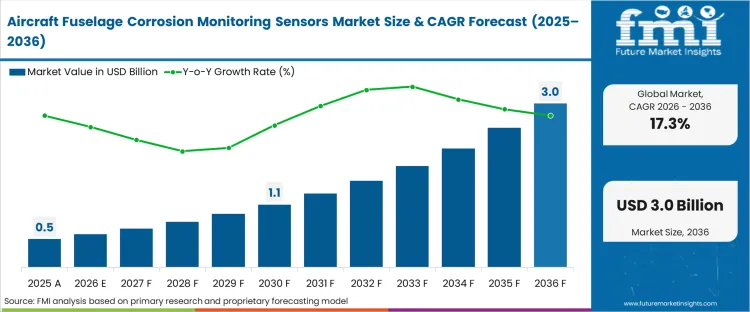
Aircraft Fuselage Corrosion Monitoring Sensors Market Key Takeaways
| Metric | Details |
|---|---|
| Industry Size (2026) | USD 0.6 billion |
| Industry Value (2036) | USD 2.9 billion |
| CAGR (2026-2036) | 17.30% |
Source: Future Market Insights (FMI) analysis, based on proprietary forecasting model and primary research
The transition to self-sensing airframes depends on the certification of wireless data transmission protocols through shielded aircraft skins. Once aerospace regulators move beyond wired sensor architectures, the parasitic weight of traditional monitoring is eliminated, making fleet-wide deployment commercially viable for narrow-body operators. Tier-1 manufacturers require digital twins of airframe stress to validate new composite material performance over 20-year lifecycles. This specific structural gate ensures that growth becomes self-sustaining as sensor density increases without impacting fuel efficiency.
Demand for monitoring solutions in China anchors a 18.7% compound expansion while sales in India follow a 18.0% annual growth rate through 2036. The United States aircraft sensors sector is poised to expand at 16.8%, while Japan records a 15.7% compound trajectory. Germany posts a 15.4% expansion rate and the United Kingdom tracks at 15.1% annual growth. South Korea reaches a 15.0% CAGR as regional manufacturing hubs leverage greenfield production to bypass legacy retrofit hurdles. This geographic dispersion is structural, reflecting the concentration of new airframe production lines in Asian hubs versus the retrofit-heavy maintenance focus of North American and European legacy carriers.
Aircraft Fuselage Corrosion Monitoring Sensors Market Definition
The aircraft fuselage corrosion monitoring sensors market comprises specialized sensing elements and integrated coating systems designed to detect chemical, electrical, or physical indicators of metal oxidation and moisture ingress. These sensors are embedded within the airframe’s protective layers to provide continuous, non-invasive surveillance of structural integrity. The boundary of this market is defined by the functional integration of the sensor into the aircraft's skin, distinguishing it from portable testing equipment.
Aircraft Fuselage Corrosion Monitoring Sensors Market Inclusions
The market scope includes conductive sensor-integrated coatings, thin-film piezoelectric sensors for fatigue tracking, and microcapsule-based indicating systems. Protocol-specific software stacks, configuration tools for network scheduling, and associated physical layer testing equipment fall within the boundaries. The ecosystem also incorporates sensor ready coatings designed for structural health monitoring and the specialized data acquisition hardware mounted on the airframe.
Aircraft Fuselage Corrosion Monitoring Sensors Market Exclusions
Standard commercial off-the-shelf ultrasonic or eddy current testing devices used during manual inspections are excluded from this analysis. General-purpose aerospace primers and topcoats that lack active sensing or reporting capabilities are also outside the scope. Furthermore, monitoring systems designed exclusively for ground support equipment or airport infrastructure, rather than the aircraft airframe itself, are not accounted for in these valuations.
Aircraft Fuselage Corrosion Monitoring Sensors Market Research Methodology
- Primary Research: Analysts engaged with Chief Maintenance Officers at global airlines, structural integrity engineers at major OEMs, and aerospace materials scientists to map adoption velocities.
- Desk Research: The data collection phase aggregated FAA and EASA certification registries, aerospace procurement archives for structural health monitoring, and technical filings from industry-specific annual conferences.
- Market-Sizing and Forecasting: The baseline anchors to the global delivery volume of new narrow-body and wide-body aircraft, cross-referenced with the adoption rate of digital maintenance programs.
- Data Validation and Update Cycle: Forecasts were validated using independent fleet tracking data to triangulate real-world maintenance cycles and aging airframe concentrations.
Segmental Analysis
Aircraft Fuselage Corrosion Monitoring Sensors Market Analysis by Coating Type
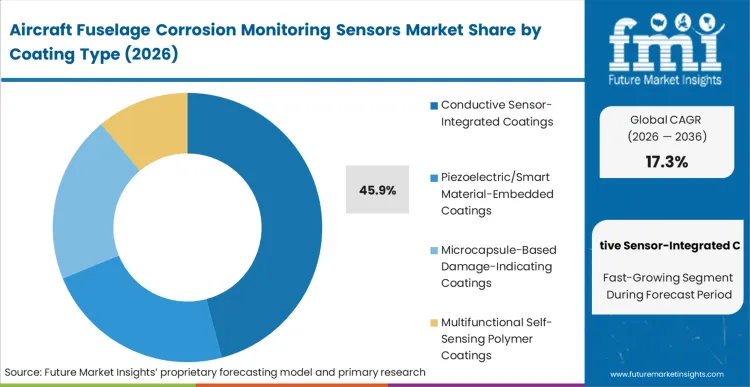
The structural reason conductive sensor-integrated coatings hold a dominant 45.9% share in 2026 comes down to the operational requirement of minimizing parasitic weight. This segment provides a distributed sensing mesh that functions as part of the protective primer layer, delivering chrome free coatings performance while reporting electrical impedance changes across the airframe skin. Based on FMI's assessment, the ability to monitor large surface areas without disrupting airframe aerodynamics makes this the default choice for narrow-body fuselages. Procurement managers at major OEMs choose these systems because they integrate directly into existing robotic spray-coating lines, avoiding the labor costs of manual sensor placement. Maintenance engineers who continue with legacy primers face rising A-check durations as localized pitting often goes undetected under insulation blankets.
- Direct lifecycle valuation: Integrated meshes eliminate the secondary cost of periodic sensor replacement by lasting the full duration of a D-check cycle. Fleet managers capture this as a reduction in total cost of ownership compared to adhesive-mounted alternatives.
- Surface logic persistence: Embedded conductive paths maintain connectivity even under high-vibration conditions that typically cause discrete sensor bonding failure. This ensures structural data continuity during long-haul transoceanic flight sequences.
- Application compatibility: These coatings are formulated to match the thermal expansion coefficients of aerospace aluminum, preventing delamination at cruising altitudes. Maintenance teams avoid the risk of induced stress concentrations associated with mechanical sensor fasteners.
Aircraft Fuselage Corrosion Monitoring Sensors Market Analysis by Sensing Functionality
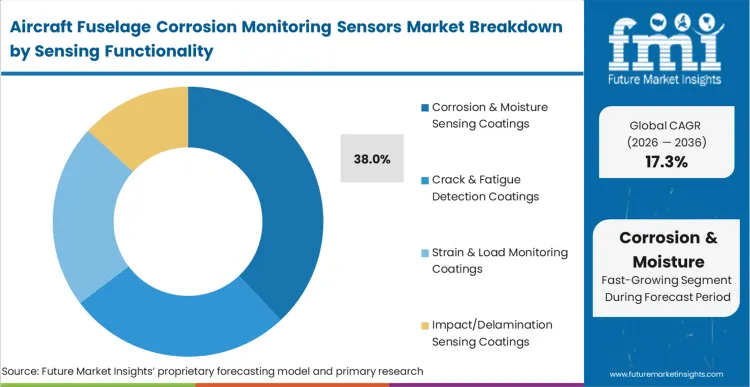
Maintenance directors are being asked to decide between reactive detection and predictive precursors, a choice that centers on moisture sensing logic. This segment focuses on the condition monitoring system logic that identifies electrolytic activity before it results in material loss. According to FMI's estimates, the decision to prioritize moisture sensing reflects a shift toward preventing the chemical environment required for corrosion to thrive. Buyers who specify these aircraft sensors are often motivated by the high cost of structural repair in inaccessible wing-to-fuselage joints. These systems deliver an operational alert weeks before a manual scan would register a thickness change. Choosing the wrong sensing threshold leads to either a high false-alarm rate or, more critically, missed structural degradation in high-humidity tropical routes.
- Precursor alert thresholds: Sensors identify the exact humidity levels that trigger galvanic corrosion in bimetallic airframe junctions. This prevents the progression from moisture ingress to irreversible intergranular cracking.
- Residual risk management: While moisture sensing is highly effective, operators must still account for crevice corrosion that occurs in low-oxygen stagnant zones. Buyers integrate secondary sensing layers to cover these specific edge-case failure modes.
- Operational calibration: Effective deployment requires the calibration of sensor sensitivity against the specific saline exposure of a carrier's route network. This ensures that maintenance triggers are aligned with actual airframe risk rather than generic industry averages.
Aircraft Fuselage Corrosion Monitoring Sensors Market Analysis by Application Area
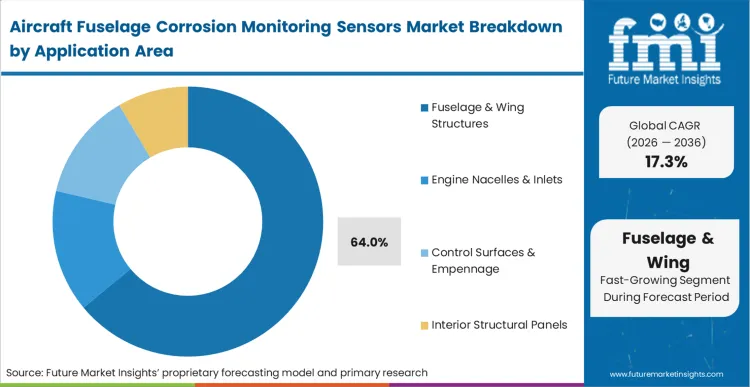
Fuselage and wing structures occupy the leading position because they represent the highest risk zones for catastrophic fatigue failure and hidden corrosion. The trajectory of this segment is moving toward full-airframe "nervous systems" where electric aircraft sensors provide continuous feedback on skin health. According to FMI's assessment, the concentration of monitoring in these areas is a response to the massive labor requirement of stripping interior panels for visual inspections. As narrow-body fleets are pushed to their design life limits, the requirement for automated surveillance of primary structures becomes a non-negotiable safety mandate. The consequence of delaying deployment on these critical structures is a permanent increase in manual inspection hours as the airframe ages.
- Early adopter mandates: Flag carriers and military operators were the first to deploy these systems on primary wings to validate composite-to-metal bonding durability. This established the performance baseline for the broader commercial aviation market.
- Mainstream integration: Low-cost carriers are now adopting these sensors on fuselage skins to shorten the duration of C-checks by pre-identifying inspection zones. This allows for more precise labor allocation during time-sensitive maintenance windows.
- Total airframe coverage: By 2036, even secondary structures like floor beams and seat tracks will likely arrive with factory-integrated sensors. This marks the final stage of adoption where health monitoring becomes a universal standard.
Aircraft Fuselage Corrosion Monitoring Sensors Market Analysis by End User
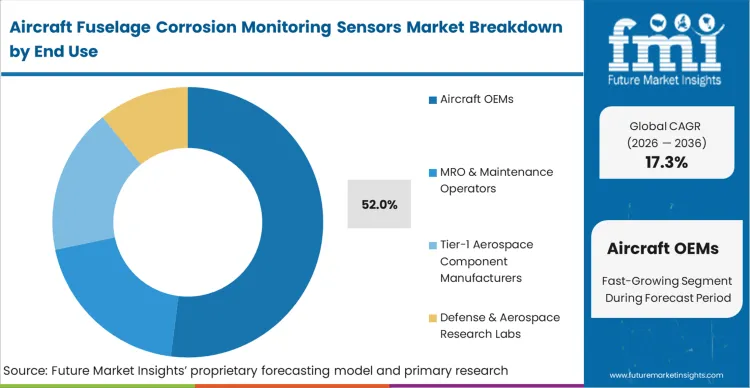
OEMs dominate the end-user landscape because the structural integration of sensors is most efficient during the initial assembly phase. The decision facing aircraft manufacturers is whether to offer these systems as a standard safety feature or a premium maintenance-efficiency package. Choosing to delay integration forces cabin environment sensor and structural health data into the more expensive retrofit market. FMI analysts opine that the commercial outcome for OEMs who lead in this space is a deeper, data-driven relationship with their customers, as they become the primary interpreters of airframe health data. A manufacturer that fails to provide integrated monitoring loses visibility into how their aircraft perform in diverse climatic conditions.
- Verification of design: Integrated sensors provide OEMs with real-world data on how airframe stresses align with theoretical structural models. This validates the durability of new lightweight designs and influences future material specifications.
- Qualification validation: Sensor data allows manufacturers to defend maintenance interval recommendations to global aviation authorities. This provides a data-backed justification for extending time-between-overhaul requirements for new aircraft models.
- Expansion of service revenue: By controlling the initial sensor hardware, OEMs position themselves to offer high-margin data analytics and predictive maintenance services. This creates a recurring revenue stream that persists long after the initial aircraft sale.
Aircraft Fuselage Corrosion Monitoring Sensors Market Drivers, Restraints, and Opportunities
The structural forcing condition driving this market is the mandatory transition toward digitized airworthiness records, which requires verifiable, high-frequency data from the airframe. Maintenance leads at global airlines face a decision to either hire more NDT specialists or invest in aircraft contaminant resistant coatings and sensing meshes. The commercial stakes are found in the ability to skip invasive inspection steps during major checks, a capability that directly impacts fleet availability. This driver is not about rising demand but about the structural inability of manual labor to keep pace with the inspection requirements of modern, high-utilization flight schedules.
The primary restraint is the structural friction of aerospace certification cycles, where a sensor-integrated coating is treated with the same regulatory caution as a primary load-bearing component. A new sensing material must prove it does not degrade the airframe's fatigue life over 60,000 flight cycles. This qualification requirement makes the friction structural rather than temporary. A partial solution is emerging in the form of non-structural sensor patches, but these do not offer the full-coverage benefits of integrated meshes and are limited by their potential to create secondary corrosion sites at their bond lines.
Opportunities in the Aircraft Fuselage Corrosion Monitoring Sensors Market
- Secondary structural retrofits: Fleet operators running aircraft beyond their first decade of service can capture significant labor savings by retrofitting sensors in high-corrosion zones. Maintenance leads at regional airlines are prioritizing these retrofits to avoid unplanned structural repairs during heavy maintenance.
- Wireless data bridging: A specific opportunity exists for technology providers who can bridge the gap between embedded sensors and aviation test equipment without adding wiring weight. Sourcing directors at major airlines are actively seeking solutions that utilize existing onboard wireless protocols to transmit airframe health data.
- Integrated de-icing monitoring: Manufacturers can combine corrosion sensing with ice-detection logic in a single multifunctional coating layer. This allows procurement heads to consolidate two critical safety systems into a single hardware footprint, simplifying the aerospace supply chain.
Regional Analysis
Based on the regional analysis, the Aircraft Fuselage Corrosion Monitoring Sensors market is segmented into North America, Latin America, Europe, South Asia, East Asia, Oceania, and Middle East & Africa across 40 plus countries.
.webp "Top Country Growth Comparison Aircraft Fuselage Corrosion Monitoring Sensors Market Cagr (2026 2036)")
| Country | CAGR (2026 to 2036) |
|---|---|
| China | 18.7% |
| India | 18.0% |
| United States | 16.8% |
| Japan | 15.7% |
| Germany | 15.4% |
| United Kingdom | 15.1% |
| South Korea | 15.0% |
Source: Future Market Insights (FMI) analysis, based on proprietary forecasting model and primary research
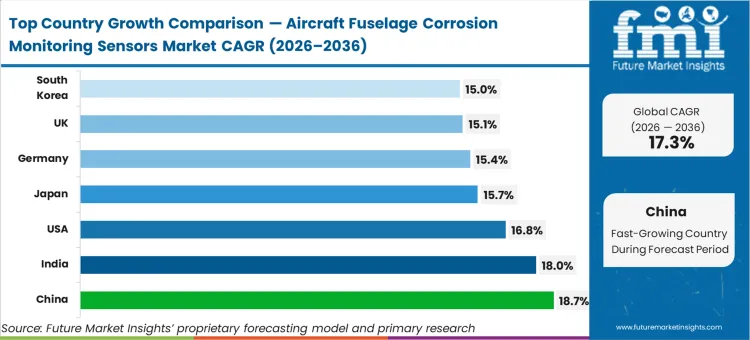
East Asia Aircraft Fuselage Corrosion Monitoring Sensors Market Analysis
East Asia's adoption pattern is infrastructure-led, characterized by the rapid build-out of a domestic aerospace manufacturing ecosystem that treats ai driven predictive maintenance as a baseline requirement. Unlike North American markets that must manage legacy fleets, East Asian operators and OEMs are integrating sensors into factory-fresh aircraft. FMI analysts opine that the regional dynamic is shaped by a central push to become the global leader in smart aviation maintenance.
- China: China's focus on the narrow-body program enables the direct factory integration of sensing meshes, bypassing the labor-intensive retrofit phase. Greenfield facility architects specify native sensing endpoints for all new airframe procurement contracts to ensure data visibility. The sheer volume of new aircraft production establishes a massive installed base of interoperable communication infrastructure across the industrial corridor. This aggressive modernization strategy anchors China's 18.7% compound expansion to 2036.
- Japan: Japanese aerospace component manufacturers leverage expertise in micro-electronics to lead in the development of piezoelectric sensor patches for regional jets. The mechanism anchors Japan's 15.7% compound expansion to 2036. This specialized focus positions Japanese firms as critical tier-2 suppliers to global airframe manufacturers.
- South Korea: South Korea's trajectory is defined by its strong MRO infrastructure that is rapidly pivoting toward high-tech structural health monitoring for international carriers. The mechanism sustains a 15.0% compound rate for aircraft fuselage corrosion monitoring sensors market in South Korea. This transition ensures South Korea remains a preferred maintenance hub as global fleets modernize.
South Asia Aircraft Fuselage Corrosion Monitoring Sensors Market Analysis
South Asia’s adoption pattern is characterized by a rapid expansion of domestic MRO facilities aiming to capture maintenance spend that previously leaked to overseas hubs. The structural lens here is a focus on the digitization of new hangars to handle high-frequency inspection data. FMI analysts opine that the regional dynamic is shaped by the need to prove technical parity with Western maintenance standards to attract international leasing business. This necessitates a transition to condition monitoring system share analysis that provides verifiable airframe health records.
- India: India's aggressive MRO localization policies and the sheer volume of new aircraft orders allow for factory-level sensor integration. Process engineers deploy control networks capable of guaranteeing critical sensor data delivery to centralized historians. The national push toward self-sufficiency triggers a wave of facility upgrades prioritizing unified, secure communication backbones. India's 18.0% annual growth rate reflects government localized MRO mandates through 2036.
North America Aircraft Fuselage Corrosion Monitoring Sensors Market Analysis
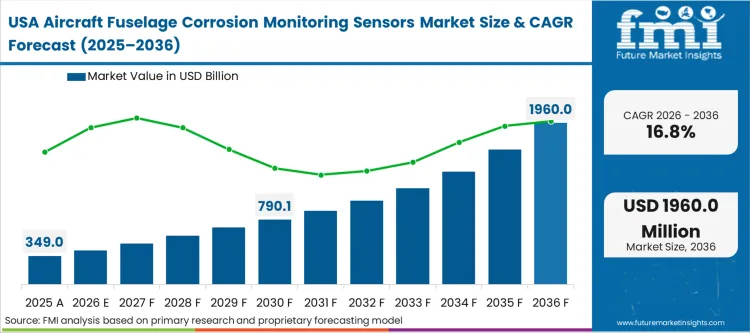
The North American market is driven by the economics of life-extension for a massive installed base of narrow-body aircraft. Control systems engineers leading critical infrastructure overhauls face directives to unify disparate communication domains under a single manageable architecture. Based on FMI's assessment, the region's focus is on predictive retrofits where sensors are placed in known problem areas.
- United States: The United States advances at a 16.8% compound rate as discrete manufacturers unify their logical network topologies. Federal infrastructure modernization initiatives actively fund the replacement of vulnerable legacy systems with standardized, resilient backbones. Procurement directors at major USA carriers must balance the upfront cost of sensor deployment against the rising price of certified labor.
Europe Aircraft Fuselage Corrosion Monitoring Sensors Market Analysis
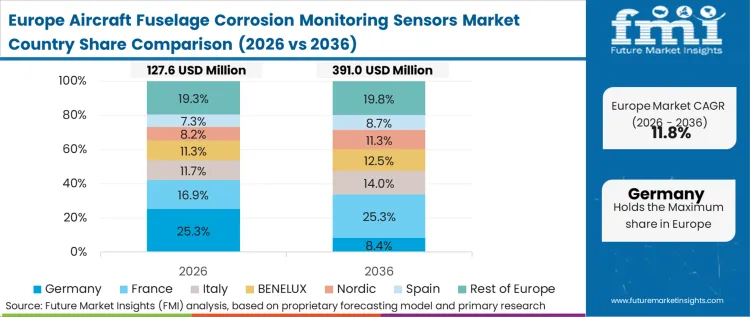
European adoption is policy-led, driven by sustainability mandates that discourage the use of chrome-based primers. Automation architects redesigning legacy production lines must integrate continuous monitoring data alongside critical machine control signals. This transition provides the necessary bandwidth and synchronization precision to support advanced sustainable manufacturing practices.
- Germany: Germany's updated aerospace research initiatives create a direct link between university material science and industrial MRO application. Structural integrity engineers in Germany advance at a 15.4% compound rate as mandatory compliance with strict machinery safety directives forces asset owners to specify deterministic networks.
- United Kingdom: The United Kingdom industry expands at a 15.1% CAGR as it focuses on high-value monitoring for trans-Atlantic wide-body routes. UK-based maintenance firms use sensor data to differentiate their services in a highly competitive European MRO market. This operational outcome clears the bottleneck of manual report processing.
FMI's report includes additional coverage across Latin America, South Asia, Oceania, and the Middle East. A structural pattern emerging in the Middle East involves the use of sensors to monitor the accelerated corrosion caused by high-salinity dust and extreme thermal cycling.
Competitive Aligners for Market Players
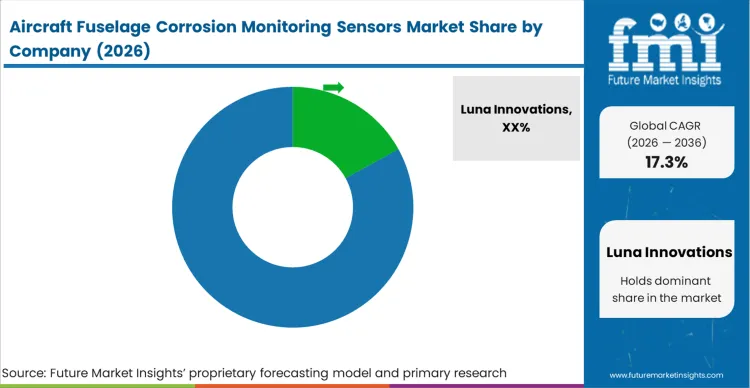
The competitive structure of this market is concentrated and IP-dependent, with leading firms holding a structural advantage due to established aerospace certification pedigrees. Buyers in this market do not choose based on sensor price; they select based on the verifiable survival rate of the hardware in the wet areas of the airframe. Leading companies distinguish themselves by offering predictive maintenance platforms that can ingest data from both their own sensors and third-party hardware. This open-architecture approach is the primary variable buyers use to distinguish qualified vendors from those attempting to force proprietary lock-in.
Incumbents have built a structural advantage through deep integration into the global aviation mro services workflow. This advantage persists because these firms have already secured the necessary form-fit-function approvals from airframe OEMs, a process that takes years of testing. A challenger must build more than just a better sensor; they must develop a category of capability that includes automated data cleaning and FAA-compliant reporting modules. Most new entrants struggle not with the physics of the sensor, but with the documentation required to prove that the installation does not compromise the aircraft's lightning protection system.
Buyer behavior is shifting as large operators resist vendor lock-in by demanding standardized data formats for all airframe sensors. This structural tension between buyer preferences and vendor incentives to create closed ecosystems defines current product development cycles. FMI anticipates that firms that provide the most seamless integration into the central aerospace avionics bus will gain the most significant trajectory toward 2036. This competitive structure limits vendor pricing power even in a concentrated market as buyers prioritize platforms that avoid the complexity of external timing gateways.
Key Players in Aircraft Fuselage Corrosion Monitoring Sensors Market
- Luna Innovations
- Metis Design Corporation
- HBK (Hottinger Brüel & Kjær)
- Honeywell International Inc.
- Parker Hannifin Corporation (Parker Lord)
- Eddyfi Technologies
- Wabtec Corporation (Evident Inspection Technologies)
Scope of the Report
| Metric | Value |
|---|---|
| Quantitative Units | USD 0.6 billion to USD 2.9 billion, at a CAGR of 17.30% |
| Market Definition | A structural health monitoring category focused on sensors and coatings embedded in the aircraft fuselage to detect moisture ingress and metal degradation. |
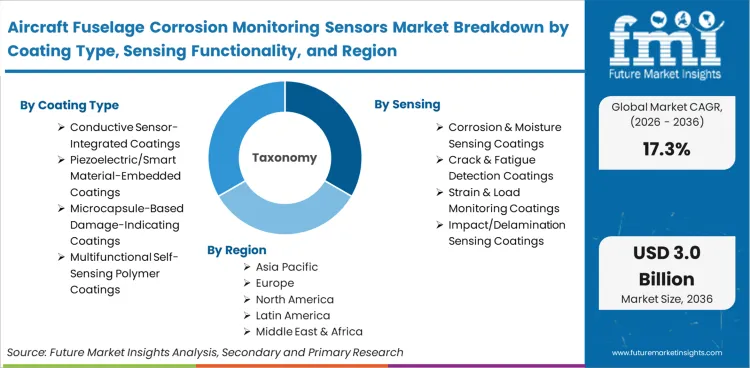
| Coating Type Segmentation | Conductive Sensor-Integrated Coatings, Piezoelectric/Smart Material-Embedded Coatings, Microcapsule-Based Damage-Indicating Coatings, Multifunctional Self-Sensing Polymer Coatings |
| Sensing Functionality Segmentation | Corrosion & Moisture Sensing Coatings, Crack & Fatigue Detection Coatings, Strain & Load Monitoring Coatings, Impact/Delamination Sensing Coatings |
| Application Area Segmentation | Fuselage & Wing Structures, Engine Nacelles & Inlets, Control Surfaces & Empennage, Interior Structural Panels |
| End User Segmentation | Aircraft OEMs, MRO & Maintenance Operators, Tier-1 Aerospace Component Manufacturers, Defense & Aerospace Research Labs |
| Regions Covered | North America, Latin America, Europe, South Asia, East Asia, Oceania, Middle East & Africa |
| Countries Covered | China, India, United States, Japan, Germany, United Kingdom, South Korea, and 40 plus countries |
| Key Companies Profiled | Luna Innovations, Metis Design, HBK, Honeywell, Parker Hannifin, Eddyfi, Wabtec |
| Forecast Period | 2026 to 2036 |
| Approach | FMI utilized primary interviews with MRO directors and structural engineers, anchored baseline data to global aircraft delivery backlogs, and validated forecasts against regional airworthiness mandates. |
Source: Future Market Insights (FMI) analysis, based on proprietary forecasting model and primary research
Aircraft Fuselage Corrosion Monitoring Sensors Market Analysis by Segments
Coating Type:
- Conductive Sensor-Integrated Coatings
- Piezoelectric/Smart Material-Embedded Coatings
- Microcapsule-Based Damage-Indicating Coatings
- Multifunctional Self-Sensing Polymer Coatings
Sensing Functionality:
- Corrosion & Moisture Sensing Coatings
- Crack & Fatigue Detection Coatings
- Strain & Load Monitoring Coatings
- Impact/Delamination Sensing Coatings
Application Area:
- Fuselage & Wing Structures
- Engine Nacelles & Inlets
- Control Surfaces & Empennage
- Interior Structural Panels
End User:
- Aircraft OEMs
- MRO & Maintenance Operators
- Tier-1 Aerospace Component Manufacturers
- Defense & Aerospace Research Labs
Region:
- East Asia
- China
- Japan
- South Korea
- North America
- United States
- Europe
- Germany
- United Kingdom
Bibliography
- Scarselli, G., & Nicassio, F. (2025, October). Machine Learning for Structural Health Monitoring of Aerospace Structures: A Review. Sensors.
- Kosova, F., Altay, Ö., & Ünver, H. Ö. (2025, February). Structural health monitoring in aviation: a comprehensive review and future directions for machine learning. Nondestructive Testing and Evaluation.
- Elizabeth, I. (2025, January). A Comprehensive Review on Corrosion Detection Methods in Aircraft Structures. Environment and Social Technology.
- Lilly, A. (2024, March). Development of Corrosion Severity Assessment Algorithms Using Environmental Monitoring Sensors in Naval Aircraft. AMPP Annual Conference + Expo 2024.
- Avance, V. (2024, March). Real-Time Measurement of Aerospace Organic Coating Condition to Enhance Corrosion Management. AMPP Annual Conference + Expo 2024.
This bibliography is provided for reader reference. The full FMI report contains the complete reference list with primary source documentation.
Frequently Asked Questions
How large is the Aircraft Fuselage Corrosion Monitoring Sensors Market in 2026?
The market is valued at USD 0.6 billion in 2026. This figure reflects the initial surge in OEM-led integration of sensing meshes into next-generation narrow-body production lines.
What will the market be valued at by 2036?
It is projected to reach USD 2.9 billion by 2036. This growth signals the full transition of the commercial aviation industry toward digital airworthiness records.
What CAGR is projected for the Aircraft Fuselage Corrosion Monitoring Sensors Market from 2026 to 2036?
A CAGR of 17.30% is projected for the forecast decade. This rate reflects the pace of digital transformation in maintenance hubs as operators seek to maximize asset availability.
Which coating type leads the market by 2026?
Conductive Sensor-Integrated Coatings lead with 45.9% share in 2026. This segment dominates because it eliminates the weight and complexity of thousands of discrete wired sensors.
Which sensing functionality is most prominent in 2026?
Corrosion & Moisture Sensing Coatings are dominant, capturing 24.5% of the market share in 2026. This leadership is driven by the industry's focus on moisture as the primary predictor of structural risk.
Which application area accounts for the highest market share?
Fuselage & Wing Structures lead with 46.7% share in 2026. These primary structures contain the most critical inspection zones where manual teardowns are most expensive.
What is the fastest-growing country in the forecast period?
China is the fastest-growing market at 18.7%. This growth is sustained by the rapid expansion of domestic aircraft manufacturing and narrow-body backlogs.
What supports India's growth in this sector?
India's 18.0% annual growth rate reflects government localized MRO mandates. The push for pharmaceutical and manufacturing self-sufficiency triggers facility upgrades that include secure communication backbones.
How does moisture sensing differ from corrosion sensing?
Moisture sensors detect the electrolyte required for galvanic activity, identifying risk conditions before oxidation starts. This allows for preventive resealing before irreversible material loss occurs.
What is the role of iot in aviation systems for this market?
This logic allows for real-time data extraction from internal airframe structural joints. It facilitates the transition from schedule-based to predictive maintenance protocols.
What are sensor ready coatings?
These are specialized aerospace primers designed to integrate directly with structural health monitoring sensors. They provide the environmental protection of standard coatings while enabling active damage reporting.
How does chrome free coatings performance impact the market?
Environmental regulations are forcing the adoption of new, less-tested primers. Sensors are used to monitor these eco-friendly coatings to ensure they match legacy corrosion protection levels.
What is condition monitoring system logic?
This refers to the software and hardware protocols that identify electrolytic activity before metal degradation. It helps maintenance teams intervene in high-humidity zones before cracking occurs.
How are electric aircraft sensors being used?
These sensors provide continuous feedback on airframe skin health as part of a digital "nervous system." They are critical for monitoring fatigue in primary wing and fuselage structures.
What is ai driven predictive maintenance in this context?
It uses sensor data to predict failure windows and optimize maintenance schedules. This approach reduces unplanned groundings and improves total equipment effectiveness.
What does condition monitoring system share analysis involve?
This analysis tracks the adoption of specific sensing functions across diverse aircraft types. It evaluates the technical limitations that drive component upgrades in different regions.
What are aircraft contaminant resistant coatings?
These are specialized layers that prevent chemical oxidation in harsh environments. They are integrated with sensing logic to monitor the presence of saline or industrial pollutants.
What is the function of a cabin environment sensor in structural health?
While monitoring cabin conditions, these sensors also track moisture ingress that affects structural joints. They provide data that influences the duration of maintenance check cycles.
How is the aerospace avionics bus used for sensor data?
New sensor architectures aim to integrate directly into the aircraft's central data bus. This eliminates the need for redundant wiring and simplifies the communication topology.
Can these sensors be retrofitted on legacy aircraft?
Retrofitting is a major segment for older fleets reaching their second decade of service. It is typically integrated into existing D-check workflows to minimize labor costs.
What is the primary restraint facing sensor manufacturers?
The rigorous aerospace certification cycle creates a structural barrier to new entrants. Sensing materials must prove they do not compromise airframe fatigue life over 60,000 flight cycles.
What opportunity exists for wireless data bridging?
Technology providers can bridge the gap between embedded sensors and test equipment without adding wiring weight. This opportunity is actively pursued by carriers looking to simplify airframe networks.
How does FMI validate these market projections?
FMI cross-references aircraft delivery backlogs with the adoption rates of digital maintenance platforms. Analysts also conduct primary interviews with MRO leads to validate real-world retrofit rates.
Preview the report firsthand - request a free sample
Get SampleGet the brochure for pricing and purchase details.
Get PDFTable of Content
- Executive Summary
- Global Market Outlook
- Demand-side Trends
- Supply-side Trends
- Technology Roadmap Analysis
- Analysis and Recommendations
- Market Overview
- Market Coverage / Taxonomy
- Market Definition / Scope / Limitations
- Research Methodology
- Chapter Orientation
- Analytical Lens and Working Hypotheses
- Market Structure, Signals, and Trend Drivers
- Benchmarking and Cross-market Comparability
- Market Sizing, Forecasting, and Opportunity Mapping
- Research Design and Evidence Framework
- Desk Research Programme (Secondary Evidence)
- Company Annual and Sustainability Reports
- Peer-reviewed Journals and Academic Literature
- Corporate Websites, Product Literature, and Technical Notes
- Earnings Decks and Investor Briefings
- Statutory Filings and Regulatory Disclosures
- Technical White Papers and Standards Notes
- Trade Journals, Industry Magazines, and Analyst Briefs
- Conference Proceedings, Webinars, and Seminar Materials
- Government Statistics Portals and Public Data Releases
- Press Releases and Reputable Media Coverage
- Specialist Newsletters and Curated Briefings
- Sector Databases and Reference Repositories
- FMI Internal Proprietary Databases and Historical Market Datasets
- Subscription Datasets and Paid Sources
- Social Channels, Communities, and Digital Listening Inputs
- Additional Desk Sources
- Expert Input and Fieldwork (Primary Evidence)
- Primary Modes
- Qualitative Interviews and Expert Elicitation
- Quantitative Surveys and Structured Data Capture
- Blended Approach
- Why Primary Evidence is Used
- Focus Groups
- Observational and In-context Research
- Social and Community Interactions
- Primary Modes
- Stakeholder Universe Engaged
- C-suite Leaders
- Board Members
- Presidents and Vice Presidents
- R&D and Innovation Heads
- Technical Specialists
- Domain Subject-matter Experts
- Scientists
- Physicians and Other Healthcare Professionals
- Governance, Ethics, and Data Stewardship
- Research Ethics
- Data Integrity and Handling
- Desk Research Programme (Secondary Evidence)
- Tooling, Models, and Reference Databases
- Data Engineering and Model Build
- Data Acquisition and Ingestion
- Cleaning, Normalisation, and Verification
- Synthesis, Triangulation, and Analysis
- Quality Assurance and Audit Trail
- Market Background
- Market Dynamics
- Drivers
- Restraints
- Opportunity
- Trends
- Scenario Forecast
- Demand in Optimistic Scenario
- Demand in Likely Scenario
- Demand in Conservative Scenario
- Opportunity Map Analysis
- Product Life Cycle Analysis
- Supply Chain Analysis
- Investment Feasibility Matrix
- Value Chain Analysis
- PESTLE and Porter’s Analysis
- Regulatory Landscape
- Regional Parent Market Outlook
- Production and Consumption Statistics
- Import and Export Statistics
- Market Dynamics
- Global Market Analysis 2021 to 2025 and Forecast, 2026 to 2036
- Historical Market Size Value (USD Million) Analysis, 2021 to 2025
- Current and Future Market Size Value (USD Million) Projections, 2026 to 2036
- Y-o-Y Growth Trend Analysis
- Absolute $ Opportunity Analysis
- Global Market Pricing Analysis 2021 to 2025 and Forecast 2026 to 2036
- Global Market Analysis 2021 to 2025 and Forecast 2026 to 2036, By Coating Type
- Introduction / Key Findings
- Historical Market Size Value (USD Million) Analysis By Coating Type , 2021 to 2025
- Current and Future Market Size Value (USD Million) Analysis and Forecast By Coating Type , 2026 to 2036
- Conductive Sensor-Integrated Coatings
- Piezoelectric/Smart Material-Embedded Coatings
- Microcapsule-Based Damage-Indicating Coatings
- Multifunctional Self-Sensing Polymer Coatings
- Conductive Sensor-Integrated Coatings
- Y-o-Y Growth Trend Analysis By Coating Type , 2021 to 2025
- Absolute $ Opportunity Analysis By Coating Type , 2026 to 2036
- Global Market Analysis 2021 to 2025 and Forecast 2026 to 2036, By Sensing Functionality
- Introduction / Key Findings
- Historical Market Size Value (USD Million) Analysis By Sensing Functionality, 2021 to 2025
- Current and Future Market Size Value (USD Million) Analysis and Forecast By Sensing Functionality, 2026 to 2036
- Corrosion & Moisture Sensing Coatings
- Crack & Fatigue Detection Coatings
- Strain & Load Monitoring Coatings
- Impact/Delamination Sensing Coatings
- Corrosion & Moisture Sensing Coatings
- Y-o-Y Growth Trend Analysis By Sensing Functionality, 2021 to 2025
- Absolute $ Opportunity Analysis By Sensing Functionality, 2026 to 2036
- Global Market Analysis 2021 to 2025 and Forecast 2026 to 2036, By Application Area
- Introduction / Key Findings
- Historical Market Size Value (USD Million) Analysis By Application Area, 2021 to 2025
- Current and Future Market Size Value (USD Million) Analysis and Forecast By Application Area, 2026 to 2036
- Fuselage & Wing Structures
- Engine Nacelles & Inlets
- Control Surfaces & Empennage
- Interior Structural Panels
- Fuselage & Wing Structures
- Y-o-Y Growth Trend Analysis By Application Area, 2021 to 2025
- Absolute $ Opportunity Analysis By Application Area, 2026 to 2036
- Global Market Analysis 2021 to 2025 and Forecast 2026 to 2036, By End Use
- Introduction / Key Findings
- Historical Market Size Value (USD Million) Analysis By End Use, 2021 to 2025
- Current and Future Market Size Value (USD Million) Analysis and Forecast By End Use, 2026 to 2036
- Aircraft OEMs
- MRO & Maintenance Operators
- Tier-1 Aerospace Component Manufacturers
- Defense & Aerospace Research Labs
- Aircraft OEMs
- Y-o-Y Growth Trend Analysis By End Use, 2021 to 2025
- Absolute $ Opportunity Analysis By End Use, 2026 to 2036
- Global Market Analysis 2021 to 2025 and Forecast 2026 to 2036, By Region
- Introduction
- Historical Market Size Value (USD Million) Analysis By Region, 2021 to 2025
- Current Market Size Value (USD Million) Analysis and Forecast By Region, 2026 to 2036
- North America
- Latin America
- Western Europe
- Eastern Europe
- East Asia
- South Asia and Pacific
- Middle East & Africa
- Market Attractiveness Analysis By Region
- North America Market Analysis 2021 to 2025 and Forecast 2026 to 2036, By Country
- Historical Market Size Value (USD Million) Trend Analysis By Market Taxonomy, 2021 to 2025
- Market Size Value (USD Million) Forecast By Market Taxonomy, 2026 to 2036
- By Country
- USA
- Canada
- Mexico
- By Coating Type
- By Sensing Functionality
- By Application Area
- By End Use
- By Country
- Market Attractiveness Analysis
- By Country
- By Coating Type
- By Sensing Functionality
- By Application Area
- By End Use
- Key Takeaways
- Latin America Market Analysis 2021 to 2025 and Forecast 2026 to 2036, By Country
- Historical Market Size Value (USD Million) Trend Analysis By Market Taxonomy, 2021 to 2025
- Market Size Value (USD Million) Forecast By Market Taxonomy, 2026 to 2036
- By Country
- Brazil
- Chile
- Rest of Latin America
- By Coating Type
- By Sensing Functionality
- By Application Area
- By End Use
- By Country
- Market Attractiveness Analysis
- By Country
- By Coating Type
- By Sensing Functionality
- By Application Area
- By End Use
- Key Takeaways
- Western Europe Market Analysis 2021 to 2025 and Forecast 2026 to 2036, By Country
- Historical Market Size Value (USD Million) Trend Analysis By Market Taxonomy, 2021 to 2025
- Market Size Value (USD Million) Forecast By Market Taxonomy, 2026 to 2036
- By Country
- Germany
- UK
- Italy
- Spain
- France
- Nordic
- BENELUX
- Rest of Western Europe
- By Coating Type
- By Sensing Functionality
- By Application Area
- By End Use
- By Country
- Market Attractiveness Analysis
- By Country
- By Coating Type
- By Sensing Functionality
- By Application Area
- By End Use
- Key Takeaways
- Eastern Europe Market Analysis 2021 to 2025 and Forecast 2026 to 2036, By Country
- Historical Market Size Value (USD Million) Trend Analysis By Market Taxonomy, 2021 to 2025
- Market Size Value (USD Million) Forecast By Market Taxonomy, 2026 to 2036
- By Country
- Russia
- Poland
- Hungary
- Balkan & Baltic
- Rest of Eastern Europe
- By Coating Type
- By Sensing Functionality
- By Application Area
- By End Use
- By Country
- Market Attractiveness Analysis
- By Country
- By Coating Type
- By Sensing Functionality
- By Application Area
- By End Use
- Key Takeaways
- East Asia Market Analysis 2021 to 2025 and Forecast 2026 to 2036, By Country
- Historical Market Size Value (USD Million) Trend Analysis By Market Taxonomy, 2021 to 2025
- Market Size Value (USD Million) Forecast By Market Taxonomy, 2026 to 2036
- By Country
- China
- Japan
- South Korea
- By Coating Type
- By Sensing Functionality
- By Application Area
- By End Use
- By Country
- Market Attractiveness Analysis
- By Country
- By Coating Type
- By Sensing Functionality
- By Application Area
- By End Use
- Key Takeaways
- South Asia and Pacific Market Analysis 2021 to 2025 and Forecast 2026 to 2036, By Country
- Historical Market Size Value (USD Million) Trend Analysis By Market Taxonomy, 2021 to 2025
- Market Size Value (USD Million) Forecast By Market Taxonomy, 2026 to 2036
- By Country
- India
- ASEAN
- Australia & New Zealand
- Rest of South Asia and Pacific
- By Coating Type
- By Sensing Functionality
- By Application Area
- By End Use
- By Country
- Market Attractiveness Analysis
- By Country
- By Coating Type
- By Sensing Functionality
- By Application Area
- By End Use
- Key Takeaways
- Middle East & Africa Market Analysis 2021 to 2025 and Forecast 2026 to 2036, By Country
- Historical Market Size Value (USD Million) Trend Analysis By Market Taxonomy, 2021 to 2025
- Market Size Value (USD Million) Forecast By Market Taxonomy, 2026 to 2036
- By Country
- Kingdom of Saudi Arabia
- Other GCC Countries
- Turkiye
- South Africa
- Other African Union
- Rest of Middle East & Africa
- By Coating Type
- By Sensing Functionality
- By Application Area
- By End Use
- By Country
- Market Attractiveness Analysis
- By Country
- By Coating Type
- By Sensing Functionality
- By Application Area
- By End Use
- Key Takeaways
- Key Countries Market Analysis
- USA
- Pricing Analysis
- Market Share Analysis, 2025
- By Coating Type
- By Sensing Functionality
- By Application Area
- By End Use
- Canada
- Pricing Analysis
- Market Share Analysis, 2025
- By Coating Type
- By Sensing Functionality
- By Application Area
- By End Use
- Mexico
- Pricing Analysis
- Market Share Analysis, 2025
- By Coating Type
- By Sensing Functionality
- By Application Area
- By End Use
- Brazil
- Pricing Analysis
- Market Share Analysis, 2025
- By Coating Type
- By Sensing Functionality
- By Application Area
- By End Use
- Chile
- Pricing Analysis
- Market Share Analysis, 2025
- By Coating Type
- By Sensing Functionality
- By Application Area
- By End Use
- Germany
- Pricing Analysis
- Market Share Analysis, 2025
- By Coating Type
- By Sensing Functionality
- By Application Area
- By End Use
- UK
- Pricing Analysis
- Market Share Analysis, 2025
- By Coating Type
- By Sensing Functionality
- By Application Area
- By End Use
- Italy
- Pricing Analysis
- Market Share Analysis, 2025
- By Coating Type
- By Sensing Functionality
- By Application Area
- By End Use
- Spain
- Pricing Analysis
- Market Share Analysis, 2025
- By Coating Type
- By Sensing Functionality
- By Application Area
- By End Use
- France
- Pricing Analysis
- Market Share Analysis, 2025
- By Coating Type
- By Sensing Functionality
- By Application Area
- By End Use
- India
- Pricing Analysis
- Market Share Analysis, 2025
- By Coating Type
- By Sensing Functionality
- By Application Area
- By End Use
- ASEAN
- Pricing Analysis
- Market Share Analysis, 2025
- By Coating Type
- By Sensing Functionality
- By Application Area
- By End Use
- Australia & New Zealand
- Pricing Analysis
- Market Share Analysis, 2025
- By Coating Type
- By Sensing Functionality
- By Application Area
- By End Use
- China
- Pricing Analysis
- Market Share Analysis, 2025
- By Coating Type
- By Sensing Functionality
- By Application Area
- By End Use
- Japan
- Pricing Analysis
- Market Share Analysis, 2025
- By Coating Type
- By Sensing Functionality
- By Application Area
- By End Use
- South Korea
- Pricing Analysis
- Market Share Analysis, 2025
- By Coating Type
- By Sensing Functionality
- By Application Area
- By End Use
- Russia
- Pricing Analysis
- Market Share Analysis, 2025
- By Coating Type
- By Sensing Functionality
- By Application Area
- By End Use
- Poland
- Pricing Analysis
- Market Share Analysis, 2025
- By Coating Type
- By Sensing Functionality
- By Application Area
- By End Use
- Hungary
- Pricing Analysis
- Market Share Analysis, 2025
- By Coating Type
- By Sensing Functionality
- By Application Area
- By End Use
- Kingdom of Saudi Arabia
- Pricing Analysis
- Market Share Analysis, 2025
- By Coating Type
- By Sensing Functionality
- By Application Area
- By End Use
- Turkiye
- Pricing Analysis
- Market Share Analysis, 2025
- By Coating Type
- By Sensing Functionality
- By Application Area
- By End Use
- South Africa
- Pricing Analysis
- Market Share Analysis, 2025
- By Coating Type
- By Sensing Functionality
- By Application Area
- By End Use
- USA
- Market Structure Analysis
- Competition Dashboard
- Competition Benchmarking
- Market Share Analysis of Top Players
- By Regional
- By Coating Type
- By Sensing Functionality
- By Application Area
- By End Use
- Competition Analysis
- Competition Deep Dive
- Luna Innovations
- Overview
- Product Portfolio
- Profitability by Market Segments (Product/Age /Sales Channel/Region)
- Sales Footprint
- Strategy Overview
- Marketing Strategy
- Product Strategy
- Channel Strategy
- Metis Design Corporation
- HBK (Hottinger Brüel & Kjær)
- Honeywell International Inc.
- Parker Hannifin Corporation (Parker Lord)
- Eddyfi Technologies
- Wabtec Corporation (Evident Inspection Technologies)
- Luna Innovations
- Competition Deep Dive
- Assumptions & Acronyms Used


