

- Industry Size (2026)
- USD 480 Mn
- Forecast (2036)
- USD 1570 Mn
- CAGR (2026 to 2036)
- 12.1%
Chrome-Free Corrosion Protection Coatings for Aluminum Aircraft Skins Market Forecast and Outlook 2026 to 2036
The global market for chrome-free corrosion protection coatings for aluminum aircraft skins, valued at USD 480 million in 2026, is projected to grow to USD 1,570 million by 2036, with a CAGR of 12.1%. The growth is fueled by increasing demand for environmentally friendly, efficient corrosion protection solutions in the aerospace industry.
Nano-ceramic chrome-free coatings, which account for 38% of the coating technology market share, are gaining preference due to their superior corrosion resistance and eco-friendly properties. New aircraft OEM applications, representing 44% of the application segment, are the largest consumers of these coatings, as they are essential for protecting aluminum aircraft skins against corrosion without the use of harmful chrome-based chemicals. The market's growth is further supported by the rising demand for sustainable, high-performance coatings in the aviation sector.
Quick Stats for Chrome-Free Corrosion Protection Coatings for Aluminum Aircraft Skins Market
- Chrome-Free Corrosion Protection Coatings for Aluminum Aircraft Skins Market Value (2026): USD 480 million
- Chrome-Free Corrosion Protection Coatings for Aluminum Aircraft Skins Market Forecast Value (2036): USD 1,570 million
- Chrome-Free Corrosion Protection Coatings for Aluminum Aircraft Skins Market Global Forecast CAGR (2026–2036): 12.1%
- Top Application by Share in Chrome-Free Corrosion Protection Coatings for Aluminum Aircraft Skins Market: New Aircraft OEM Applications (44%)
- Key Growth Regions in Chrome-Free Corrosion Protection Coatings for Aluminum Aircraft Skins Market: China, India, USA, UK, Japan
- Top Players in Chrome-Free Corrosion Protection Coatings for Aluminum Aircraft Skins Market: PPG Aerospace, AkzoNobel Aerospace Coatings, Sherwin-Williams Aerospace, Hexcel Corporation, Hentzen Coatings
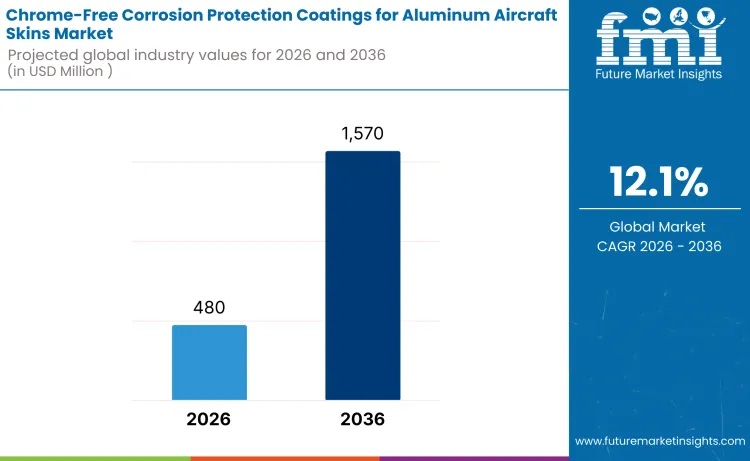
Chrome-Free Corrosion Protection Coatings for Aluminum Aircraft Skins Market Key Takeaways
| Metric | Value |
|---|---|
| Industry Sales Value (2026) | USD 480 million |
| Industry Forecast Value (2036) | USD 1,570 million |
| Industry Forecast CAGR (2026 to 2036) | 12.1% |
What Are the Key Segments in Chrome-Free Corrosion Protection Coatings for Aluminum Aircraft Skins Market?
The chrome-free corrosion protection coatings for aluminum aircraft skins market is segmented by coating technology and application. Nano-ceramic chrome-free coatings lead the coating technology segment with 38% of the market share, offering advanced corrosion protection without the use of harmful chrome. New aircraft OEM applications dominate the application segment, accounting for 44%, driven by the growing need for environmentally friendly and durable protective coatings. The market is expanding as the aerospace industry seeks more sustainable alternatives to chrome-based coatings.
Which Coating Technology Drives Chrome-Free Corrosion Protection Coatings for Aluminum Aircraft Skins Market Demand Globally?
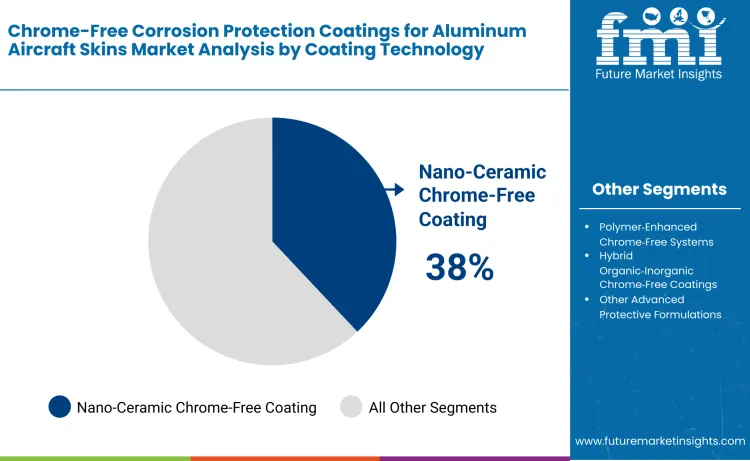
Nano-ceramic chrome-free coatings are the leading coating technology, representing 38% of the market share. These coatings use nano-ceramic particles to provide exceptional corrosion resistance while eliminating the need for chromium, which is harmful to both health and the environment. Nano-ceramic coatings form a protective layer on aluminum aircraft skins, offering improved durability against environmental factors such as moisture, UV radiation, and temperature fluctuations. This technology is particularly attractive as the aviation industry moves toward more sustainable and environmentally responsible alternatives to traditional chrome-based coatings. Nano-ceramic coatings are highly effective in preventing corrosion without compromising on performance, which is crucial for ensuring the long-term reliability and safety of aircraft. As environmental regulations tighten and sustainability becomes a priority, the demand for chrome-free coatings, particularly those using advanced nano-ceramic technology, is expected to grow significantly.
Which Application Drives Chrome-Free Corrosion Protection Coatings for Aluminum Aircraft Skins Market Demand Globally?
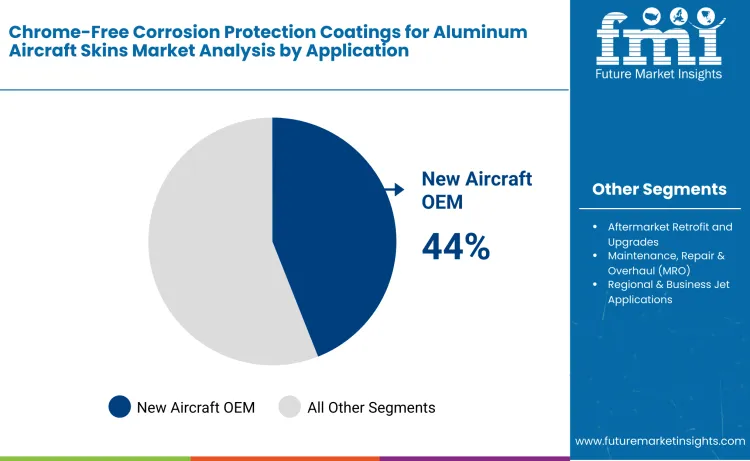
New aircraft OEM applications lead the market with 44% of the share. The adoption of chrome-free corrosion protection coatings in new aircraft manufacturing is driven by the industry's increasing emphasis on environmental responsibility and the need to comply with stricter regulations regarding hazardous materials. Aircraft manufacturers are increasingly incorporating sustainable, eco-friendly materials and coatings in the production of new aircraft to meet regulatory standards and consumer demand for greener technologies. Chrome-free coatings offer a safer, more sustainable alternative to traditional chrome-based systems, which have been criticized for their environmental and health impacts. As the aerospace industry continues to focus on reducing its environmental footprint and enhancing aircraft performance, the demand for chrome-free corrosion protection coatings is expected to grow, particularly in new aircraft OEM applications. Although applications like aftermarket retrofit and upgrades, MRO, and regional & business jet applications also contribute to the market, the new aircraft OEM sector remains the largest, reflecting the industry's shift toward sustainable manufacturing practices.
What is the Demand Dynamics for the Global Chrome Free Corrosion Protection Coatings for Aluminum Aircraft Skins Market?
The global chrome‑free corrosion protection coatings for aluminum aircraft skins market is expanding as aerospace manufacturers and operators adopt safer, compliant surface systems. These coatings protect fuselage and structural surfaces from corrosion caused by moisture, salt exposure and environmental stress while avoiding hexavalent chromium chemistries. Adoption reflects heightened regulatory focus on health and environmental safety, and requirement for long‑lasting, maintenance‑efficient coatings in commercial and military fleets. Demand is supported by growth in aircraft deliveries, fleet modernization, and emphasis on performance and lifecycle cost reduction.
What are the Key Drivers for the Global Chrome‑Free Corrosion Protection Coatings for Aluminum Aircraft Skins Market?
Growth is driven by regulatory and industry mandates that discourage or phase out chrome‑based coatings due to toxicity and environmental concerns. Aerospace OEMs and maintenance providers seek chrome‑free alternatives that meet stringent corrosion resistance requirements and comply with evolving standards. Increasing aircraft utilization and global fleet expansion create ongoing need for durable surface protection. Technological progress in polymer and inorganic hybrid chemistries enables coatings that deliver strong adhesion, barrier performance and compatibility with aluminum substrates. Operator focus on reducing maintenance cycles and preserving structural integrity also supports market uptake of advanced protective coatings.
What are the Restraints for the Global Chrome‑Free Corrosion Protection Coatings for Aluminum Aircraft Skins Market?
Challenges include technical difficulty in matching long‑established corrosion resistance of traditional chrome‑based systems while maintaining adhesion, flexibility and environmental durability. Development and qualification of new chrome‑free coatings involve extensive testing under operational stress, which can increase development time and cost. Premium pricing of advanced formulations compared with legacy options may limit adoption in budget‑sensitive maintenance programs. Coating suppliers must address variability in environmental exposures across global flight routes, requiring tailored solutions that add complexity to specification and deployment. Integration into existing application processes and training of maintenance teams also affect pace of adoption.
What is the Country-Wise Outlook for Chrome-Free Corrosion Protection Coatings for Aluminum Aircraft Skins?
The Chrome-Free Corrosion Protection Coatings for Aluminum Aircraft Skins market is expected to grow steadily, driven by the increasing demand for environmentally friendly, efficient, and durable solutions in the aerospace industry. Countries like China, India, and the USA are leading this growth, driven by a focus on improving aircraft safety, performance, and sustainability. The demand for chrome-free coatings, which offer a safer alternative to traditional chromium-based products, is rising as aerospace manufacturers seek more sustainable and high-performance solutions. As the aviation industry continues to modernize, the market for these coatings is projected to expand across these regions.
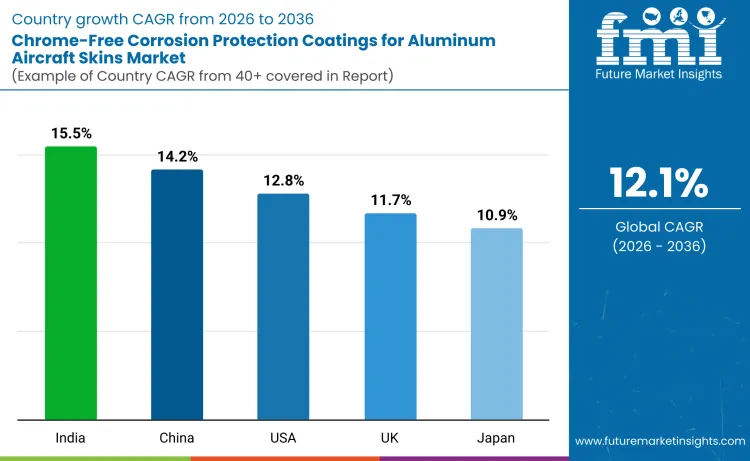
| Country | CAGR (2026 to 2036) |
|---|---|
| China | 14.2% |
| India | 15.5% |
| USA | 12.8% |
| UK | 11.7% |
| Japan | 10.9% |
What is Driving the Growth of Chrome-Free Corrosion Protection Coatings for Aluminum Aircraft Skins in China?
China’s Chrome-Free Corrosion Protection Coatings for Aluminum Aircraft Skins market is projected to grow at a CAGR of 14.2%. The rapid expansion of China’s aviation industry, combined with a growing focus on sustainability and aircraft performance, is driving the demand for environmentally friendly corrosion protection coatings. As China continues to modernize its fleet and increase aircraft manufacturing, the adoption of chrome-free coatings is becoming essential to meet both environmental regulations and performance standards. These coatings offer superior corrosion protection without the environmental impact of chromium-based alternatives, further driving market growth.
What is Contributing to the Growth of Chrome-Free Corrosion Protection Coatings for Aluminum Aircraft Skins in India?
India’s Chrome-Free Corrosion Protection Coatings for Aluminum Aircraft Skins market is expected to grow at an impressive CAGR of 15.5%. As India’s aviation sector continues to expand, there is a growing demand for efficient and sustainable solutions to protect aircraft from corrosion. Chrome-free coatings, which offer superior performance and reduce environmental impact, are becoming increasingly popular in the aerospace industry. The growing focus on fleet modernization, safety, and regulatory compliance in India is contributing to the market’s growth. The push for eco-friendly alternatives in aviation and the increasing emphasis on sustainability in industrial manufacturing further support the demand for these coatings.
What is Driving the Chrome-Free Corrosion Protection Coatings Market Growth in the USA?
The USA’s Chrome-Free Corrosion Protection Coatings for Aluminum Aircraft Skins market is projected to grow at a CAGR of 12.8%. The USA’s well-established aerospace industry, along with its focus on sustainability, is driving the adoption of chrome-free coatings. These coatings offer several advantages, including improved corrosion resistance and a reduced environmental footprint, making them increasingly attractive to manufacturers and airlines. The growing regulatory pressure to eliminate toxic substances like chromium from the aviation industry, combined with the need for high-performance coatings to enhance aircraft lifespan, is expected to drive continued growth in the USA market.
What is Influencing the Growth of Chrome-Free Corrosion Protection Coatings for Aluminum Aircraft Skins in the UK?
The UK’s Chrome-Free Corrosion Protection Coatings for Aluminum Aircraft Skins market is expected to grow at a CAGR of 11.7%. The UK’s aerospace sector is focusing on reducing the environmental impact of aircraft maintenance and manufacturing, driving the adoption of chrome-free coatings. These coatings not only offer superior corrosion protection but also comply with increasingly stringent environmental regulations. As the UK pushes for more sustainable and eco-friendly aerospace solutions, the demand for chrome-free coatings that ensure both high performance and minimal environmental impact is rising. This trend is expected to continue as the UK modernizes its fleet and adheres to global sustainability standards.
What is Contributing to the Growth of Chrome-Free Corrosion Protection Coatings for Aluminum Aircraft Skins in Japan?
Japan’s Chrome-Free Corrosion Protection Coatings for Aluminum Aircraft Skins market is projected to grow at a CAGR of 10.9%. Japan’s aerospace industry, known for its emphasis on innovation and safety, is increasingly adopting chrome-free coatings as part of its push toward more sustainable and efficient solutions. The adoption of these coatings is driven by the need for improved corrosion resistance, longer-lasting aircraft, and compliance with environmental regulations. As Japan continues to prioritize green technologies and modernize its fleet, the demand for chrome-free corrosion protection coatings is expected to rise, supporting market growth throughout the forecast period.
What is the Competitive Landscape for the Chrome Free Corrosion Protection Coatings for Aluminum Aircraft Skins Market?
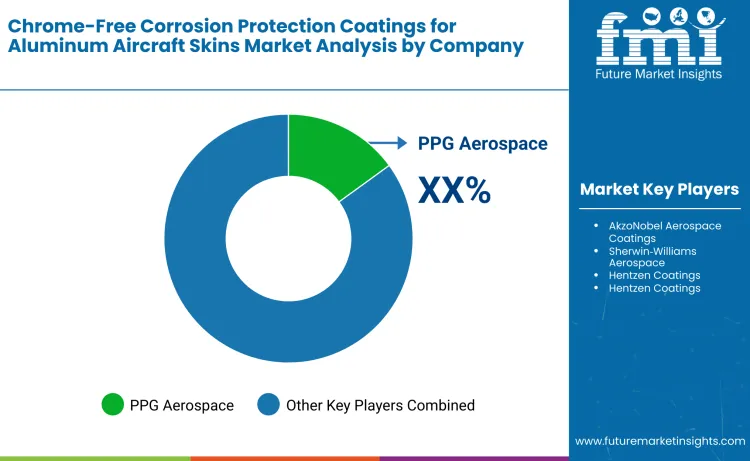
Global demand for chrome‑free corrosion protection coatings for aluminum aircraft skins is increasing as regulatory pressures tighten around hexavalent chromium and aircraft operators seek safer, environmentally compliant alternatives without compromising performance. Traditional chromate‑based pretreatments and primers have long protected aluminum airframes against corrosion, but phase‑outs under environmental and worker‑safety standards are driving adoption of chrome‑free systems. Aircraft exposed to moisture, salts and fluctuating temperatures require robust protection to prevent corrosion, maintain structural integrity and reduce maintenance cycles. As commercial and military fleets expand and aircraft lifespans extend, coatings that offer reliable corrosion resistance with lower environmental impact are gaining traction across North America, Europe and Asia Pacific. Airlines and maintenance organisations prioritise solutions that meet aerospace specification standards while aligning with sustainability commitments and reduced hazardous material use.
On the supply side several aerospace coatings and materials companies compete to provide chrome‑free corrosion protection systems tailored for aluminum aircraft skins. PPG Aerospace is recognised as a leading key player with established product lines and technical support for high‑performance aerospace coatings. Other significant competitors include AkzoNobel Aerospace Coatings, Sherwin‑Williams Aerospace, Hexcel Corporation and Hentzen Coatings, each offering corrosion‑resistant primers, pretreatments and topcoats formulated to meet stringent aerospace requirements without hexavalent chromium. Competition among these suppliers centers on corrosion performance in accelerated and real‑world exposure, adhesion and durability on aluminum substrates, compatibility with existing application and maintenance workflows, and certification support. Firms that combine innovative chrome‑free chemistry, rigorous quality control, and strong technical and after‑sales support are best positioned to capture growth as the aerospace industry continues to transition to environmentally safer corrosion protection for aluminum aircraft structures.
Key Players
- PPG Aerospace
- AkzoNobel Aerospace Coatings
- Sherwin‑Williams Aerospace
- Hexcel Corporation
- Hentzen Coatings
Scope of the Report
| Items | Values |
|---|---|
| Quantitative Units (2026) | USD Million |
| Coating Technology | Nano-Ceramic Chrome-Free Coatings, Polymer-Enhanced Chrome-Free Systems, Hybrid Organic-Inorganic Chrome-Free Coatings, Other Advanced Protective Formulations |
| Application | New Aircraft OEM Applications, Aftermarket Retrofit and Upgrades, Maintenance, Repair & Overhaul (MRO), Regional & Business Jet Applications |
| Companies | PPG Aerospace, AkzoNobel Aerospace Coatings, Sherwin-Williams Aerospace, Hexcel Corporation, Hentzen Coatings |
| Regions Covered | North America, Latin America, Western Europe, Eastern Europe, South Asia and Pacific, East Asia, Middle East & Africa |
| Countries Covered | United States, Canada, Mexico, Brazil, Argentina, Germany, France, United Kingdom, Italy, Spain, Netherlands, China, India, Japan, South Korea, ANZ, GCC Countries, South Africa |
| Additional Attributes | Dollar by sales by coating technology, application, and region. Includes market trends in chrome-free corrosion protection coatings, performance in new aircraft OEM applications, aftermarket upgrades, and MRO, cost-effectiveness, sustainability practices, regulatory compliance, market share and competitive positioning of key companies, and the role of advanced coatings in improving aluminum skin durability, reducing environmental impact, and enhancing aircraft performance in commercial, military, and business jet applications. |
Key Segments in the Chrome-Free Corrosion Protection Coatings for Aluminum Aircraft Skins Market
By Coating Technology:
- Nano‑Ceramic Chrome‑Free Coatings
- Polymer‑Enhanced Chrome‑Free Systems
- Hybrid Organic‑Inorganic Chrome‑Free Coatings
- Other Advanced Protective Formulations
By Application:
- New Aircraft OEM Applications
- Aftermarket Retrofit and Upgrades
- Maintenance, Repair & Overhaul (MRO)
- Regional & Business Jet Applications
By Region:
- Asia Pacific
- China
- India
- Japan
- South Korea
- ASEAN
- Rest of Asia Pacific
- Europe
- Germany
- United Kingdom
- France
- Italy
- Spain
- Nordic
- BENELUX
- Rest of Europe
- North America
- United States
- Canada
- Mexico
- Latin America
- Brazil
- Chile
- Rest of Latin America
- Middle East & Africa
- Kingdom of Saudi Arabia
- Other GCC Countries
- Turkey
- South Africa
- Other African Union
- Rest of Middle East & Africa
Frequently Asked Questions
How big is the Chrome-Free Corrosion Protection Coatings for Aluminum Aircraft Skins market?
The market is valued at USD 480 million in 2026 and is expected to grow at a CAGR of 12.1%, reaching USD 1.57 billion by 2036.
What is the growth outlook for the Chrome-Free Corrosion Protection Coatings for Aluminum Aircraft Skins market?
The market is projected to grow at a CAGR of 12.1% from 2026 to 2036.
Which regions are expected to experience the fastest growth in the Chrome-Free Corrosion Protection Coatings for Aluminum Aircraft Skins market?
China, India, and the USA are expected to lead with growth rates of 14.2%, 15.5%, and 12.8%, respectively.
What are the key applications of Chrome-Free Corrosion Protection Coatings for Aluminum Aircraft Skins?
The coatings are mainly used in new aircraft OEM applications, accounting for 44% of the market share.
Who are the major players in the Chrome-Free Corrosion Protection Coatings for Aluminum Aircraft Skins market?
Key players include PPG Aerospace, AkzoNobel Aerospace Coatings, Sherwin-Williams Aerospace, Hexcel Corporation, and Hentzen Coatings.
Preview the report firsthand - request a free sample
Get SampleGet the brochure for pricing and purchase details.
Get PDFTable of Content
- Executive Summary
- Market Overview
- Global Market Value, 2020 to 2026
- Global Market Forecast, 2026 to 2036
- Market Dynamics
- Drivers
- Restraints
- Opportunities
- Regulatory & Standards Landscape
- Technology & Material Innovation Outlook
- Market Segmentation Analysis
- By Coating Technology
- Nano-Ceramic Chrome-Free Coatings
- Polymer-Enhanced Chrome-Free Systems
- Hybrid Organic-Inorganic Chrome-Free Coatings
- Other Advanced Protective Formulations
- By Application
- New Aircraft OEM Applications
- Aftermarket Retrofit Services
- Maintenance, Repair & Overhaul (MRO)
- Other Aviation Platforms
- By End Use
- Commercial Airlines
- Leasing Companies
- MRO Service Providers
- By Sales Channel
- Direct OEM Supply
- Distributor Channels
- Aftermarket Supply
- By Coating Technology
- Regional Outlook
- North America
- Latin America
- Western Europe
- Eastern Europe
- South Asia & Pacific
- East Asia
- Middle East & Africa
- Country-Level Outlook
- United States
- Canada
- Mexico
- Brazil
- Argentina
- Germany
- France
- United Kingdom
- Italy
- Spain
- Netherlands
- China
- India
- Japan
- South Korea
- ANZ
- GCC Countries
- South Africa
- Competitive Landscape
- Market Structure Overview
- Company Positioning
- Strategic Initiatives
- Key Player Profiles
- Scope of the Report
- Research Methodology
- Assumptions & Acronyms


