

- Industry Size (2026)
- USD 364.2 Mn
- Forecast (2036)
- USD 575.8 Mn
- CAGR (2026 to 2036)
- 4.7%
Aircraft Exterior Thermal Gradient Monitoring Systems Market Size, Market Forecast and Outlook By FMI
The aircraft exterior thermal gradient monitoring systems market was valued at USD 348.0 million in 2025. Demand is poised to cross USD 364.2 million in 2026 at a CAGR of 4.7% during forecast period. Revenue expansion propels cumulative buildup to USD 575.8 million through 2036 as composite airframe structures require continuous thermodynamic stress validation during high-altitude operations to prevent delamination.
Chief engineers at commercial airframe manufacturers face intense pressure to reduce weight without compromising ice protection validation. Evaluating what drives demand for aircraft exterior thermal monitoring systems reveals that replacing traditional copper wiring looms with networked aircraft surface temperature nodes eliminates redundant mass. Delaying this transition forces airlines into shorter inspection intervals and increased line-maintenance downtime. Surface gradients reveal localized bleed-air leaks long before mechanical failure occurs, altering how predictive maintenance schedules are built. Examining aircraft thermal monitoring market forecast 2036 highlights how these data streams fundamentally reshape the aircraft surface temperature monitoring systems market trajectory.
Summary of Aircraft Exterior Thermal Gradient Monitoring Systems Market
- Aircraft Exterior Thermal Gradient Monitoring Systems Market Definition
- Aircraft exterior thermal gradient monitoring systems market includes sensor arrays and diagnostic hardware measuring temperature differentials across aircraft skins to identify aerodynamic icing, internal heating leaks, and composite stress during flight operations.
- Demand Drivers in the Market
- Composite fuselage integration forces airframe engineers to implement aircraft skin temperature monitoring systems preventing thermal delamination.
- Next-generation bleed-air anti-ice configurations compel system architects to deploy aerospace icing detection technologies for precise valve control.
- Predictive maintenance protocols push MRO facility managers to require downloadable thermal gradient logs optimizing inspection schedules.
- Key Segments Analyzed in the FMI Report
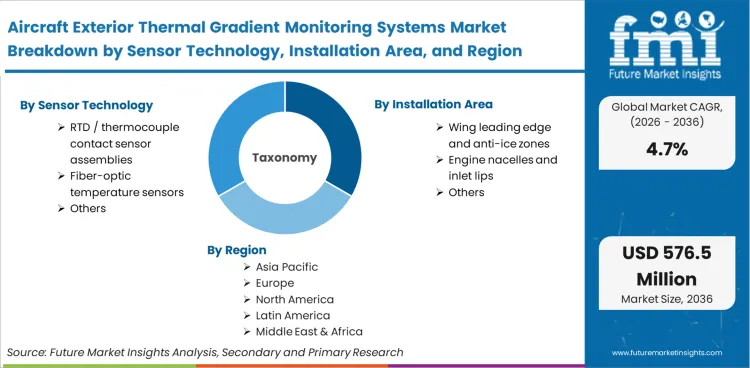
- RTD / thermocouple contact sensor assemblies are projected to hold 41.0% share in 2026, driven by established regulatory certification heritage and high vibration tolerance.
- Wing leading edge and anti-ice zones are set to account for 33.0% share, owing to critical flight safety mandates regarding aerodynamic stall prevention.
- Standalone hardware plus local controller is poised to grab 46.0% share, supported by simpler integration pathways on legacy airframes.
- Line-fit OEM installation is anticipated to record 57.0% share, as factory-level composite embedding proves far more reliable than aftermarket bonding.
- Airframe OEMs are expected to capture 38.0% share, reflecting bulk procurement power during initial aircraft design phases.
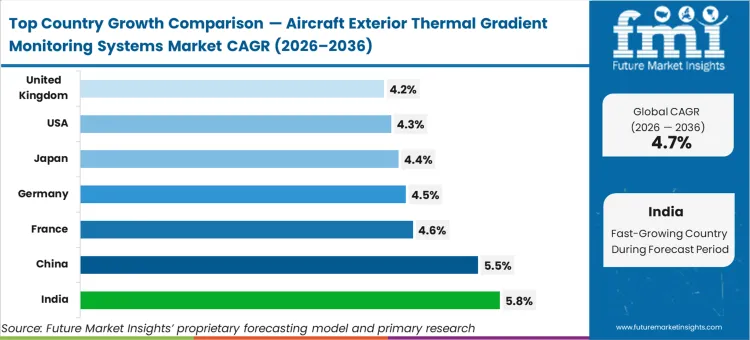
- India: 5.8% compound growth, propelled by aggressive domestic airline fleet expansion and greenfield airport construction.
- Analyst Opinion at FMI
- Nikhil Kaitwade, Principal Analyst, Process Automation, at FMI, says, "Flight test engineers expect optical arrays to replace discrete contact sensors quickly due to weight savings. Reality proves differently. While fiber optic sensing in aircraft thermal monitoring offers superior multiplexing across broad composite spans, line maintenance technicians struggle with field repairs when a single optical line fractures. This practical repair constraint keeps traditional RTD networks dominant in commercial fleets, pushing advanced health monitoring coatings to military or highly specialized platforms where downtime penalties are calculated differently."
- Strategic Implications / Executive Takeaways
- Tier-one avionics suppliers must develop wireless interrogators resolving sensor wiring and weight tradeoffs in aircraft monitoring inside composite wings.
- MRO service providers face urgent requirements justifying ROI of aircraft exterior temperature monitoring systems by reading high-density thermal logs quickly.
- Airframe procurement officers must balance factory-embedded sensor costs against OEM approved aircraft ice and temperature monitoring solutions warranties.
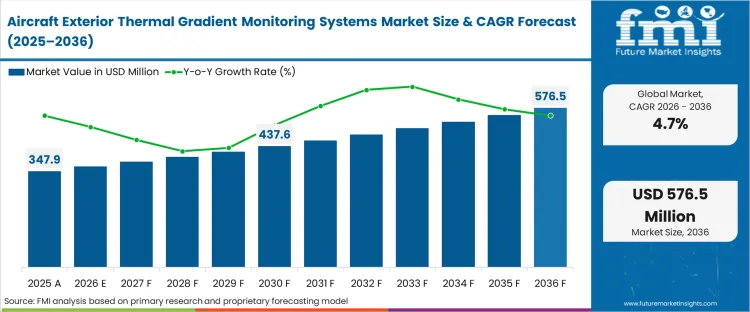
Key Takeaways
| Metric | Details |
|---|---|
| Industry Size (2026) | USD 364.2 million |
| Industry Value (2036) | USD 575.8 million |
| CAGR (2026 to 2036) | 4.7% |
Source: Future Market Insights (FMI) analysis, based on proprietary forecasting model and primary research
Once regulatory bodies mandate continuous thermal profiling for composite wings, aircraft thermal gradient monitoring market size accelerates exponentially. Original equipment manufacturers who integrate aircraft sensors directly into composite layups establish superiority. Edge computing capability embedded within nacelle panels turns passive skins into active diagnostic boundaries, pushing demand for predictive maintenance aircraft temperature sensors.
India leads at 5.8% CAGR, fueled by massive commercial fleet expansion and new maintenance infrastructure build-outs. China follows at 5.5% as domestic aircraft production accelerates. Germany advances at 4.5% supported by Airbus manufacturing integration. France tracks closely at 4.6% driven by component-level innovation. Japan exhibits 4.4% expansion through engineering-focused upgrades. The United States records 4.3% growth rooted in North America aircraft thermal monitoring market fleet renewals. The United Kingdom sustains 4.2% expansion via Europe aircraft exterior temperature monitoring market defense retrofits. Baseline divergence centers on whether regional fleets require fresh factory builds or complex mid-life retrofit kits.
Definition
Answering what is an aircraft exterior thermal gradient monitoring system requires looking beyond basic thermostats. To explain aircraft exterior thermal gradient monitoring in simple terms, this sector comprises specialized sensor networks, data acquisition units, and analytical software measuring thermodynamic variations across external aircraft surfaces. Continuous thermal mapping allows flight crews and ground diagnostic teams to identify ice accumulation, bleed-air duct leaks, and composite material stress before degradation occurs.
Inclusions
Scope incorporates contact sensors, fiber-optic arrays, and infrared modules explicitly certified for exterior aerospace application. Outlining which aircraft use exterior thermal gradient monitoring systems involves tracking composite fuselage thermal monitoring sensors on integrated aircraft automated inspection platforms. Coverage spans commercial aircraft thermal monitoring systems, military aircraft thermal monitoring sensors, and UAV exterior thermal monitoring sensors.
Exclusions
Cabin climate control thermostats and internal engine core temperature probes remain excluded because they monitor enclosed environments rather than exterior aerodynamic surfaces. Ground-based weather scanning radars are omitted since they do not measure direct skin temperatures. General-purpose industrial thermocouples lacking aviation certification fall outside scope entirely.
Aircraft Exterior Thermal Gradient Monitoring Systems Market Research Methodology
- Primary Research: Chief avionics engineers, MRO facility directors, and airframe procurement officers navigating aircraft thermal monitoring certification challenges.
- Desk Research: European Union Aviation Safety Agency certification directives, FAA icing condition mandates, and composite material thermodynamic test registries.
- Market-Sizing and Forecasting: Annual commercial aircraft delivery volumes and scheduled heavy-maintenance D-check frequencies.
- Data Validation and Update Cycle: Independent aerospace component supply chain shipment audits cross-referenced against tier-one avionics supplier earnings.
Segmental Analysis
Aircraft Exterior Thermal Gradient Monitoring Systems Market Analysis by Sensor Technology
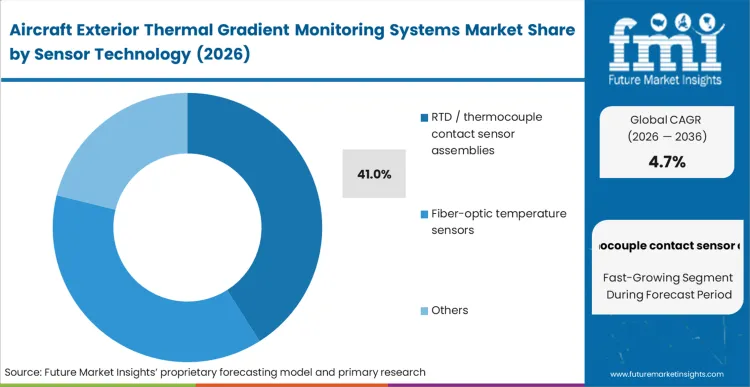
Airlines demand lighter sensor payloads, yet certification authorities require unbroken historical performance data before approving new safety-critical architectures. RTD / thermocouple contact sensor assemblies capture 41.0% share in 2026 because avionics design chiefs prioritize predictable failure modes over marginal weight savings. Evaluating RTD vs fiber optic aircraft temperature sensors reveals traditional contact nodes survive extreme vibration profiles near engine nacelles where delicate optical fibers often micro-fracture. MRO line technicians prefer discrete wiring because isolating a single failed thermocouple takes minutes. Troubleshooting an integrated integrated sensor ready optical loop requires specialized diagnostic gear rarely available at remote outstations. Assessing contact sensors vs infrared aircraft thermal monitoring shows heavy copper shielding around RTDs provides natural electromagnetic interference protection that composite fuselages lack. Fleet operators choosing unshielded modern alternatives face severe operational restrictions during convective weather routing.
- Initial qualification: Avionics designers select RTDs because decades of accumulated flight-hour data satisfy stringent FAA redundancy requirements instantly. Airframe OEMs avoid costly recertification campaigns.
- Line maintenance validation: Ground crews verify RTD integrity using standard multimeters during routine turnarounds. Maintenance supervisors maintain high dispatch reliability without training staff on advanced optical reflectometry.
- Lifecycle renewal: Component buyers replace degraded thermocouples individually rather than replacing entire systemic loops. Procurement directors achieve predictable maintenance budgets over a thirty-year airframe lifespan.
Aircraft Exterior Thermal Gradient Monitoring Systems Market Analysis by Installation Area
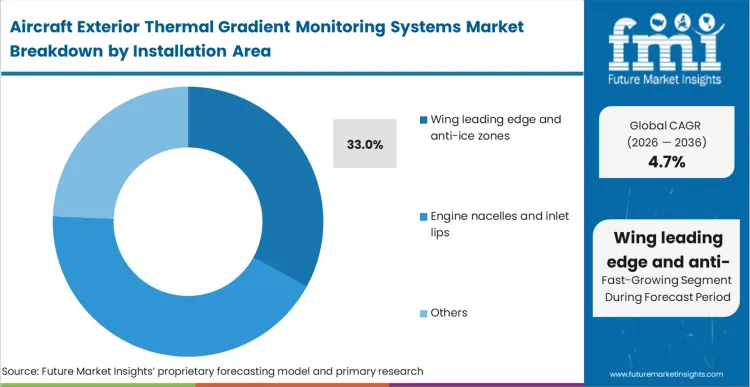
Aerodynamic stall caused by asymmetrical ice shedding presents extreme catastrophic risk to commercial flight operations. Wing leading edge and anti-ice zones command 33.0% share as thermal validation prevents precisely this outcome. Bleed-air systems routing hot gas through wing cavities require wing leading edge thermal monitoring to prevent composite skin heat damage while ensuring sufficient anti-icing energy. FMI's analysis indicates ice accretion detection nodes prevent valves from overheating delicate carbon fiber structures. System architects realize that thermal profiling on leading edges does more than just melt ice. What component suppliers rarely advertise is how aircraft composite skin temperature monitoring allows engines to retain more thrust during critical climb phases by reducing continuous bleed-air extraction. Carriers operating without precision radome surface temperature sensing aircraft or thermal monitoring for aircraft empennage surfaces suffer continuous fuel-burn penalties by running anti-ice systems conservatively hot.
- Catastrophic stall prevention: Precision thermal mapping prevents uneven ice accretion across slat surfaces. Flight crews avoid critical aerodynamic lift disruption during low-altitude holding patterns.
- Structural degradation risk: Excessively hot bleed-air causes microscopic resin breakdown inside composite leading edges. Engineering directors face premature structural replacement costs if temperature spikes go undetected.
- Optimization capture: High-resolution gradient data allows automated controllers to pulse anti-ice valves precisely. Flight operations managers capture immediate fuel savings across winter operating schedules.
Aircraft Exterior Thermal Gradient Monitoring Systems Market Analysis by System Architecture
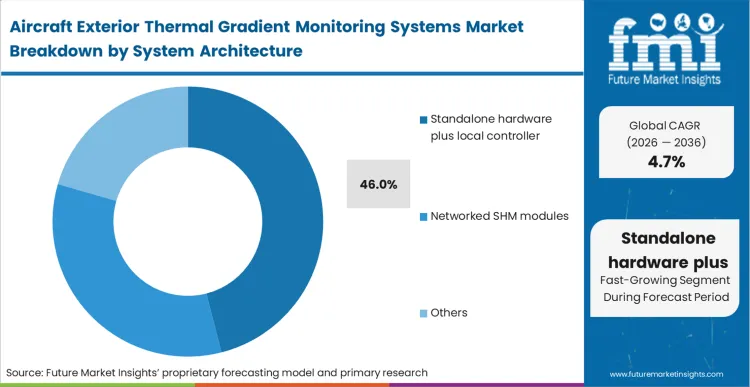
Fully integrated central avionics suites struggle to accommodate add-on thermal diagnostic modules without triggering massive software recertification costs. Standalone hardware plus local controller architectures secure 46.0% share by isolating thermal data from primary flight control computers. Legacy airframes require simple digital twin integration for aircraft thermal monitoring boxes processing sensor inputs locally to merely send alert flags to flight decks. According to FMI's estimates, this federated approach appeals to retrofit program managers who cannot justify multimillion-dollar software integration campaigns for mid-life aircraft. The hidden commercial reality involves data ownership. Standalone controllers often store high-fidelity logs on removable media, allowing airlines to utilize distributed temperature sensing aircraft exterior without OEM cloud analytics subscriptions. Operators lacking localized controllers surrender valuable AI-enabled aircraft thermal anomaly detection data to airframe manufacturers rather than managing their own flight data monitoring systems.
- Tier-two production: Specialized avionics boutiques manufacture federated controllers faster than prime integrators update core software. Supply chain directors avoid long lead times associated with primary flight computer modifications.
- Integration bottlenecks: Certifying new software on centralized flight platforms takes years of rigorous testing. Program managers bypass these delays using standalone boxes with independent DO-178C certifications.
- Future architecture shifts: Next-generation aircraft will eventually absorb local tasks into central edge computing nodes. Hardware manufacturers must pivot toward software-defined algorithms to survive this transition.
Aircraft Exterior Thermal Gradient Monitoring Systems Market Analysis by Fitment
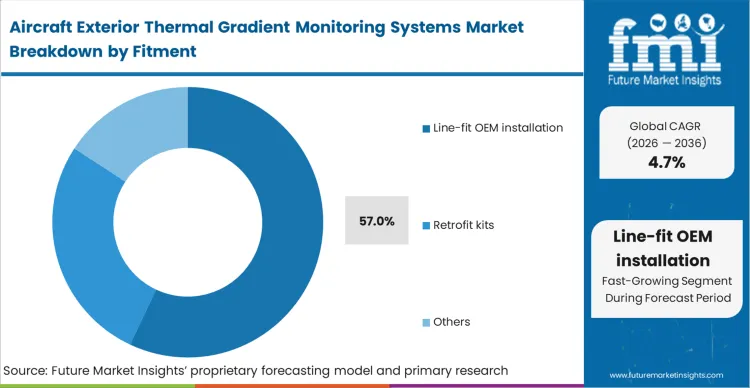
Embedding delicate sensor networks into carbon-fibre structures after factory curing is practically impossible without compromising integrity. Line-fit OEM installation commands 57.0% share because advanced thermal monitoring must be woven directly into airframe manufacturing processes. Factory integration allows cables to run alongside primary power runs before internal cabin panels are sealed. Evaluating line-fit vs retrofit aircraft thermal monitoring systems shows manufacturing heads rely on line-fit solutions ensuring sensor longevity matches airframe lifespan. Determining is aircraft thermal gradient monitoring an OEM or retrofit market requires understanding aerodynamic peeling forces destroying external aftermarket optical fibers. What aftermarket suppliers obscure is that retrofit economics of aircraft thermal monitoring systems rely on wireless nodes with heavy internal batteries. Carriers relying on retrofit thermal packages accept permanent payload restrictions rather than investing in thermal management exterior coatings.
- Prime manufacturer adoption: Major airframe builders integrate sensor looms during fuselage barrel joining. Assembly line directors prevent complex post-production modification bottlenecks.
- Operator acceptance: Airlines receive newly delivered aircraft with thermal baselines already established. Fleet technical managers utilize factory diagnostic software immediately without custom configuration.
- Late-cycle retrofitting: Older cargo conversions eventually receive simplified stick-on thermal nodes to comply with updated icing regulations. Cargo operators accept suboptimal aerodynamic drag to keep aging planes legally airworthy.
Aircraft Exterior Thermal Gradient Monitoring Systems Market Analysis by End User
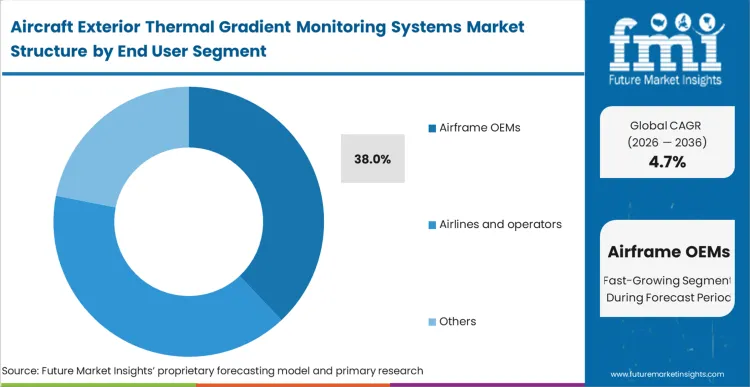
Aircraft design teams face a critical choice between adding physical structural reinforcements or using active thermal management to protect lighter composite skins. Airframe OEMs hold 38.0% share because they mandate sensor integration to achieve aggressive weight-reduction targets. By actively monitoring heat distribution near exhaust plumes, structural engineers use thinner heat-shields, saving hundreds of pounds per aircraft. Discovering how to select an aircraft thermal monitoring supplier involves bulk purchasing power driving unit costs down. The strategic leverage lies in warranty control. Airframe builders use continuous thermal data to deny operator claims if heat damage resulted from improper ground running procedures. Buyers analyzing regional aircraft exterior temperature monitoring or helicopter surface temperature monitoring systems without OEM-integrated logging lose critical evidence during costly warranty disputes, increasing reliance on structural health monitoring verification.
- Bulk procurement savings: Factory buyers negotiate massive volume discounts for standardized thermocouple reels. Supply chain executives reduce overall bill-of-materials costs across multi-year production blocks.
- Hidden weight costs: Eliminating active thermal monitoring forces designers to use thicker composite layups for safety margins. Program directors miss critical fuel-efficiency guarantees promised to airline customers.
- Lifecycle value capture: OEMs monetize thermal data by selling predictive analytics back to operators. Commercial strategy heads convert one-time hardware sales into recurring software revenue streams.
Aircraft Exterior Thermal Gradient Monitoring Systems Market Drivers, Restraints, and Opportunities
Bleed-air leak containment protocols compel commercial airline engineering directors to deploy high-density thermal gradient arrays across all composite fuselage structures immediately. A single undetected hot-air leak inside a carbon-fiber wingbox degrades resin integrity within minutes, forcing catastrophic structural write-offs. Delaying sensor upgrades leaves carriers exposed to massive unscheduled D-check repair bills and extended aircraft grounding. This commercial urgency accelerates adoption of aircraft anti-ice surface temperature monitoring and smart icing detection systems for aircraft far beyond baseline regulatory icing mandates. Operators recognize active thermal mapping shifts maintenance from reactive panel replacement to proactive valve adjustment using electric aircraft onboard processing.
Internal cable routing complexity inside sealed composite wings slows widespread fiber-optic sensor adoption even when chief engineers want lighter diagnostic payloads. Aviation rules dictating certification requirements for aircraft temperature sensing systems strictly prohibit drilling new access holes through primary carbon-fiber spars to route aftermarket sensor wires. This physical barrier locks operators out of harsh environment aerospace temperature sensing upgrades unless they undertake massive scheduled teardowns. Wireless interrogator nodes are emerging as a partial solution, but battery reliance creates secondary maintenance burdens that line technicians actively resist.
Opportunities in Aircraft Exterior Thermal Gradient Monitoring Systems Market
- Wireless energy-harvesting nodes: Avionics hardware startups gain immediate traction by developing thermal gradient sensors for aircraft surfaces powered by ambient aerodynamic vibration. Maintenance directors avoid battery replacement cycles entirely.
- Digital-twin integration: Software developers secure lucrative aircraft structural health monitoring sensors contracts merging real-time thermal gradient logs with 3D airframe models. Airline reliability engineers isolate internal valve leaks visually before removing physical panels using aircraft cabin environment interfaces.
- De-icing fluid optimization: System integrators help carriers deploy aircraft condition based maintenance sensors linking wing surface temperature data directly to ground-spray equipment. Station managers cut winter operational costs while accelerating gate departures.
Regional Analysis
Based on regional analysis, aircraft exterior thermal gradient monitoring systems market is segmented into North America, Latin America, Western Europe, Eastern Europe, Middle East and Africa, East Asia, and South Asia and Pacific across 40 plus countries.
.webp "Top Country Growth Comparison Aircraft Exterior Thermal Gradient Monitoring Systems Market Cagr (2026 2036)")
| Country | CAGR (2026 to 2036) |
|---|---|
| India | 5.8% |
| China | 5.5% |
| France | 4.6% |
| Germany | 4.5% |
| Japan | 4.4% |
| United States | 4.3% |
| United Kingdom | 4.2% |
Source: Future Market Insights (FMI) analysis, based on proprietary forecasting model and primary research
South Asia and Pacific Aircraft Exterior Thermal Gradient Monitoring Systems Market Analysis
Aggressive commercial fleet expansion combined with intense tropical weather exposure drives sensor demand across this region. FMI analysts note rapid onboarding of composite widebody aircraft requires new aircraft exterior temperature sensor market architectures to handle high-humidity thermal cycling. Local maintenance organizations lack decades of legacy metallic airframe experience, pushing them to rely heavily on automated diagnostic platforms rather than manual inspection. This creates a massive greenfield opportunity for advanced thermal logging software parsing aircraft thermal gradient monitoring CAGR metrics.
- India: Massive airport infrastructure build-outs and historic airline aircraft orders mandate immediate factory-installed thermal arrays. Fleet technical managers utilize localized gradient data to optimize engine thrust limits during extreme summer ground operations. Demand is forecast to hit 5.8% CAGR. Regional MRO providers secure lucrative heavy-maintenance contracts using sensor fusion platforms processing high-density thermal logs faster than competitors.
East Asia Aircraft Exterior Thermal Gradient Monitoring Systems Market Analysis
Domestic aerospace manufacturing acceleration forces local suppliers to adopt stringent international certification standards for thermal monitoring. Regional aircraft designers prioritize integrated aerospace thermal monitoring systems market components matching western airframe efficiency metrics. Establishing independent supply chains for critical safety-of-flight sensors insulates regional builders from international trade friction while building indigenous engineering capabilities.
- China: Fast-paced domestic passenger jet production requires localized thermal sensor sourcing to meet aggressive delivery schedules. Procurement officers bypass foreign export restrictions cultivating local China aircraft thermal monitoring systems market manufacturers. Revenue expands at 5.5% compound growth. This localized supply base quickly pivots to export low-cost retrofit kits to emerging markets using thermal management frameworks.
- Japan: Engineering-driven adoption focuses on extreme reliability and precision over rapid volume expansion. Avionics design chiefs integrate advanced piezoelectric thermal nodes navigating Japan’s aerospace thermal monitoring systems market challenges to reduce overall sensor weight. Growth is anticipated at 4.4% annually. Japanese suppliers cement their position as tier-two providers of highly specialized composite-embedded iot in aviation components to global prime manufacturers.
Western Europe Aircraft Exterior Thermal Gradient Monitoring Systems Market Analysis
Airbus-centered manufacturing depth dictates sensor architecture standards across entire global supply chains originating here. European aviation safety mandates regarding ice crystal icing compel engineering teams to deploy next generation aircraft surface monitoring systems. Continuous push toward zero-emission hydrogen propulsion prototypes requires entirely new cryogenic-to-ambient thermal gradient monitoring paradigms that legacy systems cannot support.
- France: Proximity to primary airframe final assembly lines enables rapid iterative testing of novel thermal skins. The revenue of the French aerospace thermal monitoring systems market is poised to track 4.6% growth. System architects embed smart nodes directly into engine nacelle acoustic liners. French component manufacturers maintain the advantage by holding critical intellectual property regarding aerospace avionics techniques near primary assembly lines.
- Germany: Deep expertise in carbon-fiber production scales advanced sensor-embedding techniques for next-generation wing structures. Manufacturing heads automate sensor placement using precision robotics eliminating human error. Demand is expected to register 4.5% CAGR. This aerospace robotics automation translates into lower unit costs for highly complex fiber-optic mesh arrays.
- United Kingdom: Specialised defence retrofits and engine-core thermal dynamics expertise drive niche applications. Military procurement officers fund development of high-temperature gradient monitors for next-generation combat aircraft exhausts. The UK’s aerospace thermal monitoring systems market revenue is estimated to grow at 4.2% annually. Innovations funded by military budgets eventually migrate into commercial widebody engine diagnostic packages.
FMI's report includes United States analysis where massive installed commercial fleets drive replacement-led cycles rather than greenfield adoption. Mature regulatory oversight forces legacy carriers to adopt strict thermal validation during mandatory heavy maintenance intervals.
Competitive Aligners for Market Players
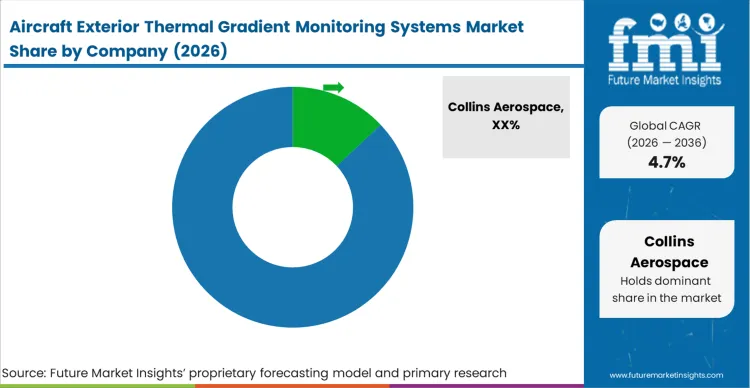
Competition in this specialized aerospace niche operates through rigid certification lock-ins rather than traditional price wars. Aircraft thermal monitoring key players, including aircraft exterior temperature sensor manufacturers and aircraft thermal monitoring system suppliers, dominate primary airframe integration, holding vast libraries of validated flight-hour data. Airframe chief engineers rarely risk unproven thermal arrays on new aircraft programs, strongly favouring incumbents who can guarantee DO-160 environmental survival. Startups struggle immensely to penetrate line-fit factory installations, forcing them into secondary MRO retrofit channels where airlines test novel wireless diagnostic nodes on ageing freighters. Assessing cooling management system hardware proves challenging for unverified vendors.
Incumbents defend their positions through proprietary data protocols making hardware mixing practically impossible. Aircraft icing sensor OEMs and aircraft temperature sensor systems providers manufacture highly reliable RTD nodes feeding localized controllers via closed communication loops. Challengers attempting to introduce advanced fiber-optic interrogators must build costly software translation layers to interface with legacy central maintenance computers. This integration friction protects established suppliers from rapid technological displacement. Component buyers at airlines find themselves captive to original hardware manufacturers when seeking aeroderivative sensor replacement parts, as third-party thermal sensors rarely possess identical thermal-mass response times required by flight control logic.
Major commercial airlines counter vendor lock-in by demanding standardized ARINC data outputs from all thermal monitoring hardware. Fleet technical directors explicitly write open-architecture requirements into future aircraft procurement contracts, forcing system integrators to abandon proprietary diagnostic software. Comparing aircraft thermal gradient monitoring system price or issuing an RFQ aircraft surface temperature monitoring system helps evaluate the best aircraft thermal monitoring vendors. Market share ultimately flows toward hardware providers offering seamless thermal gradient visibility into airline-owned predictive maintenance clouds, separating physical sensor sales from recurring analytical thermal management technologies subscriptions.
Key Players in Aircraft Exterior Thermal Gradient Monitoring Systems Market
- Collins Aerospace
- Safran Aerosystems
- Parker Hannifin
- Curtiss-Wright
- TE Connectivity
- AMETEK
- Baker Hughes (Druck)
Scope of the Report
| Metric | Value |
|---|---|
| Quantitative Units | USD 364.2 million to USD 575.8 million, at a CAGR of 4.7% |
| Market Definition | Aircraft Exterior Thermal Gradient Monitoring Systems Market comprises specialized sensor networks, data acquisition units, and analytical software designed to measure thermodynamic variations across external aircraft surfaces to detect localized heating or cooling anomalies in real-time. |
| Segmentation | By Sensor Technology, By Installation Area, By System Architecture, By Fitment, By End User, and Region |
| Regions Covered | North America, Latin America, Western Europe, Eastern Europe, Middle East and Africa, East Asia, South Asia and Pacific |
| Countries Covered | United States, France, Germany, United Kingdom, China, India, Japan |
| Key Companies Profiled | Collins Aerospace, Safran Aerosystems, Parker Hannifin, Curtiss-Wright, TE Connectivity, AMETEK, Baker Hughes (Druck) |
| Forecast Period | 2026 to 2036 |
| Approach | Annual commercial aircraft delivery volumes and scheduled heavy-maintenance D-check frequencies. |
Source: Future Market Insights (FMI) analysis, based on proprietary forecasting model and primary research
Aircraft Exterior Thermal Gradient Monitoring Systems Market Analysis by Segments
By Sensor Technology
- RTD / thermocouple contact sensor assemblies
- Fiber-optic temperature sensors
- Infrared / thermal imaging modules
- Distributed temperature sensing arrays
- Hybrid thermal-gradient nodes
By Installation Area
- Wing leading edge and anti-ice zones
- Engine nacelles and inlet lips
- Fuselage composite skin hotspots
- Empennage and control surfaces
- Radome and fairing surfaces
By System Architecture
- Standalone hardware plus local controller
- Networked SHM modules
- Edge analytics and alerting units
- Digital-twin linked monitoring platforms
- Ground diagnostic interfaces
By Fitment
- Line-fit OEM installation
- Retrofit kits
- MRO-installed upgrade packages
By End User
- Airframe OEMs
- Airlines and operators
- MRO providers
- Defense aviation users
- Flight-test and certification organizations
Region:
- North America
- United States
- Canada
- Europe
- Germany
- United Kingdom
- France
- Italy
- Spain
- Asia Pacific
- China
- Japan
- South Korea
- Taiwan
- Singapore
- Latin America
- Brazil
- Mexico
- Argentina
- Middle East & Africa
- GCC Countries
- South Africa
- Europe
Bibliography
- Federal Aviation Administration. (2024, August 6). Ground Deicing Program - General Information. U.S. Department of Transportation.
- Transport Canada. (2024). Guidelines for Aircraft Ground Icing Operations (TP 14052E). Government of Canada.
- Ballarin, P., Ricci, F., Lampani, L., & Monaco, E. (2025). Cost-Effectiveness of Structural Health Monitoring in Aviation. Sensors, 25(19), 6146.
- Maio, L., Guardone, A., & Quaranta, G. (2026). A review of ice detection technologies. Progress in Aerospace Sciences, 161, 101158.
- Gui, X., Zhao, X., Liu, Y., & Li, H. (2025). Detection of aircraft wing icing and de-icing by optical fiber distributed acoustic sensing with Fiber Bragg Gratings array. Measurement, 255, 117648.
- Civil Aviation Safety Authority. (2024, June). (OPS.22) Aircraft ground de-icing / anti-icing program. Australian Government.
This bibliography is provided for reader reference. The full FMI report contains the complete reference list with primary source documentation.
This Report Addresses
- Specific weight penalties associated with retrofit thermal wireless arrays.
- Integration friction between legacy flight computers and novel fiber-optic sensors.
- Aircraft exterior thermal monitoring trends shaping composite validation.
- Thermal monitoring system integration with aircraft SHM expanding diagnostic capabilities.
- Certification barriers preventing deep composite spar drilling for sensor wires.
- Line-maintenance preference for traditional RTD nodes over complex optical reflectometry.
- Extreme vibration survival profiles required near engine nacelle monitoring zones.
- Cost structures separating initial hardware sales from recurring predictive analytics software.
Frequently Asked Questions
What is an aircraft exterior thermal gradient monitoring system?
Answering what is an aircraft exterior thermal gradient monitoring system requires looking at specialized sensor networks. These systems measure thermodynamic variations across external aircraft surfaces to detect localized heating anomalies, ice accumulation, and composite structural stress in real-time.
Why do aircraft need surface temperature monitoring?
Addressing why do aircraft need surface temperature monitoring involves structural integrity. Composite airframes degrade rapidly if internal bleed-air duct leaks cause localized overheating. Continuous thermal mapping prevents this delamination while optimizing ice protection system energy usage during flight.
How do aircraft thermal gradient sensors work?
Explaining how do aircraft thermal gradient sensors work highlights hardware translating physical temperature changes into electrical resistance. These electrical signals feed into local controllers, providing flight crews precise gradient data indicating anomalous thermodynamic conditions on aircraft skins.
Where are aircraft exterior temperature sensors installed?
Detailing where are aircraft exterior temperature sensors installed focuses on high-risk aerodynamic zones. Prime locations include wing leading edges, engine nacelle temperature monitoring aircraft zones, inlet lips, empennage control surfaces, and critical fuselage composite skin hotspots vulnerable to severe thermal cycling.
Can thermal gradient monitoring prevent aircraft icing incidents?
Assessing can thermal gradient monitoring prevent aircraft icing incidents reveals positive safety outcomes. By feeding exact surface temperature data to anti-ice controllers, these systems ensure leading edges remain warm enough to prevent asymmetrical ice accretion without overheating delicate structures.
Compare aircraft surface temperature monitoring and ice detection sensors.
When users compare aircraft surface temperature monitoring and ice detection sensors, a clear distinction emerges. Ice detectors measure physical accretion presence, whereas thermal monitoring maps the entire surface heat profile, predicting where ice will form before physical accumulation actually begins.
How does aircraft thermal gradient monitoring vs ice accretion sensors differ?
Evaluating aircraft thermal gradient monitoring vs ice accretion sensors highlights proactive versus reactive capabilities. Thermal gradients prevent icing by optimizing heated surfaces, while accretion sensors only alert flight crews after ice has already formed, requiring immediate remedial action.
What causes aircraft icing detection false alarm reduction?
Achieving aircraft icing detection false alarm reduction relies on overlapping sensor data. Integrating thermal gradient profiles with optical ice detectors allows avionic computers to filter out non-threatening moisture, significantly reducing unnecessary anti-ice system activation and fuel burn.
What drives demand for aircraft exterior thermal monitoring systems?
Understanding what drives demand for aircraft exterior thermal monitoring systems points to composite airframe integration. Carbon-fiber structures require stringent heat monitoring to prevent resin degradation, compelling airlines to mandate localized diagnostic nodes across all next-generation commercial aircraft deliveries.
Which aircraft use exterior thermal gradient monitoring systems?
Answering which aircraft use exterior thermal gradient monitoring systems covers virtually all modern platforms. Next-generation composite widebodies, specialized military combat jets, and heavy regional freighters utilize these arrays to validate anti-ice performance and ensure long-term structural health.
What value represents Aircraft Exterior Thermal Gradient Monitoring Systems Market in 2026?
Demand is projected to reach USD 364.2 million in 2026. This baseline valuation reflects aggressive monitoring mandates issued by aviation safety regulators to prevent composite delamination on next-generation widebody airframes.
Which sensor technology commands primary adoption?
RTD / thermocouple contact sensor assemblies hold 41.0% share. Avionics design chiefs select traditional contact nodes because vast historical flight-hour data instantly satisfies stringent FAA redundancy and lightning strike certification requirements.
Why do fiber-optic arrays face integration challenges?
Fiber optics struggle because line maintenance technicians cannot easily repair fractured optical lines at remote outstations. Splicing optical glass requires specialized diagnostic equipment rarely available during rapid commercial aircraft turnarounds.
Which installation area generates highest hardware volume?
Wing leading edge and anti-ice zones account for 33.0% share. Thermal validation in this critical zone prevents catastrophic aerodynamic stall caused by asymmetrical ice shedding during low-altitude holding patterns.
Why do standalone controllers dominate system architectures?
Standalone hardware secures 46.0% share because modifying central flight computers triggers massive software recertification costs. Independent controllers process thermal data locally, allowing legacy airframes to achieve modern diagnostic capability quickly.
What data ownership conflict exists with localized controllers?
Airlines prefer standalone boxes storing high-fidelity thermal logs on removable media. This hardware independence allows carriers to bypass expensive cloud analytics subscriptions demanded by original airframe manufacturers.
Which fitment type leads integration pathways?
Line-fit OEM installation captures 57.0% share. Embedding delicate sensor networks directly into carbon-fiber structures during factory curing ensures longevity matches airframe lifespan, avoiding aerodynamic peeling forces associated with aftermarket stick-on kits.
Why do retrofit packages rely on wireless nodes?
Aviation regulations strictly prohibit drilling new access holes through primary composite spars for wiring. Retrofit suppliers use wireless battery-powered nodes to bypass internal routing bottlenecks, despite severe weight penalties.
How do airframe OEMs leverage purchasing power?
Factory buyers hold 38.0% share by purchasing standard thermocouple reels in massive bulk quantities. Supply chain executives reduce overall bill-of-materials costs while capturing lucrative predictive maintenance software revenue streams later.
Why does India register fastest growth rate?
India tracks at 5.8% compound growth. Massive commercial fleet orders force immediate factory-installed thermal arrays, while local MRO providers build specialized capabilities to process high-density thermal logs for tropical weather operations.
How does China approach thermal monitoring localization?
China advances at 5.5% CAGR as fast-paced domestic passenger jet production requires localized sensor sourcing. Procurement officers bypass foreign export restrictions by cultivating indigenous manufacturers capable of meeting international certification standards.
What structural dynamic drives German adoption?
Germany records 4.5% expansion supported by Airbus manufacturing integration. Deep expertise in carbon-fiber production allows manufacturing heads to automate highly complex fiber-optic mesh placement using precision robotics.
How do major airlines counter supplier lock-in?
Fleet technical directors write open-architecture requirements into future aircraft procurement contracts. This forces system integrators to abandon proprietary diagnostic software in favor of standardized ARINC data outputs.
What limits startup penetration in thermal hardware?
New entrants struggle because competition operates through rigid certification lock-ins. Airframe chief engineers rarely risk unproven thermal arrays lacking DO-160 environmental survival history on multi-billion dollar aircraft programs.
Preview the report firsthand - request a free sample
Get SampleGet the brochure for pricing and purchase details.
Get PDFTable of Content
- Executive Summary
- Global Market Outlook
- Demand-side Trends
- Supply-side Trends
- Technology Roadmap Analysis
- Analysis and Recommendations
- Market Overview
- Market Coverage / Taxonomy
- Market Definition / Scope / Limitations
- Research Methodology
- Chapter Orientation
- Analytical Lens and Working Hypotheses
- Market Structure, Signals, and Trend Drivers
- Benchmarking and Cross-market Comparability
- Market Sizing, Forecasting, and Opportunity Mapping
- Research Design and Evidence Framework
- Desk Research Programme (Secondary Evidence)
- Company Annual and Sustainability Reports
- Peer-reviewed Journals and Academic Literature
- Corporate Websites, Product Literature, and Technical Notes
- Earnings Decks and Investor Briefings
- Statutory Filings and Regulatory Disclosures
- Technical White Papers and Standards Notes
- Trade Journals, Industry Magazines, and Analyst Briefs
- Conference Proceedings, Webinars, and Seminar Materials
- Government Statistics Portals and Public Data Releases
- Press Releases and Reputable Media Coverage
- Specialist Newsletters and Curated Briefings
- Sector Databases and Reference Repositories
- FMI Internal Proprietary Databases and Historical Market Datasets
- Subscription Datasets and Paid Sources
- Social Channels, Communities, and Digital Listening Inputs
- Additional Desk Sources
- Expert Input and Fieldwork (Primary Evidence)
- Primary Modes
- Qualitative Interviews and Expert Elicitation
- Quantitative Surveys and Structured Data Capture
- Blended Approach
- Why Primary Evidence is Used
- Field Techniques
- Interviews
- Surveys
- Focus Groups
- Observational and In-context Research
- Social and Community Interactions
- Stakeholder Universe Engaged
- C-suite Leaders
- Board Members
- Presidents and Vice Presidents
- R&D and Innovation Heads
- Technical Specialists
- Domain Subject-matter Experts
- Scientists
- Physicians and Other Healthcare Professionals
- Governance, Ethics, and Data Stewardship
- Research Ethics
- Data Integrity and Handling
- Primary Modes
- Tooling, Models, and Reference Databases
- Desk Research Programme (Secondary Evidence)
- Data Engineering and Model Build
- Data Acquisition and Ingestion
- Cleaning, Normalisation, and Verification
- Synthesis, Triangulation, and Analysis
- Quality Assurance and Audit Trail
- Market Background
- Market Dynamics
- Drivers
- Restraints
- Opportunity
- Trends
- Scenario Forecast
- Demand in Optimistic Scenario
- Demand in Likely Scenario
- Demand in Conservative Scenario
- Opportunity Map Analysis
- Product Life Cycle Analysis
- Supply Chain Analysis
- Investment Feasibility Matrix
- Value Chain Analysis
- PESTLE and Porter’s Analysis
- Regulatory Landscape
- Regional Parent Market Outlook
- Production and Consumption Statistics
- Import and Export Statistics
- Market Dynamics
- Global Market Analysis 2021 to 2025 and Forecast, 2026 to 2036
- Historical Market Size Value (USD Million) Analysis, 2021 to 2025
- Current and Future Market Size Value (USD Million) Projections, 2026 to 2036
- Y-o-Y Growth Trend Analysis
- Absolute $ Opportunity Analysis
- Global Market Pricing Analysis 2021 to 2025 and Forecast 2026 to 2036
- Global Market Analysis 2021 to 2025 and Forecast 2026 to 2036, By Sensor Technology
- Introduction / Key Findings
- Historical Market Size Value (USD Million) Analysis By Sensor Technology , 2021 to 2025
- Current and Future Market Size Value (USD Million) Analysis and Forecast By Sensor Technology , 2026 to 2036
- RTD / thermocouple contact sensor assemblies
- Fiber-optic temperature sensors
- Others
- RTD / thermocouple contact sensor assemblies
- Y-o-Y Growth Trend Analysis By Sensor Technology , 2021 to 2025
- Absolute $ Opportunity Analysis By Sensor Technology , 2026 to 2036
- Global Market Analysis 2021 to 2025 and Forecast 2026 to 2036, By Installation Area
- Introduction / Key Findings
- Historical Market Size Value (USD Million) Analysis By Installation Area, 2021 to 2025
- Current and Future Market Size Value (USD Million) Analysis and Forecast By Installation Area, 2026 to 2036
- Wing leading edge and anti-ice zones
- Engine nacelles and inlet lips
- Others
- Wing leading edge and anti-ice zones
- Y-o-Y Growth Trend Analysis By Installation Area, 2021 to 2025
- Absolute $ Opportunity Analysis By Installation Area, 2026 to 2036
- Global Market Analysis 2021 to 2025 and Forecast 2026 to 2036, By System Architecture
- Introduction / Key Findings
- Historical Market Size Value (USD Million) Analysis By System Architecture, 2021 to 2025
- Current and Future Market Size Value (USD Million) Analysis and Forecast By System Architecture, 2026 to 2036
- Standalone hardware plus local controller
- Networked SHM modules
- Others
- Standalone hardware plus local controller
- Y-o-Y Growth Trend Analysis By System Architecture, 2021 to 2025
- Absolute $ Opportunity Analysis By System Architecture, 2026 to 2036
- Global Market Analysis 2021 to 2025 and Forecast 2026 to 2036, By Fitment
- Introduction / Key Findings
- Historical Market Size Value (USD Million) Analysis By Fitment, 2021 to 2025
- Current and Future Market Size Value (USD Million) Analysis and Forecast By Fitment, 2026 to 2036
- Line-fit OEM installation
- Retrofit kits
- Others
- Line-fit OEM installation
- Y-o-Y Growth Trend Analysis By Fitment, 2021 to 2025
- Absolute $ Opportunity Analysis By Fitment, 2026 to 2036
- Global Market Analysis 2021 to 2025 and Forecast 2026 to 2036, By End User
- Introduction / Key Findings
- Historical Market Size Value (USD Million) Analysis By End User, 2021 to 2025
- Current and Future Market Size Value (USD Million) Analysis and Forecast By End User, 2026 to 2036
- Airframe OEMs
- Airlines and operators
- Others
- Airframe OEMs
- Y-o-Y Growth Trend Analysis By End User, 2021 to 2025
- Absolute $ Opportunity Analysis By End User, 2026 to 2036
- Global Market Analysis 2021 to 2025 and Forecast 2026 to 2036, By Region
- Introduction
- Historical Market Size Value (USD Million) Analysis By Region, 2021 to 2025
- Current Market Size Value (USD Million) Analysis and Forecast By Region, 2026 to 2036
- North America
- Latin America
- Western Europe
- Eastern Europe
- East Asia
- South Asia and Pacific
- Middle East & Africa
- Market Attractiveness Analysis By Region
- North America Market Analysis 2021 to 2025 and Forecast 2026 to 2036, By Country
- Historical Market Size Value (USD Million) Trend Analysis By Market Taxonomy, 2021 to 2025
- Market Size Value (USD Million) Forecast By Market Taxonomy, 2026 to 2036
- By Country
- USA
- Canada
- Mexico
- By Sensor Technology
- By Installation Area
- By System Architecture
- By Fitment
- By End User
- By Country
- Market Attractiveness Analysis
- By Country
- By Sensor Technology
- By Installation Area
- By System Architecture
- By Fitment
- By End User
- Key Takeaways
- Latin America Market Analysis 2021 to 2025 and Forecast 2026 to 2036, By Country
- Historical Market Size Value (USD Million) Trend Analysis By Market Taxonomy, 2021 to 2025
- Market Size Value (USD Million) Forecast By Market Taxonomy, 2026 to 2036
- By Country
- Brazil
- Chile
- Rest of Latin America
- By Sensor Technology
- By Installation Area
- By System Architecture
- By Fitment
- By End User
- By Country
- Market Attractiveness Analysis
- By Country
- By Sensor Technology
- By Installation Area
- By System Architecture
- By Fitment
- By End User
- Key Takeaways
- Western Europe Market Analysis 2021 to 2025 and Forecast 2026 to 2036, By Country
- Historical Market Size Value (USD Million) Trend Analysis By Market Taxonomy, 2021 to 2025
- Market Size Value (USD Million) Forecast By Market Taxonomy, 2026 to 2036
- By Country
- Germany
- UK
- Italy
- Spain
- France
- Nordic
- BENELUX
- Rest of Western Europe
- By Sensor Technology
- By Installation Area
- By System Architecture
- By Fitment
- By End User
- By Country
- Market Attractiveness Analysis
- By Country
- By Sensor Technology
- By Installation Area
- By System Architecture
- By Fitment
- By End User
- Key Takeaways
- Eastern Europe Market Analysis 2021 to 2025 and Forecast 2026 to 2036, By Country
- Historical Market Size Value (USD Million) Trend Analysis By Market Taxonomy, 2021 to 2025
- Market Size Value (USD Million) Forecast By Market Taxonomy, 2026 to 2036
- By Country
- Russia
- Poland
- Hungary
- Balkan & Baltic
- Rest of Eastern Europe
- By Sensor Technology
- By Installation Area
- By System Architecture
- By Fitment
- By End User
- By Country
- Market Attractiveness Analysis
- By Country
- By Sensor Technology
- By Installation Area
- By System Architecture
- By Fitment
- By End User
- Key Takeaways
- East Asia Market Analysis 2021 to 2025 and Forecast 2026 to 2036, By Country
- Historical Market Size Value (USD Million) Trend Analysis By Market Taxonomy, 2021 to 2025
- Market Size Value (USD Million) Forecast By Market Taxonomy, 2026 to 2036
- By Country
- China
- Japan
- South Korea
- By Sensor Technology
- By Installation Area
- By System Architecture
- By Fitment
- By End User
- By Country
- Market Attractiveness Analysis
- By Country
- By Sensor Technology
- By Installation Area
- By System Architecture
- By Fitment
- By End User
- Key Takeaways
- South Asia and Pacific Market Analysis 2021 to 2025 and Forecast 2026 to 2036, By Country
- Historical Market Size Value (USD Million) Trend Analysis By Market Taxonomy, 2021 to 2025
- Market Size Value (USD Million) Forecast By Market Taxonomy, 2026 to 2036
- By Country
- India
- ASEAN
- Australia & New Zealand
- Rest of South Asia and Pacific
- By Sensor Technology
- By Installation Area
- By System Architecture
- By Fitment
- By End User
- By Country
- Market Attractiveness Analysis
- By Country
- By Sensor Technology
- By Installation Area
- By System Architecture
- By Fitment
- By End User
- Key Takeaways
- Middle East & Africa Market Analysis 2021 to 2025 and Forecast 2026 to 2036, By Country
- Historical Market Size Value (USD Million) Trend Analysis By Market Taxonomy, 2021 to 2025
- Market Size Value (USD Million) Forecast By Market Taxonomy, 2026 to 2036
- By Country
- Kingdom of Saudi Arabia
- Other GCC Countries
- Turkiye
- South Africa
- Other African Union
- Rest of Middle East & Africa
- By Sensor Technology
- By Installation Area
- By System Architecture
- By Fitment
- By End User
- By Country
- Market Attractiveness Analysis
- By Country
- By Sensor Technology
- By Installation Area
- By System Architecture
- By Fitment
- By End User
- Key Takeaways
- Key Countries Market Analysis
- USA
- Pricing Analysis
- Market Share Analysis, 2025
- By Sensor Technology
- By Installation Area
- By System Architecture
- By Fitment
- By End User
- Canada
- Pricing Analysis
- Market Share Analysis, 2025
- By Sensor Technology
- By Installation Area
- By System Architecture
- By Fitment
- By End User
- Mexico
- Pricing Analysis
- Market Share Analysis, 2025
- By Sensor Technology
- By Installation Area
- By System Architecture
- By Fitment
- By End User
- Brazil
- Pricing Analysis
- Market Share Analysis, 2025
- By Sensor Technology
- By Installation Area
- By System Architecture
- By Fitment
- By End User
- Chile
- Pricing Analysis
- Market Share Analysis, 2025
- By Sensor Technology
- By Installation Area
- By System Architecture
- By Fitment
- By End User
- Germany
- Pricing Analysis
- Market Share Analysis, 2025
- By Sensor Technology
- By Installation Area
- By System Architecture
- By Fitment
- By End User
- UK
- Pricing Analysis
- Market Share Analysis, 2025
- By Sensor Technology
- By Installation Area
- By System Architecture
- By Fitment
- By End User
- Italy
- Pricing Analysis
- Market Share Analysis, 2025
- By Sensor Technology
- By Installation Area
- By System Architecture
- By Fitment
- By End User
- Spain
- Pricing Analysis
- Market Share Analysis, 2025
- By Sensor Technology
- By Installation Area
- By System Architecture
- By Fitment
- By End User
- France
- Pricing Analysis
- Market Share Analysis, 2025
- By Sensor Technology
- By Installation Area
- By System Architecture
- By Fitment
- By End User
- India
- Pricing Analysis
- Market Share Analysis, 2025
- By Sensor Technology
- By Installation Area
- By System Architecture
- By Fitment
- By End User
- ASEAN
- Pricing Analysis
- Market Share Analysis, 2025
- By Sensor Technology
- By Installation Area
- By System Architecture
- By Fitment
- By End User
- Australia & New Zealand
- Pricing Analysis
- Market Share Analysis, 2025
- By Sensor Technology
- By Installation Area
- By System Architecture
- By Fitment
- By End User
- China
- Pricing Analysis
- Market Share Analysis, 2025
- By Sensor Technology
- By Installation Area
- By System Architecture
- By Fitment
- By End User
- Japan
- Pricing Analysis
- Market Share Analysis, 2025
- By Sensor Technology
- By Installation Area
- By System Architecture
- By Fitment
- By End User
- South Korea
- Pricing Analysis
- Market Share Analysis, 2025
- By Sensor Technology
- By Installation Area
- By System Architecture
- By Fitment
- By End User
- Russia
- Pricing Analysis
- Market Share Analysis, 2025
- By Sensor Technology
- By Installation Area
- By System Architecture
- By Fitment
- By End User
- Poland
- Pricing Analysis
- Market Share Analysis, 2025
- By Sensor Technology
- By Installation Area
- By System Architecture
- By Fitment
- By End User
- Hungary
- Pricing Analysis
- Market Share Analysis, 2025
- By Sensor Technology
- By Installation Area
- By System Architecture
- By Fitment
- By End User
- Kingdom of Saudi Arabia
- Pricing Analysis
- Market Share Analysis, 2025
- By Sensor Technology
- By Installation Area
- By System Architecture
- By Fitment
- By End User
- Turkiye
- Pricing Analysis
- Market Share Analysis, 2025
- By Sensor Technology
- By Installation Area
- By System Architecture
- By Fitment
- By End User
- South Africa
- Pricing Analysis
- Market Share Analysis, 2025
- By Sensor Technology
- By Installation Area
- By System Architecture
- By Fitment
- By End User
- USA
- Market Structure Analysis
- Competition Dashboard
- Competition Benchmarking
- Market Share Analysis of Top Players
- By Regional
- By Sensor Technology
- By Installation Area
- By System Architecture
- By Fitment
- By End User
- Competition Analysis
- Competition Deep Dive
- Collins Aerospace
- Overview
- Product Portfolio
- Profitability by Market Segments (Product/Age /Sales Channel/Region)
- Sales Footprint
- Strategy Overview
- Marketing Strategy
- Product Strategy
- Channel Strategy
- Safran Aerosystems
- Parker Hannifin
- Curtiss-Wright
- TE Connectivity
- AMETEK
- Collins Aerospace
- Competition Deep Dive
- Assumptions & Acronyms Used


