

- Industry Size (2026)
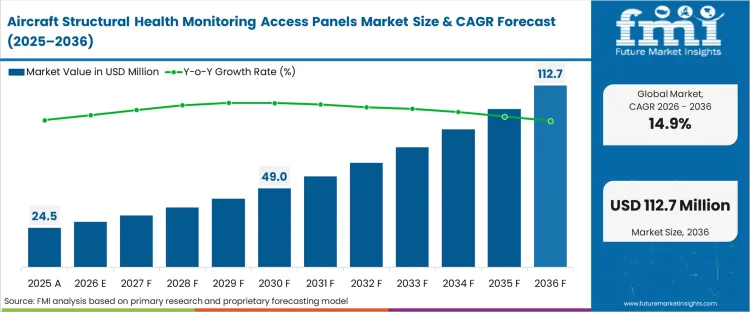
- USD 28.1 Mn
- Forecast (2036)
- USD 112.7 Mn/li>
- CAGR (2026 to 2036)
- 14.9%
Aircraft Structural Health Monitoring Access Panels Market Size, Market Forecast and Outlook By FMI
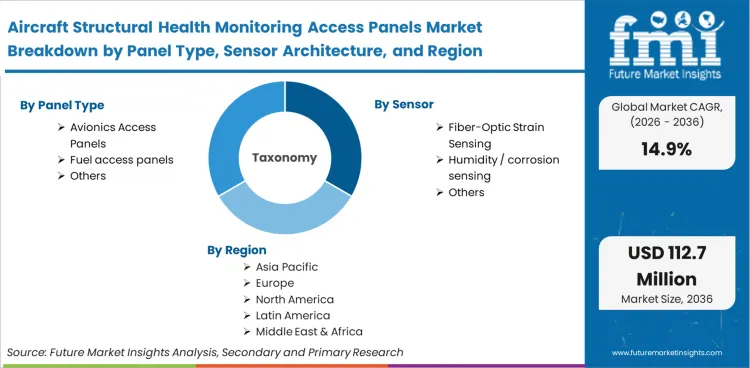
The aircraft structural health monitoring access panels market accomplished a growth of USD 24.5 million in 2025 with the industry poised to surpass USD 28.1 million in 2026 at a CAGR of 14.9% during the decade. The consistent increase in demand encourages a predicted scale to USD 112.7 million through 2036, as fleet operators transition from schedule-based teardowns to continuous in-flight telemetry logging.
Airline maintenance directors face immediate compliance penalties when composite structures sustain undetected micro-fractures. Relying on manual ultrasonic sweeps grounds aircraft for up to forty hours per heavy maintenance check. Procurement teams circumvent this revenue leakage by sourcing sensor-integrated aircraft access panels directly from tier-one suppliers with automated inspection and monitoring capabilities. Selecting passive covers saves unit weight but compounds labor costs over twenty-year airframe lifespans. Fleet managers prioritize aircraft predictive maintenance access panel upgrades to maintain dispatch reliability across aging airframes.
Certification of wireless sensor nodes triggers fleet-wide retrofitting. Once maintenance crews download stress profiles to mobile ground stations without penetrating pressurized vessels with copper wiring, operators bypass traditional inspection intervals entirely. Base maintenance facilities fundamentally rewrite service manuals using aircraft panel fatigue monitoring data.
Summary of Aircraft Structural Health Monitoring Access Panels Market
- Aircraft Structural Health Monitoring Access Panels Market Definition
- Aircraft access panels with embedded sensors represent specialized fuselage hatches equipped with diagnostic telemetry components. Component design converts passive access points into active network nodes that measure stress and environmental degradation.
- Demand Drivers in the Market
- Severe turbulence events force airline maintenance directors to conduct unscheduled composite teardowns.
- EASA airworthiness directives require commercial operators to monitor localized fatigue on aging airframes.
- Turnaround time constraints push line maintenance supervisors to automate structural inspection workflows.
- Key Segments Analyzed in the FMI Report
- Avionics Access Panels: 28.0% in 2026, driven by extreme thermal cycling that degrades adjacent composite plies faster than aerodynamic stress.
- Fiber-Optic Strain Sensing: 31.0% in 2026, favored because optical lines resist lightning strike electromagnetic interference better than copper wiring.
- Retrofit: 57.0% in 2026, as leasing companies demand baseline structural data before transferring mid-life assets.
- Commercial Fixed-Wing: 46.0% in 2026, pushed by procurement officers leveraging telemetry data to negotiate lower fleet insurance premiums.
- Composite Sandwich Panels: 52.0% in 2026, because internal delamination remains invisible to traditional visual inspections.
- China: 16.6% CAGR, resulting from severe domestic shortages of certified manual non-destructive testing technicians.
- Analyst Opinion at FMI
- Nikhil Kaitwade, Principal Analyst at FMI, Automotive, notes that "Generalist prognostications assume airlines adopt structural telemetry to prevent catastrophic mid-air failures. That entirely misses how maintenance operations actually function. Airline procurement officers approve smart aircraft access panels to prove to lessors that airframes have not exceeded design limits during severe turbulence. Without verifiable sensor logs, leasing companies force operators to perform million-dollar structural teardowns before returning aircraft off lease."
- Strategic Implications / Executive Takeaways
- MRO facility commanders face pressure to integrate wireless data extraction protocols into existing turnaround procedures.
- Tier-one component suppliers risk losing contract renewals if they cannot package electronic sensor arrays into standard composite panel dimensions.
- Fleet leasing agents require continuous structural data logs to accurately calculate residual asset values.
- Methodology
- FMI analysts interview procurement directors and composite engineering chiefs to map actual buying behavior.
- Secondary data collection relies on EASA continuing airworthiness directives and FAA transport airplane issues lists.
- Baseline market sizing anchors on commercial aircraft delivery schedules and documented heavy maintenance interval frequencies.
- Forecast validation cross-references tier-one supplier earnings with MRO component installation volumes.
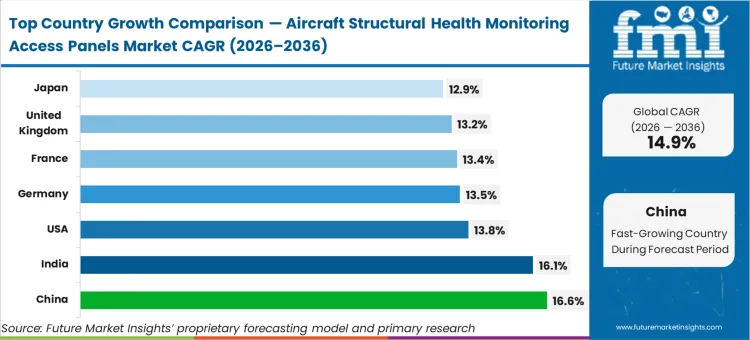
China leads at 16.6% as domestic carriers mandate localized sensor integration to offset critical technician shortages. India tracks at 16.1% fueled by aggressive narrow-body fleet expansion, while United States advances at 13.8% driven by aging military cargo airframe life-extension programs. Germany grows at 13.5%, France at 13.4%, United Kingdom at 13.2%, and Japan at 12.9%. Regulatory divergence dictates whether operators prioritize fatigue tracking or moisture ingress detection across these distinct aviation ecosystems.
Aircraft Structural Health Monitoring Access Panels Market Definition
The aircraft structural health monitoring access panels market definition requires looking at specialized fuselage hatches embedded with diagnostic telemetry components. Engineering specifications require these doors to measure localized stress and thermal degradation while maintaining their primary function as removable maintenance barriers. Integrating sensing layers directly into hatch geometry converts passive points into active network nodes. Component design focuses on maintaining aerodynamic continuity while shielding delicate sensing optics from environmental exposure during flight operations.
Aircraft Structural Health Monitoring Access Panels Market Inclusions
Scope boundaries encompass all removable airframe panels featuring factory-integrated sensing matrices designed for continuous structural diagnostics. Diagnostic components like fiber-optic strain arrays and wireless data-transmission modules embedded within hatch structures fall completely within analysis boundaries. Analysis incorporates structural health monitoring coatings when applied directly to these specific access components. Fastening hardware containing integrated load-monitoring capabilities qualifies only when sold alongside primary hatches.
Aircraft Structural Health Monitoring Access Panels Market Exclusions
Handheld diagnostic ultrasound equipment remains entirely outside scope parameters. Standalone sensors applied to permanent fuselage sections rather than removable access panels do not qualify for inclusion. Flight data recorders and core avionics computing units process gathered telemetry but sit outside physical panel boundaries. General passenger cabin interior panels lacking structural diagnostic capabilities fall entirely outside this specific aerospace hardware category.
Aircraft Structural Health Monitoring Access Panels Market Research Methodology
- Primary Research: Procurement directors at commercial airlines, composite engineering chiefs at tier-one aerostructure suppliers, and base maintenance commanders.
- Desk Research: EASA continuing airworthiness directives, FAA transport airplane issues lists, and maintenance repair organization certification registries.
- Market-Sizing and Forecasting: Annual commercial aircraft delivery schedules cross-referenced with retrofit adoption rates across major global airline alliances.
- Data Validation and Update Cycle: Tier-one supplier earnings reports correlated against component delivery volumes recorded in aviation supply chain databases.
Segmental Analysis
Aircraft Structural Health Monitoring Access Panels Market Analysis by Panel Type
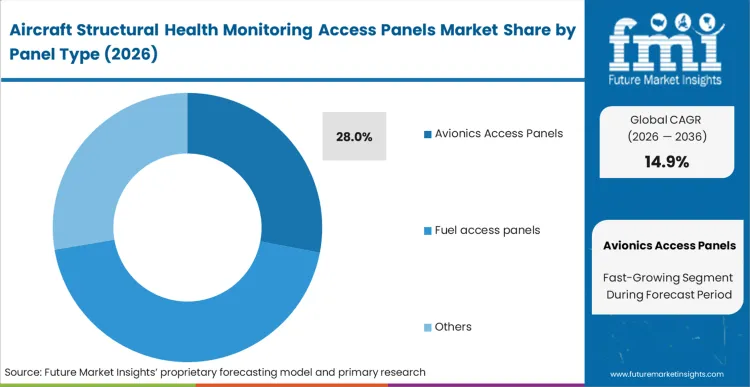
Extreme thermal cycling adjacent to high-power electronics degrades surrounding composite matrices faster than aerodynamic stress alone. Avionics access panels hold 28.0% share in 2026 as engineering chiefs mandate continuous embedded telemetry at these thermal chokepoints. FMI's assessment indicates this density requirement turns basic access doors into critical data-aggregation hubs. Ground crews previously spent hours unfastening cowlings just to insert diagnostic probes. Integrating aircraft sensors directly into hatches allows mechanics to pull thermal degradation data instantly upon landing. What structural engineering models often omit is that physical weight from traditional diagnostic wiring harnesses negates fuel savings from switching to composite panels. Operators clinging to unmonitored hatches face compounding dispatch delays when undocumented heat damage requires sudden part replacement.
- Thermal Mapping: Embedded thermocouples track heat soak propagation across composite plies. Avionics technicians bypass manual thermal gun inspections using avionics access panel monitoring systems during turnaround windows.
- Vibration Isolation: High-frequency trembling from cooling fans induces localized fatigue. Maintenance supervisors utilize engine cowling access panel SHM data to adjust fastener torque schedules dynamically.
- Moisture Detection: Condensation pools inside unvented electronics bays during rapid descent profiles. Engineering directors utilize fuselage corrosion monitoring sensors to authorize preemptive desiccant replacement before arcing occurs.
Aircraft Structural Health Monitoring Access Panels Market Analysis by Sensor Architecture
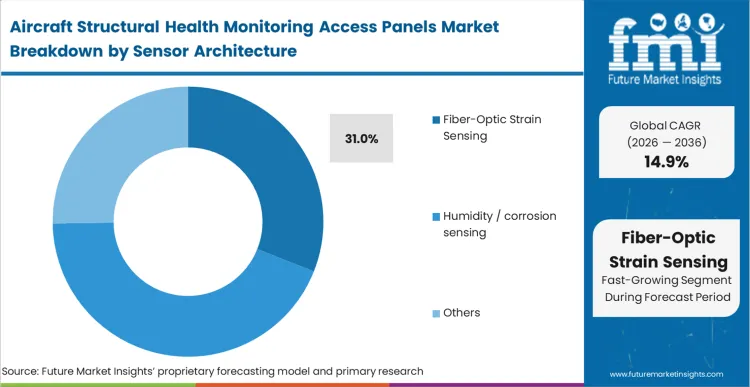
Copper wiring introduces severe lightning strike vulnerabilities when routed through exterior fuselage components. Fiber-optic strain sensing captures 31.0% share in 2026 due to its inherent immunity to electromagnetic interference in harsh flight environments. Electrical engineering directors prioritize fiber optic aircraft access panel sensing to prevent localized sensor shorts from cascading into primary flight control networks. Replacing piezoelectric nodes with optical arrays slashes overall component weight by eliminating heavy electrical shielding. Data accuracy improves significantly when electromagnetic noise generated by engine generators stops interfering with delicate strain measurements. FMI observes that optical architectures quietly shift maintenance bottlenecks from data collection to data storage, forcing airlines to invest heavily in ground-based server capacity. Procurement teams selecting fiber optic sensing for aircraft panels discover that optical systems outlast airframes themselves.
- Optical Alignment: Micro-bending in fiber cores reveals exact points of structural deflection. Structures engineers calculate remaining fatigue life without grounding aircraft.
- Interference Immunity: Optical cables transmit data securely through high-voltage equipment zones. Avionics integration managers reduce overall harness weight by dropping copper shielding requirements.
- Acoustic Detection: Micro-acoustic emissions flag tool drops or bird strikes. Ramp supervisors utilize piezoelectric aircraft panel monitoring to identify hidden subsurface fractures immediately without waiting for scheduled ultrasound sweeps.
Aircraft Structural Health Monitoring Access Panels Market Analysis by Fitment
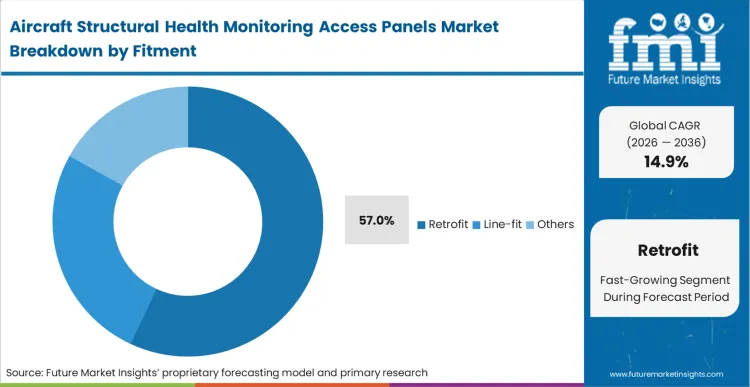
Fleet transition managers evaluating line-fit vs retrofit aircraft SHM panels recognize that installing sensing doors provides cheaper asset validation than conducting full manual composite teardowns. Upgrading passive hatches with surface temperature monitoring systems during scheduled maintenance windows avoids costly out-of-service penalties. Integrating retrofit SHM panels for aircraft requires specific supplemental type certificates that limit which suppliers airlines can actually choose. Mid-life airframes transitioning between lessors require definitive proof of structural integrity before contracts close. Retrofit commands 57.0% share in 2026 as leasing companies force operators to install diagnostic panels during heavy maintenance checks. In FMI's view, massive installed bases of unmonitored early-generation composite aircraft create captive audiences that dwarf new-build delivery volumes. Operators ignoring growth of retrofit SHM hardware in aviation inevitably absorb severe financial penalties during asset handback negotiations.
- Baseline Establishment: Technicians record initial strain signatures immediately after panel installation. Asset managers use this zero-hour data to track subsequent degradation across lease terms.
- Certification Hurdles: Engineering departments must secure regulatory approval for every specific panel geometry modified. Compliance officers experience severe bottlenecks when applying generic sensor kits to legacy airframes.
- Asset Valuation: Continuous telemetry logs prove airframes avoided severe stress events. Leasing directors command higher resale values by presenting incontrovertible structural histories.
Aircraft Structural Health Monitoring Access Panels Market Analysis by Aircraft Type
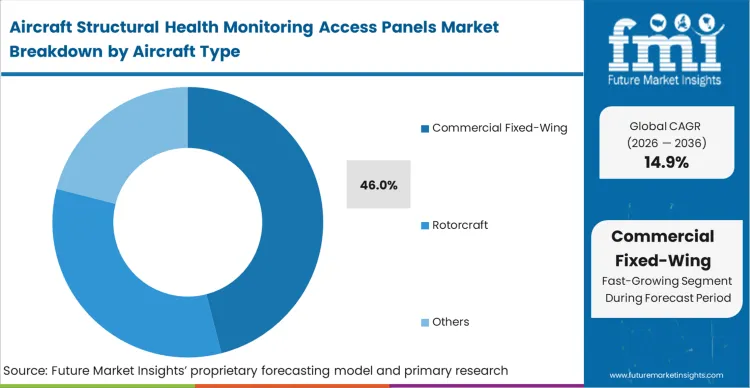
Fleet reliability directors depend on commercial aircraft SHM access panels to keep highly utilized aircraft flying eighteen hours daily. Replacing manual testing sweeps with automated hatch diagnostics saves airlines hundreds of labor hours per heavy maintenance cycle. As per FMI's projection, commercial carriers care less about preventing catastrophic failure than eliminating three-day delays caused by inconclusive visual inspections. The factor that legacy aerostructure providers fail to grasp is that airlines buy these panels to streamline ground operations, not to improve flight dynamics. Airlines ignoring this technology eventually price themselves out of competitive route networks due to bloated maintenance budgets. Profit margins in passenger aviation evaporate entirely when unpredictable maintenance events ground narrow-body fleets. Commercial fixed-wing platforms account for 46.0% share in 2026 as airline procurement officers weaponize telemetry data to negotiate lower insurance premiums.
- Turnaround Velocity: Ground crews download structural logs wirelessly while passengers disembark. Line maintenance supervisors clear aircraft for subsequent flights without opening physical cowlings.
- Insurance Negotiations: Risk managers present verified stress histories to aviation underwriters. Procurement directors secure significant premium reductions by proving fleets operate strictly within design limits.
- Defense Longevity: Heavy transport airframes operate decades beyond original design life. Defense procurement officers require military aircraft structural monitoring panels to safely validate these extreme life-extension programs.
Aircraft Structural Health Monitoring Access Panels Market Analysis by Material Platform
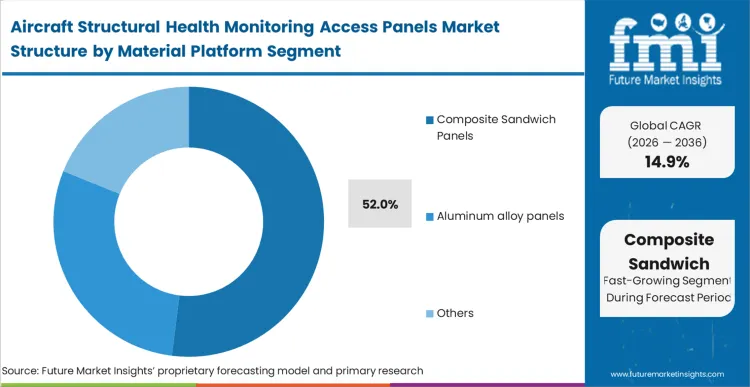
Internal delamination within multi-layered structures remains entirely invisible to routine visual runway inspections. Composite sandwich panels hold 52.0% share in 2026 as regulatory bodies mandate embedded diagnostics for all primary composite load paths. Materials engineering heads acknowledge that carbon fiber behaves unpredictably under repetitive point loads, necessitating continuous strain tracking. Swapping legacy aluminum access doors for composite airframes requires simultaneous sensor integration to satisfy stringent EASA continuing airworthiness directives. Embedding sensors directly into resin matrices during layup processes prevents optical fibers from detaching under severe aerodynamic flutter. FMI analysts note that composite access panels aircraft monitoring effectively merges materials supply chains with electronics supply chains, forcing traditional carbon-fiber weavers to acquire avionics expertise. Suppliers failing to master this hybrid manufacturing process lose tier-one status entirely.
- Resin Curing: Manufacturers embed optical fibers between carbon plies prior to autoclave processing. Production managers monitor internal resin flow temperatures to guarantee perfect panel consolidation.
- Impact Tracking: Hidden subsurface fractures plague modern airframes. Ramp supervisors solve aircraft composite panel impact detection problems by reviewing localized acoustic sensor logs immediately after suspected bird strikes.
- Moisture Ingress: Embedded capacitive sensors detect water accumulation inside honeycomb cores. Maintenance directors order preemptive panel replacement before trapped moisture freezes and shatters composite structures at altitude.
Aircraft Structural Health Monitoring Access Panels Market Drivers, Restraints, and Opportunities
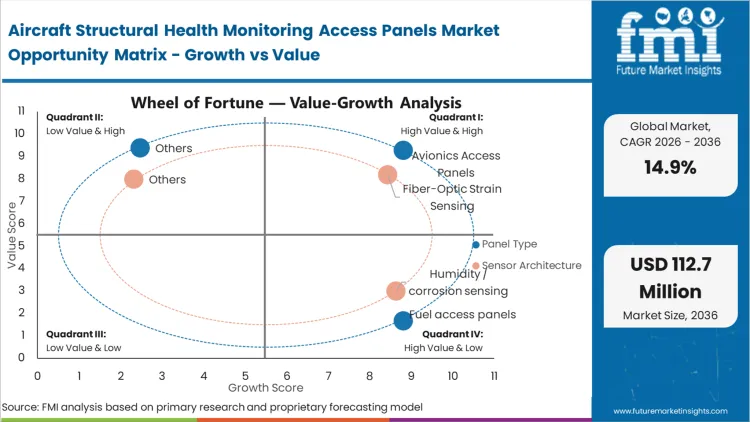
Severe turbulence events force airline maintenance directors to conduct unscheduled composite teardowns to verify airframe integrity. Relying on manual ultrasonic testing keeps revenue-generating assets inside hangars for days while technicians map every inch of affected fuselages. Airline procurement teams demand aircraft access panel damage detection capabilities to drastically compress these post-event inspection timelines. Downloading stress profiles directly from panels allows line maintenance supervisors to clear aircraft for flight within hours rather than days. Fleet operations managers realize that possessing verifiable telemetry data immediately ends debates with leasing companies over potential structural exceedances. Focus shifts rapidly toward reducing unscheduled aircraft panel inspections to protect razor-thin operating margins.
Wiring weight penalties severely constrain broad deployment of diagnostic panels across entire fuselages. Routing copper data cables from distant tail access hatches to central avionics bays adds hundreds of pounds to airframes, negating inherent weight benefits of composite structures. Engineering chiefs resist adding extensive harness networks through pressurized bulkheads due to strict certification challenges for aircraft SHM panels. Localized wireless transmission nodes offer partial solutions, but powering these transmitters requires either bulky batteries or complex energy-harvesting piezoelectric arrays.
Opportunities in the Aircraft Structural Health Monitoring Access Panels Market
- Energy Harvesting: Piezoelectric materials convert airframe vibration directly into electrical current. Systems engineering directors eliminate heavy battery packs and wiring harnesses from remote diagnostic panels entirely.
- Manufacturing Automation: Robotic tape-laying machines integrate delicate optical fibers automatically during production. Operations managers at composite facilities utilize smart composite layup machines for aerospace to dramatically reduce sensor breakage rates.
- Digital Integration: Ground-based algorithms process terabytes of strain data to predict component failure timelines. Fleet reliability directors exploring digital twin integration aircraft structural panels transition entirely from schedule-based component replacement to precise condition-based maintenance protocols.
Regional Analysis
Based on regional analysis, Aircraft Structural Health Monitoring Access Panels is segmented into North America, Europe, Asia Pacific, and Rest of the World across 40 plus countries with the global adoption for the market reflecting a stark structural divide, where legacy fleet life-extension programs dominate Western maintenance hangars while acute technical labor shortages drive integration across Eastern aviation hubs. Fleet commanders globally prioritize continuous telemetry to secure verifiable asset histories over manual inspection cycles.
.webp "Top Country Growth Comparison Aircraft Structural Health Monitoring Access Panels Market Cagr (2026 2036)")
| Country | CAGR (2026 to 2036) |
|---|---|
| China | 16.6% |
| India | 16.1% |
| United States | 13.8% |
| Germany | 13.5% |
| France | 13.4% |
| United Kingdom | 13.2% |
| Japan | 12.9% |
Source: Future Market Insights (FMI) analysis, based on proprietary forecasting model and primary research
Asia-Pacific Aircraft Structural Health Monitoring Access Panels Market Analysis
Expanding narrow-body fleets place unprecedented strain on underdeveloped maintenance infrastructure across this geography. Bypassing a severe regional shortage of Level-3 certified non-destructive testing technicians fundamentally requires airline operations directors to aggressively deploy automated diagnostic hatches. Regional civil aviation authorities actively encourage telemetry adoption to maintain safety margins amid explosive passenger volume increases, allowing localized facilities to service aircraft without importing expensive foreign technical expertise. Operations directors mandate integrated sensors on all incoming leased equipment to standardize ground handling procedures, making continuous structural tracking a strict operational necessity rather than a luxury upgrade.
- China: 16.6% CAGR in China reflects how base maintenance commanders struggle to process massive volumes of mandatory structural checks on rapidly aging domestic fleets. Regional airlines cut heavy maintenance downtime by forty percent and gain massive commercial advantages by installing sensor-embedded hatches that shift analytical burdens from local hangars to centralized data hubs.
- India: Fleet reliability managers battle severe dispatch delays caused by mandatory manual inspections following frequent monsoon-season turbulence events, pushing India to a 16.1% of CAGR. Ground crews instantly verify structural limits without pulling aircraft offline by integrating automated strain sensors, a capability that structurally separates tier-one operators from regional competitors struggling with unpredictable maintenance grounding.
- Japan: Engineering directors specify multi-modal sensing panels to prevent hidden corrosion inside composite honeycomb cores because stringent domestic regulatory frameworks compel major carriers to track microscopic moisture ingress across high-humidity coastal flight routes. This proactive stance structurally guarantees higher residual asset values, securing a CAGR trajectory of 12.9% for Japan, when transitioning aircraft to secondary operators.
FMI's report includes South Korea, Taiwan, Bangladesh, and Sri Lanka. Aviation authorities across the region rewrite compliance protocols to officially recognize automated telemetry logs as valid substitutes for physical inspections, while regional MRO facilities integrate advanced diagnostic readers directly into standard turnaround toolkits to accommodate telemetry-equipped foreign fleets.
North America Aircraft Structural Health Monitoring Access Panels Market Analysis
Safely operating heavy transport airframes decades beyond their original design life demands sophisticated diagnostic hatches from defense procurement officers. Massive legacy installed bases force operators to prioritize aftermarket retrofit kits over waiting for factory-integrated solutions. Domestic airlines find a proven method to monitor localized fatigue on aging composite fuselages by transitioning this validated military technology into commercial fleets. Military cargo life-extension programs ultimately dictate the adoption curves across North America.
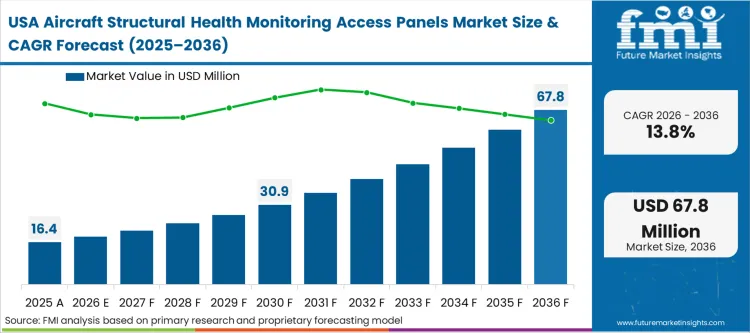
- United States: Risk management directors secure substantial premium reductions by proving airframes operate securely within prescribed structural limits, driving the United States toward a 13.8% of CAGR, while major commercial carriers utilize this comprehensive telemetry data to renegotiate restrictive terms with aviation insurance underwriters. This financial lever shifts diagnostic hardware from pure maintenance expenses into strategic corporate assets.
FMI's report includes Canada and Mexico. Cross-border leasing agencies mandate structural data continuity before approving asset transfers between regional operators.
Europe Aircraft Structural Health Monitoring Access Panels Market Analysis
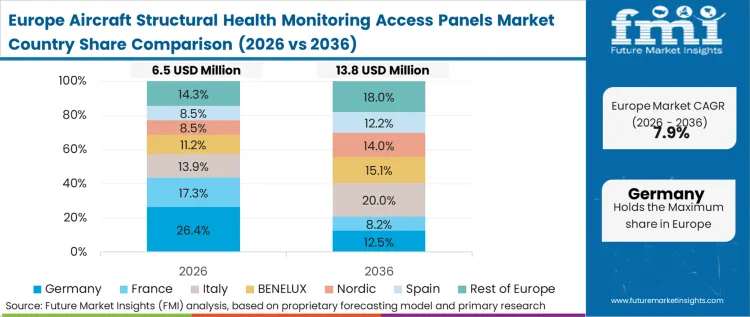
European tier-one aerostructure suppliers lead the integration of optical sensing fibers directly into resin matrices of primary load-bearing doors. Quality assurance directors across the continent deploy monitored access panels to comply strictly with mandates surrounding hidden subsurface delamination because stringent EASA continuing airworthiness directives compel operators to implement highly specific tracking mechanisms for composite degradation. Proximity to major airframe manufacturers creates an environment where factory-installed telemetry rapidly becomes the baseline standard for new deliveries.
- France: A 13.4% of CAGR characterizes France as composite manufacturing hubs mandate the integration of thermal and strain sensors directly into initial layup processes. Production managers achieve zero-defect component validation by monitoring internal resin temperatures during autoclave curing, structurally linking manufacturing quality directly to in-flight performance monitoring.
- United Kingdom: Avionics directors specify pure optical sensor arrays for all new hatch designs to immunize critical data streams against lightning strikes, steering the United Kingdom along a 13.2% CAGR curve, as aerospace engineering consortiums focus heavily on resolving electromagnetic interference challenges associated with copper diagnostic wiring. Structural trajectories point toward completely wireless, self-powered diagnostic nodes within the next decade.
- Germany: Maintenance supervisors utilize continuous data streams to preemptively replace degrading fasteners before they shear, ensuring maximum dispatch reliability for critical overnight logistics networks. Generating a 13.5% CAGR trajectory in Germany, high-volume cargo operators demand precise vibration telemetry to track fatigue induced by continuous heavy payload cycling.
FMI's report includes Italy and Spain. Regional aerospace clusters collaborate specifically on standardizing wireless data transmission protocols alongside aerospace engineering services outsourcing providers to streamline European fleet compliance.
Competitive Aligners for Market Players
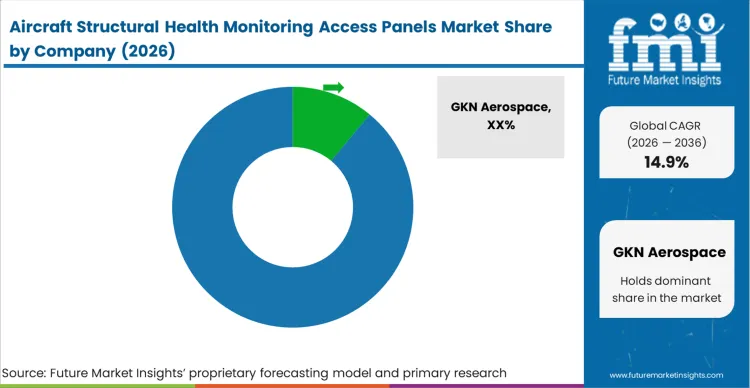
Certifying a primary aerodynamic structure forms an absolute barrier that pure electronics firms simply cannot cross independently. Procurement directors at major airframers restrict sourcing exclusively to aircraft structural monitoring panel suppliers possessing multi-decade track records in aerospace materials compliance, treating the sensing capability as a secondary requirement to physical integrity. This structural reality cements the dominance of tier-one composite manufacturers like GKN Aerospace and Spirit AeroSystems, whose core competency lies in navigating exhaustive flight-safety qualifications rather than software development. Suppliers such as Daher and Hutchinson maintain their strategic footing by mastering the complex physical integration of delicate optical fibers into rigid composite matrices without compromising the panel's fundamental load-bearing characteristics. Because the diagnostic hatch must first survive severe aerodynamic flutter and extreme thermal cycling before transmitting a single byte of data, developers of sensor-integrated aircraft access panels face a difficult choice. They are forced to license their telemetry hardware to these established aerostructure giants instead of selling directly to airlines, effectively creating a symbiotic supply chain where aerospace heritage outranks digital innovation. The inability to unilaterally certify these hybrid components keeps software-focused startups locked out of direct airframe negotiations entirely.
Possessing terabytes of historical flight data allows incumbent aircraft SHM panel manufacturers to program diagnostic hatches that actively filter out routine aerodynamic noise. Specialized sensing developers like Luna Innovations and Acellent Technologies translate this massive volume of raw strain data into actionable insights, ensuring aircraft access panels with embedded sensors transmit only critical structural alerts rather than burying mechanics in irrelevant vibration logs. Emerging competitors can easily reverse-engineer a monitored hatch, but without the algorithmic maturity to interpret the resulting telemetry, their panels generate endless false positives that immediately frustrate ground crews conducting aircraft access panel damage detection. Operations directors explicitly mandate that new diagnostic components must integrate flawlessly with existing AI predictive maintenance software architectures to prevent data silos on the hangar floor. This absolute necessity for algorithmic precision turns historical flight data into an insurmountable moat, preventing new entrants from achieving the diagnostic accuracy required for commercial certification. Securing a seat at the procurement table requires proving that the panel's internal logic can accurately distinguish between a harmless runway bump and a critical subsurface composite fracture.
Weaponizing their massive purchasing scale, major buyers of commercial aircraft SHM access panels actively dismantle vendor lock-in by enforcing open-architecture transmission protocols across all diagnostic hardware. Maintenance directors refuse to equip line technicians with proprietary diagnostic readers for every different panel manufacturer represented on a mixed commercial fleet. Fleet managers utilize their leverage to force integrated avionics leaders like Collins Aerospace to adopt open data formats, guaranteeing that aircraft panel fatigue monitoring logs remain accessible regardless of which specific company physically manufactured the hatch. Refusing to open these proprietary data ecosystems triggers immediate disqualification during lucrative aftermarket retrofit procurement cycles, where airlines dictate the technical terms. Suppliers who successfully decouple their hardware from restrictive software environments position themselves to capture the vast majority of legacy fleet upgrade contracts. The competitive battle ultimately centers on who can provide the most frictionless data offload experience for ground crews working under extreme turnaround time constraints. Companies insisting on closed digital environments find their technologically superior panels repeatedly rejected by procurement officers optimizing for fleet-wide operational uniformity.
Key Players in Aircraft Structural Health Monitoring Access Panels Market
- GKN Aerospace
- Hutchinson
- Daher
- Spirit AeroSystems
- Luna Innovations
- Acellent Technologies
- Collins Aerospace
Scope of the Report
| Metric | Value |
|---|---|
| Quantitative Units | USD 28.1 million to USD 112.7 million, at a CAGR of 14.9% |
| Market Definition | Aircraft structural health monitoring access panels are specialized fuselage and wing hatches embedded with diagnostic telemetry components. Component design converts passive access points into active network nodes that measure stress and environmental degradation. |
| Segmentation | Panel type, Sensor architecture, Fitment, Aircraft type, Material platform, and Region |
| Regions Covered | North America, Latin America, Western Europe, Eastern Europe, South Asia and Pacific, East Asia, Middle East and Africa |
| Countries Covered | United States, Canada, Mexico, Brazil, Germany, France, United Kingdom, Italy, Spain, Russia, India, ASEAN, Australia, China, Japan, South Korea, GCC Countries, South Africa |
| Key Companies Profiled | GKN Aerospace, Hutchinson, Daher, Spirit AeroSystems, Luna Innovations, Acellent Technologies, Collins Aerospace |
| Forecast Period | 2026 to 2036 |
| Approach | Annual commercial aircraft delivery schedules cross-referenced with retrofit adoption rates across major global airline alliances. |
Source: Future Market Insights (FMI) analysis, based on proprietary forecasting model and primary research
Key Segments
Panel Type
- Avionics access panels
- Engine / fan-cowl access panels
- Fuel access panels
- Hydraulic service panels
- Landing-gear service panels
Sensor Architecture
- Fiber-optic strain sensing
- Piezoelectric vibration sensing
- Humidity / corrosion sensing
- Temperature sensing
- Position / latch-state sensing
Fitment
- Retrofit
- Line-fit
- Aftermarket replacement kits
Aircraft Type
- Commercial fixed-wing
- Military fixed-wing
- Rotorcraft
- Business jets
- UAV / special mission aircraft
Material Platform
- Composite sandwich panels
- Aluminum alloy panels
- Titanium-reinforced panels
- Hybrid composite-metal panels
Regions:
- North America
- United States
- Canada
- Mexico
- Latin America
- Brazil
- Argentina
- Chile
- Europe
- Germany
- United Kingdom
- France
- Italy
- Spain
- Asia-Pacific
- China
- Japan
- South Korea
- India
- ASEAN
- ANZ
- Middle East & Africa
- UAE
- Saudi Arabia
- South Africa
Bibliography
- Ogunleye, R.O., & others. (2024, August). Advanced sensors and sensing systems for structural health monitoring in aerospace applications: A review. Advanced Engineering Materials.
- Federal Aviation Administration. (2024, July). Transport Airplane Issues List, 2024 Q2. U.S. Department of Transportation.
- Khalid, I., Qureshi, Z. A., Oterkus, S., & Oterkus, E. (2025, January). Structural health monitoring of aerospace thin plate and shell structures using the inverse finite element method (iFEM). Thin-Walled Structures.
- National Aeronautics and Space Administration. (2025). Aerospace Safety Advisory Panel 2025 Annual Report. NASA.
- Scarselli, G., & others. (2025, October). Machine learning for structural health monitoring of aerospace systems: A review. Sensors.
This bibliography is provided for reader reference. The full FMI report contains the complete reference list with primary source documentation.
This Report Addresses
- Procurement strategies for integrating fiber-optic strain arrays into legacy commercial fleets.
- Certification bottlenecks delaying wireless diagnostic hatch deployment across major aviation alliances.
- Labor cost reductions achieved by replacing manual ultrasonic sweeps with automated telemetry.
- Insurance premium negotiations driven by verifiable structural health logs.
- Manufacturing challenges surrounding embedded optical fibers in composite sandwich panels.
- Regulatory divergence between EASA and FAA regarding continuous airworthiness monitoring.
- Competitive positioning of aerostructure giants versus software-focused diagnostic startups.
- Leasing asset valuation dynamics impacted by presence of verifiable structural data.
Frequently Asked Questions
What are aircraft structural health monitoring access panels?
They are specialized removable fuselage hatches embedded with diagnostic telemetry components designed to measure localized stress and environmental degradation without requiring physical dismantling of airframe structures.
How do sensor-integrated aircraft access panels work?
Embedded optical fibers or piezoelectric sensors convert passive access points into active network nodes by measuring structural deflections and transmitting raw telemetry wirelessly to ground-based diagnostic servers.
Why are smart access panels relevant to predictive maintenance in aviation?
Continuous in-flight telemetry logging empowers fleet reliability directors to transition from schedule-based component replacement to precise condition-based maintenance protocols, avoiding unnecessary teardowns by calculating exact component fatigue life.
Are smart aircraft access panels line-fit or retrofit?
Retrofit commands 57.0% share in 2026 as leasing companies force operators to install diagnostic panels during heavy maintenance checks to secure verifiable asset histories before transitioning mid-life airframes.
Which sensors are used in aircraft SHM panels?
Fiber-optic strain sensing captures 31.0% share because electrical engineering directors prioritize optical architectures for their inherent immunity against electromagnetic interference, preventing localized sensor shorts from cascading into primary flight control networks.
Compare aircraft SHM access panels with SHM coatings?
While coatings offer broad surface-level strain visualization across large unbroken structures, monitored access panels provide deep structural telemetry specifically focused on high-stress intersections and frequently removed composite hatches.
Who are the leading companies in aircraft SHM access panels?
Incumbent tier-one aerostructure manufacturers like GKN Aerospace and Spirit AeroSystems maintain dominance because their core competencies lie in certifying primary aerodynamic structures, locking out software-only diagnostic startups.
Give me the forecast for sensor-integrated aircraft access panels?
Demand is poised to reach USD 28.1 million in 2026 and propel to USD 112.7 million through 2036 at a CAGR of 14.9% as fleet operators prioritize automated inspection capabilities.
How do operators determine the ROI of smart aircraft access panels?
Procurement directors secure significant premium reductions by presenting verified stress histories to aviation underwriters, proving fleets operate strictly within design limits and shifting diagnostic panels from pure maintenance expenses into strategic corporate assets.
What changes structurally about market competition toward 2036?
Airlines wield massive purchasing power to force standardized open-architecture data formats upon tier-one suppliers, meaning aerostructure manufacturers who refuse to abandon proprietary diagnostic readers face immediate disqualification from lucrative fleet-wide retrofit contracts.
Why do avionics access panels hold 28.0% share in 2026?
Avionics access panels hold 28.0% share because high-power electronics induce extreme localized thermal cycling, forcing engineering chiefs to mandate dense sensor integration at these specific points to track heat soak propagation before catastrophic matrix failure occurs.
Why do retrofit applications command 57.0% share?
Retrofit applications command 57.0% share because leasing companies refuse to accept mid-life airframes off lease without definitive proof of structural integrity, prompting fleet transition managers to install diagnostic panels during heavy maintenance checks to avoid million-dollar manual teardowns.
How does commercial fixed-wing application shape demand?
Commercial fixed-wing operators shape demand by utilizing automated telemetry to drastically compress ground turnaround times while leveraging continuous structural data to prove safe operations and secure substantial insurance premium reductions.
Why do composite sandwich panels necessitate embedded sensors?
Materials engineering heads specify integrated sensors for composite sandwich panels because internal honeycomb delamination remains entirely invisible to routine exterior visual inspections, necessitating early detection of hidden fractures and moisture accumulation before high-altitude freezing shatters the structure.
Why does China grow at 16.6% compared to other regions?
China grows at 16.6% because explosive domestic fleet expansion vastly outpaces the training of certified non-destructive testing technicians, forcing base maintenance commanders to deploy automated diagnostic hatches that shift analytical burdens to centralized data hubs.
What specific operational friction slows broader diagnostic adoption?
Broader diagnostic adoption is slowed by weight penalties associated with routing copper data cables that negate the benefits of composite structures, causing engineering chiefs to delay full implementation until wireless nodes clear strict regulatory certification hurdles.
How do operators circumvent manual ultrasonic sweep delays?
Line maintenance supervisors circumvent delays by utilizing diagnostic panels to download stress profiles wirelessly while passengers disembark, allowing ground crews to clear aircraft for subsequent flights within minutes instead of enduring forty-hour manual inspection groundings.
How does moisture detection influence engineering workflows?
Because condensation pools inside unvented electronics bays during rapid descent profiles, maintenance directors use embedded capacitive sensor data to authorize preemptive desiccant replacement long before trapped water causes critical electrical arcing.
What hidden costs emerge from passive access panels?
While selecting unmonitored hatches saves initial unit weight, operators absorb severe financial penalties over a twenty-year lifespan through compounding labor costs and sudden dispatch delays when undocumented structural damage forces unexpected component replacement.
Why do low-cost carriers in India prioritize self-diagnosing panels?
Low-cost carriers in India prioritize self-diagnosing panels because aggressive narrow-body fleet utilization leaves zero margin for unpredictable maintenance grounding, prompting procurement directors to specify automated sensors that instantly verify structural limits following severe monsoon-season turbulence.
How do smart layup machines impact sensor deployment?
Robotic tape-laying equipment integrates optical fibers directly into resin matrices during production, allowing operations managers to eliminate manual handling errors, drastically reduce sensor breakage rates, and lower the final unit costs of diagnostic panels.
What structural difference explains US versus European adoption?
US deployment anchors heavily on life-extension retrofit kits for aging military cargo fleets, whereas European adoption centers on tier-one aerostructure suppliers embedding sensors directly into the initial manufacturing processes for new commercial deliveries.
Why do materials engineering heads resist traditional wiring?
Materials engineering heads resist traditional wiring because the physical mass of standard diagnostic harnesses often exceeds the weight saved by switching to composite doors, a structural contradiction that forces the pursuit of purely optical or wireless architectures.
How do piezoelectric nodes alter ramp operations?
By registering acoustic micro-emissions from tool drops or minor support vehicle collisions, piezoelectric nodes allow ramp supervisors to immediately identify hidden subsurface fractures and prevent minor impacts from escalating into catastrophic in-flight structural failures.
Preview the report firsthand - request a free sample
Get SampleGet the brochure for pricing and purchase details.
Get PDFTable of Content
- Executive Summary
- Global Market Outlook
- Demand-side Trends
- Supply-side Trends
- Technology Roadmap Analysis
- Analysis and Recommendations
- Market Overview
- Market Coverage / Taxonomy
- Market Definition / Scope / Limitations
- Research Methodology
- Chapter Orientation
- Analytical Lens and Working Hypotheses
- Market Structure, Signals, and Trend Drivers
- Benchmarking and Cross-market Comparability
- Market Sizing, Forecasting, and Opportunity Mapping
- Research Design and Evidence Framework
- Desk Research Programme (Secondary Evidence)
- Company Annual and Sustainability Reports
- Peer-reviewed Journals and Academic Literature
- Corporate Websites, Product Literature, and Technical Notes
- Earnings Decks and Investor Briefings
- Statutory Filings and Regulatory Disclosures
- Technical White Papers and Standards Notes
- Trade Journals, Industry Magazines, and Analyst Briefs
- Conference Proceedings, Webinars, and Seminar Materials
- Government Statistics Portals and Public Data Releases
- Press Releases and Reputable Media Coverage
- Specialist Newsletters and Curated Briefings
- Sector Databases and Reference Repositories
- FMI Internal Proprietary Databases and Historical Market Datasets
- Subscription Datasets and Paid Sources
- Social Channels, Communities, and Digital Listening Inputs
- Additional Desk Sources
- Expert Input and Fieldwork (Primary Evidence)
- Primary Modes
- Qualitative Interviews and Expert Elicitation
- Quantitative Surveys and Structured Data Capture
- Blended Approach
- Why Primary Evidence is Used
- Field Techniques
- Interviews
- Surveys
- Focus Groups
- Observational and In-context Research
- Social and Community Interactions
- Stakeholder Universe Engaged
- C-suite Leaders
- Board Members
- Presidents and Vice Presidents
- R&D and Innovation Heads
- Technical Specialists
- Domain Subject-matter Experts
- Scientists
- Physicians and Other Healthcare Professionals
- Governance, Ethics, and Data Stewardship
- Research Ethics
- Data Integrity and Handling
- Primary Modes
- Tooling, Models, and Reference Databases
- Desk Research Programme (Secondary Evidence)
- Data Engineering and Model Build
- Data Acquisition and Ingestion
- Cleaning, Normalisation, and Verification
- Synthesis, Triangulation, and Analysis
- Quality Assurance and Audit Trail
- Market Background
- Market Dynamics
- Drivers
- Restraints
- Opportunity
- Trends
- Scenario Forecast
- Demand in Optimistic Scenario
- Demand in Likely Scenario
- Demand in Conservative Scenario
- Opportunity Map Analysis
- Product Life Cycle Analysis
- Supply Chain Analysis
- Investment Feasibility Matrix
- Value Chain Analysis
- PESTLE and Porter’s Analysis
- Regulatory Landscape
- Regional Parent Market Outlook
- Production and Consumption Statistics
- Import and Export Statistics
- Market Dynamics
- Global Market Analysis 2021 to 2025 and Forecast, 2026 to 2036
- Historical Market Size Value (USD Million) Analysis, 2021 to 2025
- Current and Future Market Size Value (USD Million) Projections, 2026 to 2036
- Y-o-Y Growth Trend Analysis
- Absolute $ Opportunity Analysis
- Global Market Pricing Analysis 2021 to 2025 and Forecast 2026 to 2036
- Global Market Analysis 2021 to 2025 and Forecast 2026 to 2036, By Panel Type
- Introduction / Key Findings
- Historical Market Size Value (USD Million) Analysis By Panel Type , 2021 to 2025
- Current and Future Market Size Value (USD Million) Analysis and Forecast By Panel Type , 2026 to 2036
- Avionics Access Panels
- Fuel access panels
- Others
- Avionics Access Panels
- Y-o-Y Growth Trend Analysis By Panel Type , 2021 to 2025
- Absolute $ Opportunity Analysis By Panel Type , 2026 to 2036
- Global Market Analysis 2021 to 2025 and Forecast 2026 to 2036, By Sensor Architecture
- Introduction / Key Findings
- Historical Market Size Value (USD Million) Analysis By Sensor Architecture, 2021 to 2025
- Current and Future Market Size Value (USD Million) Analysis and Forecast By Sensor Architecture, 2026 to 2036
- Fiber-Optic Strain Sensing
- Humidity / corrosion sensing
- Others
- Fiber-Optic Strain Sensing
- Y-o-Y Growth Trend Analysis By Sensor Architecture, 2021 to 2025
- Absolute $ Opportunity Analysis By Sensor Architecture, 2026 to 2036
- Global Market Analysis 2021 to 2025 and Forecast 2026 to 2036, By Fitment
- Introduction / Key Findings
- Historical Market Size Value (USD Million) Analysis By Fitment, 2021 to 2025
- Current and Future Market Size Value (USD Million) Analysis and Forecast By Fitment, 2026 to 2036
- Retrofit
- Line-fit
- Others
- Retrofit
- Y-o-Y Growth Trend Analysis By Fitment, 2021 to 2025
- Absolute $ Opportunity Analysis By Fitment, 2026 to 2036
- Global Market Analysis 2021 to 2025 and Forecast 2026 to 2036, By Aircraft Type
- Introduction / Key Findings
- Historical Market Size Value (USD Million) Analysis By Aircraft Type, 2021 to 2025
- Current and Future Market Size Value (USD Million) Analysis and Forecast By Aircraft Type, 2026 to 2036
- Commercial Fixed-Wing
- Rotorcraft
- Others
- Commercial Fixed-Wing
- Y-o-Y Growth Trend Analysis By Aircraft Type, 2021 to 2025
- Absolute $ Opportunity Analysis By Aircraft Type, 2026 to 2036
- Global Market Analysis 2021 to 2025 and Forecast 2026 to 2036, By Material Platform
- Introduction / Key Findings
- Historical Market Size Value (USD Million) Analysis By Material Platform, 2021 to 2025
- Current and Future Market Size Value (USD Million) Analysis and Forecast By Material Platform, 2026 to 2036
- Composite Sandwich Panels
- Aluminum alloy panels
- Others
- Composite Sandwich Panels
- Y-o-Y Growth Trend Analysis By Material Platform, 2021 to 2025
- Absolute $ Opportunity Analysis By Material Platform, 2026 to 2036
- Global Market Analysis 2021 to 2025 and Forecast 2026 to 2036, By Region
- Introduction
- Historical Market Size Value (USD Million) Analysis By Region, 2021 to 2025
- Current Market Size Value (USD Million) Analysis and Forecast By Region, 2026 to 2036
- North America
- Latin America
- Western Europe
- Eastern Europe
- East Asia
- South Asia and Pacific
- Middle East & Africa
- Market Attractiveness Analysis By Region
- North America Market Analysis 2021 to 2025 and Forecast 2026 to 2036, By Country
- Historical Market Size Value (USD Million) Trend Analysis By Market Taxonomy, 2021 to 2025
- Market Size Value (USD Million) Forecast By Market Taxonomy, 2026 to 2036
- By Country
- USA
- Canada
- Mexico
- By Panel Type
- By Sensor Architecture
- By Fitment
- By Aircraft Type
- By Material Platform
- By Country
- Market Attractiveness Analysis
- By Country
- By Panel Type
- By Sensor Architecture
- By Fitment
- By Aircraft Type
- By Material Platform
- Key Takeaways
- Latin America Market Analysis 2021 to 2025 and Forecast 2026 to 2036, By Country
- Historical Market Size Value (USD Million) Trend Analysis By Market Taxonomy, 2021 to 2025
- Market Size Value (USD Million) Forecast By Market Taxonomy, 2026 to 2036
- By Country
- Brazil
- Chile
- Rest of Latin America
- By Panel Type
- By Sensor Architecture
- By Fitment
- By Aircraft Type
- By Material Platform
- By Country
- Market Attractiveness Analysis
- By Country
- By Panel Type
- By Sensor Architecture
- By Fitment
- By Aircraft Type
- By Material Platform
- Key Takeaways
- Western Europe Market Analysis 2021 to 2025 and Forecast 2026 to 2036, By Country
- Historical Market Size Value (USD Million) Trend Analysis By Market Taxonomy, 2021 to 2025
- Market Size Value (USD Million) Forecast By Market Taxonomy, 2026 to 2036
- By Country
- Germany
- UK
- Italy
- Spain
- France
- Nordic
- BENELUX
- Rest of Western Europe
- By Panel Type
- By Sensor Architecture
- By Fitment
- By Aircraft Type
- By Material Platform
- By Country
- Market Attractiveness Analysis
- By Country
- By Panel Type
- By Sensor Architecture
- By Fitment
- By Aircraft Type
- By Material Platform
- Key Takeaways
- Eastern Europe Market Analysis 2021 to 2025 and Forecast 2026 to 2036, By Country
- Historical Market Size Value (USD Million) Trend Analysis By Market Taxonomy, 2021 to 2025
- Market Size Value (USD Million) Forecast By Market Taxonomy, 2026 to 2036
- By Country
- Russia
- Poland
- Hungary
- Balkan & Baltic
- Rest of Eastern Europe
- By Panel Type
- By Sensor Architecture
- By Fitment
- By Aircraft Type
- By Material Platform
- By Country
- Market Attractiveness Analysis
- By Country
- By Panel Type
- By Sensor Architecture
- By Fitment
- By Aircraft Type
- By Material Platform
- Key Takeaways
- East Asia Market Analysis 2021 to 2025 and Forecast 2026 to 2036, By Country
- Historical Market Size Value (USD Million) Trend Analysis By Market Taxonomy, 2021 to 2025
- Market Size Value (USD Million) Forecast By Market Taxonomy, 2026 to 2036
- By Country
- China
- Japan
- South Korea
- By Panel Type
- By Sensor Architecture
- By Fitment
- By Aircraft Type
- By Material Platform
- By Country
- Market Attractiveness Analysis
- By Country
- By Panel Type
- By Sensor Architecture
- By Fitment
- By Aircraft Type
- By Material Platform
- Key Takeaways
- South Asia and Pacific Market Analysis 2021 to 2025 and Forecast 2026 to 2036, By Country
- Historical Market Size Value (USD Million) Trend Analysis By Market Taxonomy, 2021 to 2025
- Market Size Value (USD Million) Forecast By Market Taxonomy, 2026 to 2036
- By Country
- India
- ASEAN
- Australia & New Zealand
- Rest of South Asia and Pacific
- By Panel Type
- By Sensor Architecture
- By Fitment
- By Aircraft Type
- By Material Platform
- By Country
- Market Attractiveness Analysis
- By Country
- By Panel Type
- By Sensor Architecture
- By Fitment
- By Aircraft Type
- By Material Platform
- Key Takeaways
- Middle East & Africa Market Analysis 2021 to 2025 and Forecast 2026 to 2036, By Country
- Historical Market Size Value (USD Million) Trend Analysis By Market Taxonomy, 2021 to 2025
- Market Size Value (USD Million) Forecast By Market Taxonomy, 2026 to 2036
- By Country
- Kingdom of Saudi Arabia
- Other GCC Countries
- Turkiye
- South Africa
- Other African Union
- Rest of Middle East & Africa
- By Panel Type
- By Sensor Architecture
- By Fitment
- By Aircraft Type
- By Material Platform
- By Country
- Market Attractiveness Analysis
- By Country
- By Panel Type
- By Sensor Architecture
- By Fitment
- By Aircraft Type
- By Material Platform
- Key Takeaways
- Key Countries Market Analysis
- USA
- Pricing Analysis
- Market Share Analysis, 2025
- By Panel Type
- By Sensor Architecture
- By Fitment
- By Aircraft Type
- By Material Platform
- Canada
- Pricing Analysis
- Market Share Analysis, 2025
- By Panel Type
- By Sensor Architecture
- By Fitment
- By Aircraft Type
- By Material Platform
- Mexico
- Pricing Analysis
- Market Share Analysis, 2025
- By Panel Type
- By Sensor Architecture
- By Fitment
- By Aircraft Type
- By Material Platform
- Brazil
- Pricing Analysis
- Market Share Analysis, 2025
- By Panel Type
- By Sensor Architecture
- By Fitment
- By Aircraft Type
- By Material Platform
- Chile
- Pricing Analysis
- Market Share Analysis, 2025
- By Panel Type
- By Sensor Architecture
- By Fitment
- By Aircraft Type
- By Material Platform
- Germany
- Pricing Analysis
- Market Share Analysis, 2025
- By Panel Type
- By Sensor Architecture
- By Fitment
- By Aircraft Type
- By Material Platform
- UK
- Pricing Analysis
- Market Share Analysis, 2025
- By Panel Type
- By Sensor Architecture
- By Fitment
- By Aircraft Type
- By Material Platform
- Italy
- Pricing Analysis
- Market Share Analysis, 2025
- By Panel Type
- By Sensor Architecture
- By Fitment
- By Aircraft Type
- By Material Platform
- Spain
- Pricing Analysis
- Market Share Analysis, 2025
- By Panel Type
- By Sensor Architecture
- By Fitment
- By Aircraft Type
- By Material Platform
- France
- Pricing Analysis
- Market Share Analysis, 2025
- By Panel Type
- By Sensor Architecture
- By Fitment
- By Aircraft Type
- By Material Platform
- India
- Pricing Analysis
- Market Share Analysis, 2025
- By Panel Type
- By Sensor Architecture
- By Fitment
- By Aircraft Type
- By Material Platform
- ASEAN
- Pricing Analysis
- Market Share Analysis, 2025
- By Panel Type
- By Sensor Architecture
- By Fitment
- By Aircraft Type
- By Material Platform
- Australia & New Zealand
- Pricing Analysis
- Market Share Analysis, 2025
- By Panel Type
- By Sensor Architecture
- By Fitment
- By Aircraft Type
- By Material Platform
- China
- Pricing Analysis
- Market Share Analysis, 2025
- By Panel Type
- By Sensor Architecture
- By Fitment
- By Aircraft Type
- By Material Platform
- Japan
- Pricing Analysis
- Market Share Analysis, 2025
- By Panel Type
- By Sensor Architecture
- By Fitment
- By Aircraft Type
- By Material Platform
- South Korea
- Pricing Analysis
- Market Share Analysis, 2025
- By Panel Type
- By Sensor Architecture
- By Fitment
- By Aircraft Type
- By Material Platform
- Russia
- Pricing Analysis
- Market Share Analysis, 2025
- By Panel Type
- By Sensor Architecture
- By Fitment
- By Aircraft Type
- By Material Platform
- Poland
- Pricing Analysis
- Market Share Analysis, 2025
- By Panel Type
- By Sensor Architecture
- By Fitment
- By Aircraft Type
- By Material Platform
- Hungary
- Pricing Analysis
- Market Share Analysis, 2025
- By Panel Type
- By Sensor Architecture
- By Fitment
- By Aircraft Type
- By Material Platform
- Kingdom of Saudi Arabia
- Pricing Analysis
- Market Share Analysis, 2025
- By Panel Type
- By Sensor Architecture
- By Fitment
- By Aircraft Type
- By Material Platform
- Turkiye
- Pricing Analysis
- Market Share Analysis, 2025
- By Panel Type
- By Sensor Architecture
- By Fitment
- By Aircraft Type
- By Material Platform
- South Africa
- Pricing Analysis
- Market Share Analysis, 2025
- By Panel Type
- By Sensor Architecture
- By Fitment
- By Aircraft Type
- By Material Platform
- USA
- Market Structure Analysis
- Competition Dashboard
- Competition Benchmarking
- Market Share Analysis of Top Players
- By Regional
- By Panel Type
- By Sensor Architecture
- By Fitment
- By Aircraft Type
- By Material Platform
- Competition Analysis
- Competition Deep Dive
- GKN Aerospace
- Overview
- Product Portfolio
- Profitability by Market Segments (Product/Age /Sales Channel/Region)
- Sales Footprint
- Strategy Overview
- Marketing Strategy
- Product Strategy
- Channel Strategy
- Hutchinson
- Daher
- Spirit AeroSystems
- Luna Innovations
- Acellent Technologies
- Collins Aerospace
- GKN Aerospace
- Competition Deep Dive
- Assumptions & Acronyms Used


