

- Industry Size (2026)
- USD 566 Mn
- Forecast (2036)
- USD 1303.5 Mn
- CAGR (2026 to 2036)
- 8.70%
Smart Composite Layup Machines for Aerospace Market Forecast and Outlook 2026 to 2036
The smart composite layup machines for aerospace market is projected to reach USD 566 million in 2026 and USD 1,303.5 million by 2036, registering a CAGR of 8.7% over the forecast period. Adoption rates are directly shaped by the regulatory architecture surrounding composite part traceability, process validation, and aerospace manufacturing certification. Stringent standards from aviation authorities such as FAA, EASA, and national defense bodies demand machine-level transparency in fiber placement, pressure control, and thermal processing. Compliance costs rise with requirements for closed-loop monitoring, calibrated tooling, and auditable quality logs, narrowing the field to vendors with system-level integration capabilities. Certification pathways lengthen procurement cycles, especially for new machine entrants or hybrid configurations. Equipment suppliers must align product architecture with aerospace documentation protocols, interface with digital quality systems, and support validation under AS9100 and NADCAP regimes. Vendors with built-in compliance features gain strategic positioning, as buyers increasingly prioritize audit readiness over marginal cost or throughput advantage.
Quick Stats for Smart Composite Layup Machines for Aerospace Market
- Smart Composite Layup Machines for Aerospace Market Value (2026): USD 566 Million
- Smart Composite Layup Machines for Aerospace Market Forecast Value (2036): USD 1,303.5 Million
- Smart Composite Layup Machines for Aerospace Market Forecast CAGR 2026 to 2036: 8.70%
- Leading Machine Type in Smart Composite Layup Machines for Aerospace Market: Automated Fiber Placement (AFP) Machines (~40% share)
- Key Growth Countries in Smart Composite Layup Machines for Aerospace Market: China, India, USA, Japan, Germany
- Top Key Players in Smart Composite Layup Machines for Aerospace Market: Ingersoll Machine Tools; Electroimpact Inc.; Fives Group; MTorres; Mikrosam AD; Accudyne Systems; GKN Aerospace; Dassault Systèmes; KUKA Robotics; Spirit AeroSystems

Smart Composite Layup Machines for Aerospace Market Key Takeaways
| Metric | Value |
|---|---|
| Smart Composite Layup Machines for Aerospace Market Value (2026) | USD 566 Million |
| Smart Composite Layup Machines for Aerospace Market Forecast Value (2036) | USD 1,303.5 Million |
| Smart Composite Layup Machines for Aerospace Market Forecast CAGR 2026 to 2036 | 8.70% |
Why is the Smart Composite Layup Machines for Aerospace Market Experiencing Strong Growth?
The smart composite layup machines for aerospace market is expanding as aerospace manufacturers adopt advanced manufacturing technologies to meet increasing demand for lightweight, high-strength components. The push for fuel-efficient aircraft and sustainable material usage is driving adoption of composite materials, which require precise layup processes supported by smart machinery. Automated and intelligent systems improve accuracy, reduce errors, and enhance productivity in component fabrication.
Technological innovation is strengthening growth in the smart composite layup machines for aerospace market. Machines now incorporate robotics, real-time monitoring, sensor integration, and AI-driven process control. These features allow operators to optimize material placement, minimize waste, and ensure consistent quality in large-scale production. Compatibility with various composite fibers and resin systems further expands applicability across different aircraft models and structural components.
Increasing aerospace production and retrofitting activities are fueling expansion in the smart composite layup machines for aerospace market. Both commercial and defense sectors are investing in new aircraft programs and modernization of existing fleets, requiring advanced manufacturing equipment. Rising emphasis on operational efficiency, precision, and reduced cycle times encourages manufacturers to integrate smart layup solutions. Combined, technological advancement, material trends, and aerospace production growth are supporting sustained market expansion over the forecast period.
What Does The Segment Overview Indicate About The Smart Composite Layup Machines For Aerospace Market?
The smart composite layup machines market is segmented by machine type and application, reflecting variations in automation levels and aerospace manufacturing processes. Automated fiber placement (AFP) machines lead the market with approximately 40% share, due to their precision and suitability for high-volume component production. Other systems, such as ATL, robotic, and hybrid machines, support specialized needs and variable geometries. Commercial aircraft manufacturing dominates the application segment with an estimated 55% share, driven by demand for structural composite parts in fuselage, wings, and engine nacelles. Military, space, and rotorcraft segments show focused but smaller-scale adoption depending on production complexity.
Why Do Automated Fiber Placement Machines Hold The Leading Type Share In The Smart Composite Layup Machines For Aerospace Market?
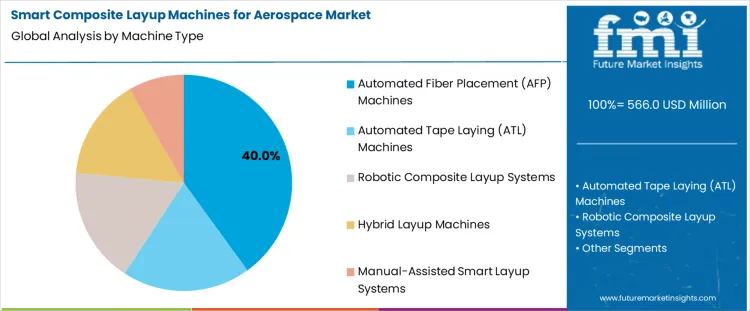
Automated fiber placement (AFP) machines hold the leading 40% share in the smart composite layup machines for aerospace market due to their ability to precisely place continuous fiber tows on complex molds at high speeds. These systems are essential for manufacturing large, load-bearing structures like fuselage barrels, wing skins, and spars in commercial aircraft. Their programmability and multi-axis movement enable high repeatability and minimal material wastage, making them cost-effective for high-volume programs. Demand for AFP machines is also rising in rotorcraft and defense segments where structural integrity is critical. Equipment upgrades, machine reliability, and integration with digital twin systems continue to drive AFP’s position as the core technology in automated composite layup.
How Does Commercial Aircraft Manufacturing Drive Application Demand In The Smart Composite Layup Machines For Aerospace Market?
Commercial aircraft manufacturing leads demand in the smart composite layup machines market with a dominant 55% share, driven by the widespread use of carbon fiber-reinforced structures in next-generation aircraft. OEMs deploy AFP and ATL machines for producing lightweight airframe components to reduce fuel consumption and improve payload efficiency. Long production runs and stringent quality standards make automation essential. High adoption is seen in narrow-body and wide-body aircraft programs, where consistent layup performance supports scalable output. Demand variations arise between Tier 1 suppliers and OEMs, with both segments investing in smart systems to streamline workflows. Backlogs in commercial aviation programs and the ongoing shift to composite-intensive designs continue to reinforce this segment’s leadership.
What Structural Demands Are Driving Growth in the Smart Composite Layup Machines for Aerospace Market?
The smart composite layup machines for aerospace market is growing due to increasing use of carbon fiber-reinforced polymers in aircraft structures. OEMs are shifting toward automated, high-precision layup systems to meet volume, repeatability, and material efficiency targets. These machines improve fiber alignment, resin flow control, and ply placement in large components such as fuselage panels, wing skins, and nacelle structures. Growth is further supported by performance-driven material mandates in defense, commercial, and space segments. Smart machines with process monitoring, closed-loop feedback, and robotic integration enable consistent layup quality. Rising aircraft backlog and demand for lightweight structures are reinforcing the move to advanced automated layup systems.
Why Is Aerospace Manufacturing Adopting Intelligent Composite Layup Solutions?
Aircraft manufacturers are adopting smart composite layup machines for aerospace to reduce cycle times, material waste, and human error in critical component production. Manual layup methods struggle to deliver the precision required for high-performance aerospace parts. Smart machines offer features such as automatic ply cutting, placement verification, and adaptive pressure control. These systems support thermoset and thermoplastic layups across flat, contoured, and complex geometries. Adoption is increasing in programs focused on narrow-body weight optimization, UAV airframes, and next-gen mobility aircraft. The need for digital traceability, process repeatability, and integration with Industry 4.0 platforms is driving demand for intelligent composite manufacturing systems.
What Challenges Are Slowing Broader Deployment in Aerospace Applications?
Adoption of smart composite layup machines for aerospace is restrained by high capital investment, long integration timelines, and limited machine flexibility across varying part sizes. Custom tooling, software configuration, and production floor reorganization are often required. Smaller suppliers face budget and training constraints, slowing technology diffusion across the supply chain. Material variability and complex part shapes demand adaptive control algorithms, which remain under development. Downtime risks during system faults or calibration drift also affect throughput. Certification of layup processes and validation under aerospace quality standards extend the deployment timeline. OEM dependency on legacy production systems further slows transition to smart solutions.
What is the Country-Wise Growth Outlook for the Smart Composite Layup Machines for Aerospace Market?
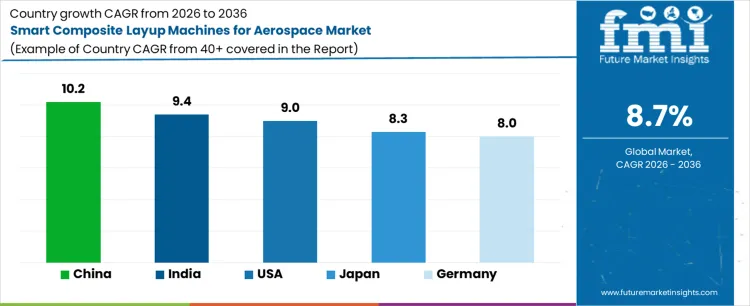
The smart composite layup machines for aerospace market is expanding steadily as aircraft manufacturers seek precision, repeatability, and speed in composite part fabrication. China leads all countries with a CAGR of 10.2%, supported by active aerospace investments and domestic aircraft programs. India follows at 9.4% CAGR, where defense manufacturing upgrades and private aerospace growth drive machinery adoption. The USA grows at 9.0% CAGR, backed by ongoing automation in airframe production. Japan records 8.3% CAGR due to robotics integration and demand from Tier-1 aerospace suppliers. Germany posts an 8.0% CAGR, driven by lightweighting priorities and R&D-backed tooling investments.
| Country | CAGR |
|---|---|
| China | 10.2% |
| India | 9.4% |
| USA | 9.0% |
| Japan | 8.3% |
| Germany | 8.0% |
Why is China Leading Growth in the Smart Composite Layup Machines for Aerospace Market?
Demand for the smart composite layup machines for aerospace market in China is expanding at a CAGR of 10.2%, driven by state-backed aircraft programs and strategic investments in aerospace-grade automation. The country’s commercial aviation roadmap, led by COMAC and AVIC, includes active use of composite structures in regional jets and next-generation narrowbodies. Smart layup systems with robotic arms, tape placement modules, and CNC integration are being deployed across new factories. Government R&D incentives support the domestic development of carbon fiber prepreg handling, automated draping, and out-of-autoclave manufacturing. Suppliers also target Tier-2 aerospace vendors and research labs focused on rotorcraft, UAVs, and military airframes. Compact, high-speed layup equipment gains preference among private aviation contractors in provinces with local aerospace clusters. These structural shifts, combined with a national push for aviation self-reliance and quality benchmarking, sustain rapid adoption of smart composite layup machines across China’s expanding aerospace manufacturing footprint.
What Factors Are Supporting India’s Strong Growth in Smart Composite Layup Machines?
Sales for the smart composite layup machines for aerospace in India are growing at a CAGR of 9.4%, driven by structural expansion in defense aviation, domestic MRO, and civil aerospace assembly. The country’s aerospace ecosystem is shifting toward composite-intensive designs, especially across programs led by HAL, DRDO, and private OEMs. Smart layup machines with controlled fiber orientation and repeatable deposition support growing demand for precision in radomes, fairings, wing structures, and UAV shells. Defense production corridors and offset-linked partnerships bring global equipment suppliers into Indian composites tooling networks. Sales also benefit from upgrades in Tier-1 and Tier-2 suppliers serving global aerospace supply chains. Compact gantry-based layup systems are preferred for research centers and DRDO test labs. As cleanroom infrastructure expands within new aerospace parks, automated layup equipment becomes central to production quality, cycle time reduction, and materials utilization.
Why is the USA a Stable and High-Value Market for Smart Composite Layup Machines?
Demand for the smart composite layup machines for aerospace in the USA is advancing at a CAGR of 9.0%, supported by sustained modernization of aircraft programs, upgrades in materials handling systems, and expansion of composite component output. Major OEMs including Boeing and Lockheed Martin continue to integrate smart layup equipment across their airframe assembly lines, especially for nacelles, fuselage skins, spars, and rotor blades. Demand is shaped by large-volume automated fiber placement installations and hybrid layup solutions integrated with digital control platforms. Retrofit contracts for existing layup cells with new sensors and material monitoring also contribute to unit growth. R&D labs, space startups, and UAV builders invest in compact, high-precision machines for prototyping and low-rate production. National focus on materials traceability, process repeatability, and cleanroom compliance sustains continued investment in advanced layup systems.
What Is Fueling Demand for Smart Composite Layup Machines in Japan?
Sales for the smart composite layup machines for aerospace in Japan are growing at a CAGR of 8.3%, supported by incremental investments in aircraft component standardization, robotics integration, and precision manufacturing. Japanese aerospace suppliers produce control surfaces, nacelles, and wing boxes for global aircraft platforms. These components increasingly rely on tight-tolerance composite layups executed with automation to ensure uniformity and throughput. Demand also rises from public-sector research programs and industrial R&D consortia investigating adaptive layup solutions for future air mobility systems. Equipment buyers prioritize process reliability, low material wastage, and real-time fault detection. Compact machines tailored for trial parts, subassemblies, and test coupons see strong demand in universities and materials labs. Tier-1 suppliers use integrated inspection and data logging to align with quality requirements of global primes.
How Is Germany Maintaining Its Position in the Smart Composite Layup Machines for Aerospace Market?
Demand for the smart composite layup machines for aerospace in Germany is growing at a CAGR of 8.0%, supported by precision requirements across aerostructure components, rotorcraft platforms, and aerospace R&D institutions. German aerospace suppliers integrate smart layup systems for wing skins, stringers, and engine nacelles with a focus on reducing process variability. Automation ensures accurate fiber orientation, compaction force control, and consistency across production runs. Buyers prefer modular equipment supporting robotic interfacing, digital tracking, and automated tool changes. Equipment vendors collaborate with Fraunhofer institutes and aerospace clusters to pilot advanced multi-axis layup systems. As composite content increases in European aircraft programs, suppliers adopt systems aligned with regional materials handling standards, sustaining Germany’s methodical and specification-driven adoption pattern.
How Are Leading Companies Competing And Differentiating In The Smart Composite Layup Machines For Aerospace Market?

Competition in the smart composite layup machines for aerospace market is being shaped by automation precision, cycle time reduction, and material adaptability. Ingersoll Machine Tools is being positioned around integrated layup cells for large-scale fuselage and wing sections, highlighting robotic deposition, real-time monitoring, and minimal material waste in product brochures. Electroimpact Inc. is being differentiated through high-accuracy automated placement, large-format handling, and turnkey system integration for structural components, emphasizing repeatability and reduced rework.
Process innovation and digital integration are being leveraged by Fives Group, MTorres, and Mikrosam AD. Fives Group is promoting adaptive layup robots with multi-axis control and embedded quality checks, highlighting faster cycle times for composite panels. MTorres focuses on modular and flexible layup systems compatible with thermoset and thermoplastic composites, while Mikrosam AD emphasizes custom cell solutions for small and medium aerospace components, stressing precision and material-specific optimization. Accudyne Systems integrates software-driven deposition and defect tracking, emphasizing operator assistance and system intelligence in brochures.
A different competitive angle is being pursued by GKN Aerospace, Dassault Systèmes, KUKA Robotics, and Spirit AeroSystems. GKN Aerospace highlights system-level integration with existing production lines and supply chain alignment. Dassault Systèmes promotes digital twins and simulation-driven process optimization for composite layup, emphasizing virtual commissioning. KUKA Robotics markets multi-axis robots tailored for complex geometries, while Spirit AeroSystems positions hybrid layup cells for fuselage and empennage sections, emphasizing structural consistency and throughput. Across the market, differentiation is being shaped by precision, automation intelligence, and material versatility, with product brochures translating technical capabilities into measurable efficiency and component quality benefits for aerospace manufacturers.
Key Players in Smart Composite Layup Machines for Aerospace Market
- Ingersoll Machine Tools
- Electroimpact Inc.
- Fives Group
- MTorres
- Mikrosam AD
- Accudyne Systems
- GKN Aerospace
- Dassault Systèmes
- KUKA Robotics
- Spirit AeroSystems
Scope of Report
| Attributes | Description |
|---|---|
| Quantitative Unit | USD Million |
| Type | Automated Fiber Placement (AFP) Machines, Automated Tape Laying (ATL) Machines, Robotic Composite Layup Systems, Hybrid Layup Machines, Manual Assisted Smart Layup Systems |
| Application | Commercial Aircraft Manufacturing, Military Aircraft, Business Jets, Helicopters, Spacecraft Components |
| Regions Covered | Asia Pacific, Europe, North America, Latin America, Middle East & Africa |
| Countries Covered | China, Japan, South Korea, India, Australia & New Zealand, ASEAN, Rest of Asia Pacific, Germany, United Kingdom, France, Italy, Spain, Nordic, BENELUX, Rest of Europe, United States, Canada, Mexico, Brazil, Chile, Rest of Latin America, Kingdom of Saudi Arabia, Other GCC Countries, Turkey, South Africa, Other African Union, Rest of Middle East & Africa |
| Key Companies Profiled | Ingersoll Machine Tools, Electroimpact Inc., Fives Group, MTorres, Mikrosam AD, Accudyne Systems, GKN Aerospace, Dassault Systèmes, KUKA Robotics, Spirit AeroSystems |
| Additional Attributes | Dollar sales by machine type and application; regional adoption trends; revenue contribution by type and application; projected market share trends for 2026-2036; competitive landscape; analysis of commercial, military, and space aerospace segments; evaluation of emerging markets and technological adoption. |
Smart Composite Layup Machines for Aerospace Market by Key Segments
Machine Type:
- Automated Fiber Placement (AFP) Machines
- Automated Tape Laying (ATL) Machines
- Robotic Composite Layup Systems
- Hybrid Layup Machines
- Manual‑Assisted Smart Layup Systems
Application:
- Commercial Aircraft Manufacturing
- Military Aircraft
- Business Jets
- Helicopters
- Spacecraft Components
Region:
- Asia Pacific
- China
- Japan
- South Korea
- India
- Australia & New Zealand
- ASEAN
- Rest of Asia Pacific
- Europe
- Germany
- United Kingdom
- France
- Italy
- Spain
- Nordic
- BENELUX
- Rest of Europe
- North America
- United States
- Canada
- Mexico
- Latin America
- Brazil
- Chile
- Rest of Latin America
- Middle East & Africa
- Kingdom of Saudi Arabia
- Other GCC Countries
- Turkey
- South Africa
- Other African Union
- Rest of Middle East & Africa
Bibliography
- Food and Agriculture Organization of the United Nations. (2024). Mechanization for rural development: A review of patterns and progress from around the world. FAO.
- World Bank. (2024). World Development Report 2024: Farming, food systems, and rural livelihoods in a changing world. World Bank.
- International Organization for Standardization. (2023). ISO 4254‑5:2018 Agricultural machinery. Part 5: Power‑driven soil‑working machines. ISO.
- U.S. Bureau of Labor Statistics. (2025). Manufacturing: Employment, output, and industry performance overview. U.S. Bureau of Labor Statistics.
- Organisation for Economic Co‑operation and Development. (2024). OECD Science, Technology and Industry Scoreboard 2024: Innovation and competitiveness in manufacturing.
- International Labour Organization. (2024). World employment and social outlook: Manufacturing and automation trends.
Frequently Asked Questions
How big is the smart composite layup machines for aerospace market in 2026?
The global smart composite layup machines for aerospace market is estimated to be valued at USD 566.0 million in 2026.
What will be the size of smart composite layup machines for aerospace market in 2036?
The market size for the smart composite layup machines for aerospace market is projected to reach USD 1,303.5 million by 2036.
How much will be the smart composite layup machines for aerospace market growth between 2026 and 2036?
The smart composite layup machines for aerospace market is expected to grow at a 8.7% CAGR between 2026 and 2036.
What are the key product types in the smart composite layup machines for aerospace market?
The key product types in smart composite layup machines for aerospace market are automated fiber placement (afp) machines, automated tape laying (atl) machines, robotic composite layup systems, hybrid layup machines and manual‑assisted smart layup systems.
Which application segment to contribute significant share in the smart composite layup machines for aerospace market in 2026?
In terms of application, commercial aircraft manufacturing segment to command 55.0% share in the smart composite layup machines for aerospace market in 2026.
Preview the report firsthand - request a free sample
Get SampleGet the brochure for pricing and purchase details.
Get PDFTable of Content
- Executive Summary
- Global Market Outlook
- Demand-side Trends
- Supply-side Trends
- Technology Roadmap Analysis
- Analysis and Recommendations
- Market Overview
- Market Coverage / Taxonomy
- Market Definition / Scope / Limitations
- Market Background
- Market Dynamics
- Drivers
- Restraints
- Opportunity
- Trends
- Scenario Forecast
- Demand in Optimistic Scenario
- Demand in Likely Scenario
- Demand in Conservative Scenario
- Opportunity Map Analysis
- Product Life Cycle Analysis
- Supply Chain Analysis
- Investment Feasibility Matrix
- Value Chain Analysis
- PESTLE and Porter’s Analysis
- Regulatory Landscape
- Regional Parent Market Outlook
- Production and Consumption Statistics
- Import and Export Statistics
- Market Dynamics
- Global Market Analysis 2021 to 2025 and Forecast, 2026 to 2036
- Historical Market Size Value (USD Million) Analysis, 2021 to 2025
- Current and Future Market Size Value (USD Million) Projections, 2026 to 2036
- Y-o-Y Growth Trend Analysis
- Absolute $ Opportunity Analysis
- Global Market Pricing Analysis 2021 to 2025 and Forecast 2026 to 2036
- Global Market Analysis 2021 to 2025 and Forecast 2026 to 2036, By Machine Type
- Introduction / Key Findings
- Historical Market Size Value (USD Million) Analysis By Machine Type, 2021 to 2025
- Current and Future Market Size Value (USD Million) Analysis and Forecast By Machine Type, 2026 to 2036
- Automated Fiber Placement (AFP) Machines
- Automated Tape Laying (ATL) Machines
- Robotic Composite Layup Systems
- Hybrid Layup Machines
- Manual‑Assisted Smart Layup Systems
- Automated Fiber Placement (AFP) Machines
- Y-o-Y Growth Trend Analysis By Machine Type, 2021 to 2025
- Absolute $ Opportunity Analysis By Machine Type, 2026 to 2036
- Global Market Analysis 2021 to 2025 and Forecast 2026 to 2036, By Application
- Introduction / Key Findings
- Historical Market Size Value (USD Million) Analysis By Application, 2021 to 2025
- Current and Future Market Size Value (USD Million) Analysis and Forecast By Application, 2026 to 2036
- Commercial Aircraft Manufacturing
- Military Aircraft
- Business Jets
- Helicopters
- Spacecraft Components
- Commercial Aircraft Manufacturing
- Y-o-Y Growth Trend Analysis By Application, 2021 to 2025
- Absolute $ Opportunity Analysis By Application, 2026 to 2036
- Global Market Analysis 2021 to 2025 and Forecast 2026 to 2036, By Region
- Introduction
- Historical Market Size Value (USD Million) Analysis By Region, 2021 to 2025
- Current Market Size Value (USD Million) Analysis and Forecast By Region, 2026 to 2036
- North America
- Latin America
- Western Europe
- Eastern Europe
- East Asia
- South Asia and Pacific
- Middle East & Africa
- Market Attractiveness Analysis By Region
- North America Market Analysis 2021 to 2025 and Forecast 2026 to 2036, By Country
- Historical Market Size Value (USD Million) Trend Analysis By Market Taxonomy, 2021 to 2025
- Market Size Value (USD Million) Forecast By Market Taxonomy, 2026 to 2036
- By Country
- USA
- Canada
- Mexico
- By Machine Type
- By Application
- By Country
- Market Attractiveness Analysis
- By Country
- By Machine Type
- By Application
- Key Takeaways
- Latin America Market Analysis 2021 to 2025 and Forecast 2026 to 2036, By Country
- Historical Market Size Value (USD Million) Trend Analysis By Market Taxonomy, 2021 to 2025
- Market Size Value (USD Million) Forecast By Market Taxonomy, 2026 to 2036
- By Country
- Brazil
- Chile
- Rest of Latin America
- By Machine Type
- By Application
- By Country
- Market Attractiveness Analysis
- By Country
- By Machine Type
- By Application
- Key Takeaways
- Western Europe Market Analysis 2021 to 2025 and Forecast 2026 to 2036, By Country
- Historical Market Size Value (USD Million) Trend Analysis By Market Taxonomy, 2021 to 2025
- Market Size Value (USD Million) Forecast By Market Taxonomy, 2026 to 2036
- By Country
- Germany
- UK
- Italy
- Spain
- France
- Nordic
- BENELUX
- Rest of Western Europe
- By Machine Type
- By Application
- By Country
- Market Attractiveness Analysis
- By Country
- By Machine Type
- By Application
- Key Takeaways
- Eastern Europe Market Analysis 2021 to 2025 and Forecast 2026 to 2036, By Country
- Historical Market Size Value (USD Million) Trend Analysis By Market Taxonomy, 2021 to 2025
- Market Size Value (USD Million) Forecast By Market Taxonomy, 2026 to 2036
- By Country
- Russia
- Poland
- Hungary
- Balkan & Baltic
- Rest of Eastern Europe
- By Machine Type
- By Application
- By Country
- Market Attractiveness Analysis
- By Country
- By Machine Type
- By Application
- Key Takeaways
- East Asia Market Analysis 2021 to 2025 and Forecast 2026 to 2036, By Country
- Historical Market Size Value (USD Million) Trend Analysis By Market Taxonomy, 2021 to 2025
- Market Size Value (USD Million) Forecast By Market Taxonomy, 2026 to 2036
- By Country
- China
- Japan
- South Korea
- By Machine Type
- By Application
- By Country
- Market Attractiveness Analysis
- By Country
- By Machine Type
- By Application
- Key Takeaways
- South Asia and Pacific Market Analysis 2021 to 2025 and Forecast 2026 to 2036, By Country
- Historical Market Size Value (USD Million) Trend Analysis By Market Taxonomy, 2021 to 2025
- Market Size Value (USD Million) Forecast By Market Taxonomy, 2026 to 2036
- By Country
- India
- ASEAN
- Australia & New Zealand
- Rest of South Asia and Pacific
- By Machine Type
- By Application
- By Country
- Market Attractiveness Analysis
- By Country
- By Machine Type
- By Application
- Key Takeaways
- Middle East & Africa Market Analysis 2021 to 2025 and Forecast 2026 to 2036, By Country
- Historical Market Size Value (USD Million) Trend Analysis By Market Taxonomy, 2021 to 2025
- Market Size Value (USD Million) Forecast By Market Taxonomy, 2026 to 2036
- By Country
- Kingdom of Saudi Arabia
- Other GCC Countries
- Turkiye
- South Africa
- Other African Union
- Rest of Middle East & Africa
- By Machine Type
- By Application
- By Country
- Market Attractiveness Analysis
- By Country
- By Machine Type
- By Application
- Key Takeaways
- Key Countries Market Analysis
- USA
- Pricing Analysis
- Market Share Analysis, 2025
- By Machine Type
- By Application
- Canada
- Pricing Analysis
- Market Share Analysis, 2025
- By Machine Type
- By Application
- Mexico
- Pricing Analysis
- Market Share Analysis, 2025
- By Machine Type
- By Application
- Brazil
- Pricing Analysis
- Market Share Analysis, 2025
- By Machine Type
- By Application
- Chile
- Pricing Analysis
- Market Share Analysis, 2025
- By Machine Type
- By Application
- Germany
- Pricing Analysis
- Market Share Analysis, 2025
- By Machine Type
- By Application
- UK
- Pricing Analysis
- Market Share Analysis, 2025
- By Machine Type
- By Application
- Italy
- Pricing Analysis
- Market Share Analysis, 2025
- By Machine Type
- By Application
- Spain
- Pricing Analysis
- Market Share Analysis, 2025
- By Machine Type
- By Application
- France
- Pricing Analysis
- Market Share Analysis, 2025
- By Machine Type
- By Application
- India
- Pricing Analysis
- Market Share Analysis, 2025
- By Machine Type
- By Application
- ASEAN
- Pricing Analysis
- Market Share Analysis, 2025
- By Machine Type
- By Application
- Australia & New Zealand
- Pricing Analysis
- Market Share Analysis, 2025
- By Machine Type
- By Application
- China
- Pricing Analysis
- Market Share Analysis, 2025
- By Machine Type
- By Application
- Japan
- Pricing Analysis
- Market Share Analysis, 2025
- By Machine Type
- By Application
- South Korea
- Pricing Analysis
- Market Share Analysis, 2025
- By Machine Type
- By Application
- Russia
- Pricing Analysis
- Market Share Analysis, 2025
- By Machine Type
- By Application
- Poland
- Pricing Analysis
- Market Share Analysis, 2025
- By Machine Type
- By Application
- Hungary
- Pricing Analysis
- Market Share Analysis, 2025
- By Machine Type
- By Application
- Kingdom of Saudi Arabia
- Pricing Analysis
- Market Share Analysis, 2025
- By Machine Type
- By Application
- Turkiye
- Pricing Analysis
- Market Share Analysis, 2025
- By Machine Type
- By Application
- South Africa
- Pricing Analysis
- Market Share Analysis, 2025
- By Machine Type
- By Application
- USA
- Market Structure Analysis
- Competition Dashboard
- Competition Benchmarking
- Market Share Analysis of Top Players
- By Regional
- By Machine Type
- By Application
- Competition Analysis
- Competition Deep Dive
- Ingersoll Machine Tools
- Overview
- Product Portfolio
- Profitability by Market Segments (Product/Age /Sales Channel/Region)
- Sales Footprint
- Strategy Overview
- Marketing Strategy
- Product Strategy
- Channel Strategy
- Electroimpact Inc.
- Fives Group
- MTorres
- Mikrosam AD
- Accudyne Systems
- GKN Aerospace
- Dassault Systèmes
- KUKA Robotics
- Spirit AeroSystems
- Ingersoll Machine Tools
- Competition Deep Dive
- Assumptions & Acronyms Used
- Research Methodology


