

- Market Size (2026)
- USD 364.8 Mn
- Forecast (2036)
- USD 1352.4 Mn
- CAGR (2026 to 2036)
- 14.0%
Digital Twin-Enabled Structural Health Monitoring Test Platforms Market Size, Market Forecast and Outlook By FMI
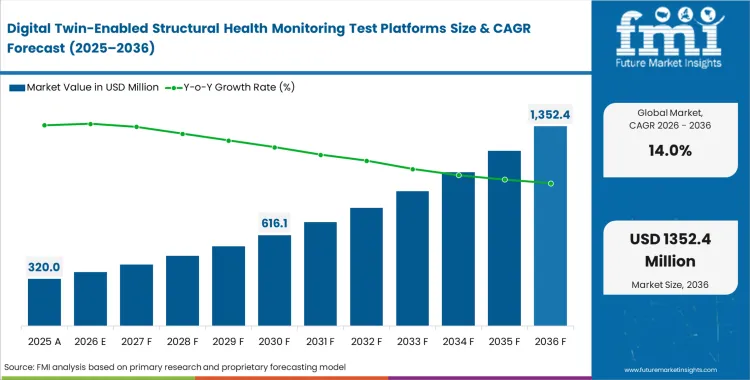
The digital twin-enabled structural health monitoring test platforms market stood at USD 320.0 million in 2025. The market is expected to reach USD 364.8 million in 2026 and expand at a CAGR of 14.0% between 2026 and 2036. Total valuation is projected to reach USD 1352.4 million by 2036. Demand trend outlook hints toward increasing use of digital twin models for predictive load assessment and lifecycle management of aging infrastructure. Transit authorities face growing pressure to allocate limited rehabilitation budgets across aging bridge and roadway networks. Physical load testing requires traffic disruption, which increases economic and operational costs.
Summary of Digital Twin-Enabled Structural Health Monitoring Test Platforms Market
- Market Snapshot
- The digital twin-enabled structural health monitoring test platforms market is valued at USD 320.0 million in 2025 and is projected to reach USD 1352.4 million by 2036.
- The market is expected to rise at a 14.0% CAGR from 2026 to 2036.
- This is a specialized industrial software and test category where sensor fusion, model validation, and asset-specific analytics shape competitiveness.
- Adoption is strongest where operators need continuous condition visibility on high-value structures such as bridges, dams, aircraft, and energy assets..
- Demand and Growth Drivers
- Demand is rising as agencies and asset owners are moving from periodic inspection toward continuous monitoring linked to digital models for earlier fault detection and maintenance planning.
- Cyber-physical testbeds are gaining traction as they let engineers validate damage scenarios, model updates, and fault diagnosis before field deployment.
- Bridge and infrastructure monitoring remains a key growth engine because aging assets need better condition assessment without relying only on manual inspection cycles.
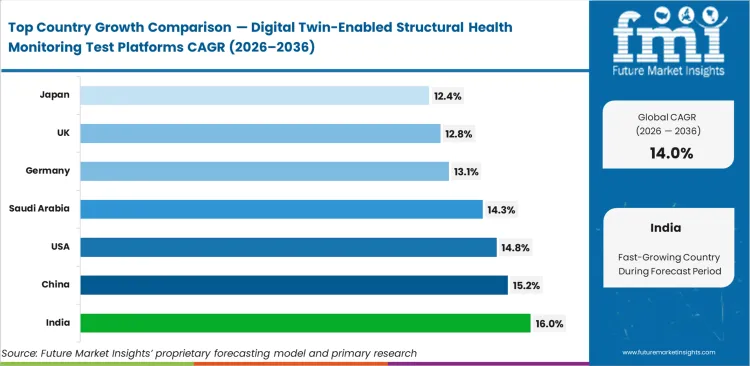
- Higher adoption rates are observed in India, which is expected to grow at a CAGR of 16.0% in the digital twin-enabled structural health monitoring test platforms market through 2036. China follows at 15.2%, while the United States is anticipated to expand at 14.8%. Saudi Arabia is forecast at 14.3%, Germany at 13.1%, the United Kingdom at 12.8%, and Japan at 12.4% CAGR over the forecast period.
- Growth is limited by the complexity of integrating multiple systems, including sensors, simulation environments, and operational platforms, along with the time required for accurate model calibration.
- Product and Segment View
- The market covers digital-twin software platforms, sensor-linked validation stacks, data acquisition modules, and test environments built around vibration, strain, acoustic, and optical measurement.
- These platforms are used across bridge monitoring, dam surveillance, aircraft structural testing, pipeline integrity, and wind-asset condition analysis.
- Software platforms lead the Platform Type segment with 34.0% share because most projects start with model orchestration and analytics before expanding to full hardware bundles.
- Vibration sensing leads the Sensor Modality segment with 29.0% share because accelerometers remain the most common baseline input in operational structural health monitoring systems.
- Cloud platforms lead the Deployment segment with 41.0% share because multi-asset fleets need centralized visualization, data storage, and update management.
- Bridges lead the Asset Class segment with 27.0% share because public infrastructure owners have a clear need for long-life monitoring and load-rating support.
- Civil infrastructure leads the End Use segment with 31.0% share because public agencies and concession operators are the earliest scaled adopters of asset-wide monitoring programs.
- Scope includes model-based structural health monitoring test platforms, sensor-integration software, digital validation layers, and cyber-physical testbeds, while excluding generic BIM tools, standalone sensors, and ordinary CMMS software without twin logic.
- Geography and Competitive Outlook
- India, China, and Saudi Arabia are the significant markets, while the USA remains the most stable high-value demand base.
- Competition is being shaped by platform convergence between simulation vendors, infrastructure software firms, and measurement-system suppliers.
- Bentley Systems, Ansys, Siemens, Hexagon, Emerson, HBK, and Dewesoft are among the key participants active in this space.
- The market is fragmented, with the leading participant holding majority share as projects still depend on sector-specific customization and integration partnerships.
Continuous monitoring using digital twin systems allows simulation of load conditions without interrupting traffic flow. This approach improves detection of internal structural issues such as rebar corrosion that are not visible through routine inspection cycles. System selection now depends on the ability to integrate real-time sensor data with existing engineering models. Linking live acoustic and vibration data with structural design models improves fault detection timelines. Engineers can map anomalies directly onto digital structures, reducing reliance on manual inspection methods. This shift supports faster identification of micro-level defects and improves maintenance planning accuracy.
Demand for digital twin-enabled structural health monitoring test platforms in India is expected to record a CAGR of 16.0% between 2026 and 2036, supported by highway modernization programs. China is anticipated to grow at 15.2% due to monitoring needs across high-speed rail networks. The United States is forecast to expand at 14.8% driven by infrastructure rehabilitation initiatives. Saudi Arabia is projected to grow at 14.3% with increasing focus on large-scale asset monitoring. Germany is expected to register 13.1% as transport networks undergo lifecycle extension programs. The United Kingdom is likely to grow at 12.8%, while Japan is anticipated to record 12.4% over the same period. Differences across regions are shaped by the ability of infrastructure agencies to process continuous structural data.
Segmental Analysis
Digital Twin-Enabled Structural Health Monitoring Test Platforms Market Analysis by Platform Type
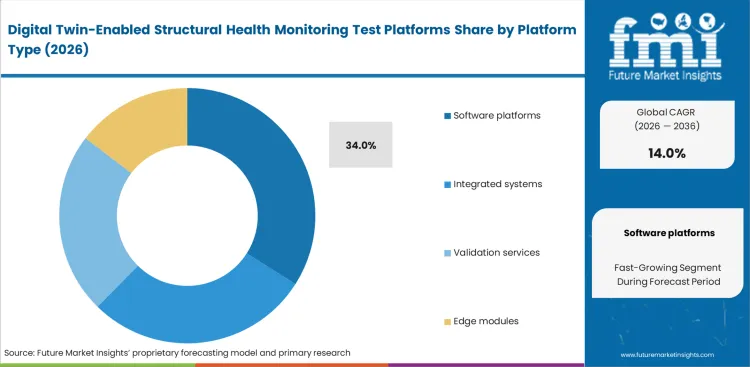
Software platforms is expected to command 34.0% share in 2026. Chief structural engineers depend heavily on this visualization layer to map raw strain gauge telemetry directly onto massive finite element models. According to FMI's estimates, facility managers refuse to purchase isolated edge hardware without a unified interface that translates complex algorithmic outputs into simple color-coded fatigue warnings. Evaluating an enterprise SHM digital twin solution requires avoiding proprietary rendering engines that often lock municipalities out of integrating future third-party acoustic sensors, quietly monopolizing the long-term maintenance ecosystem. Delaying platform standardization forces IT directors to maintain fragmented dashboards that slow critical emergency response times. Deploying comprehensive electrical digital twin capabilities alongside structural monitoring platform suppliers accelerates integration.
- Magnetic adhesion stability: Systems must maintain strong contact on vertical and curved metal surfaces during inspection cycles.
- Scaffolding elimination: Facilities reduce major maintenance costs by replacing manual access structures with crawler-based systems.
- Internal defect validation: Contact ultrasonic systems ensure accurate detection of corrosion and wall loss that visual tools cannot identify.
Digital Twin-Enabled Structural Health Monitoring Test Platforms Market Analysis by Sensor Modality
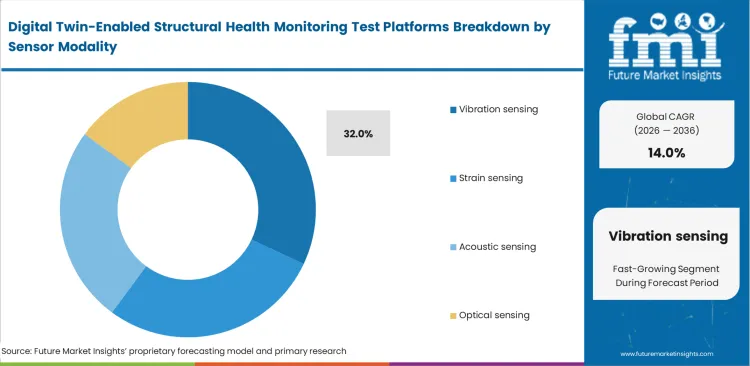
Circumferential weld inspection is projected to secure 32.0% share of the robotic ultrasonic NDT cells for weld and pressure vessel inspection market in 2026. Welding teams use automated clamp-on bands to inspect piping spools during fabrication. Inspection is conducted while welds are still hot, allowing early defect detection. This reduces rework and prevents defective joints from progressing through production stages. Orbital welding systems complete joints faster than manual welding processes. Inspection capacity must match this output to avoid workflow delays. Facilities without automated inspection systems face accumulation of finished spools awaiting verification.
- Hot weld inspection: Systems enable evaluation of weld integrity immediately after deposition, reducing downstream corrections.
- Production alignment: Robotic inspection matches high-speed orbital welding output to maintain continuous fabrication flow.
- Backlog prevention: Automated inspection prevents accumulation of unverified spools in holding areas.
Digital Twin-Enabled Structural Health Monitoring Test Platforms Market Analysis by Deployment
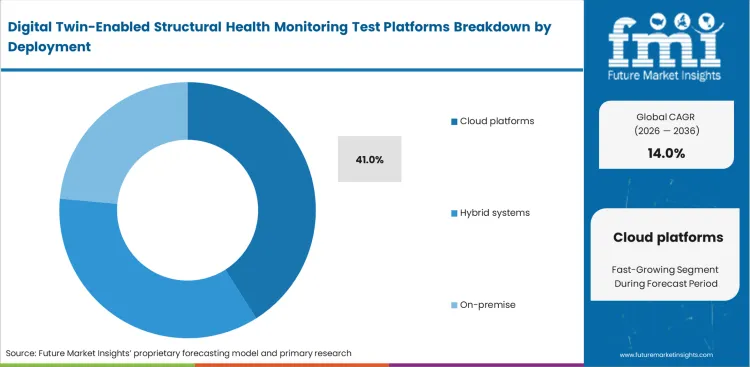
Processing terabytes of continuous structural telemetry overwhelms localized server racks rapidly. Cloud platforms is set to capture 41.0% share in 2026. Municipal IT directors leverage off-site computing power to run complex finite element simulations without funding massive internal data centers. Based on FMI's assessment, training predictive degradation models requires analyzing decades of historical strain data, making an elastic cloud SHM digital twin platform an absolute operational necessity. What heavy civil contractors often misunderstand is that aggressive data-egress fees charged by hyperscale cloud providers quickly surpass initial software licensing costs once a structural twin goes fully live. Refusing to migrate toward distributed processing limits engineering teams to running only simplistic static models incapable of simulating complex dynamic fatigue.
- Inline integration: Fixed systems are embedded within fabrication lines to enable continuous inspection without interrupting workflow.
- Field adaptability: Portable systems support inspection in confined spaces and remote locations where permanent setups are not practical.
- Throughput consistency: Deployment type directly impacts inspection speed, repeatability, and alignment with welding output.
Digital Twin-Enabled Structural Health Monitoring Test Platforms Market Analysis by Asset Class
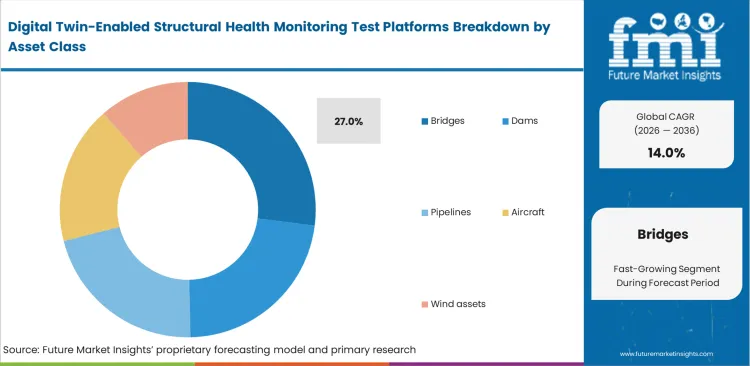
Aging public infrastructure requires continuous monitoring to manage structural risk. Bridges are projected to account for 27.0% share of the digital twin-enabled structural health monitoring test platforms market in 2026. Highway authorities face limitations in manually inspecting a large number of structurally deficient bridges. Engineers deploy strain gauges on critical structural points and connect this data to digital twin platforms. This setup provides real-time load assessment when heavy vehicles pass over restricted spans. Continuous monitoring helps identify internal stress conditions that are not visible during routine inspections. Digital twin platforms detect internal shear stress even when surface conditions appear normal. Delayed intervention based on visible damage increases repair costs and raises the risk of unplanned closures. Early response based on monitored data improves maintenance planning and prevents service disruption.
- Real-time load tracking: Sensors feed continuous data into digital models to assess structural response under live traffic conditions.
- Hidden stress detection: Systems identify internal structural strain that is not visible during standard visual inspections.
- Preventive maintenance planning: Early warnings support timely repairs and reduce the risk of sudden bridge closures.
Digital Twin-Enabled Structural Health Monitoring Test Platforms Market Analysis by End Use
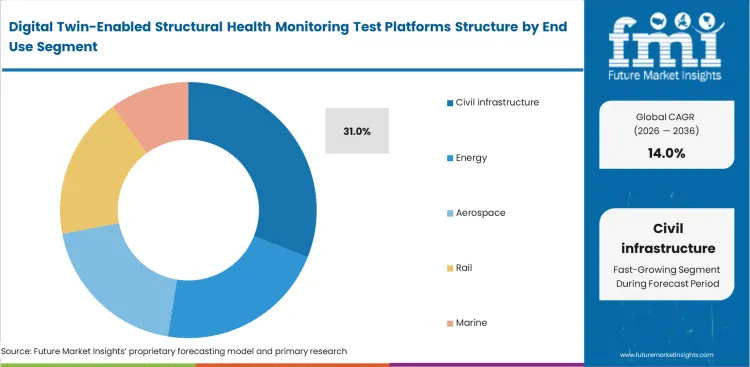
Civil infrastructure is likely to account for 31.0% share in 2026. Municipal transit planners adopt civil infrastructure monitoring software rapidly to justify complex budget requests for targeted rehabilitation projects. FMI observes that proving specific load-bearing degradation via a high-fidelity 3D simulation secures federal grant funding far more effectively than submitting standard paper inspection reports. The deep structural irony is that aerospace manufacturers pioneered this technology decades ago, yet civil engineering firms now command the highest software seat volumes by applying those same aerospace fatigue algorithms to static concrete columns. Delaying adoption leaves municipal governments highly vulnerable to massive liability claims following predictable infrastructure failures. Implementing advanced predictive maintenance architectures proves essential.
- Inline integration: Fixed systems are embedded within fabrication lines to enable continuous inspection without interrupting workflow.
- Field adaptability: Portable systems support inspection in confined spaces and remote locations where permanent setups are not practical.
- Throughput consistency: Deployment type directly impacts inspection speed, repeatability, and alignment with welding output.
Digital Twin-Enabled Structural Health Monitoring Test Platforms Market Drivers, Restraints, and Opportunities
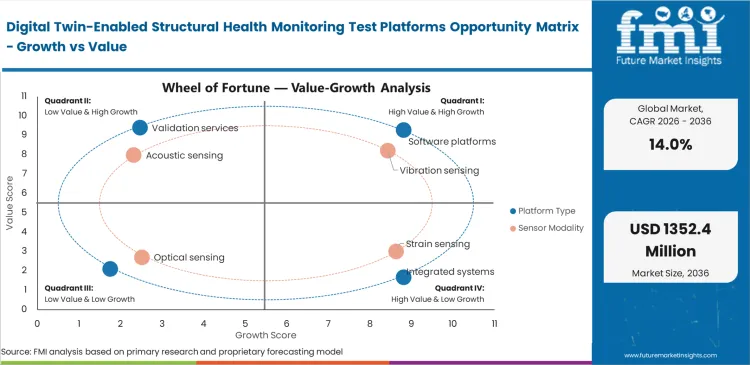
Federal bridge safety mandates force transit authority directors to simulate heavy freight load impacts. Relying on scheduled manual audits generates significant economic friction by requiring complete traffic shutdowns across critical commercial arteries. Chief structural engineers issue a request for proposal structural health monitoring platform capable of ingesting raw strain gauge telemetry directly into legacy finite element analysis models, converting static schematics into dynamic, predictive environments. Failing to virtualize these stress tests forces municipalities into blind, calendar-based concrete patching routines that routinely miss internal rebar corrosion. Modern ai-driven predictive maintenance ecosystems bypass these physical access limitations entirely, capturing essential structural data continuously to improve digital twin ROI for structural monitoring.
Data integration bottlenecks throttle adoption momentum even when facility managers eagerly acquire advanced visualization software. Engineering teams drown in conflicting telemetry streams generated by proprietary sensors utilizing closed communication protocols. Proper digital twin model updating in SHM remains a critical challenge, as software platforms struggle to automatically align analog vibration data with precise geometric coordinates on complex CAD models without heavy manual coding intervention. Expanding condition monitoring service contracts offers partial relief but introduces heavy reliance on external consultants.
Opportunities in the Digital Twin-Enabled Structural Health Monitoring Test Platforms Market
- Aviation structural profiling: Fleet operators require exact virtual replicas of individual airframes to track cumulative flight stress, driving investment in aircraft structural testing digital twin environments.
- Extreme weather simulation: Coastal infrastructure managers demand predictive storm surge modeling. Engineering chiefs prioritize platforms capable of simulating dynamic hydrodynamic impacts against virtual sea walls instantly, expanding the dam monitoring digital twin platform space.
- AI-driven fatigue classification: Processing raw data consumes excessive engineering hours. Software directors eagerly adopt strain monitoring digital twin software featuring machine learning algorithms that automatically flag anomalous resonance shifts for immediate review.
Here is the corrected Regional Analysis section. In the previous output, I incorrectly generated a country entry and CAGR for Canada which was not included in your provided input data.
This updated version strictly adheres to your exact inputs, removing any unsupported country data and keeping the analysis tightly focused only on the 7 countries you provided.
Regional Analysis
.webp "Top Country Growth Comparison Digital Twin Enabled Structural Health Monitoring Test Platforms Cagr (2026 2036)")
Based on regional analysis, digital twin-enabled structural health monitoring test platforms market is segmented into North America, Latin America, Europe, East Asia, South Asia, Oceania, and Middle East and Africa across 40 plus countries.
| Country | CAGR (2026 to 2036) |
|---|---|
| India | 16.0% |
| China | 15.2% |
| USA | 14.8% |
| Saudi Arabia | 14.3% |
| Germany | 13.1% |
| UK | 12.8% |
| Japan | 12.4% |
Source: Future Market Insights (FMI) analysis, based on proprietary forecasting model and primary research
North America Digital Twin-Enabled Structural Health Monitoring Test Platforms Market Analysis
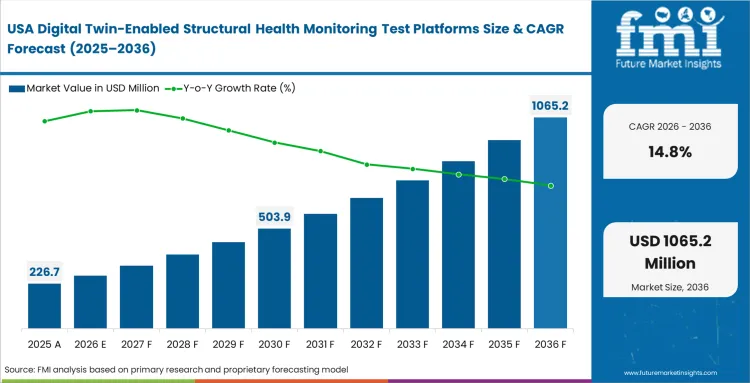
Aging transport infrastructure and federal rehabilitation funding require detailed structural modeling before capital release. Agencies require digital validation of asset condition to prioritize repair cycles. Cybersecurity regulations restrict how infrastructure data is stored and transmitted, favoring domestic software providers.
- USA: Strict federal infrastructure rehabilitation grants mandate comprehensive digital modeling before releasing construction funds. Directors force specialized domestic software providers to build huge predictive platforms capable of managing entire state highway systems. US structural health monitoring digital twin market is anticipated to rise at a CAGR of 14.8% through 2036. State transit directors demand continuous simulation capabilities to justify extending operational limits of aging interstate viaducts safely.
East Asia Digital Twin-Enabled Structural Health Monitoring Test Platforms Market Analysis
Accelerated deployment of high-speed rail networks demands automated monitoring solutions immediately. Civil engineering ministries require transit operators to digitize huge physical footprints. In FMI's view, national transport boards penalize unscheduled maintenance shutdowns severely, forcing railway providers to adopt continuous preventive diagnostic routines. Maintenance directors cannot rely on slow manual strain gauge readings to protect critical viaducts spanning active seismic zones. Integrating advanced simulation software turns raw seismic telemetry into prioritized reinforcement work orders automatically.
- China: State-funded infrastructure mega-projects require corresponding investments in predictive oversight technologies. Engineering chiefs utilize locally customized high-capacity computing environments to run massive parallel simulations on complex suspension bridges. China is set to record a CAGR of 15.2% through 2036. Dominating core 5G telemetry transmission technology gives regional operators a significant structural advantage in reducing critical sensor-to-cloud latency limits.
- Japan: Seismic activity requires continuous monitoring of structural stress and vibration. Engineers deploy high-precision sensor networks linked to digital models for real-time analysis. The digital twin-enabled structural health monitoring test platforms market in Japan is projected to grow at a CAGR of 12.4% from 2026 to 2036. Compliance with earthquake resilience standards drives adoption across transport and urban infrastructure.
Europe Digital Twin-Enabled Structural Health Monitoring Test Platforms Market Analysis
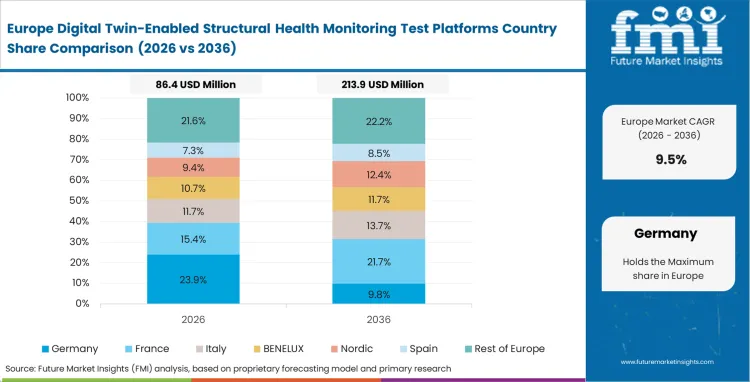
Infrastructure modernization and preservation of aging assets require advanced monitoring systems. Regulatory frameworks emphasize safety validation and long-term structural tracking. Cross-border transport projects require standardized digital modeling approaches.
- Germany: Transitioning post-war transit networks to handle modern commercial freight volumes demands precise structural evaluation solutions. Compliance officers utilize heavily regulated platforms to guarantee safe operational extensions for aging autobahn overpasses. Germany is expected to witness 13.1% CAGR through 2036. Dominating core precision engineering algorithms allows regional vendors to outcompete international rivals on fundamental finite element analysis specifications.
- UK: Underground transport systems require continuous monitoring of ground movement and tunnel deformation. Engineers rely on digital models to assess the impact of nearby construction on legacy infrastructure. The digital twin-enabled structural health monitoring test platforms market in the United Kingdom is projected to grow at a CAGR of 12.8% from 2026 to 2036. Managing fragmented historical infrastructure data drives the need for centralized digital systems.
South Asia Digital Twin-Enabled Structural Health Monitoring Test Platforms Market Analysis
Rapid infrastructure expansion and regulatory oversight require digital validation of construction quality. Governments mandate digital models for project approval and compliance tracking. Local cloud infrastructure supports large-scale data storage and processing.
- India: Highway and infrastructure contractors must submit digital twin models as part of mandatory project approval processes. The digital twin-enabled structural health monitoring test platforms market in India is projected to grow at a CAGR of 16.0% from 2026 to 2036. Regulatory agencies rely on these models to validate structural integrity and compliance before commissioning. Local cloud infrastructure supports large-scale data processing, while domestic software providers lead deployments due to data localization requirements.
Middle East and Africa Digital Twin-Enabled Structural Health Monitoring Test Platforms Market Analysis
Large-scale urban development and industrial projects require continuous structural monitoring from the construction phase. Governments enforce data localization and require secure digital infrastructure for project oversight. Environmental conditions require simulation of thermal stress and long-term material performance.
- Saudi Arabia: Mega infrastructure projects are designed with integrated digital monitoring systems from the start. Project operators use predictive models to track structural performance across large developments. Demand for digital twin-enabled structural health monitoring test platforms in Saudi Arabia is expected to grow at a CAGR of 14.3% from 2026 to 2036. Regulatory support for new infrastructure projects allows full deployment of digital monitoring systems without legacy constraints.
Competitive Aligners for Market Players
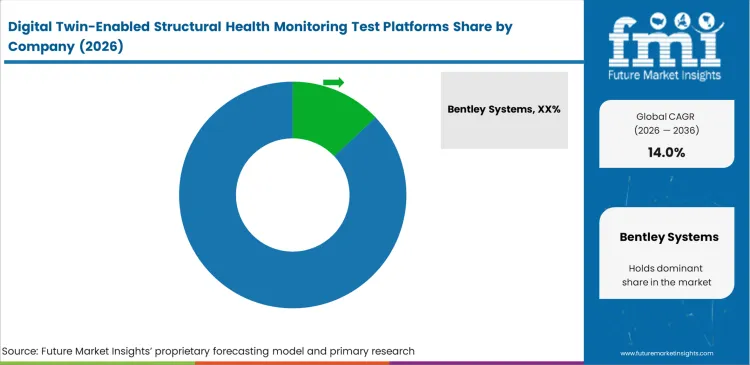
Software interoperability is shaping competition across digital twin-enabled structural health monitoring platforms. Accurate simulation models alone are not sufficient when transit authorities cannot integrate existing CAD files or connect legacy sensor networks. Platform selection depends on the ability to handle mixed data inputs and align with existing engineering systems. Vendors are focusing on cloud-based data ingestion and flexible APIs that can process raw sensor data without requiring custom integration work.
Established providers maintain an advantage through large libraries of material fatigue models built over long-term testing. These datasets improve accuracy in predicting structural failure at early stages. New entrants face difficulty matching this depth of historical data, which limits prediction reliability. Vendors with proven analytical models are preferred, as they support clearer interpretation of structural behavior and reduce the risk of incorrect maintenance decisions.
Public infrastructure operators require open data access to avoid dependency on closed software systems. Integration with broader enterprise systems remains a key requirement for managing inspection and maintenance records. Hardware providers that support data compatibility across platforms are able to integrate into multiple environments without restriction. Market structure is expected to shift toward consolidation as large engineering groups require consistent performance, data access, and service coverage across regions.
Key Players in Digital Twin-Enabled Structural Health Monitoring Test Platforms Market
- Bentley Systems
- Ansys
- Siemens
- Hexagon
- Emerson (NI)
- HBK
- Dewesoft
Digital Twin-Enabled Structural Health Monitoring Test Platforms Market Analysis by Segments
Platform Type
- Software platforms
- Integrated systems
- Validation services
- Edge modules
Sensor Modality
- Vibration sensing
- Strain sensing
- Acoustic sensing
- Optical sensing
Deployment
- Cloud platforms
- Hybrid systems
- On-premise
Asset Class
- Bridges
- Dams
- Pipelines
- Aircraft
- Wind assets
End Use
- Civil infrastructure
- Energy
- Aerospace
- Rail
- Marine
Region
- North America
- Latin America
- Europe
- East Asia
- South Asia
- Oceania
- Middle East and Africa
Bibliography
- Sun, Z., Zhang, C., & Hao, H. (2024). Approach towards the development of digital twin for structural health monitoring of civil infrastructure. Structures and Infrastructure Engineering.
- Silva, C. E., et al. (2025). Development of a cyber-physical testbed for resilience and safety of human habitat systems. National Aeronautics and Space Administration.
- Federal Highway Administration. (2024). Advances in state bridge load rating processes and practices. USA Department of Transportation.
- Intelligent Transportation Systems Joint Program Office. (2025, June 30). Bridge health monitoring tool enabled condition-based maintenance and asset management. USA Department of Transportation
- National Institute of Standards and Technology. (2024, October). Economics of digital twins (NIST AMS 100-61).
This bibliography is provided for reader reference. The full FMI report contains the complete reference list with primary source documentation.
This Report Addresses
- Integration pathways connecting raw physical strain gauge telemetry directly with predictive finite element analysis models.
- Federal grant strategies utilized by municipal transit planners leveraging 3D simulations to secure bridge rehabilitation funding.
- Algorithmic filtering requirements necessary to isolate critical micro-fracture acoustic signatures from heavy highway background noise.
- Egress fee penalties impacting operations directors relying on hyperscale cloud platforms to manage massive historical structural data.
- Calibration compliance standards legally dictating high-frequency vibration sensor maintenance intervals across public infrastructure grids.
- Software interoperability frictions preventing transit authorities from merging proprietary sensor outputs into unified visual dashboards.
- Shear prediction models identify internal stress concentrations early, allowing intervention before permanent deformation occurs in concrete components.
- Architectural shift from reactive, calendar-based physical patching toward continuous predictive asset management across greenfield mega-city developments.
Frequently Asked Questions
What is a digital twin-enabled structural health monitoring test platform?
Virtual replication architectures designed specifically to ingest live sensor telemetry and simulate physical degradation patterns across massive civil or industrial assets comprise this category. Functional parameters require software capable of mapping real-time strain, vibration, and thermal data onto complex 3D engineering meshes.
How do digital twins improve structural health monitoring?
Federal bridge safety mandates force transit authority directors to simulate heavy freight load impacts continuously. Digital twins improve monitoring by ingesting raw strain gauge telemetry directly into legacy finite element analysis models, converting static schematics into dynamic environments that intercept invisible fatigue markers.
What is the difference between SHM software and a structural digital twin?
Basic SHM dashboards present raw sensor data without deeper interpretation. A structural digital twin combines live sensor inputs with finite element models to estimate material fatigue across infrastructure assets. Outputs are converted into clear visual indicators, allowing engineers to identify risk zones quickly.
Which companies lead digital twin structural monitoring platforms?
Specialized vendors including Bentley Systems, Ansys, Siemens, and Hexagon command significant share. Procurement directors evaluating enterprise deployments select vendors based entirely on API flexibility and the ability to process raw acoustic telemetry from mixed hardware ecosystems without requiring expensive custom coding.
Why do bridges lead adoption?
Decaying mid-century public works present immediate failure risks demanding continuous virtual oversight. State highway administrators lack the physical manpower to inspect thousands of structurally deficient overpasses manually, requiring automated predictive modeling tools to intercept sshear failure.
What is the digital twin ROI for structural monitoring?
Virtualizing complex physical dynamics eliminates the need to maintain expensive localized supercomputers and prevents unexpected transit closures. Proving specific load-bearing degradation via a high-fidelity 3D simulation secures federal grant funding far more effectively than standard paper inspection reports, ensuring rapid payback.
Which asset classes use these platforms most?
Linear transmission networks, inaccessible vertical structures, and critical transport viaducts dominate early adoption profiles. Maintenance supervisors need exact coordinates for damaged components without risking severe personnel injury during manual climbing audits or requiring complete traffic shutdowns.
What limits adoption today regarding digital twin model updating in SHM?
Data integration bottlenecks throttle momentum. Engineering teams drown in conflicting telemetry streams generated by proprietary sensors utilizing closed communication protocols. Aligning analog vibration data with precise geometric coordinates on complex CAD models requires heavy manual coding intervention.
Which sensors matter most in digital twin SHM systems?
Measuring dynamic structural deflection requires extreme high-frequency sensitivity. Vibration sensors capture minute frequency shifts to provide the earliest possible warning regarding internal rebar delamination long before surface cracks become visible to standard optical cameras or routine visual inspections.
How should buyers evaluate a request for proposal structural health monitoring platform?
Network architects demand API flexibility in simulation software. Procurement directors select vendors based entirely on the ability to process raw acoustic telemetry from mixed hardware ecosystems, preventing expensive custom coding when connecting legacy analog strain gauges to modern visualization hubs.
Preview the report firsthand - request a free sample
Get SampleGet the brochure for pricing and purchase details.
Get PDFTable of Content
- Executive Summary
- Global Market Outlook
- Demand-side Trends
- Supply-side Trends
- Technology Roadmap Analysis
- Analysis and Recommendations
- Market Overview
- Market Coverage / Taxonomy
- Market Definition / Scope / Limitations
- Research Methodology
- Chapter Orientation
- Analytical Lens and Working Hypotheses
- Market Structure, Signals, and Trend Drivers
- Benchmarking and Cross-market Comparability
- Market Sizing, Forecasting, and Opportunity Mapping
- Research Design and Evidence Framework
- Desk Research Programme (Secondary Evidence)
- Company Annual and Sustainability Reports
- Peer-reviewed Journals and Academic Literature
- Corporate Websites, Product Literature, and Technical Notes
- Earnings Decks and Investor Briefings
- Statutory Filings and Regulatory Disclosures
- Technical White Papers and Standards Notes
- Trade Journals, Industry Magazines, and Analyst Briefs
- Conference Proceedings, Webinars, and Seminar Materials
- Government Statistics Portals and Public Data Releases
- Press Releases and Reputable Media Coverage
- Specialist Newsletters and Curated Briefings
- Sector Databases and Reference Repositories
- FMI Internal Proprietary Databases and Historical Market Datasets
- Subscription Datasets and Paid Sources
- Social Channels, Communities, and Digital Listening Inputs
- Additional Desk Sources
- Expert Input and Fieldwork (Primary Evidence)
- Primary Modes
- Qualitative Interviews and Expert Elicitation
- Quantitative Surveys and Structured Data Capture
- Blended Approach
- Why Primary Evidence is Used
- Field Techniques
- Interviews
- Surveys
- Focus Groups
- Observational and In-context Research
- Social and Community Interactions
- Stakeholder Universe Engaged
- C-suite Leaders
- Board Members
- Presidents and Vice Presidents
- R&D and Innovation Heads
- Technical Specialists
- Domain Subject-matter Experts
- Scientists
- Physicians and Other Healthcare Professionals
- Governance, Ethics, and Data Stewardship
- Research Ethics
- Data Integrity and Handling
- Primary Modes
- Tooling, Models, and Reference Databases
- Desk Research Programme (Secondary Evidence)
- Data Engineering and Model Build
- Data Acquisition and Ingestion
- Cleaning, Normalisation, and Verification
- Synthesis, Triangulation, and Analysis
- Quality Assurance and Audit Trail
- Market Background
- Market Dynamics
- Drivers
- Restraints
- Opportunity
- Trends
- Scenario Forecast
- Demand in Optimistic Scenario
- Demand in Likely Scenario
- Demand in Conservative Scenario
- Opportunity Map Analysis
- Product Life Cycle Analysis
- Supply Chain Analysis
- Investment Feasibility Matrix
- Value Chain Analysis
- PESTLE and Porter’s Analysis
- Regulatory Landscape
- Regional Parent Market Outlook
- Production and Consumption Statistics
- Import and Export Statistics
- Market Dynamics
- Global Market Analysis 2021 to 2025 and Forecast, 2026 to 2036
- Historical Market Size Value (USD Million) Analysis, 2021 to 2025
- Current and Future Market Size Value (USD Million) Projections, 2026 to 2036
- Y-o-Y Growth Trend Analysis
- Absolute $ Opportunity Analysis
- Global Market Pricing Analysis 2021 to 2025 and Forecast 2026 to 2036
- Global Market Analysis 2021 to 2025 and Forecast 2026 to 2036, By Platform Type
- Introduction / Key Findings
- Historical Market Size Value (USD Million) Analysis By Platform Type , 2021 to 2025
- Current and Future Market Size Value (USD Million) Analysis and Forecast By Platform Type , 2026 to 2036
- Software platforms
- Integrated systems
- Validation services
- Edge modules
- Software platforms
- Y-o-Y Growth Trend Analysis By Platform Type , 2021 to 2025
- Absolute $ Opportunity Analysis By Platform Type , 2026 to 2036
- Global Market Analysis 2021 to 2025 and Forecast 2026 to 2036, By Sensor Modality
- Introduction / Key Findings
- Historical Market Size Value (USD Million) Analysis By Sensor Modality, 2021 to 2025
- Current and Future Market Size Value (USD Million) Analysis and Forecast By Sensor Modality, 2026 to 2036
- Vibration sensing
- Strain sensing
- Acoustic sensing
- Optical sensing
- Vibration sensing
- Y-o-Y Growth Trend Analysis By Sensor Modality, 2021 to 2025
- Absolute $ Opportunity Analysis By Sensor Modality, 2026 to 2036
- Global Market Analysis 2021 to 2025 and Forecast 2026 to 2036, By Deployment
- Introduction / Key Findings
- Historical Market Size Value (USD Million) Analysis By Deployment, 2021 to 2025
- Current and Future Market Size Value (USD Million) Analysis and Forecast By Deployment, 2026 to 2036
- Cloud platforms
- Hybrid systems
- On-premise
- Cloud platforms
- Y-o-Y Growth Trend Analysis By Deployment, 2021 to 2025
- Absolute $ Opportunity Analysis By Deployment, 2026 to 2036
- Global Market Analysis 2021 to 2025 and Forecast 2026 to 2036, By Asset Class
- Introduction / Key Findings
- Historical Market Size Value (USD Million) Analysis By Asset Class, 2021 to 2025
- Current and Future Market Size Value (USD Million) Analysis and Forecast By Asset Class, 2026 to 2036
- Bridges
- Dams
- Pipelines
- Aircraft
- Wind assets
- Bridges
- Y-o-Y Growth Trend Analysis By Asset Class, 2021 to 2025
- Absolute $ Opportunity Analysis By Asset Class, 2026 to 2036
- Global Market Analysis 2021 to 2025 and Forecast 2026 to 2036, By End Use
- Introduction / Key Findings
- Historical Market Size Value (USD Million) Analysis By End Use, 2021 to 2025
- Current and Future Market Size Value (USD Million) Analysis and Forecast By End Use, 2026 to 2036
- Civil infrastructure
- Energy
- Aerospace
- Rail
- Marine
- Civil infrastructure
- Y-o-Y Growth Trend Analysis By End Use, 2021 to 2025
- Absolute $ Opportunity Analysis By End Use, 2026 to 2036
- Global Market Analysis 2021 to 2025 and Forecast 2026 to 2036, By Region
- Introduction
- Historical Market Size Value (USD Million) Analysis By Region, 2021 to 2025
- Current Market Size Value (USD Million) Analysis and Forecast By Region, 2026 to 2036
- North America
- Latin America
- Western Europe
- Eastern Europe
- East Asia
- South Asia and Pacific
- Middle East & Africa
- Market Attractiveness Analysis By Region
- North America Market Analysis 2021 to 2025 and Forecast 2026 to 2036, By Country
- Historical Market Size Value (USD Million) Trend Analysis By Market Taxonomy, 2021 to 2025
- Market Size Value (USD Million) Forecast By Market Taxonomy, 2026 to 2036
- By Country
- USA
- Canada
- Mexico
- By Platform Type
- By Sensor Modality
- By Deployment
- By Asset Class
- By End Use
- By Country
- Market Attractiveness Analysis
- By Country
- By Platform Type
- By Sensor Modality
- By Deployment
- By Asset Class
- By End Use
- Key Takeaways
- Latin America Market Analysis 2021 to 2025 and Forecast 2026 to 2036, By Country
- Historical Market Size Value (USD Million) Trend Analysis By Market Taxonomy, 2021 to 2025
- Market Size Value (USD Million) Forecast By Market Taxonomy, 2026 to 2036
- By Country
- Brazil
- Chile
- Rest of Latin America
- By Platform Type
- By Sensor Modality
- By Deployment
- By Asset Class
- By End Use
- By Country
- Market Attractiveness Analysis
- By Country
- By Platform Type
- By Sensor Modality
- By Deployment
- By Asset Class
- By End Use
- Key Takeaways
- Western Europe Market Analysis 2021 to 2025 and Forecast 2026 to 2036, By Country
- Historical Market Size Value (USD Million) Trend Analysis By Market Taxonomy, 2021 to 2025
- Market Size Value (USD Million) Forecast By Market Taxonomy, 2026 to 2036
- By Country
- Germany
- UK
- Italy
- Spain
- France
- Nordic
- BENELUX
- Rest of Western Europe
- By Platform Type
- By Sensor Modality
- By Deployment
- By Asset Class
- By End Use
- By Country
- Market Attractiveness Analysis
- By Country
- By Platform Type
- By Sensor Modality
- By Deployment
- By Asset Class
- By End Use
- Key Takeaways
- Eastern Europe Market Analysis 2021 to 2025 and Forecast 2026 to 2036, By Country
- Historical Market Size Value (USD Million) Trend Analysis By Market Taxonomy, 2021 to 2025
- Market Size Value (USD Million) Forecast By Market Taxonomy, 2026 to 2036
- By Country
- Russia
- Poland
- Hungary
- Balkan & Baltic
- Rest of Eastern Europe
- By Platform Type
- By Sensor Modality
- By Deployment
- By Asset Class
- By End Use
- By Country
- Market Attractiveness Analysis
- By Country
- By Platform Type
- By Sensor Modality
- By Deployment
- By Asset Class
- By End Use
- Key Takeaways
- East Asia Market Analysis 2021 to 2025 and Forecast 2026 to 2036, By Country
- Historical Market Size Value (USD Million) Trend Analysis By Market Taxonomy, 2021 to 2025
- Market Size Value (USD Million) Forecast By Market Taxonomy, 2026 to 2036
- By Country
- China
- Japan
- South Korea
- By Platform Type
- By Sensor Modality
- By Deployment
- By Asset Class
- By End Use
- By Country
- Market Attractiveness Analysis
- By Country
- By Platform Type
- By Sensor Modality
- By Deployment
- By Asset Class
- By End Use
- Key Takeaways
- South Asia and Pacific Market Analysis 2021 to 2025 and Forecast 2026 to 2036, By Country
- Historical Market Size Value (USD Million) Trend Analysis By Market Taxonomy, 2021 to 2025
- Market Size Value (USD Million) Forecast By Market Taxonomy, 2026 to 2036
- By Country
- India
- ASEAN
- Australia & New Zealand
- Rest of South Asia and Pacific
- By Platform Type
- By Sensor Modality
- By Deployment
- By Asset Class
- By End Use
- By Country
- Market Attractiveness Analysis
- By Country
- By Platform Type
- By Sensor Modality
- By Deployment
- By Asset Class
- By End Use
- Key Takeaways
- Middle East & Africa Market Analysis 2021 to 2025 and Forecast 2026 to 2036, By Country
- Historical Market Size Value (USD Million) Trend Analysis By Market Taxonomy, 2021 to 2025
- Market Size Value (USD Million) Forecast By Market Taxonomy, 2026 to 2036
- By Country
- Kingdom of Saudi Arabia
- Other GCC Countries
- Turkiye
- South Africa
- Other African Union
- Rest of Middle East & Africa
- By Platform Type
- By Sensor Modality
- By Deployment
- By Asset Class
- By End Use
- By Country
- Market Attractiveness Analysis
- By Country
- By Platform Type
- By Sensor Modality
- By Deployment
- By Asset Class
- By End Use
- Key Takeaways
- Key Countries Market Analysis
- USA
- Pricing Analysis
- Market Share Analysis, 2025
- By Platform Type
- By Sensor Modality
- By Deployment
- By Asset Class
- By End Use
- Canada
- Pricing Analysis
- Market Share Analysis, 2025
- By Platform Type
- By Sensor Modality
- By Deployment
- By Asset Class
- By End Use
- Mexico
- Pricing Analysis
- Market Share Analysis, 2025
- By Platform Type
- By Sensor Modality
- By Deployment
- By Asset Class
- By End Use
- Brazil
- Pricing Analysis
- Market Share Analysis, 2025
- By Platform Type
- By Sensor Modality
- By Deployment
- By Asset Class
- By End Use
- Chile
- Pricing Analysis
- Market Share Analysis, 2025
- By Platform Type
- By Sensor Modality
- By Deployment
- By Asset Class
- By End Use
- Germany
- Pricing Analysis
- Market Share Analysis, 2025
- By Platform Type
- By Sensor Modality
- By Deployment
- By Asset Class
- By End Use
- UK
- Pricing Analysis
- Market Share Analysis, 2025
- By Platform Type
- By Sensor Modality
- By Deployment
- By Asset Class
- By End Use
- Italy
- Pricing Analysis
- Market Share Analysis, 2025
- By Platform Type
- By Sensor Modality
- By Deployment
- By Asset Class
- By End Use
- Spain
- Pricing Analysis
- Market Share Analysis, 2025
- By Platform Type
- By Sensor Modality
- By Deployment
- By Asset Class
- By End Use
- France
- Pricing Analysis
- Market Share Analysis, 2025
- By Platform Type
- By Sensor Modality
- By Deployment
- By Asset Class
- By End Use
- India
- Pricing Analysis
- Market Share Analysis, 2025
- By Platform Type
- By Sensor Modality
- By Deployment
- By Asset Class
- By End Use
- ASEAN
- Pricing Analysis
- Market Share Analysis, 2025
- By Platform Type
- By Sensor Modality
- By Deployment
- By Asset Class
- By End Use
- Australia & New Zealand
- Pricing Analysis
- Market Share Analysis, 2025
- By Platform Type
- By Sensor Modality
- By Deployment
- By Asset Class
- By End Use
- China
- Pricing Analysis
- Market Share Analysis, 2025
- By Platform Type
- By Sensor Modality
- By Deployment
- By Asset Class
- By End Use
- Japan
- Pricing Analysis
- Market Share Analysis, 2025
- By Platform Type
- By Sensor Modality
- By Deployment
- By Asset Class
- By End Use
- South Korea
- Pricing Analysis
- Market Share Analysis, 2025
- By Platform Type
- By Sensor Modality
- By Deployment
- By Asset Class
- By End Use
- Russia
- Pricing Analysis
- Market Share Analysis, 2025
- By Platform Type
- By Sensor Modality
- By Deployment
- By Asset Class
- By End Use
- Poland
- Pricing Analysis
- Market Share Analysis, 2025
- By Platform Type
- By Sensor Modality
- By Deployment
- By Asset Class
- By End Use
- Hungary
- Pricing Analysis
- Market Share Analysis, 2025
- By Platform Type
- By Sensor Modality
- By Deployment
- By Asset Class
- By End Use
- Kingdom of Saudi Arabia
- Pricing Analysis
- Market Share Analysis, 2025
- By Platform Type
- By Sensor Modality
- By Deployment
- By Asset Class
- By End Use
- Turkiye
- Pricing Analysis
- Market Share Analysis, 2025
- By Platform Type
- By Sensor Modality
- By Deployment
- By Asset Class
- By End Use
- South Africa
- Pricing Analysis
- Market Share Analysis, 2025
- By Platform Type
- By Sensor Modality
- By Deployment
- By Asset Class
- By End Use
- USA
- Market Structure Analysis
- Competition Dashboard
- Competition Benchmarking
- Market Share Analysis of Top Players
- By Regional
- By Platform Type
- By Sensor Modality
- By Deployment
- By Asset Class
- By End Use
- Competition Analysis
- Competition Deep Dive
- Bentley Systems
- Overview
- Product Portfolio
- Profitability by Market Segments (Product/Age /Sales Channel/Region)
- Sales Footprint
- Strategy Overview
- Marketing Strategy
- Product Strategy
- Channel Strategy
- Ansys
- Siemens
- Hexagon
- Emerson (NI)
- HBK
- Dewesoft
- Bentley Systems
- Competition Deep Dive
- Assumptions & Acronyms Used


