

- Industry Size (2026)
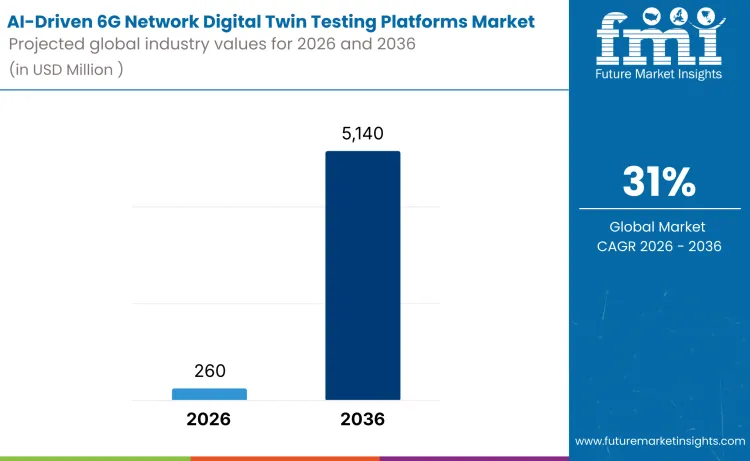
- USD 260 Mn
- Forecast (2036)
- USD 5140 Mn
- CAGR (2026 to 2036)
- 31%
AI-Driven 6G Network Digital Twin Testing Platforms Market Outlook 2026 to 2036
The global AI-driven 6G network digital twin testing platforms market, valued at USD 260 million in 2026, is projected to grow to USD 5,140 million by 2036, with a CAGR of 31%. The market is driven by the rapid advancements in 6G technologies and the increasing need for efficient testing and validation of next-generation networks using digital twins and AI-driven solutions.
Software platforms, which account for 30% of the component market share, are the leading segment due to their ability to simulate and optimize network performance in real-time. On-premise solutions, representing 25% of the deployment model market share, are preferred for their security and control, allowing organizations to manage the testing environment internally. The market growth is further fueled by the global shift towards the development of 6G networks and the need for sophisticated testing methods to ensure their performance and reliability.
Quick Stats for AI-Driven 6G Network Digital Twin Testing Platforms Market
- AI-Driven 6G Network Digital Twin Testing Platforms Market Value (2026): USD 260 million
- AI-Driven 6G Network Digital Twin Testing Platforms Market Forecast Value (2036): USD 5,140 million
- AI-Driven 6G Network Digital Twin Testing Platforms Market Global Forecast CAGR: 31%
- Leading Component in AI-Driven 6G Network Digital Twin Testing Platforms Market: Software platforms (30%)
- Key Growth Regions in AI-Driven 6G Network Digital Twin Testing Platforms Market: China, USA, India, UK, Japan
- Top Players in AI-Driven 6G Network Digital Twin Testing Platforms Market: NVIDIA Corporation, VIAVI Solutions Inc., Spirent Communications, Rohde & Schwarz, Keysight Technologies, Samsung Electronics Co Ltd, Nokia Corporation, Ericsson, Qualcomm Incorporated, Intel Corporation, ZTE Corporation, NEC Corporation, Telefonaktiebolaget LM Ericsson, Huawei Technologies Co Ltd
AI-Driven 6G Network Digital Twin Testing Platforms Market Key Takeaways
| Metric | Value |
|---|---|
| Industry Sales Value (2026) | USD 260 million |
| Industry Forecast Value (2036) | USD 5,140 million |
| Industry Forecast CAGR (2026 to 2036) | 31% |
What Is Driving the Demand for AI-Driven 6G Network Digital Twin Testing Platforms Globally?
The demand for AI-driven 6G network digital twin testing platforms is driven by the growing need for efficient, cost-effective solutions in the development of next-generation telecommunications networks. As 6G technologies advance, the complexity of network design increases with the convergence of AI, edge computing, and ultra-low-latency requirements. Digital twin platforms enable engineers to simulate network performance in real-world conditions, reducing reliance on field trials. Incorporating AI improves predictive capabilities, fault detection, and self-optimization, supporting faster deployment and lower costs. Telecommunications operators and equipment manufacturers use these platforms to validate protocols, manage resources, and optimize network performance. The increasing number of 6G trials in regions like Asia Pacific, North America, and Europe continues to drive demand for these testing platforms.
Future demand for AI-driven digital twin platforms is expected to grow as 6G development progresses. With more connected devices, network slicing, and autonomous systems, the need for predictive testing and real-time optimization will increase. Advancements in AI and machine learning will enhance digital twin capabilities for anomaly detection, optimization, and security testing. As network providers collaborate on standards and interoperability, the market for these platforms will expand, supporting 6G deployment and reducing time-to-market for new services.
What Are the Key Segments in AI-Driven 6G Network Digital Twin Testing Platforms Market?
The AI-driven 6G network digital twin testing platforms market is expanding, driven by the demand for accurate network simulation and optimization. Software platforms hold 30% of the market share, providing advanced tools for virtual network testing. On-premise solutions represent 25% of the deployment market, preferred by enterprises for enhanced data control and security. This market is growing rapidly as industries prepare for the transition to 6G networks.
Which Component Drives AI-Driven 6G Network Digital Twin Testing Platforms Demand Globally?
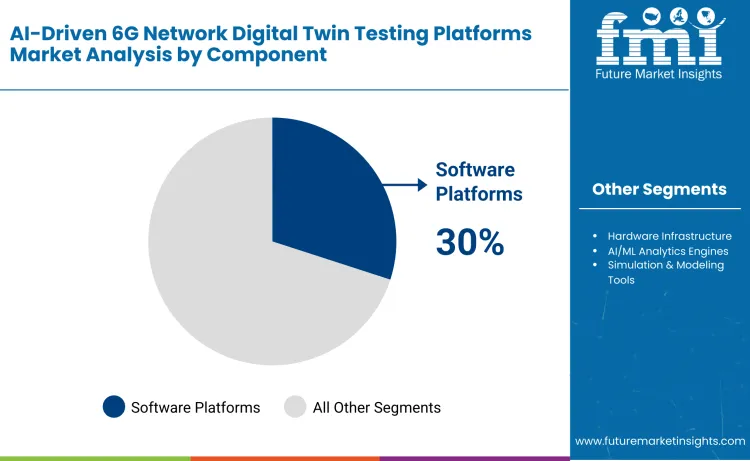
Software platforms lead the AI-driven 6G network digital twin testing platforms market, making up 30% of the share. These platforms simulate and test network performance under real-world conditions without requiring live deployment. They allow telecom companies to predict 6G network behavior, optimize configurations, and troubleshoot potential issues before they arise. The rise of AI and machine learning enhances the accuracy and predictive power of these platforms. As telecom providers shift toward 6G, the demand for software solutions capable of simulating complex network scenarios grows. Software platforms help reduce costs, speed up development, and improve overall efficiency, making them crucial for operators as they prepare for 6G rollouts.
Which Deployment Model Drives AI-Driven 6G Network Digital Twin Testing Platforms Demand Globally?
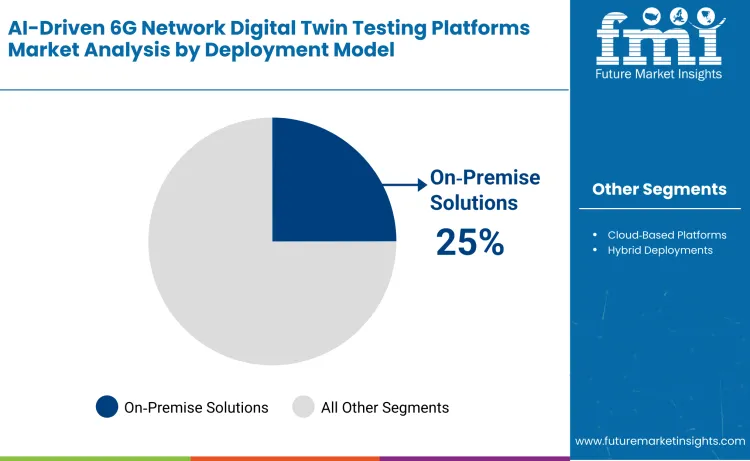
On-premise solutions account for 25% of the market, favored by companies needing control over their data. These solutions ensure security, compliance, and privacy, particularly for industries like telecom, where sensitive information is involved. On-premise systems integrate well with existing infrastructure and offer customization for specific needs. As 6G testing involves high-security data, the demand for on-premise models remains strong, providing companies with complete oversight of their network simulations.
What are the Key Trends in the Global AI-Driven 6G Network Digital Twin Testing Platforms Market?
The global AI-driven 6G network digital twin testing platforms market is emerging as next-generation wireless communication evolves beyond 5G toward 6G. Digital twin testing platforms create virtual replicas of network environments that can simulate, analyse and optimise performance using artificial intelligence. These platforms help operators, equipment vendors and service integrators design, validate and deploy 6G network elements with higher accuracy, lower risk and faster time to market. Growth is supported by increasing complexity of network architectures, demand for automated performance assurance, and the need for real-time predictive insights across spectrum, nodes, and traffic scenarios.
What are the Key Drivers for the Global AI-Driven 6G Network Digital Twin Testing Platforms Market?
Key drivers include rising global investment in 6G research and early-stage deployment planning by telecom operators, which creates demand for tools that can evaluate network performance before physical rollouts. The complexity of 6G use cases - such as ultralow latency, massive device connectivity and integrated sensing capabilities - pushes developers to adopt AI-enabled digital twin platforms for simulation and validation. Integration of artificial intelligence for predictive analytics, anomaly detection and automated optimisation enhances testing efficiency. Increasing focus on reducing deployment risk and ensuring quality of experience fuels adoption among network planners, system integrators, and research organisations worldwide.
What are the Restraints for the Global AI-Driven 6G Network Digital Twin Testing Platforms Market?
A primary restraint is that the 6G standard and commercial specifications are still evolving, which creates uncertainty for platform developers and limits broad enterprise investment until standards mature. Developing highfidelity digital twin models that accurately mirror complex 6G behaviours requires significant data collection, computational resources and advanced AI expertise, which can increase development costs and slow initial adoption. Integration challenges with existing network management systems and legacy testing tools may complicate deployment. Variability in digital infrastructure readiness across regions could also restrict the pace of adoption in markets with limited research or investment in next-generation wireless technologies.
What is the Global Demand Outlook for AI-Driven 6G Network Digital Twin Testing Platforms?
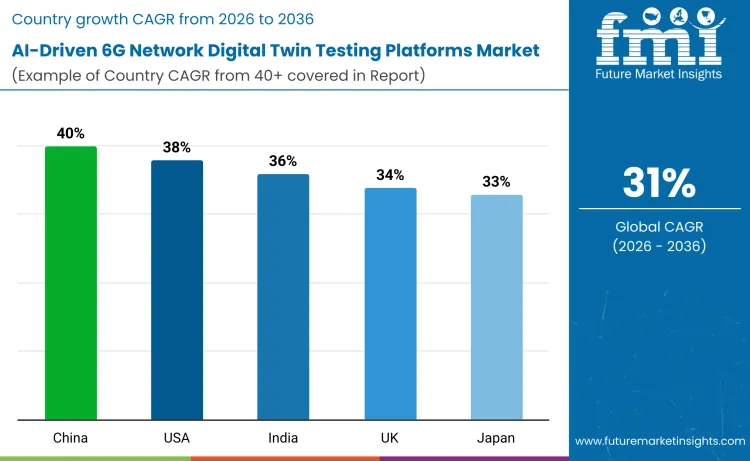
The AI-driven 6G network digital twin testing platforms market is set to grow rapidly, with China leading the way at a projected CAGR of 40%. The USA follows closely with a growth rate of 38%, while India is expected to grow at 36%. The UK is projected to grow at 34%, and Japan at 33%. As 6G technology begins to take shape, the demand for digital twin testing platforms powered by AI will increase, driven by the need for advanced simulations, real-time testing, and optimization of 6G networks. These platforms help simulate the behavior of networks and predict performance under various conditions, making them essential for the successful deployment of 6G technology.
| Country | CAGR (2026 to 2036) |
|---|---|
| China | 40% |
| USA | 38% |
| India | 36% |
| UK | 34% |
| Japan | 33% |
What is Driving the Growth of AI-Driven 6G Network Digital Twin Testing Platforms in China?
China is projected to experience the highest growth in the AI-driven 6G network digital twin testing platforms market, with a projected CAGR of 40%. China has been at the forefront of technological advancements in telecommunications, and its significant investments in 5G and 6G research are driving the demand for these testing platforms. The government’s focus on becoming a global leader in 6G technology and the ongoing development of digital infrastructure are major contributors to the market's growth. Additionally, the need for AI-driven simulations to test network capabilities in real-time, optimize performance, and ensure reliability is increasing as China prepares for the rollout of 6G networks. The country's investments in digital innovation and smart cities are further accelerating the demand for digital twin testing platforms.
Why is the AI-Driven 6G Network Digital Twin Testing Platforms Market Expanding in the USA?
In the USA, the AI-driven 6G network digital twin testing platforms market is projected to grow at a CAGR of 38%. The USA has a strong telecommunications infrastructure and is investing heavily in 6G technology research and development. The increasing focus on AI, machine learning, and digital transformation in the telecommunications sector is a significant driver of this market. As the USA looks to develop its future 6G networks, the need for advanced testing platforms to simulate and optimize network performance is growing. Digital twin technology powered by AI helps telecom companies test different scenarios, manage network complexities, and predict issues before deployment, which is essential for the efficient rollout of 6G networks. The USA’s focus on innovation and technological leadership is pushing the adoption of these advanced testing platforms.
How is the AI-Driven 6G Network Digital Twin Testing Platforms Market Growing in India?
In India, the AI-driven 6G network digital twin testing platforms market is projected to grow at a CAGR of 36%. India is increasingly focusing on the development of 5G and 6G technologies to improve connectivity and support its digital transformation goals. As India prepares for 6G network deployments, the demand for digital twin testing platforms, which enable real-time simulations and testing of network performance, is growing. These platforms are essential for optimizing the performance of complex 6G networks and ensuring their efficiency and reliability. India’s growing emphasis on smart cities, the Internet of Things (IoT), and digital infrastructure development is driving the adoption of AI-powered network testing platforms. With the government’s strong push for digital innovation and sustainable development, the market for these platforms is expected to see substantial growth.
What is Contributing to the Growth of AI-Driven 6G Network Digital Twin Testing Platforms in the UK?
In the UK, the AI-driven 6G network digital twin testing platforms market is projected to grow at a CAGR of 34%. The UK is making significant strides in its 5G and 6G research and development efforts, with a focus on advancing its digital infrastructure to meet the demands of future technologies. The need for AI-driven digital twin testing platforms to simulate, optimize, and predict network performance is growing as telecom providers and research institutions in the UK prepare for the deployment of 6G networks. The UK government’s emphasis on technological innovation, smart cities, and digital transformation is further driving demand for advanced testing solutions. As the UK continues to develop its 6G capabilities, these platforms will play a crucial role in the successful implementation of next-generation networks.
What is Influencing the Growth of AI-Driven 6G Network Digital Twin Testing Platforms in Japan?
In Japan, the demand for AI-driven 6G network digital twin testing platforms is projected to grow at a CAGR of 33%. Japan has been an early adopter of cutting-edge technologies in telecommunications and is actively investing in 6G research and development. The government’s initiatives to position Japan as a global leader in 6G technology are creating strong demand for advanced digital twin testing platforms. These platforms allow telecom operators to simulate real-world conditions and optimize the performance of 6G networks. Japan’s focus on AI, automation, and digital infrastructure, along with its commitment to developing smart cities and connected technologies, is driving the market for these testing solutions. As Japan looks toward the next generation of mobile networks, the adoption of AI-driven digital twin testing platforms will be essential for ensuring optimal network performance and reliability.
What is the Competitive Landscape for the Global AI-Driven 6G Network Digital Twin Testing Platforms Market?
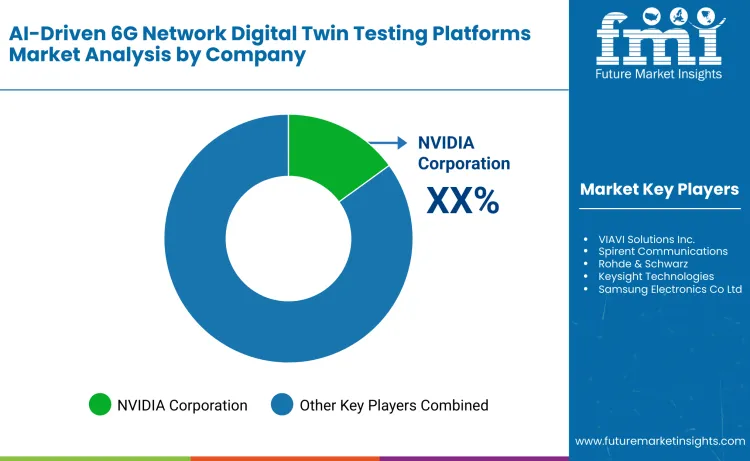
Global demand for AI-driven 6G network digital twin testing platforms is growing rapidly as telecommunications providers prepare for next-generation mobile networks that require unprecedented performance, reliability and efficiency. Digital twin platforms simulate physical network environments in software, enabling operators to test, optimise and validate network behaviour before deployment. With 6G expected to support advanced use cases such as ultralow latency communication, autonomous systems, immersive media and massive machine type communication, traditional testing methods are no longer sufficient. AI integration enhances predictive analytics, automated scenario testing and real-time optimisation across simulated network layers, making digital twin platforms essential for reducing rollout risk and operational cost. Growth in global 6G research, pilot deployments and investment in network infrastructure across Asia Pacific, North America and Europe are key factors driving adoption of these advanced testing solutions.
On the supply side, a broad group of technology, test-equipment and telecommunications companies compete to lead this emerging market. NVIDIA Corporation is widely regarded as a leading player thanks to its AI hardware and software ecosystem that supports complex simulation workloads. Other significant competitors include VIAVI Solutions Inc., Spirent Communications, Rohde & Schwarz, Keysight Technologies, Samsung Electronics Co Ltd, Nokia Corporation, Ericsson, Qualcomm Incorporated, Intel Corporation, ZTE Corporation, NEC Corporation and Huawei Technologies Co Ltd. These firms offer testing hardware, software frameworks, simulation engines and AI-enabled analytics components designed to support digital twin environments for 6G network planning and validation. Competition among suppliers is shaped by platform scalability, accuracy of simulation models, AI capability, integration with existing network infrastructure, support services and global reach. Vendors that combine robust AI platforms, highfidelity modelling, flexible architectures and strong partnerships with network operators are best positioned to capture growth as telcos and ecosystem partners accelerate 6G innovation and deployment worldwide.
Key Players
- NVIDIA Corporation
- VIAVI Solutions Inc.
- Spirent Communications
- Rohde & Schwarz
- Keysight Technologies
- Samsung Electronics Co Ltd
- Nokia Corporation
- Ericsson
- Qualcomm Incorporated
- Intel Corporation
- ZTE Corporation
- NEC Corporation
- Telefonaktiebolaget LM Ericsson
- Huawei Technologies Co Ltd
Scope of the Report
| Items | Values |
|---|---|
| Quantitative Units (2025) | USD Million |
| Component | Software platforms, Hardware infrastructure, AI/ML analytics engines, Simulation & modeling tools, Integration & support services |
| Deployment Model | On-premise solutions, Cloud-based platforms, Hybrid deployments |
| End User | Telecom network operators, Network equipment manufacturers, Enterprise & large-scale industries, Government & defense agencies, Research institutions |
| Application | Network planning & optimization, Real-time performance monitoring, Fault prediction & preventive diagnostics, Security testing & threat simulations, Spectrum management & optimization |
| Technology | Artificial intelligence modules, Machine learning frameworks, Digital twin simulation engines, Edge computing integration, Advanced analytics & visualization |
| Sales Channel | Direct enterprise sales, Channel partners & resellers, Managed service providers |
| Companies | NVIDIA Corporation, VIAVI Solutions Inc., Spirent Communications, Rohde & Schwarz, Keysight Technologies, Samsung Electronics Co Ltd, Nokia Corporation, Ericsson, Qualcomm Incorporated, Intel Corporation, ZTE Corporation, NEC Corporation, Telefonaktiebolaget LM Ericsson, Huawei Technologies Co Ltd |
| Regions Covered | North America, Latin America, Western Europe, Eastern Europe, South Asia and Pacific, East Asia, Middle East & Africa |
| Countries Covered | United States, Canada, Mexico, Brazil, Argentina, Germany, France, United Kingdom, Italy, Spain, Netherlands, China, India, Japan, South Korea, ANZ, GCC Countries, South Africa |
| Additional Attributes | Dollar by sales by component, deployment model, end-user, application, technology, sales channel, and region. Includes market trends in the adoption of AI/ML and digital twin technologies for network management, real-time performance monitoring, fault prediction, and spectrum optimization. Performance metrics, cost-effectiveness, sustainability practices, regulatory compliance, and the role of advanced analytics in enhancing network efficiency, security, and predictive capabilities. Market share and competitive positioning of key companies in the telecom and network infrastructure sectors. |
Key Segments in the AI-Driven 6G Network Digital Twin Testing Platforms Market
Component
- Software platforms
- Hardware infrastructure
- AI/ML analytics engines
- Simulation & modeling tools
- Integration & support services
Deployment Model
- On-premise solutions
- Cloud-based platforms
- Hybrid deployments
End User
- Telecom network operators
- Network equipment manufacturers
- Enterprise & largescale industries
- Government & defense agencies
- Research institutions
Application
- Network planning & optimization
- Realtime performance monitoring
- Fault prediction & preventive diagnostics
- Security testing & threat simulations
- Spectrum management & optimization
Technology
- Artificial intelligence modules
- Machine learning frameworks
- Digital twin simulation engines
- Edge computing integration
- Advanced analytics & visualization
Sales Channel
- Direct enterprise sales
- Channel partners & resellers
- Managed service providers
Region
- Asia Pacific
- China
- India
- Japan
- South Korea
- ASEAN
- Rest of Asia Pacific
- Europe
- Germany
- United Kingdom
- France
- Italy
- Spain
- Nordic
- BENELUX
- Rest of Europe
- North America
- United States
- Canada
- Mexico
- Latin America
- Brazil
- Chile
- Rest of Latin America
- Middle East & Africa
- Kingdom of Saudi Arabia
- Other GCC Countries
- Turkey
- South Africa
- Other African Union
- Rest of Middle East & Africa
Frequently Asked Questions
How big is the AI-Driven 6G Network Digital Twin Testing Platforms market?
The market is valued at USD 260 million in 2026 and is expected to grow at a CAGR of 31%, reaching USD 5.14 billion by 2036.
What is the growth outlook for the AI-Driven 6G Network Digital Twin Testing Platforms market?
The market is projected to grow at a CAGR of 31% from 2026 to 2036.
Which region is expected to experience the fastest growth in the AI-Driven 6G Network Digital Twin Testing Platforms market?
China is expected to lead with a growth rate of 40%, driven by advancements in 6G network infrastructure and the increasing adoption of AI-driven technologies.
What are the key applications of AI-Driven 6G Network Digital Twin Testing Platforms?
These platforms are primarily used in simulating and testing digital twin models for 6G networks, enhancing the development and optimization of next-generation communication systems.
Who is the major player in the AI-Driven 6G Network Digital Twin Testing Platforms market?
The leading player in the market is NVIDIA Corporation.
Preview the report firsthand - request a free sample
Get SampleGet the brochure for pricing and purchase details.
Get PDFTable of Content
- Executive Summary
- Market Overview
- Global Market Value, 2020-2025
- Global Market Forecast, 2026-2036
- Market Dynamics
- Drivers
- Restraints
- Opportunities
- Regulatory & Standards Landscape
- Technology & Innovation Outlook
- Market Segmentation Analysis
- By Component
- Software Platforms
- Hardware Infrastructure
- AI/ML Analytics Engines
- Simulation & Modeling Tools
- Integration & Support Services
- By Deployment Model
- On-Premise Solutions
- Cloud-Based Platforms
- Hybrid Deployments
- By End User
- Telecom Network Operators
- Network Equipment Manufacturers
- Enterprise & Large-Scale Industries
- Government & Defense Agencies
- Research Institutions
- By Application
- Network Planning & Optimization
- Real-Time Performance Monitoring
- Fault Prediction & Preventive Diagnostics
- Security Testing & Threat Simulations
- Spectrum Management & Optimization
- By Technology
- Artificial Intelligence Modules
- Machine Learning Frameworks
- Digital Twin Simulation Engines
- Edge Computing Integration
- Advanced Analytics & Visualization
- By Sales Channel
- Direct Enterprise Sales
- Channel Partners & Resellers
- Managed Service Providers
- By Component
- Regional Outlook
- North America
- Latin America
- Western Europe
- Eastern Europe
- South Asia & Pacific
- East Asia
- Middle East & Africa
- Country-Level Outlook
- United States
- Canada
- Mexico
- Brazil
- Argentina
- Germany
- France
- United Kingdom
- Italy
- Spain
- Netherlands
- China
- India
- Japan
- South Korea
- ANZ
- GCC Countries
- South Africa
- Competitive Landscape
- Market Structure Overview
- Company Positioning
- Strategic Initiatives
- Key Player Profiles
- Scope of the Report
- Research Methodology
- Assumptions & Acronyms


