

- Industry Size (2026)
- USD 10.4 Bn
- Forecast (2036)
- USD 148.7 Bn
- CAGR (2026 to 2036)
- 30.1%
6G Network Energy Efficiency and Power Consumption Test Platforms Market Forecast and Outlook 2026 to 2036
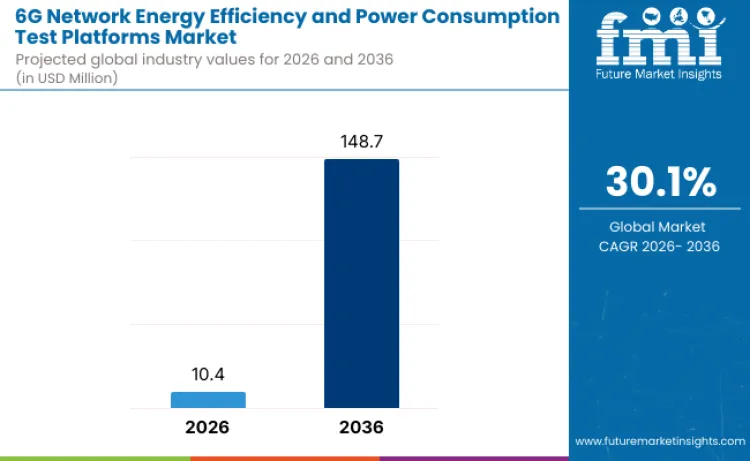
The 6G network energy efficiency and power consumption test platforms market is valued at USD 10.4 billion in 2026 and is projected to reach USD 148.7 billion by 2036, reflecting a CAGR of 30.1%. Demand expands as telecom developers focus on optimizing energy performance in early 6G architectures built around terahertz bands, dense cell deployments, and AI-driven network control. Research institutions and infrastructure suppliers rely on precision test systems to validate power behavior and ensure scalable, low-energy network designs.
Hardware leads component usage because instrument-grade analyzers, power meters, signal generators, and RF test chambers deliver essential measurement accuracy for emerging 6G requirements. Platforms support validation of massive MIMO arrays, beam steering, adaptive modulation, and power consumption under ultra-high throughput workloads. Emphasis on energy profiling under real-time conditions strengthens reliance on advanced test benches across prototype and pre-commercial environments.
Quick Stats for 6G Network Energy Efficiency and Power Consumption Test Platforms Market
- Market Value (2026): USD 10.4 billion
- Market Forecast Value (2036): USD 148.7 billion
- Forecast CAGR (2026 to 2036): 30.1%
- Leading Component Segment in Global Demand: Hardware
- Key Growth Regions in Global Demand: China, India, Japan, USA
- Top Players in Global Demand: Keysight Technologies, Rohde & Schwarz, Anritsu Corporation, VIAVI Solutions, Spirent Communications
China, India, Japan, and the USA represent core growth regions due to large-scale 6G research programs and accelerated investment in next-generation telecom infrastructure. Keysight Technologies, Rohde & Schwarz, Anritsu Corporation, VIAVI Solutions, and Spirent Communications shape competitive activity through development of terahertz-ready instrumentation, AI-enhanced analytics, and integrated test suites designed to benchmark energy efficiency across evolving 6G deployment models.
6G Network Energy Efficiency and Power Consumption Test Platforms Market Key Takeaways
| Metric | Value |
|---|---|
| Market Value (2026) | USD 10.4 billion |
| Market Forecast Value (2036) | USD 148.7 billion |
| Forecast CAGR (2026 to 2036) | 30.1% |
How Are the Segments Classified in the 6G Network Energy Efficiency and Power Consumption Test Platforms Market?
Demand for 6G energy-efficiency and power-consumption test platforms is shaped by requirements for reduced operational load, distributed architectures, and validation of ultra-dense networks. Buyers evaluate hardware scalability, software-defined measurement capability, and service expertise supporting next-generation performance targets. Adoption patterns reflect early research cycles, prototype verification, and infrastructure planning across laboratories, equipment vendors, and network operators preparing for 6G deployment.
Which Component Segment Accounts for the Largest Share of Global Demand?
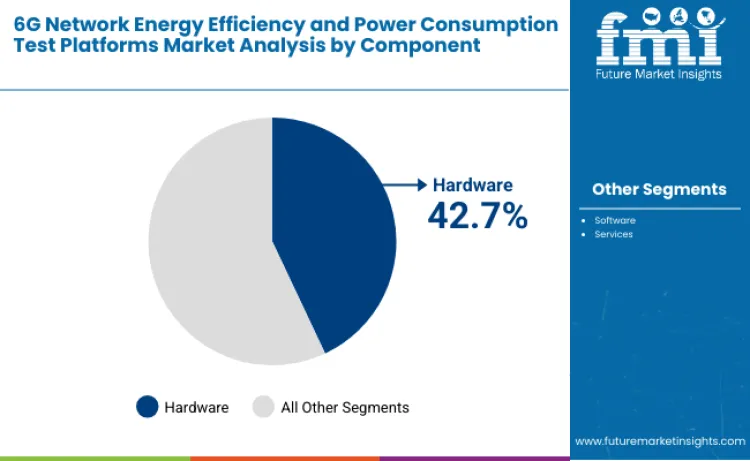
Hardware holds 42.7%, making it the leading component segment in global demand for 6G power-consumption and energy-efficiency testing. Hardware platforms support signal-path measurement, real-time load evaluation, and precise power tracking across RAN, core, and NTN systems in pre-commercial environments. Software supports automation, energy-model simulation, and AI-driven optimization functions compatible with virtualized 6G architectures. Services support deployment guidance, calibration tasks, and lifecycle test management for research and commercial users. Component distribution reflects reliance on physical measurement systems during early-stage system development and growing demand for software-enabled analytics.
Key Points:
- Hardware supports high-precision measurement across 6G subsystems.
- Software enables automated modelling and AI-driven test control.
- Services provide configuration and lifecycle testing expertise.
- Distribution aligns with early infrastructure validation needs.
Which Technology Layer Represents the Largest Segment?
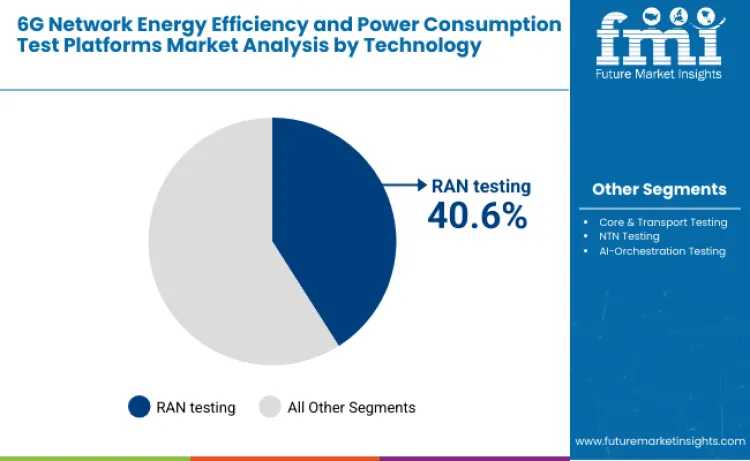
RAN testing holds 40.6%, making it the largest technology-layer segment in global 6G test-platform demand. Energy-efficiency assessment at the radio layer requires multi-band measurement, beamforming evaluation, and load-adaptation analysis across dense heterogeneous access environments. Core and transport testing supports evaluation of routing behavior, protocol workloads, and energy distribution across virtualized and distributed cores. NTN testing enables energy modelling for satellite-linked communication paths and non-terrestrial architectures. AI-orchestration testing evaluates power-optimization algorithms and intelligent resource-management frameworks. Distribution reflects priority placed on RAN-level energy constraints during 6G development.
Key Points:
- RAN testing addresses energy performance in dense access environments.
- Core and transport testing supports distributed-architecture workloads.
- NTN testing evaluates satellite-linked power behavior.
- Layer selection reflects energy constraints across 6G subsystems.
Which End-User Segment Accounts for the Largest Share of Global Demand?
Network operators hold 39.2%, making them the leading end-user segment in global demand. Operators require energy-efficiency validation to manage operational expenditure, model power load across network densification, and verify multi-layer interaction ahead of commercial rollout. Equipment vendors rely on test platforms to evaluate product-level energy performance and ensure compliance with upcoming 6G requirements. Research labs support early-stage concept investigation, protocol evaluation, and performance benchmarking. Enterprises adopt platforms for private-network planning and energy-aware infrastructure assessment. End-user distribution reflects responsibility for system-wide performance and technology-readiness planning.
Key Points:
- Operators lead due to network-wide energy-performance obligations.
- Vendors depend on testing for product validation.
- Research labs support early architectural investigations.
- Enterprises use testing for private-network planning and optimization.
What are the Key Dynamics in the 6G Network Energy Efficiency and Power Consumption Test Platforms Market?
Global demand grows as early 6G development expands across telecom, semiconductor, and research ecosystems. Energy efficiency emerges as a core performance benchmark for next generation networks operating across dense, high frequency architectures. Test platforms support evaluation of power behaviour in devices, radios, and distributed systems. Stakeholders invest in systems that model large scale workloads, simulate sustainability metrics, and validate performance for emerging applications across advanced communication environments.
How is early stage 6G R&D activity shaping requirements for energy optimization?
Growing research programs create sustained need for platforms that analyze energy behaviour across terahertz communication, reconfigurable surfaces, and intelligent network elements. System designers evaluate tools capable of mapping power consumption for massive antenna arrays, edge nodes, and AI enhanced network functions. Semiconductor teams use precision test modules to validate chip level efficiency under variable workloads. Research laboratories integrate modelling environments that simulate real time power dynamics for multi node networks. Governments funding early 6G trials encourage development of testbeds that measure energy metrics across experimental architectures. Cross sector applications, including robotics and mobility, raise interest in efficiency centred evaluation.
How do capital intensity, evolving protocols, and modernization needs influence market adoption?
Instrumentation investment remains substantial due to requirements for high accuracy power sensors, scalable emulation frameworks, and advanced RF modules. Early stage specifications limit certainty for long term equipment compatibility, which influences planning across research organizations and vendors. Interoperability challenges arise when integrating multi-vendor hardware in complex configurations. Expertise gaps within emerging communication labs extend development cycles. Virtualized test environments gain attention as buyers seek scalable alternatives to full physical infrastructure. Vendors develop modular architectures designed to adapt to evolving standards while supporting sustainability goals through precise measurement of energy use across future 6G network components.
How is Demand for 6G Network Energy Efficiency and Power Consumption Test Platforms Market Evolving Across Key Countries?
Demand for 6G network energy efficiency and power consumption test platforms is rising due to expanding next-generation network development, broader device-testing requirements, and increasing emphasis on minimizing energy loads in telecom infrastructure. China records a CAGR of 36.4% supported by extensive 6G R&D cycles. India shows a 30.7% CAGR driven by network modernization. Japan posts a 29.5% CAGR supported by precision-driven engineering and advanced telecom testing needs. USA holds a 28.2% CAGR linked to high investment in telecom innovation. UK records a 26.9% CAGR supported by ongoing digital-infrastructure enhancement.
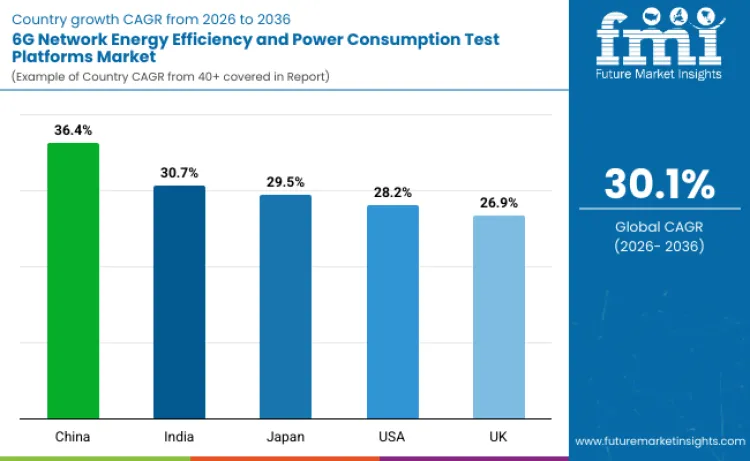
| Country | CAGR (%) |
|---|---|
| China | 36.4 % |
| India | 30.7 % |
| Japan | 29.5 % |
| USA | 28.2 % |
| UK | 26.9 % |
How is China driving demand for 6G Network Energy Efficiency and Power Consumption Test Platforms?
China drives demand through its extensive 6G development pipeline, strong telecom manufacturing ecosystem, and high output of test-equipment research programs. The country’s CAGR of 36.4% reflects intense activity across prototype validation, power-consumption modelling, and hardware-software optimization workflows. Telecom operators and national laboratories utilize test platforms to evaluate energy-efficient architectures, device thermal behavior, and advanced radio-frequency performance. Large equipment manufacturers maintain consistent procurement to support iterative design cycles. Strong government-backed research initiatives sustain ongoing interest in energy-efficient network components and performance-monitoring systems. Continuous expansion of early-stage 6G trials reinforces demand across institutional and industrial settings.
- Extensive telecom R&D capacity
- Continuous prototype and hardware testing cycles
- Strong demand for RF and power-efficiency validation
- Government-supported 6G development programs
How is India driving demand for 6G Network Energy Efficiency and Power Consumption Test Platforms?
India supports rising demand due to network-modernization programs, expanding digital-infrastructure investments, and emphasis on energy-efficient telecom deployments. The country’s CAGR of 30.7% reflects strong institutional and industrial interest in test platforms that measure device-level power dynamics and base-station energy profiles. Telecom operators plan long-term modernization strategies incorporating 6G-aligned test environments. Academic and national research centers evaluate energy-efficient waveform technologies and network simulations. Manufacturers adopt power-consumption testing to support device-certification pathways. Growth in large-scale network rollouts strengthens demand for reliable measurement tools supporting energy-optimization objectives.
- Network-modernization programs accelerating adoption
- Academic and national research activity
- Increased industry focuses on device-efficiency validation
- Rising need for energy-optimization modelling tools
How is Japan driving demand for 6G Network Energy Efficiency and Power Consumption Test Platforms?
Japan drives demand due to its precision-engineering culture, strong telecom-equipment base, and structured approach to next-generation network planning. The country’s CAGR of 29.5% reflects consistent need for controlled test environments assessing radio-unit power behavior, device energy flow, and thermal stability. Telecom operators conduct detailed simulations to support energy-efficient network-design decisions. Research institutions advance measurement protocols for low-power communication components. Equipment manufacturers rely on test platforms to validate energy-efficiency benchmarks across multiple hardware iterations. Stable collaboration between industry and research entities reinforces continuous usage.
- Strong precision-engineering and telecom-equipment activity
- Consistent use of detailed simulation and modelling tools
- Research-driven measurement protocol development
- Continuous hardware iteration requiring energy-testing cycles
How is the USA driving demand for 6G Network Energy Efficiency and Power Consumption Test Platforms?
USA drives demand through high investment in telecom innovation, broad device-development activity, and expansion of research programs focusing on energy-aware network design. The country’s CAGR of 28.2% reflects steady adoption of test platforms for evaluating chip-level power usage, antenna-system efficiency, and base-station energy loads. Technology firms rely on advanced modelling systems to study energy-performance tradeoffs in emerging 6G architectures. Academic and industrial laboratories conduct large-scale simulations requiring high-fidelity test setups. Manufacturers integrate measurement systems to meet evolving performance and efficiency standards for next-generation communication hardware.
- High investment in telecom research
- Broad adoption of chip- and device-level energy testing
- Large simulation workloads across research institutions
- Strong need for efficiency validation in hardware development
How is the UK driving demand for 6G Network Energy Efficiency and Power Consumption Test Platforms?
UK supports demand through ongoing digital-infrastructure upgrades, strong academic participation, and interest in energy-efficient telecom solutions. The country’s CAGR of 26.9% reflects adoption of power-consumption test tools used for evaluating hardware performance under varied network-load conditions. Research centers investigate low-power designs for 6G-aligned components. Telecom operators apply test frameworks to assess energy-optimization strategies for urban and rural deployments. Equipment developers use measured power-efficiency data to support certification and product-validation processes. National initiatives emphasizing sustainable digital systems reinforce ongoing demand.
- Strong academic and telecom research involvement
- Broad interest in low-power communication technologies
- Consistent use of test platforms for hardware performance evaluation
- National focus on sustainable digital-infrastructure development
What is the competitive landscape of demand for 6G network energy efficiency and power consumption test platforms globally?
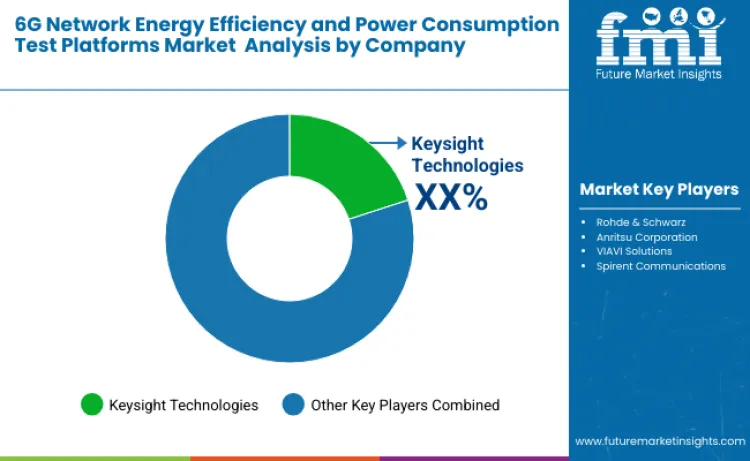
Demand for 6G network energy efficiency and power consumption test platforms grows as operators, component suppliers, and research institutions expand prototype validation for advanced radio architectures. Requirements focus on accurate power profiling, thermal behavior assessment, and multi-band measurement capability linked to sub-THz development. Buyers evaluate waveform generation stability, analyzer sensitivity, synchronization performance, and integration with automated test workflows. Procurement teams prioritize calibrated measurement accuracy, modular hardware options, and software environments supporting evolving 3GPP study items. Trend in the global market reflects wider interest in reducing network energy intensity, optimizing beamforming circuits, and validating power demand across dense antenna arrays.
Keysight Technologies holds a significant share. Position strengthens through high-performance vector signal analyzers, scalable power measurement systems, and established relationships with semiconductor and infrastructure developers. Rohde & Schwarz participates with test platforms supporting sub-THz signal characterization and energy-aware performance analysis. Anritsu Corporation contributes instrument suites used in device-level power validation and RF efficiency studies. VIAVI Solutions supports demand through network-level test systems suited for power management analysis in early 6G architectures. Spirent Communications remains active with software-driven test environments used for modeling energy behavior across virtualized and cloud-native setups. Competitive positioning globally reflects measurement precision, software flexibility, hardware scalability, and support capability aligned with emerging 6G research programs.
Key Players in the 6G Network Energy Efficiency and Power Consumption Test Platforms Market
- Keysight Technologies
- Rohde & Schwarz
- Anritsu Corporation
- VIAVI Solutions
- Spirent Communications
Scope of the Report
| Items | Values |
|---|---|
| Quantitative Units | USD billion |
| By Component | Hardware, Software, Services |
| Technology Layer | RAN Testing, Core & Transport Testing, NTN Testing, AI-Orchestration Testing |
| End-User | Network Operators, Equipment Vendors, Research Labs, Enterprises |
| Regions Covered | Asia Pacific, Europe, North America, Latin America, Middle East & Africa |
| Countries Covered | India, China, USA, Germany, South Korea, Japan, Italy, and 40+ countries |
| Key Companies Profiled | Keysight Technologies, Rohde & Schwarz, Anritsu Corporation, VIAVI Solutions, Spirent Communications |
| Additional Attributes | Dollar sales by component categories and technology layers; regional adoption trends across Asia Pacific, Europe, and North America; competitive landscape of 6G power-consumption and efficiency testing platforms; developments in RAN, core, NTN, and AI-orchestrated testing systems; integration with energy-optimized network hardware, digital twins, simulation frameworks, and operator/vendor lab environments; compliance with emerging 6G testing standards and sustainability benchmarks. |
6G Network Energy Efficiency and Power Consumption Test Platforms Market by Segment
By Component:
- Hardware
- Software
- Services
By Technology Layer:
- RAN Testing
- Core & Transport Testing
- NTN Testing
- AI-Orchestration Testing
By End-User:
- Network Operators
- Equipment Vendors
- Research Labs
- Enterprises
Region:
- Asia Pacific
- China
- Japan
- South Korea
- India
- Australia & New Zealand
- ASEAN
- Rest of Asia Pacific
- Europe
- Germany
- United Kingdom
- France
- Italy
- Spain
- Nordic
- BENELUX
- Rest of Europe
- North America
- United States
- Canada
- Mexico
- Latin America
- Brazil
- Chile
- Rest of Latin America
- Middle East & Africa
- Kingdom of Saudi Arabia
- Other GCC Countries
- Turkey
- South Africa
- Other African Union
- Rest of Middle East & Africa
Frequently Asked Questions
What is the size of the 6G network energy efficiency and power consumption test platforms market in 2026?
The market is valued at USD 10.4 billion in 2026, supported by early-stage 6G testing activity and rising performance-validation needs.
What will be the industry size by 2036?
Industry value will reach USD 148.7 billion by 2036 as engineering groups expand test requirements for waveform behavior, energy metrics, and device interoperability.
What is the CAGR for 2026 to 2036?
The 6G network energy efficiency and power consumption test platforms market expands at a 30.1% CAGR during the forecast period.
Which component segment leads in 2026?
Hardware accounts for 42.7% share in 2026 due to requirement for high-precision instruments used in energy measurement and RF assessment.
Which technology layer segment holds the highest share?
RAN testing leads with 40.6% share, reflecting its role in validating spectrum usage, power efficiency, and network configuration under 6G conditions.
Preview the report firsthand - request a free sample
Get SampleGet the brochure for pricing and purchase details.
Get PDFTable of Content
- Executive Summary
- Market Overview
- Global Market Value, 2020-2026
- Global Market Forecast, 2026-2036
- Market Dynamics
- Drivers
- Restraints
- Opportunities
- Regulatory & Standards Landscape
- Technology & Material Innovation Outlook
- Market Segmentation Analysis
- By Component
- Hardware
- Software
- Services
- By Technology Layer
- RAN Testing
- Core & Transport Testing
- NTN Testing
- AI-Orchestration Testing
- By End-User
- Network Operators
- Equipment Vendors
- Research Labs
- Enterprises
- By Component
- Regional Outlook
- Asia Pacific
- Europe
- North America
- Latin America
- Middle East & Africa
- Country-Level Outlook
- China
- India
- Japan
- United States
- Germany
- South Korea
- Italy
- Australia & New Zealand
- ASEAN
- United Kingdom
- France
- Spain
- Nordic
- BENELUX
- Mexico
- Brazil
- Chile
- Turkey
- South Africa
- Other GCC Countries
- Rest of Middle East & Africa
- Competitive Landscape
- Market Structure Overview
- Company Positioning
- Strategic Initiatives
- Key Player Profiles
- Scope of the Report
- Research Methodology
- Assumptions & Acronyms


