

- Industry Size (2026)
- USD 2.4 Bn
- Forecast (2036)
- USD 11.7 Bn
- CAGR (2026 to 2036)
- 17.3%
Integrated Sensor-Ready Coatings for Aircraft Structural Health Monitoring Market Forecast and Outlook 2026 to 2036
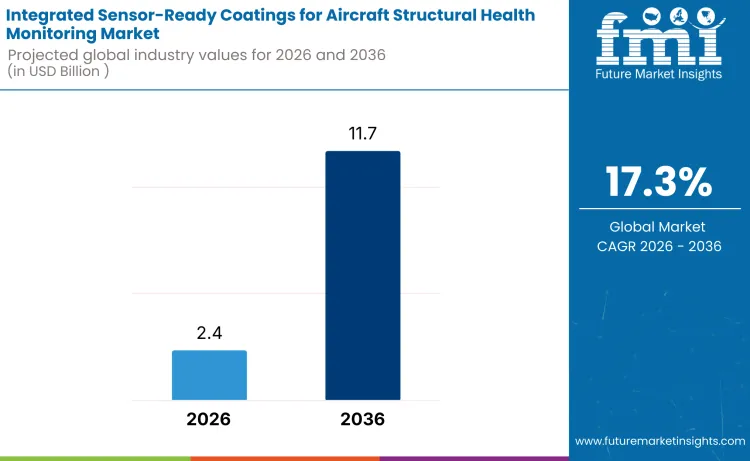
The integrated sensor-ready coatings for aircraft structural health monitoring market is valued at USD 2.4 billion in 2026 and is projected to reach USD 11.7 billion by 2036, reflecting a CAGR of 17.3%. Demand rises as aviation platforms shift toward continuous structural health monitoring to reduce inspection burdens, enhance safety, and optimize maintenance planning. Growth aligns with increased use of composite airframes requiring advanced, embedded sensing capabilities.
Conductive sensor-integrated coatings lead adoption because these formulations incorporate nano-conductive networks, piezoresistive elements, or strain-responsive additives that generate measurable signals under mechanical stress. Coatings act as distributed sensing layers, enabling early detection of fatigue, delamination, and impact events. Compatibility with automated application systems and composite substrates supports integration into OEM manufacturing workflows.
China, India, USA, and Japan represent key growth regions driven by next-generation aircraft programs, defense modernization, and investment in predictive maintenance technologies. PPG Aerospace, AkzoNobel, 3M, and Mankiewicz guide sector development with multifunctional coating architectures, embedded-sensor chemistries, and data-connectivity interfaces designed to support real-time monitoring across critical aircraft structures.
Quick Stats for Integrated Sensor-Ready Coatings for Aircraft Structural Health Monitoring Market
- Market Value (2026): USD 2.4 billion
- Market Forecast Value (2036): USD 11.7 billion
- Forecast CAGR (2026-2036): 17.3%
- Leading Coating Type in Global Demand: Conductive sensor-integrated coatings
- Key Growth Regions in Global Demand: China, India, USA, Japan
- Top Players in Global Demand: PPG Aerospace, AkzoNobel, 3M, Mankiewicz
Integrated Sensor-Ready Coatings for Aircraft Structural Health Monitoring Market Key Takeaways
| Metric | Value |
|---|---|
| Market Value (2026) | USD 2.4 billion |
| Market Forecast Value (2036) | USD 11.7 billion |
| Forecast CAGR (2026-2036) | 17.3% |
How Are the Segments Classified in the Integrated Sensor-Ready Coatings for Aircraft Structural Health Monitoring Market?
Demand for sensor-ready aircraft coatings is shaped by increasing reliance on predictive maintenance, weight-efficient sensing solutions, and integration of smart functionalities directly into coated aircraft structures. Buyers evaluate conductivity, piezoelectric responsiveness, microdamage indication, and multifunctional sensing capability across metallic and composite airframes. Adoption patterns reflect aviation-sector interest in continuous structural monitoring, reduced inspection burden, and enhanced detection of fatigue, corrosion, strain, and impact events.
Which Coating Type Accounts for the Largest Share of Global Demand?
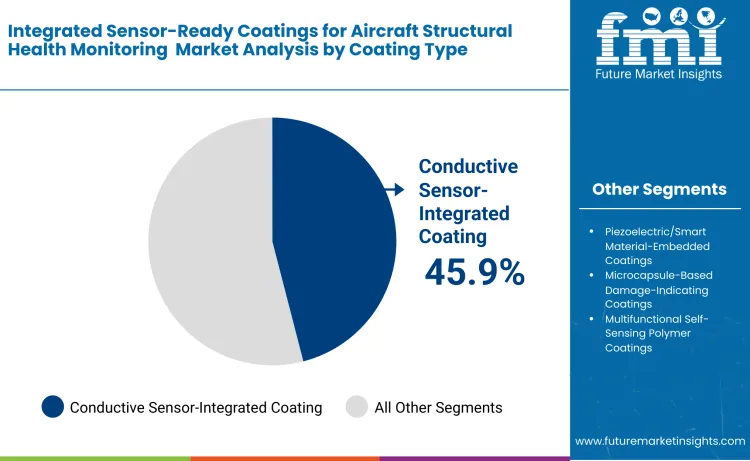
Conductive sensor-integrated coatings hold 45.9%, making them the leading coating-type segment globally. These coatings provide embedded conductive pathways that enable real-time electrical resistance or impedance monitoring for crack initiation and substrate changes. Piezoelectric or smart material-embedded coatings support active sensing through mechanical–electrical responses. Microcapsule-based damage-indicating coatings release detectable markers when microcracks occur. Multifunctional self-sensing polymer coatings combine conductivity, strain responsiveness, and durability for broad monitoring tasks. Coating-type distribution reflects preference for conductive systems that interface directly with aircraft health-monitoring electronics.
Key Points:
- Conductive coatings support real-time electrical sensing.
- Piezoelectric systems enable active monitoring under mechanical load.
- Microcapsule coatings indicate early-stage damage visually or chemically.
- Self-sensing polymers integrate multiple monitoring capabilities.
Which Sensing Functionality Represents the Largest Share of Global Demand?
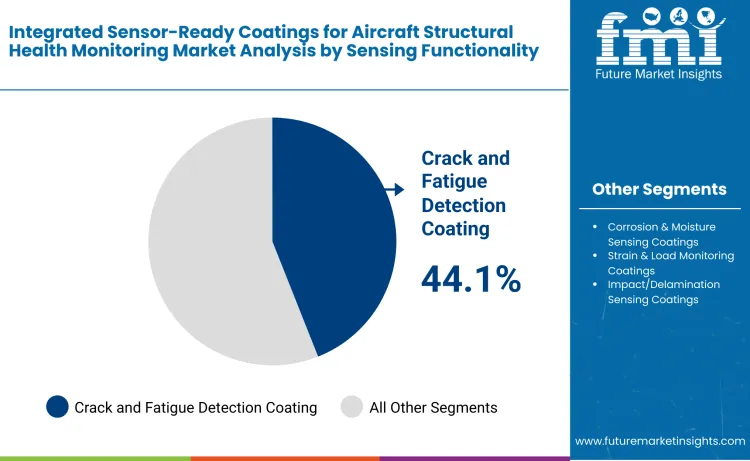
Crack and fatigue detection coatings hold 44.1%, making them the largest sensing-functionality segment. These coatings provide early detection of fatigue progression across primary structures exposed to cyclic stress. Corrosion and moisture sensing coatings monitor environmental degradation, especially in metallic regions vulnerable to moisture ingress. Strain and load monitoring coatings measure deformation across composite and metallic components. Impact and delamination sensing coatings address high-energy events affecting composite skins and substructures. Functionality distribution reflects priority placed on fatigue monitoring for enhancing airframe life and maintenance planning.
Key Points:
- Fatigue detection supports early intervention in cyclic-stress regions.
- Corrosion/moisture sensing monitors environmental degradation.
- Strain monitoring supports load-distribution assessment.
- Impact sensing identifies delamination in composite structures.
Which Application Area Accounts for the Largest Share of Global Demand?
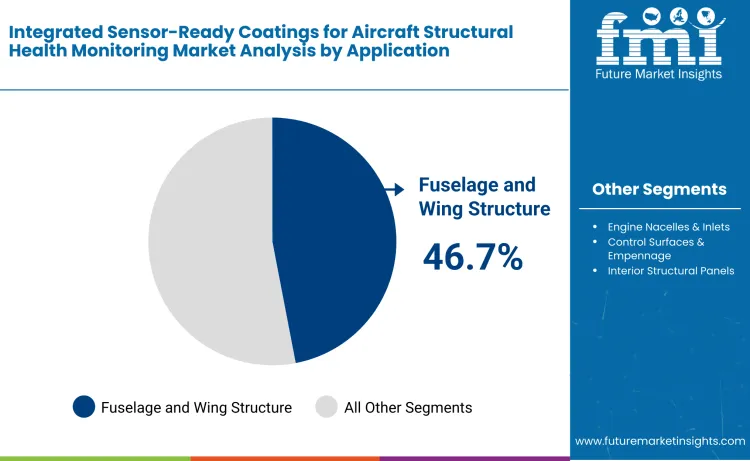
Fuselage and wing structures hold 46.7%, making them the leading application-area segment. These surfaces experience continuous mechanical loading, environmental exposure, and high structural-criticality, creating strong demand for integrated sensing coatings. Engine nacelles and inlets require coatings capable of monitoring thermal and vibration-induced stress changes. Control surfaces and empennage structures depend on sensing systems that maintain operational reliability under aerodynamic loading. Interior structural panels adopt sensor-ready coatings for weight-efficient monitoring in secondary structures. Application distribution reflects focus on primary airframe zones where fatigue and corrosion risks are most critical.
Key Points:
- Fuselage and wings require continuous structural monitoring.
- Nacelles and inlets face thermal and vibratory stresses.
- Control surfaces need sensing for load and fatigue exposure.
- Interior panels benefit from lightweight embedded monitoring.
What are the Key Dynamics in the Integrated Sensor-Ready Coatings for Aircraft Structural Health Monitoring Market?
Global demand rises as aerospace manufacturers, operators, and MRO organizations explore coatings engineered to interface with embedded or surface-mounted sensors for real time structural condition assessment. Sensor-ready coatings support data capture on strain, fatigue, moisture ingress, and impact events. Interest grows as fleets expand reliance on predictive maintenance, digital twins, and continuous airframe monitoring to reduce downtime and improve lifecycle performance across composite and metallic structures.
How are predictive maintenance goals and airframe monitoring needs shaping development of sensor-ready coating systems?
Aircraft operators adopt structural health monitoring tools that require coatings allowing stable sensor adhesion, signal transmission, and environmental protection. Coating chemistry evolves to maintain dielectric stability, controlled conductivity, and low-noise interfaces with piezoelectric, fibre-optic, or printed sensors. Engineers evaluate formulations suitable for composite fuselages and wings that experience thermal cycling, vibration, and ultraviolet exposure. Sensor-ready coatings improve durability of sensing networks in areas prone to moisture, delamination, or impact. OEMs integrate coatings into digital maintenance strategies supported by flight-by-flight condition tracking. Growth in lightweight composite structures strengthens need for coatings that preserve structural integrity while enabling embedded sensing architectures.
How do certification demands, application complexity, and system integration challenges influence scalability?
Aerospace certification requires extensive validation of coating performance with embedded sensing components under mechanical, thermal, and electromagnetic loads. Application processes must ensure consistent thickness and adhesion to avoid signal interference. MRO teams require training to integrate sensors during repaint or repair cycles without disrupting airframe integrity. Coatings must withstand hydraulic fluid exposure, erosion, and de-icing operations without degrading sensor functionality. Data integration with onboard and ground systems introduces interoperability requirements. Long-term stability across global climatic conditions shapes adoption planning. Variability in regulatory frameworks and qualification pathways influences widespread deployment of sensor-enabled coating systems.
How is Demand for Integrated Sensor-Ready Coatings for Aircraft Structural Health Monitoring Market Evolving Across Key Countries?
market is rising due to increased emphasis on predictive maintenance, interest in embedded sensing technologies, and broader adoption of smart-coating systems for safety-critical aviation applications. China records a CAGR of 18.7% supported by rapid aerospace expansion. India shows an 18.0% CAGR driven by fleet growth and MRO modernization. USA posts a 16.8% CAGR supported by strong R&D activity. Japan holds a 15.7% CAGR linked with precision engineering capabilities. UK records a 15.1% CAGR supported by advanced aerospace-innovation programs.
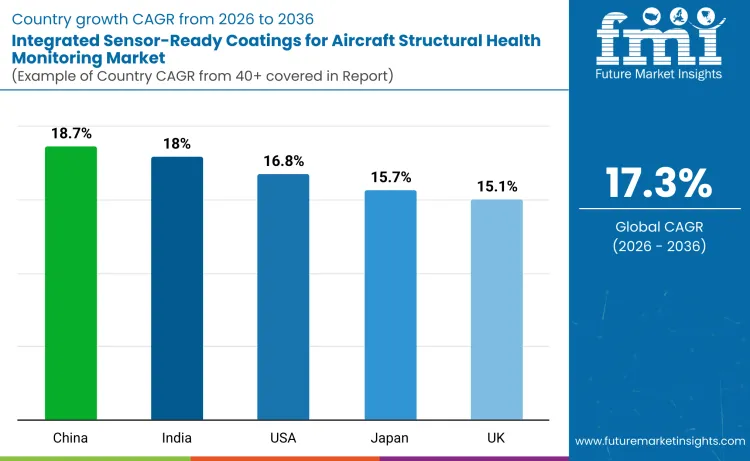
| Country | CAGR (%) |
|---|---|
| China | 18.7% |
| India | 18.0% |
| USA | 16.8% |
| Japan | 15.7% |
| UK | 15.1% |
How is China driving demand for Integrated Sensor-Ready Coatings for Aircraft Structural Health Monitoring?
China drives demand due to rapid growth in commercial and defense aviation, increased investment in smart materials, and interest in predictive structural diagnostics. The country’s CAGR of 18.7% reflects adoption of sensor-embedded coatings incorporating microcapsules, conductive pathways, or strain-responsive materials. Aerospace manufacturers integrate these coatings to enable real-time damage detection across fuselage and wing structures. Research institutes develop multifunctional coating chemistries improving conductivity, adhesion, and environmental resistance. National aerospace programs accelerate testing of advanced diagnostic coatings in next-generation aircraft platforms.
- Expansion of commercial and defense aviation
- Integration of strain- and damage-responsive coating systems
- R&D improving conductive and multifunctional coating properties
- National programs supporting predictive-maintenance technologies
How is India driving demand for Integrated Sensor-Ready Coatings for Aircraft Structural Health Monitoring?
India supports rising demand due to increasing aircraft procurement, modernization of MRO capabilities, and interest in cost-efficient structural monitoring solutions. The country’s CAGR of 18.0% reflects evaluation of coatings incorporating embedded sensors enabling early detection of microcracks, corrosion, or fatigue. Research organizations explore piezoelectric, microcapsule-based, and conductive polymer coatings suited for regional climatic variation. Airlines and defense operators consider smart coatings to reduce manual inspection requirements. Growth in domestic aerospace manufacturing strengthens integration of health-monitoring materials across airframe components.
- Growing fleet size requiring enhanced structural monitoring
- Development of piezoelectric and conductive coating systems
- MRO interest in reducing manual inspection workloads
- Expansion of domestic aerospace manufacturing capacity
How is the USA driving demand for Integrated Sensor-Ready Coatings for Aircraft Structural Health Monitoring?
The USA drives demand through advanced materials research, strong defense-aircraft development, and focus on improving maintenance efficiency through real-time diagnostics. The country’s CAGR of 16.8% reflects significant R&D into smart coatings embedding conductive networks, nano-sensors, and microcapsule indicators. Aerospace companies test coatings enabling crack propagation detection and environmental degradation monitoring. Defense programs accelerate adoption of multifunctional coatings supporting mission-readiness. Commercial aviation considers smart-coating integration to improve reliability and reduce lifecycle maintenance costs.
- Strong R&D activity in multifunctional smart coatings
- Use of embedded sensors for damage and fatigue detection
- Defense-driven development accelerating technology adoption
- Commercial interest in predictive-maintenance cost reduction
How is Japan driving demand for Integrated Sensor-Ready Coatings for Aircraft Structural Health Monitoring?
Japan drives demand due to precision engineering standards, strong materials-science expertise, and interest in enhancing operational reliability of domestic and regional fleets. The country’s CAGR of 15.7% reflects controlled adoption of coatings embedding micro-sensors and conductive pathways to support structural diagnostics. Research institutes develop hybrid polymer–ceramic systems improving signal stability and durability. Aerospace manufacturers integrate sensor-ready coatings in composite structures where monitoring access is limited. National emphasis on safety and long-term reliability supports continued investment.
- Development of hybrid polymer–ceramic sensing coatings
- Integration of coatings in composite aircraft structures
- Strong focus on durability and signal stability
- National safety standards supporting predictive diagnostics
How is the UK driving demand for Integrated Sensor-Ready Coatings for Aircraft Structural Health Monitoring?
The UK supports demand through aerospace innovation programs, strong materials research capability, and interest in smart maintenance technologies for regional aviation. The country’s CAGR of 15.1% reflects adoption of coatings enabling distributed sensing across airframe surfaces. Research institutions develop conductive and strain-responsive coating chemistries supporting real-time structural assessment. Airlines and MRO facilities evaluate smart coatings to reduce inspection time and increase aircraft availability. National aerospace strategies promote integration of advanced diagnostic materials in next-generation platforms.
- Innovation programs supporting smart-coating development
- Development of conductive and strain-responsive coating chemistries
- MRO interest in reducing inspection downtime
- National strategies promoting predictive aviation technologies
What is the competitive landscape of demand for integrated sensor-ready coatings for aircraft structural health monitoring globally?
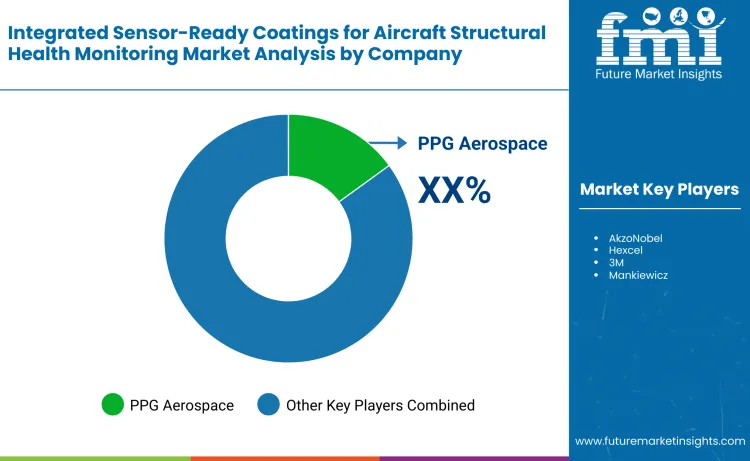
Demand for integrated sensor-ready coatings for aircraft structural health monitoring grows as OEMs and operators advance condition-based maintenance strategies and lightweight embedded sensing architectures. Requirements center on conductive or piezoresistive coating layers, stable adhesion, predictable electrical behavior, and compatibility with composite and metallic substrates used across airframes. Buyers evaluate coating uniformity, signal repeatability, environmental durability, and integration with sensor nodes, wiring interfaces, or wireless transmitters. Procurement teams prioritize certification readiness, maintenance compatibility, and long-term performance under vibration, thermal cycling, and operational moisture loads. Trend in the global market reflects rising interest in distributed sensing, digital monitoring frameworks, and coatings that reduce wiring mass.
AkzoNobel participates with functional aviation coatings engineered for electrical pathways and composite-surface compatibility required in health-monitoring applications. 3M contributes conductive and dielectric materials used in sensor integration and data-transfer pathways on aircraft structures. Mankiewicz supports demand with aerospace coatings tailored for sensor adhesion, surface stability, and controlled resistive behavior. Competitive positioning globally reflects coating conductivity control, environmental durability, integration capability, and alignment with certification frameworks supporting structural health monitoring systems.
Key Players in the Integrated Sensor-Ready Coatings for Aircraft Structural Health Monitoring Market
- PPG Aerospace
- AkzoNobel
- 3M
- Mankiewicz
Scope of the Report
| Items | Values |
|---|---|
| Quantitative Units | USD billion |
| Coating Type | Conductive Sensor-Integrated Coatings; Piezoelectric/Smart Material-Embedded Coatings; Microcapsule-Based Damage-Indicating Coatings; Multifunctional Self-Sensing Polymer Coatings |
| Sensing Functionality | Crack & Fatigue Detection Coatings; Corrosion & Moisture Sensing Coatings; Strain & Load Monitoring Coatings; Impact/Delamination Sensing Coatings |
| Application Area | Fuselage & Wing Structures; Engine Nacelles & Inlets; Control Surfaces & Empennage; Interior Structural Panels |
| End-User | Aircraft OEMs; MRO & Maintenance Operators; Tier-1 Aerospace Component Manufacturers; Defense & Aerospace Research Labs |
| Regions Covered | Asia Pacific, Europe, North America, Latin America, Middle East & Africa |
| Countries Covered | India, China, USA, Germany, South Korea, Japan, Italy, and 40+ countries |
| Key Companies Profiled | PPG Aerospace; AkzoNobel; 3M; Mankiewicz |
| Additional Attributes | Dollar sales by coating type and sensing functionality; integration of smart materials for real-time structural monitoring; compatibility with composite and metallic airframes; advancements in embedded piezoelectric sensing networks; adoption trends across OEM and MRO ecosystems; developments in multifunctional coatings that combine protection and embedded diagnostics. |
Integrated Sensor-Ready Coatings for Aircraft Structural Health Monitoring Market by Segment
By Coating Type:
- Conductive Sensor-Integrated Coatings
- Piezoelectric/Smart Material-Embedded Coatings
- Microcapsule-Based Damage-Indicating Coatings
- Multifunctional Self-Sensing Polymer Coatings
By Sensing Functionality:
- Crack & Fatigue Detection Coatings
- Corrosion & Moisture Sensing Coatings
- Strain & Load Monitoring Coatings
- Impact/Delamination Sensing Coatings
By Application Area:
- Fuselage & Wing Structures
- Engine Nacelles & Inlets
- Control Surfaces & Empennage
- Interior Structural Panels
By End-User:
- Aircraft OEMs
- MRO & Maintenance Operators
- Tier-1 Aerospace Component Manufacturers
- Defense & Aerospace Research Labs
Region:
- Asia Pacific
- China
- Japan
- South Korea
- India
- Australia & New Zealand
- ASEAN
- Rest of Asia Pacific
- Europe
- Germany
- United Kingdom
- France
- Italy
- Spain
- Nordic
- BENELUX
- Rest of Europe
- North America
- United States
- Canada
- Mexico
- Latin America
- Brazil
- Chile
- Rest of Latin America
- Middle East & Africa
- Kingdom of Saudi Arabia
- Other GCC Countries
- Turkey
- South Africa
- Other African Union
- Rest of Middle East & Africa
Frequently Asked Questions
What is the size of the integrated sensor-ready coatings for aircraft structural health monitoring market in 2026?
The market is valued at USD 2.4 billion in 2026 due to increased implementation of coatings that enable embedded sensing for structural assessment.
What will be the industry size by 2036?
Industry value will reach USD 11.7 billion by 2036 as aerospace operators adopt sensor-integrated coatings to enhance maintenance efficiency and extend airframe life.
What is the CAGR for 2026-2036?
The integrated sensor-ready coatings for aircraft structural health monitoring market expands at a 17.3% CAGR during the forecast period.
Which coating-type segment leads in 2026?
Conductive sensor-integrated coatings hold 45.9% share due to their capability to transmit structural integrity data through embedded conductive pathways.
Which sensing-functionality segment holds the highest share?
Crack and fatigue detection coatings lead with 44.1% share, reflecting demand for early detection of structural anomalies in aircraft components.
Preview the report firsthand - request a free sample
Get SampleGet the brochure for pricing and purchase details.
Get PDFTable of Content
- Executive Summary
- Market Overview
- Global Market Value, 2020-2026
- Global Market Forecast, 2026-2036
- Market Dynamics
- Drivers
- Restraints
- Opportunities
- Regulatory & Standards Landscape
- Coating Technology & Embedded Sensing Outlook
- Market Segmentation Analysis
- By Coating Type
- Conductive Sensor-Integrated Coatings
- Piezoelectric or Smart Material-Embedded Coatings
- Microcapsule-Based Damage-Indicating Coatings
- Multifunctional Self-Sensing Polymer Coatings
- By Sensing Functionality
- Crack & Fatigue Detection Coatings
- Corrosion & Moisture Sensing Coatings
- Strain & Load Monitoring Coatings
- Impact & Delamination Sensing Coatings
- By Sales Channel
- Direct OEM Integration
- MRO & Maintenance Operators
- Aftermarket & System Integrators
- By Coating Type
- Regional Outlook
- North America
- Latin America
- Western Europe
- Eastern Europe
- South Asia & Pacific
- East Asia
- Middle East & Africa
- Country-Level Outlook
- United States
- Canada
- Mexico
- Brazil
- Argentina
- Germany
- France
- United Kingdom
- Italy
- Spain
- Netherlands
- China
- India
- Japan
- South Korea
- ANZ
- GCC Countries
- South Africa
- Competitive Landscape
- Market Structure Overview
- Company Positioning
- Strategic Initiatives
- Key Player Profiles
- Scope of the Report
- Research Methodology
- Assumptions & Acronyms


