

- Industry Size (2026)
- USD 196.4 Mn
- Forecast (2036)
- USD 469.2 Mn
- CAGR (2026 to 2036)
- 9.10%
Icephobic Nano Coatings for Aircraft Market Forecast and Outlook 2026 to 2036
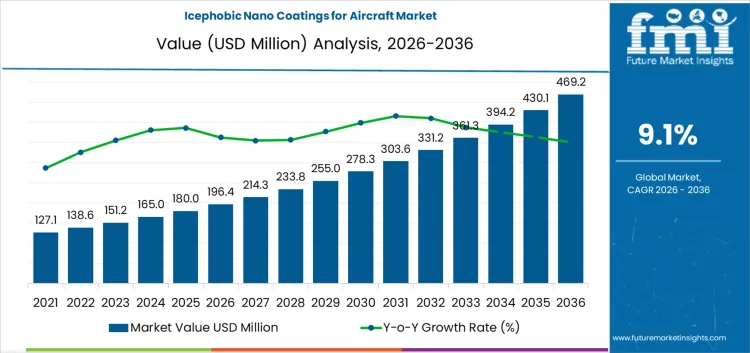
The icephobic nano coatings for aircraft market is valued at USD 196.4 million in 2026 and is projected to reach USD 469.2 million by 2036, reflecting a CAGR of 9.1%. Early growth is driven by increasing integration of anti-icing surface technologies across commercial and military aviation. Cost structures are shaped by nano-material synthesis, coating application precision, and extensive certification requirements. Pricing control concentrates with suppliers able to guarantee measurable ice prevention under operational conditions. Margin concentration favors firms combining proprietary coatings with fleet maintenance and performance verification services, capturing value through operational efficiency rather than high-volume application.
Between 2026 and 2036, regional adoption depends on airline fleet composition, climate exposure, and regulatory approvals. Value accrual is strongest for companies providing validated coatings across multiple aircraft types with repeatable performance. Operators that integrate technology with maintenance schedules and offer multi-aircraft certification maintain higher margins. Firms lacking proprietary formulations or certification face slower adoption and lower returns. Revenue concentration is linked to performance verification, client engagement, and demonstrated fuel efficiency or safety benefits, rather than material throughput.
Quick Stats of the Icephobic Nano Coatings for Aircraft Market
- Icephobic Nano Coatings for Aircraft Market Value (2026): USD 196.4 million
- Icephobic Nano Coatings for Aircraft Market Forecast Value (2036): USD 469.2 million
- Icephobic Nano Coatings for Aircraft Market Forecast CAGR 2026 to 2036: 9.10%
- Icephobic Nano Coatings for Aircraft Leading Coating Chemistry: Fluoropolymer-Based (34%)
- Icephobic Nano Coatings for Aircraft Key Growth Regions: China, Brazil, USA, South Korea, UK, Japan
- Icephobic Nano Coatings for Aircraft Top Players: PPG Industries, AkzoNobel, 3M, Sherwin-Williams, Mankiewicz, BASF, DuPont, Dow, Solvay, Saint-Gobain
What is the Growth Forecast for Icephobic Nano Coatings for Aircraft Market through 2036?
Between 2026 and 2031, the icephobic nano coatings for aircraft market is projected to grow from USD 196.4 million to USD 303.6 million, generating an absolute increase of USD 107.2 million and reflecting a CAGR of 9.1%. Growth is driven by adoption of fluoropolymer-based, siloxane, and nanocomposite coatings on leading edges, windshields, and engine inlets. Commercial aircraft represent 54% of applications. Early adoption focuses on new-build programs and trial installations. Cost structures are influenced by coating chemistry, surface preparation, and application precision. Value capture favors companies delivering verified icephobic performance and operational reliability.
From 2031 to 2036, the market is expected to expand from USD 303.6 million to USD 469.2 million, adding USD 165.5 million. Growth is supported by retrofit programs, aftermarket upgrades, and military aircraft integration. Adoption increases across commercial, business jet, and military segments. Suppliers with proven coating technologies, full application services, and integration with OEMs gain a competitive edge. Performance validation, durability, and regulatory compliance determine market positioning. Market expansion favors firms combining chemistry expertise, surface engineering, and operational support for global fleets.
Icephobic Nano Coatings for Aircraft Market Key Takeaways
| Metric | Value |
|---|---|
| Market Value (2026) | USD 196.4 million |
| Forecast Value (2036) | USD 469.2 million |
| Forecast CAGR 2026 to 2036 | 9.10% |
What Is Driving Demand for Icephobic Nano Coatings for Aircraft?
Icephobic nano coatings are increasingly adopted to prevent ice accumulation on wings, fuselage, and critical flight surfaces. Conventional deicing relied on chemical fluids, heated surfaces, or mechanical removal, which added weight and operational delays. Nano-engineered coatings reduce ice adhesion, enhance hydrophobicity, and maintain aerodynamic performance under subzero conditions. Aircraft manufacturers, airlines, and maintenance providers prioritize coating durability, regulatory compliance, and compatibility with existing surface materials. Early adoption focused on test fleets and military aircraft, while current applications extend to commercial aviation seeking reduced turnaround times, lower fuel consumption, and improved safety. Maintenance protocols, surface preparation, and coating longevity influence selection and operational integration.
Increasing air traffic and regulatory emphasis on operational efficiency drive adoption of icephobic nano coatings. Modern formulations emphasize abrasion resistance, uniform nano-structure, and scalable application methods for commercial aircraft fleets. Costs are affected by material synthesis, surface treatment, and application labor, concentrating margins among suppliers capable of repeatable, high-performance coatings. Airlines implement coatings to minimize flight delays, reduce deicing fluid use, and maintain safety standards. By 2036, icephobic nano coatings are expected to become integral to aircraft surface management, supporting reliability, efficiency, and environmental compliance across aviation operations.
What Factors Are Shaping the Demand for Icephobic Nano Coatings for Aircraft in Terms of Coating Chemistry and Application Area?
The demand for icephobic nano coatings for aircraft is segmented by coating chemistry and application area. Coating types include fluoropolymer-based, siloxane and hybrid, nanocomposite particle coatings, and other advanced materials. Application areas cover leading edges, windshields and sensors, engine inlets or nacelles, and other aircraft surfaces. Adoption is influenced by ice adhesion reduction, operational safety, and certification compliance. Uptake is driven by improved aerodynamic performance, reduced deicing requirements, and lower operational costs. Coating choice depends on aircraft component geometry, environmental exposure, and maintenance accessibility to ensure reliable ice mitigation and performance under extreme conditions.
Why Are Fluoropolymer-Based Coatings Leading the Chemistry Segment in Icephobic Nano Coatings?
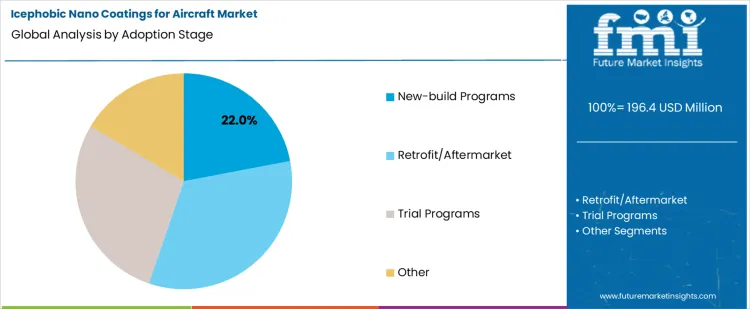
Fluoropolymer-based coatings account for approximately 34% of total coating chemistry demand, making them the dominant category. These coatings provide ultra-low surface energy, limiting ice adhesion on aircraft surfaces exposed to high humidity and freezing conditions. Airlines and manufacturers apply them to leading edges and other critical surfaces where ice accumulation significantly affects aerodynamics and safety. Adoption is reinforced by resistance to erosion, chemical stability, and compatibility with standard aircraft maintenance practices. Fluoropolymer coatings maintain ice mitigation efficiency across temperature fluctuations and repeated cleaning or deicing cycles, providing consistent operational performance and measurable reductions in fuel and maintenance costs.
Operational and environmental factors further support adoption. Fluoropolymer coatings adhere reliably to metal and composite substrates while withstanding thermal cycling and high-speed airflow. Crews apply coatings using controlled surface preparation to ensure uniform coverage and performance. Aircraft operators measure ice accumulation and drag reduction to validate coating efficacy. The segment leads because fluoropolymer-based coatings combine proven icephobic performance, substrate compatibility, and operational reliability, making them the primary choice for extreme weather mitigation in commercial and military aviation.
Why Are Leading Edges Representing the Largest Application Area in Icephobic Nano Coatings?
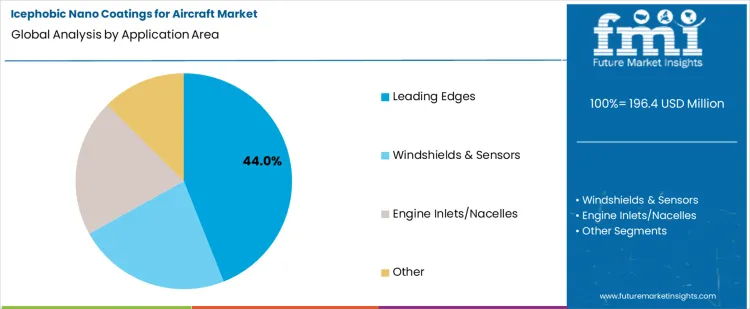
Leading edges account for approximately 44% of total application area demand, making them the largest segment. These surfaces are highly exposed to airflow and precipitation, creating the greatest risk for ice buildup. Ice accumulation on leading edges compromises aerodynamic efficiency, lift, and overall flight safety. Operators prioritize coatings on these areas to maintain smooth airflow, reduce drag, and minimize deicing interventions. Adoption is reinforced by regulatory safety requirements, measurable operational efficiency, and enhanced component lifespan. Coating application considers surface curvature, accessibility, and integration with existing inspection routines to maintain long-term ice mitigation performance.
Performance under environmental stress drives adoption. Icephobic coatings on leading edges must resist erosion, temperature extremes, and repeated moisture exposure. Proper alignment of micro- and nanoscale features ensures maximum ice release efficiency. Airlines integrate application with scheduled maintenance to avoid operational downtime. Material choice balances durability, performance consistency, and lifecycle cost. Leading edges lead because they represent the most critical aerodynamic surfaces, offering the highest measurable ice mitigation benefits and operational efficiency, establishing them as the primary focus of icephobic nano coating programs.
How Are Icephobic Nano Coatings Enhancing Aircraft Safety and Performance?
Icephobic nano coatings are applied to wings, fuselage, and engine components to prevent ice accumulation during flight. Adoption is concentrated among commercial airlines, business jets, and military operators in regions experiencing frequent cold-weather conditions. Coatings are selected based on adhesion, durability, and resistance to deicing chemicals. Growth is driven by operational safety, reduced maintenance, and improved fuel efficiency. Investment focuses on long-term coating performance and compatibility with standard maintenance schedules. Operators value products that maintain aerodynamic efficiency and minimize the need for mechanical or chemical ice removal across regional and international flight operations.
Why Are Cold Climate Operations and Aviation Safety Standards Driving Adoption?
Airlines and operators facing extreme winter conditions prioritize coatings that mitigate ice formation risk. Regulatory safety mandates and performance certification requirements reinforce adoption of validated icephobic solutions. Long-term operational reliability is critical in maintaining flight schedules and preventing in-flight hazards. Coatings that withstand repeated icing cycles gain preference. Regions with rigorous safety oversight or severe winter weather exhibit higher adoption rates. Integration with routine maintenance and operational procedures ensures consistent performance and compliance, providing operators with confidence in both safety and efficiency.
What Constraints Limit Broader Deployment of Icephobic Coatings?
High application costs and the need for specialized surface preparation challenge broader implementation. Coating effectiveness can decline under extreme temperature fluctuations, high humidity, or abrasive environmental conditions. Skilled personnel and controlled environments are required to ensure uniform application. Inspection and maintenance protocols introduce additional operational considerations. Approval processes and regional certification requirements can extend timelines for deployment. These factors restrict early adoption to airlines, military fleets, and OEMs capable of managing technical complexity and maintenance infrastructure. Operators in milder climates or smaller fleets adopt more slowly despite safety advantages.
How Are Technological Developments and Collaborative Efforts Shaping Market Growth?
Nano-structured coatings with enhanced durability and resistance to environmental degradation are increasingly introduced. Manufacturers work with aircraft OEMs and airline operators to validate performance under real-world flight conditions and achieve regulatory alignment. Pilot-scale testing evaluates ice shedding and aerodynamic impact before industrial deployment. Digital monitoring and batch-level certification improve consistency and regulatory compliance. Emphasis is placed on safety, reliability, and long-term durability rather than production volume or cost. Partnerships enable adoption of icephobic nano coatings that reduce maintenance requirements and enhance operational safety in cold-weather aviation operations.
What is the Demand for Icephobic Nano Coatings for Aircraft by Country?
| Country | CAGR (%) |
|---|---|
| USA | 8.7% |
| South Korea | 8.4% |
| China | 10.8% |
| UK | 8.2% |
| Brazil | 10.1% |
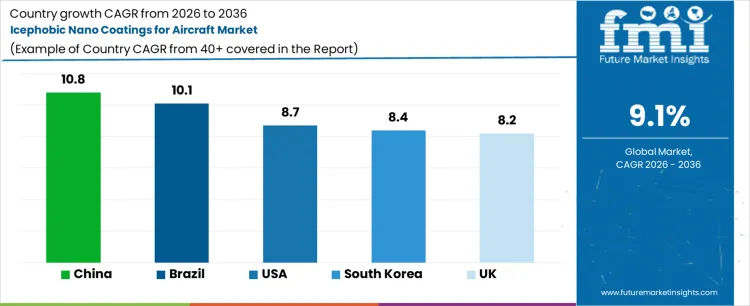
Demand for icephobic nano coatings for aircraft is rising as airlines and aircraft manufacturers seek to enhance flight safety, reduce de-icing costs, and improve operational efficiency. China leads with a 10.8% CAGR, driven by rapid expansion of commercial and regional aircraft fleets and integration of advanced surface treatments. Brazil follows at 10.1%, supported by domestic aircraft production and retrofitting initiatives for fuel and safety optimization. The USA grows at 8.7%, shaped by adoption in both commercial and defense aviation sectors. South Korea records 8.4% growth, driven by aerospace R&D and technological upgrades. The UK shows 8.2% CAGR, reflecting steady application in maintenance, repair, and manufacturing processes for improved aerodynamic performance.
How Is the United States Experiencing Growth in the Icephobic Nano Coatings for Aircraft Market?
United States is experiencing growth at a CAGR of 8.7%, supported by increasing adoption of icephobic nano-coatings across commercial and military aircraft fleets. Airlines and aerospace OEMs are applying coatings on wings, fuselage, and control surfaces to prevent ice formation, improve aerodynamic efficiency, and reduce de-icing costs. Demand is concentrated in major airline hubs, maintenance, repair, and overhaul (MRO) centers, and aerospace manufacturing facilities. Investments prioritize material durability, coating performance, and application precision rather than expanding fleet size. Growth reflects rising regulatory focus on flight safety, operational efficiency, and environmental compliance. Manufacturers are developing advanced formulations with long-lasting properties, low maintenance requirements, and compatibility with various aircraft materials to meet increasing industry standards.
- Airlines and OEMs drive adoption.
- Coatings prevent ice formation on critical aircraft surfaces.
- Airline hubs and MRO centers concentrate demand.
- Coating durability and application precision guide investment.
How Is South Korea Witnessing Increased Adoption With Safety Initiatives?
South Korea is witnessing growth at a CAGR of 8.4%, driven by the adoption of icephobic nano-coatings to enhance aircraft operational safety and reliability. Airlines and aerospace OEMs are implementing coatings on wings, fuselage, and control surfaces to reduce ice accumulation, optimize aerodynamic performance, and minimize operational disruptions. Demand is concentrated in metropolitan airport hubs, MRO centers, and aircraft manufacturing facilities. Investments focus on coating performance, material longevity, and precise application rather than fleet expansion. Growth reflects increased airline emphasis on operational efficiency, environmental compliance, and passenger safety. Manufacturers are introducing advanced surface technologies designed to maintain performance under extreme weather conditions while reducing maintenance and operational costs.
- Airline safety measures drive adoption.
- Coatings applied to wings and fuselage prevent ice.
- Urban airport hubs and maintenance facilities concentrate demand.
- Coating performance and longevity guide investment.
How Is China Experiencing Rapid Growth Through Aircraft Operational Efficiency?
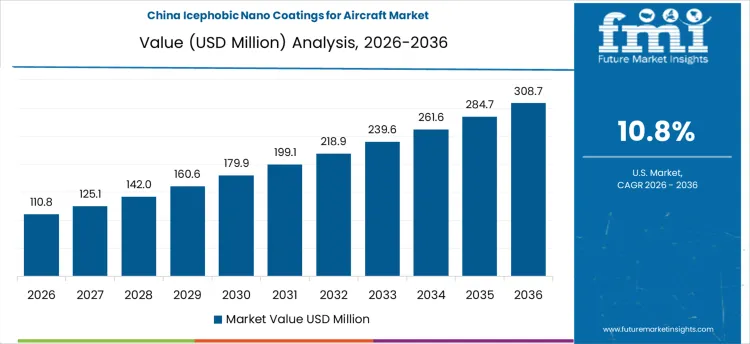
China is experiencing rapid growth at a CAGR of 10.8%, supported by expansion of commercial and military aircraft fleets and adoption of icephobic nano-coatings to improve operational efficiency. Airlines and aerospace OEMs are applying coatings to wings, fuselage, and control surfaces to reduce drag, prevent ice formation, and minimize de-icing requirements. Demand is concentrated in airline hubs, aerospace manufacturing centers, and maintenance facilities. Investments prioritize material durability, application accuracy, and coating performance rather than fleet expansion. Growth reflects increasing operational efficiency targets, fuel savings, and adherence to international safety standards. Manufacturers are developing formulations optimized for longevity, low maintenance, and compatibility with multiple aircraft materials, supporting large-scale fleet adoption.
- Fleet expansion and operational efficiency drive adoption.
- Coatings reduce de-icing requirements and improve safety.
- Airline hubs and OEM facilities concentrate demand.
- Material performance and application precision guide investment.
How Is the United Kingdom Growing With Cold Weather Protection Measures?
The United Kingdom is growing at a CAGR of 8.2%, supported by adoption of icephobic nano-coatings to enhance aircraft safety and reduce operational risks in cold climates. Airlines and aerospace manufacturers are implementing coatings on wings, fuselage panels, and control surfaces to prevent ice formation, maintain aerodynamic efficiency, and minimize maintenance costs. Demand is concentrated in airline hubs, aerospace MRO centers, and aircraft manufacturing facilities. Investments focus on coating performance, material durability, and precise application rather than fleet expansion. Growth reflects regulatory emphasis on flight safety, environmental compliance, and operational efficiency. Advanced formulations are being developed for long-term performance, low maintenance requirements, and compatibility with diverse aircraft materials and designs.
- Cold weather protection drives adoption.
- Coatings are applied to wings, fuselage, and control surfaces.
- Airline hubs and MRO centers concentrate demand.
- Coating durability and performance guide investment.
How Is Brazil Witnessing Expansion Through Airline and Defense Initiatives?
Brazil is witnessing growth at a CAGR of 10.1%, driven by the adoption of icephobic nano-coatings in commercial and defense aircraft to reduce drag, prevent ice accumulation, and enhance operational efficiency. Airlines, military operators, and aerospace OEMs are implementing coatings on wings, fuselage, and control surfaces to improve aerodynamic performance and reduce de-icing costs. Demand is concentrated in airline hubs, MRO centers, and aerospace manufacturing facilities. Investments prioritize material performance, application precision, and coating durability rather than fleet expansion. Growth reflects operational efficiency objectives, compliance with environmental regulations, and adoption of advanced surface technologies. Manufacturers are providing formulations that support long-term durability, low maintenance, and compatibility with multiple aircraft materials and designs.
- Airlines and OEMs drive adoption.
- Coatings prevent ice accumulation on critical surfaces.
- Airline hubs and maintenance facilities concentrate demand.
- Material longevity and application accuracy guide investment.
Who Competes in the Icephobic Nano Coatings for Aircraft Market and What Are Their Core Capabilities?
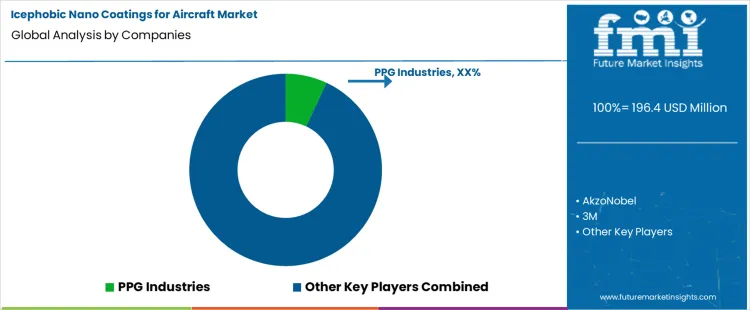
Competition in the icephobic nano coatings market for aircraft reflects differences in surface science, aerospace qualification experience, and formulation depth that address ice adhesion, adhesion durability, and environmental resistance. PPG Industries develops nano-engineered chemistries engineered to reduce ice formation on leading edges of wings and control surfaces while maintaining compatibility with existing primer and topcoat layers. AkzoNobel offers barrier coatings that integrate anti-icing performance with long-term UV resistance and mechanical stability under operational loads. 3M supplies functional coatings that modify surface energy to discourage ice adhesion without compromising aerodynamic profiles. Sherwin-Williams provides formulations that balance anti-icing properties with corrosion protection and fleet maintenance requirements.
Other participants focus on polymer innovation, additive science, and application support that align with certification standards and airline maintenance cycles. Mankiewicz develops nano coatings tailored to specific aircraft substrate materials and finishing processes. BASF advances surface additives that influence crystallinity and microstructure to reduce ice nucleation. DuPont contributes proprietary low surface energy chemistries that enhance de-icing performance at low temperatures. Dow focuses on fluoropolymer and silicone technologies that improve durability under repeated freeze-thaw cycles. Solvay explores structured polymer systems that maintain cohesive strength while disrupting ice adhesion. Saint-Gobain provides engineered interfaces that support adhesion of nano coatings to complex aircraft geometries. Competitive differences arise from validation data under icing conditions, lifecycle performance, and ability to integrate coatings within existing maintenance and inspection regimes.
Key Players in the Icephobic Nano Coatings for Aircraft Market
- PPG Industries
- AkzoNobel
- 3M
- Sherwin-Williams
- Mankiewicz
- BASF
- DuPont
- Dow
- Solvay
- Saint-Gobain
Scope of the Report
| Items | Values |
|---|---|
| Quantitative Units (2026) | USD million |
| Coating Chemistry | Fluoropolymer-Based, Siloxane and Hybrid, Nanocomposite (Particles), Other |
| Application Area | Leading Edges, Windshields & Sensors, Engine Inlets/Nacelles, Other |
| Aircraft Type | Commercial Aircraft, Business Jets, Military Aircraft, Other |
| Adoption Stage | New-build Programs, Retrofit/Aftermarket, Trial Programs, Other |
| End Users | Airlines and Fleet Operators, MRO Providers, OEMs, Other |
| Region | Asia Pacific, Europe, North America, Latin America, Middle East & Africa |
| Key Countries Covered | China, Japan, South Korea, India, Australia & New Zealand, Germany, United Kingdom, France, Italy, Spain, Nordic, BENELUX, United States, Canada, Mexico, Brazil, Chile, Kingdom of Saudi Arabia, Other GCC Countries, Turkey, South Africa, Other African Union |
| Key Companies Profiled | PPG Industries, AkzoNobel, 3M, Sherwin-Williams, Mankiewicz, BASF, DuPont, Dow, Solvay, Saint-Gobain |
| Additional Attributes | Dollar sales by coating chemistry, application area, aircraft type, adoption stage, and end-user; regional CAGR and forecast value growth 2026 to 2036; operational performance, icephobic efficiency, regulatory compliance, and fleet maintenance integration |
Icephobic Nano Coatings for Aircraft Market Segmentation
Coating Chemistry:
- Fluoropolymer-Based
- Siloxane and Hybrid
- Nanocomposite (Particles)
- Other
Application Area:
- Leading Edges
- Windshields & Sensors
- Engine Inlets/Nacelles
- Other
Aircraft Type:
- Commercial Aircraft
- Business Jets
- Military Aircraft
- Other
Adoption Stage:
- New-build Programs
- Retrofit/Aftermarket
- Trial Programs
- Other
Region
- Asia Pacific
- China
- Japan
- South Korea
- India
- Australia & New Zealand
- ASEAN
- Rest of Asia Pacific
- Europe
- Germany
- United Kingdom
- France
- Italy
- Spain
- Nordic
- BENELUX
- Rest of Europe
- North America
- United States
- Canada
- Mexico
- Latin America
- Brazil
- Chile
- Rest of Latin America
- Middle East & Africa
- Kingdom of Saudi Arabia
- Other GCC Countries
- Turkey
- South Africa
- Other African Union
- Rest of Middle East & Africa
Bibliography
- Meuler, A. J., McKinley, G. H., & Cohen, R. E. (2010). Exploiting topographical texture to impart icephobicity. ACS Nano, 4(12), 7048–7052.
- Schaef, H. T., Schutzius, T. M., & Poulikakos, D. (2015). Icephobic surfaces: Fundamentals and applications in aerospace. Langmuir, 31(49), 13410–13420.
Frequently Asked Questions
How big is the icephobic nano coatings for aircraft market in 2026?
The global icephobic nano coatings for aircraft market is estimated to be valued at USD 196.4 million in 2026.
What will be the size of icephobic nano coatings for aircraft market in 2036?
The market size for the icephobic nano coatings for aircraft market is projected to reach USD 469.2 million by 2036.
How much will be the icephobic nano coatings for aircraft market growth between 2026 and 2036?
The icephobic nano coatings for aircraft market is expected to grow at a 9.1% CAGR between 2026 and 2036.
What are the key product types in the icephobic nano coatings for aircraft market?
The key product types in icephobic nano coatings for aircraft market are fluoropolymer-based, siloxane and hybrid, nanocomposite (particles) and other.
Which application area segment to contribute significant share in the icephobic nano coatings for aircraft market in 2026?
In terms of application area, leading edges segment to command 44.0% share in the icephobic nano coatings for aircraft market in 2026.
Preview the report firsthand - request a free sample
Get SampleGet the brochure for pricing and purchase details.
Get PDFTable of Content
- Executive Summary
- Global Market Outlook
- Demand-side Trends
- Supply-side Trends
- Technology Roadmap Analysis
- Analysis and Recommendations
- Market Overview
- Market Coverage / Taxonomy
- Market Definition / Scope / Limitations
- Market Background
- Market Dynamics
- Drivers
- Restraints
- Opportunity
- Trends
- Scenario Forecast
- Demand in Optimistic Scenario
- Demand in Likely Scenario
- Demand in Conservative Scenario
- Opportunity Map Analysis
- Product Life Cycle Analysis
- Supply Chain Analysis
- Investment Feasibility Matrix
- Value Chain Analysis
- PESTLE and Porter’s Analysis
- Regulatory Landscape
- Regional Parent Market Outlook
- Production and Consumption Statistics
- Import and Export Statistics
- Market Dynamics
- Global Market Analysis 2021 to 2025 and Forecast, 2026 to 2036
- Historical Market Size Value (USD Million) Analysis, 2021 to 2025
- Current and Future Market Size Value (USD Million) Projections, 2026 to 2036
- Y-o-Y Growth Trend Analysis
- Absolute $ Opportunity Analysis
- Global Market Pricing Analysis 2021 to 2025 and Forecast 2026 to 2036
- Global Market Analysis 2021 to 2025 and Forecast 2026 to 2036, By Coating Chemistry
- Introduction / Key Findings
- Historical Market Size Value (USD Million) Analysis By Coating Chemistry , 2021 to 2025
- Current and Future Market Size Value (USD Million) Analysis and Forecast By Coating Chemistry , 2026 to 2036
- Fluoropolymer-Based
- Siloxane and Hybrid
- Nanocomposite (Particles)
- Other
- Fluoropolymer-Based
- Y-o-Y Growth Trend Analysis By Coating Chemistry , 2021 to 2025
- Absolute $ Opportunity Analysis By Coating Chemistry , 2026 to 2036
- Global Market Analysis 2021 to 2025 and Forecast 2026 to 2036, By Application Area
- Introduction / Key Findings
- Historical Market Size Value (USD Million) Analysis By Application Area, 2021 to 2025
- Current and Future Market Size Value (USD Million) Analysis and Forecast By Application Area, 2026 to 2036
- Leading Edges
- Windshields & Sensors
- Engine Inlets/Nacelles
- Other
- Leading Edges
- Y-o-Y Growth Trend Analysis By Application Area, 2021 to 2025
- Absolute $ Opportunity Analysis By Application Area, 2026 to 2036
- Global Market Analysis 2021 to 2025 and Forecast 2026 to 2036, By Aircraft Type
- Introduction / Key Findings
- Historical Market Size Value (USD Million) Analysis By Aircraft Type, 2021 to 2025
- Current and Future Market Size Value (USD Million) Analysis and Forecast By Aircraft Type, 2026 to 2036
- Commercial Aircraft
- Business Jets
- Military Aircraft
- Other
- Commercial Aircraft
- Y-o-Y Growth Trend Analysis By Aircraft Type, 2021 to 2025
- Absolute $ Opportunity Analysis By Aircraft Type, 2026 to 2036
- Global Market Analysis 2021 to 2025 and Forecast 2026 to 2036, By Adoption Stage
- Introduction / Key Findings
- Historical Market Size Value (USD Million) Analysis By Adoption Stage, 2021 to 2025
- Current and Future Market Size Value (USD Million) Analysis and Forecast By Adoption Stage, 2026 to 2036
- New-build Programs
- Retrofit/Aftermarket
- Trial Programs
- Other
- New-build Programs
- Y-o-Y Growth Trend Analysis By Adoption Stage, 2021 to 2025
- Absolute $ Opportunity Analysis By Adoption Stage, 2026 to 2036
- Global Market Analysis 2021 to 2025 and Forecast 2026 to 2036, By Region
- Introduction
- Historical Market Size Value (USD Million) Analysis By Region, 2021 to 2025
- Current Market Size Value (USD Million) Analysis and Forecast By Region, 2026 to 2036
- North America
- Latin America
- Western Europe
- Eastern Europe
- East Asia
- South Asia and Pacific
- Middle East & Africa
- Market Attractiveness Analysis By Region
- North America Market Analysis 2021 to 2025 and Forecast 2026 to 2036, By Country
- Historical Market Size Value (USD Million) Trend Analysis By Market Taxonomy, 2021 to 2025
- Market Size Value (USD Million) Forecast By Market Taxonomy, 2026 to 2036
- By Country
- USA
- Canada
- Mexico
- By Coating Chemistry
- By Application Area
- By Aircraft Type
- By Adoption Stage
- By Country
- Market Attractiveness Analysis
- By Country
- By Coating Chemistry
- By Application Area
- By Aircraft Type
- By Adoption Stage
- Key Takeaways
- Latin America Market Analysis 2021 to 2025 and Forecast 2026 to 2036, By Country
- Historical Market Size Value (USD Million) Trend Analysis By Market Taxonomy, 2021 to 2025
- Market Size Value (USD Million) Forecast By Market Taxonomy, 2026 to 2036
- By Country
- Brazil
- Chile
- Rest of Latin America
- By Coating Chemistry
- By Application Area
- By Aircraft Type
- By Adoption Stage
- By Country
- Market Attractiveness Analysis
- By Country
- By Coating Chemistry
- By Application Area
- By Aircraft Type
- By Adoption Stage
- Key Takeaways
- Western Europe Market Analysis 2021 to 2025 and Forecast 2026 to 2036, By Country
- Historical Market Size Value (USD Million) Trend Analysis By Market Taxonomy, 2021 to 2025
- Market Size Value (USD Million) Forecast By Market Taxonomy, 2026 to 2036
- By Country
- Germany
- UK
- Italy
- Spain
- France
- Nordic
- BENELUX
- Rest of Western Europe
- By Coating Chemistry
- By Application Area
- By Aircraft Type
- By Adoption Stage
- By Country
- Market Attractiveness Analysis
- By Country
- By Coating Chemistry
- By Application Area
- By Aircraft Type
- By Adoption Stage
- Key Takeaways
- Eastern Europe Market Analysis 2021 to 2025 and Forecast 2026 to 2036, By Country
- Historical Market Size Value (USD Million) Trend Analysis By Market Taxonomy, 2021 to 2025
- Market Size Value (USD Million) Forecast By Market Taxonomy, 2026 to 2036
- By Country
- Russia
- Poland
- Hungary
- Balkan & Baltic
- Rest of Eastern Europe
- By Coating Chemistry
- By Application Area
- By Aircraft Type
- By Adoption Stage
- By Country
- Market Attractiveness Analysis
- By Country
- By Coating Chemistry
- By Application Area
- By Aircraft Type
- By Adoption Stage
- Key Takeaways
- East Asia Market Analysis 2021 to 2025 and Forecast 2026 to 2036, By Country
- Historical Market Size Value (USD Million) Trend Analysis By Market Taxonomy, 2021 to 2025
- Market Size Value (USD Million) Forecast By Market Taxonomy, 2026 to 2036
- By Country
- China
- Japan
- South Korea
- By Coating Chemistry
- By Application Area
- By Aircraft Type
- By Adoption Stage
- By Country
- Market Attractiveness Analysis
- By Country
- By Coating Chemistry
- By Application Area
- By Aircraft Type
- By Adoption Stage
- Key Takeaways
- South Asia and Pacific Market Analysis 2021 to 2025 and Forecast 2026 to 2036, By Country
- Historical Market Size Value (USD Million) Trend Analysis By Market Taxonomy, 2021 to 2025
- Market Size Value (USD Million) Forecast By Market Taxonomy, 2026 to 2036
- By Country
- India
- ASEAN
- Australia & New Zealand
- Rest of South Asia and Pacific
- By Coating Chemistry
- By Application Area
- By Aircraft Type
- By Adoption Stage
- By Country
- Market Attractiveness Analysis
- By Country
- By Coating Chemistry
- By Application Area
- By Aircraft Type
- By Adoption Stage
- Key Takeaways
- Middle East & Africa Market Analysis 2021 to 2025 and Forecast 2026 to 2036, By Country
- Historical Market Size Value (USD Million) Trend Analysis By Market Taxonomy, 2021 to 2025
- Market Size Value (USD Million) Forecast By Market Taxonomy, 2026 to 2036
- By Country
- Kingdom of Saudi Arabia
- Other GCC Countries
- Turkiye
- South Africa
- Other African Union
- Rest of Middle East & Africa
- By Coating Chemistry
- By Application Area
- By Aircraft Type
- By Adoption Stage
- By Country
- Market Attractiveness Analysis
- By Country
- By Coating Chemistry
- By Application Area
- By Aircraft Type
- By Adoption Stage
- Key Takeaways
- Key Countries Market Analysis
- USA
- Pricing Analysis
- Market Share Analysis, 2025
- By Coating Chemistry
- By Application Area
- By Aircraft Type
- By Adoption Stage
- Canada
- Pricing Analysis
- Market Share Analysis, 2025
- By Coating Chemistry
- By Application Area
- By Aircraft Type
- By Adoption Stage
- Mexico
- Pricing Analysis
- Market Share Analysis, 2025
- By Coating Chemistry
- By Application Area
- By Aircraft Type
- By Adoption Stage
- Brazil
- Pricing Analysis
- Market Share Analysis, 2025
- By Coating Chemistry
- By Application Area
- By Aircraft Type
- By Adoption Stage
- Chile
- Pricing Analysis
- Market Share Analysis, 2025
- By Coating Chemistry
- By Application Area
- By Aircraft Type
- By Adoption Stage
- Germany
- Pricing Analysis
- Market Share Analysis, 2025
- By Coating Chemistry
- By Application Area
- By Aircraft Type
- By Adoption Stage
- UK
- Pricing Analysis
- Market Share Analysis, 2025
- By Coating Chemistry
- By Application Area
- By Aircraft Type
- By Adoption Stage
- Italy
- Pricing Analysis
- Market Share Analysis, 2025
- By Coating Chemistry
- By Application Area
- By Aircraft Type
- By Adoption Stage
- Spain
- Pricing Analysis
- Market Share Analysis, 2025
- By Coating Chemistry
- By Application Area
- By Aircraft Type
- By Adoption Stage
- France
- Pricing Analysis
- Market Share Analysis, 2025
- By Coating Chemistry
- By Application Area
- By Aircraft Type
- By Adoption Stage
- India
- Pricing Analysis
- Market Share Analysis, 2025
- By Coating Chemistry
- By Application Area
- By Aircraft Type
- By Adoption Stage
- ASEAN
- Pricing Analysis
- Market Share Analysis, 2025
- By Coating Chemistry
- By Application Area
- By Aircraft Type
- By Adoption Stage
- Australia & New Zealand
- Pricing Analysis
- Market Share Analysis, 2025
- By Coating Chemistry
- By Application Area
- By Aircraft Type
- By Adoption Stage
- China
- Pricing Analysis
- Market Share Analysis, 2025
- By Coating Chemistry
- By Application Area
- By Aircraft Type
- By Adoption Stage
- Japan
- Pricing Analysis
- Market Share Analysis, 2025
- By Coating Chemistry
- By Application Area
- By Aircraft Type
- By Adoption Stage
- South Korea
- Pricing Analysis
- Market Share Analysis, 2025
- By Coating Chemistry
- By Application Area
- By Aircraft Type
- By Adoption Stage
- Russia
- Pricing Analysis
- Market Share Analysis, 2025
- By Coating Chemistry
- By Application Area
- By Aircraft Type
- By Adoption Stage
- Poland
- Pricing Analysis
- Market Share Analysis, 2025
- By Coating Chemistry
- By Application Area
- By Aircraft Type
- By Adoption Stage
- Hungary
- Pricing Analysis
- Market Share Analysis, 2025
- By Coating Chemistry
- By Application Area
- By Aircraft Type
- By Adoption Stage
- Kingdom of Saudi Arabia
- Pricing Analysis
- Market Share Analysis, 2025
- By Coating Chemistry
- By Application Area
- By Aircraft Type
- By Adoption Stage
- Turkiye
- Pricing Analysis
- Market Share Analysis, 2025
- By Coating Chemistry
- By Application Area
- By Aircraft Type
- By Adoption Stage
- South Africa
- Pricing Analysis
- Market Share Analysis, 2025
- By Coating Chemistry
- By Application Area
- By Aircraft Type
- By Adoption Stage
- USA
- Market Structure Analysis
- Competition Dashboard
- Competition Benchmarking
- Market Share Analysis of Top Players
- By Regional
- By Coating Chemistry
- By Application Area
- By Aircraft Type
- By Adoption Stage
- Competition Analysis
- Competition Deep Dive
- PPG Industries
- Overview
- Product Portfolio
- Profitability by Market Segments (Product/Age /Sales Channel/Region)
- Sales Footprint
- Strategy Overview
- Marketing Strategy
- Product Strategy
- Channel Strategy
- AkzoNobel
- 3M
- Sherwin-Williams
- Mankiewicz
- BASF
- DuPont
- Dow
- Solvay
- Saint-Gobain
- PPG Industries
- Competition Deep Dive
- Assumptions & Acronyms Used
- Research Methodology


