

- Industry Size (2026)
- USD 3.3 Bn
- Forecast (2036)
- USD 15.6 Bn
- CAGR (2026 to 2036)
- 16.8%
Radar-Signature-Control Exterior Coatings for Special Mission Aircraft Market Forecast and Outlook 2026 to 2036
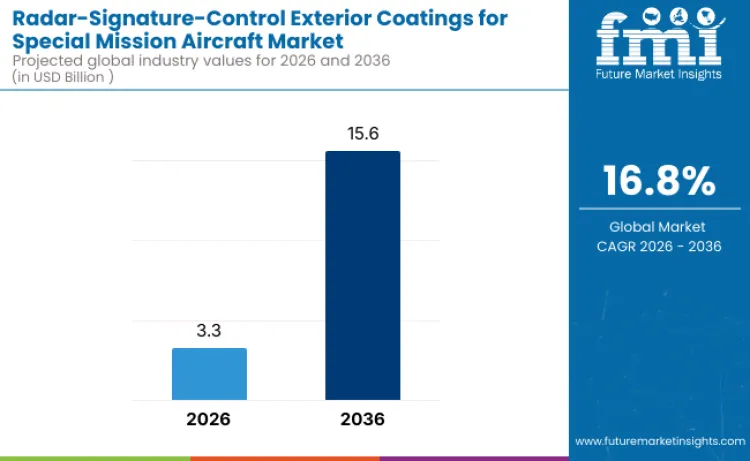
The radar-signature-control exterior coatings for special mission aircraft market is valued at USD 3.3 billion in 2026 and is projected to reach USD 15.6 billion by 2036, reflecting a CAGR of 16.8%. Demand increases as defense forces expand fleets of ISR, electronic-warfare, and low-observable platforms requiring reduced radar cross-section performance. Modernization programs and rising geopolitical tension drive accelerated adoption of stealth-enhancing exterior coating systems.
Radar-absorbing material (RAM) coatings lead coating-type usage because engineered polymer-filler matrices dissipate incident radar energy across targeted frequency bands. Formulations incorporate conductive and magnetic fillers, graded dielectric layers, and controlled porosity structures to attenuate reflections while maintaining durability. Compatibility with composite airframes and complex geometries supports integration across next-generation mission aircraft.
China, India, USA, and Japan represent key growth regions due to advanced defense procurement, indigenous aircraft programs, and sustained investment in stealth technologies. PPG Aerospace, AkzoNobel, Mankiewicz, 3M, and Hexcel guide competitive development through tuned-frequency RAM systems, multifunctional coating stacks, and application processes engineered for consistent radar-signature control across demanding operational environments.
Quick Stats for Radar-Signature-Control Exterior Coatings for Special Mission Aircraft Market
- Market Value (2026): USD 3.3 billion
- Market Forecast Value (2036): USD 15.6 billion
- Market Forecast CAGR (2026-2036): 16.8%
- Leading Coating Type in Global Demand: Radar-absorbing material (RAM) coatings
- Key Growth Regions in Global Demand: China, India, USA, Japan
- Top Players in Global Demand: PPG Aerospace, AkzoNobel, Mankiewicz, 3M, Hexcel
Radar-Signature-Control Exterior Coatings for Special Mission Aircraft Market Key Takeaways
| Metric | Value |
|---|---|
| Market Value (2026) | USD 3.3 billion |
| Market Forecast Value (2036) | USD 15.6 billion |
| Forecast CAGR (2026-2036) | 16.8% |
How Are the Segments Classified in the Radar-Signature-Control Exterior Coatings for Special Mission Aircraft Market?
Demand for radar-signature-control exterior coatings is shaped by low-observability requirements, multi-band radar threats, and the need for durable stealth coatings compatible with metallic and composite airframes. Buyers evaluate absorption performance, scattering control, metamaterial enhancement, and conductive-polymer functionality that support reduced radar cross-section across varied frequencies. Adoption patterns reflect mission profiles, survivability objectives, and integration of advanced RAM chemistries into fuselage, wing, nacelle, and sensor-pod structures.
Which Coating Type Accounts for the Largest Share of Global Demand?

Radar-absorbing material coatings hold 47.4%, making them the leading coating-type segment globally. RAM coatings use lossy dielectric or magnetic fillers to attenuate radar energy and reduce reflected signatures. Radar-scattering or diffusive coatings redirect incident waves toward non-threat angles. Metamaterial-enhanced stealth coatings manipulate electromagnetic responses using engineered microstructures. Conductive polymer-based coatings provide tunable resistivity and support supplementary signature-control functions. Coating-type distribution reflects the dominance of absorption mechanisms for cross-section reduction.
Key Points:
- RAM coatings absorb incident radar energy across priority bands.
- Scattering coatings diffuse reflections away from threat sensors.
- Metamaterial systems tailor electromagnetic interaction.
- Conductive polymers support tunable signature control.
Which Functional Mechanism Represents the Largest Share of Global Demand?
Absorptive stealth coatings hold 45.6%, making them the largest functional-mechanism segment. These lossy-dielectric or carbon-based systems dissipate electromagnetic energy as heat, reducing radar return strength. Scattering and wave-diffusion coatings break coherent reflections through microstructured surfaces. Frequency-selective surface integrated coatings target specific radar bands using patterned conductive layers. Multi-band signature-control systems address broad threat environments requiring stable performance across varying frequencies. Mechanism distribution reflects prioritization of absorption-dominant stealth behavior.
Key Points:
- Absorptive coatings dissipate energy and reduce detectability.
- Scattering systems diffuse radar waves to lessen coherence.
- FSS coatings manage band-specific radar interaction.
- Multi-band systems address diverse operational frequencies.
Which Application Area Accounts for the Largest Share of Global Demand?
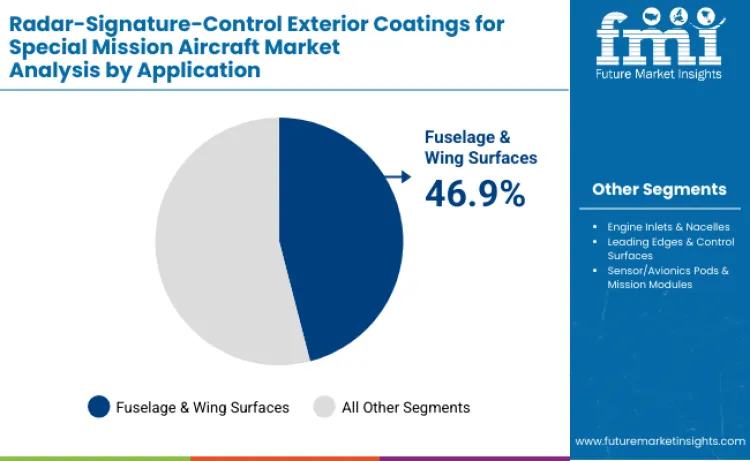
Fuselage and wing surfaces hold 46.9%, making them the leading application-area segment. These surfaces dominate radar-exposed areas and require uniform, durable coatings for consistent signature reduction. Engine inlets and nacelles rely on coatings that limit radar reflections inside curved geometries. Leading edges and control surfaces require coatings that maintain aerodynamic integrity while minimizing radar hotspots. Sensor and avionics pods need signature-controlled coatings that protect mission electronics without compromising performance. Application distribution reflects concentration of radar exposure on primary airframe surfaces.
Key Points:
- Fuselage and wings present largest radar-reflective surfaces.
- Inlets and nacelles need controlled interior and exterior reflections.
- Leading edges require stable low-observable performance under airflow.
- Sensor pods depend on coatings that integrate stealth with mission capability.
What are the Key Dynamics in the Radar-Signature-Control Exterior Coatings for Special Mission Aircraft Market?
Global demand rises as defence operators, OEMs, and mission-focused fleets adopt radar-signature-control coatings that suppress reflectivity across wide frequency bands. These coatings support low-observable performance for surveillance, electronic warfare, patrol, and intelligence aircraft. Formulations combine dielectric tuning, microstructured fillers, and controlled surface roughness to minimize radar returns. Interest escalates as nations expand ISR missions requiring reduced detectability and stable stealth characteristics across diverse operating environments.
How are low-observable mission requirements and multi-band radar threats shaping coating development?
Special mission aircraft require coatings that attenuate radar reflections across multiple bands encountered in modern detection systems. Material scientists design dielectric matrices and absorption fillers tailored to degrade incident radar waves while preserving aerodynamic smoothness. Coatings must integrate with composite and metallic substrates common in mission aircraft. Operators assess solutions capable of maintaining low signature profiles during varied missions, including maritime patrol and border surveillance. Durability against humidity, UV exposure, and particulate erosion becomes essential for aircraft operating in harsh theatres. System integrators test coatings with edge treatments and structural features to ensure consistent radar attenuation across mission-critical surfaces.
How do certification demands, maintenance constraints, and environmental durability challenges influence scalability?
Validation requires laboratory and field testing under radar exposure across operational frequencies, extending certification pathways. Coatings must maintain adhesion, dielectric properties, and surface uniformity after thermal cycling, de-icing, hydraulic fluid exposure, and abrasion. MRO facilities need procedures that allow precise reapplication without altering aircraft signature characteristics. Repair processes become complex when coatings involve multi-layer structures with tuned electromagnetic properties. Environmental regulations influence allowable chemistries for radar-absorbing compounds. Long-term signature stability across global deployment regions shapes procurement decisions for special mission aircraft fleets. Integration with structural modifications and edge treatments adds complexity to fleet-wide adoption.
How is Demand for Radar-Signature-Control Exterior Coatings for Special Mission Aircraft Market Evolving Across Key Countries?
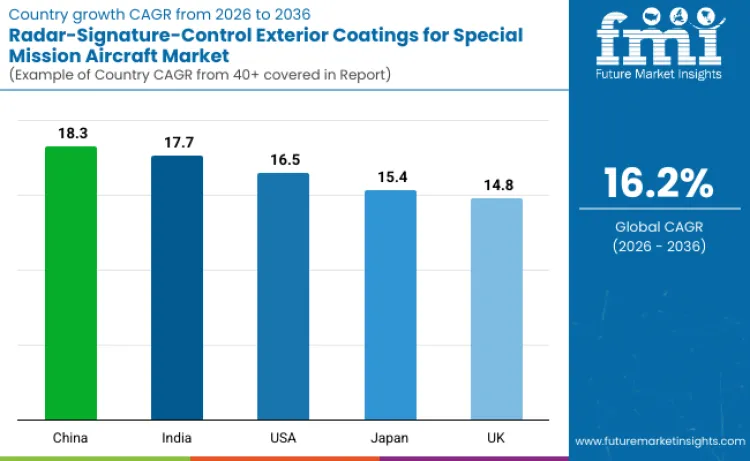
Demand for the radar-signature-control exterior coatings for special mission aircraft market is rising due to increased investment in low-observable technologies, modernization of defense fleets, and broader deployment of advanced surface-material systems. China records a CAGR of 18.3% supported by rapid defense-aircraft development. India shows a 17.7% CAGR driven by expanding airborne surveillance and tactical programs. USA posts a 16.5% CAGR supported by strong stealth-technology R&D. Japan holds a 15.4% CAGR linked with precision materials engineering. UK records a 14.8% CAGR supported by defense-modernization and sensor-evasion initiatives.
| Country | CAGR (%) |
|---|---|
| China | 18.3% |
| India | 17.7% |
| USA | 16.5% |
| Japan | 15.4% |
| UK | 14.8% |
How is China driving demand for Radar-Signature-Control Exterior Coatings for Special Mission Aircraft?
China drives demand due to expansion of special mission and surveillance aircraft programs, strong focus on stealth capability, and rapid development of radar-absorbing materials. The country’s CAGR of 18.3% reflects adoption of composite-compatible coatings reducing electromagnetic reflectivity across critical frequency bands. Research institutes develop multifunctional formulations combining radar absorption, thermal stability, and abrasion resistance. Defense manufacturers integrate signature-control coatings to support next-generation airborne platforms. National security programs accelerate testing and refinement of low-observable exterior treatments.
- Growth of special mission and surveillance aircraft fleets
- Development of advanced radar-absorbing formulations
- Integration with composite airframe structures
- National defense programs supporting low-observable technologies
How is India driving demand for Radar-Signature-Control Exterior Coatings for Special Mission Aircraft?
India supports rising demand due to modernization of airborne tactical and surveillance capabilities, expansion of defense R&D, and interest in indigenous low-observable technologies. The country’s CAGR of 17.7% reflects evaluation of radar-absorbing coatings enhancing mission survivability. Research organizations develop polymer-filler systems tailored for targeted radar-frequency attenuation. Defense aviation programs upgrade aircraft requiring reduced radar cross-section. Collaboration between research institutes and aerospace firms strengthens material performance across diverse climatic environments.
- Upgrades to surveillance and tactical aircraft fleets
- Development of frequency-specific radar-absorbing coatings
- Increased emphasis on indigenous low-observable materials
- Collaborative testing to validate climatic durability
How is the USA driving demand for Radar-Signature-Control Exterior Coatings for Special Mission Aircraft?
The USA drives demand through advanced stealth-technology research, strong defense-aircraft development, and emphasis on minimizing radar cross-section for classified and special mission platforms. The country’s CAGR of 16.5% reflects deployment of coatings incorporating conductive networks, magnetic fillers, and energy-dissipating structures. R&D programs refine low-observable coatings improving environmental durability and multi-band attenuation. Integration into next-generation ISR, transport, and unmanned platforms strengthens long-term demand. Defense modernization initiatives reinforce continuous enhancement of signature-control technologies.
- Advanced stealth and low-observable R&D
- Use of magnetic and conductive fillers for signature reduction
- Integration into next-generation ISR and unmanned aircraft
- Defense modernization strengthening adoption
How is Japan driving demand for Radar-Signature-Control Exterior Coatings for Special Mission Aircraft?
Japan drives demand due to precise engineering requirements, expansion of defense-surveillance capability, and interest in materials improving aircraft survivability. The country’s CAGR of 15.4% reflects controlled adoption of radar-absorbing coatings designed for multi-band performance and long-term environmental stability. Materials research focuses on polymer-ceramic and magnetic-filler systems improving energy attenuation. Special mission aircraft upgrades incorporate signature-control coatings to enhance operational stealth. National security priorities support investment in advanced surface-engineering technologies.
- Development of polymer-ceramic radar-absorbing coatings
- Integration into upgraded special mission platforms
- Emphasis on environmental stability and durability
- National security goals supporting technology adoption
How is the UK driving demand for Radar-Signature-Control Exterior Coatings for Special Mission Aircraft?
The UK supports demand through defense-modernization programs, strong materials research capability, and interest in enhancing survivability of intelligence and reconnaissance aircraft. The country’s CAGR of 14.8% reflects adoption of coatings engineered to reduce radar detectability while maintaining structural and aerodynamic performance. Research institutes develop formulations targeting multi-frequency radar suppression. Defense aviation programs integrate signature-control coatings into specialized airborne platforms. National strategies emphasizing advanced materials and low-observable performance reinforce ongoing development.
- Defense-modernization supporting signature-reduction technologies
- Multi-frequency radar-attenuation coating development
- Integration into intelligence and reconnaissance aircraft
- National materials-innovation frameworks promoting adoption
What is the competitive landscape of demand for radar-signature-control exterior coatings for special mission aircraft globally?

Demand for radar-signature-control exterior coatings for special mission aircraft grows as defense programs strengthen low-observability requirements across surveillance, reconnaissance, and electronic-warfare fleets. Requirements center on controlled dielectric behavior, stable attenuation across radar bands, erosion resistance, and adhesion performance on composite and metallic substrates. Buyers evaluate coating thickness precision, conductivity profiles, environmental durability, and compatibility with stealth-related surface treatments. Procurement teams prioritize certification readiness, maintenance predictability, and multilayer system stability under thermal cycling, humidity exposure, and high-speed particulate impact. Trend in the global market reflects sustained investment in low-observable technologies and enhanced exterior systems that support signature management while preserving aerodynamic performance.
PPG Aerospace holds an estimated 28.0% share. Position strengthens through specialty low-observable coatings engineered for dielectric control and operational durability. AkzoNobel participates with functional military coatings designed for radar-attenuating performance across varied aircraft platforms. Mankiewicz maintains visibility with advanced exterior systems incorporating controlled electrical properties suited for signature-management applications. 3M contributes engineered materials and functional additives integrated into radar-absorbing coating formulations. Hexcel supports demand through composite technologies used in low-observable structures paired with compatible exterior coatings. Competitive positioning globally reflects radar-band performance, environmental stability, multilayer integration capability, and alignment with defense qualification standards for special mission fleets.
Key Players in the Radar-Signature-Control Exterior Coatings for Special Mission Aircraft Market
- PPG Aerospace
- AkzoNobel
- Mankiewicz
- 3M
- Hexcel
Scope of the Report
| Items | Values |
|---|---|
| Quantitative Units | USD billion |
| Coating Type | Radar-Absorbing Material (RAM) Coatings; Radar-Scattering / Diffusive Coatings; Metamaterial-Enhanced Stealth Coatings; Conductive Polymer-Based Signature-Control Coatings |
| Functional Mechanism | Absorptive Stealth Coatings (Lossy Dielectric/Carbon-Based); Scattering & Wave-Diffusion Coatings; Frequency-Selective Surface (FSS) Integrated Coatings; Multi-Band Signature-Control Coating Systems |
| Application Area | Fuselage & Wing Surfaces; Engine Inlets & Nacelles; Leading Edges & Control Surfaces; Sensor/Avionics Pods & Mission Modules |
| End-User | Special Mission Aircraft OEMs; Defense Forces & Aerospace Agencies; MRO & Stealth Maintenance Facilities; Coating & Advanced Materials Manufacturers |
| Regions Covered | Asia Pacific, Europe, North America, Latin America, Middle East & Africa |
| Countries Covered | India, China, USA, Germany, South Korea, Japan, Italy, and 40+ countries |
| Key Companies Profiled | PPG Aerospace; AkzoNobel; Mankiewicz; 3M; Hexcel |
| Additional Attributes | Dollar sales by coating type and functional mechanism; stealth performance metrics across multi-band radar frequencies; adoption trends in special mission aircraft retrofits and OEM programs; advances in metamaterial-based low-observable coatings; lifecycle durability and maintenance considerations for RAM and radar-scattering systems; compatibility with composite and metallic airframes. |
Radar-Signature-Control Exterior Coatings for Special Mission Aircraft Market by Segment
By Coating Type:
- Radar-Absorbing Material (RAM) Coatings
- Radar-Scattering / Diffusive Coatings
- Metamaterial-Enhanced Stealth Coatings
- Conductive Polymer-Based Signature-Control Coatings
By Functional Mechanism:
- Absorptive Stealth Coatings (Lossy Dielectric/Carbon-Based)
- Scattering & Wave-Diffusion Coatings
- Frequency-Selective Surface (FSS) Integrated Coatings
- Multi-Band Signature-Control Coating Systems
By Application Area:
- Fuselage & Wing Surfaces
- Engine Inlets & Nacelles
- Leading Edges & Control Surfaces
- Sensor/Avionics Pods & Mission Modules
By End-User:
- Special Mission Aircraft OEMs
- Defense Forces & Aerospace Agencies
- MRO & Stealth Maintenance Facilities
- Coating & Advanced Materials Manufacturers
Region:
- Asia Pacific
- China
- Japan
- South Korea
- India
- Australia & New Zealand
- ASEAN
- Rest of Asia Pacific
- Europe
- Germany
- United Kingdom
- France
- Italy
- Spain
- Nordic
- BENELUX
- Rest of Europe
- North America
- United States
- Canada
- Mexico
- Latin America
- Brazil
- Chile
- Rest of Latin America
- Middle East & Africa
- Kingdom of Saudi Arabia
- Other GCC Countries
- Turkey
- South Africa
- Other African Union
- Rest of Middle East & Africa
Frequently Asked Questions
What is the radar-signature-control exterior coatings market for special mission aircraft?
This market covers exterior coating systems designed to reduce radar cross-section on special mission aircraft. It includes radar-absorbing material (RAM) coatings and other signature-management coating stacks applied on airframe surfaces and mission modules where radar exposure is highest.
Why is demand for radar-signature-control exterior coatings rising during 2026–2036?
Demand is increasing as defense forces expand and modernize ISR, surveillance, and electronic-warfare fleets where low observability is a defined performance requirement. Procurement cycles and upgrades are driving adoption in both new builds and selective retrofits.
Which radar-signature-control exterior coatings type leads adoption, and why?
RAM coatings lead because they are engineered to dissipate incident radar energy across targeted frequency bands. They are often preferred where programs need repeatable attenuation performance alongside durability, adhesion, and compatibility with composite and metallic substrates.
What factors limit scaling of radar-signature-control exterior coatings across fleets?
Scaling is constrained by qualification and certification timelines, application precision (thickness and surface uniformity), and durability needs under thermal cycling, abrasion, fluids, UV, and humidity. Maintenance adds friction because tuned, multilayer systems can require controlled repair processes to avoid signature drift.
How do buyers evaluate radar-signature-control exterior coatings before procurement?
Evaluation typically focuses on measured radar attenuation across relevant bands, stability after environmental exposure, adhesion and erosion resistance, and maintainability at MRO level. Programs also assess integration with existing surface treatments, structural features, and operational maintenance.
Preview the report firsthand - request a free sample
Get SampleGet the brochure for pricing and purchase details.
Get PDFTable of Content
- Executive Summary
- Radar-Signature-Control Exterior Coatings for Special Mission Aircraft Market Overview
- Global Market Size and Value Analysis, 2020 to 2026
- Global Market Forecast and Growth Outlook, 2026 to 2036
- Market Structure and Industry Ecosystem
- Stealth Coatings Technology Evolution and Adoption Trends
- Market Dynamics and Industry Fundamentals
- Key Demand Drivers
- Market Restraints and Technical Barriers
- Opportunities in Low-Observable Aircraft Programs
- Regulatory, Defense Procurement, and Certification Environment
- Market Segmentation Analysis by Coating Type
- Radar-Absorbing Material (RAM) Coatings
- Radar-Scattering and Diffusive Coatings
- Metamaterial-Enhanced Stealth Coatings
- Conductive Polymer-Based Signature-Control Coatings
- Market Segmentation Analysis by Functional Mechanism
- Absorptive Stealth Coatings (Lossy Dielectric and Carbon-Based)
- Scattering and Wave-Diffusion Coatings
- Frequency-Selective Surface Integrated Coatings
- Multi-Band Signature-Control Coating Systems
- Market Segmentation Analysis by Application Area
- Fuselage and Wing Surfaces
- Engine Inlets and Nacelles
- Leading Edges and Control Surfaces
- Sensor, Avionics Pods, and Mission Modules
- Regional Market Analysis
- North America Market Analysis
- Latin America Market Analysis
- Western Europe Market Analysis
- Eastern Europe Market Analysis
- South Asia and Pacific Market Analysis
- East Asia Market Analysis
- Middle East and Africa Market Analysis
- Country-Level Market Analysis
- United States
- Canada
- Mexico
- Brazil
- Argentina
- Germany
- France
- United Kingdom
- Italy
- Spain
- Netherlands
- China
- India
- Japan
- South Korea
- ANZ
- GCC Countries
- South Africa
- Competitive Landscape Analysis
- Global Competitive Structure
- Market Share Analysis of Key Players
- Technology Differentiation and Coating Performance Strategies
- Strategic Partnerships, Defense Contracts, and R&D Investments
- Company Profiles
- Scope of the Report
- Research Methodology
- Assumptions and Acronyms


