

- Industry Size (2026)
- USD 100 Mn
- Forecast (2036)
- USD 960 Mn
- CAGR (2026 to 2036)
- 25.4%
eVTOL Exterior Damage-Resistant Coatings Market Size, Market Forecast and Outlook By FMI
The eVTOL exterior damage-resistant coatings market was valued at USD 80 million in 2025, with the industry expected to reach USD 100 million in 2026. It is projected to expand at a CAGR of 25.4% through 2036, reaching USD 960 million by the end of the forecast period. Market growth is being shaped by the need for strong protective coatings that help lightweight composite airframes withstand erosion in low-altitude environments.
Aircraft manufacturers are moving away from standard commercial aviation finishes as air taxis operation demand a far tougher level of surface durability. In the UAM exterior protective coatings market, procurement teams are giving less importance to passive color topcoats and placing greater focus on specialized multifunctional films that can withstand intense ramp abrasion without constant heavy maintenance. Any delay in qualifying these severe-duty coatings increases the risk of faster aerodynamic wear, putting pressure on the narrow energy margins that support profitable short-hop service. The coating chemistry must perform under extreme wear conditions while still meeting strict weight targets.
Summary of eVTOL Exterior Damage-Resistant Coatings Market
- eVTOL Exterior Damage-Resistant Coatings Market Definition
- The sector covers the resilient surface chemistries and elastomeric films engineered to shield low-altitude electric aircraft from aggressive particulate erosion and mechanical abrasion, defined functionally by their ability to maintain aerodynamic smoothness under continuous high-frequency urban cycling.
- Demand Drivers in the Market
- Low-altitude flight profiles expose structures to severe particulate abrasion, compelling materials engineers to mandate heavy-duty elastomeric films on leading edges.
- High-frequency passenger boarding cycles force fleet maintenance directors to procure scratch-resistant formulations that prevent rapid aesthetic and structural degradation around access doors.
- Stringent energy density limitations obligate structural designers to source ultra-thin aerospace lightweight materials that provide maximum erosion defense without imposing parasitic weight penalties.
- Key Segments Analyzed in the FMI Report
- Abrasion and erosion-resistant polyurethane coatings: Abrasion and erosion-resistant polyurethane coatings is expected to hold 34.0% share in 2026, as this specific chemistry offers the only compliant balance of flexibility and toughness required to survive continuous rotor downwash.
- Composite airframe exteriors: Composite airframe exteriors is poised to garner 49.0% share in 2026, capturing the overwhelming majority of surface volume because carbon matrices are highly susceptible to micro-cracking without dedicated environmental shielding.
- Lift plus cruise eVTOL aircraft: Lift plus cruise eVTOL aircraft is anticipated to account for 36.0% share in 2026, representing the dominant structural architecture that requires extensive aerodynamic smoothing across separated lift and thrust pylons.
- OEM line-fit application: OEM line-fit application is set to capture 79.0% share in 2026, reflecting the current industry reality where capital is entirely deployed toward manufacturing initial conforming flight-test articles rather than servicing non-existent aftermarket fleets.
- Passenger urban air taxi fleets: Passenger urban air taxi fleets is estimated to record 63.0% share in 2026, establishing the baseline durability and rapid-turnaround aesthetic requirements for the entire supply chain.
- China: 29.1% compound growth, propelled by a centralized regulatory environment that allows domestic integrators to rapidly translate prototype coating specifications into high-volume commercial production.
- Analyst Opinion at FMI
- Nikhil Kaitwade, Principal Analyst, Automotive, at FMI, notes, "The prevailing assumption is that battery chemistry limits commercial rollout timelines. However, the operational reality on the assembly floor reveals a different bottleneck: coating cure times. A high-performance polyurethane that requires a 12-hour thermal cure completely breaks the promised four-aircraft-per-month production math. Procurement teams are not just buying eVTOL erosion-resistant coatings; they are paying severe premiums for formulations that cure at room temperature in under two hours, recognizing that chemical throughput limits dictate final assembly scale."
- Strategic Implications / Executive Takeaways
- Aerospace chemical formulators must validate rapid-cure, low-temperature systems to capture volume line-fit contracts from OEMs transitioning out of prototype phase.
- Fleet maintenance operators should secure supply lines for field-repairable elastomeric boots to avoid stranding aircraft during aggressive daily urban cycling.
- Composite airframe manufacturers face severe requalification delays if they attempt to swap surface protection chemistries late in the flight-test program.
- Methodology
- Primary Research: Executive interviews with surface chemistry specialists, eVTOL supply chain managers, and certification engineers.
- Desk Research: Analysis of aviation authority special conditions, supplier capacity expansion announcements, and material safety data registries.
- Market-Sizing and Forecasting: Anchored to near-term air-taxi production volumes paired with estimated surface-protection content per aircraft.
- Data Validation and Update Cycle: Triangulated against public supplier positioning from major aerospace coating incumbents.
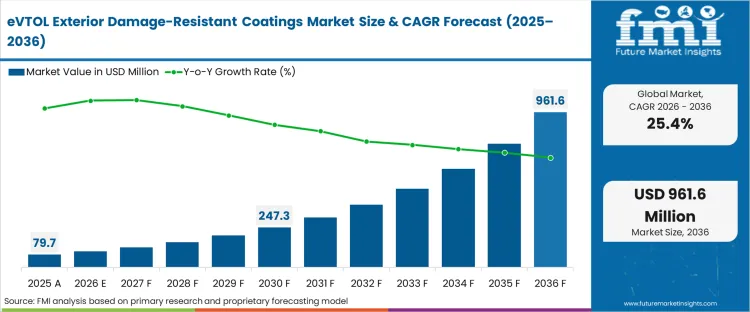
Commercial-scale production depends on clearing a key manufacturing barrier, the transition from manual high-temperature coating booths to automated robotic cells with rapid-cure capability. Aerospace chemical prime contractors enable this by formulating exterior coating systems that achieve full hardness without relying on legacy thermal autoclaves. Once these fast-cure systems are proven against strict civil aviation crashworthiness benchmarks, the physical limit on assembly floor throughput is reduced. That shift helps production scale more effectively toward promised delivery volumes.
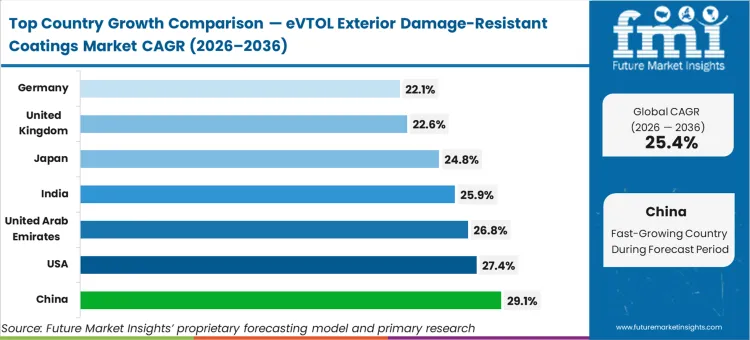
China remains the fastest-growing market at 29.1%, driven by centralized approval pathways that help domestic integrators move more quickly into volume procurement than Western operators facing harmonized regulatory systems. The United States follows at 27.4%, using non-dilutive defense programs to derisk advanced abrasion-resistant coating chemistries. The United Arab Emirates records 26.8% growth as harsh heat and desert particulate conditions make durable erosion protection a near-term requirement. India tracks at 25.9%, benefiting from technology transfer strategies that strengthen local formulation capacity. Japan is projected to grow at 24.8%, while the United Kingdom and Germany advance at 22.6% and 22.1%, respectively. This variation across markets shows how environmental intensity continues to shape procurement timing.
eVTOL Exterior Damage-Resistant Coatings Market Definition
The market consists of the specialized chemical formulations, elastomeric films, and polyurethane layers engineered specifically to protect powered-lift aircraft from mechanical abrasion, environmental degradation, and particulate erosion. It is functionally bounded by materials applied to the outer aerodynamic mold line that actively prevent substrate damage, distinguishing these systems from decorative paints or internal structural primers.
eVTOL Exterior Damage-Resistant Coatings Market Inclusions
Scope inclusions encompass abrasion and erosion-resistant polyurethane coatings, UV-stable topcoats, and impact-resistant elastomeric protective boots applied directly to advanced air mobility platforms. The market incorporates eVTOL canopy scratch-resistant coatings, chemical-resistant finishes protecting against aviation fluids, and specialized edge seals. Multifunctional conductive coatings that provide both advanced air mobility surface protection and environmental shielding for exterior structures are fully included.
eVTOL Exterior Damage-Resistant Coatings Market Exclusions
The market excludes interior cabin paints, structural bonding adhesives located beneath the mold line, and thermal barrier coatings used directly on internal motor stators or battery cells. Decorative liveries without measurable abrasion or impact resistance are not included. Raw substrate materials themselves also remain outside the scope, including carbon fiber prepregs and uncoated acrylic transparencies.
eVTOL Exterior Damage-Resistant Coatings Market Research Methodology
- Primary Research: Procurement directors at leading eVTOL original equipment manufacturers, senior materials engineers specializing in composite surface protection, and aerospace chemical formulation leads.
- Desk Research: Aggregation of material qualification dossiers from national aviation authorities, supplier technical data sheets for low-VOC aerospace formulations, and public capital expenditure reports tracking coating facility expansions.
- Market-Sizing and Forecasting: Baseline sizing anchors to publicly disclosed pre-order backlogs and known air-taxi production ramps, applying an estimated protective coating volume per conforming airframe.
- Data Validation and Update Cycle: Forecast trajectories are triangulated against capacity disclosures from major aerospace chemical suppliers and plausibility checks using generalized aircraft surface area models.
Segmental Analysis
eVTOL Exterior Damage-Resistant Coatings Market Analysis by Coating Type
Abrasion and erosion-resistant polyurethane coatings account for 34.0% of the eVTOL abrasion-resistant coatings market due to a basic mechanical requirement. Lightweight carbon airframes flex during operation, and rigid topcoats are more likely to crack under that movement. Operators need a coating that can move with the composite surface while still resisting high-velocity particulate impact. FMI estimates that procurement teams continue to favor advanced polyurethanes due to the long performance history and fatigue data available from conventional rotary-wing use. This existing qualification base helps aircraft developers move faster through type certification. Lower-cost acrylic alternatives carry a greater risk of micro-cracking during transition flight, leading to repaint cycles that reduce fleet availability.
- Elasticity limits: Formulations stretch without fracturing under heavy aerodynamic loads. Engineers specify these bounds to match the inherent flex of the underlying advanced composites.
- Adhesion vulnerability: Prolonged exposure to extreme temperature shifts can compromise bonding at leading edges. Operators monitor these zones rigorously to prevent widespread delamination.
- Qualification mandates: Regulatory bodies require extensive weathering proof. Suppliers who provide pre-certified, flame-retardant erosion systems dictate the immediate procurement standards.
eVTOL Exterior Damage-Resistant Coatings Market Analysis by Substrate
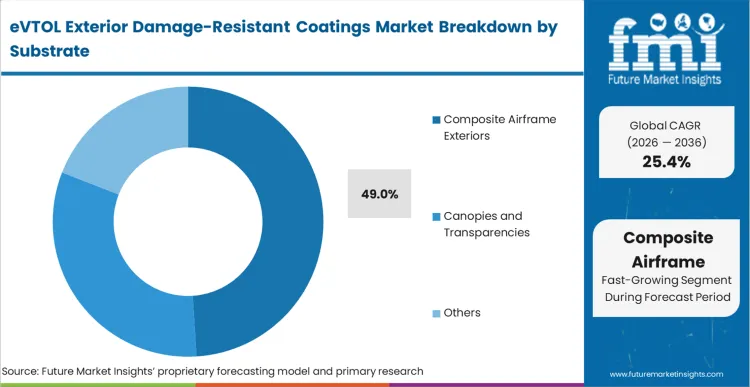
Composite airframe exteriors hold a 49.0% share as composite structures respond very differently to stress than traditional aluminum airframes. Without a specialized protective layer, exposed carbon matrices are vulnerable to moisture absorption and sustained ultraviolet degradation, both of which can weaken structural reliability. Engineers evaluating protective coatings for eVTOL platforms typically require full surface coverage to seal micro-porosities created during out-of-autoclave production. This chemical barrier is essential to maintaining airframe performance. Reducing the layer to save weight can leave the composite exposed to long-term environmental damage and hidden fatigue buildup.
- Ingress prevention: Highly crosslinked polymer chains block water absorption into the matrix. This eliminates the risk of freeze-thaw expansion inside the carbon weave.
- Delamination risks: Minor surface strikes can cause invisible sub-surface fractures if the coating is too brittle. Operators utilize specialized primers to enhance impact absorption.
- Maintenance protocols: Maximizing lifecycle value requires immediate localized repair of any surface breach. Mechanics must apply rapid-cure patches to restore the moisture barrier before returning the aircraft to service.
eVTOL Exterior Damage-Resistant Coatings Market Analysis by Aircraft Configuration
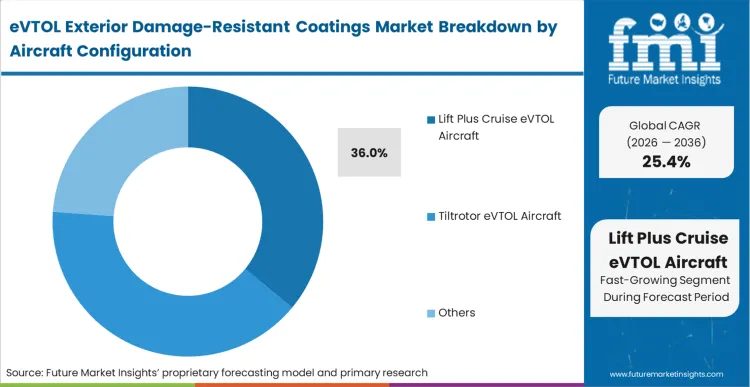
Lift plus cruise eVTOL aircraft capture 36.0% share as the separation of vertical lift and forward propulsion creates a far more demanding external profile. This architecture adds exposed pylons, static lift booms, and rotor fairings that face turbulent, multi-directional airflow along with intense particulate impact during takeoff. FMI views these platforms as priority applications for heavy-duty protective films, since eroded static rotor surfaces can sharply increase drag. Maintaining smooth fairings remains essential for preserving battery efficiency during horizontal cruise.
- Abrasion zones: The multi-boom layout multiplies the leading edges requiring defense. Procurement focuses heavily on securing volume supply of moldable elastomeric boots.
- Surface validation: Smooth aerodynamic profiles directly correlate to extended flight range. Quality assurance teams reject any application demonstrating textures that induce parasitic drag.
- Platform rollout: As early lift-plus-cruise models log commercial hours, their exact coating specifications become the default standard for all subsequent market entrants.
eVTOL Exterior Damage-Resistant Coatings Market Analysis by Sales Channel
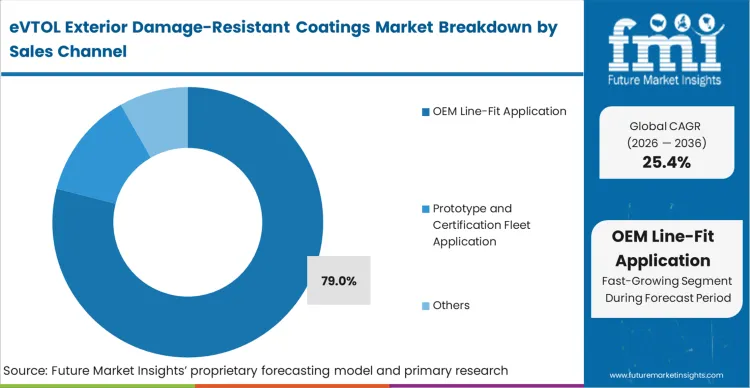
OEM line-fit application leads with a 79.0% share since the industry has not yet generated enough commercial flight hours to create a meaningful repair market. Current demand remains concentrated around the first aircraft moving through the assembly process. FMI analysts suggest that this places procurement leverage with aircraft developers, who are locking in volume contracts with established aerospace chemical suppliers able to provide pre-mixed and color-matched coatings directly to manufacturing sites. Without a reliable flow of these topcoats, finished aircraft risk sitting idle before final flight clearance.
- Line integration: Factories install dedicated, climate-controlled robotic spray cells. Suppliers who design coatings compatible with these automated application methods win the primary contracts.
- Cure bottlenecks: Long drying times drag down the entire production rate. Buyers pressure formulators for innovations that cut thermal baking requirements without sacrificing hardness.
- Aftermarket eventualities: Independent maintenance depots will eventually assume repair duties, forcing suppliers to package complex systems into localized touch-up kits.
eVTOL Exterior Damage-Resistant Coatings Market Analysis by End Use
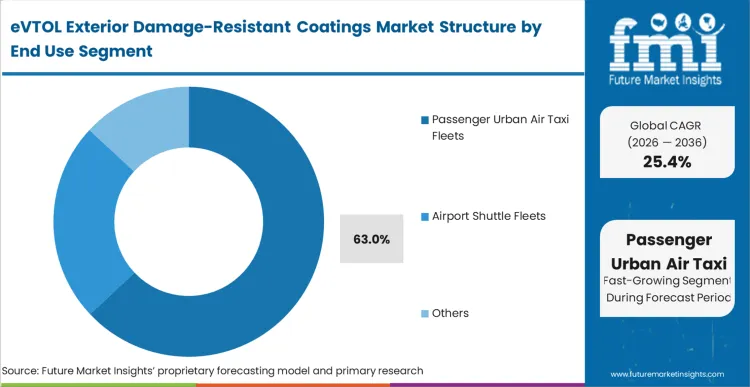
The intense pressure to achieve rapid turnaround times while maintaining pristine aesthetics places Passenger urban air taxi fleets in a continuous operational tension, capturing 63.0% share. Fleet managers are forced to balance the need for extreme surface durability against the strict weight limitations of their battery-powered vehicles. As per FMI's projection, commercial networks demand high-cycle eVTOL refurbishment coatings and fluid-resistant systems that allow line mechanics to quickly wipe away hydraulic leaks, bird strikes, and urban grime between short 20-minute hops. Relying on standard commercial aviation paints in this high-cycle environment guarantees rapid aesthetic degradation, eroding consumer trust long before the airframe actually requires mechanical overhaul.
- Aesthetic control: Gloss retention directly influences passenger perception of safety. Operators justify premium chemical costs by minimizing the frequency of full repaints.
- Turnaround friction: Elaborate cleaning protocols burn valuable charging time. Formulators mitigate this by designing ultra-slick, oleophobic surfaces that shed dirt naturally.
- Lifecycle optimization: Over the decade, calculating total ownership cost proves that investing in high-end aerospace coatings protection offsets the severe revenue losses associated with extended depot downtime.
eVTOL Exterior Damage-Resistant Coatings Market Drivers, Restraints, and Opportunities
The absolute imperative to minimize parasitic drag acts as the primary driver for the market, forcing structural engineers to specify highly contoured, precision-molded composite exteriors. Because any pitting or surface erosion drastically disrupts laminar airflow and drains battery efficiency, procurement directors are obligated to source advanced elastomeric films and heavy-duty polyurethanes. This is not an aesthetic choice; it is a strict aerodynamic requirement that dictates whether the aircraft can physically complete its promised commercial range under varying environmental conditions. The commercial stakes are absolute: fleets that utilize inferior coatings will suffer immediate range degradation, rendering their urban shuttle networks economically unviable.
The primary organizational friction slowing supply chain acceleration is the protracted requalification timeline demanded by civil aviation authorities. Whenever a chemical supplier alters a formulation to improve cure speeds or remove toxic solvents, the new coating must undergo exhaustive thermal, flammability, and fatigue testing to prove it does not compromise the underlying composite matrix. This regulatory rigidity severely limits the agility of the market. Aerospace formulators cannot simply push high performance composites innovations to the factory floor; they must navigate a years-long certification bureaucracy, restricting aircraft integrators to legacy chemistries that bottleneck modern automated production rates.
Opportunities in the eVTOL Exterior Damage-Resistant Coatings Market
- UV-Cured Coating Systems: The demand for rapid production throughput enables UV-cured technology. Suppliers who adapt these instantaneous-curing resins for large-scale aerospace application completely eliminate thermal baking bottlenecks, capturing massive line-fit volume.
- Integrated Conductive Layers: The necessity to manage electromagnetic interference allows formulators to embed metallic nanoparticles directly into protective films. Offering a single-layer solution for both erosion defense and lightning strike protection secures preferred status by eliminating weight.
- Field-Deployable Repair Films: High-frequency cycling inevitably damages leading edges. Developing peel-and-stick, aviation-grade elastomeric patches empowers line mechanics to permanently repair ramp damage without returning the aircraft to a specialized depot.
Regional Analysis
Based on the regional analysis, the eVTOL Exterior Damage-Resistant Coatings Market is segmented into North America, Europe, Asia Pacific, and Rest of the World across 40 plus countries.
.webp "Top Country Growth Comparison Evtol Exterior Damage Resistant Coatings Market Cagr (2026 2036)")
| Country | CAGR (2026 to 2036) |
|---|---|
| China | 29.1% |
| United States | 27.4% |
| United Arab Emirates | 26.8% |
| India | 25.9% |
| Japan | 24.8% |
| United Kingdom | 22.6% |
| Germany | 22.1% |
Source: Future Market Insights (FMI) analysis, based on proprietary forecasting model and primary research
Asia Pacific eVTOL Exterior Damage-Resistant Coatings Market Analysis
Asia Pacific is moving along a path defined by policy-led aerospace industrialization, with centralized aviation authorities prioritizing commercialization speed ahead of harmonized international qualification standards. Localized pilot ecosystems are giving domestic eVTOL manufacturers room to scale production lines and deploy conforming flight articles under national airspace conditions. FMI estimates that this structure allows regional chemical supply chains to build automated mixing and application capacity without facing the extended testing delays seen in Western markets. Strong capabilities in high-volume automotive finishing provide a solid base, while chemical traceability systems continue to evolve toward commercial aviation standards.
- China: China's state-directed regulatory environment bypasses complex pilot-in-command debates, allowing domestic developers to freeze their aerodynamic designs and issue massive volume contracts. The China eVTOL protective coatings market is expected to see its sector grow at a compound annual rate of 29.1%. This trajectory positions Chinese tier-one chemical suppliers to capture the first global economies of scale, eventually translating their domestic volume dominance into highly competitive export pricing for specialized aerostructure films.
- Japan: Japanese materials conglomerates transitioning into the aerospace sector face the immediate challenge of qualifying high-volume aerospace insulation and chemistries against stringent aviation standards. Operations managers are actively adapting precision robotic spray techniques for next-generation polyurethanes. The market is forecast to register a CAGR of 24.8%. Securing these requalification gates allows legacy Japanese industrial giants to seamlessly integrate into the global eVTOL supply chain as dominant providers of scratch-resistant transparency coatings.
- India: Lacking deep legacy aerospace infrastructure, domestic aviation startups leverage strategic technology transfer agreements with established global chemical engineering firms to import critical formulation expertise. India's industry is projected to witness growth at a CAGR of 25.9%. Integrating aerospace adhesives and rapid-cure capabilities structurally alters the domestic supply base, eventually transitioning the nation from a reliance on imported coatings toward independent, high-throughput manufacturing nodes.
FMI's report includes extensive analysis of emerging markets across Southeast Asia and Oceania. These secondary nations primarily focus on developing the vertiports ground infrastructure required to support imported fleets rather than establishing indigenous aerospace chemical formulation capabilities.
North America and Europe eVTOL Exterior Damage-Resistant Coatings Market Analysis
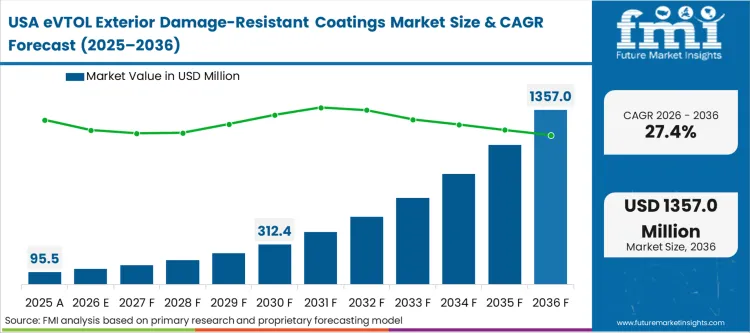
Strict and harmonized civil aviation safety standards establish the structural rhythm of chemical procurement across North America and Europe. Aircraft integrators must fulfill the dual mandates of the FAA and EASA, ensuring that every applied film, topcoat, and bonded edge seal performs to the flammability and fatigue resistance standards associated with legacy commercial airliners. FMI projects that this demanding regulatory burden forces developers to streamline their supply chains and contract exclusively with established aerospace tier-one suppliers that already possess certified quality management systems. Procurement remains heavily centered on derisking automated application processes so higher production throughput does not compromise the strict safety margins required by Western regulators.
- United States: The United States eVTOL coatings market leverages concurrent military validation programs to drastically accelerate the maturity of its domestic surface-protection supply chain. These non-dilutive defense contracts allow operators to cycle composite fairings through punishing flight profiles, generating critical abrasion data for FAA compliance. Demand in the United States is set to grow at a CAGR of 27.4%. This dual-use strategy clears the operational bottleneck of producing conforming flight-test articles, establishing a practitioner reality where military funding directly subsidizes the civil certification timeline for novel resilient chemistries.
- United Kingdom: Airspace integration frameworks in the UK obligate structural engineering firms to focus heavily on acoustic mitigation alongside aerodynamic efficiency. Design teams iterate leading-edge films specifically engineered to maintain absolute laminar flow, preventing turbulent noise generation during urban hover profiles. The United Kingdom market is likely to post a CAGR of 22.6%. The operational outcome of this regulatory focus is that British urban autonomous evtols systems prioritize flawless surface finishes, driving long-term structural innovation toward low-drag, high-durability coatings.
- Germany: Germany's legacy stronghold in precision chemical formulation requires specialized adaptation; suppliers must pivot their high-throughput automotive capabilities to meet the exacting documentation standards of commercial aerospace. Procurement directors actively validate low-VOC systems that preserve composite integrity under high cyclic loading. Demand for protective systems in Germany expands at a CAGR of 22.1%. Companies that successfully map their high-volume synthesis expertise to aviation safety standards capture preferred supplier status in procurement networks that rarely reopen once established.
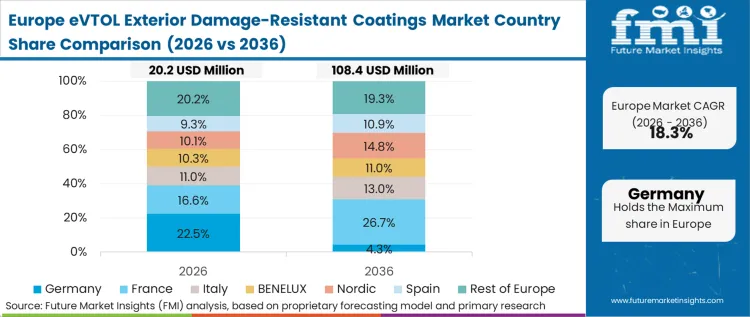
FMI's report includes comprehensive tracking of secondary European aerospace hubs like France and Italy. These nations leverage their deep heritage in rotary-wing manufacturing to provide highly specialized dynamic rotor-blade coatings to the broader market.
Middle East eVTOL Exterior Damage-Resistant Coatings Market Analysis
The Middle East is advancing its air mobility strategy through unrestricted capital access and strong state mandates around smart city infrastructure. Sovereign wealth is being deployed to attract global eVTOL developers and build local operational hubs rather than indigenous aircraft manufacturing programs. FMI’s assessment highlights a clear shift in procurement requirements toward extreme environmental durability. Integrators supplying fleets to the region must adapt standard composite protection systems to withstand intense solar exposure, extreme ambient heat, and highly abrasive desert sand carried in the air. The structural emphasis is centered on specialized reflective topcoats that help maintain critical battery thermal efficiency under harsh regional conditions.
- United Arab Emirates: Sovereign commitments establishing commercial networks by 2026 obligate operators in the UAE to demand severe environmental modifications from their global suppliers. Fleet managers require robust external shielding and specialized evtol charging facilities interfaces that prevent particulate ingress into sensitive electrical routes. The UAE's component landscape is poised to expand at a CAGR of 26.8%. Successfully solving these extreme thermal and abrasive challenges commercially positions fleets operating in the Emirates as the proving ground for environmental resilience across all subsequent global deployments.
FMI's report includes adjacent analysis of Saudi Arabia's smart city initiatives. These massive urban development projects are integrating bespoke aerial mobility infrastructure directly into their architectural blueprints, establishing centralized procurement models for customized heavy-duty fleet operations.
Competitive Aligners for Market Players
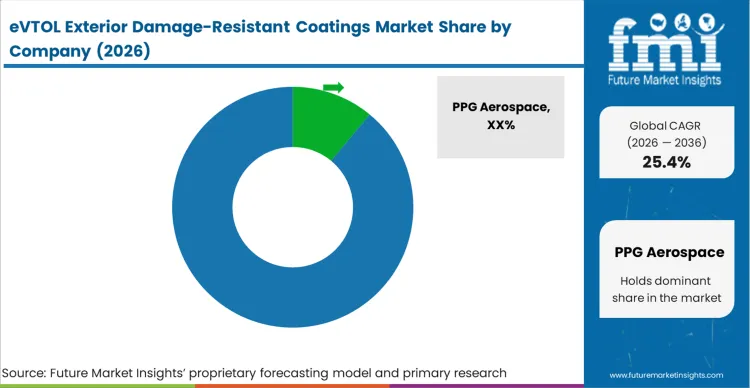
The competitive landscape exhibits a highly concentrated structure governed by the immense capital required to meet aerospace quality management standards. Buyers in this sector cannot risk sourcing critical chemical formulations from unproven vendors, regardless of cost savings. The primary variable used to distinguish qualified eVTOL coating manufacturers from the broader industrial coatings market is their existing possession of verifiable aerospace material traceability systems and FAA/EASA compliant testing dossiers. Established air taxi coating suppliers dominate because they absorb the massive upfront qualification costs and guarantee that every manufactured batch matches the approved type-design exactly.
Position of established suppliers is reinforced by decades of integration with civil aviation authorities. Legacy providers like PPG, AkzoNobel, and Mankiewicz offer broad statistical databases covering environmental weathering and composite flex fatigue, making their systems the natural choice for eVTOL developers looking to reduce certification complexity. For a challenger, matching that advantage requires a substantial coupon-testing program that validates resilience across millions of simulated flight cycles and long-duration ultraviolet exposure. Suppliers that combine this with automated rapid-cure capability inside aircraft electrification component layup workflows gain a clear advantage in high-throughput manufacturing.
As the market accelerates toward 2036, the tension between developers demanding automotive-style production rates and tier-one chemical suppliers constrained by traditional aerospace batch methodologies will define the competitive trajectory. Integrators actively attempt to resist supplier lock-in by validating multiple baseline polyurethane formulations. However, the extreme performance tolerances required for advanced electric propulsion aircraft erosion protection ensure that the upper tier of top eVTOL protective coating suppliers remains highly concentrated, allowing established primes to capture the vast majority of recurring line-fit revenue.
Key Players in eVTOL Exterior Damage-Resistant Coatings Market
- PPG Aerospace
- AkzoNobel Aerospace Coatings
- Mankiewicz
- Sherwin-Williams Aerospace Coatings
- 3M
- Henkel
- Hentzen Coatings, Inc.
Scope of the Report
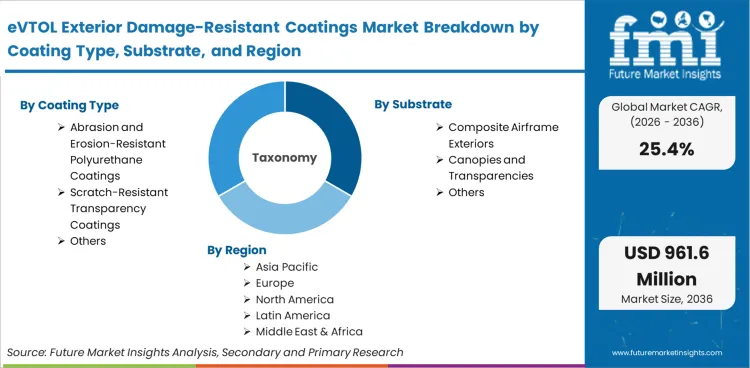
| Metric | Value |
|---|---|
| Quantitative Units | USD 100 million to USD 960 million, at a CAGR of 25.4% |
| Market Definition | The sector covers resilient surface chemistries and elastomeric films engineered to shield low-altitude electric aircraft from aggressive particulate erosion and mechanical abrasion. |
| Coating Type Segmentation | Abrasion and erosion-resistant polyurethane coatings, Scratch-resistant transparency coatings, UV and weathering-resistant topcoats, Impact-resistant protective films and boots, Fluid, chemical, and cleaner-resistant surface systems, Multifunctional conductive and protective coatings |
| Substrate Segmentation | Composite airframe exteriors, Canopies and transparencies, Metal access panels and exposed structures, Rotor-adjacent fairings and leading edges, Battery-shell-adjacent external housings |
| Aircraft Configuration Segmentation | Lift plus cruise eVTOL aircraft, Multicopter eVTOL aircraft, Tiltrotor eVTOL aircraft, Tiltwing and vectored-thrust aircraft |
| Sales Channel Segmentation | OEM line-fit application, Prototype and certification fleet application, Aftermarket repair and refurbishment |
| End Use Segmentation | Passenger urban air taxi fleets, Airport shuttle fleets, Tourism and sightseeing platforms, Public service and utility eVTOL platforms |
| Regions Covered | North America, Europe, Asia Pacific, Rest of the World |
| Countries Covered | China, United States, United Arab Emirates, India, Japan, United Kingdom, Germany, and 40 plus countries |
| Key Companies Profiled | PPG Aerospace, AkzoNobel Aerospace Coatings, Mankiewicz, Sherwin-Williams Aerospace Coatings, 3M, Henkel, Hentzen Coatings, Inc. |
| Forecast Period | 2026 to 2036 |
| Approach | Procurement directors, surface chemistry engineers, and certification specialists were interviewed. Sizing anchors to near-term air-taxi production ramps and estimated coating content per airframe. Forecasts are validated against capacity disclosures from major aerospace chemical suppliers. |
Source: Future Market Insights (FMI) analysis, based on proprietary forecasting model and primary research
eVTOL Exterior Damage-Resistant Coatings Market Analysis by Segments
Coating Type:
- Abrasion and erosion-resistant polyurethane coatings
- Scratch-resistant transparency coatings
- UV and weathering-resistant topcoats
- Impact-resistant protective films and boots
- Fluid, chemical, and cleaner-resistant surface systems
- Multifunctional conductive and protective coatings
Substrate:
- Composite airframe exteriors
- Canopies and transparencies
- Metal access panels and exposed structures
- Rotor-adjacent fairings and leading edges
- Battery-shell-adjacent external housings
Aircraft Configuration:
- Lift plus cruise eVTOL aircraft
- Multicopter eVTOL aircraft
- Tiltrotor eVTOL aircraft
- Tiltwing and vectored-thrust aircraft
Sales Channel:
- OEM line-fit application
- Prototype and certification fleet application
- Aftermarket repair and refurbishment
End Use:
- Passenger urban air taxi fleets
- Airport shuttle fleets
- Tourism and sightseeing platforms
- Public service and utility eVTOL platforms
Region:
- North America
- United States
- Canada
- Europe
- Germany
- United Kingdom
- France
- Italy
- Spain
- Asia Pacific
- China
- Japan
- South Korea
- Taiwan
- Singapore
- Latin America
- Brazil
- Mexico
- Argentina
- Middle East & Africa
- GCC Countries
- South Africa
Bibliography
- Archer Aviation Inc. (2026, March 2). Archer announces fourth quarter and full year 2025 results, USA and UAE air taxi pilot programs on-track for 2026.
- EHang Holdings Limited. (2026, March 12). EHang reports fourth quarter and fiscal year 2025 unaudited financial results.
- Joby Aviation, Inc. (2026, February 25). Joby reports fourth quarter 2025 financial results.
- PPG Aerospace. (2024, July). Electric vertical take-off and landing (eVTOL).
- Sherwin-Williams. (2024, October). Aerospace coatings.
This bibliography is provided for reader reference. The full FMI report contains the complete reference list with primary source documentation.
Frequently Asked Questions
How big is the evtol exterior damage-resistant coatings market?
The sector is valued at USD 100 million in 2026. This figure reflects the immediate capital deployed by early-stage OEMs to secure line-fit chemical supplies for their initial waves of conforming flight-test fleets.
Estimate the evtol exterior damage-resistant coatings market by 2036?
The valuation reaches USD 960 million by 2036. This expansion signals the critical transition from manual prototype spray applications to high-throughput, automated robotic coating cells operating at commercial scale.
What is included in evtol damage-resistant coatings?
The scope encompasses abrasion and erosion-resistant polyurethanes, UV-stable topcoats, impact-resistant elastomeric boots, scratch-resistant canopy hardcoats, and chemical-resistant surface finishes applied directly to the aerodynamic mold line.
Explain the value chain for evtol protective coatings?
The value chain moves from raw chemical suppliers synthesizing base resins, to tier-one aerospace formulators creating certifiable polyurethanes and films, and finally to airframe OEMs who utilize robotic spray cells to apply these coatings during final vehicle assembly.
How much coating content is on an evtol aircraft exterior?
While exact volumes vary by architecture, lift plus cruise platforms demand the highest volume due to their complex array of static booms, exposed pylons, and multiple rotor fairings that require comprehensive elastomeric erosion protection.
Who supplies evtol exterior protective coatings?
Leading suppliers include PPG Aerospace, AkzoNobel Aerospace Coatings, Mankiewicz, Sherwin-Williams, and 3M. These established incumbents dominate because they possess the certified traceability systems and decades of statistical fatigue data required for civil aviation approval.
Polyurethane vs film protection for evtol exteriors?
Polyurethane offers exceptional, seamless elasticity across the entire composite flex profile, while protective films (elastomeric boots) are selectively applied to high-impact leading edges where localized particulate erosion is most severe. Both are required for comprehensive protection.
What drives rapid growth in this market?
The absolute necessity to preserve battery energy density drives immediate procurement. Pitted or eroded composite surfaces induce massive parasitic drag, destroying the tight aerodynamic margins required to complete promised urban flight routes.
What is the primary restraint facing suppliers?
The protracted requalification timeline demanded by aviation authorities limits agility. Any modification to a chemical formulation to improve cure speed requires exhaustive flammability and fatigue re-testing, severely bottlenecking the introduction of modern chemistries.
Which country grows fastest?
China expands at 29.1%, structurally outpacing the United States' 27.4%. China utilizes centralized, state-backed pilot ecosystems that bypass the protracted public airspace integration debates, allowing rapid scale of domestic aerospace coating lines.
How do European airspace regulations shape procurement?
Harmonized EASA standards compel developers in the UK and Germany to utilize heavily documented tier-one aerospace chemical supply chains. Operations managers cannot risk sourcing from unproven automotive paint vendors lacking aviation-grade material traceability.
Why does the lack of aftermarket demand influence current strategies?
With OEM line-fit capturing 79.0% of the value, suppliers concentrate entirely on guaranteeing factory floor delivery. Capital is deployed toward clearing primary assembly line bottlenecks rather than formulating small-batch, localized repair kits.
How do incumbent aerospace tier-ones maintain dominance?
Incumbents hold immense statistical databases of material fatigue testing previously validated by the FAA. Challengers cannot replicate this regulatory trust without spending millions to redundantly test new formulations across identical simulated flight cycles.
How does extreme heat in the Middle East alter coating design?
Operations in the UAE require severe environmental modifications. Fleets must integrate highly reflective topcoats and heavy-duty elastomeric films to prevent intense solar radiation and airborne desert sand from degrading sensitive composite structures.
Why are UV-cured systems considered a critical inflection point?
Current aerospace topcoats require hours inside massive thermal baking booths, hard-capping output rates. Validating UV-cured resins against aviation standards allows tier-one suppliers to finish exterior panels in minutes, aligning aerospace output with automotive-style demand curves.
How does noise mitigation impact aerodynamic film design?
Strict urban operational noise limits force structural engineers to maintain absolute laminar flow across the airframe. Any surface pitting generates turbulent air and acoustic noise, necessitating the use of ultra-resilient, smooth erosion boots on all leading edges.
What operational consequence do eVTOL developers face if they delay supplier lock-in?
Failing to secure production slots at established aerospace chemical primes leaves developers without conforming surface finishes. Without these protective layers, composite test articles degrade, halting certification flights and jeopardizing commercial launch windows.
Why do structural engineers reject standard automotive paints for these specific airframes?
Legacy automotive finishes lack the necessary flexibility to survive the high-vibration harmonic resonance generated by distributed electric motors. Using rigid paints results in immediate micro-cracking, allowing moisture to compromise the underlying carbon fiber.
What role do field-deployable repair films play in fleet maintenance?
High-frequency urban cycling inevitably leads to abrasive ramp damage. Fleet operators require advanced peel-and-stick elastomeric patches that allow line mechanics to perform localized erosion repairs on the tarmac, eliminating costly depot-level downtime.
How does military funding derisk civilian commercial coatings in the US?
Non-dilutive defense contracts allow developers to subject their coated fairings to extreme abrasive loading profiles. This generates the vital weathering and fatigue data required for FAA compliance without burning private venture capital.
Preview the report firsthand - request a free sample
Get SampleGet the brochure for pricing and purchase details.
Get PDFTable of Content
- Executive Summary
- Global Market Outlook
- Demand-side Trends
- Supply-side Trends
- Technology Roadmap Analysis
- Analysis and Recommendations
- Market Overview
- Market Coverage / Taxonomy
- Market Definition / Scope / Limitations
- Research Methodology
- Chapter Orientation
- Analytical Lens and Working Hypotheses
- Market Structure, Signals, and Trend Drivers
- Benchmarking and Cross-market Comparability
- Market Sizing, Forecasting, and Opportunity Mapping
- Research Design and Evidence Framework
- Desk Research Programme (Secondary Evidence)
- Company Annual and Sustainability Reports
- Peer-reviewed Journals and Academic Literature
- Corporate Websites, Product Literature, and Technical Notes
- Earnings Decks and Investor Briefings
- Statutory Filings and Regulatory Disclosures
- Technical White Papers and Standards Notes
- Trade Journals, Industry Magazines, and Analyst Briefs
- Conference Proceedings, Webinars, and Seminar Materials
- Government Statistics Portals and Public Data Releases
- Press Releases and Reputable Media Coverage
- Specialist Newsletters and Curated Briefings
- Sector Databases and Reference Repositories
- FMI Internal Proprietary Databases and Historical Market Datasets
- Subscription Datasets and Paid Sources
- Social Channels, Communities, and Digital Listening Inputs
- Additional Desk Sources
- Expert Input and Fieldwork (Primary Evidence)
- Primary Modes
- Qualitative Interviews and Expert Elicitation
- Quantitative Surveys and Structured Data Capture
- Blended Approach
- Why Primary Evidence is Used
- Field Techniques
- Interviews
- Surveys
- Focus Groups
- Observational and In-context Research
- Social and Community Interactions
- Stakeholder Universe Engaged
- C-suite Leaders
- Board Members
- Presidents and Vice Presidents
- R&D and Innovation Heads
- Technical Specialists
- Domain Subject-matter Experts
- Scientists
- Physicians and Other Healthcare Professionals
- Governance, Ethics, and Data Stewardship
- Research Ethics
- Data Integrity and Handling
- Primary Modes
- Tooling, Models, and Reference Databases
- Desk Research Programme (Secondary Evidence)
- Data Engineering and Model Build
- Data Acquisition and Ingestion
- Cleaning, Normalisation, and Verification
- Synthesis, Triangulation, and Analysis
- Quality Assurance and Audit Trail
- Market Background
- Market Dynamics
- Drivers
- Restraints
- Opportunity
- Trends
- Scenario Forecast
- Demand in Optimistic Scenario
- Demand in Likely Scenario
- Demand in Conservative Scenario
- Opportunity Map Analysis
- Product Life Cycle Analysis
- Supply Chain Analysis
- Investment Feasibility Matrix
- Value Chain Analysis
- PESTLE and Porter’s Analysis
- Regulatory Landscape
- Regional Parent Market Outlook
- Production and Consumption Statistics
- Import and Export Statistics
- Market Dynamics
- Global Market Analysis 2021 to 2025 and Forecast, 2026 to 2036
- Historical Market Size Value (USD Million) Analysis, 2021 to 2025
- Current and Future Market Size Value (USD Million) Projections, 2026 to 2036
- Y-o-Y Growth Trend Analysis
- Absolute $ Opportunity Analysis
- Global Market Pricing Analysis 2021 to 2025 and Forecast 2026 to 2036
- Global Market Analysis 2021 to 2025 and Forecast 2026 to 2036, By Coating Type
- Introduction / Key Findings
- Historical Market Size Value (USD Million) Analysis By Coating Type , 2021 to 2025
- Current and Future Market Size Value (USD Million) Analysis and Forecast By Coating Type , 2026 to 2036
- Abrasion and Erosion-Resistant Polyurethane Coatings
- Scratch-Resistant Transparency Coatings
- Others
- Abrasion and Erosion-Resistant Polyurethane Coatings
- Y-o-Y Growth Trend Analysis By Coating Type , 2021 to 2025
- Absolute $ Opportunity Analysis By Coating Type , 2026 to 2036
- Global Market Analysis 2021 to 2025 and Forecast 2026 to 2036, By Substrate
- Introduction / Key Findings
- Historical Market Size Value (USD Million) Analysis By Substrate, 2021 to 2025
- Current and Future Market Size Value (USD Million) Analysis and Forecast By Substrate, 2026 to 2036
- Composite Airframe Exteriors
- Canopies and Transparencies
- Others
- Composite Airframe Exteriors
- Y-o-Y Growth Trend Analysis By Substrate, 2021 to 2025
- Absolute $ Opportunity Analysis By Substrate, 2026 to 2036
- Global Market Analysis 2021 to 2025 and Forecast 2026 to 2036, By Aircraft Configuration
- Introduction / Key Findings
- Historical Market Size Value (USD Million) Analysis By Aircraft Configuration, 2021 to 2025
- Current and Future Market Size Value (USD Million) Analysis and Forecast By Aircraft Configuration, 2026 to 2036
- Lift Plus Cruise eVTOL Aircraft
- Tiltrotor eVTOL Aircraft
- Others
- Lift Plus Cruise eVTOL Aircraft
- Y-o-Y Growth Trend Analysis By Aircraft Configuration, 2021 to 2025
- Absolute $ Opportunity Analysis By Aircraft Configuration, 2026 to 2036
- Global Market Analysis 2021 to 2025 and Forecast 2026 to 2036, By Sales Channel
- Introduction / Key Findings
- Historical Market Size Value (USD Million) Analysis By Sales Channel, 2021 to 2025
- Current and Future Market Size Value (USD Million) Analysis and Forecast By Sales Channel, 2026 to 2036
- OEM Line-Fit Application
- Prototype and Certification Fleet Application
- Others
- OEM Line-Fit Application
- Y-o-Y Growth Trend Analysis By Sales Channel, 2021 to 2025
- Absolute $ Opportunity Analysis By Sales Channel, 2026 to 2036
- Global Market Analysis 2021 to 2025 and Forecast 2026 to 2036, By End Use
- Introduction / Key Findings
- Historical Market Size Value (USD Million) Analysis By End Use, 2021 to 2025
- Current and Future Market Size Value (USD Million) Analysis and Forecast By End Use, 2026 to 2036
- Passenger Urban Air Taxi Fleets
- Airport Shuttle Fleets
- Others
- Passenger Urban Air Taxi Fleets
- Y-o-Y Growth Trend Analysis By End Use, 2021 to 2025
- Absolute $ Opportunity Analysis By End Use, 2026 to 2036
- Global Market Analysis 2021 to 2025 and Forecast 2026 to 2036, By Region
- Introduction
- Historical Market Size Value (USD Million) Analysis By Region, 2021 to 2025
- Current Market Size Value (USD Million) Analysis and Forecast By Region, 2026 to 2036
- North America
- Latin America
- Western Europe
- Eastern Europe
- East Asia
- South Asia and Pacific
- Middle East & Africa
- Market Attractiveness Analysis By Region
- North America Market Analysis 2021 to 2025 and Forecast 2026 to 2036, By Country
- Historical Market Size Value (USD Million) Trend Analysis By Market Taxonomy, 2021 to 2025
- Market Size Value (USD Million) Forecast By Market Taxonomy, 2026 to 2036
- By Country
- USA
- Canada
- Mexico
- By Coating Type
- By Substrate
- By Aircraft Configuration
- By Sales Channel
- By End Use
- By Country
- Market Attractiveness Analysis
- By Country
- By Coating Type
- By Substrate
- By Aircraft Configuration
- By Sales Channel
- By End Use
- Key Takeaways
- Latin America Market Analysis 2021 to 2025 and Forecast 2026 to 2036, By Country
- Historical Market Size Value (USD Million) Trend Analysis By Market Taxonomy, 2021 to 2025
- Market Size Value (USD Million) Forecast By Market Taxonomy, 2026 to 2036
- By Country
- Brazil
- Chile
- Rest of Latin America
- By Coating Type
- By Substrate
- By Aircraft Configuration
- By Sales Channel
- By End Use
- By Country
- Market Attractiveness Analysis
- By Country
- By Coating Type
- By Substrate
- By Aircraft Configuration
- By Sales Channel
- By End Use
- Key Takeaways
- Western Europe Market Analysis 2021 to 2025 and Forecast 2026 to 2036, By Country
- Historical Market Size Value (USD Million) Trend Analysis By Market Taxonomy, 2021 to 2025
- Market Size Value (USD Million) Forecast By Market Taxonomy, 2026 to 2036
- By Country
- Germany
- UK
- Italy
- Spain
- France
- Nordic
- BENELUX
- Rest of Western Europe
- By Coating Type
- By Substrate
- By Aircraft Configuration
- By Sales Channel
- By End Use
- By Country
- Market Attractiveness Analysis
- By Country
- By Coating Type
- By Substrate
- By Aircraft Configuration
- By Sales Channel
- By End Use
- Key Takeaways
- Eastern Europe Market Analysis 2021 to 2025 and Forecast 2026 to 2036, By Country
- Historical Market Size Value (USD Million) Trend Analysis By Market Taxonomy, 2021 to 2025
- Market Size Value (USD Million) Forecast By Market Taxonomy, 2026 to 2036
- By Country
- Russia
- Poland
- Hungary
- Balkan & Baltic
- Rest of Eastern Europe
- By Coating Type
- By Substrate
- By Aircraft Configuration
- By Sales Channel
- By End Use
- By Country
- Market Attractiveness Analysis
- By Country
- By Coating Type
- By Substrate
- By Aircraft Configuration
- By Sales Channel
- By End Use
- Key Takeaways
- East Asia Market Analysis 2021 to 2025 and Forecast 2026 to 2036, By Country
- Historical Market Size Value (USD Million) Trend Analysis By Market Taxonomy, 2021 to 2025
- Market Size Value (USD Million) Forecast By Market Taxonomy, 2026 to 2036
- By Country
- China
- Japan
- South Korea
- By Coating Type
- By Substrate
- By Aircraft Configuration
- By Sales Channel
- By End Use
- By Country
- Market Attractiveness Analysis
- By Country
- By Coating Type
- By Substrate
- By Aircraft Configuration
- By Sales Channel
- By End Use
- Key Takeaways
- South Asia and Pacific Market Analysis 2021 to 2025 and Forecast 2026 to 2036, By Country
- Historical Market Size Value (USD Million) Trend Analysis By Market Taxonomy, 2021 to 2025
- Market Size Value (USD Million) Forecast By Market Taxonomy, 2026 to 2036
- By Country
- India
- ASEAN
- Australia & New Zealand
- Rest of South Asia and Pacific
- By Coating Type
- By Substrate
- By Aircraft Configuration
- By Sales Channel
- By End Use
- By Country
- Market Attractiveness Analysis
- By Country
- By Coating Type
- By Substrate
- By Aircraft Configuration
- By Sales Channel
- By End Use
- Key Takeaways
- Middle East & Africa Market Analysis 2021 to 2025 and Forecast 2026 to 2036, By Country
- Historical Market Size Value (USD Million) Trend Analysis By Market Taxonomy, 2021 to 2025
- Market Size Value (USD Million) Forecast By Market Taxonomy, 2026 to 2036
- By Country
- Kingdom of Saudi Arabia
- Other GCC Countries
- Turkiye
- South Africa
- Other African Union
- Rest of Middle East & Africa
- By Coating Type
- By Substrate
- By Aircraft Configuration
- By Sales Channel
- By End Use
- By Country
- Market Attractiveness Analysis
- By Country
- By Coating Type
- By Substrate
- By Aircraft Configuration
- By Sales Channel
- By End Use
- Key Takeaways
- Key Countries Market Analysis
- USA
- Pricing Analysis
- Market Share Analysis, 2025
- By Coating Type
- By Substrate
- By Aircraft Configuration
- By Sales Channel
- By End Use
- Canada
- Pricing Analysis
- Market Share Analysis, 2025
- By Coating Type
- By Substrate
- By Aircraft Configuration
- By Sales Channel
- By End Use
- Mexico
- Pricing Analysis
- Market Share Analysis, 2025
- By Coating Type
- By Substrate
- By Aircraft Configuration
- By Sales Channel
- By End Use
- Brazil
- Pricing Analysis
- Market Share Analysis, 2025
- By Coating Type
- By Substrate
- By Aircraft Configuration
- By Sales Channel
- By End Use
- Chile
- Pricing Analysis
- Market Share Analysis, 2025
- By Coating Type
- By Substrate
- By Aircraft Configuration
- By Sales Channel
- By End Use
- Germany
- Pricing Analysis
- Market Share Analysis, 2025
- By Coating Type
- By Substrate
- By Aircraft Configuration
- By Sales Channel
- By End Use
- UK
- Pricing Analysis
- Market Share Analysis, 2025
- By Coating Type
- By Substrate
- By Aircraft Configuration
- By Sales Channel
- By End Use
- Italy
- Pricing Analysis
- Market Share Analysis, 2025
- By Coating Type
- By Substrate
- By Aircraft Configuration
- By Sales Channel
- By End Use
- Spain
- Pricing Analysis
- Market Share Analysis, 2025
- By Coating Type
- By Substrate
- By Aircraft Configuration
- By Sales Channel
- By End Use
- France
- Pricing Analysis
- Market Share Analysis, 2025
- By Coating Type
- By Substrate
- By Aircraft Configuration
- By Sales Channel
- By End Use
- India
- Pricing Analysis
- Market Share Analysis, 2025
- By Coating Type
- By Substrate
- By Aircraft Configuration
- By Sales Channel
- By End Use
- ASEAN
- Pricing Analysis
- Market Share Analysis, 2025
- By Coating Type
- By Substrate
- By Aircraft Configuration
- By Sales Channel
- By End Use
- Australia & New Zealand
- Pricing Analysis
- Market Share Analysis, 2025
- By Coating Type
- By Substrate
- By Aircraft Configuration
- By Sales Channel
- By End Use
- China
- Pricing Analysis
- Market Share Analysis, 2025
- By Coating Type
- By Substrate
- By Aircraft Configuration
- By Sales Channel
- By End Use
- Japan
- Pricing Analysis
- Market Share Analysis, 2025
- By Coating Type
- By Substrate
- By Aircraft Configuration
- By Sales Channel
- By End Use
- South Korea
- Pricing Analysis
- Market Share Analysis, 2025
- By Coating Type
- By Substrate
- By Aircraft Configuration
- By Sales Channel
- By End Use
- Russia
- Pricing Analysis
- Market Share Analysis, 2025
- By Coating Type
- By Substrate
- By Aircraft Configuration
- By Sales Channel
- By End Use
- Poland
- Pricing Analysis
- Market Share Analysis, 2025
- By Coating Type
- By Substrate
- By Aircraft Configuration
- By Sales Channel
- By End Use
- Hungary
- Pricing Analysis
- Market Share Analysis, 2025
- By Coating Type
- By Substrate
- By Aircraft Configuration
- By Sales Channel
- By End Use
- Kingdom of Saudi Arabia
- Pricing Analysis
- Market Share Analysis, 2025
- By Coating Type
- By Substrate
- By Aircraft Configuration
- By Sales Channel
- By End Use
- Turkiye
- Pricing Analysis
- Market Share Analysis, 2025
- By Coating Type
- By Substrate
- By Aircraft Configuration
- By Sales Channel
- By End Use
- South Africa
- Pricing Analysis
- Market Share Analysis, 2025
- By Coating Type
- By Substrate
- By Aircraft Configuration
- By Sales Channel
- By End Use
- USA
- Market Structure Analysis
- Competition Dashboard
- Competition Benchmarking
- Market Share Analysis of Top Players
- By Regional
- By Coating Type
- By Substrate
- By Aircraft Configuration
- By Sales Channel
- By End Use
- Competition Analysis
- Competition Deep Dive
- PPG Aerospace
- Overview
- Product Portfolio
- Profitability by Market Segments (Product/Age /Sales Channel/Region)
- Sales Footprint
- Strategy Overview
- Marketing Strategy
- Product Strategy
- Channel Strategy
- AkzoNobel Aerospace Coatings
- Mankiewicz
- Sherwin-Williams Aerospace Coatings
- 3M
- Henkel
- PPG Aerospace
- Competition Deep Dive
- Assumptions & Acronyms Used


