

- Industry Size (2026)
- Forecast (2036)
- CAGR
- (2026 to 2036)
eVTOL Rapid-Access Exterior Inspection Port Systems Market Size, Market Forecast and Outlook By FMI
The eVTOL rapid-access exterior inspection port systems market was valued at USD 21.2 million in 2025. Sales are projected to reach USD 24.8 million in 2026 and expand at a CAGR of 17.10% from 2026 to 2036. Market value is forecast to rise to USD 120.4 million by 2036 as fleet utilization pressures push manufacturers to prioritize faster turnaround and line-maintenance access over fully seamless exterior surfaces.
Maintenance directors at emerging advanced air mobility networks face brutal dispatch requirements, demanding rapid turnaround times between commuter flights. Analysts seeking to build a market outlook for eVTOL inspection access hardware must recognize structural engineers initially designed flawless composite skins to maximize battery range, completely ignoring how ground crews would actually inspect high-voltage lines or flight-critical actuators. Operators delaying supplier qualification for standardized quick-release panels face severe operational grounding when routine visual inspections require hours of composite disassembly across any electric aircraft rapid access port.
Once civil aviation authorities finalize continuous airworthiness maintenance programs for electric vertical flight, hardware requirements lock permanently. Regulators trigger this transition by mandating specific visual inspection intervals for distributed propulsion nodes. Standardized hatches replace custom composite covers immediately following these regulatory approvals, significantly expanding overall eVTOL maintenance access systems volumes globally.
Summary of eVTOL Rapid-Access Exterior Inspection Port Systems Market
- eVTOL Rapid-Access Exterior Inspection Port Systems Market Definition
- Purpose-built exterior access hardware allowing rapid ground-crew inspection of critical electric aviation subsystems without compromising aerodynamic integrity.
- Demand Drivers in the Market
- Turnaround time constraints compel fleet operators to demand tool-less access to high-voltage battery terminals.
- Continuous airworthiness mandates force airframe designers to integrate frequent visual inspection points across distributed propulsion nacelles.
- Certification safety margins push structural engineers to utilize proven mechanical latches over experimental electronic locking mechanisms.
- Key Segments Analyzed in the FMI Report
- Product Type: External inspection doors and hatches are expected to hold 34.0% share in 2026, driven by primary battery swapping and charging access requirements.
- Hardware Type: Latch and latch-actuation systems are projected to capture 29.0% share in 2026, as OEMs rely on established mechanical reliability for critical flight surfaces.
- Access Function: Routine line-inspection ports are set to secure 31.0% share in 2026, reflecting intense visual checks for commercial urban air autonomous eVTOLs.
- Installation Type: OEM factory-installed systems are estimated to command 72.0% share in 2026, because retrofitting structural access panels into cured composite skins introduces severe stress fractures.
- Aircraft Type: Passenger air taxi eVTOLs is anticipated to lead with 41.0% share in 2026, driven by massive capital backing and early commercialization targets.
- United States: 18.2% compound growth, anchored by aggressive domestic certification timelines from leading electric aviation startups.
- Analyst Opinion at FMI
- Nikhil Kaitwade, Principal Analyst for Automotive, at Future Market Insights, notes that "General metrics often assume hardware component volumes rise in line with airframe production. The deeper structural challenge becomes clearer when operators assess turnaround profitability through eVTOL inspection access panels. Procurement teams are not only assessing latches as components, they are evaluating how much ground time can be reduced through faster access and servicing. Supplier strength depends on maintaining aerodynamic flushness and durability across thousands of mechanical cycles in corrosive operating conditions, rather than only meeting initial static load requirements."
- Strategic Implications / Executive Takeaways
- Aerostructures suppliers must prioritize mechanical fatigue testing to pass stringent OEM supplier qualification audits.
- Fleet maintenance directors face severe operational bottlenecks if they fail to secure replacement hardware supply chains before commercial launch.
- Airframe designers risk total project failure if exterior port layouts conflict with load-bearing composite stress paths.
- Methodology
- Primary Research: Direct interviews with line maintenance directors validating turnaround time operational requirements.
- Desk Research: Systematic review of FAA and EASA certification guidelines dictating inspection intervals.
- Market-Sizing and Forecasting: Baseline calculation derived from verified airframe prototype and early production manufacturing schedules.
- Data Validation and Update Cycle: Continuous cross-referencing against specialized aerospace fastener production volume disclosures.
eVTOL Rapid-Access Exterior Inspection Port Systems Market Key Takeaways
| Metric | Details |
|---|---|
| Industry Size (2026) | USD 24.8 Million |
| Industry Value (2036) | USD 120.4 Million |
| CAGR (2026-2036) | 17.10% |
Source: Future Market Insights (FMI) analysis, based on proprietary forecasting model and primary research
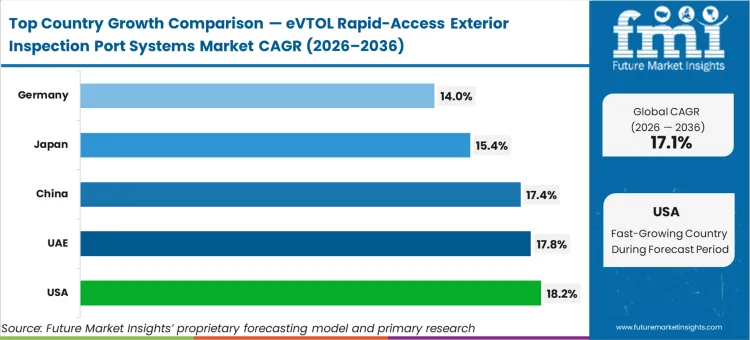
United States demand leads at an 18.2% CAGR as domestic operators push aggressively toward commercial launch targets. UAE tracks closely at 17.8% optimizing dedicated smart-city aviation corridors. China advances at 17.4% driven by heavy state funding for uncrewed logistics platforms. United Kingdom progresses at 16.8% utilizing established aerospace clusters. Germany expands at 15.9% balancing strict European certification protocols. Japan registers 15.4% prioritizing urban density logistics. Singapore secures 15.1% through highly controlled regulatory sandboxes. Geographic divergence hinges entirely on local regulatory willingness to approve commercial electric flight paths.
eVTOL Rapid-Access Exterior Inspection Port Systems Market Definition
Answering what is an eVTOL inspection port system requires looking at specialized exterior access hardware designed specifically for electric vertical takeoff and landing airframes. These components provide ground crews immediate visual and physical access to internal critical systems without requiring specialized tooling or extensive disassembly. Equipment in this category balances strict aerodynamic flushness requirements with high-frequency mechanical actuation durability across all eVTOL exterior inspection port systems.
eVTOL Rapid-Access Exterior Inspection Port Systems Market Inclusions
Scope covers load-bearing composite inspection doors, quick-release aerospace fasteners, captive latching mechanisms, and specialized aerodynamic weather seals surrounding access cutouts. Detailing exactly what hardware is included in an eVTOL inspection port assembly encompasses both primary battery bay service hatches and secondary avionics troubleshooting ports. Factory-installed framing substructures designed to support removable panels fall within these analytical boundaries.
eVTOL Rapid-Access Exterior Inspection Port Systems Market Exclusions
Main passenger ingress doors and cargo loading ramps fall entirely outside this perimeter. Internal cabin access panels, cosmetic trim covers, and ground-based diagnostic equipment lack direct exterior airframe integration. Permanent composite skin panels requiring structural bonding for installation do not qualify as rapid-access hardware.
eVTOL Rapid-Access Exterior Inspection Port Systems Market Research Methodology
- Primary Research: Chief airworthiness engineers, line maintenance directors, and aerostructures procurement officers at tier-1 electric aviation startups.
- Desk Research: Federal Aviation Administration type certificate applications, EASA special condition VTOL documentation, and public hardware supply agreements.
- Market-Sizing and Forecasting: Baseline production volumes derived directly from stated OEM manufacturing capacity roadmaps.
- Data Validation and Update Cycle: Independent cross-referencing against quarterly aerospace latch and fastener supplier shipment disclosures.
Segmental Analysis
eVTOL Rapid-Access Exterior Inspection Port Systems Market Analysis by Product Type
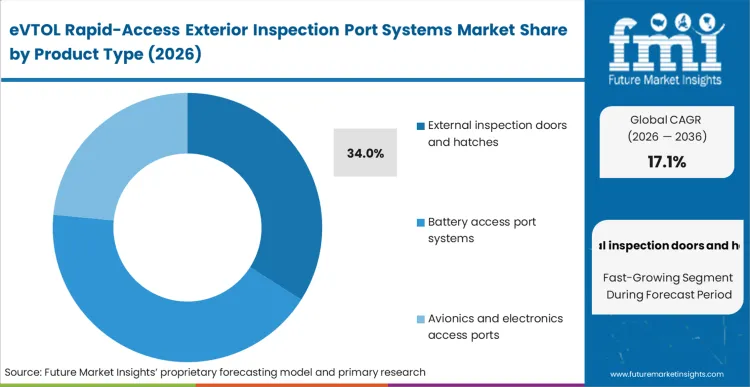
Flush composite skins conflict with continuous maintenance needs, with external inspection doors and hatches poised to hold 34.0% share in 2026. Chief engineers are recognizing that fully sealed airframes remain commercially difficult once real service access requirements are considered. Procurement teams at tier-1 startups are prioritizing load-bearing composite covers that protect critical aircraft sensors while still allowing fast technician entry. These systems must preserve aerodynamic continuity during cruise and open quickly during ground inspections. The challenge lies in durability across repeated flight cycles. Current hinge systems can struggle under the mechanical fatigue created by frequent multi-leg commuter operations. Operators using lower-grade thermoplastic covers risk panel warping, localized drag, and premature power loss. This is increasing attention on more durable battery access port systems and inspection hardware for eVTOL applications.
- Initial specification limits: Weight budgets restrict initial hardware selection. Structural engineers avoid heavy metallic assemblies, forcing suppliers innovating lightweight composite hatches.
- Vibration qualification standards: Harmonic resonance testing validates long-term durability. Flight control teams demand absolute proof doors will not flutter under high-torque rotor downwash.
- Fatigue lifecycle tracking: Daily actuation cycles degrade retaining mechanisms rapidly. Fleet managers mandate predictable replacement intervals preventing catastrophic in-flight panel separation.
eVTOL Rapid-Access Exterior Inspection Port Systems Market Analysis by Hardware Type
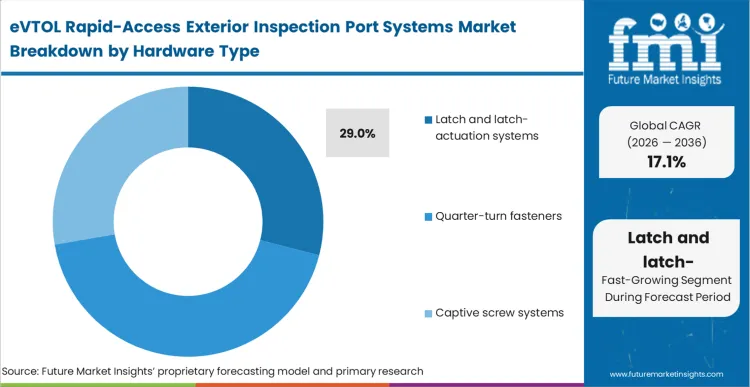
Mechanical reliability outweighs electronic convenience in critical flight safety applications. Latch and latch-actuation systems are expected to record 29.0% share in 2026 because aviation authorities fundamentally distrust unproven electromagnetic locks on exterior surfaces. Airworthiness engineers specify these mechanical components securing aerospace sealants tightly against pressurized bays. Technicians require positive tactile feedback confirming panel security before clearing aircraft for takeoff. According to FMI's estimates, flush-mounted push-button latches dominate early designs, yet they frequently jam when exposed to urban particulate matter or freezing rain. Maintenance directors ignoring environmental fouling risks discover highly efficient electric aircraft grounded by frozen quarter-turn fasteners for eVTOL inspection panels.
- Urban particulate fouling: Micro-debris jams intricate spring mechanisms. Ground crews fail accessing critical charging ports during tight ten-minute turnaround windows.
- Thermal expansion binding: Dissimilar materials expand unevenly under direct sunlight. Maintenance supervisors must force stuck panels open, causing expensive structural damage across composite frames.
- Preventative lubrication protocols: Regular cleaning maintains reliable actuation. Line technicians must implement rigorous lubrication schedules preserving mechanical integrity across thousands of flight cycles.
eVTOL Rapid-Access Exterior Inspection Port Systems Market Analysis by Access Function
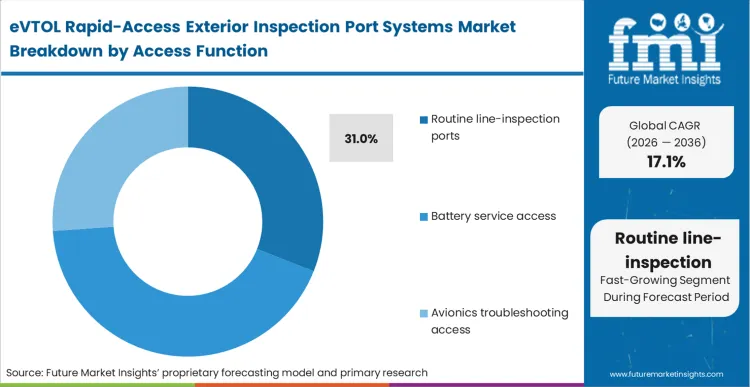
Traditional deep-maintenance teardowns destroy economic models underpinning electric air taxis. Routine line-inspection ports is anticipated to secure 31.0% share in 2026 as operators demand visual access covering critical aircraft maintenance repair and overhaul nodes without removing entire nacelle fairings, answering exactly why do eVTOL aircraft need rapid-access exterior panels. Certification officers require these specific viewing angles verifying rotor pitch linkage integrity between every flight. Small strategically placed access points allow ground personnel performing mandated safety checks in seconds rather than hours. FMI observes engineers initially placed these ports based on internal component layouts rather than human ergonomics. Operators saddled with poorly placed inspection windows suffer cascading schedule delays when technicians need specialized mirrors or ladders just completing pre-flight routines.
- Turnaround time reduction: Tool-less entry eliminates wrench-turning delays. Operations directors maximize daily flight volume compressing mandatory ground inspection procedures.
- Hidden aerodynamic drag: Poorly seated covers generate parasitic drag continuously. Performance engineers calculate massive aggregate range losses stemming from multiple slightly misaligned inspection ports.
- Lifecycle labor comparisons: Rapid-access hardware costs more upfront than standard fasteners. Finance teams realize return on investment within months through drastically reduced technician labor hours.
eVTOL Rapid-Access Exterior Inspection Port Systems Market Analysis by Installation Type
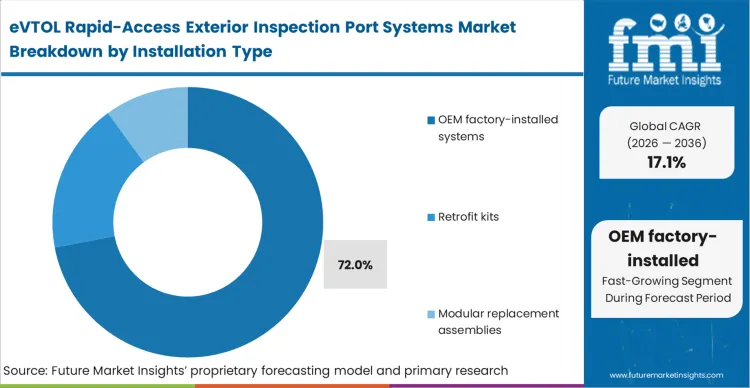
Structural integrity requirements eliminate aftermarket modifications. OEM factory-installed systems are projected to command 72.0% share in 2026 because cutting access holes into cured carbon fiber introduces unpredictable stress concentrations. Manufacturing directors integrate these composite materials directly into primary layups maintaining unbroken load paths across fuselage sections. Hardware suppliers providing OEM-installed inspection port systems for eVTOL must deliver fully assembled port frames directly to assembly lines meeting strict production cadences. Based on FMI's assessment, late-stage design changes to exterior ports routinely delay entire aircraft certification programs by months. Airframe developers failing freezing access locations early face catastrophic tooling redesign costs when static load tests reveal structural weaknesses around cutouts.
- Production line integration: Just-in-time delivery synchronizes with composite curing schedules. Procurement officers build highly rigid supply chains preventing airframe assembly bottlenecks.
- Certification documentation traceability: Factory installation guarantees material provenance. Quality assurance managers satisfy regulators maintaining unbroken chains of custody for every latch and hinge.
- Aftermarket upgrade limitations: Structural permanence prevents easy field modifications. Fleet operators must live with initial factory layouts, heavily penalizing early designs featuring suboptimal maintenance ergonomics.
eVTOL Rapid-Access Exterior Inspection Port Systems Market Analysis by Aircraft Type
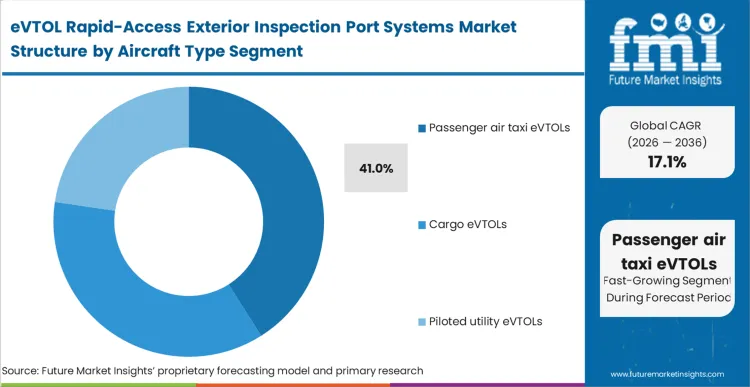
Passenger air taxi eVTOLs is estimated to hold 41.0% share in 2026 as highly capitalized startups push toward aggressive commercial launch dates. Flight operations directors orchestrate dense daily schedules necessitating dedicated eVTOL charging facilities and ultra-fast turnaround protocols. Hardware covering critical battery bay access port for air taxi aircraft connectors must survive constant physical abuse from hurried ground crews. FMI analysts note passenger proximity dictates specialized tamper-proof latches, preventing curious commuters accidentally opening high-voltage bays. Operators failing specifying robust hardware face immediate regulatory grounding if single exterior panels separate over populated metropolitan areas.
- High-cycle actuation endurance: Commuter routes demand dozens of daily openings. Hardware engineers select titanium or high-grade aerospace alloys preventing premature mechanical wear.
- Acoustic sealing requirements: Loose panels generate unacceptable high-frequency cabin noise. Acoustic engineers mandate precision gaskets preventing airflow whistling during high-speed forward cruise.
- Tamper-resistance standards: Public accessibility introduces severe safety risks. Certification authorities require specialized locking geometries defeating unauthorized entry while remaining instantly accessible to trained ground crews.
eVTOL Rapid-Access Exterior Inspection Port Systems Market Drivers, Restraints, and Opportunities
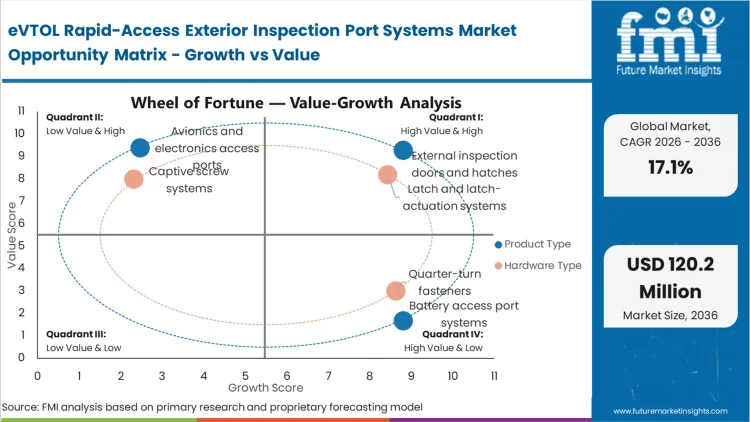
Turnaround time constraints compel fleet operators demanding tool-less access to high-voltage battery terminals immediately. Maintenance directors cannot tolerate traditional screw-fastened panels when business models require aircraft landing, recharging, and departing within fifteen minutes. Delaying procurement of specialized rapid-access hardware destroys fundamental economic viability underpinning high-frequency electric aviation. Regulatory bodies assessing what regulations drive inspection hatch design in eVTOL aircraft mandate these highly reliable aircraft health monitoring system physical inspection points before granting any commercial operating certificates.
Flushness tolerances create severe operational friction during manufacturing. Airframe engineers demand zero-gap installations maintaining laminar airflow over complex composite curves. This friction persists structurally because mass-producing curved access doors perfectly matching surrounding fuselage contours across hundreds of airframes requires incredibly expensive precision tooling. Current adjustable hinge designs offer partial aerodynamic relief but introduce unacceptable weight penalties to highly optimized electric aircraft electrical systems.
Opportunities in the eVTOL Rapid-Access Exterior Inspection Port Systems Market
- Smart-latch telemetry integration: Embedding micro-sensors detects unsecured panels instantly. Avionics directors secure aircraft automated inspection and monitoring capabilities without adding separate complex wiring harnesses.
- Thermoplastic composite manufacturing: Injecting carbon-reinforced polymers reduces unit costs dramatically. Procurement officers secure high-volume production pricing while maintaining structural rigidity matching primary airframes.
- Ice-phobic coating application: Specialized surface treatments prevent latches freezing at altitude. Fleet managers ensure reliable all-weather operability across varying urban air mobility inspection hatch systems.
Regional Analysis
.webp "Top Country Growth Comparison Evtol Rapid Access Exterior Inspection Port Systems Market Cagr (2026 2036)")
Based on regional analysis, eVTOL Rapid-Access Exterior Inspection Port Systems is segmented into North America, Latin America, Western Europe, Eastern Europe, East Asia, South Asia & Pacific, and Middle East & Africa across 40 plus countries.
| Country | CAGR (2026 to 2036) |
|---|---|
| US | 18.2% |
| UAE | 17.8% |
| China | 17.4% |
| Japan | 15.4% |
Source: Future Market Insights (FMI) analysis, based on proprietary forecasting model and primary research
North America eVTOL Rapid-Access Exterior Inspection Port Systems Market Analysis
Localized experimental flight waivers govern initial operational footprints. Civil aviation authorities prioritize rapid domestic commercialization over harmonized global standards. Procurement directors at tier-1 startups capitalize on established aerospace supply chains sourcing specialized quick-release hardware locally. FMI observes air traffic management integration protocols here emphasize heavy reliance on physical pre-flight inspections mitigating early algorithmic risks.
- United States: Aggressive domestic certification timelines from leading electric aviation startups drive an 18.2% CAGR shaping robust United States eVTOL inspection port systems. Chief engineering officers over-spec hardware guaranteeing compliance under intense FAA scrutiny. Domestic suppliers secure massive early prototype contracts.
Latin America eVTOL Rapid-Access Exterior Inspection Port Systems Market Analysis
Urban logistics modernization and public-service aviation pilots are shaping early adoption patterns across Latin America. Regulators move selectively, focusing on controlled demonstration routes rather than wide commercial liberalization. Procurement heads rely on imported aerospace-grade latching systems and composite access structures while local integrators build maintenance-friendly configurations for demanding tropical operating environments. FMI indicates humidity exposure, rainfall intensity, and uneven maintenance infrastructure increase the need for rapid-access inspection hardware that can withstand repeated field servicing without compromising aerodynamic fit.
- • Brazil: Expanding urban air mobility pilots and drone logistics trials are expected to support strong market growth through 2036. Brazil is estimated to hold nearly 7.0% share in 2026. Engineering teams prioritize rugged exterior inspection port systems that tolerate moisture, heat, and frequent maintenance cycles across dense metro corridors. Local operators adopting durable quick-access covers and reinforced external service panels are better positioned to secure fleet contracts in cargo, infrastructure monitoring, and passenger eVTOL programs.
Middle East & Africa eVTOL Rapid-Access Exterior Inspection Port Systems Market Analysis
Dedicated smart-city flight corridors establish clear operational boundaries for early hardware deployments. Aviation authorities in specific urban centers proactively carve out exclusive airspace for autonomous testing. Fleet operators utilize these simplified environments validating baseline hardware performance under extreme thermal and dust conditions. FMI's assessment indicates severe daytime heat profiles routinely warp poorly designed thermoplastic access covers.
- UAE: State-backed logistics networks construct massive dedicated aerial corridors, driving a 17.8% CAGR. Fleet managers demand extreme thermal resilience from external drone logistics transportation pods. Regional operators solving heat-degradation challenges immediately secure lucrative state logistics contracts.
East Asia eVTOL Rapid-Access Exterior Inspection Port Systems Market Analysis
Aggressive state-backed certification frameworks dictate adoption speed across this geography. Civil aviation authorities prioritize rapid deployment of uncrewed logistics networks over stringent legacy aerospace testing timelines. Procurement directors capitalize on localized manufacturing hubs rapidly iterating hardware designs. FMI notes regional operators utilize highly dense metropolitan airspace stress-testing component durability continuously.
- China: State-level mandates force rapid type certification for autonomous cargo platforms, growing at 17.4%. Logistics directors deploy expansive unmanned aerial vehicles UAV commercial drone networks demanding robust hardware. Chinese suppliers dominate low-cost composite panel production globally.
- Japan: Urban density logistics programs receive priority airspace allocations. Public safety directors demand extreme hardware reliability, pushing a 15.4% expansion rate. Early hardware qualification grants domestic suppliers immense competitive advantages against foreign entrants.
FMI's report includes United Kingdom, Germany, and other key nations. Strict legacy aerospace regulations in Europe severely restrict experimental flights, forcing suppliers over-engineering latches meeting EASA's unique VTOL special conditions.
Competitive Aligners for Market Players
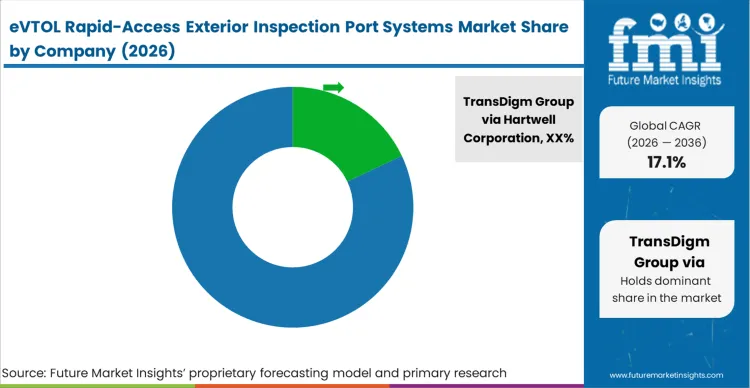
Certification experience creates impenetrable barriers for consumer electronics entrants attempting capturing aerospace share. TransDigm Group via Hartwell Corporation holds 17.0% position entirely because their engineering teams possess decades of institutional knowledge regarding DO-160G environmental testing. Procurement directors evaluating who are the top suppliers of eVTOL access panel systems refuse evaluating uncertified latches, regardless of weight savings or innovative designs. Hardware startups consistently underestimate millions of dollars required simply validating vibration resilience inside specialized wind tunnels.
Established suppliers hold an advantage through certified actuators, hinges, latches, and fastening systems already proven in aerospace use. Their experience in pressure sealing, vibration endurance, and fluid resistance lowers qualification risk for eVTOL manufacturers. New entrants must build these validation capabilities while developing ultra-lightweight composite structures, which raises testing demands and slows market entry.
Large airframe integrators fiercely resist vendor lock-in standardizing mounting footprints across fleets. Chief engineering officers write strict interface control documents requiring aircraft access latch manufacturers for eVTOL delivering hardware fitting universal fuselage cutouts. Competition centers on fulfilling any RFQ eVTOL access hatch hardware by delivering aerodynamically flawless customized avionic systems ports maintaining perfect laminar flow without requiring constant technician adjustment.
Key Players in eVTOL Rapid-Access Exterior Inspection Port Systems Market
- TransDigm Group via Hartwell Corporation
- Howmet Aerospace
- Southco
- TriMas Aerospace
- RTX Collins Aerospace
- LISI Aerospace
- Camloc Motion Control
Scope of the Report
| Metric | Value |
|---|---|
| Quantitative Units | USD 24.8 million to USD 120.4 million, at a CAGR of 17.10% |
| Market Definition | Purpose-built exterior access hardware allowing rapid ground-crew inspection of critical electric aviation subsystems without compromising aerodynamic integrity. |
| Segmentation | By Product Type, By Hardware Type, By Access Function, By Installation Type, and By Aircraft Type |
| Regions Covered | North America, Latin America, Western Europe, Eastern Europe, East Asia, South Asia & Pacific, Middle East & Africa |
| Countries Covered | United States, UAE, China, United Kingdom, Germany, Japan, Singapore |
| Key Companies Profiled | TransDigm Group via Hartwell Corporation, Howmet Aerospace, Southco, TriMas Aerospace, RTX Collins Aerospace, LISI Aerospace, Camloc Motion Control |
| Forecast Period | 2026 to 2036 |
| Approach | Baseline production volumes derived directly from stated OEM manufacturing capacity roadmaps. |
Source: Future Market Insights (FMI) analysis, based on proprietary forecasting model and primary research
eVTOL Rapid-Access Exterior Inspection Port Systems Market Analysis by Segments
Product Type
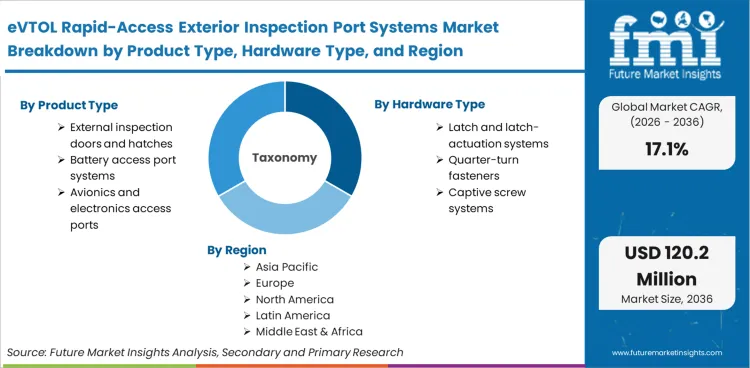
- External inspection doors and hatches
- Battery access port systems
- Avionics and electronics access ports
- Sensor and wiring inspection covers
- Serviceable nacelle or fairing inspection panels
- Composite removable inspection covers
Hardware Type
- Latch and latch-actuation systems
- Quarter-turn fasteners
- Captive screw systems
- Hinge and hold-open assemblies
- Peripheral seals and gaskets
- Framing and reinforcement substructures
Access Function
- Routine line-inspection ports
- Battery service access
- Avionics troubleshooting access
- Charging and power-system access
- Condition-monitoring access
- Damage inspection and maintenance access
Installation Type
- OEM factory-installed systems
- Retrofit kits
- Modular replacement assemblies
Aircraft Type
- Passenger air taxi eVTOLs
- Cargo eVTOLs
- Piloted utility eVTOLs
- Autonomous logistics eVTOLs
- Defense and special-mission eVTOLs
Region
- North America
- United States
- Canada
- Latin America
- Brazil
- Mexico
- Rest of Latin America
- Western Europe
- Germany
- United Kingdom
- France
- Spain
- Italy
- BENELUX
- Rest of Western Europe
- Eastern Europe
- Russia
- Poland
- Rest of Eastern Europe
- East Asia
- China
- Japan
- South Korea
- South Asia & Pacific
- India
- ASEAN
- Oceania
- Rest of South Asia & Pacific
- Middle East & Africa
- GCC
- South Africa
- North Africa
- Rest of Middle East & Africa
Bibliography
- Archer Aviation Inc. (2026, March 2). Q4’25 & FY 2025 shareholder letter.
- European Union Aviation Safety Agency. (2025, July 18). Special condition for VTOL and means of compliance.
- Federal Aviation Administration. (2025). Roadmap for advanced air mobility aircraft type certification.
- Joby Aviation, Inc. (2026, February 25). Joby reports fourth quarter 2025 financial results.
- BETA Technologies, Inc. (2026, March 9). BETA Technologies, Inc. announces fourth quarter and full year 2025 results.
This bibliography is provided for reader reference. The full FMI report contains the complete reference list with primary source documentation.
This Report Addresses
- Component certification barriers complicating aerostructures hardware deployments.
- Weight-to-payload limitations driving composite access hatch material selections.
- Airframe composite stress fractures caused by rigid aftermarket retrofit installations.
- Thermal expansion vulnerabilities inherent inside sealed aerodynamic inspection ports.
- Flight turnaround efficiency dependence on rapid-access latch actuation cycles.
- Operational shutdowns resulting from localized mechanical fastener freezing.
- Early revenue testing models leveraging strictly segregated logistics flight corridors.
- Type certificate application volumes anchoring precise hardware demand forecasting.
Frequently Asked Questions
Explain the eVTOL rapid-access exterior inspection port systems?
This sector involves purpose-built exterior access hardware designed specifically for electric vertical takeoff and landing airframes. These components provide ground crews immediate visual and physical access to internal critical systems without requiring specialized tooling or extensive disassembly.
How much does an eVTOL inspection hatch system cost?
Pricing varies significantly based on composite material requirements and mechanical complexity. Early prototype and low-rate initial production hardware can cost several thousand dollars per airframe, though prices will compress rapidly as OEMs freeze designs and initiate serial production.
Estimate price per eVTOL access port assembly?
A single specialized access port assembly ranges from hundreds to thousands of dollars depending on integrated smart-latch telemetry, acoustic sealing parameters, and load-bearing structural certification requirements mandated by aviation authorities.
Which companies make aircraft access latches for eVTOLs?
Leading suppliers include TransDigm Group via Hartwell Corporation, Howmet Aerospace, Southco, TriMas Aerospace, RTX Collins Aerospace, LISI Aerospace, and Camloc Motion Control. These incumbents leverage deep institutional knowledge regarding DO-160G environmental testing.
What limits retrofit inspection port installation on certified platforms?
Aerodynamic testing profiles break instantly upon adding unapproved exterior structures. Fleet maintenance teams face immediate airworthiness certificate revocation if they modify external composite surfaces without full engineering revalidation.
Why do mechanical latches dominate over electronic locking mechanisms?
Aviation authorities fundamentally distrust unproven electromagnetic locks on exterior surfaces. Airworthiness engineers specify mechanical components guaranteeing tactile feedback and fail-safe operation during power loss scenarios.
How do flush inspection covers affect aircraft maintenance cycles?
Unified composite covers prioritizing aerodynamics often require specialized tooling and extensive time removing. Maintenance directors trade aerodynamic drag reduction for vastly increased unit turnaround times on tarmac surfaces.
What specific operational hurdle slows passenger UAM certification?
Regulators demand thousands of verified safe mechanical actuation cycles before authorizing commercial human transport. Component suppliers currently lack sufficient real-world dense commuter data proving latch fatigue reliability conclusively.
Why do routine line-inspection ports require specialized aerodynamic sealing?
Loose panels generate unacceptable high-frequency cabin noise and parasitic drag. Acoustic engineers mandate precision gaskets preventing airflow whistling during high-speed forward cruise while preserving easy access.
How do thermal expansion constraints influence exterior hardware design?
Dissimilar materials expand unevenly under direct sunlight, causing composite hatches binding against frames. Hardware engineers must design latches capable of overcoming this thermal friction without warping surrounding panels.
What structural difference explains China's accelerated hardware adoption?
Aggressive state-backed aviation authorities bypass prolonged experimental stages mandating rapid uncrewed logistics deployments. Domestic logistics directors scale massive cargo networks utilizing simplified hardware configurations.
Why do OEMs demand standardized hardware footprints?
Airframe designers want retaining absolute control over critical supply chains. Chief engineering officers write strict interface documents preventing vendor lock-in, allowing rapid supplier switching if specific latch manufacturers fail.
What specific advantage do legacy aerospace suppliers hold?
Incumbents possess deep institutional knowledge regarding DO-160G environmental stress protocols. Procurement teams heavily favor suppliers guaranteeing hardware survival during extreme vibration and altitude pressure cycling.
How do urban particulates threaten autonomous dispatch reliability?
Micro-debris jams intricate spring mechanisms inside flush-mounted latches. Fleet dispatchers lose massive revenue when forced grounding entire regional networks because ground crews cannot open fouled battery charging ports.
Why are lightweight composite hatches critical for future hardware designs?
Heavy metallic assemblies introduce unacceptable weight penalties into strictly controlled designs. Thermoplastic composites eliminate excess mass, allowing procurement teams meeting strict mechanical tolerance budgets.
What restricts generic fastener effectiveness during daily commuter operations?
Standard fasteners degrade rapidly under high-frequency actuation cycles. Operations directors must replace cheap hardware constantly or risk catastrophic in-flight panel separation over densely populated metropolitan areas.
How does battery access dictate external hardware procurement?
Excessive turnaround time directly destroys electric flight profitability. Chief engineering officers reject highly aerodynamic perception suites if complex removal processes extend scheduled ground times beyond fifteen minutes.
Why are dedicated cargo operations crucial for hardware validation?
Regulators grant flight waivers rapidly over unpopulated industrial zones. Hardware engineers utilize these freight operations harvesting terabytes of mechanical fatigue data required for eventual passenger certification.
What causes composite delamination during retrofit installations?
Cutting access holes into cured carbon fiber creates concentrated stress points during high-G maneuvers. Structural engineers prevent catastrophic airframe failure forcing all hardware integration into primary factory layups.
How do smart-latches simplify autonomous flight architectures?
Embedding micro-sensors directly into latch mechanisms detects unsecured panels instantly. Avionics architects integrate this telemetry keeping central flight computers focused on trajectory management rather than manual status checks.
Why do Middle Eastern operators prioritize extreme thermal resilience?
Daytime desert operating profiles push external thermoplastic composites past standard aerospace heat tolerances. Fleet managers strictly evaluate suppliers based on capacity preventing critical hardware warping during peak summer dispatch windows.
What role does silicon foundry data play in FMI forecasting?
Advanced aerospace avionics require specialized access ports maintaining cooling and connectivity. Analysts track these specific semiconductor shipments validating actual airframe production schedules against OEM claims.
How do icing conditions cripple mechanical latch actuation?
Moisture penetration followed by freezing temperatures locks internal spring mechanisms solid. Maintenance technicians discover one frozen latch during winter flight destroys turnaround schedules completely.
Why do public safety fleets demand distinct hardware parameters?
Emergency operations require reliable access under extreme environmental stress. Public safety directors specify highly specialized tactile latches capable of being operated by personnel wearing thick protective gloves.
What forces airframe manufacturers into strict vendor lock-in?
Re-certifying new supplier latches requires millions of dollars in aircraft lighting systems compatibility and environmental re-testing. Chief engineering officers rarely switch hardware partners once original type certificates secure civil aviation approval.
How do flushness restrictions influence external hardware packaging?
Bulky exterior hinges generate unacceptable drag and acoustic signatures. Aerodynamicists sculpt aircraft transparency and access ports explicitly minimizing drag-induced noise over densely populated residential zones.
Preview the report firsthand - request a free sample
Get SampleGet the brochure for pricing and purchase details.
Get PDFTable of Content
- Executive Summary
- Global Market Outlook
- Demand-side Trends
- Supply-side Trends
- Technology Roadmap Analysis
- Analysis and Recommendations
- Market Overview
- Market Coverage / Taxonomy
- Market Definition / Scope / Limitations
- Research Methodology
- Chapter Orientation
- Analytical Lens and Working Hypotheses
- Market Structure, Signals, and Trend Drivers
- Benchmarking and Cross-market Comparability
- Market Sizing, Forecasting, and Opportunity Mapping
- Research Design and Evidence Framework
- Desk Research Programme (Secondary Evidence)
- Company Annual and Sustainability Reports
- Peer-reviewed Journals and Academic Literature
- Corporate Websites, Product Literature, and Technical Notes
- Earnings Decks and Investor Briefings
- Statutory Filings and Regulatory Disclosures
- Technical White Papers and Standards Notes
- Trade Journals, Industry Magazines, and Analyst Briefs
- Conference Proceedings, Webinars, and Seminar Materials
- Government Statistics Portals and Public Data Releases
- Press Releases and Reputable Media Coverage
- Specialist Newsletters and Curated Briefings
- Sector Databases and Reference Repositories
- FMI Internal Proprietary Databases and Historical Market Datasets
- Subscription Datasets and Paid Sources
- Social Channels, Communities, and Digital Listening Inputs
- Additional Desk Sources
- Expert Input and Fieldwork (Primary Evidence)
- Primary Modes
- Qualitative Interviews and Expert Elicitation
- Quantitative Surveys and Structured Data Capture
- Blended Approach
- Why Primary Evidence is Used
- Field Techniques
- Interviews
- Surveys
- Focus Groups
- Observational and In-context Research
- Social and Community Interactions
- Stakeholder Universe Engaged
- C-suite Leaders
- Board Members
- Presidents and Vice Presidents
- R&D and Innovation Heads
- Technical Specialists
- Domain Subject-matter Experts
- Scientists
- Physicians and Other Healthcare Professionals
- Governance, Ethics, and Data Stewardship
- Research Ethics
- Data Integrity and Handling
- Primary Modes
- Tooling, Models, and Reference Databases
- Desk Research Programme (Secondary Evidence)
- Data Engineering and Model Build
- Data Acquisition and Ingestion
- Cleaning, Normalisation, and Verification
- Synthesis, Triangulation, and Analysis
- Quality Assurance and Audit Trail
- Market Background
- Market Dynamics
- Drivers
- Restraints
- Opportunity
- Trends
- Scenario Forecast
- Demand in Optimistic Scenario
- Demand in Likely Scenario
- Demand in Conservative Scenario
- Opportunity Map Analysis
- Product Life Cycle Analysis
- Supply Chain Analysis
- Investment Feasibility Matrix
- Value Chain Analysis
- PESTLE and Porter’s Analysis
- Regulatory Landscape
- Regional Parent Market Outlook
- Production and Consumption Statistics
- Import and Export Statistics
- Market Dynamics
- Global Market Analysis 2021 to 2025 and Forecast, 2026 to 2036
- Historical Market Size Value (USD Million) Analysis, 2021 to 2025
- Current and Future Market Size Value (USD Million) Projections, 2026 to 2036
- Y-o-Y Growth Trend Analysis
- Absolute $ Opportunity Analysis
- Global Market Pricing Analysis 2021 to 2025 and Forecast 2026 to 2036
- Global Market Analysis 2021 to 2025 and Forecast 2026 to 2036, By Product Type
- Introduction / Key Findings
- Historical Market Size Value (USD Million) Analysis By Product Type , 2021 to 2025
- Current and Future Market Size Value (USD Million) Analysis and Forecast By Product Type , 2026 to 2036
- External inspection doors and hatches
- Battery access port systems
- Avionics and electronics access ports
- Sensor and wiring inspection covers
- Serviceable nacelle or fairing inspection panels
- Composite removable inspection covers
- External inspection doors and hatches
- Y-o-Y Growth Trend Analysis By Product Type , 2021 to 2025
- Absolute $ Opportunity Analysis By Product Type , 2026 to 2036
- Global Market Analysis 2021 to 2025 and Forecast 2026 to 2036, By Hardware Type
- Introduction / Key Findings
- Historical Market Size Value (USD Million) Analysis By Hardware Type, 2021 to 2025
- Current and Future Market Size Value (USD Million) Analysis and Forecast By Hardware Type, 2026 to 2036
- Latch and latch-actuation systems
- Quarter-turn fasteners
- Captive screw systems
- Hinge and hold-open assemblies
- Peripheral seals and gaskets
- Framing and reinforcement substructures
- Latch and latch-actuation systems
- Y-o-Y Growth Trend Analysis By Hardware Type, 2021 to 2025
- Absolute $ Opportunity Analysis By Hardware Type, 2026 to 2036
- Global Market Analysis 2021 to 2025 and Forecast 2026 to 2036, By Access Function
- Introduction / Key Findings
- Historical Market Size Value (USD Million) Analysis By Access Function, 2021 to 2025
- Current and Future Market Size Value (USD Million) Analysis and Forecast By Access Function, 2026 to 2036
- Routine line-inspection ports
- Battery service access
- Avionics troubleshooting access
- Charging and power-system access
- Condition-monitoring access
- Damage inspection and maintenance access
- Routine line-inspection ports
- Y-o-Y Growth Trend Analysis By Access Function, 2021 to 2025
- Absolute $ Opportunity Analysis By Access Function, 2026 to 2036
- Global Market Analysis 2021 to 2025 and Forecast 2026 to 2036, By Installation Type
- Introduction / Key Findings
- Historical Market Size Value (USD Million) Analysis By Installation Type, 2021 to 2025
- Current and Future Market Size Value (USD Million) Analysis and Forecast By Installation Type, 2026 to 2036
- OEM factory-installed systems
- Retrofit kits
- Modular replacement assemblies
- OEM factory-installed systems
- Y-o-Y Growth Trend Analysis By Installation Type, 2021 to 2025
- Absolute $ Opportunity Analysis By Installation Type, 2026 to 2036
- Global Market Analysis 2021 to 2025 and Forecast 2026 to 2036, By Aircraft Type
- Introduction / Key Findings
- Historical Market Size Value (USD Million) Analysis By Aircraft Type, 2021 to 2025
- Current and Future Market Size Value (USD Million) Analysis and Forecast By Aircraft Type, 2026 to 2036
- Passenger air taxi eVTOLs
- Cargo eVTOLs
- Piloted utility eVTOLs
- Autonomous logistics eVTOLs
- Defense and special-mission eVTOLs
- Passenger air taxi eVTOLs
- Y-o-Y Growth Trend Analysis By Aircraft Type, 2021 to 2025
- Absolute $ Opportunity Analysis By Aircraft Type, 2026 to 2036
- Global Market Analysis 2021 to 2025 and Forecast 2026 to 2036, By Region
- Introduction
- Historical Market Size Value (USD Million) Analysis By Region, 2021 to 2025
- Current Market Size Value (USD Million) Analysis and Forecast By Region, 2026 to 2036
- North America
- Latin America
- Western Europe
- Eastern Europe
- East Asia
- South Asia and Pacific
- Middle East & Africa
- Market Attractiveness Analysis By Region
- North America Market Analysis 2021 to 2025 and Forecast 2026 to 2036, By Country
- Historical Market Size Value (USD Million) Trend Analysis By Market Taxonomy, 2021 to 2025
- Market Size Value (USD Million) Forecast By Market Taxonomy, 2026 to 2036
- By Country
- USA
- Canada
- Mexico
- By Product Type
- By Hardware Type
- By Access Function
- By Installation Type
- By Aircraft Type
- By Country
- Market Attractiveness Analysis
- By Country
- By Product Type
- By Hardware Type
- By Access Function
- By Installation Type
- By Aircraft Type
- Key Takeaways
- Latin America Market Analysis 2021 to 2025 and Forecast 2026 to 2036, By Country
- Historical Market Size Value (USD Million) Trend Analysis By Market Taxonomy, 2021 to 2025
- Market Size Value (USD Million) Forecast By Market Taxonomy, 2026 to 2036
- By Country
- Brazil
- Chile
- Rest of Latin America
- By Product Type
- By Hardware Type
- By Access Function
- By Installation Type
- By Aircraft Type
- By Country
- Market Attractiveness Analysis
- By Country
- By Product Type
- By Hardware Type
- By Access Function
- By Installation Type
- By Aircraft Type
- Key Takeaways
- Western Europe Market Analysis 2021 to 2025 and Forecast 2026 to 2036, By Country
- Historical Market Size Value (USD Million) Trend Analysis By Market Taxonomy, 2021 to 2025
- Market Size Value (USD Million) Forecast By Market Taxonomy, 2026 to 2036
- By Country
- Germany
- UK
- Italy
- Spain
- France
- Nordic
- BENELUX
- Rest of Western Europe
- By Product Type
- By Hardware Type
- By Access Function
- By Installation Type
- By Aircraft Type
- By Country
- Market Attractiveness Analysis
- By Country
- By Product Type
- By Hardware Type
- By Access Function
- By Installation Type
- By Aircraft Type
- Key Takeaways
- Eastern Europe Market Analysis 2021 to 2025 and Forecast 2026 to 2036, By Country
- Historical Market Size Value (USD Million) Trend Analysis By Market Taxonomy, 2021 to 2025
- Market Size Value (USD Million) Forecast By Market Taxonomy, 2026 to 2036
- By Country
- Russia
- Poland
- Hungary
- Balkan & Baltic
- Rest of Eastern Europe
- By Product Type
- By Hardware Type
- By Access Function
- By Installation Type
- By Aircraft Type
- By Country
- Market Attractiveness Analysis
- By Country
- By Product Type
- By Hardware Type
- By Access Function
- By Installation Type
- By Aircraft Type
- Key Takeaways
- East Asia Market Analysis 2021 to 2025 and Forecast 2026 to 2036, By Country
- Historical Market Size Value (USD Million) Trend Analysis By Market Taxonomy, 2021 to 2025
- Market Size Value (USD Million) Forecast By Market Taxonomy, 2026 to 2036
- By Country
- China
- Japan
- South Korea
- By Product Type
- By Hardware Type
- By Access Function
- By Installation Type
- By Aircraft Type
- By Country
- Market Attractiveness Analysis
- By Country
- By Product Type
- By Hardware Type
- By Access Function
- By Installation Type
- By Aircraft Type
- Key Takeaways
- South Asia and Pacific Market Analysis 2021 to 2025 and Forecast 2026 to 2036, By Country
- Historical Market Size Value (USD Million) Trend Analysis By Market Taxonomy, 2021 to 2025
- Market Size Value (USD Million) Forecast By Market Taxonomy, 2026 to 2036
- By Country
- India
- ASEAN
- Australia & New Zealand
- Rest of South Asia and Pacific
- By Product Type
- By Hardware Type
- By Access Function
- By Installation Type
- By Aircraft Type
- By Country
- Market Attractiveness Analysis
- By Country
- By Product Type
- By Hardware Type
- By Access Function
- By Installation Type
- By Aircraft Type
- Key Takeaways
- Middle East & Africa Market Analysis 2021 to 2025 and Forecast 2026 to 2036, By Country
- Historical Market Size Value (USD Million) Trend Analysis By Market Taxonomy, 2021 to 2025
- Market Size Value (USD Million) Forecast By Market Taxonomy, 2026 to 2036
- By Country
- Kingdom of Saudi Arabia
- Other GCC Countries
- Turkiye
- South Africa
- Other African Union
- Rest of Middle East & Africa
- By Product Type
- By Hardware Type
- By Access Function
- By Installation Type
- By Aircraft Type
- By Country
- Market Attractiveness Analysis
- By Country
- By Product Type
- By Hardware Type
- By Access Function
- By Installation Type
- By Aircraft Type
- Key Takeaways
- Key Countries Market Analysis
- USA
- Pricing Analysis
- Market Share Analysis, 2025
- By Product Type
- By Hardware Type
- By Access Function
- By Installation Type
- By Aircraft Type
- Canada
- Pricing Analysis
- Market Share Analysis, 2025
- By Product Type
- By Hardware Type
- By Access Function
- By Installation Type
- By Aircraft Type
- Mexico
- Pricing Analysis
- Market Share Analysis, 2025
- By Product Type
- By Hardware Type
- By Access Function
- By Installation Type
- By Aircraft Type
- Brazil
- Pricing Analysis
- Market Share Analysis, 2025
- By Product Type
- By Hardware Type
- By Access Function
- By Installation Type
- By Aircraft Type
- Chile
- Pricing Analysis
- Market Share Analysis, 2025
- By Product Type
- By Hardware Type
- By Access Function
- By Installation Type
- By Aircraft Type
- Germany
- Pricing Analysis
- Market Share Analysis, 2025
- By Product Type
- By Hardware Type
- By Access Function
- By Installation Type
- By Aircraft Type
- UK
- Pricing Analysis
- Market Share Analysis, 2025
- By Product Type
- By Hardware Type
- By Access Function
- By Installation Type
- By Aircraft Type
- Italy
- Pricing Analysis
- Market Share Analysis, 2025
- By Product Type
- By Hardware Type
- By Access Function
- By Installation Type
- By Aircraft Type
- Spain
- Pricing Analysis
- Market Share Analysis, 2025
- By Product Type
- By Hardware Type
- By Access Function
- By Installation Type
- By Aircraft Type
- France
- Pricing Analysis
- Market Share Analysis, 2025
- By Product Type
- By Hardware Type
- By Access Function
- By Installation Type
- By Aircraft Type
- India
- Pricing Analysis
- Market Share Analysis, 2025
- By Product Type
- By Hardware Type
- By Access Function
- By Installation Type
- By Aircraft Type
- ASEAN
- Pricing Analysis
- Market Share Analysis, 2025
- By Product Type
- By Hardware Type
- By Access Function
- By Installation Type
- By Aircraft Type
- Australia & New Zealand
- Pricing Analysis
- Market Share Analysis, 2025
- By Product Type
- By Hardware Type
- By Access Function
- By Installation Type
- By Aircraft Type
- China
- Pricing Analysis
- Market Share Analysis, 2025
- By Product Type
- By Hardware Type
- By Access Function
- By Installation Type
- By Aircraft Type
- Japan
- Pricing Analysis
- Market Share Analysis, 2025
- By Product Type
- By Hardware Type
- By Access Function
- By Installation Type
- By Aircraft Type
- South Korea
- Pricing Analysis
- Market Share Analysis, 2025
- By Product Type
- By Hardware Type
- By Access Function
- By Installation Type
- By Aircraft Type
- Russia
- Pricing Analysis
- Market Share Analysis, 2025
- By Product Type
- By Hardware Type
- By Access Function
- By Installation Type
- By Aircraft Type
- Poland
- Pricing Analysis
- Market Share Analysis, 2025
- By Product Type
- By Hardware Type
- By Access Function
- By Installation Type
- By Aircraft Type
- Hungary
- Pricing Analysis
- Market Share Analysis, 2025
- By Product Type
- By Hardware Type
- By Access Function
- By Installation Type
- By Aircraft Type
- Kingdom of Saudi Arabia
- Pricing Analysis
- Market Share Analysis, 2025
- By Product Type
- By Hardware Type
- By Access Function
- By Installation Type
- By Aircraft Type
- Turkiye
- Pricing Analysis
- Market Share Analysis, 2025
- By Product Type
- By Hardware Type
- By Access Function
- By Installation Type
- By Aircraft Type
- South Africa
- Pricing Analysis
- Market Share Analysis, 2025
- By Product Type
- By Hardware Type
- By Access Function
- By Installation Type
- By Aircraft Type
- USA
- Market Structure Analysis
- Competition Dashboard
- Competition Benchmarking
- Market Share Analysis of Top Players
- By Regional
- By Product Type
- By Hardware Type
- By Access Function
- By Installation Type
- By Aircraft Type
- Competition Analysis
- Competition Deep Dive
- TransDigm Group via Hartwell Corporation
- Overview
- Product Portfolio
- Profitability by Market Segments (Product/Age /Sales Channel/Region)
- Sales Footprint
- Strategy Overview
- Marketing Strategy
- Product Strategy
- Channel Strategy
- Howmet Aerospace
- Southco
- TriMas Aerospace
- RTX Collins Aerospace
- LISI Aerospace
- Camloc Motion Control
- TransDigm Group via Hartwell Corporation
- Competition Deep Dive
- Assumptions & Acronyms Used


