

- Industry Size (2026)
- USD 900 Mn
- Forecast (2036)
- USD 3260 Mn
- CAGR (2026 to 2036)
- 13.7%
Material Passport Systems for Circular Plastics Market Forecast and Outlook 2026 to 2036
Material passport systems for circular plastics market revenue is projected to total USD 900 million in 2026, increasing to USD 3,260 million by 2036, at a CAGR of 13.7%. FMI analysis indicates the market is undergoing a fundamental shift from voluntary disclosure platforms to mandatory, legally recognized systems that impact market access and cost of capital. The 2026 to 2027 period will be defined by the enforcement of the EU’s Digital Product Passport for packaging, creating an immediate compliance-driven demand surge and establishing de facto global standards for data verification.
Circularise has strengthened its support for mass-balance and cryptographically verifiable recycled-content allocation. The platform enables brands in packaging and electronics to make batch-level recycled-content and circularity claims while preserving upstream supplier confidentiality. This approach is increasingly used to operationalize mass-balance accounting across complex petrochemical and polymer supply chains, aligning with Digital Product Passport readiness and third-party certification workflows.
Technical innovation is centered on data sovereignty and interoperability. Enterprise sustainability software providers such as Sphera are positioning their product sustainability and compliance platforms to support region-specific data governance requirements, including in-region hosting and controlled data access. This reflects growing pressure from data-localization regimes and sectoral compliance rules, while still maintaining consolidated audit trails for multinational reporting and assurance.
Enterprise ERP providers are embedding passport-relevant data directly into core business systems. SAP has positioned Digital Product Passport functionality as an extension of existing material master data, sustainability, and supply-chain management workflows within S/4HANA and its sustainability portfolio. This approach treats PCR content, recycled attribution, and compliance evidence as first-class business attributes rather than external certification add-ons, lowering adoption friction for high-volume plastics applications.
Platform competition increasingly emphasizes trusted provenance and tamper-resistant records without bespoke acquisitions. IBM continues to advance hybrid-cloud, AI, and distributed-ledger capabilities that support material traceability and provenance use cases in sectors such as automotive and electronics. Rather than acquiring niche cryptography firms, IBM’s strategy focuses on integrating verification, analytics, and data integrity into scalable enterprise platforms where material fraud risk and warranty exposure are high.
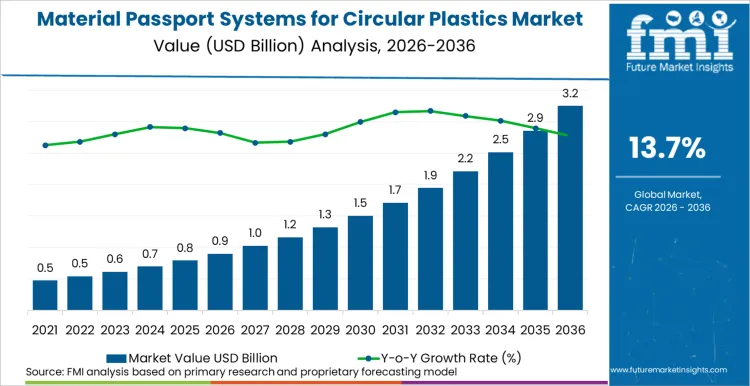
Summary of Material Passport Systems for Circular Plastics Market
What is the Long-Term Growth Outlook for the Material Passport Systems Market?
FMI projects the global market to expand from USD 900 million in 2026 to USD 3,260 million by 2036, registering a 13.7% CAGR. Market expansion reflects the critical role of passports in converting environmental claims into auditable, contract-bound data assets, essential for regulatory compliance, litigation defense, and accessing green financing.
FMI Research Approach: This projection is derived from FMI's proprietary forecasting model integrating regulatory enforcement timelines, PCR demand forecasts, analysis of ESG-linked loan criteria, and primary interviews with brand compliance officers and supply chain software providers.
How do FMI Analysts Expect the Market to Evolve Structurally?
FMI analysts anticipate a bifurcation into public compliance utilities and private value-chain optimization tools. The market will fragment into specialized platforms catering to high-volume/low-cost verification for packaging versus high-security/high-value traceability for technical polymers, with interoperability between these layers becoming a key purchasing criterion.
FMI Research Approach: Insights are informed by analysis of software partnership announcements, procurement requirements from multinational brand consortia, and the evolving architecture of regulatory data schemes like the EU DPP.
Which Geographies Command the Largest Growth Rates?
China leads with a projected 15.8% CAGR, driven by export compliance needs and domestic platform strategy. India follows at 16.0% CAGR, fueled by formalization of informal waste streams. The USA (13.4% CAGR) and Germany (13.0% CAGR) are high-value markets shaped by litigation risk and verification engineering, respectively.
FMI Research Approach: Country-level forecasts are built using analysis of trade law developments, local data sovereignty policies, and the investment patterns of national tech champions in traceability infrastructure.
What Will be the Market Size by 2036?
By 2036, the market is expected to reach USD 3,260 million. This growth will be supported by mandates making passports a condition of sale in key economies, the proliferation of advanced recycling requiring mass balance tracking, and the premium for cryptographically assured data over self-declared content.
FMI Research Approach: Long-term market sizing incorporates regulatory rollout calendars, adoption curves for chemcycling technologies, and pricing analysis for differentiated data-verification services.
What are some Globally Distinct Trends Shaping the Market?
Globally, the market is being shaped by the weaponization of data in anti-greenwashing litigation, the use of passports as tools for trade tariff mitigation (e.g., CBAM), and the integration of physical-digital markers like digital watermarks to bridge the physical recycling gap.
FMI Research Approach: Legal case tracking, international trade policy reviews, and technology roadmaps from cross-industry initiatives like HolyGrail 2.0 inform Trend analysis.
Material Passport Systems for Circular Plastics Market Key Takeaways
| Metrics | Values |
|---|---|
| Expected Value (2026E) | USD 900 million |
| Projected Value (2036F) | USD 3,260 million |
| CAGR (2026 to 2036) | 13.7% |
Source: Future Market Insights (FMI) analysis, based on proprietary forecasting model and primary research
Why is the Material Passport Systems Market Growing?
The crystallization of legal liability for false recycled content claims is a primary demand driver. A landmark 2025 class-action lawsuit in California against a major apparel brand for overstating PCR content established a legal precedent. This has forced brand legal departments to mandate systems providing forensic-grade evidence for all marketing claims, moving passports from a sustainability function to a risk mitigation necessity.
International trade is being reshaped by traceability requirements. The European Union’s Carbon Border Adjustment Mechanism (CBAM), expanded in scope in 2026 to include polymers, places a carbon cost on imported plastics. A verified material passport showing recycled content becomes a direct financial instrument to reduce CBAM liabilities at the border, creating a clear ROI for system implementation.
The rise of advanced recycling introduces new verification complexity that passports must solve. Mass balance accounting for chemically recycled feedstock is central to certification but remains opaque. Passport systems that can visually map and verify the mass balance chain, as piloted by a consortium of Nordic chemical companies in early 2026, are critical for maintaining trust and premium pricing in these new material flows.
How is the Material Passport Systems Market Segmented?
Primarily data granularity and the level of trust required for regulatory, commercial, and legal use cases segment the material passport systems market. Product- and batch-level passports account for about 48% of total market value, as they are the only formats capable of anchoring specific recycled content and sustainability claims directly to individual SKUs or production runs, enabling auditability and liability containment.
Supplier-linked and facility-level passports form a secondary layer, serving procurement transparency and B2B contract governance rather than consumer-facing disclosure. These systems are increasingly adopted in multi-supplier environments to verify process integrity and certification status without revealing proprietary formulations, reinforcing a value hierarchy where claim-level traceability commands a premium over operational visibility alone.
How is PCR Data Dominance Sustained as the Core Value Driver?
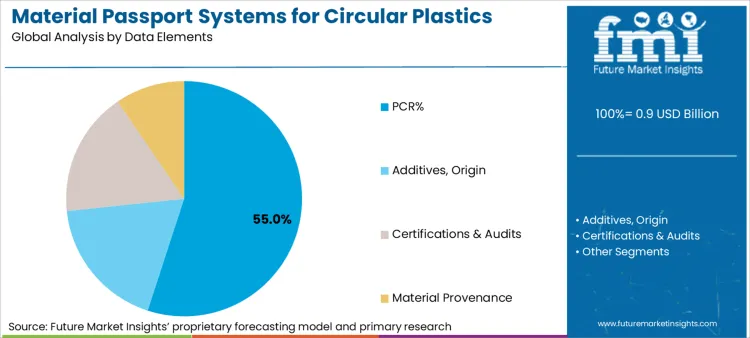
Data related to PCR content represents the single largest value pool in the market, accounting for approximately 55% of total data monetization, because it sits at the intersection of regulation, pricing power, and brand risk. PCR percentage is not merely a sustainability metric; it directly influences compliance with mandatory recycled content laws, eligibility for fiscal incentives or tax credits, and the ability to justify premium pricing to brand owners and retailers. Inaccurate or unverifiable PCR claims expose companies to penalties, product withdrawals, and reputational damage, elevating this data point above all others in commercial importance.
Competitive differentiation among passport platforms increasingly depends on how PCR data is verified, secured, and selectively disclosed. Leading systems are designed to cryptographically validate PCR percentages across multiple processing stages while preventing counterparties from reverse-engineering supplier recipes, yield losses, or proprietary recycling processes. Platforms that can reconcile mass-balance accounting, third-party certification inputs, and transaction-level data into a single, audit-ready PCR figure are capturing disproportionate share, as customers are willing to pay a premium for solutions that reduce both regulatory exposure and commercial friction.
Which Factors Are Preserving the Dominance of Packaging and Electronics Applications?
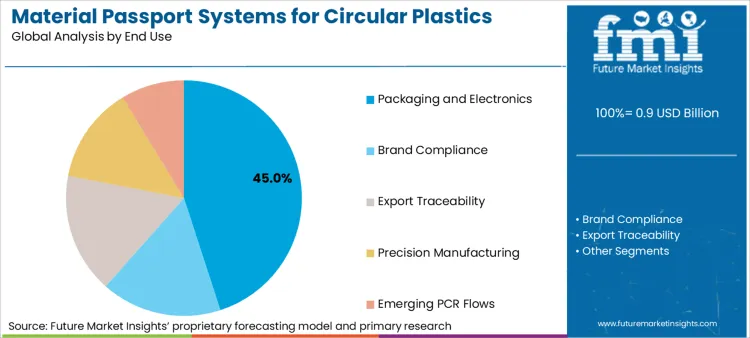
Packaging and electronics together account for around 45% of total market demand, reflecting their position as the most regulated, visible, and operationally complex end-use sectors for material passports. In packaging, escalating restrictions on recyclability claims, recycled content thresholds, and extended producer responsibility obligations are forcing converters and brand owners to adopt passport systems at scale. These buyers prioritize low-cost, high-throughput solutions capable of handling millions of units while still producing defensible, regulator-ready datasets.
Electronics is driving demand for deeply integrated, high-granularity passport architectures. OEMs in this sector require material passports that connect polymer data with parts serialization, warranty management, repair documentation, and take-back programs. This has elevated requirements for interoperability between passport platforms and existing product lifecycle management systems.
What Role does DPP Compliance Play in Defining Platform Leadership?
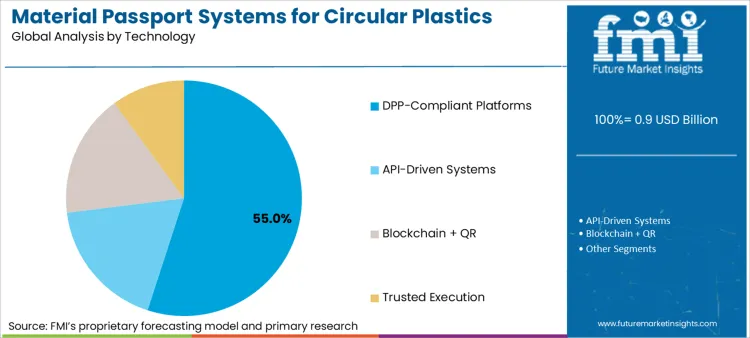
Alignment with the EU’s Digital Product Passport framework has emerged as the single most important determinant of platform leadership, with DPP-aligned solutions accounting for an estimated 55% of market share. Although originally conceived as a regional regulatory instrument, the DPP specification is rapidly becoming a global technical reference point, as multinational brands and suppliers seek systems that can be deployed consistently across jurisdictions. The emphasis on open, interoperable data schemas has fundamentally altered competitive dynamics, favoring platforms that invest early in standards alignment and ecosystem compatibility.
This shift is accelerating consolidation within the market. Proprietary, closed-loop passport systems, particularly those designed for single enterprises or vertically integrated supply chains, are marginalized if they cannot exchange data with regulators, certification bodies, or downstream partners. In contrast, platforms that treat DPP compliance as a foundational architecture rather than a bolt-on feature are positioning themselves as long-term infrastructure providers. As regulatory scope expands beyond Europe, this standards-led segmentation is likely to intensify, further concentrating value among a smaller group of globally interoperable platforms.
What Drivers, Restraints, Opportunities, and Trends Prevail in the Market?
Market expansion is supported by the monetization of recycled content via green premiums. In supply agreements for 2026-27, price differentials for certified, passport-tracked PCR are contractually stipulated, often 15-30% above non-verified PCR, creating a direct funding mechanism for passport adoption.
While demand is robust, a critical barrier is the lack of standardized, machine-readable data from the fragmented waste collection and sorting sector. The cost of retrofitting this upstream link with digital data capture is slowing system-wide rollouts and creating data gaps that undermine downstream passport integrity.
Technical innovation is defined by the convergence of physical and digital tracking via smart markers. Incorporating digital watermarks or DNA tracers into plastics provides a physical anchor point for the digital passport, closing the verification loop and enabling high-precision automated sorting, a trend championed by the HolyGrail 2.0 initiative.
The emergence of ‘passport-as-a-service’ for SMEs represents a disruptive opportunity. Large platform providers are launching simplified, low-monthly-fee offerings that allow smaller brands to generate and manage DPPs without major IT integration, tapping into a long-tail market driven by B2B customer mandates.
Analysis of Material Passport Systems Market by Key Countries
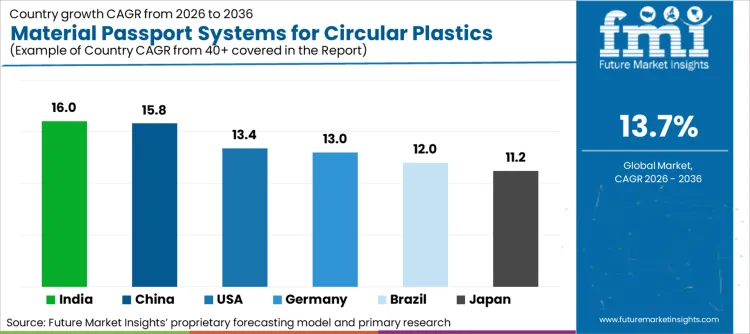
| Country | CAGR (2026–2036) |
|---|---|
| China | 15.8% |
| USA | 13.4% |
| Germany | 13.0% |
| Japan | 11.2% |
| India | 16.0% |
| Brazil | 12.0% |
Source: FMI analysis based on primary research and proprietary forecasting model
How Is Export Credentialing Reshaping China’s Material Passport Ecosystem?
China’s material passport systems market is expanding at a 15.8% CAGR between 2026 and 2036, primarily driven by external trade requirements rather than domestic sustainability signaling. For Chinese polymer producers and recyclers, digital material passports function as export-enabling infrastructure-a prerequisite to maintain uninterrupted access to North American and European buyers operating under tightening recycled content verification and traceability rules. As Western importers increasingly demand auditable proof of polymer origin, processing history, and additive disclosure, Chinese suppliers are embedding passport systems directly into export documentation workflows rather than treating them as standalone ESG tools.
A distinctive feature of the Chinese market is the emergence of state-aligned digital infrastructure players such as AntChain, which are positioning passport platforms as full-stack trade utilities. These systems integrate blockchain verification, customs documentation, and lifecycle tracking across borders, allowing Chinese exporters to present a single, verifiable data layer from feedstock sourcing to downstream recycling claims. This approach challenges Western software vendors by reframing material passports not as compliance software, but as sovereign-scale digital trade infrastructure.
Which Litigation and Regulatory Dynamics Are Accelerating Adoption in the United States?
A uniquely adversarial regulatory environment shapes USA, growing at a 13.4% CAGR, where legal exposure, rather than centralized policy, drives adoption. State-level legislation such as California’s SB 343 and similar statutes emerging across New York and other states have created a fragmented but high-risk compliance landscape. In response, brand owners and packaging producers are deploying material passport systems as defensive tools, designed to demonstrate due diligence, substantiate recyclability claims, and reduce the risk of class-action litigation tied to misleading environmental disclosures.
This has resulted in a bifurcated technology ecosystem. Large multinational corporations favor API-driven passport architectures that integrate directly with ERP, LCA, and supplier compliance systems, enabling real-time audit readiness. Mid-market converters and recyclers, by contrast, are gravitating toward lighter, blockchain technology-based solutions that provide immutable transaction records without heavy IT investment. The US market is therefore less about standardization and more about legal resilience, with passports increasingly treated as evidentiary assets rather than sustainability credentials.
What Role does Verification Infrastructure Engineering Play in Germany’s Market Leadership?
Germany’s material passport systems market is expanding at a 13.0% CAGR, with growth rooted not in headline adoption rates but in its central role as the architect of verification credibility. German stakeholders are concentrating on the institutional backbone that determines whether passport data is legally defensible and commercially trusted. Industry consortia involving TÜV, DIN, and leading chemical producers are jointly developing audit protocols, certification schemas, and laboratory correlation standards that connect digital records to physical material testing.
As a result, Germany is emerging as the reference market for “system trust”-where material passports are only considered valid if they align with accredited testing methods, recognized conformity assessments, and harmonized documentation practices. This positioning gives German-developed frameworks outsized influence across the EU, as other markets increasingly adopt German verification logic to ensure that passport data can withstand regulatory scrutiny and cross-border disputes.
How are Keiretsu Networks Driving Secure, Closed-Loop Passport Development in Japan?
Japan’s market, growing at an 11.2% CAGR, reflects a fundamentally different adoption logic centered on industrial confidentiality and material performance assurance. Material passports in Japan are primarily deployed within tightly integrated keiretsu networks spanning automotive, electronics, and high-performance engineering plastics. Here, passports are not designed to support consumer-facing sustainability claims, but to guarantee consistent quality, recycling yields, and material integrity within closed-loop production systems.
Consequently, Japanese platforms emphasize permissioned data environments, granular access controls, and secure inter-company data exchange. Passport systems are engineered to protect proprietary recycling formulations, compounding recipes, and performance data while still enabling traceability across multiple lifecycle loops. This B2B-centric approach limits interoperability with open, global platforms but delivers high adoption within domestic industrial ecosystems where trust, long-term supplier relationships, and IP protection are paramount.
How is India Using Material Passports to Formalize Informal Plastic Supply Chains?
India stands out with the highest CAGR at 16.0%, driven by the strategic use of material passports as instruments of supply-chain formalization rather than downstream compliance. A significant share of India’s plastic waste collection and sorting still occurs in informal networks that lack documentation, standardization, and financial traceability. Passport platforms are being deployed to digitally bridge this gap by enabling waste pickers and aggregators to log material flows using low-cost smartphone interfaces and minimal data inputs.
This approach is transforming undocumented waste streams into auditable feedstock pools that can be accessed by formal recyclers, brand owners, and financial institutions. By converting informal activity into verifiable data, passports are unlocking investment, contract manufacturing relationships, and EPR participation that were previously inaccessible. In India, therefore, material passports function as economic inclusion tools, reshaping the structure of the recycling market rather than merely optimizing existing supply chains.
Which Regional Trade Hub Dynamics Are Influencing Brazil’s Market Development?
Brazil’s material passport systems market is expanding at a 12.0% CAGR closely aligned with its role as a regional plastics manufacturing and compounding hub for Latin America. Adoption is being driven by the need to guarantee the origin, composition, and regulatory compliance of both virgin and recycled polymers circulating within Mercosur trade flows. Large resin producers and compounders are using passport systems to standardize quality assurance across borders, reducing disputes related to recycled content claims and material performance variability.
Unlike markets driven by consumer regulation or litigation risk, Brazil’s passport adoption is anchored in trade efficiency and industrial credibility. Robust digital traceability systems are increasingly viewed as prerequisites for regional supply contracts, enabling Brazilian suppliers to differentiate themselves as reliable, compliant partners in a market where regulatory harmonization remains uneven. As a result, passports are embedded in commercial negotiation and cross-border procurement rather than positioned solely as sustainability infrastructure.
What is the Competition Outlook for Material Passport Systems?
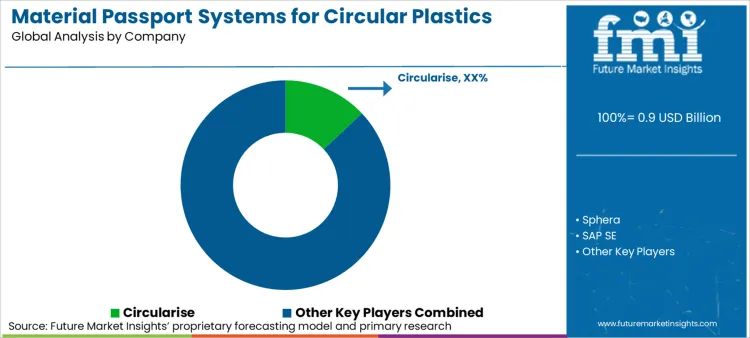
Competitive intensity is rising because material passports are becoming a trusted data layer that connects product composition, compliance attributes, and chain-of-custody evidence across multi-tier supply chains. The competitive set is broadly separating into enterprise infrastructure ecosystems where passports plug into ERP/supply-chain and sustainability data flows and specialist traceability providers focused on verifiable circularity data exchange and Digital Product Passport readiness. For example, Circularise explicitly positions its platform for DPPs and mass-balance/traceability data collection, including integration into enterprise system landscapes via API.
A clear strategic direction is verticalization, vendors and consortia are converging on sector- and material-specific implementations, where data models, roles, and exchange rules are pre-defined to reduce deployment complexity. This is visible in EU-backed pilot work such as CIRPASS-2, which is explicitly designed to demonstrate DPPs in real settings across multiple value chains and emphasizes interoperability, an enabling condition for scalable material passport systems.
Another competitive axis is verification and auditability at lower cost. The winners will be those who can operationalize reliable, machine-verifiable evidence trails such as linking passport records to business transactions and physical identifiers without making participation too expensive for high-volume packaging streams.
Recent Developments:
- In May 2024, S1SEVEN announced its Digital Material Passport is available on the SAP Store, and states that it integrates with SAP S/4HANA to digitize and streamline material/batch documentation flows, an example of enterprise infrastructure enablement for passport-style data.
- In March 2025, Circularise announced it joined an expert group in the CIRPASS-2 project to help shape future DPP legislation/implementation, reinforcing the role of specialist traceability providers in emerging passport frameworks.
- In June 2025, Avery Dennison announced an APR Design® for Recyclability-recognized RFID label compatible with North America’s PET recycling stream supporting the pathway where packaging identifiers can connect items to digital records for sorting/recycling and supply-chain visibility.
Key Players Profiled
- Circularise
- Sphera
- SAP SE
- IBM Corporation
- Ant Group (AntChain)
- VeChain
- NEC Corporation
- Avery Dennison
- Siemens AG (MindSphere)
- Oracle Corporation
Market Definition
The material passport systems for circular plastics market comprises revenue generated from software platforms, services, and related infrastructure used to create, host, verify, and manage digital records containing specified data on the composition, origin, and lifecycle of plastic materials and products. These systems provide a secure, tamper-evident chain of custody to validate claims regarding recycled content, chemical additives, carbon footprint, and recyclability. The market includes revenue from software licensing, cloud subscriptions, implementation, integration, and verification services for systems used across the plastics value chain.
The market scope covers dedicated passport platforms and integrated modules within broader ERP or supply chain management software. It excludes generic product information management (PIM) systems, basic QR code generators, and standalone life cycle assessment (LCA) tools unless they are explicitly designed and sold to generate compliant material passports for circular plastics.
Scope of Report
| Items | Values |
|---|---|
| Quantitative Units | USD 900 million |
| Passport Scope | Product & Batch Passports, Supplier-Linked Passports, Trade Passports, Secure Passports, Others |
| Data Elements | PCR %, Additives, Origin, Certifications & Audits, Material Provenance, Others |
| Technology | DPP-Compliant Platforms, API-Driven Systems, Blockchain + QR, Trusted Execution, Others |
| End Use | Packaging & Electronics, Brand Compliance, Export Traceability, Precision Manufacturing, Emerging PCR Flows, Others |
| Regions Covered | North America, Western Europe, Eastern Europe, East Asia, South Asia & Pacific, Latin America, Middle East & Africa |
| Countries | China, USA, Germany, Japan, India, Brazil and 40+ countries |
| Key Companies | Circularise, Sphera, SAP SE, IBM Corporation, Ant Group, VeChain, NEC Corporation, Avery Dennison, Siemens AG, Oracle Corporation |
Source: Future Market Insights (FMI) analysis, based on proprietary forecasting model and primary research
Material Passport Systems for Circular Plastics Market Key Segments
By Passport Scope:
- Product & Batch Passports
- Supplier-Linked Passports
- Trade Passports
- Secure Passports
- Others
By Data Elements:
- PCR%
- Additives, Origin
- Certifications & Audits
- Material Provenance
- Others
By Technology:
- DPP-Compliant Platforms
- API-Driven Systems
- Blockchain + QR
- Trusted Execution
- Others
By End Use:
- Packaging & Electronics
- Brand Compliance
- Export Traceability
- Precision Manufacturing
- Emerging PCR Flows
- Others
By Region:
- North America
- Western Europe
- Eastern Europe
- East Asia
- South Asia & Pacific
- Latin America
- Middle East & Africa
Bibliography
- International Sustainability and Carbon Certification (ISCC). (2026). Mass Balance and Chain of Custody Requirements for Circular Polymers (Version 3.0). ISCC System.
- DIN Deutsches Institut für Normung. (2025). DIN SPEC 91446: Digital Product Passport – Data Model and Exchange Requirements. Beuth Verlag.
- World Economic Forum. (2025). Traceability and Transparency for Circular Plastics: Data Infrastructure Requirements. World Economic Forum.
- International Chamber of Commerce (ICC). (2026). Digital Trade, Product Traceability, and Compliance Data in Cross-Border Goods. ICC Publishing.
- Japan Ministry of Economy, Trade and Industry (METI). (2025). Policy Framework for Product Traceability and Circular Manufacturing. Government of Japan.
- Confederation of Indian Industry (CII). (2025). Formalising Plastic Waste Value Chains Through Digital Traceability. CII Publications.
- Brazilian Plastics Industry Association (ABIPLAST). (2025). Traceability, Compliance, and Trade Integrity in Circular Plastics. ABIPLAST.
Frequently Asked Questions
How big is the material passport systems for circular plastics market in 2026?
The global material passport systems for circular plastics market is estimated to be valued at USD 0.9 billion in 2026.
What will be the size of material passport systems for circular plastics market in 2036?
The market size for the material passport systems for circular plastics market is projected to reach USD 3.2 billion by 2036.
How much will be the material passport systems for circular plastics market growth between 2026 and 2036?
The material passport systems for circular plastics market is expected to grow at a 13.7% CAGR between 2026 and 2036.
What are the key product types in the material passport systems for circular plastics market?
The key product types in material passport systems for circular plastics market are pcr%, additives, origin, certifications & audits and material provenance.
Which end use segment to contribute significant share in the material passport systems for circular plastics market in 2026?
In terms of end use, packaging and electronics segment to command 45.0% share in the material passport systems for circular plastics market in 2026.
Preview the report firsthand - request a free sample
Get SampleGet the brochure for pricing and purchase details.
Get PDFTable of Content
- Executive Summary
- Global Market Outlook
- Demand-side Trends
- Supply-side Trends
- Technology Roadmap Analysis
- Analysis and Recommendations
- Market Overview
- Market Coverage / Taxonomy
- Market Definition / Scope / Limitations
- Research Methodology
- Chapter Orientation
- Analytical Lens and Working Hypotheses
- Market Structure, Signals, and Trend Drivers
- Benchmarking and Cross-market Comparability
- Market Sizing, Forecasting, and Opportunity Mapping
- Research Design and Evidence Framework
- Desk Research Programme (Secondary Evidence)
- Company Annual and Sustainability Reports
- Peer-reviewed Journals and Academic Literature
- Corporate Websites, Product Literature, and Technical Notes
- Earnings Decks and Investor Briefings
- Statutory Filings and Regulatory Disclosures
- Technical White Papers and Standards Notes
- Trade Journals, Industry Magazines, and Analyst Briefs
- Conference Proceedings, Webinars, and Seminar Materials
- Government Statistics Portals and Public Data Releases
- Press Releases and Reputable Media Coverage
- Specialist Newsletters and Curated Briefings
- Sector Databases and Reference Repositories
- FMI Internal Proprietary Databases and Historical Market Datasets
- Subscription Datasets and Paid Sources
- Social Channels, Communities, and Digital Listening Inputs
- Additional Desk Sources
- Expert Input and Fieldwork (Primary Evidence)
- Primary Modes
- Qualitative Interviews and Expert Elicitation
- Quantitative Surveys and Structured Data Capture
- Blended Approach
- Why Primary Evidence is Used
- Field Techniques
- Interviews
- Surveys
- Focus Groups
- Observational and In-context Research
- Social and Community Interactions
- Stakeholder Universe Engaged
- C-suite Leaders
- Board Members
- Presidents and Vice Presidents
- R&D and Innovation Heads
- Technical Specialists
- Domain Subject-matter Experts
- Scientists
- Physicians and Other Healthcare Professionals
- Governance, Ethics, and Data Stewardship
- Research Ethics
- Data Integrity and Handling
- Primary Modes
- Tooling, Models, and Reference Databases
- Desk Research Programme (Secondary Evidence)
- Data Engineering and Model Build
- Data Acquisition and Ingestion
- Cleaning, Normalisation, and Verification
- Synthesis, Triangulation, and Analysis
- Quality Assurance and Audit Trail
- Market Background
- Market Dynamics
- Drivers
- Restraints
- Opportunity
- Trends
- Scenario Forecast
- Demand in Optimistic Scenario
- Demand in Likely Scenario
- Demand in Conservative Scenario
- Opportunity Map Analysis
- Product Life Cycle Analysis
- Supply Chain Analysis
- Investment Feasibility Matrix
- Value Chain Analysis
- PESTLE and Porter’s Analysis
- Regulatory Landscape
- Regional Parent Market Outlook
- Production and Consumption Statistics
- Import and Export Statistics
- Market Dynamics
- Global Market Analysis 2021 to 2025 and Forecast, 2026 to 2036
- Historical Market Size Value (USD Million) Analysis, 2021 to 2025
- Current and Future Market Size Value (USD Million) Projections, 2026 to 2036
- Y-o-Y Growth Trend Analysis
- Absolute $ Opportunity Analysis
- Global Market Pricing Analysis 2021 to 2025 and Forecast 2026 to 2036
- Global Market Analysis 2021 to 2025 and Forecast 2026 to 2036, By Data Elements
- Introduction / Key Findings
- Historical Market Size Value (USD Million) Analysis By Data Elements , 2021 to 2025
- Current and Future Market Size Value (USD Million) Analysis and Forecast By Data Elements , 2026 to 2036
- PCR%
- Additives, Origin
- Certifications & Audits
- Material Provenance
- PCR%
- Y-o-Y Growth Trend Analysis By Data Elements , 2021 to 2025
- Absolute $ Opportunity Analysis By Data Elements , 2026 to 2036
- Global Market Analysis 2021 to 2025 and Forecast 2026 to 2036, By End Use
- Introduction / Key Findings
- Historical Market Size Value (USD Million) Analysis By End Use, 2021 to 2025
- Current and Future Market Size Value (USD Million) Analysis and Forecast By End Use, 2026 to 2036
- Packaging and Electronics
- Brand Compliance
- Export Traceability
- Precision Manufacturing
- Emerging PCR Flows
- Packaging and Electronics
- Y-o-Y Growth Trend Analysis By End Use, 2021 to 2025
- Absolute $ Opportunity Analysis By End Use, 2026 to 2036
- Global Market Analysis 2021 to 2025 and Forecast 2026 to 2036, By Technology
- Introduction / Key Findings
- Historical Market Size Value (USD Million) Analysis By Technology, 2021 to 2025
- Current and Future Market Size Value (USD Million) Analysis and Forecast By Technology, 2026 to 2036
- DPP-Compliant Platforms
- API-Driven Systems
- Blockchain + QR
- Trusted Execution
- DPP-Compliant Platforms
- Y-o-Y Growth Trend Analysis By Technology, 2021 to 2025
- Absolute $ Opportunity Analysis By Technology, 2026 to 2036
- Global Market Analysis 2021 to 2025 and Forecast 2026 to 2036, By Region
- Introduction
- Historical Market Size Value (USD Million) Analysis By Region, 2021 to 2025
- Current Market Size Value (USD Million) Analysis and Forecast By Region, 2026 to 2036
- North America
- Latin America
- Western Europe
- Eastern Europe
- East Asia
- South Asia and Pacific
- Middle East & Africa
- Market Attractiveness Analysis By Region
- North America Market Analysis 2021 to 2025 and Forecast 2026 to 2036, By Country
- Historical Market Size Value (USD Million) Trend Analysis By Market Taxonomy, 2021 to 2025
- Market Size Value (USD Million) Forecast By Market Taxonomy, 2026 to 2036
- By Country
- USA
- Canada
- Mexico
- By Data Elements
- By End Use
- By Technology
- By Country
- Market Attractiveness Analysis
- By Country
- By Data Elements
- By End Use
- By Technology
- Key Takeaways
- Latin America Market Analysis 2021 to 2025 and Forecast 2026 to 2036, By Country
- Historical Market Size Value (USD Million) Trend Analysis By Market Taxonomy, 2021 to 2025
- Market Size Value (USD Million) Forecast By Market Taxonomy, 2026 to 2036
- By Country
- Brazil
- Chile
- Rest of Latin America
- By Data Elements
- By End Use
- By Technology
- By Country
- Market Attractiveness Analysis
- By Country
- By Data Elements
- By End Use
- By Technology
- Key Takeaways
- Western Europe Market Analysis 2021 to 2025 and Forecast 2026 to 2036, By Country
- Historical Market Size Value (USD Million) Trend Analysis By Market Taxonomy, 2021 to 2025
- Market Size Value (USD Million) Forecast By Market Taxonomy, 2026 to 2036
- By Country
- Germany
- UK
- Italy
- Spain
- France
- Nordic
- BENELUX
- Rest of Western Europe
- By Data Elements
- By End Use
- By Technology
- By Country
- Market Attractiveness Analysis
- By Country
- By Data Elements
- By End Use
- By Technology
- Key Takeaways
- Eastern Europe Market Analysis 2021 to 2025 and Forecast 2026 to 2036, By Country
- Historical Market Size Value (USD Million) Trend Analysis By Market Taxonomy, 2021 to 2025
- Market Size Value (USD Million) Forecast By Market Taxonomy, 2026 to 2036
- By Country
- Russia
- Poland
- Hungary
- Balkan & Baltic
- Rest of Eastern Europe
- By Data Elements
- By End Use
- By Technology
- By Country
- Market Attractiveness Analysis
- By Country
- By Data Elements
- By End Use
- By Technology
- Key Takeaways
- East Asia Market Analysis 2021 to 2025 and Forecast 2026 to 2036, By Country
- Historical Market Size Value (USD Million) Trend Analysis By Market Taxonomy, 2021 to 2025
- Market Size Value (USD Million) Forecast By Market Taxonomy, 2026 to 2036
- By Country
- China
- Japan
- South Korea
- By Data Elements
- By End Use
- By Technology
- By Country
- Market Attractiveness Analysis
- By Country
- By Data Elements
- By End Use
- By Technology
- Key Takeaways
- South Asia and Pacific Market Analysis 2021 to 2025 and Forecast 2026 to 2036, By Country
- Historical Market Size Value (USD Million) Trend Analysis By Market Taxonomy, 2021 to 2025
- Market Size Value (USD Million) Forecast By Market Taxonomy, 2026 to 2036
- By Country
- India
- ASEAN
- Australia & New Zealand
- Rest of South Asia and Pacific
- By Data Elements
- By End Use
- By Technology
- By Country
- Market Attractiveness Analysis
- By Country
- By Data Elements
- By End Use
- By Technology
- Key Takeaways
- Middle East & Africa Market Analysis 2021 to 2025 and Forecast 2026 to 2036, By Country
- Historical Market Size Value (USD Million) Trend Analysis By Market Taxonomy, 2021 to 2025
- Market Size Value (USD Million) Forecast By Market Taxonomy, 2026 to 2036
- By Country
- Kingdom of Saudi Arabia
- Other GCC Countries
- Turkiye
- South Africa
- Other African Union
- Rest of Middle East & Africa
- By Data Elements
- By End Use
- By Technology
- By Country
- Market Attractiveness Analysis
- By Country
- By Data Elements
- By End Use
- By Technology
- Key Takeaways
- Key Countries Market Analysis
- USA
- Pricing Analysis
- Market Share Analysis, 2025
- By Data Elements
- By End Use
- By Technology
- Canada
- Pricing Analysis
- Market Share Analysis, 2025
- By Data Elements
- By End Use
- By Technology
- Mexico
- Pricing Analysis
- Market Share Analysis, 2025
- By Data Elements
- By End Use
- By Technology
- Brazil
- Pricing Analysis
- Market Share Analysis, 2025
- By Data Elements
- By End Use
- By Technology
- Chile
- Pricing Analysis
- Market Share Analysis, 2025
- By Data Elements
- By End Use
- By Technology
- Germany
- Pricing Analysis
- Market Share Analysis, 2025
- By Data Elements
- By End Use
- By Technology
- UK
- Pricing Analysis
- Market Share Analysis, 2025
- By Data Elements
- By End Use
- By Technology
- Italy
- Pricing Analysis
- Market Share Analysis, 2025
- By Data Elements
- By End Use
- By Technology
- Spain
- Pricing Analysis
- Market Share Analysis, 2025
- By Data Elements
- By End Use
- By Technology
- France
- Pricing Analysis
- Market Share Analysis, 2025
- By Data Elements
- By End Use
- By Technology
- India
- Pricing Analysis
- Market Share Analysis, 2025
- By Data Elements
- By End Use
- By Technology
- ASEAN
- Pricing Analysis
- Market Share Analysis, 2025
- By Data Elements
- By End Use
- By Technology
- Australia & New Zealand
- Pricing Analysis
- Market Share Analysis, 2025
- By Data Elements
- By End Use
- By Technology
- China
- Pricing Analysis
- Market Share Analysis, 2025
- By Data Elements
- By End Use
- By Technology
- Japan
- Pricing Analysis
- Market Share Analysis, 2025
- By Data Elements
- By End Use
- By Technology
- South Korea
- Pricing Analysis
- Market Share Analysis, 2025
- By Data Elements
- By End Use
- By Technology
- Russia
- Pricing Analysis
- Market Share Analysis, 2025
- By Data Elements
- By End Use
- By Technology
- Poland
- Pricing Analysis
- Market Share Analysis, 2025
- By Data Elements
- By End Use
- By Technology
- Hungary
- Pricing Analysis
- Market Share Analysis, 2025
- By Data Elements
- By End Use
- By Technology
- Kingdom of Saudi Arabia
- Pricing Analysis
- Market Share Analysis, 2025
- By Data Elements
- By End Use
- By Technology
- Turkiye
- Pricing Analysis
- Market Share Analysis, 2025
- By Data Elements
- By End Use
- By Technology
- South Africa
- Pricing Analysis
- Market Share Analysis, 2025
- By Data Elements
- By End Use
- By Technology
- USA
- Market Structure Analysis
- Competition Dashboard
- Competition Benchmarking
- Market Share Analysis of Top Players
- By Regional
- By Data Elements
- By End Use
- By Technology
- Competition Analysis
- Competition Deep Dive
- Circularise
- Overview
- Product Portfolio
- Profitability by Market Segments (Product/Age /Sales Channel/Region)
- Sales Footprint
- Strategy Overview
- Marketing Strategy
- Product Strategy
- Channel Strategy
- Sphera
- SAP SE
- IBM Corporation
- Ant Group (AntChain)
- VeChain
- NEC Corporation
- Circularise
- Competition Deep Dive
- Assumptions & Acronyms Used


