

- Industry Size (2026)
- USD 353.37 Mn
- Forecast (2036)
- USD 621.00 Mn
- CAGR (2026 to 2036)
- 5.8%
Material Rack Correction Machine Market Size, Market Forecast and Outlook By FMI
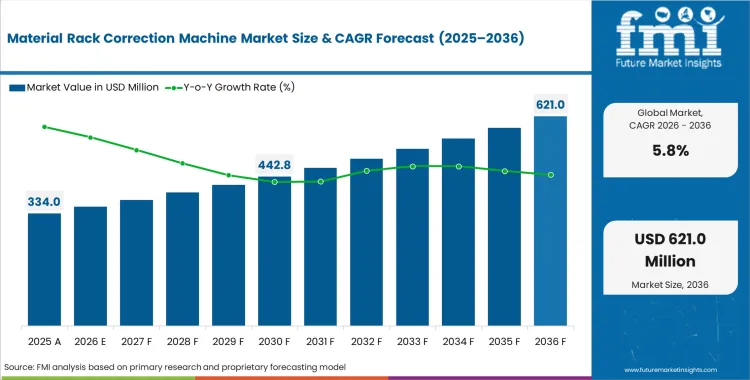
The material rack correction machine market was valued at USD 334.00 million in 2025, projected to reach USD 353.37 million in 2026, and is forecast to expand to USD 621.00 million by 2036 at a 5.8% CAGR. Expanding precision manufacturing requirements in metal processing, automotive stamping, and electronics component fabrication are sustaining procurement cycles for material rack correction equipment. Production engineers operating sheet metal forming lines treat rack correction machines as mandatory upstream quality equipment that prevents downstream dimensional defects in stamped, bent, and pressed components.
Summary of Material Rack Correction Machine Market
- The market is forecast to reach USD 621.00 million by 2036.
- The market is expected to grow at a CAGR of 5.8% from 2026 to 2036.
- The market was estimated at USD 334.00 million in 2025.
- The forecast period represents an incremental opportunity of USD 267.62 million.
- The market is projected to reach USD 353.37 million in 2026, indicating steady growth.
- Growth is driven by increasing precision manufacturing requirements in metal processing, automotive stamping, and electronics component fabrication.
- Rising need for flatness correction in sheet metal forming is sustaining demand for rack correction machines.
- Transition from manual to hydraulic and servo-driven machines is accelerating due to higher production speeds and tighter tolerances.
- Hand-crank expansion machines dominate by type with a 40.0% share in 2026 due to lower capital cost.
- Metal processing leads the application segment with a 35.0% share, driven by sheet preparation requirements.
- China and India are the fastest-growing markets, supported by expanding manufacturing and automotive production capacity.
- Key companies in the market include Mahlo GmbH + Co. KG, Ideal Machine, GESCO-Group, Shung Dar, Shanghai Wansheng Machinery Automation, Lihao Machine, Qingdao Yituo Machinery Equipment, Hebei Zhijie Machinery Manufacturing, and Kunshan Longgengkai Mechanical Equipment.
Material Rack Correction Machine Market Key Takeaways
| Metric | Details |
|---|---|
| Industry Size (2026) | USD 353.37 million |
| Industry Value (2036) | USD 621.00 million |
| CAGR (2026-2036) | 5.8% |
Source: Future Market Insights, 2026
Hand-crank expansion mechanisms retain the lead position at 40.0% share in 2026 due to their lower capital cost and operational simplicity for small-to-medium batch production environments. Metal processing accounts for 35.0% of application demand, driven by flat sheet and coil stock preparation requirements in stamping, laser cutting, and forming operations. As per FMI, the transition toward hydraulic and servo-driven correction machines is accelerating as automotive tier-1 suppliers and electronics manufacturers demand tighter flatness tolerances that manual correction cannot consistently achieve at production line speeds. Facilities operating legacy hand-crank equipment face increasing rejection rates as downstream forming tolerances tighten across automotive body-in-white and electronics enclosure applications.
All key markets reflect differentiated growth trajectories. China advances at 7.8% driven by expanding metal processing and automotive stamping capacity. India advances at 7.3% fueled by automotive tier-supplier manufacturing expansion and metalworking sector growth. Germany advances at 6.7% supported by precision manufacturing equipment replacement and automotive tooling modernization. Brazil advances at 6.1% sustained by automotive manufacturing investment and general metalworking expansion. USA advances at 5.5% maintained by automotive and aerospace sheet metal processing demand. UK advances at 4.9% anchored by precision manufacturing and defense sector metal forming requirements. Japan advances at 4.4% supported by electronics and automotive precision component manufacturing.
Material Rack Correction Machine Market Definition
Material Rack Correction Machine represents precision industrial equipment designed to correct flatness deviations, residual stresses, and dimensional inconsistencies in sheet metal and coil stock before downstream forming, stamping, and fabrication operations. The market encompasses hand-crank expansion, hydraulic expansion, and servo-driven correction machines deployed in metal processing, automotive manufacturing, electronics fabrication, and general precision manufacturing environments.
Material Rack Correction Machine Market Inclusions
Market scope includes hand-crank, hydraulic, and servo-driven material rack correction machines for sheet metal and coil stock conditioning. Global and regional market sizes, forecast period 2026 to 2036, and segment breakdowns by Expansion Mechanism and Application are fully covered.
Material Rack Correction Machine Market Exclusions
The scope excludes standalone sheet metal leveling machines, decoiling and recoiling equipment, and general-purpose hydraulic presses not designed for material correction. Roller straightening lines integrated into steel mill finishing sections are omitted from the valuation.
Material Rack Correction Machine Market Research Methodology
Primary Research
Analysts engaged with procurement managers, technical specification leads, and operations directors across key end-use segments to map the decision gates triggering equipment and service upgrades.
Desk Research
Data collection phases aggregated regulatory compliance timelines, standards body publication schedules, industry association technical reports, and publicly filed corporate disclosures.
Market-Sizing and Forecasting
Baseline values derive from a bottom-up aggregation of product shipment volumes, service contract values, and consumption data, applying region-specific adoption curves to project future demand velocity.
Data Validation and Update Cycle
Projections are tested against publicly reported expenditure guidance from leading industry participants and validated through cross-referencing with regulatory filing data and trade association statistics.
Why is the Material Rack Correction Machine Market Growing?
Market expansion is being supported by the increasing global focus on manufacturing efficiency and the corresponding need for precision material handling equipment that can ensure proper material alignment, reduce waste, and maintain consistent production quality across various metal processing and manufacturing applications. Modern manufacturing facilities and production managers are increasingly focused on implementing automation solutions that can eliminate material misalignment, improve production throughput, and provide consistent quality control in demanding manufacturing environments. Material rack correction machines' proven ability to deliver precise material positioning, reduce production waste, and enhance manufacturing efficiency makes them essential equipment for contemporary production operations and quality management.
The growing focus on automated manufacturing and production optimization is driving demand for material rack correction machines that can support continuous production, ensure material quality, and enable comprehensive process control. Manufacturing operators' preference for equipment that combines automation with precision control and maintenance efficiency is creating opportunities for innovative material rack correction machine implementations. The rising influence of Industry 4.0 and smart manufacturing is also contributing to increased adoption of material rack correction machines that can provide intelligent correction capabilities without compromising production speed or operational efficiency.
Segmental Analysis
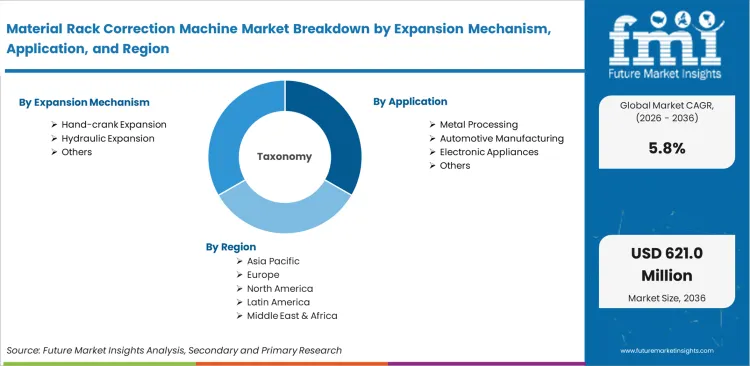
The market is segmented by expansion mechanism, application, and region. By expansion mechanism, the market is divided into hand-crank expansion, hydraulic expansion, and others. Based on application, the market is categorized into metal processing, automotive manufacturing, electronic appliances, and others. Regionally, the market is divided into Asia Pacific, North America, Europe, Latin America, and the Middle East & Africa.
By the Expansion Mechanism, the Hand-crank Expansion Segment Leads the Market with 40% Share
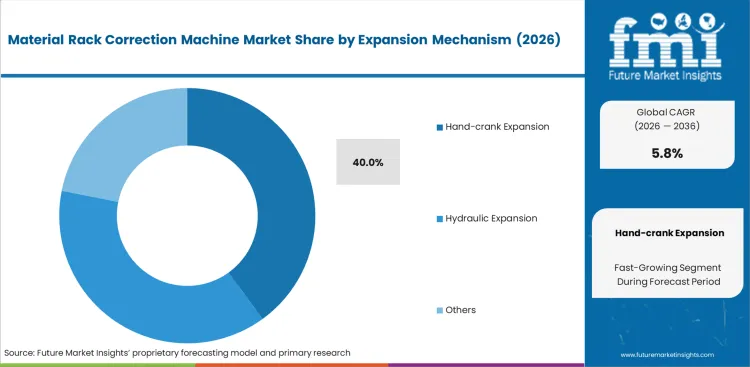
The hand-crank expansion segment is projected to maintain its leading position in the material rack correction machine market in 2026, capturing 40% of the market share. Manufacturing operators and equipment technicians increasingly prefer hand-crank expansion systems for their precise control capabilities, reliable operation, and versatility across various material correction requirements. Hand-crank technology’s proven reliability and ability to provide manual control directly address the manufacturing need for accurate material positioning and adjustment in diverse production environments. This actuation system forms the foundation of modern material correction operations, offering the highest control precision across multiple manufacturing processes and material handling applications. With material correction requiring precise control and operator intervention, hand-crank expansion systems remain central to comprehensive material handling strategies.
- Offers superior precision control for manual adjustments in material correction applications.
- Highly reliable and versatile across various production environments and material handling needs.
- Key component for operational effectiveness in manufacturing, enabling precise material positioning
By Application, the Metal Processing Segment Dominates Market Demand with 35% Share
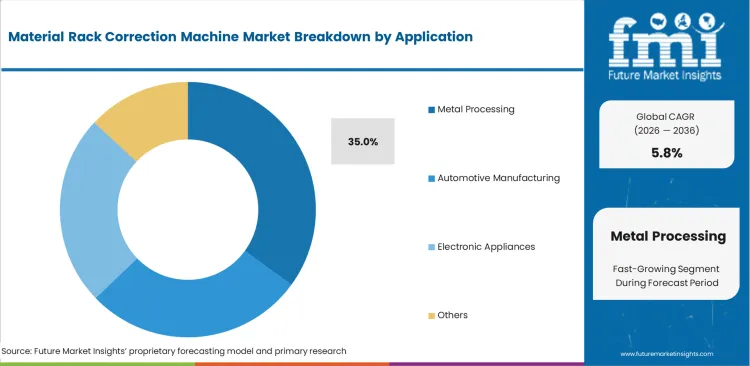
The metal processing application segment is projected to represent the largest share of material rack correction machine demand in 2026, accounting for 35% of the market. Metal processing facilities prefer material rack correction machines for their ability to meet the high precision material handling requirements, quality control needs, and consistent material alignment during production. These machines play a critical role in steel processing, sheet metal fabrication, and metal forming operations. They help ensure continuous production, reduce waste, and support operational efficiency. As metal processing technologies evolve, the need for specialized correction systems with enhanced automation and quality control grows. Investments in comprehensive material handling programs further drive demand for these systems, making the metal processing segment a dominant force in the market as the industry continues to push for higher precision and production optimization.
- Critical for precise material alignment and quality control in metal processing operations.
- Supports large-scale production requirements, enhancing efficiency and waste reduction.
- Dominates the market by providing advanced correction solutions to meet increasing precision demands.
What are the Drivers, Restraints, and Key Trends of the Material Rack Correction Machine Market?
The material rack correction machine market is advancing steadily due to increasing demand for manufacturing automation and growing adoption of precision material handling technologies that provide enhanced production efficiency and quality control across diverse manufacturing applications. The market faces challenges, including high equipment costs and installation complexity, technical requirements for system integration and operator training, and competition from alternative material handling solutions. Innovation in intelligent automation and IoT connectivity continues to influence product development and market expansion patterns.
Expansion of Intelligent Automation and IoT Integration
The growing adoption of intelligent automation systems and IoT connectivity is enabling manufacturers to achieve superior material handling precision, enhanced production monitoring, and comprehensive data collection for improved manufacturing processes. Intelligent automation systems provide improved operational efficiency while allowing more predictable material correction and consistent quality control across various production applications and manufacturing environments. Manufacturers are increasingly recognizing the competitive advantages of intelligent automation capabilities for operational differentiation and production optimization.
Integration of Advanced Servo Control and Precision Positioning Systems
Modern material rack correction machine manufacturers are incorporating advanced servo control technologies and precision positioning systems to enhance correction accuracy, enable automated adjustment protocols, and provide superior material handling through real-time feedback and control optimization. These technologies improve operational precision while enabling new applications, including adaptive correction and predictive material handling. Advanced control integration also allows manufacturers to support comprehensive production automation and quality optimization beyond traditional manual correction approaches.
Analysis of the Material Rack Correction Machine Market by Key Countries
.webp "Top Country Growth Comparison Material Rack Correction Machine Market Cagr (2026 2036)")
| Country | CAGR (2026-2036) |
|---|---|
| China | 7.8% |
| India | 7.3% |
| Germany | 6.7% |
| Brazil | 6.1% |
| USA | 5.5% |
| UK | 4.9% |
| Japan | 4.4% |
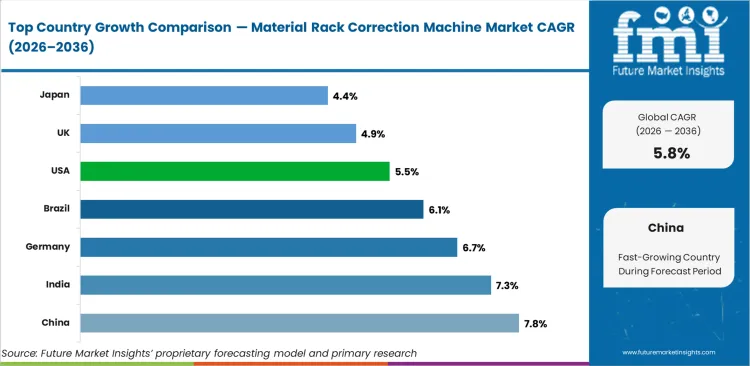
The material rack correction machine market is experiencing solid growth globally, with China leading at a 7.8% CAGR through 2036, driven by the expanding manufacturing sector, growing industrial automation adoption, and significant investment in production equipment modernization and material handling technology advancement. India follows at 7.3%, supported by rapid industrial development, increasing manufacturing capabilities, and growing adoption of automated material handling equipment in manufacturing facilities. Germany shows growth at 6.7%, emphasizing precision engineering and advanced manufacturing automation technologies. Brazil records 6.1%, focusing on industrial modernization and manufacturing equipment upgrade initiatives. The USA demonstrates 5.5% growth, supported by an established manufacturing infrastructure and a focus on production automation. The UK exhibits 4.9% growth, emphasizing manufacturing excellence and automation technology advancement. Japan shows 4.4% growth, supported by advanced manufacturing technologies and precision equipment development.
The report covers an in-depth analysis of 40+ countries; seven top-performing countries are highlighted below.
In-depth Analysis of Material Rack Correction Machine Market in China
The material rack correction machine market in China is projected to grow at a CAGR of 7.8% from 2026 to 2036. As the country continues to expand its manufacturing and industrial sectors, the demand for machinery that can ensure precise correction and alignment of material racks is increasing. The growth in the automotive, construction, and logistics industries is expected to drive this demand. China’s large-scale production facilities and continued investment in automation are key factors supporting the growth of this market. The country is also embracing new technologies, which further contribute to improved efficiency and accuracy in material handling. With the increasing focus on supply chain optimization and efficient warehouse management, material rack correction machines are poised to become indispensable in industrial operations across China.
- Expanding manufacturing sector driving demand for correction machinery
- Increased adoption of automation technology in warehouses and production lines
- Focus on efficient logistics and supply chain optimization boosting market growth
Sales Analysis of Material Rack Correction Machine Market in India
Demand for material rack correction machine in India is anticipated to grow at a CAGR of 7.3% from 2026 to 2036. As India's industrial base continues to expand, particularly in sectors like automotive, manufacturing, and logistics, the need for advanced material handling equipment is increasing. Material rack correction machines play a critical role in ensuring the correct alignment of materials, preventing damage during handling and storage. India’s growing infrastructure development and logistics networks also contribute to this rise. The demand for such machinery is further fueled by the country’s rapid adoption of automation in warehouses and factories. The ongoing shift towards modern industrial processes is expected to drive significant growth in this market.
- Expanding industrial and infrastructure sectors boosting demand for correction machines
- Automation adoption in warehouses and factories increasing machine demand
- Growth of logistics networks enhancing the need for efficient material handling solutions
Demand Outlook for Material Rack Correction Machine Market in Germany
The material rack correction machine market in Germany is set to grow at a CAGR of 6.7% from 2026 to 2036. As one of the leading manufacturing hubs in Europe, Germany continues to invest in state-of-the-art technology and industrial equipment to maintain its competitive edge. The demand for material rack correction machines is driven by the need for high precision and efficiency in the automotive, manufacturing, and logistics sectors. With stringent regulations and a growing focus on operational efficiency, German industries are increasingly adopting advanced solutions to ensure better handling of materials in production and distribution processes. Germany’s focus on Industry 4.0 and smart manufacturing technologies will further propel the demand for automated and high-precision machinery in the market.
- Strong demand from automotive, manufacturing, and logistics sectors
- Germany’s Industry 4.0 adoption driving need for precision equipment
- Focus on operational efficiency and regulatory compliance boosting market growth
Opportunity Analysis of Material Rack Correction Machine Market in Brazil
Demand for material rack correction machine market is growing at a CAGR of 6.1% from 2026 to 2036. Brazil’s growing industrial activities, particularly in automotive and manufacturing, are contributing to the increasing demand for advanced material handling solutions. The expansion of infrastructure, including logistics and distribution networks, also creates opportunities for correction machinery that ensures precise alignment of material racks in large-scale operations. As Brazilian industries focus on enhancing productivity and reducing operational downtime, the market for efficient and automated material handling equipment is expected to witness steady growth. With increased foreign investments and the modernization of Brazil's industrial base, the market for material rack correction machines will continue to thrive.
- Industrial expansion in automotive and manufacturing sectors driving growth
- Expansion of logistics and infrastructure networks fueling demand
- Modernization of Brazil’s industrial base and increased investments promoting market opportunities
Demand Analysis for Material Rack Correction Machine Market in the USA
The material rack correction machine market in the USA is projected to grow at a CAGR of 5.5% from 2026 to 2036. The United States continues to lead in industrial innovation, with significant growth in sectors like automotive, aerospace, and logistics. As American industries focus on improving productivity and efficiency, material rack correction machines have become essential in ensuring smooth material handling and precise alignment in production processes. The rise of e-commerce and growing demand for warehousing solutions will also drive the demand for such machinery. The USA's investment in automation and robotics, particularly in distribution centers, will further support market growth.
- Demand driven by growth in automotive, aerospace, and logistics sectors
- Rise in e-commerce and warehousing solutions boosting the need for efficient material handling
- Increased investments in automation and robotics supporting market expansion
Opportunity Analysis of Material Rack Correction Machine Market in the UK
The material rack correction machine market in the UK is forecast to grow at a CAGR of 4.9% from 2026 to 2036. As the UK continues to modernize its manufacturing and industrial sectors, there is a growing need for advanced material handling and correction equipment. The demand for material rack correction machines is expected to rise with increased focus on production efficiency and automation. The UK's strong automotive, aerospace, and manufacturing industries will be key contributors to this growth. The focus on energy-efficient solutions in UK industries will further drive the adoption of these advanced machines, ensuring accurate and smooth material handling in warehouses and factories.
- Modernization of manufacturing and industrial sectors boosting demand
- Strong automotive, aerospace, and manufacturing industries supporting market growth
- Focus on energy efficiency and automation driving the need for advanced machinery
Demand Outlook for Material Rack Correction Machine Market in Japan
Sales of material rack correction machine in Japan is expected to grow at a CAGR of 4.4% from 2026 to 2036. With its well-established manufacturing sector, Japan is one of the key players in the global market for material handling solutions. The country’s focus on automation and robotics in manufacturing has led to an increased demand for precision machinery such as material rack correction machines. The automotive and electronics industries, in particular, are contributing significantly to this demand, as they require accurate and reliable systems for handling materials in production facilities. Japan’s continued investment in high-tech solutions for industrial applications will further support market growth.
- Strong automotive and electronics industries driving demand for material handling machines
- Japan’s investment in automation and robotics boosting need for advanced equipment
- Focus on precision and reliability in manufacturing increasing market demand
Europe Market Split by Countries
The material rack correction machine market in Europe is projected to grow from USD 123.2 million in 2026 to USD 205.8 million by 2036, registering a CAGR of 5.3% over the forecast period. Germany is expected to maintain its leadership position with a 27.0% market share in 2026, moderating slightly to 26.8% by 2036, supported by its strong automotive sector, advanced manufacturing technologies, and comprehensive material handling infrastructure serving major European markets.
The United Kingdom follows with 20.0% in 2026, projected to reach 19.8% by 2036, driven by established manufacturing excellence, a comprehensive automation framework, and advanced production technology programs. France holds 18.5% in 2026, rising to 18.7% by 2036, supported by automotive manufacturing leadership and growing adoption of advanced material handling technologies. Italy commands 14.0% in 2026, projected to reach 14.1% by 2036, while Spain accounts for 9.0% in 2026, expected to reach 9.1% by 2036. The Netherlands maintains a 4.0% share in 2026, growing to 4.1% by 2036. The Rest of Europe region, including Nordic countries, Eastern Europe, and other markets, is anticipated to maintain its position, holding its collective share at 7.5% by 2036, attributed to increasing manufacturing modernization and growing automation technology adoption across emerging industrial markets implementing advanced material handling standards.
Competitive Landscape of the Material Rack Correction Machine Market
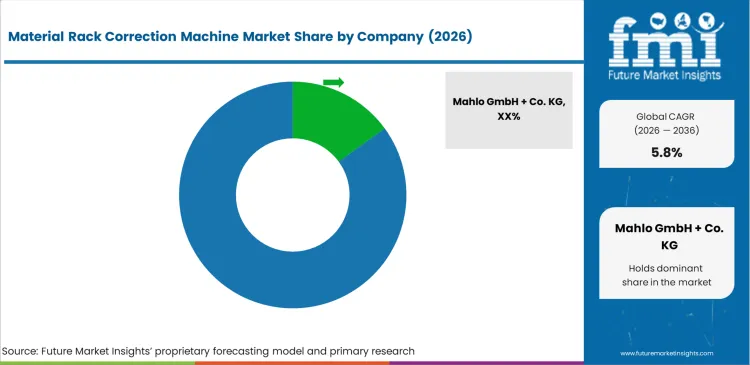
The material rack correction machine market is characterized by competition among established industrial equipment manufacturers, specialized material handling companies, and integrated automation solution providers. Companies are investing in advanced automation technology research, precision engineering, quality assurance, and comprehensive product portfolios to deliver reliable, precise, and efficient material rack correction machine solutions. Innovation in intelligent control systems, IoT integration, and automated positioning technologies is central to strengthening market position and competitive advantage.
Mahlo GmbH + Co. KG leads the market with comprehensive textile and material handling solutions, offering advanced material rack correction machines with a focus on precision control and automation excellence in industrial applications. Ideal Machine provides specialized manufacturing equipment with an focus on material processing and production optimization. GESCO-Group delivers integrated industrial solutions with a focus on material handling and manufacturing automation. Shung Dar specializes in machinery manufacturing with focus on precision equipment and industrial applications. Shanghai Wansheng Machinery Automation focuses on industrial automation and material handling systems. Lihao Machine offers comprehensive manufacturing equipment with a focus on precision and reliability.
Material Rack Correction Machine Market - Stakeholder Contribution Framework
Material rack correction machines represent a specialized automation segment within precision manufacturing and material handling, projected to grow from USD 334.0 million in 2025 to USD 586.9 million by 2035 at a 5.8% CAGR. These precision equipment systems-primarily hand-crank expansion mechanisms for operator control-ensure proper material alignment and correction during metal processing, automotive manufacturing, and electronics production. Market expansion is driven by increasing manufacturing automation demands, growing focus on production quality control, Industry 4.0 integration requirements, and the rising need for waste reduction through precise material positioning across diverse industrial processing applications.
How Manufacturing Industry Associations Could Advance Automation Standards and Best Practices?
- Precision Material Handling Standards: Develop comprehensive technical specifications for material alignment accuracy, correction protocols, and quality control procedures that ensure consistent manufacturing performance across different industrial applications and production environments.
- Automation Integration Guidelines: Establish industry protocols for integrating material rack correction machines with existing production lines, ERP systems, and quality management platforms that enable seamless workflow optimization and data connectivity.
- Operator Training Certification: Create specialized training programs covering equipment operation, maintenance procedures, troubleshooting techniques, and safety protocols specific to material rack correction systems that ensure optimal performance and worker competency.
- Performance Benchmarking Systems: Implement industry-wide metrics for material waste reduction, alignment precision, production efficiency, and equipment reliability that enable comparative analysis and continuous improvement across manufacturing facilities.
- Technology Adoption Roadmaps: Guide manufacturers through systematic automation upgrade paths, including assessment methodologies, ROI calculation frameworks, and phased implementation strategies that optimize investment returns and minimize production disruption.
How Equipment Manufacturers Could Drive Innovation and Market Expansion?
- Advanced Automation Technologies: Develop next-generation systems incorporating servo-driven positioning, AI-powered correction algorithms, and predictive maintenance capabilities that improve precision, reduce downtime, and enable autonomous operation with minimal human intervention.
- Modular System Design: Create flexible, scalable equipment platforms that can be customized for specific material types, production volumes, and space constraints while maintaining standardized interfaces and upgrade compatibility across different manufacturing environments.
- IoT Integration and Connectivity: Implement comprehensive digital platforms connecting material rack correction machines to manufacturing execution systems, providing real-time performance monitoring, predictive analytics, and remote diagnostics capabilities.
- Industry-Specific Solutions: Engineers specialized variants optimized for metal processing, automotive manufacturing, and electronics production with tailored features addressing unique material characteristics, precision requirements, and production workflow integration needs.
- Global Service Networks: Establish comprehensive support infrastructure, including installation services, maintenance programs, spare parts availability, and technical assistance that ensures optimal equipment performance throughout operational lifecycles.
How Manufacturing Facilities Could Optimize Production Efficiency and Quality Control?
- Systematic Implementation Planning: Conduct comprehensive production line assessments, material flow analysis, and ROI evaluations to identify optimal integration points for material rack correction machines that maximize quality improvements and productivity gains.
- Operator Training and Development: Implement comprehensive training programs covering equipment operation, maintenance procedures, quality control protocols, and continuous improvement methodologies that ensure optimal system utilization and performance optimization.
- Preventive Maintenance Excellence: Establish rigorous maintenance schedules, condition monitoring protocols, and predictive maintenance systems that maximize equipment uptime, extend operational life, and prevent quality disruptions in production processes.
- Quality Management Integration: Incorporate material rack correction performance data into statistical process control systems, quality metrics tracking, and continuous improvement programs that support overall manufacturing excellence initiatives.
- Production Line Optimization: Utilize material rack correction capabilities to eliminate bottlenecks, reduce material waste, improve throughput consistency, and enhance overall equipment effectiveness across integrated manufacturing operations.
How Technology Integration Partners Could Enable Smart Manufacturing?
- Industrial IoT Platform Development: Create comprehensive connectivity solutions linking material rack correction machines to enterprise systems, enabling data integration, performance analytics, and remote monitoring capabilities that support Industry 4.0 implementations.
- Predictive Analytics Systems: Develop machine learning algorithms analyzing correction patterns, material characteristics, and production variables to predict maintenance needs, optimize settings, and prevent quality issues before they impact production.
- Digital Twin Technology: Implement virtual modeling systems that simulate material rack correction performance, enable optimization testing, and support production planning without disrupting actual manufacturing operations.
- Cybersecurity Solutions: Provide robust security frameworks protecting connected material handling equipment from cyber threats while ensuring data integrity and operational continuity in networked manufacturing environments.
- System Integration Services: Offer comprehensive integration expertise connecting material rack correction machines with existing automation systems, quality management platforms, and enterprise resource planning systems.
How End-User Industries Could Drive Demand and Innovation?
- Quality Standard Enhancement: Implement stringent material alignment specifications, surface quality requirements, and dimensional accuracy standards that necessitate advanced correction capabilities and drive demand for precision equipment.
- Sustainability Initiative Integration: Utilize material rack correction machines as key components in waste reduction programs, resource optimization initiatives, and circular economy strategies that demonstrate environmental responsibility and cost savings.
- Production Flexibility Requirements: Demand versatile equipment capable of handling diverse material types, varying production volumes, and quick changeover capabilities that support agile manufacturing and mass customization strategies.
- Data-Driven Decision Making: Leverage material rack correction performance data for production optimization, quality trend analysis, and predictive maintenance decisions that improve overall manufacturing effectiveness and competitiveness.
- Supplier Partnership Development: Collaborate with equipment manufacturers on custom solution development, performance optimization, and technology roadmap planning that ensures long-term competitive advantage and operational excellence.
How Investors and Financial Enablers Could Support Market Development?
- Manufacturing Automation Investment: Finance the development of breakthrough automation technologies, AI-powered control systems, and advanced sensing capabilities that revolutionize material handling precision and reduce manufacturing costs.
- Industry 4.0 Integration Funding: Support companies developing comprehensive digital platforms, IoT connectivity solutions, and data analytics systems that enable smart manufacturing implementations and competitive differentiation.
- Global Market Expansion Capital: Provide funding for equipment manufacturers expanding into emerging markets, establishing local service networks, and developing region-specific solutions that address diverse manufacturing requirements and cost structures.
- Technology Partnership Financing: Fund collaborative research initiatives between equipment manufacturers, technology companies, and academic institutions focused on advancing material handling automation and precision manufacturing capabilities.
- Sustainability Innovation Investment: Support development of energy-efficient systems, waste reduction technologies, and environmentally green manufacturing solutions that address growing corporate sustainability requirements and regulatory compliance needs.
Key Players in the Material Rack Correction Machine Market
- Mahlo GmbH + Co. KG
- Ideal Machine
- GESCO-Group
- Shung Dar
- Shanghai Wansheng Machinery Automation
- Lihao Machine
- Qingdao Yituo Machinery Equipment
- Hebei Zhijie Machinery Manufacturing
- Kunshan Longgengkai Mechanical Equipment
Scope of the Report
| Metric | Value |
|---|---|
| Quantitative Units | USD 353.37 million to USD 621.00 million, at a CAGR of 5.8% |
| Market Definition | Material Rack Correction Machine represents precision industrial equipment designed to correct flatness deviations, residual stresses, and dimensional inconsistencies in sheet metal and coil stock before downstream forming, stamping, and fabrication operations. The market encompasses hand-crank expansion, hydraulic expansion, and servo-driven correction machines deployed in metal processing, automotive manufacturing, electronics fabrication, and general precision manufacturing environments. |
| Segmentation | Expansion Mechanism: Hand-crank Expansion, Hydraulic Expansion, Others; Application: Metal Processing, Automotive Manufacturing, Electronic Appliances, Others |
| Regions Covered | North America, Latin America, Europe, East Asia, South Asia, Oceania, Middle East & Africa |
| Countries Covered | China, India, Germany, Brazil, USA, UK, Japan, and 40 plus countries |
| Key Companies Profiled | Mahlo GmbH + Co. KG, Ideal Machine, GESCO-Group, Shung Dar, Shanghai Wansheng Machinery Automation, Lihao Machine, Qingdao Yituo Machinery Equipment, Hebei Zhijie Machinery Manufacturing, Kunshan Longgengkai Mechanical Equipment |
| Forecast Period | 2026 to 2036 |
| Approach | Forecasting models apply a hybrid bottom-up and top-down methodology starting with installed base metrics and cross-validating projections against primary research and public disclosure data. |
Material Rack Correction Machine Market by Segments
Expansion Mechanism:
- Hand-crank Expansion
- Hydraulic Expansion
- Others
Application:
- Metal Processing
- Automotive Manufacturing
- Electronic Appliances
- Others
Region:
- Asia Pacific
- China
- India
- Japan
- South Korea
- ASEAN
- Australia & New Zealand
- Rest of Asia Pacific
- North America
- United States
- Canada
- Mexico
- Europe
- Germany
- United Kingdom
- France
- Italy
- Spain
- Nordic
- BENELUX
- Rest of Europe
- Latin America
- Brazil
- Chile
- Argentina
- Rest of Latin America
- Middle East & Africa
- Kingdom of Saudi Arabia
- Other GCC Countries
- Turkey
- South Africa
- Other African Union
- Rest of Middle East & Africa
Bibliography
- 1. International Organization for Standardization. (2025). ISO 6892: Metallic Materials, Tensile Testing. ISO.
- 2. Society of Manufacturing Engineers. (2025). Metal Stamping Design Guidelines. SME.
- 3. European Committee for Standardization. (2025). EN 10131: Cold Rolled Uncoated Flat Products, Tolerances on Dimensions. CEN.
- 4. China Machinery Industry Federation. (2025). Metal Processing Equipment Industry Report 2025. CMIF.
- 5. Bureau of Indian Standards. (2025). IS 1079: Hot Rolled Carbon Steel Sheet and Strip. BIS.
- 6. Automotive Industry Action Group. (2025). AIAG CQI-9: Special Process Assessment for Heat Treat. AIAG.
This bibliography is provided for reader reference. The full Future Market Insights report contains the complete reference list with primary research documentation.
Frequently Asked Questions
How large is the demand for Material Rack Correction Machine in the global market in 2026?
Demand for Material Rack Correction Machine in the global market is estimated to be valued at USD 353.37 million in 2026.
What will be the market size of Material Rack Correction Machine in the global market by 2036?
Market size for Material Rack Correction Machine is projected to reach USD 621.00 million by 2036.
What is the expected demand growth for Material Rack Correction Machine in the global market between 2026 and 2036?
Demand for Material Rack Correction Machine is expected to grow at a CAGR of 5.8% between 2026 and 2036.
Which Expansion Mechanism is poised to lead global sales by 2026?
Hand-crank Expansion accounts for 40.0% share in 2026.
How significant is Metal Processing in driving Material Rack Correction Machine adoption in 2026?
Metal Processing represents 35.0% of segment share in 2026.
What is China's growth outlook in this report?
China is projected to grow at a CAGR of 7.8% during 2026 to 2036.
What is Material Rack Correction Machine and what is it mainly used for?
Material Rack Correction Machine represents precision industrial equipment designed to correct flatness deviations, residual stresses, and dimensional inconsistencies in sheet metal and coil stock before downstream forming, stamping, and fabrication operations. The market encompasses hand-crank expansion, hydraulic expansion, and servo-driven correction machines deployed in metal processing, automotive manufacturing, electronics fabrication, and general precision manufacturing environments.
What is included in the scope of this Material Rack Correction Machine report?
Market scope includes hand-crank, hydraulic, and servo-driven material rack correction machines for sheet metal and coil stock conditioning. Global and regional market sizes, forecast period 2026 to 2036, and segment breakdowns by Expansion Mechanism and Application are fully covered.
Preview the report firsthand - request a free sample
Get SampleGet the brochure for pricing and purchase details.
Get PDFTable of Content
- Executive Summary
- Global Market Outlook
- Demand-side Trends
- Supply-side Trends
- Technology Roadmap Analysis
- Analysis and Recommendations
- Market Overview
- Market Coverage / Taxonomy
- Market Definition / Scope / Limitations
- Research Methodology
- Chapter Orientation
- Analytical Lens and Working Hypotheses
- Market Structure, Signals, and Trend Drivers
- Benchmarking and Cross-market Comparability
- Market Sizing, Forecasting, and Opportunity Mapping
- Research Design and Evidence Framework
- Desk Research Programme (Secondary Evidence)
- Company Annual and Sustainability Reports
- Peer-reviewed Journals and Academic Literature
- Corporate Websites, Product Literature, and Technical Notes
- Earnings Decks and Investor Briefings
- Statutory Filings and Regulatory Disclosures
- Technical White Papers and Standards Notes
- Trade Journals, Industry Magazines, and Analyst Briefs
- Conference Proceedings, Webinars, and Seminar Materials
- Government Statistics Portals and Public Data Releases
- Press Releases and Reputable Media Coverage
- Specialist Newsletters and Curated Briefings
- Sector Databases and Reference Repositories
- FMI Internal Proprietary Databases and Historical Market Datasets
- Subscription Datasets and Paid Sources
- Social Channels, Communities, and Digital Listening Inputs
- Additional Desk Sources
- Expert Input and Fieldwork (Primary Evidence)
- Primary Modes
- Qualitative Interviews and Expert Elicitation
- Quantitative Surveys and Structured Data Capture
- Blended Approach
- Why Primary Evidence is Used
- Field Techniques
- Interviews
- Surveys
- Focus Groups
- Observational and In-context Research
- Social and Community Interactions
- Stakeholder Universe Engaged
- C-suite Leaders
- Board Members
- Presidents and Vice Presidents
- R&D and Innovation Heads
- Technical Specialists
- Domain Subject-matter Experts
- Scientists
- Physicians and Other Healthcare Professionals
- Governance, Ethics, and Data Stewardship
- Research Ethics
- Data Integrity and Handling
- Primary Modes
- Tooling, Models, and Reference Databases
- Desk Research Programme (Secondary Evidence)
- Data Engineering and Model Build
- Data Acquisition and Ingestion
- Cleaning, Normalisation, and Verification
- Synthesis, Triangulation, and Analysis
- Quality Assurance and Audit Trail
- Market Background
- Market Dynamics
- Drivers
- Restraints
- Opportunity
- Trends
- Scenario Forecast
- Demand in Optimistic Scenario
- Demand in Likely Scenario
- Demand in Conservative Scenario
- Opportunity Map Analysis
- Product Life Cycle Analysis
- Supply Chain Analysis
- Investment Feasibility Matrix
- Value Chain Analysis
- PESTLE and Porter’s Analysis
- Regulatory Landscape
- Regional Parent Market Outlook
- Production and Consumption Statistics
- Import and Export Statistics
- Market Dynamics
- Global Market Analysis 2021 to 2025 and Forecast, 2026 to 2036
- Historical Market Size Value (USD Million) Analysis, 2021 to 2025
- Current and Future Market Size Value (USD Million) Projections, 2026 to 2036
- Y-o-Y Growth Trend Analysis
- Absolute $ Opportunity Analysis
- Global Market Pricing Analysis 2021 to 2025 and Forecast 2026 to 2036
- Global Market Analysis 2021 to 2025 and Forecast 2026 to 2036, By Expansion Mechanism
- Introduction / Key Findings
- Historical Market Size Value (USD Million) Analysis By Expansion Mechanism , 2021 to 2025
- Current and Future Market Size Value (USD Million) Analysis and Forecast By Expansion Mechanism , 2026 to 2036
- Hand-crank Expansion
- Hydraulic Expansion
- Others
- Hand-crank Expansion
- Y-o-Y Growth Trend Analysis By Expansion Mechanism , 2021 to 2025
- Absolute $ Opportunity Analysis By Expansion Mechanism , 2026 to 2036
- Global Market Analysis 2021 to 2025 and Forecast 2026 to 2036, By Application
- Introduction / Key Findings
- Historical Market Size Value (USD Million) Analysis By Application, 2021 to 2025
- Current and Future Market Size Value (USD Million) Analysis and Forecast By Application, 2026 to 2036
- Metal Processing
- Automotive Manufacturing
- Electronic Appliances
- Others
- Metal Processing
- Y-o-Y Growth Trend Analysis By Application, 2021 to 2025
- Absolute $ Opportunity Analysis By Application, 2026 to 2036
- Global Market Analysis 2021 to 2025 and Forecast 2026 to 2036, By Region
- Introduction
- Historical Market Size Value (USD Million) Analysis By Region, 2021 to 2025
- Current Market Size Value (USD Million) Analysis and Forecast By Region, 2026 to 2036
- North America
- Latin America
- Western Europe
- Eastern Europe
- East Asia
- South Asia and Pacific
- Middle East & Africa
- Market Attractiveness Analysis By Region
- North America Market Analysis 2021 to 2025 and Forecast 2026 to 2036, By Country
- Historical Market Size Value (USD Million) Trend Analysis By Market Taxonomy, 2021 to 2025
- Market Size Value (USD Million) Forecast By Market Taxonomy, 2026 to 2036
- By Country
- USA
- Canada
- Mexico
- By Expansion Mechanism
- By Application
- By Country
- Market Attractiveness Analysis
- By Country
- By Expansion Mechanism
- By Application
- Key Takeaways
- Latin America Market Analysis 2021 to 2025 and Forecast 2026 to 2036, By Country
- Historical Market Size Value (USD Million) Trend Analysis By Market Taxonomy, 2021 to 2025
- Market Size Value (USD Million) Forecast By Market Taxonomy, 2026 to 2036
- By Country
- Brazil
- Chile
- Rest of Latin America
- By Expansion Mechanism
- By Application
- By Country
- Market Attractiveness Analysis
- By Country
- By Expansion Mechanism
- By Application
- Key Takeaways
- Western Europe Market Analysis 2021 to 2025 and Forecast 2026 to 2036, By Country
- Historical Market Size Value (USD Million) Trend Analysis By Market Taxonomy, 2021 to 2025
- Market Size Value (USD Million) Forecast By Market Taxonomy, 2026 to 2036
- By Country
- Germany
- UK
- Italy
- Spain
- France
- Nordic
- BENELUX
- Rest of Western Europe
- By Expansion Mechanism
- By Application
- By Country
- Market Attractiveness Analysis
- By Country
- By Expansion Mechanism
- By Application
- Key Takeaways
- Eastern Europe Market Analysis 2021 to 2025 and Forecast 2026 to 2036, By Country
- Historical Market Size Value (USD Million) Trend Analysis By Market Taxonomy, 2021 to 2025
- Market Size Value (USD Million) Forecast By Market Taxonomy, 2026 to 2036
- By Country
- Russia
- Poland
- Hungary
- Balkan & Baltic
- Rest of Eastern Europe
- By Expansion Mechanism
- By Application
- By Country
- Market Attractiveness Analysis
- By Country
- By Expansion Mechanism
- By Application
- Key Takeaways
- East Asia Market Analysis 2021 to 2025 and Forecast 2026 to 2036, By Country
- Historical Market Size Value (USD Million) Trend Analysis By Market Taxonomy, 2021 to 2025
- Market Size Value (USD Million) Forecast By Market Taxonomy, 2026 to 2036
- By Country
- China
- Japan
- South Korea
- By Expansion Mechanism
- By Application
- By Country
- Market Attractiveness Analysis
- By Country
- By Expansion Mechanism
- By Application
- Key Takeaways
- South Asia and Pacific Market Analysis 2021 to 2025 and Forecast 2026 to 2036, By Country
- Historical Market Size Value (USD Million) Trend Analysis By Market Taxonomy, 2021 to 2025
- Market Size Value (USD Million) Forecast By Market Taxonomy, 2026 to 2036
- By Country
- India
- ASEAN
- Australia & New Zealand
- Rest of South Asia and Pacific
- By Expansion Mechanism
- By Application
- By Country
- Market Attractiveness Analysis
- By Country
- By Expansion Mechanism
- By Application
- Key Takeaways
- Middle East & Africa Market Analysis 2021 to 2025 and Forecast 2026 to 2036, By Country
- Historical Market Size Value (USD Million) Trend Analysis By Market Taxonomy, 2021 to 2025
- Market Size Value (USD Million) Forecast By Market Taxonomy, 2026 to 2036
- By Country
- Kingdom of Saudi Arabia
- Other GCC Countries
- Turkiye
- South Africa
- Other African Union
- Rest of Middle East & Africa
- By Expansion Mechanism
- By Application
- By Country
- Market Attractiveness Analysis
- By Country
- By Expansion Mechanism
- By Application
- Key Takeaways
- Key Countries Market Analysis
- USA
- Pricing Analysis
- Market Share Analysis, 2025
- By Expansion Mechanism
- By Application
- Canada
- Pricing Analysis
- Market Share Analysis, 2025
- By Expansion Mechanism
- By Application
- Mexico
- Pricing Analysis
- Market Share Analysis, 2025
- By Expansion Mechanism
- By Application
- Brazil
- Pricing Analysis
- Market Share Analysis, 2025
- By Expansion Mechanism
- By Application
- Chile
- Pricing Analysis
- Market Share Analysis, 2025
- By Expansion Mechanism
- By Application
- Germany
- Pricing Analysis
- Market Share Analysis, 2025
- By Expansion Mechanism
- By Application
- UK
- Pricing Analysis
- Market Share Analysis, 2025
- By Expansion Mechanism
- By Application
- Italy
- Pricing Analysis
- Market Share Analysis, 2025
- By Expansion Mechanism
- By Application
- Spain
- Pricing Analysis
- Market Share Analysis, 2025
- By Expansion Mechanism
- By Application
- France
- Pricing Analysis
- Market Share Analysis, 2025
- By Expansion Mechanism
- By Application
- India
- Pricing Analysis
- Market Share Analysis, 2025
- By Expansion Mechanism
- By Application
- ASEAN
- Pricing Analysis
- Market Share Analysis, 2025
- By Expansion Mechanism
- By Application
- Australia & New Zealand
- Pricing Analysis
- Market Share Analysis, 2025
- By Expansion Mechanism
- By Application
- China
- Pricing Analysis
- Market Share Analysis, 2025
- By Expansion Mechanism
- By Application
- Japan
- Pricing Analysis
- Market Share Analysis, 2025
- By Expansion Mechanism
- By Application
- South Korea
- Pricing Analysis
- Market Share Analysis, 2025
- By Expansion Mechanism
- By Application
- Russia
- Pricing Analysis
- Market Share Analysis, 2025
- By Expansion Mechanism
- By Application
- Poland
- Pricing Analysis
- Market Share Analysis, 2025
- By Expansion Mechanism
- By Application
- Hungary
- Pricing Analysis
- Market Share Analysis, 2025
- By Expansion Mechanism
- By Application
- Kingdom of Saudi Arabia
- Pricing Analysis
- Market Share Analysis, 2025
- By Expansion Mechanism
- By Application
- Turkiye
- Pricing Analysis
- Market Share Analysis, 2025
- By Expansion Mechanism
- By Application
- South Africa
- Pricing Analysis
- Market Share Analysis, 2025
- By Expansion Mechanism
- By Application
- USA
- Market Structure Analysis
- Competition Dashboard
- Competition Benchmarking
- Market Share Analysis of Top Players
- By Regional
- By Expansion Mechanism
- By Application
- Competition Analysis
- Competition Deep Dive
- Mahlo GmbH + Co. KG
- Overview
- Product Portfolio
- Profitability by Market Segments (Product/Age /Sales Channel/Region)
- Sales Footprint
- Strategy Overview
- Marketing Strategy
- Product Strategy
- Channel Strategy
- Ideal Machine
- GESCO-Group
- Shung Dar
- Shanghai Wansheng Machinery Automation
- Lihao Machine
- Qingdao Yituo Machinery Equipment
- Hebei Zhijie Machinery Manufacturing
- Kunshan Longgengkai Mechanical Equipment
- Mahlo GmbH + Co. KG
- Competition Deep Dive
- Assumptions & Acronyms Used


