

- Industry Size (2026)
- USD 740.0 Mn
- Forecast (2036)
- USD 1788 Mn
- CAGR (2026 to 2036)
- 9.1%
Hybrid Paper-Polymer Material Systems for Lightweight Structural Components Market Forecast and Outlook 2026 to 2036
The hybrid paper-polymer material systems for lightweight structural components are valued at USD 740.0 million in 2026 and are projected to reach USD 1,788 million by 2036, reflecting a CAGR of 9.1%. Expansion is linked to structural redesign efforts where weight reduction, material efficiency, and controlled stiffness are addressed simultaneously rather than sequentially.
Paper fibers and pulp-based reinforcements introduce rigidity and form stability, while polymer matrices provide impact tolerance, moisture resistance, and manufacturability. This combination allows designers to replace mineral-filled plastics and selected metal parts in interior automotive structures, electronic housings, and industrial panels without compromising dimensional control. Hybrid systems are increasingly specified where structural function is secondary but weight and material volume directly influence system-level efficiency and cost.
Quick Stats for Hybrid Paper-Polymer Material Systems for Lightweight Structural Components Market
- Hybrid Paper-Polymer Material Systems for Lightweight Structural Components Market Value (2026): USD 740.0 million
- Hybrid Paper-Polymer Material Systems for Lightweight Structural Components Market Forecast Value (2036): USD 1,788 million
- Hybrid Paper-Polymer Material Systems for Lightweight Structural Components Market Forecast CAGR (2026-2036): 9.1%
- Leading Material System Type: Paper-Fiber Reinforced Thermoplastic Systems
- Fastest-Growing Countries: China, India, Germany, USA, Japan
- Key Players: Avient Corporation, BASF SE, Stora Enso, Covestro, LyondellBasell
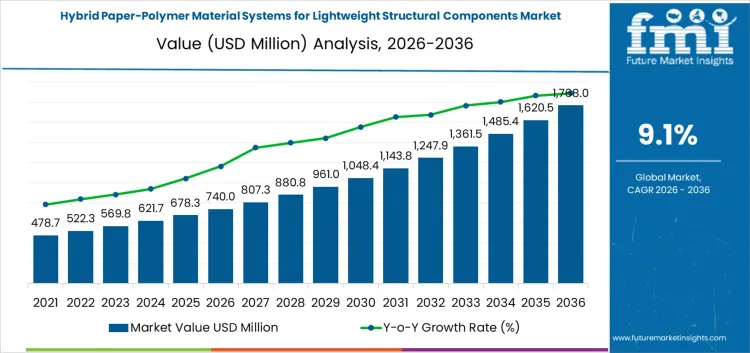
Adoption momentum is shaped by engineering validation cycles and processing compatibility rather than short-term sustainability signaling. Paper-polymer hybrids gain acceptance when fiber dispersion, interfacial bonding, and moisture behavior remain predictable across high-volume molding, lamination, or forming operations. Manufacturers favor material systems that integrate into existing production lines while delivering consistent stiffness-to-weight ratios and surface quality. Regulatory pressure on plastic intensity and carbon accounting reinforces material substitution decisions already justified by mechanical performance and part consolidation benefits. Growth strengthens where hybrid systems support standardized component architectures across regions, enabling scale efficiencies and stable qualification outcomes. Demand progression reflects structural confidence and process reliability more than rapid material experimentation.
Hybrid Paper-Polymer Material Systems for Lightweight Structural Components Market Key Takeaways
| Metric | Value |
|---|---|
| Market Value (2026) | USD 740.0 million |
| Market Forecast Value (2036) | USD 1,788 million |
| Forecast CAGR (2026-2036) | 9.1% |
Why is the Demand for Hybrid Paper-Polymer Material Systems for Lightweight Structural Components Market Growing Globally?
Demand for hybrid paper-polymer material systems for lightweight structural components is growing globally due to expanding interest in sustainable materials and improved performance in automotive, electronics, packaging, and consumer goods applications. Hybrid materials that combine paper or cellulose-based reinforcements with polymer matrices offer favorable strength, stiffness, and reduced weight compared with traditional thermoplastics or metal parts, which supports design goals tied to fuel efficiency, material cost reduction, and environmental impact. Structural components such as interior panels, trim, housings, and protective covers benefit from engineered hybrid systems that balance mechanical integrity with recyclability and lower embodied energy.
Regulatory frameworks in multiple regions promote use of renewable and recycled content in engineered materials to meet circular economy and emission reduction targets, which motivates procurement of low carbon hybrid solutions. Advances in material engineering improve interfacial bonding, uniform dispersion, and moisture resistance, enabling reliable performance under diverse operating conditions. Manufacturers integrate these systems with injection molding, compression molding, and hybrid processing platforms that support scalable production while maintaining part quality. Expansion of global manufacturing footprints and sustainability commitments among original equipment manufacturers reinforce demand for hybrid paper-polymer materials that deliver weight savings, enhanced material efficiency, and alignment with environmental compliance expectations across structural component applications worldwide.
How Is the Global Hybrid Paper-Polymer Material Systems for Lightweight Structural Components Market Structured?
Global demand for hybrid paper-polymer material systems is driven by lightweighting requirements, material efficiency targets, and substitution of mineral-filled plastics in semi-structural components. These systems combine paper fibers or pulp structures with thermoplastics or bio-resins to balance stiffness, impact tolerance, and manufacturability. Adoption is concentrated in applications requiring reduced mass, improved sustainability metrics, and compatibility with established molding or lamination processes. Material developers focus on achieving repeatable structural performance while maintaining cost control and scalable production.
Which Material System Type Accounts for the Largest Share of Global Demand?
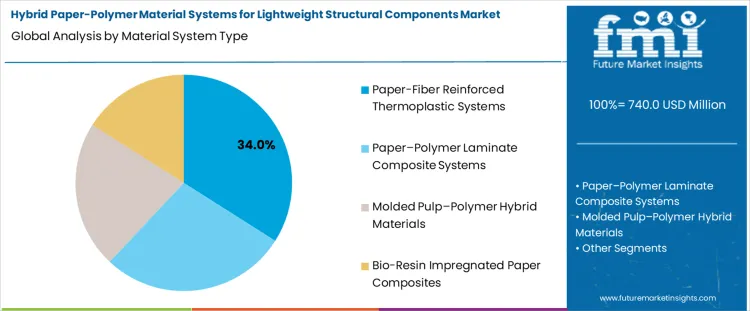
Paper-fiber reinforced thermoplastic systems account for the largest share at 34.0%, supported by their ability to deliver stiffness enhancement and weight reduction within conventional injection and compression molding workflows. These systems enable partial polymer replacement while maintaining mechanical consistency across high-volume production. Paper-polymer laminate composite systems represent 28.0%, driven by applications requiring layered strength, surface uniformity, and improved bending resistance. Molded pulp-polymer hybrid materials hold 22.0%, reflecting use in shaped components where complex geometries and cushioning behavior are required. Bio-resin impregnated paper composites account for 16.0%, applied in lower-volume programs prioritizing renewable content and reduced fossil dependency.
Key Points
- Paper-fiber thermoplastic systems lead due to process compatibility
- Laminate composites support layered structural performance
- Bio-resin systems remain limited to targeted sustainability programs
Which Structural Performance Focus Drives the Majority of Adoption?
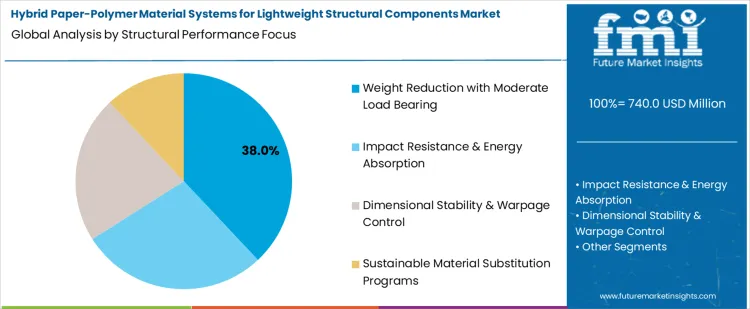
Weight reduction with moderate load-bearing capability represents the dominant focus at 38.0%, reflecting widespread use in components that must reduce mass without serving as primary load paths. These materials replace heavier plastics or mineral-filled compounds while retaining adequate stiffness. Impact resistance and energy absorption account for 28.0%, driven by interior and enclosure applications requiring damage tolerance under repeated use. Dimensional stability and warpage control hold 22.0%, supporting applications where flatness and tolerance retention are critical during thermal cycling. Sustainable material substitution programs represent 12.0%, reflecting initiatives driven more by regulatory or brand objectives than mechanical necessity.
Key Points
- Lightweighting remains primary driver across structural applications
- Impact performance supports durability-focused designs
- Sustainability programs influence selective adoption
Which Application Segment Generates the Highest Global Demand?
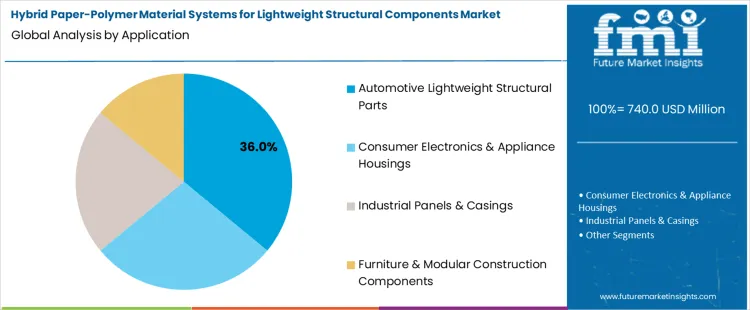
Automotive lightweight structural parts account for 36.0% of global demand, reflecting use in interior supports, trim substrates, and non-critical structural elements where mass reduction improves efficiency. Consumer electronics and appliance housings represent 28.0%, driven by demand for rigid, lightweight enclosures with improved sustainability positioning. Industrial panels and casings hold 22.0%, supporting equipment housings and protective covers requiring stiffness and dimensional stability. Furniture and modular construction components account for 14.0%, constrained by longer qualification cycles and structural certification requirements.
Key Points
- Automotive adoption leads due to weight and efficiency targets
- Electronics housings value stiffness and material storytelling
- Industrial applications balance durability and manufacturability
What are the Key Dynamics in the Hybrid Paper-Polymer Material Systems for Lightweight Structural Components Market?
Global demand rises as manufacturers in automotive, consumer appliances, packaging, and industrial goods adopt hybrid paper-polymer material systems to achieve lightweight structural performance with enhanced sustainability credentials. Hybrid paper-polymer systems combine cellulosic fiber reinforcements and engineered polymers to produce parts that balance stiffness, impact resistance, and reduced mass. Adoption aligns with corporate environmental commitments, fuel efficiency goals, and regulatory pressure to lower carbon intensity across production and product lifecycles in North America, Europe, Asia-Pacific, and Latin America. Usage spans interior vehicle panels, appliance housings, structural inserts, and load-bearing packaging components where weight reduction and renewable content are priorities.
How do performance requirements and sustainability drivers shape adoption?
Original equipment manufacturers and brand owners emphasize materials that contribute to energy savings and recyclability without compromising mechanical performance. Hybrid paper-polymer systems support structural integrity while lowering part weight relative to traditional thermoplastic or metal alternatives, enhancing product efficiency and lifecycle metrics. Material engineers optimize fiber dispersion, interfacial adhesion, and polymer matrix selection to achieve design targets for stiffness, strength, and vibration damping. Retailers and OEMs highlight these attributes in product specifications and sustainability reporting to meet consumer and regulatory expectations.
How do cost pressures, processing complexity, and regulatory variation influence market scalability?
Hybrid paper-polymer material systems involve advanced compounding, tailored compatibilizers, and precise processing conditions that increase formulation and equipment requirements relative to commodity polymers, affecting cost competitiveness in price-sensitive applications. Processing challenges include maintaining consistent fiber orientation, moisture control, and dimensional precision during molding and extrusion, requiring skilled technicians and optimized production controls. Variability in raw material quality, supply continuity, and price dynamics for both biogenic fibers and polymer resins influences planning and cost stability across regions. Regulatory frameworks governing renewable content claims, composite material classification, and recycling standards differ internationally, shaping compliance and labeling strategies for global distribution. Long-term growth depends on continued innovation in cost-effective, high-performance hybrid systems and harmonized standards that support broad adoption in lightweight structural components worldwide.
How Is Demand for Hybrid Paper-Polymer Material Systems for Lightweight Structural Components Evolving Globally?
Demand for hybrid paper-polymer material systems for lightweight structural components is increasing globally due to weight reduction targets, plastic substitution policies, and need for structurally reliable sustainable materials. China leads with a 9.7% CAGR, supported by industrial-scale adoption in packaging and consumer structures. India follows at 9.4%, driven by cost-sensitive lightweighting and regulatory pressure on plastics. Germany records 9.1%, reflecting engineering-led integration into structural applications. USA posts an 8.9% CAGR, shaped by sustainability commitments and material innovation programs. Japan records 8.7%, supported by precision manufacturing and controlled material qualification. Growth reflects transition toward hybrid systems combining paper reinforcement with polymer matrices to achieve stiffness, weight reduction, and recyclability.
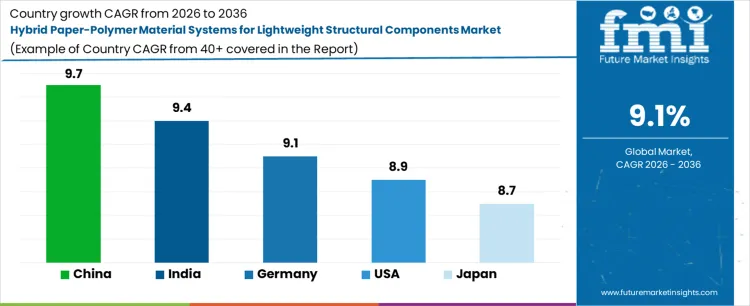
| Country | CAGR (%) |
|---|---|
| China | 9.7% |
| India | 9.4% |
| Germany | 9.1% |
| USA | 8.9% |
| Japan | 8.7% |
What is driving strong adoption of hybrid paper-polymer systems in China?
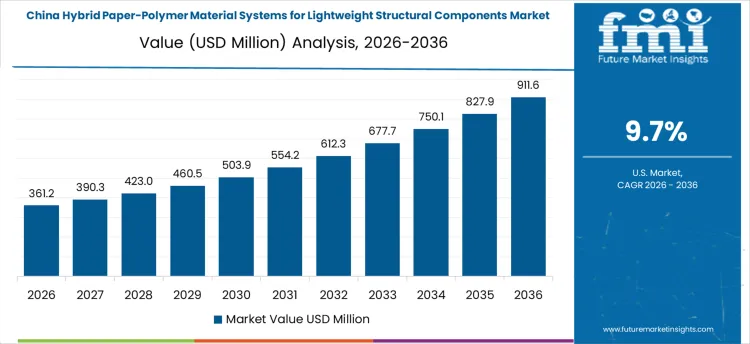
China demand is driven by large-scale replacement of conventional plastics in lightweight structural applications. CAGR of 9.7% reflects increased use of hybrid paper-polymer systems in protective housings, logistics components, and semi-structural packaging. Manufacturers require materials that reduce weight while maintaining load-bearing integrity. Regulatory pressure on plastic reduction accelerates hybrid adoption. Domestic material suppliers scale production of paper-reinforced polymer sheets and molded components. Compatibility with existing forming and molding infrastructure supports rapid deployment. Growth remains scale-driven and policy-aligned, supported by industrial manufacturing capacity and sustainability mandates.
- Large-scale plastic substitution initiatives
- Use in semi-structural and protective components
- Regulatory pressure supporting hybrid material adoption
- Compatibility with existing manufacturing systems
How is India sustaining growth in hybrid paper-polymer material usage?
India demand reflects emphasis on affordable lightweighting and gradual transition toward sustainable materials. CAGR of 9.4% is supported by adoption of hybrid paper-polymer systems in consumer goods, transport packaging, and utility components. Manufacturers prioritize cost efficiency, stiffness improvement, and reduced polymer usage. Government sustainability programs influence material choices. Domestic producers utilize locally sourced paper fibers to control costs. Processing simplicity and robustness guide adoption. Growth remains manufacturing-led and cost-aligned, supported by incremental replacement of traditional plastic components.
- Cost-driven lightweighting strategies
- Use of locally sourced paper reinforcements
- Focus on stiffness and polymer reduction
- Gradual adoption across consumer and logistics components
What factors support Germany’s steady expansion in hybrid structural material systems?
Germany demand reflects engineering discipline, structural performance validation, and sustainability integration. CAGR of 9.1% is supported by adoption of hybrid paper-polymer materials in automotive interiors, technical housings, and lightweight panels. Manufacturers require predictable mechanical behavior, moisture control, and dimensional stability. Regulatory frameworks support validated material transitions. Material suppliers invest in controlled fiber dispersion and matrix bonding technologies. Collaboration between OEMs and material developers accelerates qualification. Growth remains technology-led and quality-focused, aligned with advanced manufacturing standards.
- Engineering-led validation of structural performance
- Adoption in automotive and technical applications
- Emphasis on dimensional stability and durability
- Strong collaboration across OEM and supplier base
What is shaping demand growth in the USA for hybrid paper-polymer systems?
USA demand is shaped by sustainability targets, lightweighting initiatives, and redesign of structural consumer components. CAGR of 8.9% reflects adoption of hybrid systems in logistics packaging, interior structures, and industrial components. Manufacturers seek materials that balance sustainability claims with mechanical reliability. Compatibility with existing tooling influences adoption speed. Domestic material suppliers offer application-specific hybrid solutions. Growth remains brand-led and compliance-focused, supported by environmental reporting requirements and gradual material substitution strategies.
- Corporate sustainability and lightweighting initiatives
- Use in logistics and structural consumer components
- Demand for mechanical reliability and tooling compatibility
- Expansion of application-specific hybrid materials
Why is Japan showing measured growth in hybrid paper-polymer material adoption?
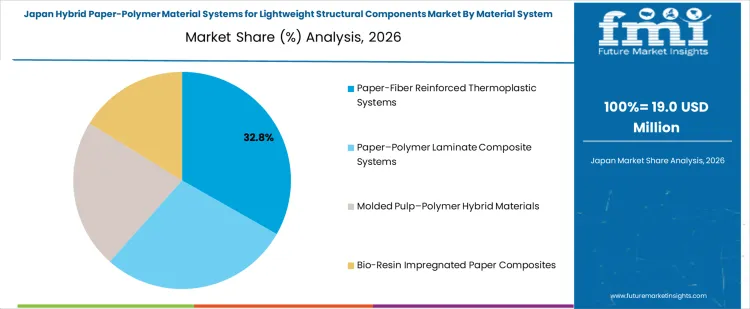
Japan demand reflects cautious material qualification, precision manufacturing culture, and emphasis on structural consistency. CAGR of 8.7% is supported by selective use of hybrid paper-polymer systems in lightweight panels and consumer structures. Manufacturers prioritize surface finish, dimensional accuracy, and long-term reliability. Material qualification cycles remain stringent. Domestic suppliers focus on consistency and controlled fiber integration. Growth remains quality-driven and technology-aligned, supported by disciplined engineering practices and incremental adoption of hybrid structural materials.
- High standards for precision and surface quality
- Selective adoption in lightweight structural panels
- Rigorous material qualification processes
- Emphasis on long-term structural reliability
What is the competitive landscape of demand for hybrid paper-polymer material systems for lightweight structural components globally?
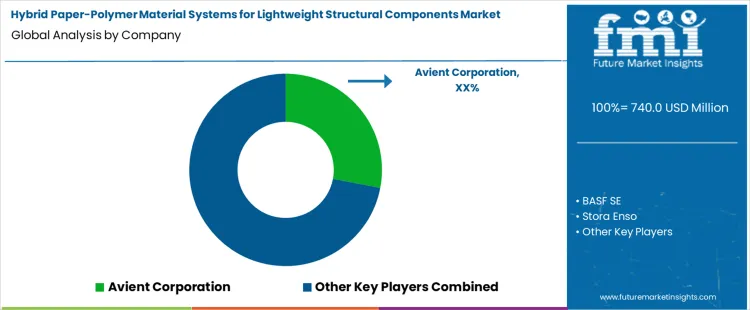
Demand for hybrid paper-polymer material systems for lightweight structural components is driven by lightweighting mandates, recyclability targets, and substitution of conventional plastics and metals. These systems combine cellulose-based reinforcements with polymer matrices to deliver stiffness, impact resistance, and dimensional stability at reduced weight and fossil content. Buyers evaluate fiber dispersion quality, interfacial bonding, moisture resistance, mechanical performance under load, and process compatibility with injection molding and thermoforming. Procurement teams prioritize suppliers with validated material performance data, consistent fiber sourcing, and capability to support structural applications across packaging, consumer goods, and mobility components. Trend in the global market reflects increased adoption of bio-hybrid materials to meet regulatory pressure on plastics while maintaining functional performance.
Avient Corporation holds leading positioning through engineered composite material platforms integrating natural fibers with thermoplastics for structural use. BASF SE supports demand with hybrid polymer systems and material science expertise focused on lightweight and sustainable component design. Stora Enso contributes fiber-based reinforcement technologies and renewable material know-how enabling paper-polymer hybrid development. Covestro participates through engineering polymers and hybrid material innovation targeting structural integrity and durability. LyondellBasell supports adoption through polyolefin matrices optimized for fiber compatibility and scalable processing. Competitive differentiation depends on fiber-polymer interface control, mechanical reliability, process scalability, and ability to meet structural performance requirements across applications.
Key Players in the Hybrid Paper–Polymer Material Systems for Lightweight Structural Components Market
- Avient Corporation
- BASF SE
- Stora Enso
- Covestro
- LyondellBasell
Scope of the Report
| Items | Values |
|---|---|
| Quantitative Units | USD million |
| Material System Type | Paper-Fiber Reinforced Thermoplastic Systems; Paper-Polymer Laminate Composite Systems; Molded Pulp-Polymer Hybrid Materials; Bio-Resin Impregnated Paper Composites |
| Structural Performance Focus | Weight Reduction with Moderate Load Bearing; Impact Resistance & Energy Absorption; Dimensional Stability & Warpage Control; Sustainable Material Substitution Programs |
| Application | Automotive Lightweight Structural Parts; Consumer Electronics & Appliance Housings; Industrial Panels & Casings; Furniture & Modular Construction Components |
| Regions Covered | Asia Pacific, Europe, North America, Latin America, Middle East & Africa |
| Countries Covered | China, India, Germany, USA, Japan, and 40+ countries |
| Key Companies Profiled | Avient Corporation; BASF SE; Stora Enso; Covestro; LyondellBasell |
| Additional Attributes | Dollar sales by material system type and application; adoption trends for paper-polymer hybrids in lightweight structural substitution programs; stiffness-to-weight ratio, impact performance, and dimensional stability metrics; compatibility with injection molding, compression molding, and lamination processes; recyclability pathways, moisture management, and surface finishing considerations; compliance with sustainability targets, bio-content disclosure, and material safety standards influencing hybrid material system selection. |
Hybrid Paper-Polymer Material Systems for Lightweight Structural Components Market by Segment
Material System Type:
- Paper-Fiber Reinforced Thermoplastic Systems
- Paper-Polymer Laminate Composite Systems
- Molded Pulp-Polymer Hybrid Materials
- Bio-Resin Impregnated Paper Composites
Structural Performance Focus:
- Weight Reduction with Moderate Load Bearing
- Impact Resistance & Energy Absorption
- Dimensional Stability & Warpage Control
- Sustainable Material Substitution Programs
Application:
- Automotive Lightweight Structural Parts
- Consumer Electronics & Appliance Housings
- Industrial Panels & Casings
- Furniture & Modular Construction Components
Region:
- Asia Pacific
- China
- Japan
- South Korea
- India
- Australia & New Zealand
- ASEAN
- Rest of Asia Pacific
- Europe
- Germany
- United Kingdom
- France
- Italy
- Spain
- Nordic
- BENELUX
- Rest of Europe
- North America
- United States
- Canada
- Mexico
- Latin America
- Brazil
- Chile
- Rest of Latin America
- Middle East & Africa
- Kingdom of Saudi Arabia
- Other GCC Countries
- Turkey
- South Africa
- Other African Union
- Rest of Middle East & Africa
Frequently Asked Questions
How big is the hybrid paper-polymer material systems for lightweight structural components market in 2026?
The global hybrid paper-polymer material systems for lightweight structural components market is estimated to be valued at USD 740.0 million in 2026.
What will be the size of hybrid paper-polymer material systems for lightweight structural components market in 2036?
The market size for the hybrid paper-polymer material systems for lightweight structural components market is projected to reach USD 1,768.0 million by 2036.
How much will be the hybrid paper-polymer material systems for lightweight structural components market growth between 2026 and 2036?
The hybrid paper-polymer material systems for lightweight structural components market is expected to grow at a 9.1% CAGR between 2026 and 2036.
What are the key product types in the hybrid paper-polymer material systems for lightweight structural components market?
The key product types in hybrid paper-polymer material systems for lightweight structural components market are paper-fiber reinforced thermoplastic systems, paper–polymer laminate composite systems, molded pulp–polymer hybrid materials and bio-resin impregnated paper composites.
Which structural performance focus segment to contribute significant share in the hybrid paper-polymer material systems for lightweight structural components market in 2026?
In terms of structural performance focus, weight reduction with moderate load bearing segment to command 38.0% share in the hybrid paper-polymer material systems for lightweight structural components market in 2026.
Preview the report firsthand - request a free sample
Get SampleGet the brochure for pricing and purchase details.
Get PDFTable of Content
- Executive Summary
- Global Market Outlook
- Demand-side Trends
- Supply-side Trends
- Technology Roadmap Analysis
- Analysis and Recommendations
- Market Overview
- Market Coverage / Taxonomy
- Market Definition / Scope / Limitations
- Market Background
- Market Dynamics
- Drivers
- Restraints
- Opportunity
- Trends
- Scenario Forecast
- Demand in Optimistic Scenario
- Demand in Likely Scenario
- Demand in Conservative Scenario
- Opportunity Map Analysis
- Product Life Cycle Analysis
- Supply Chain Analysis
- Investment Feasibility Matrix
- Value Chain Analysis
- PESTLE and Porter’s Analysis
- Regulatory Landscape
- Regional Parent Market Outlook
- Production and Consumption Statistics
- Import and Export Statistics
- Market Dynamics
- Global Market Analysis 2021 to 2025 and Forecast, 2026 to 2036
- Historical Market Size Value (USD Million) Analysis, 2021 to 2025
- Current and Future Market Size Value (USD Million) Projections, 2026 to 2036
- Y-o-Y Growth Trend Analysis
- Absolute $ Opportunity Analysis
- Global Market Pricing Analysis 2021 to 2025 and Forecast 2026 to 2036
- Global Market Analysis 2021 to 2025 and Forecast 2026 to 2036, By Material System Type
- Introduction / Key Findings
- Historical Market Size Value (USD Million) Analysis By Material System Type , 2021 to 2025
- Current and Future Market Size Value (USD Million) Analysis and Forecast By Material System Type , 2026 to 2036
- Paper-Fiber Reinforced Thermoplastic Systems
- Paper–Polymer Laminate Composite Systems
- Molded Pulp–Polymer Hybrid Materials
- Bio-Resin Impregnated Paper Composites
- Paper-Fiber Reinforced Thermoplastic Systems
- Y-o-Y Growth Trend Analysis By Material System Type , 2021 to 2025
- Absolute $ Opportunity Analysis By Material System Type , 2026 to 2036
- Global Market Analysis 2021 to 2025 and Forecast 2026 to 2036, By Structural Performance Focus
- Introduction / Key Findings
- Historical Market Size Value (USD Million) Analysis By Structural Performance Focus, 2021 to 2025
- Current and Future Market Size Value (USD Million) Analysis and Forecast By Structural Performance Focus, 2026 to 2036
- Weight Reduction with Moderate Load Bearing
- Impact Resistance & Energy Absorption
- Dimensional Stability & Warpage Control
- Sustainable Material Substitution Programs
- Weight Reduction with Moderate Load Bearing
- Y-o-Y Growth Trend Analysis By Structural Performance Focus, 2021 to 2025
- Absolute $ Opportunity Analysis By Structural Performance Focus, 2026 to 2036
- Global Market Analysis 2021 to 2025 and Forecast 2026 to 2036, By Application
- Introduction / Key Findings
- Historical Market Size Value (USD Million) Analysis By Application, 2021 to 2025
- Current and Future Market Size Value (USD Million) Analysis and Forecast By Application, 2026 to 2036
- Automotive Lightweight Structural Parts
- Consumer Electronics & Appliance Housings
- Industrial Panels & Casings
- Furniture & Modular Construction Components
- Automotive Lightweight Structural Parts
- Y-o-Y Growth Trend Analysis By Application, 2021 to 2025
- Absolute $ Opportunity Analysis By Application, 2026 to 2036
- Global Market Analysis 2021 to 2025 and Forecast 2026 to 2036, By Region
- Introduction
- Historical Market Size Value (USD Million) Analysis By Region, 2021 to 2025
- Current Market Size Value (USD Million) Analysis and Forecast By Region, 2026 to 2036
- North America
- Latin America
- Western Europe
- Eastern Europe
- East Asia
- South Asia and Pacific
- Middle East & Africa
- Market Attractiveness Analysis By Region
- North America Market Analysis 2021 to 2025 and Forecast 2026 to 2036, By Country
- Historical Market Size Value (USD Million) Trend Analysis By Market Taxonomy, 2021 to 2025
- Market Size Value (USD Million) Forecast By Market Taxonomy, 2026 to 2036
- By Country
- USA
- Canada
- Mexico
- By Material System Type
- By Structural Performance Focus
- By Application
- By Country
- Market Attractiveness Analysis
- By Country
- By Material System Type
- By Structural Performance Focus
- By Application
- Key Takeaways
- Latin America Market Analysis 2021 to 2025 and Forecast 2026 to 2036, By Country
- Historical Market Size Value (USD Million) Trend Analysis By Market Taxonomy, 2021 to 2025
- Market Size Value (USD Million) Forecast By Market Taxonomy, 2026 to 2036
- By Country
- Brazil
- Chile
- Rest of Latin America
- By Material System Type
- By Structural Performance Focus
- By Application
- By Country
- Market Attractiveness Analysis
- By Country
- By Material System Type
- By Structural Performance Focus
- By Application
- Key Takeaways
- Western Europe Market Analysis 2021 to 2025 and Forecast 2026 to 2036, By Country
- Historical Market Size Value (USD Million) Trend Analysis By Market Taxonomy, 2021 to 2025
- Market Size Value (USD Million) Forecast By Market Taxonomy, 2026 to 2036
- By Country
- Germany
- UK
- Italy
- Spain
- France
- Nordic
- BENELUX
- Rest of Western Europe
- By Material System Type
- By Structural Performance Focus
- By Application
- By Country
- Market Attractiveness Analysis
- By Country
- By Material System Type
- By Structural Performance Focus
- By Application
- Key Takeaways
- Eastern Europe Market Analysis 2021 to 2025 and Forecast 2026 to 2036, By Country
- Historical Market Size Value (USD Million) Trend Analysis By Market Taxonomy, 2021 to 2025
- Market Size Value (USD Million) Forecast By Market Taxonomy, 2026 to 2036
- By Country
- Russia
- Poland
- Hungary
- Balkan & Baltic
- Rest of Eastern Europe
- By Material System Type
- By Structural Performance Focus
- By Application
- By Country
- Market Attractiveness Analysis
- By Country
- By Material System Type
- By Structural Performance Focus
- By Application
- Key Takeaways
- East Asia Market Analysis 2021 to 2025 and Forecast 2026 to 2036, By Country
- Historical Market Size Value (USD Million) Trend Analysis By Market Taxonomy, 2021 to 2025
- Market Size Value (USD Million) Forecast By Market Taxonomy, 2026 to 2036
- By Country
- China
- Japan
- South Korea
- By Material System Type
- By Structural Performance Focus
- By Application
- By Country
- Market Attractiveness Analysis
- By Country
- By Material System Type
- By Structural Performance Focus
- By Application
- Key Takeaways
- South Asia and Pacific Market Analysis 2021 to 2025 and Forecast 2026 to 2036, By Country
- Historical Market Size Value (USD Million) Trend Analysis By Market Taxonomy, 2021 to 2025
- Market Size Value (USD Million) Forecast By Market Taxonomy, 2026 to 2036
- By Country
- India
- ASEAN
- Australia & New Zealand
- Rest of South Asia and Pacific
- By Material System Type
- By Structural Performance Focus
- By Application
- By Country
- Market Attractiveness Analysis
- By Country
- By Material System Type
- By Structural Performance Focus
- By Application
- Key Takeaways
- Middle East & Africa Market Analysis 2021 to 2025 and Forecast 2026 to 2036, By Country
- Historical Market Size Value (USD Million) Trend Analysis By Market Taxonomy, 2021 to 2025
- Market Size Value (USD Million) Forecast By Market Taxonomy, 2026 to 2036
- By Country
- Kingdom of Saudi Arabia
- Other GCC Countries
- Turkiye
- South Africa
- Other African Union
- Rest of Middle East & Africa
- By Material System Type
- By Structural Performance Focus
- By Application
- By Country
- Market Attractiveness Analysis
- By Country
- By Material System Type
- By Structural Performance Focus
- By Application
- Key Takeaways
- Key Countries Market Analysis
- USA
- Pricing Analysis
- Market Share Analysis, 2025
- By Material System Type
- By Structural Performance Focus
- By Application
- Canada
- Pricing Analysis
- Market Share Analysis, 2025
- By Material System Type
- By Structural Performance Focus
- By Application
- Mexico
- Pricing Analysis
- Market Share Analysis, 2025
- By Material System Type
- By Structural Performance Focus
- By Application
- Brazil
- Pricing Analysis
- Market Share Analysis, 2025
- By Material System Type
- By Structural Performance Focus
- By Application
- Chile
- Pricing Analysis
- Market Share Analysis, 2025
- By Material System Type
- By Structural Performance Focus
- By Application
- Germany
- Pricing Analysis
- Market Share Analysis, 2025
- By Material System Type
- By Structural Performance Focus
- By Application
- UK
- Pricing Analysis
- Market Share Analysis, 2025
- By Material System Type
- By Structural Performance Focus
- By Application
- Italy
- Pricing Analysis
- Market Share Analysis, 2025
- By Material System Type
- By Structural Performance Focus
- By Application
- Spain
- Pricing Analysis
- Market Share Analysis, 2025
- By Material System Type
- By Structural Performance Focus
- By Application
- France
- Pricing Analysis
- Market Share Analysis, 2025
- By Material System Type
- By Structural Performance Focus
- By Application
- India
- Pricing Analysis
- Market Share Analysis, 2025
- By Material System Type
- By Structural Performance Focus
- By Application
- ASEAN
- Pricing Analysis
- Market Share Analysis, 2025
- By Material System Type
- By Structural Performance Focus
- By Application
- Australia & New Zealand
- Pricing Analysis
- Market Share Analysis, 2025
- By Material System Type
- By Structural Performance Focus
- By Application
- China
- Pricing Analysis
- Market Share Analysis, 2025
- By Material System Type
- By Structural Performance Focus
- By Application
- Japan
- Pricing Analysis
- Market Share Analysis, 2025
- By Material System Type
- By Structural Performance Focus
- By Application
- South Korea
- Pricing Analysis
- Market Share Analysis, 2025
- By Material System Type
- By Structural Performance Focus
- By Application
- Russia
- Pricing Analysis
- Market Share Analysis, 2025
- By Material System Type
- By Structural Performance Focus
- By Application
- Poland
- Pricing Analysis
- Market Share Analysis, 2025
- By Material System Type
- By Structural Performance Focus
- By Application
- Hungary
- Pricing Analysis
- Market Share Analysis, 2025
- By Material System Type
- By Structural Performance Focus
- By Application
- Kingdom of Saudi Arabia
- Pricing Analysis
- Market Share Analysis, 2025
- By Material System Type
- By Structural Performance Focus
- By Application
- Turkiye
- Pricing Analysis
- Market Share Analysis, 2025
- By Material System Type
- By Structural Performance Focus
- By Application
- South Africa
- Pricing Analysis
- Market Share Analysis, 2025
- By Material System Type
- By Structural Performance Focus
- By Application
- USA
- Market Structure Analysis
- Competition Dashboard
- Competition Benchmarking
- Market Share Analysis of Top Players
- By Regional
- By Material System Type
- By Structural Performance Focus
- By Application
- Competition Analysis
- Competition Deep Dive
- Avient Corporation
- Overview
- Product Portfolio
- Profitability by Market Segments (Product/Age /Sales Channel/Region)
- Sales Footprint
- Strategy Overview
- Marketing Strategy
- Product Strategy
- Channel Strategy
- BASF SE
- Stora Enso
- Covestro
- LyondellBasell
- Avient Corporation
- Competition Deep Dive
- Assumptions & Acronyms Used
- Research Methodology


