

- Industry Size (2026)
- USD 466.6 Mn
- Forecast (2036)
- USD 1054.9 Mn
- CAGR (2026 to 2036)
- 8.5%
Hybrid Antioxidant Systems for Long-Shelf-Life Oils and Snacks Market Forecast and Outlook 2026 to 2036
The hybrid antioxidant systems for long-shelf-life oils and snacks market is valued at USD 466.6 million in 2026 and is projected to reach USD 1,054.9 million by 2036, reflecting a CAGR of 8.5%. Performance across this period is shaped less by expansion of snack volumes and more by how oxidative risk is priced, managed, and transferred across value chains. Oxidation failure directly converts into write-offs, brand erosion, and retailer penalties, which shifts economic weight toward antioxidant systems that deliver measurable shelf-life assurance. Value concentrates around suppliers able to combine primary and secondary antioxidant mechanisms with validated stability data across multiple oil chemistries. Cost structures favor hybrid systems because single-agent antioxidants increasingly fail regulatory, sensory, or duration thresholds, forcing reformulation and retesting cycles.
Quick Stats for Hybrid Antioxidant Systems for Long-Shelf-Life Oils and Snacks Market
- Hybrid Antioxidant Systems for Long-Shelf-Life Oils and Snacks Market Value (2026): USD 466.6 million
- Hybrid Antioxidant Systems for Long-Shelf-Life Oils and Snacks Market Forecast Value (2036): USD 1,054.9 million
- Hybrid Antioxidant Systems for Long-Shelf-Life Oils and Snacks Market Forecast CAGR (2026 to 2036): 8.5%
- Leading Application Segment in Global Demand: Standard
- Fastest-Growing Countries: China, France, USA, Germany
- Key Players in Global Demand: Kemin, BASF, ADM, DSM-Firmenich, IFF, Eastman
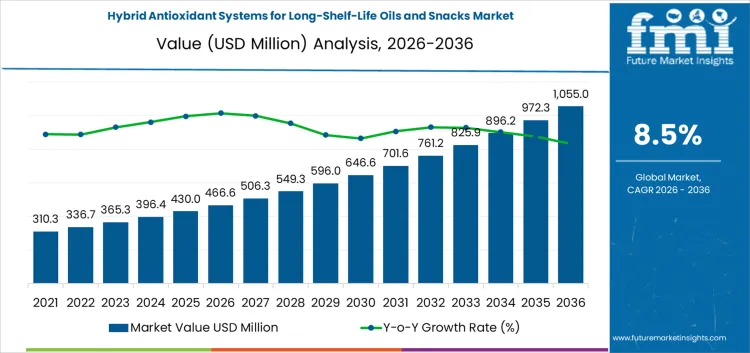
Buyer behavior reinforces margin concentration rather than price-driven commoditization. Oil refiners and snack manufacturers display low tolerance for performance variability, prioritizing antioxidants that stabilize products across temperature swings, light exposure, and extended logistics windows. Switching costs remain elevated since antioxidant systems are validated at formulation, processing, and shelf-life levels, making late-stage replacement operationally risky. Procurement teams therefore reward suppliers offering predictable oxidation control, regulatory readiness, and formulation support over lowest unit pricing. Investment flows toward blended antioxidant platforms that balance clean-label constraints with industrial robustness. Between 2026 and 2036, growth quality depends on execution reliability, risk reduction capability, and ability to protect finished product economics, rather than expansion of snack categories alone.
Hybrid Antioxidant Systems for Long-Shelf-Life Oils and Snacks Market Key Takeaways
| Metric | Value |
|---|---|
| Market Value (2026) | USD 466.6 million |
| Market Forecast Value (2036) | USD 1,054.9 million |
| Forecast CAGR (2026-2036) | 8.5% |
Why is the Demand for Hybrid Antioxidant Systems for Long-Shelf-Life Oils and Snacks Market Growing Globally?
Demand for hybrid antioxidant systems for long-shelf-life oils and snacks is growing globally due to increasing focus on product quality, extended shelf stability, and reduced reliance on synthetic preservatives. Oils and snack products are susceptible to oxidative degradation, which leads to rancidity, off-flavors, and nutrient loss during storage and distribution. Manufacturers adopt hybrid antioxidant systems that combine natural and engineered antioxidant compounds to achieve robust oxidative stability while aligning with regulatory limits and consumer expectations for cleaner ingredient profiles. Regulatory frameworks in multiple regions emphasize labeling transparency, permissible additive use, and reduced exposure to potentially harmful synthetic antioxidants, which motivates formulation with integrated systems that deliver both performance and compliance.
Growth in global snack consumption, healthy snack segments, and packaged food demand reinforces need for antioxidant solutions capable of protecting product integrity under varied temperature, light, and oxygen exposure conditions. Advances in antioxidant delivery technologies improve dispersion, solubility, and sustained activity in complex lipid matrices common in oils and fried or baked snack foods. Retail expansion through mass market, convenience, and online channels increases product turnover and storage timeframes, strengthening requirement for reliable oxidative protection. Continued emphasis on sensory quality, nutritional retention, and clean label positioning supports sustained adoption of hybrid antioxidant systems in global food portfolios.
How Is the Global Hybrid Antioxidant Systems for Long-Shelf-Life Oils and Snacks Market Structured?
Global demand for hybrid antioxidant systems in oils and snack products is driven by requirements for oxidative stability, flavor preservation, and extended shelf performance under varied storage conditions. Formulators integrate multiple antioxidant mechanisms to control lipid oxidation across frying oils, baked snacks, and packaged foods. Adoption reflects emphasis on maintaining sensory consistency, regulatory compliance, and processing compatibility while supporting long distribution cycles and ambient storage across diverse geographies.
Which Application Segment Represents the Largest Share of Global Demand?
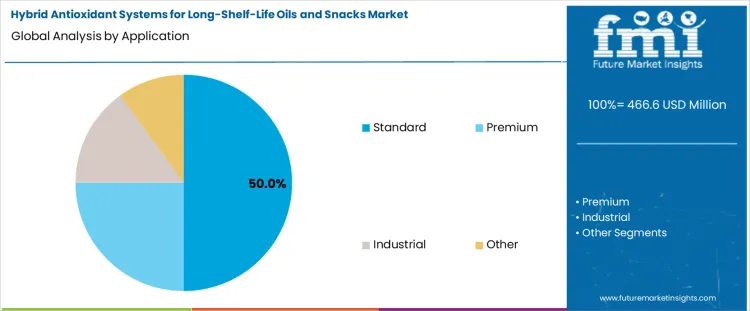
Standard applications account for 50.0% of global demand, reflecting widespread use in mainstream edible oils, packaged snacks, and everyday food products requiring consistent oxidation control. These applications prioritize balanced cost performance, predictable antioxidant activity, and compatibility with high-throughput processing. Premium applications represent 25.0%, driven by branded oils and specialty snacks where extended freshness, clean positioning, and sensory stability are critical. Industrial applications hold 15.0%, supporting bulk oil processing, ingredient manufacturing, and foodservice operations with rigorous stability requirements. Other applications account for 10.0%, covering niche formats such as specialty coatings, seasoning systems, and emerging snack categories.
Key Takeaways
- Standard applications lead due to broad use in mass-consumption oils and snacks
- Premium products emphasize extended freshness and sensory retention
- Industrial and niche uses remain volume-specific
Which Product Form Is Most Widely Adopted in Hybrid Antioxidant Systems?
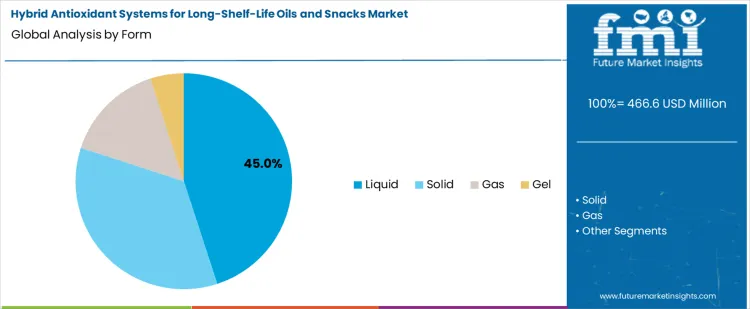
Liquid forms dominate with a 45.0% share, favored for ease of dosing, rapid dispersion, and uniform protection in oils and liquid fat systems. Liquids integrate efficiently into frying oils and spray applications during snack processing. Solid forms account for 35.0%, supporting stability and controlled release in dry snack formulations and seasoning blends. Gas-based systems represent 15.0%, reflecting specialized use in modified atmosphere packaging where oxidative exposure is minimized. Gel formats hold 5.0%, applied selectively where localized antioxidant delivery or viscosity contribution is required during processing.
Key Takeaways
- Liquid formats lead due to direct compatibility with oil systems
- Solid forms support dry snack and seasoning applications
- Gas and gel formats serve specialized processing needs
Which Distribution Channel Dominates Global Supply of Hybrid Antioxidant Systems?
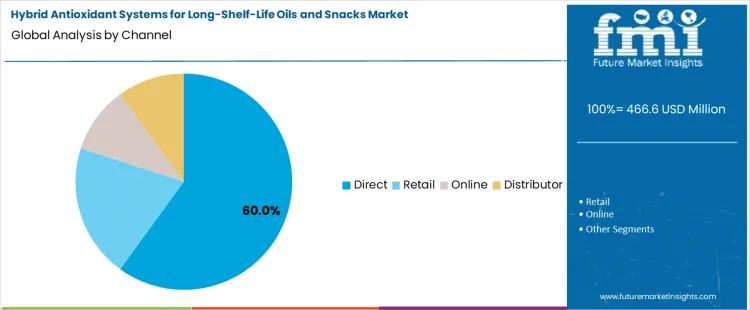
Direct channels account for 60.0% of global distribution, reflecting the need for formulation alignment, processing validation, and performance testing across oil and snack matrices. Direct supplier engagement supports customization based on fat composition and shelf-life targets. Retail channels represent 20.0%, supplying standardized antioxidant systems to smaller producers and regional brands. Online channels hold 10.0%, supporting development-stage sourcing and rapid procurement. Distributor-led supply accounts for 10.0%, enabling efficient distribution of established formulations across multiple regions.
Key Takeaways
- Direct supply leads due to formulation-specific performance requirements
- Retail and distributors expand access to standardized systems
- Online channels support early-stage and flexible sourcing
What are the Key Dynamics in the Hybrid Antioxidant Systems for Long-Shelf-Life Oils and Snacks Market?
Global demand rises as food manufacturers adopt hybrid antioxidant systems that combine natural extracts, tocopherols, and engineered stabilizers to extend oxidative stability of oils and snack products. Hybrid antioxidants help maintain product freshness, reduce rancidity, and preserve sensory quality during prolonged storage and distribution. Adoption aligns with consumer preference for cleaner labels, extended shelf life without synthetic overreliance, and regulatory scrutiny of food additives across North America, Europe, Asia-Pacific, and Latin America. Usage spans packaged cooking oils, extruded snacks, chips, nut butters, and baked goods where lipid oxidation is a primary quality concern.
How do quality expectations and processing performance shape adoption?
Consumers increasingly demand long-lasting products that retain taste, aroma, and nutritional value without undesirable off-flavors that arise from oxidation. Food developers integrate hybrid antioxidant systems to balance efficacy and label positioning by combining plant-derived antioxidants with efficacious stabilizers that delay oxidative breakdown of unsaturated fats. Snack producers focus on formulations that maintain crispness and color stability under varied temperature and humidity conditions encountered during supply chain movement. Oil processors tailor antioxidant blends to specific oil profiles such as sunflower, canola, and high-oleic varieties to maximize protection. Retailers emphasize products with credible shelf-life claims supported by stability testing and transparent ingredient disclosure.
How do cost pressures, formulation complexity, and regulatory variation influence market scalability?
Hybrid antioxidant systems often involve specialized ingredient combinations that increase formulation complexity and raw material costs relative to single-agent solutions. Manufacturers must optimize synergistic effects to achieve desired shelf-life improvements while avoiding interactions that impact taste or processing behavior. Pricing strategies for finished products must account for ingredient premiums in value-sensitive segments. Regulatory frameworks governing antioxidant use, allowable declarations, and functional claims vary across jurisdictions, influencing compliance planning for global product distribution. Supply chain variability in natural antioxidant sources affects pricing and availability. Long-term growth depends on continued innovation in cost-effective, high-performance antioxidant solutions and harmonized safety and labeling standards that support broad adoption in oils and snacks worldwide.
How Is Demand for Hybrid Antioxidant Systems for Long-Shelf-Life Oils and Snacks Evolving Globally?
Demand for hybrid antioxidant systems for long-shelf-life oils and snacks is increasing globally due to oxidation control requirements, extended distribution cycles, and reformulation pressure to replace single-function antioxidants. China leads with a 12.0% CAGR, supported by large-scale edible oil refining and packaged snack expansion. France follows at 11.1%, driven by quality preservation standards and premium snack positioning. USA records a 10.8% CAGR, shaped by shelf-life guarantees and clean-label reformulation. Germany posts 10.6%, reflecting regulatory discipline and predictable performance requirements. Growth reflects shift toward combined antioxidant systems that integrate primary and secondary mechanisms to stabilize fats, flavors, and textures over prolonged storage.
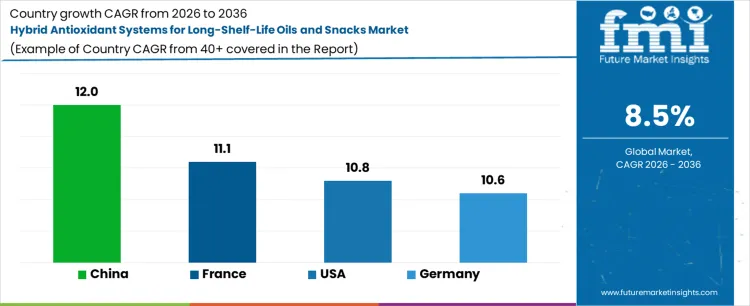
| Country | CAGR (%) |
|---|---|
| China | 12.0% |
| France | 11.1% |
| USA | 10.8% |
| Germany | 10.6% |
What is driving accelerated adoption of hybrid antioxidant systems in China?
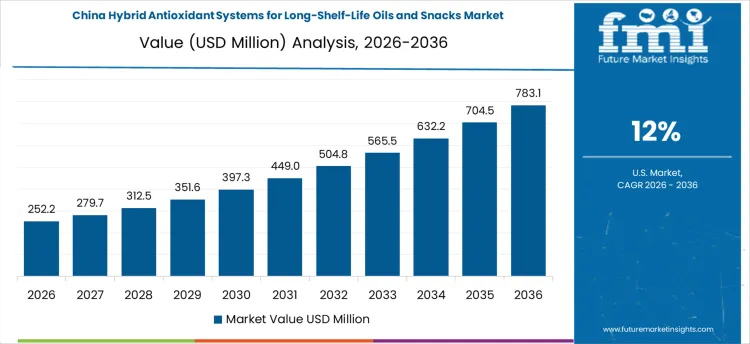
China demand is driven by rapid expansion of packaged snacks and high-volume edible oil production supplying nationwide distribution networks. CAGR of 12.0% reflects increasing use of hybrid antioxidant systems that combine tocopherols, chelators, and synergists to delay lipid oxidation. Manufacturers require solutions that perform consistently across variable storage temperatures and extended logistics cycles. Regulatory focus on food safety supports controlled antioxidant selection. Domestic ingredient suppliers scale blended antioxidant platforms compatible with refined oils and fried snacks. Growth remains scale-driven and processing-aligned, supported by industrial food manufacturing growth and need for shelf-life predictability.
- Expansion of packaged snack and edible oil production
- Need for oxidation control over long logistics cycles
- Adoption of multi-mechanism antioxidant blends
- Scaling of domestic antioxidant ingredient platforms
How is France sustaining growth in hybrid antioxidant system adoption?
France demand reflects strong emphasis on product quality, flavor integrity, and shelf stability in oils and snack foods. CAGR of 11.1% is supported by use of hybrid antioxidant systems that preserve sensory attributes while extending shelf life. Manufacturers prioritize protection against rancidity without compromising taste profiles. Culinary quality expectations influence antioxidant strategy selection. Ingredient solutions often combine natural extracts with functional stabilizers. Regulatory alignment supports controlled use of antioxidant blends. Growth remains quality-driven and formulation-focused, supported by premium snack development and export-oriented food production.
- Emphasis on flavor preservation and quality stability
- Use of combined natural and functional antioxidants
- Adoption in premium oils and snack categories
- Alignment with regulatory and culinary standards
What factors are shaping demand growth in the USA for hybrid antioxidant systems?
USA demand is shaped by retailer shelf-life requirements, clean-label reformulation, and large-scale snack manufacturing. CAGR of 10.8% reflects increased use of hybrid antioxidant systems to replace single additives while maintaining oxidative stability. Brands focus on extending freshness without synthetic-heavy profiles. Snack producers require antioxidants compatible with frying, baking, and ambient storage. Regulatory clarity supports blended antioxidant solutions. Ingredient suppliers develop application-specific systems for oils and snacks. Growth remains brand-led and compliance-focused, aligned with reformulation cycles and shelf-life assurance needs.
- Retailer-driven shelf-life guarantees
- Clean-label reformulation pressure
- Need for stability across multiple processing methods
- Availability of application-specific antioxidant blends
Why is Germany showing steady expansion in hybrid antioxidant system usage?
Germany demand reflects strong regulatory oversight, emphasis on predictable performance, and cautious additive use. CAGR of 10.6% is supported by adoption of hybrid antioxidant systems that deliver consistent oxidation control with documented efficacy. Manufacturers prioritize reproducibility and compliance in oils and snack products. Ingredient selection favors well-characterized blends with stable performance across batches. Quality assurance standards drive adoption of multi-function systems. Growth remains regulation-aligned and quality-focused, supported by disciplined formulation practices and high consumer trust in food stability standards.
- Strong regulatory and quality assurance frameworks
- Demand for predictable antioxidant performance
- Adoption in oils and processed snack categories
- Preference for documented and compliant systems
What is the competitive landscape of demand for hybrid antioxidant systems for long-shelf-life oils and snacks globally?
Demand for hybrid antioxidant systems for long-shelf-life oils and snacks is driven by oxidation control requirements, extended distribution cycles, and reduction of synthetic additive reliance. These systems combine natural and nature-identical antioxidants to protect fats and oils from rancidity, flavor degradation, and color instability during processing and storage. Buyers evaluate oxidative stability performance, synergy between antioxidant components, thermal resistance, and compatibility with frying oils, baked snacks, and extruded products. Procurement teams prioritize suppliers offering validated shelf-life extension data, regulatory compliance across food categories, and formulation flexibility supporting clean-label positioning. Trend in the global market reflects increased use of blended antioxidant approaches to balance performance, cost efficiency, and label acceptance.
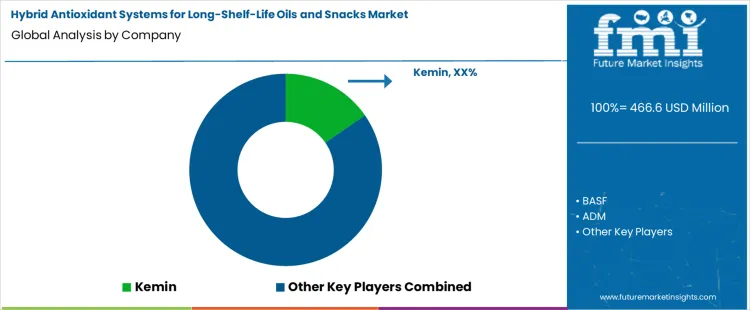
Kemin holds leading positioning through proprietary antioxidant blends designed for oil and snack stability under high-temperature and long-storage conditions. BASF supplies antioxidant technologies and formulation expertise supporting lipid protection in processed foods. ADM contributes natural antioxidant ingredients and integrated oil stabilization solutions serving large-scale snack and oil processors. DSM-Firmenich supports demand with science-backed antioxidant systems and sensory optimization capabilities. IFF participates through functional ingredient platforms combining oxidation control with flavor protection. Competitive differentiation depends on oxidation inhibition efficiency, formulation adaptability, regulatory readiness, and ability to support consistent product quality across extended shelf lives.
Key Players in the Hybrid Antioxidant Systems for Long-Shelf-Life Oils and Snacks Market
- Kemin
- BASF
- ADM
- DSM-Firmenich
- IFF
- Eastman
Scope of the Report
| Items | Values |
|---|---|
| Quantitative Units | USD million |
| Application | Standard; Premium; Industrial; Other |
| Form | Liquid; Solid; Gas; Gel |
| Channel | Direct; Retail; Online; Distributor |
| Regions Covered | Asia Pacific, Europe, North America, Latin America, Middle East & Africa |
| Countries Covered | China, France, USA, Germany, and 40+ countries |
| Key Companies Profiled | Kemin; BASF; ADM; DSM-Firmenich; IFF; Eastman |
| Additional Attributes | Dollar sales by application and form; adoption trends for hybrid antioxidant systems combining natural and synthetic actives in oils and snack matrices; oxidative stability, peroxide value control, and sensory preservation performance metrics; compatibility with frying oils, baked snacks, and extruded products; processing stability under heat, oxygen exposure, and extended storage; regulatory compliance, clean-label positioning, and shelf-life claim substantiation influencing antioxidant system selection. |
Hybrid Antioxidant Systems for Long-Shelf-Life Oils and Snacks Market by Segment
Application:
- Standard
- Premium
- Industrial
- Other
Form:
- Liquid
- Solid
- Gas
- Gel
Channel:
- Direct
- Retail
- Online
- Distributor
Region:
- Asia Pacific
- China
- Japan
- South Korea
- India
- Australia & New Zealand
- ASEAN
- Rest of Asia Pacific
- Europe
- Germany
- United Kingdom
- France
- Italy
- Spain
- Nordic
- BENELUX
- Rest of Europe
- North America
- United States
- Canada
- Mexico
- Latin America
- Brazil
- Chile
- Rest of Latin America
- Middle East & Africa
- Kingdom of Saudi Arabia
- Other GCC Countries
- Turkey
- South Africa
- Other African Union
- Rest of Middle East & Africa
Frequently Asked Questions
How big is the hybrid antioxidant systems for long-shelf-life oils and snacks market in 2026?
The global hybrid antioxidant systems for long-shelf-life oils and snacks market is estimated to be valued at USD 466.6 million in 2026.
What will be the size of hybrid antioxidant systems for long-shelf-life oils and snacks market in 2036?
The market size for the hybrid antioxidant systems for long-shelf-life oils and snacks market is projected to reach USD 1,055.0 million by 2036.
How much will be the hybrid antioxidant systems for long-shelf-life oils and snacks market growth between 2026 and 2036?
The hybrid antioxidant systems for long-shelf-life oils and snacks market is expected to grow at a 8.5% CAGR between 2026 and 2036.
What are the key product types in the hybrid antioxidant systems for long-shelf-life oils and snacks market?
The key product types in hybrid antioxidant systems for long-shelf-life oils and snacks market are standard, premium, industrial and other.
Which form segment to contribute significant share in the hybrid antioxidant systems for long-shelf-life oils and snacks market in 2026?
In terms of form, liquid segment to command 45.0% share in the hybrid antioxidant systems for long-shelf-life oils and snacks market in 2026.
Preview the report firsthand - request a free sample
Get SampleGet the brochure for pricing and purchase details.
Get PDFTable of Content
- Executive Summary
- Global Market Outlook
- Demand-side Trends
- Supply-side Trends
- Technology Roadmap Analysis
- Analysis and Recommendations
- Market Overview
- Market Coverage / Taxonomy
- Market Definition / Scope / Limitations
- Market Background
- Market Dynamics
- Drivers
- Restraints
- Opportunity
- Trends
- Scenario Forecast
- Demand in Optimistic Scenario
- Demand in Likely Scenario
- Demand in Conservative Scenario
- Opportunity Map Analysis
- Product Life Cycle Analysis
- Supply Chain Analysis
- Investment Feasibility Matrix
- Value Chain Analysis
- PESTLE and Porter’s Analysis
- Regulatory Landscape
- Regional Parent Market Outlook
- Production and Consumption Statistics
- Import and Export Statistics
- Market Dynamics
- Global Market Analysis 2021 to 2025 and Forecast, 2026 to 2036
- Historical Market Size Value (USD Million) Analysis, 2021 to 2025
- Current and Future Market Size Value (USD Million) Projections, 2026 to 2036
- Y-o-Y Growth Trend Analysis
- Absolute $ Opportunity Analysis
- Global Market Pricing Analysis 2021 to 2025 and Forecast 2026 to 2036
- Global Market Analysis 2021 to 2025 and Forecast 2026 to 2036, By Application
- Introduction / Key Findings
- Historical Market Size Value (USD Million) Analysis By Application , 2021 to 2025
- Current and Future Market Size Value (USD Million) Analysis and Forecast By Application , 2026 to 2036
- Standard
- Premium
- Industrial
- Other
- Standard
- Y-o-Y Growth Trend Analysis By Application , 2021 to 2025
- Absolute $ Opportunity Analysis By Application , 2026 to 2036
- Global Market Analysis 2021 to 2025 and Forecast 2026 to 2036, By Form
- Introduction / Key Findings
- Historical Market Size Value (USD Million) Analysis By Form, 2021 to 2025
- Current and Future Market Size Value (USD Million) Analysis and Forecast By Form, 2026 to 2036
- Liquid
- Solid
- Gas
- Gel
- Liquid
- Y-o-Y Growth Trend Analysis By Form, 2021 to 2025
- Absolute $ Opportunity Analysis By Form, 2026 to 2036
- Global Market Analysis 2021 to 2025 and Forecast 2026 to 2036, By Channel
- Introduction / Key Findings
- Historical Market Size Value (USD Million) Analysis By Channel, 2021 to 2025
- Current and Future Market Size Value (USD Million) Analysis and Forecast By Channel, 2026 to 2036
- Direct
- Retail
- Online
- Distributor
- Direct
- Y-o-Y Growth Trend Analysis By Channel, 2021 to 2025
- Absolute $ Opportunity Analysis By Channel, 2026 to 2036
- Global Market Analysis 2021 to 2025 and Forecast 2026 to 2036, By Region
- Introduction
- Historical Market Size Value (USD Million) Analysis By Region, 2021 to 2025
- Current Market Size Value (USD Million) Analysis and Forecast By Region, 2026 to 2036
- North America
- Latin America
- Western Europe
- Eastern Europe
- East Asia
- South Asia and Pacific
- Middle East & Africa
- Market Attractiveness Analysis By Region
- North America Market Analysis 2021 to 2025 and Forecast 2026 to 2036, By Country
- Historical Market Size Value (USD Million) Trend Analysis By Market Taxonomy, 2021 to 2025
- Market Size Value (USD Million) Forecast By Market Taxonomy, 2026 to 2036
- By Country
- USA
- Canada
- Mexico
- By Application
- By Form
- By Channel
- By Country
- Market Attractiveness Analysis
- By Country
- By Application
- By Form
- By Channel
- Key Takeaways
- Latin America Market Analysis 2021 to 2025 and Forecast 2026 to 2036, By Country
- Historical Market Size Value (USD Million) Trend Analysis By Market Taxonomy, 2021 to 2025
- Market Size Value (USD Million) Forecast By Market Taxonomy, 2026 to 2036
- By Country
- Brazil
- Chile
- Rest of Latin America
- By Application
- By Form
- By Channel
- By Country
- Market Attractiveness Analysis
- By Country
- By Application
- By Form
- By Channel
- Key Takeaways
- Western Europe Market Analysis 2021 to 2025 and Forecast 2026 to 2036, By Country
- Historical Market Size Value (USD Million) Trend Analysis By Market Taxonomy, 2021 to 2025
- Market Size Value (USD Million) Forecast By Market Taxonomy, 2026 to 2036
- By Country
- Germany
- UK
- Italy
- Spain
- France
- Nordic
- BENELUX
- Rest of Western Europe
- By Application
- By Form
- By Channel
- By Country
- Market Attractiveness Analysis
- By Country
- By Application
- By Form
- By Channel
- Key Takeaways
- Eastern Europe Market Analysis 2021 to 2025 and Forecast 2026 to 2036, By Country
- Historical Market Size Value (USD Million) Trend Analysis By Market Taxonomy, 2021 to 2025
- Market Size Value (USD Million) Forecast By Market Taxonomy, 2026 to 2036
- By Country
- Russia
- Poland
- Hungary
- Balkan & Baltic
- Rest of Eastern Europe
- By Application
- By Form
- By Channel
- By Country
- Market Attractiveness Analysis
- By Country
- By Application
- By Form
- By Channel
- Key Takeaways
- East Asia Market Analysis 2021 to 2025 and Forecast 2026 to 2036, By Country
- Historical Market Size Value (USD Million) Trend Analysis By Market Taxonomy, 2021 to 2025
- Market Size Value (USD Million) Forecast By Market Taxonomy, 2026 to 2036
- By Country
- China
- Japan
- South Korea
- By Application
- By Form
- By Channel
- By Country
- Market Attractiveness Analysis
- By Country
- By Application
- By Form
- By Channel
- Key Takeaways
- South Asia and Pacific Market Analysis 2021 to 2025 and Forecast 2026 to 2036, By Country
- Historical Market Size Value (USD Million) Trend Analysis By Market Taxonomy, 2021 to 2025
- Market Size Value (USD Million) Forecast By Market Taxonomy, 2026 to 2036
- By Country
- India
- ASEAN
- Australia & New Zealand
- Rest of South Asia and Pacific
- By Application
- By Form
- By Channel
- By Country
- Market Attractiveness Analysis
- By Country
- By Application
- By Form
- By Channel
- Key Takeaways
- Middle East & Africa Market Analysis 2021 to 2025 and Forecast 2026 to 2036, By Country
- Historical Market Size Value (USD Million) Trend Analysis By Market Taxonomy, 2021 to 2025
- Market Size Value (USD Million) Forecast By Market Taxonomy, 2026 to 2036
- By Country
- Kingdom of Saudi Arabia
- Other GCC Countries
- Turkiye
- South Africa
- Other African Union
- Rest of Middle East & Africa
- By Application
- By Form
- By Channel
- By Country
- Market Attractiveness Analysis
- By Country
- By Application
- By Form
- By Channel
- Key Takeaways
- Key Countries Market Analysis
- USA
- Pricing Analysis
- Market Share Analysis, 2025
- By Application
- By Form
- By Channel
- Canada
- Pricing Analysis
- Market Share Analysis, 2025
- By Application
- By Form
- By Channel
- Mexico
- Pricing Analysis
- Market Share Analysis, 2025
- By Application
- By Form
- By Channel
- Brazil
- Pricing Analysis
- Market Share Analysis, 2025
- By Application
- By Form
- By Channel
- Chile
- Pricing Analysis
- Market Share Analysis, 2025
- By Application
- By Form
- By Channel
- Germany
- Pricing Analysis
- Market Share Analysis, 2025
- By Application
- By Form
- By Channel
- UK
- Pricing Analysis
- Market Share Analysis, 2025
- By Application
- By Form
- By Channel
- Italy
- Pricing Analysis
- Market Share Analysis, 2025
- By Application
- By Form
- By Channel
- Spain
- Pricing Analysis
- Market Share Analysis, 2025
- By Application
- By Form
- By Channel
- France
- Pricing Analysis
- Market Share Analysis, 2025
- By Application
- By Form
- By Channel
- India
- Pricing Analysis
- Market Share Analysis, 2025
- By Application
- By Form
- By Channel
- ASEAN
- Pricing Analysis
- Market Share Analysis, 2025
- By Application
- By Form
- By Channel
- Australia & New Zealand
- Pricing Analysis
- Market Share Analysis, 2025
- By Application
- By Form
- By Channel
- China
- Pricing Analysis
- Market Share Analysis, 2025
- By Application
- By Form
- By Channel
- Japan
- Pricing Analysis
- Market Share Analysis, 2025
- By Application
- By Form
- By Channel
- South Korea
- Pricing Analysis
- Market Share Analysis, 2025
- By Application
- By Form
- By Channel
- Russia
- Pricing Analysis
- Market Share Analysis, 2025
- By Application
- By Form
- By Channel
- Poland
- Pricing Analysis
- Market Share Analysis, 2025
- By Application
- By Form
- By Channel
- Hungary
- Pricing Analysis
- Market Share Analysis, 2025
- By Application
- By Form
- By Channel
- Kingdom of Saudi Arabia
- Pricing Analysis
- Market Share Analysis, 2025
- By Application
- By Form
- By Channel
- Turkiye
- Pricing Analysis
- Market Share Analysis, 2025
- By Application
- By Form
- By Channel
- South Africa
- Pricing Analysis
- Market Share Analysis, 2025
- By Application
- By Form
- By Channel
- USA
- Market Structure Analysis
- Competition Dashboard
- Competition Benchmarking
- Market Share Analysis of Top Players
- By Regional
- By Application
- By Form
- By Channel
- Competition Analysis
- Competition Deep Dive
- Kemin
- Overview
- Product Portfolio
- Profitability by Market Segments (Product/Age /Sales Channel/Region)
- Sales Footprint
- Strategy Overview
- Marketing Strategy
- Product Strategy
- Channel Strategy
- BASF
- ADM
- DSM-Firmenich
- IFF
- Eastman
- Kemin
- Competition Deep Dive
- Assumptions & Acronyms Used
- Research Methodology


