

- Industry Size (2026)
- USD 461 Mn
- Forecast (2036)
- USD 833.4 Mn
- CAGR (2026 to 2036)
- 6.10%
Static Spray Balls Market Forecast and Outlook 2026 to 2036
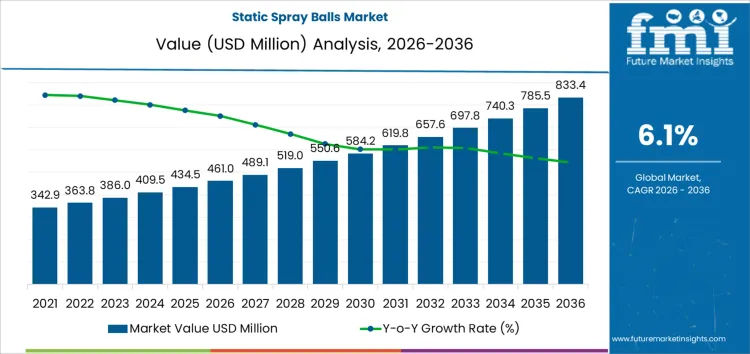
The static spray balls market is anticipated to expand from USD 461 million in 2026 to USD 833.4 million by 2036, registering a CAGR of 6.10%. The expansion is anchored in the non-discretionary nature of cleaning-in-place requirements across food processing, pharmaceuticals, beverages, and chemical manufacturing. Static spray balls are specified as permanent hygienic components within tanks, vessels, and reactors, making demand closely tied to installed processing capacity rather than short-term capital cycles. Buyers value predictable spray coverage, mechanical simplicity, and long operating life, which supports repeat procurement during plant upgrades, tank replacements, and regulatory-driven retrofits. Replacement demand remains steady as facilities periodically update cleaning hardware to maintain sanitation compliance and audit readiness.
Growth is further supported by rising automation of CIP systems and increased emphasis on water and chemical efficiency. While pricing pressure exists from low-cost alternatives, certified and application-validated products retain preference in regulated environments. The static spray balls market demonstrates stable, quality-led growth driven by hygiene mandates, retrofit activity, and long-term process reliability requirements rather than volume volatility.
Quick Stats for Static Spray Balls Market
- Static Spray Balls Market Value (2026): USD 461 Million
- Static Spray Balls Market Forecast Value (2036): USD 833.4 Million
- Static Spray Balls Market Forecast CAGR 2026 to 2036: 6.10%
- Leading Product Type in Static Spray Balls Market: Standard Static Spray Balls
- Key Growth Regions in Static Spray Balls Market: Asia Pacific, Europe, North America, Latin America, Middle East & Africa
- High-Growth Countries in Static Spray Balls Market: United States, China, India, Germany, United Kingdom
- Top Key Players in Static Spray Balls Market: Lechler GmbH, GEA Group AG, Spraying Systems Co., Alfa Laval AB, Butterworth Inc., SCANJET Systems AB, BETE Fog Nozzle, Inc., PNR Italia S.r.l., URACA GmbH & Co. KG, Toftejorg
Static Spray Balls Market Key Takeaways
| Metric | Value |
|---|---|
| Static Spray Balls Market Value (2026) | USD 461 Million |
| Static Spray Balls Market Forecast Value (2036) | USD 833.4 Million |
| Static Spray Balls Market Forecast CAGR 2026 to 2036 | 6.10% |
How Are Hygiene Standards and Process Efficiency Requirements Expanding the Static Spray Balls Market?
Demand for static spray balls is increasing as food, beverage, pharmaceutical, and chemical processors prioritize consistent cleaning performance and compliance with hygiene standards. Static spray balls are being selected for cleaning-in-place applications where reliability, simplicity, and predictable spray coverage are critical. For equipment manufacturers and system integrators, this demand translates into steady, repeat-order business tied to tank fabrication, process line expansion, and facility upgrades rather than discretionary capital spending cycles.
Procurement priorities in this market are shifting toward lifecycle efficiency rather than upfront unit cost. End users are evaluating spray ball designs based on cleaning effectiveness, flow optimization, pressure requirements, and resistance to chemical and thermal stress. Manufacturers offering precision-drilled spray patterns, corrosion-resistant alloys, and standardized sanitary connections are better positioned to meet customer expectations. Compatibility with automated CIP systems and reduced water and chemical consumption are increasingly influencing buyer selection.
Regulatory compliance and plant modernization are further supporting market growth. Stricter food safety and pharmaceutical manufacturing standards are driving replacement of improvised or outdated cleaning devices with certified, hygienic spray solutions. Expansion of processing capacity in Asia Pacific, along with nearshoring of food and beverage production in North America and Europe, is generating new installation demand. For suppliers, differentiation in this market increasingly depends on application expertise, customization capability, and long-term support rather than basic product availability.
What Is The Segment Overview Of The Static Spray Balls Market?
The static spray balls market is segmented by product type and application, reflecting how cleaning efficiency, hygiene standards, and process compatibility drive purchasing decisions across industries. By product type, standard static spray balls represent the leading segment, as they are widely used in clean-in-place (CIP) systems for routine tank and vessel cleaning. Custom static spray balls address specialized flow patterns, pressure conditions, and vessel geometries. By application, food and beverage processing forms the primary demand base, supported by strict sanitation requirements. Pharmaceuticals, chemicals, water treatment, industrial cleaning, and other sectors expand adoption across regulated and heavy-process environments.
What Factors Make Standard Static Spray Balls the Preferred Product Type?
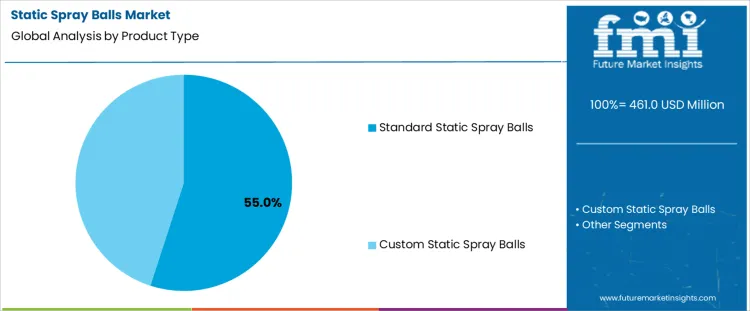
Standard static spray balls contribute 55% share of the static spray balls market because they deliver consistent internal surface coverage with a simple, maintenance-free design. Their fixed spray pattern ensures predictable cleaning performance across tanks, mixers, and reactors used in hygienic processing. Food and beverage manufacturers favor standard designs due to ease of validation and compatibility with existing CIP infrastructure. For suppliers, standardized models enable cost-efficient manufacturing and faster delivery cycles. These spray balls operate effectively at moderate pressures, meeting most routine sanitation requirements. This combination of operational reliability, affordability, and regulatory acceptance explains their strong market preference.
What Drives Food and Beverage Processing As the Leading Application Segment?
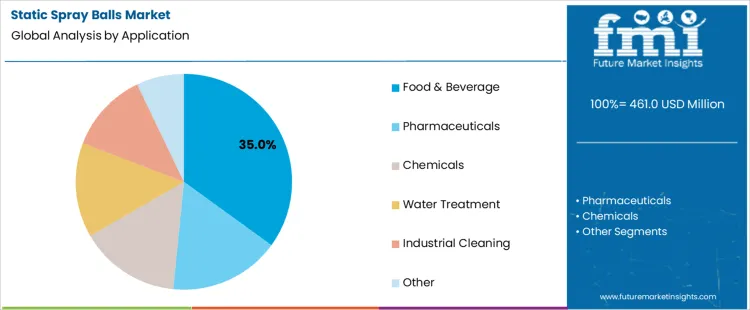
Food and beverage processing accounts for 35% share of the static spray balls market due to mandatory sanitation standards and repeated cleaning cycles across production lines. Vessels used for mixing, fermentation, and storage must be cleaned thoroughly to avoid cross-contamination and ensure product safety. Static spray balls enable automated, repeatable CIP processes without manual intervention, reducing downtime and labor costs. High throughput production environments increase cleaning frequency, sustaining steady demand. For manufacturers and suppliers, this segment offers recurring replacement opportunities and demand for hygienic-grade materials. These operational drivers position food and beverage processing as the primary application area.
What Are The Key Dynamics Of The Static Spray Balls Market?
The static spray balls market is influenced by the growing need for efficient, cost-effective cleaning solutions in food and beverage, pharmaceuticals, dairy, and chemical processing industries. Static spray balls are essential components in clean-in-place (CIP) systems, providing effective surface coverage with minimal mechanical complexity. Demand is driven by stringent hygiene and sanitation standards, regulatory compliance, and operational efficiency goals. Material selection (stainless steel grades, surface finish quality), spray coverage efficiency, and custom diameter and port designs remain critical purchase considerations. For manufacturers and suppliers, reliable supply chains, quality certifications, and ability to support engineering specifications across industries are key competitive differentiators.
How Are Application And Industry Trends Shaping The Static Spray Balls Market?
Application and industry trends are shaping the static spray balls market through increasing adoption of automated CIP systems and design optimization for higher throughput cleaning. Food processing facilities are specifying static spray balls with improved distribution patterns to reduce cycle times and chemical usage, supporting sustainability objectives. Growth in dairy and brewery operations is elevating demand for hygienic designs with smooth internal finishes and sanitary connections. Pharmaceutical and biotech sectors require traceable material certification and compatibility with aggressive cleaning agents. Suppliers offering engineering support for optimal placement, multi-plane coverage layouts, and retrofit solutions are gaining traction among end-users.
Why Do Design, Compliance, And Cost Challenges Restrain The Static Spray Balls Market?
Design, compliance, and cost challenges restrain the static spray balls market. Meeting diverse application requirements such as high pressure, varying viscosities, and sanitary standards necessitates tailored designs, which can increase manufacturing complexity and lead times. Material compliance with food-grade and pharmaceutical standards (e.g., 3-A, ASME BPE) adds certification and verification costs. Competition from low-cost, non-certified alternatives pressures pricing and margin performance for established manufacturers. Smaller processors may delay CIP upgrades due to budget constraints, limiting broader market adoption. Ensuring consistency in spray patterns and performance across batches requires rigorous quality control, impacting production costs.
How is the Global Cleaning-in-Place Landscape Shaping the Static Spray Balls Market?
The static spray balls market is shaped by hygiene compliance requirements, clean-in-place standardization, and process efficiency expectations across food processing, pharmaceuticals, breweries, and chemical manufacturing. Adoption patterns vary by region depending on automation maturity, regulatory rigor, and plant retrofit cycles. Developed markets emphasize validated cleaning coverage, material compliance, and long service life, while emerging markets focus on cost efficiency and retrofit compatibility. Suppliers increasingly compete on spray pattern reliability, flow optimization, and compatibility with stainless steel vessels and piping. Growth is influenced by replacement of manual cleaning methods, expansion of hygienic processing capacity, and modernization of legacy tanks. Manufacturers offering standardized designs, material traceability, and application engineering support are better positioned across global markets.
Why Does the United States Represent a High-Value Market for Static Spray Ball Suppliers?
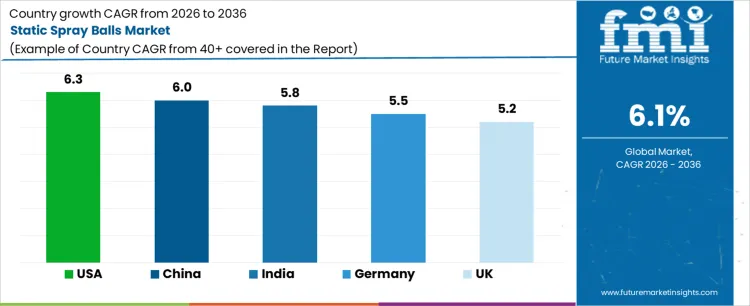
Demand for static spray balls in the United States, expanding at a CAGR of 6.3% during 2026 to 2036, is driven by strict hygiene standards across food, beverage, pharmaceutical, and biotechnology manufacturing facilities. End users prioritize validated cleaning performance, repeatable spray coverage, and compliance with FDA and sanitary design guidelines. Replacement of manual wash-down methods and older rotary devices supports steady equipment upgrades. Buyers emphasize material certification, corrosion resistance, and compatibility with automated CIP systems. Stainless steel static spray balls are widely specified for tanks, fermenters, and reactors requiring low-maintenance cleaning solutions. Procurement decisions favor suppliers offering documented spray patterns, application sizing support, and strong aftersales service. Volumes are moderate, but unit pricing remains attractive due to quality expectations and compliance requirements. Retrofit projects in breweries, dairy plants, and life sciences facilities contribute recurring demand. The United States rewards suppliers that combine product reliability, regulatory familiarity, and technical support rather than low-cost offerings.
How Is China Driving Volume-Oriented Adoption of Static Spray Balls?
Sale of static spray balls in China, growing at a CAGR of 6.0% from 2026 to 2036, is shaped by rapid expansion of food processing, beverage production, and chemical manufacturing capacity. Facilities increasingly implement CIP systems to improve consistency and reduce labor dependency. Buyers focus on affordability, basic spray coverage reliability, and compatibility with standardized tank designs. Local manufacturers dominate supply for general-purpose applications, creating strong price competition. International suppliers find opportunity in high-quality spray balls for pharmaceutical, dairy, and export-oriented food plants. Procurement often occurs in bulk, favoring suppliers with scalable production and local inventory. Retrofit activity in existing plants supports additional installations as hygiene expectations rise. While regulatory enforcement varies, export-driven facilities adopt higher sanitation standards. China represents a volume-driven market where success depends on cost efficiency, local presence, and ability to supply standardized products at scale.
How Is India Evolving into a Retrofit-Driven Market for Static Spray Balls?
Demand for static spray balls market in India, expanding at a CAGR of 5.8% during 2026 to 2036, reflects gradual modernization of hygienic processing facilities across food, dairy, beverage, and pharmaceutical sectors. Many plants continue operating legacy tanks and vessels, creating strong retrofit opportunities for simple, low-maintenance cleaning components. Buyers prioritize cost efficiency, ease of installation, and compatibility with existing clean-in-place infrastructure rather than advanced automation features. Stainless steel spray balls are increasingly preferred due to durability and resistance to aggressive cleaning chemicals. Procurement decisions are strongly influenced by price sensitivity, availability of local suppliers, and aftersales responsiveness. Government initiatives supporting food safety standards and pharmaceutical manufacturing upgrades indirectly support wider adoption. Small and mid-sized processors favor standardized designs that reduce downtime and simplify validation processes. Import substitution trends encourage sourcing from domestic manufacturers or regional distributors. Volumes are rising steadily as hygiene awareness improves and export-oriented facilities upgrade cleaning practices. India offers suppliers a long-term growth market where competitive pricing, local distribution networks, and application guidance drive sustained penetration across decentralized manufacturing clusters.
What Shapes Germany’s Quality-Focused Procurement for Static Spray Balls?
Sale of static spray balls market in Germany, growing at a CAGR of 5.5% during 2026 to 2036, is shaped by stringent hygiene standards and precision-oriented manufacturing practices. Food processing, brewery, pharmaceutical, and specialty chemical plants emphasize repeatable cleaning coverage and documented sanitation performance. Buyers focus on material traceability, surface finish quality, and long service life under aggressive cleaning regimes. Procurement processes are structured, with preference for suppliers providing detailed spray pattern validation and technical documentation. Replacement activity dominates, as facilities periodically upgrade components to maintain compliance with evolving standards. Volumes are moderate, yet quality expectations support premium pricing. Stainless steel spray balls with optimized flow characteristics are widely specified for tanks, reactors, and storage vessels. Suppliers benefit from long-term customer relationships and predictable maintenance cycles. Germany favors manufacturers offering engineering support, customization options, and consistent production quality rather than commodity products. This market rewards technical credibility, reliable logistics, and alignment with regulated industrial environments across export-oriented processing industries.
Why Does the UK Offer Stable, Specification-Led Opportunities for Suppliers?
The static spray balls market in United Kingdom, expanding at a CAGR of 5.2% during 2026 to 2036, reflects stable modernization within food, beverage, pharmaceutical, and specialty processing facilities. Buyers operate in regulated environments that prioritize consistent cleaning outcomes and audit-ready sanitation practices. Procurement focuses on reliability, compact design, and compatibility with existing clean-in-place systems. Replacement installations dominate, as plants update aging vessels and accessories to meet current hygiene expectations. Volumes remain limited compared with larger markets, yet specification rigor supports steady purchasing. Stainless steel static spray balls are commonly selected for tanks, fermenters, and storage units requiring simple, maintenance-free operation. Suppliers offering technical guidance, sizing support, and responsive service gain preference. Centralized purchasing within larger processing groups influences supplier selection. The UK market favors dependable products, short lead times, and compliance familiarity over extensive customization. This environment offers suppliers consistent opportunities tied to refurbishment projects and incremental plant upgrades across diverse hygienic processing segments.
How Are Manufacturers Competing in the Static Spray Balls Market?
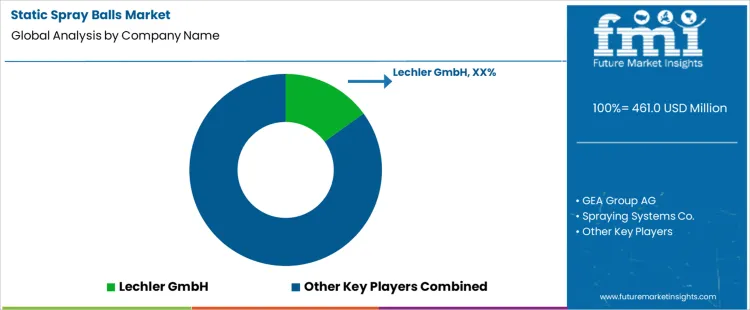
Competition in the static spray balls market is grounded in spray coverage efficiency, sanitary design validation, and compatibility with diverse tank geometries as presented in official product catalogs. Lechler GmbH positions its static spray balls around optimized orifice placement and self-draining bodies. Product documentation highlights uniform distribution patterns, minimal dead zones, and compliance with hygienic standards for beverage and dairy CIP systems. GEA Group AG competes through sanitary spray ball portfolios integrated with broader clean-in-place (CIP) systems. Its brochures emphasize engineered coverage efficiency and wash validation protocols for pharmaceutical and food processing tanks.
Broad nozzle and ball coverage defines another axis of competition. Spraying Systems Co. markets static spray balls with official literature that details multiple spray angle options and modular body materials for stainless steel and polymer environments. Alfa Laval AB positions its static spray balls with brochures highlighting hygienic design features such as crevice-free construction and FDA/EC compliance, aimed at high-purity cleaning applications. Butterworth Inc. competes on polished finishes and traceability documentation for dairy and beverage tanks, with product sheets outlining ASME-BPE fitting compatibility.
Sanitary and custom-fit solutions appeal to specialist segments. SCANJET Systems AB emphasizes robust static spray balls supported by certified flow rate data across pressure ranges. BETE Fog Nozzle, Inc. and PNR Italia S.r.l. offer variants with documentation on precision machined orifice sets and material traceability for hygienic service. URACA GmbH & Co. KG positions its products with emphasis on durability and CIP efficiency backed by technical datasheets.
Toftejorg (Alfa Laval) differentiates through static spray balls specified for high-sanitation cleanroom and biotech applications with brochures detailing surface roughness profiles and wash validation data. Sanipure Water Systems competes with corrosion-resistant configurations targeted at water and wastewater CIP processes, with official specs focused on flow distribution and maintenance simplicity. Across suppliers, differentiation is driven by brochure-verified spray pattern performance, sanitary certification alignment, and documented adaptability to industry standards rather than pricing alone.
Key Players in Static Spray Balls Market
- Lechler GmbH
- GEA Group AG
- Spraying Systems Co.
- Alfa Laval AB
- Butterworth Inc.
- SCANJET Systems AB
- BETE Fog Nozzle, Inc.
- PNR Italia S.r.l.
- URACA GmbH & Co. KG
- Toftejorg (Alfa Laval)
- Sanipure Water Systems
Scope of Report
| Attribute | Description |
|---|---|
| Quantitative Unit | USD Million |
| Product Type | Standard Static Spray Balls, Custom Static Spray Balls |
| Application | Food & Beverage, Pharmaceuticals, Chemicals, Water Treatment, Industrial Cleaning, Other |
| Countries Covered | China, Japan, South Korea, India, Australia & New Zealand, ASEAN, Rest of Asia Pacific, Germany, United Kingdom, France, Italy, Spain, Nordic, BENELUX, Rest of Europe, United States, Canada, Mexico, Brazil, Chile, Rest of Latin America, Kingdom of Saudi Arabia, Other GCC Countries, Turkey, South Africa, Other African Union, Rest of Middle East & Africa |
| Regions Covered | Asia Pacific, Europe, North America, Latin America, Middle East & Africa |
| Key Companies Profiled | Lechler GmbH, GEA Group AG, Spraying Systems Co., Alfa Laval AB, Butterworth Inc., SCANJET Systems AB, BETE Fog Nozzle, Inc., PNR Italia S.r.l., URACA GmbH & Co. KG, Toftejorg (Alfa Laval), Sanipure Water Systems |
| Additional Attributes | Dollar sales by product type and application are analyzed across hygienic and industrial cleaning operations. The report includes country-level demand assessment, growth projections for 2026 to 2036, evaluation of spray coverage and flow efficiency, assessment of CIP system integration trends, competitive benchmarking of manufacturers, and analysis of procurement patterns across food, pharmaceutical, chemical, and water treatment facilities. |
Static Spray Balls Market by Key Segments
Product Type:
- Standard Static Spray Balls
- Custom Static Spray Balls
Application:
- Food & Beverage
- Pharmaceuticals
- Chemicals
- Water Treatment
- Industrial Cleaning
- Other
Region:
- Asia Pacific
- China
- Japan
- South Korea
- India
- Australia & New Zealand
- ASEAN
- Rest of Asia Pacific
- Europe
- Germany
- United Kingdom
- France
- Italy
- Spain
- Nordic
- BENELUX
- Rest of Europe
- North America
- United States
- Canada
- Mexico
- Latin America
- Brazil
- Chile
- Rest of Latin America
- Middle East & Africa
- Kingdom of Saudi Arabia
- Other GCC Countries
- Turkey
- South Africa
- Other African Union
- Rest of Middle East & Africa
Bibliography
- American Society of Mechanical Engineers. (2024). ASME BPE-2024: Bioprocessing equipment. ASME.
- European Commission. (2024, September 5). Commission Implementing Regulation (EU) 2024/2209. Official Journal of the European Union.
- European Hygienic Engineering & Design Group. (2023). EHEDG Guideline 51: Hygienic design aspects for tank and vessel cleaning. EHEDG.
- Pharmaceutical Inspection Co-operation Scheme. (2023). Guide to GMP for medicinal products (PE 009-17), Part I. PIC/S.
- U.S. Government Publishing Office. (2026). Electronic Code of Federal Regulations: 21 CFR Part 117. GovInfo.
Frequently Asked Questions
How big is the static spray balls market in 2026?
The global static spray balls market is estimated to be valued at USD 461.0 million in 2026.
What will be the size of static spray balls market in 2036?
The market size for the static spray balls market is projected to reach USD 833.4 million by 2036.
How much will be the static spray balls market growth between 2026 and 2036?
The static spray balls market is expected to grow at a 6.1% CAGR between 2026 and 2036.
What are the key product types in the static spray balls market?
The key product types in static spray balls market are standard static spray balls and custom static spray balls.
Which application segment to contribute significant share in the static spray balls market in 2026?
In terms of application, food & beverage segment to command 35.0% share in the static spray balls market in 2026.
Preview the report firsthand - request a free sample
Get SampleGet the brochure for pricing and purchase details.
Get PDFTable of Content
- Executive Summary
- Global Market Outlook
- Demand-side Trends
- Supply-side Trends
- Technology Roadmap Analysis
- Analysis and Recommendations
- Market Overview
- Market Coverage / Taxonomy
- Market Definition / Scope / Limitations
- Market Background
- Market Dynamics
- Drivers
- Restraints
- Opportunity
- Trends
- Scenario Forecast
- Demand in Optimistic Scenario
- Demand in Likely Scenario
- Demand in Conservative Scenario
- Opportunity Map Analysis
- Product Life Cycle Analysis
- Supply Chain Analysis
- Investment Feasibility Matrix
- Value Chain Analysis
- PESTLE and Porter’s Analysis
- Regulatory Landscape
- Regional Parent Market Outlook
- Production and Consumption Statistics
- Import and Export Statistics
- Market Dynamics
- Global Market Analysis 2021 to 2025 and Forecast, 2026 to 2036
- Historical Market Size Value (USD Million) Analysis, 2021 to 2025
- Current and Future Market Size Value (USD Million) Projections, 2026 to 2036
- Y-o-Y Growth Trend Analysis
- Absolute $ Opportunity Analysis
- Global Market Pricing Analysis 2021 to 2025 and Forecast 2026 to 2036
- Global Market Analysis 2021 to 2025 and Forecast 2026 to 2036, By Product Type
- Introduction / Key Findings
- Historical Market Size Value (USD Million) Analysis By Product Type , 2021 to 2025
- Current and Future Market Size Value (USD Million) Analysis and Forecast By Product Type , 2026 to 2036
- Standard Static Spray Balls
- Custom Static Spray Balls
- Standard Static Spray Balls
- Y-o-Y Growth Trend Analysis By Product Type , 2021 to 2025
- Absolute $ Opportunity Analysis By Product Type , 2026 to 2036
- Global Market Analysis 2021 to 2025 and Forecast 2026 to 2036, By Application
- Introduction / Key Findings
- Historical Market Size Value (USD Million) Analysis By Application, 2021 to 2025
- Current and Future Market Size Value (USD Million) Analysis and Forecast By Application, 2026 to 2036
- Food & Beverage
- Pharmaceuticals
- Chemicals
- Water Treatment
- Industrial Cleaning
- Other
- Food & Beverage
- Y-o-Y Growth Trend Analysis By Application, 2021 to 2025
- Absolute $ Opportunity Analysis By Application, 2026 to 2036
- Global Market Analysis 2021 to 2025 and Forecast 2026 to 2036, By Region
- Introduction
- Historical Market Size Value (USD Million) Analysis By Region, 2021 to 2025
- Current Market Size Value (USD Million) Analysis and Forecast By Region, 2026 to 2036
- North America
- Latin America
- Western Europe
- Eastern Europe
- East Asia
- South Asia and Pacific
- Middle East & Africa
- Market Attractiveness Analysis By Region
- North America Market Analysis 2021 to 2025 and Forecast 2026 to 2036, By Country
- Historical Market Size Value (USD Million) Trend Analysis By Market Taxonomy, 2021 to 2025
- Market Size Value (USD Million) Forecast By Market Taxonomy, 2026 to 2036
- By Country
- USA
- Canada
- Mexico
- By Product Type
- By Application
- By Country
- Market Attractiveness Analysis
- By Country
- By Product Type
- By Application
- Key Takeaways
- Latin America Market Analysis 2021 to 2025 and Forecast 2026 to 2036, By Country
- Historical Market Size Value (USD Million) Trend Analysis By Market Taxonomy, 2021 to 2025
- Market Size Value (USD Million) Forecast By Market Taxonomy, 2026 to 2036
- By Country
- Brazil
- Chile
- Rest of Latin America
- By Product Type
- By Application
- By Country
- Market Attractiveness Analysis
- By Country
- By Product Type
- By Application
- Key Takeaways
- Western Europe Market Analysis 2021 to 2025 and Forecast 2026 to 2036, By Country
- Historical Market Size Value (USD Million) Trend Analysis By Market Taxonomy, 2021 to 2025
- Market Size Value (USD Million) Forecast By Market Taxonomy, 2026 to 2036
- By Country
- Germany
- UK
- Italy
- Spain
- France
- Nordic
- BENELUX
- Rest of Western Europe
- By Product Type
- By Application
- By Country
- Market Attractiveness Analysis
- By Country
- By Product Type
- By Application
- Key Takeaways
- Eastern Europe Market Analysis 2021 to 2025 and Forecast 2026 to 2036, By Country
- Historical Market Size Value (USD Million) Trend Analysis By Market Taxonomy, 2021 to 2025
- Market Size Value (USD Million) Forecast By Market Taxonomy, 2026 to 2036
- By Country
- Russia
- Poland
- Hungary
- Balkan & Baltic
- Rest of Eastern Europe
- By Product Type
- By Application
- By Country
- Market Attractiveness Analysis
- By Country
- By Product Type
- By Application
- Key Takeaways
- East Asia Market Analysis 2021 to 2025 and Forecast 2026 to 2036, By Country
- Historical Market Size Value (USD Million) Trend Analysis By Market Taxonomy, 2021 to 2025
- Market Size Value (USD Million) Forecast By Market Taxonomy, 2026 to 2036
- By Country
- China
- Japan
- South Korea
- By Product Type
- By Application
- By Country
- Market Attractiveness Analysis
- By Country
- By Product Type
- By Application
- Key Takeaways
- South Asia and Pacific Market Analysis 2021 to 2025 and Forecast 2026 to 2036, By Country
- Historical Market Size Value (USD Million) Trend Analysis By Market Taxonomy, 2021 to 2025
- Market Size Value (USD Million) Forecast By Market Taxonomy, 2026 to 2036
- By Country
- India
- ASEAN
- Australia & New Zealand
- Rest of South Asia and Pacific
- By Product Type
- By Application
- By Country
- Market Attractiveness Analysis
- By Country
- By Product Type
- By Application
- Key Takeaways
- Middle East & Africa Market Analysis 2021 to 2025 and Forecast 2026 to 2036, By Country
- Historical Market Size Value (USD Million) Trend Analysis By Market Taxonomy, 2021 to 2025
- Market Size Value (USD Million) Forecast By Market Taxonomy, 2026 to 2036
- By Country
- Kingdom of Saudi Arabia
- Other GCC Countries
- Turkiye
- South Africa
- Other African Union
- Rest of Middle East & Africa
- By Product Type
- By Application
- By Country
- Market Attractiveness Analysis
- By Country
- By Product Type
- By Application
- Key Takeaways
- Key Countries Market Analysis
- USA
- Pricing Analysis
- Market Share Analysis, 2025
- By Product Type
- By Application
- Canada
- Pricing Analysis
- Market Share Analysis, 2025
- By Product Type
- By Application
- Mexico
- Pricing Analysis
- Market Share Analysis, 2025
- By Product Type
- By Application
- Brazil
- Pricing Analysis
- Market Share Analysis, 2025
- By Product Type
- By Application
- Chile
- Pricing Analysis
- Market Share Analysis, 2025
- By Product Type
- By Application
- Germany
- Pricing Analysis
- Market Share Analysis, 2025
- By Product Type
- By Application
- UK
- Pricing Analysis
- Market Share Analysis, 2025
- By Product Type
- By Application
- Italy
- Pricing Analysis
- Market Share Analysis, 2025
- By Product Type
- By Application
- Spain
- Pricing Analysis
- Market Share Analysis, 2025
- By Product Type
- By Application
- France
- Pricing Analysis
- Market Share Analysis, 2025
- By Product Type
- By Application
- India
- Pricing Analysis
- Market Share Analysis, 2025
- By Product Type
- By Application
- ASEAN
- Pricing Analysis
- Market Share Analysis, 2025
- By Product Type
- By Application
- Australia & New Zealand
- Pricing Analysis
- Market Share Analysis, 2025
- By Product Type
- By Application
- China
- Pricing Analysis
- Market Share Analysis, 2025
- By Product Type
- By Application
- Japan
- Pricing Analysis
- Market Share Analysis, 2025
- By Product Type
- By Application
- South Korea
- Pricing Analysis
- Market Share Analysis, 2025
- By Product Type
- By Application
- Russia
- Pricing Analysis
- Market Share Analysis, 2025
- By Product Type
- By Application
- Poland
- Pricing Analysis
- Market Share Analysis, 2025
- By Product Type
- By Application
- Hungary
- Pricing Analysis
- Market Share Analysis, 2025
- By Product Type
- By Application
- Kingdom of Saudi Arabia
- Pricing Analysis
- Market Share Analysis, 2025
- By Product Type
- By Application
- Turkiye
- Pricing Analysis
- Market Share Analysis, 2025
- By Product Type
- By Application
- South Africa
- Pricing Analysis
- Market Share Analysis, 2025
- By Product Type
- By Application
- USA
- Market Structure Analysis
- Competition Dashboard
- Competition Benchmarking
- Market Share Analysis of Top Players
- By Regional
- By Product Type
- By Application
- Competition Analysis
- Competition Deep Dive
- Lechler GmbH
- Overview
- Product Portfolio
- Profitability by Market Segments (Product/Age /Sales Channel/Region)
- Sales Footprint
- Strategy Overview
- Marketing Strategy
- Product Strategy
- Channel Strategy
- GEA Group AG
- Spraying Systems Co.
- Alfa Laval AB
- Butterworth Inc.
- SCANJET Systems AB
- BETE Fog Nozzle, Inc.
- PNR Italia S.r.l.
- URACA GmbH & Co. KG
- Toftejorg (Alfa Laval)
- Sanipure Water Systems
- Lechler GmbH
- Competition Deep Dive
- Assumptions & Acronyms Used
- Research Methodology


