

- Industry Size (2025)
- USD 2.2 Bn
- Forecast (2035)
- USD 4.2 Bn
- CAGR (2025 to 2035)
- 6.7%
Spray Polyurethane Foam Market Size and Share Forecast Outlook 2025 to 2035
The Spray Polyurethane Foam Market is estimated to be valued at USD 2.2 billion in 2025 and is projected to reach USD 4.2 billion by 2035, registering a compound annual growth rate (CAGR) of 6.7% over the forecast period.
Quick Stats for Spray Polyurethane Foam Market
- Spray Polyurethane Foam Market Value (2025): USD 2.2 billion
- Spray Polyurethane Foam Market Forecast Value (2035): USD 4.2 billion
- Spray Polyurethane Foam Market Forecast CAGR: 6.7%
- Leading Segment in Spray Polyurethane Foam Market in 2025: Closed Cell Spray Polyurethane Foam (Ccspf) (57.6%)
- Key Growth Regions in Spray Polyurethane Foam Market: North America, Asia-Pacific, Europe
- Top Key Players in Spray Polyurethane Foam Market: BASF SE, Dow Chemical Company, Huntsman Corporation, Covestro AG, Carlisle Companies Inc., Johns Manville, NCFI Polyurethanes

Spray Polyurethane Foam Market Key Takeaways
| Metric | Value |
|---|---|
| Spray Polyurethane Foam Market Estimated Value in (2025 E) | USD 2.2 billion |
| Spray Polyurethane Foam Market Forecast Value in (2035 F) | USD 4.2 billion |
| Forecast CAGR (2025 to 2035) | 6.7% |
Why is the Spray Polyurethane Foam Market Growing?
The Spray Polyurethane Foam market is experiencing robust growth driven by increasing demand for energy-efficient and sustainable insulation solutions across residential, commercial, and industrial sectors. Rising awareness of energy conservation, stricter building codes, and government initiatives promoting green construction have contributed to market expansion. Spray polyurethane foam offers superior thermal performance, moisture resistance, and air-sealing capabilities compared with conventional insulation materials, making it highly suitable for modern construction projects.
The ongoing trend toward retrofitting and upgrading older buildings for energy efficiency has further supported the adoption of spray polyurethane foam. Additionally, the versatility of the material, including its applicability in complex structures, flat or sloped roofs, and new constructions, provides significant opportunities for growth.
Manufacturers are focusing on innovations such as low global warming potential formulations and rapid-curing products to meet environmental standards and shorten project timelines With increasing residential construction activity and urbanization, the Spray Polyurethane Foam market is expected to sustain strong growth over the coming years, providing efficient, long-lasting insulation solutions that align with energy-saving objectives.
Segmental Analysis
The spray polyurethane foam market is segmented by type, application, end user, and geographic regions. By type, spray polyurethane foam market is divided into Closed Cell Spray Polyurethane Foam (Ccspf) and Open Cell Spray Polyurethane Foam (Ocspf). In terms of application, spray polyurethane foam market is classified into Roofs, Floors, Walls, Ceilings, and Attics.
Based on end user, spray polyurethane foam market is segmented into Residential, Commercial, and Industrial. Regionally, the spray polyurethane foam industry is classified into North America, Latin America, Western Europe, Eastern Europe, Balkan & Baltic Countries, Russia & Belarus, Central Asia, East Asia, South Asia & Pacific, and the Middle East & Africa.
Insights into the Closed Cell Spray Polyurethane Foam (Ccspf) Segment
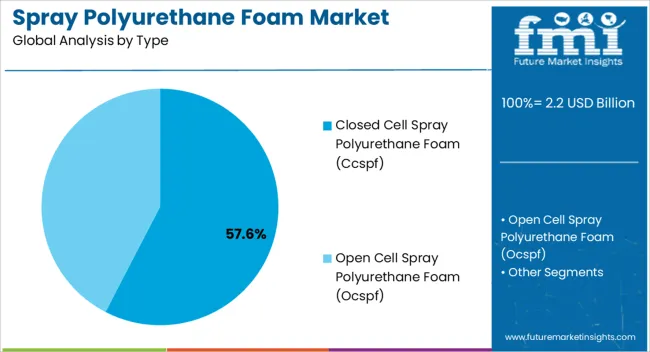
The Closed Cell Spray Polyurethane Foam segment is projected to hold 57.60% of the market revenue in 2025, making it the leading type in the Spray Polyurethane Foam market. This dominance is driven by its high insulation value, moisture resistance, and structural reinforcement properties, which are highly desirable in both new construction and retrofitting projects. The superior density of closed cell foam provides better thermal insulation per unit thickness, allowing for thinner application layers without compromising performance.
Its ability to act as both an air and vapor barrier has enhanced its adoption in regions with extreme weather conditions. The segment’s growth has also been fueled by increasing regulatory emphasis on energy efficiency and stringent building codes.
In addition, closed cell formulations provide enhanced durability, resistance to water absorption, and long-term dimensional stability, making them particularly suitable for residential and commercial roofing applications These performance advantages have positioned closed cell spray polyurethane foam as the preferred choice for developers, contractors, and architects seeking reliable, high-performance insulation solutions that meet both environmental and building standards.
Insights into the Roofs Application Segment
The Roofs application segment is expected to account for 42.80% of the Spray Polyurethane Foam market revenue in 2025, representing the largest share among applications. This segment’s leadership is being driven by the material’s ability to improve thermal insulation, prevent water infiltration, and extend roof lifespan, which are critical factors in both new construction and renovation projects. Spray polyurethane foam allows for seamless coverage over complex roof geometries, ensuring superior performance compared with traditional insulation methods.
Its application reduces energy consumption by maintaining indoor temperatures and preventing heat loss, which is increasingly valued by homeowners and commercial property managers. In addition, the rapid curing time and lightweight properties of foam have facilitated faster construction schedules and reduced structural load requirements.
The segment has also benefited from growing investments in energy-efficient buildings and rising awareness of sustainable construction practices These factors combined have established roofs as the dominant application for spray polyurethane foam, and its usage is expected to expand further with increasing green building initiatives and regulatory mandates focused on energy efficiency.
Insights into the Residential End User Segment
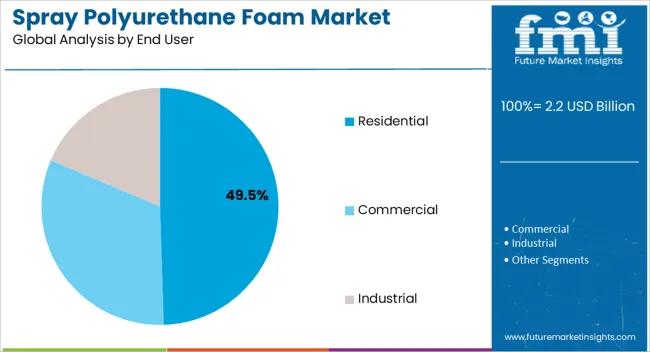
The Residential end-user segment is projected to hold 49.50% of the Spray Polyurethane Foam market revenue in 2025, making it the leading end-use industry. This segment’s growth has been fueled by rising residential construction, urbanization, and a focus on energy-efficient homes. Spray polyurethane foam provides superior thermal insulation, airtightness, and moisture resistance, which are critical for reducing energy bills and maintaining indoor comfort in residential buildings.
Its adaptability for roofs, walls, and basement insulation has made it a preferred choice among homeowners, builders, and contractors seeking long-term performance and sustainability. Additionally, government incentives and subsidies for energy-efficient housing projects have encouraged wider adoption of spray polyurethane foam in residential construction. The ease of retrofitting older homes with foam insulation without major structural alterations has further supported market penetration.
The segment’s growth is also being driven by increased consumer awareness regarding environmental impact, indoor air quality, and energy conservation As residential construction continues to expand in emerging and developed markets, spray polyurethane foam is expected to maintain its leading position, offering high-performance, durable, and sustainable insulation solutions.
Spray Polyurethane Foam Market: Introduction
Spray polyurethane foam is an insulator that is sprayed on the interior parts of a building (e.g., walls, roofs, and floors); it acts as an air barrier that prevents thermal leaks. Spray polyurethane foam is produced by two liquid components, polyol blend and MDI, which are mixed under pressure and sprayed onto a wall cavity or roof. Usage of spray polyurethane foam reduces the overall maintenance cost, extends the life span of a building and allows flexibility of building design. The spray polyurethane foam comes in two forms: open cell foam and closed cell foam. Among these, open cell foam also known as half-pound or low density foam is expected to gain traction in the coming years, owing to its wide application in building interiors.
Analysis of Spray Polyurethane Foam Market By Key Countries
| Country | CAGR |
|---|---|
| China | 9.0% |
| India | 8.4% |
| Germany | 7.7% |
| France | 7.0% |
| UK | 6.4% |
| USA | 5.7% |
| Brazil | 5.0% |
Country-wise Analysis
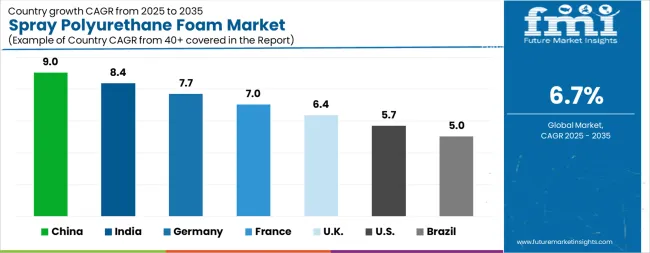
The Spray Polyurethane Foam Market is expected to register a CAGR of 6.7% during the forecast period, exhibiting varied country level momentum. China leads with the highest CAGR of 9.0%, followed by India at 8.4%. Developed markets such as Germany, France, and the UK continue to expand steadily, while the USA is likely to grow at consistent rates.
Brazil posts the lowest CAGR at 5.0%, yet still underscores a broadly positive trajectory for the global Spray Polyurethane Foam Market. In 2024, Germany held a dominant revenue in the Western Europe market and is expected to grow with a CAGR of 7.7%. The USA Spray Polyurethane Foam Market is estimated to be valued at USD 761.2 million in 2025 and is anticipated to reach a valuation of USD 1.3 billion by 2035.
Sales are projected to rise at a CAGR of 5.7% over the forecast period between 2025 and 2035. While Japan and South Korea markets are estimated to be valued at USD 99.1 million and USD 61.3 million respectively in 2025.
Key Players in the Spray Polyurethane Foam Market
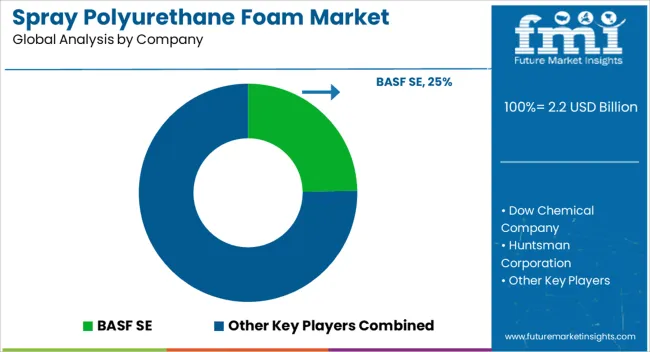
- BASF SE
- Dow Chemical Company
- Huntsman Corporation
- Covestro AG
- Carlisle Companies Inc.
- Johns Manville
- NCFI Polyurethanes
Scope of the Report
| Item | Value |
|---|---|
| Quantitative Units | USD 2.2 Billion |
| Type | Closed Cell Spray Polyurethane Foam (Ccspf) and Open Cell Spray Polyurethane Foam (Ocspf) |
| Application | Roofs, Floors, Walls, Ceilings, and Attics |
| End User | Residential, Commercial, and Industrial |
| Regions Covered | North America, Europe, Asia-Pacific, Latin America, Middle East & Africa |
| Country Covered | United States, Canada, Germany, France, United Kingdom, China, Japan, India, Brazil, South Africa |
| Key Companies Profiled | BASF SE, Dow Chemical Company, Huntsman Corporation, Covestro AG, Carlisle Companies Inc., Johns Manville, and NCFI Polyurethanes |
Spray Polyurethane Foam Market by Segments
Type:
- Closed Cell Spray Polyurethane Foam (Ccspf)
- Open Cell Spray Polyurethane Foam (Ocspf)
Application:
- Roofs
- Floors
- Walls
- Ceilings
- Attics
End User:
- Residential
- Commercial
- Industrial
Region:
- North America
- USA
- Canada
- Mexico
- Latin America
- Brazil
- Chile
- Rest of Latin America
- Western Europe
- Germany
- UK
- Italy
- Spain
- France
- Nordic
- BENELUX
- Rest of Western Europe
- Eastern Europe
- Russia
- Poland
- Hungary
- Balkan & Baltic
- Rest of Eastern Europe
- East Asia
- China
- Japan
- South Korea
- South Asia and Pacific
- India
- ASEAN
- Australia & New Zealand
- Rest of South Asia and Pacific
- Middle East & Africa
- Kingdom of Saudi Arabia
- Other GCC Countries
- Turkiye
- South Africa
- Other African Union
- Rest of Middle East & Africa
Frequently Asked Questions
How big is the spray polyurethane foam market in 2025?
The global spray polyurethane foam market is estimated to be valued at USD 2.2 billion in 2025.
What will be the size of spray polyurethane foam market in 2035?
The market size for the spray polyurethane foam market is projected to reach USD 4.2 billion by 2035.
How much will be the spray polyurethane foam market growth between 2025 and 2035?
The spray polyurethane foam market is expected to grow at a 6.7% CAGR between 2025 and 2035.
What are the key product types in the spray polyurethane foam market?
The key product types in spray polyurethane foam market are closed cell spray polyurethane foam (ccspf) and open cell spray polyurethane foam (ocspf).
Which application segment to contribute significant share in the spray polyurethane foam market in 2025?
In terms of application, roofs segment to command 42.8% share in the spray polyurethane foam market in 2025.
Preview the report firsthand - request a free sample
Get SampleGet the brochure for pricing and purchase details.
Get PDFTable of Content
- Executive Summary
- Global Market Outlook
- Demand-side Trends
- Supply-side Trends
- Technology Roadmap Analysis
- Analysis and Recommendations
- Market Overview
- Market Coverage / Taxonomy
- Market Definition / Scope / Limitations
- Market Background
- Market Dynamics
- Drivers
- Restraints
- Opportunity
- Trends
- Scenario Forecast
- Demand in Optimistic Scenario
- Demand in Likely Scenario
- Demand in Conservative Scenario
- Opportunity Map Analysis
- Product Life Cycle Analysis
- Supply Chain Analysis
- Investment Feasibility Matrix
- Value Chain Analysis
- PESTLE and Porter’s Analysis
- Regulatory Landscape
- Regional Parent Market Outlook
- Production and Consumption Statistics
- Import and Export Statistics
- Market Dynamics
- Global Market Analysis 2020 to 2024 and Forecast, 2025 to 2035
- Historical Market Size Value (USD Million) Analysis, 2020 to 2024
- Current and Future Market Size Value (USD Million) Projections, 2025 to 2035
- Y-o-Y Growth Trend Analysis
- Absolute $ Opportunity Analysis
- Global Market Pricing Analysis 2020 to 2024 and Forecast 2025 to 2035
- Global Market Analysis 2020 to 2024 and Forecast 2025 to 2035, By Type
- Introduction / Key Findings
- Historical Market Size Value (USD Million) Analysis By Type, 2020 to 2024
- Current and Future Market Size Value (USD Million) Analysis and Forecast By Type, 2025 to 2035
- Closed Cell (Ccspf)
- Open Cell (Ocspf)
- Y-o-Y Growth Trend Analysis By Type, 2020 to 2024
- Absolute $ Opportunity Analysis By Type, 2025 to 2035
- Global Market Analysis 2020 to 2024 and Forecast 2025 to 2035, By Application
- Introduction / Key Findings
- Historical Market Size Value (USD Million) Analysis By Application, 2020 to 2024
- Current and Future Market Size Value (USD Million) Analysis and Forecast By Application, 2025 to 2035
- Roofs
- Floors
- Walls
- Ceilings
- Attics
- Y-o-Y Growth Trend Analysis By Application, 2020 to 2024
- Absolute $ Opportunity Analysis By Application, 2025 to 2035
- Global Market Analysis 2020 to 2024 and Forecast 2025 to 2035, By End User
- Introduction / Key Findings
- Historical Market Size Value (USD Million) Analysis By End User, 2020 to 2024
- Current and Future Market Size Value (USD Million) Analysis and Forecast By End User, 2025 to 2035
- Residential
- Commercial
- Industrial
- Y-o-Y Growth Trend Analysis By End User, 2020 to 2024
- Absolute $ Opportunity Analysis By End User, 2025 to 2035
- Global Market Analysis 2020 to 2024 and Forecast 2025 to 2035, By Region
- Introduction
- Historical Market Size Value (USD Million) Analysis By Region, 2020 to 2024
- Current Market Size Value (USD Million) Analysis and Forecast By Region, 2025 to 2035
- North America
- Latin America
- Western Europe
- Eastern Europe
- East Asia
- South Asia and Pacific
- Middle East & Africa
- Market Attractiveness Analysis By Region
- North America Market Analysis 2020 to 2024 and Forecast 2025 to 2035, By Country
- Historical Market Size Value (USD Million) Trend Analysis By Market Taxonomy, 2020 to 2024
- Market Size Value (USD Million) Forecast By Market Taxonomy, 2025 to 2035
- By Country
- USA
- Canada
- Mexico
- By Type
- By Application
- By End User
- By Country
- Market Attractiveness Analysis
- By Country
- By Type
- By Application
- By End User
- Key Takeaways
- Latin America Market Analysis 2020 to 2024 and Forecast 2025 to 2035, By Country
- Historical Market Size Value (USD Million) Trend Analysis By Market Taxonomy, 2020 to 2024
- Market Size Value (USD Million) Forecast By Market Taxonomy, 2025 to 2035
- By Country
- Brazil
- Chile
- Rest of Latin America
- By Type
- By Application
- By End User
- By Country
- Market Attractiveness Analysis
- By Country
- By Type
- By Application
- By End User
- Key Takeaways
- Western Europe Market Analysis 2020 to 2024 and Forecast 2025 to 2035, By Country
- Historical Market Size Value (USD Million) Trend Analysis By Market Taxonomy, 2020 to 2024
- Market Size Value (USD Million) Forecast By Market Taxonomy, 2025 to 2035
- By Country
- Germany
- UK
- Italy
- Spain
- France
- Nordic
- BENELUX
- Rest of Western Europe
- By Type
- By Application
- By End User
- By Country
- Market Attractiveness Analysis
- By Country
- By Type
- By Application
- By End User
- Key Takeaways
- Eastern Europe Market Analysis 2020 to 2024 and Forecast 2025 to 2035, By Country
- Historical Market Size Value (USD Million) Trend Analysis By Market Taxonomy, 2020 to 2024
- Market Size Value (USD Million) Forecast By Market Taxonomy, 2025 to 2035
- By Country
- Russia
- Poland
- Hungary
- Balkan & Baltic
- Rest of Eastern Europe
- By Type
- By Application
- By End User
- By Country
- Market Attractiveness Analysis
- By Country
- By Type
- By Application
- By End User
- Key Takeaways
- East Asia Market Analysis 2020 to 2024 and Forecast 2025 to 2035, By Country
- Historical Market Size Value (USD Million) Trend Analysis By Market Taxonomy, 2020 to 2024
- Market Size Value (USD Million) Forecast By Market Taxonomy, 2025 to 2035
- By Country
- China
- Japan
- South Korea
- By Type
- By Application
- By End User
- By Country
- Market Attractiveness Analysis
- By Country
- By Type
- By Application
- By End User
- Key Takeaways
- South Asia and Pacific Market Analysis 2020 to 2024 and Forecast 2025 to 2035, By Country
- Historical Market Size Value (USD Million) Trend Analysis By Market Taxonomy, 2020 to 2024
- Market Size Value (USD Million) Forecast By Market Taxonomy, 2025 to 2035
- By Country
- India
- ASEAN
- Australia & New Zealand
- Rest of South Asia and Pacific
- By Type
- By Application
- By End User
- By Country
- Market Attractiveness Analysis
- By Country
- By Type
- By Application
- By End User
- Key Takeaways
- Middle East & Africa Market Analysis 2020 to 2024 and Forecast 2025 to 2035, By Country
- Historical Market Size Value (USD Million) Trend Analysis By Market Taxonomy, 2020 to 2024
- Market Size Value (USD Million) Forecast By Market Taxonomy, 2025 to 2035
- By Country
- Kingdom of Saudi Arabia
- Other GCC Countries
- Turkiye
- South Africa
- Other African Union
- Rest of Middle East & Africa
- By Type
- By Application
- By End User
- By Country
- Market Attractiveness Analysis
- By Country
- By Type
- By Application
- By End User
- Key Takeaways
- Key Countries Market Analysis
- USA
- Pricing Analysis
- Market Share Analysis, 2024
- By Type
- By Application
- By End User
- Canada
- Pricing Analysis
- Market Share Analysis, 2024
- By Type
- By Application
- By End User
- Mexico
- Pricing Analysis
- Market Share Analysis, 2024
- By Type
- By Application
- By End User
- Brazil
- Pricing Analysis
- Market Share Analysis, 2024
- By Type
- By Application
- By End User
- Chile
- Pricing Analysis
- Market Share Analysis, 2024
- By Type
- By Application
- By End User
- Germany
- Pricing Analysis
- Market Share Analysis, 2024
- By Type
- By Application
- By End User
- UK
- Pricing Analysis
- Market Share Analysis, 2024
- By Type
- By Application
- By End User
- Italy
- Pricing Analysis
- Market Share Analysis, 2024
- By Type
- By Application
- By End User
- Spain
- Pricing Analysis
- Market Share Analysis, 2024
- By Type
- By Application
- By End User
- France
- Pricing Analysis
- Market Share Analysis, 2024
- By Type
- By Application
- By End User
- India
- Pricing Analysis
- Market Share Analysis, 2024
- By Type
- By Application
- By End User
- ASEAN
- Pricing Analysis
- Market Share Analysis, 2024
- By Type
- By Application
- By End User
- Australia & New Zealand
- Pricing Analysis
- Market Share Analysis, 2024
- By Type
- By Application
- By End User
- China
- Pricing Analysis
- Market Share Analysis, 2024
- By Type
- By Application
- By End User
- Japan
- Pricing Analysis
- Market Share Analysis, 2024
- By Type
- By Application
- By End User
- South Korea
- Pricing Analysis
- Market Share Analysis, 2024
- By Type
- By Application
- By End User
- Russia
- Pricing Analysis
- Market Share Analysis, 2024
- By Type
- By Application
- By End User
- Poland
- Pricing Analysis
- Market Share Analysis, 2024
- By Type
- By Application
- By End User
- Hungary
- Pricing Analysis
- Market Share Analysis, 2024
- By Type
- By Application
- By End User
- Kingdom of Saudi Arabia
- Pricing Analysis
- Market Share Analysis, 2024
- By Type
- By Application
- By End User
- Turkiye
- Pricing Analysis
- Market Share Analysis, 2024
- By Type
- By Application
- By End User
- South Africa
- Pricing Analysis
- Market Share Analysis, 2024
- By Type
- By Application
- By End User
- USA
- Market Structure Analysis
- Competition Dashboard
- Competition Benchmarking
- Market Share Analysis of Top Players
- By Regional
- By Type
- By Application
- By End User
- Competition Analysis
- Competition Deep Dive
- BASF SE
- Overview
- Product Portfolio
- Profitability by Market Segments (Product/Age /Sales Channel/Region)
- Sales Footprint
- Strategy Overview
- Marketing Strategy
- Product Strategy
- Channel Strategy
- Dow Chemical Company
- Huntsman Corporation
- Covestro AG
- Carlisle Companies Inc.
- Johns Manville
- NCFI Polyurethanes
- BASF SE
- Competition Deep Dive
- Assumptions & Acronyms Used
- Research Methodology


