

- Industry Size (2026)
- USD 308 Mn
- Forecast (2036)
- USD 798.9 Mn
- CAGR (2026 to 2036)
- 10.0%
Sprayable Waterborne Construction Adhesives for Offsite Modules Market Forecast and Outlook 2026 to 2036
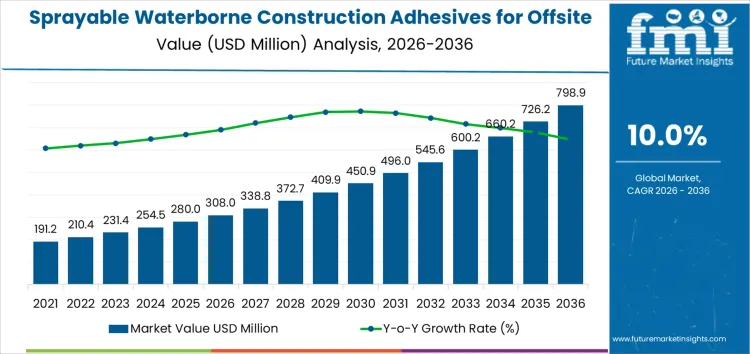
The sprayable waterborne construction adhesives for offsite modules market is valued at USD 308 million in 2026 and is projected to reach USD 798.9 million by 2036 reflecting a CAGR of 10.0%. Adoption patterns are shaped by installation speed requirements labor constraints and overspray control within factory assembly environments. Cost structures depend on curing time consistency spray equipment utilization and rework avoidance during repetitive module fabrication. Suppliers enabling faster takt times gain pricing leverage when adhesive choice influences throughput planning. That advantage favors formulations balancing open time adhesion strength and cleanability under standardized offsite production workflows used across projects globally.
Between 2026 and 2036 value capture reflects control over application performance rather than adhesive volumes sold. Offsite builders prioritize predictability waste reduction and compatibility with mixed substrates. Once specified adhesives remain locked due to process validation and worker training requirements. Strategic trade offs arise between formulation flexibility spray stability and line changeover efficiency. Firms offering application support documentation and consistent batch behavior retain stronger margins. Dependency on approved chemistries reduces supplier churn across long module programs. Profit pools favor vendors aligned with factory automation investment cycles where adhesive performance directly influences throughput reliability and cost predictability for developers and contractors.
Quick Stats for Sprayable Waterborne Construction Adhesives for Offsite Modules Market
- Sprayable Waterborne Construction Adhesives for Offsite Modules Market Value (2026): USD 308 million
- Sprayable Waterborne Construction Adhesives for Offsite Modules Market Forecast Value (2036): USD 798.9 million
- Sprayable Waterborne Construction Adhesives for Offsite Modules Market Forecast CAGR (2026–2036): 10.0%
- Leading Type in Sprayable Waterborne Construction Adhesives for Offsite Modules Market: Waterborne acrylic adhesives
- Key Growth Regions in Sprayable Waterborne Construction Adhesives for Offsite Modules Market: Asia Pacific, Europe, North America
- Top Players in Sprayable Waterborne Construction Adhesives for Offsite Modules Market: Henkel AG & Co. KGaA, H.B. Fuller Company, Sika AG, 3M Company, Arkema, Bostik
What Is the Growth Forecast for Sprayable Waterborne Construction Adhesives for Offsite Modules Market through 2036?
Installation speed requirements and labor productivity constraints define the early growth phase of the sprayable waterborne construction adhesives for offsite modules market between 2026 and 2031. During this period, the market expands from USD 308 million to USD 449 million, adding USD 141 million in value. Annual progression from USD 181 million to USD 308 million reflects rising adoption in prefabricated wall panels, flooring assemblies, and modular structural components. Historical growth was limited by reliance on mechanical fastening and solvent based bonding systems. Future expansion in this phase is supported by faster application times, improved bonding uniformity, and growing acceptance of spray applied solutions within controlled factory environments.
Standardization of modular construction workflows and scale efficiency shape growth from 2031 to 2036. Over this period, the market increases from USD 449 million to USD 798.9 million, adding USD 350 million and representing the stronger expansion phase. Annual values rise from USD 493 million to USD 798.9 million, indicating accelerating year over year momentum. Earlier demand focused on selective module applications, while future growth reflects wider specification across volumetric construction systems. Higher factory throughput, consistent bond quality, and growing deployment in residential and commercial offsite projects support sustained expansion as sprayable waterborne adhesives become integral to modular construction processes.
Sprayable Waterborne Construction Adhesives for Offsite Modules Market Key Takeaways
| Metric | Value |
|---|---|
| Market Value (2026) | USD 308 million |
| Forecast Value (2036) | USD 798.9 million |
| Forecast CAGR (2026–2036) | 10.0% |
What Is Driving Growth in the Sprayable Waterborne Construction Adhesives for Offsite Modules Market?
Growth in the sprayable waterborne construction adhesives market for offsite modules reflects shifts in building methods and environmental priorities rather than general adhesive demand alone. Prefabricated and modular construction requires adhesives that bond diverse substrates rapidly and reliably under controlled assembly conditions. Traditional solvent-based adhesives posed health, fire, and volatile emission challenges during indoor factory assembly. Waterborne formulations emerged to reduce volatile organic compound exposure while enabling spray application for speed and consistency. Early uptake occurred where offsite assembly volumes made bonding performance and workplace safety quantifiable issues rather than optional performance enhancements.
Future growth will be shaped by broader adoption of offsite construction methods and formalised sustainability criteria rather than isolated operational needs. Regulatory frameworks are tightening limits on volatile emissions and worker exposure during manufacturing and on job sites. Modular builders are incorporating sprayable waterborne adhesives into quality standards and assembly protocols to meet indoor air quality targets and reduce curing time without compromising bond strength. Advances in polymer technology are improving adhesion to a range of substrates used in modules, including engineered wood, composites, and insulation materials. Demand will align with procurement specifications that integrate environmental compliance, performance documentation, and repeatable application processes rather than solely with cost or convenience.
What Factors Are Affecting the Demand for Sprayable Waterborne Construction Adhesives for Offsite Modules Market in Terms of Adhesive Chemistry and Offsite Module Type?
The sprayable waterborne construction adhesives market for offsite modules is driven by growth in modular construction, tighter VOC regulations, and the need for faster, cleaner bonding methods in factory settings. Demand centers on adhesive systems that support rapid application, consistent bond quality, and worker safety. Adoption is influenced by module standardization, automation readiness, and compatibility with prefabrication workflows. Market leadership reflects process efficiency and regulatory compliance rather than adhesive strength alone.
What Is Driving Leadership by Adhesive Chemistry in the Sprayable Waterborne Construction Adhesives Market?
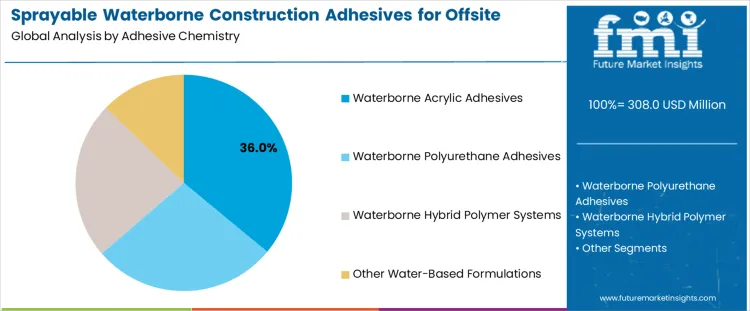
Waterborne acrylic adhesives account for about 36% of demand because they offer a balance of low emissions, fast track development, and ease of spray application in controlled factory environments. Offsite construction facilities favor acrylic systems due to their predictable viscosity, broad substrate compatibility, and minimal odor during application. These adhesives bond common modular materials such as gypsum boards, insulation panels, wood composites, and lightweight metals without requiring solvent handling or extended ventilation. Their water-based nature supports compliance with occupational health standards and simplifies cleanup, which is critical in high-throughput module assembly lines. Acrylic systems also tolerate minor surface variability, supporting consistent bond performance across standardized modules.
Waterborne polyurethane and hybrid polymer systems expand performance options but remain secondary. Polyurethane adhesives deliver higher flexibility and moisture resistance, making them suitable for modules exposed to humidity variation, though they require tighter process control. Hybrid systems combine strength and elasticity but increase formulation complexity and cost. Other water-based formulations serve niche needs or regional preferences. These alternatives complement acrylic dominance rather than displace it. Chemistry leadership therefore reflects scalability, application speed, and regulatory acceptance rather than maximum structural performance.
What Is Driving Leadership by Offsite Module Type in the Sprayable Waterborne Construction Adhesives Market?
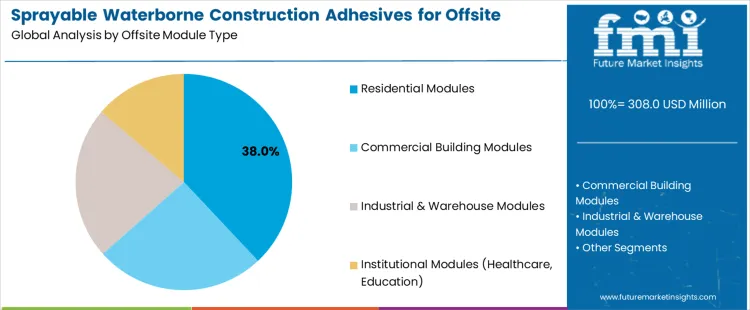
Residential modules represent about 38% of demand because housing construction leads adoption of offsite building methods. High volumes of repetitive unit’s favor sprayable adhesives that reduce labor time and ensure uniform bonding across walls, floors, and ceiling assemblies. Residential modules prioritize indoor air quality and regulatory compliance, reinforcing use of low-emission waterborne adhesives. Tight production schedules and cost sensitivity further support chemistries that integrate easily with automated or semi-automated spray systems in modular factories.
Commercial, industrial, and institutional modules form significant secondary segments. Commercial building modules adopt sprayable adhesives for speed and consistency but face more varied material specifications. Industrial and warehouse modules emphasize durability and load tolerance, sometimes requiring higher-performance systems. Institutional modules such as healthcare and education prioritize compliance and cleanliness but operate at lower volumes. These segments add diversity but do not match residential scale. Application leadership therefore reflects housing volume concentration and standardization rather than overall construction complexity.
How Are Sprayable Waterborne Construction Adhesives Being Applied Across Offsite Modular Construction?
Use appears in prefabricated building modules, panelized walls, and floor assemblies where strong, rapid bonding is required without solvent-based emissions. Manufacturers adopt sprayable waterborne adhesives to join wood, composites, and engineered panels while reducing VOC exposure and environmental impact. Offsite construction facilities integrate these adhesives for high-throughput production of modular units, ensuring dimensional stability and structural integrity. These applications reflect operational and environmental priorities rather than aesthetic objectives, with adoption driven by bonding performance, worker safety, and compliance with sustainability regulations.
What Operational and Material Conditions Support Adoption of Sprayable Waterborne Construction Adhesives?
Selection aligns with substrates requiring uniform coverage, high adhesion strength, and rapid setting times under variable humidity and temperature. Formulations are optimized for viscosity, sprayability, and curing kinetics compatible with automated or semi-automated dispensing systems. Operators monitor adhesive thickness, substrate preparation, and curing environment to ensure consistent module performance. Quality control checks structural integrity, bond strength, and VOC compliance. These conditions emerge from operational efficiency, material performance, and environmental compliance priorities in structured offsite manufacturing workflows.
Which Practical Considerations Limit Wider Use of Sprayable Waterborne Construction Adhesives?
Performance can be affected by substrate moisture content, temperature variations, or contamination. Cost per unit may be higher than solvent-based alternatives in some regions. Equipment calibration, spray nozzle maintenance, and operator training are required for consistent application. Regulatory approvals for building codes or VOC emissions vary by region. These factors lead to selective deployment where bonding quality, environmental compliance, and operational efficiency justify incremental cost and process management.
What is the Demand for Sprayable Waterborne Construction Adhesives for Offsite Modules by Country?
| Country | CAGR (%) |
|---|---|
| China | 12.5% |
| India | 11.8% |
| USA | 8.7% |
| Germany | 8.2% |
| UK | 7.8% |
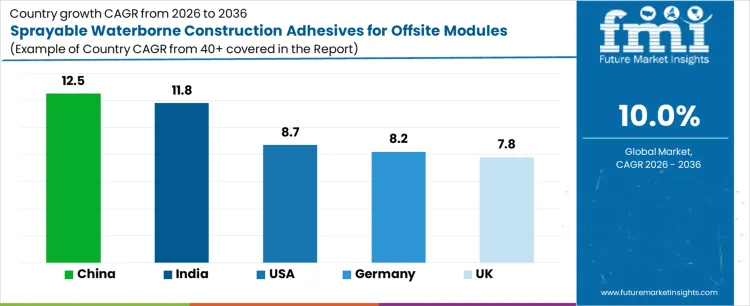
The demand for sprayable waterborne construction adhesives for offsite modules varies across countries, driven by modular construction adoption, sustainability initiatives, and industrial efficiency improvements. China leads with a 12.5% CAGR, supported by rapid urbanization, government incentives for modular construction, and large scale adoption of ecofriendly adhesive solutions. India follows at 11.8%, driven by growth in prefabricated building projects, industrial offsite manufacturing, and regulatory focus on low VOC adhesives. The USA grows at 8.7%, reflecting adoption in residential and commercial modular construction. Germany records 8.2%, shaped by mature construction markets and sustainability standards. The UK posts 7.8%, supported by offsite construction initiatives and environmental compliance in building projects.
How Are Sprayable Waterborne Construction Adhesives Driving Growth in China?
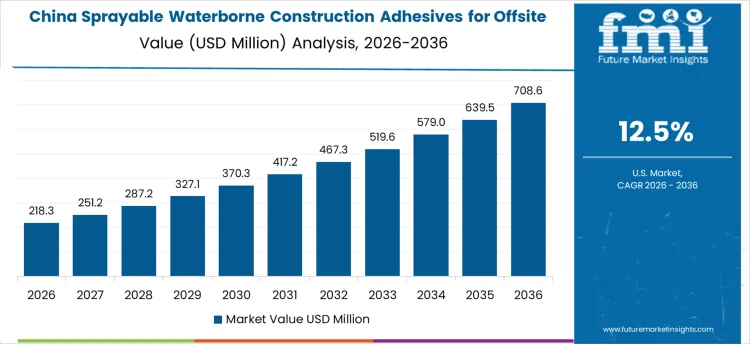
In China, the Sprayable Waterborne Construction Adhesives for Offsite Modules Market is expanding at a CAGR of 12.5% through 2036, fueled by rapid adoption of offsite and modular construction in residential, commercial, and industrial projects. Contractors and prefabrication facilities are using waterborne adhesives to improve bonding efficiency, reduce VOC emissions, and enhance sustainability in modular panel assembly. Demand is concentrated in urban industrial hubs, large-scale residential developments, and commercial construction clusters. Compared to India, China emphasizes large-scale integration in high-volume offsite construction. Domestic suppliers provide high-performance, low-emission adhesives compatible with automated spraying systems and recurring construction cycles.
- Urban industrial hubs, residential developments, and commercial construction clusters drive adoption
- Waterborne adhesives improve bonding, reduce VOCs, and support sustainability
- Domestic suppliers provide high-performance, sprayable adhesive solutions
- Recurring offsite module production cycles sustain adoption
How Is Modular Construction Expansion Supporting Adoption in India?
In India, revenue is growing at a CAGR of 11.8% through 2036, supported by rapid growth in prefabricated housing, commercial modular projects, and infrastructure initiatives. Contractors are adopting sprayable waterborne adhesives for efficient panel bonding, low-emission construction, and regulatory compliance. Demand is concentrated in urban industrial clusters, large-scale residential projects, and commercial offsite module facilities. Compared to China, adoption in India is influenced by emerging industrial zones and government incentives promoting sustainable construction. Domestic suppliers provide cost-effective, high-performance adhesives compatible with automated spraying and recurring modular assembly operations.
- Industrial clusters, residential projects, and offsite module facilities drive adoption
- Adhesives improve bonding efficiency and reduce emissions
- Domestic suppliers provide cost-effective, high-performance solutions
- Recurring modular assembly operations sustain adoption
How Are Prefabrication and Sustainability Driving Growth in the United States?
In the United States, the market is expanding at a CAGR of 8.7% through 2036, driven by rising adoption of offsite and prefabricated construction, coupled with sustainability and low-VOC regulations. Contractors and modular construction firms are integrating sprayable waterborne adhesives to improve workflow efficiency, meet environmental standards, and enhance durability of prefabricated panels. Demand is concentrated in urban modular construction hubs, residential housing projects, and commercial facilities. Compared to Germany, the U.S. emphasizes operational efficiency alongside regulatory compliance. Domestic suppliers provide high-performance, sprayable adhesives suitable for recurring offsite production cycles.
- Urban modular construction hubs, residential projects, and commercial facilities drive adoption
- Adhesives improve workflow efficiency and reduce VOC emissions
- Domestic suppliers provide high-performance, sprayable adhesive solutions
- Recurring offsite production cycles sustain adoption
How Are Environmental and Construction Standards Supporting Growth in Germany?
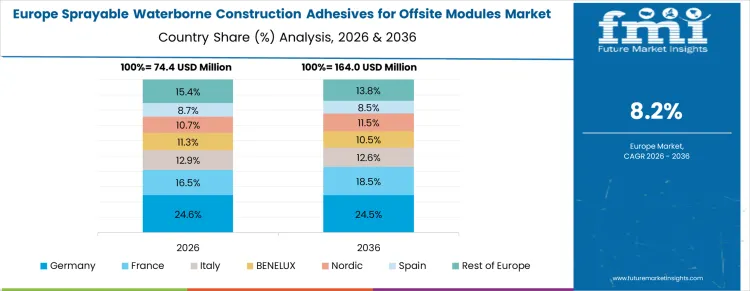
In Germany, revenue is growing at a CAGR of 8.2% through 2036, supported by strict EU environmental regulations, VOC limits, and prefabrication standards. Construction firms and industrial modular facilities are adopting sprayable waterborne adhesives to comply with regulations, enhance bonding reliability, and support sustainable building practices. Demand is concentrated in industrial construction hubs, commercial modular projects, and residential prefabrication zones. Compared to the U.S., adoption is more regulatory-driven than operational-efficiency-focused. Domestic suppliers provide high-quality, EU-compliant adhesives compatible with automated spraying systems and recurring modular assembly processes.
- Industrial construction hubs, commercial modular projects, and residential prefabrication zones drive adoption
- Adhesives comply with environmental regulations and enhance bonding reliability
- Domestic suppliers provide EU-compliant, high-quality sprayable solutions
- Recurring modular assembly processes sustain adoption
How Is Modular Construction and Industrial Production Driving Adoption in the UK?
In the UK, the market is expanding at a CAGR of 7.8% through 2036, driven by growing prefabricated housing, commercial offsite projects, and sustainable construction practices. Contractors and industrial fabrication facilities are integrating sprayable waterborne adhesives to reduce VOC emissions, improve bond strength, and enhance efficiency in panel assembly. Demand is concentrated in urban modular construction hubs, industrial production centers, and commercial building projects. Compared to China and India, adoption is focused on smaller-scale industrial hubs with higher regulatory compliance emphasis. Domestic suppliers provide high-performance adhesives compatible with recurring modular assembly cycles.
- Urban modular construction hubs, industrial production centers, and commercial projects drive adoption
- Adhesives reduce VOC emissions and improve bond strength
- Domestic suppliers provide high-performance, sprayable solutions
- Recurring modular assembly cycles sustain adoption
Which Strategic Approaches Define Competition in the Sprayable Waterborne Construction Adhesives Market for Offsite Modular Construction?
Competition in sprayable waterborne construction adhesives for offsite modules is shaped by factory production logic rather than traditional site application needs. Adhesives are selected based on spray consistency, open time control, and bond development that aligns with panelized and volumetric assembly sequences. Henkel and H.B. Fuller position their offerings around production stability, emphasizing low overspray, fast track development, and predictable curing under controlled factory climates. Their strategies focus on minimizing rework, supporting automated or semi-automated spray systems, and maintaining adhesion across mixed substrates such as gypsum, insulation boards, metals, and engineered wood. Performance evaluation centers on throughput impact, bond repeatability, and compatibility with high cadence manufacturing rather than ultimate bond strength alone.
A different strategic emphasis is evident among suppliers aligned closely with construction system design. Sika approaches the market through modular building envelopes and flooring systems, embedding sprayable adhesives within broader offsite construction solutions. Arkema, via Bostik, competes through formulation flexibility, tailoring waterborne systems to meet regional fire, emissions, and handling requirements while supporting rapid assembly. 3M participates selectively where sprayable adhesives intersect with acoustic control, panel lamination, or lightweight modular components. Across the market, competitive advantage is built through production line integration, technical support during factory setup, and consistency across large module runs. Adoption favors suppliers that reduce manufacturing variability, support regulatory compliance, and align adhesive behavior with offsite construction workflows rather than those optimized for conventional on site use.
Key Players in the Sprayable Waterborne Construction Adhesives Market
- Henkel AG & Co. KGaA
- H.B. Fuller Company
- Sika AG
- 3M Company
- Arkema
- Bostik
Scope of the Report
| Items | Values |
|---|---|
| Quantitative Units (2026) | USD million |
| Type | Waterborne Acrylic Adhesives, Waterborne Polyurethane Adhesives, Waterborne Hybrid Polymer Systems, Other Water-Based Formulations |
| Application | Wood and Engineered Timber Bonding, Fiber Cement and Panel Bonding, Insulation and Acoustic Panel Bonding, Metal and Composite Panel Bonding |
| End User | Offsite Modular Construction Companies, Prefabricated Building Manufacturers, Construction Contractors Using Modular Systems, Industrialized Building System Developers |
| Regions Covered | Asia Pacific, Europe, North America, Latin America, Middle East & Africa |
| Countries Covered | China, India, USA, Germany, United Kingdom, Japan, South Korea, France, Italy, Canada, Mexico, Brazil, ASEAN countries, GCC countries, and other global regions |
| Key Companies Profiled | Henkel AG & Co. KGaA, H.B. Fuller Company, Sika AG, 3M Company, Arkema, Bostik |
| Additional Attributes | Dollar sales by adhesive chemistry and offsite module type, regional adoption trends across Asia Pacific Europe and North America, competitive landscape of global and regional construction adhesive suppliers, factory application requirements including spray stability open time and overspray control, curing time consistency and throughput impact in offsite manufacturing, integration with automated and semi-automated spray systems in modular construction facilities |
Sprayable Waterborne Construction Adhesives Market Segmentation
Adhesive Chemistry:
- Waterborne Acrylic Adhesives
- Waterborne Polyurethane Adhesives
- Waterborne Hybrid Polymer Systems
- Other Water-Based Formulations
Offsite Module Type:
- Residential Modules
- Commercial Building Modules
- Industrial & Warehouse Modules
- Institutional Modules (Healthcare, Education)
Substrate Bonding Application:
- Wood & Engineered Timber
- Fiber Cement & Panels
- Insulation & Acoustic Panels
- Metal & Composite Panels
Region
Asia Pacific
- China
- Japan
- South Korea
- India
- Australia & New Zealand
- ASEAN
- Rest of Asia Pacific
Europe
- Germany
- United Kingdom
- France
- Italy
- Spain
- Nordic
- BENELUX
- Rest of Europe
North America
- United States
- Canada
- Mexico
Latin America
- Brazil
- Chile
- Rest of Latin America
Middle East & Africa
- Kingdom of Saudi Arabia
- Other GCC Countries
- Turkey
- South Africa
- Other African Union
- Rest of Middle East & Africa
Frequently Asked Questions
How big is the sprayable waterborne construction adhesives for offsite modules market in 2026?
The global sprayable waterborne construction adhesives for offsite modules market is estimated to be valued at USD 308.0 million in 2026.
What will be the size of sprayable waterborne construction adhesives for offsite modules market in 2036?
The market size for the sprayable waterborne construction adhesives for offsite modules market is projected to reach USD 798.9 million by 2036.
How much will be the sprayable waterborne construction adhesives for offsite modules market growth between 2026 and 2036?
The sprayable waterborne construction adhesives for offsite modules market is expected to grow at a 10.0% CAGR between 2026 and 2036.
What are the key product types in the sprayable waterborne construction adhesives for offsite modules market?
The key product types in sprayable waterborne construction adhesives for offsite modules market are waterborne acrylic adhesives, waterborne polyurethane adhesives, waterborne hybrid polymer systems and other water-based formulations.
Which offsite module type segment to contribute significant share in the sprayable waterborne construction adhesives for offsite modules market in 2026?
In terms of offsite module type, residential modules segment to command 38.0% share in the sprayable waterborne construction adhesives for offsite modules market in 2026.
Preview the report firsthand - request a free sample
Get SampleGet the brochure for pricing and purchase details.
Get PDFTable of Content
- Executive Summary
- Global Market Outlook
- Demand-side Trends
- Supply-side Trends
- Technology Roadmap Analysis
- Analysis and Recommendations
- Market Overview
- Market Coverage / Taxonomy
- Market Definition / Scope / Limitations
- Market Background
- Market Dynamics
- Drivers
- Restraints
- Opportunity
- Trends
- Scenario Forecast
- Demand in Optimistic Scenario
- Demand in Likely Scenario
- Demand in Conservative Scenario
- Opportunity Map Analysis
- Product Life Cycle Analysis
- Supply Chain Analysis
- Investment Feasibility Matrix
- Value Chain Analysis
- PESTLE and Porter’s Analysis
- Regulatory Landscape
- Regional Parent Market Outlook
- Production and Consumption Statistics
- Import and Export Statistics
- Market Dynamics
- Global Market Analysis 2021 to 2025 and Forecast, 2026 to 2036
- Historical Market Size Value (USD Million) Analysis, 2021 to 2025
- Current and Future Market Size Value (USD Million) Projections, 2026 to 2036
- Y-o-Y Growth Trend Analysis
- Absolute $ Opportunity Analysis
- Global Market Pricing Analysis 2021 to 2025 and Forecast 2026 to 2036
- Global Market Analysis 2021 to 2025 and Forecast 2026 to 2036, By Adhesive Chemistry
- Introduction / Key Findings
- Historical Market Size Value (USD Million) Analysis By Adhesive Chemistry , 2021 to 2025
- Current and Future Market Size Value (USD Million) Analysis and Forecast By Adhesive Chemistry , 2026 to 2036
- Waterborne Acrylic Adhesives
- Waterborne Polyurethane Adhesives
- Waterborne Hybrid Polymer Systems
- Other Water-Based Formulations
- Waterborne Acrylic Adhesives
- Y-o-Y Growth Trend Analysis By Adhesive Chemistry , 2021 to 2025
- Absolute $ Opportunity Analysis By Adhesive Chemistry , 2026 to 2036
- Global Market Analysis 2021 to 2025 and Forecast 2026 to 2036, By Offsite Module Type
- Introduction / Key Findings
- Historical Market Size Value (USD Million) Analysis By Offsite Module Type, 2021 to 2025
- Current and Future Market Size Value (USD Million) Analysis and Forecast By Offsite Module Type, 2026 to 2036
- Residential Modules
- Commercial Building Modules
- Industrial & Warehouse Modules
- Institutional Modules (Healthcare, Education)
- Residential Modules
- Y-o-Y Growth Trend Analysis By Offsite Module Type, 2021 to 2025
- Absolute $ Opportunity Analysis By Offsite Module Type, 2026 to 2036
- Global Market Analysis 2021 to 2025 and Forecast 2026 to 2036, By Substrate Bonding Application
- Introduction / Key Findings
- Historical Market Size Value (USD Million) Analysis By Substrate Bonding Application, 2021 to 2025
- Current and Future Market Size Value (USD Million) Analysis and Forecast By Substrate Bonding Application, 2026 to 2036
- Wood & Engineered Timber
- Fiber Cement & Panels
- Insulation & Acoustic Panels
- Metal & Composite Panels
- Wood & Engineered Timber
- Y-o-Y Growth Trend Analysis By Substrate Bonding Application, 2021 to 2025
- Absolute $ Opportunity Analysis By Substrate Bonding Application, 2026 to 2036
- Global Market Analysis 2021 to 2025 and Forecast 2026 to 2036, By Region
- Introduction
- Historical Market Size Value (USD Million) Analysis By Region, 2021 to 2025
- Current Market Size Value (USD Million) Analysis and Forecast By Region, 2026 to 2036
- North America
- Latin America
- Western Europe
- Eastern Europe
- East Asia
- South Asia and Pacific
- Middle East & Africa
- Market Attractiveness Analysis By Region
- North America Market Analysis 2021 to 2025 and Forecast 2026 to 2036, By Country
- Historical Market Size Value (USD Million) Trend Analysis By Market Taxonomy, 2021 to 2025
- Market Size Value (USD Million) Forecast By Market Taxonomy, 2026 to 2036
- By Country
- USA
- Canada
- Mexico
- By Adhesive Chemistry
- By Offsite Module Type
- By Substrate Bonding Application
- By Country
- Market Attractiveness Analysis
- By Country
- By Adhesive Chemistry
- By Offsite Module Type
- By Substrate Bonding Application
- Key Takeaways
- Latin America Market Analysis 2021 to 2025 and Forecast 2026 to 2036, By Country
- Historical Market Size Value (USD Million) Trend Analysis By Market Taxonomy, 2021 to 2025
- Market Size Value (USD Million) Forecast By Market Taxonomy, 2026 to 2036
- By Country
- Brazil
- Chile
- Rest of Latin America
- By Adhesive Chemistry
- By Offsite Module Type
- By Substrate Bonding Application
- By Country
- Market Attractiveness Analysis
- By Country
- By Adhesive Chemistry
- By Offsite Module Type
- By Substrate Bonding Application
- Key Takeaways
- Western Europe Market Analysis 2021 to 2025 and Forecast 2026 to 2036, By Country
- Historical Market Size Value (USD Million) Trend Analysis By Market Taxonomy, 2021 to 2025
- Market Size Value (USD Million) Forecast By Market Taxonomy, 2026 to 2036
- By Country
- Germany
- UK
- Italy
- Spain
- France
- Nordic
- BENELUX
- Rest of Western Europe
- By Adhesive Chemistry
- By Offsite Module Type
- By Substrate Bonding Application
- By Country
- Market Attractiveness Analysis
- By Country
- By Adhesive Chemistry
- By Offsite Module Type
- By Substrate Bonding Application
- Key Takeaways
- Eastern Europe Market Analysis 2021 to 2025 and Forecast 2026 to 2036, By Country
- Historical Market Size Value (USD Million) Trend Analysis By Market Taxonomy, 2021 to 2025
- Market Size Value (USD Million) Forecast By Market Taxonomy, 2026 to 2036
- By Country
- Russia
- Poland
- Hungary
- Balkan & Baltic
- Rest of Eastern Europe
- By Adhesive Chemistry
- By Offsite Module Type
- By Substrate Bonding Application
- By Country
- Market Attractiveness Analysis
- By Country
- By Adhesive Chemistry
- By Offsite Module Type
- By Substrate Bonding Application
- Key Takeaways
- East Asia Market Analysis 2021 to 2025 and Forecast 2026 to 2036, By Country
- Historical Market Size Value (USD Million) Trend Analysis By Market Taxonomy, 2021 to 2025
- Market Size Value (USD Million) Forecast By Market Taxonomy, 2026 to 2036
- By Country
- China
- Japan
- South Korea
- By Adhesive Chemistry
- By Offsite Module Type
- By Substrate Bonding Application
- By Country
- Market Attractiveness Analysis
- By Country
- By Adhesive Chemistry
- By Offsite Module Type
- By Substrate Bonding Application
- Key Takeaways
- South Asia and Pacific Market Analysis 2021 to 2025 and Forecast 2026 to 2036, By Country
- Historical Market Size Value (USD Million) Trend Analysis By Market Taxonomy, 2021 to 2025
- Market Size Value (USD Million) Forecast By Market Taxonomy, 2026 to 2036
- By Country
- India
- ASEAN
- Australia & New Zealand
- Rest of South Asia and Pacific
- By Adhesive Chemistry
- By Offsite Module Type
- By Substrate Bonding Application
- By Country
- Market Attractiveness Analysis
- By Country
- By Adhesive Chemistry
- By Offsite Module Type
- By Substrate Bonding Application
- Key Takeaways
- Middle East & Africa Market Analysis 2021 to 2025 and Forecast 2026 to 2036, By Country
- Historical Market Size Value (USD Million) Trend Analysis By Market Taxonomy, 2021 to 2025
- Market Size Value (USD Million) Forecast By Market Taxonomy, 2026 to 2036
- By Country
- Kingdom of Saudi Arabia
- Other GCC Countries
- Turkiye
- South Africa
- Other African Union
- Rest of Middle East & Africa
- By Adhesive Chemistry
- By Offsite Module Type
- By Substrate Bonding Application
- By Country
- Market Attractiveness Analysis
- By Country
- By Adhesive Chemistry
- By Offsite Module Type
- By Substrate Bonding Application
- Key Takeaways
- Key Countries Market Analysis
- USA
- Pricing Analysis
- Market Share Analysis, 2025
- By Adhesive Chemistry
- By Offsite Module Type
- By Substrate Bonding Application
- Canada
- Pricing Analysis
- Market Share Analysis, 2025
- By Adhesive Chemistry
- By Offsite Module Type
- By Substrate Bonding Application
- Mexico
- Pricing Analysis
- Market Share Analysis, 2025
- By Adhesive Chemistry
- By Offsite Module Type
- By Substrate Bonding Application
- Brazil
- Pricing Analysis
- Market Share Analysis, 2025
- By Adhesive Chemistry
- By Offsite Module Type
- By Substrate Bonding Application
- Chile
- Pricing Analysis
- Market Share Analysis, 2025
- By Adhesive Chemistry
- By Offsite Module Type
- By Substrate Bonding Application
- Germany
- Pricing Analysis
- Market Share Analysis, 2025
- By Adhesive Chemistry
- By Offsite Module Type
- By Substrate Bonding Application
- UK
- Pricing Analysis
- Market Share Analysis, 2025
- By Adhesive Chemistry
- By Offsite Module Type
- By Substrate Bonding Application
- Italy
- Pricing Analysis
- Market Share Analysis, 2025
- By Adhesive Chemistry
- By Offsite Module Type
- By Substrate Bonding Application
- Spain
- Pricing Analysis
- Market Share Analysis, 2025
- By Adhesive Chemistry
- By Offsite Module Type
- By Substrate Bonding Application
- France
- Pricing Analysis
- Market Share Analysis, 2025
- By Adhesive Chemistry
- By Offsite Module Type
- By Substrate Bonding Application
- India
- Pricing Analysis
- Market Share Analysis, 2025
- By Adhesive Chemistry
- By Offsite Module Type
- By Substrate Bonding Application
- ASEAN
- Pricing Analysis
- Market Share Analysis, 2025
- By Adhesive Chemistry
- By Offsite Module Type
- By Substrate Bonding Application
- Australia & New Zealand
- Pricing Analysis
- Market Share Analysis, 2025
- By Adhesive Chemistry
- By Offsite Module Type
- By Substrate Bonding Application
- China
- Pricing Analysis
- Market Share Analysis, 2025
- By Adhesive Chemistry
- By Offsite Module Type
- By Substrate Bonding Application
- Japan
- Pricing Analysis
- Market Share Analysis, 2025
- By Adhesive Chemistry
- By Offsite Module Type
- By Substrate Bonding Application
- South Korea
- Pricing Analysis
- Market Share Analysis, 2025
- By Adhesive Chemistry
- By Offsite Module Type
- By Substrate Bonding Application
- Russia
- Pricing Analysis
- Market Share Analysis, 2025
- By Adhesive Chemistry
- By Offsite Module Type
- By Substrate Bonding Application
- Poland
- Pricing Analysis
- Market Share Analysis, 2025
- By Adhesive Chemistry
- By Offsite Module Type
- By Substrate Bonding Application
- Hungary
- Pricing Analysis
- Market Share Analysis, 2025
- By Adhesive Chemistry
- By Offsite Module Type
- By Substrate Bonding Application
- Kingdom of Saudi Arabia
- Pricing Analysis
- Market Share Analysis, 2025
- By Adhesive Chemistry
- By Offsite Module Type
- By Substrate Bonding Application
- Turkiye
- Pricing Analysis
- Market Share Analysis, 2025
- By Adhesive Chemistry
- By Offsite Module Type
- By Substrate Bonding Application
- South Africa
- Pricing Analysis
- Market Share Analysis, 2025
- By Adhesive Chemistry
- By Offsite Module Type
- By Substrate Bonding Application
- USA
- Market Structure Analysis
- Competition Dashboard
- Competition Benchmarking
- Market Share Analysis of Top Players
- By Regional
- By Adhesive Chemistry
- By Offsite Module Type
- By Substrate Bonding Application
- Competition Analysis
- Competition Deep Dive
- Henkel AG & Co. KGaA
- Overview
- Product Portfolio
- Profitability by Market Segments (Product/Age /Sales Channel/Region)
- Sales Footprint
- Strategy Overview
- Marketing Strategy
- Product Strategy
- Channel Strategy
- H.B. Fuller Company
- Sika AG
- 3M Company
- Arkema
- Bostik
- Henkel AG & Co. KGaA
- Competition Deep Dive
- Assumptions & Acronyms Used
- Research Methodology


