

- Industry Size (2026)
- Forecast (2036)
- CAGR
- (2026 to 2036)
Bio-Based Structural Wood Adhesives for Modular Construction Market Size, Market Forecast and Outlook By FMI
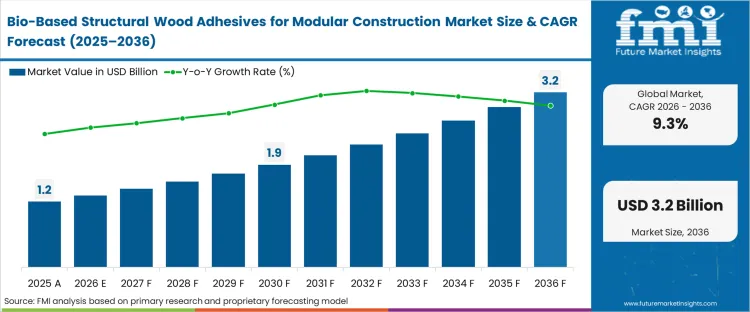
The bio-based structural wood adhesives for modular construction market was valued at USD 1.2 billion in 2025. Revenue is expected to cross USD 1.3 billion in 2026 at a CAGR of 9.3% during the forecast period. The market value is expected to reach USD 3.2 billion by 2036 as mass‑timber manufacturers shift from limited compliance-oriented pilots to fully standardized, green‑certified production systems,.
Procurement directors at offsite manufacturing facilities face immediate pressure to eliminate petrochemical binders without sacrificing line speed. Sourcing teams evaluating modular construction adhesives cannot accept extended press times in high-throughput cross-laminated timber factories, forcing a binary choice between fast-curing synthetic resins that trigger indoor air quality penalties or bio-based building materials that match existing operational rhythms. Failure to secure high-performance biological adhesives locks modular builders out of premium municipal contracts requiring strict embodied carbon limits. What surface statistics miss is how legacy phenolic resin suppliers rapidly lose volume to niche biological formulations that clear structural shear-strength thresholds at room temperature.
Once mass timber certifiers formally approve a specific formulation of bio-based structural adhesives for timber applied in load-bearing shear walls, adoption accelerates exponentially across regional factory networks. Factory managers shift from testing biological resins on non-structural interior elements to specifying them for primary structural columns, permanently displacing synthetic volumes.
Summary of Bio-Based Structural Wood Adhesives for Modular Construction Market
- Bio-Based Structural Wood Adhesives for Modular Construction Market Definition
- Biological bonding agents engineered to replace petrochemical resins in load-bearing mass timber elements. Formulations meet strict mechanical stress certifications while enabling carbon-neutral or carbon-negative prefabricated building lifecycles.
- Demand Drivers in the Market
- Municipal embodied carbon caps force mass timber fabricators to eliminate petroleum-derived components from supply chains.
- Indoor air quality certifications push institutional building developers to ban formaldehyde-emitting structural panels.
- Petrochemical price volatility compels engineered wood procurement teams to secure stable bio-based feedstock contracts.
- Key Segments Analyzed in the FMI Report
- Lignin-based adhesives: This segment is projected to grab 38.5% share in 2026, benefiting from direct integration with existing kraft pulping side-streams.
- Cross-Laminated Timber (CLT) Panels: This segment is expected to account for 44.2% share in 2026, driven by rapid municipal adoption of mid-rise wooden structures.
- Residential Modular Construction: This segment is set to hold 52.8% share, reacting to intense consumer demand for zero-emission homes.
- Structural Load-Bearing Adhesives: This segment is poised to record 61.3% share as certification bodies increasingly approve bio-resins for critical safety applications.
- Cold-set Adhesives: This segment is likely to garner 46.7% share, matching high-throughput factory requirements without excessive energy consumption.
- India: India anticipates 11.2% CAGR, propelled by massive state-funded urban modular housing programs prioritizing sustainable materials.
- Analyst Opinion at FMI
- Nikhil Kaitwade, Principal Analyst, Chemicals, at FMI, points out, "Standard metrics capture the increasing tonnage of bio-resins sold, but they miss the intense qualification friction happening inside CLT factories. Procurement directors assume switching to soy or lignin is a simple volume substitution. Reality dictates that replacing a phenolic binder requires entirely re-engineering the press line's thermal profile and moisture management controls. Factory managers who underestimate this calibration period suffer catastrophic delamination failures during initial runs, effectively delaying their green-certified product launches by a full calendar year while competitors lock in early-adopter municipal contracts."
- Strategic Implications / Executive Takeaways
- Chemical formulation directors face immediate requirements to reduce cold-press curing times to match legacy polyurethane benchmarks.
- CLT plant operations managers must upgrade moisture control infrastructure before transitioning to protein-based adhesive systems.
- Mass timber developers gain substantial competitive advantages in bidding for public institutional projects by specifying 100% bio-bonded panels.
- Methodology
- Bottom-up calculations anchor on raw timber production volumes processed through modular factories. Primary interviews with resin chemists and structural engineers validate the penetration rate of bio-alternatives against traditional synthetic baselines.
Bio-Based Structural Wood Adhesives for Modular Construction Market Key Takeaways
| Metric | Details |
|---|---|
| Industry Size (2026) | USD 1.3 billion |
| Industry Value (2036) | USD 3.2 billion |
| CAGR (2026–2036) | 9.3% |
Source: Future Market Insights (FMI) analysis, based on proprietary forecasting model and primary research
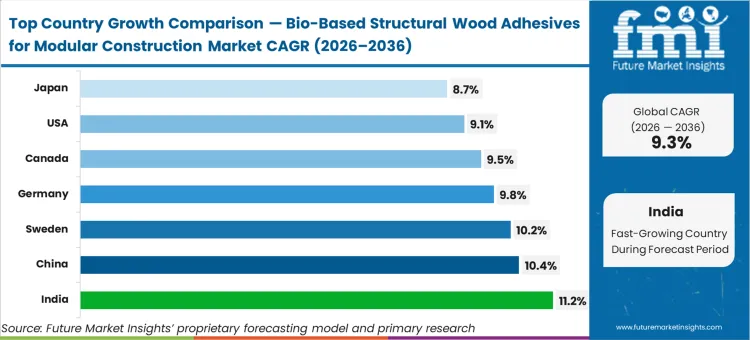
India leads global transition at 11.2% as government-backed prefabricated housing initiatives scale rapidly. China tracks closely at 10.4% supported by strict embodied carbon targets for engineered wood adhesives demand in urban commercial zones. Sweden records 10.2% expansion driven by mature mass timber supply chains converting completely to sustainable construction adhesives. Germany advances at 9.8% on the back of stringent indoor air quality regulations governing formaldehyde-free wood adhesives utilized in public modular buildings. Canada scales at 9.5% while the United States follows at 9.1%, constrained by fragmented local building codes. Japan maintains steady 8.7% growth as established prefabricated residential producers optimize existing supply chains. Geographic divergence stems directly from local regulatory willingness to accept non-phenolic adhesives in primary load-bearing applications.
Bio-Based Structural Wood Adhesives for Modular Construction Market Definition
The bio-based structural wood adhesives for modular construction market encompasses biologically derived polymeric binders engineered specifically to achieve structural-grade shear strength and moisture resistance in engineered wood products. Formulations utilize renewable feedstocks including lignin, soy proteins, tannins, or carbohydrates rather than petroleum-derived phenols or formaldehydes. Bonding performance must meet strict load-bearing building code certifications for cross-laminated timber and glulam elements used in offsite prefabricated construction environments. Identifying what are bio-based adhesives in construction structurally requires verifying their mechanical stress certification parity with legacy petrochemical binders.
Bio-Based Structural Wood Adhesives for Modular Construction Market Inclusions
Scope includes all fully biological and high-bio-content hybrid resins deployed in offsite timber fabrication facilities. Formulations utilizing modified lignin derivatives, enzymatically treated soy proteins, and concentrated condensed tannins fall strictly within boundaries. Cross-linking agents derived from renewable sources and wood adhesives and binders utilized in structural wall panels, roof trusses, and load-bearing floor cassettes represent core product categories evaluated. Specific inclusion depends heavily on demonstrating that these eco-friendly adhesives for timber perform equally to traditional synthetics under dynamic structural loading.
Bio-Based Structural Wood Adhesives for Modular Construction Market Exclusions
Petroleum-derived polyurethane or phenol-formaldehyde resins containing minimal bio-based extenders fall completely outside analytical boundaries. Adhesives deployed exclusively for non-structural interior millwork, decorative veneers, or on-site residential framing connections do not meet structural modular criteria. Binders utilized in general furniture manufacturing or non-load-bearing particleboard fail to satisfy the strict engineering thresholds required for inclusion, as they cannot serve as legitimate structural adhesives for timber buildings.
Bio-Based Structural Wood Adhesives for Modular Construction Market Research Methodology
- Primary Research: Cross-laminated timber plant managers, structural engineering certifiers, and bio-polymer R&D directors.
- Desk Research: European Technical Assessment (ETA) certifications, mass timber shear testing databases, and municipal green building code registries.
- Market-Sizing and Forecasting: Global engineered wood production volumes matched against average adhesive application rates per cubic meter.
- Data Validation and Update Cycle: Bio-chemical feedstock pricing indices and UN Comtrade export data for specialty natural polymers cross-validate baseline projections.
Segmental Analysis
Bio-Based Structural Wood Adhesives for Modular Construction Market Analysis by Resin Type
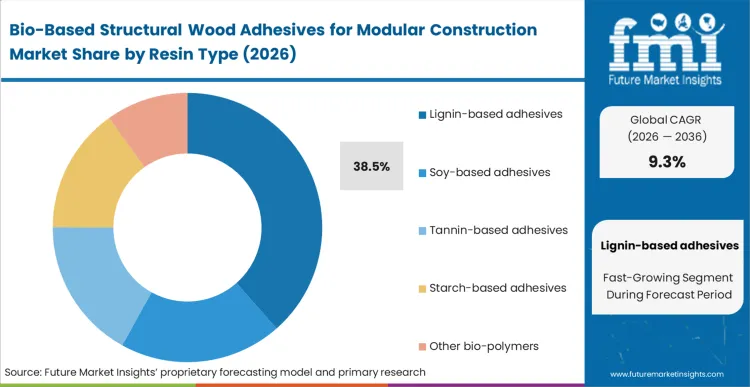
Displacement of legacy phenol-formaldehyde systems accelerates specifically when biological alternatives match existing factory press speeds. Lignin-based adhesives holds 38.5% share in 2026, and FMI's analysis indicates factors supporting compound growth stem directly from chemical compatibility with standard hot-press equipment. Mass timber plant managers refuse to replace multi-million-dollar pressing lines simply to accommodate new bio resin adhesives. Formulations derived from kraft pulping lignin drop seamlessly into existing wood adhesives delivery networks, eliminating massive capital expenditure hurdles. What volume metrics fail to reveal is that pure lignin-based adhesives remain rare; most commercial applications rely on lignin-phenol hybrids to guarantee structural integrity under extreme moisture cycling. Offsite manufacturing directors evaluating lignin-based adhesives vs synthetic adhesives who attempt to force 100% natural soy alternatives into legacy hot-press systems face unacceptable delamination risks, ultimately retreating to hybrid solutions to maintain structural certification.
- Hot-press compatibility: Drop-in chemical characteristics allow factories to utilize existing thermal pressing infrastructure. Plant operations managers avoid severe capital expenditures associated with retrofitting lines for pure protein curing profiles.
- Moisture cycling resilience: Hybrid lignin matrices maintain shear strength during rigorous environmental exposure testing. Quality control directors pass strict European Technical Assessment protocols without altering baseline timber species inputs.
- Feedstock scale limitation: Pulp mill extraction capacity restricts total available highly-refined lignin volumes globally. Procurement teams face severe supply bottlenecks when attempting to scale massive multi-factory rollouts simultaneously.
Bio-Based Structural Wood Adhesives for Modular Construction Market Analysis by Application in Modular Construction
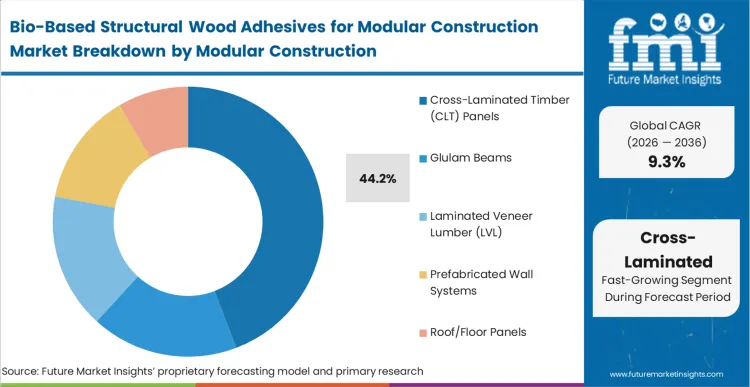
High-rise modular components demand exceptional internal bond strength to resist complex wind and seismic shear forces. Structural engineering certifiers mandate rigorous mechanical testing for structural adhesives deployed in these massive planar elements. Cross-Laminated Timber (CLT) panels segment commands 44.2% share in 2026, with factors supporting compound growth driven by sheer surface area bonding requirements per manufactured unit. Transitioning a CLT line to biological binders alters the entire factory throughput equation, requiring precise climate control during the curing phase. Generalist observers assume bio-resins penetrate all wood applications equally, completely missing that high-stress glulam beams still heavily rely on synthetic polyurethanes due to concentrated point-load demands. Modular developers who specify untested bio-based adhesives for CLT for critical floor cassettes often fail municipal building inspections, triggering devastating project delays and forcing costly retro-fitting with compliant synthetic-bonded panels.
- Planar stress distribution: Massive panel geometries spread shear loads across wide biological glue lines. Structural engineers confidently specify lignin binders for walls where point-load stress remains minimal compared to primary support beams.
- Climate control burden: Water-based biological formulations require strict ambient humidity management during panel lay-up. Factory floor supervisors install expensive HVAC upgrades to prevent premature resin curing during humid summer production months.
- Certification cascade: Winning approval for specific adhesives used in cross laminated timber unlocks immediate acceptance for smaller wall assemblies. Compliance officers leverage initial heavy-timber testing data to fast-track municipal clearance for lighter residential partitions.
Bio-Based Structural Wood Adhesives for Modular Construction Market Analysis by End-Use Sector
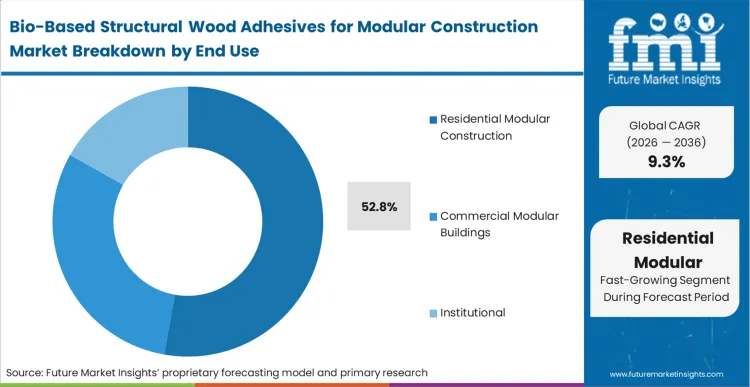
Volume homebuilders competing in premium suburban markets utilize formaldehyde-free structural panels as a primary sales differentiator. Sourcing directors seeking wood adhesives for modular housing at residential offsite factories face immense pressure to strip petrochemicals from wall assemblies before new European indoor air standards activate. Zero-emission mandates act as factors supporting compound growth, forcing residential modular construction segment to an expected 52.8% share by 2026 as consumer awareness targets indoor air quality. Achieving green-certified modular construction status unlocks vital state subsidies and favorable mortgage rates for buyers. Market share figures mask a critical technical reality: residential panels experience significantly lower dynamic loads than commercial floors, allowing factories to deploy less robust starch-based adhesives without failing safety parameters. Commercial property developers who attempt to port these residential bio-resins directly into heavy institutional builds routinely fail acoustic and vibration dampening tests.
- Air quality differentiation: Eliminating off-gassing allows builders to market premium healthy-home environments directly to consumers. Residential category managers capture premium pricing margins by explicitly advertising biological structural binders in marketing materials.
- Subsidy qualification: Meeting stringent organic material thresholds triggers specific government green-building tax credits. Financial controllers offset the slightly higher per-kilogram cost of bio-adhesives through aggregated municipal tax rebates.
- Dynamic load limits: Starch-based formulations excel in static residential walls but struggle under active commercial vibration. Structural specifiers evaluating adhesives in prefabricated construction must carefully isolate residential resin chemistry from heavy-duty institutional floor designs to prevent long-term fatigue.
Bio-Based Structural Wood Adhesives for Modular Construction Market Analysis by Performance Type
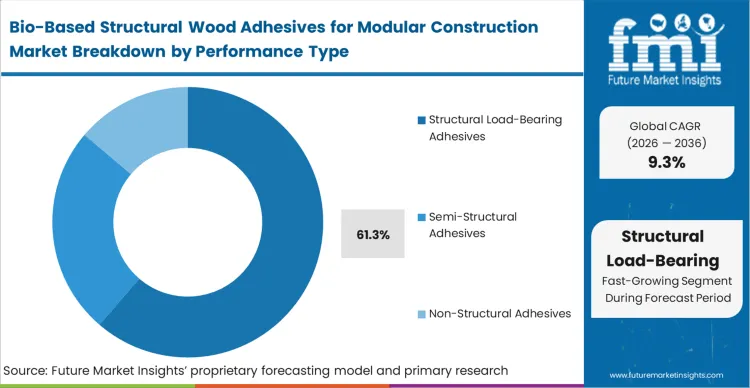
Building code compliance strictly governs this category, requiring decades of simulated aging data before approving natural construction adhesives for primary support columns. Certification board directors hold immense gatekeeping power, demanding exhaustive boil-dry cycling tests to verify biological resin durability. Substituting a certified load-bearing binder alters the entire structural calculation matrix for a modular skyscraper. What casual observers miss is the vast pricing chasm between structural and semi-structural bio-resins; achieving the final 10% of required shear strength often triples the chemical formulation cost. Achieving parity with legacy systems acts as factors supporting compound growth, pushing structural load-bearing adhesives segment to a commanding 61.3% share position. Factory procurement teams trying to cut costs by deploying semi-structural eco-friendly adhesives construction variants in load-bearing nodes face catastrophic liability exposure when inspectors inevitably halt site assembly.
- Aging simulation hurdles: Biological polymers must survive brutal accelerated weathering chambers without catastrophic delamination. Chemical formulation directors spend millions on third-party testing simply to prove parity with cheap phenolic resins.
- Margin compression reality: Extreme chemical refinement required for load-bearing certification destroys traditional markup structures. Resin manufacturers absorb massive R&D overhead, limiting profitability despite premium per-ton pricing models.
- Liability transfer: Deploying certified structural binders shields modular factories from long-term collapse litigation. Risk management officers refuse to authorize uncertified novel bio-resins regardless of sustainability benefits.
Bio-Based Structural Wood Adhesives for Modular Construction Market Analysis by Curing Technology
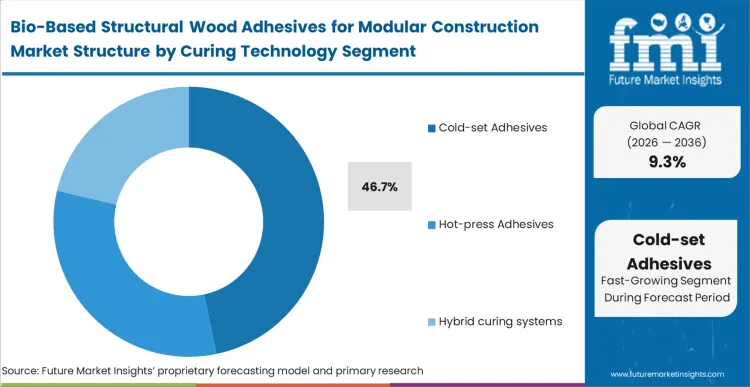
High-frequency radio curing and hot-pressing consume massive electrical loads, destroying the carbon-neutral narrative of green modular building. Plant operations managers actively seek polyurethane adhesives biological equivalents that cross-link effectively at ambient factory temperatures. Ambient curing requires exceptional chemical precision, balancing pot-life workability against acceptable clamp-time speeds. The hidden reality within the cold-set segment is that ambient bio-resins remain highly sensitive to seasonal factory temperature fluctuations, severely impacting winter production speeds. Manufacturers failing to implement expensive pre-heating staging areas for cold-set operations suffer dramatic throughput collapses when ambient temperatures drop below operational chemical thresholds. Energy cost volatility creates intense operational friction, acting as factors supporting compound growth that drive cold-set adhesives to a 46.7% share as factories desperately seek to power down massive thermal presses.
- Energy overhead elimination: Removing thermal pressing requirements instantly slashes factory electrical consumption profiles. Plant operations managers aggressively champion cold-set biologicals to meet aggressive internal corporate carbon-reduction mandates.
- Clamp-time bottlenecks: Natural ambient cross-linking naturally proceeds slower than forced thermal reactions. Production line supervisors struggle to maintain legacy throughput speeds, forcing complex factory footprint redesigns to accommodate longer staging rails.
- Seasonal thermal sensitivity: Chemical reaction speeds plummet in poorly insulated winter factory environments. Quality assurance directors must constantly tweak catalyst ratios to prevent defective bonds during unpredictable cold-weather shifts.
Bio-Based Structural Wood Adhesives for Modular Construction Market Drivers, Restraints, and Opportunities
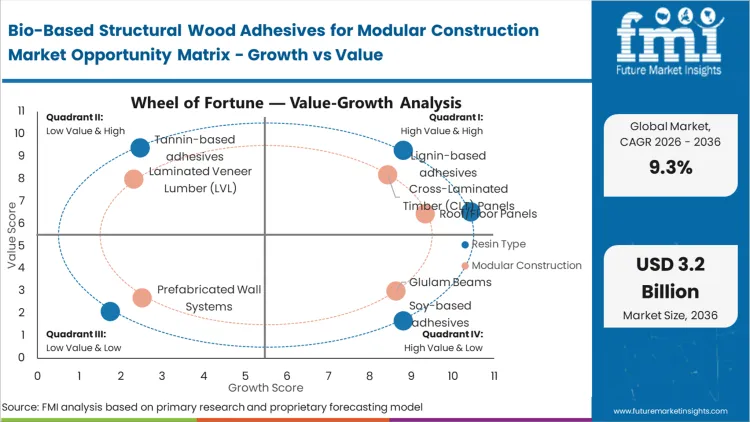
Embodied carbon taxation schemes force large-scale commercial developers to aggressively strip petrochemical footprints from mass timber supply chains. Sourcing directors at major offsite manufacturing firms cannot achieve required zero-carbon building certifications while utilizing thousands of gallons of petroleum-derived resins in their cross-laminated timber panels. Delaying the transition to renewable adhesives construction variants threatens developers with massive municipal carbon penalties and exclusion from lucrative government housing contracts.
Protracted European Technical Assessment testing cycles severely block rapid integration of novel bio-resins into active formaldehyde-free resin mass timber production lines. Structural engineering certifiers require years of simulated weathering and delamination data before approving any non-phenolic binder for load-bearing high-rise applications. Emerging computational aging models attempt to accelerate this validation, but conservative municipal inspectors still overwhelmingly demand physical long-term durability proof before signing occupancy permits.
Opportunities in the Bio-Based Structural Wood Adhesives for Modular Construction Market
- Enzymatic soy-protein modification: Bio-chemical engineers achieve superior cross-linking density through targeted enzymatic treatments. Resin formulation directors capture massive margins by solving legacy soy-adhesive moisture sensitivity issues.
- Microwave-assisted cold-curing: Integrating targeted radio-frequency bursts accelerates natural bio-based binder for building materials polymerization without heating the entire wood mass. Factory floor managers achieve synthetic-level throughput speeds while maintaining green credentials.
- Hyper-concentrated condensed tannins: Utilizing specific bark extracts drastically improves natural moisture resistance profiles. Procurement teams secure highly durable external-grade panel certifications previously impossible with basic carbohydrate binders.
Regional Analysis
.webp "Top Country Growth Comparison Bio Based Structural Wood Adhesives For Modular Construction Market Cagr (2026 2036)")
Based on regional analysis, bio-based structural wood adhesives for modular construction market is segmented into North America, Europe, Asia Pacific, Latin America, and Middle East & Africa.
| Country | CAGR (2026 to 2036) |
|---|---|
| India | 11.2% |
| China | 10.4% |
| Sweden | 10.2% |
| Germany | 9.8% |
| Canada | 9.5% |
| United States | 9.1% |
| Japan | 8.7% |
Source: Future Market Insights (FMI) analysis, based on proprietary forecasting model and primary research
Asia Pacific Bio-Based Structural Wood Adhesives for Modular Construction Market Analysis
Stringent new embodied carbon targets and state-funded urban housing mandates prioritize sustainable materials across major metropolitan zones. Rapid mobilization of prefabricated factories requires vast quantities of structural adhesives, pushing procurement teams toward domestically sourced biological alternatives. FMI's assessment indicates that local agricultural waste streams and massive manufacturing scale allow resin producers to drive down bio-chemical refinement costs faster than any other global region. Heavy monsoon moisture cycles and dense urban acoustic regulations demand exceptional delamination resistance, forcing bio-resin formulators to engineer hyper-durable hybrid systems specifically for tropical and seismic deployments.
- India: Procurement directors at regional modular factories utilize localized agricultural biomass to formulate highly cost-effective prefabricated building adhesives. Massive state-backed prefabricated housing initiatives act as factors supporting compound growth, driving an aggressive 11.2% CAGR. Domestic developers gain immediate competitive advantages bidding on government contracts by specifying completely indigenous bio-bonded timber panels.
- China: Strict carbon emission zoning laws act as factors supporting compound growth, pushing structural adoption to a 10.4% CAGR. Mass timber factory managers aggressively deploy modified soy-resins to meet aggressive state-mandated sustainability quotas. Success here positions China offsite manufacturers to dominate export markets requiring high-tier environmental product declarations.
- Japan: Structural engineering directors prioritize exceptional seismic flexibility, utilizing advanced bio-polyurethane hybrids to absorb dynamic earthquake loads. Regional mass timber producers face immense pressure to balance traditional joinery aesthetics with modern biological adhesive performance. Established prefabricated residential networks act as factors supporting compound growth, maintaining steady 8.7% CAGR while optimizing highly refined supply chains.
Europe Bio-Based Structural Wood Adhesives for Modular Construction Market Analysis
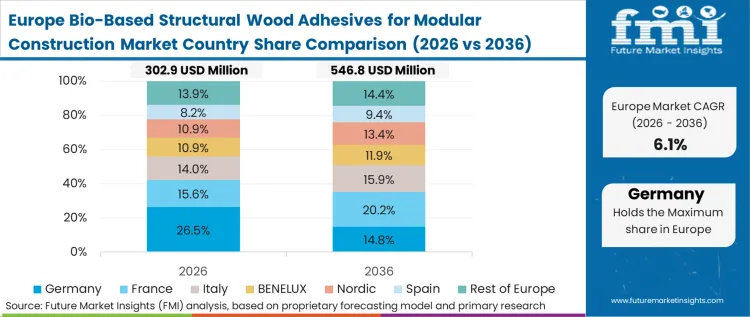
Mature mass timber supply chains convert completely to biological bonding agents under the pressure of severe European Union indoor air quality directives. Public institutional projects outright ban formaldehyde-emitting structural panels, forcing legacy cross-laminated timber producers into rapid chemical transitions. Based on FMI's projection, the advanced state of regional forestry infrastructure provides unparalleled access to high-purity kraft lignin, cementing regional formulation dominance. Regulatory bodies aggressively fast-track technical assessments for novel bio-resins, collapsing traditional certification timelines from years down to months. Extreme cold-weather modular deployments in northern territories demand unique low-temperature curing profiles, pushing regional industrial adhesives R&D teams to pioneer advanced enzymatic cold-set catalysts.
- Sweden: Advanced forestry integration acts as factors supporting compound growth, fueling a 10.2% CAGR as national mandates require bio-based mass timber in public infrastructure. Factory floor supervisors easily drop high-purity lignin binders into existing Scandinavian hot-press lines. Domestic CLT producers secure total dominance across European premium green-building sectors.
- Germany: Institutional procurement officers completely disqualify offsite manufacturers utilizing traditional phenol-formaldehyde panel configurations. Deep integration between regional chemical giants and modular builders establishes a formidable barrier to entry for foreign synthetic resin suppliers. Stringent indoor air quality regulations for public buildings act as factors supporting compound growth, sustaining strong 9.8% CAGR.
North America Bio-Based Structural Wood Adhesives for Modular Construction Market Analysis
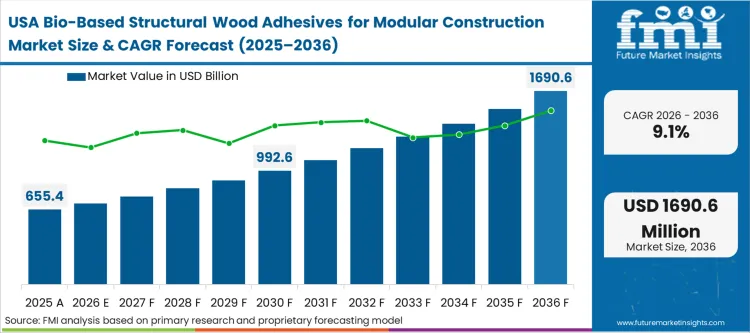
Fragmented building codes create localized adoption pockets, requiring suppliers to navigate complex state-by-state structural validation testing. Despite regulatory friction, high-volume developers actively transition toward biological binders to capture premium green-building incentives and satisfy stringent corporate sustainability mandates. FMI observes that mass timber production capacity is expanding rapidly across the continent, pulling massive volumes of bio-resins into newly commissioned cross-laminated timber facilities. Procurement directors prioritize resins that integrate seamlessly with existing cold-set and hot-press infrastructures without demanding exorbitant capital retrofits.
- Canada: Factory floor managers seamlessly integrate locally sourced bio-resins into expanding modular production lines. Expanding forestry infrastructure and progressive municipal building codes act as factors supporting compound growth, propelling a 9.5% CAGR. Domestic producers secure strong export positioning by offering fully certified, low-embodied-carbon structural panels.
- United States: Intense competition among volume homebuilders acts as factors supporting compound growth, driving a 9.1% CAGR. Sourcing teams aggressively secure formaldehyde-free formulations to market premium healthy-home environments directly to suburban buyers. Mass timber developers gain substantial competitive advantages in bidding for public institutional projects by specifying completely bio-bonded panels.
FMI's report includes detailed analysis of Latin America and the Middle East & Africa, where emerging urban infrastructure projects are beginning to evaluate low-carbon adhesive requirements.
Competitive Aligners for Market Players
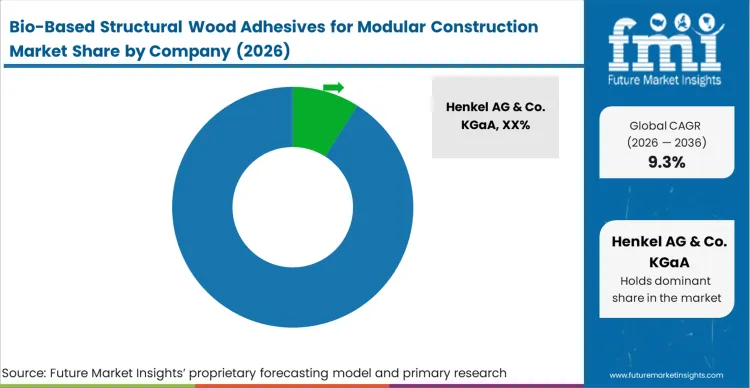
Chemical formulation control fundamentally dictates competitive positioning within this highly technical materials sector. Henkel AG & Co. KGaA and Arkema S.A. aggressively acquire niche bio-polymer startups to secure exclusive enzymatic modification patents, locking out mid-tier formulators from premium load-bearing certifications. Procurement directors at mega-scale modular factories refuse to entertain bids from adhesive suppliers lacking massive internal testing infrastructure, knowing that municipal building inspectors rely heavily on manufacturer-supplied weathering data. Success depends directly on a supplier's ability to shoulder the multi-million-dollar burden of European Technical Assessment and ICC-ES structural certifications.
Incumbent chemical giants possess deep integration with existing engineered wood factory press equipment. H.B. Fuller Company and Sika AG deploy massive teams of process engineers to physically recalibrate client factory lines when introducing new biological resins, a service small bio-chemical startups simply cannot afford to provide. This hands-on integration creates profound vendor stickiness; once a mass timber plant manager successfully calibrates a continuous press line to a specific adhesives and sealants natural curing profile, switching suppliers risks catastrophic production downtime. Challengers must build drop-in formulations that require absolutely zero thermal or pressure adjustments to existing synthetic infrastructure.
Large modular fabricators actively resist this chemical lock-in by demanding open-source curing parameters during initial contract negotiations. Sourcing teams force top-tier bio-based resin suppliers to guarantee formulation consistency across multiple global batching facilities, mitigating regional supply chain disruptions. Toward the next decade, competitive dominance will shift away from basic bio-content percentages toward verifiable rapid-curing capabilities that finally match legacy polyurethane line speeds without the massive energy penalty of hot-pressing.
Key Players in Bio-Based Structural Wood Adhesives for Modular Construction Market
- Henkel AG & Co. KGaA
- Arkema S.A. (Bostik)
- H.B. Fuller Company
- Sika AG
- Ashland Inc.
- Stora Enso Oyj
- UPM-Kymmene Corporation
Scope of the Report
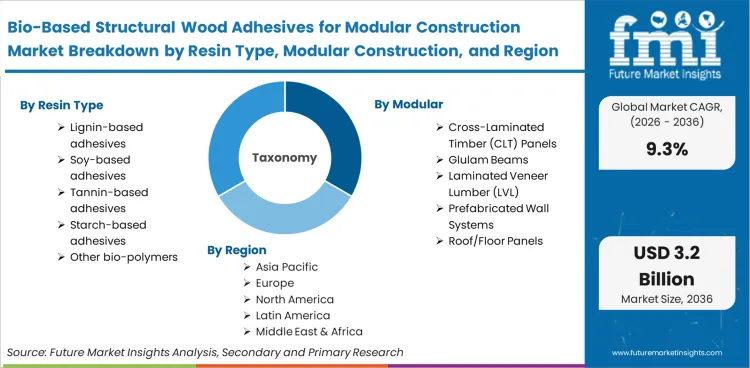
| Metric | Value |
|---|---|
| Quantitative Units | USD 1.3 billion to USD 3.2 billion, at a CAGR of 9.3% |
| Market Definition | Biological bonding agents engineered to replace petrochemical resins in load-bearing mass timber elements, meeting strict mechanical stress certifications. |
| Segmentation | Resin Type, Application in Modular Construction, End-Use Sector, Performance Type, Curing Technology, Region |
| Regions Covered | North America, Europe, Asia Pacific, Latin America, Middle East & Africa |
| Countries Covered | United States, Canada, Germany, Sweden, China, Japan, India |
| Key Companies Profiled | Henkel AG & Co. KGaA, Arkema S.A. (Bostik), H.B. Fuller Company, Sika AG, Ashland Inc., Stora Enso Oyj, UPM-Kymmene Corporation |
| Forecast Period | 2026 to 2036 |
| Approach | Bottom-up calculations anchored on global timber production volumes validated against average adhesive application rates per cubic meter. |
Source: Future Market Insights (FMI) analysis, based on proprietary forecasting model and primary research
Bio-Based Structural Wood Adhesives for Modular Construction Market Analysis by Segments
Resin Type
- Lignin-based adhesives
- Soy-based adhesives
- Tannin-based adhesives
- Starch-based adhesives
- Other bio-polymers
Application in Modular Construction
- Cross-Laminated Timber (CLT) Panels
- Glulam Beams
- Laminated Veneer Lumber (LVL)
- Prefabricated Wall Systems
- Roof/Floor Panels
End-Use Sector
- Residential Modular Construction
- Commercial Modular Buildings
- Institutional
Performance Type
- Structural Load-Bearing Adhesives
- Semi-Structural Adhesives
- Non-Structural Adhesives
Curing Technology
- Cold-set Adhesives
- Hot-press Adhesives
- Hybrid curing systems
Region
- North America
- United States
- Canada
- Europe
- Germany
- United Kingdom
- France
- Italy
- Spain
- Russia
- Sweden
- Asia Pacific
- China
- Japan
- India
- South Korea
- Australia
- New Zealand
- Indonesia
- Thailand
- Malaysia
- Latin America
- Brazil
- Mexico
- Middle East & Africa
- GCC Countries
- South Africa
- North Africa
Bibliography
- Chen, H., Wu, Q., Ren, X., Zhu, X., & Fan, D. (2024, August). A fully bio-based adhesive with high bonding strength, low environmental impact, and competitive performance. Chemical Engineering Journal.
- Younesi-Kordkheili, H., et al. (2025, November). Wood bio-adhesives made by polymerizing oxidized starch and lignin systems. Polymers (MDPI).
- Páez, J., et al. (2025, August). Incorporation of lignin into adhesives: A comprehensive review. Green Chemistry (RSC Publishing).
- Kardam, S. K., et al. (2025, December). Wood adhesives: Smart adhesion, aging, and sustainability trends. ACS Engineering Au.
- TechScience Press. (2025, May). Facile crosslinking of hardwood kraft lignin for sustainable bio-based wood adhesives. Journal of Renewable Materials.
This bibliography is provided for reader reference. The full FMI report contains the complete reference list with primary source documentation.
This Report Addresses
- Cross-laminated timber capacity constraints linked directly to biological curing speeds.
- Emitted formaldehyde penalization driving institutional architectural specifications toward bio-resins.
- Extreme chemical refining costs separating load-bearing certifications from basic residential applications.
- Lignin extraction bottlenecks at global kraft pulping facilities limiting high-strength resin availability.
- Energy consumption differentials between thermal pressing and ambient cold-set natural polymerization.
- Massive disparity in embodied carbon taxation between North America and Europe modular markets.
- Supplier integration friction preventing fast switching between synthetic and bio-based resin networks.
- Structural testing lags delaying innovative soy-protein modifiers from achieving municipal clearance.
Frequently Asked Questions
What is the projected value of the market by 2036?
Total valuation reaches USD 3.2 billion by 2036. This massive expansion reflects an irreversible shift among major modular fabricators abandoning petrochemical resins to secure lucrative green-building municipal contracts and avoid impending carbon taxation.
What is the expected CAGR from 2026 to 2036?
Revenue expansion operates at a 9.3% compound annual growth rate. This velocity relies heavily on chemical formulators successfully dropping biological resin curing times down to match legacy polyurethane hot-press line speeds.
Which resin type currently holds the largest share?
Lignin-based formulations secure 38.5% of demand. Structural engineers prefer these specific biologicals because hybrid lignin-phenol matrices maintain critical shear strength during violent moisture-cycling tests required for European Technical Assessment certification.
Why do cross-laminated timber panels dominate application volume?
Planar structural elements command 44.2% share simply due to massive glue-line surface areas per manufactured unit. Engineers confidently specify natural binders here because stress distributes widely across the panel, unlike highly concentrated point-loads found in primary glulam support beams.
What operational barrier slows bio-resin adoption?
Protracted mechanical certification cycles absolutely paralyze rapid chemical transitions. Municipal building inspectors require years of simulated weathering and delamination data before signing off on novel biological adhesives for load-bearing high-rise mass timber applications.
Why does India grow faster than established Europe markets?
India achieves an 11.2% expansion rate due to aggressive state-funded prefabricated housing rollouts. Procurement teams leverage highly abundant localized agricultural biomass to bypass volatile global chemical supply chains, whereas Europe producers face constrained high-purity lignin extraction bottlenecks.
How does curing technology impact factory profitability?
Cold-set biological systems drastically reduce factory electrical loads by eliminating massive thermal presses. However, plant supervisors struggle with extreme seasonal temperature sensitivity, forcing expensive facility insulation upgrades to prevent slow winter-month polymerization.
What non-obvious factor protects incumbent chemical giants?
Major resin suppliers deploy massive teams of process engineers to physically recalibrate client factory press lines when introducing new biological formulas. Small bio-chemical startups cannot afford to provide this intense physical integration, essentially locking them out of massive commercial supply contracts.
Why are starch-based adhesives limited to residential applications?
Standard residential wall panels experience significantly lower dynamic loads than commercial building floors. Formulators deploy cheaper starch matrices successfully in static residential geometries but fail critical acoustic and vibration dampening tests when attempting to port them into heavy institutional designs.
How do embodied carbon mandates change procurement behavior?
Sourcing directors face massive financial penalties if total building life-cycle emissions exceed strict new zoning laws. Eliminating petroleum-derived adhesives from mass timber panels often represents the final critical step required to achieve profitable zero-carbon project status.
What happens when modular builders use uncertified bio-resins?
Risk management officers face catastrophic liability exposure and immediate municipal stop-work orders. Attempting to cut formulation costs by deploying semi-structural natural binders in critical load-bearing nodes inevitably triggers total project delays and devastating retro-fitting expenses.
How will supply chain constraints affect lignin availability?
Total global kraft pulping capacity strictly limits highly refined lignin extraction volumes. Chemical formulation directors face severe raw material bottlenecks when attempting to scale massive multi-factory biological resin rollouts simultaneously across international borders.
Preview the report firsthand - request a free sample
Get SampleGet the brochure for pricing and purchase details.
Get PDFTable of Content
- Executive Summary
- Global Market Outlook
- Demand-side Trends
- Supply-side Trends
- Technology Roadmap Analysis
- Analysis and Recommendations
- Market Overview
- Market Coverage / Taxonomy
- Market Definition / Scope / Limitations
- Research Methodology
- Chapter Orientation
- Analytical Lens and Working Hypotheses
- Market Structure, Signals, and Trend Drivers
- Benchmarking and Cross-market Comparability
- Market Sizing, Forecasting, and Opportunity Mapping
- Research Design and Evidence Framework
- Desk Research Programme (Secondary Evidence)
- Company Annual and Sustainability Reports
- Peer-reviewed Journals and Academic Literature
- Corporate Websites, Product Literature, and Technical Notes
- Earnings Decks and Investor Briefings
- Statutory Filings and Regulatory Disclosures
- Technical White Papers and Standards Notes
- Trade Journals, Industry Magazines, and Analyst Briefs
- Conference Proceedings, Webinars, and Seminar Materials
- Government Statistics Portals and Public Data Releases
- Press Releases and Reputable Media Coverage
- Specialist Newsletters and Curated Briefings
- Sector Databases and Reference Repositories
- FMI Internal Proprietary Databases and Historical Market Datasets
- Subscription Datasets and Paid Sources
- Social Channels, Communities, and Digital Listening Inputs
- Additional Desk Sources
- Expert Input and Fieldwork (Primary Evidence)
- Primary Modes
- Qualitative Interviews and Expert Elicitation
- Quantitative Surveys and Structured Data Capture
- Blended Approach
- Why Primary Evidence is Used
- Field Techniques
- Interviews
- Surveys
- Focus Groups
- Observational and In-context Research
- Social and Community Interactions
- Stakeholder Universe Engaged
- C-suite Leaders
- Board Members
- Presidents and Vice Presidents
- R&D and Innovation Heads
- Technical Specialists
- Domain Subject-matter Experts
- Scientists
- Physicians and Other Healthcare Professionals
- Governance, Ethics, and Data Stewardship
- Research Ethics
- Data Integrity and Handling
- Primary Modes
- Tooling, Models, and Reference Databases
- Desk Research Programme (Secondary Evidence)
- Data Engineering and Model Build
- Data Acquisition and Ingestion
- Cleaning, Normalisation, and Verification
- Synthesis, Triangulation, and Analysis
- Quality Assurance and Audit Trail
- Market Background
- Market Dynamics
- Drivers
- Restraints
- Opportunity
- Trends
- Scenario Forecast
- Demand in Optimistic Scenario
- Demand in Likely Scenario
- Demand in Conservative Scenario
- Opportunity Map Analysis
- Product Life Cycle Analysis
- Supply Chain Analysis
- Investment Feasibility Matrix
- Value Chain Analysis
- PESTLE and Porter’s Analysis
- Regulatory Landscape
- Regional Parent Market Outlook
- Production and Consumption Statistics
- Import and Export Statistics
- Market Dynamics
- Global Market Analysis 2021 to 2025 and Forecast, 2026 to 2036
- Historical Market Size Value (USD Million) Analysis, 2021 to 2025
- Current and Future Market Size Value (USD Million) Projections, 2026 to 2036
- Y-o-Y Growth Trend Analysis
- Absolute $ Opportunity Analysis
- Global Market Pricing Analysis 2021 to 2025 and Forecast 2026 to 2036
- Global Market Analysis 2021 to 2025 and Forecast 2026 to 2036, By Resin Type
- Introduction / Key Findings
- Historical Market Size Value (USD Million) Analysis By Resin Type , 2021 to 2025
- Current and Future Market Size Value (USD Million) Analysis and Forecast By Resin Type , 2026 to 2036
- Lignin-based adhesives
- Soy-based adhesives
- Tannin-based adhesives
- Starch-based adhesives
- Other bio-polymers
- Lignin-based adhesives
- Y-o-Y Growth Trend Analysis By Resin Type , 2021 to 2025
- Absolute $ Opportunity Analysis By Resin Type , 2026 to 2036
- Global Market Analysis 2021 to 2025 and Forecast 2026 to 2036, By Modular Construction
- Introduction / Key Findings
- Historical Market Size Value (USD Million) Analysis By Modular Construction, 2021 to 2025
- Current and Future Market Size Value (USD Million) Analysis and Forecast By Modular Construction, 2026 to 2036
- Cross-Laminated Timber (CLT) Panels
- Glulam Beams
- Laminated Veneer Lumber (LVL)
- Prefabricated Wall Systems
- Roof/Floor Panels
- Cross-Laminated Timber (CLT) Panels
- Y-o-Y Growth Trend Analysis By Modular Construction, 2021 to 2025
- Absolute $ Opportunity Analysis By Modular Construction, 2026 to 2036
- Global Market Analysis 2021 to 2025 and Forecast 2026 to 2036, By End Use
- Introduction / Key Findings
- Historical Market Size Value (USD Million) Analysis By End Use, 2021 to 2025
- Current and Future Market Size Value (USD Million) Analysis and Forecast By End Use, 2026 to 2036
- Residential Modular Construction
- Commercial Modular Buildings
- Institutional
- Residential Modular Construction
- Y-o-Y Growth Trend Analysis By End Use, 2021 to 2025
- Absolute $ Opportunity Analysis By End Use, 2026 to 2036
- Global Market Analysis 2021 to 2025 and Forecast 2026 to 2036, By Performance Type
- Introduction / Key Findings
- Historical Market Size Value (USD Million) Analysis By Performance Type, 2021 to 2025
- Current and Future Market Size Value (USD Million) Analysis and Forecast By Performance Type, 2026 to 2036
- Structural Load-Bearing Adhesives
- Semi-Structural Adhesives
- Non-Structural Adhesives
- Structural Load-Bearing Adhesives
- Y-o-Y Growth Trend Analysis By Performance Type, 2021 to 2025
- Absolute $ Opportunity Analysis By Performance Type, 2026 to 2036
- Global Market Analysis 2021 to 2025 and Forecast 2026 to 2036, By Curing Technology
- Introduction / Key Findings
- Historical Market Size Value (USD Million) Analysis By Curing Technology, 2021 to 2025
- Current and Future Market Size Value (USD Million) Analysis and Forecast By Curing Technology, 2026 to 2036
- Cold-set Adhesives
- Hot-press Adhesives
- Hybrid curing systems
- Cold-set Adhesives
- Y-o-Y Growth Trend Analysis By Curing Technology, 2021 to 2025
- Absolute $ Opportunity Analysis By Curing Technology, 2026 to 2036
- Global Market Analysis 2021 to 2025 and Forecast 2026 to 2036, By Region
- Introduction
- Historical Market Size Value (USD Million) Analysis By Region, 2021 to 2025
- Current Market Size Value (USD Million) Analysis and Forecast By Region, 2026 to 2036
- North America
- Latin America
- Western Europe
- Eastern Europe
- East Asia
- South Asia and Pacific
- Middle East & Africa
- Market Attractiveness Analysis By Region
- North America Market Analysis 2021 to 2025 and Forecast 2026 to 2036, By Country
- Historical Market Size Value (USD Million) Trend Analysis By Market Taxonomy, 2021 to 2025
- Market Size Value (USD Million) Forecast By Market Taxonomy, 2026 to 2036
- By Country
- USA
- Canada
- Mexico
- By Resin Type
- By Modular Construction
- By End Use
- By Performance Type
- By Curing Technology
- By Country
- Market Attractiveness Analysis
- By Country
- By Resin Type
- By Modular Construction
- By End Use
- By Performance Type
- By Curing Technology
- Key Takeaways
- Latin America Market Analysis 2021 to 2025 and Forecast 2026 to 2036, By Country
- Historical Market Size Value (USD Million) Trend Analysis By Market Taxonomy, 2021 to 2025
- Market Size Value (USD Million) Forecast By Market Taxonomy, 2026 to 2036
- By Country
- Brazil
- Chile
- Rest of Latin America
- By Resin Type
- By Modular Construction
- By End Use
- By Performance Type
- By Curing Technology
- By Country
- Market Attractiveness Analysis
- By Country
- By Resin Type
- By Modular Construction
- By End Use
- By Performance Type
- By Curing Technology
- Key Takeaways
- Western Europe Market Analysis 2021 to 2025 and Forecast 2026 to 2036, By Country
- Historical Market Size Value (USD Million) Trend Analysis By Market Taxonomy, 2021 to 2025
- Market Size Value (USD Million) Forecast By Market Taxonomy, 2026 to 2036
- By Country
- Germany
- UK
- Italy
- Spain
- France
- Nordic
- BENELUX
- Rest of Western Europe
- By Resin Type
- By Modular Construction
- By End Use
- By Performance Type
- By Curing Technology
- By Country
- Market Attractiveness Analysis
- By Country
- By Resin Type
- By Modular Construction
- By End Use
- By Performance Type
- By Curing Technology
- Key Takeaways
- Eastern Europe Market Analysis 2021 to 2025 and Forecast 2026 to 2036, By Country
- Historical Market Size Value (USD Million) Trend Analysis By Market Taxonomy, 2021 to 2025
- Market Size Value (USD Million) Forecast By Market Taxonomy, 2026 to 2036
- By Country
- Russia
- Poland
- Hungary
- Balkan & Baltic
- Rest of Eastern Europe
- By Resin Type
- By Modular Construction
- By End Use
- By Performance Type
- By Curing Technology
- By Country
- Market Attractiveness Analysis
- By Country
- By Resin Type
- By Modular Construction
- By End Use
- By Performance Type
- By Curing Technology
- Key Takeaways
- East Asia Market Analysis 2021 to 2025 and Forecast 2026 to 2036, By Country
- Historical Market Size Value (USD Million) Trend Analysis By Market Taxonomy, 2021 to 2025
- Market Size Value (USD Million) Forecast By Market Taxonomy, 2026 to 2036
- By Country
- China
- Japan
- South Korea
- By Resin Type
- By Modular Construction
- By End Use
- By Performance Type
- By Curing Technology
- By Country
- Market Attractiveness Analysis
- By Country
- By Resin Type
- By Modular Construction
- By End Use
- By Performance Type
- By Curing Technology
- Key Takeaways
- South Asia and Pacific Market Analysis 2021 to 2025 and Forecast 2026 to 2036, By Country
- Historical Market Size Value (USD Million) Trend Analysis By Market Taxonomy, 2021 to 2025
- Market Size Value (USD Million) Forecast By Market Taxonomy, 2026 to 2036
- By Country
- India
- ASEAN
- Australia & New Zealand
- Rest of South Asia and Pacific
- By Resin Type
- By Modular Construction
- By End Use
- By Performance Type
- By Curing Technology
- By Country
- Market Attractiveness Analysis
- By Country
- By Resin Type
- By Modular Construction
- By End Use
- By Performance Type
- By Curing Technology
- Key Takeaways
- Middle East & Africa Market Analysis 2021 to 2025 and Forecast 2026 to 2036, By Country
- Historical Market Size Value (USD Million) Trend Analysis By Market Taxonomy, 2021 to 2025
- Market Size Value (USD Million) Forecast By Market Taxonomy, 2026 to 2036
- By Country
- Kingdom of Saudi Arabia
- Other GCC Countries
- Turkiye
- South Africa
- Other African Union
- Rest of Middle East & Africa
- By Resin Type
- By Modular Construction
- By End Use
- By Performance Type
- By Curing Technology
- By Country
- Market Attractiveness Analysis
- By Country
- By Resin Type
- By Modular Construction
- By End Use
- By Performance Type
- By Curing Technology
- Key Takeaways
- Key Countries Market Analysis
- USA
- Pricing Analysis
- Market Share Analysis, 2025
- By Resin Type
- By Modular Construction
- By End Use
- By Performance Type
- By Curing Technology
- Canada
- Pricing Analysis
- Market Share Analysis, 2025
- By Resin Type
- By Modular Construction
- By End Use
- By Performance Type
- By Curing Technology
- Mexico
- Pricing Analysis
- Market Share Analysis, 2025
- By Resin Type
- By Modular Construction
- By End Use
- By Performance Type
- By Curing Technology
- Brazil
- Pricing Analysis
- Market Share Analysis, 2025
- By Resin Type
- By Modular Construction
- By End Use
- By Performance Type
- By Curing Technology
- Chile
- Pricing Analysis
- Market Share Analysis, 2025
- By Resin Type
- By Modular Construction
- By End Use
- By Performance Type
- By Curing Technology
- Germany
- Pricing Analysis
- Market Share Analysis, 2025
- By Resin Type
- By Modular Construction
- By End Use
- By Performance Type
- By Curing Technology
- UK
- Pricing Analysis
- Market Share Analysis, 2025
- By Resin Type
- By Modular Construction
- By End Use
- By Performance Type
- By Curing Technology
- Italy
- Pricing Analysis
- Market Share Analysis, 2025
- By Resin Type
- By Modular Construction
- By End Use
- By Performance Type
- By Curing Technology
- Spain
- Pricing Analysis
- Market Share Analysis, 2025
- By Resin Type
- By Modular Construction
- By End Use
- By Performance Type
- By Curing Technology
- France
- Pricing Analysis
- Market Share Analysis, 2025
- By Resin Type
- By Modular Construction
- By End Use
- By Performance Type
- By Curing Technology
- India
- Pricing Analysis
- Market Share Analysis, 2025
- By Resin Type
- By Modular Construction
- By End Use
- By Performance Type
- By Curing Technology
- ASEAN
- Pricing Analysis
- Market Share Analysis, 2025
- By Resin Type
- By Modular Construction
- By End Use
- By Performance Type
- By Curing Technology
- Australia & New Zealand
- Pricing Analysis
- Market Share Analysis, 2025
- By Resin Type
- By Modular Construction
- By End Use
- By Performance Type
- By Curing Technology
- China
- Pricing Analysis
- Market Share Analysis, 2025
- By Resin Type
- By Modular Construction
- By End Use
- By Performance Type
- By Curing Technology
- Japan
- Pricing Analysis
- Market Share Analysis, 2025
- By Resin Type
- By Modular Construction
- By End Use
- By Performance Type
- By Curing Technology
- South Korea
- Pricing Analysis
- Market Share Analysis, 2025
- By Resin Type
- By Modular Construction
- By End Use
- By Performance Type
- By Curing Technology
- Russia
- Pricing Analysis
- Market Share Analysis, 2025
- By Resin Type
- By Modular Construction
- By End Use
- By Performance Type
- By Curing Technology
- Poland
- Pricing Analysis
- Market Share Analysis, 2025
- By Resin Type
- By Modular Construction
- By End Use
- By Performance Type
- By Curing Technology
- Hungary
- Pricing Analysis
- Market Share Analysis, 2025
- By Resin Type
- By Modular Construction
- By End Use
- By Performance Type
- By Curing Technology
- Kingdom of Saudi Arabia
- Pricing Analysis
- Market Share Analysis, 2025
- By Resin Type
- By Modular Construction
- By End Use
- By Performance Type
- By Curing Technology
- Turkiye
- Pricing Analysis
- Market Share Analysis, 2025
- By Resin Type
- By Modular Construction
- By End Use
- By Performance Type
- By Curing Technology
- South Africa
- Pricing Analysis
- Market Share Analysis, 2025
- By Resin Type
- By Modular Construction
- By End Use
- By Performance Type
- By Curing Technology
- USA
- Market Structure Analysis
- Competition Dashboard
- Competition Benchmarking
- Market Share Analysis of Top Players
- By Regional
- By Resin Type
- By Modular Construction
- By End Use
- By Performance Type
- By Curing Technology
- Competition Analysis
- Competition Deep Dive
- Henkel AG & Co. KGaA
- Overview
- Product Portfolio
- Profitability by Market Segments (Product/Age /Sales Channel/Region)
- Sales Footprint
- Strategy Overview
- Marketing Strategy
- Product Strategy
- Channel Strategy
- Arkema S.A. (Bostik)
- H.B. Fuller Company
- Sika AG
- Ashland Inc.
- Stora Enso Oyj
- UPM-Kymmene Corporation
- Henkel AG & Co. KGaA
- Competition Deep Dive
- Assumptions & Acronyms Used


