

- Industry Size (2026)
- USD 127.9 Mn
- Forecast (2036)
- USD 289.2 Mn
- CAGR (2026 to 2036)
- 8.5%
Construction and Demolition Waste Automated Sorting Lines in EU Urban Regions Size, Market Forecast and Outlook By FMI
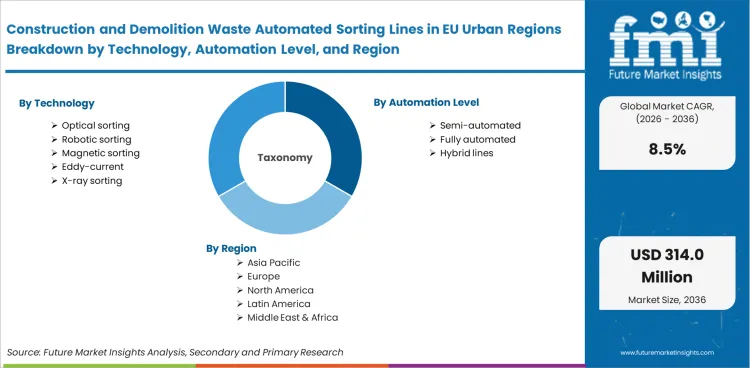
The construction and demolition waste automated sorting lines in EU urban regions crossed a valuation of USD 117.9 million in 2025. Demand is projected to reach USD 127.9 million in 2026 and is expected to rise to USD 289.2 million by 2036, reflecting a CAGR of 8.5% over the forecast period.
Summary of Construction and Demolition Waste Automated Sorting Lines in EU Urban Regions
- The market is forecast to reach USD 289.2 million by 2036.
- The market is expected to grow at a CAGR of 8.5% from 2026 to 2036.
- The market was estimated at USD 117.9 million in 2025.
- The forecast period represents an incremental opportunity of USD 162.5 million.
- The market is projected to reach USD 127.9 million in 2026.
- Optical sorting leads the segment with a 34.0% share, driven by its role in improving material purity.
- Semi-automated systems account for 41.0% share, reflecting continued reliance on manual inspection alongside automation.
- Mixed mineral waste dominates with a 38.0% share, due to high volumes of concrete, bricks, and plaster.
- Retrofit lines lead with a 57.0% share, as operators prefer upgrading existing facilities.
- Recyclers hold 49.0% share, representing the largest end-user segment.
- Key companies in the market include TOMRA, STEINERT, STADLER, Pellenc ST, Recycleye, Binder+Co, and ZenRobotics (Terex Recycling Systems).
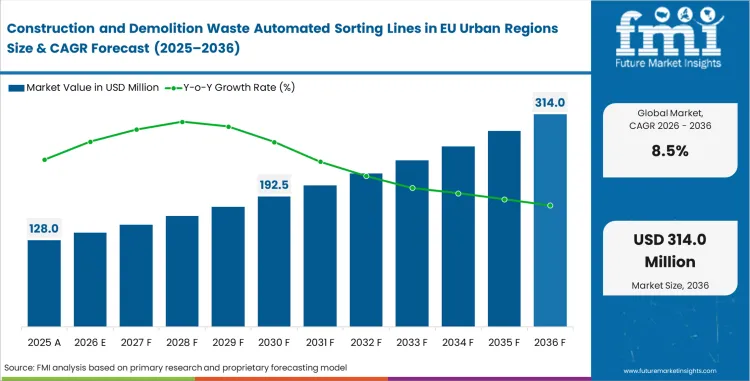
Market expansion is being supported by rising landfill charges and stricter recovery requirements, which are increasing the value of cleaner output streams from mixed construction and demolition waste.
Processing plants are under pressure from both disposal cost inflation and inconsistent feedstock quality. Buyers are no longer looking only at nameplate throughput. They are weighing whether a line can keep recovery rates stable when dust, mixed mineral loads, and labor shortages start to erode actual performance. That is why investment decisions are now tied more closely to output purity, service intervals, retrofit fit, and payback discipline than to equipment speed alone.
Upgrade timing is increasingly influenced by tender conditions and local recovery requirements, especially where public or municipal contracts require better diversion reporting. Once municipal and public-project contracts require better diversion records, operators cannot rely on manual picking lines that lose consistency during peak urban demolition cycles. New system purchases are being judged on calibration stability, commissioning risk, and the amount of rework needed to fit new modules into constrained urban yards. FMI is of the opinion that the best-positioned suppliers will be the ones that can prove stable sorting performance after installation rather than only promising higher recovery in pilot conditions.
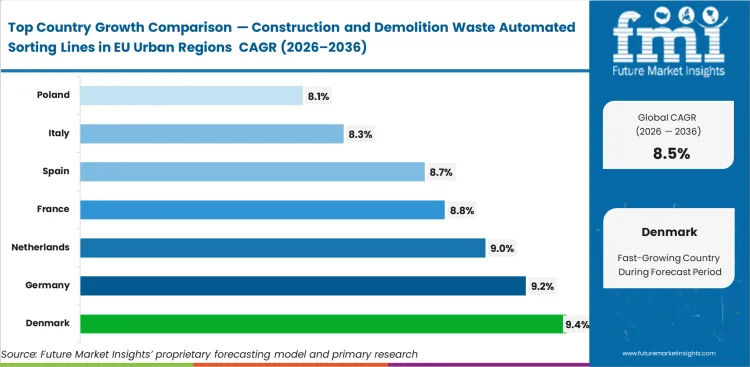
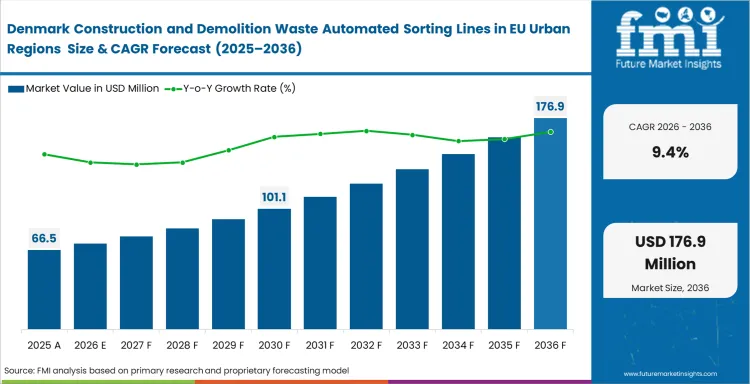
Denmark is expected to remain the fastest-growing market, with a CAGR of 9.4% through 2036, supported by active redevelopment cycles and firm policy execution. Germany is projected to register a CAGR of 9.2%, reflecting continued pressure from strict recycling compliance. Netherlands is estimated to expand at a CAGR of 9.0% as infrastructure renewal supports equipment replacement. France is likely to post 8.8% CAGR, while Spain is projected to record 8.7% CAGR as municipal waste recovery systems continue to improve. Italy is expected to grow at a CAGR of 8.3%, and Poland is likely to register 8.1% CAGR, where adoption remains more dependent on retrofit economics at the facility level. Regional growth patterns remain uneven because landfill cost exposure and investment returns differ across national markets.
Segmental Analysis
Construction and Demolition Waste Automated Sorting Lines in EU Urban Regions Analysis by Technology
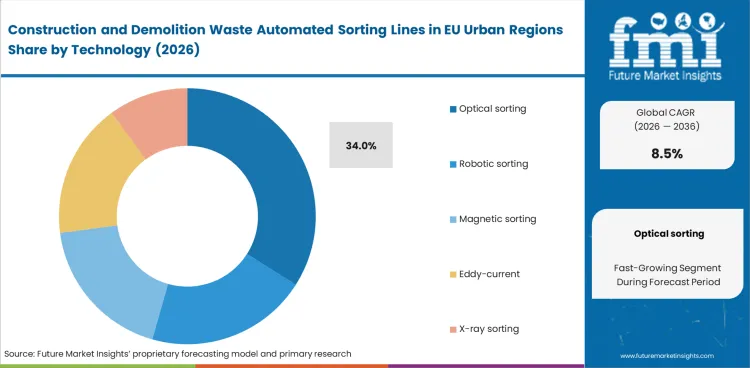
Sensor deployment changes how facilities handle dense and mixed incoming loads. Plant operators install a construction debris optical sorter to distinguish wood grades and plastic polymers buried inside dusty rubble with better accuracy. Optical sorting for construction waste is estimated to account for 34.0% share in 2026, as per FMI’s analysis. AI waste sorting robots work alongside these scanners to remove identified materials and support faster robotic sorting for demolition waste. Optical identification reduces sorting mistakes that rise during long manual shifts. Dust remains a clear operating constraint because heavy buildup can impair sensor performance within a short period. Frequent lens cleaning and strong air extraction remain necessary to protect output quality. Delayed maintenance lowers secondary commodity purity and weakens line efficiency.
- Decision triggers: Rising disposal charges push facility owners to assess high-speed identification systems early.
- Validation metrics: Installations move ahead when pilot runs demonstrate measurable purity improvement across target fractions under site-specific operating conditions.
- Expansion pathways: Robotic extraction arms are usually added after optical scanners prove stable under continuous dusty operating conditions.
Construction and Demolition Waste Automated Sorting Lines in EU Urban Regions Analysis by Automation Level
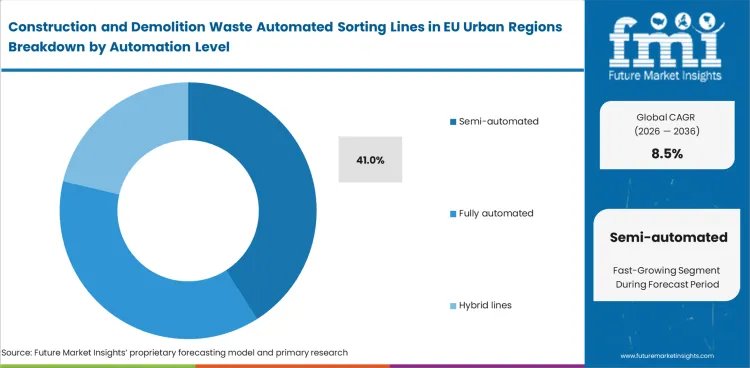
Capital availability shapes how automation is introduced across existing yards. Mid-sized waste management operators often prefer semi-automated layouts because they combine mechanical screening with selective robotic support and keep initial investment more manageable. Hybrid systems also help lines continue running when one robotic unit stops for maintenance. Based on FMI’s assessment, semi-automated configurations are expected to hold 41.0% share in 2026. Manual quality checks remain part of the process, but belt speed must be controlled carefully to avoid worker fatigue and uneven material flow. Poor coordination between human and machine sections causes spillover and disrupts output consistency. Routine recalibration also adds to ongoing operating cost.
- Maintenance costs: Routine sensor recalibration consumes a meaningful share of operating budgets and makes preventive servicing essential.
- Hidden inefficiencies: Conveyor belt wear rises quickly in mixed automated systems, leading to more frequent section replacement.
- Lifecycle analysis: Equipment value becomes clearer only after several years of uninterrupted operation.
Construction and Demolition Waste Automated Sorting Lines in EU Urban Regions Analysis by Waste Fraction
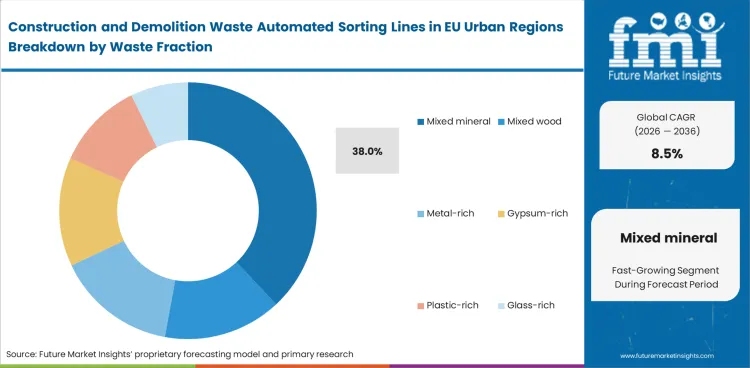
Heavy concrete and brick streams set the baseline for conveyor durability and equipment strength. Crushing, screening, and classification capacity remain central because facilities process large mineral volumes under constant mechanical stress. Clean output also matters because recycled concrete aggregates create a better secondary sales mix for plant owners. FMI indicates mixed mineral processing is likely to represent 38.0% share in 2026. Heavy mineral handling also creates strong vibration, and that operating condition can damage nearby optical systems if plant layouts are poorly designed. Physical separation between crushing zones and sensor-based sorting sections remains important for equipment life. Weak planning raises maintenance costs and shortens the service life of sensitive electronics.
- Wear prevention: Heavy mineral impact damages standard conveyor belts quickly, which increases the need for reinforced belt materials.
- Secondary damage: Crushing dust spreads across the facility fast and requires constant cleaning to protect control systems.
- Full capture: Maximum mineral recovery depends on accurate screening sequences and close control of mesh sizes.
Construction and Demolition Waste Automated Sorting Lines in EU Urban Regions Analysis by Installation Type
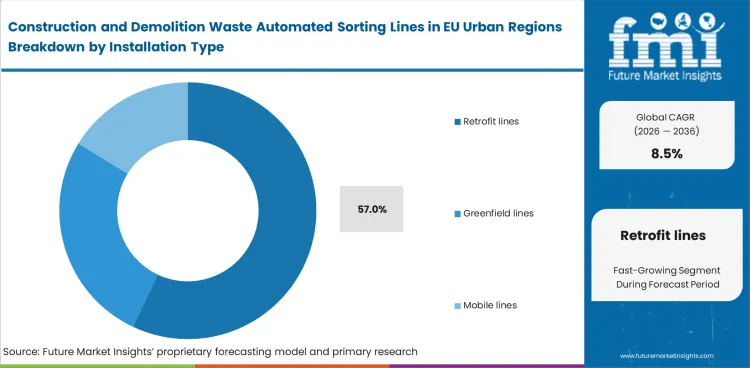
Space limits shape most plant upgrade decisions in dense urban settings. Urban construction aggregates facilities often add new sensors and robotic units inside existing sheds because permits for new sites take time and create project delays. Retrofit sorting lines for C&D waste are projected to secureb share in 2026 when retrofit and greenfield investments are compared. Installation work also becomes more complex when new robotic arms must be mounted over older conveyor structures. Weekend shutdown windows are often used to reduce disruption, but older steel frames may still require major reinforcement before upgrades can operate safely. Hidden costs can materially change project economics. Poorly executed retrofits often create ongoing stress cracks and repeated maintenance issues.
- Early adopters: Municipal recycling centers often move first when near-term compliance pressure requires faster upgrades.
- Follower execution: Private operators usually commit capital after early projects prove uptime and integration performance.
- Laggard conversion: Smaller yards often delay upgrades until disposal economics become too difficult to absorb.
Construction and Demolition Waste Automated Sorting Lines in EU Urban Regions Analysis by End User
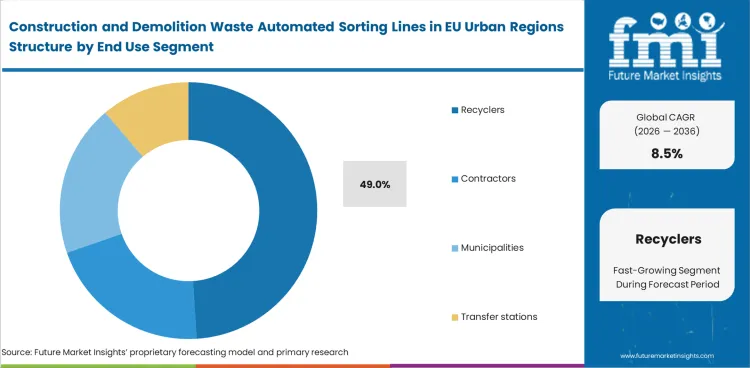
Dedicated recyclers rely on material recovery efficiency to protect margins from mixed incoming loads. Separating metals, clean wood, and mineral fractions with accuracy remains central to plant economics. According to FMI’s estimates, recyclers are anticipated to account for 49.0% share in 2026. AI sorting in C&D recycling plants supports this position by improving recovery rates across variable waste streams. Metal recycling equipment also plays a direct role by producing cleaner ferrous and non-ferrous output for resale. Exposure to commodity price swings remains a major risk for these operators, especially after large line investments. Delayed upgrades can also weaken their ability to retain municipal contracts. Both factors shape the pace and timing of equipment adoption.
- Performance surges: Scanners perform better when material size is more uniform, which is why pre-shredding often improves line efficiency.
- Edge failures: Wet or frozen rubble can disrupt optical recognition and reduce sorting accuracy during winter operations.
- Acceptability standards: End-market buyers maintain strict purity requirements, leaving little room for calibration errors.
Construction and Demolition Waste Automated Sorting Lines in EU Urban Regions Drivers, Restraints, and Opportunities
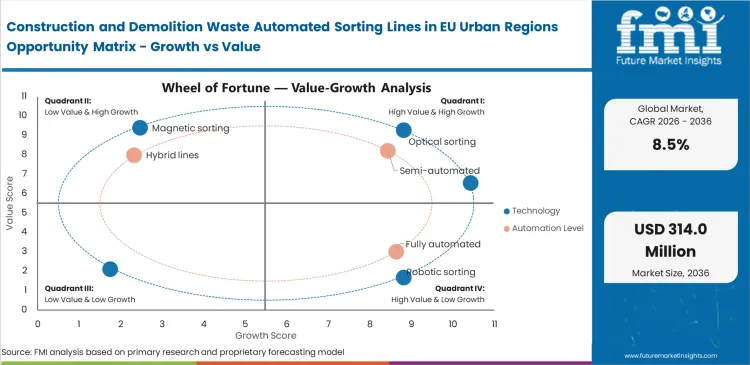
Landfill gate fees and stricter diversion obligations are pushing urban demolition contractors to recover more value before disposal. That pressure is strongest where public projects write recycling performance into tender requirements. Once contract eligibility depends on cleaner fractions and documented recovery, facility owners have a clearer reason to modernize sorting capacity rather than extend the life of manual lines.
Permitting and retrofit complexity still slow investment. Noise controls, dust concerns, constrained yard layouts, and structural reinforcement needs can delay projects even after financing is in place. Compact modular systems help operators work around site limits, but smaller footprints may struggle when demolition inflows spike or feedstock quality becomes unstable.
Opportunities in the Construction and Demolition Waste Automated Sorting Lines in EU Urban Regions
- Mobile deployment: Engineering compact sensor rigs onto tracked chassis allows contractors to process material directly at large demolition sites.
- Digital reporting: Integrating blockchain-backed audit trails into control software gives municipalities verifiable proof of diverted tonnage.
- Wood extraction: Installing specialized wood recycling equipment captures high-value timber for particleboard manufacturers.
Regional Analysis
Based on regional analysis, Construction and Demolition Waste Automated Sorting Lines in EU Urban Regions is segmented into Nordics, DACH, Western Europe, Southern Europe, and Eastern Europe across multiple countries.
.webp "Top Country Growth Comparison Construction And Demolition Waste Automated Sorting Lines In Eu Urban Regions Cagr (2026 2036)")
| Country | CAGR (2026 to 2036) |
|---|---|
| Denmark | 9.4% |
| Germany | 9.2% |
| Netherlands | 9.0% |
| France | 8.8% |
| Spain | 8.7% |
| Italy | 8.3% |
| Poland | 8.1% |
Source: Future Market Insights (FMI) analysis, based on proprietary forecasting model and primary research
Nordics Construction and Demolition Waste Automated Sorting Lines in EU Urban Regions Analysis
Urban redevelopment and firm policy execution shape buying behavior across the Nordics. High labor costs increase the penalty for relying on manual sorting over long shifts, so operators place more value on stable throughput and lower staffing intensity. Suppliers that can keep performance steady in dusty, variable loads are better placed than those that compete on speed claims alone.
- Denmark: Denmark combines active redevelopment cycles with relatively firm enforcement of recovery standards. Demand for automated sorting lines in Denmark is anticipated to rise at a CAGR of 9.4% through 2036. Buyers here are more likely to prioritize proven detection quality, reporting capability, and compliance support because public-project eligibility can depend on documented recovery performance.
DACH Construction and Demolition Waste Automated Sorting Lines in EU Urban Regions Analysis
Output quality requirements are especially important across the DACH region. Existing infrastructure is broad, which makes retrofit compatibility more valuable than greenfield design appeal. Equipment selection tends to favor robust mechanical separation backed by targeted sensor systems that can fit into established conveyor layouts without excessive downtime.
- Germany: Germany remains one of the strongest markets for higher-specification sorting upgrades. Germany is expected to register a CAGR of 9.2% in the sorting line sector through 2036. Buyers are likely to place greater weight on contamination control, aggregate quality, and system integration because stricter recycling practice leaves less room for unstable output.
Western Europe Construction and Demolition Waste Automated Sorting Lines in EU Urban Regions Analysis
Western Europe combines dense metropolitan waste flows with site constraints that make expansion difficult. Compact modules, smart layout planning, and dependable service support matter because many yards cannot afford prolonged outages during upgrades. Value creation depends on recovering more usable material from the same footprint.
- Netherlands: Land scarcity and tight disposal economics continue to support automation in the Netherlands. Automated sorting line demand in the Netherlands is poised to expand at a CAGR of 9.0% through 2036. Multi-sensor configurations are more attractive where operators need higher recovery from constrained sites and cannot depend on landfilling as a pressure-release option.
- France: France remains an important scale market because metropolitan redevelopment continues to generate mixed demolition loads. Sales of automated sorting lines in France are expected to increase at a CAGR of 8.8% during the forecast period. Investment decisions are still likely to be filtered through secondary commodity-price risk, which makes payback discipline and service reliability important purchase criteria.
Southern Europe Construction and Demolition Waste Automated Sorting Lines in EU Urban Regions Analysis
Southern Europe shows a more uneven adoption pattern. Policy enforcement and subsidy access can differ by location, so buyers often phase investment rather than commit to full automation at once. Heat, abrasive mineral flows, and long operating hours also increase the importance of cooling, maintenance planning, and durable component choice.
- Spain: Municipal pressure and infrastructure renewal are improving the case for automation in Spain. Spain is anticipated to see the sorting line market grow at a CAGR of 8.7% over the forecast period. Operators are likely to focus on safer handling of seasonal demolition volumes and on line designs that can improve recovery without creating excessive retrofit disruption.
- Italy: Italy remains more dependent on local retrofit economics and regional implementation conditions. Automated sorting adoption in Italy is likely to advance at a CAGR of 8.3% by 2036. Semi-automated systems can remain attractive where buyers want a lower-risk step toward modernization before committing to fully automated plant redesign.
Eastern Europe Construction and Demolition Waste Automated Sorting Lines in EU Urban Regions Analysis
Transitioning away from cheap landfill options alters local processing economics. Recycling facilities face mounting commercial pressure as regional disposal fees climb steadily toward broader EU averages. Initial automation investments focus primarily on basic optical sorting capabilities. Securing European Union development grants frequently dictates exact project timelines and the overall scale of machinery integration.
- Poland: Rising tipping fees rapidly dismantle traditional manual business models. Recycling businesses source robust, proven identification technologies rather than testing experimental systems to ensure immediate financial returns. Domestic adoption speeds depend heavily on the timing of specific facility retrofit cycles and local grant approvals. Poland is set to record a CAGR of 8.1% in automated sorting equipment during the assessment period. Securing these technological advantages early allows domestic businesses to withstand volatile European secondary material pricing.
FMI's report includes additional countries not detailed above. Equipment deployment strategies across these specific emerging geographies rely heavily on compact, mobile processing units rather than massive stationary plants.
Competitive Aligners for Market Players
Supplying durable hardware alone is no longer enough to win contracts among construction waste sorting line manufacturers in Europe. Buyers increasingly assess vendors on software flexibility, upgrade potential, and maintenance reliability over the life of the system. Machinery suppliers need to show that sensor models can be adjusted quickly as incoming material mixes change. Robotic performance also matters at site level, especially in dusty and high-vibration environments where manual correction raises operating cost. For that reason, standalone equipment vendors are losing ground to suppliers that can offer a more integrated sorting line solution.
Established players hold an advantage when they have broader operating data from live processing conditions. Long equipment histories across mixed waste streams help improve sensor calibration, fault detection, and material recognition accuracy in ways that are difficult for smaller entrants to match quickly. New challengers usually need to enter through narrower use cases, especially where existing systems still struggle with specific fractions inside mixed demolition waste. Competitive entry depends less on broad claims and more on proving a measurable improvement in sort accuracy or recovery quality for a defined application.
Large waste management groups are shaping supplier competition through standardization across multiple sites. They increasingly favor systems that can fit into wider plant networks without creating software dependence on a single vendor. Smaller machinery producers can still compete when they focus on retrofit modules or targeted process upgrades that larger suppliers do not prioritize. Over time, supplier position is likely to depend on a combination of equipment reliability, model adaptability, service support, and predictive maintenance capability. Contract success is moving toward vendors that can improve sorting performance without creating operational rigidity for plant operators.
Key Players in Construction and Demolition Waste Automated Sorting Lines in EU Urban Regions
- TOMRA
- STEINERT
- STADLER
- Pellenc ST
- Recycleye
- Binder+Co
- ZenRobotics (Terex Recycling Systems)
Scope of the Report
| Metric | Value |
|---|---|
| Quantitative Units | USD 127.9 million to USD 289.2 million, at a CAGR of 8.50% |
| Market Definition | Specialized sensor-based and mechanical separation machinery processing heavy building debris within European metropolitan zones to classify mixed rubble into pure fractions for secondary reuse. |
| Segmentation | By Technology, By Automation Level, By Waste Fraction, By Installation Type, By End User, and Region |
| Regions Covered | Nordics, DACH, Western Europe, Southern Europe, Eastern Europe |
| Countries Covered | Denmark, Germany, Netherlands, France, Spain, Italy, Poland |
| Key Companies Profiled | TOMRA, STEINERT, STADLER, Pellenc ST, Recycleye, Binder+Co, ZenRobotics (Terex Recycling Systems) |
| Forecast Period | 2026 to 2036 |
| Approach | Regional landfill tax rates and urban demolition volume metrics anchored our quantitative modeling. |
Source: Future Market Insights (FMI) analysis, based on proprietary forecasting model and primary research
Construction and Demolition Waste Automated Sorting Lines in EU Urban Regions Analysis by Segments
By Technology:
- Optical sorting
- Robotic sorting
- Magnetic sorting
- Eddy-current
- X-ray sorting
By Automation Level
- Semi-automated
- Fully automated
- Hybrid lines
By Waste Fraction:
- Mixed mineral
- Mixed wood
- Metal-rich
- Gypsum-rich
- Plastic-rich
- Glass-rich
By Installation Type:
- Retrofit lines
- Greenfield lines
- Mobile lines
By End User:
- Recyclers
- Contractors
- Municipalities
- Transfer stations
Region:
- Nordics
- Denmark
- DACH
- Germany
- Western Europe
- Netherlands
- France
- Southern Europe
- Spain
- Italy
- Eastern Europe
- Poland
Bibliography
- Wu, Z., Pei, T., Bao, Z., Ng, S. T., Lu, G., & Chen, K. (2024). Utilizing intelligent technologies in construction and demolition waste management: From a systematic review to an implementation framework. Frontiers of Engineering Management, 12, 1-23.
- Dodampegama, S., Hou, L., Asadi, E., Zhang, G., & Setunge, S. (2024). Revolutionizing construction and demolition waste sorting: Insights from artificial intelligence and robotic applications. Resources, Conservation and Recycling, 202, 107375.
- Bauer, A., & Kruggel-Emden, H. (2024). An image-based approach to automated recognition of asbestos-containing components in wall demolition waste. Chemie Ingenieur Technik, 96(7), 958-968.
- Göbbels, L., Feil, A., Raulf, K., & Greiff, K. (2025). Current State of the Art and Potential for Construction and Demolition Waste Processing: A Scoping Review of Sensor-Based Quality Monitoring and Control for In- and Online Implementation in Production Processes. Sensors, 25(14), 4401.
- Dierks, C., Hagedorn, T., Mack, T., & Zeller, V. (2024). Consequential life cycle assessment of demolition waste management in Germany. Frontiers in Sustainability, 5, 1417637.
This bibliography is provided for reader reference. The full FMI report contains the complete reference list with primary source documentation.
This Report Addresses
- Specific sensor calibration challenges processing mixed mineral rubble.
- Operational impacts caused by sudden shifts in regional disposal fees.
- Capital requirements necessary for retrofitting legacy conveyor belts.
- Identification accuracy rates achieved by optical scanners under dusty conditions.
- Sourcing timelines dictated by municipal circular economy mandates.
- Financial risks associated with highly automated robotic extraction arms.
- Conveyor wear patterns observed during heavy concrete crushing phases.
- Equipment certification standards required for public infrastructure projects.
Frequently Asked Questions
Give me the EU market size for C&D automated sorting lines
Revenue is projected to reach USD 127.9 million in 2026. This baseline reflects massive initial capital required to upgrade legacy yards across European metropolitan zones before expanding to USD 289.2 million by 2036.
What drives growth in urban construction waste sorting lines?
Escalating landfill gate fees force urban demolition contractors to extract every possible valuable fraction before disposal. Facility owners cannot absorb continuous tax hikes on heavy residuals, making automation a financial necessity.
Which companies supply robotic sorting lines for demolition waste in Europe?
Leading suppliers include TOMRA, STEINERT, STADLER, Pellenc ST, Recycleye, Binder+Co, and ZenRobotics (Terex Recycling Systems). Processing facility departments evaluate these vendors based on software adaptability and long-term maintenance guarantees.
Compare optical and robotic sorting for construction waste
Optical sorting relies on scanners to detect distinct polymers and wood grades instantly. Robotic sorting uses AI-guided mechanical arms to physically extract those identified materials from the conveyor, replacing manual picking labor.
Fastest growing EU countries for demolition waste sorting automation
Denmark tracks at 9.4% CAGR through 2036, supported by urban redevelopment and early policy enforcement. Germany follows closely at 9.2% CAGR as strict regulations regarding recycled aggregate certification run immediate equipment upgrades.
How much does a construction waste sorting line cost?
Costs vary heavily based on scale and technology choice, but investments represent multi-million euro capital expenditures. Mid-sized contractors frequently favor semi-automated configurations to balance initial capital limits with improved throughput.
What materials can a C&D sorting line recover?
Advanced systems classify mixed rubble into pure fractions like concrete, wood, plastics, and metals. Separating valuable metals and clean wood from low-value mineral dust guarantees operational profitability for dedicated recyclers.
Preview the report firsthand - request a free sample
Get SampleGet the brochure for pricing and purchase details.
Get PDFTable of Content
- Executive Summary
- Global Market Outlook
- Demand-side Trends
- Supply-side Trends
- Technology Roadmap Analysis
- Analysis and Recommendations
- Market Overview
- Market Coverage / Taxonomy
- Market Definition / Scope / Limitations
- Research Methodology
- Chapter Orientation
- Analytical Lens and Working Hypotheses
- Market Structure, Signals, and Trend Drivers
- Benchmarking and Cross-market Comparability
- Market Sizing, Forecasting, and Opportunity Mapping
- Research Design and Evidence Framework
- Desk Research Programme (Secondary Evidence)
- Company Annual and Sustainability Reports
- Peer-reviewed Journals and Academic Literature
- Corporate Websites, Product Literature, and Technical Notes
- Earnings Decks and Investor Briefings
- Statutory Filings and Regulatory Disclosures
- Technical White Papers and Standards Notes
- Trade Journals, Industry Magazines, and Analyst Briefs
- Conference Proceedings, Webinars, and Seminar Materials
- Government Statistics Portals and Public Data Releases
- Press Releases and Reputable Media Coverage
- Specialist Newsletters and Curated Briefings
- Sector Databases and Reference Repositories
- FMI Internal Proprietary Databases and Historical Market Datasets
- Subscription Datasets and Paid Sources
- Social Channels, Communities, and Digital Listening Inputs
- Additional Desk Sources
- Expert Input and Fieldwork (Primary Evidence)
- Primary Modes
- Qualitative Interviews and Expert Elicitation
- Quantitative Surveys and Structured Data Capture
- Blended Approach
- Why Primary Evidence is Used
- Field Techniques
- Interviews
- Surveys
- Focus Groups
- Observational and In-context Research
- Social and Community Interactions
- Stakeholder Universe Engaged
- C-suite Leaders
- Board Members
- Presidents and Vice Presidents
- R&D and Innovation Heads
- Technical Specialists
- Domain Subject-matter Experts
- Scientists
- Physicians and Other Healthcare Professionals
- Governance, Ethics, and Data Stewardship
- Research Ethics
- Data Integrity and Handling
- Primary Modes
- Tooling, Models, and Reference Databases
- Desk Research Programme (Secondary Evidence)
- Data Engineering and Model Build
- Data Acquisition and Ingestion
- Cleaning, Normalisation, and Verification
- Synthesis, Triangulation, and Analysis
- Quality Assurance and Audit Trail
- Market Background
- Market Dynamics
- Drivers
- Restraints
- Opportunity
- Trends
- Scenario Forecast
- Demand in Optimistic Scenario
- Demand in Likely Scenario
- Demand in Conservative Scenario
- Opportunity Map Analysis
- Product Life Cycle Analysis
- Supply Chain Analysis
- Investment Feasibility Matrix
- Value Chain Analysis
- PESTLE and Porter’s Analysis
- Regulatory Landscape
- Regional Parent Market Outlook
- Production and Consumption Statistics
- Import and Export Statistics
- Market Dynamics
- Global Market Analysis 2021 to 2025 and Forecast, 2026 to 2036
- Historical Market Size Value (USD Million) Analysis, 2021 to 2025
- Current and Future Market Size Value (USD Million) Projections, 2026 to 2036
- Y-o-Y Growth Trend Analysis
- Absolute $ Opportunity Analysis
- Global Market Pricing Analysis 2021 to 2025 and Forecast 2026 to 2036
- Global Market Analysis 2021 to 2025 and Forecast 2026 to 2036, By Technology
- Introduction / Key Findings
- Historical Market Size Value (USD Million) Analysis By Technology , 2021 to 2025
- Current and Future Market Size Value (USD Million) Analysis and Forecast By Technology , 2026 to 2036
- Optical sorting
- Robotic sorting
- Magnetic sorting
- Eddy-current
- X-ray sorting
- Optical sorting
- Y-o-Y Growth Trend Analysis By Technology , 2021 to 2025
- Absolute $ Opportunity Analysis By Technology , 2026 to 2036
- Global Market Analysis 2021 to 2025 and Forecast 2026 to 2036, By Automation Level
- Introduction / Key Findings
- Historical Market Size Value (USD Million) Analysis By Automation Level, 2021 to 2025
- Current and Future Market Size Value (USD Million) Analysis and Forecast By Automation Level, 2026 to 2036
- Semi-automated
- Fully automated
- Hybrid lines
- Semi-automated
- Y-o-Y Growth Trend Analysis By Automation Level, 2021 to 2025
- Absolute $ Opportunity Analysis By Automation Level, 2026 to 2036
- Global Market Analysis 2021 to 2025 and Forecast 2026 to 2036, By Waste Fraction
- Introduction / Key Findings
- Historical Market Size Value (USD Million) Analysis By Waste Fraction, 2021 to 2025
- Current and Future Market Size Value (USD Million) Analysis and Forecast By Waste Fraction, 2026 to 2036
- Mixed mineral
- Mixed wood
- Metal-rich
- Gypsum-rich
- Plastic-rich
- Glass-rich
- Mixed mineral
- Y-o-Y Growth Trend Analysis By Waste Fraction, 2021 to 2025
- Absolute $ Opportunity Analysis By Waste Fraction, 2026 to 2036
- Global Market Analysis 2021 to 2025 and Forecast 2026 to 2036, By Installation Type
- Introduction / Key Findings
- Historical Market Size Value (USD Million) Analysis By Installation Type, 2021 to 2025
- Current and Future Market Size Value (USD Million) Analysis and Forecast By Installation Type, 2026 to 2036
- Retrofit lines
- Greenfield lines
- Mobile lines
- Retrofit lines
- Y-o-Y Growth Trend Analysis By Installation Type, 2021 to 2025
- Absolute $ Opportunity Analysis By Installation Type, 2026 to 2036
- Global Market Analysis 2021 to 2025 and Forecast 2026 to 2036, By End Use
- Introduction / Key Findings
- Historical Market Size Value (USD Million) Analysis By End Use, 2021 to 2025
- Current and Future Market Size Value (USD Million) Analysis and Forecast By End Use, 2026 to 2036
- Recyclers
- Contractors
- Municipalities
- Transfer stations
- Recyclers
- Y-o-Y Growth Trend Analysis By End Use, 2021 to 2025
- Absolute $ Opportunity Analysis By End Use, 2026 to 2036
- Global Market Analysis 2021 to 2025 and Forecast 2026 to 2036, By Region
- Introduction
- Historical Market Size Value (USD Million) Analysis By Region, 2021 to 2025
- Current Market Size Value (USD Million) Analysis and Forecast By Region, 2026 to 2036
- North America
- Latin America
- Western Europe
- Eastern Europe
- East Asia
- South Asia and Pacific
- Middle East & Africa
- Market Attractiveness Analysis By Region
- North America Market Analysis 2021 to 2025 and Forecast 2026 to 2036, By Country
- Historical Market Size Value (USD Million) Trend Analysis By Market Taxonomy, 2021 to 2025
- Market Size Value (USD Million) Forecast By Market Taxonomy, 2026 to 2036
- By Country
- USA
- Canada
- Mexico
- By Technology
- By Automation Level
- By Waste Fraction
- By Installation Type
- By End Use
- By Country
- Market Attractiveness Analysis
- By Country
- By Technology
- By Automation Level
- By Waste Fraction
- By Installation Type
- By End Use
- Key Takeaways
- Latin America Market Analysis 2021 to 2025 and Forecast 2026 to 2036, By Country
- Historical Market Size Value (USD Million) Trend Analysis By Market Taxonomy, 2021 to 2025
- Market Size Value (USD Million) Forecast By Market Taxonomy, 2026 to 2036
- By Country
- Brazil
- Chile
- Rest of Latin America
- By Technology
- By Automation Level
- By Waste Fraction
- By Installation Type
- By End Use
- By Country
- Market Attractiveness Analysis
- By Country
- By Technology
- By Automation Level
- By Waste Fraction
- By Installation Type
- By End Use
- Key Takeaways
- Western Europe Market Analysis 2021 to 2025 and Forecast 2026 to 2036, By Country
- Historical Market Size Value (USD Million) Trend Analysis By Market Taxonomy, 2021 to 2025
- Market Size Value (USD Million) Forecast By Market Taxonomy, 2026 to 2036
- By Country
- Germany
- UK
- Italy
- Spain
- France
- Nordic
- BENELUX
- Rest of Western Europe
- By Technology
- By Automation Level
- By Waste Fraction
- By Installation Type
- By End Use
- By Country
- Market Attractiveness Analysis
- By Country
- By Technology
- By Automation Level
- By Waste Fraction
- By Installation Type
- By End Use
- Key Takeaways
- Eastern Europe Market Analysis 2021 to 2025 and Forecast 2026 to 2036, By Country
- Historical Market Size Value (USD Million) Trend Analysis By Market Taxonomy, 2021 to 2025
- Market Size Value (USD Million) Forecast By Market Taxonomy, 2026 to 2036
- By Country
- Russia
- Poland
- Hungary
- Balkan & Baltic
- Rest of Eastern Europe
- By Technology
- By Automation Level
- By Waste Fraction
- By Installation Type
- By End Use
- By Country
- Market Attractiveness Analysis
- By Country
- By Technology
- By Automation Level
- By Waste Fraction
- By Installation Type
- By End Use
- Key Takeaways
- East Asia Market Analysis 2021 to 2025 and Forecast 2026 to 2036, By Country
- Historical Market Size Value (USD Million) Trend Analysis By Market Taxonomy, 2021 to 2025
- Market Size Value (USD Million) Forecast By Market Taxonomy, 2026 to 2036
- By Country
- China
- Japan
- South Korea
- By Technology
- By Automation Level
- By Waste Fraction
- By Installation Type
- By End Use
- By Country
- Market Attractiveness Analysis
- By Country
- By Technology
- By Automation Level
- By Waste Fraction
- By Installation Type
- By End Use
- Key Takeaways
- South Asia and Pacific Market Analysis 2021 to 2025 and Forecast 2026 to 2036, By Country
- Historical Market Size Value (USD Million) Trend Analysis By Market Taxonomy, 2021 to 2025
- Market Size Value (USD Million) Forecast By Market Taxonomy, 2026 to 2036
- By Country
- India
- ASEAN
- Australia & New Zealand
- Rest of South Asia and Pacific
- By Technology
- By Automation Level
- By Waste Fraction
- By Installation Type
- By End Use
- By Country
- Market Attractiveness Analysis
- By Country
- By Technology
- By Automation Level
- By Waste Fraction
- By Installation Type
- By End Use
- Key Takeaways
- Middle East & Africa Market Analysis 2021 to 2025 and Forecast 2026 to 2036, By Country
- Historical Market Size Value (USD Million) Trend Analysis By Market Taxonomy, 2021 to 2025
- Market Size Value (USD Million) Forecast By Market Taxonomy, 2026 to 2036
- By Country
- Kingdom of Saudi Arabia
- Other GCC Countries
- Turkiye
- South Africa
- Other African Union
- Rest of Middle East & Africa
- By Technology
- By Automation Level
- By Waste Fraction
- By Installation Type
- By End Use
- By Country
- Market Attractiveness Analysis
- By Country
- By Technology
- By Automation Level
- By Waste Fraction
- By Installation Type
- By End Use
- Key Takeaways
- Key Countries Market Analysis
- USA
- Pricing Analysis
- Market Share Analysis, 2025
- By Technology
- By Automation Level
- By Waste Fraction
- By Installation Type
- By End Use
- Canada
- Pricing Analysis
- Market Share Analysis, 2025
- By Technology
- By Automation Level
- By Waste Fraction
- By Installation Type
- By End Use
- Mexico
- Pricing Analysis
- Market Share Analysis, 2025
- By Technology
- By Automation Level
- By Waste Fraction
- By Installation Type
- By End Use
- Brazil
- Pricing Analysis
- Market Share Analysis, 2025
- By Technology
- By Automation Level
- By Waste Fraction
- By Installation Type
- By End Use
- Chile
- Pricing Analysis
- Market Share Analysis, 2025
- By Technology
- By Automation Level
- By Waste Fraction
- By Installation Type
- By End Use
- Germany
- Pricing Analysis
- Market Share Analysis, 2025
- By Technology
- By Automation Level
- By Waste Fraction
- By Installation Type
- By End Use
- UK
- Pricing Analysis
- Market Share Analysis, 2025
- By Technology
- By Automation Level
- By Waste Fraction
- By Installation Type
- By End Use
- Italy
- Pricing Analysis
- Market Share Analysis, 2025
- By Technology
- By Automation Level
- By Waste Fraction
- By Installation Type
- By End Use
- Spain
- Pricing Analysis
- Market Share Analysis, 2025
- By Technology
- By Automation Level
- By Waste Fraction
- By Installation Type
- By End Use
- France
- Pricing Analysis
- Market Share Analysis, 2025
- By Technology
- By Automation Level
- By Waste Fraction
- By Installation Type
- By End Use
- India
- Pricing Analysis
- Market Share Analysis, 2025
- By Technology
- By Automation Level
- By Waste Fraction
- By Installation Type
- By End Use
- ASEAN
- Pricing Analysis
- Market Share Analysis, 2025
- By Technology
- By Automation Level
- By Waste Fraction
- By Installation Type
- By End Use
- Australia & New Zealand
- Pricing Analysis
- Market Share Analysis, 2025
- By Technology
- By Automation Level
- By Waste Fraction
- By Installation Type
- By End Use
- China
- Pricing Analysis
- Market Share Analysis, 2025
- By Technology
- By Automation Level
- By Waste Fraction
- By Installation Type
- By End Use
- Japan
- Pricing Analysis
- Market Share Analysis, 2025
- By Technology
- By Automation Level
- By Waste Fraction
- By Installation Type
- By End Use
- South Korea
- Pricing Analysis
- Market Share Analysis, 2025
- By Technology
- By Automation Level
- By Waste Fraction
- By Installation Type
- By End Use
- Russia
- Pricing Analysis
- Market Share Analysis, 2025
- By Technology
- By Automation Level
- By Waste Fraction
- By Installation Type
- By End Use
- Poland
- Pricing Analysis
- Market Share Analysis, 2025
- By Technology
- By Automation Level
- By Waste Fraction
- By Installation Type
- By End Use
- Hungary
- Pricing Analysis
- Market Share Analysis, 2025
- By Technology
- By Automation Level
- By Waste Fraction
- By Installation Type
- By End Use
- Kingdom of Saudi Arabia
- Pricing Analysis
- Market Share Analysis, 2025
- By Technology
- By Automation Level
- By Waste Fraction
- By Installation Type
- By End Use
- Turkiye
- Pricing Analysis
- Market Share Analysis, 2025
- By Technology
- By Automation Level
- By Waste Fraction
- By Installation Type
- By End Use
- South Africa
- Pricing Analysis
- Market Share Analysis, 2025
- By Technology
- By Automation Level
- By Waste Fraction
- By Installation Type
- By End Use
- USA
- Market Structure Analysis
- Competition Dashboard
- Competition Benchmarking
- Market Share Analysis of Top Players
- By Region
- By Technology
- By Automation Level
- By Waste Fraction
- By Installation Type
- By End Use
- Competition Analysis
- Competition Deep Dive
- TOMRA
- Overview
- Product Portfolio
- Profitability by Market Segments (Product/Age /Sales Channel/Region)
- Sales Footprint
- Strategy Overview
- Marketing Strategy
- Product Strategy
- Channel Strategy
- STEINERT
- STADLER
- Pellenc ST
- Recycleye
- Binder+Co
- ZenRobotics (Terex Recycling Systems)
- TOMRA
- Competition Deep Dive
- Assumptions & Acronyms Used


