

- Industry Size (2026)
- USD 58.0 Mn
- Forecast (2036)
- USD 110.0 Mn
- CAGR (2026 to 2036)
- 6.6%
Small Appliance Plastic and Metal Automated Separation Lines in EU Industry Size, Market Forecast and Outlook By FMI
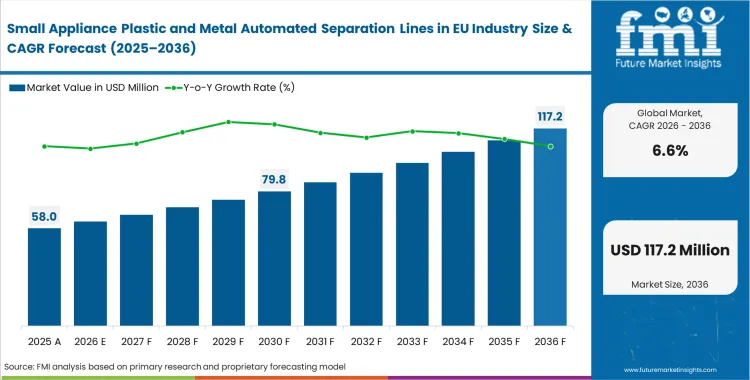
The small appliance plastic and metal automated separation lines industry in the EU was valued at USD 54.4 million in 2025 and is estimated to reach USD 58.0 million in 2026. FMI estimates the industry will expand at a CAGR of 6.6% from 2026 to 2036, taking total valuation to USD 110.0 million by 2036. Industry growth is being supported by tighter waste-shipment controls, which are pushing domestic recyclers to improve material purity before mixed outputs can move downstream or enter export channels.
Summary of Small Appliance Plastic and Metal Automated Separation Lines in EU Industry
- The market is forecast to reach USD 110.0 million by 2036.
- The market is expected to grow at a CAGR of 6.6% from 2026 to 2036.
- The market was estimated at USD 54.4 million in 2025.
- The forecast period represents an incremental opportunity of USD 52.0 million.
- This market focuses on automated recycling lines designed to separate plastics and metals from small-appliance WEEE streams after initial processing.
- Demand is driven by EU pressure to improve WEEE collection and recycling efficiency, along with stricter waste-shipment regulations.
- Automated sorting technologies are gaining traction due to the complexity and contamination of mixed e-waste plastic streams.
- Standalone lines lead the configuration segment with a 34% share, as recyclers gradually automate individual processing stages.
- Sensor sorters dominate the technology segment with a 31% share, enabling precise identification of polymers and mixed materials.
- Mixed metals account for 37% of output streams, reflecting their strong recovery value in e-scrap processing.
- Fully automatic systems lead with a 56% share, driven by labor cost pressures and the need for consistent output purity.
- Retrofit installations dominate with a 61% share, as operators upgrade existing facilities rather than build new plants.
- Poland, Germany, and the Czech Republic are the fastest-growing markets, with Poland leading at a 7.4% CAGR.
- TOMRA Recycling, STEINERT, Sesotec, REDWAVE, Pellenc ST, and STADLER Anlagenbau are key players in the competitive landscape.
Processing economics are becoming more sensitive to separation quality at the plant floor level. Mixed appliance scrap carries engineering plastics, ferrous fractions, non-ferrous metals, wiring, and contaminated residues that lose value quickly when separation lacks precision. Lower-purity output can weaken bale pricing and can also increase rejection risk in downstream channels. Retrofittable sorting equipment is gaining traction for this reason across existing recycling layouts. Operators can add optical, sensor-based, or automated ejection systems without fully rebuilding the line, which makes phased upgrades more commercially workable. Performance still depends on calibration quality. Sensor drift during long operating cycles can reduce black plastic detection accuracy and distort recovery outcomes, especially where plants are separating high-value polymers from mixed copper, copper alloy scrap, and other non-ferrous fractions.
Adoption tends to strengthen once manual picking no longer maintains acceptable contamination control. Larger recyclers that validate automated separation settings for brominated flame retardants and other problematic material classes help establish a clearer operating benchmark for the wider market. Facilities are upgrading lines not only to improve throughput, but to protect output quality, preserve resale value, and keep recovered material within tighter specification limits. Automated separation is therefore expected to become a more necessary part of appliance recycling operations as quality requirements continue to tighten.
Poland is poised to witness 7.4% CAGR through 2036, supported by active investment in recycling capacity and broader modernization of e-waste separation infrastructure. Germany is expected to grow at 7.1% as domestic processors handle large installed volumes of discarded small appliances and continue upgrading recovery lines. The Czech Republic is likely to register 6.8% CAGR during the forecast period, helped by its role as a central processing and logistics point within regional recycling flows. The Netherlands is estimated at 6.7%, where established recovery networks support faster adoption of automated sorting upgrades. France is anticipated to post 6.5% as plant operators continue improving material separation consistency. Spain is projected to expand at 6.3%, while Italy is expected to record 6.1% as line improvement remains more retrofit-led than greenfield-led. Across the EU, the market is separating into two clear tracks: countries building new high-automation facilities and countries extending the life of older recycling infrastructure through targeted sorting upgrades.
Segmental Analysis
Small Appliance Plastic and Metal Automated Separation Lines in EU Industry Analysis by Line Configuration
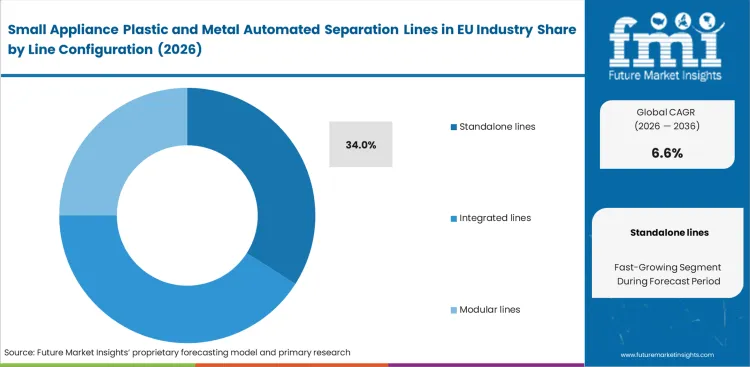
Many European facilities upgrade sorting capacity in stages because existing sites rarely support full replacement in a single phase. Floor limitations, legacy conveyors, and commissioning risk all favor incremental change within established waste management operations. Standalone layouts are estimated to account for 34.0% share in 2026, as operators often prefer units that fit current processing footprints without major civil modification. This structure shortens installation cycles and limits exposure to full-line shutdowns during modernization. It can still create transfer imbalances when new module speeds fail to match older upstream equipment. Plants that push tightly integrated overhauls into aging layouts are more likely to face longer downtime and a more difficult startup adjustment period.
- Initial footprint evaluation: Facility teams first assess floor limits and structural constraints before approving new sorting equipment. Standalone units usually qualify faster because they avoid major building alteration.
- Control system validation: Engineers test communication between older shredders and newly added sorting modules. Isolated systems reduce software conflict and simplify early commissioning.
- Expansion trigger: Rising contamination levels often push plants to add extra sorting stages. Standalone architecture makes those additions easier to deploy when buyer specifications tighten.
Small Appliance Plastic and Metal Automated Separation Lines in EU Industry Analysis by Sorting Technology
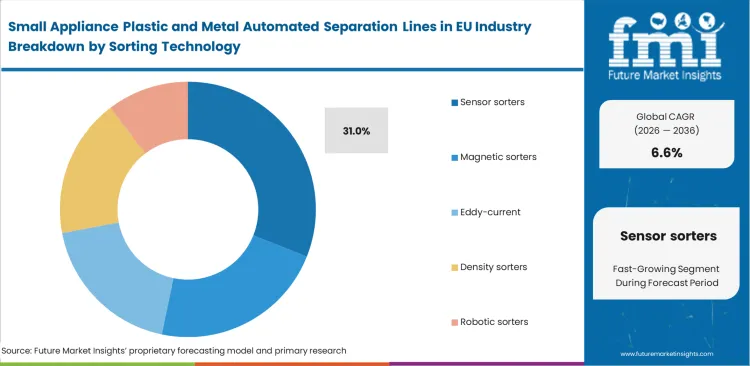
Material separation becomes more demanding when mixed polymers look similar and behave alike in mechanical treatment. Density-based systems cannot always distinguish complex appliance plastics at the purity levels expected by packaging waste recycling processors. Sensor sorters are expected to represent 31.0% share in 2026 because they identify material type through spectral recognition rather than bulk physical behavior alone. That gives operators a more practical route to producing cleaner mono-material output from mixed small appliance waste. Even so, system performance depends heavily on maintenance, because dust buildup and changing feed quality can weaken recognition accuracy during a shift. Facilities that stay with simpler density systems usually limit the value they can extract from mixed polymer streams.
- Dust occlusion prevention: Sensor sorting systems need protected optics and regular cleaning to maintain recognition quality. Daily maintenance becomes essential where dust loads are high.
- Algorithmic drift risk: New additives and resin changes can reduce sorting accuracy when spectral libraries are outdated. Plants need regular software updates to avoid misclassification.
- Calibration discipline: Changes in lighting and operating conditions affect optical baseline readings. Routine calibration helps maintain stable output purity across shifts.
Small Appliance Plastic and Metal Automated Separation Lines in EU Industry Analysis by Output Stream
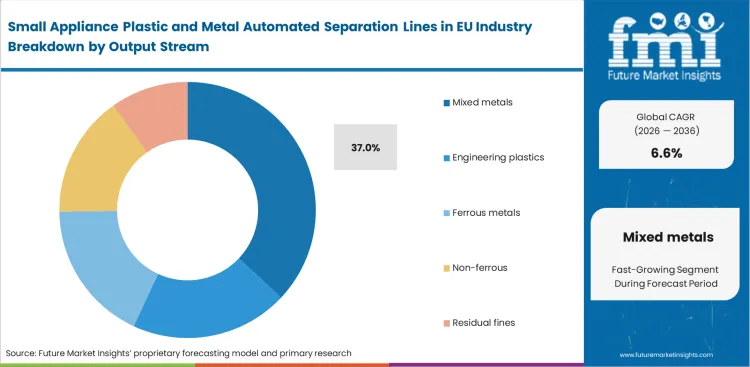
Metal recovery continues to provide the earliest and most reliable output value in many appliance separation plants. Facilities usually extract ferrous and non-ferrous fractions first to reduce load on downstream plastic sorting and protect belts from abrasive damage. Mixed metals are likely to account for 37.0% share in 2026, reflecting their importance to plant economics and their role in supporting waste recycling services workflows. Early removal of dense fractions, especially copper and copper alloy scrap and recycling, also improves downstream equipment stability by reducing impact stress and fragment carryover. Older facilities sometimes appear productive on metal recovery alone while underperforming sharply on plastics. Plants that stop at broad mixed-metal output also leave additional upgrading value unrealized.
- Primary revenue generation: Mixed metal output provides early cash flow support for routine plant operations. This is especially important where energy and handling costs remain high.
- Downstream damage prevention: Early removal of heavy metallic fragments protects optical belts and later-stage equipment from avoidable wear. That also helps stabilize maintenance cycles.
- Secondary separation value: Selling undivided metal output limits pricing upside. Additional sorting stages can improve returns by separating higher-value alloys from general mix.
Small Appliance Plastic and Metal Automated Separation Lines in EU Industry Analysis by Automation Level
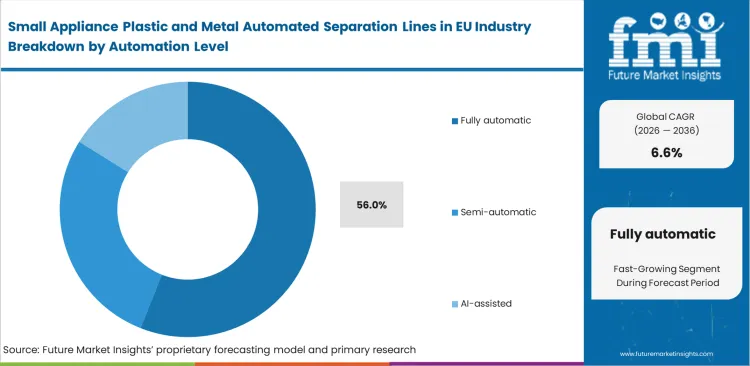
Manual sorting is becoming harder to sustain as labor availability tightens across industrial regions in Europe. Plants need stable throughput across multiple shifts, especially where output quality must meet export-grade requirements for recycled scrap metal buyers. Fully automatic configurations are estimated to account for 56.0% share in 2026 because automated inspection and ejection deliver more consistent output than labor-intensive lines usually maintain. This model also supports continuous operation without the fatigue and variability that affect manual stations. Greater automation still increases dependence on specialized technicians who manage software, sensors, and fault response. Semi-automatic lines remain more exposed to contamination swings and less consistent qualification performance, which keeps full automation better aligned with stricter output control.
- Baseline throughput consistency: Fully automatic lines reduce variation in sorting speed across long operating cycles. This improves shipment planning and monthly output reliability.
- Edge condition handling: Tangled wires and irregular fragments can still disrupt mechanical flow. Automated systems therefore need built-in response logic to clear blockages without manual stoppage.
- Export qualification standards: Low-contamination thresholds require stable verification and repeatable purity control. Automated optical inspection is increasingly central to meeting those standards.
Small Appliance Plastic and Metal Automated Separation Lines in EU Industry Analysis by Installation Mode
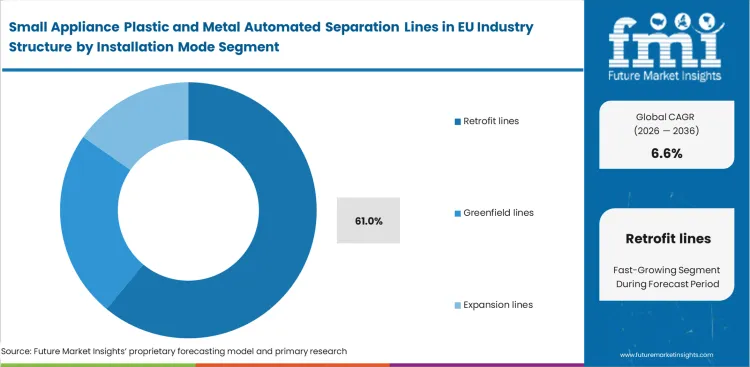
New waste processing sites in Europe face lengthy approval cycles, making expansion through existing facilities a more practical option for many operators. Retrofit projects also preserve current logistics flows and allow faster modernization of lines already handling recycled plastic packaging and metal streams. As a result, retrofit lines are anticipated to account for 61.0% share in 2026. Upgrading installed facilities lets operators replace outdated screens and separators without waiting for new land, new zoning, or a full permitting cycle. The trade-off is that legacy layouts often force engineering compromises on conveyor angle, machine spacing, and line speed. Even with those limits, retrofits usually provide a faster route to commercial readiness than greenfield builds.
- Legacy site upgrades: Operators use retrofits to extend the life of existing facilities with lower upfront disruption. Engineering work then focuses on fitting new modules into old structural layouts.
- Permitting bypass strategies: Internal upgrades usually move faster through approval than new site development. This helps facilities improve capability without reopening broader location-level review.
- Integration friction: Older control systems often struggle to communicate with modern sensor equipment. Technicians frequently need custom interface work before stable operation is achieved.
Small Appliance Plastic and Metal Automated Separation Lines in EU Industry Drivers, Restraints, and Opportunities
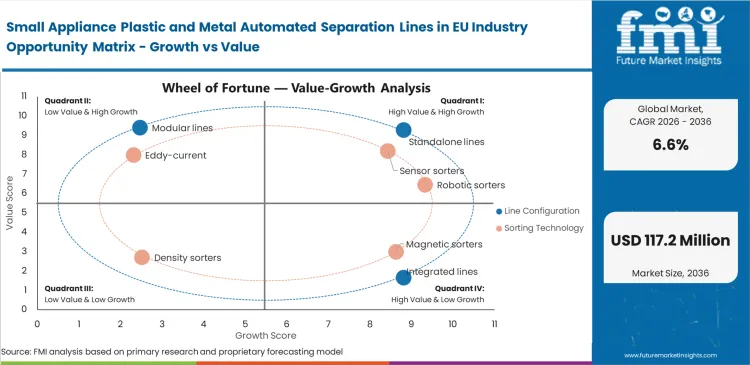
EU WEEE collection targets and related regulatory requirements are increasing pressure on processors to improve domestic extraction capability. Low-quality scrap exports face tighter scrutiny, which raises the commercial risk tied to contaminated bale shipments. Automated sorting modules are gaining importance because higher purity thresholds leave less room for inconsistency in recovered output. Upgrading optical recognition stages helps convert hazardous electronic waste into cleaner commodity streams that are easier to place in downstream markets. Domestic off-take value is becoming more important as regional buyers place greater emphasis on material quality, traceability, and specification control.
High capital requirements for small appliance recycling lines in Europe continue to slow deployment even where investment approval is in place. Plant operators often face integration difficulty when high-speed optical ejectors must work with older mechanical shredders. Closed control systems across mixed equipment layouts can limit communication between units from different manufacturers. Many sites therefore rely on custom integration work, which adds cost and extends commissioning time. This bottleneck often keeps new optical sorters running below optimal speed to avoid upstream shredder disruption, which limits the full benefit of line modernization.
Opportunities in the Small Appliance Plastic and Metal Automated Separation Lines in EU Industry
- Black polymer recovery: Optical sensor advancements allow facilities to identify previously invisible carbon-black plastics. Companies capture significant new revenue by selling distinct engineering polymer fractions.
- Flame retardant isolation: X-ray transmission modules accurately detect hazardous brominated compounds. Compliance officers utilize this capability to separate restricted materials safely.
- Watermark tracking integration: Next-generation sorting lines read embedded digital tags on appliance casings. Digital watermark detection modules are deployed to build precise material origin databases.
Regional Analysis
Based on regional analysis, small appliance plastic and metal automated separation lines in EU industry is segmented into Western Europe, Southern Europe, and Central & Eastern Europe across multiple countries.
.webp "Top Country Growth Comparison Small Appliance Plastic And Metal Automated Separation Lines In Eu Industry Cagr (2026 2036)")
| Country | CAGR (2026 to 2036) |
|---|---|
| Poland | 7.4% |
| Germany | 7.1% |
| Czech Republic | 6.8% |
| Netherlands | 6.7% |
| France | 6.5% |
| Spain | 6.3% |
| Italy | 6.1% |
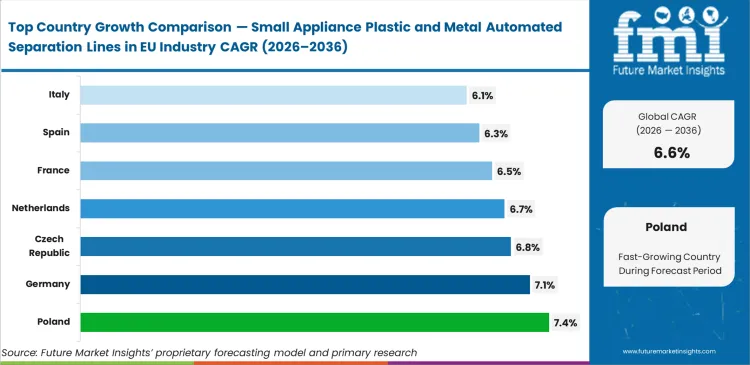
Source: Future Market Insights (FMI) analysis, based on proprietary forecasting model and primary research
Western Europe Small Appliance Plastic and Metal Automated Separation Lines in EU Industry Analysis
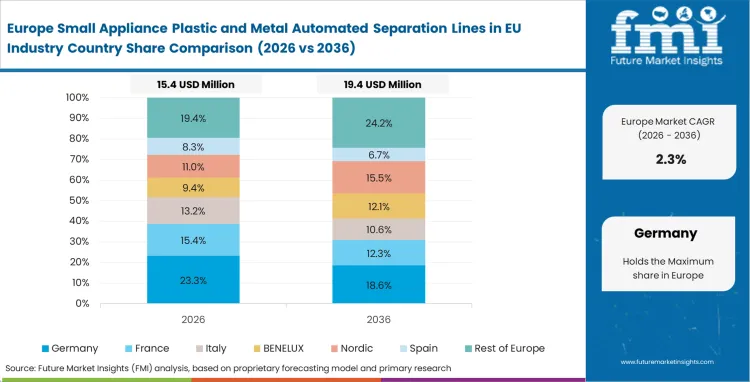
Policy mandates across Western Europe are shifting from incentive structures to strict domestic processing requirements. Recycling facilities face continuous pressure to minimize residual waste directed toward municipal incinerators. Advanced sorting and grading machines anchor new circular economy investments, prioritizing high-resolution optical arrays capable of isolating distinct engineering polymers from commingled shredder streams. Local authorities penalize sites failing to meet sorting purity for recycled appliance plastics thresholds. This regulatory environment accelerates the replacement of outdated mechanical separation setups with fully automated sensor-based layouts.
- Germany: High domestic appliance consumption volumes guarantee continuous feedstock for local recycling plants, bolstering the Germany appliance WEEE sorting line industry. Demand across Germany is anticipated to rise at a CAGR of 7.1% through 2036. The focus remains heavily on separating complex polymer blends. Securing long-term off-take contracts with automotive compounders serves as the primary commercial opportunity for sites investing in advanced extraction.
- Netherlands: Strategic port logistics position local facilities as central hubs for cross-border electronic waste processing, driving Netherlands appliance recycling automation. Conveyor layouts are increasingly optimized to handle massive transit volumes efficiently. The industry in the Netherlands is poised to expand at a CAGR of 6.7% during the forecast period. Distinct competitive positioning stems from offering multi-material separation capabilities to neighboring nations.
- France: National circularity targets compel the complete overhaul of legacy municipal recovery sheds across the country. Targeted optical retrofits are being deployed to boost baseline polymer recovery rates. The adoption of automated separation lines in France is likely to advance at a CAGR of 6.5% by 2036. Reaching zero-waste-to-landfill status alters the economics of processing sites near major industrial zones.
Southern Europe Small Appliance Plastic and Metal Automated Separation Lines in EU Industry Analysis
Extended producer responsibility schemes are reshaping how Southern European municipalities approach electronic waste processing. Recycling facilities face strict audits regarding final material destination data, making modern sorter machines essential for exact digital tracking. Regional investment heavily favors modular retrofit installations over new greenfield construction due to complex local permitting environments. Capital expenditure targets specific high-value extraction stages, primarily prioritizing non-ferrous recovery from small appliances to maximize immediate cash flow.
- Spain: Regional waste management authorities are pushing the industrial sector to improve base material recovery statistics. Sales of separation equipment in Spain are expected to increase at a CAGR of 6.3% during the forecast period. Sensor modules are slowly integrated onto existing mechanical belts. Stricter landfill taxes push this hardware adoption forward, shaping the long-term trajectory of Iberian processing facilities.
- Italy: Decentralized regional processing centers handle highly variable shredded input streams, requiring adaptable software algorithms capable of shifting material recognition profiles mid-shift. Persistent skilled labor shortages often create this automation faster than explicit environmental policies. The sector in Italy is anticipated to gain momentum, with demand rising at a CAGR of 6.1% through 2036. This reduces reliance on manual sorting interventions.
Central & Eastern Europe Small Appliance Plastic and Metal Automated Separation Lines in EU Industry Analysis
Heavy industrial capacity expansion defines operational landscapes across Central and Eastern processing corridors. Massive high-throughput separation facilities are being commissioned across the region. These greenfield installations utilize advanced sorting technologies for multilayer flexible films detection techniques adapted for rigid appliance casings. Facility layouts prioritize pure volume handling alongside high-resolution extraction. The strategic focus remains on supplying distinct polymer and metal fractions directly to local manufacturing bases, reducing reliance on external raw material imports.
- Poland: Massive internal manufacturing demand for recycled polymers fuels high Poland e-waste sorting equipment demand. Poland is forecast to record steady growth in separation infrastructure at a CAGR of 7.4% from 2026 to 2036. Highly automated lines are being constructed to produce extrusion-ready plastic flakes. Achieving automotive-grade purity levels changes the operational economics and final output value for major processing plants.
- Czech Republic: Cross-border waste flows from neighboring industrial zones require highly efficient central processing nodes. Secondary optical stages see heavy investment to refine mixed material streams. The Czech Republic is projected to witness an estimated 6.8% CAGR in the automated separation segment through 2036. Providing rapid toll-processing services to external logistics networks defines the primary commercial opportunity for domestic recycling hubs.
Secondary processing markets across Scandinavia and the Baltics demonstrate parallel capacity expansions. Advancements in closed loop plastics recycling infrastructure shift how peripheral nations handle domestic appliance waste stockpiles, reducing raw scrap exports.
Competitive Aligners for Market Players
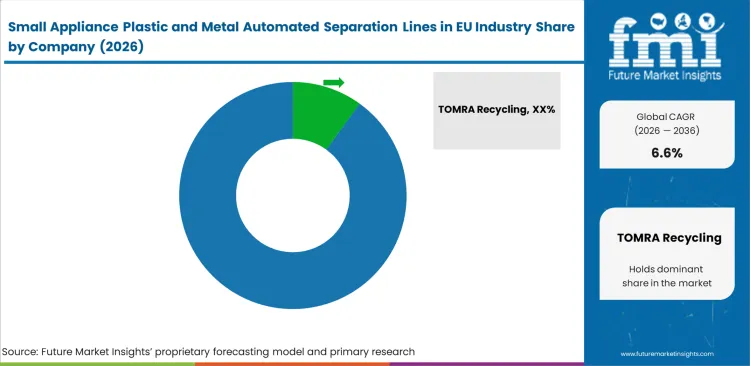
Hardware reliability during continuous processing shifts remains a key competitive factor among equipment manufacturers. Suppliers serving premium dark plastics sorting installations are valued for optical systems that can hold calibration under dusty operating conditions. Buyers comparing equipment for appliance WEEE sorting look beyond conveyor design and place greater weight on sorting accuracy, false-positive control, and output purity consistency. Modular system design also matters for mid-sized municipal operators that need added sorting capacity without extensive civil modification. Competitive positioning is therefore shaped by how well equipment maintains recovery accuracy during high-speed belt operation.
Established vendors often protect their installed base through proprietary control software and tighter system integration. Technical experience built across many plant layouts can create an advantage when linking shredding, conveying, and optical ejection stages into one working line. New entrants usually find it harder to match that integration depth in the early phase of market entry. Facility upgrades depend on stable digital communication between primary crushers and downstream optical sorters, and closed equipment ecosystems can make that process more difficult. This keeps integration compatibility central to vendor selection.
Large waste contractors are placing more pressure on equipment suppliers to support open communication standards. Integrated recycling hubs increasingly prefer central control architecture that can connect hardware from different vendors without heavy customization. Equipment evaluation is moving toward optical array performance, data visibility, and integration flexibility rather than mechanical hardware alone. Suppliers that can offer stronger algorithm transparency and smoother interoperability are likely to be better placed as buyers seek more adaptable appliance recycling systems across Europe.
Key Players in Small Appliance Plastic and Metal Automated Separation Lines in EU Industry
- TOMRA Recycling
- STEINERT
- Sesotec
- REDWAVE
- Pellenc ST
- STADLER Anlagenbau
Scope of the Report
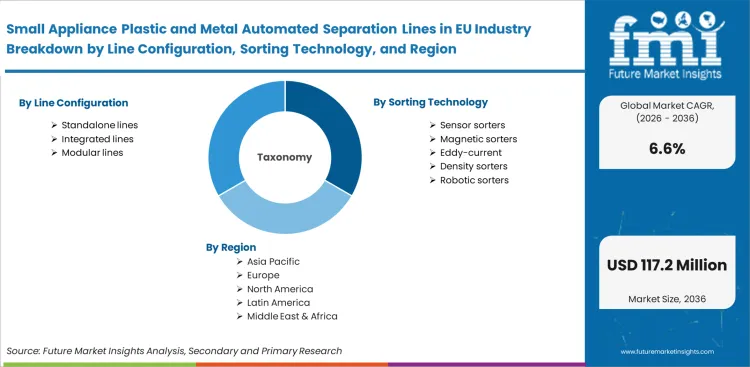
| Metric | Value |
|---|---|
| Quantitative Units | USD 58.0 million to USD 110.0 million, at a CAGR of 6.6% |
| Market Definition | Plant infrastructure designed specifically to separate mixed shredded material from small domestic devices into distinct polymer and metal fractions. Mechanical, magnetic, and optical systems work sequentially to isolate valuable commodities. |
| Segmentation | By line configuration, By sorting technology, By output stream, By automation level, By installation mode, By throughput, By end customer, and Region. |
| Regions Covered | North America, Latin America, Europe, Asia Pacific, Middle East and Africa |
| Countries Covered | Poland, Germany, Czech Republic, Netherlands, France, Spain, Italy |
| Key Companies Profiled | TOMRA Recycling, STEINERT, Sesotec, REDWAVE, Pellenc ST, STADLER Anlagenbau |
| Forecast Period | 2026 to 2036 |
| Approach | Installed capacity data for shredded appliance processing anchored baseline valuation models. |
Source: Future Market Insights (FMI) analysis, based on proprietary forecasting model and primary research
Small Appliance Plastic and Metal Automated Separation Lines in EU Industry Analysis by Segments
By line configuration
- Standalone lines
- Integrated lines
- Modular lines
By sorting technology
- Sensor sorters
- Magnetic sorters
- Eddy-current
- Density sorters
- Robotic sorters
By output stream
- Mixed metals
- Engineering plastics
- Ferrous metals
- Non-ferrous
- Residual fines
By automation level
- Semi-automatic
- Fully automatic
- AI-assisted
By installation mode
- Greenfield lines
- Retrofit lines
- Expansion lines
By throughput
- Low-capacity
- Mid-capacity
- High-capacity
By end customer
- WEEE recyclers
- Integrated waste firms
- Metal recyclers
- Plastic recyclers
Region
- Western Europe
- Germany
- Netherlands
- France
- Southern Europe
- Spain
- Italy
- Central & Eastern Europe
- Poland
- Czech Republic
Bibliography
- Chaine, C., Errandonea, M. M., & Vega, B. M. (2025). Advancing Waste Electrical and Electronic Equipment (WEEE) recycling: A random forest approach to classifying WEEE plastics for sustainable waste management. Environments, 12(2), 68.
- European Environment Agency. (2025). Waste electrical and electronic equipment (WEEE) collection rate (Indicator).
- Hossain, R., & Sahajwalla, V. (2024). Current recycling innovations to utilize e-waste in sustainable green metal manufacturing. Philosophical Transactions of the Royal Society A: Mathematical, Physical and Engineering Sciences, 382(2284), 20230239.
- Saenz, J., Felsch, T., Walter, C., König, T., Poenicke, O., Bayrhammer, E., Vorbröcker, M., Berndt, D., Elkmann, N., & Arlinghaus, J. (2024). Automated disassembly of e-waste-requirements on modeling of processes and product states. Frontiers in Robotics and AI, 11, 1303279.
- Vogelgesang, M., Kaczmarek, V., do Carmo Precci Lopes, A., Li, C., Ionescu, E., & Schebek, L. (2025). Automated material flow characterization of WEEE in sorting plants using deep learning and regression models on RGB data. Waste Management, 204, 114904.
This bibliography is provided for reader reference. The full FMI report contains the complete reference list with primary source documentation.
This Report Addresses
- Detailed evaluation of standalone versus integrated sorting line configurations across European facilities.
- Analysis regarding how tightening EU waste-shipment rules impact equipment sourcing.
- Commercial evaluation comparing mechanical separation methods with advanced optical array systems.
- Specific revenue mapping for output streams including engineering plastics and mixed non-ferrous metals.
- Geographically isolated expansion data tracking greenfield construction versus legacy retrofit projects.
- Hardware integration constraints involving legacy shredder controllers and modern optical ejectors.
- Granular country-level capacity planning metrics for Poland, Germany, and neighboring processing hubs.
- Proprietary algorithmic performance benchmarking among leading sorting technology manufacturers.
Frequently Asked Questions
What is the market size of small appliance automated separation lines in the EU?
Demand reached USD 54.4 million in 2025. Firms face immediate pressure to upgrade existing mechanical lines.
Give me the EU industry forecast for small appliance plastic and metal separation lines?
Total valuation is projected to hit USD 110.0 million by 2036. European shipment restrictions accelerate this necessary capital expenditure at a 6.6% CAGR.
Which sorting technologies are best for mixed appliance plastics and metals?
Near-infrared arrays separate visually identical engineering polymers, while magnetic and eddy-current systems pull dense metallic fractions early to protect optical belts.
How are plastics and metals separated from small appliances?
Mechanical, magnetic, and optical systems work sequentially. Facilities extract heavy shrapnel first to protect downstream sensors that eject targeted polymer fragments via compressed air.
Why do WEEE recyclers need optical sorting for appliance plastics?
Visual inspection and basic density tanks fail to separate polymers with identical specific gravities. Optical arrays guarantee the mono-material purity that downstream compounders require.
Which EU countries are investing most in WEEE sorting lines?
Poland and Germany lead capacity expansion. Massive internal automotive manufacturing demand pushes Polish operators to build highly automated lines producing extrusion-ready plastic flakes.
What is the ROI of a WEEE plastic metal separation line?
The return on investment of optical sorting in WEEE plants depends entirely on capturing premium engineering polymers. Upgrading transforms hazardous electronic waste into highly tradable, high-margin commodity streams.
Which companies supply automated WEEE separation lines for appliances in Europe?
Leading suppliers include TOMRA Recycling, STEINERT, Sesotec, REDWAVE, Pellenc ST, and STADLER Anlagenbau. Vendors are evaluated based on proprietary software reliability.
Compare TOMRA, STEINERT, and Sesotec for appliance WEEE sorting?
TOMRA and STEINERT dominate premium installations by maintaining calibration amid severe dust occlusion. Sesotec targets mid-tier operators by offering highly modular units that bypass complex concrete modifications.
How does EU waste policy affect appliance recycling automation demand?
Shipping mandates enforce sub-one-percent contamination limits. Only fully automated optical verification generates the legally binding purity certificates required for destination ports.
What is the difference between a retrofit line and a greenfield WEEE plant?
Greenfield sites require years of zoning and permitting approvals. Retrofitting involves dropping advanced sensors into legacy layouts, allowing rapid capacity upgrades while preserving existing logistics networks.
Why does dust occlusion affect operational efficiency?
Particulate buildup across sensor lenses degrades algorithmic recognition accuracy mid-shift. Maintenance technicians must establish strict daily calibration routines to prevent sudden failure.
Why is black plastic recovery difficult?
Traditional near-infrared cameras absorb light against dark backgrounds, rendering black polymers invisible. Advanced facilities deploy specialized multi-spectral arrays to capture this specific fraction.
What role do digital watermarks play?
Embedded casing tags provide precise material origin data. Compliance officers utilize optical readers to trace appliance plastics directly back to original manufacturers.
How do operators manage algorithmic drift?
Novel plastic additives introduced by appliance manufacturers confuse standard spectral libraries. Plant engineers continuously update recognition software to prevent valuable polymers from entering residual streams.
Why do standalone lines create transfer bottlenecks?
Mismatched conveyor speeds between legacy shredders and new optical ejectors disrupt material flow. Operators must synchronize belt frequencies carefully to prevent internal piling.
How do tight export regulations shape equipment choice?
International shipping mandates enforce sub-one-percent contamination limits. Only fully automated optical verification generates legally binding purity certificates for destination ports.
What advantage do established manufacturers possess?
Legacy vendors hold massive technical libraries detailing material flow characteristics across thousands of layouts. Challengers struggle to replicate this deep integration experience quickly.
Why do large contractors resist proprietary ecosystems?
Companies want flexibility to specify exact optical array performance metrics from varied vendors. Open-source communication standards prevent single-supplier hardware lock-in.
How do shifts in ambient lighting impact sorting?
External light variations interfere with delicate near-infrared baseline readings. Facilities must enclose sensor units completely to guarantee consistent downstream bale purity.
What drives investment in Czech Republic facilities?
Central logistics positioning makes local plants critical cross-border processing nodes. Companies expand secondary optical stages to handle massive transit volumes rapidly.
How do Southern European operators structure upgrades?
Complex local permitting forces Italian and Spanish plants to favor modular retrofits. Capital expenditure targets specific high-value non-ferrous extraction stages to maximize immediate cash flow.
Preview the report firsthand - request a free sample
Get SampleGet the brochure for pricing and purchase details.
Get PDFTable of Content
- Executive Summary
- Global Market Outlook
- Demand-side Trends
- Supply-side Trends
- Technology Roadmap Analysis
- Analysis and Recommendations
- Market Overview
- Market Coverage / Taxonomy
- Market Definition / Scope / Limitations
- Research Methodology
- Chapter Orientation
- Analytical Lens and Working Hypotheses
- Market Structure, Signals, and Trend Drivers
- Benchmarking and Cross-market Comparability
- Market Sizing, Forecasting, and Opportunity Mapping
- Research Design and Evidence Framework
- Desk Research Programme (Secondary Evidence)
- Company Annual and Sustainability Reports
- Peer-reviewed Journals and Academic Literature
- Corporate Websites, Product Literature, and Technical Notes
- Earnings Decks and Investor Briefings
- Statutory Filings and Regulatory Disclosures
- Technical White Papers and Standards Notes
- Trade Journals, Industry Magazines, and Analyst Briefs
- Conference Proceedings, Webinars, and Seminar Materials
- Government Statistics Portals and Public Data Releases
- Press Releases and Reputable Media Coverage
- Specialist Newsletters and Curated Briefings
- Sector Databases and Reference Repositories
- FMI Internal Proprietary Databases and Historical Market Datasets
- Subscription Datasets and Paid Sources
- Social Channels, Communities, and Digital Listening Inputs
- Additional Desk Sources
- Expert Input and Fieldwork (Primary Evidence)
- Primary Modes
- Qualitative Interviews and Expert Elicitation
- Quantitative Surveys and Structured Data Capture
- Blended Approach
- Why Primary Evidence is Used
- Field Techniques
- Interviews
- Surveys
- Focus Groups
- Observational and In-context Research
- Social and Community Interactions
- Stakeholder Universe Engaged
- C-suite Leaders
- Board Members
- Presidents and Vice Presidents
- R&D and Innovation Heads
- Technical Specialists
- Domain Subject-matter Experts
- Scientists
- Physicians and Other Healthcare Professionals
- Governance, Ethics, and Data Stewardship
- Research Ethics
- Data Integrity and Handling
- Primary Modes
- Tooling, Models, and Reference Databases
- Desk Research Programme (Secondary Evidence)
- Data Engineering and Model Build
- Data Acquisition and Ingestion
- Cleaning, Normalisation, and Verification
- Synthesis, Triangulation, and Analysis
- Quality Assurance and Audit Trail
- Market Background
- Market Dynamics
- Drivers
- Restraints
- Opportunity
- Trends
- Scenario Forecast
- Demand in Optimistic Scenario
- Demand in Likely Scenario
- Demand in Conservative Scenario
- Opportunity Map Analysis
- Product Life Cycle Analysis
- Supply Chain Analysis
- Investment Feasibility Matrix
- Value Chain Analysis
- PESTLE and Porter’s Analysis
- Regulatory Landscape
- Regional Parent Market Outlook
- Production and Consumption Statistics
- Import and Export Statistics
- Market Dynamics
- Global Market Analysis 2021 to 2025 and Forecast, 2026 to 2036
- Historical Market Size Value (USD Million) Analysis, 2021 to 2025
- Current and Future Market Size Value (USD Million) Projections, 2026 to 2036
- Y-o-Y Growth Trend Analysis
- Absolute $ Opportunity Analysis
- Global Market Pricing Analysis 2021 to 2025 and Forecast 2026 to 2036
- Global Market Analysis 2021 to 2025 and Forecast 2026 to 2036, By Line Configuration
- Introduction / Key Findings
- Historical Market Size Value (USD Million) Analysis By Line Configuration , 2021 to 2025
- Current and Future Market Size Value (USD Million) Analysis and Forecast By Line Configuration , 2026 to 2036
- Standalone lines
- Integrated lines
- Modular lines
- Standalone lines
- Y-o-Y Growth Trend Analysis By Line Configuration , 2021 to 2025
- Absolute $ Opportunity Analysis By Line Configuration , 2026 to 2036
- Global Market Analysis 2021 to 2025 and Forecast 2026 to 2036, By Sorting Technology
- Introduction / Key Findings
- Historical Market Size Value (USD Million) Analysis By Sorting Technology, 2021 to 2025
- Current and Future Market Size Value (USD Million) Analysis and Forecast By Sorting Technology, 2026 to 2036
- Sensor sorters
- Magnetic sorters
- Eddy-current
- Density sorters
- Robotic sorters
- Sensor sorters
- Y-o-Y Growth Trend Analysis By Sorting Technology, 2021 to 2025
- Absolute $ Opportunity Analysis By Sorting Technology, 2026 to 2036
- Global Market Analysis 2021 to 2025 and Forecast 2026 to 2036, By Output Stream
- Introduction / Key Findings
- Historical Market Size Value (USD Million) Analysis By Output Stream, 2021 to 2025
- Current and Future Market Size Value (USD Million) Analysis and Forecast By Output Stream, 2026 to 2036
- Mixed metals
- Engineering plastics
- Ferrous metals
- Non-ferrous
- Residual fines
- Mixed metals
- Y-o-Y Growth Trend Analysis By Output Stream, 2021 to 2025
- Absolute $ Opportunity Analysis By Output Stream, 2026 to 2036
- Global Market Analysis 2021 to 2025 and Forecast 2026 to 2036, By Automation Level
- Introduction / Key Findings
- Historical Market Size Value (USD Million) Analysis By Automation Level, 2021 to 2025
- Current and Future Market Size Value (USD Million) Analysis and Forecast By Automation Level, 2026 to 2036
- Fully automatic
- Semi-automatic
- AI-assisted
- Fully automatic
- Y-o-Y Growth Trend Analysis By Automation Level, 2021 to 2025
- Absolute $ Opportunity Analysis By Automation Level, 2026 to 2036
- Global Market Analysis 2021 to 2025 and Forecast 2026 to 2036, By Installation Mode
- Introduction / Key Findings
- Historical Market Size Value (USD Million) Analysis By Installation Mode, 2021 to 2025
- Current and Future Market Size Value (USD Million) Analysis and Forecast By Installation Mode, 2026 to 2036
- Retrofit lines
- Greenfield lines
- Expansion lines
- Retrofit lines
- Y-o-Y Growth Trend Analysis By Installation Mode, 2021 to 2025
- Absolute $ Opportunity Analysis By Installation Mode, 2026 to 2036
- Global Market Analysis 2021 to 2025 and Forecast 2026 to 2036, By Region
- Introduction
- Historical Market Size Value (USD Million) Analysis By Region, 2021 to 2025
- Current Market Size Value (USD Million) Analysis and Forecast By Region, 2026 to 2036
- North America
- Latin America
- Western Europe
- Eastern Europe
- East Asia
- South Asia and Pacific
- Middle East & Africa
- Market Attractiveness Analysis By Region
- North America Market Analysis 2021 to 2025 and Forecast 2026 to 2036, By Country
- Historical Market Size Value (USD Million) Trend Analysis By Market Taxonomy, 2021 to 2025
- Market Size Value (USD Million) Forecast By Market Taxonomy, 2026 to 2036
- By Country
- USA
- Canada
- Mexico
- By Line Configuration
- By Sorting Technology
- By Output Stream
- By Automation Level
- By Installation Mode
- By Country
- Market Attractiveness Analysis
- By Country
- By Line Configuration
- By Sorting Technology
- By Output Stream
- By Automation Level
- By Installation Mode
- Key Takeaways
- Latin America Market Analysis 2021 to 2025 and Forecast 2026 to 2036, By Country
- Historical Market Size Value (USD Million) Trend Analysis By Market Taxonomy, 2021 to 2025
- Market Size Value (USD Million) Forecast By Market Taxonomy, 2026 to 2036
- By Country
- Brazil
- Chile
- Rest of Latin America
- By Line Configuration
- By Sorting Technology
- By Output Stream
- By Automation Level
- By Installation Mode
- By Country
- Market Attractiveness Analysis
- By Country
- By Line Configuration
- By Sorting Technology
- By Output Stream
- By Automation Level
- By Installation Mode
- Key Takeaways
- Western Europe Market Analysis 2021 to 2025 and Forecast 2026 to 2036, By Country
- Historical Market Size Value (USD Million) Trend Analysis By Market Taxonomy, 2021 to 2025
- Market Size Value (USD Million) Forecast By Market Taxonomy, 2026 to 2036
- By Country
- Germany
- UK
- Italy
- Spain
- France
- Nordic
- BENELUX
- Rest of Western Europe
- By Line Configuration
- By Sorting Technology
- By Output Stream
- By Automation Level
- By Installation Mode
- By Country
- Market Attractiveness Analysis
- By Country
- By Line Configuration
- By Sorting Technology
- By Output Stream
- By Automation Level
- By Installation Mode
- Key Takeaways
- Eastern Europe Market Analysis 2021 to 2025 and Forecast 2026 to 2036, By Country
- Historical Market Size Value (USD Million) Trend Analysis By Market Taxonomy, 2021 to 2025
- Market Size Value (USD Million) Forecast By Market Taxonomy, 2026 to 2036
- By Country
- Russia
- Poland
- Hungary
- Balkan & Baltic
- Rest of Eastern Europe
- By Line Configuration
- By Sorting Technology
- By Output Stream
- By Automation Level
- By Installation Mode
- By Country
- Market Attractiveness Analysis
- By Country
- By Line Configuration
- By Sorting Technology
- By Output Stream
- By Automation Level
- By Installation Mode
- Key Takeaways
- East Asia Market Analysis 2021 to 2025 and Forecast 2026 to 2036, By Country
- Historical Market Size Value (USD Million) Trend Analysis By Market Taxonomy, 2021 to 2025
- Market Size Value (USD Million) Forecast By Market Taxonomy, 2026 to 2036
- By Country
- China
- Japan
- South Korea
- By Line Configuration
- By Sorting Technology
- By Output Stream
- By Automation Level
- By Installation Mode
- By Country
- Market Attractiveness Analysis
- By Country
- By Line Configuration
- By Sorting Technology
- By Output Stream
- By Automation Level
- By Installation Mode
- Key Takeaways
- South Asia and Pacific Market Analysis 2021 to 2025 and Forecast 2026 to 2036, By Country
- Historical Market Size Value (USD Million) Trend Analysis By Market Taxonomy, 2021 to 2025
- Market Size Value (USD Million) Forecast By Market Taxonomy, 2026 to 2036
- By Country
- India
- ASEAN
- Australia & New Zealand
- Rest of South Asia and Pacific
- By Line Configuration
- By Sorting Technology
- By Output Stream
- By Automation Level
- By Installation Mode
- By Country
- Market Attractiveness Analysis
- By Country
- By Line Configuration
- By Sorting Technology
- By Output Stream
- By Automation Level
- By Installation Mode
- Key Takeaways
- Middle East & Africa Market Analysis 2021 to 2025 and Forecast 2026 to 2036, By Country
- Historical Market Size Value (USD Million) Trend Analysis By Market Taxonomy, 2021 to 2025
- Market Size Value (USD Million) Forecast By Market Taxonomy, 2026 to 2036
- By Country
- Kingdom of Saudi Arabia
- Other GCC Countries
- Turkiye
- South Africa
- Other African Union
- Rest of Middle East & Africa
- By Line Configuration
- By Sorting Technology
- By Output Stream
- By Automation Level
- By Installation Mode
- By Country
- Market Attractiveness Analysis
- By Country
- By Line Configuration
- By Sorting Technology
- By Output Stream
- By Automation Level
- By Installation Mode
- Key Takeaways
- Key Countries Market Analysis
- USA
- Pricing Analysis
- Market Share Analysis, 2025
- By Line Configuration
- By Sorting Technology
- By Output Stream
- By Automation Level
- By Installation Mode
- Canada
- Pricing Analysis
- Market Share Analysis, 2025
- By Line Configuration
- By Sorting Technology
- By Output Stream
- By Automation Level
- By Installation Mode
- Mexico
- Pricing Analysis
- Market Share Analysis, 2025
- By Line Configuration
- By Sorting Technology
- By Output Stream
- By Automation Level
- By Installation Mode
- Brazil
- Pricing Analysis
- Market Share Analysis, 2025
- By Line Configuration
- By Sorting Technology
- By Output Stream
- By Automation Level
- By Installation Mode
- Chile
- Pricing Analysis
- Market Share Analysis, 2025
- By Line Configuration
- By Sorting Technology
- By Output Stream
- By Automation Level
- By Installation Mode
- Germany
- Pricing Analysis
- Market Share Analysis, 2025
- By Line Configuration
- By Sorting Technology
- By Output Stream
- By Automation Level
- By Installation Mode
- UK
- Pricing Analysis
- Market Share Analysis, 2025
- By Line Configuration
- By Sorting Technology
- By Output Stream
- By Automation Level
- By Installation Mode
- Italy
- Pricing Analysis
- Market Share Analysis, 2025
- By Line Configuration
- By Sorting Technology
- By Output Stream
- By Automation Level
- By Installation Mode
- Spain
- Pricing Analysis
- Market Share Analysis, 2025
- By Line Configuration
- By Sorting Technology
- By Output Stream
- By Automation Level
- By Installation Mode
- France
- Pricing Analysis
- Market Share Analysis, 2025
- By Line Configuration
- By Sorting Technology
- By Output Stream
- By Automation Level
- By Installation Mode
- India
- Pricing Analysis
- Market Share Analysis, 2025
- By Line Configuration
- By Sorting Technology
- By Output Stream
- By Automation Level
- By Installation Mode
- ASEAN
- Pricing Analysis
- Market Share Analysis, 2025
- By Line Configuration
- By Sorting Technology
- By Output Stream
- By Automation Level
- By Installation Mode
- Australia & New Zealand
- Pricing Analysis
- Market Share Analysis, 2025
- By Line Configuration
- By Sorting Technology
- By Output Stream
- By Automation Level
- By Installation Mode
- China
- Pricing Analysis
- Market Share Analysis, 2025
- By Line Configuration
- By Sorting Technology
- By Output Stream
- By Automation Level
- By Installation Mode
- Japan
- Pricing Analysis
- Market Share Analysis, 2025
- By Line Configuration
- By Sorting Technology
- By Output Stream
- By Automation Level
- By Installation Mode
- South Korea
- Pricing Analysis
- Market Share Analysis, 2025
- By Line Configuration
- By Sorting Technology
- By Output Stream
- By Automation Level
- By Installation Mode
- Russia
- Pricing Analysis
- Market Share Analysis, 2025
- By Line Configuration
- By Sorting Technology
- By Output Stream
- By Automation Level
- By Installation Mode
- Poland
- Pricing Analysis
- Market Share Analysis, 2025
- By Line Configuration
- By Sorting Technology
- By Output Stream
- By Automation Level
- By Installation Mode
- Hungary
- Pricing Analysis
- Market Share Analysis, 2025
- By Line Configuration
- By Sorting Technology
- By Output Stream
- By Automation Level
- By Installation Mode
- Kingdom of Saudi Arabia
- Pricing Analysis
- Market Share Analysis, 2025
- By Line Configuration
- By Sorting Technology
- By Output Stream
- By Automation Level
- By Installation Mode
- Turkiye
- Pricing Analysis
- Market Share Analysis, 2025
- By Line Configuration
- By Sorting Technology
- By Output Stream
- By Automation Level
- By Installation Mode
- South Africa
- Pricing Analysis
- Market Share Analysis, 2025
- By Line Configuration
- By Sorting Technology
- By Output Stream
- By Automation Level
- By Installation Mode
- USA
- Market Structure Analysis
- Competition Dashboard
- Competition Benchmarking
- Market Share Analysis of Top Players
- By Regional
- By Line Configuration
- By Sorting Technology
- By Output Stream
- By Automation Level
- By Installation Mode
- Competition Analysis
- Competition Deep Dive
- TOMRA Recycling
- Overview
- Product Portfolio
- Profitability by Market Segments (Product/Age /Sales Channel/Region)
- Sales Footprint
- Strategy Overview
- Marketing Strategy
- Product Strategy
- Channel Strategy
- STEINERT
- Sesotec
- REDWAVE
- Pellenc ST
- STADLER Anlagenbau
- TOMRA Recycling
- Competition Deep Dive
- Assumptions & Acronyms Used


