

- Industry Size (2026)
- USD 509 Mn
- Forecast (2036)
- USD 1436 Mn
- CAGR (2026 to 2036)
- 10.9%
Sorting Technologies for Multilayer Flexible Films Market Forecast and Outlook 2026 to 2036
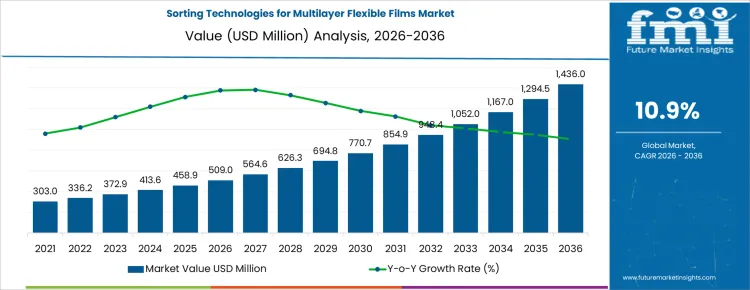
The sorting technologies for multilayer flexible films market is anticipated to grow from USD 509 million in 2026 to USD 1,436 million by 2036, at a CAGR of 10.9%. Growth is primarily driven by rising post-consumer flexible film waste and increasing demand for high-purity recycled PE/PP multilayer films. Advanced optical sorters integrated with NIR and AI material fingerprinting are becoming standard, enabling precise separation of multilayer laminates and mixed flexible waste streams.
End-use applications span flexible packaging recycling, film waste recovery, and post-consumer film streams, with technologies including sensor-based sorters, AI-assisted recognition, and multi-sensor fusion. Compact and conveyor-integrated sorters are expanding adoption in informal-to-formal recycling setups. Regulatory mandates for recycled content and sustainability initiatives by FMCG and packaging sectors further stimulate market penetration, while ongoing innovations in AI and sensor accuracy continue to enhance sorting efficiency and operational throughput across recycling facilities.
Quick Stats of the Sorting Technologies for Multilayer Flexible Films Market
- Sorting Technologies for Multilayer Flexible Films Market Value (2026): USD 509 million
- Sorting Technologies for Multilayer Flexible Films Market Forecast Value (2036): USD 1,436 million
- Sorting Technologies for Multilayer Flexible Films Market Forecast CAGR (2026 to 2036): 10.9%
- Leading Sorting Technology Type in the Market: Advanced Optical Sorters (45%)
- Key Growth Regions in the Market: India, China, USA, Brazil, Germany
- Top Players in the Market: TOMRA, STEINERT, BoReTech, Local Engineering Firms, Local OEMs, TOSHIBA Infrastructure, Pellenc ST
What is the Growth Forecast for the Sorting Technologies for Multilayer Flexible Films Market through 2036?
From 2026 to 2031, the sorting technologies market for multilayer flexible films grows from USD 509 million to approximately USD 821 million, representing the early adoption phase. Annual value additions rise from USD 47 million in 2026 to USD 73 million in 2031. Growth is driven by increasing recycling initiatives in packaging, where multilayer films require specialized separation technologies to restore polymer value. Early adoption is concentrated in Europe and North America, accounting for roughly 60% of market value, with pilot programs focusing on high-throughput sorting, detection accuracy, and integration into existing material recovery facilities.
Between 2031 and 2036, the market expands from roughly USD 821 million to USD 1,436 million, illustrating the late adoption curve characterized by broader commercialization and industrial-scale deployment. Annual increments increase from USD 73 million to USD 155 million, driven by multi-site installations, repeat procurement, and global adoption across emerging and established recycling markets. Growth is reinforced by regulatory mandates for recycled content, portfolio-wide adoption in flexible packaging streams, and structural integration of sorting technologies into automated waste management systems. Early growth relied on selective pilot projects, while later expansion is driven by scale deployment and normalized operational use.
Sorting Technologies for Multilayer Flexible Films Market Key Takeaways
| Metric | Value |
|---|---|
| Market Value (2026) | USD 509 million |
| Forecast Value (2036) | USD 1,436 million |
| Forecast CAGR (2026 to 2036) | 10.9% |
Why Are Multilayer Films Forcing a Rethink of Sorting Technology Design?
For years, multilayer flexible films were treated as an unavoidable loss within recycling systems. Their value lay in performance, not recoverability. Sorting plants focused on rigid containers and mono materials, while multilayer films moved through as contamination. Operators accepted this because separation was technically impractical and economically unjustified. Early attempts relied on manual removal or crude classification, producing inconsistent outputs. Demand for specialised sorting only emerged when volumes of flexible packaging increased sharply and disposal costs rose. Historical pressure came from accumulation and inefficiency, not from circular design goals or downstream material demand.
Future demand is driven by necessity rather than ambition. Multilayer films now represent a significant share of plastic waste entering facilities. Excluding them reduces recovery rates and undermines compliance targets. Sorting technologies are being developed to identify structure, not just polymer type, enabling controlled routing rather than blanket rejection. Adoption follows system bottlenecks, feedstock scarcity, and contractual recycling obligations. Sorting becomes a gatekeeping function that determines whether multilayer films remain waste or become usable input.
What Factors Are Affecting the Demand for Sorting Technologies for Multilayer Flexible Films Market in Terms of End Use Application and Sorting Technology Type?
Demand for sorting technologies for multilayer flexible films is segmented by end use application and sorting technology type across recycling and recovery operations. Flexible packaging recycling accounts for about 40% of total demand, making it the leading end use segment. Post consumer film streams, film waste recovery operations, informal to formal recycling transitions, FMCG waste streams, and high precision sorting users represent additional applications without disclosed share splits. These segments differ in film composition complexity, contamination levels, and throughput consistency. Sorting technology type determines detection accuracy and operational integration. Advanced optical sorters account for about 45% of demand, followed by sensor based systems, conveyor based film sorters, compact film sorters, and other configurations. Together, these segments explain demand formation shaped by material identification limits and recovery targets rather than total film waste volume.
What Drives Demand by End Use Application in the Sorting Technologies for Multilayer Flexible Films Market?
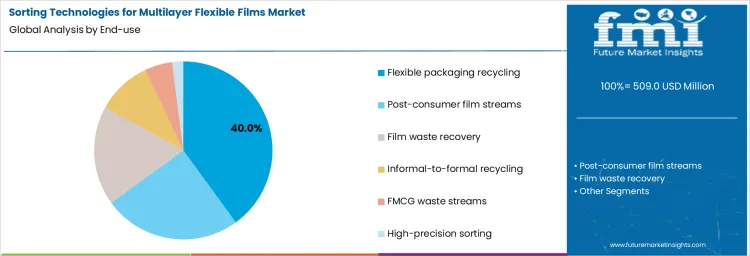
Flexible packaging recycling leads demand with a 40% share because multilayer films present separation challenges that conventional sorting cannot resolve. These operations require technologies capable of distinguishing layered structures and composite materials. Post consumer film streams adopt sorting to improve feedstock quality for downstream processing. Film waste recovery facilities apply sorting to reduce reject rates and improve bale consistency. Informal to formal recycling systems use compact solutions to upgrade manual sorting practices. FMCG waste streams require sorting to meet packaging recovery commitments. End use demand therefore reflects pressure to recover complex flexible materials rather than expansion of recycling infrastructure.
Application driven demand remains stable because multilayer film complexity persists. Recycling operators integrate sorting technologies to address contamination and improve yield. Post consumer streams scale adoption as collection volumes increase. Informal sector transitions occur gradually due to capital limits. FMCG driven recovery initiatives support selective deployment. These patterns limit short term volatility. End use segmentation highlights reliance on improved sorting capability to manage material complexity rather than discretionary technology upgrades.
How Does Sorting Technology Type Shape Demand for Sorting Technologies for Multilayer Flexible Films Market?
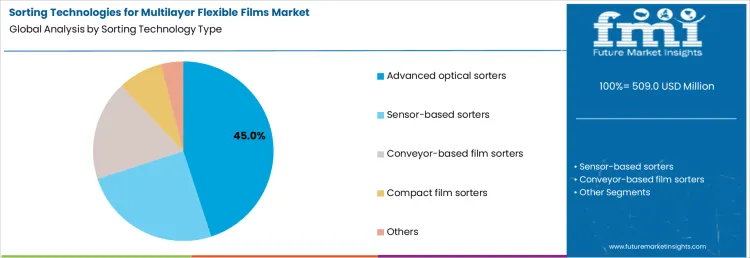
Advanced optical sorters account for about 45% of total demand, making them the leading technology type. Their dominance reflects ability to detect subtle differences in film composition and structure. Sensor based sorters are used where additional material signatures improve separation accuracy. Conveyor based film sorters support high throughput operations with consistent material flow. Compact film sorters serve decentralized or space constrained facilities. Other technologies address specialized recovery requirements. Technology selection depends on detection sensitivity, line speed, and retrofit feasibility. Demand follows separation performance under mixed film conditions rather than adoption of novel hardware.
Advanced optical systems maintain leadership due to proven effectiveness with multilayer films. Sensor based units complement optical detection in complex streams. Conveyor based systems scale in centralized facilities. Compact units support emerging recycling operations. Operators avoid frequent technology changes due to integration costs and training needs. This stabilizes demand by technology type. Sorting technology segmentation therefore reinforces concentration in optical and sensor driven systems capable of addressing multilayer film recovery challenges.
How Are Sorting Technologies for Multilayer Flexible Films Being Applied in Recycling Facilities?
Use is focused on separating complex flexible packaging such as snack pouches, coffee bags, and laminated wrappers, where standard NIR scanners fail to distinguish multiple polymer layers. Recycling operators integrate combined spectroscopy, machine learning, and robotic pick-and-place systems to target multilayer films that otherwise contaminate PET, PE, or PP streams. Some facilities employ inline thickness sensors or hyperspectral imaging to differentiate metallicized films from clear or opaque plastics. Adoption is concentrated in plants supplying high-value recyclate for secondary packaging or composite sheet production, where material purity directly affects downstream mechanical and barrier performance.
What Operational and Material Conditions Support Adoption of Multilayer Flexible Film Sorting Systems?
Implementation is viable where high-volume mixed-film streams are consistently fed on conveyors and where separation speed matches automated removal mechanisms. Systems must account for films with variable thickness, print patterns, and laminates, while maintaining high throughput without tearing or misclassification. Facility engineers calibrate sensors against polymer blends, metallic coatings, and inks to reduce false positives. Operational success depends on stable lighting, minimized static adhesion, and continuous operator oversight to adjust for seasonal packaging changes. These conditions support reliability, maintain recyclate integrity, and reduce contamination in downstream extrusion or compounding.
Which Practical Considerations Limit Wider Use of Multilayer Flexible Film Sorting Systems?
Detection accuracy drops sharply with new packaging formats or heavily printed pouches, requiring frequent recalibration and dataset retraining. Initial investment for hyperspectral imaging, robotics, and AI processing is high, often exceeding $1-2 million per line. Conveyor integration may require structural modifications to avoid overlap or jamming. Even with advanced systems, thin laminates or films with high static cling remain challenging to extract, producing a residual contamination rate of 5-10%. Adoption is therefore concentrated in high-volume, high-margin recycling streams where the value of clean multilayer material outweighs capital and operational complexity.
What is the Demand for Sorting Technologies for Multilayer Flexible Films by Country?
| Country | CAGR (%) |
|---|---|
| USA | 9.2% |
| Germany | 8.0% |
| China | 11.8% |
| India | 12.8% |
| Brazil | 8.2% |
| Japan | 5.2% |
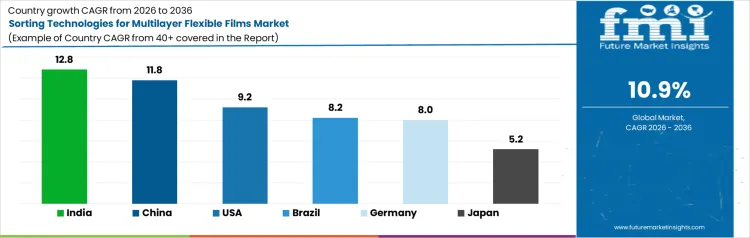
The demand for sorting technologies for multilayer flexible films varies across countries, driven by recycling efficiency, packaging waste management, and adoption of advanced sorting solutions. India leads with a 12.8% CAGR, supported by expanding recycling infrastructure, increasing use of multilayer films in packaging, and regulatory focus on sustainable waste management. China follows at 11.8%, driven by large scale industrial recycling operations and adoption of automated sorting technologies. The USA grows at 9.2%, reflecting adoption in municipal and industrial recycling programs. Brazil records 8.2%, shaped by growing recycling networks and packaging consumption. Germany posts 8.0%, supported by structured recycling systems, while Japan grows at 5.2%, reflecting mature waste management markets and steady adoption of sorting technologies.
How Is Multilayer Flexible Film Sorting Driving Growth in the United States?
In the United States, revenue from the Sorting Technologies for Multilayer Flexible Films Market is expanding at a CAGR of 9.2% through 2036, driven by adoption of advanced mechanical, optical, and AI-enabled sorting systems to separate complex multilayer post-consumer recycled (PCR) films. Manufacturers are integrating sorting technologies in recycling facilities, material recovery operations, and industrial processing lines to improve material purity, recovery rates, and efficiency. Demand is concentrated in food and beverage packaging, industrial films, and consumer goods. Domestic suppliers provide high-performance, technology-compatible sorting systems suitable for automated production lines. Recurring recycling operations, quality standards, and regulatory compliance are sustaining predictable procurement nationwide.
- Food and beverage packaging, industrial films, and consumer goods drive adoption
- Sorting technologies improve purity, recovery rates, and processing efficiency
- Domestic suppliers provide automated, technology-compatible systems
- Recurring recycling operations sustain predictable procurement
How Are Recycling and Material Standards Supporting Growth in Germany?
Germany continues to record steady growth in the Sorting Technologies for Multilayer Flexible Films Market at a CAGR of 8% through 2036, supported by strict recycling quality regulations and sustainability initiatives. Manufacturers are adopting sorting technologies to separate multilayer flexible films for packaging, industrial applications, and consumer products, improving material quality and processing efficiency. Demand is concentrated in food and beverage packaging, household products, and industrial films. Domestic suppliers provide high-performance, automated sorting systems compatible with conveyor and robotic lines. Compliance with recycling standards and recurring PCR operations are sustaining measured adoption nationwide.
- Food and beverage packaging, household products, and industrial films anchor demand
- Sorting technologies improve multilayer film separation and material quality
- Domestic suppliers provide conveyor- and robotic-compatible systems
- Recurring PCR operations sustain steady adoption
How Is Industrial and Consumer Recycling Expansion Accelerating Adoption in China?
In China, revenue from the Sorting Technologies for Multilayer Flexible Films Market is growing at a CAGR of 11.8% through 2036, driven by rapid expansion of recycling infrastructure and industrial PCR processing. Manufacturers are integrating advanced sorting technologies to increase recovery rates, improve film purity, and enable high-quality reuse in packaging and industrial applications. Demand is strong across food and beverage packaging, industrial films, and consumer products. Domestic suppliers are scaling production of high-performance, automated sorting systems compatible with extrusion and thermoforming lines. Expanding recycling operations and structured PCR processing are sustaining rapid adoption nationwide.
- Food and beverage packaging, industrial films, and consumer products drive adoption
- Sorting technologies improve recovery rates, film purity, and reuse quality
- Domestic suppliers scale automated, high-performance systems
- Recycling operations sustain consistent adoption
How Is Post-Consumer Recycling Supporting Growth in India?
In India, revenue from the Sorting Technologies for Multilayer Flexible Films Market is expanding at a CAGR of 12.8% through 2036, supported by increasing adoption of PCR films in packaging, industrial, and consumer goods applications. Manufacturers are adopting sorting technologies to enhance separation accuracy, improve material quality, and support high-volume recycling operations. Demand is concentrated in food and beverage packaging, industrial films, and consumer products. Domestic suppliers provide high-performance, technology-compatible sorting systems suitable for automated and semi-automated processing lines. Growth in PCR infrastructure and recurring recycling operations are sustaining robust adoption nationwide.
- Food and beverage packaging, industrial films, and consumer products drive adoption
- Sorting technologies enhance separation accuracy and material quality
- Domestic suppliers provide automated and semi-automated systems
- Recurring PCR operations sustain robust adoption
How Is Industrial Recycling and Packaging Expansion Supporting Adoption in Brazil?
Brazil is seeing strong growth in the Sorting Technologies for Multilayer Flexible Films Market at a CAGR of 8.2% through 2036, supported by increasing industrial recycling operations and adoption of multilayer PCR films in packaging and consumer goods. Manufacturers are integrating sorting technologies to improve film recovery, purity, and processing efficiency. Demand is concentrated in food and beverage packaging, industrial films, and household products. Domestic suppliers are expanding production of high-performance, automated sorting systems compatible with industrial recycling lines. Growth in recycling infrastructure and recurring PCR operations are sustaining robust procurement nationwide.
- Food and beverage packaging, industrial films, and household products drive adoption
- Sorting technologies improve recovery, purity, and processing efficiency
- Domestic suppliers expand automated, high-performance systems
- Recurring PCR operations sustain robust procurement
How Is Industrial and Consumer Recycling Adoption Driving Growth in Japan?
Japan is witnessing growth in the Sorting Technologies for Multilayer Flexible Films Market at a CAGR of 5.2% through 2036, driven by adoption of advanced sorting technologies for separating multilayer PCR films in packaging, industrial, and consumer goods applications. Manufacturers are integrating optical, AI-enabled, and mechanical sorting systems to improve material recovery, purity, and processing efficiency. Demand is concentrated in food and beverage packaging, industrial films, and household products. Domestic suppliers provide high-performance, technology-compatible sorting systems suitable for automated recycling lines. Regulatory compliance, recycling standards, and recurring PCR operations are sustaining predictable procurement nationwide.
- Food and beverage packaging, industrial films, and household products anchor demand
- Sorting technologies improve recovery, purity, and processing efficiency
- Domestic suppliers provide automated, high-performance sorting systems
- Recurring PCR operations sustain predictable procurement
Which Companies Shape Competition in Sorting Technologies for Multilayer Flexible Films Based On Failure Modes and Recovery Limits?

Competitive differentiation in sorting technologies for multilayer flexible films emerges from how systems handle what they cannot easily classify. Multilayer films often fail optical identification due to thin gauges, overlapping materials, and inconsistent presentation, making mis-sorts a central operational concern. TOMRA, STEINERT, and Pellenc ST are evaluated on how their systems manage false positives, material overlap, and film flutter rather than peak recognition accuracy alone. TOSHIBA Infrastructure contributes sensing and control components used where electrical stability and line synchronization affect detection reliability. System selection is driven by plant operators seeking predictable recovery behavior under degraded feedstock conditions, where avoiding contamination of recovered fractions is often prioritized over marginal yield gains.
Procurement decisions are shaped as much by engineering adaptability as by core technology. BoReTech participates where sorting is embedded within integrated film recycling plants, linking detection to downstream washing and reprocessing constraints. Local OEMs and engineering firms frequently define real world performance by designing feeding, spreading, and air management systems that determine whether sensors function as intended. In many regions, local system integrators hold decisive influence by tailoring layouts, maintenance access, and operator interfaces to site capabilities. Competitive positioning depends on commissioning outcomes, operator error tolerance, and stability over extended operating periods. The market rewards suppliers whose systems fail predictably and recover gracefully rather than those optimized solely for ideal material streams.
Key Players in the Sorting Technologies for Multilayer Flexible Films
- TOMRA
- STEINERT
- BoReTech
- Local engineering firms
- Local OEMs
- TOSHIBA Infrastructure
- Pellenc ST
Scope of the Report
| Items | Values |
|---|---|
| Quantitative Units (2026) | USD million |
| End-use / Application | Flexible packaging recycling, Post-consumer film streams, Film waste recovery, Informal-to-formal recycling, FMCG waste streams, High-precision sorting |
| Sorting Technology Type | Advanced optical sorters, Sensor-based sorters, Conveyor-based film sorters, Compact film sorters, Others |
| Material Stream | Multilayer PE/PP films, Multilayer laminates, Mixed flexible waste, PE-dominant films, Others |
| Technology | NIR + AI material fingerprinting, Multi-sensor fusion, AI-assisted film recognition, Cost-efficient sensor arrays, Others |
| Region | Asia Pacific (China, Japan, South Korea, India, Australia & New Zealand, ASEAN, Rest of Asia Pacific), Europe (Germany, United Kingdom, France, Italy, Spain, Nordic, BENELUX, Rest of Europe), North America (United States, Canada, Mexico), Latin America (Brazil, Chile, Rest of Latin America), Middle East & Africa (KSA, Other GCC Countries, Turkey, South Africa, Other African Union, Rest of Middle East & Africa) |
| Key Companies Profiled | TOMRA, STEINERT, BoReTech, Local engineering firms, Local OEMs, TOSHIBA Infrastructure, Pellenc ST |
| Additional Attributes | Dollar by sales by end-use and technology type, Dollar by sales by material stream, Dollar by sales by region, Adoption patterns by recycling operators, Sorting efficiency, Multilayer film recovery performance, AI and sensor integration, Operational throughput, Conveyor and plant compatibility, Capital investment considerations, Recurring procurement patterns |
Sorting Technologies for Multilayer Flexible Films Segmentation
Application:
- Flexible packaging recycling
- Post-consumer film streams
- Film waste recovery
- Informal-to-formal recycling
- FMCG waste streams
- High-precision sorting
Sorting Technology Type:
- Advanced optical sorters
- Sensor-based sorters
- Conveyor-based film sorters
- Compact film sorters
- Others
Material Stream:
- Multilayer PE/PP films
- Multilayer laminates
- Mixed flexible waste
- PE-dominant films
- Others
Technology:
- NIR AI material fingerprinting
- Multi-sensor fusion
- AI-assisted film recognition
- Cost-efficient sensor arrays
- Others
Region:
-
Asia Pacific
- China
- Japan
- South Korea
- India
- Australia & New Zealand
- ASEAN
- Rest of Asia Pacific
-
Europe
- Germany
- United Kingdom
- France
- Italy
- Spain
- Nordic
- BENELUX
- Rest of Europe
-
North America
- United States
- Canada
- Mexico
-
Latin America
- Brazil
- Chile
- Rest of Latin America
-
Middle East & Africa
- Kingdom of Saudi Arabia
- Other GCC Countries
- Turkey
- South Africa
- Other African Union
- Rest of Middle East & Africa
Frequently Asked Questions
How big is the sorting technologies for multilayer flexible films market in 2026?
The global sorting technologies for multilayer flexible films market is estimated to be valued at USD 509.0 million in 2026.
What will be the size of sorting technologies for multilayer flexible films market in 2036?
The market size for the sorting technologies for multilayer flexible films market is projected to reach USD 1,436.0 million by 2036.
How much will be the sorting technologies for multilayer flexible films market growth between 2026 and 2036?
The sorting technologies for multilayer flexible films market is expected to grow at a 10.9% CAGR between 2026 and 2036.
What are the key product types in the sorting technologies for multilayer flexible films market?
The key product types in sorting technologies for multilayer flexible films market are flexible packaging recycling, post-consumer film streams, film waste recovery, informal-to-formal recycling, fmcg waste streams and high-precision sorting.
Which sorting technology type segment to contribute significant share in the sorting technologies for multilayer flexible films market in 2026?
In terms of sorting technology type, advanced optical sorters segment to command 45.0% share in the sorting technologies for multilayer flexible films market in 2026.
Preview the report firsthand - request a free sample
Get SampleGet the brochure for pricing and purchase details.
Get PDFTable of Content
- Executive Summary
- Global Market Outlook
- Demand-side Trends
- Supply-side Trends
- Technology Roadmap Analysis
- Analysis and Recommendations
- Market Overview
- Market Coverage / Taxonomy
- Market Definition / Scope / Limitations
- Market Background
- Market Dynamics
- Drivers
- Restraints
- Opportunity
- Trends
- Scenario Forecast
- Demand in Optimistic Scenario
- Demand in Likely Scenario
- Demand in Conservative Scenario
- Opportunity Map Analysis
- Product Life Cycle Analysis
- Supply Chain Analysis
- Investment Feasibility Matrix
- Value Chain Analysis
- PESTLE and Porter’s Analysis
- Regulatory Landscape
- Regional Parent Market Outlook
- Production and Consumption Statistics
- Import and Export Statistics
- Market Dynamics
- Global Market Analysis 2021 to 2025 and Forecast, 2026 to 2036
- Historical Market Size Value (USD Million) Analysis, 2021 to 2025
- Current and Future Market Size Value (USD Million) Projections, 2026 to 2036
- Y-o-Y Growth Trend Analysis
- Absolute $ Opportunity Analysis
- Global Market Pricing Analysis 2021 to 2025 and Forecast 2026 to 2036
- Global Market Analysis 2021 to 2025 and Forecast 2026 to 2036, By End-use
- Introduction / Key Findings
- Historical Market Size Value (USD Million) Analysis By End-use , 2021 to 2025
- Current and Future Market Size Value (USD Million) Analysis and Forecast By End-use , 2026 to 2036
- Flexible packaging recycling
- Post-consumer film streams
- Film waste recovery
- Informal-to-formal recycling
- FMCG waste streams
- High-precision sorting
- Y-o-Y Growth Trend Analysis By End-use , 2021 to 2025
- Absolute $ Opportunity Analysis By End-use , 2026 to 2036
- Global Market Analysis 2021 to 2025 and Forecast 2026 to 2036, By Sorting Technology Type
- Introduction / Key Findings
- Historical Market Size Value (USD Million) Analysis By Sorting Technology Type, 2021 to 2025
- Current and Future Market Size Value (USD Million) Analysis and Forecast By Sorting Technology Type, 2026 to 2036
- Advanced optical sorters
- Sensor-based sorters
- Conveyor-based film sorters
- Compact film sorters
- Others
- Y-o-Y Growth Trend Analysis By Sorting Technology Type, 2021 to 2025
- Absolute $ Opportunity Analysis By Sorting Technology Type, 2026 to 2036
- Global Market Analysis 2021 to 2025 and Forecast 2026 to 2036, By Material Stream
- Introduction / Key Findings
- Historical Market Size Value (USD Million) Analysis By Material Stream, 2021 to 2025
- Current and Future Market Size Value (USD Million) Analysis and Forecast By Material Stream, 2026 to 2036
- Multilayer PE/PP films
- Multilayer laminates
- Mixed flexible waste
- PE-dominant films
- Others
- Y-o-Y Growth Trend Analysis By Material Stream, 2021 to 2025
- Absolute $ Opportunity Analysis By Material Stream, 2026 to 2036
- Global Market Analysis 2021 to 2025 and Forecast 2026 to 2036, By Technology
- Introduction / Key Findings
- Historical Market Size Value (USD Million) Analysis By Technology, 2021 to 2025
- Current and Future Market Size Value (USD Million) Analysis and Forecast By Technology, 2026 to 2036
- NIR + AI material fingerprinting
- Multi-sensor fusion
- AI-assisted film recognition
- Cost-efficient sensor arrays
- Others
- Y-o-Y Growth Trend Analysis By Technology, 2021 to 2025
- Absolute $ Opportunity Analysis By Technology, 2026 to 2036
- Global Market Analysis 2021 to 2025 and Forecast 2026 to 2036, By Region
- Introduction
- Historical Market Size Value (USD Million) Analysis By Region, 2021 to 2025
- Current Market Size Value (USD Million) Analysis and Forecast By Region, 2026 to 2036
- North America
- Latin America
- Western Europe
- Eastern Europe
- East Asia
- South Asia and Pacific
- Middle East & Africa
- Market Attractiveness Analysis By Region
- North America Market Analysis 2021 to 2025 and Forecast 2026 to 2036, By Country
- Historical Market Size Value (USD Million) Trend Analysis By Market Taxonomy, 2021 to 2025
- Market Size Value (USD Million) Forecast By Market Taxonomy, 2026 to 2036
- By Country
- USA
- Canada
- Mexico
- By End-use
- By Sorting Technology Type
- By Material Stream
- By Technology
- By Country
- Market Attractiveness Analysis
- By Country
- By End-use
- By Sorting Technology Type
- By Material Stream
- By Technology
- Key Takeaways
- Latin America Market Analysis 2021 to 2025 and Forecast 2026 to 2036, By Country
- Historical Market Size Value (USD Million) Trend Analysis By Market Taxonomy, 2021 to 2025
- Market Size Value (USD Million) Forecast By Market Taxonomy, 2026 to 2036
- By Country
- Brazil
- Chile
- Rest of Latin America
- By End-use
- By Sorting Technology Type
- By Material Stream
- By Technology
- By Country
- Market Attractiveness Analysis
- By Country
- By End-use
- By Sorting Technology Type
- By Material Stream
- By Technology
- Key Takeaways
- Western Europe Market Analysis 2021 to 2025 and Forecast 2026 to 2036, By Country
- Historical Market Size Value (USD Million) Trend Analysis By Market Taxonomy, 2021 to 2025
- Market Size Value (USD Million) Forecast By Market Taxonomy, 2026 to 2036
- By Country
- Germany
- UK
- Italy
- Spain
- France
- Nordic
- BENELUX
- Rest of Western Europe
- By End-use
- By Sorting Technology Type
- By Material Stream
- By Technology
- By Country
- Market Attractiveness Analysis
- By Country
- By End-use
- By Sorting Technology Type
- By Material Stream
- By Technology
- Key Takeaways
- Eastern Europe Market Analysis 2021 to 2025 and Forecast 2026 to 2036, By Country
- Historical Market Size Value (USD Million) Trend Analysis By Market Taxonomy, 2021 to 2025
- Market Size Value (USD Million) Forecast By Market Taxonomy, 2026 to 2036
- By Country
- Russia
- Poland
- Hungary
- Balkan & Baltic
- Rest of Eastern Europe
- By End-use
- By Sorting Technology Type
- By Material Stream
- By Technology
- By Country
- Market Attractiveness Analysis
- By Country
- By End-use
- By Sorting Technology Type
- By Material Stream
- By Technology
- Key Takeaways
- East Asia Market Analysis 2021 to 2025 and Forecast 2026 to 2036, By Country
- Historical Market Size Value (USD Million) Trend Analysis By Market Taxonomy, 2021 to 2025
- Market Size Value (USD Million) Forecast By Market Taxonomy, 2026 to 2036
- By Country
- China
- Japan
- South Korea
- By End-use
- By Sorting Technology Type
- By Material Stream
- By Technology
- By Country
- Market Attractiveness Analysis
- By Country
- By End-use
- By Sorting Technology Type
- By Material Stream
- By Technology
- Key Takeaways
- South Asia and Pacific Market Analysis 2021 to 2025 and Forecast 2026 to 2036, By Country
- Historical Market Size Value (USD Million) Trend Analysis By Market Taxonomy, 2021 to 2025
- Market Size Value (USD Million) Forecast By Market Taxonomy, 2026 to 2036
- By Country
- India
- ASEAN
- Australia & New Zealand
- Rest of South Asia and Pacific
- By End-use
- By Sorting Technology Type
- By Material Stream
- By Technology
- By Country
- Market Attractiveness Analysis
- By Country
- By End-use
- By Sorting Technology Type
- By Material Stream
- By Technology
- Key Takeaways
- Middle East & Africa Market Analysis 2021 to 2025 and Forecast 2026 to 2036, By Country
- Historical Market Size Value (USD Million) Trend Analysis By Market Taxonomy, 2021 to 2025
- Market Size Value (USD Million) Forecast By Market Taxonomy, 2026 to 2036
- By Country
- Kingdom of Saudi Arabia
- Other GCC Countries
- Turkiye
- South Africa
- Other African Union
- Rest of Middle East & Africa
- By End-use
- By Sorting Technology Type
- By Material Stream
- By Technology
- By Country
- Market Attractiveness Analysis
- By Country
- By End-use
- By Sorting Technology Type
- By Material Stream
- By Technology
- Key Takeaways
- Key Countries Market Analysis
- USA
- Pricing Analysis
- Market Share Analysis, 2025
- By End-use
- By Sorting Technology Type
- By Material Stream
- By Technology
- Canada
- Pricing Analysis
- Market Share Analysis, 2025
- By End-use
- By Sorting Technology Type
- By Material Stream
- By Technology
- Mexico
- Pricing Analysis
- Market Share Analysis, 2025
- By End-use
- By Sorting Technology Type
- By Material Stream
- By Technology
- Brazil
- Pricing Analysis
- Market Share Analysis, 2025
- By End-use
- By Sorting Technology Type
- By Material Stream
- By Technology
- Chile
- Pricing Analysis
- Market Share Analysis, 2025
- By End-use
- By Sorting Technology Type
- By Material Stream
- By Technology
- Germany
- Pricing Analysis
- Market Share Analysis, 2025
- By End-use
- By Sorting Technology Type
- By Material Stream
- By Technology
- UK
- Pricing Analysis
- Market Share Analysis, 2025
- By End-use
- By Sorting Technology Type
- By Material Stream
- By Technology
- Italy
- Pricing Analysis
- Market Share Analysis, 2025
- By End-use
- By Sorting Technology Type
- By Material Stream
- By Technology
- Spain
- Pricing Analysis
- Market Share Analysis, 2025
- By End-use
- By Sorting Technology Type
- By Material Stream
- By Technology
- France
- Pricing Analysis
- Market Share Analysis, 2025
- By End-use
- By Sorting Technology Type
- By Material Stream
- By Technology
- India
- Pricing Analysis
- Market Share Analysis, 2025
- By End-use
- By Sorting Technology Type
- By Material Stream
- By Technology
- ASEAN
- Pricing Analysis
- Market Share Analysis, 2025
- By End-use
- By Sorting Technology Type
- By Material Stream
- By Technology
- Australia & New Zealand
- Pricing Analysis
- Market Share Analysis, 2025
- By End-use
- By Sorting Technology Type
- By Material Stream
- By Technology
- China
- Pricing Analysis
- Market Share Analysis, 2025
- By End-use
- By Sorting Technology Type
- By Material Stream
- By Technology
- Japan
- Pricing Analysis
- Market Share Analysis, 2025
- By End-use
- By Sorting Technology Type
- By Material Stream
- By Technology
- South Korea
- Pricing Analysis
- Market Share Analysis, 2025
- By End-use
- By Sorting Technology Type
- By Material Stream
- By Technology
- Russia
- Pricing Analysis
- Market Share Analysis, 2025
- By End-use
- By Sorting Technology Type
- By Material Stream
- By Technology
- Poland
- Pricing Analysis
- Market Share Analysis, 2025
- By End-use
- By Sorting Technology Type
- By Material Stream
- By Technology
- Hungary
- Pricing Analysis
- Market Share Analysis, 2025
- By End-use
- By Sorting Technology Type
- By Material Stream
- By Technology
- Kingdom of Saudi Arabia
- Pricing Analysis
- Market Share Analysis, 2025
- By End-use
- By Sorting Technology Type
- By Material Stream
- By Technology
- Turkiye
- Pricing Analysis
- Market Share Analysis, 2025
- By End-use
- By Sorting Technology Type
- By Material Stream
- By Technology
- South Africa
- Pricing Analysis
- Market Share Analysis, 2025
- By End-use
- By Sorting Technology Type
- By Material Stream
- By Technology
- USA
- Market Structure Analysis
- Competition Dashboard
- Competition Benchmarking
- Market Share Analysis of Top Players
- By Regional
- By End-use
- By Sorting Technology Type
- By Material Stream
- By Technology
- Competition Analysis
- Competition Deep Dive
- TOMRA
- Overview
- Product Portfolio
- Profitability by Market Segments (Product/Age /Sales Channel/Region)
- Sales Footprint
- Strategy Overview
- Marketing Strategy
- Product Strategy
- Channel Strategy
- STEINERT
- BoReTech
- Local engineering firms
- Local OEMs
- TOSHIBA Infrastructure
- Pellenc ST
- TOMRA
- Competition Deep Dive
- Assumptions & Acronyms Used
- Research Methodology


