

- Market Size (2026)
- USD 1820.0 Mn
- Forecast (2036)
- USD 5703.3 Mn
- CAGR (2026 to 2036)
- 12.1%
Flexible Film PCR for Personal Care Packaging Market Forecast and Outlook 2026 to 2036
The flexible film PCR for personal care packaging market is forecasted to be valued at USD 1,820.0 million in 2026 and is expected to reach USD 5,703.3 million by 2036, at a 12.1% CAGR. Expansion reflects structural realignment of personal care packaging toward high-volume flexible formats that can absorb recycled content without disrupting line efficiency or shelf presentation. Sachets, pouches, and refill packs dominate adoption because they tolerate higher PCR incorporation while maintaining seal integrity and mechanical durability. Value growth concentrates where converters can stabilize film performance despite variability in post-consumer feedstock, particularly for products sensitive to moisture ingress and fragrance migration.
Market behavior is shaped by processing discipline and material qualification rather than branding initiatives alone. Flexible film PCR must perform consistently across extrusion, printing, and form-fill-seal operations that run at industrial speeds with narrow tolerance for defects. Procurement decisions prioritize resin filtration quality, melt homogeneity, and additive dispersion to prevent gel formation, haze, or sealing failure. Supply chains favor PCR sources with predictable composition and traceable collection streams to support repeatability across production cycles. Regulatory scrutiny of recycled content claims and packaging recyclability further reinforces demand for mono-material film structures that align with collection and recovery systems. Cost sensitivity remains pronounced in mass personal care categories, limiting adoption where PCR premiums cannot be offset through downgauging or material efficiency. Sustained value creation depends on converters’ ability to control processing risk while scaling recycled content across geographically diverse manufacturing networks.
Quick Stats for Flexible Film PCR for Personal Care Packaging Market
- Flexible Film PCR for Personal Care Packaging Market Value (2026): USD 1,820.0 million
- Flexible Film PCR for Personal Care Packaging Market Forecast Value (2036): USD 5,703.3 million
- Flexible Film PCR for Personal Care Packaging Market Forecast CAGR 2026 to 2036: 12.1%
- Leading Packaging Format by Demand Share: Sachets & pouches
- Fastest-Growing Countries: India, China, Brazil, USA, Germany
- Top Players in Global Demand: Mondi, Huhtamaki, Berry Global, Amcor, Zijiang

Flexible Film PCR for Personal Care Packaging Market Key Takeaways
| Metric | Value |
|---|---|
| Market Value (2026) | USD 1,820.0 million |
| Market Forecast Value (2036) | USD 5,703.3 million |
| Forecast CAGR 2026 to 2036 | 12.1% |
Why is the Demand for Flexible Film PCR for Personal Care Packaging Market Growing?
Personal care brands are increasingly choosing flexible film made with post-consumer recycled (PCR) content because consumer expectations now include both sustainability and high performance in everyday products. Shampoos, conditioners, lotions, and wipes in pouches and sachets require films that deliver barrier properties to protect against moisture and volatile fragrance loss. Flexible film PCR formulations are engineered to match tensile strength, tear resistance, and seal integrity of virgin film while reducing reliance on fossil-based resin. Packaging teams integrate high PCR content films into rollstock and form-fill-seal operations, ensuring run speeds and seal quality remain consistent with production objectives.
Manufacturers of premium personal care products emphasize clear or uniformly tinted films that preserve visual appeal and label readability, supporting brand positioning across retail and direct-to-consumer channels. Growth in this market is also influenced by regulatory expectations and corporate environmental goals that target circular economy outcomes in packaged goods. Regions with recycled content requirements for plastic packaging drive procurement of flexible film PCR because compliance affects shelf placement and category eligibility in major retail accounts. Material scientists focus on consistency in PCR feedstock and dispersion of additives to minimize gel formation and maintain clarity. Packaging engineers conduct rigorous evaluation of oxygen and water vapor transmission rates to ensure personal care ingredients are protected over expected shelf life. Consumer scrutiny of sustainability claims encourages transparent reporting of PCR percentages on packaging.
How Is the Flexible Film PCR for Personal Care Packaging Market Evolving Across Formats, Materials, and Processing Capabilities?
Use of post-consumer recycled flexible films in personal care packaging is expanding beyond pilot initiatives into scaled commercial adoption. This shift is driven by regulatory pressure on plastic waste, brand-level circularity commitments, and advances in material conditioning technologies. Market structure varies significantly depending on packaging format complexity, polymer choice, and the ability of converters to manage PCR-related variability at industrial speeds.
Which Packaging Formats Are Driving Demand for PCR Flexible Films in Personal Care?
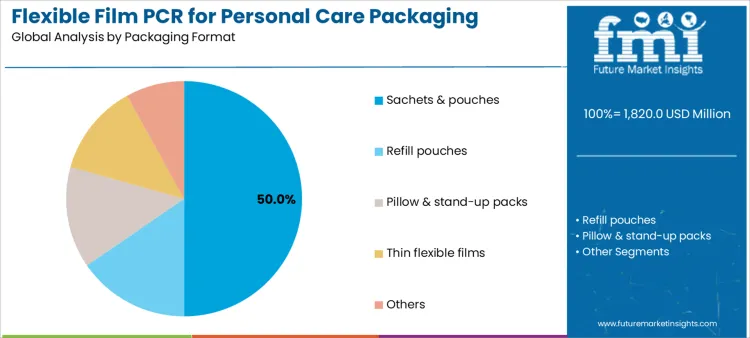
Sachets and pouches represent the largest share at 50.0%, reflecting their dominance in mass-volume personal care categories such as haircare, skincare, and hygiene products. These formats allow easier downgauging and faster integration of PCR content without major tooling changes. Refill pouches are gaining attention as brands promote reuse and reduced virgin plastic use, particularly in premium and urban markets. Pillow packs, stand-up packs, and thin flexible films show selective adoption, constrained by seal integrity requirements and consumer perception concerns related to aesthetics.
Key Points
- High-volume sachets enable faster PCR scale-up
- Refill pouches align with circular packaging strategies
- Thin films face tighter performance tolerances
How Does Material Choice Influence PCR Film Performance and Adoption?
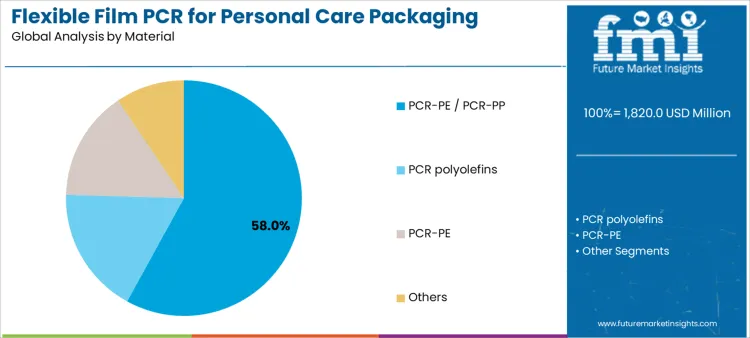
PCR-PE and PCR-PP together account for 58.0%, supported by strong availability, established recycling infrastructure, and compatibility with existing film extrusion lines. These materials offer acceptable mechanical strength and seal performance when properly compounded and filtered. Broader PCR polyolefin grades and PCR-PE variants are used to fine-tune stiffness, clarity, and tactile feel. Other materials remain limited due to inconsistent feedstock quality and challenges in odor and color control, which are critical in personal care packaging.
Key Points
- Polyolefin PCR dominates due to processing familiarity
- Material consistency remains a key selection criterion
- Aesthetic sensitivity limits broader polymer experimentation
Which Processing Technologies Are Enabling Commercial-Scale PCR Integration?

Mono-material high-seal film technologies account for 52.0%, reflecting industry efforts to improve recyclability while maintaining packaging performance. These structures simplify material recovery and support regulatory compliance. Sealant optimisation and high-speed film extrusion address variability in melt flow and contamination inherent to PCR materials. Surface finish control technologies are increasingly important for meeting brand expectations on gloss, transparency, and print quality. Other processing approaches support niche applications or early-stage innovation.
Key Points
- Mono-material films support recycling system compatibility
- Process optimisation offsets PCR material variability
- Surface control is critical for brand acceptance
What are the Key Dynamics in the flexible film PCR for personal care packaging market?
Demand in the flexible film PCR (post-consumer recycled) market for personal care packaging is shaped by consumer and brand commitments to sustainability without compromising tactile quality, print fidelity, or barrier performance. Personal care products such as shampoo sachets, face mask pouches, lotion tubes, and refill pouches require films that deliver durability during handling, maintain graphic appeal on shelf, and preserve product integrity from manufacturing through consumer use. Brands with sustainability targets increasingly seek PCR content that aligns with corporate environmental reporting while meeting functional demands of packaging lines.
How do performance requirements in personal care formats influence material adoption?
Flexible films used for personal care packaging must maintain strength, elongation, and resistance to flex fatigue under repeated handling and transport. PCR films tailored for this market are engineered to balance tensile properties with seal strength compatible with high-speed pouching, tubing, and refill equipment. Barrier performance against moisture and, where relevant, UV exposure is vital for products with sensitive formulations such as serums, wet wipes, or emulsified lotions. Visual clarity and print surface consistency are critical for premium and mass-market brands that depend on vibrant graphics and tactile finish to communicate quality. PCR film grades that provide reliable sealing and dimensional stability help prevent failures during application of heat seals or cold seals, reducing downgrades and line stoppages.
What supply chain and processing challenges influence market scale?
Growth of flexible film PCR in personal care packaging is influenced by the availability of high-quality recycled film streams and the ability to process them consistently. Collection and sorting of post-consumer films must produce feedstock with low levels of contaminants such as inks, adhesives, and multilayer residues that can adversely affect melt flow and seal performance. Compounding and film conversion lines require films with predictable rheology and homogeneity to avoid gauge variations and sealing defects. Divergent regional standards on recycled content declarations and food-contact/consumer-contact approvals shape where brands can deploy specific PCR film grades without extensive testing cycles. Price sensitivity in value-oriented personal care segments affects how much PCR content brands can justify while maintaining sought-after barrier and aesthetic properties in finished flexible film packaging. Manufacturers investing in trial runs and qualification protocols for PCR grades must balance cost of development against anticipated sustainability gains and long-term supply consistency.
How Is Demand for the Flexible Film PCR for Personal Care Packaging Market Evolving Globally?
Global demand for flexible film PCR (Post-Consumer Recycled) packaging for personal care products is rising as the personal care industry focuses on sustainability and eco-friendly packaging solutions. Growth reflects increasing consumer demand for environmentally conscious products, coupled with regulatory pressures on plastic waste reduction. Flexible film PCR packaging is widely used for personal care products like lotions, shampoos, and cosmetics due to its flexibility, cost-effectiveness, and sustainability. India records 15.6% CAGR, China records 14.6% CAGR, USA records 11.8% CAGR, Germany records 11.4% CAGR, and Japan records 10.2% CAGR. Adoption is driven by the shift towards circular economy practices, regulatory support, and consumer preference for recycled content in packaging.

| Country | CAGR (%) |
|---|---|
| India | 15.6% |
| China | 14.6% |
| USA | 11.8% |
| Germany | 11.4% |
| Japan | 10.2% |
What is driving growth of flexible film PCR for personal care packaging demand in India?
Demand for flexible film PCR packaging for personal care products in India is expanding as the personal care sector embraces sustainable packaging solutions. Growth at 15.6% CAGR reflects the rising use of PCR materials in packaging for shampoos, conditioners, lotions, and other beauty products. With the Indian government's emphasis on reducing plastic waste and promoting recycling, there is a growing focus on incorporating recycled content in packaging. Local manufacturers are investing in flexible film technologies to ensure that PCR packaging meets both performance standards and sustainability goals, particularly in mass-market personal care products.
- Government push for reducing plastic waste
- Growing adoption of recycled content in personal care packaging
- Focus on sustainability in mass-market personal care products
- Development of local PCR film production capacity
Why is China seeing expansion in flexible film PCR for personal care packaging adoption?
Flexible film PCR packaging for personal care products is seeing rapid adoption in China as the country strengthens its recycling infrastructure and focuses on sustainability in packaging. Growth at 14.6% CAGR reflects China’s push for the integration of recycled plastics into packaging, especially in the personal care sector. Stringent environmental regulations and consumer demand for eco-friendly packaging are key drivers of this growth. As personal care brands in China prioritize sustainable packaging, flexible film PCR materials are increasingly being adopted to ensure compliance with recycling targets and to meet the preferences of eco-conscious consumers.
- Strict environmental regulations on plastic waste
- Strong consumer demand for sustainable packaging
- Increasing use of recycled content in personal care products
- Investment in recycling infrastructure and technologies
What factors are shaping flexible film PCR for personal care packaging sales in the USA?
Sales of flexible film PCR packaging for personal care products in the USA are increasing as personal care brands respond to sustainability trends and consumer preferences for eco-friendly packaging. Growth at 11.8% CAGR reflects the rising need for recycled content in packaging, particularly for lotions, creams, and cosmetic products. The USA's stringent regulations on plastic waste management and growing consumer awareness about environmental impact are accelerating the adoption of PCR-based packaging solutions. Personal care manufacturers are increasingly looking for packaging that aligns with both regulatory standards and brand sustainability goals.
- Regulatory pressure on plastic waste reduction
- Consumer demand for eco-friendly personal care packaging
- Growing focus on sustainability in the personal care industry
- Adoption of high-performance PCR flexible films
How is Germany supporting growth of flexible film PCR for personal care packaging demand?
Flexible film PCR packaging for personal care products is gaining momentum in Germany as the country leads in sustainable packaging initiatives. Growth at 11.4% CAGR reflects Germany's strong commitment to the circular economy and its focus on reducing plastic waste. As the personal care industry shifts towards eco-friendly solutions, the demand for flexible film PCR packaging continues to grow. Regulatory pressures, combined with consumer preference for sustainable products, are driving personal care manufacturers to incorporate more recycled content in packaging. Germany's robust recycling infrastructure and innovative recycling technologies are key enablers of this market’s growth.
- Circular economy initiatives and sustainability focus
- Regulatory push for recycled content in packaging
- Consumer preference for eco-friendly personal care products
- Investment in recycling infrastructure and innovation
What is driving expansion of flexible film PCR for personal care packaging demand in Japan?
Demand for flexible film PCR packaging for personal care products in Japan is increasing as the country prioritizes sustainability in packaging and consumer products. Growth at 10.2% CAGR reflects the demand for eco-friendly packaging solutions in the personal care industry, where flexible films are commonly used for products like shampoos, conditioners, and lotions. Japan’s strong recycling programs, along with regulatory support for using recycled materials, are accelerating the adoption of PCR packaging. Consumers in Japan are increasingly opting for products with environmentally friendly packaging, further fueling the market for flexible film PCR materials.
- Strong focus on sustainability and waste reduction
- Regulatory and consumer-driven demand for eco-friendly packaging
- Growing use of recycled materials in personal care products
- Development of efficient recycling systems and technologies
What is the competitive landscape of demand for the flexible film PCR for personal care packaging market globally?
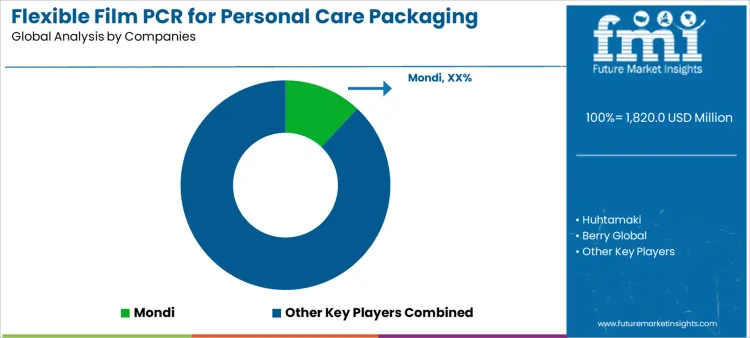
Demand for flexible film PCR in personal care packaging is growing rapidly due to consumer preference for sustainable and eco-friendly packaging solutions. Brands are increasingly adopting PCR materials in packaging to meet environmental goals and address consumer concerns about plastic waste. Manufacturers assess barrier properties, film strength, compatibility with filling processes, and overall product integrity. Buyer evaluation also focuses on packaging aesthetics, flexibility, printability, and the ease of recycling. Procurement behavior leans toward suppliers offering high-quality PCR flexible films that meet industry standards while ensuring cost-effectiveness in mass production. Trend in the market reflects a shift towards increasing the use of PCR in flexible films, particularly in response to regulatory pressures and consumer demand for sustainability.
Mondi leads the competitive landscape with its sustainable packaging solutions and commitment to integrating PCR content in flexible films while maintaining product performance. Huhtamaki competes by offering a broad range of sustainable packaging options, focusing on high-quality flexible films with significant PCR content suitable for personal care products. Berry Global offers flexible packaging flexible packaging solutions with innovative designs and focuses on the performance and visual appeal of their PCR films, catering to the personal care industry. Amcor follows with a strong emphasis on sustainability and the development of flexible films incorporating a high level of PCR content, aligning with global sustainability initiatives. Zijiang and Greatview participate by supplying regionally competitive flexible film packaging solutions, with a focus on quality and cost efficiency. Toppan and Dai Nippon Printing also cater to the market by combining sustainable printing and packaging technologies, offering flexible films with high PCR content. Competitive differentiation centers on film quality, sustainability certification, printability, regulatory compliance, and supply chain robustness.
Key Players in the Flexible Film PCR for Personal Care Packaging Market
- Mondi
- Huhtamaki
- Berry Global
- Amcor
- Zijiang
- Greatview
- Toppan
- Dai Nippon Printing
- Others
Scope of the Report
| Items | Values |
|---|---|
| Quantitative Units | USD million |
| Packaging Format | Sachets & pouches; Refill pouches; Pillow & stand-up packs; Thin flexible films; Others |
| Material | PCR-PE / PCR-PP; PCR polyolefins; PCR-PE; Others |
| Processing Technology | Mono-material high-seal films; Sealant optimisation; High-speed film extrusion; Surface finish control; Others |
| Regions Covered | Asia Pacific, Europe, North America, Latin America, Middle East & Africa |
| Countries Covered | India, China, USA, Germany, Japan, and 40+ countries |
| Key Companies Profiled | Mondi; Huhtamaki; Berry Global; Amcor; Zijiang; Greatview; Toppan; Dai Nippon Printing; Others |
| Additional Attributes | Dollar sales by packaging format, material, and processing technology; effectiveness of mono-material high-seal films in improving recyclability and packaging strength; role of PCR polyolefins and PE/PP systems in sustainability goals across personal care packaging; performance of surface finish control and sealant optimisation in ensuring product protection and aesthetics; procurement dynamics driven by clean-label and regulatory pressures in personal care packaging. |
Flexible Film PCR for Personal Care Packaging Market by Segment
Packaging Format:
- Sachets & pouches
- Refill pouches
- Pillow & stand-up packs
- Thin flexible films
- Others
Material:
- PCR-PE / PCR-PP
- PCR polyolefins
- PCR-PE
- Others
Processing Technology:
- Mono-material high-seal films
- Sealant optimisation
- High-speed film extrusion
- Surface finish control
- Others
Region:
- Asia Pacific
- China
- Japan
- South Korea
- India
- Australia & New Zealand
- ASEAN
- Rest of Asia Pacific
- Europe
- Germany
- United Kingdom
- France
- Italy
- Spain
- Nordic
- BENELUX
- Rest of Europe
- North America
- United States
- Canada
- Mexico
- Latin America
- Brazil
- Chile
- Rest of Latin America
- Middle East & Africa
- Kingdom of Saudi Arabia
- Other GCC Countries
- Turkey
- South Africa
- Other African Union
- Rest of Middle East & Africa
Bibliography
- European Commission, Joint Research Centre. (2024). Mechanical and barrier performance of recycled polyolefin films for consumer and personal care packaging. Publications Office of the European Union.
- Food and Agriculture Organization of the United Nations. (2023). Recycled plastics in consumer product packaging: Performance, safety, and sustainability considerations. FAO.
- International Organization for Standardization. (2023). ISO/TR 21960: Packaging-Recycled plastics content, material performance, and recyclability assessment. ISO.
- Organisation for Economic Co-operation and Development. (2024). Flexible plastic packaging in a circular economy: Design, recycling, and post-consumer resin integration. OECD Publishing.
- Zhao, L., Hernandez, R., & Müller, A. (2024). Processing-structure-property relationships of post-consumer recycled polyethylene films for personal care packaging. Polymer Engineering & Science, 64(9), 3127-3140.
Frequently Asked Questions
How big is the flexible film pcr for personal care packaging market in 2026?
The global flexible film pcr for personal care packaging market is estimated to be valued at USD 1,820.0 million in 2026.
What will be the size of flexible film pcr for personal care packaging market in 2036?
The market size for the flexible film pcr for personal care packaging market is projected to reach USD 5,703.3 million by 2036.
How much will be the flexible film pcr for personal care packaging market growth between 2026 and 2036?
The flexible film pcr for personal care packaging market is expected to grow at a 12.1% CAGR between 2026 and 2036.
What are the key product types in the flexible film pcr for personal care packaging market?
The key product types in flexible film pcr for personal care packaging market are sachets & pouches, refill pouches, pillow & stand-up packs, thin flexible films and others.
Which material segment to contribute significant share in the flexible film pcr for personal care packaging market in 2026?
In terms of material, pcr-pe / pcr-pp segment to command 58.0% share in the flexible film pcr for personal care packaging market in 2026.
Preview the report firsthand - request a free sample
Get SampleGet the brochure for pricing and purchase details.
Get PDFTable of Content
- Executive Summary
- Global Market Outlook
- Demand-side Trends
- Supply-side Trends
- Technology Roadmap Analysis
- Analysis and Recommendations
- Market Overview
- Market Coverage / Taxonomy
- Market Definition / Scope / Limitations
- Market Background
- Market Dynamics
- Drivers
- Restraints
- Opportunity
- Trends
- Scenario Forecast
- Demand in Optimistic Scenario
- Demand in Likely Scenario
- Demand in Conservative Scenario
- Opportunity Map Analysis
- Product Life Cycle Analysis
- Supply Chain Analysis
- Investment Feasibility Matrix
- Value Chain Analysis
- PESTLE and Porter’s Analysis
- Regulatory Landscape
- Regional Parent Market Outlook
- Production and Consumption Statistics
- Import and Export Statistics
- Market Dynamics
- Global Market Analysis 2021 to 2025 and Forecast, 2026 to 2036
- Historical Market Size Value (USD Million) Analysis, 2021 to 2025
- Current and Future Market Size Value (USD Million) Projections, 2026 to 2036
- Y-o-Y Growth Trend Analysis
- Absolute $ Opportunity Analysis
- Global Market Pricing Analysis 2021 to 2025 and Forecast 2026 to 2036
- Global Market Analysis 2021 to 2025 and Forecast 2026 to 2036, By Packaging Format
- Introduction / Key Findings
- Historical Market Size Value (USD Million) Analysis By Packaging Format , 2021 to 2025
- Current and Future Market Size Value (USD Million) Analysis and Forecast By Packaging Format , 2026 to 2036
- Sachets & pouches
- Refill pouches
- Pillow & stand-up packs
- Thin flexible films
- Others
- Sachets & pouches
- Y-o-Y Growth Trend Analysis By Packaging Format , 2021 to 2025
- Absolute $ Opportunity Analysis By Packaging Format , 2026 to 2036
- Global Market Analysis 2021 to 2025 and Forecast 2026 to 2036, By Material
- Introduction / Key Findings
- Historical Market Size Value (USD Million) Analysis By Material, 2021 to 2025
- Current and Future Market Size Value (USD Million) Analysis and Forecast By Material, 2026 to 2036
- PCR-PE / PCR-PP
- PCR polyolefins
- PCR-PE
- Others
- PCR-PE / PCR-PP
- Y-o-Y Growth Trend Analysis By Material, 2021 to 2025
- Absolute $ Opportunity Analysis By Material, 2026 to 2036
- Global Market Analysis 2021 to 2025 and Forecast 2026 to 2036, By Processing Technology
- Introduction / Key Findings
- Historical Market Size Value (USD Million) Analysis By Processing Technology, 2021 to 2025
- Current and Future Market Size Value (USD Million) Analysis and Forecast By Processing Technology, 2026 to 2036
- Mono-material high-seal films
- Sealant optimisation
- High-speed film extrusion
- Surface finish control
- Others
- Mono-material high-seal films
- Y-o-Y Growth Trend Analysis By Processing Technology, 2021 to 2025
- Absolute $ Opportunity Analysis By Processing Technology, 2026 to 2036
- Global Market Analysis 2021 to 2025 and Forecast 2026 to 2036, By Region
- Introduction
- Historical Market Size Value (USD Million) Analysis By Region, 2021 to 2025
- Current Market Size Value (USD Million) Analysis and Forecast By Region, 2026 to 2036
- North America
- Latin America
- Western Europe
- Eastern Europe
- East Asia
- South Asia and Pacific
- Middle East & Africa
- Market Attractiveness Analysis By Region
- North America Market Analysis 2021 to 2025 and Forecast 2026 to 2036, By Country
- Historical Market Size Value (USD Million) Trend Analysis By Market Taxonomy, 2021 to 2025
- Market Size Value (USD Million) Forecast By Market Taxonomy, 2026 to 2036
- By Country
- USA
- Canada
- Mexico
- By Packaging Format
- By Material
- By Processing Technology
- By Country
- Market Attractiveness Analysis
- By Country
- By Packaging Format
- By Material
- By Processing Technology
- Key Takeaways
- Latin America Market Analysis 2021 to 2025 and Forecast 2026 to 2036, By Country
- Historical Market Size Value (USD Million) Trend Analysis By Market Taxonomy, 2021 to 2025
- Market Size Value (USD Million) Forecast By Market Taxonomy, 2026 to 2036
- By Country
- Brazil
- Chile
- Rest of Latin America
- By Packaging Format
- By Material
- By Processing Technology
- By Country
- Market Attractiveness Analysis
- By Country
- By Packaging Format
- By Material
- By Processing Technology
- Key Takeaways
- Western Europe Market Analysis 2021 to 2025 and Forecast 2026 to 2036, By Country
- Historical Market Size Value (USD Million) Trend Analysis By Market Taxonomy, 2021 to 2025
- Market Size Value (USD Million) Forecast By Market Taxonomy, 2026 to 2036
- By Country
- Germany
- UK
- Italy
- Spain
- France
- Nordic
- BENELUX
- Rest of Western Europe
- By Packaging Format
- By Material
- By Processing Technology
- By Country
- Market Attractiveness Analysis
- By Country
- By Packaging Format
- By Material
- By Processing Technology
- Key Takeaways
- Eastern Europe Market Analysis 2021 to 2025 and Forecast 2026 to 2036, By Country
- Historical Market Size Value (USD Million) Trend Analysis By Market Taxonomy, 2021 to 2025
- Market Size Value (USD Million) Forecast By Market Taxonomy, 2026 to 2036
- By Country
- Russia
- Poland
- Hungary
- Balkan & Baltic
- Rest of Eastern Europe
- By Packaging Format
- By Material
- By Processing Technology
- By Country
- Market Attractiveness Analysis
- By Country
- By Packaging Format
- By Material
- By Processing Technology
- Key Takeaways
- East Asia Market Analysis 2021 to 2025 and Forecast 2026 to 2036, By Country
- Historical Market Size Value (USD Million) Trend Analysis By Market Taxonomy, 2021 to 2025
- Market Size Value (USD Million) Forecast By Market Taxonomy, 2026 to 2036
- By Country
- China
- Japan
- South Korea
- By Packaging Format
- By Material
- By Processing Technology
- By Country
- Market Attractiveness Analysis
- By Country
- By Packaging Format
- By Material
- By Processing Technology
- Key Takeaways
- South Asia and Pacific Market Analysis 2021 to 2025 and Forecast 2026 to 2036, By Country
- Historical Market Size Value (USD Million) Trend Analysis By Market Taxonomy, 2021 to 2025
- Market Size Value (USD Million) Forecast By Market Taxonomy, 2026 to 2036
- By Country
- India
- ASEAN
- Australia & New Zealand
- Rest of South Asia and Pacific
- By Packaging Format
- By Material
- By Processing Technology
- By Country
- Market Attractiveness Analysis
- By Country
- By Packaging Format
- By Material
- By Processing Technology
- Key Takeaways
- Middle East & Africa Market Analysis 2021 to 2025 and Forecast 2026 to 2036, By Country
- Historical Market Size Value (USD Million) Trend Analysis By Market Taxonomy, 2021 to 2025
- Market Size Value (USD Million) Forecast By Market Taxonomy, 2026 to 2036
- By Country
- Kingdom of Saudi Arabia
- Other GCC Countries
- Turkiye
- South Africa
- Other African Union
- Rest of Middle East & Africa
- By Packaging Format
- By Material
- By Processing Technology
- By Country
- Market Attractiveness Analysis
- By Country
- By Packaging Format
- By Material
- By Processing Technology
- Key Takeaways
- Key Countries Market Analysis
- USA
- Pricing Analysis
- Market Share Analysis, 2025
- By Packaging Format
- By Material
- By Processing Technology
- Canada
- Pricing Analysis
- Market Share Analysis, 2025
- By Packaging Format
- By Material
- By Processing Technology
- Mexico
- Pricing Analysis
- Market Share Analysis, 2025
- By Packaging Format
- By Material
- By Processing Technology
- Brazil
- Pricing Analysis
- Market Share Analysis, 2025
- By Packaging Format
- By Material
- By Processing Technology
- Chile
- Pricing Analysis
- Market Share Analysis, 2025
- By Packaging Format
- By Material
- By Processing Technology
- Germany
- Pricing Analysis
- Market Share Analysis, 2025
- By Packaging Format
- By Material
- By Processing Technology
- UK
- Pricing Analysis
- Market Share Analysis, 2025
- By Packaging Format
- By Material
- By Processing Technology
- Italy
- Pricing Analysis
- Market Share Analysis, 2025
- By Packaging Format
- By Material
- By Processing Technology
- Spain
- Pricing Analysis
- Market Share Analysis, 2025
- By Packaging Format
- By Material
- By Processing Technology
- France
- Pricing Analysis
- Market Share Analysis, 2025
- By Packaging Format
- By Material
- By Processing Technology
- India
- Pricing Analysis
- Market Share Analysis, 2025
- By Packaging Format
- By Material
- By Processing Technology
- ASEAN
- Pricing Analysis
- Market Share Analysis, 2025
- By Packaging Format
- By Material
- By Processing Technology
- Australia & New Zealand
- Pricing Analysis
- Market Share Analysis, 2025
- By Packaging Format
- By Material
- By Processing Technology
- China
- Pricing Analysis
- Market Share Analysis, 2025
- By Packaging Format
- By Material
- By Processing Technology
- Japan
- Pricing Analysis
- Market Share Analysis, 2025
- By Packaging Format
- By Material
- By Processing Technology
- South Korea
- Pricing Analysis
- Market Share Analysis, 2025
- By Packaging Format
- By Material
- By Processing Technology
- Russia
- Pricing Analysis
- Market Share Analysis, 2025
- By Packaging Format
- By Material
- By Processing Technology
- Poland
- Pricing Analysis
- Market Share Analysis, 2025
- By Packaging Format
- By Material
- By Processing Technology
- Hungary
- Pricing Analysis
- Market Share Analysis, 2025
- By Packaging Format
- By Material
- By Processing Technology
- Kingdom of Saudi Arabia
- Pricing Analysis
- Market Share Analysis, 2025
- By Packaging Format
- By Material
- By Processing Technology
- Turkiye
- Pricing Analysis
- Market Share Analysis, 2025
- By Packaging Format
- By Material
- By Processing Technology
- South Africa
- Pricing Analysis
- Market Share Analysis, 2025
- By Packaging Format
- By Material
- By Processing Technology
- USA
- Market Structure Analysis
- Competition Dashboard
- Competition Benchmarking
- Market Share Analysis of Top Players
- By Regional
- By Packaging Format
- By Material
- By Processing Technology
- Competition Analysis
- Competition Deep Dive
- Mondi
- Overview
- Product Portfolio
- Profitability by Market Segments (Product/Age /Sales Channel/Region)
- Sales Footprint
- Strategy Overview
- Marketing Strategy
- Product Strategy
- Channel Strategy
- Huhtamaki
- Berry Global
- Amcor
- Zijiang
- Greatview
- Toppan
- Dai Nippon Printing
- Others
- Mondi
- Competition Deep Dive
- Assumptions & Acronyms Used
- Research Methodology


