

- Industry Size (2026)
- USD 3480.0 Mn
- Forecast (2036)
- USD 10243.1 Mn
- CAGR (2026 to 2036)
- 11.4%
PCR Market for E-Commerce & Protective Packaging Forecast and Outlook 2026 to 2036
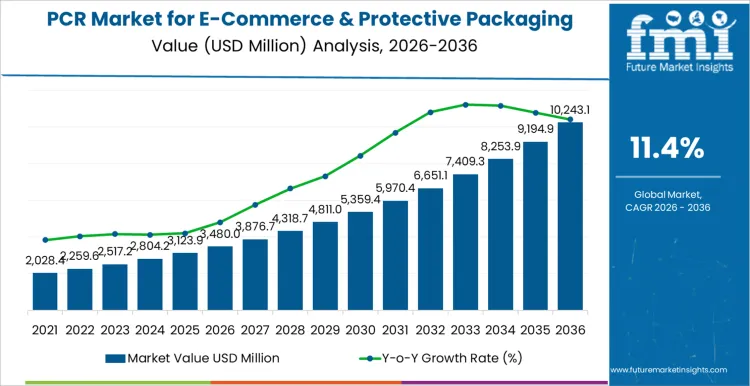
The PCR market for e-commerce and protective packaging is likely to be valued at USD 3,480.0 million in 2026 and is projected to reach USD 10,243.1 million by 2036, at a CAGR of 11.4% during the forecast period. Growth is driven by sustained expansion of e-commerce fulfillment networks, rising parcel volumes, and increasing pressure on brands and logistics operators to reduce virgin plastic usage. Protective mailers, cushioning films, void fill, and corrugated protective formats are progressively incorporating PCR materials that meet drop resistance, compression strength, and automation compatibility requirements.
Market development reflects improving consistency of PCR polyolefin feedstocks and wider adoption of recycled paper-based protective solutions that perform reliably on high-speed packing lines. Regulatory recycled content mandates, extended producer responsibility frameworks, and retailer sustainability scorecards accelerate adoption across fulfillment centers and cross-border logistics. Demand concentrates on mailers and void-fill formats that balance lightweight protection with cost efficiency, while premium e-commerce applications emphasize durability and presentation. Growth follows logistics scale-up, packaging standardization, and compliance readiness rather than shipment volume growth alone, supporting steady integration of PCR materials across global e-commerce protective packaging systems.
Quick Stats for PCR Market for E-Commerce & Protective Packaging
- PCR Market for E-Commerce & Protective Packaging Value (2026): USD 3,480.0 million
- PCR Market for E-Commerce & Protective Packaging Forecast Value (2036): USD 10,243.1 million
- PCR Market for E-Commerce & Protective Packaging Forecast CAGR (2026-2036): 11.4%
- Leading Material by Demand Share: PCR-PE / PCR-PP
- Fastest-Growing Countries: India, China, Germany, Brazil, USA
- Top Players in Global Demand: Sealed Air, Pregis, Storopack, Mondi, Nine Dragons Packaging
PCR Market for E-Commerce & Protective Packaging Key Takeaways
| Metric | Value |
|---|---|
| Market Value (2026) | USD 3,480.0 million |
| Market Forecast Value (2036) | USD 10,243.1 million |
| Forecast CAGR (2026-2036) | 11.4% |
Why is the Demand for PCR Market for E-Commerce & Protective Packaging Growing?
E-commerce fulfillment operations increasingly rely on post-consumer recycled materials as shipping volumes rise and packaging waste becomes a cost and compliance concern. Corrugated inserts, mailers, cushioning films, and molded protective components require materials that deliver impact absorption, compression strength, and dimensional consistency across long distribution cycles. PCR polymers and recycled paper-based substrates are being engineered to meet drop test and vibration resistance criteria demanded by parcel carriers and marketplace platforms. Large e-commerce retailers integrate PCR packaging to align with packaging reduction pledges while maintaining pack-out efficiency in automated warehouses. Protective packaging used for electronics, home appliances, and personal care products depends on PCR grades that balance rigidity and flexibility to prevent transit damage without increasing package weight.
Regulatory pressure and retailer scorecards accelerate adoption as extended producer responsibility schemes and recycled content targets expand across regions. Packaging engineers evaluate PCR solutions that run reliably on high-speed cutting, forming, and sealing equipment used in fulfillment centers. Material suppliers refine blend consistency to manage variability inherent in recycled feedstocks, supporting predictable cushioning performance. Brand owners prioritize traceable PCR inputs to substantiate sustainability claims tied to online sales channels. Growth in cross-border shipping strengthens demand for durable PCR protective packaging that performs across varied climate and handling conditions.
How Is the PCR Segment for E-Commerce & Protective Packaging Structured by Material, Packaging Format, and End Use?
Demand for PCR-based solutions in e-commerce and protective packaging is driven by parcel volume growth, sustainability mandates, and pressure to reduce virgin polymer usage. Packaging designers focus on impact protection, material efficiency, and compatibility with automated fulfillment systems. Performance consistency, puncture resistance, and recyclability influence adoption decisions. Segmentation by material, packaging format, and end use clarifies how logistics intensity, shipment distance, and brand positioning shape material selection across diverse e-commerce packaging workflows.
Which Material Category Holds the Largest Share in PCR E-Commerce Packaging?
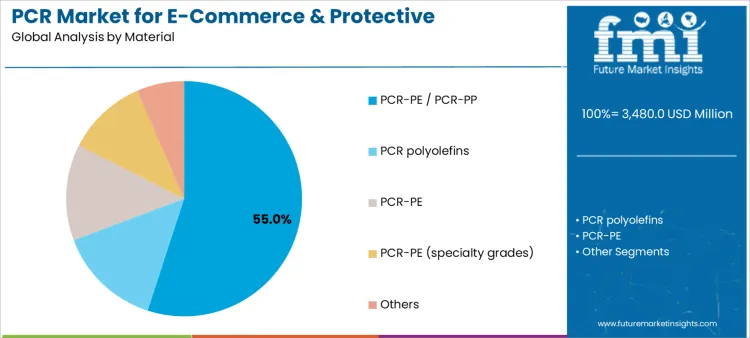
PCR-PE and PCR-PP account for 55.0%, reflecting broad availability, toughness, and flexibility across protective packaging applications. These materials support cushioning, films, and mailers requiring tear resistance and seal integrity. PCR polyolefins extend usage into mixed-grade applications where cost control and recycled content targets dominate. PCR-PE grades support lightweight protective films, while specialty PCR-PE grades address higher clarity or enhanced mechanical performance needs. Other materials serve niche protection or transitional formats. Material segmentation reflects alignment between polymer durability, recyclability, and fulfillment-scale processing requirements.
Key Points
- PCR-PE and PCR-PP dominate due to toughness and versatility.
- Specialty PCR grades address higher performance thresholds.
- Polyolefin recycling infrastructure supports consistent supply.
How Does Packaging Format Influence PCR Adoption in Protective Applications?
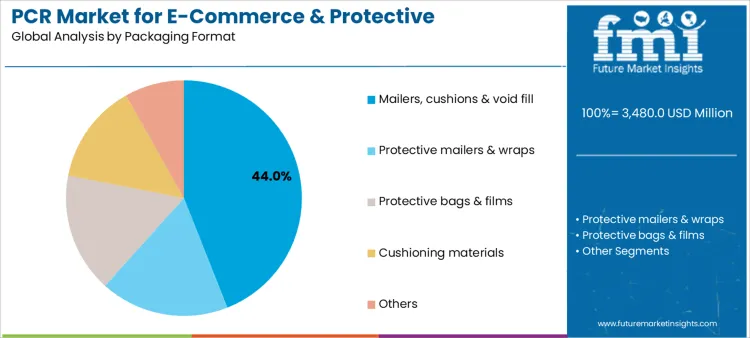
Mailers, cushions, and void fill represent 44.0%, driven by demand for lightweight protection in parcel shipping. These formats balance impact absorption with minimal material usage. Protective mailers and wraps extend protection for fragile items, while protective bags and films support multi-item bundling and moisture control. Cushioning materials address drop resistance during last-mile delivery. Other formats serve specialized or branded packaging needs. Packaging-format segmentation highlights how protection level, automation compatibility, and dimensional efficiency guide PCR material integration in e-commerce fulfillment environments.
Key Points
- Mailers and void fill lead due to parcel efficiency.
- Cushioning materials manage impact during transit.
- Film-based formats support bundling and moisture protection.
Which End-Use Segments Drive Demand for PCR Protective Packaging?
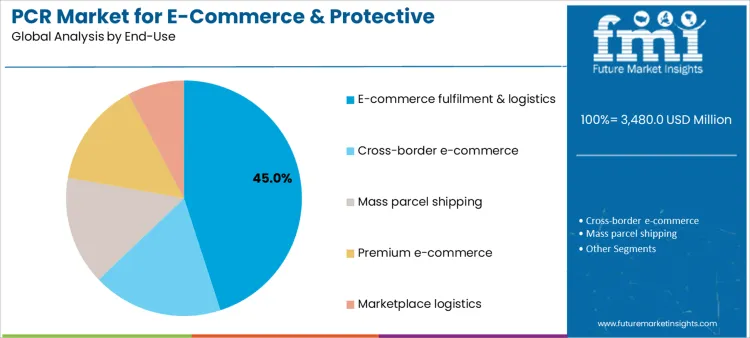
E-commerce fulfillment and logistics account for 45.0%, reflecting high shipment volumes and sustainability commitments from platforms and retailers. Cross-border e-commerce increases demand for durable protection capable of extended transit. Mass parcel shipping emphasizes cost efficiency and material reduction. Premium e-commerce prioritizes appearance, unboxing experience, and protective reliability. Marketplace logistics require scalable, standardized packaging formats. End-use segmentation shows concentration of PCR demand where shipment frequency, regulatory pressure, and operational scale intersect.
Key Points
- Fulfillment operations drive primary PCR consumption.
- Cross-border shipping increases durability requirements.
- Premium e-commerce balances protection with presentation.
What are the Key Dynamics in the PCR Market for E-Commerce & Protective Packaging?
Demand in the post-consumer recycled (PCR) market for e-commerce and protective packaging is shaped by sharp growth in online retail activity and rising sustainability commitments from brands and marketplaces. Manufacturers of mailer bags, corrugated protective wraps, void fill, and cushioning films increasingly specify PCR content to reduce reliance on virgin resins while maintaining protection during transit. Value for buyers depends on consistent mechanical performance, tear resistance, and shock absorption in materials that must survive multiple handling stages from fulfillment centers to consumer delivery.
How do parcel transit stresses and performance requirements influence material selection?
E-commerce packaging must withstand stacking loads, impact forces, and abrasion encountered in automated sortation and delivery networks. PCR films and corrugated liners are engineered to deliver tensile strength, puncture resistance, and energy-absorbing characteristics that protect diverse products ranging from electronics to apparel. Void fill foams and bubble films with high PCR content must balance resilience with compressibility to support fragile items without excessive bulk. Mailer bags incorporating PCR polymers are evaluated for seam strength and resistance to edge wear as they navigate conveyor belts and handheld handling. Brands often benchmark PCR materials against virgin alternatives to ensure that recycled content does not compromise protection, particularly for high-value goods where damage rates directly affect returns and customer satisfaction.
How do supply variability and processing compatibility affect market expansion?
The expansion of PCR in e-commerce and protective packaging is influenced by the availability of quality recycled feedstock and by compatibility with high-speed converting equipment. Variability in PCR pellets, such as melt flow fluctuations or residual contaminants, can affect film extrusion and corrugation processes, leading converters to condition or blend PCR with virgin resin to achieve stable processing windows. Sorting infrastructure in many regions must adapt to produce PCR streams tailored for bulky and flexible applications rather than traditional bottle-focused recycling, which creates feedstock gaps for protective packaging grades. Price sensitivity in commodity packaging segments means that PCR materials must compete with low-cost virgin polymers without sacrificing performance, shaping adoption across value-oriented brands. Converters invest in qualification testing to ensure that PCR formulations deliver repeatable mechanical properties at production scale, and variations in regional recycled content regulations influence where brands choose to declare PCR on pack without incurring compliance complexity.
How Is Demand for the PCR Market for E-Commerce & Protective Packaging Evolving Globally?
Global demand for PCR materials in e-commerce and protective packaging is rising as logistics volumes increase and sustainability mandates tighten. Growth reflects rising use of recycled plastics in mailers, protective films, cushioning materials, and rigid transit packaging. Brand commitments to reduce virgin plastic usage influence material selection across fulfillment operations. Performance requirements emphasize impact resistance, dimensional stability, and processability on automated packing lines. India records 15.2% CAGR, China records 13.6% CAGR, Germany records 11.1% CAGR, Brazil records 11.0% CAGR, and the USA records 10.8% CAGR. Market expansion follows logistics scale-up and packaging standardization rather than shipment growth alone.
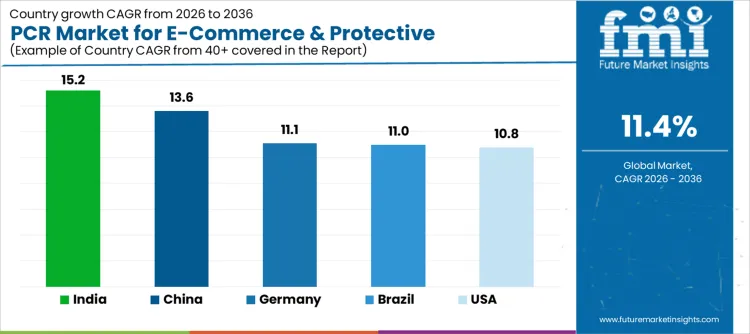
| Country | CAGR (%) |
|---|---|
| India | 15.2% |
| China | 13.6% |
| Germany | 11.1% |
| Brazil | 11.0% |
| USA | 10.8% |
What is driving growth of PCR demand for e-commerce and protective packaging in India?
Demand for PCR materials in e-commerce and protective packaging in India is expanding as online retail penetration accelerates across urban and semi-urban regions. Growth at 15.2% CAGR reflects rising use of PCR mailers, void fill films, and protective packaging for consumer electronics, fashion, and household goods. Logistics providers seek cost-efficient materials aligned with sustainability targets. Regulatory pressure on single-use plastics increases recycled content integration. Packaging converters optimize PCR blends to maintain impact resistance and machinability. Demand remains concentrated within high-volume fulfillment centers serving fast-growing domestic e-commerce platforms.
- Rapid growth of domestic e-commerce logistics
- Regulatory pressure on plastic packaging
- Rising use of PCR mailers and films
- Focus on automated packaging compatibility
Why is China seeing expansion in PCR adoption for e-commerce and protective packaging?
PCR demand for e-commerce and protective packaging in China is rising as large-scale logistics networks expand recycled material usage. Growth at 13.6% CAGR reflects high shipment volumes requiring standardized protective packaging solutions. Regulatory mandates on plastic reduction accelerate PCR substitution across mailers, cushioning, and secondary packaging. Centralized manufacturing enables consistent material qualification. Export-oriented e-commerce packaging requires compliance with international sustainability standards. Demand remains centered on flexible protective materials supporting high-speed packing operations across national fulfillment hubs.
- High-volume e-commerce shipment growth
- Regulatory mandates on recycled plastics
- Centralized packaging manufacturing scale
- Export compliance requirements
How is Germany supporting growth of PCR demand in e-commerce and protective packaging?
Demand for PCR materials in e-commerce and protective packaging in Germany is advancing as circular economy regulations tighten logistics packaging standards. Growth at 11.1% CAGR reflects adoption across protective films, cushioning systems, and reusable transit packaging. EU packaging directives increase recycled content requirements. German logistics operators emphasize traceability and recyclability. Advanced collection systems support consistent PCR supply. Demand remains compliance-driven and focused on standardized protective formats rather than experimental packaging designs.
- EU circular economy packaging mandates
- Strong focus on recyclability compliance
- Advanced PCR supply infrastructure
- Standardized protective packaging formats
What factors are shaping PCR sales for e-commerce and protective packaging in Brazil?
Sales of PCR materials for e-commerce and protective packaging in Brazil are increasing as logistics infrastructure modernizes. Growth at 11.0% CAGR reflects rising demand for protective packaging in electronics, appliances, and consumer goods distribution. Regional recycling capacity improvements support PCR availability. Packaging converters balance performance requirements with cost constraints. Climate conditions influence material selection for impact and compression resistance. Demand concentrates within domestic fulfillment networks rather than export-led logistics.
- Expansion of domestic e-commerce logistics
- Improvement in regional recycling capacity
- Focus on impact-resistant packaging
- Cost-sensitive material optimization
What is driving expansion of PCR demand for e-commerce and protective packaging in the USA?
Demand for PCR materials in e-commerce and protective packaging in the USA is rising as fulfillment operations prioritize sustainability metrics. Growth at 10.8% CAGR reflects adoption across mailers, cushioning films, and rigid protective packaging. Retail sustainability scorecards influence packaging specifications. High automation levels require consistent material performance. State-level regulations shape recycled content targets. Demand is driven by system-wide packaging transitions across national logistics networks.
- Retail sustainability requirements
- High automation in fulfillment centers
- Focus on consistent material performance
- Influence of state-level regulations
What is the competitive landscape of demand for the PCR market for e-commerce & protective packaging globally?
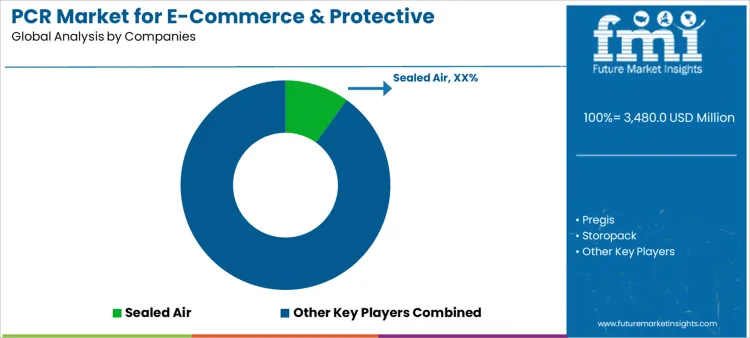
Rapid growth in parcel shipments, damage reduction targets, and brand sustainability commitments are reshaping demand for PCR-based protective packaging. E-commerce operators and fulfillment centers assess cushioning performance, compression recovery, puncture resistance, and consistency when recycled content is introduced. Buyer evaluation also focuses on compatibility with automated packing lines, weight efficiency for shipping cost control, and recyclability communication to end customers. Procurement behavior favors suppliers offering scalable PCR supply, drop-test validated designs, and reliable performance across temperature and humidity variations. Trend in the PCR market for e-commerce and protective packaging reflects transition from virgin foams and films toward recycled-content mailers, air cushions, and paper-based protective systems.
Sealed Air leads competitive positioning by incorporating PCR into protective films and cushioning systems optimized for automated fulfillment environments. Pregis competes through engineered protective packaging combining recycled polymers with material reduction strategies. Storopack maintains relevance with molded and foam protective solutions adapted for PCR inputs while preserving energy absorption characteristics. Mondi supports demand by supplying paper-based and hybrid protective packaging integrating recycled fibers and polymers. Nine Dragons Packaging participates through protective paper and corrugated solutions tailored for high-volume e-commerce logistics. Competitive differentiation centers on protective performance consistency, automation compatibility, PCR availability at scale, and ability to support fast-growing fulfillment networks.
Key Players in the PCR Market for E-Commerce & Protective Packaging
- Sealed Air
- Pregis
- Storopack
- Mondi
- Nine Dragons Packaging (protective)
- FP Corporation
- Yamaton
- Others
Scope of the Report
| Items | Values |
|---|---|
| Quantitative Units | USD million |
| Material | PCR-PE / PCR-PP; PCR polyolefins; PCR-PE; PCR-PE (specialty grades); Others |
| Packaging Format | Mailers, cushions & void fill; Protective mailers & wraps; Protective bags & films; Cushioning materials; Others |
| End-Use | E-commerce fulfilment & logistics; Cross-border e-commerce; Mass parcel shipping; Premium e-commerce; Marketplace logistics |
| Regions Covered | Asia Pacific, Europe, North America, Latin America, Middle East & Africa |
| Countries Covered | India, China, Germany, Brazil, USA, and 40+ countries |
| Key Companies Profiled | Sealed Air; Pregis; Storopack; Mondi; Nine Dragons Packaging (protective); FP Corporation; Yamaton; Others |
| Additional Attributes | Dollar sales by material type, packaging format, and logistics application; rising integration of PCR polyolefin mailers across high-volume e-commerce fulfilment; demand for lightweight and impact-resistant protective films in cross-border shipping; compatibility of PCR materials with automated packing lines; increasing adoption of specialty-grade PCR for premium and fragile goods protection. |
PCR Market for E-Commerce & Protective Packaging by Segment
Material:
- PCR-PE / PCR-PP
- PCR polyolefins
- PCR-PE
- PCR-PE (specialty grades)
- Others
Packaging Format:
- Mailers, cushions & void fill
- Protective mailers & wraps
- Protective bags & films
- Cushioning materials
- Others
End-Use:
- E-commerce fulfilment & logistics
- Cross-border e-commerce
- Mass parcel shipping
- Premium e-commerce
- Marketplace logistics
Region:
- Asia Pacific
- China
- Japan
- South Korea
- India
- Australia & New Zealand
- ASEAN
- Rest of Asia Pacific
- Europe
- Germany
- United Kingdom
- France
- Italy
- Spain
- Nordic
- BENELUX
- Rest of Europe
- North America
- United States
- Canada
- Mexico
- Latin America
- Brazil
- Chile
- Rest of Latin America
- Middle East & Africa
- Kingdom of Saudi Arabia
- Other GCC Countries
- Turkey
- South Africa
- Other African Union
- Rest of Middle East & Africa
Bibliography
- European Commission. (2023). Packaging and packaging waste regulation: Recycled content and e‑commerce packaging requirements. Publications Office of the European Union.
- International Organization for Standardization. (2023). ISO 22095:2023—Plastics: Environmental aspects—Recycled content, traceability, and assessment. ISO.
- Organisation for Economic Co‑operation and Development. (2023). Policy approaches for sustainable e‑commerce packaging and recycled plastics. OECD Publishing.
Frequently Asked Questions
How big is the PCR market for e-commerce and protective packaging in 2026?
The PCR market for e-commerce and protective packaging is projected to be valued at USD 3,480.0 million in 2026.
What will be the size of the PCR market for e-commerce and protective packaging in 2036?
The market size for PCR e-commerce and protective packaging is projected to reach USD 10,243.1 million by 2036.
How much will the demand for PCR e-commerce and protective packaging grow between 2026 and 2036?
Demand for PCR e-commerce and protective packaging is projected to grow at an 11.4% CAGR between 2026 and 2036.
Which material type holds a significant share in the PCR e-commerce and protective packaging market in 2026?
In terms of material type, PCR-PE and PCR-PP are expected to account for a 55.0% share in 2026.
Which end-use segment contributes a major share in the PCR e-commerce and protective packaging market in 2026?
The e-commerce fulfilment and logistics segment is expected to command a 45.0% share in the PCR e-commerce and protective packaging market in 2026.
Preview the report firsthand - request a free sample
Get SampleGet the brochure for pricing and purchase details.
Get PDFTable of Content
- Executive Summary
- Global Market Outlook
- Demand-side Trends
- Supply-side Trends
- Technology Roadmap Analysis
- Analysis and Recommendations
- Market Overview
- Market Coverage / Taxonomy
- Market Definition / Scope / Limitations
- Market Background
- Market Dynamics
- Drivers
- Restraints
- Opportunity
- Trends
- Scenario Forecast
- Demand in Optimistic Scenario
- Demand in Likely Scenario
- Demand in Conservative Scenario
- Opportunity Map Analysis
- Product Life Cycle Analysis
- Supply Chain Analysis
- Investment Feasibility Matrix
- Value Chain Analysis
- PESTLE and Porter’s Analysis
- Regulatory Landscape
- Regional Parent Market Outlook
- Production and Consumption Statistics
- Import and Export Statistics
- Market Dynamics
- Global Market Analysis 2021 to 2025 and Forecast, 2026 to 2036
- Historical Market Size Value (USD Million) Analysis, 2021 to 2025
- Current and Future Market Size Value (USD Million) Projections, 2026 to 2036
- Y-o-Y Growth Trend Analysis
- Absolute $ Opportunity Analysis
- Global Market Pricing Analysis 2021 to 2025 and Forecast 2026 to 2036
- Global Market Analysis 2021 to 2025 and Forecast 2026 to 2036, By Material
- Introduction / Key Findings
- Historical Market Size Value (USD Million) Analysis By Material , 2021 to 2025
- Current and Future Market Size Value (USD Million) Analysis and Forecast By Material , 2026 to 2036
- PCR-PE / PCR-PP
- PCR polyolefins
- PCR-PE
- PCR-PE (specialty grades)
- Others
- PCR-PE / PCR-PP
- Y-o-Y Growth Trend Analysis By Material , 2021 to 2025
- Absolute $ Opportunity Analysis By Material , 2026 to 2036
- Global Market Analysis 2021 to 2025 and Forecast 2026 to 2036, By Packaging Format
- Introduction / Key Findings
- Historical Market Size Value (USD Million) Analysis By Packaging Format, 2021 to 2025
- Current and Future Market Size Value (USD Million) Analysis and Forecast By Packaging Format, 2026 to 2036
- Mailers, cushions & void fill
- Protective mailers & wraps
- Protective bags & films
- Cushioning materials
- Others
- Mailers, cushions & void fill
- Y-o-Y Growth Trend Analysis By Packaging Format, 2021 to 2025
- Absolute $ Opportunity Analysis By Packaging Format, 2026 to 2036
- Global Market Analysis 2021 to 2025 and Forecast 2026 to 2036, By End-Use
- Introduction / Key Findings
- Historical Market Size Value (USD Million) Analysis By End-Use, 2021 to 2025
- Current and Future Market Size Value (USD Million) Analysis and Forecast By End-Use, 2026 to 2036
- E-commerce fulfilment & logistics
- Cross-border e-commerce
- Mass parcel shipping
- Premium e-commerce
- Marketplace logistics
- E-commerce fulfilment & logistics
- Y-o-Y Growth Trend Analysis By End-Use, 2021 to 2025
- Absolute $ Opportunity Analysis By End-Use, 2026 to 2036
- Global Market Analysis 2021 to 2025 and Forecast 2026 to 2036, By Region
- Introduction
- Historical Market Size Value (USD Million) Analysis By Region, 2021 to 2025
- Current Market Size Value (USD Million) Analysis and Forecast By Region, 2026 to 2036
- North America
- Latin America
- Western Europe
- Eastern Europe
- East Asia
- South Asia and Pacific
- Middle East & Africa
- Market Attractiveness Analysis By Region
- North America Market Analysis 2021 to 2025 and Forecast 2026 to 2036, By Country
- Historical Market Size Value (USD Million) Trend Analysis By Market Taxonomy, 2021 to 2025
- Market Size Value (USD Million) Forecast By Market Taxonomy, 2026 to 2036
- By Country
- USA
- Canada
- Mexico
- By Material
- By Packaging Format
- By End-Use
- By Country
- Market Attractiveness Analysis
- By Country
- By Material
- By Packaging Format
- By End-Use
- Key Takeaways
- Latin America Market Analysis 2021 to 2025 and Forecast 2026 to 2036, By Country
- Historical Market Size Value (USD Million) Trend Analysis By Market Taxonomy, 2021 to 2025
- Market Size Value (USD Million) Forecast By Market Taxonomy, 2026 to 2036
- By Country
- Brazil
- Chile
- Rest of Latin America
- By Material
- By Packaging Format
- By End-Use
- By Country
- Market Attractiveness Analysis
- By Country
- By Material
- By Packaging Format
- By End-Use
- Key Takeaways
- Western Europe Market Analysis 2021 to 2025 and Forecast 2026 to 2036, By Country
- Historical Market Size Value (USD Million) Trend Analysis By Market Taxonomy, 2021 to 2025
- Market Size Value (USD Million) Forecast By Market Taxonomy, 2026 to 2036
- By Country
- Germany
- UK
- Italy
- Spain
- France
- Nordic
- BENELUX
- Rest of Western Europe
- By Material
- By Packaging Format
- By End-Use
- By Country
- Market Attractiveness Analysis
- By Country
- By Material
- By Packaging Format
- By End-Use
- Key Takeaways
- Eastern Europe Market Analysis 2021 to 2025 and Forecast 2026 to 2036, By Country
- Historical Market Size Value (USD Million) Trend Analysis By Market Taxonomy, 2021 to 2025
- Market Size Value (USD Million) Forecast By Market Taxonomy, 2026 to 2036
- By Country
- Russia
- Poland
- Hungary
- Balkan & Baltic
- Rest of Eastern Europe
- By Material
- By Packaging Format
- By End-Use
- By Country
- Market Attractiveness Analysis
- By Country
- By Material
- By Packaging Format
- By End-Use
- Key Takeaways
- East Asia Market Analysis 2021 to 2025 and Forecast 2026 to 2036, By Country
- Historical Market Size Value (USD Million) Trend Analysis By Market Taxonomy, 2021 to 2025
- Market Size Value (USD Million) Forecast By Market Taxonomy, 2026 to 2036
- By Country
- China
- Japan
- South Korea
- By Material
- By Packaging Format
- By End-Use
- By Country
- Market Attractiveness Analysis
- By Country
- By Material
- By Packaging Format
- By End-Use
- Key Takeaways
- South Asia and Pacific Market Analysis 2021 to 2025 and Forecast 2026 to 2036, By Country
- Historical Market Size Value (USD Million) Trend Analysis By Market Taxonomy, 2021 to 2025
- Market Size Value (USD Million) Forecast By Market Taxonomy, 2026 to 2036
- By Country
- India
- ASEAN
- Australia & New Zealand
- Rest of South Asia and Pacific
- By Material
- By Packaging Format
- By End-Use
- By Country
- Market Attractiveness Analysis
- By Country
- By Material
- By Packaging Format
- By End-Use
- Key Takeaways
- Middle East & Africa Market Analysis 2021 to 2025 and Forecast 2026 to 2036, By Country
- Historical Market Size Value (USD Million) Trend Analysis By Market Taxonomy, 2021 to 2025
- Market Size Value (USD Million) Forecast By Market Taxonomy, 2026 to 2036
- By Country
- Kingdom of Saudi Arabia
- Other GCC Countries
- Turkiye
- South Africa
- Other African Union
- Rest of Middle East & Africa
- By Material
- By Packaging Format
- By End-Use
- By Country
- Market Attractiveness Analysis
- By Country
- By Material
- By Packaging Format
- By End-Use
- Key Takeaways
- Key Countries Market Analysis
- USA
- Pricing Analysis
- Market Share Analysis, 2025
- By Material
- By Packaging Format
- By End-Use
- Canada
- Pricing Analysis
- Market Share Analysis, 2025
- By Material
- By Packaging Format
- By End-Use
- Mexico
- Pricing Analysis
- Market Share Analysis, 2025
- By Material
- By Packaging Format
- By End-Use
- Brazil
- Pricing Analysis
- Market Share Analysis, 2025
- By Material
- By Packaging Format
- By End-Use
- Chile
- Pricing Analysis
- Market Share Analysis, 2025
- By Material
- By Packaging Format
- By End-Use
- Germany
- Pricing Analysis
- Market Share Analysis, 2025
- By Material
- By Packaging Format
- By End-Use
- UK
- Pricing Analysis
- Market Share Analysis, 2025
- By Material
- By Packaging Format
- By End-Use
- Italy
- Pricing Analysis
- Market Share Analysis, 2025
- By Material
- By Packaging Format
- By End-Use
- Spain
- Pricing Analysis
- Market Share Analysis, 2025
- By Material
- By Packaging Format
- By End-Use
- France
- Pricing Analysis
- Market Share Analysis, 2025
- By Material
- By Packaging Format
- By End-Use
- India
- Pricing Analysis
- Market Share Analysis, 2025
- By Material
- By Packaging Format
- By End-Use
- ASEAN
- Pricing Analysis
- Market Share Analysis, 2025
- By Material
- By Packaging Format
- By End-Use
- Australia & New Zealand
- Pricing Analysis
- Market Share Analysis, 2025
- By Material
- By Packaging Format
- By End-Use
- China
- Pricing Analysis
- Market Share Analysis, 2025
- By Material
- By Packaging Format
- By End-Use
- Japan
- Pricing Analysis
- Market Share Analysis, 2025
- By Material
- By Packaging Format
- By End-Use
- South Korea
- Pricing Analysis
- Market Share Analysis, 2025
- By Material
- By Packaging Format
- By End-Use
- Russia
- Pricing Analysis
- Market Share Analysis, 2025
- By Material
- By Packaging Format
- By End-Use
- Poland
- Pricing Analysis
- Market Share Analysis, 2025
- By Material
- By Packaging Format
- By End-Use
- Hungary
- Pricing Analysis
- Market Share Analysis, 2025
- By Material
- By Packaging Format
- By End-Use
- Kingdom of Saudi Arabia
- Pricing Analysis
- Market Share Analysis, 2025
- By Material
- By Packaging Format
- By End-Use
- Turkiye
- Pricing Analysis
- Market Share Analysis, 2025
- By Material
- By Packaging Format
- By End-Use
- South Africa
- Pricing Analysis
- Market Share Analysis, 2025
- By Material
- By Packaging Format
- By End-Use
- USA
- Market Structure Analysis
- Competition Dashboard
- Competition Benchmarking
- Market Share Analysis of Top Players
- By Regional
- By Material
- By Packaging Format
- By End-Use
- Competition Analysis
- Competition Deep Dive
- Sealed Air
- Overview
- Product Portfolio
- Profitability by Market Segments (Product/Age /Sales Channel/Region)
- Sales Footprint
- Strategy Overview
- Marketing Strategy
- Product Strategy
- Channel Strategy
- Pregis
- Storopack
- Mondi
- Nine Dragons Packaging (protective)
- FP Corporation
- Yamaton
- Others
- Sealed Air
- Competition Deep Dive
- Assumptions & Acronyms Used
- Research Methodology


