

- Industry Size (2026)
- USD 2180 Mn
- Forecast (2036)
- USD 6940 Mn
- CAGR (2026 to 2036)
- 12.3%
Refill-System-Compatible PCR Packaging Market Forecast and Outlook 2026 to 2036
The refill-system-compatible PCR packaging market revenue is projected to total USD 2,180 million in 2026, increasing to USD 6,940 million by 2036, at a CAGR of 12.3%. FMI analysis indicates the market is undergoing a fundamental shift from selling packaging units to selling refill cycles as a service. The 2026-2027 period will be defined by the standardization of thread geometries, closure interfaces, and cleaning protocols to ensure interoperability and safety across burgeoning refill ecosystems, particularly for high-frequency categories like laundry detergents, hand soaps, and shampoos.
Growth is anchored in binding reuse legislation and retailer-led initiatives that are reshaping access conditions in FMCG packaging. Recent regulatory progress under Europe’s Packaging and Packaging Waste framework has clarified mandatory reuse and refill obligations for selected product categories by 2030, materially raising the bar for primary packaging durability and system compatibility. Refillable containers incorporating PCR content are no longer optional sustainability features but operational prerequisites for participation in regulated markets, accelerating investment in packaging engineered for repeated wash and reuse cycles.
ALPLA has positioned itself within this transition by expanding its focus on standardized refill-ready packaging architectures. Across its global footprint, the company is advancing modular PCR-HDPE and PCR-PP bottle and closure systems designed for compatibility with automated cleaning and refilling infrastructure. These developments support emerging closed-loop refill models in multiple regions, where consistency, mechanical robustness, and recyclate traceability are essential for scalable reuse operations.
Technical innovation within the market is increasingly concentrated on durability validation and system intelligence rather than purely material substitution. AptarGroup has continued developing refill-compatible dispensing and closure concepts that emphasize precise alignment, leak prevention, and lifecycle monitoring. These solutions are intended to support retailer- and brand-operated refill ecosystems by improving quality assurance across multiple reuse cycles while remaining compatible with PCR materials and existing filling environments.
Material performance enhancement is also a priority as refill adoption expands beyond early adopters. Plastipak Packaging has publicly emphasized design-for-reuse as a strategic development focus, including surface and material treatments aimed at improving chemical resistance, reducing odor retention, and maintaining visual quality in recycled-content containers. Such efforts directly address consumer acceptance barriers that have historically limited refill penetration in personal care and home care categories.
In parallel, automation and process validation are emerging as critical enablers in high-volume refill markets. Zhejiang Sun-Rain Packaging has highlighted investments in manufacturing intelligence, including automated inspection and cleaning validation technologies, to support consistent quality in refill-ready packaging. These capabilities align with the rapid expansion of automated FMCG refill infrastructure in Asia, where scalability, traceability, and hygiene assurance are central to commercial viability.
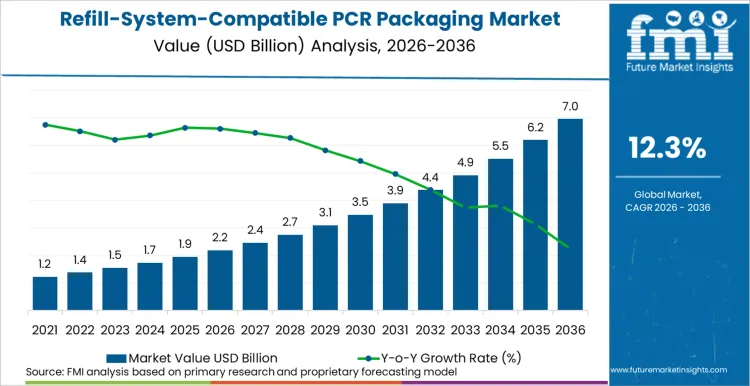
Summary of Refill-System-Compatible PCR Packaging Market
What is the Long-Term Growth Outlook for the Refill-System-Compatible PCR Packaging Market?
FMI projects the global market to expand from USD 2,180 million in 2026 to USD 6,940 million by 2036, registering a 12.3% CAGR. Market expansion reflects the critical role of durable, standardized PCR packaging in enabling commercially viable and convenient refill systems at scale. Packaging is transitioning from a cost-centric, single-trip item to a value-retaining, multi-trip asset with a distinct design and performance calculus.
FMI Research Approach: This projection is derived from FMI's proprietary forecasting framework integrating analysis of global reuse legislation, retailer refill network expansion plans, PCR feedstock durability specifications, and primary interviews with brand owners, retailers, and reverse logistics providers.
How do FMI Analysts Expect the Market to Evolve Structurally?
FMI analysts anticipate a transition from fragmented, brand-specific refill containers to a more standardized landscape of interoperable, multi-brand packaging platforms. This evolution is driven by the economic imperative for retailers and logistics providers to manage a simplified, shared pool of containers. The market will fragment into segments defined by refill channel: in-store automated stations, dedicated return-to-return kiosks, subscription-based home-collection models, and peer-to-peer refill networks.
FMI Research Approach: Insights are informed by analysis of patent filings for refill interfaces and tracking systems, retailer pilot project results, material testing data from independent durability labs, and monitoring of cross-industry consortia (e.g., Loop, Algramo, Circolution).
Which Geographies Command the Largest Share of the Market?
India leads in growth rate, advancing at an estimated 15.0% CAGR, driven by a price-sensitive consumer base, low labor costs for manual refill operations, and government policies promoting waste reduction. China follows with a 14.0% CAGR, supported by its massive investment in smart retail infrastructure and rapid rollout of unmanned refill stations in urban centers. The United States shows an 11.6% CAGR, propelled by major big-box retailer commitments and the expansion of tech-enabled refill delivery services.
Germany and Brazil represent key regulatory and scale markets, expanding at 11.2% CAGR each. Germany’s growth is fueled by the stringent PPWR mandates and high consumer environmental consciousness, while Brazil’s is shaped by innovative community-based refill models and extended producer responsibility schemes.
FMI Research Approach: Country-level forecasts are built using analysis of national reuse/refill policy timelines, retailer network density, consumer adoption studies, and primary interviews with local packaging converters and refill service operators.
What are some Globally Distinct Trends Shaping the Market?
Globally, the market is being shaped by the tension between standardization for efficiency and branding for differentiation. The rise of retailer-as-a-service (RaaS) models, where stores provide the packaging infrastructure and brands provide the concentrate, is driving demand for generic, retailer-branded PCR containers.
FMI Research Approach: Trend analysis is informed by regulatory tracking, business model analysis of refill startups, technology roadmaps from filling and cleaning equipment suppliers, and lifecycle assessment studies comparing various refill system architectures.
Refill-System-Compatible PCR Packaging Market Key Takeaways
| Metrics | Values |
|---|---|
| Expected Value (2026E) | USD 2,180 million |
| Projected Value (2036F) | USD 6,940 million |
| CAGR (2026-2036) | 12.3% |
Source: Future Market Insights (FMI) analysis, based on proprietary forecasting model and primary research
Why is the Refill-System-Compatible PCR Packaging Market Growing?
The primary accelerator is the compelling economic and environmental calculus of reuse. LCA studies consistently show that a well-operated refill system with durable PCR packaging can reduce plastic waste generation by over 70% and carbon footprint by up to 60% compared to single-use PCR packaging. This data is driving corporate sustainability targets beyond recycling toward reuse. In Q1 2026, a coalition of ten major global FMCG companies pledged to convert 20% of their global plastic packaging volume to reusable or refillable formats by 2030, creating an unprecedented, coordinated demand signal.
Furthermore, retailers are seizing refill systems as a powerful tool for customer loyalty and data acquisition. By offering in-store refill stations or take-home refillable containers, retailers increase footfall, basket size, and gain granular data on product consumption rates. This has led to retailers co-investing with packaging suppliers to develop proprietary refill ecosystems. For instance, a leading European supermarket chain’s 2026 launch of its ‘Refill+’ system featured custom-designed, QR-coded PCR-HDPE bottles that, when scanned at the refill station, automatically linked the refill to the customer’s loyalty card, offering personalized discounts and auto-replenishment prompts.
The economics are also shifting from a packaging cost to a service fee model. Brands and retailers are beginning to treat durable PCR containers as depreciating assets. The cost is amortized over their useful life and can be bundled into a refill service subscription or a small container deposit fee. This transforms the revenue model for packaging suppliers, who can now charge a premium for demonstrably higher durability and cycle performance, creating a direct incentive for innovation in long-lived PCR materials.
How is Refill-System-Compatible PCR Packaging Market Segmented?
The market segmentation reflects the diverse technical and commercial approaches to delivering refill solutions, balancing durability, cost, and consumer convenience across different product categories.
How is the Personal Care & Homecare Segment Defining Core Demand?
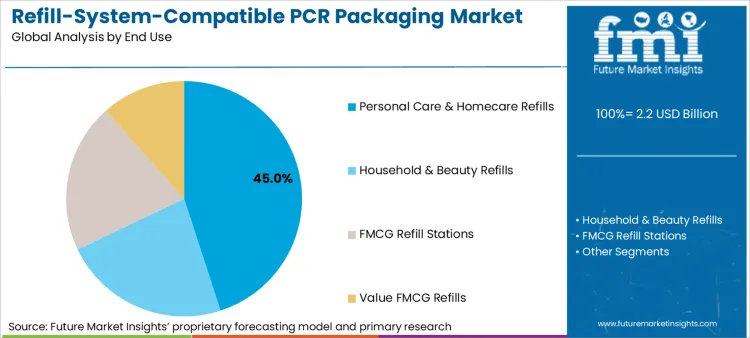
The personal care & homecare refills end-use segment commands a leading 45% value share. This dominance is rooted in high household consumption volumes, relatively low hygiene complexity compared to food, and strong consumer willingness to adopt refills for everyday products like dish soap, laundry detergent, and shower gel. The segment drives demand for refillable bottles & cartridges (50% format share) that are robust, easy to clean, and ergonomic for consumers to handle both in-store and at home.
Which Refill Format Balances Durability and Logistics Efficiency?
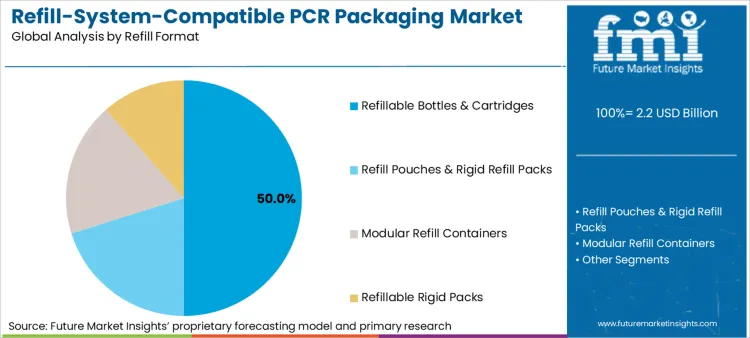
Refillable bottles & cartridges hold a dominant 50% share of the refill format segment. This format represents the classic durable container model, designed for 20+ cycles. The critical innovation is in thread standardisation and material durability.
In January 2026, a consortium led by ALPLA and Quadpack published a common technical standard for 1-liter HDPE/PCR refill bottle neck finishes for homecare products, allowing different brands’ concentrates to be dispensed into the same container at retailer refill stations, dramatically simplifying operations.
What Material Blends are Engineered for Multi-Cycle Performance?
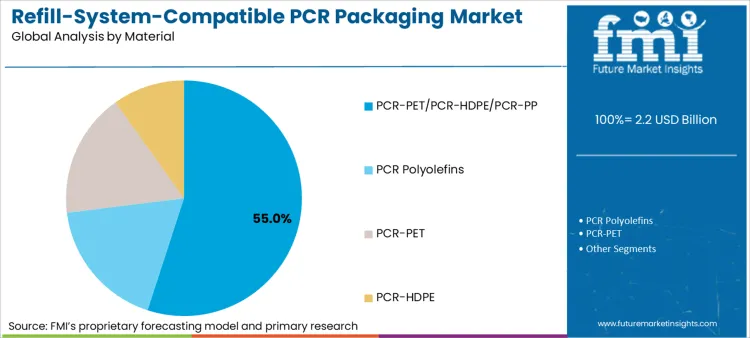
Packaging made from PCR-PET / PCR-HDPE / PCR-PP blends leads the material segment with a 55% share. This triad leverages PCR-HDPE’s impact resistance for sturdy bottles, PCR-PP’s chemical resistance and hinge durability for closures, and PCR-PET’s clarity for premium product display.
The key is engineering these blends for fatigue resistance. In 2025, Borealis launched a novel reactor-made polyolefin alloy specifically for PCR enrichment, providing exceptional stress-crack resistance and top-load strength over hundreds of filling, washing, and handling cycles, a breakthrough for refill containers.
Which Technology is Foundational to System Reliability?
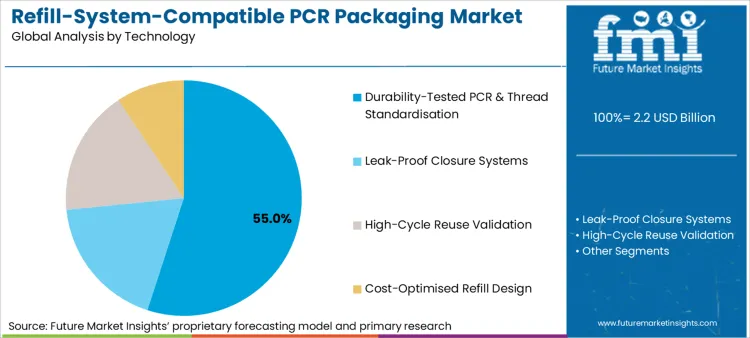
Durability-tested PCR & thread standardisation is the pivotal technology segment, accounting for 55% of focus. This encompasses accelerated lifecycle testing protocols and the geometric harmonization of closure systems.
Companies like Bericap are leading with RefillLock, a standardized, tamper-evident, one-turn closure system that works identically across multiple bottle diameters and materials, reducing consumer confusion and ensuring a reliable seal cycle after cycle, which is paramount for preventing leakage in home cabinets.
What Drivers, Restraints, Opportunities, and Trends Prevail in the Market?
Market expansion is critically supported by legislation internalizing the cost of waste. The EU’s PPWR and similar laws create direct financial penalties for single-use packaging while offering compliance pathways through reuse systems. In October 2025, Unilever and Carrefour announced a joint venture to deploy 5,000 smart refill stations across Europe by 2030, using a standardized, deposit-based PCR bottle. This massive scale was explicitly cited as a strategic response to the coming regulatory costs of single-use.
While demand is robust, the industry faces significant operational and behavioral hurdles. The capital intensity and operational complexity of establishing closed-loop collection, cleaning, and redistribution networks is a major restraint. Consumer hesitation around hygiene and the ‘inconvenience’ of returning containers also slows adoption. This necessitates not only better packaging design but also significant investment in consumer education and seamless service design.
Technical innovation is defined by ‘Smart Refill’ integration. Aptar’s 2026 development with a major IoT company featured a ‘Refill Hub’ for the home a connected countertop dispenser that accepts proprietary PCR refill cartridges. The dispenser tracks usage, automatically orders a replacement cartridge from the retailer when low, and even dispenses the perfect dose, merging packaging with a subscription service and reducing waste to near-zero.
The shift toward ultra-concentrated refills represents a disruptive product trend. The move toward sheets, tablets, or tiny pods of ultra-concentrated detergent or shampoo that are dissolved in water in a durable, reusable bottle at home minimizes the volume and weight of the refill payload. This trend shifts the packaging demand toward small, protective, water-soluble or dissolvable refill packs (often still using PCR films) and sophisticated, durable mixing bottles, creating a new sub-segment within the market.
Analysis of Refill-System-Compatible PCR Packaging Market by Key Countries
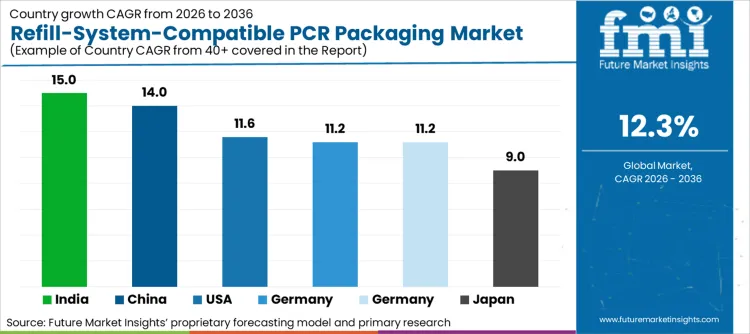
| Country | CAGR (2026 to 2036) |
|---|---|
| India | 15.0% |
| China | 14.0% |
| USA | 11.6% |
| Germany | 11.2% |
| Brazil | 11.2% |
| Japan | 9.0% |
Source: Future Market Insights (FMI) analysis, based on proprietary forecasting model and primary research
How are India's Value-Conscious Markets Driving Low-Cost Refill Models?
India is projected to expand at a leading 15.0% CAGR through 2036, driven by its vast, price-sensitive population and traditional familiarity with refill concepts. The market focuses on cost-optimised refill design for value FMCG refills.
Companies like Manjushree Technopack excel in producing extremely lightweight yet functional refill pouches and simple, stackable PCR-HDPE jars for staples like cooking oil and detergent, often sold through vast networks of small retailers with manual refill systems.
What drives China's Integration of Refill Tech into Smart Retail?
China's 14.0% CAGR growth is fueled by its lead in cashier-less stores and smart retail infrastructure. The focus is on modular refill containers for unmanned FMCG refill stations. Chinese manufacturers like Zijiang are producing sleek, RFID-tagged PCR-PET bottles and matching docking stations that integrate with mobile payment apps. Consumers tap their phone, the station identifies the bottle, dispenses the exact product, and charges their account, creating a frictionless high-tech refill experience.
How do US Retail Partnerships and Subscription Services Shape the Market?
USA, growing at an 11.6% CAGR, is characterized by partnerships between major retailers such as Walmart and Target and brands, as well as the rise of direct-to-consumer refill subscription services. This environment demands leak-proof closure systems and robust logistics.
Companies like Plastipak are supplying patented, one-way valve pouches and durable PCR containers designed to survive shipping both full and empty, catering to the ‘refill box’ subscription model where empty containers are picked up and replaced with full ones.
Why is Germany the European Regulatory and System Design Leader?
Germany's 11.2% CAGR is underpinned by its role as the de facto regulatory laboratory for the EU's PPWR. The market demands durability-tested PCR & thread standardisation (55% tech share leadership). German engineering is focused on creating the technical norms and testing certifications for refill packaging.
Organizations like the German Institute for Standardization (DIN) and companies like ALPLA are at the forefront of defining what ‘50-cycle durability’ actually means in practice, setting the quality benchmark for the continent.
How is Brazil's Waste Management Challenge Fostering Community Refill Solutions?
Brazil's 11.2% CAGR is uniquely driven by grassroots and community-led initiatives to tackle plastic waste, particularly in underserved communities. Refill systems are often local, involving small shops selling bulk products into brought-from-home or low-cost PCR containers.
The growth is in simple, robust, and locally produced PCR-HDPE bottles and jerrycans. Social enterprises are innovating with refill distribution models that also provide employment in collection and cleaning, integrating social and environmental goals.
What Factors Underpin Japan's Meticulous, High-Quality Refill Approach?
Japan's steady 9.0% CAGR reflects its culture of precision, quality, and hygiene. Growth is driven by high consumer expectations for pristine, convenient refill experiences. The focus is on impeccable design, perfect closure mechanisms, and ultra-clean refill stations.
Japanese packaging giants excel in producing refill pouches and rigid refill packs with exquisite, dripless spouts and seals that leave no residue, ensuring a clean and respectful refill ritual that aligns with cultural sensibilities.
What is the Competition Outlook for Refill-System-Compatible PCR Packaging?
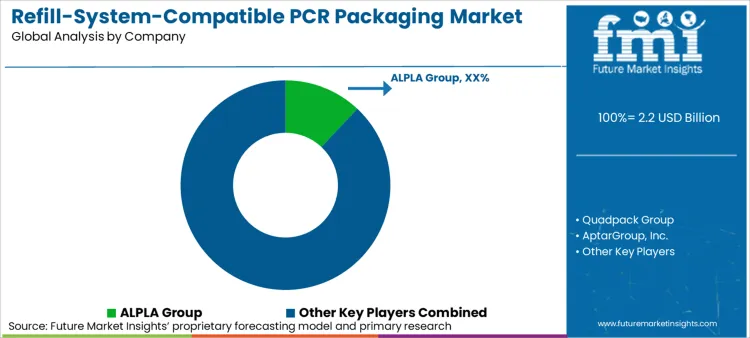
Competitive intensity reflects the need to master a triad of capabilities: material science for durability, systems design for logistics, and partnership building for ecosystem creation. The landscape is bifurcating into large-scale infrastructure providers who offer full refill system solutions (container + station + software) and nimble specialist designers who create award-winning, brand-specific durable packaging for premium refill schemes.
Strategic moves prior to 2025 involved securing partnerships with pioneering retailers and refill platforms (e.g., Loop). Suppliers focused on proving the durability and safety of their PCR containers in early pilot programs, building case studies and performance data.
The observable strategic direction for 2026 and beyond is the formation of Refill Consortia. Competing brands within the same category (e.g., rival shampoo brands) are collaborating through neutral third-party packaging suppliers like Quadpack to create shared, standardized refill containers for specific retail channels. This cooperation on the physical asset reduces costs for all while expanding the total addressable market for the packaging supplier.
Strategic leadership is shifting toward Circular Service Platforms. In early 2026, ALPLA, in partnership with a logistics software firm, launched ‘CircuLoop’, a digital platform that manages the entire life of a refill container from production and first fill through multiple cycles of return, cleaning, refill, and redistribution—for a per-cycle fee paid by the brand owner. This transforms the supplier from a manufacturer into a service operator, capturing value across the container's entire lifespan.
Recent Developments
- Procter & Gamble continued scaling refill and reuse formats for its home care portfolio across Europe during 2024–2025, including expanded Fairy dishwashing refill pouch formats and reuse pilots designed to reduce virgin plastic use. These initiatives focus on compatibility with durable primary bottles—some incorporating recycled content—while avoiding full redesign of existing filling and logistics infrastructure.
- Quadpack expanded its refillable beauty packaging portfolio in 2024-2025 through modular jar and bottle systems designed for repeated use, emphasizing mechanical robustness, simplified material structures, and compatibility with PCR materials. Rather than third-party durability certification, Quadpack supports refill adoption through internal performance validation and co-development programs with prestige beauty brands.
- Aptar advanced refill-compatible dispensing and closure solutions for the beauty and personal care sectors during 2024–2025, focusing on precise alignment, leak prevention, and consumer-friendly attachment mechanisms. These developments support emerging refill ecosystems while remaining compatible with high-PCR bottles and existing filling lines, particularly in premium skincare and fragrance applications.
Key Players Profiled
- ALPLA Group
- Quadpack Group
- AptarGroup, Inc.
- Plastipak Packaging, Inc.
- Zhejiang Sun-Rain Packaging Co., Ltd.
- Zijiang Enterprise Group
- Manjushree Technopack Ltd.
- Berry Global Inc. (including RPC)
- Silgan Holdings Inc.
- Gerresheimer AG
Market Definition
The refill-system-compatible PCR packaging market comprises revenue generated from the design, production, and servicing of durable primary packaging containers and refill formats specifically engineered to incorporate Post-Consumer Recycled (PCR) plastics and to function reliably within commercial or consumer-operated refill/reuse systems. This includes refillable bottles, cartridges, pouches, rigid refill pods, and their associated closure systems.
The market encompasses the value of the physical packaging, the durability engineering, compatibility testing with refill infrastructure, and often extended services such as reverse logistics management, cleaning validation, and digital tracking integration. The scope is limited to packaging intended for multiple cycles of refilling with the same or similar product type, excluding single-use refill pouches destined for disposal after one use.
Scope of Report
| Items | Values |
|---|---|
| Quantitative Units | USD 2,180 million (2026) |
| End Use | Personal Care & Homecare Refills, Household & Beauty Refills, FMCG Refill Stations, Value FMCG Refills, Others |
| Refill Format | Refillable Bottles & Cartridges, Refill Pouches & Rigid Refill Packs, Modular Refill Containers, Refillable Rigid Packs, Others |
| Material | PCR-PET/PCR-HDPE/PCR-PP, PCR Polyolefins, PCR-PET, PCR-HDPE, Others |
| Technology | Durability-Tested PCR & Thread Standardisation, Leak-Proof Closure Systems, High-Cycle Reuse Validation, Cost-Optimised Refill Design, Others |
| Regions Covered | North America, Western Europe, Eastern Europe, East Asia, South Asia & Pacific, Latin America, Middle East & Africa |
| Countries | Germany, USA, China, India, Brazil, Japan and 40+ countries |
| Key Companies | ALPLA, Quadpack, Aptar, Plastipak, Zhejiang Sun-Rain, Zijiang, Manjushree Technopack, Berry Global, Silgan, Gerresheimer |
Source: Future Market Insights (FMI) analysis, based on proprietary forecasting model and primary research
Refill-System-Compatible PCR Packaging Market Key Segments
By End Use:
- Personal Care & Homecare Refills
- Household & Beauty Refills
- FMCG Refill Stations
- Value FMCG Refills
By Refill Format:
- Refillable Bottles & Cartridges
- Refill Pouches & Rigid Refill Packs
- Modular Refill Containers
- Refillable Rigid Packs
By Material:
- PCR-PET/PCR-HDPE/PCR-PP
- PCR Polyolefins
- PCR-PET
- PCR-HDPE
By Technology:
- Durability-Tested PCR & Thread Standardisation
- Leak-Proof Closure Systems
- High-Cycle Reuse Validation
- Cost-Optimised Refill Design
By Region:
- North America
- Western Europe
- Eastern Europe
- East Asia
- South Asia & Pacific
- Latin America
- Middle East & Africa
Bibliography
- Institute of Packaging Professionals (IoPP). (2024). Reusable and refillable packaging: Design, durability, and system integration. Herndon, VA: IoPP.
- Plastics Recyclers Europe (PRE). (2025). Design requirements for durable and reusable plastic packaging incorporating recycled content. Brussels: PRE.
- CEFLEX. (2024). Designing packaging for reuse and refill within circular economy systems. Brussels: Circular Economy for Flexible Packaging.
- Food Packaging Forum Foundation. (2026). Hygiene, material safety, and repeated-use considerations in refillable packaging. Zurich: Food Packaging Forum.
- Retail Institute of Scandinavia. (2025). Operational models for in-store refill systems and consumer adoption. Stockholm: RIS Publications.
- Smithers. (2026). The future of refillable and reusable FMCG packaging. Akron, OH: Smithers.
Frequently Asked Questions
How big is the refill-system-compatible pcr packaging market in 2026?
The global refill-system-compatible pcr packaging market is estimated to be valued at USD 2.2 billion in 2026.
What will be the size of refill-system-compatible pcr packaging market in 2036?
The market size for the refill-system-compatible pcr packaging market is projected to reach USD 7.0 billion by 2036.
How much will be the refill-system-compatible pcr packaging market growth between 2026 and 2036?
The refill-system-compatible pcr packaging market is expected to grow at a 12.3% CAGR between 2026 and 2036.
What are the key product types in the refill-system-compatible pcr packaging market?
The key product types in refill-system-compatible pcr packaging market are personal care & homecare refills, household & beauty refills, fmcg refill stations and value fmcg refills.
Which refill format segment to contribute significant share in the refill-system-compatible pcr packaging market in 2026?
In terms of refill format , refillable bottles & cartridges segment to command 50.0% share in the refill-system-compatible pcr packaging market in 2026.
Preview the report firsthand - request a free sample
Get SampleGet the brochure for pricing and purchase details.
Get PDFTable of Content
- Executive Summary
- Global Market Outlook
- Demand-side Trends
- Supply-side Trends
- Technology Roadmap Analysis
- Analysis and Recommendations
- Market Overview
- Market Coverage / Taxonomy
- Market Definition / Scope / Limitations
- Research Methodology
- Chapter Orientation
- Analytical Lens and Working Hypotheses
- Market Structure, Signals, and Trend Drivers
- Benchmarking and Cross-market Comparability
- Market Sizing, Forecasting, and Opportunity Mapping
- Research Design and Evidence Framework
- Desk Research Programme (Secondary Evidence)
- Company Annual and Sustainability Reports
- Peer-reviewed Journals and Academic Literature
- Corporate Websites, Product Literature, and Technical Notes
- Earnings Decks and Investor Briefings
- Statutory Filings and Regulatory Disclosures
- Technical White Papers and Standards Notes
- Trade Journals, Industry Magazines, and Analyst Briefs
- Conference Proceedings, Webinars, and Seminar Materials
- Government Statistics Portals and Public Data Releases
- Press Releases and Reputable Media Coverage
- Specialist Newsletters and Curated Briefings
- Sector Databases and Reference Repositories
- FMI Internal Proprietary Databases and Historical Market Datasets
- Subscription Datasets and Paid Sources
- Social Channels, Communities, and Digital Listening Inputs
- Additional Desk Sources
- Expert Input and Fieldwork (Primary Evidence)
- Primary Modes
- Qualitative Interviews and Expert Elicitation
- Quantitative Surveys and Structured Data Capture
- Blended Approach
- Why Primary Evidence is Used
- Field Techniques
- Interviews
- Surveys
- Focus Groups
- Observational and In-context Research
- Social and Community Interactions
- Stakeholder Universe Engaged
- C-suite Leaders
- Board Members
- Presidents and Vice Presidents
- R&D and Innovation Heads
- Technical Specialists
- Domain Subject-matter Experts
- Scientists
- Physicians and Other Healthcare Professionals
- Governance, Ethics, and Data Stewardship
- Research Ethics
- Data Integrity and Handling
- Primary Modes
- Tooling, Models, and Reference Databases
- Desk Research Programme (Secondary Evidence)
- Data Engineering and Model Build
- Data Acquisition and Ingestion
- Cleaning, Normalisation, and Verification
- Synthesis, Triangulation, and Analysis
- Quality Assurance and Audit Trail
- Market Background
- Market Dynamics
- Drivers
- Restraints
- Opportunity
- Trends
- Scenario Forecast
- Demand in Optimistic Scenario
- Demand in Likely Scenario
- Demand in Conservative Scenario
- Opportunity Map Analysis
- Product Life Cycle Analysis
- Supply Chain Analysis
- Investment Feasibility Matrix
- Value Chain Analysis
- PESTLE and Porter’s Analysis
- Regulatory Landscape
- Regional Parent Market Outlook
- Production and Consumption Statistics
- Import and Export Statistics
- Market Dynamics
- Global Market Analysis 2021 to 2025 and Forecast, 2026 to 2036
- Historical Market Size Value (USD Million) Analysis, 2021 to 2025
- Current and Future Market Size Value (USD Million) Projections, 2026 to 2036
- Y-o-Y Growth Trend Analysis
- Absolute $ Opportunity Analysis
- Global Market Pricing Analysis 2021 to 2025 and Forecast 2026 to 2036
- Global Market Analysis 2021 to 2025 and Forecast 2026 to 2036, By End Use
- Introduction / Key Findings
- Historical Market Size Value (USD Million) Analysis By End Use , 2021 to 2025
- Current and Future Market Size Value (USD Million) Analysis and Forecast By End Use , 2026 to 2036
- Personal Care & Homecare Refills
- Household & Beauty Refills
- FMCG Refill Stations
- Value FMCG Refills
- Personal Care & Homecare Refills
- Y-o-Y Growth Trend Analysis By End Use , 2021 to 2025
- Absolute $ Opportunity Analysis By End Use , 2026 to 2036
- Global Market Analysis 2021 to 2025 and Forecast 2026 to 2036, By Refill Format
- Introduction / Key Findings
- Historical Market Size Value (USD Million) Analysis By Refill Format, 2021 to 2025
- Current and Future Market Size Value (USD Million) Analysis and Forecast By Refill Format, 2026 to 2036
- Refillable Bottles & Cartridges
- Refill Pouches & Rigid Refill Packs
- Modular Refill Containers
- Refillable Rigid Packs
- Refillable Bottles & Cartridges
- Y-o-Y Growth Trend Analysis By Refill Format, 2021 to 2025
- Absolute $ Opportunity Analysis By Refill Format, 2026 to 2036
- Global Market Analysis 2021 to 2025 and Forecast 2026 to 2036, By Material
- Introduction / Key Findings
- Historical Market Size Value (USD Million) Analysis By Material, 2021 to 2025
- Current and Future Market Size Value (USD Million) Analysis and Forecast By Material, 2026 to 2036
- PCR-PET/PCR-HDPE/PCR-PP
- PCR Polyolefins
- PCR-PET
- PCR-HDPE
- PCR-PET/PCR-HDPE/PCR-PP
- Y-o-Y Growth Trend Analysis By Material, 2021 to 2025
- Absolute $ Opportunity Analysis By Material, 2026 to 2036
- Global Market Analysis 2021 to 2025 and Forecast 2026 to 2036, By Technology
- Introduction / Key Findings
- Historical Market Size Value (USD Million) Analysis By Technology, 2021 to 2025
- Current and Future Market Size Value (USD Million) Analysis and Forecast By Technology, 2026 to 2036
- Durability-Tested PCR & Thread Standardisation
- Leak-Proof Closure Systems
- High-Cycle Reuse Validation
- Cost-Optimised Refill Design
- Durability-Tested PCR & Thread Standardisation
- Y-o-Y Growth Trend Analysis By Technology, 2021 to 2025
- Absolute $ Opportunity Analysis By Technology, 2026 to 2036
- Global Market Analysis 2021 to 2025 and Forecast 2026 to 2036, By Region
- Introduction
- Historical Market Size Value (USD Million) Analysis By Region, 2021 to 2025
- Current Market Size Value (USD Million) Analysis and Forecast By Region, 2026 to 2036
- North America
- Latin America
- Western Europe
- Eastern Europe
- East Asia
- South Asia and Pacific
- Middle East & Africa
- Market Attractiveness Analysis By Region
- North America Market Analysis 2021 to 2025 and Forecast 2026 to 2036, By Country
- Historical Market Size Value (USD Million) Trend Analysis By Market Taxonomy, 2021 to 2025
- Market Size Value (USD Million) Forecast By Market Taxonomy, 2026 to 2036
- By Country
- USA
- Canada
- Mexico
- By End Use
- By Refill Format
- By Material
- By Technology
- By Country
- Market Attractiveness Analysis
- By Country
- By End Use
- By Refill Format
- By Material
- By Technology
- Key Takeaways
- Latin America Market Analysis 2021 to 2025 and Forecast 2026 to 2036, By Country
- Historical Market Size Value (USD Million) Trend Analysis By Market Taxonomy, 2021 to 2025
- Market Size Value (USD Million) Forecast By Market Taxonomy, 2026 to 2036
- By Country
- Brazil
- Chile
- Rest of Latin America
- By End Use
- By Refill Format
- By Material
- By Technology
- By Country
- Market Attractiveness Analysis
- By Country
- By End Use
- By Refill Format
- By Material
- By Technology
- Key Takeaways
- Western Europe Market Analysis 2021 to 2025 and Forecast 2026 to 2036, By Country
- Historical Market Size Value (USD Million) Trend Analysis By Market Taxonomy, 2021 to 2025
- Market Size Value (USD Million) Forecast By Market Taxonomy, 2026 to 2036
- By Country
- Germany
- UK
- Italy
- Spain
- France
- Nordic
- BENELUX
- Rest of Western Europe
- By End Use
- By Refill Format
- By Material
- By Technology
- By Country
- Market Attractiveness Analysis
- By Country
- By End Use
- By Refill Format
- By Material
- By Technology
- Key Takeaways
- Eastern Europe Market Analysis 2021 to 2025 and Forecast 2026 to 2036, By Country
- Historical Market Size Value (USD Million) Trend Analysis By Market Taxonomy, 2021 to 2025
- Market Size Value (USD Million) Forecast By Market Taxonomy, 2026 to 2036
- By Country
- Russia
- Poland
- Hungary
- Balkan & Baltic
- Rest of Eastern Europe
- By End Use
- By Refill Format
- By Material
- By Technology
- By Country
- Market Attractiveness Analysis
- By Country
- By End Use
- By Refill Format
- By Material
- By Technology
- Key Takeaways
- East Asia Market Analysis 2021 to 2025 and Forecast 2026 to 2036, By Country
- Historical Market Size Value (USD Million) Trend Analysis By Market Taxonomy, 2021 to 2025
- Market Size Value (USD Million) Forecast By Market Taxonomy, 2026 to 2036
- By Country
- China
- Japan
- South Korea
- By End Use
- By Refill Format
- By Material
- By Technology
- By Country
- Market Attractiveness Analysis
- By Country
- By End Use
- By Refill Format
- By Material
- By Technology
- Key Takeaways
- South Asia and Pacific Market Analysis 2021 to 2025 and Forecast 2026 to 2036, By Country
- Historical Market Size Value (USD Million) Trend Analysis By Market Taxonomy, 2021 to 2025
- Market Size Value (USD Million) Forecast By Market Taxonomy, 2026 to 2036
- By Country
- India
- ASEAN
- Australia & New Zealand
- Rest of South Asia and Pacific
- By End Use
- By Refill Format
- By Material
- By Technology
- By Country
- Market Attractiveness Analysis
- By Country
- By End Use
- By Refill Format
- By Material
- By Technology
- Key Takeaways
- Middle East & Africa Market Analysis 2021 to 2025 and Forecast 2026 to 2036, By Country
- Historical Market Size Value (USD Million) Trend Analysis By Market Taxonomy, 2021 to 2025
- Market Size Value (USD Million) Forecast By Market Taxonomy, 2026 to 2036
- By Country
- Kingdom of Saudi Arabia
- Other GCC Countries
- Turkiye
- South Africa
- Other African Union
- Rest of Middle East & Africa
- By End Use
- By Refill Format
- By Material
- By Technology
- By Country
- Market Attractiveness Analysis
- By Country
- By End Use
- By Refill Format
- By Material
- By Technology
- Key Takeaways
- Key Countries Market Analysis
- USA
- Pricing Analysis
- Market Share Analysis, 2025
- By End Use
- By Refill Format
- By Material
- By Technology
- Canada
- Pricing Analysis
- Market Share Analysis, 2025
- By End Use
- By Refill Format
- By Material
- By Technology
- Mexico
- Pricing Analysis
- Market Share Analysis, 2025
- By End Use
- By Refill Format
- By Material
- By Technology
- Brazil
- Pricing Analysis
- Market Share Analysis, 2025
- By End Use
- By Refill Format
- By Material
- By Technology
- Chile
- Pricing Analysis
- Market Share Analysis, 2025
- By End Use
- By Refill Format
- By Material
- By Technology
- Germany
- Pricing Analysis
- Market Share Analysis, 2025
- By End Use
- By Refill Format
- By Material
- By Technology
- UK
- Pricing Analysis
- Market Share Analysis, 2025
- By End Use
- By Refill Format
- By Material
- By Technology
- Italy
- Pricing Analysis
- Market Share Analysis, 2025
- By End Use
- By Refill Format
- By Material
- By Technology
- Spain
- Pricing Analysis
- Market Share Analysis, 2025
- By End Use
- By Refill Format
- By Material
- By Technology
- France
- Pricing Analysis
- Market Share Analysis, 2025
- By End Use
- By Refill Format
- By Material
- By Technology
- India
- Pricing Analysis
- Market Share Analysis, 2025
- By End Use
- By Refill Format
- By Material
- By Technology
- ASEAN
- Pricing Analysis
- Market Share Analysis, 2025
- By End Use
- By Refill Format
- By Material
- By Technology
- Australia & New Zealand
- Pricing Analysis
- Market Share Analysis, 2025
- By End Use
- By Refill Format
- By Material
- By Technology
- China
- Pricing Analysis
- Market Share Analysis, 2025
- By End Use
- By Refill Format
- By Material
- By Technology
- Japan
- Pricing Analysis
- Market Share Analysis, 2025
- By End Use
- By Refill Format
- By Material
- By Technology
- South Korea
- Pricing Analysis
- Market Share Analysis, 2025
- By End Use
- By Refill Format
- By Material
- By Technology
- Russia
- Pricing Analysis
- Market Share Analysis, 2025
- By End Use
- By Refill Format
- By Material
- By Technology
- Poland
- Pricing Analysis
- Market Share Analysis, 2025
- By End Use
- By Refill Format
- By Material
- By Technology
- Hungary
- Pricing Analysis
- Market Share Analysis, 2025
- By End Use
- By Refill Format
- By Material
- By Technology
- Kingdom of Saudi Arabia
- Pricing Analysis
- Market Share Analysis, 2025
- By End Use
- By Refill Format
- By Material
- By Technology
- Turkiye
- Pricing Analysis
- Market Share Analysis, 2025
- By End Use
- By Refill Format
- By Material
- By Technology
- South Africa
- Pricing Analysis
- Market Share Analysis, 2025
- By End Use
- By Refill Format
- By Material
- By Technology
- USA
- Market Structure Analysis
- Competition Dashboard
- Competition Benchmarking
- Market Share Analysis of Top Players
- By Regional
- By End Use
- By Refill Format
- By Material
- By Technology
- Competition Analysis
- Competition Deep Dive
- ALPLA Group
- Overview
- Product Portfolio
- Profitability by Market Segments (Product/Age /Sales Channel/Region)
- Sales Footprint
- Strategy Overview
- Marketing Strategy
- Product Strategy
- Channel Strategy
- Quadpack Group
- AptarGroup, Inc.
- Plastipak Packaging, Inc.
- Zhejiang Sun-Rain Packaging Co., Ltd.
- Zijiang Enterprise Group
- Manjushree Technopack Ltd.
- ALPLA Group
- Competition Deep Dive
- Assumptions & Acronyms Used


