

- Industry Size (2026)
- USD 1060 Mn
- Forecast (2036)
- USD 3540 Mn
- CAGR (2026 to 2036)
- 12.8%
Dye-Free & Label-Free Packaging for PCR Optimization Market Forecast and Outlook 2026 to 2036
Revenue from dye-free and label-free packaging designed to optimize PCR use is projected to reach USD 1,060 million in 2026 and expand to USD 3,540 million by 2036, reflecting a CAGR of 12.8%. FMI opines that brand owners depending on reliable access to food-grade PCR are now specifying dye-free and label-free packaging at the design stage, rather than treating it as an optional recyclability upgrade driven by recycler preference.
This growth is being shaped less by sustainability positioning and more by practical recycling economics. Bottle-to-bottle systems operate under strict quality thresholds, natural-color PCR flakes continue to command a clear price premium, and design-for-recycling guidelines increasingly treat labels and dyes as avoidable sources of contamination.
Food-grade PCR operations run on tight quality controls, and that reality is shaping how primary packaging is designed. Super-clean recycling facilities supplying resin for new food-contact applications, including those operated by Plastipak through its Clean Tech recycling operations, apply strict acceptance criteria at the bale level. Material containing heavy pigmentation, incompatible labels, or adhesive residue is diverted from food-grade streams.
Recycler groups and industry working bodies are therefore pushing brand owners toward packaging designs that rely on natural-color containers and simpler structures, ensuring that packaging used for products such as milk, bottled water, and household liquids consistently qualifies for high-value recycling.
One practical response has been to remove secondary materials altogether. ALPLA has implemented mold-in embossing and debossing techniques across parts of its HDPE bottle portfolio, allowing logos, recycling symbols, fill marks, and functional indicators to be formed directly into the bottle wall during molding. Eliminating pressure-sensitive labels and shrink sleeves keeps the polymer stream clean and color-neutral, improving recovery rates and making the recycled output more suitable for food-grade HDPE applications.
Price dynamics in recycled resin markets reinforce this shift. Natural, unpigmented HDPE and PET flakes typically command a 20–30% premium over mixed-color or contaminated material because they are reused across a wider range of closed-loop, food-contact applications. For brand owners and retailers operating in high-volume, cost-sensitive categories such as dairy and beverages, specifying dye-free, label-free primary packaging is increasingly viewed as a way to reduce long-term compliance costs by improving PCR availability and lowering procurement risk.
Alongside these physical design changes, direct-to-container marking is gaining traction on high-speed filling lines. Berry Global has introduced laser-based coding on selected PET and HDPE packaging formats, enabling batch codes, date marks, and limited branding to be applied directly to natural-color containers without inks, adhesives, or added materials. These laser marks meet traceability and regulatory requirements while preserving mono-material integrity, making them a practical alternative to traditional labels for FMCG producers seeking cleaner recycling outcomes without disrupting line efficiency.
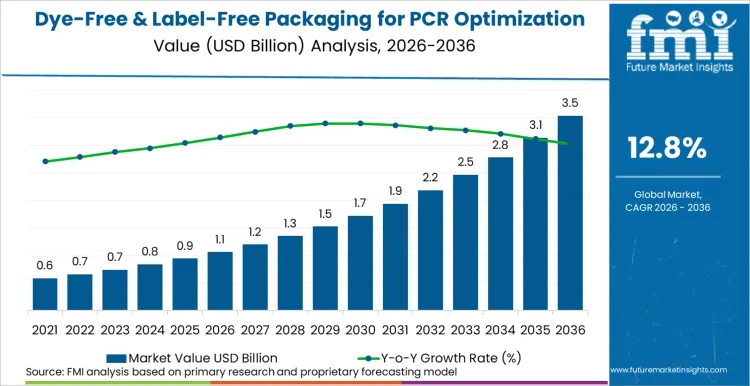
Summary of Dye-Free & Label-Free Packaging for PCR Optimization Market
What is the Long-Term Growth Outlook for the Dye-Free & Label-Free Packaging Market?
FMI projects the global dye-free & label-free packaging for PCR optimization market to expand from USD 1,060 million in 2026 to USD 3,540 million by 2036, registering a 12.8% CAGR. This accelerated growth reflects a deepening understanding of the recycling value chain, where upstream design decisions directly dictate downstream material value.
FMI Research Approach: This projection is derived from FMI's proprietary model analyzing quality specifications of food-grade PCR production facilities, the adoption of design-for-recycling guidelines from bodies like the Association of Plastic Recyclers (APR), premium pricing for natural-color flakes, and brand-led packaging redesign initiatives focused on PCR feedstock optimization.
How do FMI Analysts Expect the Dye-Free & Label-Free Packaging Market to Evolve Structurally?
FMI analysts anticipate a market evolution from basic, unbranded containers to sophisticated packaging that uses texture, shape, and advanced laser marking for brand identity. Household chemicals and dairy, followed by expansion into personal care and beverages, will lead growth.
FMI Research Approach: Tracking patent filings in mold-in-label and laser marking technologies inform Insights, analyzing packaging specifications from retailer sustainability scorecards, and monitoring the bale composition requirements published by major plastic re-processors.
Which Geographies Command Strategic Importance in the Dye-Free & Label-Free Packaging Market?
Strategic growth is concentrated in regions with advanced mechanical recycling industries targeting food-grade output. The United States and Germany are early adopters due to strong food-grade PCR demand. China and India represent high-growth markets where large-scale recycling infrastructure is being built, allowing for the incorporation of optimal packaging design from the outset. Japan's market is driven by precision and high-value material recovery.
FMI Research Approach: Regional market sizing is based on the capacity and sophistication of domestic bottle-to-bottle recycling, the presence of large dairy or beverage cooperatives, and the strength of retailer or brand consortiums promoting standardized, recycling-friendly packaging.
What Will Be the Market Size of Dye-Free & Label-Free Packaging by 2036?
By 2036, the dye-free & label-free packaging market is expected to reach USD 3,540 million. This expansion will correlate with the scaling of closed-loop recycling systems for polymers, where the highest economic and environmental return is achieved by keeping material streams as pure as possible.
FMI Research Approach: The long-term outlook incorporates forecasts for food-grade PCR capacity, the penetration of APR or RecyClass design guidelines, and the progressive phase-out of problematic packaging elements by large-volume brand owners.
What are some Globally Distinct Trends Shaping the Dye-Free & Label-Free Packaging Market?
Demand is is shaped by the "Natural HDPE" standard in dairy, the use of digital watermarks as an invisible alternative to labels, and the integration of RFID tags into molded packaging. The dairy industry's shift to natural HDPE bottles is a major trend.
FMI Research Approach: Trend identification involves monitoring industry alliances (e.g., the HolyGrail 2.0 initiative), analyzing material specifications from large dairy and water brands, and reviewing advancements in functional polymer additives that enable integration without contamination.
Dye-Free & Label-Free Packaging for PCR Optimization Market Key Takeaways
| Metrics | Values |
|---|---|
| Expected Value (2026E) | USD 1,060 million |
| Projected Value (2036F) | USD 3,540 million |
| CAGR (2026-2036) | 12.8% |
Source: Future Market Insights (FMI) analysis, based on proprietary forecasting model and primary research
Why is the Dye-Free & Label-Free Packaging for PCR Optimization Market Growing?
Growth is navigating from the recycling side of the value chain, particularly by advanced mechanical recycling operations supplying food-grade material. Solid-state polymerization plants producing rPET or rHDPE operate with very narrow tolerance limits for colorants, adhesives, and foreign materials. Packaging that enters these systems without dyes or labels reduces contamination risk at the input stage, lowers the need for intensive filtration and reprocessing, and improves overall yield. The result is a cleaner polymer stream produced with less energy and fewer losses, which makes dye-free and label-free packaging formats more attractive to recyclers and, in turn, more desirable to packaging designers supplying bottle-to-bottle systems.
Brand-side risk management is reinforcing this shift. As companies increase recycled content in primary packaging, they face tighter performance expectations, especially in applications where appearance and material consistency matter. Pigment bleed, adhesive residue, or particulate contamination from labels can show up as visual defects or processing issues in new bottles. By eliminating dyes and labels at the design stage, brands protect the quality of future feedstock for their own packaging programs, reducing variability and safeguarding recycled-content claims in high-sensitivity formats such as white or transparent containers.
Commercial adoption is enabled by changes in how packaging is decorated. Early dye-free and label-free designs were dismissed as visually undifferentiated. That constraint is weakening as mold-in embossing, surface texturing, and laser-based marking mature and scale. These technologies now support sharper brand definition and regulatory marking while operating at line speeds comparable to conventional labeling systems. With shelf presentation no longer a limiting factor, brands are finding fewer reasons to retain labels and dyes in packaging formats intended for closed-loop recycling.
How is Dye-Free & Label-Free Packaging for PCR Optimization Market Segmented?
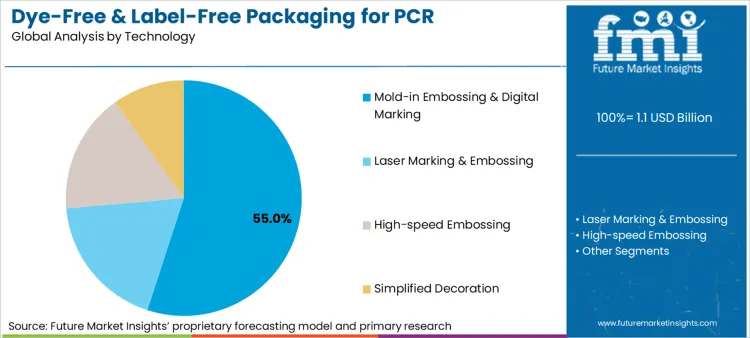
The market segment landscape is defined by the pursuit of material purity in high-volume recycling streams. Food and beverage packaging leads as the sector with the strongest drive toward food-grade PCR. Unpigmented containers are the dominant format, made from natural-grade polymers, with mold-in embossing and digital marking serving as the enabling decoration technologies.
How is the Food & Beverage Sector Leading the Shift to Material Purity?
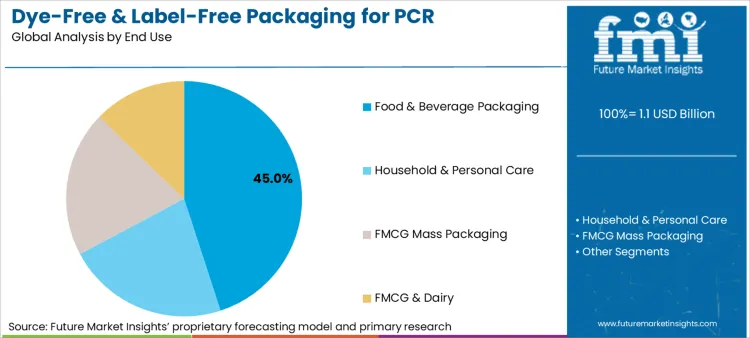
Food & beverage packaging represents the largest end-use segment with a 45.0% share. This sector, particularly bottled water, milk, juices, and cooking oils, is under intense pressure to incorporate recycled content, often with a focus on closed-loop, bottle-to-bottle systems. The use of natural-color, label-free HDPE or PET bottles is the most effective way to ensure the recycled flake meets the clarity and contamination standards for direct food contact. Major dairy cooperatives and beverage companies are leading this shift to secure their own supply of high-quality PCR.
This segment’s requirements set the technical benchmark. A milk bottle must be opaque to protect contents, yet its natural white color comes from the polymer itself (often TiO2-free formulations are used) without pigmentation, and all necessary information is embossed or laser-marked. This creates a perfect circular input for recycling back into new food-grade milk bottles.
Which Packaging Format Maximizes Recyclate Value?
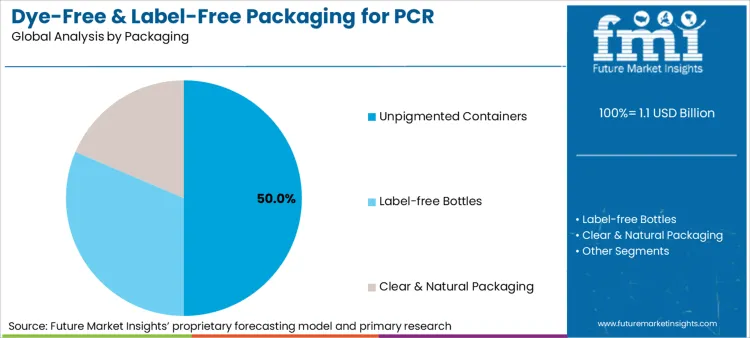
Unpigmented containers constitute the leading packaging segment with a 50.0% share. This includes bottles, jars, and tubs in their natural polymer color—clear, translucent, or white (from the resin, not added pigments). The absence of dyes means that during recycling, the polymer melt remains a consistent, predictable color, allowing it to be used in a wide variety of new applications without color-matching limitations. This maximizes the market value and utility of the output PCR.
What is the Foundational Material Requirement?
The use of natural PE, PP, and PET is the leading material segment with a 55.0% share. "Natural" refers to the polymer as supplied by the producer, without the addition of color masterbatch or pigments. These virgin materials have consistent properties that are well-understood by recyclers. Designing packaging from these base materials ensures that, once recycled, the polymer stream is not degraded or altered by unknown additive packages from colors, providing a reliable feedstock for high-specification recycling processes.
Which Technology Replaces Traditional Decoration?
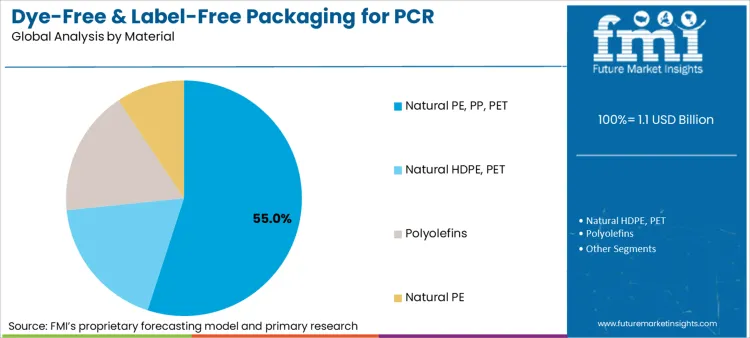
Mold-in embossing and digital marking is the dominant technology segment with a 55.0% share. Mold-in embossing creates permanent, raised text and graphics during the blow-molding or injection-molding process. Digital marking, primarily via lasers, ablates a microscopic layer of the polymer surface to create contrast or applies a subtle code. Together, these technologies fulfill the legal and commercial requirements for product information and branding without introducing any foreign material that would contaminate the recycling stream.
What Drivers, Restraints, Opportunities, and Trends Prevail in the Dye-Free & Label-Free Packaging Market?
Pricing behavior at material recovery facilities is playing a direct role in how packaging is being designed. Many MRFs now pay a higher per-ton price for bottle bales that are already sorted as natural color and free of labels. That pricing preference moves upstream, encouraging brand owners to choose packaging formats that help collectors and recyclers capture a premium, rather than forcing material into lower-value streams. In practice, design choices are increasingly being shaped by how the bale will be priced once it enters the recovery system.
Adoption is slowed by the structure of existing supply chains. Colored masterbatch suppliers and label manufacturers represent a large, well-established global ecosystem. Moving away from dyes and labels affects long-standing sourcing relationships and often requires converters to invest in new tooling for embossing or in laser-coding equipment. For smaller brands and private converters, the combination of capital expense and process change can delay the transition, even when the recycling benefits are clear.
Retail private-label programs represent a clear area of near-term growth. Supermarket chains and mass retailers control their own packaging specifications and already operate at high volumes across categories such as bottled water, milk, and household cleaners. This gives them the ability to mandate dye-free, label-free designs across entire product lines, quickly generating scale and setting a visible packaging standard that consumers encounter repeatedly on shelf.
On the technology side, laser marking is becoming more refined through changes in how polymer surfaces are engineered. Early laser marking on natural polymers could leave rough textures or visible residue. New approaches focus on adjusting polymer formulations or applying clear, compatible surface layers during molding so the laser produces a sharp, high-contrast mark without affecting surface smoothness. This improves both appearance and tactile quality, making laser-marked packaging suitable for higher-end applications.
Design priorities are also shifting toward what many brands describe as “brand by shape.” With color and large labels removed, bottle geometry, surface texture, and form factor carry more of the brand identity. Distinctive molds and heavier texturing are being used to create recognition and shelf presence, turning the container itself into the primary branding element. This strategy fits naturally with dye-free, label-free packaging and offers a tactile experience that printed labels and shrink sleeves cannot replicate.
Analysis of Dye-Free & Label-Free Packaging Market by Key Countries
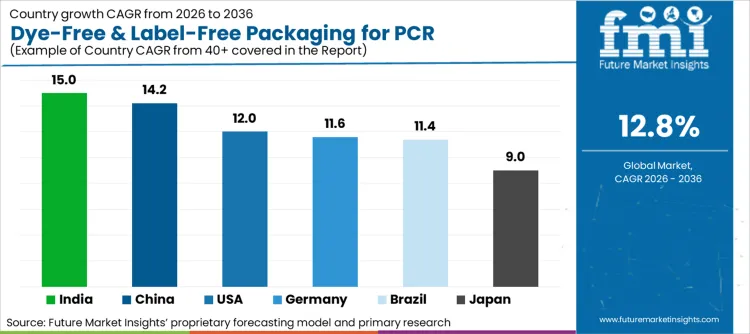
| Country | CAGR (2026-2036) |
|---|---|
| India | 15.0% |
| China | 14.2% |
| USA | 12.0% |
| Germany | 11.6% |
| Brazil | 11.4% |
| Japan | 9.0% |
Source: Future Market Insights (FMI) analysis, based on proprietary forecasting model and primary research
How are Dairy Cooperatives and EPR Catalyzing the Indian Market?
India is projected to expand at a 15.0% CAGR through 2036, the highest among key nations. This is driven by the massive dairy sector, where cooperatives like Amul are pioneering shifts to natural HDPE milk pouches and bottles to improve the value of post-consumer plastic. Concurrently, the digital tracking requirements of India's EPR rules make laser-marked batch codes ideal for compliance.
This combination of a dominant application (dairy) and a regulatory push for traceability is creating rapid adoption of simplified, dye-free packaging optimized for local recycling streams.
How do Vertical Integration and New Recycling Builds Shape the Chinese Market?
China’s market is growing at a 14.2% CAGR, fueled by the vertical integration of its packaging and recycling industries. Large petrochemical and packaging groups are building state-of-the-art bottle-to-bottle recycling plants.
To ensure the efficiency and output quality of these new assets, they are mandating dye-free, label-free designs for the packaging they produce for key domestic FMCG brands. This creates a closed, optimized loop from the outset, with packaging design dictated by the needs of the group's own recycling division.
Which Retailer Leadership and Food-Grade PCR Demand Define the US Market?
Expanding at a 12.0% CAGR, USA is characterized by leadership from major retailers and the strong demand for food-grade rPET and rHDPE. Large grocery chains are specifying natural, label-free packaging for their private-label beverages and household products.
The expansion of food-grade recycling capacity by companies like Plastipak and Indorama Ventures creates a guaranteed, high-value end-market for the collected material, incentivizing the design shift across the national packaging landscape.
How do the EU Green Deal and DRS Precision Drive the German Market?
Germany’s market, expanding at an 11.6% CAGR, is shaped by the EU's circular economy ambitions and the precision of its Deposit Return Scheme. The DRS ensures high collection rates of bottles, and the system's operators strongly prefer un-pigmented, label-free containers to maximize the value of the returned stream and reduce sorting complexity. Brands are adapting to this systemic preference, using mold-in embossing to meet mandatory deposit information requirements without labels.
What Role does the Association with Bio-based Plastics Play in Brazil?
Brazil’s market, with an 11.4% CAGR, is influenced by its leadership in sugarcane-based bio-polymers. There is a synergistic trend where brands using bio-PE or bio-PP for marketing purposes are also opting for dye-free, label-free versions of these packs. This combination amplifies the natural and sustainable messaging and ensures that these bio-based plastics, at end-of-life, provide a pristine feedstock for mechanical recycling, supporting the circular narrative for bioplastics.
How does a Focus on Precision Sorting and High-Quality Output Influence Japan?
Japan’s market, growing at a 9.0% CAGR, is defined by its highly efficient, technology-driven sorting systems and demand for exceptionally pure PCR. Japanese recycling facilities utilize advanced optical sorters that can be calibrated to achieve higher purity with natural, unlabeled streams. Japanese brands in the personal care and premium beverage sectors use the high-quality, natural PCR from these streams in transparent packaging, creating a closed-loop preference for the input material that is dye-free and label-free.
What is the Competition Outlook for Dye-Free & Label-Free Packaging?
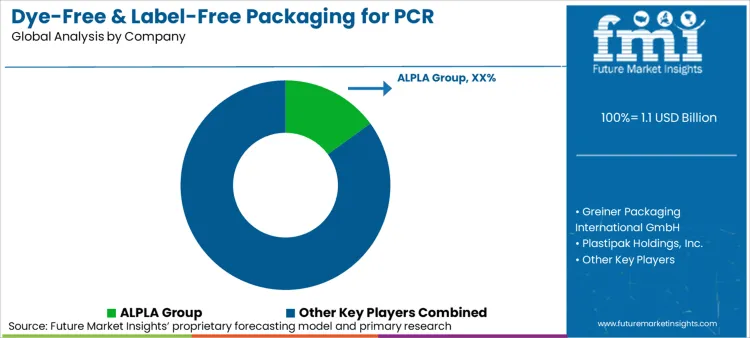
Competitive intensity centers on mastering the integration of decoration technology with high-speed molding and securing partnerships with large-volume, sustainability-forward brands. Leaders are packaging converters that have invested in advanced tooling for mold-in embossing and have seamlessly integrated laser coding stations into their production lines. Success depends on providing a total solution that delivers brand appeal, operational efficiency, and end-of-life optimization in one package.
Strategic moves are characterized by partnerships between packaging manufacturers, laser technology firms, and recycling entities. Converters are collaborating directly with recycling companies to test and validate that their specific mold designs and laser-marking parameters do not interfere with sorting or washing processes. This downstream validation becomes a key selling point to brands, proving that the packaging is not just theoretically recyclable but practically optimized for the specific recycling infrastructure.
Recent Developments
Greiner Packaging commercialized its K3® r100 packaging concept in 2024, a self-separating cardboard–plastic solution designed to enable automatic material separation during waste processing. The system significantly improves plastic recyclate purity by minimizing residual fiber contamination, thereby supporting higher-quality PCR streams suitable for food-contact applications, even though it is not explicitly positioned as a dye-free or label-free container.
Berry Global expanded its portfolio of natural-color HDPE bottles incorporating high post-consumer recycled (PCR) content, supplying multiple brand owners with packaging designed to enhance mechanical recycling efficiency. These bottles leverage simplified material structures and reduced additives to improve PCR yield and quality, reinforcing Berry Global’s broader closed-loop and circular packaging initiatives, though no publicly documented 2025 milestone confirms a 1-billion-unit, laser-coded, label-free supply program.
ALPLA continued to scale production of lightweight, food-grade PCR HDPE dairy bottles under its Eco-Bottle platform, supporting the use of natural or lightly pigmented HDPE to improve recyclability and secure future supplies of high-quality recycled material for milk packaging. While ALPLA actively collaborates with dairy brands on recyclable design principles, there is no publicly released 2024 joint industry design guide formally mandating embossing or natural-color HDPE as an industry standard.
Key Players Profiled
- ALPLA Group
- Greiner Packaging International GmbH
- Plastipak Holdings, Inc.
- Berry Global Inc.
- Zijiang Enterprise Group Co., Ltd.
- Manjushree Technopack Ltd.
Market Definition
The dye-free & label-free packaging for PCR optimization market comprises revenue generated from the design, manufacture, and supply of rigid and flexible plastic packaging that intentionally excludes added colorants (dyes, pigments) and adhesive paper or plastic labels. This packaging is made from "natural" polymer grades and utilizes alternative methods such as mold-in embossing, laser marking, or textured surfaces for product identification, branding, and legal compliance.
The market scope includes primary packaging containers such as bottles, jars, tubs, and pouches sold to FMCG brands. The value is attributed to the packaging's design and production, which incorporates the specific tooling and processes needed to eliminate dyes and labels while maintaining functionality and appeal. The market excludes standard colored or labeled packaging, and packaging where decoration is applied via sleeves, direct printing, or adhesive labels.
Scope of Report
| Items | Values |
|---|---|
| Quantitative Units (2026) | USD 1,060 Million |
| End-use | Food & Beverage Packaging, Household & Personal Care, FMCG Mass Packaging, FMCG & Dairy, Other |
| Packaging | Unpigmented Containers, Label-free Bottles, Clear & Natural Packaging |
| Material | Natural PE, PP, PET, Natural HDPE, PET, Polyolefins, Natural PE |
| Technology | Mold-in Embossing & Digital Marking, Laser Marking & Embossing, High-speed Embossing, Simplified Decoration, Other |
| Regions Covered | North America, Europe, Asia-Pacific, Latin America, Middle East & Africa |
| Countries | USA, Germany, China, India, Brazil, Japan and 40+ countries |
| Key Companies | ALPLA, Greiner Packaging, Plastipak, Berry Global, Zijiang Enterprise, Manjushree Technopack |
Source: Future Market Insights (FMI) analysis, based on proprietary forecasting model and primary research
Dye-Free & Label-Free Packaging for PCR Optimization Market Key Segments
End-use
- Food & Beverage Packaging
- Household & Personal Care
- FMCG Mass Packaging
- FMCG & Dairy
Packaging
- Unpigmented Containers
- Label-free Bottles
- Clear & Natural Packaging
Material
- Natural PE, PP, PET
- Natural HDPE, PET
- Polyolefins
- Natural PE
Technology
- Mold-in Embossing & Digital Marking
- Laser Marking & Embossing
- High-speed Embossing
- Simplified Decoration
Region
- North America
- Europe
- Asia-Pacific
- Latin America
- Middle East & Africa
Bibliography
- Association of Plastic Recyclers. (2024). APR design guide for plastics recyclability: Guidance on colorants, labels, and adhesives. Association of Plastic Recyclers.
- RecyClass. (2024). Design for recycling guidelines for plastic packaging: Evaluation of pigments, inks, and label systems. RecyClass.
- Plastics Recyclers Europe. (2025). Recyclability guidance for plastic packaging: Effects of color and decoration on PCR quality. Plastics Recyclers Europe.
- International Solid Waste Association. (2024). Improving recyclate quality through packaging design: Impacts of labels, inks, and pigments. ISWA.
- European PET Bottle Platform. (2025). Design guidelines for PET bottles: Labeling, color, and compatibility with bottle-to-bottle recycling. EPBP.
- Plastipak Holdings, Inc. (2025). Sustainability and recycling innovation report. Plastipak Holdings, Inc.
- Berry Global Inc. (2026). Material simplification strategies for recyclable, label-free plastic packaging. Berry Global Inc.
-
Frequently Asked Questions
- What is the expected value of the dye-free & label-free packaging market in 2026?
- The dye-free & label-free packaging for PCR optimization market is expected to reach USD 1,060 million in 2026.
- What is the projected value by 2036 and the CAGR from 2026 to 2036?
- By 2036, the market is projected to reach USD 3,540 million, expanding at a CAGR of 12.8% between 2026 and 2036.
- Which end-use sector is the primary driver for this packaging?
- The food & beverage packaging sector is the largest driver, representing a 45.0% share.
- What is the key packaging format in this market?
- Unpigmented containers are the leading format, holding a 50.0% share.
- What technology enables branding on this type of packaging?
- Mold-in embossing and digital marking is the dominant technology, with a 55.0% share. This involves creating raised text/graphics directly in the mold and using lasers to etch information onto the surface.
Frequently Asked Questions
How big is the dye-free & label-free packaging for pcr optimization market in 2026?
The global dye-free & label-free packaging for pcr optimization market is estimated to be valued at USD 1.1 billion in 2026.
What will be the size of dye-free & label-free packaging for pcr optimization market in 2036?
The market size for the dye-free & label-free packaging for pcr optimization market is projected to reach USD 3.5 billion by 2036.
How much will be the dye-free & label-free packaging for pcr optimization market growth between 2026 and 2036?
The dye-free & label-free packaging for pcr optimization market is expected to grow at a 12.8% CAGR between 2026 and 2036.
What are the key product types in the dye-free & label-free packaging for pcr optimization market?
The key product types in dye-free & label-free packaging for pcr optimization market are food & beverage packaging, household & personal care, fmcg mass packaging and fmcg & dairy.
Which packaging segment to contribute significant share in the dye-free & label-free packaging for pcr optimization market in 2026?
In terms of packaging, unpigmented containers segment to command 50.0% share in the dye-free & label-free packaging for pcr optimization market in 2026.
Preview the report firsthand - request a free sample
Get SampleGet the brochure for pricing and purchase details.
Get PDFTable of Content
- Executive Summary
- Global Market Outlook
- Demand-side Trends
- Supply-side Trends
- Technology Roadmap Analysis
- Analysis and Recommendations
- Market Overview
- Market Coverage / Taxonomy
- Market Definition / Scope / Limitations
- Research Methodology
- Chapter Orientation
- Analytical Lens and Working Hypotheses
- Market Structure, Signals, and Trend Drivers
- Benchmarking and Cross-market Comparability
- Market Sizing, Forecasting, and Opportunity Mapping
- Research Design and Evidence Framework
- Desk Research Programme (Secondary Evidence)
- Company Annual and Sustainability Reports
- Peer-reviewed Journals and Academic Literature
- Corporate Websites, Product Literature, and Technical Notes
- Earnings Decks and Investor Briefings
- Statutory Filings and Regulatory Disclosures
- Technical White Papers and Standards Notes
- Trade Journals, Industry Magazines, and Analyst Briefs
- Conference Proceedings, Webinars, and Seminar Materials
- Government Statistics Portals and Public Data Releases
- Press Releases and Reputable Media Coverage
- Specialist Newsletters and Curated Briefings
- Sector Databases and Reference Repositories
- FMI Internal Proprietary Databases and Historical Market Datasets
- Subscription Datasets and Paid Sources
- Social Channels, Communities, and Digital Listening Inputs
- Additional Desk Sources
- Expert Input and Fieldwork (Primary Evidence)
- Primary Modes
- Qualitative Interviews and Expert Elicitation
- Quantitative Surveys and Structured Data Capture
- Blended Approach
- Why Primary Evidence is Used
- Field Techniques
- Interviews
- Surveys
- Focus Groups
- Observational and In-context Research
- Social and Community Interactions
- Stakeholder Universe Engaged
- C-suite Leaders
- Board Members
- Presidents and Vice Presidents
- R&D and Innovation Heads
- Technical Specialists
- Domain Subject-matter Experts
- Scientists
- Physicians and Other Healthcare Professionals
- Governance, Ethics, and Data Stewardship
- Research Ethics
- Data Integrity and Handling
- Primary Modes
- Tooling, Models, and Reference Databases
- Desk Research Programme (Secondary Evidence)
- Data Engineering and Model Build
- Data Acquisition and Ingestion
- Cleaning, Normalisation, and Verification
- Synthesis, Triangulation, and Analysis
- Quality Assurance and Audit Trail
- Market Background
- Market Dynamics
- Drivers
- Restraints
- Opportunity
- Trends
- Scenario Forecast
- Demand in Optimistic Scenario
- Demand in Likely Scenario
- Demand in Conservative Scenario
- Opportunity Map Analysis
- Product Life Cycle Analysis
- Supply Chain Analysis
- Investment Feasibility Matrix
- Value Chain Analysis
- PESTLE and Porter’s Analysis
- Regulatory Landscape
- Regional Parent Market Outlook
- Production and Consumption Statistics
- Import and Export Statistics
- Market Dynamics
- Global Market Analysis 2021 to 2025 and Forecast, 2026 to 2036
- Historical Market Size Value (USD Million) Analysis, 2021 to 2025
- Current and Future Market Size Value (USD Million) Projections, 2026 to 2036
- Y-o-Y Growth Trend Analysis
- Absolute $ Opportunity Analysis
- Global Market Pricing Analysis 2021 to 2025 and Forecast 2026 to 2036
- Global Market Analysis 2021 to 2025 and Forecast 2026 to 2036, By End Use
- Introduction / Key Findings
- Historical Market Size Value (USD Million) Analysis By End Use , 2021 to 2025
- Current and Future Market Size Value (USD Million) Analysis and Forecast By End Use , 2026 to 2036
- Food & Beverage Packaging
- Household & Personal Care
- FMCG Mass Packaging
- FMCG & Dairy
- Food & Beverage Packaging
- Y-o-Y Growth Trend Analysis By End Use , 2021 to 2025
- Absolute $ Opportunity Analysis By End Use , 2026 to 2036
- Global Market Analysis 2021 to 2025 and Forecast 2026 to 2036, By Packaging
- Introduction / Key Findings
- Historical Market Size Value (USD Million) Analysis By Packaging, 2021 to 2025
- Current and Future Market Size Value (USD Million) Analysis and Forecast By Packaging, 2026 to 2036
- Unpigmented Containers
- Label-free Bottles
- Clear & Natural Packaging
- Unpigmented Containers
- Y-o-Y Growth Trend Analysis By Packaging, 2021 to 2025
- Absolute $ Opportunity Analysis By Packaging, 2026 to 2036
- Global Market Analysis 2021 to 2025 and Forecast 2026 to 2036, By Material
- Introduction / Key Findings
- Historical Market Size Value (USD Million) Analysis By Material, 2021 to 2025
- Current and Future Market Size Value (USD Million) Analysis and Forecast By Material, 2026 to 2036
- Natural PE, PP, PET
- Natural HDPE, PET
- Polyolefins
- Natural PE
- Natural PE, PP, PET
- Y-o-Y Growth Trend Analysis By Material, 2021 to 2025
- Absolute $ Opportunity Analysis By Material, 2026 to 2036
- Global Market Analysis 2021 to 2025 and Forecast 2026 to 2036, By Technology
- Introduction / Key Findings
- Historical Market Size Value (USD Million) Analysis By Technology, 2021 to 2025
- Current and Future Market Size Value (USD Million) Analysis and Forecast By Technology, 2026 to 2036
- Mold-in Embossing & Digital Marking
- Laser Marking & Embossing
- High-speed Embossing
- Simplified Decoration
- Mold-in Embossing & Digital Marking
- Y-o-Y Growth Trend Analysis By Technology, 2021 to 2025
- Absolute $ Opportunity Analysis By Technology, 2026 to 2036
- Global Market Analysis 2021 to 2025 and Forecast 2026 to 2036, By Region
- Introduction
- Historical Market Size Value (USD Million) Analysis By Region, 2021 to 2025
- Current Market Size Value (USD Million) Analysis and Forecast By Region, 2026 to 2036
- North America
- Latin America
- Western Europe
- Eastern Europe
- East Asia
- South Asia and Pacific
- Middle East & Africa
- Market Attractiveness Analysis By Region
- North America Market Analysis 2021 to 2025 and Forecast 2026 to 2036, By Country
- Historical Market Size Value (USD Million) Trend Analysis By Market Taxonomy, 2021 to 2025
- Market Size Value (USD Million) Forecast By Market Taxonomy, 2026 to 2036
- By Country
- USA
- Canada
- Mexico
- By End Use
- By Packaging
- By Material
- By Technology
- By Country
- Market Attractiveness Analysis
- By Country
- By End Use
- By Packaging
- By Material
- By Technology
- Key Takeaways
- Latin America Market Analysis 2021 to 2025 and Forecast 2026 to 2036, By Country
- Historical Market Size Value (USD Million) Trend Analysis By Market Taxonomy, 2021 to 2025
- Market Size Value (USD Million) Forecast By Market Taxonomy, 2026 to 2036
- By Country
- Brazil
- Chile
- Rest of Latin America
- By End Use
- By Packaging
- By Material
- By Technology
- By Country
- Market Attractiveness Analysis
- By Country
- By End Use
- By Packaging
- By Material
- By Technology
- Key Takeaways
- Western Europe Market Analysis 2021 to 2025 and Forecast 2026 to 2036, By Country
- Historical Market Size Value (USD Million) Trend Analysis By Market Taxonomy, 2021 to 2025
- Market Size Value (USD Million) Forecast By Market Taxonomy, 2026 to 2036
- By Country
- Germany
- UK
- Italy
- Spain
- France
- Nordic
- BENELUX
- Rest of Western Europe
- By End Use
- By Packaging
- By Material
- By Technology
- By Country
- Market Attractiveness Analysis
- By Country
- By End Use
- By Packaging
- By Material
- By Technology
- Key Takeaways
- Eastern Europe Market Analysis 2021 to 2025 and Forecast 2026 to 2036, By Country
- Historical Market Size Value (USD Million) Trend Analysis By Market Taxonomy, 2021 to 2025
- Market Size Value (USD Million) Forecast By Market Taxonomy, 2026 to 2036
- By Country
- Russia
- Poland
- Hungary
- Balkan & Baltic
- Rest of Eastern Europe
- By End Use
- By Packaging
- By Material
- By Technology
- By Country
- Market Attractiveness Analysis
- By Country
- By End Use
- By Packaging
- By Material
- By Technology
- Key Takeaways
- East Asia Market Analysis 2021 to 2025 and Forecast 2026 to 2036, By Country
- Historical Market Size Value (USD Million) Trend Analysis By Market Taxonomy, 2021 to 2025
- Market Size Value (USD Million) Forecast By Market Taxonomy, 2026 to 2036
- By Country
- China
- Japan
- South Korea
- By End Use
- By Packaging
- By Material
- By Technology
- By Country
- Market Attractiveness Analysis
- By Country
- By End Use
- By Packaging
- By Material
- By Technology
- Key Takeaways
- South Asia and Pacific Market Analysis 2021 to 2025 and Forecast 2026 to 2036, By Country
- Historical Market Size Value (USD Million) Trend Analysis By Market Taxonomy, 2021 to 2025
- Market Size Value (USD Million) Forecast By Market Taxonomy, 2026 to 2036
- By Country
- India
- ASEAN
- Australia & New Zealand
- Rest of South Asia and Pacific
- By End Use
- By Packaging
- By Material
- By Technology
- By Country
- Market Attractiveness Analysis
- By Country
- By End Use
- By Packaging
- By Material
- By Technology
- Key Takeaways
- Middle East & Africa Market Analysis 2021 to 2025 and Forecast 2026 to 2036, By Country
- Historical Market Size Value (USD Million) Trend Analysis By Market Taxonomy, 2021 to 2025
- Market Size Value (USD Million) Forecast By Market Taxonomy, 2026 to 2036
- By Country
- Kingdom of Saudi Arabia
- Other GCC Countries
- Turkiye
- South Africa
- Other African Union
- Rest of Middle East & Africa
- By End Use
- By Packaging
- By Material
- By Technology
- By Country
- Market Attractiveness Analysis
- By Country
- By End Use
- By Packaging
- By Material
- By Technology
- Key Takeaways
- Key Countries Market Analysis
- USA
- Pricing Analysis
- Market Share Analysis, 2025
- By End Use
- By Packaging
- By Material
- By Technology
- Canada
- Pricing Analysis
- Market Share Analysis, 2025
- By End Use
- By Packaging
- By Material
- By Technology
- Mexico
- Pricing Analysis
- Market Share Analysis, 2025
- By End Use
- By Packaging
- By Material
- By Technology
- Brazil
- Pricing Analysis
- Market Share Analysis, 2025
- By End Use
- By Packaging
- By Material
- By Technology
- Chile
- Pricing Analysis
- Market Share Analysis, 2025
- By End Use
- By Packaging
- By Material
- By Technology
- Germany
- Pricing Analysis
- Market Share Analysis, 2025
- By End Use
- By Packaging
- By Material
- By Technology
- UK
- Pricing Analysis
- Market Share Analysis, 2025
- By End Use
- By Packaging
- By Material
- By Technology
- Italy
- Pricing Analysis
- Market Share Analysis, 2025
- By End Use
- By Packaging
- By Material
- By Technology
- Spain
- Pricing Analysis
- Market Share Analysis, 2025
- By End Use
- By Packaging
- By Material
- By Technology
- France
- Pricing Analysis
- Market Share Analysis, 2025
- By End Use
- By Packaging
- By Material
- By Technology
- India
- Pricing Analysis
- Market Share Analysis, 2025
- By End Use
- By Packaging
- By Material
- By Technology
- ASEAN
- Pricing Analysis
- Market Share Analysis, 2025
- By End Use
- By Packaging
- By Material
- By Technology
- Australia & New Zealand
- Pricing Analysis
- Market Share Analysis, 2025
- By End Use
- By Packaging
- By Material
- By Technology
- China
- Pricing Analysis
- Market Share Analysis, 2025
- By End Use
- By Packaging
- By Material
- By Technology
- Japan
- Pricing Analysis
- Market Share Analysis, 2025
- By End Use
- By Packaging
- By Material
- By Technology
- South Korea
- Pricing Analysis
- Market Share Analysis, 2025
- By End Use
- By Packaging
- By Material
- By Technology
- Russia
- Pricing Analysis
- Market Share Analysis, 2025
- By End Use
- By Packaging
- By Material
- By Technology
- Poland
- Pricing Analysis
- Market Share Analysis, 2025
- By End Use
- By Packaging
- By Material
- By Technology
- Hungary
- Pricing Analysis
- Market Share Analysis, 2025
- By End Use
- By Packaging
- By Material
- By Technology
- Kingdom of Saudi Arabia
- Pricing Analysis
- Market Share Analysis, 2025
- By End Use
- By Packaging
- By Material
- By Technology
- Turkiye
- Pricing Analysis
- Market Share Analysis, 2025
- By End Use
- By Packaging
- By Material
- By Technology
- South Africa
- Pricing Analysis
- Market Share Analysis, 2025
- By End Use
- By Packaging
- By Material
- By Technology
- USA
- Market Structure Analysis
- Competition Dashboard
- Competition Benchmarking
- Market Share Analysis of Top Players
- By Regional
- By End Use
- By Packaging
- By Material
- By Technology
- Competition Analysis
- Competition Deep Dive
- ALPLA Group
- Overview
- Product Portfolio
- Profitability by Market Segments (Product/Age /Sales Channel/Region)
- Sales Footprint
- Strategy Overview
- Marketing Strategy
- Product Strategy
- Channel Strategy
- Greiner Packaging International GmbH
- Plastipak Holdings, Inc.
- Berry Global Inc.
- Zijiang Enterprise Group Co., Ltd.
- ALPLA Group
- Competition Deep Dive
- Assumptions & Acronyms Used


