

- Industry Size (2026)
- USD 385 Mn
- Forecast (2036)
- USD 646 Mn
- CAGR (2026 to 2036)
- 6.4%
High-Barrier PCR Packaging Film Market Forecast and Outlook 2026 to 2036
The high-barrier PCR packaging film market is forecasted to be valued at USD 385 Million in 2026, and reach USD 646 Million by 2036, at a CAGR of 6.4%. Expansion reflects increased integration of post-consumer recycled polymers into flexible packaging formats that must still meet strict shelf-life, safety, and performance thresholds. Growth behavior is shaped by the structural tension between recycled content targets and barrier reliability requirements.
Food and personal care brands increasingly require films that control oxygen and moisture transmission while accommodating variability inherent in PCR feedstocks. Multilayer film architectures, selective barrier resins, and compatibilization strategies allow converters to stabilize seal strength, puncture resistance, and machinability on high-speed filling lines. Regulatory pressure on recycled content accelerates substitution away from virgin films, while quality assurance protocols limit adoption to PCR-based films that demonstrate consistent barrier performance under thermal, mechanical, and distribution stress. Value concentration remains strongest in applications where compliance, shelf stability, and risk mitigation outweigh material cost sensitivity, reinforcing demand for engineered high-barrier PCR solutions rather than commodity recycled films.
Quick Stats for High-Barrier PCR Packaging Film Market
- High-Barrier PCR Packaging Film Market Value (2026): USD 385 Million
- High-Barrier PCR Packaging Film Market Forecast Value (2036): USD 646 Million
- High-Barrier PCR Packaging Film Market Forecast CAGR 2026 to 2036: 6.4%
- Leading Film Type by Demand Share: Polyethylene
- Fastest-Growing Countries: India, China, Brazil, USA, Germany
- Top Players in Global Demand: Amcor, Sealed Air, Berry Global, SABIC, Dow Inc.
High-Barrier PCR Packaging Film Market Key Takeaways
| Metric | Value |
|---|---|
| Market Value (2026) | USD 385 Million |
| Market Forecast Value (2036) | USD 646 Million |
| Forecast CAGR 2026 to 2036 | 6.4% |
Why is the Demand for High-Barrier PCR Packaging Film Growing?
High barrier PCR packaging film is experiencing rising demand as brand owners in food, beverage, and personal care categories increase use of post consumer recycled content while protecting product shelf life. Recycled films can carry contaminants and structural inconsistencies that reduce performance in oxygen and moisture sensitive applications. High barrier PCR films are engineered with multilayer structures and selective resins that deliver low oxygen transmission rates and controlled water vapor barriers, supporting freshness in snacks, ready to eat meals, and liquid pouches. Flexible packaging converters working with high speed filling lines require films that maintain tensile strength and seal integrity without frequent machine adjustments. Cosmetic and specialty care brands select barrier PCR films for pouches and sachets where color stability and aroma protection are critical during extended display and transport cycles.
Regulatory mandates and voluntary recycled content targets influence procurement choices for packaging engineers who must balance sustainability goals with technical specifications. Regions that impose recycled content requirements encourage conversion from virgin films to high barrier PCR alternatives that meet stringent performance metrics. Material scientists focus on optimizing layer formulations so that barrier function is preserved despite variability in sourced PCR flake quality. Quality assurance teams conduct rigorous testing on barrier films to verify compliance with food contact standards and mechanical stress tests typical of global supply chains. Demand continues to grow as supply chain partners align sustainability initiatives with functional performance requirements.
How Is the High-Barrier PCR Packaging Film Industry Segmented by Film Type, Barrier Type, and Application?
Demand for high-barrier PCR packaging films is driven by recycled content mandates, shelf-life protection requirements, and brand commitments to circular materials. Converters require films that preserve barrier performance while accommodating recycled resin variability. Processing stability, seal integrity, and optical quality influence material selection. Segmentation by film type, barrier type, and application clarifies how functional priorities align with packaging performance needs across food, pharmaceutical, cosmetic, and selected non-food uses.
Which Film Type Holds the Largest Share in High-Barrier PCR Packaging Films?
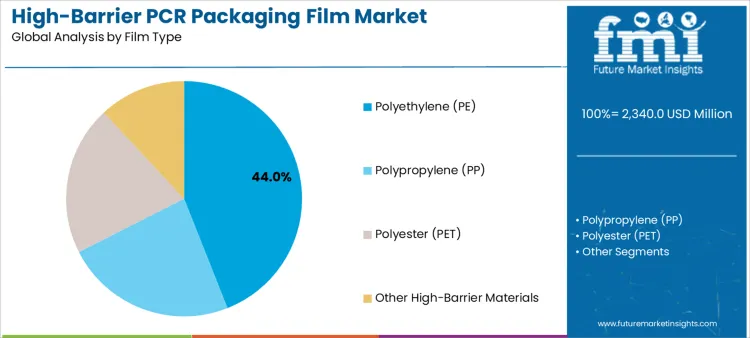
Polyethylene films hold 44.0%, reflecting versatility across flexible formats and compatibility with multilayer barrier structures. Adoption benefits from established recycling streams and broad sealing windows suited to PCR blends. Polypropylene accounts for 32.0%, supporting stiffness, heat resistance, and downgauging in oriented constructions. Polyester represents 16.0%, applied where strength, clarity, and dimensional stability are required. Other high-barrier materials account for 8.0%, addressing niche performance targets through specialty layers or coatings. Film-type segmentation reflects trade-offs among recyclability, processing latitude, and barrier integration.
Key Points
- Polyethylene enables versatile high-barrier constructions.
- Polypropylene supports stiffness and heat resistance.
- Polyester serves clarity and strength-focused designs.
How Does Barrier Type Influence Material Selection in PCR Films?
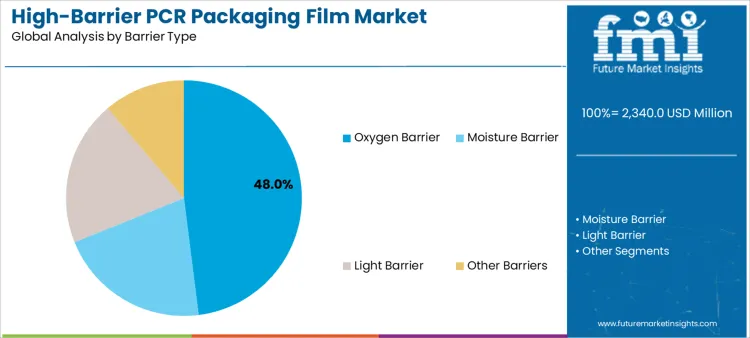
Oxygen barrier represents 48.0%, driven by oxidation control needs for perishable and sensitive contents. Structures emphasize EVOH or coated layers compatible with PCR substrates. Moisture barrier accounts for 32.0%, prioritizing water vapor control to maintain texture and shelf stability. Light barrier holds 14.0%, used to protect photosensitive products through pigments or metallization. Other barriers represent 6.0%, covering aroma retention and gas selectivity. Barrier-type segmentation reflects alignment between product sensitivity and achievable performance within recyclable architectures.
Key Points
- Oxygen control remains the primary protection requirement.
- Moisture management supports texture and shelf stability.
- Light barriers protect photosensitive contents.
Which Applications Drive Demand for High-Barrier PCR Packaging Films?
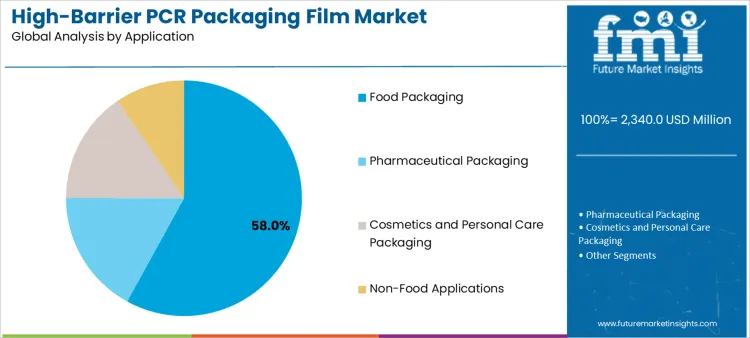
Food packaging accounts for 58.0%, reflecting stringent freshness, safety, and compliance requirements alongside recycled content targets. Pharmaceutical packaging Pharmaceutical packaging represents 18.0%, emphasizing protection, consistency, and validation compatibility. Cosmetics and personal care hold 12.0%, where barrier performance supports stability and sensory quality. Non-food applications account for 12.0%, including household and specialty items requiring protection without food-contact constraints. Application segmentation shows concentration where performance parity and sustainability expectations converge at scale.
Key Points
- Food uses dominate due to protection and compliance needs.
- Pharmaceuticals prioritize consistency and validation fit.
- Cosmetics balance barrier performance with aesthetics.
What are the key dynamics in the high barrier PCR packaging film market?
The high barrier post consumer recycled (PCR) packaging film market is propelled by strict recyclability targets and brand commitments to reduce virgin polymer use while maintaining barrier performance for oxygen, moisture, and aroma protection. Demand concentrates in flexible packaging for food products such as snacks, ready meals, and perishable goods where shelf life and product integrity are essential. Performance expectations center on multi layer PCR films tailored to resist transmission without compromising clarity, seal strength, or processability on high speed converting lines.
How do food preservation requirements and quality retention influence adoption?
Brands that package oxygen sensitive foods such as cured meats, cheese slices, and freeze dried snacks specify high barrier PCR films to ensure shelf life comparable to conventional materials. Barrier performance is measured in oxygen transmission rate (OTR) and water vapor transmission rate (WVTR), with many applications requiring OTR below 1 cc/m²·day and WVTR below 5 g/m²·day to prevent rancidity, moisture loss, and texture degradation. These films are engineered with tie layers and barrier resins compatible with PCR content to balance recyclability with functional needs. Ready to eat meals and chilled foods often incorporate high barrier PCR films that maintain steam retention while preventing external contamination, aligning with cold chain handling. Growing e commerce food fulfillment increases need for sturdy PCR films that protect products against mechanical stress and atmospheric exposure during transport.
What do recycling economics and processing requirements imply for market growth?
Complexity in sourcing consistent, high quality PCR feedstock with low contamination influences film manufacturers’ ability to meet both barrier and sustainability targets. Variability in PCR streams can lead to fluctuations in barrier resin performance, which necessitates tighter quality control and advanced sorting or purification before compounding. Conversion processes such as co extrusion demand precise melt viscosity and layer adhesion, and PCR variants often require formulation adjustments to match performance of virgin polymers. Regulatory regimes on recycled content percentages and food contact approvals shape where high barrier PCR films can be deployed without extensive compliance work. Pricing pressures emerge when multi component film structures with high PCR loading approach cost levels that challenge value positioning in commodity segments, affecting adoption rates outside premium and compliance driven product lines.
How Is Demand for the High-Barrier PCR Packaging Film Market Evolving Globally?
Global demand for high-barrier PCR (Post-Consumer Recycled) packaging films is rising as industries, especially in food, beverage, and consumer goods, prioritize sustainability and circular economy practices. Growth reflects the shift towards incorporating recycled content into packaging to reduce waste and carbon footprint while maintaining packaging performance. High-barrier films are essential for ensuring product freshness, extending shelf life, and providing protection from external elements. India records 8.2% CAGR, China records 7.9% CAGR, Brazil records 7.5% CAGR, USA records 6.4% CAGR, and Germany records 6.1% CAGR. Adoption is driven by regulatory pressures, consumer demand for eco-friendly products, and brand sustainability goals.
| Country | CAGR (%) |
|---|---|
| India | 8.2% |
| China | 7.9% |
| Brazil | 7.5% |
| USA | 6.4% |
| Germany | 6.1% |
What is driving growth of high-barrier PCR packaging film demand in India?
Demand for high-barrier PCR packaging films in India is expanding as manufacturers increasingly shift towards sustainable packaging solutions to meet regulatory requirements and consumer demand for recycled content. Growth at 8.2% CAGR reflects strong adoption across the food and beverage sector, particularly for products requiring long shelf life and freshness. High-barrier films are crucial for maintaining product integrity while using PCR content, which addresses plastic waste concerns. Local producers focus on scaling up PCR packaging capacity to meet growing demand, while cost-effective solutions remain a priority in the competitive market. Demand is strongest in packaged food, dairy products, and convenience foods.
- Regulatory push for sustainable packaging
- Increasing demand for recycled content in packaging
- Focus on food product shelf life and freshness
- Cost-effective solutions for large-scale production
Why is China seeing expansion in high-barrier PCR packaging film adoption?
High-barrier PCR packaging film demand in China is rising as the country’s packaging industry increasingly adopts sustainable practices driven by government mandates and consumer preferences. Growth at 7.9% CAGR reflects the need for packaging solutions that can integrate recycled materials without compromising on performance. The food and beverage sectors, particularly those producing perishable goods, rely on high-barrier films for extended freshness and product protection. As China increases its recycling capacity and focuses on a circular economy, demand for PCR films with high barrier properties is set to continue growing.
- Government regulations on plastic waste and recycling
- Need for extended shelf life in food packaging
- Circular economy and sustainability initiatives
- Growth of consumer demand for eco-friendly packaging
What factors are shaping high-barrier PCR packaging film sales in Brazil?
Sales of high-barrier PCR packaging films in Brazil are increasing as manufacturers adopt more sustainable packaging solutions in response to environmental regulations and consumer demand for eco-friendly products. Growth at 7.5% CAGR reflects the adoption of recycled content in packaging, particularly in the food and beverage sector. The use of high-barrier films allows for better product preservation while utilizing recycled PET, which helps in reducing environmental impact. Local producers are expanding their capacity to meet the growing demand for sustainable packaging solutions that meet both regulatory and consumer expectations.
- Environmental regulations and plastic waste management
- Growing adoption of recycled content in packaging
- Need for better preservation and shelf life in food packaging
- Consumer preference for eco-conscious packaging
How is the USA supporting growth of high-barrier PCR packaging film demand?
High-barrier PCR packaging films demand in the USA is advancing as brands aim to meet sustainability targets while ensuring the quality and protection of packaged goods. Growth at 6.4% CAGR reflects adoption across packaged food, beverage, and consumer goods industries. With a focus on reducing plastic waste, high-barrier PCR films help extend shelf life while maintaining product quality without compromising on recyclability. As regulatory frameworks tighten and consumer preferences for sustainable packaging increase, demand for high-barrier films incorporating recycled content is expected to continue growing.
- Increased sustainability focus in packaging
- Regulatory push for reduced plastic waste
- Need for product protection and long shelf life
- Rising consumer demand for recyclable packaging
What is driving expansion of high-barrier PCR packaging film demand in Germany?
Demand for high-barrier PCR packaging films in Germany is rising as the country’s packaging industry leads in adopting sustainable solutions. Growth at 6.1% CAGR reflects Germany’s commitment to the circular economy, where high-barrier films made from PCR materials are crucial for maintaining packaging performance while reducing waste. Regulatory pressures and consumer preference for eco-friendly products continue to drive adoption, particularly in the food and beverage sectors, where extended shelf life and freshness are important. Local production capacities for PCR films are expanding to meet the demand for high-quality, sustainable packaging solutions.
- Circular economy and sustainability initiatives
- Need for high-performance packaging in food products
- Stringent packaging regulations and recycling targets
- Increasing consumer preference for environmentally friendly products
What is the competitive landscape of demand for the high-barrier PCR packaging film market globally?
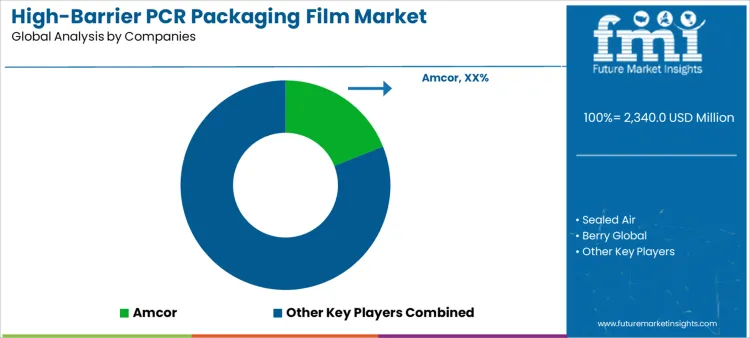
The high-barrier PCR packaging film market is driven by increasing demand for sustainable packaging solutions in the food, beverage, and consumer goods industries. Manufacturers assess barrier performance, film strength, flexibility, and compatibility with post-consumer recycled (PCR) content. Buyer evaluation extends to recyclability, regulatory compliance, and ability to preserve product integrity during storage and transportation. Procurement behavior emphasizes suppliers offering cost-effective, high-performance films while adhering to environmental standards. Trend in the high-barrier PCR packaging film market shows growing adoption as brands push for circular economy practices, and the demand for sustainable packaging intensifies.
Amcor leads competitive positioning with its innovative high-barrier packaging solutions, combining performance and sustainability through advanced PCR film technology. Sealed Air competes by offering barrier films designed for sensitive products requiring long shelf life, focusing on both sustainability and functional performance. Berry Global supports demand with tailored packaging films that offer robust barrier properties and sustainability credentials, particularly in the food and beverage sector. SABIC’s strength lies in its ability to integrate high-quality PCR content into packaging solutions while maintaining product protection and compliance with regulatory standards. Dow Inc. complements this competitive landscape with high-barrier films designed for both food safety and sustainability, advancing its commitment to circular packaging systems. Competitive differentiation is driven by packaging performance, PCR content integration, regulatory compliance, and supply chain sustainability.
Key Players in the High-Barrier PCR Packaging Film Market
- Amcor
- Sealed Air
- Berry Global
- SABIC
- Dow Inc.
- Others
Scope of the Report
| Items | Values |
|---|---|
| Quantitative Units | USD million |
| Film Type | Polyethylene (PE); Polypropylene (PP); Polyester (PET); Other High-Barrier Materials |
| Barrier Type | Oxygen Barrier; Moisture Barrier; Light Barrier; Other Barriers |
| Application | Food Packaging; Pharmaceutical Packaging; Cosmetics and Personal Care Packaging; Non-Food Applications |
| Regions Covered | Asia Pacific, Europe, North America, Latin America, Middle East & Africa |
| Countries Covered | India, China, Brazil, USA, Germany, and 40+ countries |
| Key Companies Profiled | Amcor; Sealed Air; Berry Global; SABIC; Dow Inc.; Others |
| Additional Attributes | Dollar sales by film type, barrier type, and application; performance of high-barrier materials in extending shelf life and preserving product integrity under oxygen, moisture, and light exposure; material compatibility with food, pharmaceutical, and cosmetic packaging requirements; role in sustainable packaging solutions and recycling compatibility; procurement dynamics driven by regulatory pressures, consumer demand for longer shelf life, and supplier collaboration on advanced barrier technologies. |
High-Barrier PCR Packaging Film Market by Segment
Film Type:
- Polyethylene (PE)
- Polypropylene (PP)
- Polyester (PET)
- Other High-Barrier Materials
Barrier Type:
- Oxygen Barrier
- Moisture Barrier
- Light Barrier
- Other Barriers
Application:
- Food Packaging
- Pharmaceutical Packaging
- Cosmetics and Personal Care Packaging
- Non-Food Applications
Region:
- Asia Pacific
- China
- Japan
- South Korea
- India
- Australia & New Zealand
- ASEAN
- Rest of Asia Pacific
- Europe
- Germany
- United Kingdom
- France
- Italy
- Spain
- Nordic
- BENELUX
- Rest of Europe
- North America
- United States
- Canada
- Mexico
- Latin America
- Brazil
- Chile
- Rest of Latin America
- Middle East & Africa
- Kingdom of Saudi Arabia
- Other GCC Countries
- Turkey
- South Africa
- Other African Union
- Rest of Middle East & Africa
Bibliography
- European Commission. (2023). Regulation proposal on packaging and packaging waste (PPWR): Recycled content, recyclability, and barrier material performance requirements. Publications Office of the European Union.
- Food and Agriculture Organization of the United Nations. (2023). Food packaging and shelf-life extension: Barrier materials, recycled plastics, and safety considerations. FAO.
- International Organization for Standardization. (2023). Packaging - Flexible packaging materials - Performance requirements for barrier properties and recyclability (ISO/TR 22047:2023). ISO.
- Marsh, K., & Bugusu, B. (2023). Food packaging materials: Barrier properties, recyclability, and performance trade-offs in multilayer polymer films. Journal of Food Science, 88(9), 4021-4036.
- PlasticsEurope. (2024). Designing high-barrier flexible packaging with recycled polymers: Technical limits and circularity pathways. PlasticsEurope Association.
- Ragaert, K., Huysveld, S., & Van Geem, K. (2023). Recycled polymers in food contact packaging: Barrier performance, contamination risk, and processing constraints. Waste Management, 161, 240-252.
- USA. Food and Drug Administration. (2023). Use of recycled plastics in food packaging: Barrier function, migration, and safety assessment. Center for Food Safety and Applied Nutrition.
Frequently Asked Questions
How big is the high-barrier pcr packaging film market in 2026?
The global high-barrier pcr packaging film market is estimated to be valued at USD 385 Million in 2026.
What will be the size of high-barrier pcr packaging film market in 2036?
The market size for the high-barrier pcr packaging film market is projected to reach USD 646 Million by 2036.
How much will be the high-barrier pcr packaging film market growth between 2026 and 2036?
The high-barrier pcr packaging film market is expected to grow at a 6.4% CAGR between 2026 and 2036.
What are the key product types in the high-barrier pcr packaging film market?
The key product types in high-barrier pcr packaging film market are polyethylene (pe), polypropylene (pp), polyester (pet) and other high-barrier materials.
Which barrier type segment to contribute significant share in the high-barrier pcr packaging film market in 2026?
In terms of barrier type, oxygen barrier segment to command 48.0% share in the high-barrier pcr packaging film market in 2026.
Preview the report firsthand - request a free sample
Get SampleGet the brochure for pricing and purchase details.
Get PDFTable of Content
- Executive Summary
- Global Market Outlook
- Demand-side Trends
- Supply-side Trends
- Technology Roadmap Analysis
- Analysis and Recommendations
- Market Overview
- Market Coverage / Taxonomy
- Market Definition / Scope / Limitations
- Market Background
- Market Dynamics
- Drivers
- Restraints
- Opportunity
- Trends
- Scenario Forecast
- Demand in Optimistic Scenario
- Demand in Likely Scenario
- Demand in Conservative Scenario
- Opportunity Map Analysis
- Product Life Cycle Analysis
- Supply Chain Analysis
- Investment Feasibility Matrix
- Value Chain Analysis
- PESTLE and Porter’s Analysis
- Regulatory Landscape
- Regional Parent Market Outlook
- Production and Consumption Statistics
- Import and Export Statistics
- Market Dynamics
- Global Market Analysis 2021 to 2025 and Forecast, 2026 to 2036
- Historical Market Size Value (USD Million) Analysis, 2021 to 2025
- Current and Future Market Size Value (USD Million) Projections, 2026 to 2036
- Y-o-Y Growth Trend Analysis
- Absolute $ Opportunity Analysis
- Global Market Pricing Analysis 2021 to 2025 and Forecast 2026 to 2036
- Global Market Analysis 2021 to 2025 and Forecast 2026 to 2036, By Film Type
- Introduction / Key Findings
- Historical Market Size Value (USD Million) Analysis By Film Type, 2021 to 2025
- Current and Future Market Size Value (USD Million) Analysis and Forecast By Film Type, 2026 to 2036
- Polyethylene (PE)
- Polypropylene (PP)
- Polyester (PET)
- Other High-Barrier Materials
- Polyethylene (PE)
- Y-o-Y Growth Trend Analysis By Film Type, 2021 to 2025
- Absolute $ Opportunity Analysis By Film Type, 2026 to 2036
- Global Market Analysis 2021 to 2025 and Forecast 2026 to 2036, By Barrier Type
- Introduction / Key Findings
- Historical Market Size Value (USD Million) Analysis By Barrier Type, 2021 to 2025
- Current and Future Market Size Value (USD Million) Analysis and Forecast By Barrier Type, 2026 to 2036
- Oxygen Barrier
- Moisture Barrier
- Light Barrier
- Other Barriers
- Oxygen Barrier
- Y-o-Y Growth Trend Analysis By Barrier Type, 2021 to 2025
- Absolute $ Opportunity Analysis By Barrier Type, 2026 to 2036
- Global Market Analysis 2021 to 2025 and Forecast 2026 to 2036, By Application
- Introduction / Key Findings
- Historical Market Size Value (USD Million) Analysis By Application, 2021 to 2025
- Current and Future Market Size Value (USD Million) Analysis and Forecast By Application, 2026 to 2036
- Food Packaging
- Pharmaceutical Packaging
- Cosmetics and Personal Care Packaging
- Non-Food Applications
- Food Packaging
- Y-o-Y Growth Trend Analysis By Application, 2021 to 2025
- Absolute $ Opportunity Analysis By Application, 2026 to 2036
- Global Market Analysis 2021 to 2025 and Forecast 2026 to 2036, By Region
- Introduction
- Historical Market Size Value (USD Million) Analysis By Region, 2021 to 2025
- Current Market Size Value (USD Million) Analysis and Forecast By Region, 2026 to 2036
- North America
- Latin America
- Western Europe
- Eastern Europe
- East Asia
- South Asia and Pacific
- Middle East & Africa
- Market Attractiveness Analysis By Region
- North America Market Analysis 2021 to 2025 and Forecast 2026 to 2036, By Country
- Historical Market Size Value (USD Million) Trend Analysis By Market Taxonomy, 2021 to 2025
- Market Size Value (USD Million) Forecast By Market Taxonomy, 2026 to 2036
- By Country
- USA
- Canada
- Mexico
- By Film Type
- By Barrier Type
- By Application
- By Country
- Market Attractiveness Analysis
- By Country
- By Film Type
- By Barrier Type
- By Application
- Key Takeaways
- Latin America Market Analysis 2021 to 2025 and Forecast 2026 to 2036, By Country
- Historical Market Size Value (USD Million) Trend Analysis By Market Taxonomy, 2021 to 2025
- Market Size Value (USD Million) Forecast By Market Taxonomy, 2026 to 2036
- By Country
- Brazil
- Chile
- Rest of Latin America
- By Film Type
- By Barrier Type
- By Application
- By Country
- Market Attractiveness Analysis
- By Country
- By Film Type
- By Barrier Type
- By Application
- Key Takeaways
- Western Europe Market Analysis 2021 to 2025 and Forecast 2026 to 2036, By Country
- Historical Market Size Value (USD Million) Trend Analysis By Market Taxonomy, 2021 to 2025
- Market Size Value (USD Million) Forecast By Market Taxonomy, 2026 to 2036
- By Country
- Germany
- UK
- Italy
- Spain
- France
- Nordic
- BENELUX
- Rest of Western Europe
- By Film Type
- By Barrier Type
- By Application
- By Country
- Market Attractiveness Analysis
- By Country
- By Film Type
- By Barrier Type
- By Application
- Key Takeaways
- Eastern Europe Market Analysis 2021 to 2025 and Forecast 2026 to 2036, By Country
- Historical Market Size Value (USD Million) Trend Analysis By Market Taxonomy, 2021 to 2025
- Market Size Value (USD Million) Forecast By Market Taxonomy, 2026 to 2036
- By Country
- Russia
- Poland
- Hungary
- Balkan & Baltic
- Rest of Eastern Europe
- By Film Type
- By Barrier Type
- By Application
- By Country
- Market Attractiveness Analysis
- By Country
- By Film Type
- By Barrier Type
- By Application
- Key Takeaways
- East Asia Market Analysis 2021 to 2025 and Forecast 2026 to 2036, By Country
- Historical Market Size Value (USD Million) Trend Analysis By Market Taxonomy, 2021 to 2025
- Market Size Value (USD Million) Forecast By Market Taxonomy, 2026 to 2036
- By Country
- China
- Japan
- South Korea
- By Film Type
- By Barrier Type
- By Application
- By Country
- Market Attractiveness Analysis
- By Country
- By Film Type
- By Barrier Type
- By Application
- Key Takeaways
- South Asia and Pacific Market Analysis 2021 to 2025 and Forecast 2026 to 2036, By Country
- Historical Market Size Value (USD Million) Trend Analysis By Market Taxonomy, 2021 to 2025
- Market Size Value (USD Million) Forecast By Market Taxonomy, 2026 to 2036
- By Country
- India
- ASEAN
- Australia & New Zealand
- Rest of South Asia and Pacific
- By Film Type
- By Barrier Type
- By Application
- By Country
- Market Attractiveness Analysis
- By Country
- By Film Type
- By Barrier Type
- By Application
- Key Takeaways
- Middle East & Africa Market Analysis 2021 to 2025 and Forecast 2026 to 2036, By Country
- Historical Market Size Value (USD Million) Trend Analysis By Market Taxonomy, 2021 to 2025
- Market Size Value (USD Million) Forecast By Market Taxonomy, 2026 to 2036
- By Country
- Kingdom of Saudi Arabia
- Other GCC Countries
- Turkiye
- South Africa
- Other African Union
- Rest of Middle East & Africa
- By Film Type
- By Barrier Type
- By Application
- By Country
- Market Attractiveness Analysis
- By Country
- By Film Type
- By Barrier Type
- By Application
- Key Takeaways
- Key Countries Market Analysis
- USA
- Pricing Analysis
- Market Share Analysis, 2025
- By Film Type
- By Barrier Type
- By Application
- Canada
- Pricing Analysis
- Market Share Analysis, 2025
- By Film Type
- By Barrier Type
- By Application
- Mexico
- Pricing Analysis
- Market Share Analysis, 2025
- By Film Type
- By Barrier Type
- By Application
- Brazil
- Pricing Analysis
- Market Share Analysis, 2025
- By Film Type
- By Barrier Type
- By Application
- Chile
- Pricing Analysis
- Market Share Analysis, 2025
- By Film Type
- By Barrier Type
- By Application
- Germany
- Pricing Analysis
- Market Share Analysis, 2025
- By Film Type
- By Barrier Type
- By Application
- UK
- Pricing Analysis
- Market Share Analysis, 2025
- By Film Type
- By Barrier Type
- By Application
- Italy
- Pricing Analysis
- Market Share Analysis, 2025
- By Film Type
- By Barrier Type
- By Application
- Spain
- Pricing Analysis
- Market Share Analysis, 2025
- By Film Type
- By Barrier Type
- By Application
- France
- Pricing Analysis
- Market Share Analysis, 2025
- By Film Type
- By Barrier Type
- By Application
- India
- Pricing Analysis
- Market Share Analysis, 2025
- By Film Type
- By Barrier Type
- By Application
- ASEAN
- Pricing Analysis
- Market Share Analysis, 2025
- By Film Type
- By Barrier Type
- By Application
- Australia & New Zealand
- Pricing Analysis
- Market Share Analysis, 2025
- By Film Type
- By Barrier Type
- By Application
- China
- Pricing Analysis
- Market Share Analysis, 2025
- By Film Type
- By Barrier Type
- By Application
- Japan
- Pricing Analysis
- Market Share Analysis, 2025
- By Film Type
- By Barrier Type
- By Application
- South Korea
- Pricing Analysis
- Market Share Analysis, 2025
- By Film Type
- By Barrier Type
- By Application
- Russia
- Pricing Analysis
- Market Share Analysis, 2025
- By Film Type
- By Barrier Type
- By Application
- Poland
- Pricing Analysis
- Market Share Analysis, 2025
- By Film Type
- By Barrier Type
- By Application
- Hungary
- Pricing Analysis
- Market Share Analysis, 2025
- By Film Type
- By Barrier Type
- By Application
- Kingdom of Saudi Arabia
- Pricing Analysis
- Market Share Analysis, 2025
- By Film Type
- By Barrier Type
- By Application
- Turkiye
- Pricing Analysis
- Market Share Analysis, 2025
- By Film Type
- By Barrier Type
- By Application
- South Africa
- Pricing Analysis
- Market Share Analysis, 2025
- By Film Type
- By Barrier Type
- By Application
- USA
- Market Structure Analysis
- Competition Dashboard
- Competition Benchmarking
- Market Share Analysis of Top Players
- By Regional
- By Film Type
- By Barrier Type
- By Application
- Competition Analysis
- Competition Deep Dive
- Amcor
- Overview
- Product Portfolio
- Profitability by Market Segments (Product/Age /Sales Channel/Region)
- Sales Footprint
- Strategy Overview
- Marketing Strategy
- Product Strategy
- Channel Strategy
- Sealed Air
- Berry Global
- SABIC
- Dow Inc.
- Others
- Amcor
- Competition Deep Dive
- Assumptions & Acronyms Used
- Research Methodology


