

- Industry Size (2026)
- USD 554 Mn
- Forecast (2036)
- USD 947 Mn
- CAGR (2026 to 2036)
- 6.6%
PCR Shrink and Stretch Film Market Forecast and Outlook 2026 to 2036
The PCR shrink and stretch film market is valued at USD 554 Million in 2026 and is projected to reach USD 947 Million by 2036, reflecting a CAGR of 6.6%. This category occupies a strategic position within flexible packaging because it links recycled resin supply with brand facing performance requirements. Demand growth depends on consistent PCR feedstock quality, extrusion reliability, and downstream compatibility with automated wrapping systems. Cost structures are sensitive to resin pricing volatility and yield losses during film conversion. Producers controlling material sourcing and formulation retain greater pricing leverage with industrial buyers. That dynamic defines early value capture.
Between 2026 and 2036, strategic importance increases as packaging owners rely on these films to meet regulatory and customer content thresholds. Control points concentrate around resin procurement contracts, qualification approvals, and converter relationships. Suppliers lacking secure PCR access face margin pressure and delivery risk. Brand owners favor partners that balance performance consistency with documented recycled content. Strategic tradeoffs emerge between cost control, material availability, and line efficiency. Firms integrating upstream sourcing with downstream conversion capture steadier margins. Outcomes increasingly depend on coordination rather than scale expansion alone.
Quick Stats for PCR Shrink and Stretch Film Market
- PCR Shrink and Stretch Film Market Value (2026): USD 554 Million
- PCR Shrink and Stretch Film Market Forecast Value (2036): USD 947 Million
- PCR Shrink and Stretch Film Market Forecast CAGR (2026 to 2036): 6.6%
- Leading Type in PCR Shrink and Stretch Film Market: Stretch films
- Key Growth Regions in PCR Shrink and Stretch Film Market: Asia Pacific, Europe, North America
- Top Players in PCR Shrink and Stretch Film Market: Berry Global, Trioworld, Hualun Packaging, UFlex, Nitto Denko, Amcor
What Is the Growth Forecast for PCR Shrink and Stretch Film Market through 2036?
From 2026 to 2031, the PCR shrink and stretch film market grows, reflecting an expansion phase that remains below saturation thresholds. Annual values rise gradually, indicating increasing penetration across packaging applications. During this stage, demand is still absorption driven, supported by broader acceptance of post-consumer recycled content in secondary and tertiary packaging. Historical adoption was limited by performance consistency and supply constraints, while future growth in this phase reflects improving material reliability, expanding converter capacity, and wider uptake across food, beverage, and consumer goods distribution chains.
Between 2031 and 2036, the market advances, approaching early saturation in mature packaging segments. Annual values accelerate, signaling stronger utilization of available demand pools. Earlier growth was driven by substitution of virgin films, while later expansion reflects deeper penetration within existing users rather than new application creation. Saturation effects begin to emerge in developed markets as adoption reaches scale, shifting growth emphasis toward volume optimization, thicker gauge applications, and incremental demand from logistics and pallet stabilization uses rather than broad category expansion.
PCR Shrink and Stretch Film Market Key Takeaways
| Metric | Value |
|---|---|
| Market Value (2026) | USD 554 Million |
| Forecast Value (2036) | USD 947 Million |
| Forecast CAGR (2026 to 2036) | 6.6% |
What Is Driving Growth in the PCR Shrink and Stretch Film Market?
Growth in the post-consumer recycled (PCR) shrink and stretch film market is emerging from evolving circular economy expectations and practical limitations in conventional film recycling. Standard shrink and stretch films used for palletising and packaging are typically made from virgin polyethylene and possess performance attributes calibrated for strength, elongation, and cling properties. Mechanical recycling of used films often yields inconsistent resin quality due to contamination, variable polymer grades, and mixed waste streams. This variability historically relegated recycled outputs to low-value applications rather than reuse in performance-critical films, limiting PCR content uptake. Market growth now reflects efforts to enhance material quality and integrate recycled polymers into high-use film formats without sacrificing functional requirements.
Future growth is being shaped by regulatory recycled content mandates, corporate sustainable packaging commitments, and supply chain demand for traceable circular materials. Governments in multiple regions are establishing minimum recycled content requirements for plastic packaging, including films, to reduce landfill demand and lower carbon footprints. Brand owners and retailers are responding by specifying PCR in their packaging guidelines, driving demand for films that balance environmental claims with mechanical reliability. Technology improvements in compatibilisers, stabilisers, and resin reconditioning processes are expanding the achievable PCR percentage in shrink and stretch films, supporting compliance without performance compromise. Logistic and industrial users also preference PCR films to align with environmental reporting and procurement criteria that prioritise recyclability and reduced reliance on virgin polymers.
What Factors Are Affecting the Demand for PCR Shrink and Stretch Film Market in Terms of Film Type and Material?
The PCR shrink and stretch film market is driven by packaging sustainability mandates, retailer recycled content targets, and rising acceptance of post-consumer resin in secondary packaging. Demand concentrates on film types and materials that balance recycled content with mechanical performance and process reliability. Market leadership reflects compatibility with high-speed packaging operations and predictable supply of recycled polymers rather than experimentation with novel film structures.
What Is Driving Leadership by Film Type in the PCR Shrink and Stretch Film Market?
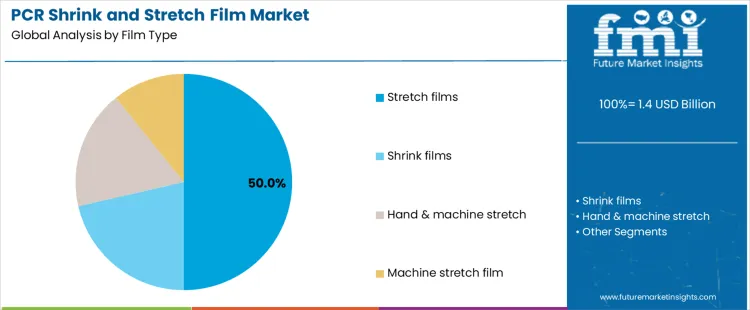
Stretch films account for about 50% of demand because they are widely used in pallet wrapping, load stabilization, and transport packaging across logistics and manufacturing sectors. These applications prioritize tensile strength, elongation, and puncture resistance, making stretch film a high-volume, repeat-use product. The transition to PCR content has progressed faster in stretch films because performance requirements can be met through blending and downgauging strategies. Hand and machine stretch films are easily adapted to PCR incorporation without altering wrapping equipment, supporting adoption across warehouses and distribution centers. Consistent demand from e-commerce, FMCG, and industrial supply chains reinforces stretch film leadership.
Shrink films represent a smaller share because they are more sensitive to optical clarity, shrink force control, and seal integrity. These requirements complicate PCR integration, particularly where packaging aesthetics are critical. While shrink films are used in multipacks and retail display, lower volumes and tighter specifications slow conversion. Machine stretch film variants further reinforce stretch dominance due to automation compatibility. Film type leadership therefore reflects functional tolerance to recycled content and volume intensity rather than total packaging diversity across end uses.
What Is Driving Leadership by Material in the PCR Shrink and Stretch Film Market?
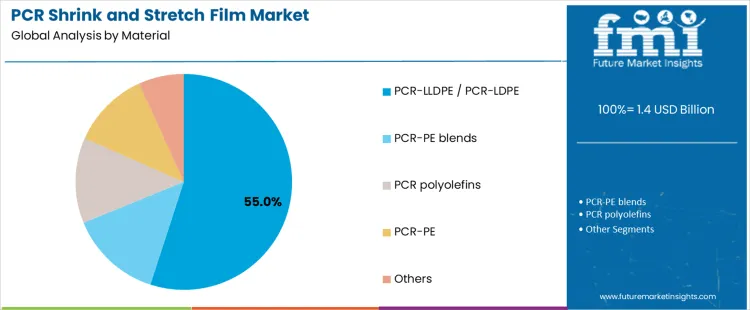
PCR-LLDPE and PCR-LDPE account for about 55% of demand because these resins offer a balance of flexibility, strength, and processability suitable for stretch film applications. Established recycling streams for polyethylene films support more consistent resin quality, enabling converters to meet mechanical performance thresholds. These materials integrate well with existing extrusion lines and allow blending with virgin resin to achieve targeted recycled content levels. Brand and retailer specifications often reference PCR-PE grades, reinforcing demand concentration. Material familiarity across converters reduces qualification time and operational risk, accelerating adoption.
PCR-PE blends and broader PCR polyolefin materials support additional applications but face variability challenges. Blends help manage property fluctuations but increase formulation complexity. Shrink film materials require tighter control of melt behavior and optics, limiting acceptable PCR ratios. Other materials remain niche due to supply inconsistency or performance tradeoffs. Material leadership therefore reflects availability, consistency, and compatibility with high-throughput film production rather than maximum recycled content potential alone.
How Is the PCR Shrink and Stretch Film Market Being Applied Across Packaging and Logistics?
Use appears in food, beverage, and consumer goods packaging where post-consumer recycled (PCR) films replace virgin polymers for pallet wrapping, bundling, and unitizing products. Manufacturers adopt PCR shrink and stretch films to reduce environmental impact while maintaining tensile strength, elasticity, and puncture resistance. Retailers and logistics providers integrate these films to secure shipments, protect products during transit, and optimize storage. These applications reflect operational and sustainability priorities rather than aesthetic objectives, with adoption driven by recyclate utilization, packaging performance, and regulatory compliance.
What Operational and Material Conditions Support Adoption of PCR Shrink and Stretch Films?
Selection aligns with production lines capable of processing recycled polymer resins with consistent melt flow and film thickness. Extrusion, casting, or blown-film processes are optimized to ensure uniform stretchability, shrink ratio, and mechanical properties. Quality control monitors puncture resistance, cling performance, and dimensional stability to meet packaging standards. Brand owners specify PCR content levels to achieve environmental certifications without compromising packaging efficiency. These conditions emerge from operational reliability, material performance, and sustainability priorities in structured packaging workflows.
Which Practical Considerations Limit Wider Use of PCR Shrink and Stretch Films?
Variability in recycled feedstock can affect clarity, strength, and stretchability, requiring process adjustments. Cost per unit may be higher compared with conventional virgin films in some regions. Compatibility with automated wrapping or shrink tunnels must be ensured to prevent operational inefficiency. Regulatory and certification requirements influence adoption in food-contact and sensitive applications. These factors lead to selective deployment where recyclate integration, packaging performance, and sustainability goals justify incremental cost and operational adaptation.
What is the Demand for PCR Shrink and Stretch Film by Country?
| Country | CAGR (%) |
|---|---|
| USA | 8.8% |
| Germany | 7.6% |
| China | 11.8% |
| India | 12.8% |
| Brazil | 8.2% |
The demand for PCR shrink and stretch film varies across countries, driven by sustainable packaging adoption, retail and industrial packaging requirements, and circular economy initiatives. India leads with a 12.8% CAGR, supported by growing e commerce, food and beverage packaging, and rising use of recycled plastics in flexible packaging. China follows at 11.8%, driven by large scale manufacturing, industrial packaging adoption, and regulatory focus on recycled content. The USA grows at 8.8%, reflecting steady adoption in retail, logistics, and industrial sectors. Brazil records 8.2%, shaped by packaging modernization and sustainability initiatives. Germany posts 7.6%, supported by mature packaging markets and regulatory compliance.
How Is the PCR Shrink and Stretch Film Market Expanding in the United States?
In the United States, the PCR Shrink and Stretch Film Market is growing at a CAGR of 8.8% through 2036, driven by increasing adoption of recycled-content films in packaging, logistics, and retail applications. Companies are integrating post-consumer recycled (PCR) films to meet sustainability goals, reduce virgin plastic usage, and comply with corporate ESG standards. Demand is concentrated in e-commerce packaging, food and beverage operations, and warehouse distribution centers. Compared to Germany, where regulatory compliance is the main adoption driver, the USA market emphasizes both sustainability and supply chain efficiency. Domestic suppliers provide high-performance, flexible PCR films suitable for recurring packaging operations.
- E-commerce packaging, food and beverage, and distribution centers drive adoption
- PCR films reduce virgin plastic use and support sustainability goals
- Domestic suppliers provide high-performance, flexible recycled-content films
- Recurring packaging operations sustain long-term adoption
How Are Regulatory and Sustainability Standards Driving Growth in Germany?
Germany is witnessing growth at a CAGR of 7.6% through 2036, supported by EU packaging regulations and mandates for recycled content. Food and beverage manufacturers, warehouse distributors, and logistics companies are adopting PCR shrink and stretch films to reduce environmental impact and ensure compliance. Demand is concentrated in industrial packaging hubs, retail distribution centers, and food processing facilities. Compared to the USA, Germany’s growth is more compliance-driven than efficiency-focused. Domestic suppliers provide high-quality, EU-compliant films suitable for repeated use and various stretch or shrink applications. Recurring packaging cycles and regulatory audits sustain steady adoption nationwide.
- Industrial packaging hubs, distribution centers, and food processing facilities drive adoption
- Films reduce environmental impact and ensure regulatory compliance
- Domestic suppliers provide EU-compliant, high-quality recycled-content films
- Recurring packaging cycles sustain steady adoption
How Is Industrial Expansion Driving Adoption in China?
In China, the market is expanding at a CAGR of 11.8% through 2036, fueled by rapid growth in e-commerce, food and beverage production, and warehouse logistics. Companies are adopting PCR shrink and stretch films to meet sustainability initiatives, reduce virgin plastic consumption, and optimize packaging operations. Demand is concentrated in urban industrial zones, manufacturing clusters, and logistics hubs. Domestic suppliers are scaling production of high-performance, recycled-content films compatible with automated packaging lines. Compared to Brazil, adoption focuses on large-scale industrial integration and urban distribution efficiency. Recurring packaging operations sustain rapid adoption nationwide.
- Urban industrial zones, manufacturing clusters, and logistics hubs drive adoption
- PCR films reduce virgin plastic use and optimize packaging operations
- Domestic suppliers scale high-performance, recycled-content films
- Recurring packaging operations sustain rapid adoption
How Is Packaging Growth Supporting Market Expansion in India?
In India, revenue is growing at a CAGR of 12.8% through 2036, supported by expansion of industrial parks, food and beverage processing, and e-commerce distribution networks. Companies are adopting PCR shrink and stretch films to meet sustainability targets, reduce virgin plastic consumption, and improve operational efficiency. Demand is concentrated in urban industrial clusters, warehouse facilities, and food and beverage manufacturers. Domestic suppliers provide cost-effective, high-performance PCR films compatible with automated packaging and logistics operations. Compared to China, adoption in India is heavily influenced by emerging industrial zones and regulatory encouragement. Recurring packaging cycles sustain robust adoption nationwide.
- Industrial clusters, warehouse facilities, and food and beverage manufacturers drive adoption
- Films reduce virgin plastic use and support sustainability targets
- Domestic suppliers provide cost-effective, high-performance films
- Recurring packaging cycles sustain robust adoption
How Are Industrial Hubs Driving Market Growth in Brazil?
In Brazil, the market is growing at a CAGR of 8.2% through 2036, driven by regional industrial hubs, packaging manufacturers, and logistics networks adopting PCR shrink and stretch films. Companies are using recycled-content films to improve environmental compliance, reduce virgin plastic usage, and support corporate sustainability initiatives. Demand is concentrated in chemical and manufacturing hubs, warehouse facilities, and food packaging operations. Domestic suppliers provide high-performance, flexible PCR films suitable for recurring packaging applications. Compared to India and China, adoption is focused on established hubs rather than emerging industrial zones. Recurring packaging operations sustain steady market growth.
- Industrial hubs, warehouse facilities, and food packaging operations drive adoption
- Films improve environmental compliance and reduce virgin plastic usage
- Domestic suppliers provide high-performance, flexible PCR films
- Recurring packaging operations sustain steady adoption
Which Strategic Approaches Define Competition in the PCR Shrink and Stretch Film Market through Processing Constraints and End-Use Acceptance?
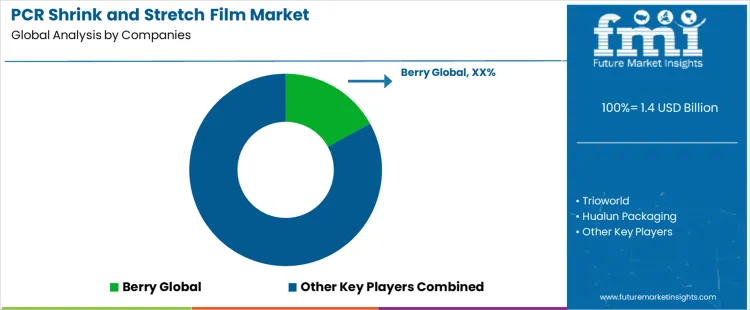
Competition in the PCR shrink and stretch film market is shaped by how effectively recycled content is incorporated without compromising runnability on high speed packaging lines. Berry Global and Amcor approach this market through controlled PCR integration, prioritizing film gauge consistency, tensile strength, and seal behavior to meet brand owner and logistics requirements. Trioworld emphasizes process discipline and feedstock selection, aligning PCR film performance with pallet wrapping and transport stability needs. Nitto Denko participates selectively, focusing on specialty stretch films where performance tolerance is narrower and qualification standards are higher. Across these suppliers, competitive positioning depends on minimizing film breaks, maintaining load containment, and delivering predictable performance across variable PCR input quality.
Execution at the conversion level plays a decisive role in market outcomes. Hualun Packaging and UFlex compete by scaling PCR film production for cost sensitive and export oriented applications, balancing recycled content targets with operational efficiency. Local converters influence adoption by tailoring formulations to regional waste streams, machine configurations, and customer handling practices. In many cases, qualification is driven by warehouse trials rather than laboratory testing, placing emphasis on real world stretch behavior and tear resistance. Competitive advantage is built through processing know how, feedstock control, and customer collaboration. The market rewards suppliers that can stabilize performance under variable recyclate conditions rather than those pursuing maximum recycled content at the expense of operational reliability.
Key Players in the PCR Shrink and Stretch Film Market
- Berry Global
- Trioworld
- Hualun Packaging
- UFlex
- Local converters
- Nitto Denko
- Amcor
Scope of the Report
| Items | Values |
|---|---|
| Quantitative Units (2026) | USD million |
| Type | Stretch Films, Shrink Films, Hand Stretch Films, Machine Stretch Films |
| Application | Pallet Wrapping and Logistics, Industrial Packaging, Manufacturing Exports, FMCG and Warehousing, Beverage and Food Logistics |
| End User | Packaging Converters, Logistics and Warehousing Operators, Food and Beverage Manufacturers, FMCG Producers, Industrial Exporters |
| Regions Covered | Asia Pacific, Europe, North America, Latin America, Middle East & Africa |
| Countries Covered | USA, Germany, China, India, Japan, South Korea, Brazil, United Kingdom, France, Italy, Canada, Mexico, ASEAN countries, GCC countries, and other global regions |
| Key Companies Profiled | Berry Global, Trioworld, Amcor, UFlex, Hualun Packaging, Nitto Denko, Local Converters |
| Additional Attributes | Dollar sales by film type and material categories, regional adoption trends across Asia Pacific, Europe, and North America, competitive landscape across global and regional flexible packaging converters, PCR feedstock sourcing and qualification requirements, processing and performance considerations across automated packaging and logistics systems |
PCR Shrink and Stretch Film Market Segmentation
End-use:
- Pallet wrapping & logistics
- Industrial packaging
- Manufacturing exports
- FMCG & warehousing
- Beverage & food logistics
- Precision logistics
Film Type:
- Stretch films
- Shrink films
- Hand & machine stretch
- Machine stretch film
Material:
- PCR-LLDPE / PCR-LDPE
- PCR-PE blends
- PCR polyolefins
- PCR-PE
- Others
Technology:
- Downgauging & PCR stabilisation
- Multi-layer co-extrusion
- High-output blown film lines
- Cost-optimised PCR compounding
- Others
Region
- Asia Pacific
- China
- Japan
- South Korea
- India
- Australia & New Zealand
- ASEAN
- Rest of Asia Pacific
- Europe
- Germany
- United Kingdom
- France
- Italy
- Spain
- Nordic
- BENELUX
- Rest of Europe
- North America
- United States
- Canada
- Mexico
- Latin America
- Brazil
- Chile
- Rest of Latin America
- Middle East & Africa
- Kingdom of Saudi Arabia
- Other GCC Countries
- Turkey
- South Africa
- Other African Union
- Rest of Middle East & Africa
Frequently Asked Questions
How big is the PCR shrink and stretch film market in 2026?
The global PCR shrink and stretch film market is estimated to be valued at USD 554 Million in 2026.
What will be the size of PCR shrink and stretch film market in 2036?
The market size for the PCR shrink and stretch film market is projected to reach USD 947 Million by 2036.
How much will be the PCR shrink and stretch film market growth between 2026 and 2036?
The PCR shrink and stretch film market is expected to grow at a 6.6% CAGR between 2026 and 2036.
What are the key product types in the PCR shrink and stretch film market?
The key product types in PCR shrink and stretch film market are pallet wrapping & logistics, industrial packaging, manufacturing exports, FMCG & warehousing, beverage & food logistics and precision logistics.
Which film type segment to contribute significant share in the PCR shrink and stretch film market in 2026?
In terms of film type, stretch films segment to command 50.0% share in the PCR shrink and stretch film market in 2026.
Preview the report firsthand - request a free sample
Get SampleGet the brochure for pricing and purchase details.
Get PDFTable of Content
- Executive Summary
- Global Market Outlook
- Demand-side Trends
- Supply-side Trends
- Technology Roadmap Analysis
- Analysis and Recommendations
- Market Overview
- Market Coverage / Taxonomy
- Market Definition / Scope / Limitations
- Market Background
- Market Dynamics
- Drivers
- Restraints
- Opportunity
- Trends
- Scenario Forecast
- Demand in Optimistic Scenario
- Demand in Likely Scenario
- Demand in Conservative Scenario
- Opportunity Map Analysis
- Product Life Cycle Analysis
- Supply Chain Analysis
- Investment Feasibility Matrix
- Value Chain Analysis
- PESTLE and Porter’s Analysis
- Regulatory Landscape
- Regional Parent Market Outlook
- Production and Consumption Statistics
- Import and Export Statistics
- Market Dynamics
- Global Market Analysis 2021 to 2025 and Forecast, 2026 to 2036
- Historical Market Size Value (USD Million) Analysis, 2021 to 2025
- Current and Future Market Size Value (USD Million) Projections, 2026 to 2036
- Y-o-Y Growth Trend Analysis
- Absolute $ Opportunity Analysis
- Global Market Pricing Analysis 2021 to 2025 and Forecast 2026 to 2036
- Global Market Analysis 2021 to 2025 and Forecast 2026 to 2036, By End-use
- Introduction / Key Findings
- Historical Market Size Value (USD Million) Analysis By End-use , 2021 to 2025
- Current and Future Market Size Value (USD Million) Analysis and Forecast By End-use , 2026 to 2036
- Pallet wrapping & logistics
- Industrial packaging
- Manufacturing exports
- FMCG & warehousing
- Beverage & food logistics
- Precision logistics
- Pallet wrapping & logistics
- Y-o-Y Growth Trend Analysis By End-use , 2021 to 2025
- Absolute $ Opportunity Analysis By End-use , 2026 to 2036
- Global Market Analysis 2021 to 2025 and Forecast 2026 to 2036, By Film Type
- Introduction / Key Findings
- Historical Market Size Value (USD Million) Analysis By Film Type, 2021 to 2025
- Current and Future Market Size Value (USD Million) Analysis and Forecast By Film Type, 2026 to 2036
- Stretch films
- Shrink films
- Hand & machine stretch
- Machine stretch film
- Stretch films
- Y-o-Y Growth Trend Analysis By Film Type, 2021 to 2025
- Absolute $ Opportunity Analysis By Film Type, 2026 to 2036
- Global Market Analysis 2021 to 2025 and Forecast 2026 to 2036, By Material
- Introduction / Key Findings
- Historical Market Size Value (USD Million) Analysis By Material, 2021 to 2025
- Current and Future Market Size Value (USD Million) Analysis and Forecast By Material, 2026 to 2036
- PCR-LLDPE / PCR-LDPE
- PCR-PE blends
- PCR polyolefins
- PCR-PE
- Others
- PCR-LLDPE / PCR-LDPE
- Y-o-Y Growth Trend Analysis By Material, 2021 to 2025
- Absolute $ Opportunity Analysis By Material, 2026 to 2036
- Global Market Analysis 2021 to 2025 and Forecast 2026 to 2036, By Technology
- Introduction / Key Findings
- Historical Market Size Value (USD Million) Analysis By Technology, 2021 to 2025
- Current and Future Market Size Value (USD Million) Analysis and Forecast By Technology, 2026 to 2036
- Downgauging & PCR stabilisation
- Multi-layer co-extrusion
- High-output blown film lines
- Cost-optimised PCR compounding
- Others
- Downgauging & PCR stabilisation
- Y-o-Y Growth Trend Analysis By Technology, 2021 to 2025
- Absolute $ Opportunity Analysis By Technology, 2026 to 2036
- Global Market Analysis 2021 to 2025 and Forecast 2026 to 2036, By Region
- Introduction
- Historical Market Size Value (USD Million) Analysis By Region, 2021 to 2025
- Current Market Size Value (USD Million) Analysis and Forecast By Region, 2026 to 2036
- North America
- Latin America
- Western Europe
- Eastern Europe
- East Asia
- South Asia and Pacific
- Middle East & Africa
- Market Attractiveness Analysis By Region
- North America Market Analysis 2021 to 2025 and Forecast 2026 to 2036, By Country
- Historical Market Size Value (USD Million) Trend Analysis By Market Taxonomy, 2021 to 2025
- Market Size Value (USD Million) Forecast By Market Taxonomy, 2026 to 2036
- By Country
- USA
- Canada
- Mexico
- By End-use
- By Film Type
- By Material
- By Technology
- By Country
- Market Attractiveness Analysis
- By Country
- By End-use
- By Film Type
- By Material
- By Technology
- Key Takeaways
- Latin America Market Analysis 2021 to 2025 and Forecast 2026 to 2036, By Country
- Historical Market Size Value (USD Million) Trend Analysis By Market Taxonomy, 2021 to 2025
- Market Size Value (USD Million) Forecast By Market Taxonomy, 2026 to 2036
- By Country
- Brazil
- Chile
- Rest of Latin America
- By End-use
- By Film Type
- By Material
- By Technology
- By Country
- Market Attractiveness Analysis
- By Country
- By End-use
- By Film Type
- By Material
- By Technology
- Key Takeaways
- Western Europe Market Analysis 2021 to 2025 and Forecast 2026 to 2036, By Country
- Historical Market Size Value (USD Million) Trend Analysis By Market Taxonomy, 2021 to 2025
- Market Size Value (USD Million) Forecast By Market Taxonomy, 2026 to 2036
- By Country
- Germany
- UK
- Italy
- Spain
- France
- Nordic
- BENELUX
- Rest of Western Europe
- By End-use
- By Film Type
- By Material
- By Technology
- By Country
- Market Attractiveness Analysis
- By Country
- By End-use
- By Film Type
- By Material
- By Technology
- Key Takeaways
- Eastern Europe Market Analysis 2021 to 2025 and Forecast 2026 to 2036, By Country
- Historical Market Size Value (USD Million) Trend Analysis By Market Taxonomy, 2021 to 2025
- Market Size Value (USD Million) Forecast By Market Taxonomy, 2026 to 2036
- By Country
- Russia
- Poland
- Hungary
- Balkan & Baltic
- Rest of Eastern Europe
- By End-use
- By Film Type
- By Material
- By Technology
- By Country
- Market Attractiveness Analysis
- By Country
- By End-use
- By Film Type
- By Material
- By Technology
- Key Takeaways
- East Asia Market Analysis 2021 to 2025 and Forecast 2026 to 2036, By Country
- Historical Market Size Value (USD Million) Trend Analysis By Market Taxonomy, 2021 to 2025
- Market Size Value (USD Million) Forecast By Market Taxonomy, 2026 to 2036
- By Country
- China
- Japan
- South Korea
- By End-use
- By Film Type
- By Material
- By Technology
- By Country
- Market Attractiveness Analysis
- By Country
- By End-use
- By Film Type
- By Material
- By Technology
- Key Takeaways
- South Asia and Pacific Market Analysis 2021 to 2025 and Forecast 2026 to 2036, By Country
- Historical Market Size Value (USD Million) Trend Analysis By Market Taxonomy, 2021 to 2025
- Market Size Value (USD Million) Forecast By Market Taxonomy, 2026 to 2036
- By Country
- India
- ASEAN
- Australia & New Zealand
- Rest of South Asia and Pacific
- By End-use
- By Film Type
- By Material
- By Technology
- By Country
- Market Attractiveness Analysis
- By Country
- By End-use
- By Film Type
- By Material
- By Technology
- Key Takeaways
- Middle East & Africa Market Analysis 2021 to 2025 and Forecast 2026 to 2036, By Country
- Historical Market Size Value (USD Million) Trend Analysis By Market Taxonomy, 2021 to 2025
- Market Size Value (USD Million) Forecast By Market Taxonomy, 2026 to 2036
- By Country
- Kingdom of Saudi Arabia
- Other GCC Countries
- Turkiye
- South Africa
- Other African Union
- Rest of Middle East & Africa
- By End-use
- By Film Type
- By Material
- By Technology
- By Country
- Market Attractiveness Analysis
- By Country
- By End-use
- By Film Type
- By Material
- By Technology
- Key Takeaways
- Key Countries Market Analysis
- USA
- Pricing Analysis
- Market Share Analysis, 2025
- By End-use
- By Film Type
- By Material
- By Technology
- Canada
- Pricing Analysis
- Market Share Analysis, 2025
- By End-use
- By Film Type
- By Material
- By Technology
- Mexico
- Pricing Analysis
- Market Share Analysis, 2025
- By End-use
- By Film Type
- By Material
- By Technology
- Brazil
- Pricing Analysis
- Market Share Analysis, 2025
- By End-use
- By Film Type
- By Material
- By Technology
- Chile
- Pricing Analysis
- Market Share Analysis, 2025
- By End-use
- By Film Type
- By Material
- By Technology
- Germany
- Pricing Analysis
- Market Share Analysis, 2025
- By End-use
- By Film Type
- By Material
- By Technology
- UK
- Pricing Analysis
- Market Share Analysis, 2025
- By End-use
- By Film Type
- By Material
- By Technology
- Italy
- Pricing Analysis
- Market Share Analysis, 2025
- By End-use
- By Film Type
- By Material
- By Technology
- Spain
- Pricing Analysis
- Market Share Analysis, 2025
- By End-use
- By Film Type
- By Material
- By Technology
- France
- Pricing Analysis
- Market Share Analysis, 2025
- By End-use
- By Film Type
- By Material
- By Technology
- India
- Pricing Analysis
- Market Share Analysis, 2025
- By End-use
- By Film Type
- By Material
- By Technology
- ASEAN
- Pricing Analysis
- Market Share Analysis, 2025
- By End-use
- By Film Type
- By Material
- By Technology
- Australia & New Zealand
- Pricing Analysis
- Market Share Analysis, 2025
- By End-use
- By Film Type
- By Material
- By Technology
- China
- Pricing Analysis
- Market Share Analysis, 2025
- By End-use
- By Film Type
- By Material
- By Technology
- Japan
- Pricing Analysis
- Market Share Analysis, 2025
- By End-use
- By Film Type
- By Material
- By Technology
- South Korea
- Pricing Analysis
- Market Share Analysis, 2025
- By End-use
- By Film Type
- By Material
- By Technology
- Russia
- Pricing Analysis
- Market Share Analysis, 2025
- By End-use
- By Film Type
- By Material
- By Technology
- Poland
- Pricing Analysis
- Market Share Analysis, 2025
- By End-use
- By Film Type
- By Material
- By Technology
- Hungary
- Pricing Analysis
- Market Share Analysis, 2025
- By End-use
- By Film Type
- By Material
- By Technology
- Kingdom of Saudi Arabia
- Pricing Analysis
- Market Share Analysis, 2025
- By End-use
- By Film Type
- By Material
- By Technology
- Turkiye
- Pricing Analysis
- Market Share Analysis, 2025
- By End-use
- By Film Type
- By Material
- By Technology
- South Africa
- Pricing Analysis
- Market Share Analysis, 2025
- By End-use
- By Film Type
- By Material
- By Technology
- USA
- Market Structure Analysis
- Competition Dashboard
- Competition Benchmarking
- Market Share Analysis of Top Players
- By Regional
- By End-use
- By Film Type
- By Material
- By Technology
- Competition Analysis
- Competition Deep Dive
- Berry Global
- Overview
- Product Portfolio
- Profitability by Market Segments (Product/Age /Sales Channel/Region)
- Sales Footprint
- Strategy Overview
- Marketing Strategy
- Product Strategy
- Channel Strategy
- Trioworld
- Hualun Packaging
- UFlex
- Local converters
- Nitto Denko
- Amcor
- Berry Global
- Competition Deep Dive
- Assumptions & Acronyms Used
- Research Methodology


