

- Industry Size (2026)
- USD 2040.0 Mn
- Forecast (2036)
- USD 6743.3 Mn
- CAGR (2026 to 2036)
- 12.7%
PCR Cosmetic Packaging Market Forecast and Outlook 2026 to 2036
The PCR cosmetic packaging market is valued at USD 2,040.0 million in 2026 and is projected to reach USD 6,743.3 million by 2036, at a CAGR of 12.7% over the forecast period. Growth reflects accelerating integration of post-consumer recycled materials across skincare, makeup, and personal care packaging as brands align sustainability objectives with premium presentation requirements. Bottles, jars, airless packs, and injection-moulded components increasingly incorporate PCR-PET and PCR-PP grades engineered for clarity, surface smoothness, and dimensional accuracy. Improvements in feedstock purification and additive formulation enable PCR cosmetic packs to meet automated filling, decoration, and handling standards comparable to virgin materials.
Market expansion is shaped by regulatory recycled content targets, retailer sustainability scorecards, and rising consumer scrutiny of packaging claims. Cosmetic brands prioritize PCR solutions that support traceability, consistent aesthetics, and compatibility with oil-based, alcohol-based, and active formulations. Qualification cycles emphasize color stability, odor neutrality, and resistance to stress cracking under transport and retail conditions. Adoption progresses through flagship products, refill systems, and prestige lines rather than full portfolio conversion. As supply reliability improves and cosmetic-grade PCR quality metrics become standardized, PCR packaging is positioned as a core material strategy rather than a limited sustainability experiment.
Quick Stats for PCR Cosmetic Packaging Market
- PCR Cosmetic Packaging Market Value (2026): USD 2,040.0 million
- PCR Cosmetic Packaging Market Forecast Value (2036): USD 6,743.3 million
- PCR Cosmetic Packaging Market Forecast CAGR (2026 to 2036): 12.7%
- Leading Packaging Format by Demand Share: Bottles, jars & airless packs
- Fastest-Growing Countries: India, China, USA, Germany, Japan
- Top Players in Global Demand: Quadpack, ALPLA, Aptar Beauty, HCP Packaging, Zhejiang Sun-Rain
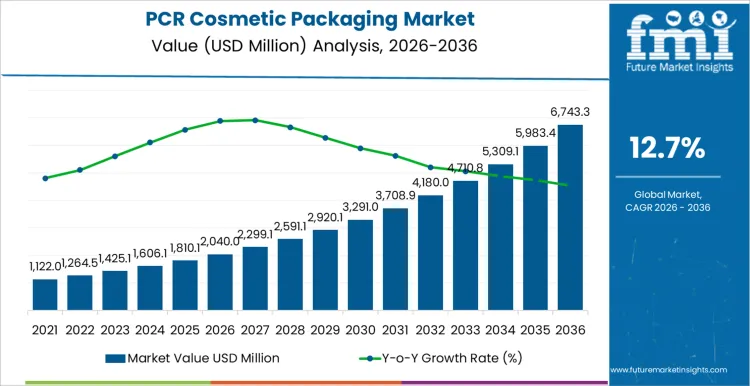
PCR Cosmetic Packaging Market Key Takeaways
| Metric | Value |
|---|---|
| Market Value (2026) | USD 2040.0 million |
| Market Forecast Value (2036) | USD 6743.3 million |
| Forecast CAGR (2026 to 2036) | 12.7% |
Why is the Demand for PCR Cosmetic Packaging Market Growing?
Beauty and personal care brands are increasingly specifying post-consumer recycled (PCR) materials in cosmetic packaging to support environmental commitments while preserving the premium look and feel expected by consumers. Clear and tinted PCR resins are engineered to deliver consistent gloss, impact resistance, and dimensional precision needed for lipstick tubes, skincare jars, and mascara tubes on automated filling lines. Refillable compact systems and modular packaging formats that reduce waste lean on PCR components that resist cracking and maintain aesthetic consistency. Retail buyers in prestige segments evaluate packaging quality closely; PCR formulations that meet clarity and tactile standards help brands avoid compromise in visual appeal while fulfilling sustainability narratives.
Converters adapt molding parameters and quality checks to manage variations in recycled feedstock, ensuring dimensional tolerances and surface finish meet brand specifications. Procurement dynamics in this market are influenced by regulatory recycled content targets in key geographies that extend into personal care packaging categories. Compliance teams require documented proof of recycled content and performance validation, prompting adoption of PCR grades verified through traceability systems. Material scientists focus on reducing residual contaminants and tailoring additive packages to support UV stability and barrier performance against fragrance and oil migration. Packaging engineers conduct rigorous drop, compression, and aging tests on PCR cosmetic components to ensure durability in handling and retail presentation. Expanded availability of PCR supply and standardization of quality metrics drives continued uptake across mainstream and niche beauty brands.
How Is the PCR Cosmetic Packaging Market Evolving Across Format, Material, and Brand Positioning?
PCR cosmetic packaging is transitioning from a compliance-driven initiative to a strategic brand differentiator. Adoption is no longer limited to experimental launches. Instead, it reflects deeper alignment between sustainability commitments, packaging aesthetics, and supply-chain feasibility. Material science improvements, better sorting infrastructure, and premium-grade PCR availability are reshaping how cosmetic brands integrate recycled content without diluting brand equity.
Why Do Bottles, Jars, and Airless Packs Lead PCR Adoption?
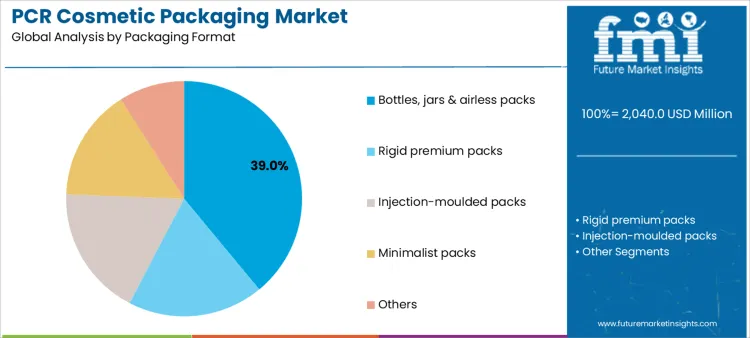
Bottles, jars, and airless packs account for 39.0% of PCR cosmetic packaging usage, largely because they represent the highest-volume SKUs in skincare and makeup portfolios. These formats allow gradual PCR integration while preserving functional integrity. Airless packs are especially important in active skincare, where contamination control and dosage precision are critical. Rigid premium packs, injection-moulded components, and minimalist formats are gaining relevance in niche launches, refill concepts, and mono-material design strategies. Format decisions increasingly balance tooling investments, recyclability goals, and shelf differentiation rather than cost alone.
Key Points:
- High-volume primary packs drive early PCR scale-up
- Airless formats enable PCR use in sensitive formulations
- Packaging format choices reflect both operational and branding priorities
How Is Material Selection Shaping PCR Cosmetic Packaging Performance?
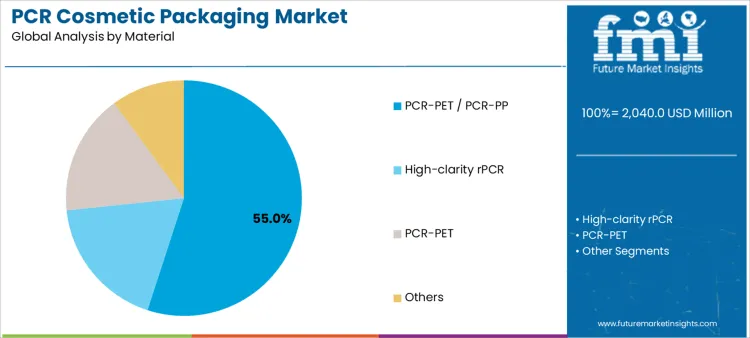
PCR-PET and PCR-PP together represent 55.0% of material usage, supported by improving clarity, odor control, and process consistency. These polymers offer the best balance between recyclability, cost efficiency, and compatibility with existing moulding lines. High-clarity rPCR grades are increasingly deployed in prestige and transparent packaging, where visual purity is non-negotiable. Other PCR material variants are selectively used in opaque or colored packs, where design flexibility offsets minor aesthetic limitations. Material strategy is becoming SKU-specific rather than portfolio-wide.
Key Points:
- PCR-PET and PCR-PP remain foundational for cosmetic packaging
- High-clarity rPCR unlocks premium and transparent applications
- Material choice is driven by performance thresholds, not sustainability alone
Which Brand Segments Are Driving Demand for PCR Cosmetic Packaging?
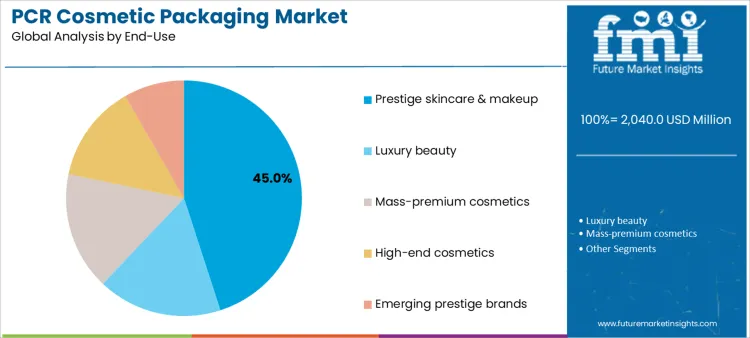
Prestige skincare and makeup brands account for 45.0% of demand, reflecting stronger ESG positioning and higher consumer tolerance for premium pricing. These brands often lead PCR adoption through hero products, refill systems, or limited-edition sustainability lines. Luxury beauty and mass-premium cosmetics are following with selective integration, while emerging prestige brands are using PCR packaging to establish sustainability credentials early in their lifecycle. Adoption depth varies significantly, with most brands prioritising visibility and storytelling over full conversion.
Key Points:
- Prestige brands lead PCR adoption as part of brand differentiation
- PCR is often introduced through flagship or refillable products
- End-use demand is influenced as much by narrative as by regulation
What are the Key Dynamics in the PCR Cosmetic Packaging Market?
Growth in the post-consumer recycled (PCR) cosmetic packaging market stems from rising consumer and brand emphasis on sustainability credentials without degrading premium aesthetics or functional performance. Cosmetic firms increasingly specify PCR materials for bottles, jars, caps, and compact cases where both visual appeal and tactile quality matter. Adoption patterns are influenced by how well PCR resins deliver consistent clarity, color uniformity, and surface smoothness under cosmetic filling and decoration operations. Material selection aligns with brand positioning around eco-impact messaging as well as technical fit with existing packaging machinery.
In what ways do beauty sector performance expectations influence material use?
Cosmetic formulators demand PCR packaging that withstands repeated handling and varied environmental conditions typical of beauty products. Clear or translucent PCR bottles used for serums and toners must maintain optical quality through injection molding and transport without haze or yellowing. High-end makeup compacts require PCR polymers with stable dimensional accuracy to support precise fitment of applicators and closures. Tubes and flexible PCR films employed in creams and lotions need to tolerate flexing without crack initiation at stress points. Creases, delamination, or print adhesion failures can undermine shelf presence and brand equity, pushing developers to qualify PCR grades against stringent performance criteria before deployment in premium and mass-market beauty lines.
How do feedstock consistency and regulatory requirements affect market expansion?
Market expansion for PCR cosmetic packaging is shaped by how reliably recycled feedstock meets cosmetic contact standards and by regional labeling rules. Sorting and decontamination processes must ensure PCR resins have low contaminant levels and maintain mechanical properties that mimic virgin materials, reducing the risk of defects during high-speed conversion. Compliance with cosmetic contact guidelines and migration limits influences where specific PCR formulations can be used without extensive requalification, particularly for lip and eye products with prolonged skin contact. Variability in recycled feedstock can lead converters to blend PCR with virgin polymers to manage risk, with impact on declared recycled content levels on packaging. Price sensitivity in mainstream beauty segments further influences how much PCR content brands can justify while preserving desired finish, feel, and performance.
How Is Demand for the PCR Cosmetic Packaging Market Evolving Globally?
Global demand for PCR cosmetic packaging is rising as beauty brands restructure packaging portfolios around recycled content commitments. Growth reflects pressure to reduce virgin plastic usage while preserving aesthetics, functionality, and brand differentiation. PCR integration remains concentrated in bottles, jars, tubes, and caps used across skincare, haircare, and color cosmetics. Regulatory frameworks and retailer sustainability scorecards reinforce adoption timelines. Material quality, color consistency, and odor control shape qualification cycles. India records 15.6% CAGR, China records 14.8% CAGR, USA records 12.0% CAGR, Germany records 11.6% CAGR, and Japan records 9.8% CAGR. Expansion follows compliance readiness rather than packaging volume growth.
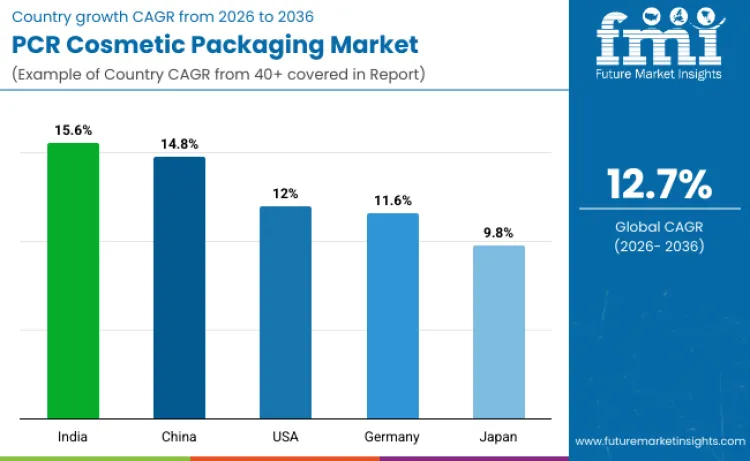
| Country | CAGR (%) |
|---|---|
| India | 15.6% |
| China | 14.8% |
| USA | 12.0% |
| Germany | 11.6% |
| Japan | 9.8% |
What is driving growth of PCR cosmetic packaging demand in India?
Demand for PCR cosmetic packaging in India is expanding as domestic beauty brands accelerate sustainability positioning across mass and premium segments. Growth at 15.6% CAGR reflects rising use of PCR bottles, jars, and closures for skincare and haircare products. Rapid brand proliferation increases packaging differentiation needs aligned with recycled content narratives. Regulatory focus on plastic waste reduction strengthens substitution pressure. Cost sensitivity favors optimized PCR blends maintaining surface finish and mechanical integrity. Adoption remains strongest within organized retail and e-commerce driven brands targeting urban consumers. Packaging converters invest in improved processing controls to manage color variability and consistency at scale.
- Expansion of domestic beauty brand portfolios
- Rising regulatory pressure on plastic usage
- Growth of organized retail beauty channels
- Focus on cost-optimized PCR material blends
Why is China seeing expansion in PCR cosmetic packaging adoption?
PCR cosmetic packaging demand in China is rising as large beauty manufacturers integrate recycled content across high-volume product lines. Growth at 14.8% CAGR reflects strong uptake in skincare and personal care packaging serving domestic and export markets. Centralized manufacturing enables consistent material qualification across multiple brands. Regulatory mandates on plastic reduction accelerate PCR substitution. Local recyclers improve washing, deodorization, and color correction to meet cosmetic packaging standards. Demand concentrates on rigid packaging formats requiring clarity, gloss, and dimensional stability. Export compliance requirements reinforce adoption of certified PCR materials aligned with international sustainability benchmarks.
- High-volume cosmetic packaging production
- Regulatory mandates on recycled plastics
- Advancements in PCR purification quality
- Export-driven sustainability compliance needs
What factors are shaping PCR cosmetic packaging sales in the USA?
Sales of PCR cosmetic packaging in the USA are increasing as global beauty brands execute recycled content roadmaps. Growth at 12.0% CAGR reflects portfolio-wide transitions across skincare, haircare, and prestige beauty packaging. Retailer sustainability scorecards influence packaging material specifications. Brand risk management drives conservative PCR adoption focused on visual consistency and odor neutrality. Qualification emphasizes performance parity with virgin plastics. Demand is driven by compliance commitments rather than new cosmetic product launches. Packaging suppliers align documentation, traceability, and testing protocols to meet audit expectations across national brand portfolios.
- Brand-level recycled content commitments
- Retail sustainability scorecard influence
- Emphasis on visual and odor consistency
- Standardized supplier qualification protocols
How is Germany supporting growth of PCR cosmetic packaging demand?
PCR cosmetic packaging demand in Germany is advancing as circular economy regulations tighten across consumer goods packaging. Growth at 11.6% CAGR reflects adoption within premium skincare and cosmetic brands prioritizing recyclability and material transparency. EU compliance frameworks increase pressure for certified recycled content. German converters emphasize traceability, emissions control, and consistent surface quality. Consumer awareness reinforces preference for sustainable packaging solutions. Demand remains anchored in regulated packaging formats rather than experimental design changes. High documentation standards shape longer qualification cycles and structured supplier engagement.
- EU circular economy compliance pressure
- High standards for material traceability
- Focus on premium cosmetic packaging
- Emphasis on certified recycled content
What is driving expansion of PCR cosmetic packaging demand in Japan?
Demand for PCR cosmetic packaging in Japan is rising as brands integrate recycled materials within quality-sensitive beauty applications. Growth at 9.8% CAGR reflects cautious adoption across skincare and cosmetics requiring high aesthetic precision. Consumer expectations for packaging quality influence conservative substitution strategies. Manufacturers prioritize PCR grades with controlled color, low odor, and stable surface finish. Regulatory guidance on waste reduction supports gradual integration. Demand concentrates within premium brands executing controlled material transitions aligned with long-term sustainability goals rather than rapid packaging redesigns.
- High aesthetic expectations in cosmetics
- Conservative PCR qualification approaches
- Focus on low-odor material performance
- Gradual sustainability-driven adoption strategies
What is the competitive landscape of demand for the PCR cosmetic packaging market globally?
Cosmetics brands are accelerating Demand for PCR cosmetic packaging as sustainability commitments extend to primary packs with direct consumer visibility. Brand owners and packaging engineers focus on surface finish quality, color consistency, tactile feel, and resistance to stress cracking when recycled content is introduced. Buyer assessment includes compatibility with formulations containing oils, alcohols, and active ingredients, along with decoration performance for metallization, lacquering, and printing. Procurement behavior prioritizes suppliers able to guarantee cosmetic-grade PCR availability, aesthetic repeatability across batches, and compliance with beauty industry safety standards. Trend in the PCR cosmetic packaging market reflects movement from secondary packaging into premium primary components.
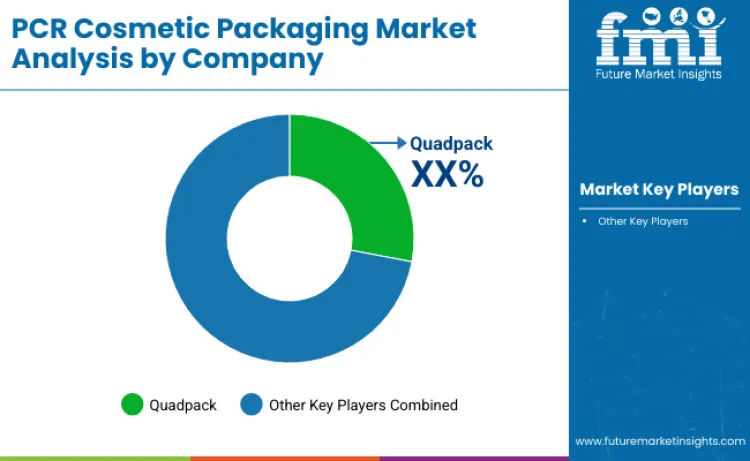
Quadpack holds leading positioning by combining PCR sourcing with design-led cosmetic packaging tailored for premium and indie beauty brands. ALPLA competes through large-scale PCR bottle production supported by closed-loop recycling systems ensuring material consistency. Aptar Beauty maintains relevance by integrating PCR into dispensing systems where functional precision and aesthetics must align. HCP Packaging supports demand with decorative cosmetic components that retain visual quality while increasing recycled content. Zhejiang Sun-Rain participates by supplying cost-competitive PCR cosmetic packaging components for mass-market beauty products. Competitive differentiation centers on aesthetic control, formulation compatibility, PCR traceability, and ability to support brand-led design requirements.
Key Players in the PCR Cosmetic Packaging Market
- Quadpack
- ALPLA
- Aptar Beauty
- HCP Packaging
- Zhejiang Sun-Rain
- Zijiang
- Toyo Seikan
- Yoshino Kogyosho
- Others
Scope of the Report
| Items | Values |
|---|---|
| Quantitative Units | USD million |
| Packaging Format | Bottles, jars & airless packs; Rigid premium packs; Injection-moulded packs; Minimalist packs; Others |
| Material | PCR-PET / PCR-PP; High-clarity rPCR; PCR-PET; Others |
| End-Use | Prestige skincare & makeup; Luxury beauty; Mass-premium cosmetics; High-end cosmetics; Emerging prestige brands |
| Regions Covered | Asia Pacific, Europe, North America, Latin America, Middle East & Africa |
| Countries Covered | India, China, USA, Germany, Japan, and 40+ countries |
| Key Companies Profiled | Quadpack; ALPLA; Aptar Beauty; HCP Packaging; Zhejiang Sun-Rain; Zijiang; Toyo Seikan; Yoshino Kogyosho; Others |
| Additional Attributes | Dollar sales by packaging format, material, and end-use segment; adoption of high-clarity PCR resins in luxury and prestige cosmetic packs; design trade-offs between recycled content, aesthetics, and functionality; sourcing strategies aligned with brand sustainability commitments; conversion capabilities supporting airless and injection-moulded PCR cosmetic packaging formats. |
PCR Cosmetic Packaging Market by Segment
Packaging Format:
- Bottles, jars & airless packs
- Rigid premium packs
- Injection-moulded packs
- Minimalist packs
- Others
Material:
- PCR-PET / PCR-PP
- High-clarity rPCR
- PCR-PET
- Others
End-Use:
- Prestige skincare & makeup
- Luxury beauty
- Mass-premium cosmetics
- High-end cosmetics
- Emerging prestige brands
Region:
- Asia Pacific
- China
- Japan
- South Korea
- India
- Australia & New Zealand
- ASEAN
- Rest of Asia Pacific
- Europe
- Germany
- United Kingdom
- France
- Italy
- Spain
- Nordic
- BENELUX
- Rest of Europe
- North America
- United States
- Canada
- Mexico
- Latin America
- Brazil
- Chile
- Rest of Latin America
- Middle East & Africa
- Kingdom of Saudi Arabia
- Other GCC Countries
- Turkey
- South Africa
- Other African Union
- Rest of Middle East & Africa
Bibliography
- European Commission. (2023). Proposal for a regulation on packaging and packaging waste (PPWR) and implications for cosmetic packaging materials. Publications Office of the European Union.
- European Chemicals Agency. (2023). Guidance on the safety assessment of recycled plastics intended for consumer product packaging. ECHA.
- International Organization for Standardization. (2023). Packaging and the environment—Material recycling (ISO 18604:2023). ISO.
Frequently Asked Questions
How big is the PCR cosmetic packaging market in 2026?
The global PCR cosmetic packaging market is estimated to be valued at USD 2,040.0 million in 2026.
What will be the size of PCR cosmetic packaging market in 2036?
The market size for the PCR cosmetic packaging market is projected to reach USD 6,743.3 million by 2036.
How much will be the PCR cosmetic packaging market growth between 2026 and 2036?
The PCR cosmetic packaging market is expected to grow at a 12.7% CAGR between 2026 and 2036.
What are the key product types in the PCR cosmetic packaging market?
The key product types in PCR cosmetic packaging market are bottles, jars & airless packs, rigid premium packs, injection-moulded packs, minimalist packs and others.
Which material segment to contribute significant share in the PCR cosmetic packaging market in 2026?
In terms of material, the PCR-PET/PCR-PP segment is expected to command 55.0% share in the PCR cosmetic packaging market in 2026.
Preview the report firsthand - request a free sample
Get SampleGet the brochure for pricing and purchase details.
Get PDFTable of Content
- Executive Summary
- Global Market Outlook
- Demand-side Trends
- Supply-side Trends
- Technology Roadmap Analysis
- Analysis and Recommendations
- Market Overview
- Market Coverage / Taxonomy
- Market Definition / Scope / Limitations
- Market Background
- Market Dynamics
- Drivers
- Restraints
- Opportunity
- Trends
- Scenario Forecast
- Demand in Optimistic Scenario
- Demand in Likely Scenario
- Demand in Conservative Scenario
- Opportunity Map Analysis
- Product Life Cycle Analysis
- Supply Chain Analysis
- Investment Feasibility Matrix
- Value Chain Analysis
- PESTLE and Porter’s Analysis
- Regulatory Landscape
- Regional Parent Market Outlook
- Production and Consumption Statistics
- Import and Export Statistics
- Market Dynamics
- Global Market Analysis 2021 to 2025 and Forecast, 2026 to 2036
- Historical Market Size Value (USD Million) Analysis, 2021 to 2025
- Current and Future Market Size Value (USD Million) Projections, 2026 to 2036
- Y-o-Y Growth Trend Analysis
- Absolute $ Opportunity Analysis
- Global Market Pricing Analysis 2021 to 2025 and Forecast 2026 to 2036
- Global Market Analysis 2021 to 2025 and Forecast 2026 to 2036, By Packaging Format
- Introduction / Key Findings
- Historical Market Size Value (USD Million) Analysis By Packaging Format , 2021 to 2025
- Current and Future Market Size Value (USD Million) Analysis and Forecast By Packaging Format , 2026 to 2036
- Bottles, jars & airless packs
- Rigid premium packs
- Injection-moulded packs
- Minimalist packs
- Others
- Bottles, jars & airless packs
- Y-o-Y Growth Trend Analysis By Packaging Format , 2021 to 2025
- Absolute $ Opportunity Analysis By Packaging Format , 2026 to 2036
- Global Market Analysis 2021 to 2025 and Forecast 2026 to 2036, By Material
- Introduction / Key Findings
- Historical Market Size Value (USD Million) Analysis By Material, 2021 to 2025
- Current and Future Market Size Value (USD Million) Analysis and Forecast By Material, 2026 to 2036
- PCR-PET / PCR-PP
- High-clarity rPCR
- PCR-PET
- Others
- PCR-PET / PCR-PP
- Y-o-Y Growth Trend Analysis By Material, 2021 to 2025
- Absolute $ Opportunity Analysis By Material, 2026 to 2036
- Global Market Analysis 2021 to 2025 and Forecast 2026 to 2036, By End-Use
- Introduction / Key Findings
- Historical Market Size Value (USD Million) Analysis By End-Use, 2021 to 2025
- Current and Future Market Size Value (USD Million) Analysis and Forecast By End-Use, 2026 to 2036
- Prestige skincare & makeup
- Luxury beauty
- Mass-premium cosmetics
- High-end cosmetics
- Emerging prestige brands
- Prestige skincare & makeup
- Y-o-Y Growth Trend Analysis By End-Use, 2021 to 2025
- Absolute $ Opportunity Analysis By End-Use, 2026 to 2036
- Global Market Analysis 2021 to 2025 and Forecast 2026 to 2036, By Region
- Introduction
- Historical Market Size Value (USD Million) Analysis By Region, 2021 to 2025
- Current Market Size Value (USD Million) Analysis and Forecast By Region, 2026 to 2036
- North America
- Latin America
- Western Europe
- Eastern Europe
- East Asia
- South Asia and Pacific
- Middle East & Africa
- Market Attractiveness Analysis By Region
- North America Market Analysis 2021 to 2025 and Forecast 2026 to 2036, By Country
- Historical Market Size Value (USD Million) Trend Analysis By Market Taxonomy, 2021 to 2025
- Market Size Value (USD Million) Forecast By Market Taxonomy, 2026 to 2036
- By Country
- USA
- Canada
- Mexico
- By Packaging Format
- By Material
- By End-Use
- By Country
- Market Attractiveness Analysis
- By Country
- By Packaging Format
- By Material
- By End-Use
- Key Takeaways
- Latin America Market Analysis 2021 to 2025 and Forecast 2026 to 2036, By Country
- Historical Market Size Value (USD Million) Trend Analysis By Market Taxonomy, 2021 to 2025
- Market Size Value (USD Million) Forecast By Market Taxonomy, 2026 to 2036
- By Country
- Brazil
- Chile
- Rest of Latin America
- By Packaging Format
- By Material
- By End-Use
- By Country
- Market Attractiveness Analysis
- By Country
- By Packaging Format
- By Material
- By End-Use
- Key Takeaways
- Western Europe Market Analysis 2021 to 2025 and Forecast 2026 to 2036, By Country
- Historical Market Size Value (USD Million) Trend Analysis By Market Taxonomy, 2021 to 2025
- Market Size Value (USD Million) Forecast By Market Taxonomy, 2026 to 2036
- By Country
- Germany
- UK
- Italy
- Spain
- France
- Nordic
- BENELUX
- Rest of Western Europe
- By Packaging Format
- By Material
- By End-Use
- By Country
- Market Attractiveness Analysis
- By Country
- By Packaging Format
- By Material
- By End-Use
- Key Takeaways
- Eastern Europe Market Analysis 2021 to 2025 and Forecast 2026 to 2036, By Country
- Historical Market Size Value (USD Million) Trend Analysis By Market Taxonomy, 2021 to 2025
- Market Size Value (USD Million) Forecast By Market Taxonomy, 2026 to 2036
- By Country
- Russia
- Poland
- Hungary
- Balkan & Baltic
- Rest of Eastern Europe
- By Packaging Format
- By Material
- By End-Use
- By Country
- Market Attractiveness Analysis
- By Country
- By Packaging Format
- By Material
- By End-Use
- Key Takeaways
- East Asia Market Analysis 2021 to 2025 and Forecast 2026 to 2036, By Country
- Historical Market Size Value (USD Million) Trend Analysis By Market Taxonomy, 2021 to 2025
- Market Size Value (USD Million) Forecast By Market Taxonomy, 2026 to 2036
- By Country
- China
- Japan
- South Korea
- By Packaging Format
- By Material
- By End-Use
- By Country
- Market Attractiveness Analysis
- By Country
- By Packaging Format
- By Material
- By End-Use
- Key Takeaways
- South Asia and Pacific Market Analysis 2021 to 2025 and Forecast 2026 to 2036, By Country
- Historical Market Size Value (USD Million) Trend Analysis By Market Taxonomy, 2021 to 2025
- Market Size Value (USD Million) Forecast By Market Taxonomy, 2026 to 2036
- By Country
- India
- ASEAN
- Australia & New Zealand
- Rest of South Asia and Pacific
- By Packaging Format
- By Material
- By End-Use
- By Country
- Market Attractiveness Analysis
- By Country
- By Packaging Format
- By Material
- By End-Use
- Key Takeaways
- Middle East & Africa Market Analysis 2021 to 2025 and Forecast 2026 to 2036, By Country
- Historical Market Size Value (USD Million) Trend Analysis By Market Taxonomy, 2021 to 2025
- Market Size Value (USD Million) Forecast By Market Taxonomy, 2026 to 2036
- By Country
- Kingdom of Saudi Arabia
- Other GCC Countries
- Turkiye
- South Africa
- Other African Union
- Rest of Middle East & Africa
- By Packaging Format
- By Material
- By End-Use
- By Country
- Market Attractiveness Analysis
- By Country
- By Packaging Format
- By Material
- By End-Use
- Key Takeaways
- Key Countries Market Analysis
- USA
- Pricing Analysis
- Market Share Analysis, 2025
- By Packaging Format
- By Material
- By End-Use
- Canada
- Pricing Analysis
- Market Share Analysis, 2025
- By Packaging Format
- By Material
- By End-Use
- Mexico
- Pricing Analysis
- Market Share Analysis, 2025
- By Packaging Format
- By Material
- By End-Use
- Brazil
- Pricing Analysis
- Market Share Analysis, 2025
- By Packaging Format
- By Material
- By End-Use
- Chile
- Pricing Analysis
- Market Share Analysis, 2025
- By Packaging Format
- By Material
- By End-Use
- Germany
- Pricing Analysis
- Market Share Analysis, 2025
- By Packaging Format
- By Material
- By End-Use
- UK
- Pricing Analysis
- Market Share Analysis, 2025
- By Packaging Format
- By Material
- By End-Use
- Italy
- Pricing Analysis
- Market Share Analysis, 2025
- By Packaging Format
- By Material
- By End-Use
- Spain
- Pricing Analysis
- Market Share Analysis, 2025
- By Packaging Format
- By Material
- By End-Use
- France
- Pricing Analysis
- Market Share Analysis, 2025
- By Packaging Format
- By Material
- By End-Use
- India
- Pricing Analysis
- Market Share Analysis, 2025
- By Packaging Format
- By Material
- By End-Use
- ASEAN
- Pricing Analysis
- Market Share Analysis, 2025
- By Packaging Format
- By Material
- By End-Use
- Australia & New Zealand
- Pricing Analysis
- Market Share Analysis, 2025
- By Packaging Format
- By Material
- By End-Use
- China
- Pricing Analysis
- Market Share Analysis, 2025
- By Packaging Format
- By Material
- By End-Use
- Japan
- Pricing Analysis
- Market Share Analysis, 2025
- By Packaging Format
- By Material
- By End-Use
- South Korea
- Pricing Analysis
- Market Share Analysis, 2025
- By Packaging Format
- By Material
- By End-Use
- Russia
- Pricing Analysis
- Market Share Analysis, 2025
- By Packaging Format
- By Material
- By End-Use
- Poland
- Pricing Analysis
- Market Share Analysis, 2025
- By Packaging Format
- By Material
- By End-Use
- Hungary
- Pricing Analysis
- Market Share Analysis, 2025
- By Packaging Format
- By Material
- By End-Use
- Kingdom of Saudi Arabia
- Pricing Analysis
- Market Share Analysis, 2025
- By Packaging Format
- By Material
- By End-Use
- Turkiye
- Pricing Analysis
- Market Share Analysis, 2025
- By Packaging Format
- By Material
- By End-Use
- South Africa
- Pricing Analysis
- Market Share Analysis, 2025
- By Packaging Format
- By Material
- By End-Use
- USA
- Market Structure Analysis
- Competition Dashboard
- Competition Benchmarking
- Market Share Analysis of Top Players
- By Regional
- By Packaging Format
- By Material
- By End-Use
- Competition Analysis
- Competition Deep Dive
- Quadpack
- Overview
- Product Portfolio
- Profitability by Market Segments (Product/Age /Sales Channel/Region)
- Sales Footprint
- Strategy Overview
- Marketing Strategy
- Product Strategy
- Channel Strategy
- ALPLA
- Aptar Beauty
- HCP Packaging
- Zhejiang Sun-Rain
- Zijiang
- Quadpack
- Competition Deep Dive
- Assumptions & Acronyms Used
- Research Methodology


