

- Industry Size (2026)
- USD 1150 Mn
- Forecast (2036)
- USD 2880 Mn
- CAGR (2026 to 2036)
- 9.6%
Impact-Modified PCR Plastics for Packaging Market Forecast and Outlook 2026 to 2036
The global impact-modified PCR plastics for packaging market is estimated to reach USD 1,150 million in 2026 and is projected to expand to USD 2,880 million by 2036, registering a compound annual growth rate (CAGR) of 9.6% over the forecast period.
FMI analysis indicates that this growth trajectory reflects a structural transition from recycled-content compliance to performance-driven material substitution. Earlier PCR adoption models were predicated on blending limited quantities of recycled resin into virgin polymer matrices, often at the cost of impact strength, stiffness retention, or aesthetic consistency. As sustainability targets intensified, these compromises became increasingly untenable for high-volume packaging operations.
Rigid and semi-rigid packaging represents the largest end-use segment, accounting for 40% of total market demand. This dominance is rooted in the mechanical and functional demands of packaging formats such as bottles, containers, tubs, trays, caps, and closures. These products must withstand drop impacts during filling and palletisation, compressive loads during stacking and transport, and variable handling conditions across retail and e-commerce channels. Unmodified PCR materials often exhibit brittle fracture behaviour under these conditions, limiting their applicability.
Impact modification enables recycled polyolefins to absorb impact energy more effectively, reducing crack propagation and failure rates. By restoring ductility and improving phase compatibility, impact-modified PCR compounds allow converters to achieve higher recycled content while maintaining packaging integrity. This capability is particularly critical in logistics-intensive markets, where packaging durability directly influences total cost of ownership.
From a material standpoint, impact-modified PCR-PP and PCR-PE grades together account for 45% of total market demand. Polyolefins dominate packaging due to their favourable balance of mechanical performance, chemical resistance, and recyclability. Within this category, PCR-PP / PCR-PE blends represent 55% of material share, reflecting their versatility in tuning stiffness-to-toughness ratios and compensating for feedstock variability. These blends allow compounders to optimise performance for specific packaging formats without introducing incompatible material systems.
Technologically, compatibilisation and impact modification techniques account for 55% of the market, underscoring their central role in restoring recycled polymer performance. Compatibilizers improve interfacial adhesion between dissimilar polymer phases and additives, while elastomeric impact modifiers enhance energy dissipation under mechanical stress. Advances in modifier chemistry and dispersion control are enabling higher PCR loadings while maintaining acceptable aesthetics, odour profiles, and processing windows suitable for high-speed packaging lines.
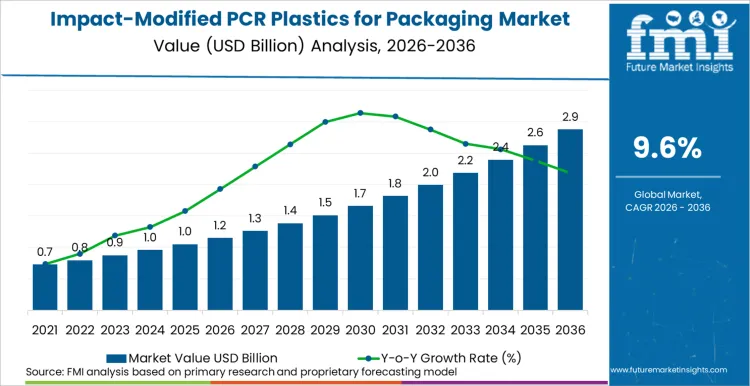
Summary of Impact-Modified PCR Plastics for Packaging Market
What is the Long-Term Growth Outlook for the Market?
Future Market Insights projects that the impact-modified PCR plastics for packaging market will grow from USD 1,150 million in 2026 to USD 2,880 million by 2036, reflecting a 9.6% CAGR over the forecast period. This expansion is driven not merely by increasing availability of PCR feedstock, but by a re-rating of impact-modified PCR compounds as value-retentive packaging materials.
Packaging converters and brand owners are increasingly evaluating materials based on lifecycle performance economics rather than upfront resin cost alone. Impact-modified PCR materials reduce breakage rates, minimise production disruptions, and stabilise processing behaviour, generating downstream cost savings that justify higher material pricing. As these economics become better understood, adoption is accelerating across rigid and semi-rigid packaging formats.
FMI Research Approach: This outlook is derived from FMI’s proprietary packaging materials forecasting framework, integrating recycled content policy trajectories, PCR compounding capacity expansion, packaging converter adoption cycles, and brand-level qualification timelines.
How is Performance Engineering Redefining PCR Plastics Adoption?
FMI analysis indicates that PCR adoption is increasingly governed by engineering performance metrics, not recycled content percentages alone. Impact strength, environmental stress crack resistance (ESCR), low-temperature toughness, and melt stability have emerged as decisive criteria in packaging material selection.
Unmodified PCR polyolefins typically exhibit reduced molecular weight and heterogeneous composition, leading to inconsistent mechanical behaviour and higher defect rates. These limitations manifest as brittle failure, warpage, and processing instability-outcomes that are unacceptable in high-speed packaging operations. Impact modification mitigates these issues by introducing elastomeric phases that improve toughness and compatibilizers that stabilise polymer morphology.
FMI Research Approach: Insights are informed by polymer compounding trends, converter-level feedback, and comparative analysis of virgin versus modified PCR performance across common packaging formats.
Which Regions Are Driving Market Expansion?
The United States, with a projected CAGR of 8.8%, leads the market in value terms. The USA packaging sector is characterised by early adoption of performance-qualified PCR materials, driven by retailer sustainability commitments and the economics of large-scale logistics. Rigid packaging applications dominate demand, as impact resistance and dimensional stability directly influence distribution efficiency and product integrity.
Germany, growing at 8.2% CAGR, represents a mature but structurally stable market. Regulatory clarity, extended producer responsibility frameworks, and brand-level recycled content commitments support consistent demand for engineered PCR materials. German packaging converters typically emphasise material traceability and performance consistency, reinforcing the role of impact-modified PCR compounds in primary packaging applications.
In contrast, China (12.0% CAGR) and India (12.8% CAGR) represent the fastest-growing markets. Growth in these regions is driven by expanding domestic PCR collection infrastructure, rising compounding capacity, and rapid growth in FMCG and food packaging volumes. Adoption patterns emphasise cost-efficient impact modification and high-throughput blending technologies capable of supporting large-scale packaging production.
FMI Research Approach: Country-level forecasts integrate packaging output growth, regulatory signals, PCR availability, and domestic compounding economics.
What Will Be the Market Size by 2036?
By 2036, the impact-modified PCR plastics for packaging market is projected to reach USD 2,880 million. This expansion will be supported by deeper penetration of impact-modified PCR materials into rigid containers, closures, and semi-rigid packaging formats that historically relied on virgin polymers due to performance constraints.
What Trends Are Structurally Transforming the Market?
Key trends reshaping the market include the increasing use of compatibilised PCR-PP / PCR-PE blends, rising demand for food-grade and cosmetic-grade impact-modified PCR compounds, expanded deployment of high-throughput blending and pelletising systems, and growing emphasis on odour mitigation and aesthetic control to meet premium packaging requirements.
Impact-Modified PCR Plastics for Packaging Market Key Takeaways
| Metric | Value |
|---|---|
| Market Value (2026) | USD 1,150 million |
| Market Value (2036) | USD 2,880 million |
| CAGR (2026 to 2036) | 9.6% |
Source: Future Market Insights (FMI), proprietary analysis
Why is the Impact-Modified PCR Plastics for Packaging Market Growing?
The primary driver of market growth is the persistent performance mismatch between unmodified PCR materials and real-world packaging demands. Packaging systems are exposed to mechanical stresses at every stage of the value chain, from filling and sealing to transport, storage, and retail handling. Even minor material failures can result in significant economic losses and brand risk.
Impact-modified PCR materials address these challenges by restoring ductility and toughness, enabling recycled polyolefins to absorb impact energy without brittle fracture. This capability is particularly critical in e-commerce and omnichannel distribution environments, where packaging is subjected to higher drop frequencies and less controlled handling conditions.
In parallel, brand owners are increasingly prioritising mono-material packaging architectures to improve recyclability and simplify waste streams. Impact-modified PCR polyolefins align with this objective by enabling higher recycled content without introducing incompatible barrier layers or additives. As a result, these materials are becoming central to packaging redesign strategies that seek to balance circularity, performance, and cost efficiency.
What is the Segment Profile of the Impact-Modified PCR Plastics for Packaging Market?
Why Does Rigid & Semi-Rigid Packaging Anchor the Largest Share of End-Use Demand?
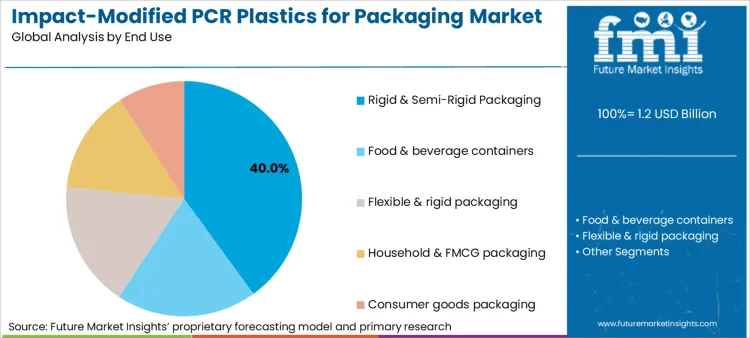
Rigid and semi-rigid packaging represents the single largest end-use segment, accounting for 40% of total market demand, because it combines high-volume consumption with strict mechanical performance requirements. Packaging formats such as bottles, tubs, trays, caps, and closures are exposed to repeated drop impacts, compression loads during pallet stacking, and vibration stresses across logistics chains. In these applications, even marginal brittleness or crack propagation can lead to leakage, product spoilage, or complete packaging failure. Unmodified PCR materials typically underperform under these stress conditions, making impact modification a functional necessity rather than a design choice.
Impact-modified PCR materials allow packaging converters to preserve structural integrity while increasing recycled content, without compromising line speed or yield. As converters increasingly internalize the cost of packaging failures-through product loss, recalls, and brand damage-rigid and semi-rigid formats have become the most economically rational entry point for engineered PCR adoption. This dynamic explains why performance-qualified PCR penetration is deepest in this segment relative to flexible or decorative packaging applications.
Why Do Impact-Modified PCR-PP / PCR-PE Grades Dominate the PCR Type Mix?
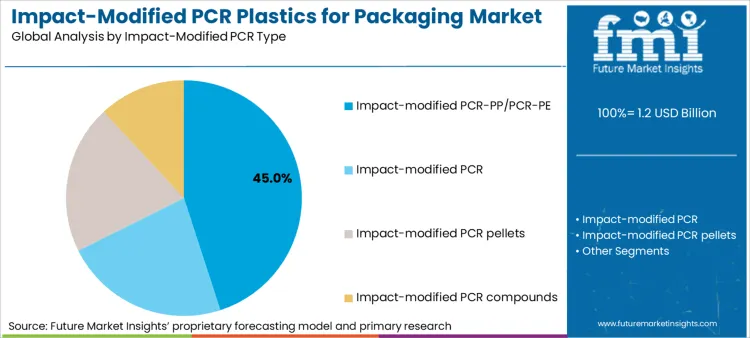
Impact-modified PCR-PP and PCR-PE grades account for 45% of total demand, reflecting the dominance of polyolefin systems in global packaging and their inherent compatibility with circular design principles. Polypropylene and polyethylene are already the backbone materials for rigid and semi-rigid packaging, and modifying these polymers allows converters to remain within mono-material architectures that simplify downstream recycling and regulatory compliance.
From a formulation standpoint, these grades offer compounders the most flexibility to restore impact resistance through elastomeric modifiers while maintaining acceptable stiffness and melt flow. This balance is critical for packaging formats that must perform reliably across both injection molding and extrusion-based processes. As brand owners increasingly mandate both recycled content and recyclability, impact-modified PCR-PP and PCR-PE grades represent the most scalable solution that aligns performance engineering with circularity objectives.
Why Do PCR-PP / PCR-PE Blends Represent the Dominant Material Strategy?
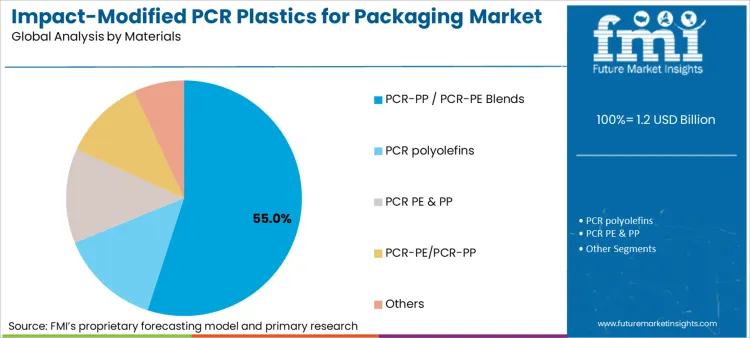
PCR-PP / PCR-PE blends collectively command 55% of the material share, as blending provides the most effective pathway to compensate for feedstock variability inherent in post-consumer recycling streams. Pure PCR streams often exhibit inconsistent molecular weight distribution and contamination profiles, making single-polymer formulations difficult to control at scale. Blending allows compounders to average out these inconsistencies while tailoring mechanical properties to application-specific requirements.
These blends are particularly valuable in packaging formats that demand a precise balance between stiffness and toughness. By adjusting blend ratios and modifier loading, suppliers can design materials that meet drop-test and compression standards without excessive over-modification. This versatility makes PCR-PP / PCR-PE blends the preferred material strategy for converters seeking predictable performance across diverse packaging SKUs.
Why Does Compatibilisation & Impact Modification Lead the Technology Landscape?
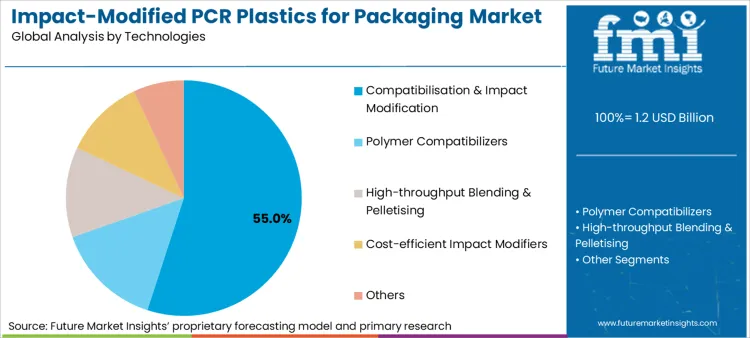
Compatibilisation and impact modification technologies account for 55% of the total technology share, underscoring their foundational role in restoring the functional performance of recycled polymers. Compatibilizers improve interfacial adhesion between immiscible polymer phases and additives, while impact modifiers introduce energy-dissipating domains that prevent brittle fracture under stress.
These technologies are especially critical in packaging applications where recycled materials must run on existing high-speed lines without frequent parameter adjustments. As converters push for higher PCR loadings, the importance of robust compatibilisation increases, reinforcing this technology’s dominance across both mature and emerging packaging markets.
Drivers, Restraints, Opportunities, and Trends Influencing Impact-Modified PCR Plastics for Packaging Demand?
The primary driver of the market is the incompatibility of unmodified PCR materials with modern packaging performance requirements. As packaging operations become faster, more automated, and more logistics-intensive, tolerance for material inconsistency has declined sharply. Impact-modified PCR materials offer a pathway to higher recycled content without sacrificing operational reliability. Regulatory pressure and brand sustainability commitments further reinforce demand, particularly where recycled content targets intersect with packaging durability requirements.
Despite strong growth prospects, the market faces structural restraints. Feedstock variability remains a persistent challenge, particularly in regions with fragmented collection systems. Variability in contamination levels, polymer composition, and degradation history complicates formulation and quality control. Odour management and aesthetic consistency are additional barriers, especially in food, beverage, and personal care packaging. Achieving acceptable appearance and smell profiles with high PCR content often requires additional processing steps, increasing cost.
Opportunities are emerging in premium and performance-sensitive packaging segments, where impact-modified PCR materials enable downgauging and material reduction without compromising durability. Cosmetic packaging, personal care containers, and specialty food packaging represent high-value opportunities where performance-engineered PCR can command a premium. Key trends include the growing use of tailored compatibilizer systems, increased adoption of ready-to-use PCR pellets, and greater focus on processing efficiency and yield stability. The market is also seeing closer collaboration between recyclers, compounders, and converters to align material specifications more tightly with application requirements.
How Do Country-Level Dynamics Shape Adoption of Impact-Modified PCR Plastics for Packaging?
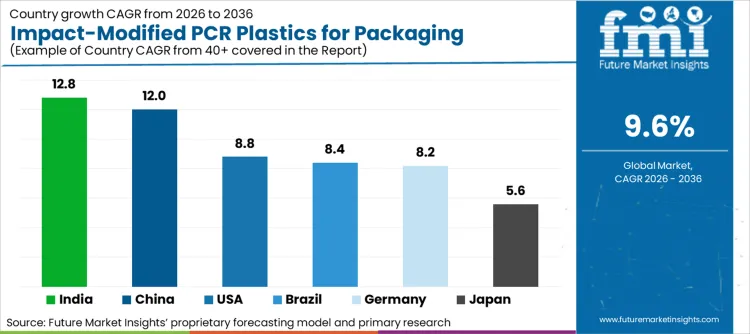
| Country | CAGR |
|---|---|
| USA | 8.8% |
| Germany | 8.2% |
| China | 12.0% |
| India | 12.8% |
| Brazil | 8.4% |
| Japan | 5.6% |
Why Does the United States Remain a Value-Led Market Despite Moderate Growth?
The United States market, growing at a CAGR of 8.8%, is defined less by speed and more by value density. Packaging converters in the USA operate at large scale with highly automated lines, where material inconsistency directly translates into downtime and yield loss. As a result, adoption of impact-modified PCR materials is closely tied to performance qualification rather than recycled content targets alone.
Rigid and semi-rigid packaging dominates demand, particularly for household, food, and beverage applications where logistics intensity is high. Impact-modified PCR materials are increasingly specified as risk-mitigation tools, enabling higher recycled content without increasing breakage rates across extended distribution networks.
How Does Germany’s Quality-Driven Model Sustain Steady Growth?
Germany, expanding at a CAGR of 8.2%, represents a quality-driven market where regulatory clarity and strong recycling infrastructure support stable adoption. German packaging converters typically require rigorous material validation, emphasizing consistency, traceability, and compliance.
Impact-modified PCR materials are increasingly deployed in primary packaging applications where mechanical reliability is critical. The emphasis on engineering-led material selection reinforces demand for well-characterized, performance-modified PCR grades rather than commodity recycled resins.
Why Is China Emerging as a Volume-Scale Growth Engine?
China’s 12.0% CAGR reflects rapid scaling of packaging production and expanding availability of recycled feedstock. Growth is driven by FMCG packaging, where cost-efficient impact modification enables large-scale substitution of virgin polymers.
The market prioritizes throughput and cost optimization, favoring technologies that support high-volume blending and pelletisation. As domestic recycling infrastructure matures, impact-modified PCR materials are positioned as mainstream packaging inputs rather than premium sustainability options.
What Makes India the Fastest-Growing Market?
India leads with a 12.8% CAGR, driven by expanding consumer markets and improving recycling systems. Adoption is concentrated in household and FMCG packaging, where durability is essential to prevent leakage and product loss in fragmented logistics environments.
Converters in India prioritize formulations that balance cost and performance, accelerating demand for scalable, cost-efficient impact-modified PCR compounds that can tolerate feedstock variability.
Why do Brazil and Japan Follow Distinct Adoption Paths?
Brazil’s 8.4% CAGR reflects steady adoption in consumer goods packaging, supported by improving access to recycled polyolefins. Impact modification is increasingly used to improve packaging robustness in long-distance domestic logistics.
Japan, growing at 5.6% CAGR, remains a niche but high-value market focused on premium cosmetic and food packaging. Here, adoption is constrained by stringent aesthetic and quality requirements, favoring lower-volume but highly engineered PCR solutions.
How is Competitive Advantage Defined in the Impact-Modified PCR Plastics for Packaging Market?
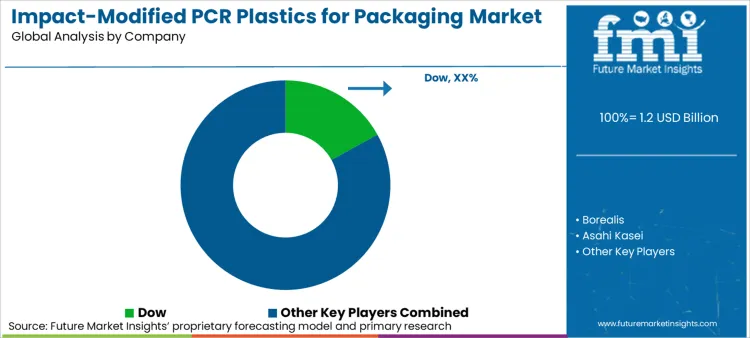
Competition in the impact-modified PCR plastics for packaging market is defined primarily by formulation expertise and consistency control, rather than by resin production scale alone. As packaging converters demand materials that perform predictably on high-speed lines, suppliers capable of delivering tightly specified, low-variability PCR compounds gain a structural advantage.
Leading players differentiate themselves through integrated capabilities spanning PCR sourcing, compounding, and modifier chemistry. Control over feedstock selection and pre-processing allows these companies to minimize variability before impact modification is applied. This upstream integration is increasingly critical as converters push PCR loadings higher while maintaining strict performance tolerances.
A second axis of competition centers on processing compatibility and yield stability. Impact-modified PCR materials must not only meet mechanical benchmarks but also process reliably without excessive parameter adjustments. Suppliers that can demonstrate stable melt flow, reduced gel formation, and consistent pellet quality are better positioned to secure long-term supply agreements with packaging converters.
Competitive positioning is shaped by the ability to support application-specific qualification, particularly in food, beverage, and personal care packaging. Suppliers that provide technical support, testing data, and formulation transparency are increasingly favored as converters seek to de-risk PCR adoption. As a result, the market is consolidating around players that combine polymer science depth with operational reliability, reinforcing barriers to entry for undifferentiated recycled resin suppliers.
Key Players Profiled
- Dow
- Borealis
- Asahi Kasei
- Kingfa
- ALPLA
- Reliance Industries
- Braskem
- Mitsui Chemicals
Market Definition
The impact-modified PCR plastics for packaging market comprises post-consumer recycled (PCR) plastic resins, compounds, and pellets that are engineered with impact modifiers and/or compatibilizers to restore or enhance mechanical performance for packaging applications. These materials are primarily based on recycled polyolefin systems (PCR-PP and PCR-PE) and are formulated to deliver improved toughness, drop impact resistance, crack resistance, and processing stability relative to unmodified PCR. In packaging value chains, impact-modified PCR materials are used when converters must increase recycled content while retaining performance comparable to virgin plastics, especially in formats exposed to mechanical stress across filling, transport, warehousing, and retail handling.
The market includes impact-modified PCR polyolefin compounds sold as pellets or resins for packaging converters; compatibilized recycled polyolefin blends engineered for improved interfacial adhesion and morphology stability; impact modification solutions applied at the compounder level to tailor stiffness-toughness balance for specific packaging formats; and material supply intended for packaging applications spanning food and beverage containers (where permitted and qualified), household and FMCG packaging, consumer goods packaging, and premium cosmetic and specialty packaging formats requiring improved robustness. The market also includes solution providers that supply impact-modified PCR packaging resins as part of broader recycled polymer portfolios, where the end use is packaging and the material is designed to deliver impact improvement versus standard PCR.
The market excludes unmodified PCR resins sold for packaging where no impact-modifier or compatibilization engineering is applied; virgin polymer resins without recycled content; recycled plastics used exclusively in non-packaging applications such as automotive components, construction products, textiles, or consumer durables; and purely mechanical recycling operations that only reprocess waste into standard recyclate without producing engineered, impact-modified packaging-grade compounds. It also excludes packaging formats where performance enhancement is achieved solely through multilayer barrier structures or non-polyolefin material substitutions without the use of impact-modified PCR as the functional packaging resin.
Scope of Report
| Items | Values |
|---|---|
| Quantitative Units | USD 1,150 Million |
| Base Year | 2026 |
| Forecast Year | 2036 |
| CAGR Period | 2026 to 2036 |
| Market Coverage | Impact-modified post-consumer recycled (PCR) plastics engineered for packaging applications |
| End-use Covered | Rigid & semi-rigid packaging; Food & beverage containers; Flexible & rigid packaging; Household & FMCG packaging; Consumer goods packaging; Premium cosmetic & food packaging |
| Impact-Modified PCR Type Covered | Impact-modified PCR-PP / PCR-PE; Impact-modified PCR; Impact-modified PCR pellets; Impact-modified PCR compounds; Others |
| Materials Covered | PCR-PP / PCR-PE blends; PCR polyolefins; PCR PE & PP; PCR-PE / PCR-PP; Others |
| Technologies Covered | Compatibilization & impact modification; Polymer compatibilizers; High-throughput blending & pelletising; Cost-efficient impact modifiers; Others |
| Countries Covered | USA, Germany, China, India, Brazil, Japan |
| Regions Covered | North America; Western Europe; Eastern Europe; East Asia; South Asia; Latin America; Rest of World |
| Key Companies Considered | Dow; Borealis; Asahi Kasei; Kingfa; ALPLA; Reliance Industries; Braskem; Mitsui Chemicals |
Key Segments Profiled
End-use
- Rigid & semi-rigid packaging
- Food & beverage containers
- Flexible & rigid packaging
- Household & FMCG packaging
- Consumer goods packaging
- Premium cosmetic & food packaging
Impact-Modified PCR Type
- Impact-modified PCR-PP/PCR-PE
- Impact-modified PCR
- Impact-modified PCR pellets
- Impact-modified PCR compounds
- Others
Materials
- PCR-PP/PCR-PE blends
- PCR polyolefins
- PCR PE & PP
- PCR-PE/PCR-PP
- Others
Technologies
- Compatibilization & Impact Modification
- Polymer Compatibilizers
- High-throughput Blending & Pelletising
- Cost-efficient Impact Modifiers
- Others
Region
- North America
- Western Europe
- Eastern Europe
- East Asia
- South Asia
- Latin America
- Rest of World
Bibliography
- International Organization for Standardization. (2024). ISO 18604:2024 Packaging and the environment - Material recycling (revised edition). ISO.
- ASTM International. (2024). ASTM D7611/D7611M-24 Standard practice for coding plastic manufactured articles for resin identification. ASTM International.
- Association of Plastic Recyclers. (2024). APR Design® Guide for Plastics Recyclability - Polyolefins and rigid packaging update. Association of Plastic Recyclers.
- Sustainable Packaging Coalition. (2024). PCR plastics in packaging: Performance considerations for rigid and semi-rigid formats. Sustainable Packaging Coalition.
- Ellen MacArthur Foundation. (2024). Global commitment progress report: Recycled content and performance trade-offs in plastic packaging. Ellen MacArthur Foundation.
- PlasticsEurope. (2025). Plastics circularity pathways for packaging applications. PlasticsEurope.
Frequently Asked Questions
How big is the impact-modified pcr plastics for packaging market in 2026?
The global impact-modified pcr plastics for packaging market is estimated to be valued at USD 1.2 billion in 2026.
What will be the size of impact-modified pcr plastics for packaging market in 2036?
The market size for the impact-modified pcr plastics for packaging market is projected to reach USD 2.9 billion by 2036.
How much will be the impact-modified pcr plastics for packaging market growth between 2026 and 2036?
The impact-modified pcr plastics for packaging market is expected to grow at a 9.6% CAGR between 2026 and 2036.
What are the key product types in the impact-modified pcr plastics for packaging market?
The key product types in impact-modified pcr plastics for packaging market are rigid & semi-rigid packaging , food & beverage containers, flexible & rigid packaging, household & fmcg packaging and consumer goods packaging.
Which impact-modified pcr type segment to contribute significant share in the impact-modified pcr plastics for packaging market in 2026?
In terms of impact-modified pcr type, impact-modified pcr-pp/pcr-pe segment to command 45.0% share in the impact-modified pcr plastics for packaging market in 2026.
Preview the report firsthand - request a free sample
Get SampleGet the brochure for pricing and purchase details.
Get PDFTable of Content
- Executive Summary
- Global Market Outlook
- Demand-side Trends
- Supply-side Trends
- Technology Roadmap Analysis
- Analysis and Recommendations
- Market Overview
- Market Coverage / Taxonomy
- Market Definition / Scope / Limitations
- Research Methodology
- Chapter Orientation
- Analytical Lens and Working Hypotheses
- Market Structure, Signals, and Trend Drivers
- Benchmarking and Cross-market Comparability
- Market Sizing, Forecasting, and Opportunity Mapping
- Research Design and Evidence Framework
- Desk Research Programme (Secondary Evidence)
- Company Annual and Sustainability Reports
- Peer-reviewed Journals and Academic Literature
- Corporate Websites, Product Literature, and Technical Notes
- Earnings Decks and Investor Briefings
- Statutory Filings and Regulatory Disclosures
- Technical White Papers and Standards Notes
- Trade Journals, Industry Magazines, and Analyst Briefs
- Conference Proceedings, Webinars, and Seminar Materials
- Government Statistics Portals and Public Data Releases
- Press Releases and Reputable Media Coverage
- Specialist Newsletters and Curated Briefings
- Sector Databases and Reference Repositories
- FMI Internal Proprietary Databases and Historical Market Datasets
- Subscription Datasets and Paid Sources
- Social Channels, Communities, and Digital Listening Inputs
- Additional Desk Sources
- Expert Input and Fieldwork (Primary Evidence)
- Primary Modes
- Qualitative Interviews and Expert Elicitation
- Quantitative Surveys and Structured Data Capture
- Blended Approach
- Why Primary Evidence is Used
- Field Techniques
- Interviews
- Surveys
- Focus Groups
- Observational and In-context Research
- Social and Community Interactions
- Stakeholder Universe Engaged
- C-suite Leaders
- Board Members
- Presidents and Vice Presidents
- R&D and Innovation Heads
- Technical Specialists
- Domain Subject-matter Experts
- Scientists
- Physicians and Other Healthcare Professionals
- Governance, Ethics, and Data Stewardship
- Research Ethics
- Data Integrity and Handling
- Primary Modes
- Tooling, Models, and Reference Databases
- Desk Research Programme (Secondary Evidence)
- Data Engineering and Model Build
- Data Acquisition and Ingestion
- Cleaning, Normalisation, and Verification
- Synthesis, Triangulation, and Analysis
- Quality Assurance and Audit Trail
- Market Background
- Market Dynamics
- Drivers
- Restraints
- Opportunity
- Trends
- Scenario Forecast
- Demand in Optimistic Scenario
- Demand in Likely Scenario
- Demand in Conservative Scenario
- Opportunity Map Analysis
- Product Life Cycle Analysis
- Supply Chain Analysis
- Investment Feasibility Matrix
- Value Chain Analysis
- PESTLE and Porter’s Analysis
- Regulatory Landscape
- Regional Parent Market Outlook
- Production and Consumption Statistics
- Import and Export Statistics
- Market Dynamics
- Global Market Analysis 2021 to 2025 and Forecast, 2026 to 2036
- Historical Market Size Value (USD Million) Analysis, 2021 to 2025
- Current and Future Market Size Value (USD Million) Projections, 2026 to 2036
- Y-o-Y Growth Trend Analysis
- Absolute $ Opportunity Analysis
- Global Market Pricing Analysis 2021 to 2025 and Forecast 2026 to 2036
- Global Market Analysis 2021 to 2025 and Forecast 2026 to 2036, By End Use
- Introduction / Key Findings
- Historical Market Size Value (USD Million) Analysis By End Use , 2021 to 2025
- Current and Future Market Size Value (USD Million) Analysis and Forecast By End Use , 2026 to 2036
- Rigid & Semi-Rigid Packaging
- Food & beverage containers
- Flexible & rigid packaging
- Household & FMCG packaging
- Consumer goods packaging
- Rigid & Semi-Rigid Packaging
- Y-o-Y Growth Trend Analysis By End Use , 2021 to 2025
- Absolute $ Opportunity Analysis By End Use , 2026 to 2036
- Global Market Analysis 2021 to 2025 and Forecast 2026 to 2036, By Impact-Modified PCR Type
- Introduction / Key Findings
- Historical Market Size Value (USD Million) Analysis By Impact-Modified PCR Type, 2021 to 2025
- Current and Future Market Size Value (USD Million) Analysis and Forecast By Impact-Modified PCR Type, 2026 to 2036
- Impact-modified PCR-PP/PCR-PE
- Impact-modified PCR
- Impact-modified PCR pellets
- Impact-modified PCR compounds
- Impact-modified PCR-PP/PCR-PE
- Y-o-Y Growth Trend Analysis By Impact-Modified PCR Type, 2021 to 2025
- Absolute $ Opportunity Analysis By Impact-Modified PCR Type, 2026 to 2036
- Global Market Analysis 2021 to 2025 and Forecast 2026 to 2036, By Materials
- Introduction / Key Findings
- Historical Market Size Value (USD Million) Analysis By Materials, 2021 to 2025
- Current and Future Market Size Value (USD Million) Analysis and Forecast By Materials, 2026 to 2036
- PCR-PP / PCR-PE Blends
- PCR polyolefins
- PCR PE & PP
- PCR-PE/PCR-PP
- Others
- PCR-PP / PCR-PE Blends
- Y-o-Y Growth Trend Analysis By Materials, 2021 to 2025
- Absolute $ Opportunity Analysis By Materials, 2026 to 2036
- Global Market Analysis 2021 to 2025 and Forecast 2026 to 2036, By Technologies
- Introduction / Key Findings
- Historical Market Size Value (USD Million) Analysis By Technologies, 2021 to 2025
- Current and Future Market Size Value (USD Million) Analysis and Forecast By Technologies, 2026 to 2036
- Compatibilisation & Impact Modification
- Polymer Compatibilizers
- High-throughput Blending & Pelletising
- Cost-efficient Impact Modifiers
- Others
- Compatibilisation & Impact Modification
- Y-o-Y Growth Trend Analysis By Technologies, 2021 to 2025
- Absolute $ Opportunity Analysis By Technologies, 2026 to 2036
- Global Market Analysis 2021 to 2025 and Forecast 2026 to 2036, By Region
- Introduction
- Historical Market Size Value (USD Million) Analysis By Region, 2021 to 2025
- Current Market Size Value (USD Million) Analysis and Forecast By Region, 2026 to 2036
- North America
- Latin America
- Western Europe
- Eastern Europe
- East Asia
- South Asia and Pacific
- Middle East & Africa
- Market Attractiveness Analysis By Region
- North America Market Analysis 2021 to 2025 and Forecast 2026 to 2036, By Country
- Historical Market Size Value (USD Million) Trend Analysis By Market Taxonomy, 2021 to 2025
- Market Size Value (USD Million) Forecast By Market Taxonomy, 2026 to 2036
- By Country
- USA
- Canada
- Mexico
- By End Use
- By Impact-Modified PCR Type
- By Materials
- By Technologies
- By Country
- Market Attractiveness Analysis
- By Country
- By End Use
- By Impact-Modified PCR Type
- By Materials
- By Technologies
- Key Takeaways
- Latin America Market Analysis 2021 to 2025 and Forecast 2026 to 2036, By Country
- Historical Market Size Value (USD Million) Trend Analysis By Market Taxonomy, 2021 to 2025
- Market Size Value (USD Million) Forecast By Market Taxonomy, 2026 to 2036
- By Country
- Brazil
- Chile
- Rest of Latin America
- By End Use
- By Impact-Modified PCR Type
- By Materials
- By Technologies
- By Country
- Market Attractiveness Analysis
- By Country
- By End Use
- By Impact-Modified PCR Type
- By Materials
- By Technologies
- Key Takeaways
- Western Europe Market Analysis 2021 to 2025 and Forecast 2026 to 2036, By Country
- Historical Market Size Value (USD Million) Trend Analysis By Market Taxonomy, 2021 to 2025
- Market Size Value (USD Million) Forecast By Market Taxonomy, 2026 to 2036
- By Country
- Germany
- UK
- Italy
- Spain
- France
- Nordic
- BENELUX
- Rest of Western Europe
- By End Use
- By Impact-Modified PCR Type
- By Materials
- By Technologies
- By Country
- Market Attractiveness Analysis
- By Country
- By End Use
- By Impact-Modified PCR Type
- By Materials
- By Technologies
- Key Takeaways
- Eastern Europe Market Analysis 2021 to 2025 and Forecast 2026 to 2036, By Country
- Historical Market Size Value (USD Million) Trend Analysis By Market Taxonomy, 2021 to 2025
- Market Size Value (USD Million) Forecast By Market Taxonomy, 2026 to 2036
- By Country
- Russia
- Poland
- Hungary
- Balkan & Baltic
- Rest of Eastern Europe
- By End Use
- By Impact-Modified PCR Type
- By Materials
- By Technologies
- By Country
- Market Attractiveness Analysis
- By Country
- By End Use
- By Impact-Modified PCR Type
- By Materials
- By Technologies
- Key Takeaways
- East Asia Market Analysis 2021 to 2025 and Forecast 2026 to 2036, By Country
- Historical Market Size Value (USD Million) Trend Analysis By Market Taxonomy, 2021 to 2025
- Market Size Value (USD Million) Forecast By Market Taxonomy, 2026 to 2036
- By Country
- China
- Japan
- South Korea
- By End Use
- By Impact-Modified PCR Type
- By Materials
- By Technologies
- By Country
- Market Attractiveness Analysis
- By Country
- By End Use
- By Impact-Modified PCR Type
- By Materials
- By Technologies
- Key Takeaways
- South Asia and Pacific Market Analysis 2021 to 2025 and Forecast 2026 to 2036, By Country
- Historical Market Size Value (USD Million) Trend Analysis By Market Taxonomy, 2021 to 2025
- Market Size Value (USD Million) Forecast By Market Taxonomy, 2026 to 2036
- By Country
- India
- ASEAN
- Australia & New Zealand
- Rest of South Asia and Pacific
- By End Use
- By Impact-Modified PCR Type
- By Materials
- By Technologies
- By Country
- Market Attractiveness Analysis
- By Country
- By End Use
- By Impact-Modified PCR Type
- By Materials
- By Technologies
- Key Takeaways
- Middle East & Africa Market Analysis 2021 to 2025 and Forecast 2026 to 2036, By Country
- Historical Market Size Value (USD Million) Trend Analysis By Market Taxonomy, 2021 to 2025
- Market Size Value (USD Million) Forecast By Market Taxonomy, 2026 to 2036
- By Country
- Kingdom of Saudi Arabia
- Other GCC Countries
- Turkiye
- South Africa
- Other African Union
- Rest of Middle East & Africa
- By End Use
- By Impact-Modified PCR Type
- By Materials
- By Technologies
- By Country
- Market Attractiveness Analysis
- By Country
- By End Use
- By Impact-Modified PCR Type
- By Materials
- By Technologies
- Key Takeaways
- Key Countries Market Analysis
- USA
- Pricing Analysis
- Market Share Analysis, 2025
- By End Use
- By Impact-Modified PCR Type
- By Materials
- By Technologies
- Canada
- Pricing Analysis
- Market Share Analysis, 2025
- By End Use
- By Impact-Modified PCR Type
- By Materials
- By Technologies
- Mexico
- Pricing Analysis
- Market Share Analysis, 2025
- By End Use
- By Impact-Modified PCR Type
- By Materials
- By Technologies
- Brazil
- Pricing Analysis
- Market Share Analysis, 2025
- By End Use
- By Impact-Modified PCR Type
- By Materials
- By Technologies
- Chile
- Pricing Analysis
- Market Share Analysis, 2025
- By End Use
- By Impact-Modified PCR Type
- By Materials
- By Technologies
- Germany
- Pricing Analysis
- Market Share Analysis, 2025
- By End Use
- By Impact-Modified PCR Type
- By Materials
- By Technologies
- UK
- Pricing Analysis
- Market Share Analysis, 2025
- By End Use
- By Impact-Modified PCR Type
- By Materials
- By Technologies
- Italy
- Pricing Analysis
- Market Share Analysis, 2025
- By End Use
- By Impact-Modified PCR Type
- By Materials
- By Technologies
- Spain
- Pricing Analysis
- Market Share Analysis, 2025
- By End Use
- By Impact-Modified PCR Type
- By Materials
- By Technologies
- France
- Pricing Analysis
- Market Share Analysis, 2025
- By End Use
- By Impact-Modified PCR Type
- By Materials
- By Technologies
- India
- Pricing Analysis
- Market Share Analysis, 2025
- By End Use
- By Impact-Modified PCR Type
- By Materials
- By Technologies
- ASEAN
- Pricing Analysis
- Market Share Analysis, 2025
- By End Use
- By Impact-Modified PCR Type
- By Materials
- By Technologies
- Australia & New Zealand
- Pricing Analysis
- Market Share Analysis, 2025
- By End Use
- By Impact-Modified PCR Type
- By Materials
- By Technologies
- China
- Pricing Analysis
- Market Share Analysis, 2025
- By End Use
- By Impact-Modified PCR Type
- By Materials
- By Technologies
- Japan
- Pricing Analysis
- Market Share Analysis, 2025
- By End Use
- By Impact-Modified PCR Type
- By Materials
- By Technologies
- South Korea
- Pricing Analysis
- Market Share Analysis, 2025
- By End Use
- By Impact-Modified PCR Type
- By Materials
- By Technologies
- Russia
- Pricing Analysis
- Market Share Analysis, 2025
- By End Use
- By Impact-Modified PCR Type
- By Materials
- By Technologies
- Poland
- Pricing Analysis
- Market Share Analysis, 2025
- By End Use
- By Impact-Modified PCR Type
- By Materials
- By Technologies
- Hungary
- Pricing Analysis
- Market Share Analysis, 2025
- By End Use
- By Impact-Modified PCR Type
- By Materials
- By Technologies
- Kingdom of Saudi Arabia
- Pricing Analysis
- Market Share Analysis, 2025
- By End Use
- By Impact-Modified PCR Type
- By Materials
- By Technologies
- Turkiye
- Pricing Analysis
- Market Share Analysis, 2025
- By End Use
- By Impact-Modified PCR Type
- By Materials
- By Technologies
- South Africa
- Pricing Analysis
- Market Share Analysis, 2025
- By End Use
- By Impact-Modified PCR Type
- By Materials
- By Technologies
- USA
- Market Structure Analysis
- Competition Dashboard
- Competition Benchmarking
- Market Share Analysis of Top Players
- By Regional
- By End Use
- By Impact-Modified PCR Type
- By Materials
- By Technologies
- Competition Analysis
- Competition Deep Dive
- Dow
- Overview
- Product Portfolio
- Profitability by Market Segments (Product/Age /Sales Channel/Region)
- Sales Footprint
- Strategy Overview
- Marketing Strategy
- Product Strategy
- Channel Strategy
- Borealis
- Asahi Kasei
- Kingfa
- ALPLA
- Dow
- Competition Deep Dive
- Assumptions & Acronyms Used


