

- Industry Size (2026)
- USD 1260 Mn
- Forecast (2036)
- USD 3980 Mn
- CAGR (2026 to 2036)
- 12.2%
Flame-Retardant PCR Plastics for Consumer Electronics Market Forecast and Outlook 2026 to 2036
The flame-retardant PCR plastics for consumer electronics market revenue is likely to total USD 1,260 million in 2026, rising further to USD 3,980 million by 2036, at a CAGR of 12.2%. Future Market Insights analysis indicates this market is overcoming a fundamental technical barrier: the degradation of polymer chains during initial use and recycling, which traditionally compromised the efficacy of FR systems. Growth through 2026 is fueled by OEM design-for-environment mandates, the standardization of PCR content requirements in eco-labels like EPEAT and TCO Certified, and significant R&D in halogen-free FR systems compatible with PCR matrices.
A pivotal driver is brand-led supply chain transformation. Dell Technologies’ 2025 sustainable materials roadmap explicitly targets integrating post-consumer recycled plastics, including FR grades, into 100% of its product portfolios by 2030. This commitment has led to direct collaboration with material suppliers to co-develop UL94 V-0 certified compounds with over 30% PCR content for laptop bottom housings, creating a validated demand signal for compliant materials.
The technical solution for flame-retardant PCR plastics in consumer electronics increasingly relies on advanced stabilization and formulation control. In 2024, Covestro continued to expand the application scope of its Makrolon® recycled-content polycarbonate portfolio for electronics housings and structural components. These materials integrate circular feedstock derived from chemically recycled post-consumer plastics and are engineered using optimized flame-retardant formulations that preserve UL 94 performance and surface quality. Covestro’s approach reflects the broader industry challenge of maintaining flame-retardant efficacy and long-term stability when incorporating recycled content into high-performance electronics polymers.
Supply-chain complexity is driving closer collaboration across recyclers, compounders, and electronics OEMs. In 2024, Avient Corporation emphasized the role of upstream partnerships in enabling PCR adoption within electronics applications, particularly through improved feedstock control, additive optimization, and material traceability. By working with recyclers and brand owners to align recyclate quality with flame-retardant performance requirements, Avient is supporting the development of PCR-based, ready-to-mold compounds for electronics housings and enclosures, helping OEMs balance circularity objectives with fire-safety and durability standards.
The economic equation is shifting due to regulatory cost internalization. The EU’s proposed Ecodesign for Sustainable Products Regulation (ESPR) includes mandates for recycled content in durable goods. Concurrently, China’s management rules for e-waste are incentivizing the use of recycled materials in new electronics. These policies transform FR-PCR plastics from a premium option into a compliance strategy, altering procurement calculations for electronics manufacturers.
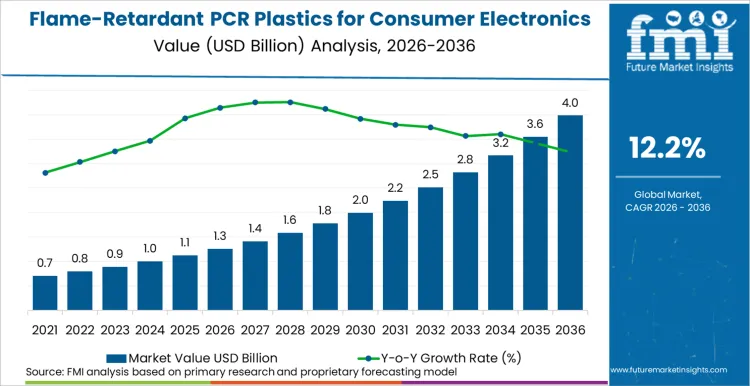
Summary of Flame-Retardant PCR Plastics for Consumer Electronics Market
What is the Long-Term Growth Outlook for the Flame-Retardant PCR Plastics Market?
FMI projects the global flame-retardant PCR plastics for consumer electronics market to expand from USD 1,260 million in 2026 to USD 3,980 million by 2036, registering a 12.2% CAGR. This accelerated growth reflects the electronics industry's dual imperative: to meet escalating consumer and regulatory demands for circularity while upholding the highest safety standards for devices that often operate on high-energy-density batteries. The market is transitioning from niche use in non-critical parts to mainstream adoption in structural housings.
FMI Research Approach: This projection is derived from FMI's proprietary model analyzing electronics OEM sustainability reports, global e-waste legislation, capacity investments in advanced polymer recycling (particularly for ABS/PC streams), and the adoption rate of halogen-free FR standards across major manufacturing regions.
How do FMI Analysts Expect the Flame-Retardant PCR Plastics Market to Evolve Structurally?
FMI analysts anticipate a shift from using PCR as a filler in FR compounds to engineering PCR as the primary polymer matrix with tailored FR packages. Development will focus on overcoming two key challenges: preventing the "blooming" or migration of FR additives to the surface (which is exacerbated by PCR), and maintaining impact strength and heat deflection temperature. The market will see increased use of reactive compatibilizers that bond FR additives to the degraded PCR polymer chains, creating more stable and predictable material performance.
FMI Research Approach: Insights are informed by tracking patent filings in FR additive technology for recycled polymers, analyzing material qualification data sheets from compounders, and monitoring updates to international safety standards (UL, IEC) regarding recycled content in FR applications.
Which Geographies Command Strategic Importance in the Flame-Retardant PCR Plastics Market?
Strategic growth is concentrated in Asia-Pacific, led by China, which is both the world's primary electronics manufacturer and a source of vast post-consumer plastic streams. Europe and North America are key regulatory and innovation drivers, where OEM sustainability mandates are most stringent. Japan and South Korea represent high-value markets focused on precision engineering and high-reliability applications, pushing the performance boundaries of FR-PCR materials.
FMI Research Approach: Regional market sizing is based on electronics production volumes, the strength of extended producer responsibility laws for e-waste, the presence of leading compounders, and the recycling infrastructure for technical plastics like ABS and PC.
What Will Be the Market Size of Flame-Retardant PCR Plastics for Consumer Electronics by 2036?
By 2036, the flame-retardant PCR plastics market is expected to reach USD 3,980 million. This expansion will be sustained as electronics brands lock in multi-year supply agreements for certified materials to meet 2030 sustainability goals. Growth will correlate with the scaling of chemical recycling for plastics from mixed e-waste, which can provide higher-purity PCR feedstock suitable for demanding FR applications.
FMI Research Approach: The long-term outlook incorporates forecasts for consumer electronics production, projected improvements in sorting and recycling technologies for e-waste plastics, and the anticipated integration of recycled content mandates into global product safety certification processes.
What are some Globally Distinct Trends Shaping the Flame-Retardant PCR Plastics Market?
Globally, the market is shaped by the phase-out of halogenated flame retardants, the need for low-VOC emissions in enclosed electronics, and digital traceability for sustainability claims. The shift to halogen-free systems (phosphorus, nitrogen, mineral-based) is accelerated in PCR applications due to environmental health concerns. Low-bloom additive technology is critical to prevent hazing on visual parts and keyboard corrosion. Furthermore, blockchain-enabled material passports are being piloted to verify the chain of custody and PCR percentage in safety-critical components.
FMI Research Approach: Trend identification involves monitoring regulatory bans on specific FR chemicals (e.g., EU POPs Regulation), reviewing OEM component material specifications for VOC limits, and analyzing case studies of digital tracking implementations in electronics supply chains.
Flame-Retardant PCR Plastics for Consumer Electronics Market Key Takeaways
| Metrics | Values |
|---|---|
| Expected Value (2026E) | USD 1,260 million |
| Projected Value (2036F) | USD 3,980 million |
| CAGR (2026-2036) | 12.2% |
Source: Future Market Insights (FMI) analysis, based on proprietary forecasting model and primary research
Why is the Flame-Retardant PCR Plastics for Consumer Electronics Market Growing?
The primary growth catalyst is the electronics industry's response to Scope 3 carbon emission targets. Using PCR plastics can reduce the cradle-to-gate carbon footprint of a device housing by up to 70% compared to virgin plastic. For global electronics brands, this presents one of the most effective levers to decarbonize their products, making investment in FR-PCR material development and supply chain integration a strategic priority aligned with climate goals.
Stringent eco-label certifications are creating formal market requirements. Standards like EPEAT for electronics and TCO Certified now include specific points for using post-consumer recycled plastic, including in applications requiring flame retardancy. To achieve the highest ratings preferred by corporate and institutional buyers, OEMs must source qualified FR-PCR compounds, creating a competitive marketplace for certified materials and pulling them into mainstream product designs.
Advancements in compatibilizer chemistry are solving core performance issues. The degraded molecular weight of PCR polymers leads to poor interfacial adhesion with FR additives and fillers, reducing efficacy and strength. New generations of copolymer and grafted compatibilizers are designed to act as molecular bridges, bonding to both the PCR polymer chain and the FR additive. This technology, central to recent product launches from major compounders, is enabling higher PCR loadings (exceeding 30%) while maintaining UL94 V-0 ratings and key mechanical properties.
How is Flame-Retardant PCR Plastics for Consumer Electronics Market Segmented?
The market segment landscape is defined by the need to balance aesthetic, safety, and circularity in high-volume electronics production. Laptop, TV, and appliance housings represent the largest volume application, utilizing versatile FR ABS and PC blends. The material challenge centers on incorporating PCR-ABS and PCR-PC, which is enabled by sophisticated halogen-free compounding technology designed to achieve the critical UL94 V-0 rating.
How are Durable Goods Housings Anchoring Volume Demand?
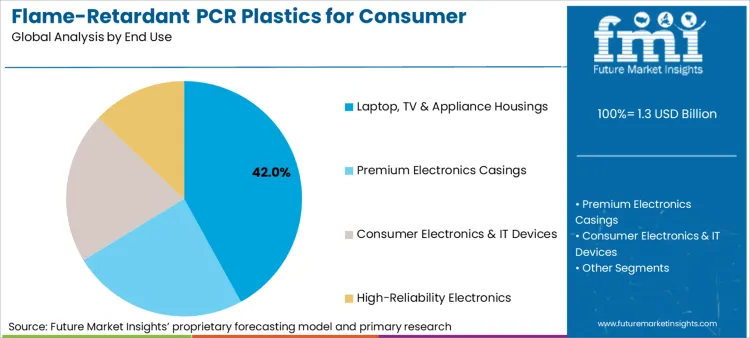
Laptop, TV, and appliance housings constitute the largest end-use segment with a 42.0% share. These applications require a combination of rigidity, impact resistance, heat resistance for UL certification, and excellent surface finish for painting or texturing. The large surface area of these parts makes them ideal for showcasing sustainability achievements. The technical focus is on integrating PCR into the often-thin walls of these housings without causing flow lines, sink marks, or compromising flame retardancy, which requires precise control over material rheology and additive dispersion.
This segment's demands validate the entire value proposition. A successful FR-PCR compound for a TV back cover must withstand long-term heat exposure from internal components, meet strict flammability standards for household goods, and provide a consistent surface for finishing-all while containing a verified percentage of post-consumer waste.
Which Polymer Blends Offer the Optimal Balance for PCR Integration?
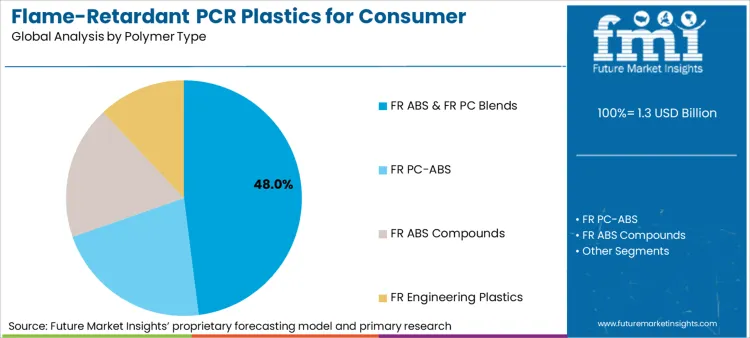
FR ABS & FR PC blends represent the leading polymer type segment with a 48.0% share. This blend capitalizes on the cost-effectiveness and processability of ABS with the superior heat and impact resistance of polycarbonate. For PCR integration, this blend system is advantageous because PCR-ABS and PCR-PC streams from e-waste are often commingled. Advanced compounding can create a homogeneous alloy from these mixed PCR feeds, with the FR system engineered to perform consistently across the blended polymer matrix. This approach maximizes the utilization of available PCR feedstock.
The dominance of this blend directs recycling and compounding strategy. It encourages the development of sorting and recycling processes that yield PCR flake from mixed ABS/PC waste streams, rather than pursuing costly separation, creating a more economically viable pathway to high-volume PCR supply.
What are the Primary PCR Feedstocks for Electronics-Grade Compounds?
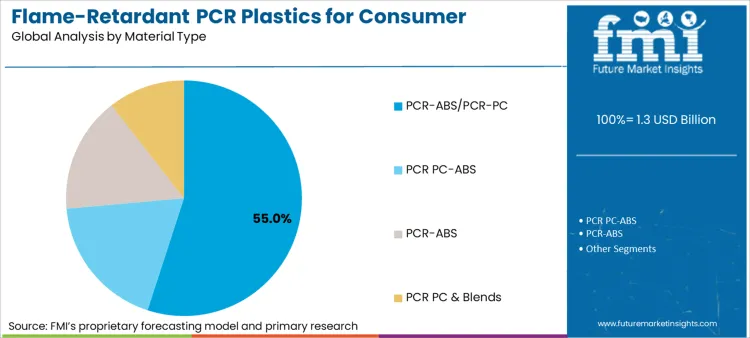
PCR-ABS and PCR-PC constitute the leading material segment with a 55.0% share. These engineering plastics are prevalent in legacy electronics, making them the most logical and available feedstock for closed-loop recycling in the electronics sector. However, recovering these materials from shredded e-waste is challenging due to contamination with other plastics, metals, and brominated flame retardants from older devices.
The market leaders are those who have developed or sourced "deep clean" PCR-ABS/PC flake through intensive washing, extraction, and filtration processes to remove contaminants that could interfere with new FR systems or cause premature polymer degradation. Securing a consistent supply of this clean, well-characterized PCR flake is a key competitive differentiator and a prerequisite for producing reliable, OEM-qualified compounds.
Which Technology is Fundamental to Meeting Safety and Environmental Standards?
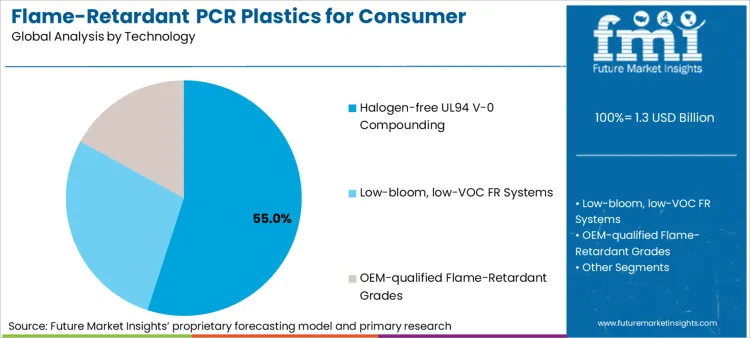
Halogen-free UL94 V-0 compounding is the dominant technology segment with a 55.0% share. This encompasses the complete system for incorporating mineral-based (e.g., metal hydroxides), phosphorus-based, or nitrogen-based flame retardants into a PCR polymer melt. The technology must ensure perfect dispersion of the FR additives to create a protective char layer during a fire, while also managing the higher melt viscosity and potential for volatiles caused by the PCR. Furthermore, the process must be tightly controlled to avoid thermal degradation of the PCR, which could release acids that neutralize certain FR chemistries. Mastering this balance is the core technical challenge of the market.
What Drivers, Restraints, Opportunities, and Trends Prevail in the Flame-Retardant PCR Plastics Market?
Market expansion is critically driven by consumer-facing sustainability branding. Electronics brands are increasingly marketing the recycled content of their devices as a key feature. Using FR-PCR plastics in visible and tactile parts like housings provides a tangible story for consumers and B2B clients, directly influencing purchasing decisions in a competitive market. This marketing advantage justifies the investment in material qualification and any associated cost premium.
A significant restraint is the risk of polymer degradation during recycling. Each heat history (initial molding, service life, recycling) breaks polymer chains, reducing molecular weight. This degradation lowers impact strength and heat resistance-properties critical for electronics housings. While compatibilizers can help, there is a practical limit to the number of times a plastic can be mechanically recycled and still meet FR performance specs, potentially capping long-term circularity aspirations without chemical recycling.
A major opportunity lies in developing FR-PCR materials for the burgeoning electric vehicle (EV) interior electronics market. EV centers consoles, battery management system housings, and charging port assemblies require flame-retardant plastics. Creating compounds that use PCR from discarded consumer electronics for these new automotive applications opens a high-growth adjacent market and leverages similar material performance requirements.
A defining technical trend is the use of "blocker" additives to neutralize legacy brominated flame retardants (BFRs). PCR from older e-waste often contains restricted BFRs. New additive systems can chemically "trap" or deactivate these legacy FRs during compounding, preventing them from interfering with the new halogen-free FR system and allowing a broader range of PCR feedstock to be used in certified materials. This technology is key to unlocking larger volumes of historical e-waste for recycling.
The trend toward multi-material, monolithic design in electronics is influencing PCR use. To simplify disassembly and recycling, OEMs are designing enclosures as single plastic types. This design-for-recycling approach makes it easier to recover clean, single-polymer PCR streams (e.g., pure PC, pure ABS) in the future, which will subsequently improve the quality and performance of next-generation FR-PCR compounds, creating a positive feedback loop for circularity.
Analysis of Flame-Retardant PCR Plastics Market by Key Countries
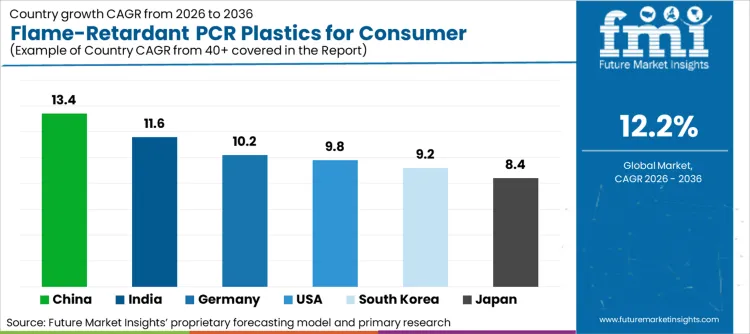
| Country | CAGR (2026-2036) |
|---|---|
| China | 13.4% |
| India | 11.6% |
| Germany | 10.2% |
| USA | 9.8% |
| South Korea | 9.2% |
| Japan | 8.4% |
Source: Future Market Insights (FMI) analysis, based on proprietary forecasting model and primary research
How are Regulatory Push and Manufacturing Scale Converging in China?
China is projected to expand at a 13.4% CAGR through 2036, the highest among key nations. This is driven by its Dual Carbon policy and stringent new rules for e-waste recycling and remanufacturing. As the world's electronics factory, Chinese OEMs and their vast supply chains are under immense pressure to green their output. Domestic compounders are leveraging high-volume, cost-optimized compounding to produce FR-PCR materials for the massive production of laptops, TVs, and appliances, both for export and the growing domestic premium market. The scale allows for rapid iteration and cost reduction.
How is a Thriving Domestic Electronics Market and Cost Focus Shaping India?
India’s market is growing at an 11.6% CAGR, fueled by its booming domestic electronics manufacturing and a price-sensitive consumer base. The demand is for FR-PCR compounds that meet basic safety standards (such as IS standards) for small appliances and entry-level electronics at the lowest possible cost. This drives innovation in using locally sourced PCR feedstock and optimizing FR additive loadings to the minimum required level, making PCR integration an economic imperative as much as an environmental one.
Which EU Regulations and Premium Brand Demand Define the German Market?
The EU’s Circular Economy Action Plan and the Ecodesign Directive shape Germany’s market, expanding at a 10.2% CAGR. German engineering and premium electronics brands demand the highest performance materials. The focus for compounders like Covestro and Trinseo is on developing low-VOC, low-bloom FR systems for PCR that meet the aesthetic (high-gloss, color consistency) and durability standards of premium products, often involving close collaboration with OEMs on specific grade development and full lifecycle assessment.
How do Corporate Sustainability Leadership and Supply Chain Initiatives Drive the US Market?
USA, with a 9.8% CAGR, is driven by the sustainability commitments of Silicon Valley and global electronics brands headquartered there, alongside retailer pressure (e.g., Best Buy's sustainability scorecard). The focus is on OEM qualification of FR-PCR grades for specific high-volume devices like laptops and monitors. US-based compounders like Avient and Teknor Apex work closely with brands to navigate UL certification with PCR content and develop supply chains that incorporate domestic PCR sources.
What role does Display and Semiconductor Leadership Play in South Korea’s Market?
South Korea, with a 9.2% CAGR, is closely tied to its global leadership in display panels, semiconductors, and consumer electronics brands. Companies like LG Chem and LOTTE Chemical are developing FR-PCR compounds specifically for high-heat applications near displays and processors, and for the thin, complex housings of flagship mobile devices. The emphasis is on material purity and precision to avoid any outgassing that could fog optical components or corrode sensitive circuits.
How do Precision, Miniaturization, and Reliability Demands Influence Japan?
Japan’s market, growing at an 8.4% CAGR, is defined by extreme precision and reliability standards for electronics in automotive, industrial, and high-end consumer applications. Japanese material suppliers like Teijin and Mitsubishi Chemical focus on precision FR additive control and advanced compatibilizers to ensure that FR-PCR plastics perform with absolute consistency in miniaturized, high-reliability components where failure is not an option, often targeting applications beyond housings, such as internal connectors and frames.
What is the Competition Outlook for Flame-Retardant PCR Plastics?
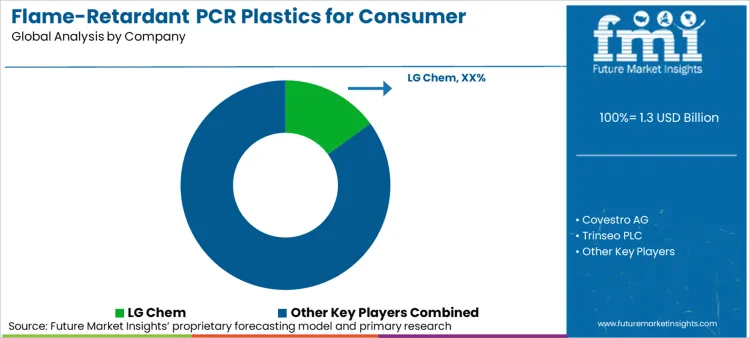
Competitive intensity revolves around mastering the complex interplay of polymer science, additive technology, and sourcing. Leaders are those who can simultaneously ensure a supply of clean PCR feedstock, formulate halogen-free FR systems that perform reliably with that feedstock, and navigate the lengthy and expensive OEM qualification process. The market features competition between large integrated chemical companies, specialized engineering compounders, and recycler-compounder alliances.
Strategic moves are focused on building circular partnerships. Compounders are forming joint ventures or long-term agreements with specialized e-waste recyclers to secure bespoke PCR flake streams. Others are investing in chemical recycling capabilities to upgrade mixed or degraded PCR into virgin-quality feedstocks suitable for the most demanding FR applications. Success depends on creating a resilient, traceable, and technically controlled supply chain from waste to finished component.
Key Developments
- SABIC has expanded its TRUCIRCLE™ portfolio for consumer electronics, including flame-retardant PC and PC-ABS compounds produced using certified circular feedstock derived from chemically recycled post-consumer plastic waste. These materials leverage mass-balance attribution to deliver high-purity, circular polymer content while maintaining compliance with stringent flame-retardancy and electrical safety requirements for electronic housings.
- Covestro has advanced the commercialization of recycled-content Makrolon® polycarbonate grades for electronics, combining post-consumer recycled material integration with established flame-retardant performance. Selected grades are validated for recycled content through third-party certification and are available in UL 94 V-0 flame-retardant formulations, supporting faster qualification and material acceptance among electronics OEMs.
- Eastman has continued to scale its molecular recycling platform and collaborate with electronics and durable-goods brands on recycled-content copolyester materials. Through polyester renewal technology, Eastman is enabling the development of specialty copolyester grades with circular feedstock that can be formulated to meet fire-safety and performance requirements, providing an alternative polymer pathway for flame-retardant, recycled-content electronics applications.
Key Players Profiled
- LG Chem
- Covestro AG
- Trinseo PLC
- Avient Corporation
- Teknor Apex Company
- Teijin Limited
- Mitsubishi Chemical Corporation
- Supreme Petrochem Ltd.
- LOTTE Chemical CORPORATION
Market Definition
The flame-retardant PCR plastics for consumer electronics market comprises revenue generated from the sale of compounded plastic resins that contain significant post-consumer recycled content and are engineered to meet recognized flame-retardancy standards (e.g., UL94 V-0, V-1, 5VB) for use in the manufacturing of consumer electronic devices and appliances. This includes polymers such as ABS, PC, PC-ABS blends, and other engineering thermoplastics.
The market scope includes ready-to-mold pelletized compounds sold to electronics OEMs and their contract manufacturers. These materials are differentiated by their certification for both recycled content via mass balance or traceable physical recycling and safety performance. The market excludes virgin flame-retardant plastics, non-flame-retardant recycled plastics, and compounds where the recycled content is primarily post-industrial.
Scope of Report
| Items | Values |
|---|---|
| Quantitative Units (2026) | USD 1,260 Million |
| End-use | Laptop, TV & Appliance Housings, Premium Electronics Casings, Consumer Electronics & IT Devices, High-Reliability Electronics, Small Appliances, Displays & IT Hardware |
| Polymer Type | FR ABS & FR PC Blends, FR PC-ABS, FR ABS Compounds, FR Engineering Plastics, Other |
| Material | PCR-ABS / PCR-PC, PCR PC-ABS, PCR-ABS, PCR PC & Blends, Other |
| Technology | Halogen-free UL94 V-0 Compounding, Low-bloom, low-VOC FR Systems, OEM-qualified Flame-Retardant Grades, Precision FR Additive Control, Other |
| Regions Covered | North America, Europe, Asia-Pacific, Latin America, Middle East & Africa |
| Countries | USA, Germany, China, Japan, India, Korea and 40+ countries |
| Key Companies | LG Chem, Covestro, Trinseo, Avient, Teknor Apex, Teijin, Mitsubishi Chemical, Supreme Petrochem, LOTTE Chemical |
Source: Future Market Insights (FMI) analysis, based on proprietary forecasting model and primary research
Flame-Retardant PCR Plastics for Consumer Electronics Market Key Segments
End-use
- Laptop, TV & Appliance Housings
- Premium Electronics Casings
- Consumer Electronics & IT Devices
- High-Reliability Electronics
- Small Appliances
- Displays & IT Hardware
Polymer Type
- FR ABS & FR PC Blends
- FR PC-ABS
- FR ABS Compounds
- FR Engineering Plastics
- Other
Material
- PCR-ABS/PCR-PC
- PCR PC-ABS
- PCR-ABS
- PCR PC & Blends
- Other
Technology
- Halogen-free UL94 V-0 Compounding
- Low-bloom, low-VOC FR Systems
- OEM-qualified Flame-Retardant Grades
- Precision FR Additive Control
- Other
Region
- North America
- Europe
- Asia-Pacific
- Latin America
- Middle East & Africa
Bibliography
- UL Solutions. (2024). UL environmental claim validation procedure for recycled content in plastic materials. UL Solutions.
- TCO Development. (2024). TCO Certified generation 10: Materials, chemicals, and circularity requirements for electronics products. TCO Development.
- IEEE Standards Association. (2024). IEEE 1680.1™: Standard for environmental and social responsibility assessment of computers and displays. IEEE.
- International Electrotechnical Commission. (2024). IEC 62321-12: Determination of regulated substances in electrotechnical products - Plastics and polymers. IEC.
- Society of Plastics Engineers. (2024). Advances in flame-retardant systems for recycled engineering thermoplastics. SPE Automotive & Electronics Division.
- Fraunhofer Institute for Chemical Technology ICT. (2024). Halogen-free flame-retardant compounding strategies for recycled ABS and PC from WEEE. Fraunhofer-Gesellschaft.
- Underwriters Laboratories. (2025). UL 94 flame retardancy classifications and recycled polymer considerations. Underwriters Laboratories.
Frequently Asked Questions
How big is the flame-retardant pcr plastics for consumer electronics market in 2026?
The global flame-retardant pcr plastics for consumer electronics market is estimated to be valued at USD 1.3 billion in 2026.
What will be the size of flame-retardant pcr plastics for consumer electronics market in 2036?
The market size for the flame-retardant pcr plastics for consumer electronics market is projected to reach USD 4.0 billion by 2036.
How much will be the flame-retardant pcr plastics for consumer electronics market growth between 2026 and 2036?
The flame-retardant pcr plastics for consumer electronics market is expected to grow at a 12.2% CAGR between 2026 and 2036.
What are the key product types in the flame-retardant pcr plastics for consumer electronics market?
The key product types in flame-retardant pcr plastics for consumer electronics market are laptop, tv & appliance housings, premium electronics casings, consumer electronics & it devices and high-reliability electronics.
Which polymer type segment to contribute significant share in the flame-retardant pcr plastics for consumer electronics market in 2026?
In terms of polymer type, fr abs & fr pc blends segment to command 48.0% share in the flame-retardant pcr plastics for consumer electronics market in 2026.
Preview the report firsthand - request a free sample
Get SampleGet the brochure for pricing and purchase details.
Get PDFTable of Content
- Executive Summary
- Global Market Outlook
- Demand-side Trends
- Supply-side Trends
- Technology Roadmap Analysis
- Analysis and Recommendations
- Market Overview
- Market Coverage / Taxonomy
- Market Definition / Scope / Limitations
- Research Methodology
- Chapter Orientation
- Analytical Lens and Working Hypotheses
- Market Structure, Signals, and Trend Drivers
- Benchmarking and Cross-market Comparability
- Market Sizing, Forecasting, and Opportunity Mapping
- Research Design and Evidence Framework
- Desk Research Programme (Secondary Evidence)
- Company Annual and Sustainability Reports
- Peer-reviewed Journals and Academic Literature
- Corporate Websites, Product Literature, and Technical Notes
- Earnings Decks and Investor Briefings
- Statutory Filings and Regulatory Disclosures
- Technical White Papers and Standards Notes
- Trade Journals, Industry Magazines, and Analyst Briefs
- Conference Proceedings, Webinars, and Seminar Materials
- Government Statistics Portals and Public Data Releases
- Press Releases and Reputable Media Coverage
- Specialist Newsletters and Curated Briefings
- Sector Databases and Reference Repositories
- FMI Internal Proprietary Databases and Historical Market Datasets
- Subscription Datasets and Paid Sources
- Social Channels, Communities, and Digital Listening Inputs
- Additional Desk Sources
- Expert Input and Fieldwork (Primary Evidence)
- Primary Modes
- Qualitative Interviews and Expert Elicitation
- Quantitative Surveys and Structured Data Capture
- Blended Approach
- Why Primary Evidence is Used
- Field Techniques
- Interviews
- Surveys
- Focus Groups
- Observational and In-context Research
- Social and Community Interactions
- Stakeholder Universe Engaged
- C-suite Leaders
- Board Members
- Presidents and Vice Presidents
- R&D and Innovation Heads
- Technical Specialists
- Domain Subject-matter Experts
- Scientists
- Physicians and Other Healthcare Professionals
- Governance, Ethics, and Data Stewardship
- Research Ethics
- Data Integrity and Handling
- Primary Modes
- Tooling, Models, and Reference Databases
- Desk Research Programme (Secondary Evidence)
- Data Engineering and Model Build
- Data Acquisition and Ingestion
- Cleaning, Normalisation, and Verification
- Synthesis, Triangulation, and Analysis
- Quality Assurance and Audit Trail
- Market Background
- Market Dynamics
- Drivers
- Restraints
- Opportunity
- Trends
- Scenario Forecast
- Demand in Optimistic Scenario
- Demand in Likely Scenario
- Demand in Conservative Scenario
- Opportunity Map Analysis
- Product Life Cycle Analysis
- Supply Chain Analysis
- Investment Feasibility Matrix
- Value Chain Analysis
- PESTLE and Porter’s Analysis
- Regulatory Landscape
- Regional Parent Market Outlook
- Production and Consumption Statistics
- Import and Export Statistics
- Market Dynamics
- Global Market Analysis 2021 to 2025 and Forecast, 2026 to 2036
- Historical Market Size Value (USD Million) Analysis, 2021 to 2025
- Current and Future Market Size Value (USD Million) Projections, 2026 to 2036
- Y-o-Y Growth Trend Analysis
- Absolute $ Opportunity Analysis
- Global Market Pricing Analysis 2021 to 2025 and Forecast 2026 to 2036
- Global Market Analysis 2021 to 2025 and Forecast 2026 to 2036, By End Use
- Introduction / Key Findings
- Historical Market Size Value (USD Million) Analysis By End Use , 2021 to 2025
- Current and Future Market Size Value (USD Million) Analysis and Forecast By End Use , 2026 to 2036
- Laptop, TV & Appliance Housings
- Premium Electronics Casings
- Consumer Electronics & IT Devices
- High-Reliability Electronics
- Laptop, TV & Appliance Housings
- Y-o-Y Growth Trend Analysis By End Use , 2021 to 2025
- Absolute $ Opportunity Analysis By End Use , 2026 to 2036
- Global Market Analysis 2021 to 2025 and Forecast 2026 to 2036, By Polymer Type
- Introduction / Key Findings
- Historical Market Size Value (USD Million) Analysis By Polymer Type, 2021 to 2025
- Current and Future Market Size Value (USD Million) Analysis and Forecast By Polymer Type, 2026 to 2036
- FR ABS & FR PC Blends
- FR PC-ABS
- FR ABS Compounds
- FR Engineering Plastics
- FR ABS & FR PC Blends
- Y-o-Y Growth Trend Analysis By Polymer Type, 2021 to 2025
- Absolute $ Opportunity Analysis By Polymer Type, 2026 to 2036
- Global Market Analysis 2021 to 2025 and Forecast 2026 to 2036, By Material Type
- Introduction / Key Findings
- Historical Market Size Value (USD Million) Analysis By Material Type, 2021 to 2025
- Current and Future Market Size Value (USD Million) Analysis and Forecast By Material Type, 2026 to 2036
- PCR-ABS/PCR-PC
- PCR PC-ABS
- PCR-ABS
- PCR PC & Blends
- PCR-ABS/PCR-PC
- Y-o-Y Growth Trend Analysis By Material Type, 2021 to 2025
- Absolute $ Opportunity Analysis By Material Type, 2026 to 2036
- Global Market Analysis 2021 to 2025 and Forecast 2026 to 2036, By Technology
- Introduction / Key Findings
- Historical Market Size Value (USD Million) Analysis By Technology, 2021 to 2025
- Current and Future Market Size Value (USD Million) Analysis and Forecast By Technology, 2026 to 2036
- Halogen-free UL94 V-0 Compounding
- Low-bloom, low-VOC FR Systems
- OEM-qualified Flame-Retardant Grades
- Halogen-free UL94 V-0 Compounding
- Y-o-Y Growth Trend Analysis By Technology, 2021 to 2025
- Absolute $ Opportunity Analysis By Technology, 2026 to 2036
- Global Market Analysis 2021 to 2025 and Forecast 2026 to 2036, By Region
- Introduction
- Historical Market Size Value (USD Million) Analysis By Region, 2021 to 2025
- Current Market Size Value (USD Million) Analysis and Forecast By Region, 2026 to 2036
- North America
- Latin America
- Western Europe
- Eastern Europe
- East Asia
- South Asia and Pacific
- Middle East & Africa
- Market Attractiveness Analysis By Region
- North America Market Analysis 2021 to 2025 and Forecast 2026 to 2036, By Country
- Historical Market Size Value (USD Million) Trend Analysis By Market Taxonomy, 2021 to 2025
- Market Size Value (USD Million) Forecast By Market Taxonomy, 2026 to 2036
- By Country
- USA
- Canada
- Mexico
- By End Use
- By Polymer Type
- By Material Type
- By Technology
- By Country
- Market Attractiveness Analysis
- By Country
- By End Use
- By Polymer Type
- By Material Type
- By Technology
- Key Takeaways
- Latin America Market Analysis 2021 to 2025 and Forecast 2026 to 2036, By Country
- Historical Market Size Value (USD Million) Trend Analysis By Market Taxonomy, 2021 to 2025
- Market Size Value (USD Million) Forecast By Market Taxonomy, 2026 to 2036
- By Country
- Brazil
- Chile
- Rest of Latin America
- By End Use
- By Polymer Type
- By Material Type
- By Technology
- By Country
- Market Attractiveness Analysis
- By Country
- By End Use
- By Polymer Type
- By Material Type
- By Technology
- Key Takeaways
- Western Europe Market Analysis 2021 to 2025 and Forecast 2026 to 2036, By Country
- Historical Market Size Value (USD Million) Trend Analysis By Market Taxonomy, 2021 to 2025
- Market Size Value (USD Million) Forecast By Market Taxonomy, 2026 to 2036
- By Country
- Germany
- UK
- Italy
- Spain
- France
- Nordic
- BENELUX
- Rest of Western Europe
- By End Use
- By Polymer Type
- By Material Type
- By Technology
- By Country
- Market Attractiveness Analysis
- By Country
- By End Use
- By Polymer Type
- By Material Type
- By Technology
- Key Takeaways
- Eastern Europe Market Analysis 2021 to 2025 and Forecast 2026 to 2036, By Country
- Historical Market Size Value (USD Million) Trend Analysis By Market Taxonomy, 2021 to 2025
- Market Size Value (USD Million) Forecast By Market Taxonomy, 2026 to 2036
- By Country
- Russia
- Poland
- Hungary
- Balkan & Baltic
- Rest of Eastern Europe
- By End Use
- By Polymer Type
- By Material Type
- By Technology
- By Country
- Market Attractiveness Analysis
- By Country
- By End Use
- By Polymer Type
- By Material Type
- By Technology
- Key Takeaways
- East Asia Market Analysis 2021 to 2025 and Forecast 2026 to 2036, By Country
- Historical Market Size Value (USD Million) Trend Analysis By Market Taxonomy, 2021 to 2025
- Market Size Value (USD Million) Forecast By Market Taxonomy, 2026 to 2036
- By Country
- China
- Japan
- South Korea
- By End Use
- By Polymer Type
- By Material Type
- By Technology
- By Country
- Market Attractiveness Analysis
- By Country
- By End Use
- By Polymer Type
- By Material Type
- By Technology
- Key Takeaways
- South Asia and Pacific Market Analysis 2021 to 2025 and Forecast 2026 to 2036, By Country
- Historical Market Size Value (USD Million) Trend Analysis By Market Taxonomy, 2021 to 2025
- Market Size Value (USD Million) Forecast By Market Taxonomy, 2026 to 2036
- By Country
- India
- ASEAN
- Australia & New Zealand
- Rest of South Asia and Pacific
- By End Use
- By Polymer Type
- By Material Type
- By Technology
- By Country
- Market Attractiveness Analysis
- By Country
- By End Use
- By Polymer Type
- By Material Type
- By Technology
- Key Takeaways
- Middle East & Africa Market Analysis 2021 to 2025 and Forecast 2026 to 2036, By Country
- Historical Market Size Value (USD Million) Trend Analysis By Market Taxonomy, 2021 to 2025
- Market Size Value (USD Million) Forecast By Market Taxonomy, 2026 to 2036
- By Country
- Kingdom of Saudi Arabia
- Other GCC Countries
- Turkiye
- South Africa
- Other African Union
- Rest of Middle East & Africa
- By End Use
- By Polymer Type
- By Material Type
- By Technology
- By Country
- Market Attractiveness Analysis
- By Country
- By End Use
- By Polymer Type
- By Material Type
- By Technology
- Key Takeaways
- Key Countries Market Analysis
- USA
- Pricing Analysis
- Market Share Analysis, 2025
- By End Use
- By Polymer Type
- By Material Type
- By Technology
- Canada
- Pricing Analysis
- Market Share Analysis, 2025
- By End Use
- By Polymer Type
- By Material Type
- By Technology
- Mexico
- Pricing Analysis
- Market Share Analysis, 2025
- By End Use
- By Polymer Type
- By Material Type
- By Technology
- Brazil
- Pricing Analysis
- Market Share Analysis, 2025
- By End Use
- By Polymer Type
- By Material Type
- By Technology
- Chile
- Pricing Analysis
- Market Share Analysis, 2025
- By End Use
- By Polymer Type
- By Material Type
- By Technology
- Germany
- Pricing Analysis
- Market Share Analysis, 2025
- By End Use
- By Polymer Type
- By Material Type
- By Technology
- UK
- Pricing Analysis
- Market Share Analysis, 2025
- By End Use
- By Polymer Type
- By Material Type
- By Technology
- Italy
- Pricing Analysis
- Market Share Analysis, 2025
- By End Use
- By Polymer Type
- By Material Type
- By Technology
- Spain
- Pricing Analysis
- Market Share Analysis, 2025
- By End Use
- By Polymer Type
- By Material Type
- By Technology
- France
- Pricing Analysis
- Market Share Analysis, 2025
- By End Use
- By Polymer Type
- By Material Type
- By Technology
- India
- Pricing Analysis
- Market Share Analysis, 2025
- By End Use
- By Polymer Type
- By Material Type
- By Technology
- ASEAN
- Pricing Analysis
- Market Share Analysis, 2025
- By End Use
- By Polymer Type
- By Material Type
- By Technology
- Australia & New Zealand
- Pricing Analysis
- Market Share Analysis, 2025
- By End Use
- By Polymer Type
- By Material Type
- By Technology
- China
- Pricing Analysis
- Market Share Analysis, 2025
- By End Use
- By Polymer Type
- By Material Type
- By Technology
- Japan
- Pricing Analysis
- Market Share Analysis, 2025
- By End Use
- By Polymer Type
- By Material Type
- By Technology
- South Korea
- Pricing Analysis
- Market Share Analysis, 2025
- By End Use
- By Polymer Type
- By Material Type
- By Technology
- Russia
- Pricing Analysis
- Market Share Analysis, 2025
- By End Use
- By Polymer Type
- By Material Type
- By Technology
- Poland
- Pricing Analysis
- Market Share Analysis, 2025
- By End Use
- By Polymer Type
- By Material Type
- By Technology
- Hungary
- Pricing Analysis
- Market Share Analysis, 2025
- By End Use
- By Polymer Type
- By Material Type
- By Technology
- Kingdom of Saudi Arabia
- Pricing Analysis
- Market Share Analysis, 2025
- By End Use
- By Polymer Type
- By Material Type
- By Technology
- Turkiye
- Pricing Analysis
- Market Share Analysis, 2025
- By End Use
- By Polymer Type
- By Material Type
- By Technology
- South Africa
- Pricing Analysis
- Market Share Analysis, 2025
- By End Use
- By Polymer Type
- By Material Type
- By Technology
- USA
- Market Structure Analysis
- Competition Dashboard
- Competition Benchmarking
- Market Share Analysis of Top Players
- By Regional
- By End Use
- By Polymer Type
- By Material Type
- By Technology
- Competition Analysis
- Competition Deep Dive
- LG Chem
- Overview
- Product Portfolio
- Profitability by Market Segments (Product/Age /Sales Channel/Region)
- Sales Footprint
- Strategy Overview
- Marketing Strategy
- Product Strategy
- Channel Strategy
- Covestro AG
- Trinseo PLC
- Avient Corporation
- Teknor Apex Company
- LG Chem
- Competition Deep Dive
- Assumptions & Acronyms Used


