

- Industry Size (2026)
- USD 1.3 Bn
- Forecast (2036)
- USD 4.1 Bn
- CAGR (2026 to 2036)
- 12.2%
Fire Safe PCR Plastics for Electric Vehicles Market Forecast and Outlook 2026 to 2036
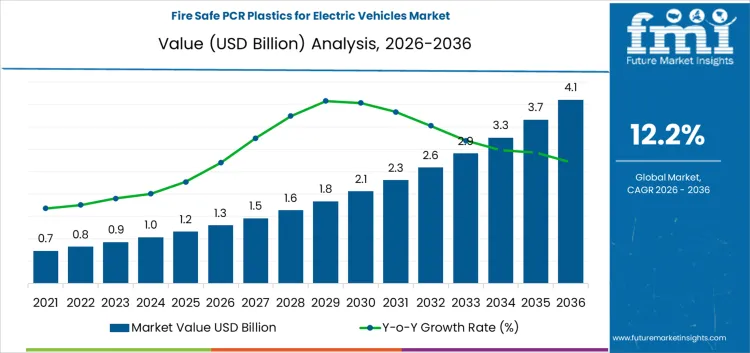
The fire-safe PCR plastics for electric vehicles market is likely to reach USD 1.3 billion in 2026 and is forecasted to grow to USD 4.1 billion by 2036, registering a CAGR of 12.2%. This growth is driven by the increasing adoption of electric vehicles (EVs) and the rising demand for materials that enhance safety in automotive applications. Fire-safe plastics, offering improved thermal and fire resistance, are critical for ensuring the durability and safety of EV components, particularly batteries and wiring, which are vulnerable to thermal risks.
As the EV market expands, the need for materials that combine fire resistance with recyclability grows. Fire-safe PCR plastics, derived from post-consumer recycled materials, help address the demand for both performance and resource efficiency in automotive manufacturing. Regulatory pressures to minimize environmental impact further encourage the use of these materials. Advances in polymer technology are enhancing the performance of fire-safe PCR plastics, making them more suitable for high-performance applications. The market is poised for growth due to the rising adoption of electric vehicles, safety concerns, and the push to improve material efficiency within the automotive sector.
Quick Stats of the Fire Safe PCR Plastics for Electric Vehicles Market
- Fire Safe PCR Plastics for Electric Vehicles Market Value (2026): USD 1.3 billion
- Fire Safe PCR Plastics for Electric Vehicles Market Forecast Value (2036): USD 4.1 billion
- Fire Safe PCR Plastics for Electric Vehicles Market Forecast CAGR 2026 to 2036: 12.2%
- Fire Safe PCR Plastics for Electric Vehicles Market Leading Material Class: Flame-retardant compounds (48 % share)
- Fire Safe PCR Plastics for Electric Vehicles Market Key Growth Regions: Asia Pacific, North America, Europe, Latin America, Middle East & Africa
- Fire Safe PCR Plastics for Electric Vehicles Market Top Players: BASF, Celanese, Kingfa, Reliance Industries, Braskem, Toray, Lanxess, SABIC, Wanhua
What is the Growth Forecast for Fire-Safe PCR Plastics for Electric Vehicles Market through 2036?
The fire-safe PCR plastics for electric vehicles market is projected to reach USD 1.3 billion in 2026 and USD 4.1 billion by 2036, with a compound annual growth rate (CAGR) of 12.2%. The market experiences steady growth, increasing from USD 0.7 billion in 2020 to USD 1.3 billion by 2026. This growth is primarily driven by the increasing adoption of electric vehicles (EVs) and the rising emphasis on vehicle safety standards. The automotive industry's growing focus on environmentally friendly materials and sustainability is pushing manufacturers to incorporate fire-safe PCR plastics into vehicle designs. Regulatory frameworks governing fire safety in electric vehicles and environmental considerations continue to support this upward market trajectory.
From 2026 to 2036, the fire-safe PCR plastics for electric vehicles market is expected to grow consistently, reaching USD 4.1 billion by 2036. The market will experience notable expansion from USD 1.5 billion in 2027 to USD 3 billion by 2034, driven by increasing electric vehicle production and the demand for safer, more sustainable materials. Factors such as stricter regulations for fire safety in EVs and a growing preference for recycled plastic solutions are expected to propel the market forward. The transition to greener materials, along with innovations in fire-resistant polymer technology, will further support the adoption of fire-safe PCR plastics. The continued focus on enhancing EV safety and reducing environmental impact will remain key drivers throughout the forecast period.
Fire Safe PCR Plastics for Electric Vehicles Market Key Takeaways
| Metric | Value |
|---|---|
| Market Value (2026) | USD 1.3 billion |
| Forecast Value (2036) | USD 4.1 billion |
| Forecast CAGR 2026 to 2036 | 12.2% |
What Factors Are Driving the Growth of Fire Safe PCR Plastics in the Electric Vehicle Industry?
Growth in the fire safe post-consumer recycled (PCR) plastics for electric vehicles (EVs) market is driven by regulatory shifts and engineering needs for safer, recyclable materials. EV manufacturers face stringent fire safety standards related to battery enclosures, cable housings, and interior components. These standards influence material selection toward polymers that resist ignition and limit flame propagation. PCR plastics with fire retardant properties meet both safety and sustainability objectives.
Regulatory frameworks in Europe and North America now demand higher recycled content in vehicles while maintaining compliance with fire safety tests such as UL 94 and FMVSS 302. Automotive tier suppliers are integrating fire safe PCR grades into structural and semi-structural parts to align with these evolving mandates. OEM procurement strategies show an increasing preference for materials that lower lifecycle emissions without compromising operational safety. Industry analysts cite the convergence of environmental policy and vehicle safety requirements as a core driver for investment in fire safe PCR technologies.
Advances in additive chemistry and compounding processes are expanding application scope for fire safe PCR plastics. Material developers are incorporating halogen-free flame retardants and synergists to improve thermal stability and reduce smoke toxicity in EV components. Specific applications gaining traction include battery module housings, high-voltage connector covers, and interior panels near heat sources. Companies such as SABIC and Covestro are releasing PCR resin lines tailored to these criteria, supported by internal testing data demonstrating sustained performance under elevated temperature conditions.
Collaborations between recycling firms and automotive suppliers are establishing closed-loop systems that convert end-of-life plastics into certified, fire-resistant grades. Procurement teams at major automakers are piloting these materials in production vehicles to validate durability and safety. Cost pressures from volatile virgin resin markets and shifting brand commitments to circularity further reinforce the adoption of fire safe PCR plastics in EV platforms.
What Are the Key Segments in the Fire Safe PCR Plastics for Electric Vehicles Market?
In the Fire Safe PCR Plastics for Electric Vehicles market, two primary segments drive growth: Material Class and Polymer Base. The Flame-retardant compounds segment is the dominant player in the material class category, accounting for 48% of the market share. On the polymer base side, PCR-PA and PCR-PP lead with 55%. These segments underscore the dual focus on both enhanced fire safety and sustainability within the electric vehicle sector. As safety regulations tighten and sustainability initiatives expand, demand for fire-safe, recycled polymers is expected to increase.
What Impact Does the Material Class Segment Have on Fire-Safe PCR Plastics?

The Flame-retardant compounds category holds a significant 48% market share within the Material Class Segment. These compounds are integral to electric vehicle safety, particularly in the areas of battery protection and electrical systems, where fire resistance is critical. With the increasing adoption of electric vehicles, the need for materials that provide superior fire resistance is more pressing than ever. These flame-retardant compounds not only help meet safety standards but also ensure that EVs remain reliable under extreme conditions.
Key factors driving the growth of flame-retardant compounds include the escalating demand for safer electric vehicle components and the growing regulatory pressure for fire safety standards. The adoption of flame-retardant materials aligns with the automotive industry's shift toward more sustainable practices. While the higher costs associated with these materials remain a challenge, the long-term benefits such as reducing the risk of fire-related incidents and enhancing the vehicle's reliability justify their usage. Moving forward, technological advancements may also help lower the costs and improve the performance of flame-retardant additives.
How Does the Polymer Base Segment Shape the Fire Safe PCR Plastics Market?
The Polymer Base Segment of the market is largely influenced by PCR-PA and PCR-PP, which together account for 55% of the total share. These recycled polymer bases are critical to the development of fire-safe plastics for electric vehicles, combining the durability needed for EV components with the added benefit of being sustainable. Recycled polyamide (PCR-PA) and polypropylene (PCR-PP) are ideal for high-performance applications due to their thermal stability, making them valuable in electric vehicles where high temperatures are common.
Adoption of these materials is primarily driven by the increasing focus on reducing carbon footprints in the automotive industry. As manufacturers strive to meet both environmental and performance standards, PCR-PA and PCR-PP offer an effective solution by integrating recycled content into vehicle construction without compromising on fire safety. The challenge lies in the need for consistent quality across recycled materials and ensuring they meet rigorous safety standards. Despite these obstacles, the growing push for sustainability, along with advances in recycling technologies, is expected to drive further adoption of PCR-based polymers in electric vehicles.
What Procurement Challenges Are Shaping the Adoption of Fire Safe PCR Plastics in Electric Vehicles?
In the EV sector, sourcing fire-safe PCR plastics involves navigating multiple layers of procurement hurdles. These plastics must meet specific safety benchmarks, such as heat release rate (HRR) and smoke toxicity, critical for vehicle components like battery packs, power cables, and interior panels. Companies are now evaluating suppliers based on both the technical properties of their recycled polymers and their ability to provide consistent flame-retardant additives. Strategic partnerships with recyclers are becoming essential as OEMs prioritize long-term agreements for materials that align with sustainability and fire safety standards, ensuring uniform quality for high-risk automotive applications.
What Production and Certification Challenges Are Hindering the Growth of Fire Safe PCR Plastics in EV Manufacturing?
Manufacturers face significant technical obstacles when scaling the use of fire-safe PCR plastics in EVs. The inherent variability in recycled feedstocks leads to inconsistencies in polymer properties, particularly in flame-retardant behavior, which is crucial for EV safety. Additionally, the process of blending flame retardants into PCR materials requires precise formulation and stringent quality checks, escalating production costs. Moreover, global certification standards for fire-resistant materials are not harmonized, creating regulatory complexity. EV manufacturers must navigate a web of national and international standards, further slowing down the time it takes to approve and deploy these materials into mass production.
What Innovations Are Emerging in Fire Safe PCR Plastics for Electric Vehicle Applications?
In the field of fire-safe PCR plastics, innovation is being driven by the development of new flame-retardant additives that work seamlessly with recycled resins. For instance, the incorporation of intumescent flame retardants is proving effective in enhancing the fire resistance of components like battery enclosures without compromising mechanical properties. Additionally, the rise of advanced manufacturing techniques, such as extrusion and injection molding, allows for better integration of these additives into PCR plastics, improving uniformity. Key OEMs are also investing in data-driven testing, using virtual simulations to predict material performance during high-temperature scenarios, optimizing designs for both fire safety and durability.
What Are the Growth Trends for Fire Safe PCR Plastics in Electric Vehicles by Country?
| Country | CAGR (%) |
|---|---|
| Germany | 10.8% |
| USA | 10.2% |
| China | 13.8% |
| India | 14.6% |
| Brazil | 9.4% |
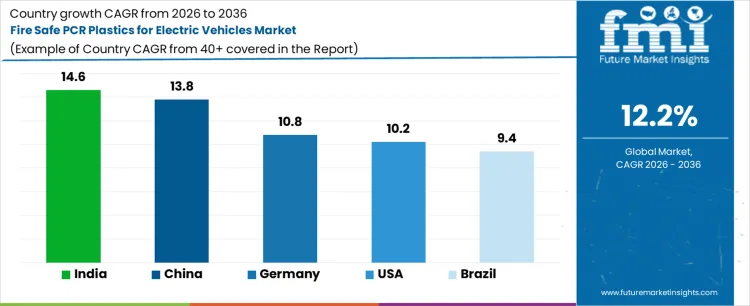
The demand for fire-safe post-consumer recycled (PCR) plastics in electric vehicles (EVs) is growing steadily across various global regions. India leads with a 14.6% CAGR, driven by rapid adoption of electric vehicles, a strong emphasis on sustainability, and increasing regulatory support for eco-friendly materials in the automotive industry. China follows with a 13.8% growth rate, supported by large-scale EV production and government policies focused on reducing carbon emissions and promoting green technologies. Germany records a 10.8% CAGR, driven by stringent environmental regulations and a mature EV market. The USA shows a steady growth rate of 10.2%, fueled by growing demand for sustainable and fire-safe materials in the EV sector. Brazil, with a 9.4% CAGR, is witnessing gradual growth in its adoption of PCR plastics as part of its broader commitment to reducing plastic waste and fostering green technology in the automotive industry.
What Drives Growth in the Fire Safe PCR Plastics Market in Germany?
Demand for fire safe PCR plastics in Germany is projected to grow at a CAGR of 10.8%. The country’s robust automotive sector and increasing shift toward electric vehicles are central to the rising demand for these materials. As electric vehicle production ramps up, manufacturers are turning to durable, fire-resistant plastics that also meet sustainability goals. Strict environmental regulations in Germany push for the use of recycled plastics in automotive applications, reinforcing the adoption of fire safe PCR materials. With the country’s ongoing investments in recycling technologies and innovation in polymer materials, Germany remains a key player in the European market for sustainable, fire-resistant polymers in electric vehicles.
- Expansion of the electric vehicle sector drives polymer demand.
- Environmental regulations encourage the use of recycled materials.
- Technological innovations in recycling boost market growth.
What Is Fueling the Growth of Fire Safe PCR Plastics in the USA?
Sales of fire safe PCR plastics for electric vehicles in the USA are expected to rise at a CAGR of 10.2%. With the growing adoption of electric vehicles, there is increasing demand for materials that meet high safety standards while being environmentally friendly. The USA automotive industry is focusing on using fire-resistant recycled plastics as part of a broader sustainability initiative. Government incentives promoting electric vehicle production and recycling programs are further contributing to this demand. As manufacturers continue to innovate, the market for fire safe PCR plastics is set to expand significantly, supporting both safety and environmental goals within the automotive sector.
- Electric vehicle adoption drives the demand for fire-safe materials.
- Government incentives foster the use of sustainable, recycled plastics.
- Innovations in recycling technologies support market growth.
How Is the Fire Safe PCR Plastics Market in China Evolving?
The fire safe PCR plastics market for electric vehicles in China is projected to grow at a CAGR of 13.8%. As the world’s largest electric vehicle manufacturer, the country is seeing substantial increases in demand for fire-resistant, eco-friendly plastics. The government’s push for circular economy practices and environmental sustainability is accelerating the use of recycled materials in automotive production. With regulatory frameworks focusing on reducing plastic waste and enhancing safety standards, China is leading the way in adopting fire safe PCR plastics. The continuous development of recycling infrastructure and advancements in polymer technology are key factors that will drive the market’s expansion over the coming years.
- Electric vehicle production expansion drives demand for fire-resistant plastics.
- Government regulations accelerate the use of recycled, sustainable materials.
- Advances in polymer technology fuel market growth.
What Is Contributing to the Growth of Fire Safe PCR Plastics in India?
In India, the fire safe PCR plastics market for electric vehicles is forecasted to grow at a CAGR of 14.6%. The country's growing electric vehicle market is creating significant demand for materials that are both fire-resistant and environmentally friendly. As India increasingly prioritizes sustainability in manufacturing, the use of recycled plastics in electric vehicle production is gaining traction. Government policies supporting recycling and waste management, along with rising consumer awareness of environmental issues, are key factors driving the adoption of fire safe PCR plastics. With continued growth in the electric vehicle industry, the demand for these materials is expected to continue rising sharply in India.
- Growing electric vehicle market increases demand for fire-safe plastics.
- Government policies support recycling and sustainable material use.
- Consumer awareness of environmental impacts accelerates adoption.
What Is Driving the Demand for Fire Safe PCR Plastics in Brazil?
The fire safe PCR plastics market for electric vehicles in Brazil is expected to grow at a CAGR of 9.4%. The country’s automotive sector is increasingly focusing on electric vehicle production, fueling the demand for fire-resistant, sustainable materials. As Brazil strengthens its recycling policies and promotes the use of eco-friendly materials, the adoption of fire safe PCR plastics in the electric vehicle market is gaining momentum. Local manufacturers are investing in new technologies to produce high-performance, fire-resistant plastics that also meet sustainability standards. With growing consumer demand for green products and a supportive regulatory environment, Brazil is poised for steady growth in this market.
- Electric vehicle market expansion drives demand for sustainable materials.
- Government incentives support the use of recycled fire-safe plastics.
- Technological advancements in polymer production boost market prospects.
What Strategies Are Leading Companies Employing to Address Fire Safety in PCR Plastics for Electric Vehicles?
BASF drives competition with specific fire-safe post-consumer recycled (PCR) polymers designed for high-temperature and electrical insulation applications in electric vehicles. Its Ultramid® A3WG10 PCR and flame-retardant PCR grades highlight retained mechanical strength and defined heat release values under standardized flammability tests. BASF markets technical data on oxygen index and glow wire flammability index to support design validation. Celanese competes with Celstran® PCR fire-resistant reinforced polymers that aim for predictable char formation and reduced smoke density in battery module housings and charging connectors. Kingfa focuses on tailored formulations of fire-retardant PCR polyamide and PPE blends that address EV under-hood thermal stress. Reliance Industries emphasizes its fire-resistant polymer feedstocks compounded with recycled content and proprietary stabilizer packages that improve fire performance. Braskem positions its PCR PE and PP derivatives with enhanced flame retardant additives aimed at interior trim and cable jacketing. Toray’s fire-safe PCR materials include engineering thermoplastics with integrated halogen-free flame retardants to meet EV fire safety standards.
SABIC and Lanxess compete by maximizing performance data for their fire-safe PCR offerings. SABIC promotes SABIC PCR PP and PA fire-resistant grades with documented thermal degradation profiles and insulation resistance for battery connectors and EV powertrain covers. Lanxess advances Durethan® PCR flame-retardant polyamides supported by test data on limiting oxygen index, peak heat release, and extended high-temperature creep resistance. Wanhua Chemical markets PCR polyolefin blends with proprietary fire retardant systems aimed at low smoke and toxicity. Each supplier emphasizes distinct recent innovations such as halogen-free systems, improved fire retardant dispersion, compatibility with EV assembly processes, and validated compliance with evolving flammability standards. Competitive differentiation rests on specific product performance data, material processing ease, and documented field performance in EV assemblies.
Key Players in the Fire Safe PCR Plastics for Electric Vehicles Market
- BASF
- Celanese
- Kingfa
- Reliance Industries
- Braskem
- Toray
- Lanxess
- SABIC
- Wanhua
Scope of the Report
| Items | Values |
|---|---|
| Quantitative Units (2026) | USD billion |
| End-use | Battery Enclosures & Modules, EV Power Electronics Housings, High-Volume EV Platforms, Two and Three Wheeler EVs, EV Componentry, Premium EVs |
| Material Class | Flame-Retardant Compounds, FR Reinforced Plastics, FR Thermoplastics, FR PP Compounds, Others |
| Polymer Base | PCR-PA and PCR-PP, PCR-PA, PCR-PP, Others |
| Technology | Halogen-Free FR Systems (UL94 V-0), Intumescent & Mineral FR Technology, High-Load FR Compounding, Cost-Efficient FR Integration, Others |
| Regions Covered | Asia Pacific, Europe, North America, Latin America, Middle East & Africa |
| Countries Covered | China, Japan, South Korea, India, Australia & New Zealand, ASEAN, Germany, United Kingdom, France, Italy, Spain, Nordic, BENELUX, United States, Canada, Mexico, Brazil, Chile, Saudi Arabia, Turkey, South Africa, and other regional markets |
| Key Companies Profiled | BASF, Celanese, Kingfa, Reliance Industries, Braskem, Toray, Lanxess, SABIC, Wanhua |
| Additional Attributes | Dollar sales by end-use, material class, polymer base, and technology, flame-retardant compounds representing the largest material class due to EV fire safety requirements, PCR-PA and PCR-PP representing the leading polymer base because of thermal stability and structural performance, demand driven by battery safety regulations and recycled content mandates, procurement shaped by compliance with UL94 and automotive flammability standards, performance economics influenced by additive systems, compounding quality, and recycled feedstock consistency, rising use in battery enclosures, high-voltage components, and power electronics housings, and competitive positioning based on verified fire performance data, smoke toxicity control, processing compatibility, and ability to meet EV OEM qualification requirements. |
Fire Safe PCR Plastics for Electric Vehicles Market Segmentation
By End-use:
- Battery enclosures & modules
- EV power electronics housings
- High-volume EV platforms
- Two and three wheeler EVs
- EV componentry
- Premium EVs
By Material Class:
- Flame-retardant compounds
- FR reinforced plastics
- FR thermoplastics
- FR PP compounds
- Others
By Polymer Base:
- PCR-PA and PCR-PP
- PCR-PA
- PCR-PP and PCR-PA
- PCR-PP
- Others
By Technology:
- Halogen-free FR systems (UL94 V-0)
- Intumescent & mineral FR tech
- High-load FR compounding
- Cost-efficient FR integration
- Others
By Region:
- Asia Pacific
- China
- Japan
- South Korea
- India
- Australia & New Zealand
- ASEAN
- Rest of Asia Pacific
- Europe
- Germany
- United Kingdom
- France
- Italy
- Spain
- Nordic
- BENELUX
- Rest of Europe
- North America
- United States
- Canada
- Mexico
- Latin America
- Brazil
- Chile
- Rest of Latin America
- Middle East & Africa
- Kingdom of Saudi Arabia
- Other GCC Countries
- Turkey
- South Africa
- Other African Union
- Rest of Middle East & Africa
Bibliography
- United Nations Environment Programme. (2024). Global waste management outlook 2024. UNEP.
- Organisation for Economic Co-operation and Development. (2024). Extended producer responsibility: Basic facts and key principles (OECD Environment Policy Paper No. 41). OECD Publishing.
- European Commission. (2023). Proposal for a regulation of the European Parliament and of the Council on circularity requirements for vehicle design and on management of end-of-life vehicles, amending Regulations (EU) 2018/858 and 2019/1020 and repealing Directives 2000/53/EC and 2005/64/EC (COM/2023/451 final). European Union.
Frequently Asked Questions
How big is the fire safe pcr plastics for electric vehicles market in 2026?
The global fire safe pcr plastics for electric vehicles market is estimated to be valued at USD 1.3 billion in 2026.
What will be the size of fire safe pcr plastics for electric vehicles market in 2036?
The market size for the fire safe pcr plastics for electric vehicles market is projected to reach USD 4.1 billion by 2036.
How much will be the fire safe pcr plastics for electric vehicles market growth between 2026 and 2036?
The fire safe pcr plastics for electric vehicles market is expected to grow at a 12.2% CAGR between 2026 and 2036.
What are the key product types in the fire safe pcr plastics for electric vehicles market?
The key product types in fire safe pcr plastics for electric vehicles market are battery enclosures & modules, ev power electronics housings, high-volume ev platforms, two and three wheeler evs, ev componentry and premium evs.
Which material class segment to contribute significant share in the fire safe pcr plastics for electric vehicles market in 2026?
In terms of material class, flame-retardant compounds segment to command 48.0% share in the fire safe pcr plastics for electric vehicles market in 2026.
Preview the report firsthand - request a free sample
Get SampleGet the brochure for pricing and purchase details.
Get PDFTable of Content
- Executive Summary
- Global Market Outlook
- Demand-side Trends
- Supply-side Trends
- Technology Roadmap Analysis
- Analysis and Recommendations
- Market Overview
- Market Coverage / Taxonomy
- Market Definition / Scope / Limitations
- Market Background
- Market Dynamics
- Drivers
- Restraints
- Opportunity
- Trends
- Scenario Forecast
- Demand in Optimistic Scenario
- Demand in Likely Scenario
- Demand in Conservative Scenario
- Opportunity Map Analysis
- Product Life Cycle Analysis
- Supply Chain Analysis
- Investment Feasibility Matrix
- Value Chain Analysis
- PESTLE and Porter’s Analysis
- Regulatory Landscape
- Regional Parent Market Outlook
- Production and Consumption Statistics
- Import and Export Statistics
- Market Dynamics
- Global Market Analysis 2021 to 2025 and Forecast, 2026 to 2036
- Historical Market Size Value (USD Million) Analysis, 2021 to 2025
- Current and Future Market Size Value (USD Million) Projections, 2026 to 2036
- Y-o-Y Growth Trend Analysis
- Absolute $ Opportunity Analysis
- Global Market Pricing Analysis 2021 to 2025 and Forecast 2026 to 2036
- Global Market Analysis 2021 to 2025 and Forecast 2026 to 2036, By End-use
- Introduction / Key Findings
- Historical Market Size Value (USD Million) Analysis By End-use , 2021 to 2025
- Current and Future Market Size Value (USD Million) Analysis and Forecast By End-use , 2026 to 2036
- Battery enclosures & modules
- EV power electronics housings
- High-volume EV platforms
- Two and three wheeler EVs
- EV componentry
- Premium EVs
- Battery enclosures & modules
- Y-o-Y Growth Trend Analysis By End-use , 2021 to 2025
- Absolute $ Opportunity Analysis By End-use , 2026 to 2036
- Global Market Analysis 2021 to 2025 and Forecast 2026 to 2036, By Material Class
- Introduction / Key Findings
- Historical Market Size Value (USD Million) Analysis By Material Class, 2021 to 2025
- Current and Future Market Size Value (USD Million) Analysis and Forecast By Material Class, 2026 to 2036
- Flame-retardant compounds
- FR reinforced plastics
- FR thermoplastics
- FR PP compounds
- Others
- Flame-retardant compounds
- Y-o-Y Growth Trend Analysis By Material Class, 2021 to 2025
- Absolute $ Opportunity Analysis By Material Class, 2026 to 2036
- Global Market Analysis 2021 to 2025 and Forecast 2026 to 2036, By Polymer Base
- Introduction / Key Findings
- Historical Market Size Value (USD Million) Analysis By Polymer Base, 2021 to 2025
- Current and Future Market Size Value (USD Million) Analysis and Forecast By Polymer Base, 2026 to 2036
- PCR-PA and PCR-PP
- PCR-PA
- PCR-PP and PCR-PA
- PCR-PP
- Others
- PCR-PA and PCR-PP
- Y-o-Y Growth Trend Analysis By Polymer Base, 2021 to 2025
- Absolute $ Opportunity Analysis By Polymer Base, 2026 to 2036
- Global Market Analysis 2021 to 2025 and Forecast 2026 to 2036, By Technology
- Introduction / Key Findings
- Historical Market Size Value (USD Million) Analysis By Technology, 2021 to 2025
- Current and Future Market Size Value (USD Million) Analysis and Forecast By Technology, 2026 to 2036
- Halogen-free FR systems (UL94 V-0)
- Intumescent & mineral FR tech
- High-load FR compounding
- Cost-efficient FR integration
- Others
- Halogen-free FR systems (UL94 V-0)
- Y-o-Y Growth Trend Analysis By Technology, 2021 to 2025
- Absolute $ Opportunity Analysis By Technology, 2026 to 2036
- Global Market Analysis 2021 to 2025 and Forecast 2026 to 2036, By 0.38
- Introduction / Key Findings
- Historical Market Size Value (USD Million) Analysis By 0.38, 2021 to 2025
- Current and Future Market Size Value (USD Million) Analysis and Forecast By 0.38, 2026 to 2036
- 0.26
- 0.22
- 0.1
- 0.02
- 0.02
- 0.26
- Y-o-Y Growth Trend Analysis By 0.38, 2021 to 2025
- Absolute $ Opportunity Analysis By 0.38, 2026 to 2036
- Global Market Analysis 2021 to 2025 and Forecast 2026 to 2036, By Region
- Introduction
- Historical Market Size Value (USD Million) Analysis By Region, 2021 to 2025
- Current Market Size Value (USD Million) Analysis and Forecast By Region, 2026 to 2036
- North America
- Latin America
- Western Europe
- Eastern Europe
- East Asia
- South Asia and Pacific
- Middle East & Africa
- Market Attractiveness Analysis By Region
- North America Market Analysis 2021 to 2025 and Forecast 2026 to 2036, By Country
- Historical Market Size Value (USD Million) Trend Analysis By Market Taxonomy, 2021 to 2025
- Market Size Value (USD Million) Forecast By Market Taxonomy, 2026 to 2036
- By Country
- USA
- Canada
- Mexico
- By End-use
- By Material Class
- By Polymer Base
- By Technology
- By 0.38
- By Country
- Market Attractiveness Analysis
- By Country
- By End-use
- By Material Class
- By Polymer Base
- By Technology
- By 0.38
- Key Takeaways
- Latin America Market Analysis 2021 to 2025 and Forecast 2026 to 2036, By Country
- Historical Market Size Value (USD Million) Trend Analysis By Market Taxonomy, 2021 to 2025
- Market Size Value (USD Million) Forecast By Market Taxonomy, 2026 to 2036
- By Country
- Brazil
- Chile
- Rest of Latin America
- By End-use
- By Material Class
- By Polymer Base
- By Technology
- By 0.38
- By Country
- Market Attractiveness Analysis
- By Country
- By End-use
- By Material Class
- By Polymer Base
- By Technology
- By 0.38
- Key Takeaways
- Western Europe Market Analysis 2021 to 2025 and Forecast 2026 to 2036, By Country
- Historical Market Size Value (USD Million) Trend Analysis By Market Taxonomy, 2021 to 2025
- Market Size Value (USD Million) Forecast By Market Taxonomy, 2026 to 2036
- By Country
- Germany
- UK
- Italy
- Spain
- France
- Nordic
- BENELUX
- Rest of Western Europe
- By End-use
- By Material Class
- By Polymer Base
- By Technology
- By 0.38
- By Country
- Market Attractiveness Analysis
- By Country
- By End-use
- By Material Class
- By Polymer Base
- By Technology
- By 0.38
- Key Takeaways
- Eastern Europe Market Analysis 2021 to 2025 and Forecast 2026 to 2036, By Country
- Historical Market Size Value (USD Million) Trend Analysis By Market Taxonomy, 2021 to 2025
- Market Size Value (USD Million) Forecast By Market Taxonomy, 2026 to 2036
- By Country
- Russia
- Poland
- Hungary
- Balkan & Baltic
- Rest of Eastern Europe
- By End-use
- By Material Class
- By Polymer Base
- By Technology
- By 0.38
- By Country
- Market Attractiveness Analysis
- By Country
- By End-use
- By Material Class
- By Polymer Base
- By Technology
- By 0.38
- Key Takeaways
- East Asia Market Analysis 2021 to 2025 and Forecast 2026 to 2036, By Country
- Historical Market Size Value (USD Million) Trend Analysis By Market Taxonomy, 2021 to 2025
- Market Size Value (USD Million) Forecast By Market Taxonomy, 2026 to 2036
- By Country
- China
- Japan
- South Korea
- By End-use
- By Material Class
- By Polymer Base
- By Technology
- By 0.38
- By Country
- Market Attractiveness Analysis
- By Country
- By End-use
- By Material Class
- By Polymer Base
- By Technology
- By 0.38
- Key Takeaways
- South Asia and Pacific Market Analysis 2021 to 2025 and Forecast 2026 to 2036, By Country
- Historical Market Size Value (USD Million) Trend Analysis By Market Taxonomy, 2021 to 2025
- Market Size Value (USD Million) Forecast By Market Taxonomy, 2026 to 2036
- By Country
- India
- ASEAN
- Australia & New Zealand
- Rest of South Asia and Pacific
- By End-use
- By Material Class
- By Polymer Base
- By Technology
- By 0.38
- By Country
- Market Attractiveness Analysis
- By Country
- By End-use
- By Material Class
- By Polymer Base
- By Technology
- By 0.38
- Key Takeaways
- Middle East & Africa Market Analysis 2021 to 2025 and Forecast 2026 to 2036, By Country
- Historical Market Size Value (USD Million) Trend Analysis By Market Taxonomy, 2021 to 2025
- Market Size Value (USD Million) Forecast By Market Taxonomy, 2026 to 2036
- By Country
- Kingdom of Saudi Arabia
- Other GCC Countries
- Turkiye
- South Africa
- Other African Union
- Rest of Middle East & Africa
- By End-use
- By Material Class
- By Polymer Base
- By Technology
- By 0.38
- By Country
- Market Attractiveness Analysis
- By Country
- By End-use
- By Material Class
- By Polymer Base
- By Technology
- By 0.38
- Key Takeaways
- Key Countries Market Analysis
- USA
- Pricing Analysis
- Market Share Analysis, 2025
- By End-use
- By Material Class
- By Polymer Base
- By Technology
- By 0.38
- Canada
- Pricing Analysis
- Market Share Analysis, 2025
- By End-use
- By Material Class
- By Polymer Base
- By Technology
- By 0.38
- Mexico
- Pricing Analysis
- Market Share Analysis, 2025
- By End-use
- By Material Class
- By Polymer Base
- By Technology
- By 0.38
- Brazil
- Pricing Analysis
- Market Share Analysis, 2025
- By End-use
- By Material Class
- By Polymer Base
- By Technology
- By 0.38
- Chile
- Pricing Analysis
- Market Share Analysis, 2025
- By End-use
- By Material Class
- By Polymer Base
- By Technology
- By 0.38
- Germany
- Pricing Analysis
- Market Share Analysis, 2025
- By End-use
- By Material Class
- By Polymer Base
- By Technology
- By 0.38
- UK
- Pricing Analysis
- Market Share Analysis, 2025
- By End-use
- By Material Class
- By Polymer Base
- By Technology
- By 0.38
- Italy
- Pricing Analysis
- Market Share Analysis, 2025
- By End-use
- By Material Class
- By Polymer Base
- By Technology
- By 0.38
- Spain
- Pricing Analysis
- Market Share Analysis, 2025
- By End-use
- By Material Class
- By Polymer Base
- By Technology
- By 0.38
- France
- Pricing Analysis
- Market Share Analysis, 2025
- By End-use
- By Material Class
- By Polymer Base
- By Technology
- By 0.38
- India
- Pricing Analysis
- Market Share Analysis, 2025
- By End-use
- By Material Class
- By Polymer Base
- By Technology
- By 0.38
- ASEAN
- Pricing Analysis
- Market Share Analysis, 2025
- By End-use
- By Material Class
- By Polymer Base
- By Technology
- By 0.38
- Australia & New Zealand
- Pricing Analysis
- Market Share Analysis, 2025
- By End-use
- By Material Class
- By Polymer Base
- By Technology
- By 0.38
- China
- Pricing Analysis
- Market Share Analysis, 2025
- By End-use
- By Material Class
- By Polymer Base
- By Technology
- By 0.38
- Japan
- Pricing Analysis
- Market Share Analysis, 2025
- By End-use
- By Material Class
- By Polymer Base
- By Technology
- By 0.38
- South Korea
- Pricing Analysis
- Market Share Analysis, 2025
- By End-use
- By Material Class
- By Polymer Base
- By Technology
- By 0.38
- Russia
- Pricing Analysis
- Market Share Analysis, 2025
- By End-use
- By Material Class
- By Polymer Base
- By Technology
- By 0.38
- Poland
- Pricing Analysis
- Market Share Analysis, 2025
- By End-use
- By Material Class
- By Polymer Base
- By Technology
- By 0.38
- Hungary
- Pricing Analysis
- Market Share Analysis, 2025
- By End-use
- By Material Class
- By Polymer Base
- By Technology
- By 0.38
- Kingdom of Saudi Arabia
- Pricing Analysis
- Market Share Analysis, 2025
- By End-use
- By Material Class
- By Polymer Base
- By Technology
- By 0.38
- Turkiye
- Pricing Analysis
- Market Share Analysis, 2025
- By End-use
- By Material Class
- By Polymer Base
- By Technology
- By 0.38
- South Africa
- Pricing Analysis
- Market Share Analysis, 2025
- By End-use
- By Material Class
- By Polymer Base
- By Technology
- By 0.38
- USA
- Market Structure Analysis
- Competition Dashboard
- Competition Benchmarking
- Market Share Analysis of Top Players
- By Regional
- By End-use
- By Material Class
- By Polymer Base
- By Technology
- By 0.38
- Competition Analysis
- Competition Deep Dive
- BASF
- Overview
- Product Portfolio
- Profitability by Market Segments (Product/Age /Sales Channel/Region)
- Sales Footprint
- Strategy Overview
- Marketing Strategy
- Product Strategy
- Channel Strategy
- Celanese
- Kingfa
- Reliance Industries
- Braskem
- Toray
- Lanxess
- SABIC
- Wanhua
- BASF
- Competition Deep Dive
- Assumptions & Acronyms Used
- Research Methodology


