

- Market Size (2026)
- USD 5.4 Bn
- Forecast (2036)
- USD 9.3 Bn
- CAGR (2026 to 2036)
- 5.6%
Electric Brake Actuator Systems for Passenger Vehicles Market Size, Market Forecast and Outlook By FMI
Summary of the Electric Brake Actuator Systems for Passenger Vehicles Market
- Demand and Growth Drivers
- Rising electric car output is lifting demand for electronically controlled braking functions across passenger vehicle programs. Global electric car sales exceeded 17 million units during 2024.
- Europe is adding more electronic brake content into mainstream passenger vehicles as battery electric cars reached 17.4% market share in 2025.
- Automated safety rules are raising response and control requirements for new passenger vehicles in major markets.
- Product and Segment View
- OEM supply is expected to lead sales channel demand with 88.0% share in 2026 as actuator systems enter vehicle programs during early platform validation.
- Parking brake applications are estimated to capture 52.0% share in 2026 as vehicle programs shift from manual systems toward electronic actuation.
- Market scope includes motorized parking brake units and integrated service brake actuators used across passenger vehicles with growing software content.
- Program development aligns with automotive brake actuation systems and EPB actuator and caliper module demand across related braking hardware platforms.
- Geography and Competitive Outlook
- China is expected to stay above the global average under very high EV production and faster by-wire engineering activity.
- South Korea and Germany are likely to post stronger country pace as electrified vehicle programs and advanced chassis content keep a higher profile.
- Competition is moderately concentrated since brake software validation and automaker approval cycles create high entry barriers.
- Analyst Opinion
- Nikhil Kaitwade, Principal Consultant at FMI says, “Passenger vehicle braking is moving deeper into software-led control as automakers seek better pedal response and energy recovery coordination. Wider EV adoption is lifting actuator value across premium and upper mid-range programs. Suppliers with proven validation strength are well placed.”
- Electric Brake Actuator Systems for Passenger Vehicles Market Value Analysis
- Revenue is moving from a parking-brake-led hardware base into a wider vehicle control layer with higher electronic content.
- Passenger vehicle electrification supports actuator demand through stronger coordination between friction braking and regenerative braking.
- Safety regulation in major markets is lifting pressure on repeatable brake response and automated intervention quality.
- Value per vehicle rises faster on EV platforms as brake integration and control calibration carry more engineering weight.
- Packaging flexibility and reduced linkage complexity also improve demand for electronically managed brake systems in newer passenger vehicle architectures.
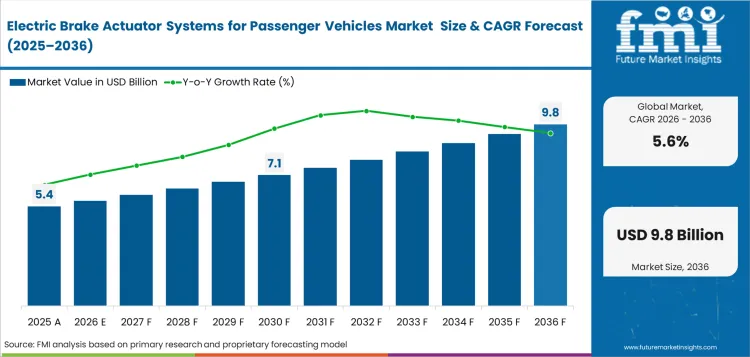
Key Takeaways, Market Size, and Forecast
- Electric brake actuator systems for passenger vehicles market was valued at USD 5.1 billion in 2025.
- By 2036, electric brake actuator systems for passenger vehicles market is estimated to reach USD 9.3 billion.
- Demand during 2026 to 2036 is expected to rise at a 5.6% CAGR.
- Market is estimated to create an incremental opportunity of USD 3.9 billion between 2026 and 2036.
- OEM supply is expected to account for 88.0% share in 2026 since platform approval and factory installation drive actuator demand.
- China is estimated to register 8.7% CAGR through 2036 under larger EV scale and stronger software-led braking integration.
Electric Brake Actuator Systems for Passenger Vehicles Market Definition
Electric brake actuator systems for passenger vehicles include electronically controlled assemblies used to apply or regulate braking force inside passenger cars and utility vehicles. Scope covers caliper-integrated parking brake modules and integrated service brake actuators with electronic control capability.
Electric Brake Actuator Systems for Passenger Vehicles Market Inclusions
Market scope includes OEM and aftermarket revenue from actuator hardware, motorized caliper modules, integrated brake actuation units, and related electronic control packages used in passenger vehicle braking applications. Coverage spans BEV, hybrid, and ICE passenger vehicles.
Electric Brake Actuator Systems for Passenger Vehicles Market Exclusions
Scope excludes conventional hydraulic master cylinders without electric actuation and mechanical handbrake lever systems without electronic control. Brake pads and rotors also fall outside this study unless sold as part of a complete actuator assembly.
Electric Brake Actuator Systems for Passenger Vehicles Market Research Methodology
- Primary Research: FMI analysts interviewed brake system engineers, actuator suppliers, and passenger vehicle manufacturers across Asia, Europe, and North America to assess current program direction.
- Desk Research: Public vehicle production data, EV registration statistics, brake safety rules, and company announcements were reviewed to build demand context and application trends.
- Market Sizing and Forecasting: Revenue estimates were developed through bottom-up mapping of passenger vehicle production, electric brake fitment, and system value by architecture.
- Data Validation: Final estimates were checked against regional vehicle mix, official country data, and recent supplier activity across advanced brake actuation programs.
Why is the Electric Brake Actuator Systems for Passenger Vehicles Market Growing?
- EV and hybrid platforms require tighter coordination between friction braking and energy recovery, which lifts use of electronically managed brake actuation.
- Safety mandates are raising control expectations for emergency intervention and brake response in new passenger vehicles.
- Vehicle designers prefer brake layouts with less mechanical linkage as software-defined architectures expand across passenger vehicles.
- Electronic parking brake adoption is expanding across mainstream passenger vehicles and supports a larger installed base for actuator suppliers.
Passenger vehicle brake design now involves higher software effort across current platform cycles. Automakers seek a stable pedal response across driver input and automated safety intervention. Brake actuator suppliers hold an important role during early vehicle development. Larger EV volume supports this direction, as energy recovery and friction braking require tight control in vacuum‑assisted systems.
Cost pressure limits full brake by wire conversion on lower-priced passenger vehicle lines. Rear axle electronic parking brake modules and one-box electrohydraulic units are entering more vehicle launches. Supplier awards now reflect packaging efficiency and validation depth as much as hardware cost. Related demand is also visible in blended brake systems and EV regenerative braking control systems.
Market Segmentation Analysis
- EPB modules are estimated to lead product type demand with 46.0% share in 2026.
- Electromechanical architecture is expected to account for 44.0% share in 2026 under large parking brake installation depth.
- Battery electric vehicles are estimated to contribute 41.0% share of propulsion revenue in 2026 due to higher content value.
- Parking brake applications are expected to hold 52.0% share in 2026 across brake function demand.
- OEM supply is likely to account for 88.0% share in 2026 due to factory-installed system concentration.
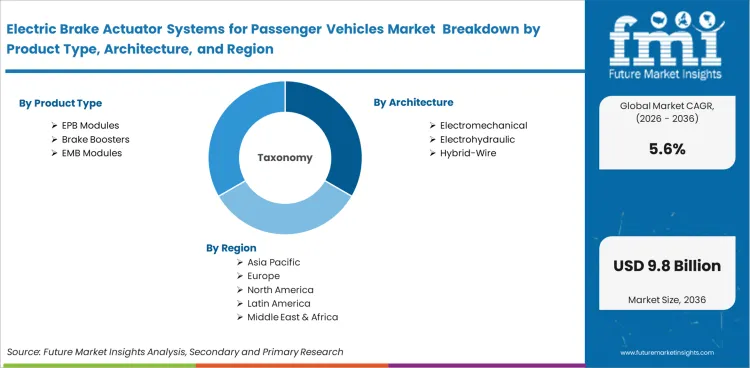
The market for electric brake actuator systems for passenger vehicles is divided into groups based on product type, architecture, propulsion, brake function, axle position, sales channel, and region. There are EPB Modules, Brake Boosters, and EMB Modules under product type. By architecture, the market includes Electromechanical, Electrohydraulic, and Hybrid-Wire systems. By propulsion, it covers BEV, Hybrid, and ICE vehicles. By brake function, the market is classified into Parking Brake, Service Brake, and Blended Brake. Based on axle position, it includes Rear Axle, Front Axle, and Four Wheel systems. By sales channel, the market is segmented into OEM and Aftermarket.
Insights into the EPB Modules Segment
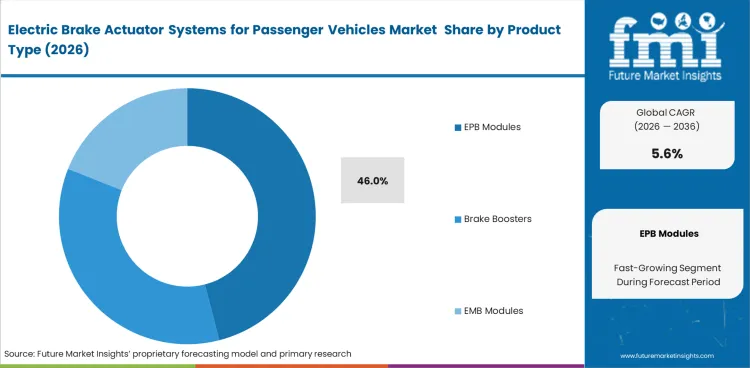
- EPB modules are estimated to account for 46.0% share in 2026 as passenger vehicle programs replace manual parking brake mechanisms.
- Rear caliper integration supports easier packaging and faster installation across a broad mix of passenger vehicle trims.
- Service replacement demand expands once the installed base reaches wiser road presence across high-volume passenger vehicle fleets.
Insights into the Electromechanical Segment
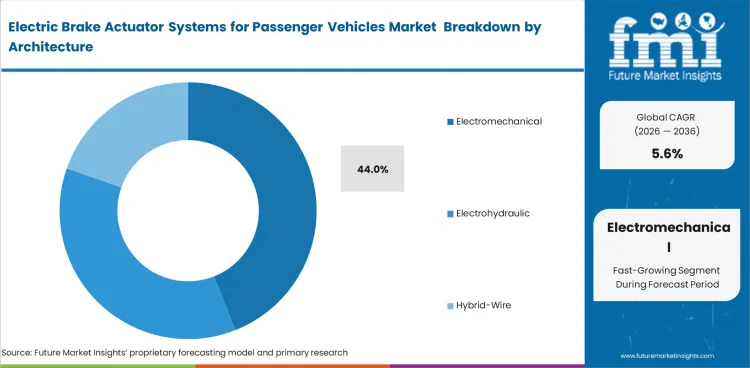
- Electromechanical layouts are estimated to hold 44.0% share in 2026 because they are widely used in parking brake applications.
- Established motor and gear systems help suppliers manage costs more effectively, especially compared with early dry‑wire alternatives.
- Related product development is visible in automotive brake-by-wire pedal simulator demand for advanced control architectures.
Insights into the Battery Electric Segment
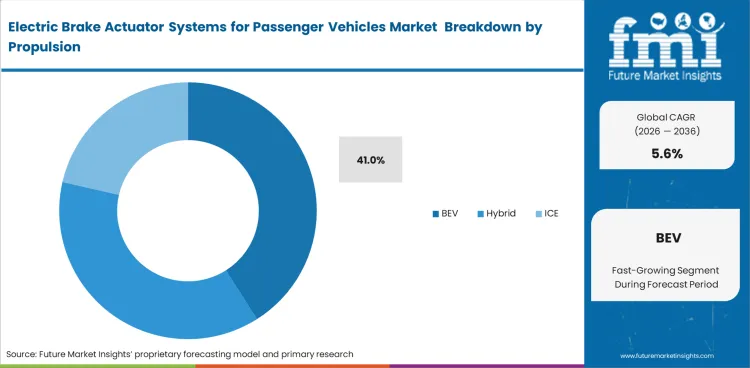
- Battery electric vehicles are expected to contribute 41.0% share in 2026 due to higher electronic brake content per vehicle.
- Regenerative braking coordination raises demand for precise actuation and stable pedal feel across urban and highway use.
- Adjacent demand links with regenerative braking systems as EV control content rises across passenger vehicle platforms.
Insights into the Parking Brake Segment
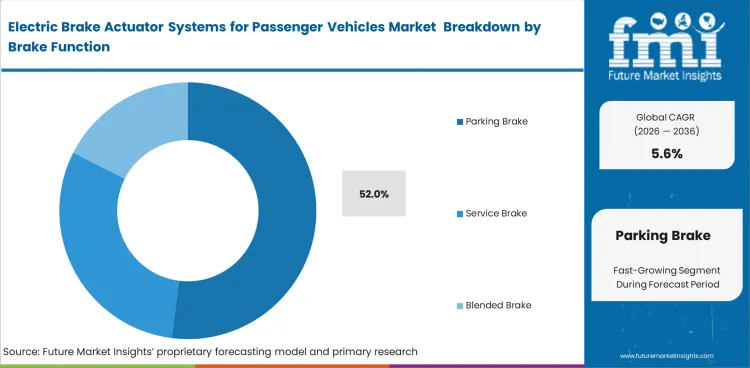
- Parking brake applications are estimated to capture 52.0% share in 2026 as vehicle programs shift toward electronic actuation.
- Passenger vehicle manufacturers view this function as a practical entry point for wider electronic brake control content.
- Larger trim coverage supports broad installation depth across premium and upper mid-range passenger vehicles.
Insights into the OEM Segment
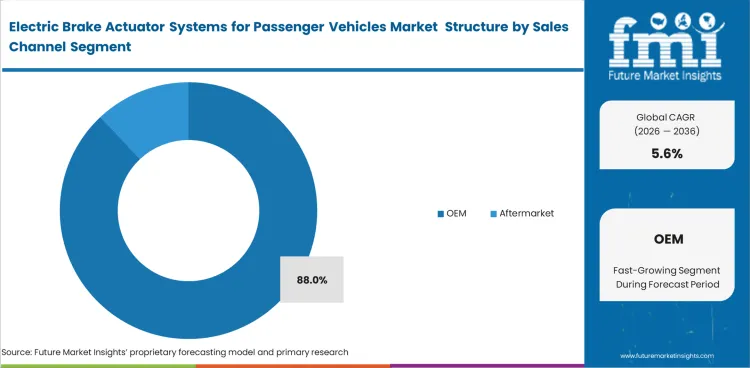
- OEM supply is expected to command 88.0% share in 2026 since actuator systems are validated before vehicle launch.
- Software integration and homologation work keep supplier changes difficult after factory programs are approved.
- Broader system direction aligns with x-by-wire platform plans across next generation passenger vehicle architectures.
Electric Brake Actuator Systems for Passenger Vehicles Market Drivers, Restraints, and Opportunities
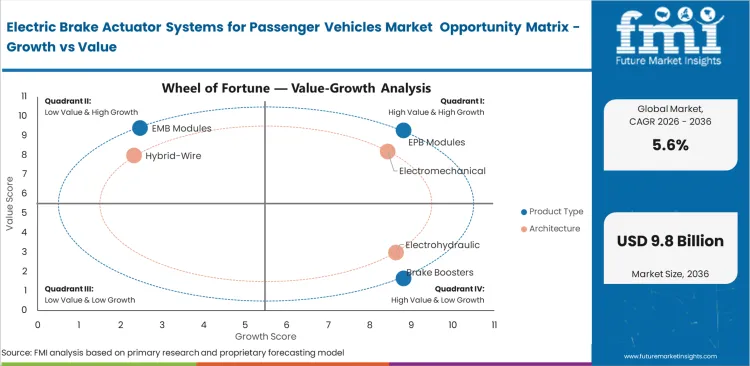
- EV platform renewal is raising electric brake content per vehicle across passenger car development cycles.
- Automated safety requirements are increasing pressure on brake response quality and control repeatability.
- Compact vehicle cost limits are slowing broader service brake electrification in lower priced passenger vehicle programs.
- Higher software and validation needs are increasing barriers for smaller suppliers without direct automaker program access.
The market for electric brake actuator systems for passenger vehicles is growing because EV adoption is rising and safety mandates are getting stricter. Automakers also want more software controlled braking. Challenges include high validation costs and pressure on entry level vehicle pricing. Full brake by wire adoption is moving at a measured pace. Growth opportunities are visible in OEM supply and parking brake electrification. Advanced braking integration is gaining traction in China and other EV focused markets.
Software-Led Brake Control
Braking control is moving deeper into central vehicle software. Passenger EV programs need accurate torque blending and stable pedal response during automated safety events. This technical need increases the value of integrated actuator packages relative to simpler mechanical systems. Development across e-motor assisted braking systems supports wider electric brake adoption in passenger vehicle programs.
Packaging and Vehicle Architecture Changes
Vehicle designers want more flexibility around firewall space and interior layout. Brake-by-wire development reduces reliance on long mechanical linkages and opens more packaging options inside passenger vehicles. This advantage is useful on EV platforms with heavier software content and tighter underhood packaging targets. Actuator suppliers benefit most in programs with stronger system integration requirements.
Analysis of Electric Brake Actuator Systems for Passenger Vehicles Market By Key Countries
.webp "Top Country Growth Comparison Electric Brake Actuator Systems For Passenger Vehicles Market Cagr (2026 2036)")
| Country | CAGR |
|---|---|
| China | 8.7% |
| South Korea | 7.9% |
| Germany | 7.6% |
| United States | 7.2% |
| Japan | 6.8% |
| United Kingdom | 6.6% |
| India | 6.4% |
Source: Future Market Insights, 2026.
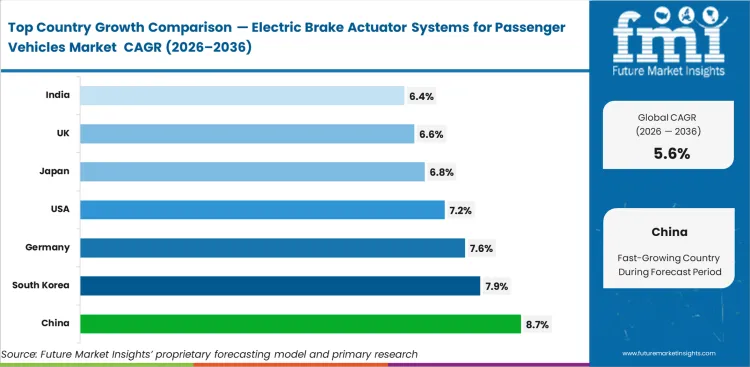
Electric Brake Actuator Systems for Passenger Vehicles Market CAGR Analysis by Country
- China is in first place with an expected 8.7% CAGR, supported by large electric vehicle output and faster adoption of software managed braking across passenger vehicle programs.
- South Korea is expected to follow with a 7.9% CAGR, supported by strong electronics capability and broad use of advanced brake control systems in electrified passenger vehicles.
- Germany is expected to record a 7.6% CAGR, supported by premium vehicle engineering and broad use of integrated brake control content across higher-value passenger vehicle programs.
- United States is projected to advance at a 7.2% CAGR, supported by rising electrified vehicle sales and tighter safety requirements across new passenger vehicle development.
- Japan is estimated to post a 6.8% CAGR, supported by strong brake engineering capability and a well-established passenger vehicle manufacturing base.
- United Kingdom is expected to register a 6.6% CAGR, supported by strong battery electric vehicle adoption and premium passenger vehicle engineering activity.
- India is projected to expand at a 6.4% CAGR, supported by rising passenger vehicle sales and gradual feature migration into upper trim models.
Global demand for electric brake actuator systems for passenger vehicles is projected to advance steadily from 2026 to 2036, supported by wider electric vehicle production and a larger role for software managed braking functions. Study coverage spans major passenger vehicle manufacturing countries, with Asia expected to hold the fastest pace during the forecast period.
Demand Outlook for Electric Brake Actuator Systems for Passenger Vehicles Market in the United States
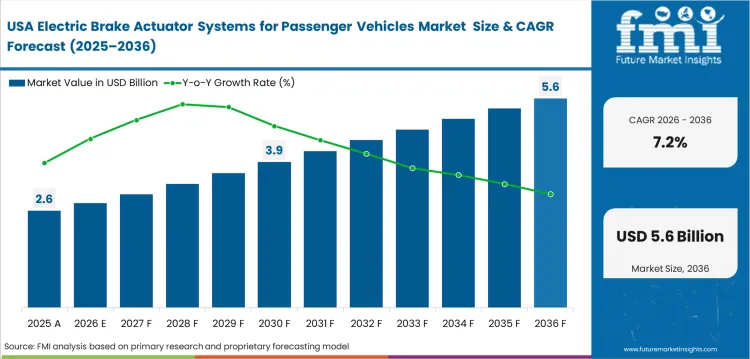
United States demand is estimated to expand at 7.2% CAGR through 2036. Passenger vehicle electrification and tougher safety requirements support higher brake system sophistication. Light truck and SUV programs add pressure for stronger brake blending and control calibration across wider vehicle platforms. USA electric and hybrid sales reached a record share in 2024, which supports more programs with electronically managed braking functions.
- USA light-duty electric and hybrid sales reached 21.2% share in the third quarter of 2024.
- Brake actuator demand is expected to be stronger in factory‑installed applications, with limited reliance on service replacement channels.
Future Outlook for Electric Brake Actuator Systems for Passenger Vehicles Market in China
China is estimated to register 8.7% CAGR through 2036 and holds the strongest country pace in this study. Passenger EV volume is large across national markets and supports rapid rollout of advanced brake architectures. Domestic automakers push more software-defined platform work into mainstream passenger vehicle launches. New brake standards and high local manufacturing scale strengthen long-term demand conditions.
- China recorded over 11 million electric car sales in 2024.
- Local scale supports broader use of integrated parking brake and service brake actuation systems.
Opportunity Analysis of Electric Brake Actuator Systems for Passenger Vehicles Market in Germany
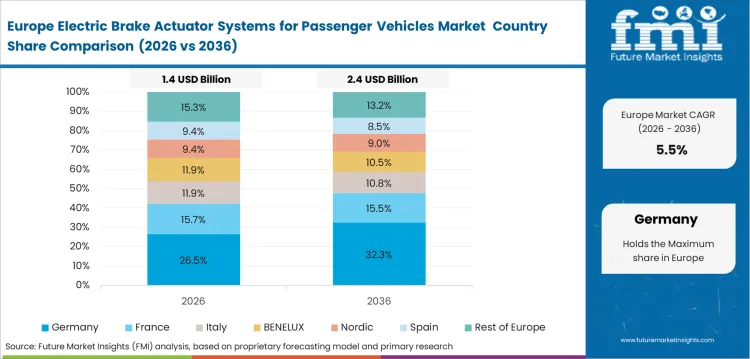
Germany is expected to record 7.6% CAGR through 2036 under premium passenger vehicle engineering and stronger EV content. Vehicle programs in Germany place strong emphasis on brake response and pedal refinement during development. Integrated chassis control receives high priority within German passenger vehicle engineering programs. Advanced actuator packages offer solid revenue potential within lower‑cost production bases. Local EV registration recovery supports fresh electronic brake content in passenger vehicle launches.
- Germany registered 45,535 BEVs in April 2025 with 18.8% market share.
- Premium vehicle programs support stronger adoption of advanced brake actuation, particularly across higher-end passenger segments.
- System suppliers with higher software validation depth are likely to benefit most in German passenger vehicle programs.
In-Depth Analysis of Electric Brake Actuator Systems for Passenger Vehicles Market in Japan
Japan is estimated to advance at 6.8% CAGR through 2036. Passenger vehicle quality standards stay high and local supplier engineering is well established. Conversion pace is measured in Japan because the vehicle mix is established and cost discipline is tight across several segments. Passenger car output and strong brake engineering capability support demand for electronic actuation modules.
- Vehicle programs favor compact actuator packaging and strong reliability under long validation cycles.
- Passenger EV and hybrid launches continue supporting incremental electronic brake content across domestic automakers.
Sales Analysis of Electric Brake Actuator Systems for Passenger Vehicles Market in South Korea
South Korea is expected to expand at 7.9% CAGR through 2036 under strong electronics capability and solid EV development depth. Passenger vehicle engineering in South Korea benefits from close integration between vehicle software and chassis control functions. Local EV output supports advanced brake content across domestic programs and export-oriented passenger vehicle platforms.
- South Korea produced 407,009 EVs in 2025 and EVs accounted for 11% of auto production.
- Brake actuator demand gains support from higher electronic content in passenger vehicle exports.
- Local supplier capability in motors and control systems supports broader brake actuation development.
In-Depth Analysis of Electric Brake Actuator Systems for Passenger Vehicles Market in the United Kingdom
United Kingdom demand is estimated to advance at 6.6% CAGR through 2036. EV adoption in the local new car market is strong and supports more brake system electronics. Passenger vehicle engineering activity in premium brands supports higher value actuator packages. Local demand centers on advanced content, with limited emphasis on large‑scale brake hardware manufacturing.
- United Kingdom new car registrations reached 2.0 million units in 2025.
- Battery electric cars accounted for nearly one quarter of registrations during 2025.
- Premium vehicle programs support stronger brake software and actuator calibration work, particularly in higher‑end segments.
Demand Analysis of Electric Brake Actuator Systems for Passenger Vehicles Market in India
India is estimated to expand at 6.4% CAGR through 2036 from a smaller starting base. Passenger vehicle production and sales keep improving, which supports gradual migration toward electronic parking brake features in upper trims. Service brake electrification is likely to move at a measured pace due to strict price targets. Local manufacturing progress will be important for wider actuator penetration across mid-range passenger vehicle programs.
- India recorded 4.3 million passenger vehicle sales during FY 2024-25.
- Electronic parking brake adoption is expected to enter more utility vehicle and sedan variants first.
- Localized supply will support cost control and wider use across mid-range passenger vehicle programs.
Competitive Landscape and Strategic Positioning for Electric Brake Actuator Systems for Passenger Vehicles Market
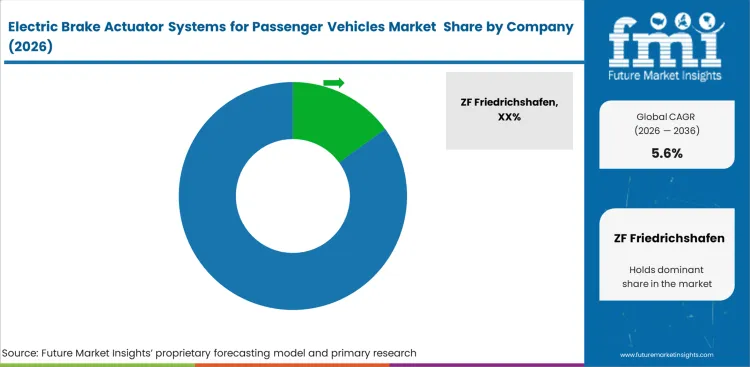
- Competition is driven primarily by software validation depth and automaker access, beyond motor hardware considerations.
- EPB scale provides a strong entry point into broader brake-by-wire and integrated chassis programs.
- Passenger vehicle awards favor suppliers with stronger factory relationships in China and Europe. Premium EV programs also support suppliers with deeper integration and long‑standing automaker partnerships.
Competitive intensity is moderate, shaped by demanding validation requirements and lengthy development cycles. Large suppliers hold an advantage through installed base familiarity and direct engineering links with passenger vehicle manufacturers. Supplier relevance rises further in programs related to automotive brake system demand across wider braking assemblies.
ZF and Bosch hold stronger positions in advanced brake actuation under broader by-wire development capability. Continental and ADVICS carry useful depth in electrohydraulic integration and passenger vehicle brake electronics. Brembo and Hyundai Mobis support premium and electrified programs with higher control content. HL Mando also benefits from wider chassis electronics activity and growing actuator relevance across Asian passenger vehicle manufacturers.
Competitive pressure is rising as automakers prioritize packaged solutions over standalone hardware modules. Suppliers with strong software integration and calibration support are likely to hold a better standing in future awards. Adjacent demand also interacts with automotive actuator development across wider vehicle control systems.
Key Companies in the Electric Brake Actuator Systems for Passenger Vehicles Market
- ZF Friedrichshafen, Bosch, and Continental hold strong positions through brake actuation depth, software integration capability, and direct links with major passenger vehicle manufacturers.
- ADVICS, Brembo, and Hyundai Mobis carry useful scale in integrated brake electronics and support several electrified passenger vehicle development programs.
- HL Mando supports competitive depth in Asian vehicle programs and benefits from broader electronic chassis content across passenger vehicle production.
Competitive Benchmarking: Electric Brake Actuator Systems for Passenger Vehicles Market
| Company | By-Wire Depth | EPB Scale | Passenger Vehicle Access | Software Integration |
|---|---|---|---|---|
| ZF Friedrichshafen | High | High | Strong | High |
| Bosch | High | Medium | Strong | High |
| Continental | High | Medium | Strong | High |
| ADVICS | Medium | High | Strong | Medium |
| Brembo | High | Medium | Medium | High |
| Hyundai Mobis | Medium | Medium | Strong | Medium |
| HL Mando | Medium | Medium | Strong | Medium |
Source: Future Market Insights, 2026.
Key Developments in Electric Brake Actuator Systems for Passenger Vehicles Market
- In January 2025, ZF announced a light vehicle agreement expected to equip nearly 5 million vehicles with electro-mechanical braking across the contract term.
- In January 2025, Bosch completed a 3,300 kilometer public road test program for hydraulic brake-by-wire and prepared launch from fall 2025.
- In April 2025, ADVICS stated its products for Suzuki e VITARA include a cooperative regenerative braking system and caliper integrated parking brake.
Key Players in the Electric Brake Actuator Systems for Passenger Vehicles Market
Major Global Players
- ZF Friedrichshafen
- Bosch
- Continental
- ADVICS
- Brembo
- Hyundai Mobis
- HL Mando
Other Active Participants
- Hitachi Astemo
- JTEKT
- FORVIA HELLA
- Aptiv
- Nidec
Report Scope and Coverage
| Parameter | Details |
|---|---|
| Quantitative Units | USD Billion |
| Market Value in 2025 | USD 5.1 billion |
| Market Value in 2026 | USD 5.4 billion |
| Market Value in 2036 | USD 9.3 billion |
| CAGR | 5.6% |
| Forecast Period | 2026 to 2036 |
| Regions Covered | North America, Europe, East Asia, South Asia and Pacific, Rest of World |
| Key Companies Profiled | ZF Friedrichshafen, Bosch, Continental, ADVICS, Brembo, Hyundai Mobis, HL Mando |
Electric Brake Actuator Systems for Passenger Vehicles Market by Segments
Electric Brake Actuator Systems for Passenger Vehicles Market Segmented by Product Type
- EPB Modules
- Brake Boosters
- EMB Modules
Electric Brake Actuator Systems for Passenger Vehicles Market Segmented by Architecture
- Electromechanical
- Electrohydraulic
- Hybrid-Wire
Electric Brake Actuator Systems for Passenger Vehicles Market Segmented by Propulsion
- BEV
- Hybrid
- ICE
Electric Brake Actuator Systems for Passenger Vehicles Market Segmented by Brake Function
- Parking Brake
- Service Brake
- Blended Brake
Electric Brake Actuator Systems for Passenger Vehicles Market Segmented by Axle Position
- Rear Axle
- Front Axle
- Four Wheel
Electric Brake Actuator Systems for Passenger Vehicles Market Segmented by Sales Channel
- OEM
- Aftermarket
Electric Brake Actuator Systems for Passenger Vehicles Market by Region
- North America
- United States
- Canada
- Mexico
- Europe
- Germany
- United Kingdom
- France
- Italy
- Spain
- East Asia
- China
- Japan
- South Korea
- South Asia and Pacific
- India
- ASEAN
- Australia and New Zealand
- Rest of World
Research Sources and Bibliography
- National Highway Traffic Safety Administration. (2024, April 29). NHTSA finalizes key safety rule to reduce crashes and save lives.
- European Automobile Manufacturers’ Association. (2026, January 27). New car registrations: 1.8% in 2025; battery-electric 17.4% market share.
- USA International Trade Administration. (2025, July 7). South Korea electric vehicles market.
- ZF Group. (2025, January 6). ZF secures substantial brake-by-wire technology business for light vehicles.
- Bosch Mobility. (2025). With brake-by-wire from Bosch to the Arctic Circle.
- ADVICS Co., Ltd. (2025, April 22). ADVICS brake products adopted for Suzuki’s first battery EV e VITARA.
- ADVICS Co., Ltd. (2025, December 24). ADVICS new cooperative regenerative braking system adopted for Toyota RAV4.
This Report Answers
- What is the current and future size of electric brake actuator systems for passenger vehicles market?
- How fast is electric brake actuator systems for passenger vehicles market expected to expand between 2026 and 2036?
- Which sales channel is expected to account for the highest share in 2026?
- Which brake function segment is expected to lead demand by 2026?
- What is supporting higher electronic brake actuator demand across passenger vehicle platforms?
- How is electric vehicle adoption influencing brake actuator design and value per vehicle?
- Which countries are expected to register the fastest pace through 2036?
- What is supporting stronger market expansion in China and South Korea?
- Who are the key companies active in electric brake actuator systems for passenger vehicles market?
- How does FMI estimate and validate the market forecast?
Frequently Asked Questions
What is the global market demand for electric brake actuator systems for passenger vehicles in 2026?
• In 2026, electric brake actuator systems for passenger vehicles market is estimated to reach USD 5.4 billion under current factory installation and content assumptions.
How large is electric brake actuator systems for passenger vehicles market likely to be by 2036?
By 2036, electric brake actuator systems for passenger vehicles market is expected to reach USD 9.3 billion under the base forecast case.
How fast is demand expected to expand between 2026 and 2036?
Demand for electric brake actuator systems for passenger vehicles is expected to expand at a 5.6% CAGR during the 2026 to 2036 period.
Which sales channel is likely to lead the market by 2026?
OEM supply is expected to lead with 88.0% share in 2026 due to early platform approval and factory-installed actuator concentration.
Which brake function segment is estimated to lead by 2026?
• Parking brake applications are estimated to account for 52.0% share in 2026 under wider migration toward electronic actuation across passenger vehicles.
What is supporting stronger demand in China?
• China is estimated to register 8.7% CAGR through 2036 under very high EV output and faster software-led brake integration across passenger vehicle programs.
What is supporting stronger demand in the United States?
United States demand is estimated to advance at 7.2% CAGR through 2036 under rising electrified vehicle sales and tighter automated safety requirements.
What does this report include in market definition?
• This report covers electronically controlled brake actuator assemblies used for parking brake and service brake functions in passenger vehicle applications.
How does FMI build and validate this forecast?
FMI uses bottom-up vehicle and fitment mapping, then checks results against public production data and official market activity indicators.
Preview the report firsthand - request a free sample
Get SampleGet the brochure for pricing and purchase details.
Get PDFTable of Content
- Executive Summary
- Global Market Outlook
- Demand-side Trends
- Supply-side Trends
- Technology Roadmap Analysis
- Analysis and Recommendations
- Market Overview
- Market Coverage / Taxonomy
- Market Definition / Scope / Limitations
- Research Methodology
- Chapter Orientation
- Analytical Lens and Working Hypotheses
- Market Structure, Signals, and Trend Drivers
- Benchmarking and Cross-market Comparability
- Market Sizing, Forecasting, and Opportunity Mapping
- Research Design and Evidence Framework
- Desk Research Programme (Secondary Evidence)
- Company Annual and Sustainability Reports
- Peer-reviewed Journals and Academic Literature
- Corporate Websites, Product Literature, and Technical Notes
- Earnings Decks and Investor Briefings
- Statutory Filings and Regulatory Disclosures
- Technical White Papers and Standards Notes
- Trade Journals, Industry Magazines, and Analyst Briefs
- Conference Proceedings, Webinars, and Seminar Materials
- Government Statistics Portals and Public Data Releases
- Press Releases and Reputable Media Coverage
- Specialist Newsletters and Curated Briefings
- Sector Databases and Reference Repositories
- FMI Internal Proprietary Databases and Historical Market Datasets
- Subscription Datasets and Paid Sources
- Social Channels, Communities, and Digital Listening Inputs
- Additional Desk Sources
- Expert Input and Fieldwork (Primary Evidence)
- Primary Modes
- Qualitative Interviews and Expert Elicitation
- Quantitative Surveys and Structured Data Capture
- Blended Approach
- Why Primary Evidence is Used
- Field Techniques
- Interviews
- Surveys
- Focus Groups
- Observational and In-context Research
- Social and Community Interactions
- Stakeholder Universe Engaged
- C-suite Leaders
- Board Members
- Presidents and Vice Presidents
- R&D and Innovation Heads
- Technical Specialists
- Domain Subject-matter Experts
- Scientists
- Physicians and Other Healthcare Professionals
- Governance, Ethics, and Data Stewardship
- Research Ethics
- Data Integrity and Handling
- Primary Modes
- Tooling, Models, and Reference Databases
- Desk Research Programme (Secondary Evidence)
- Data Engineering and Model Build
- Data Acquisition and Ingestion
- Cleaning, Normalisation, and Verification
- Synthesis, Triangulation, and Analysis
- Quality Assurance and Audit Trail
- Market Background
- Market Dynamics
- Drivers
- Restraints
- Opportunity
- Trends
- Scenario Forecast
- Demand in Optimistic Scenario
- Demand in Likely Scenario
- Demand in Conservative Scenario
- Opportunity Map Analysis
- Product Life Cycle Analysis
- Supply Chain Analysis
- Investment Feasibility Matrix
- Value Chain Analysis
- PESTLE and Porter’s Analysis
- Regulatory Landscape
- Regional Parent Market Outlook
- Production and Consumption Statistics
- Import and Export Statistics
- Market Dynamics
- Global Market Analysis 2021 to 2025 and Forecast, 2026 to 2036
- Historical Market Size Value (USD Million) Analysis, 2021 to 2025
- Current and Future Market Size Value (USD Million) Projections, 2026 to 2036
- Y-o-Y Growth Trend Analysis
- Absolute $ Opportunity Analysis
- Global Market Pricing Analysis 2021 to 2025 and Forecast 2026 to 2036
- Global Market Analysis 2021 to 2025 and Forecast 2026 to 2036, By Product Type
- Introduction / Key Findings
- Historical Market Size Value (USD Million) Analysis By Product Type , 2021 to 2025
- Current and Future Market Size Value (USD Million) Analysis and Forecast By Product Type , 2026 to 2036
- EPB Modules
- Brake Boosters
- EMB Modules
- EPB Modules
- Y-o-Y Growth Trend Analysis By Product Type , 2021 to 2025
- Absolute $ Opportunity Analysis By Product Type , 2026 to 2036
- Global Market Analysis 2021 to 2025 and Forecast 2026 to 2036, By Architecture
- Introduction / Key Findings
- Historical Market Size Value (USD Million) Analysis By Architecture, 2021 to 2025
- Current and Future Market Size Value (USD Million) Analysis and Forecast By Architecture, 2026 to 2036
- Electromechanical
- Electrohydraulic
- Hybrid-Wire
- Electromechanical
- Y-o-Y Growth Trend Analysis By Architecture, 2021 to 2025
- Absolute $ Opportunity Analysis By Architecture, 2026 to 2036
- Global Market Analysis 2021 to 2025 and Forecast 2026 to 2036, By Propulsion
- Introduction / Key Findings
- Historical Market Size Value (USD Million) Analysis By Propulsion, 2021 to 2025
- Current and Future Market Size Value (USD Million) Analysis and Forecast By Propulsion, 2026 to 2036
- BEV
- Hybrid
- ICE
- BEV
- Y-o-Y Growth Trend Analysis By Propulsion, 2021 to 2025
- Absolute $ Opportunity Analysis By Propulsion, 2026 to 2036
- Global Market Analysis 2021 to 2025 and Forecast 2026 to 2036, By Brake Function
- Introduction / Key Findings
- Historical Market Size Value (USD Million) Analysis By Brake Function, 2021 to 2025
- Current and Future Market Size Value (USD Million) Analysis and Forecast By Brake Function, 2026 to 2036
- Parking Brake
- Service Brake
- Blended Brake
- Parking Brake
- Y-o-Y Growth Trend Analysis By Brake Function, 2021 to 2025
- Absolute $ Opportunity Analysis By Brake Function, 2026 to 2036
- Global Market Analysis 2021 to 2025 and Forecast 2026 to 2036, By Sales Channel
- Introduction / Key Findings
- Historical Market Size Value (USD Million) Analysis By Sales Channel, 2021 to 2025
- Current and Future Market Size Value (USD Million) Analysis and Forecast By Sales Channel, 2026 to 2036
- OEM
- Aftermarket
- OEM
- Y-o-Y Growth Trend Analysis By Sales Channel, 2021 to 2025
- Absolute $ Opportunity Analysis By Sales Channel, 2026 to 2036
- Global Market Analysis 2021 to 2025 and Forecast 2026 to 2036, By Region
- Introduction
- Historical Market Size Value (USD Million) Analysis By Region, 2021 to 2025
- Current Market Size Value (USD Million) Analysis and Forecast By Region, 2026 to 2036
- North America
- Latin America
- Western Europe
- Eastern Europe
- East Asia
- South Asia and Pacific
- Middle East & Africa
- Market Attractiveness Analysis By Region
- North America Market Analysis 2021 to 2025 and Forecast 2026 to 2036, By Country
- Historical Market Size Value (USD Million) Trend Analysis By Market Taxonomy, 2021 to 2025
- Market Size Value (USD Million) Forecast By Market Taxonomy, 2026 to 2036
- By Country
- USA
- Canada
- Mexico
- By Product Type
- By Architecture
- By Propulsion
- By Brake Function
- By Sales Channel
- By Country
- Market Attractiveness Analysis
- By Country
- By Product Type
- By Architecture
- By Propulsion
- By Brake Function
- By Sales Channel
- Key Takeaways
- Latin America Market Analysis 2021 to 2025 and Forecast 2026 to 2036, By Country
- Historical Market Size Value (USD Million) Trend Analysis By Market Taxonomy, 2021 to 2025
- Market Size Value (USD Million) Forecast By Market Taxonomy, 2026 to 2036
- By Country
- Brazil
- Chile
- Rest of Latin America
- By Product Type
- By Architecture
- By Propulsion
- By Brake Function
- By Sales Channel
- By Country
- Market Attractiveness Analysis
- By Country
- By Product Type
- By Architecture
- By Propulsion
- By Brake Function
- By Sales Channel
- Key Takeaways
- Western Europe Market Analysis 2021 to 2025 and Forecast 2026 to 2036, By Country
- Historical Market Size Value (USD Million) Trend Analysis By Market Taxonomy, 2021 to 2025
- Market Size Value (USD Million) Forecast By Market Taxonomy, 2026 to 2036
- By Country
- Germany
- UK
- Italy
- Spain
- France
- Nordic
- BENELUX
- Rest of Western Europe
- By Product Type
- By Architecture
- By Propulsion
- By Brake Function
- By Sales Channel
- By Country
- Market Attractiveness Analysis
- By Country
- By Product Type
- By Architecture
- By Propulsion
- By Brake Function
- By Sales Channel
- Key Takeaways
- Eastern Europe Market Analysis 2021 to 2025 and Forecast 2026 to 2036, By Country
- Historical Market Size Value (USD Million) Trend Analysis By Market Taxonomy, 2021 to 2025
- Market Size Value (USD Million) Forecast By Market Taxonomy, 2026 to 2036
- By Country
- Russia
- Poland
- Hungary
- Balkan & Baltic
- Rest of Eastern Europe
- By Product Type
- By Architecture
- By Propulsion
- By Brake Function
- By Sales Channel
- By Country
- Market Attractiveness Analysis
- By Country
- By Product Type
- By Architecture
- By Propulsion
- By Brake Function
- By Sales Channel
- Key Takeaways
- East Asia Market Analysis 2021 to 2025 and Forecast 2026 to 2036, By Country
- Historical Market Size Value (USD Million) Trend Analysis By Market Taxonomy, 2021 to 2025
- Market Size Value (USD Million) Forecast By Market Taxonomy, 2026 to 2036
- By Country
- China
- Japan
- South Korea
- By Product Type
- By Architecture
- By Propulsion
- By Brake Function
- By Sales Channel
- By Country
- Market Attractiveness Analysis
- By Country
- By Product Type
- By Architecture
- By Propulsion
- By Brake Function
- By Sales Channel
- Key Takeaways
- South Asia and Pacific Market Analysis 2021 to 2025 and Forecast 2026 to 2036, By Country
- Historical Market Size Value (USD Million) Trend Analysis By Market Taxonomy, 2021 to 2025
- Market Size Value (USD Million) Forecast By Market Taxonomy, 2026 to 2036
- By Country
- India
- ASEAN
- Australia & New Zealand
- Rest of South Asia and Pacific
- By Product Type
- By Architecture
- By Propulsion
- By Brake Function
- By Sales Channel
- By Country
- Market Attractiveness Analysis
- By Country
- By Product Type
- By Architecture
- By Propulsion
- By Brake Function
- By Sales Channel
- Key Takeaways
- Middle East & Africa Market Analysis 2021 to 2025 and Forecast 2026 to 2036, By Country
- Historical Market Size Value (USD Million) Trend Analysis By Market Taxonomy, 2021 to 2025
- Market Size Value (USD Million) Forecast By Market Taxonomy, 2026 to 2036
- By Country
- Kingdom of Saudi Arabia
- Other GCC Countries
- Turkiye
- South Africa
- Other African Union
- Rest of Middle East & Africa
- By Product Type
- By Architecture
- By Propulsion
- By Brake Function
- By Sales Channel
- By Country
- Market Attractiveness Analysis
- By Country
- By Product Type
- By Architecture
- By Propulsion
- By Brake Function
- By Sales Channel
- Key Takeaways
- Key Countries Market Analysis
- USA
- Pricing Analysis
- Market Share Analysis, 2025
- By Product Type
- By Architecture
- By Propulsion
- By Brake Function
- By Sales Channel
- Canada
- Pricing Analysis
- Market Share Analysis, 2025
- By Product Type
- By Architecture
- By Propulsion
- By Brake Function
- By Sales Channel
- Mexico
- Pricing Analysis
- Market Share Analysis, 2025
- By Product Type
- By Architecture
- By Propulsion
- By Brake Function
- By Sales Channel
- Brazil
- Pricing Analysis
- Market Share Analysis, 2025
- By Product Type
- By Architecture
- By Propulsion
- By Brake Function
- By Sales Channel
- Chile
- Pricing Analysis
- Market Share Analysis, 2025
- By Product Type
- By Architecture
- By Propulsion
- By Brake Function
- By Sales Channel
- Germany
- Pricing Analysis
- Market Share Analysis, 2025
- By Product Type
- By Architecture
- By Propulsion
- By Brake Function
- By Sales Channel
- UK
- Pricing Analysis
- Market Share Analysis, 2025
- By Product Type
- By Architecture
- By Propulsion
- By Brake Function
- By Sales Channel
- Italy
- Pricing Analysis
- Market Share Analysis, 2025
- By Product Type
- By Architecture
- By Propulsion
- By Brake Function
- By Sales Channel
- Spain
- Pricing Analysis
- Market Share Analysis, 2025
- By Product Type
- By Architecture
- By Propulsion
- By Brake Function
- By Sales Channel
- France
- Pricing Analysis
- Market Share Analysis, 2025
- By Product Type
- By Architecture
- By Propulsion
- By Brake Function
- By Sales Channel
- India
- Pricing Analysis
- Market Share Analysis, 2025
- By Product Type
- By Architecture
- By Propulsion
- By Brake Function
- By Sales Channel
- ASEAN
- Pricing Analysis
- Market Share Analysis, 2025
- By Product Type
- By Architecture
- By Propulsion
- By Brake Function
- By Sales Channel
- Australia & New Zealand
- Pricing Analysis
- Market Share Analysis, 2025
- By Product Type
- By Architecture
- By Propulsion
- By Brake Function
- By Sales Channel
- China
- Pricing Analysis
- Market Share Analysis, 2025
- By Product Type
- By Architecture
- By Propulsion
- By Brake Function
- By Sales Channel
- Japan
- Pricing Analysis
- Market Share Analysis, 2025
- By Product Type
- By Architecture
- By Propulsion
- By Brake Function
- By Sales Channel
- South Korea
- Pricing Analysis
- Market Share Analysis, 2025
- By Product Type
- By Architecture
- By Propulsion
- By Brake Function
- By Sales Channel
- Russia
- Pricing Analysis
- Market Share Analysis, 2025
- By Product Type
- By Architecture
- By Propulsion
- By Brake Function
- By Sales Channel
- Poland
- Pricing Analysis
- Market Share Analysis, 2025
- By Product Type
- By Architecture
- By Propulsion
- By Brake Function
- By Sales Channel
- Hungary
- Pricing Analysis
- Market Share Analysis, 2025
- By Product Type
- By Architecture
- By Propulsion
- By Brake Function
- By Sales Channel
- Kingdom of Saudi Arabia
- Pricing Analysis
- Market Share Analysis, 2025
- By Product Type
- By Architecture
- By Propulsion
- By Brake Function
- By Sales Channel
- Turkiye
- Pricing Analysis
- Market Share Analysis, 2025
- By Product Type
- By Architecture
- By Propulsion
- By Brake Function
- By Sales Channel
- South Africa
- Pricing Analysis
- Market Share Analysis, 2025
- By Product Type
- By Architecture
- By Propulsion
- By Brake Function
- By Sales Channel
- USA
- Market Structure Analysis
- Competition Dashboard
- Competition Benchmarking
- Market Share Analysis of Top Players
- By Regional
- By Product Type
- By Architecture
- By Propulsion
- By Brake Function
- By Sales Channel
- Competition Analysis
- Competition Deep Dive
- ZF Friedrichshafen
- Overview
- Product Portfolio
- Profitability by Market Segments (Product/Age /Sales Channel/Region)
- Sales Footprint
- Strategy Overview
- Marketing Strategy
- Product Strategy
- Channel Strategy
- Bosch
- Continental
- ADVICS
- Brembo
- Hyundai Mobis
- HL Mando
- Hitachi Astemo
- JTEKT
- FORVIA HELLA
- Aptiv
- Nidec
- ZF Friedrichshafen
- Competition Deep Dive
- Assumptions & Acronyms Used


