

- Market Size (2026)
- USD 93.3 Mn
- Forecast (2036)
- USD 272.1 Mn
- CAGR (2026 to 2036)
- 11.3%
Rear-Wheel Steering Actuator Systems for SUVs Market Size, Forecast, and Outlook By FMI
Summary of the Rear-Wheel Steering Actuator Systems for SUVs Market
- Demand and Growth Drivers
- Longer SUV wheelbases increases the need for rear axle steering support in parking and low-speed turning.
- Electric SUV platforms are creating demand for compact actuator packages that work around battery floor layouts.
- Premium SUV programs are using rear-wheel steering to improve turning comfort and high-speed lane stability.
- Product and Segment View
- Central actuators lead actuator type demand as OEMs prefer compact rear axle packaging.
- Full-size SUVs dominate SUV class demand since larger vehicles benefit more from tighter turning behavior.
- Battery electric SUVs are expected to gain share as long wheelbases need electronic chassis functions.
- Geography and Competitive Outlook
- China is projected to grow faster because local premium EV brands are adding smart chassis features.
- India is expected to expand quickly as premium SUV sales shift toward higher comfort features.
- ZF, Schaeffler, Nexteer, Bosch and JTEKT are expected to differentiate through actuator design and system integration.
- Analyst Opinion
- Nikhil Kaitwade, Principal Consultant at FMI says, “Rear-wheel steering actuator systems are moving from luxury sedans into SUVs because vehicle size is becoming a daily usability issue. Buyers want large cabins and battery range, yet they expect easier parking and stable highway movement.”
- Rear-Wheel Steering Actuator Systems for SUVs Market Value Analysis
- Rear wheel steering actuator systems for SUVs are moving from premium handling features into practical maneuverability equipment.
- Longer SUV wheelbases make city driving and parking harder, creating a clearer role for rear axle steering support.
- Electric SUV platforms use advanced chassis electronics, which gives actuator suppliers a wider integration path.
- Actuator selection depends on turning comfort, stable lane behavior, durability, and platform compatibility.
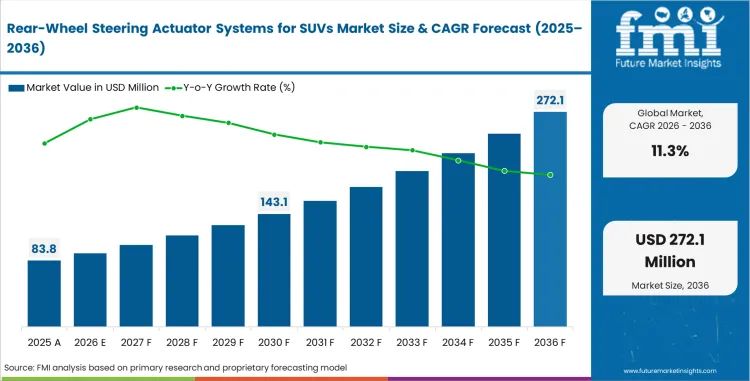
Key Takeaways, Market Size, and Forecast
- The rear-wheel steering actuator systems for SUVs market is valued at USD 83.8 million in 2025.
- By 2036, the market is expected to reach USD 272.1 million.
- From 2026 to 2036, the market is projected to expand at a CAGR of 11.3%.
- The market is expected to create an incremental opportunity of USD 160.8 million between 2026 and 2036.
- In 2026, central actuators are projected to account for 46.0% of actuator type demand.
- Full-size SUVs are expected to hold 38.0% of SUV class demand in 2026.
- China (13.1%) and India (12.8%) are projected to record faster growth through 2036.
Strategic Pointers: Rear-Wheel Steering Actuator Systems for SUVs Market
Rear wheel steering actuator systems for SUVs are moving from specialized chassis hardware into packaging and control equipment as large SUVs need improved maneuverability. ZF states that its second generation active rear axle steering can turn rear wheels by up to 12 degrees. Its AKC architecture can use one central actuator for both rear wheels or separate actuators for each wheel. Schaeffler’s DE102023109266B4 patent, published in July 2025, describes redundant motor architecture that can keep rear steering functional after main rotor failure. Schaeffler’s US11981381B2 patent, granted in May 2024, focuses on reducing actuator play and structure borne noise through a thrust rod and elastomer ring. UN Regulation No. 79 links steering automation with driver override and functional safety requirements. NHTSA’s FMVSS 126 analysis links stability control with steering angle and yaw rate inputs. Rear steering integration with ESC and chassis software becomes commercially critical. The main opportunity is in supplying SUV platforms with rear steering systems combining 10 to 12 degree actuation and validated stability control integration.
Rear-Wheel Steering Actuator Systems for SUVs Market Definition
The rear-wheel steering actuator systems for SUVs market includes mechatronic systems that turn the rear wheels in coordination with the front steering system. These systems support tighter low-speed turns and better high-speed stability in SUVs. The scope includes actuators, control units, linkages, sensors, and integration support supplied for SUV platforms.
Rear-Wheel Steering Actuator Systems for SUVs Market Inclusions
Market scope includes central actuators, dual actuator setups, electrohydraulic systems, SUV-specific rear axle steering modules, OEM integration software, sensors, linkages, and service parts used in SUV rear-wheel steering systems.
Rear-Wheel Steering Actuator Systems for SUVs Market Exclusions
The scope excludes front steering racks, steering columns, standard electric power steering motors, brake-by-wire modules, air suspension actuators, and rear axle hardware without active steering control.
Rear-Wheel Steering Actuator Systems for SUVs Market Research Methodology
- Primary Research: FMI reviewed supplier activity across steering system makers, chassis electronics providers, SUV platform engineers, and actuator specialists active in premium and electric vehicle programs.
- Desk Research: The study used public automotive production data, official supplier releases, regulatory material, and technical product information tied to rear axle steering systems.
- Market Sizing and Forecasting: The market was sized through SUV platform fitment rates, actuator bill-of-material estimates, premium trim penetration, and country-level SUV demand.
- Data Validation: Forecast assumptions were checked against rear-wheel steering launches, SUV production trends, and active supplier programs from 2024 to 2026.
Why is the Rear-Wheel Steering Actuator Systems for SUVs Market Growing?
- SUV size growth is making low-speed turning a clear product issue for urban drivers.
- Electric SUV platforms need tighter turning support because battery layouts often increase wheelbase length.
- Premium brands are using rear-wheel steering as a comfort feature and a handling upgrade.
SUVs now make up a large part of global car sales, which gives rear-wheel steering a wider base than older luxury sedan applications. Rear-wheel steering reduces the practical burden of a larger SUV by helping the vehicle turn within tighter spaces. This supports actuator demand across premium SUVs and high-end electric models.
Electric SUVs create a stronger technical case for rear-wheel steering as battery packs often push vehicle length and wheelbase upward. Rear-wheel steering suppliers benefit from this shift because EV platforms already use more electronic chassis functions. Rear axle steering becomes easier to justify when OEMs use software-based control across braking and suspension systems.
Market Segmentation Analysis
- Central actuators are projected to account for 46.0% of actuator type demand in 2026, with compact rear axle packaging guiding OEM selection.
- Full-size SUVs, with 38.0% of SUV class demand projected for 2026, benefit from easier turning in tight spaces.
- Battery electric SUVs are projected to account for 42.0% of propulsion demand in 2026 as electronic chassis control becomes more important.
- Up to 5 Degrees systems suit comfort-focused SUVs and are expected to hold 40.0% of steering angle demand in 2026.
- OEM supply is projected to account for 88.0% of sales channel demand in 2026 since rear-wheel steering requires platform-level integration.
- Global demand is projected to grow at 11.3% CAGR from 2026 to 2036, with segment demand shaped by SUV size, EV platform design, and OEM chassis integration.
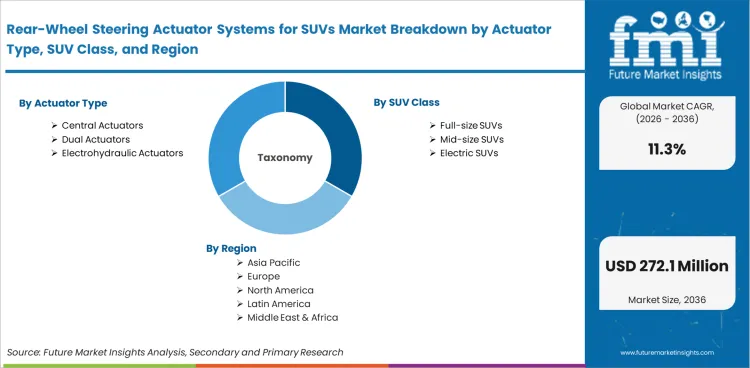
The market is segmented by actuator type, SUV class, propulsion type, steering angle, sales channel, and region. Actuator type includes Central Actuators, Dual Actuators, and Electrohydraulic Actuators. SUV class includes Mid-size SUVs, Full-size SUVs, Performance SUVs, and Electric SUVs. Propulsion type includes Battery Electric, Hybrid, and Internal Combustion. Steering angle includes Up to 5 Degrees, 5 to 10 Degrees, and Above 10 Degrees. Sales channel includes OEM Supply and Service Parts.
Insights into the Central Actuators Segment
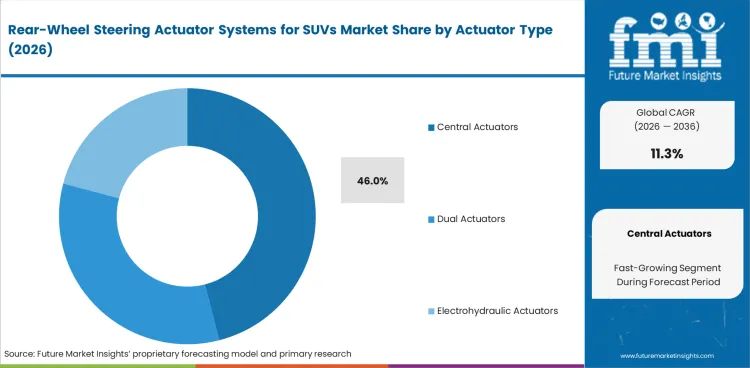
- Projected at 46.0% of actuator type demand in 2026, central actuators give OEMs one rear axle unit for cost control and compact packaging.
- Dual actuator layouts are used in premium SUV platforms that need higher steering precision and advanced chassis control.
Insights into the Full-size SUVs Segment
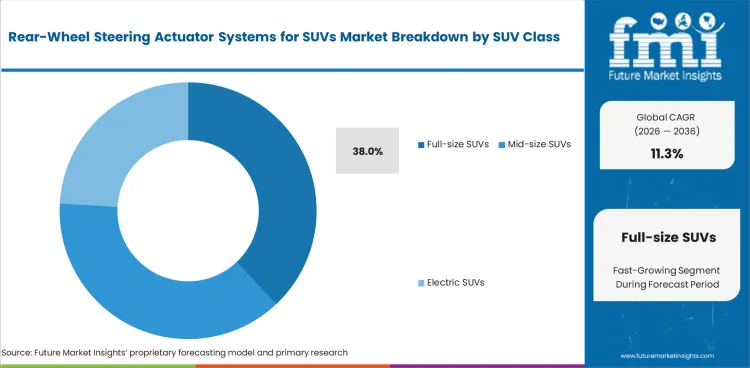
- Full-size SUVs benefit from clearer turning radius improvement, with the segment expected to hold 38.0% share in 2026.
- Performance SUVs use rear-wheel steering for stability at speed, while full-size SUVs use it mainly for comfort and easier parking.
Insights into the Battery Electric Segment
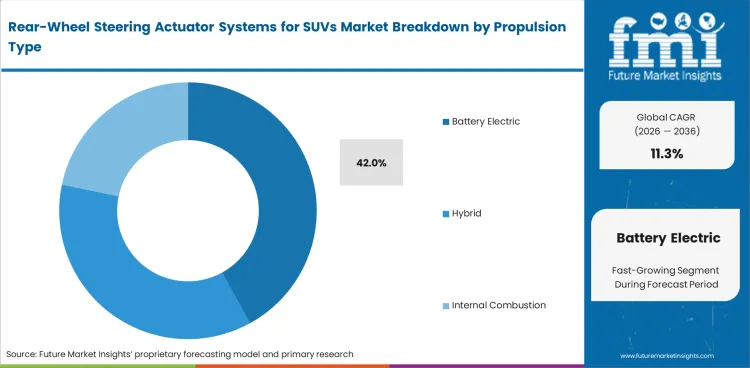
- Battery electric SUVs benefit from deeper electronic chassis integration and are projected to represent 42.0% of propulsion demand in 2026.
- Hybrid SUVs are expected to form a steady secondary base as premium hybrid models still need better low-speed handling.
Insights into the Up to 5 Degrees Segment
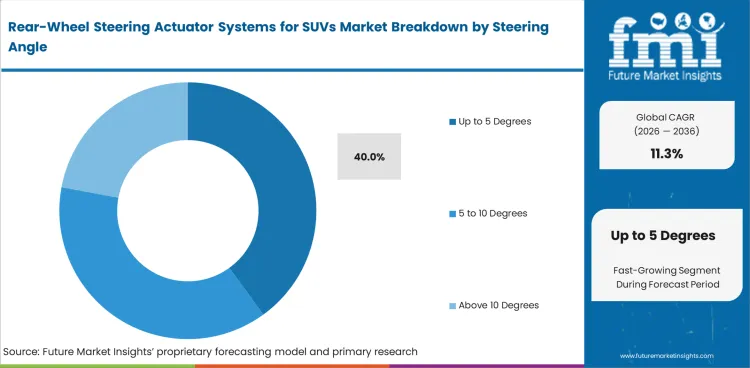
- Comfort-focused SUVs favor Up to 5 Degrees systems, which are expected to hold 40.0% share of the steering angle segment in 2026.
- Systems above 10 degrees are used more selectively as higher steering angle needs deeper suspension and control calibration.
Insights into the OEM Supply Segment
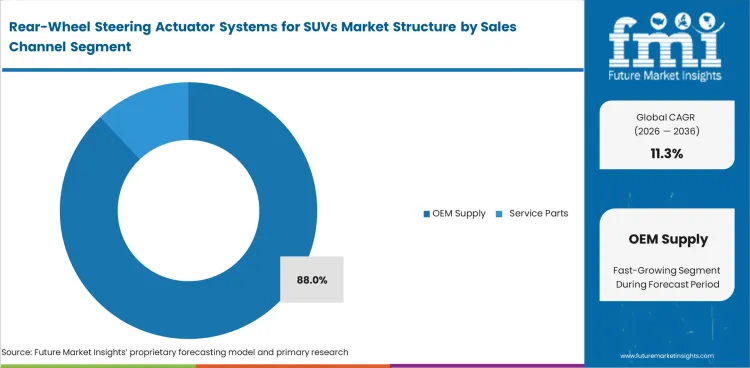
- Rear-wheel steering needs platform-level engineering, placing OEM supply at a projected 88.0% share of sales channel demand in 2026.
- Service parts demand is smaller because rear-wheel steering actuators are durable systems replaced mainly after faults or collision damage.
Rear-Wheel Steering Actuator Systems for SUVs Market Drivers, Restraints, and Opportunities
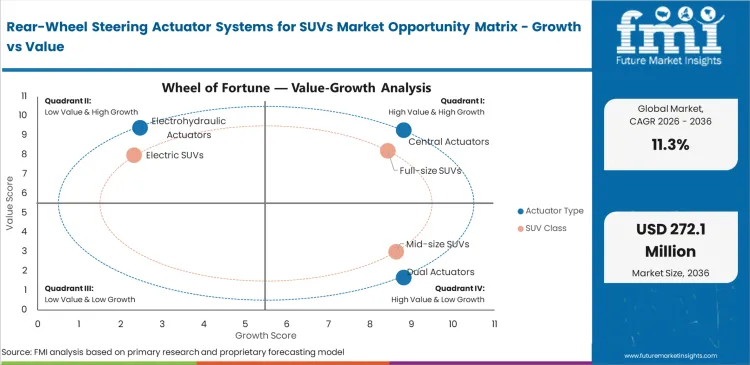
- Larger SUV bodies are creating direct need for tighter low-speed turning and easier parking.
- High actuator cost limits wider fitment across mass-market SUV trims.
- Electric SUV platforms create opportunity for rear axle steering as part of software-controlled chassis packages.
SUV Wheelbase Pressure
Demand is driven by the gap between SUV size and everyday driving needs. Customers want larger interiors, but they also expect easier movement in city streets and parking spaces. OICA said global vehicle production rose from 92.7 million units in 2024 to 96.4 million units in 2025. This broad production base gives suppliers a larger platform pool for rear steering packages. SUV programs with long wheelbases create the strongest fitment case. Suppliers that reduce packaging size and improve durability can win higher content per vehicle.
Electric Chassis Integration
Electric SUVs create a better route for rear-wheel steering because electronic chassis systems are already part of many EV platforms. Rear-wheel steering can work with braking control and stability software to improve turning behavior across parking and highway use. Longer battery platforms make turning comfort more important, especially in premium SUVs with larger cabins. OEMs can use this system to reduce the driving feel of vehicle size without changing exterior design. Rear steering suppliers gain when comfort and chassis software are sold as one higher-value package.
Cost and Fitment Limits
Cost limits wider use because rear-wheel steering adds hardware and calibration work. Mid-size SUVs face the toughest cost test as SUV owners may prioritize infotainment or driver assistance options. Fitment becomes easier when the system is tied to premium trims or electric flagship models. Suppliers must lower unit weight and reduce installation complexity to reach higher-volume SUV platforms. The opportunity is high where OEMs can market the system as a daily convenience feature.
Analysis of Rear-Wheel Steering Actuator Systems for SUVs Market by Key Countries
.webp "Top Country Growth Comparison Rear Wheel Steering Actuator Systems For Suvs Market Cagr (2026 2036)")
| Country | CAGR |
|---|---|
| China | 13.1% |
| India | 12.8% |
| US | 11.6% |
| Germany | 10.9% |
| France | 10.4% |
| UK | 10.2% |
| Japan | 9.8% |
| Brazil | 8.7% |
Source: FMI analysis based on primary research and proprietary forecasting model.
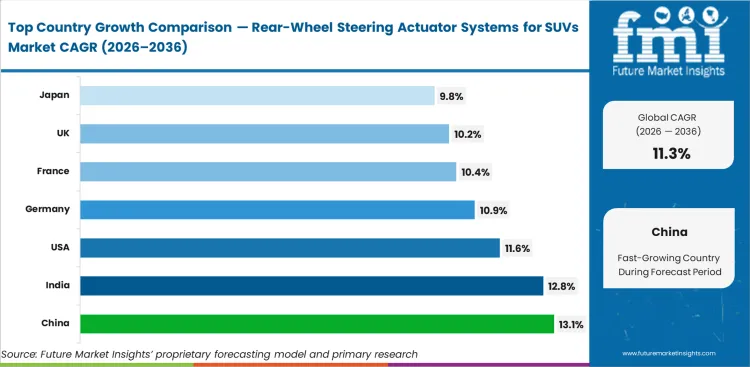
Rear-Wheel Steering Actuator Systems for SUVs Market CAGR Analysis by Country
- China is projected to record a 13.1% CAGR through 2036.
- India is expected to expand at 12.8% CAGR through 2036 .
- The USA is forecast to grow at 11.6% CAGR through 2036.
- Germany is expected to advance at 10.9% CAGR through 2036.
- France is projected to rise at 10.4% CAGR through 2036.
- The UK is forecast at 10.2% CAGR through 2036.
- Japan is expected to post 9.8% CAGR through 2036.
- Brazil is expected to grow at 8.7% CAGR through 2036.
Demand Outlook for Rear-Wheel Steering Actuator Systems for SUVs Market in China
China has the strongest growth case because premium EV brands are using chassis control as a clear product differentiator. Rear-wheel steering helps larger electric SUVs feel easier to handle in dense cities without reducing cabin size. The country is projected to record 13.1% CAGR through 2036 as local OEMs add smart chassis functions to higher-value trims. Suppliers with local engineering support can respond faster to platform changes and price pressure. Actuator makers benefit when automakers combine rear steering with braking control and suspension software.
- Shanghai and Shenzhen support premium EV demand through dense urban use and higher comfort expectations.
- Guangdong has a strong EV supply base that helps local actuator sourcing and chassis electronics development.
- Chinese premium SUV brands use rear-wheel steering to improve maneuvering in crowded city roads.
Sales Analysis of Rear-Wheel Steering Actuator Systems for SUVs Market in India
India offers a faster growth path because premium SUV buyers are moving toward larger models with higher comfort content. Rear-wheel steering adoption is expected to begin with imported and locally assembled luxury SUVs before moving into upper-mid trims. Metro traffic and tighter parking conditions make the feature clear for SUV owners. As a result, India is expected to expand at 12.8% CAGR through 2036. Suppliers that support local service training will gain an advantage as actuator systems need clear fault diagnosis and repair confidence.
- Delhi NCR and Mumbai create strong need for easier turning in premium urban SUV use.
- Maharashtra supports high-end vehicle sales through luxury dealerships and premium service networks.
- Karnataka adds demand potential through Bengaluru buyers seeking electric SUVs and advanced chassis features.
Demand Analysis of Rear-Wheel Steering Actuator Systems for SUVs Market in the USA
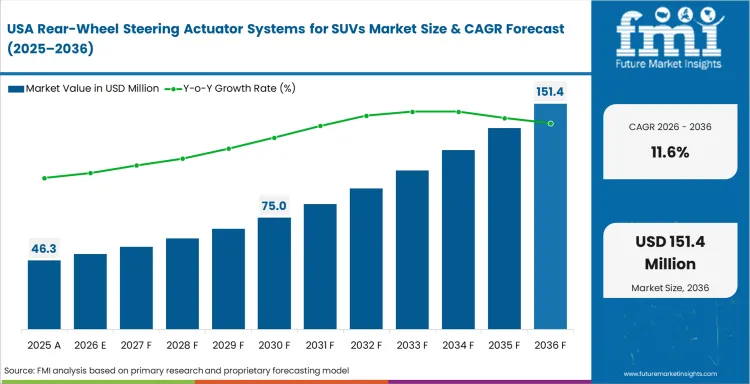
Full-size SUVs give the USA a clear base for rear-wheel steering adoption. The feature has practical value in parking lots and tight suburban turns. The USA is forecast to grow at 11.6% CAGR through 2036 as larger vehicle formats keep the fitment case visible. Pickup-based SUV platforms may support wider use once suppliers lower actuator cost. OEMs can position rear steering as a comfort feature that makes a large SUV feel easier to control.
- Texas supports full-size SUV demand through pickup and large utility vehicle use patterns.
- California supports electric SUV fitment through premium EV demand and charging network depth.
- Michigan keeps supplier engineering close to OEM chassis development centers.
Opportunity Analysis of Rear-Wheel Steering Actuator Systems for SUVs Market in Germany
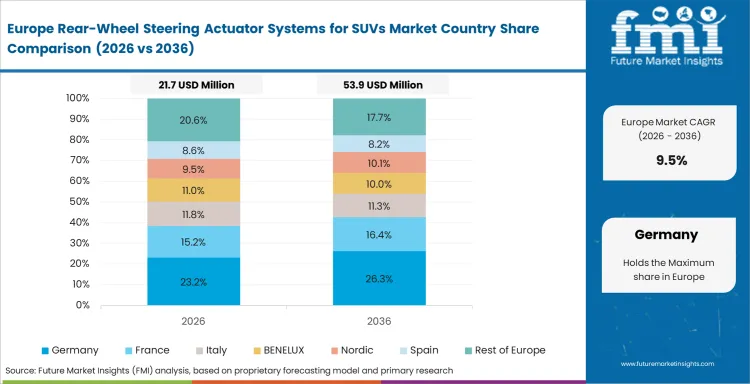
Germany’s opportunity depends on premium OEMs that treat chassis behavior as part of brand value. Rear-wheel steering suits luxury SUVs because it improves stability without making the vehicle feel less refined. Series engineering discipline gives suppliers a clear route into long platform cycles. Germany is expected to advance at 10.9% CAGR through 2036 as luxury SUV programs use more electronic chassis control. Suppliers that prove quiet operation and durable actuator response will be favored in German sourcing decisions.
- Bavaria supports premium SUV engineering through BMW and a strong chassis supplier base.
- Baden-Wuerttemberg adds demand through Mercedes-Benz SUV programs and advanced vehicle control work.
- Saxony supports EV platform growth through vehicle assembly and component investment.
Future Outlook for Rear-Wheel Steering Actuator Systems for SUVs Market in France
France is expected to grow through premium electric SUVs and platform sharing across European model lines. Rear-wheel steering will be selective, mainly appearing where comfort and handling can justify higher trim pricing. France is projected to rise at 10.4% CAGR through 2036 as EV programs add more chassis electronics. Local demand is likely to favor systems that improve urban use without adding service complexity. Suppliers can gain by offering compact actuator modules suited to shared European SUV platforms.
- Île-de-France supports premium SUV use through high-income urban buyers and dense parking conditions.
- Hauts-de-France adds potential through vehicle manufacturing and supplier activity.
- French CO2 policy pressure supports EV SUV platforms with higher electronic chassis content.
Demand Outlook for Rear-Wheel Steering Actuator Systems for SUVs Market in the UK
The UK is forecast at 10.2% CAGR through 2036 as advanced steering options move through luxury trims. Luxury SUV ownership gives the UK a steady route for rear-wheel steering adoption. Narrow urban roads and tight parking areas make the feature useful for larger SUVs. Premium SUV owners often value systems that improve everyday driving comfort without changing vehicle size. Suppliers will need strong service support because buyers expect easy ownership from high-value chassis features.
- London supports demand for tighter turning because premium SUVs face dense parking conditions.
- West Midlands keeps relevance through automotive engineering and specialist vehicle development.
- Premium SUV buyers in Surrey and Cheshire support advanced chassis option uptake.
In-depth Analysis of Rear-Wheel Steering Actuator Systems for SUVs Market in Japan
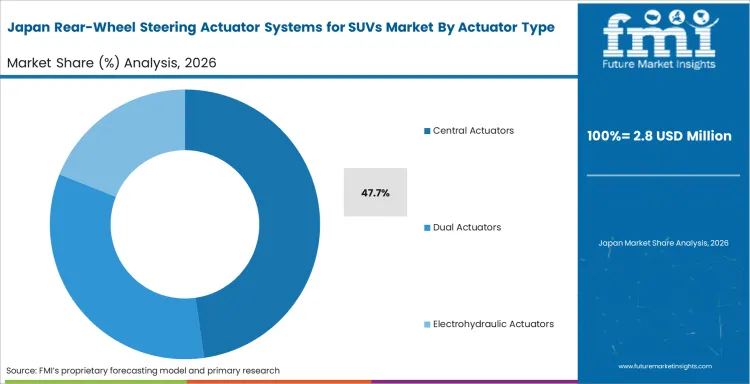
Japan is a steady market because compact premium SUVs need refined handling in dense road conditions. Rear-wheel steering can help larger models feel easier to place in narrow streets and structured parking areas. Japanese OEMs are expected to move carefully because system quietness and durability carry high weight in vehicle approval. The country is expected to post 9.8% CAGR through 2036 as adoption stays focused on premium platforms. Suppliers that can deliver smooth actuator response and low noise can improve acceptance.
- Tokyo supports compact luxury SUV demand due to dense roads and limited parking space.
- Aichi keeps supplier relevance through Toyota-linked vehicle engineering and chassis development.
- Kanagawa supports premium import demand through affluent urban and coastal SUV buyers.
Sales Outlook for Rear-Wheel Steering Actuator Systems for SUVs Market in Brazil
Brazil starts from a smaller premium SUV base, so rear-wheel steering adoption will be gradual. The feature is expected to enter through imported luxury SUVs and selected high-end trims. Price sensitivity will limit wider fitment until OEMs can connect the system to clear daily driving benefits. Brazil is expected to grow at 8.7% CAGR through 2036 as awareness improves among premium SUV owners. Suppliers with reliable service networks will have a stronger chance in this cost-aware market.
- São Paulo supports premium SUV demand through high-income households and luxury dealer networks.
- Paraná helps vehicle assembly activity through established automotive manufacturing clusters.
- Minas Gerais adds potential through SUV and light vehicle production links.
Competitive Landscape and Strategic Positioning
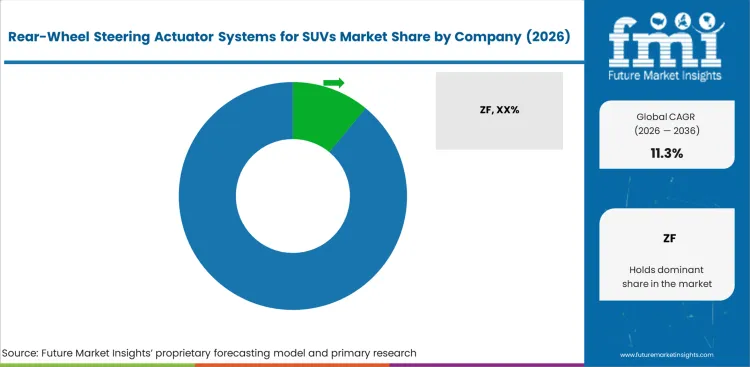
The market is concentrated among global steering and chassis suppliers with active OEM relationships.
Leading companies compete on actuator force, steering angle range, durability, and software integration.
Specialist suppliers can win when OEMs need lighter systems for EV SUV packaging.
Entry barriers are high because rear steering affects safety and vehicle dynamics calibration.
Competition depends on platform access and engineering proof. OEMs need rear-wheel steering suppliers that can validate actuator response under parking, highway, and trailer-use conditions. Nexteer launched its RWS system in March 2025 for trucks, SUVs, and EVs with focus on cost, durability, and integration. This gives Nexteer a clearer position in SUV rear steering bids. Suppliers with proven front steering, steer-by-wire, and software capability can reduce OEM risk during platform selection.
ZF has strong positioning through active rear axle steering and chassis control software. The company says its AKC system supports trucks, SUVs, and larger cars by improving maneuvering and trailer stability. ZF’s chassis electronics depth helps it compete for premium SUV programs that need rear steering tied to braking and stability control. This makes the supplier relevant for automakers adding automotive steering systems with higher software content.
Rear steering adoption is tied to the wider move toward electronic vehicle control. Premium SUV programs increasingly use automotive actuator content across chassis, braking, and body systems. Steering suppliers with strong integration skills can win larger platform contracts because OEMs prefer fewer system interfaces. Smaller suppliers face difficulty unless they can prove software safety and actuator durability at vehicle level.
Key Companies in the Rear-Wheel Steering Actuator Systems for SUVs Market
Companies differentiate by steering actuator design, chassis control integration, and OEM platform access.
- Global Steering Leaders: ZF, Nexteer, Bosch, and JTEKT have strong positions through steering system portfolios, software capability, and global OEM relationships.
- Chassis Mechatronics Specialists: Schaeffler, Hyundai Mobis, and HL Mando are positioned around mechatronic steering systems and vehicle dynamics integration.
- Regional and Platform Specialists: Hitachi Astemo and selected local suppliers support rear steering opportunities through regional OEM relationships.
Competitive Benchmarking: Rear-Wheel Steering Actuator Systems for SUVs Market
| Company | Rear Axle Actuator Depth | Chassis Software Integration | SUV Platform Access | Geographic Footprint |
|---|---|---|---|---|
| ZF | High | High | Strong | Global |
| Schaeffler | High | Medium | Strong | Europe, Global |
| Nexteer | High | Strong | Strong | Global |
| Bosch | Medium | High | Strong | Global |
| JTEKT | Medium | Medium | Strong | Japan, Global |
| Hyundai Mobis | Medium | Strong | Strong | Asia, Global |
| HL Mando | Medium | Medium | Moderate | Asia, North America |
| Hitachi Astemo | Medium | Medium | Moderate | Japan, Global |
Source: Future Market Insights competitive analysis, 2026.
Key Developments in the Rear-Wheel Steering Actuator Systems for SUVs Market
- In March 2025, Nexteer launched a rear-wheel steering system engineered for cost effectiveness and integration. The system targets trucks, SUVs, and EVs.
- In July 2025, Schaeffler started production of a mechatronic rear-wheel steering system at its Kysuce plant for a German automaker. This supports series supply credibility.
Key Players in the Rear-Wheel Steering Actuator Systems for SUVs Market
Global Steering Leaders
- ZF
- Nexteer
- Bosch
- JTEKT
Chassis Mechatronics Specialists
- Schaeffler
- Hyundai Mobis
- HL Mando
Regional and Platform Specialists
- Hitachi Astemo
Report Scope and Coverage
| Parameter | Details |
|---|---|
| Quantitative Units | USD 93.3 million to USD 272.1 million, at a CAGR of 11.3% |
| Market Definition | Systems that turn SUV rear wheels through mechatronic or electrohydraulic actuator control. |
| Regions Covered | North America, Latin America, Europe, East Asia, South Asia and Pacific, Middle East and Africa |
| Countries Covered | UK, USA, Japan, China, India, Germany, France, Brazil, 30+ countries |
| Key Companies Profiled | ZF, Schaeffler, Nexteer, Bosch, JTEKT, Hyundai Mobis, HL Mando, Hitachi Astemo |
| Forecast Period | 2026 to 2036 |
| Approach | Hybrid bottom-up and top-down methodology using SUV platform fitment rates, supplier program evidence, and actuator cost models. |
Rear-Wheel Steering Actuator Systems for SUVs Market by Segments
Rear-Wheel Steering Actuator Systems for SUVs Market Segmented by Actuator Type
- Central Actuators
- Dual Actuators
- Electrohydraulic Actuators
Rear-Wheel Steering Actuator Systems for SUVs Market Segmented by SUV Class
- Mid-size SUVs
- Full-size SUVs
- Performance SUVs
- Electric SUVs
Rear-Wheel Steering Actuator Systems for SUVs Market Segmented by Propulsion Type
- Battery Electric
- Hybrid
- Internal Combustion
Rear-Wheel Steering Actuator Systems for SUVs Market Segmented by Steering Angle
- Up to 5 Degrees
- 5 to 10 Degrees
- Above 10 Degrees
Rear-Wheel Steering Actuator Systems for SUVs Market Segmented by Sales Channel
- OEM Supply
- Service Parts
Rear-Wheel Steering Actuator Systems for SUVs Market by Region
- North America
- USA
- Canada
- Mexico
- Latin America
- Brazil
- Chile
- Rest of Latin America
- Western Europe
- Germany
- UK
- Italy
- Spain
- France
- Nordic
- BENELUX
- Rest of Western Europe
- Eastern Europe
- Russia
- Poland
- Hungary
- Balkan & Baltic
- Rest of Eastern Europe
- East Asia
- China
- Japan
- South Korea
- South Asia and Pacific
- India
- ASEAN
- Australia & New Zealand
- Rest of South Asia and Pacific
- Middle East & Africa
- Kingdom of Saudi Arabia
- Other GCC Countries
- Turkiye
- South Africa
- Other African Union
- Rest of Middle East & Africa
Research Sources and Bibliography
- International Energy Agency. (2024, May 28). SUVs are setting new sales records each year and so are their emissions.
- International Energy Agency. (2025). Global EV Outlook 2025: Executive summary. IEA.
- International Organization of Motor Vehicle Manufacturers. (2026, April 23). Auto industry growth shifted east in 2025 amid global repositioning. OICA.
- European Automobile Manufacturers’ Association. (2025, January 29). Vehicles on European roads 2025. ACEA.
- Nexteer Automotive. (2025, March 17). Nexteer launches rear-wheel steering. Nexteer.
- Schaeffler. (2025, July 9). Rear-wheel steering: Successful production launch for German OEM and new volume production orders with greater vertical integration.
- ZF. (2024, January 24). ZF supplies Lotus Eletre with top driveline tech. ZF.
This Report Answers
- What is the current and future size of the rear-wheel steering actuator systems for SUVs market?
- How fast is the market expected to grow between 2026 and 2036?
- Which actuator type is expected to lead demand by 2026?
- Which SUV class is projected to account for the highest fitment demand?
- What is driving rear-wheel steering actuator adoption in electric SUVs?
- How are long wheelbases influencing rear axle steering system design?
- Which countries are projected to show faster growth through 2036?
- Who are the key companies active in rear-wheel steering actuator systems for SUVs?
- How does FMI estimate and validate the market forecast?
Frequently Asked Questions
What is the global market demand for rear-wheel steering actuator systems for SUVs in 2026?
In 2026, the global market is expected to be worth USD 93.3 million, supported by premium SUV fitment.
How big will the rear-wheel steering actuator systems for SUVs market be in 2036?
By 2036, the market is expected to reach USD 272.1 million as electric SUV platforms use more chassis electronics.
How much is demand expected to grow between 2026 and 2036?
Demand is projected to grow at a CAGR of 11.3% between 2026 and 2036.
Which actuator type is expected to lead demand by 2026?
Central actuators are projected to lead with 46.0% share in 2026 due to compact rear axle packaging.
Which SUV class is expected to lead demand by 2026?
Full-size SUVs are expected to hold 38.0% share in 2026 since larger bodies gain clear turning benefits.
What is driving faster growth in China?
China is projected to record 13.1% CAGR through 2036 as premium EV SUVs add smart chassis systems.
What is included in this market definition?
The market includes rear axle steering actuators, control units, sensors, linkages, and OEM integration support for SUVs.
How does FMI estimate this market?
FMI uses SUV platform fitment rates, actuator cost models, supplier program checks, and country-level vehicle demand.
Preview the report firsthand - request a free sample
Get SampleGet the brochure for pricing and purchase details.
Get PDFTable of Content
- Executive Summary
- Global Market Outlook
- Demand-side Trends
- Supply-side Trends
- Technology Roadmap Analysis
- Analysis and Recommendations
- Market Overview
- Market Coverage / Taxonomy
- Market Definition / Scope / Limitations
- Research Methodology
- Chapter Orientation
- Analytical Lens and Working Hypotheses
- Market Structure, Signals, and Trend Drivers
- Benchmarking and Cross-market Comparability
- Market Sizing, Forecasting, and Opportunity Mapping
- Research Design and Evidence Framework
- Desk Research Programme (Secondary Evidence)
- Company Annual and Sustainability Reports
- Peer-reviewed Journals and Academic Literature
- Corporate Websites, Product Literature, and Technical Notes
- Earnings Decks and Investor Briefings
- Statutory Filings and Regulatory Disclosures
- Technical White Papers and Standards Notes
- Trade Journals, Industry Magazines, and Analyst Briefs
- Conference Proceedings, Webinars, and Seminar Materials
- Government Statistics Portals and Public Data Releases
- Press Releases and Reputable Media Coverage
- Specialist Newsletters and Curated Briefings
- Sector Databases and Reference Repositories
- FMI Internal Proprietary Databases and Historical Market Datasets
- Subscription Datasets and Paid Sources
- Social Channels, Communities, and Digital Listening Inputs
- Additional Desk Sources
- Expert Input and Fieldwork (Primary Evidence)
- Primary Modes
- Qualitative Interviews and Expert Elicitation
- Quantitative Surveys and Structured Data Capture
- Blended Approach
- Why Primary Evidence is Used
- Field Techniques
- Interviews
- Surveys
- Focus Groups
- Observational and In-context Research
- Social and Community Interactions
- Stakeholder Universe Engaged
- C-suite Leaders
- Board Members
- Presidents and Vice Presidents
- R&D and Innovation Heads
- Technical Specialists
- Domain Subject-matter Experts
- Scientists
- Physicians and Other Healthcare Professionals
- Governance, Ethics, and Data Stewardship
- Research Ethics
- Data Integrity and Handling
- Primary Modes
- Opportunity
- Trends
- Desk Research Programme (Secondary Evidence)
- Scenario Forecast
- Demand in Optimistic Scenario
- Demand in Likely Scenario
- Demand in Conservative Scenario
- Opportunity Map Analysis
- Product Life Cycle Analysis
- Supply Chain Analysis
- Investment Feasibility Matrix
- Value Chain Analysis
- PESTLE and Porter’s Analysis
- Regulatory Landscape
- Regional Parent Market Outlook
- Production and Consumption Statistics
- Import and Export Statistics
- Global Market Analysis 2021 to 2025 and Forecast, 2026 to 2036
- Historical Market Size Value (USD Million) Analysis, 2021 to 2025
- Current and Future Market Size Value (USD Million) Projections, 2026 to 2036
- Y-o-Y Growth Trend Analysis
- Absolute $ Opportunity Analysis
- Global Market Pricing Analysis 2021 to 2025 and Forecast 2026 to 2036
- Global Market Analysis 2021 to 2025 and Forecast 2026 to 2036, By Actuator Type
- Introduction / Key Findings
- Historical Market Size Value (USD Million) Analysis By Actuator Type , 2021 to 2025
- Current and Future Market Size Value (USD Million) Analysis and Forecast By Actuator Type , 2026 to 2036
- Central Actuators
- Dual Actuators
- Electrohydraulic Actuators
- Central Actuators
- Y-o-Y Growth Trend Analysis By Actuator Type , 2021 to 2025
- Absolute $ Opportunity Analysis By Actuator Type , 2026 to 2036
- Global Market Analysis 2021 to 2025 and Forecast 2026 to 2036, By SUV Class
- Introduction / Key Findings
- Historical Market Size Value (USD Million) Analysis By SUV Class, 2021 to 2025
- Current and Future Market Size Value (USD Million) Analysis and Forecast By SUV Class, 2026 to 2036
- Full-size SUVs
- Mid-size SUVs
- Electric SUVs
- Full-size SUVs
- Y-o-Y Growth Trend Analysis By SUV Class, 2021 to 2025
- Absolute $ Opportunity Analysis By SUV Class, 2026 to 2036
- Global Market Analysis 2021 to 2025 and Forecast 2026 to 2036, By Propulsion Type
- Introduction / Key Findings
- Historical Market Size Value (USD Million) Analysis By Propulsion Type, 2021 to 2025
- Current and Future Market Size Value (USD Million) Analysis and Forecast By Propulsion Type, 2026 to 2036
- Battery Electric
- Hybrid
- Internal Combustion
- Battery Electric
- Y-o-Y Growth Trend Analysis By Propulsion Type, 2021 to 2025
- Absolute $ Opportunity Analysis By Propulsion Type, 2026 to 2036
- Global Market Analysis 2021 to 2025 and Forecast 2026 to 2036, By Steering Angle
- Introduction / Key Findings
- Historical Market Size Value (USD Million) Analysis By Steering Angle, 2021 to 2025
- Current and Future Market Size Value (USD Million) Analysis and Forecast By Steering Angle, 2026 to 2036
- Up to 5 Degrees
- 5 to 10 Degrees
- Above 10 Degrees
- Up to 5 Degrees
- Y-o-Y Growth Trend Analysis By Steering Angle, 2021 to 2025
- Absolute $ Opportunity Analysis By Steering Angle, 2026 to 2036
- Global Market Analysis 2021 to 2025 and Forecast 2026 to 2036, By Sales Channel
- Introduction / Key Findings
- Historical Market Size Value (USD Million) Analysis By Sales Channel, 2021 to 2025
- Current and Future Market Size Value (USD Million) Analysis and Forecast By Sales Channel, 2026 to 2036
- OEM Supply
- Service Parts
- OEM Supply
- Y-o-Y Growth Trend Analysis By Sales Channel, 2021 to 2025
- Absolute $ Opportunity Analysis By Sales Channel, 2026 to 2036
- Global Market Analysis 2021 to 2025 and Forecast 2026 to 2036, By Region
- Introduction
- Historical Market Size Value (USD Million) Analysis By Region, 2021 to 2025
- Current Market Size Value (USD Million) Analysis and Forecast By Region, 2026 to 2036
- North America
- Latin America
- Western Europe
- Eastern Europe
- East Asia
- South Asia and Pacific
- Middle East & Africa
- Market Attractiveness Analysis By Region
- North America Market Analysis 2021 to 2025 and Forecast 2026 to 2036, By Country
- Historical Market Size Value (USD Million) Trend Analysis By Market Taxonomy, 2021 to 2025
- Market Size Value (USD Million) Forecast By Market Taxonomy, 2026 to 2036
- By Country
- USA
- Canada
- Mexico
- By Actuator Type
- By SUV Class
- By Propulsion Type
- By Steering Angle
- By Sales Channel
- By Country
- Market Attractiveness Analysis
- By Country
- By Actuator Type
- By SUV Class
- By Propulsion Type
- By Steering Angle
- By Sales Channel
- Key Takeaways
- Latin America Market Analysis 2021 to 2025 and Forecast 2026 to 2036, By Country
- Historical Market Size Value (USD Million) Trend Analysis By Market Taxonomy, 2021 to 2025
- Market Size Value (USD Million) Forecast By Market Taxonomy, 2026 to 2036
- By Country
- Brazil
- Chile
- Rest of Latin America
- By Actuator Type
- By SUV Class
- By Propulsion Type
- By Steering Angle
- By Sales Channel
- By Country
- Market Attractiveness Analysis
- By Country
- By Actuator Type
- By SUV Class
- By Propulsion Type
- By Steering Angle
- By Sales Channel
- Key Takeaways
- Western Europe Market Analysis 2021 to 2025 and Forecast 2026 to 2036, By Country
- Historical Market Size Value (USD Million) Trend Analysis By Market Taxonomy, 2021 to 2025
- Market Size Value (USD Million) Forecast By Market Taxonomy, 2026 to 2036
- By Country
- Germany
- UK
- Italy
- Spain
- France
- Nordic
- BENELUX
- Rest of Western Europe
- By Actuator Type
- By SUV Class
- By Propulsion Type
- By Steering Angle
- By Sales Channel
- By Country
- Market Attractiveness Analysis
- By Country
- By Actuator Type
- By SUV Class
- By Propulsion Type
- By Steering Angle
- By Sales Channel
- Key Takeaways
- Eastern Europe Market Analysis 2021 to 2025 and Forecast 2026 to 2036, By Country
- Historical Market Size Value (USD Million) Trend Analysis By Market Taxonomy, 2021 to 2025
- Market Size Value (USD Million) Forecast By Market Taxonomy, 2026 to 2036
- By Country
- Russia
- Poland
- Hungary
- Balkan & Baltic
- Rest of Eastern Europe
- By Actuator Type
- By SUV Class
- By Propulsion Type
- By Steering Angle
- By Sales Channel
- By Country
- Market Attractiveness Analysis
- By Country
- By Actuator Type
- By SUV Class
- By Propulsion Type
- By Steering Angle
- By Sales Channel
- Key Takeaways
- East Asia Market Analysis 2021 to 2025 and Forecast 2026 to 2036, By Country
- Historical Market Size Value (USD Million) Trend Analysis By Market Taxonomy, 2021 to 2025
- Market Size Value (USD Million) Forecast By Market Taxonomy, 2026 to 2036
- By Country
- China
- Japan
- South Korea
- By Actuator Type
- By SUV Class
- By Propulsion Type
- By Steering Angle
- By Sales Channel
- By Country
- Market Attractiveness Analysis
- By Country
- By Actuator Type
- By SUV Class
- By Propulsion Type
- By Steering Angle
- By Sales Channel
- Key Takeaways
- South Asia and Pacific Market Analysis 2021 to 2025 and Forecast 2026 to 2036, By Country
- Historical Market Size Value (USD Million) Trend Analysis By Market Taxonomy, 2021 to 2025
- Market Size Value (USD Million) Forecast By Market Taxonomy, 2026 to 2036
- By Country
- India
- ASEAN
- Australia & New Zealand
- Rest of South Asia and Pacific
- By Actuator Type
- By SUV Class
- By Propulsion Type
- By Steering Angle
- By Sales Channel
- By Country
- Market Attractiveness Analysis
- By Country
- By Actuator Type
- By SUV Class
- By Propulsion Type
- By Steering Angle
- By Sales Channel
- Key Takeaways
- Middle East & Africa Market Analysis 2021 to 2025 and Forecast 2026 to 2036, By Country
- Historical Market Size Value (USD Million) Trend Analysis By Market Taxonomy, 2021 to 2025
- Market Size Value (USD Million) Forecast By Market Taxonomy, 2026 to 2036
- By Country
- Kingdom of Saudi Arabia
- Other GCC Countries
- Turkiye
- South Africa
- Other African Union
- Rest of Middle East & Africa
- By Actuator Type
- By SUV Class
- By Propulsion Type
- By Steering Angle
- By Sales Channel
- By Country
- Market Attractiveness Analysis
- By Country
- By Actuator Type
- By SUV Class
- By Propulsion Type
- By Steering Angle
- By Sales Channel
- Key Takeaways
- Key Countries Market Analysis
- USA
- Pricing Analysis
- Market Share Analysis, 2025
- By Actuator Type
- By SUV Class
- By Propulsion Type
- By Steering Angle
- By Sales Channel
- Canada
- Pricing Analysis
- Market Share Analysis, 2025
- By Actuator Type
- By SUV Class
- By Propulsion Type
- By Steering Angle
- By Sales Channel
- Mexico
- Pricing Analysis
- Market Share Analysis, 2025
- By Actuator Type
- By SUV Class
- By Propulsion Type
- By Steering Angle
- By Sales Channel
- Brazil
- Pricing Analysis
- Market Share Analysis, 2025
- By Actuator Type
- By SUV Class
- By Propulsion Type
- By Steering Angle
- By Sales Channel
- Chile
- Pricing Analysis
- Market Share Analysis, 2025
- By Actuator Type
- By SUV Class
- By Propulsion Type
- By Steering Angle
- By Sales Channel
- Germany
- Pricing Analysis
- Market Share Analysis, 2025
- By Actuator Type
- By SUV Class
- By Propulsion Type
- By Steering Angle
- By Sales Channel
- UK
- Pricing Analysis
- Market Share Analysis, 2025
- By Actuator Type
- By SUV Class
- By Propulsion Type
- By Steering Angle
- By Sales Channel
- Italy
- Pricing Analysis
- Market Share Analysis, 2025
- By Actuator Type
- By SUV Class
- By Propulsion Type
- By Steering Angle
- By Sales Channel
- Spain
- Pricing Analysis
- Market Share Analysis, 2025
- By Actuator Type
- By SUV Class
- By Propulsion Type
- By Steering Angle
- By Sales Channel
- France
- Pricing Analysis
- Market Share Analysis, 2025
- By Actuator Type
- By SUV Class
- By Propulsion Type
- By Steering Angle
- By Sales Channel
- India
- Pricing Analysis
- Market Share Analysis, 2025
- By Actuator Type
- By SUV Class
- By Propulsion Type
- By Steering Angle
- By Sales Channel
- ASEAN
- Pricing Analysis
- Market Share Analysis, 2025
- By Actuator Type
- By SUV Class
- By Propulsion Type
- By Steering Angle
- By Sales Channel
- Australia & New Zealand
- Pricing Analysis
- Market Share Analysis, 2025
- By Actuator Type
- By SUV Class
- By Propulsion Type
- By Steering Angle
- By Sales Channel
- China
- Pricing Analysis
- Market Share Analysis, 2025
- By Actuator Type
- By SUV Class
- By Propulsion Type
- By Steering Angle
- By Sales Channel
- Japan
- Pricing Analysis
- Market Share Analysis, 2025
- By Actuator Type
- By SUV Class
- By Propulsion Type
- By Steering Angle
- By Sales Channel
- South Korea
- Pricing Analysis
- Market Share Analysis, 2025
- By Actuator Type
- By SUV Class
- By Propulsion Type
- By Steering Angle
- By Sales Channel
- Russia
- Pricing Analysis
- Market Share Analysis, 2025
- By Actuator Type
- By SUV Class
- By Propulsion Type
- By Steering Angle
- By Sales Channel
- Poland
- Pricing Analysis
- Market Share Analysis, 2025
- By Actuator Type
- By SUV Class
- By Propulsion Type
- By Steering Angle
- By Sales Channel
- Hungary
- Pricing Analysis
- Market Share Analysis, 2025
- By Actuator Type
- By SUV Class
- By Propulsion Type
- By Steering Angle
- By Sales Channel
- Kingdom of Saudi Arabia
- Pricing Analysis
- Market Share Analysis, 2025
- By Actuator Type
- By SUV Class
- By Propulsion Type
- By Steering Angle
- By Sales Channel
- Turkiye
- Pricing Analysis
- Market Share Analysis, 2025
- By Actuator Type
- By SUV Class
- By Propulsion Type
- By Steering Angle
- By Sales Channel
- South Africa
- Pricing Analysis
- Market Share Analysis, 2025
- By Actuator Type
- By SUV Class
- By Propulsion Type
- By Steering Angle
- By Sales Channel
- USA
- Market Structure Analysis
- Competition Dashboard
- Competition Benchmarking
- Market Share Analysis of Top Players
- By Regional
- By Actuator Type
- By SUV Class
- By Propulsion Type
- By Steering Angle
- By Sales Channel
- Competition Analysis
- Competition Deep Dive
- ZF
- Overview
- Product Portfolio
- Profitability by Market Segments (Product/Age /Sales Channel/Region)
- Sales Footprint
- Strategy Overview
- Marketing Strategy
- Product Strategy
- Channel Strategy
- Nexteer
- Bosch
- JTEKT
- Schaeffler
- Hyundai Mobis
- ZF
- Competition Deep Dive
- Assumptions & Acronyms Used


