

- Industry Size (2026)
- USD 4.9 Bn
- Forecast (2036)
- USD 7.8 Bn
- CAGR (2026 to 2036)
- 4.8%
Steering Wheel Airbag Modules Market Forecast and Outlook 2026 to 2036
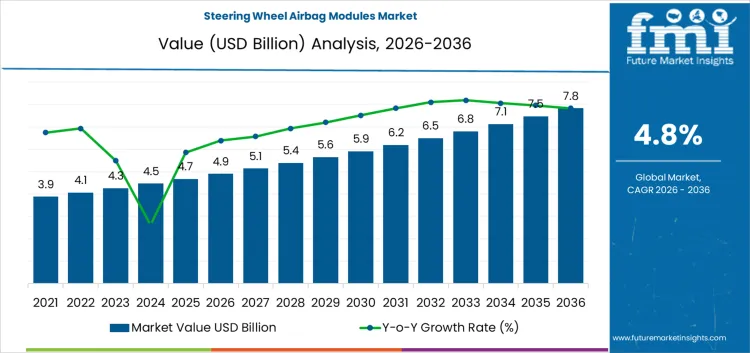
The steering wheel airbag modules market is likely to be valued at USD 4.9 billion in 2026 and is projected to reach USD 7.8 billion by 2036, reflecting a CAGR of 4.8%. Demand in the early years is set by vehicle production volumes and by regulatory baselines that fix airbag inclusion across most passenger segments. Purchasing decisions sit with platform programs rather than trim strategies, which limits short term volatility. Unit growth tracks global assembly schedules, while value growth depends on module design complexity and validation costs. Supplier selection emphasizes certification history, defect rates, and delivery reliability more than price concessions or feature variation.
Toward the later years, market behavior reflects replacement cycles, platform carryovers, and tighter control of bill of material costs. Automakers favor module standardization across steering wheel families to reduce testing duplication and inventory risk. Volume expansion remains linked to vehicle output, yet pricing remains disciplined because safety components face close audit and contract scrutiny. Capacity additions follow long term program awards rather than speculative expansion. Mature regions contribute steady replacement demand, while newer vehicle platforms sustain incremental volume. The growth profile becomes more predictable, shaped by regulatory continuity, fleet age, and the pace of platform renewals rather than by feature driven upgrades.
Quick Stats of the Steering Wheel Airbag Modules Market
- Steering Wheel Airbag Modules Market Value (2026): USD 4.9 billion
- Steering Wheel Airbag Modules Forecast Value (2036): USD 7.8 billion
- Steering Wheel Airbag Modules Forecast CAGR 2026 to 2036: 4.8%
- Leading Module Configuration in Steering Wheel Airbags: Single-Stage Modules (58 % share)
- Leading Steering Wheel Type in Steering Wheel Airbags: Standard Wheels (62 % share)
- Key Growth Regions in Steering Wheel Airbag Modules Market: India, China, South Korea, USA, Germany
- Top Players in Steering Wheel Airbag Modules Market: Autoliv, Toyoda Gosei, Joyson Safety Systems, ZF Lifetec, Hyundai Mobis, Nihon Plast, Ashimori, Daicel, ARC Automotive, GWR Safety Systems
What is the Growth Forecast for Steering Wheel Airbag Modules Market through 2036?
Between 2026 and 2031, the steering wheel airbag modules market is expected to progress from USD 4.9 billion along a trajectory consistent with a 4.8% CAGR, shaped more by regulatory and platform continuity than by rapid shifts in vehicle design. Demand remains anchored in passenger cars, where single-stage modules continue to dominate high-volume programs because they align with established validation cycles and cost targets. OEMs treat the airbag module as a tightly controlled safety system rather than a configurable feature, which limits variation but secures predictable volumes. Program awards depend on long qualification histories, process traceability, and defect rate performance. Production planning focuses on stability, long model cycles, and synchronized supply with steering wheel assembly operations.
From 2031 to 2036, the market is projected to reach USD 7.8 billion, with expansion tied to gradual increases in vehicle output and the steady spread of more complex steering wheel designs. Heated and multifunction wheels, along with broader SUV penetration, raise integration requirements without fundamentally altering the safety architecture. Dual-stage and adaptive modules gain selective share where regulations and vehicle positioning justify the added cost and validation burden. Purchasing decisions remain conservative, favoring suppliers with proven inflator control, module assembly discipline, and global manufacturing footprints. Scale, compliance management, and recall risk mitigation matter more than unit pricing alone. This environment continues to favor established suppliers such as Autoliv, Toyoda Gosei, Joyson Safety Systems, ZF Lifetec, Hyundai Mobis, Nihon Plast, Ashimori, Daicel, ARC Automotive, and GWR Safety Systems.
Steering Wheel Airbag Modules Market Key Takeaways
| Metric | Value |
|---|---|
| Market Value (2026) | USD 4.9 billion |
| Forecast Value (2036) | USD 7.8 billion |
| Forecast CAGR 2026 to 2036 | 4.8% |
How Are Steering Wheel Airbag Modules Advancing Vehicle Safety?
Steering wheel airbag modules are increasingly adopted to protect drivers during frontal and offset collisions, reducing head and chest injuries. Historically, occupant protection relied solely on seatbelts, which provided limited restraint in high-impact scenarios. Modern modules integrate advanced inflators, crash sensors, and folded airbag cushions within the steering wheel assembly to ensure rapid deployment and controlled inflation. Automotive OEMs, airbag suppliers, and safety regulators prioritize deployment reliability, material durability, and compliance with global crash-test standards. Early adoption focused on premium passenger vehicles, while current demand spans SUVs, sedans, and electric vehicles, driven by stringent safety regulations, consumer safety expectations, and automotive safety ratings. Deployment speed, sensor accuracy, and integration with restraint systems influence supplier selection.
Rising regulatory mandates, crash safety standards, and consumer awareness are shaping market growth. Compared with older airbag systems, modern steering wheel modules emphasize precise sensor integration, rapid inflation, and compatibility with advanced driver assistance and safety systems. Cost structures depend on inflator technology, airbag materials, and assembly precision, concentrating margins among suppliers capable of delivering certified, high-performance modules. Vehicle manufacturers adopt these modules to enhance driver protection, comply with safety regulations, and improve crash-test outcomes. By 2036, steering wheel airbag modules are expected to become standard across passenger, commercial, and electric vehicles, supporting occupant safety, regulatory compliance, and crash performance.
What Factors Are Shaping the Demand for Steering Wheel Airbag Modules by Deployment Logic and Wheel Architecture in 2026?
The steering wheel airbag modules market in 2026 is segmented by module configuration and steering wheel type. By module configuration, demand is divided into single stage, dual stage, adaptive deployment, and other systems, each reflecting different philosophies of crash response control and liability management. By steering wheel type, demand is organized around standard, heated, sport or performance, and other wheel formats, which determine packaging constraints, cover design, and assembly risk. These segments exist less as comfort or feature choices and more as outcomes of regulatory exposure, validation burden, field failure cost, and the need to control variant complexity across large production fleets and long vehicle program lifecycles.
Why Do Single Stage Airbag Modules Remain the Default Choice in Most Vehicle Programs?
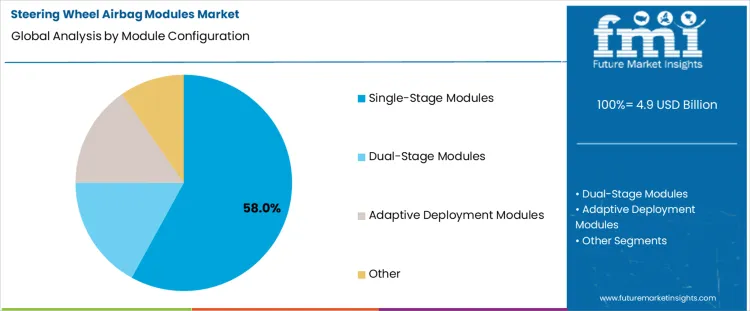
Single stage modules account for about 58% of demand in 2026, reflecting their role as the lowest risk configuration from a validation and legal exposure standpoint. These systems follow a single, well defined deployment profile that is easier to defend in regulatory tests and in post-crash investigations. Automakers favor architectures with limited behavioral states because every added logic branch expands certification scope and litigation surface. Single stage modules also reduce the number of calibration cases that must be frozen before production. Field data histories for these systems are long and well documented, which lowers uncertainty in failure rate modeling. This combination of predictable behavior, stable homologation paths, and contained recall risk sustains their dominance across high volume platforms.
Dual stage and adaptive modules introduce multiple deployment outcomes, which changes how crash performance is evaluated and defended. Each additional trigger logic path increases test matrices, documentation load, and approval cycles. These systems are specified where occupant classification strategies or brand positioning justify the added exposure. Their cost is not only in hardware but in engineering time, legal review, and long term support obligations. In the event of field issues, the scope of investigation and revalidation expands faster than with single stage systems.
Why Do Standard Steering Wheels Concentrate the Majority of Airbag Module Volume?
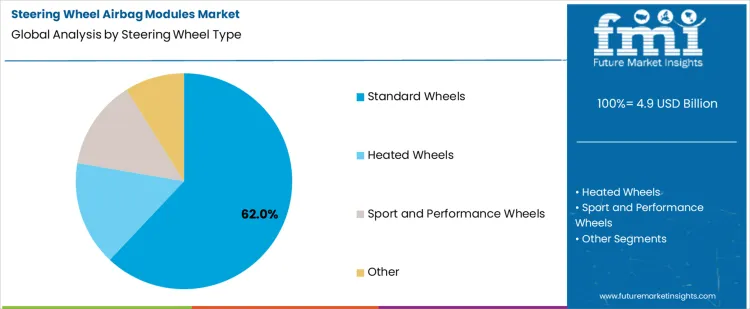
Standard steering wheels represent about 62% of demand in 2026 because they offer the most stable environment for airbag module packaging and deployment validation. Once a wheel and module interface is certified, manufacturers aim to freeze that geometry for as long as possible to avoid reopening crash tests and regulatory submissions. Standard wheels support this strategy by minimizing variation in cover materials, tear seams, and structural paths. Fewer variants also reduce the probability of assembly errors that can trigger safety recalls. From a risk management perspective, concentrating volume on one dominant interface simplifies traceability, quality audits, and field monitoring. This makes standard wheels the preferred anchor for restraint system consistency across large vehicle populations.
Heated and sport or performance wheels introduce structural and material changes around the module area, which alters deployment behavior and verification requirements. Heating elements, alternative grip materials, or reshaped rims affect cover opening dynamics and gas flow paths. Each variation requires separate validation and long term durability assessment. These wheels also tend to be added late in vehicle development cycles, which increases schedule pressure and approval risk. Their volumes remain limited because every additional interface multiplies testing, documentation, and potential recall exposure. Demand for modules in these wheel types follows trim strategy rather than safety system architecture strategy, keeping them structurally secondary to standard wheels in total production and certification planning across major automotive programs.
Why Are Vehicle Architecture and Regulatory Load Cases Rewriting Demand Patterns for Steering Wheel Airbag Modules through 2036?
Demand is shaped less by vehicle volume growth and more by changes in steering and cockpit architecture. New steering wheel designs integrate heating, sensors, and driver monitoring features, which alters available package space and affects module geometry. At the same time, updated crash test protocols and offset impact scenarios force recalibration of deployment profiles and inflator sizing. OEMs respond by freezing module specifications earlier in the vehicle program to control validation risk. This shifts purchasing behavior toward suppliers with proven certification histories. Volume follows platform carryover cycles, while value concentrates in modules qualified across multiple vehicle architectures and steering formats.
What Manufacturing, Liability, and Certification Pressures Are Constraining Supplier Participation in This Segment?
Barriers arise from risk exposure rather than lack of demand. Airbag modules carry high liability, and a single defect can trigger global recalls and legal action. As a result, OEMs demand extensive validation, traceability, and long term field data before awarding contracts. This raises fixed costs for tooling, testing, and compliance documentation. Capacity cannot be added quickly because production lines require audited safety systems and redundant quality checks. Smaller manufacturers find it difficult to justify this investment without guaranteed volumes. The outcome is a narrow supplier base, limited competitive entry, and cautious program ramp ups that slow the pace of platform transitions.
How Are Interior Layout Changes and Platform Consolidation Restructuring This Category?
Interior design trends are forcing structural change in the category. Flat bottom wheels, yokes, and steer by wire concepts alter module shape, mounting points, and deployment direction. Platform consolidation encourages reuse of validated modules across multiple vehicle lines, reducing design variation but increasing volume per program. At the same time, OEMs seek fewer tier one interfaces, pushing module suppliers to deliver more preassembled systems rather than components. Regional sourcing is also gaining weight to manage trade and logistics risk. The category is moving toward fewer, more complex module families tied closely to cockpit and steering platform strategies.
What is the Demand for Steering Wheel Airbag Modules by Country?
| Country | CAGR (%) |
|---|---|
| China | 5.6% |
| India | 5.9% |
| South Korea | 4.2% |
| USA | 3.5% |
| Germany | 3.0% |
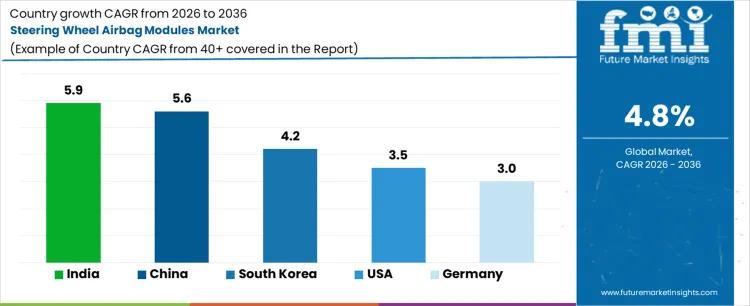
Demand for steering wheel airbag modules is rising as automotive manufacturers focus on vehicle safety, regulatory compliance, and advanced occupant protection systems. India leads with a 5.9% CAGR, driven by increasing vehicle production, rising consumer awareness of safety features, and stringent safety regulations. China follows at 5.6%, supported by expanding automotive manufacturing and adoption of airbag-equipped vehicles. South Korea grows at 4.2%, shaped by domestic production and integration of advanced airbag systems in passenger and commercial vehicles. The USA records 3.5% growth, reflecting a mature automotive market with high existing penetration of steering wheel airbags. Germany shows 3.0% CAGR, influenced by established safety standards and gradual upgrades in airbag module technologies.
How is China experiencing growth in the steering wheel airbag modules market?
China is experiencing growth at a CAGR of 5.6%, supported by adoption of steering wheel airbag modules market solutions to enhance vehicle occupant safety, crash performance, and regulatory compliance. Manufacturers and suppliers are producing airbag modules optimized for rapid deployment, reliability, and integration with steering systems. Demand is concentrated in automotive production hubs, assembly plants, and R&D centers. Investments focus on material performance, system reliability, and adherence to automotive safety standards rather than large-scale deployment. Growth reflects rising vehicle production, industrial adoption of advanced safety systems, and increasing focus on driver protection.
- Vehicle safety drives adoption.
- Airbag modules optimize rapid deployment and reliability.
- Production hubs and assembly centers concentrate demand.
- Material performance and safety compliance guide investment.
How is India witnessing growth in the steering wheel airbag modules market?
India is witnessing growth at a CAGR of 5.9%, fueled by adoption of steering wheel airbag modules market solutions to improve occupant protection, crash performance, and steering system safety. Manufacturers and suppliers are deploying modules optimized for rapid inflation, material durability, and integration with automotive steering assemblies. Demand is concentrated in automotive manufacturing hubs, assembly plants, and R&D centers. Investments prioritize system reliability, material performance, and adherence to safety regulations rather than fleet-scale deployment. Growth reflects rising vehicle production, industrial adoption of advanced airbag systems, and increased regulatory focus on driver protection.
- Occupant protection drives adoption.
- Modules enhance rapid inflation and material durability.
- Manufacturing hubs and assembly plants concentrate demand.
- System reliability and safety compliance guide investment.
How is South Korea experiencing growth in the steering wheel airbag modules market?
South Korea is experiencing growth at a CAGR of 4.2%, supported by adoption of steering wheel airbag modules market solutions to improve driver safety, steering system reliability, and crash protection. Manufacturers and suppliers are producing modules optimized for deployment speed, material strength, and integration with steering assemblies. Demand is concentrated in automotive production hubs, assembly facilities, and component manufacturing centers. Investments focus on material performance, system reliability, and compliance with automotive safety standards rather than large-scale deployment. Growth reflects industrial adoption of safety systems, moderate vehicle production, and emphasis on driver protection.
- Driver safety drives adoption.
- Modules optimize deployment speed and material strength.
- Automotive hubs and assembly facilities concentrate demand.
- Material performance and compliance guide investment.
How is the United States witnessing growth in the steering wheel airbag modules market?
United States is witnessing growth at a CAGR of 3.5%, fueled by adoption of steering wheel airbag modules market solutions to improve occupant protection, steering system safety, and crash performance. Manufacturers and suppliers are deploying modules optimized for rapid activation, material durability, and integration with automotive steering systems. Demand is concentrated in automotive assembly plants, component production hubs, and R&D centers. Investments prioritize system reliability, material performance, and adherence to safety standards rather than fleet-scale deployment. Growth reflects moderate vehicle production, industrial adoption of advanced airbag systems, and focus on driver protection.
- Occupant protection drives adoption.
- Modules enhance rapid activation and material durability.
- Assembly plants and component hubs concentrate demand.
- System reliability and safety compliance guide investment.
How is Germany experiencing growth in the steering wheel airbag modules market?
Germany is experiencing growth at a CAGR of 3%, supported by adoption of steering wheel airbag modules market solutions to enhance vehicle occupant safety, steering system reliability, and crash performance. Manufacturers and suppliers are producing modules optimized for material durability, rapid deployment, and integration with steering assemblies. Demand is concentrated in automotive production hubs, assembly plants, and R&D centers. Investments focus on material performance, operational reliability, and compliance with automotive safety standards rather than large-scale deployment. Growth reflects moderate vehicle production, industrial adoption of advanced airbag systems, and regulatory emphasis on driver safety.
- Driver safety drives adoption.
- Modules ensure rapid deployment and material durability.
- Production hubs and assembly plants concentrate demand.
- Material performance and regulatory compliance guide investment.
Who Competes in the Steering Wheel Airbag Modules Market and What Defines Their Capabilities?
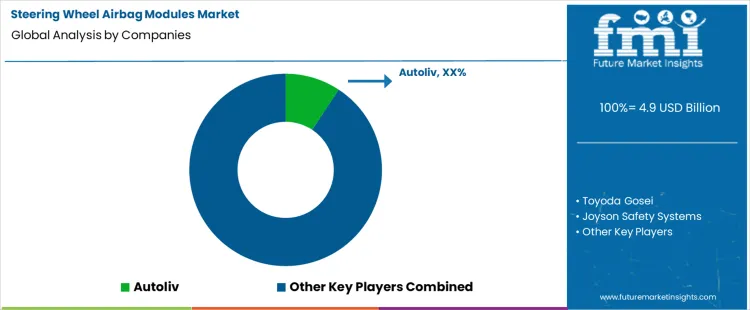
Competition in the steering wheel airbag modules market is defined by deployment reliability, sensor integration, and compliance with automotive safety regulations. Autoliv supplies airbag modules engineered for rapid and consistent deployment, high material durability, and occupant protection compliance. Toyoda Gosei develops modules with integrated inflators and sensors optimized for frontal crash protection and compact steering wheel designs. Joyson Safety Systems provides modules designed for consistent deployment timing, high tear strength, and regulatory compliance. ZF Lifetec supplies steering wheel airbags with optimized inflator performance and integration with vehicle sensing systems. Hyundai Mobis delivers modules integrated with advanced crash sensors and steering control electronics.
Nihon Plast provides modules engineered for reliable inflation and long-term material performance. Ashimori develops airbags with high tear resistance and compact packaging. Daicel supplies inflator-integrated modules for consistent performance under varying conditions. ARC Automotive delivers modular airbag systems for diverse vehicle platforms. GWR Safety Systems focuses on high-reliability steering wheel airbag modules for global OEMs. Other regional and specialty suppliers produce modules emphasizing safety compliance, material durability, and integration with advanced vehicle electronics. Competitive differentiation arises from deployment accuracy, material performance, integration with vehicle safety systems, and compliance with global airbag regulations.
Key Players in the Steering Wheel Airbag Modules Market
- Autoliv
- Toyoda Gosei
- Joyson Safety Systems
- ZF Lifetec
- Hyundai Mobis
- Nihon Plast
- Ashimori
- Daicel
- ARC Automotive
- GWR Safety Systems
Scope of the Report
| Items | Values |
|---|---|
| Quantitative Units (2026) | USD billion |
| Module Configuration | Single-Stage Modules, Dual-Stage Modules, Adaptive Deployment Modules, Other |
| Steering Wheel Type | Standard Wheels, Heated Wheels, Sport/Performance Wheels, Other |
| Vehicle Class | Passenger Cars, SUVs/Crossovers, Light Commercial Vehicles, Other |
| Sales Channel | OEM/Tier 1 Supply, Aftermarket Service, Remanufacturing, Other |
| Regions Covered | Asia Pacific, Europe, North America, Latin America, Middle East & Africa |
| Countries Covered | China, Japan, South Korea, India, Australia & New Zealand, ASEAN, Germany, United Kingdom, France, Italy, Spain, Nordic, BENELUX, United States, Canada, Mexico, Brazil, Chile, Saudi Arabia, Turkey, South Africa, and other regional markets |
| Key Companies Profiled | Autoliv, Toyoda Gosei, Joyson Safety Systems, ZF Lifetec, Hyundai Mobis, Nihon Plast, Ashimori, Daicel, ARC Automotive, GWR Safety Systems |
| Additional Attributes | Dollar sales by module configuration, steering wheel type, vehicle class, and sales channel, regional production and installation patterns tied to vehicle assembly volumes, platform-based sourcing and long-term supply agreements with OEMs, certification and validation driven cost structures, integration with steering wheel assemblies and restraint systems, and replacement demand linked to fleet age and platform carryover cycles. |
Steering Wheel Airbag Modules Market Segmentation
By Module Configuration:
- Single-Stage Modules
- Dual-Stage Modules
- Adaptive Deployment Modules
- Other
By Steering Wheel Type:
- Standard Wheels
- Heated Wheels
- Sport/Performance Wheels
- Other
By Vehicle Class:
- Passenger Cars
- SUVs/Crossovers
- Light Commercial Vehicles
- Other
By Sales Channel:
- OEM/Tier 1 Supply
- Aftermarket Service
- Remanufacturing
- Other
By Region
- Asia Pacific
- China
- Japan
- South Korea
- India
- Australia & New Zealand
- ASEAN
- Rest of Asia Pacific
- Europe
- Germany
- United Kingdom
- France
- Italy
- Spain
- Nordic
- BENELUX
- Rest of Europe
- North America
- United States
- Canada
- Mexico
- Latin America
- Brazil
- Chile
- Rest of Latin America
- Middle East & Africa
- Kingdom of Saudi Arabia
- Other GCC Countries
- Turkey
- South Africa
- Other African Union
- Rest of Middle East & Africa
Bibliography
- National Highway Traffic Safety Administration. (2024). Federal Motor Vehicle Safety Standard No. 208: Occupant crash protection. USA Department of Transportation.
- National Highway Traffic Safety Administration. (2024). Federal Motor Vehicle Safety Standard No. 203: Impact protection for the driver from the steering control system. USA Department of Transportation.
- United Nations Economic Commission for Europe. (2024). UN Regulation No. 12: Protection of the driver against the steering mechanism in the event of impact.
- International Organization for Standardization. (2024). ISO 14451: Road vehicles-Airbag modules-Performance and test methods. International Organization for Standardization.
- European New Car Assessment Programme. (2024). Frontal impact assessment protocol.
Frequently Asked Questions
How big is the steering wheel airbag modules market in 2026?
The global steering wheel airbag modules market is estimated to be valued at USD 4.9 billion in 2026.
What will be the size of steering wheel airbag modules market in 2036?
The market size for the steering wheel airbag modules market is projected to reach USD 7.8 billion by 2036.
How much will be the steering wheel airbag modules market growth between 2026 and 2036?
The steering wheel airbag modules market is expected to grow at a 4.8% CAGR between 2026 and 2036.
What are the key product types in the steering wheel airbag modules market?
The key product types in steering wheel airbag modules market are single-stage modules, dual-stage modules, adaptive deployment modules and other.
Which steering wheel type segment to contribute significant share in the steering wheel airbag modules market in 2026?
In terms of steering wheel type, standard wheels segment to command 62.0% share in the steering wheel airbag modules market in 2026.
Preview the report firsthand - request a free sample
Get SampleGet the brochure for pricing and purchase details.
Get PDFTable of Content
- Executive Summary
- Global Market Outlook
- Demand-side Trends
- Supply-side Trends
- Technology Roadmap Analysis
- Analysis and Recommendations
- Market Overview
- Market Coverage / Taxonomy
- Market Definition / Scope / Limitations
- Market Background
- Market Dynamics
- Drivers
- Restraints
- Opportunity
- Trends
- Scenario Forecast
- Demand in Optimistic Scenario
- Demand in Likely Scenario
- Demand in Conservative Scenario
- Opportunity Map Analysis
- Product Life Cycle Analysis
- Supply Chain Analysis
- Investment Feasibility Matrix
- Value Chain Analysis
- PESTLE and Porter’s Analysis
- Regulatory Landscape
- Regional Parent Market Outlook
- Production and Consumption Statistics
- Import and Export Statistics
- Market Dynamics
- Global Market Analysis 2021 to 2025 and Forecast, 2026 to 2036
- Historical Market Size Value (USD Million) Analysis, 2021 to 2025
- Current and Future Market Size Value (USD Million) Projections, 2026 to 2036
- Y-o-Y Growth Trend Analysis
- Absolute $ Opportunity Analysis
- Global Market Pricing Analysis 2021 to 2025 and Forecast 2026 to 2036
- Global Market Analysis 2021 to 2025 and Forecast 2026 to 2036, By Module Configuration
- Introduction / Key Findings
- Historical Market Size Value (USD Million) Analysis By Module Configuration , 2021 to 2025
- Current and Future Market Size Value (USD Million) Analysis and Forecast By Module Configuration , 2026 to 2036
- Single-Stage Modules
- Dual-Stage Modules
- Adaptive Deployment Modules
- Other
- Single-Stage Modules
- Y-o-Y Growth Trend Analysis By Module Configuration , 2021 to 2025
- Absolute $ Opportunity Analysis By Module Configuration , 2026 to 2036
- Global Market Analysis 2021 to 2025 and Forecast 2026 to 2036, By Steering Wheel Type
- Introduction / Key Findings
- Historical Market Size Value (USD Million) Analysis By Steering Wheel Type, 2021 to 2025
- Current and Future Market Size Value (USD Million) Analysis and Forecast By Steering Wheel Type, 2026 to 2036
- Standard Wheels
- Heated Wheels
- Sport and Performance Wheels
- Other
- Standard Wheels
- Y-o-Y Growth Trend Analysis By Steering Wheel Type, 2021 to 2025
- Absolute $ Opportunity Analysis By Steering Wheel Type, 2026 to 2036
- Global Market Analysis 2021 to 2025 and Forecast 2026 to 2036, By Vehicle Class
- Introduction / Key Findings
- Historical Market Size Value (USD Million) Analysis By Vehicle Class, 2021 to 2025
- Current and Future Market Size Value (USD Million) Analysis and Forecast By Vehicle Class, 2026 to 2036
- Passenger Cars
- SUVs and Crossovers
- Light Commercial Vehicles
- Other
- Passenger Cars
- Y-o-Y Growth Trend Analysis By Vehicle Class, 2021 to 2025
- Absolute $ Opportunity Analysis By Vehicle Class, 2026 to 2036
- Global Market Analysis 2021 to 2025 and Forecast 2026 to 2036, By Sales Channel
- Introduction / Key Findings
- Historical Market Size Value (USD Million) Analysis By Sales Channel, 2021 to 2025
- Current and Future Market Size Value (USD Million) Analysis and Forecast By Sales Channel, 2026 to 2036
- OEM and Tier 1 Supply
- Aftermarket Service
- Remanufacturing
- Other
- OEM and Tier 1 Supply
- Y-o-Y Growth Trend Analysis By Sales Channel, 2021 to 2025
- Absolute $ Opportunity Analysis By Sales Channel, 2026 to 2036
- Global Market Analysis 2021 to 2025 and Forecast 2026 to 2036, By Region
- Introduction
- Historical Market Size Value (USD Million) Analysis By Region, 2021 to 2025
- Current Market Size Value (USD Million) Analysis and Forecast By Region, 2026 to 2036
- North America
- Latin America
- Western Europe
- Eastern Europe
- East Asia
- South Asia and Pacific
- Middle East & Africa
- Market Attractiveness Analysis By Region
- North America Market Analysis 2021 to 2025 and Forecast 2026 to 2036, By Country
- Historical Market Size Value (USD Million) Trend Analysis By Market Taxonomy, 2021 to 2025
- Market Size Value (USD Million) Forecast By Market Taxonomy, 2026 to 2036
- By Country
- USA
- Canada
- Mexico
- By Module Configuration
- By Steering Wheel Type
- By Vehicle Class
- By Sales Channel
- By Country
- Market Attractiveness Analysis
- By Country
- By Module Configuration
- By Steering Wheel Type
- By Vehicle Class
- By Sales Channel
- Key Takeaways
- Latin America Market Analysis 2021 to 2025 and Forecast 2026 to 2036, By Country
- Historical Market Size Value (USD Million) Trend Analysis By Market Taxonomy, 2021 to 2025
- Market Size Value (USD Million) Forecast By Market Taxonomy, 2026 to 2036
- By Country
- Brazil
- Chile
- Rest of Latin America
- By Module Configuration
- By Steering Wheel Type
- By Vehicle Class
- By Sales Channel
- By Country
- Market Attractiveness Analysis
- By Country
- By Module Configuration
- By Steering Wheel Type
- By Vehicle Class
- By Sales Channel
- Key Takeaways
- Western Europe Market Analysis 2021 to 2025 and Forecast 2026 to 2036, By Country
- Historical Market Size Value (USD Million) Trend Analysis By Market Taxonomy, 2021 to 2025
- Market Size Value (USD Million) Forecast By Market Taxonomy, 2026 to 2036
- By Country
- Germany
- UK
- Italy
- Spain
- France
- Nordic
- BENELUX
- Rest of Western Europe
- By Module Configuration
- By Steering Wheel Type
- By Vehicle Class
- By Sales Channel
- By Country
- Market Attractiveness Analysis
- By Country
- By Module Configuration
- By Steering Wheel Type
- By Vehicle Class
- By Sales Channel
- Key Takeaways
- Eastern Europe Market Analysis 2021 to 2025 and Forecast 2026 to 2036, By Country
- Historical Market Size Value (USD Million) Trend Analysis By Market Taxonomy, 2021 to 2025
- Market Size Value (USD Million) Forecast By Market Taxonomy, 2026 to 2036
- By Country
- Russia
- Poland
- Hungary
- Balkan & Baltic
- Rest of Eastern Europe
- By Module Configuration
- By Steering Wheel Type
- By Vehicle Class
- By Sales Channel
- By Country
- Market Attractiveness Analysis
- By Country
- By Module Configuration
- By Steering Wheel Type
- By Vehicle Class
- By Sales Channel
- Key Takeaways
- East Asia Market Analysis 2021 to 2025 and Forecast 2026 to 2036, By Country
- Historical Market Size Value (USD Million) Trend Analysis By Market Taxonomy, 2021 to 2025
- Market Size Value (USD Million) Forecast By Market Taxonomy, 2026 to 2036
- By Country
- China
- Japan
- South Korea
- By Module Configuration
- By Steering Wheel Type
- By Vehicle Class
- By Sales Channel
- By Country
- Market Attractiveness Analysis
- By Country
- By Module Configuration
- By Steering Wheel Type
- By Vehicle Class
- By Sales Channel
- Key Takeaways
- South Asia and Pacific Market Analysis 2021 to 2025 and Forecast 2026 to 2036, By Country
- Historical Market Size Value (USD Million) Trend Analysis By Market Taxonomy, 2021 to 2025
- Market Size Value (USD Million) Forecast By Market Taxonomy, 2026 to 2036
- By Country
- India
- ASEAN
- Australia & New Zealand
- Rest of South Asia and Pacific
- By Module Configuration
- By Steering Wheel Type
- By Vehicle Class
- By Sales Channel
- By Country
- Market Attractiveness Analysis
- By Country
- By Module Configuration
- By Steering Wheel Type
- By Vehicle Class
- By Sales Channel
- Key Takeaways
- Middle East & Africa Market Analysis 2021 to 2025 and Forecast 2026 to 2036, By Country
- Historical Market Size Value (USD Million) Trend Analysis By Market Taxonomy, 2021 to 2025
- Market Size Value (USD Million) Forecast By Market Taxonomy, 2026 to 2036
- By Country
- Kingdom of Saudi Arabia
- Other GCC Countries
- Turkiye
- South Africa
- Other African Union
- Rest of Middle East & Africa
- By Module Configuration
- By Steering Wheel Type
- By Vehicle Class
- By Sales Channel
- By Country
- Market Attractiveness Analysis
- By Country
- By Module Configuration
- By Steering Wheel Type
- By Vehicle Class
- By Sales Channel
- Key Takeaways
- Key Countries Market Analysis
- USA
- Pricing Analysis
- Market Share Analysis, 2025
- By Module Configuration
- By Steering Wheel Type
- By Vehicle Class
- By Sales Channel
- Canada
- Pricing Analysis
- Market Share Analysis, 2025
- By Module Configuration
- By Steering Wheel Type
- By Vehicle Class
- By Sales Channel
- Mexico
- Pricing Analysis
- Market Share Analysis, 2025
- By Module Configuration
- By Steering Wheel Type
- By Vehicle Class
- By Sales Channel
- Brazil
- Pricing Analysis
- Market Share Analysis, 2025
- By Module Configuration
- By Steering Wheel Type
- By Vehicle Class
- By Sales Channel
- Chile
- Pricing Analysis
- Market Share Analysis, 2025
- By Module Configuration
- By Steering Wheel Type
- By Vehicle Class
- By Sales Channel
- Germany
- Pricing Analysis
- Market Share Analysis, 2025
- By Module Configuration
- By Steering Wheel Type
- By Vehicle Class
- By Sales Channel
- UK
- Pricing Analysis
- Market Share Analysis, 2025
- By Module Configuration
- By Steering Wheel Type
- By Vehicle Class
- By Sales Channel
- Italy
- Pricing Analysis
- Market Share Analysis, 2025
- By Module Configuration
- By Steering Wheel Type
- By Vehicle Class
- By Sales Channel
- Spain
- Pricing Analysis
- Market Share Analysis, 2025
- By Module Configuration
- By Steering Wheel Type
- By Vehicle Class
- By Sales Channel
- France
- Pricing Analysis
- Market Share Analysis, 2025
- By Module Configuration
- By Steering Wheel Type
- By Vehicle Class
- By Sales Channel
- India
- Pricing Analysis
- Market Share Analysis, 2025
- By Module Configuration
- By Steering Wheel Type
- By Vehicle Class
- By Sales Channel
- ASEAN
- Pricing Analysis
- Market Share Analysis, 2025
- By Module Configuration
- By Steering Wheel Type
- By Vehicle Class
- By Sales Channel
- Australia & New Zealand
- Pricing Analysis
- Market Share Analysis, 2025
- By Module Configuration
- By Steering Wheel Type
- By Vehicle Class
- By Sales Channel
- China
- Pricing Analysis
- Market Share Analysis, 2025
- By Module Configuration
- By Steering Wheel Type
- By Vehicle Class
- By Sales Channel
- Japan
- Pricing Analysis
- Market Share Analysis, 2025
- By Module Configuration
- By Steering Wheel Type
- By Vehicle Class
- By Sales Channel
- South Korea
- Pricing Analysis
- Market Share Analysis, 2025
- By Module Configuration
- By Steering Wheel Type
- By Vehicle Class
- By Sales Channel
- Russia
- Pricing Analysis
- Market Share Analysis, 2025
- By Module Configuration
- By Steering Wheel Type
- By Vehicle Class
- By Sales Channel
- Poland
- Pricing Analysis
- Market Share Analysis, 2025
- By Module Configuration
- By Steering Wheel Type
- By Vehicle Class
- By Sales Channel
- Hungary
- Pricing Analysis
- Market Share Analysis, 2025
- By Module Configuration
- By Steering Wheel Type
- By Vehicle Class
- By Sales Channel
- Kingdom of Saudi Arabia
- Pricing Analysis
- Market Share Analysis, 2025
- By Module Configuration
- By Steering Wheel Type
- By Vehicle Class
- By Sales Channel
- Turkiye
- Pricing Analysis
- Market Share Analysis, 2025
- By Module Configuration
- By Steering Wheel Type
- By Vehicle Class
- By Sales Channel
- South Africa
- Pricing Analysis
- Market Share Analysis, 2025
- By Module Configuration
- By Steering Wheel Type
- By Vehicle Class
- By Sales Channel
- USA
- Market Structure Analysis
- Competition Dashboard
- Competition Benchmarking
- Market Share Analysis of Top Players
- By Regional
- By Module Configuration
- By Steering Wheel Type
- By Vehicle Class
- By Sales Channel
- Competition Analysis
- Competition Deep Dive
- Autoliv
- Overview
- Product Portfolio
- Profitability by Market Segments (Product/Age /Sales Channel/Region)
- Sales Footprint
- Strategy Overview
- Marketing Strategy
- Product Strategy
- Channel Strategy
- Toyoda Gosei
- Joyson Safety Systems
- ZF Lifetec
- Hyundai Mobis
- Nihon Plast
- Ashimori
- Daicel
- ARC Automotive
- GWR Safety Systems
- Autoliv
- Competition Deep Dive
- Assumptions & Acronyms Used
- Research Methodology


