

- Industry Size (2026)
- USD 3.68 Bn
- Forecast (2036)
- USD 6.2 Bn
- CAGR (2026 to 2036)
- 5.3%
Marine Steering Systems Market Size, Market Forecast and Outlook By FMI
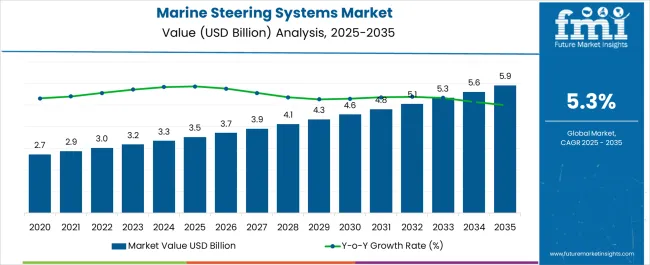
In 2025, the marine steering systems market was valued at USD 3.5 billion. Based on Future Market Insights' analysis, demand for marine steering systems is estimated to grow to USD 3.68 billion in 2026 and USD 6.2 billion by 2036. FMI projects a CAGR of 5.3% during the forecast period.
An absolute dollar growth of USD 2.52 billion between 2026 and 2036 reflects structural advancements in vessel technology rather than volume-only expansion of global fleets. Growth depends on increased specification of electro-hydraulic and fully electric steering systems that enhance fuel efficiency, reduce maintenance, and enable integration with advanced bridge systems. As per FMI, steering system suppliers are capturing value not from incremental unit counts alone, but from engineering complexity embedded in systems designed for redundancy, predictive maintenance, and compliance with evolving international maritime safety codes.
Summary of the Marine Steering Systems Market
- Market Definition:
- The market comprises the mechanisms and equipment that translate helm commands into rudder movement to control vessel direction, spanning hydraulic, electric, and mechanical technologies for vessels of all sizes [2].
- Demand Drivers:
- Global expansion of commercial shipping fleets to support seaborne trade, which exceeded 12 billion tons annually according to UNCTAD.
- Growth in naval vessel construction and modernization programs across multiple regions.
- Rising popularity of recreational boating and luxury yachts, particularly in North America and Europe.
- Increasing regulatory mandates for steering system redundancy and performance, especially for larger vessels, as codified in SOLAS regulations [4].
- Key Segments Analyzed:
- Product Type: Ram Type Steering System leads, accounting for 52.6% share in 2025 due to its robustness and suitability for a wide range of vessel sizes.
- Mechanism: Hydraulic steering mechanisms dominate, favored for their power and reliability in commercial and larger vessels.
- Vessel Type: Commercial vessels represent the largest segment, driven by global trade volumes and fleet expansion.
- Geography: Asia-Pacific leads in production and newbuild demand, while North America and Europe drive value through technology upgrades and the recreational sector.
- Analyst Opinion at FMI:
- Nikhil Kaitwade, Principal Consultant for Automotive at Future Market Insights, opines, 'In this revamped edition of the Marine Steering Systems Market report, value is migrating from reliable hydraulics to smart, integrated electro-hydraulic platforms. The core opportunity lies in delivering systems that not only steer but also communicate, feeding data into predictive maintenance models and interfacing with autonomous navigation. Suppliers mastering this transition will secure long-term partnerships with shipbuilders focused on lifecycle efficiency.'
- Strategic Implications/Executive Takeaways:
- Invest in electro-hydraulic and electronic steering technologies that offer enhanced precision, automation readiness, and real-time diagnostic capabilities.
- Develop systems with built-in redundancy and predictive diagnostic features to meet stringent safety regulations.
- Strengthen aftermarket service networks to capture retrofit and replacement demand from the aging global fleet.
- Build strategic partnerships with shipyards and naval architects to secure early specification in new vessel designs.
- Methodology:
- Built on primary interviews with marine steering system manufacturers and shipyard procurement leaders.
- Benchmarked against global shipbuilding statistics from UNCTAD and fleet age data from maritime databases.
- Validated using trade data and internal peer review as per FMI modeling standards.
China leads global expansion, supported by its dominant position in commercial shipbuilding and increasing production of recreational vessels. India follows, driven by coastal shipping development, port modernization initiatives, and growing naval shipbuilding programs under the Aatmanirbhar Bharat defense production roadmap. Germany grows on the back of its strong marine equipment manufacturing sector supplying advanced steering solutions to global shipyards and the European retrofit market. Brazil benefits from offshore oil and gas activities requiring sophisticated dynamic positioning systems and the expansion of its riverine transport network.
Mature markets such as the United States, the United Kingdom, and Japan generate comparatively slower expansion, where demand is shaped more by replacement cycles, technology upgrades, and fleet modernization programs than by new vessel build growth, with stringent safety regulations acting as a driver for higher-value system specifications [1].
Marine Steering Systems Market Definition
The marine steering systems market covers the global production and supply of mechanisms and equipment used to control the direction of vessels, from small recreational boats to large commercial ships and naval vessels. These systems translate rudder commands from the helm into precise movements, ensuring safe and efficient navigation. They are manufactured using hydraulic, electro-hydraulic, electronic, and mechanical technologies, and are integral to vessel maneuverability, stability, and operational safety across commercial, defense, and leisure maritime sectors [2].
Market Inclusions
The report includes global and regional market size estimates in value terms, with a forecast period from 2026 to 2036. It provides segmentation by Product Type, Component, Mechanism, Vessel Type, Sales Channel, and Region. The analysis incorporates manufacturing technology trends, material science advancements, control system integration, and the impact of maritime safety regulations. Regional demand dynamics, country-level growth rates, and competitive positioning are also evaluated as per FMI methodology.
Market Exclusions
The scope excludes standalone components not integrated into a steering system, such as generic hydraulic pumps sold separately, and non-steering related vessel control systems like propulsion controls. It also excludes revenues from vessel construction and focuses strictly on steering system component manufacturing and supply. Custom systems for very large or specialized one-off vessels are not considered due to their project-specific nature.
Research Methodology
- Primary Research: Interviews were conducted with marine steering system manufacturers, naval architects, shipyard procurement managers, fleet operators, and maritime safety consultants.
- Desk Research: Public company filings, international maritime organization publications, naval registry data, trade statistics from UNCTAD, and regulatory documentation from IMO and classification societies were reviewed [3].
- Market-Sizing and Forecasting: A hybrid top-down and bottom-up model was constructed, reconstructing demand from vessel newbuild and retrofit activity, steering system replacement cycles, and system-per-vessel ratios across vessel types.
- Data Validation and Update Cycle: Outputs were subjected to variance testing against production capacity data, trade flow benchmarking, and structured internal review prior to publication.
Marine Steering Systems Market Drivers, Restraints, and Opportunities
Future Market Insights analysis indicates the market is fundamentally tied to the health of the global maritime industry, encompassing commercial shipping, naval defense, and leisure boating. Its baseline scale is anchored in the essential nature of steering for vessel operation and the mandatory replacement of aging systems. As per FMI, the market's valuation is increasingly influenced by technological sophistication and regulatory compliance, where systems offering enhanced performance, safety, and data integration command premium pricing.
FMI analysts observe a steady transition from purely mechanical and basic hydraulic systems toward electro-hydraulic and fully electronic solutions. Traditional systems face replacement pressure where fleet operators seek to improve fuel efficiency and reduce maintenance downtime, while growth is concentrated in applications that justify higher initial costs through long-term operational savings and enhanced vessel capabilities. This shift nets out as consistent value growth because the added complexity of electronics, software, and fail-safe design supports margin expansion.
- Expanding global maritime trade: The United Nations Conference on Trade and Development reports that global seaborne trade volumes continue to grow, exceeding 12 billion tons annually. This expansion directly drives demand for new commercial vessels and the maintenance of existing fleets, both requiring advanced steering systems [3].
- Naval fleet modernization: Several countries are investing in modernizing their naval capabilities, commissioning new frigates, destroyers, and submarines. These vessels require highly sophisticated, redundant, and combat-ready steering systems, representing a high-value market segment.
- Recreational boating growth: Recreational boating continues to expand globally, with increasing participation in marine leisure activities driving demand for reliable and user-friendly steering systems for a wide variety of craft.
- Regulatory mandates for safety and redundancy: The International Maritime Organization's SOLAS regulations contain detailed requirements for steering systems on vessels, mandating main and auxiliary systems with specific performance and redundancy criteria. The 10th session of the IMO's Sub-Committee on Ship Design and Construction (SDC 10) in January 2024 made significant progress on developing goal-based requirements for both traditional and non-traditional steering and propulsion systems, including azimuth thrusters and waterjets. These amendments will apply to all steering and propulsion systems, ensuring modern vessels meet the same rigorous safety standards as conventional ships [4].
- Technological advancements in electronic steering: Innovations such as joystick-controlled steering systems simplify vessel maneuvering, particularly in tight docking spaces. Fly-by-wire technology replaces traditional mechanical linkages with electronic signals, enhancing responsiveness and reducing maintenance needs. AI-driven autopilot systems enable autonomous and semi-autonomous steering, optimizing route efficiency while reducing operator fatigue.
- High cost of advanced systems: The integration of electronic controllers, navigation integration, and sensor-based diagnostics requires significant capital investment. Installation, customization, and operator training further raise total costs, especially for small-scale operators and vessels in budget-sensitive sectors.
- Complexity of installation and integration: Retrofitting advanced steering systems into existing vessels can be technically challenging and costly, often requiring significant modifications and specialized labor. This complexity can slow down adoption rates of new technologies in the mature fleet.
Segment Analysis
Marine Steering Systems Market Analysis by Product Type
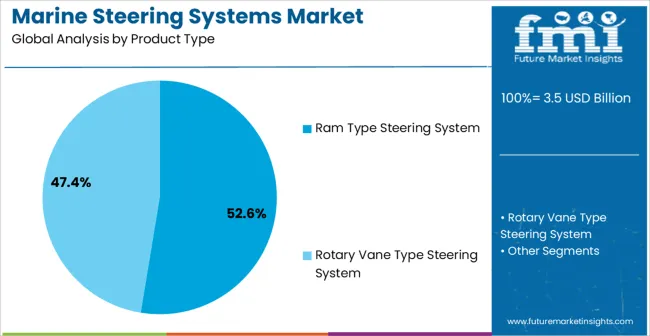
Based on FMI's marine steering systems market report, ram type steering systems are estimated to be the leading product type, accounting for 52.6% of the market revenue share in 2025. These systems utilize hydraulic cylinders (rams) to apply force directly to the rudder stock, providing robust and precise control. Their design is well-suited for a broad spectrum of vessels, from medium-sized commercial ships to large yachts and workboats. Ram-type systems are valued for their mechanical simplicity, durability, and ease of maintenance, factors that contribute to their sustained popularity in workboat and commercial sectors where reliability and serviceability are paramount.
Rotary vane steering systems represent a significant and growing segment, favored for larger commercial vessels, tankers, and bulk carriers. These systems use a stationary housing with vanes and a rotating central hub (rotor) to transfer torque. Their compact design, high efficiency, and ability to generate substantial torque in a smaller footprint make them ideal for applications where space and power density are critical. Rotary vane systems offer low vibration, reduced noise, and cost-effectiveness, making them a preferred choice for modern vessels.
- Ram system robustness: The mechanical simplicity and proven reliability of ram-type systems ensure their continued dominance, particularly in workboat and commercial sectors where robust construction and straightforward maintenance are essential.
- Rotary vane efficiency gains: Technological advancements in rotary vane steering gear focus on improving sealing, reducing internal leakage, and enhancing overall efficiency, making them increasingly attractive for fuel-conscious ship operators.
- Integration with DP systems: Both ram and rotary vane systems are being engineered to integrate seamlessly with dynamic positioning systems, allowing for automated station-keeping and precise maneuvering, which is essential for offshore vessels and advanced commercial ships.
Marine Steering Systems Market Analysis by Mechanism
Hydraulic steering mechanisms currently command the largest revenue share, favored for their ability to generate high force, provide smooth and precise control, and offer proven reliability in demanding marine environments. These systems use fluid pressure to control steering, making them ideal for larger vessels that need powerful and reliable solutions. Hydraulic systems are valued for their ability to handle heavy loads and provide smooth, precise steering, which is crucial for both commercial and recreational vessels. Their robustness and dependability in challenging marine environments ensure their ongoing popularity across various vessel types and sizes.
Electro-hydraulic steering mechanisms represent the fastest-growing segment, combining the power of hydraulics with the precision and flexibility of electronic controls. These systems use electric pumps and electronic control units to manage hydraulic pressure and flow, enabling features like joystick maneuvering, autopilot integration, and interface with advanced bridge systems. Their energy efficiency and reduced piping complexity make them a preferred choice for modern vessel designs.
Electronic (or fully electric) steering systems, while a smaller segment, are gaining traction in smaller recreational boats and as part of advanced autonomous vessel research. These systems eliminate hydraulics entirely, using electric actuators to move the rudder, offering benefits in weight savings, responsiveness, and simplified maintenance. The IMO's ongoing work on goal-based requirements for non-traditional propulsion and steering systems, including azimuth thrusters and waterjets, acknowledges the growing importance of these technologies in the modern maritime landscape [4].
- Hydraulic reliability anchor: The enduring dominance of hydraulic systems is underpinned by their unmatched reliability and power density, particularly for large vessels where hydraulic force is essential for moving massive rudders against sea forces.
- Electro-hydraulic as the technology bridge: Electro-hydraulic systems serve as the critical technology bridge, offering a pathway to digitalization and automation without sacrificing the proven power of hydraulics. This makes them a highly attractive upgrade for new vessels.
- Fuel efficiency driver: The push for fuel efficiency in commercial shipping is accelerating the adoption of electro-hydraulic and electric systems, which can be operated more efficiently by matching power output to real-time demand, unlike conventional systems that run continuously.
Marine Steering Systems Market Analysis by Vessel Type
Commercial vessels, including cargo ships, tankers, bulk carriers, and container ships, represent the largest end-use segment. The sheer scale of global maritime trade, with tens of thousands of these vessels in operation, creates substantial demand for both newbuild installations and aftermarket replacements. According to UNCTAD, over 63 million deadweight tons were added to the global fleet in recent years, emphasizing the rising demand for steering systems [3]. For these vessel operators, reliability, durability, and compliance with international safety standards are the primary procurement criteria.
Recreational boats, encompassing small powerboats, sailing yachts, and luxury motor yachts, form a dynamic and high-volume segment. The market here is driven by consumer preferences for ease of use, responsiveness, and innovative features like joystick docking. This segment is a key adopter of advanced hydraulic and emerging electronic steering technologies.
Military and defense vessels, including frigates, destroyers, patrol craft, and submarines, represent a high-value, technology-intensive segment. Steering systems for these vessels must meet stringent specifications for redundancy, shock resistance, quiet operation, and integration with combat management systems. This segment often drives innovation in fail-safe and high-performance steering technologies.
- Commercial vessel lifecycle demand: The long operational life of commercial vessels, often 25-30 years, ensures a steady stream of aftermarket demand for steering system maintenance, component replacement, and eventual full system retrofits.
- Recreational market innovation pull: The competitive recreational boating market acts as a powerful pull for innovation, with manufacturers introducing features like joystick control and integrated autopilots to differentiate their offerings.
- Naval specifications as a technology driver: The demanding requirements of naval vessels, particularly for redundancy and battle damage resilience, often lead to the development of advanced system architectures and components that eventually trickle down to the commercial market.
Regional Analysis
The marine steering systems market is segmented geographically across North America, Europe, Asia-Pacific, Latin America, and Middle East & Africa. Growth dynamics differ based on shipbuilding activity, fleet composition, naval investment, and the strength of the recreational boating sector.
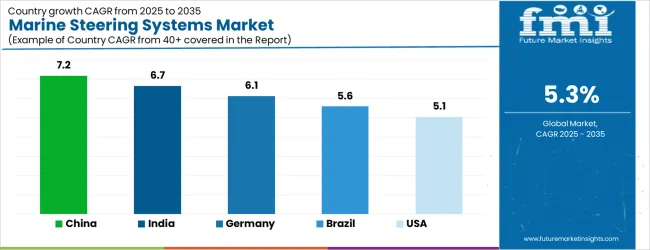
| Country | CAGR (2026 to 2036) |
|---|---|
| China | 11.4% |
| India | 10.5% |
| Germany | 4.7% |
| Brazil | 6.9% |
| USA | 6.3% |
| UK | 3.4% |
| Japan | 3.4% |
Source: Future Market Insights (FMI) analysis, based on proprietary forecasting model and primary research
Asia-Pacific Market Analysis
Asia-Pacific stands as the dominant force in the global marine steering systems market, driven by its unparalleled concentration of commercial shipbuilding, particularly in China, South Korea, and Japan. The region accounts for the vast majority of global newbuild vessel completions, creating immense demand for original equipment steering systems. According to UNCTAD, the global orderbook for new ships remains strong, with Asian shipyards capturing the largest share of contracts [3].
China
Demand for marine steering systems in China is projected to rise at 11.4% CAGR through 2036, the highest among major markets. Growth is inextricably linked to China's leadership in global shipbuilding, with its yards delivering a significant percentage of the world's commercial vessels. This includes bulk carriers, container ships, and tankers, all of which require advanced steering solutions. The Chinese government's focus on expanding its domestic maritime capabilities, including coastal shipping and a modern naval fleet, further amplifies demand.
China's shipbuilding industry is also increasingly focused on building higher-value vessel types, such as large LNG carriers and specialized offshore vessels. This trend drives the need for more sophisticated steering systems, including those with dynamic positioning capabilities and advanced automation features.
FMI's analysis of the marine steering systems market in Asia-Pacific consists of a country-wise assessment that includes China, India, Japan, South Korea, and ASEAN nations. Readers can find shipbuilding order book analysis, naval modernization program tracking, and component sourcing patterns.
India
The marine steering systems market in India is projected to rise at 10.5% CAGR through 2036. Growth is underpinned by the government's strategic focus on bolstering domestic shipbuilding under initiatives like Aatmanirbhar Bharat (Self-Reliant India), which aims to increase the country's share of global shipbuilding. Concurrent investments in port modernization and the development of inland waterways are creating demand for a variety of vessel types, including tugs, dredgers, and cargo barges.
India's naval shipbuilding program is another critical driver, with several major projects underway to build frigates, destroyers, and corvettes. These programs demand high-reliability steering systems that meet stringent naval standards, offering opportunities for both domestic manufacturers and international partners.
FMI's analysis of the marine steering systems market in Asia-Pacific consists of a country-wise assessment that includes China, India, Japan, and South Korea. Readers can find policy support analysis, naval procurement tracking, and shipbuilding capacity assessment.
Japan
Japan represents a mature, technology-oriented market with a strong focus on high-quality shipbuilding and marine equipment. Demand for marine steering systems is projected at a steady 3.4% CAGR. Japanese shipyards are renowned for building complex, high-value vessels such as LNG carriers, car carriers, and very large ore carriers, which require highly reliable and efficient steering systems.
Japanese manufacturers of marine equipment are also key global suppliers, exporting advanced steering gear and components to shipyards worldwide. The IMO's work on goal-based requirements for steering and propulsion systems, which considers both conventional and modern technologies, reflects the kind of innovation that Japanese manufacturers excel at [4].
FMI's analysis of the marine steering systems market in Asia-Pacific consists of a country-wise assessment that includes China, India, Japan, and South Korea. Readers can find technology leadership analysis, export market dynamics, and innovation pipeline tracking.
North America Market Analysis
North America is a significant market characterized by a strong recreational boating sector, a robust naval shipbuilding program, and a substantial commercial marine industry focused on inland waterways, the Great Lakes, and coastal shipping.
United States
Demand for marine steering systems in the United States is projected to advance at 6.3% CAGR through 2036. The U.S. market is bifurcated between a massive recreational boating sector and high-value naval shipbuilding.
On the recreational side, the National Marine Manufacturers Association reports sustained demand for powerboats, indicating robust health in this sector. Demand spans simple mechanical steering for small boats to advanced hydraulic and electronic systems for large sportfishing yachts and cruisers.
On the naval side, the U.S. naval shipbuilding program is a major source of high-value demand, with contracts for aircraft carriers, submarines, and surface combatants specifying the most advanced, redundant, and combat-hardened steering systems. The commercial sector, including tugboats, supply vessels, and passenger ferries, provides steady baseline demand, with a focus on system upgrades for efficiency and safety compliance.
Regulatory requirements from the U.S. Coast Guard, aligned with SOLAS standards, mandate specific performance and redundancy criteria for steering systems on various vessel classes, compelling operators to maintain and upgrade systems accordingly.
FMI's analysis of the marine steering systems market in North America consists of a country-wise assessment that includes the United States and Canada. Readers can find recreational boating industry analysis, naval procurement tracking, and regulatory impact assessment.
Europe Market Analysis
Europe represents a technologically advanced market with a strong emphasis on innovation, quality, and sustainability in marine systems. The region is home to leading equipment manufacturers and is a key hub for the construction of specialized vessels like cruise ships, mega-yachts, and offshore wind farm service vessels. The IMO's SDC 10 meeting in January 2024 made progress on revising guidelines for underwater radiated noise, which has implications for steering system design in environmentally sensitive areas [4].
Germany
Demand for marine steering systems in Germany is projected to grow at a 4.7% CAGR through 2036. Growth is driven by Germany's world-leading position in the production of complex, high-specification vessels, including luxury mega-yachts and sophisticated cruise ships. These vessels demand steering systems that offer not only flawless performance but also exceptional noise and vibration damping, integration with advanced automation, and a high degree of customization.
Beyond newbuilds, Germany has a strong marine equipment manufacturing sector, with companies like ZF Friedrichshafen AG being key global players. The domestic aftermarket for system upgrades and replacements on the existing fleet of commercial vessels operating in the North and Baltic Seas also contributes to steady demand.
FMI's analysis of the marine steering systems market in Europe consists of a country-wise assessment that includes Germany, United Kingdom, France, Italy, and Spain. Readers can find shipbuilding specialization analysis, innovation cluster mapping, and environmental regulation impact tracking.
Competitive Aligners for Market Players
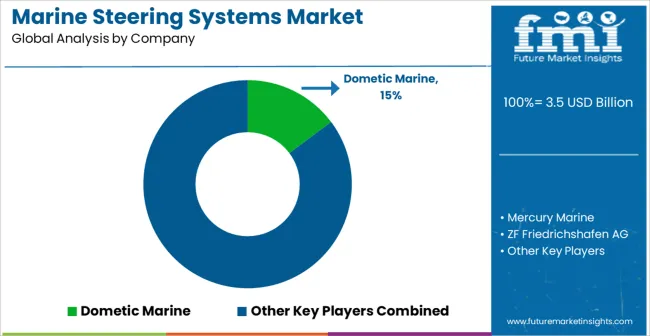
The marine steering systems market features a mix of large, diversified industrial corporations and specialized, niche players. Global leaders such as Kongsberg Maritime, ZF Friedrichshafen AG, and Wärtsilä leverage extensive engineering resources, global service networks, and broad product portfolios to serve customers across commercial, naval, and recreational segments. These companies often provide integrated packages that include steering systems alongside propulsion, controls, and dynamic positioning.
Specialized manufacturers like Kobelt Manufacturing, HyDrive Engineering, and Wills Ridley compete on the basis of deep application expertise, robust product reliability, and close customer relationships, particularly in specific vessel types or regions. These players often excel in the aftermarket, providing replacement and upgrade solutions for the global installed fleet.
Mercury Marine is a dominant force in the recreational steering market, particularly for outboard-powered boats, offering a wide range of mechanical and hydraulic systems integrated with its engine and control packages. Hypro Marine and Techno Italia Kft represent other important regional and application-specific players.
The IMO's ongoing work to update SOLAS regulations for both traditional and non-traditional steering and propulsion systems will have significant implications for manufacturers. The development of goal-based requirements, using the EMSA STEERSAFE study as a foundation, aims to ensure that all steering systems, including modern combined systems like azimuth thrusters and waterjets, meet the same rigorous safety and performance standards [4]. Manufacturers that proactively align their product development with these emerging requirements will be well-positioned for future contracts.
Key Players in the Marine Steering Systems Market
- Dometic Marine
- Mercury Marine
- ZF Friedrichshafen AG
- Bosch Rexroth
- Kongsberg Maritime
- Kobelt Manufacturing
- Damen Marine Components
- Wills Ridley Ltd
- HyDrive Engineering Pty Ltd
- Hypro Marine
- Techno Italia Kft
- Dometic Group
Scope of Report
| Metric | Value |
|---|---|
| Quantitative Units | USD 3.68 billion (2026) to USD 6.2 billion (2036), at a CAGR of 5.3% |
| Market Definition | The marine steering systems market comprises the global production and supply of mechanisms and equipment, including hydraulic, electro-hydraulic, and electronic systems, used to control vessel direction for commercial, naval, and recreational applications [2]. |
| Product Type Segmentation | Ram Type Steering System, Rotary Vane Steering System |
| Component Segmentation | Steering Pumps, Helm Pumps, Hydraulic Cylinders, Steering Wheels, Helm Stations, Rudders, Other Components |
| Mechanism Segmentation | Manual Steering, Hydraulic Steering, Electronic Steering, Electro-Hydraulic Steering |
| Vessel Type Segmentation | Small Recreational Boats, Yachts & Luxury Boats, Commercial Vessels, Military & Defense Vessels, Passenger Vessels, Other Vessels |
| Sales Channel Segmentation | OEM, Aftermarket |
| Region Segmentation | North America, Europe, Asia-Pacific, Latin America, Middle East & Africa |
| Countries Covered | United States, Canada, Germany, United Kingdom, France, Italy, Spain, China, India, Japan, South Korea, Brazil and 40+ countries |
| Key Companies Profiled | Dometic Marine, Mercury Marine, ZF Friedrichshafen AG, Bosch Rexroth, Kongsberg Maritime, Kobelt Manufacturing, Damen Marine Components, Wills Ridley Ltd, HyDrive Engineering Pty Ltd, Hypro Marine, Techno Italia Kft, Dometic Group |
| Forecast Period | 2026 to 2036 |
| Approach | Hybrid top-down and bottom-up market modeling validated through primary interviews with marine steering system manufacturers, naval architects, and shipyard procurement managers, supported by global shipbuilding statistics from UNCTAD and fleet analysis from maritime databases |
Marine Steering Systems Market Analysis by Segments
Product Type:
- Ram Type Steering System
- Rotary Vane Steering System
Component:
- Steering Pumps
- Helm Pumps
- Hydraulic Cylinders
- Steering Wheels
- Helm Stations
- Rudders
- Others
Mechanism:
- Manual Steering
- Hydraulic Steering
- Electronic Steering
- Electro-Hydraulic Steering
Vessel Type:
- Small Recreational Boats
- Yachts & Luxury Boats
- Commercial Vessels
- Military & Defense Vessels
- Passenger Vessels
- Others
Sales Channel:
- OEM
- Aftermarket
Region:
- North America (United States, Canada, Mexico)
- Latin America (Brazil, Chile, Rest of Latin America)
- Western Europe (Germany, United Kingdom, Italy, Spain, France, Nordic, BENELUX, Rest of Western Europe)
- Eastern Europe (Russia, Poland, Hungary, Balkan & Baltic, Rest of Eastern Europe)
- East Asia (China, Japan, South Korea)
- South Asia and Pacific (India, ASEAN, Australia & New Zealand, Rest of South Asia and Pacific)
- Middle East & Africa (Kingdom of Saudi Arabia, Other GCC Countries, Turkiye, South Africa, Other African Union, Rest of Middle East & Africa)
Bibliography
- USA Government Publishing Office. (2024). 46 CFR 130.130 - Steering on OSVs of less than 100 gross tons. Electronic Code of Federal Regulations.
- Lloyd's Register. (2022). Rules and Regulations for the Classification of Ships, July 2022 - Part 5 Main and Auxiliary Machinery - Chapter 19 Steering Systems. IMO Rules.
- United Nations Conference on Trade and Development (UNCTAD). (2024). Review of Maritime Transport 2024.
- International Maritime Organization (IMO). (2024, January). Sub-Committee on Ship Design and Construction (SDC 10) Meeting Report. IMO.
This bibliography is provided for reader reference and is not exhaustive. The full report contains the complete reference list and detailed citations.
This Report Addresses
- Market intelligence to enable structured strategic decision-making across marine steering system manufacturers, naval architects, shipyard procurement managers, fleet operators, and maritime safety consultants, focusing on the shift from standard hydraulic units toward electronically integrated, automation-ready systems with fail-safe redundancy features.
- Market size estimation and 10-year revenue forecasts, including validated CAGR and absolute dollar opportunity sizing.
- Growth opportunity mapping across Product Type, Component, Mechanism, Vessel Type, and Sales Channel, with emphasis on electro-hydraulic and fully electronic steering platforms, predictive maintenance capabilities, and integration with dynamic positioning and autonomous navigation architectures.
- Segment and regional forecasting covering the marine steering system landscape, alongside demand trajectories driven by commercial fleet expansion, naval modernization programs, recreational boating growth, and evolving international maritime safety regulations.
- Competition strategy assessment, including analysis of electro-hydraulic technology development, fail-safe redundancy engineering, predictive diagnostic feature integration, and aftermarket service network expansion capturing retrofit and replacement demand from the aging global fleet.
- Product and technology tracking focused on electronic control integration, joystick maneuvering systems, fly-by-wire technology, AI-driven autopilot capabilities, and steering system compatibility with azimuth thrusters and waterjets under emerging IMO goal-based requirements.
- Regulatory policy analysis covering SOLAS steering system mandates, IMO goal-based requirements for traditional and non-traditional propulsion systems, classification society rules, and national maritime safety codes influencing equipment specifications and compliance pathways.
- Report delivery in PDF, Excel, and presentation-ready formats to support executive planning, product development alignment, and competitive benchmarking across mature and high-growth markets including China, India, Germany, and the United States.
Frequently Asked Questions
How large is the marine steering systems market in 2026?
Demand for marine steering systems is estimated to be valued at USD 3.68 billion in 2026.
What will be the market size of marine steering systems by 2036?
Market size for marine steering systems is projected to reach USD 6.2 billion by 2036.
What is the expected demand growth for marine steering systems between 2026 and 2036?
Demand for marine steering systems is expected to grow at a 5.3% CAGR between 2026 and 2036.
Which product type is poised to lead global sales?
Ram Type Steering Systems lead with 52.6% share in 2025, favored for their robustness, mechanical simplicity, and suitability for a wide range of vessels.
Which mechanism segment contributes the largest revenue share?
Hydraulic steering mechanisms currently command the largest share, valued for their power, reliability, and dominance in commercial and larger vessels.
Which vessel type segment is the largest consumer?
Commercial vessels, including cargo ships and tankers, represent the largest segment, driven by global maritime trade volumes which exceed 12 billion tons annually [3].
How significant is the commercial shipping industry in driving demand?
Commercial shipping is a primary demand driver. The global fleet of tens of thousands of vessels requires steering systems for new builds and regular maintenance over their long operational lives [3].
What is driving demand in China?
China's dominant position in global commercial shipbuilding, accounting for the majority of global completions, is the primary driver of marine steering system demand.
What is the China growth outlook?
China is projected to expand at an 11.4% CAGR during 2026 to 2036.
What drives India's market growth?
India's market growth is fueled by government initiatives to boost domestic shipbuilding under Aatmanirbhar Bharat, port modernization, and an active naval vessel construction program.
What is the India growth outlook?
India is projected to expand at a 10.5% CAGR during 2026 to 2036.
What characterizes the German market?
Germany is a hub for high-value, specialized shipbuilding, particularly for complex cruise ships and mega-yachts, which demand technologically advanced, high-performance steering systems.
What is the Germany growth outlook?
Germany is projected to expand at a 4.7% CAGR during 2026 to 2036.
What drives the United States market?
A massive recreational boating sector, a robust naval shipbuilding program, and a significant commercial marine industry operating on inland and coastal waterways drive the U.S. market.
What is the United States growth outlook?
The United States is projected to expand at a 6.3% CAGR during 2026 to 2036.
What is the United Kingdom growth outlook?
The United Kingdom is projected to expand at a 3.4% CAGR during 2026 to 2036.
What is the Japan growth outlook?
Japan is projected to expand at a 3.4% CAGR during 2026 to 2036.
What is the Brazil growth outlook?
Brazil is projected to expand at a 6.9% CAGR during 2026 to 2036.
What are marine steering systems and what are they mainly used for?
Marine steering systems are the mechanisms that translate rudder commands from a vessel's helm into precise movements, enabling directional control, safe navigation, and efficient maneuvering for all types of vessels [2].
What does the marine steering systems market mean in this report?
It refers to the global manufacturing and supply of these steering systems and their core components, segmented by product type, mechanism, vessel type, and region, measured in value terms.
What is included in the scope of this report?
Scope includes market sizing and forecasting for 2026 to 2036, segmentation by product type, component, mechanism, vessel type, sales channel, and region, along with competitive assessment and country-wise outlook.
What is excluded from the scope of this report?
The scope excludes standalone, non-integrated components, non-steering vessel controls, and revenues from vessel construction, focusing strictly on steering system manufacturing and supply.
Preview the report firsthand - request a free sample
Get SampleGet the brochure for pricing and purchase details.
Get PDFTable of Content
- Executive Summary
- Global Market Outlook
- Demand-side Trends
- Supply-side Trends
- Technology Roadmap Analysis
- Analysis and Recommendations
- Market Overview
- Market Coverage / Taxonomy
- Market Definition / Scope / Limitations
- Research Methodology
- Chapter Orientation
- Analytical Lens and Working Hypotheses
- Market Structure, Signals, and Trend Drivers
- Benchmarking and Cross-market Comparability
- Market Sizing, Forecasting, and Opportunity Mapping
- Research Design and Evidence Framework
- Desk Research Programme (Secondary Evidence)
- Company Annual and Sustainability Reports
- Peer-reviewed Journals and Academic Literature
- Corporate Websites, Product Literature, and Technical Notes
- Earnings Decks and Investor Briefings
- Statutory Filings and Regulatory Disclosures
- Technical White Papers and Standards Notes
- Trade Journals, Industry Magazines, and Analyst Briefs
- Conference Proceedings, Webinars, and Seminar Materials
- Government Statistics Portals and Public Data Releases
- Press Releases and Reputable Media Coverage
- Specialist Newsletters and Curated Briefings
- Sector Databases and Reference Repositories
- FMI Internal Proprietary Databases and Historical Market Datasets
- Subscription Datasets and Paid Sources
- Social Channels, Communities, and Digital Listening Inputs
- Additional Desk Sources
- Expert Input and Fieldwork (Primary Evidence)
- Primary Modes
- Qualitative Interviews and Expert Elicitation
- Quantitative Surveys and Structured Data Capture
- Blended Approach
- Why Primary Evidence is Used
- Field Techniques
- Interviews
- Surveys
- Focus Groups
- Observational and In-context Research
- Social and Community Interactions
- Stakeholder Universe Engaged
- C-suite Leaders
- Board Members
- Presidents and Vice Presidents
- R&D and Innovation Heads
- Technical Specialists
- Domain Subject-matter Experts
- Scientists
- Physicians and Other Healthcare Professionals
- Governance, Ethics, and Data Stewardship
- Research Ethics
- Data Integrity and Handling
- Primary Modes
- Tooling, Models, and Reference Databases
- Desk Research Programme (Secondary Evidence)
- Data Engineering and Model Build
- Data Acquisition and Ingestion
- Cleaning, Normalisation, and Verification
- Synthesis, Triangulation, and Analysis
- Quality Assurance and Audit Trail
- Market Background
- Market Dynamics
- Drivers
- Restraints
- Opportunity
- Trends
- Scenario Forecast
- Demand in Optimistic Scenario
- Demand in Likely Scenario
- Demand in Conservative Scenario
- Opportunity Map Analysis
- Product Life Cycle Analysis
- Supply Chain Analysis
- Investment Feasibility Matrix
- Value Chain Analysis
- PESTLE and Porter’s Analysis
- Regulatory Landscape
- Regional Parent Market Outlook
- Production and Consumption Statistics
- Import and Export Statistics
- Market Dynamics
- Global Market Analysis 2021 to 2025 and Forecast, 2026 to 2036
- Historical Market Size Value (USD Million) Analysis, 2021 to 2025
- Current and Future Market Size Value (USD Million) Projections, 2026 to 2036
- Y-o-Y Growth Trend Analysis
- Absolute $ Opportunity Analysis
- Global Market Pricing Analysis 2021 to 2025 and Forecast 2026 to 2036
- Global Market Analysis 2021 to 2025 and Forecast 2026 to 2036, By Product Type
- Introduction / Key Findings
- Historical Market Size Value (USD Million) Analysis By Product Type , 2021 to 2025
- Current and Future Market Size Value (USD Million) Analysis and Forecast By Product Type , 2026 to 2036
- Ram Type Steering System
- Rotary Vane Steering System
- Ram Type Steering System
- Y-o-Y Growth Trend Analysis By Product Type , 2021 to 2025
- Absolute $ Opportunity Analysis By Product Type , 2026 to 2036
- Global Market Analysis 2021 to 2025 and Forecast 2026 to 2036, By Region
- Introduction
- Historical Market Size Value (USD Million) Analysis By Region, 2021 to 2025
- Current Market Size Value (USD Million) Analysis and Forecast By Region, 2026 to 2036
- North America
- Latin America
- Western Europe
- Eastern Europe
- East Asia
- South Asia and Pacific
- Middle East & Africa
- Market Attractiveness Analysis By Region
- North America Market Analysis 2021 to 2025 and Forecast 2026 to 2036, By Country
- Historical Market Size Value (USD Million) Trend Analysis By Market Taxonomy, 2021 to 2025
- Market Size Value (USD Million) Forecast By Market Taxonomy, 2026 to 2036
- By Country
- USA
- Canada
- Mexico
- By Product Type
- By Country
- Market Attractiveness Analysis
- By Country
- By Product Type
- Key Takeaways
- Latin America Market Analysis 2021 to 2025 and Forecast 2026 to 2036, By Country
- Historical Market Size Value (USD Million) Trend Analysis By Market Taxonomy, 2021 to 2025
- Market Size Value (USD Million) Forecast By Market Taxonomy, 2026 to 2036
- By Country
- Brazil
- Chile
- Rest of Latin America
- By Product Type
- By Country
- Market Attractiveness Analysis
- By Country
- By Product Type
- Key Takeaways
- Western Europe Market Analysis 2021 to 2025 and Forecast 2026 to 2036, By Country
- Historical Market Size Value (USD Million) Trend Analysis By Market Taxonomy, 2021 to 2025
- Market Size Value (USD Million) Forecast By Market Taxonomy, 2026 to 2036
- By Country
- Germany
- UK
- Italy
- Spain
- France
- Nordic
- BENELUX
- Rest of Western Europe
- By Product Type
- By Country
- Market Attractiveness Analysis
- By Country
- By Product Type
- Key Takeaways
- Eastern Europe Market Analysis 2021 to 2025 and Forecast 2026 to 2036, By Country
- Historical Market Size Value (USD Million) Trend Analysis By Market Taxonomy, 2021 to 2025
- Market Size Value (USD Million) Forecast By Market Taxonomy, 2026 to 2036
- By Country
- Russia
- Poland
- Hungary
- Balkan & Baltic
- Rest of Eastern Europe
- By Product Type
- By Country
- Market Attractiveness Analysis
- By Country
- By Product Type
- Key Takeaways
- East Asia Market Analysis 2021 to 2025 and Forecast 2026 to 2036, By Country
- Historical Market Size Value (USD Million) Trend Analysis By Market Taxonomy, 2021 to 2025
- Market Size Value (USD Million) Forecast By Market Taxonomy, 2026 to 2036
- By Country
- China
- Japan
- South Korea
- By Product Type
- By Country
- Market Attractiveness Analysis
- By Country
- By Product Type
- Key Takeaways
- South Asia and Pacific Market Analysis 2021 to 2025 and Forecast 2026 to 2036, By Country
- Historical Market Size Value (USD Million) Trend Analysis By Market Taxonomy, 2021 to 2025
- Market Size Value (USD Million) Forecast By Market Taxonomy, 2026 to 2036
- By Country
- India
- ASEAN
- Australia & New Zealand
- Rest of South Asia and Pacific
- By Product Type
- By Country
- Market Attractiveness Analysis
- By Country
- By Product Type
- Key Takeaways
- Middle East & Africa Market Analysis 2021 to 2025 and Forecast 2026 to 2036, By Country
- Historical Market Size Value (USD Million) Trend Analysis By Market Taxonomy, 2021 to 2025
- Market Size Value (USD Million) Forecast By Market Taxonomy, 2026 to 2036
- By Country
- Kingdom of Saudi Arabia
- Other GCC Countries
- Turkiye
- South Africa
- Other African Union
- Rest of Middle East & Africa
- By Product Type
- By Country
- Market Attractiveness Analysis
- By Country
- By Product Type
- Key Takeaways
- Key Countries Market Analysis
- USA
- Pricing Analysis
- Market Share Analysis, 2025
- By Product Type
- Canada
- Pricing Analysis
- Market Share Analysis, 2025
- By Product Type
- Mexico
- Pricing Analysis
- Market Share Analysis, 2025
- By Product Type
- Brazil
- Pricing Analysis
- Market Share Analysis, 2025
- By Product Type
- Chile
- Pricing Analysis
- Market Share Analysis, 2025
- By Product Type
- Germany
- Pricing Analysis
- Market Share Analysis, 2025
- By Product Type
- UK
- Pricing Analysis
- Market Share Analysis, 2025
- By Product Type
- Italy
- Pricing Analysis
- Market Share Analysis, 2025
- By Product Type
- Spain
- Pricing Analysis
- Market Share Analysis, 2025
- By Product Type
- France
- Pricing Analysis
- Market Share Analysis, 2025
- By Product Type
- India
- Pricing Analysis
- Market Share Analysis, 2025
- By Product Type
- ASEAN
- Pricing Analysis
- Market Share Analysis, 2025
- By Product Type
- Australia & New Zealand
- Pricing Analysis
- Market Share Analysis, 2025
- By Product Type
- China
- Pricing Analysis
- Market Share Analysis, 2025
- By Product Type
- Japan
- Pricing Analysis
- Market Share Analysis, 2025
- By Product Type
- South Korea
- Pricing Analysis
- Market Share Analysis, 2025
- By Product Type
- Russia
- Pricing Analysis
- Market Share Analysis, 2025
- By Product Type
- Poland
- Pricing Analysis
- Market Share Analysis, 2025
- By Product Type
- Hungary
- Pricing Analysis
- Market Share Analysis, 2025
- By Product Type
- Kingdom of Saudi Arabia
- Pricing Analysis
- Market Share Analysis, 2025
- By Product Type
- Turkiye
- Pricing Analysis
- Market Share Analysis, 2025
- By Product Type
- South Africa
- Pricing Analysis
- Market Share Analysis, 2025
- By Product Type
- USA
- Market Structure Analysis
- Competition Dashboard
- Competition Benchmarking
- Market Share Analysis of Top Players
- By Regional
- By Product Type
- Competition Analysis
- Competition Deep Dive
- Dometic Marine
- Overview
- Product Portfolio
- Profitability by Market Segments (Product/Age /Sales Channel/Region)
- Sales Footprint
- Strategy Overview
- Marketing Strategy
- Product Strategy
- Channel Strategy
- Mercury Marine
- ZF Friedrichshafen AG
- Bosch Rexroth
- Kongsberg Maritime
- Kobelt Manufacturing
- Damen Marine Components
- Dometic Marine
- Competition Deep Dive
- Assumptions & Acronyms Used


